C_S4CPS_2302 Practice Exam - SAP Certified Application AssociateSAP S/4HANA Cloud (public)Professional Services Implementation
Reliable Study Materials & Testing Engine for C_S4CPS_2302 Exam Success!
Exam Code: C_S4CPS_2302
Exam Name: SAP Certified Application AssociateSAP S/4HANA Cloud (public)Professional Services Implementation
Certification Provider: SAP
Certification Exam Name: SAP Certified Application Associate


Free Updates PDF & Test Engine
Verified By IT Certified Experts
Guaranteed To Have Actual Exam Questions
Up-To-Date Exam Study Material
99.5% High Success Pass Rate
100% Accurate Answers
100% Money Back Guarantee
Instant Downloads
Free Fast Exam Updates
Exam Questions And Answers PDF
Best Value Available in Market
Try Demo Before You Buy
Secure Shopping Experience
C_S4CPS_2302: SAP Certified Application AssociateSAP S/4HANA Cloud (public)Professional Services Implementation Study Material and Test Engine
Last Update Check: Mar 22, 2026
Latest 80 Questions & Answers
45-75% OFF
Hurry up! offer ends in 00 Days 00h 00m 00s
*Download the Test Player for FREE
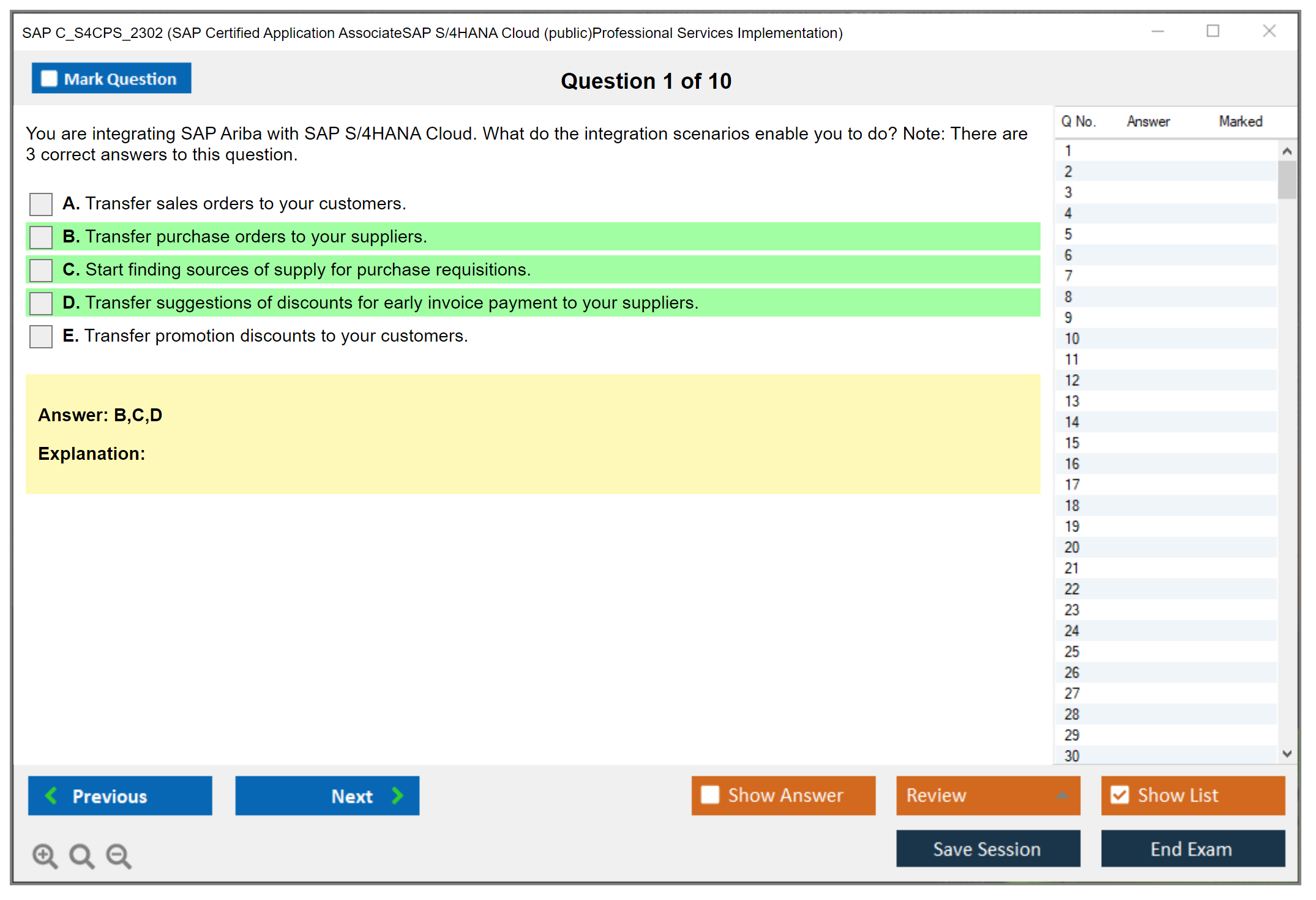
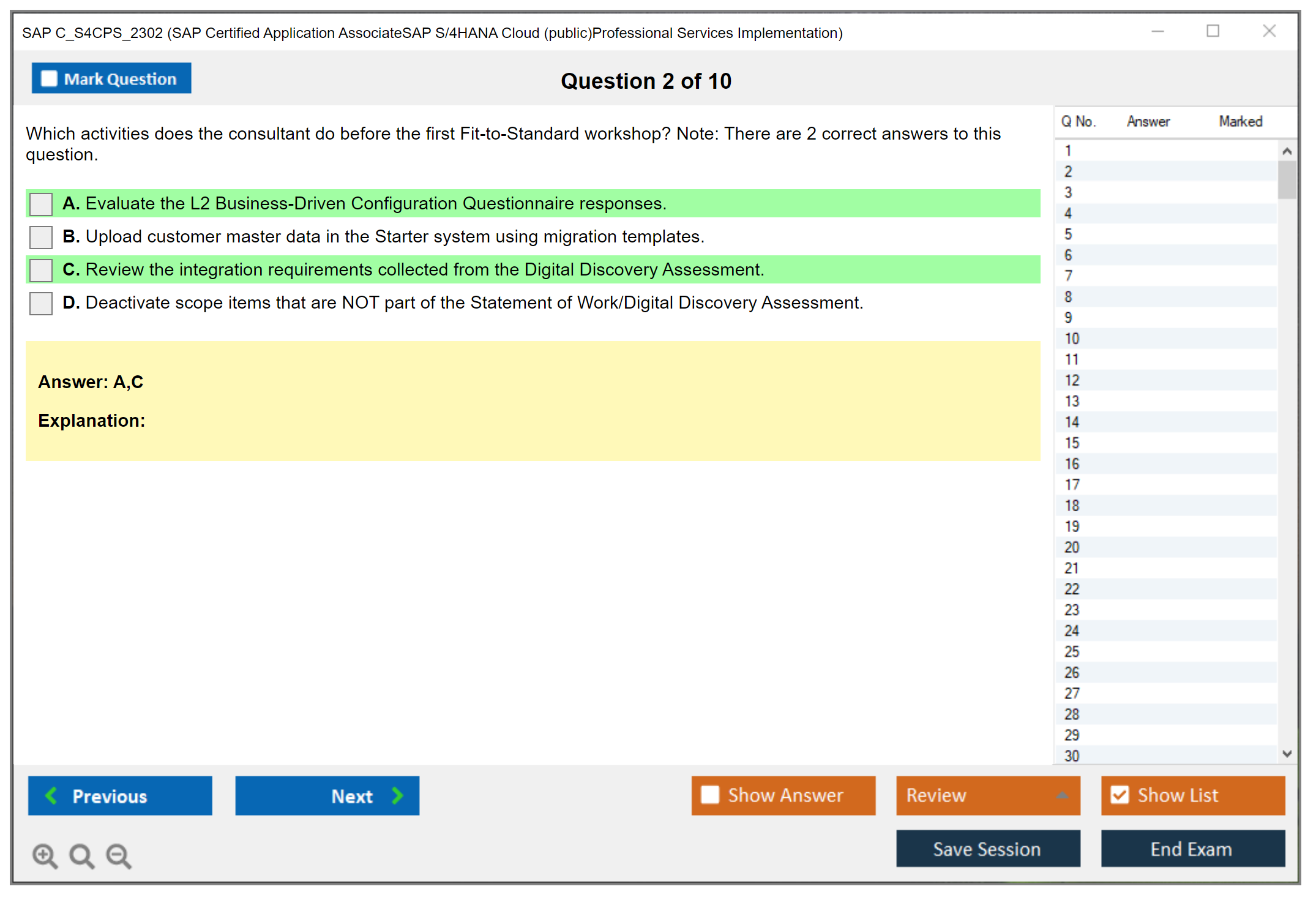
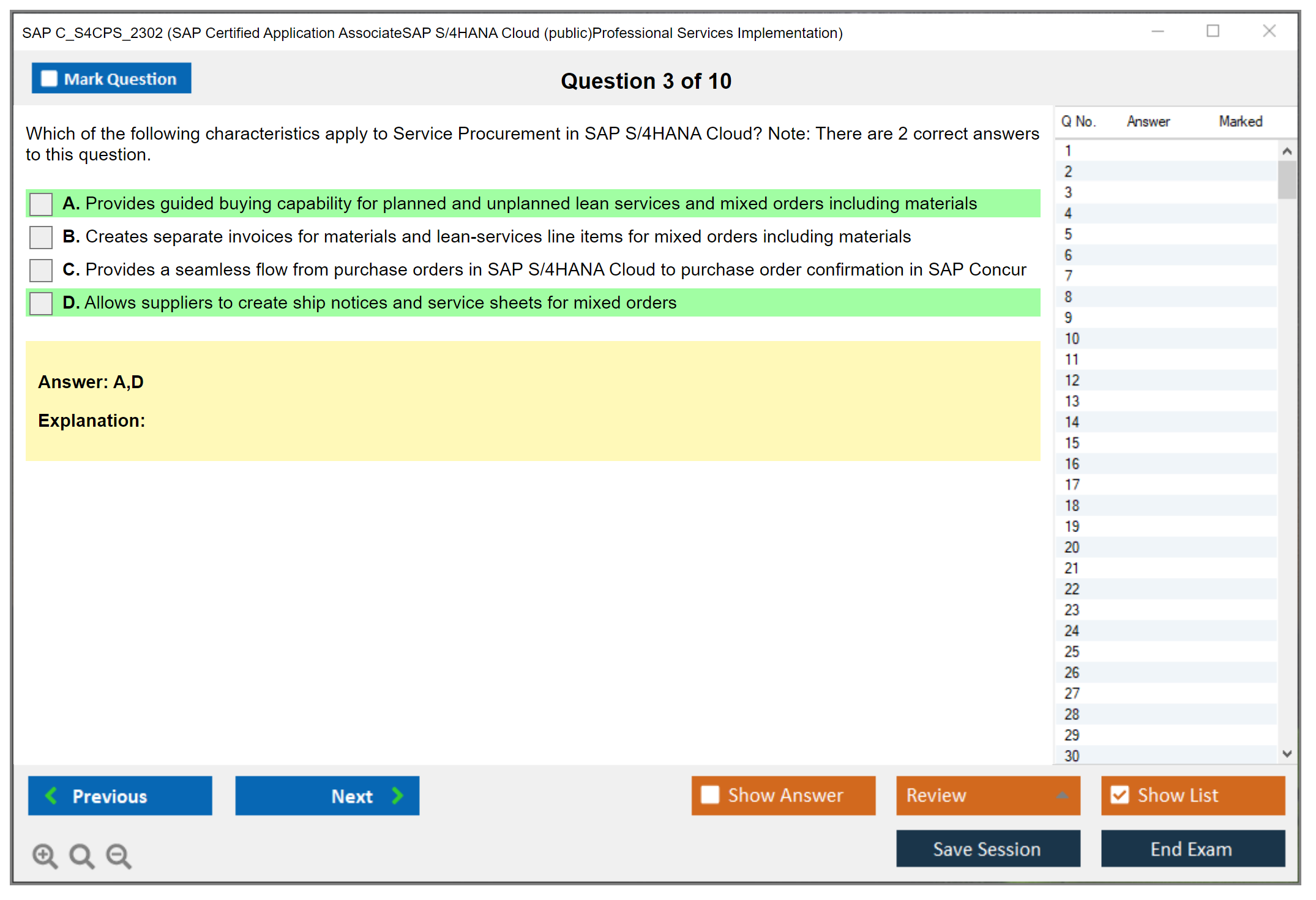
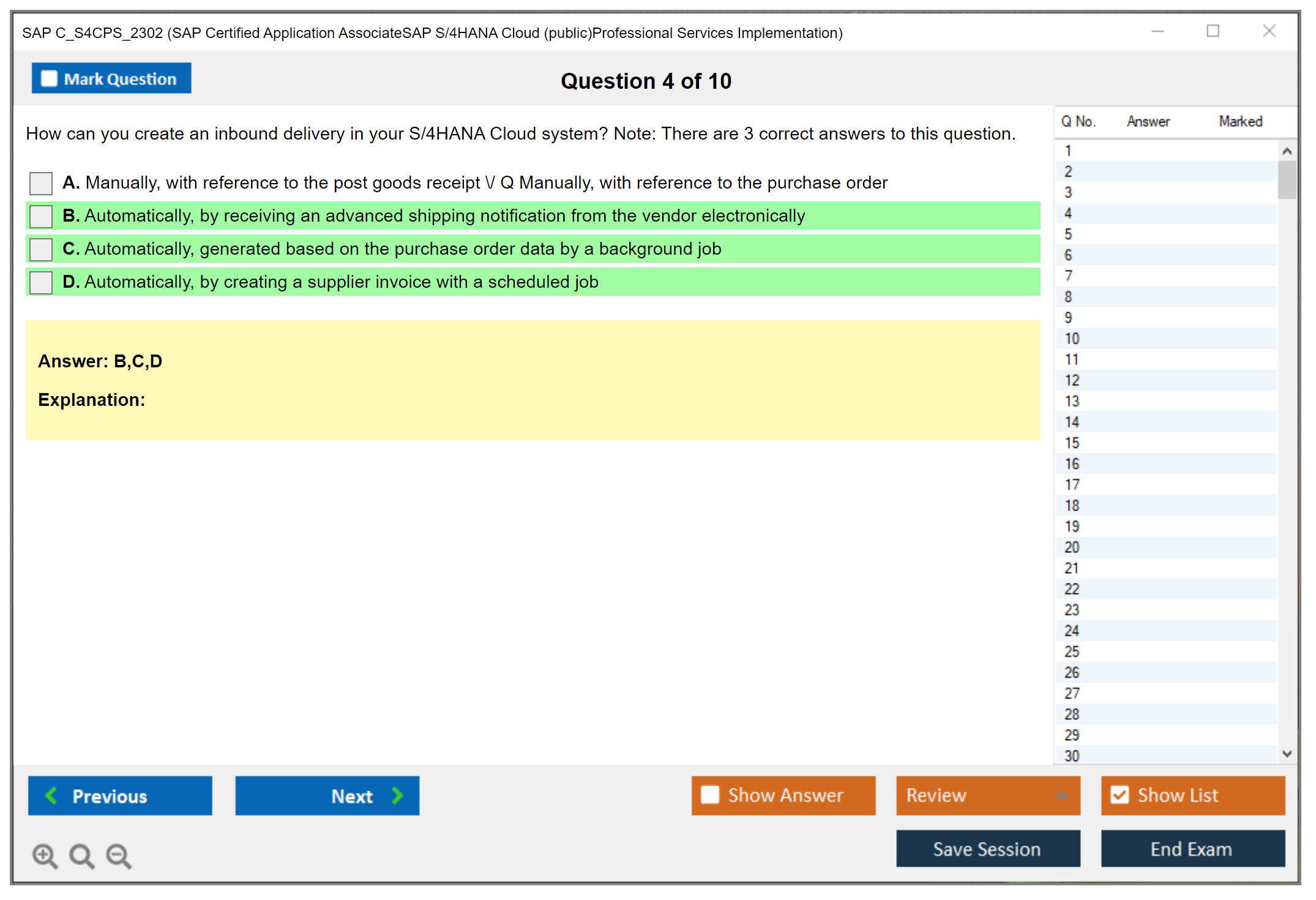
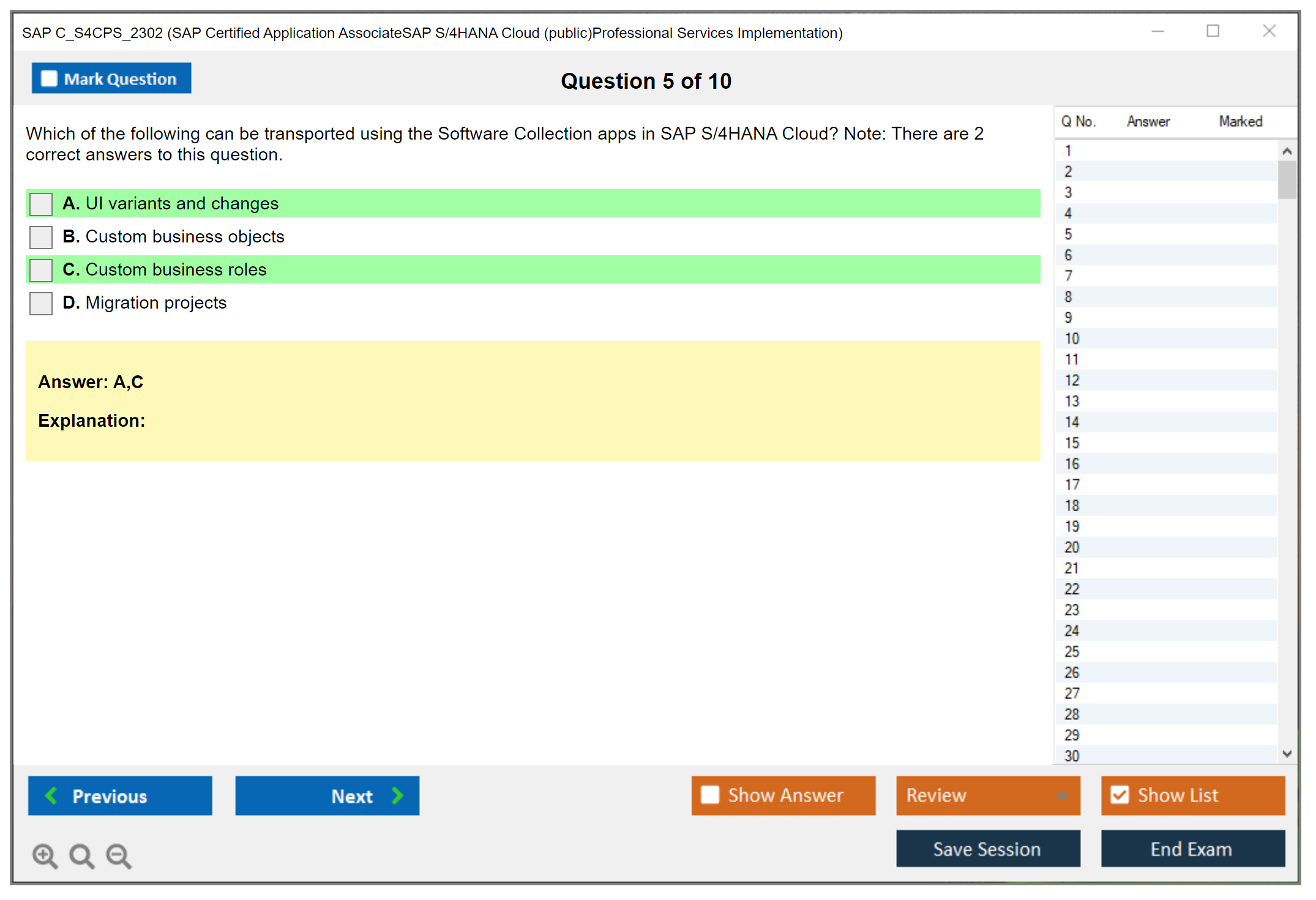
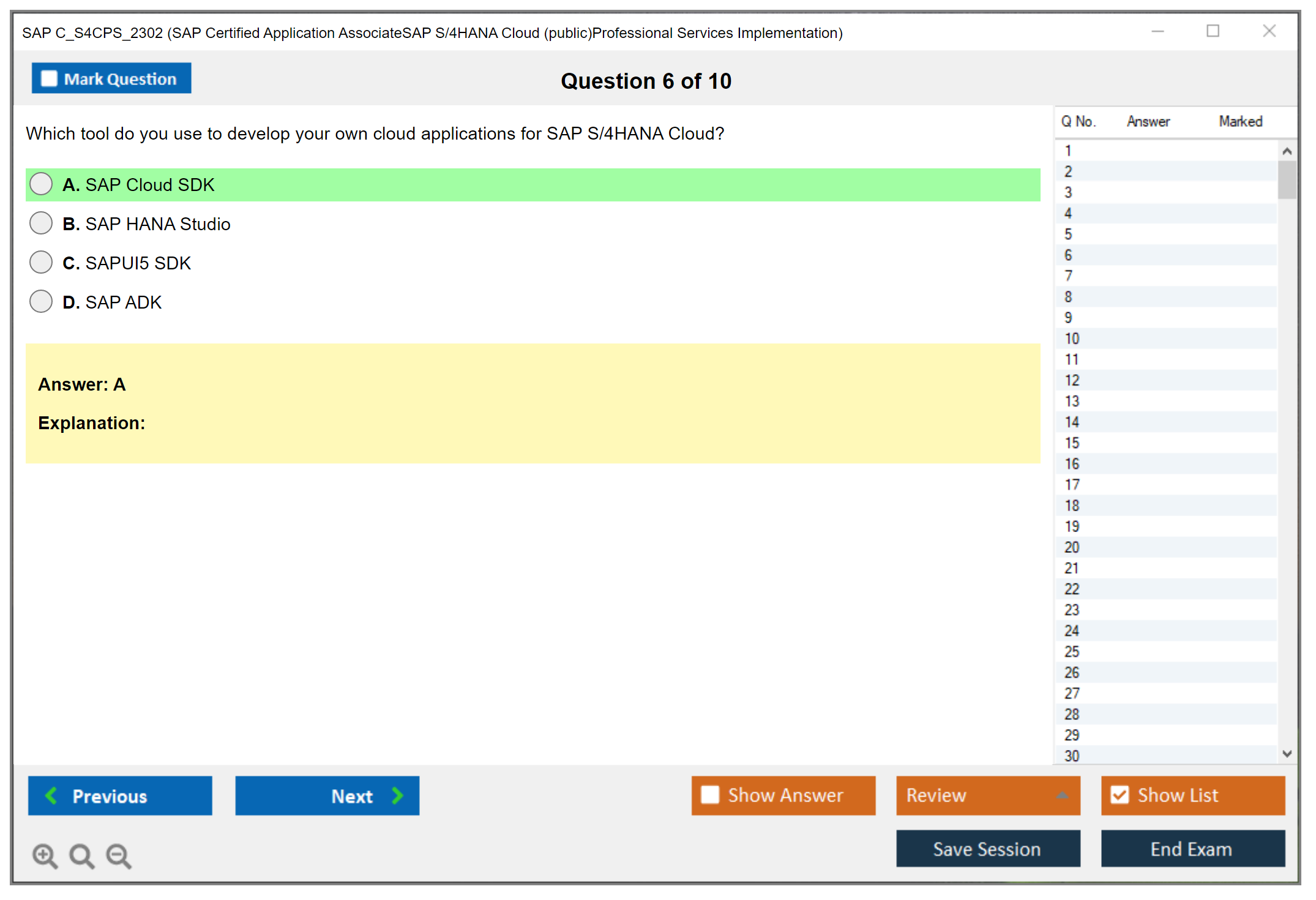
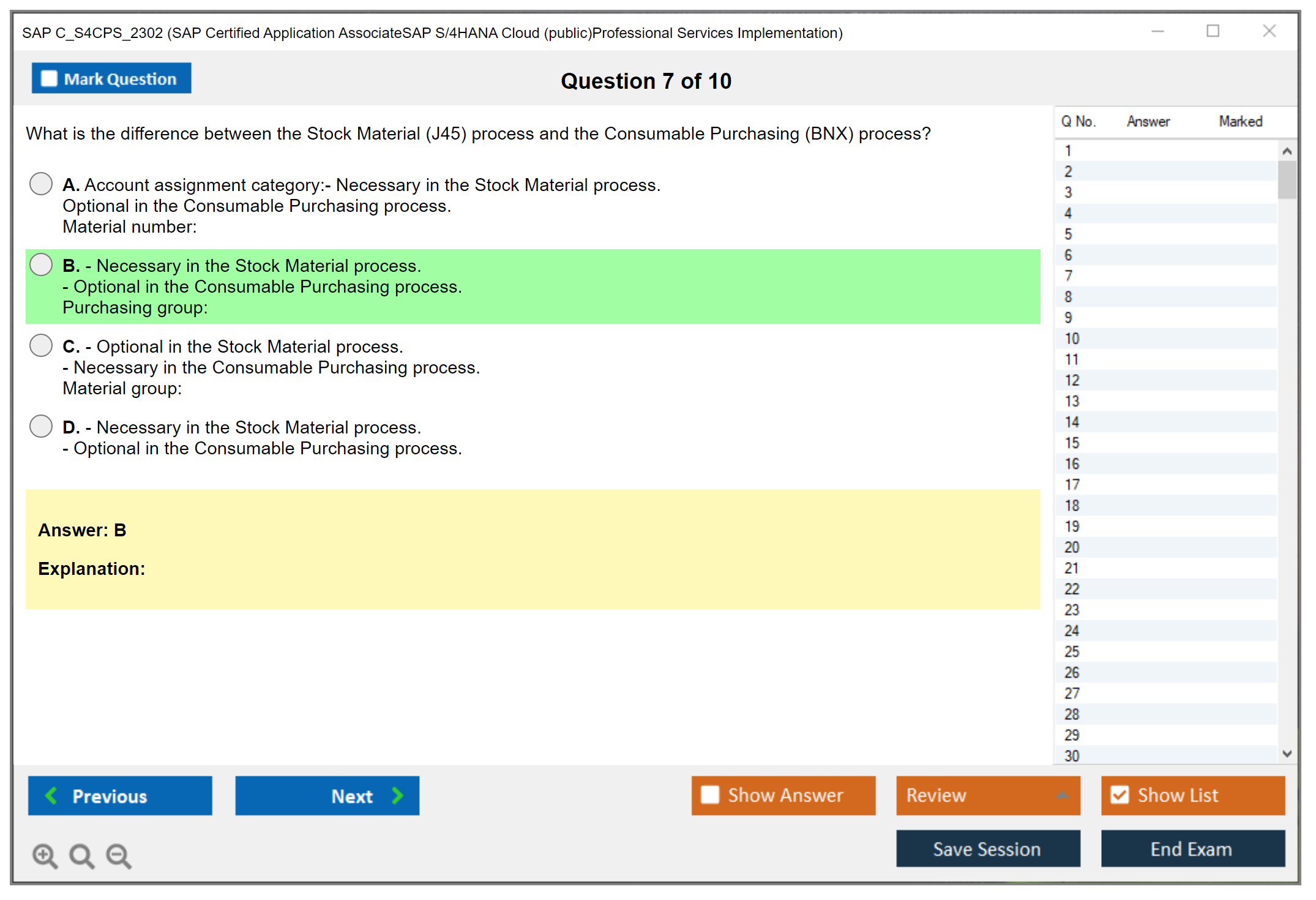
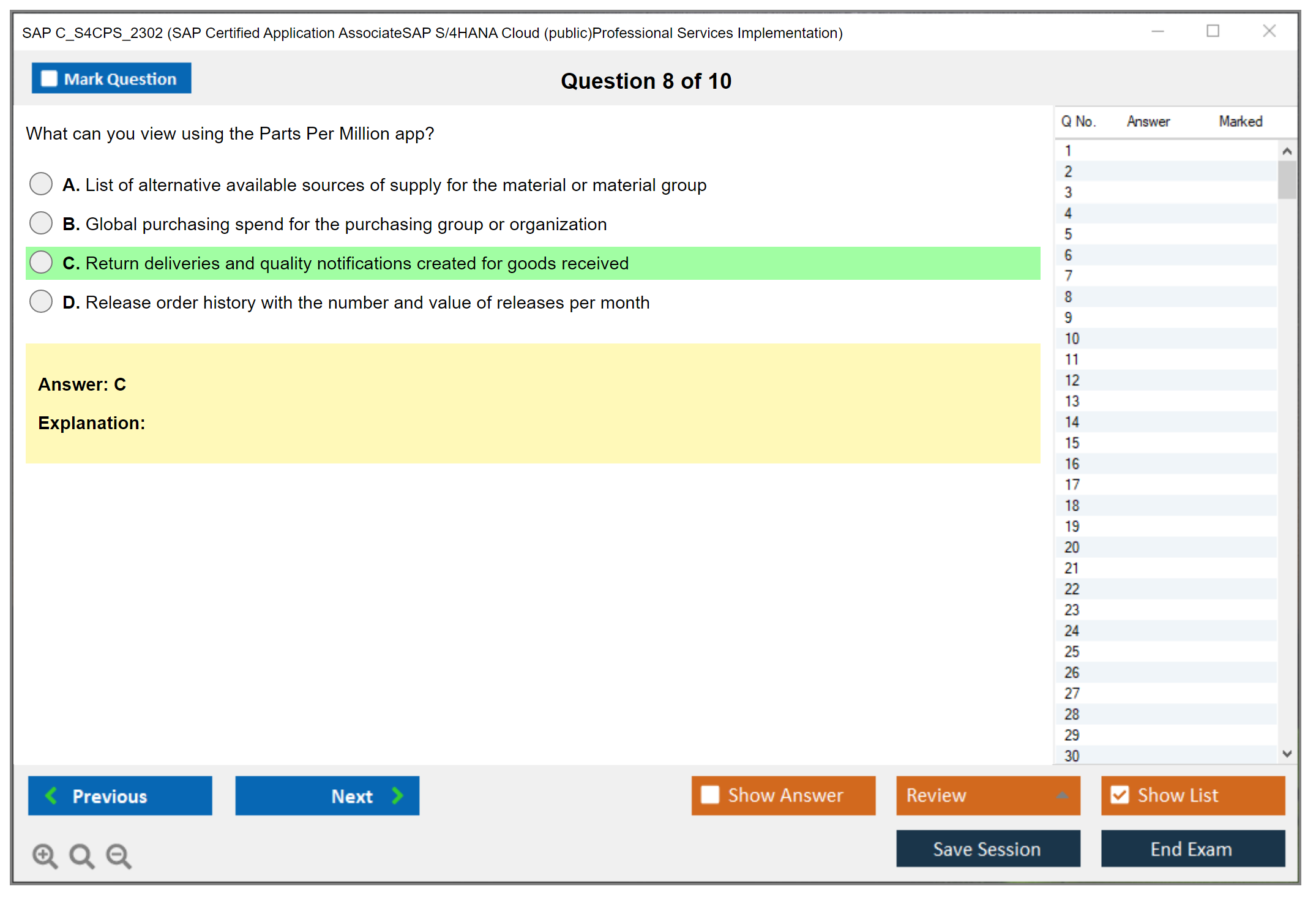
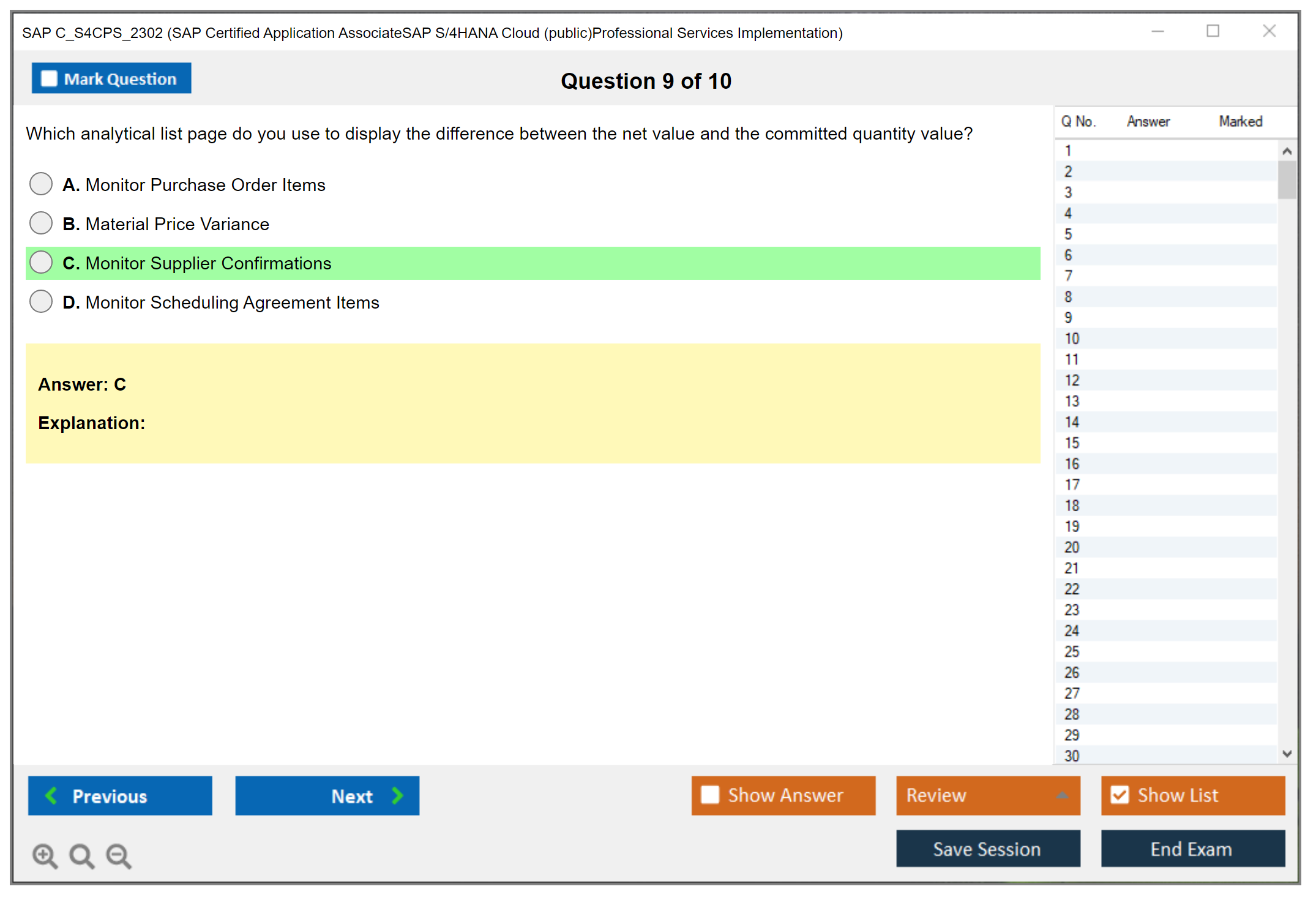
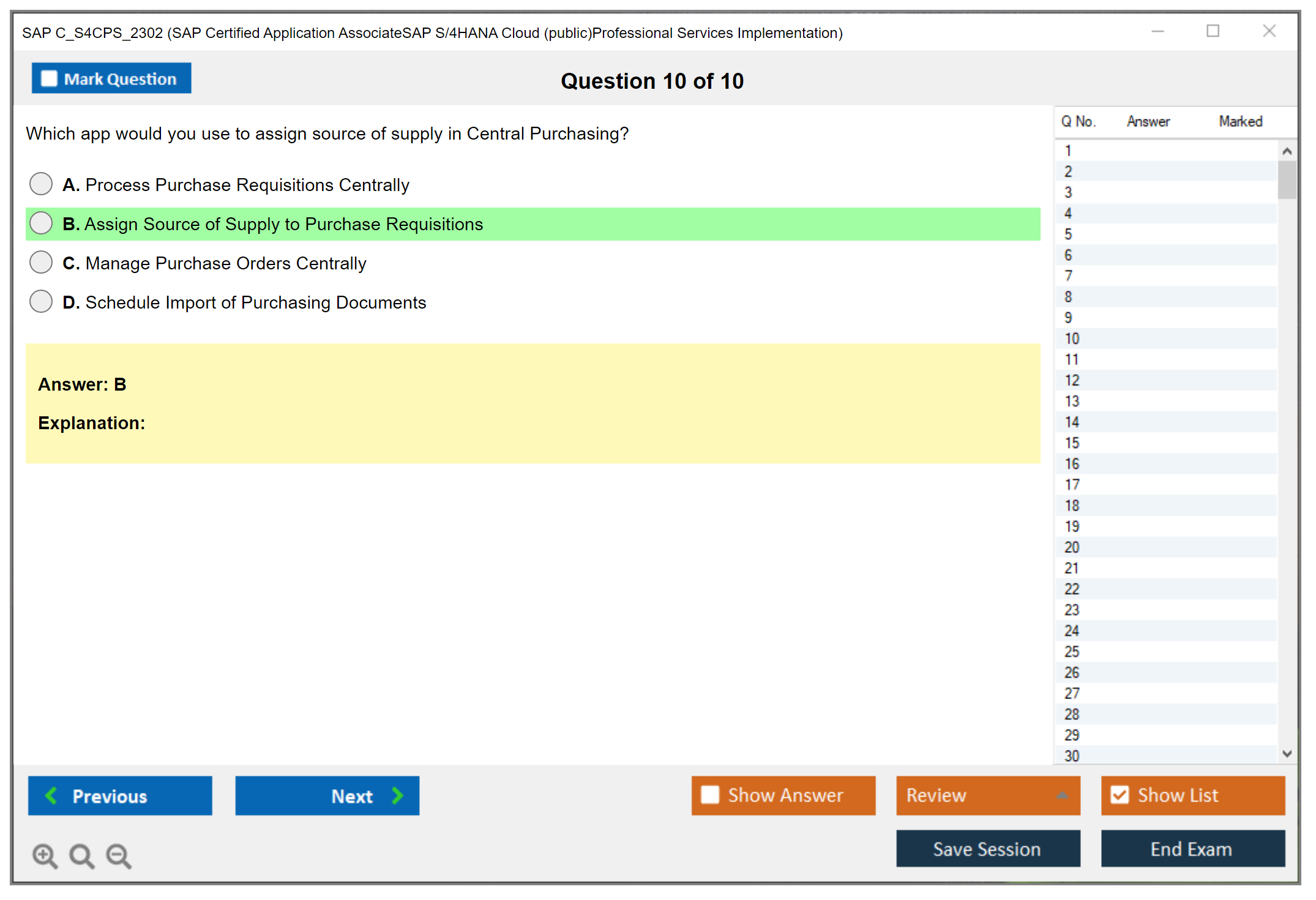
Dumpsarena SAP SAP Certified Application AssociateSAP S/4HANA Cloud (public)Professional Services Implementation (C_S4CPS_2302) Free Practice Exam Simulator Test Engine Exam preparation with its cutting-edge combination of authentic test simulation, dynamic adaptability, and intuitive design. Recognized as the industry-leading practice platform, it empowers candidates to master their certification journey through these standout features.
What is in the Premium File?
Satisfaction Policy – Dumpsarena.co
At DumpsArena.co, your success is our top priority. Our dedicated technical team works tirelessly day and night to deliver high-quality, up-to-date Practice Exam and study resources. We carefully craft our content to ensure it’s accurate, relevant, and aligned with the latest exam guidelines. Your satisfaction matters to us, and we are always working to provide you with the best possible learning experience. If you’re ever unsatisfied with our material, don’t hesitate to reach out—we’re here to support you. With DumpsArena.co, you can study with confidence, backed by a team you can trust.
SAP C_S4CPS_2302 Exam FAQs
Introduction of SAP C_S4CPS_2302 Exam!
The SAP Certified Application Associate - SAP S/4HANA Cloud - Professional Services Implementation exam (C_S4CPS_2302) is a certification exam for professionals who want to demonstrate their knowledge and skills in implementing SAP S/4HANA Cloud solutions for professional services. The exam covers topics such as project management, implementation planning, configuration, and testing. It also covers topics related to the integration of SAP S/4HANA Cloud with other SAP solutions.
What is the Duration of SAP C_S4CPS_2302 Exam?
The duration of the SAP C_S4CPS_2302 exam is 180 minutes.
What are the Number of Questions Asked in SAP C_S4CPS_2302 Exam?
The SAP C_S4CPS_2302 exam consists of 80 multiple-choice questions.
What is the Passing Score for SAP C_S4CPS_2302 Exam?
The passing score required in the SAP C_S4CPS_2302 exam is 65%.
What is the Competency Level required for SAP C_S4CPS_2302 Exam?
The SAP C_S4CPS_2302 exam is an associate-level certification exam. To pass this exam, you must have a basic understanding of SAP S/4HANA Cloud and the SAP S/4HANA Cloud Platform. You should also have a good understanding of the SAP S/4HANA Cloud Platform architecture, its components, and the integration of SAP S/4HANA Cloud with other SAP solutions. Additionally, you should have a basic understanding of the SAP S/4HANA Cloud Platform security and authorization concepts.
What is the Question Format of SAP C_S4CPS_2302 Exam?
SAP C_S4CPS_2302 exam is a multiple-choice exam.
How Can You Take SAP C_S4CPS_2302 Exam?
The SAP C_S4CPS_2302 exam is available both online and in testing centers. For online exams, students can register and purchase their exam through the SAP website. After registration and purchase, they will be provided with an authorization to test (ATT) number. This number will be used to access the exam. For testing center exams, students can register and purchase their exam through the Prometric or Pearson VUE website. They will then be able to locate their nearest testing center and schedule the exam.
What Language SAP C_S4CPS_2302 Exam is Offered?
The SAP C_S4CPS_2302 exam is offered in English.
What is the Cost of SAP C_S4CPS_2302 Exam?
The cost of the SAP C_S4CPS_2302 exam is $500 USD.
What is the Target Audience of SAP C_S4CPS_2302 Exam?
The primary target audience for the SAP C_S4CPS_2302 exam are aspiring professionals who are looking to gain knowledge and skills in SAP S/4HANA Cloud Professional Services Implementation. They should have a good understanding of SAP S/4HANA Cloud and the related technologies, in order to pass the exam.
What is the Average Salary of SAP C_S4CPS_2302 Certified in the Market?
The average salary for professionals with a C_S4CPS_2302 certification is around $100,000 per year. Salaries can vary depending on experience, location, and employer.
Who are the Testing Providers of SAP C_S4CPS_2302 Exam?
SAP provides official testing for the C_S4CPS_2302 exam. You can register for the exam on their website. Additionally, many third-party test prep companies offer practice tests and study materials for the C_S4CPS_2302 exam.
What is the Recommended Experience for SAP C_S4CPS_2302 Exam?
The best way to prepare for this exam is to have a minimum of two years of experience working with SAP S/4HANA Cloud solutions. Additionally, it is recommended that you have basic technical knowledge of SAP S/4HANA Cloud and a working knowledge of the relevant business processes.
What are the Prerequisites of SAP C_S4CPS_2302 Exam?
The Prerequisite for the SAP C_S4CPS_2302 Certified Professional - SAP S/4HANA Cloud (public) - Service Implementation exam is a SAP Certified Application Associate - SAP S/4HANA Cloud certification. Candidates should have a basic understanding of the SAP S/4HANA Cloud solution, its capabilities and architecture.
What is the Expected Retirement Date of SAP C_S4CPS_2302 Exam?
The official website to check the expected retirement date of SAP C_S4CPS_2302 exam is the SAP Certification and Training website: https://training.sap.com/certification/c_s4cps_2302-sap-certified-application-associate-sap-s4hana-cloud-professional-services-implementation-edition-2020-g/
What is the Difficulty Level of SAP C_S4CPS_2302 Exam?
The difficulty level of the SAP C_S4CPS_2302 exam is moderate.
What is the Roadmap / Track of SAP C_S4CPS_2302 Exam?
The SAP C_S4CPS_2302 exam is a certification exam for the SAP Certified Application Associate - SAP S/4HANA Cloud - Professional Services Implementation certification. This exam is designed to assess the candidate’s knowledge and skills in the areas of SAP S/4HANA Cloud Professional Services implementation, including the setup, configuration, and integration of the solution. The exam consists of 80 multiple-choice questions and has a duration of 180 minutes.
What are the Topics SAP C_S4CPS_2302 Exam Covers?
The SAP C_S4CPS_2302 exam covers the following topics:
1. SAP HANA S/4HANA Cloud: This section covers the fundamentals of SAP HANA S/4HANA Cloud, including architecture, deployment, and system administration.
2. SAP Fiori: This section covers the fundamentals of SAP Fiori, including architecture, development, and deployment.
3. SAP S/4HANA Cloud Integration: This section covers the fundamentals of SAP S/4HANA Cloud integration, including integration concepts, integration scenarios, and integration tools.
4. SAP S/4HANA Cloud Security: This section covers the fundamentals of SAP S/4HANA Cloud security, including authentication, authorization, and encryption.
5. SAP S/4HANA Cloud Analytics: This section covers the fundamentals of SAP S/4HANA Cloud analytics, including data modeling, data visualization, and data analysis.
What are the Sample Questions of SAP C_S4CPS_2302 Exam?
1. What is the purpose of the SAP Fiori launchpad?
2. What are the key components of SAP S/4HANA Cloud?
3. What are the different types of SAP Fiori apps?
4. What is the difference between SAP S/4HANA Cloud and SAP S/4HANA on-premise?
5. How do you configure the SAP S/4HANA Cloud system for an end user?
6. What are the different approaches to integrating SAP S/4HANA Cloud with third-party systems?
7. What is the purpose of the SAP Cloud Platform?
8. How can you use the SAP Cloud Platform to extend SAP S/4HANA Cloud?
9. What are the different types of analytics available in SAP S/4HANA Cloud?
10. What are the best practices for implementing SAP S/4HANA Cloud?
SAP C_S4CPS_2302 Certification Overview Look, I've been watching SAP certifications evolve for years, and the SAP C_S4CPS_2302 certification is honestly one of those credentials that makes a ton of sense if you're working in the professional services space. it's another checkbox cert. It actually validates that you know how to implement Professional Services solutions within SAP S/4HANA Cloud public edition, which is basically SAP's cloud-first answer to how consulting firms, engineering companies, and IT service providers run their project-based businesses. Why this certification matters right now The shift to public cloud is real. I mean, SAP is pushing hard on the S/4HANA Cloud public edition strategy, and professional services organizations are figuring out how to make the fit-to-standard approach work for them. This certification proves you understand that methodology, not just the old "we'll customize everything" mindset that dominated on-premise implementations. You're showing... Read More
SAP C_S4CPS_2302 Certification Overview
Look, I've been watching SAP certifications evolve for years, and the SAP C_S4CPS_2302 certification is honestly one of those credentials that makes a ton of sense if you're working in the professional services space. it's another checkbox cert. It actually validates that you know how to implement Professional Services solutions within SAP S/4HANA Cloud public edition, which is basically SAP's cloud-first answer to how consulting firms, engineering companies, and IT service providers run their project-based businesses.
Why this certification matters right now
The shift to public cloud is real. I mean, SAP is pushing hard on the S/4HANA Cloud public edition strategy, and professional services organizations are figuring out how to make the fit-to-standard approach work for them. This certification proves you understand that methodology, not just the old "we'll customize everything" mindset that dominated on-premise implementations. You're showing you can configure project-based services, resource management, time tracking, and billing within the boundaries of what the public cloud model allows.
What makes this different from older SAP certs? You're dealing with scope items, pre-configured content, and SAP Best Practices instead of endless customization tables. The SAP S/4HANA Cloud public edition Professional Services Implementation certification demonstrates you get how to use SAP's Central Business Configuration approach. It's a totally different ballgame from traditional IMG configuration.
Who actually needs this credential
Implementation consultants? Obvious candidates.
If you're working on S/4HANA Cloud public deployments for professional services clients, this cert confirms you know the territory. Project managers who need to understand the implementation space also benefit, especially if you're guiding customers through the fit-to-standard path and need credibility when you're explaining why certain customizations aren't feasible or smart.
Functional specialists working specifically with professional services industries will find this validates their niche expertise. Think consulting firms, IT services companies, engineering firms. Not gonna lie, the market for people who really understand both the business processes of project-based services AND the technical configuration in a public cloud environment is pretty tight. Having this cert differentiates you.
What you actually prove you know
The certification covers everything.
Project setup, staffing, resource planning, capacity management. The whole works. You need to understand how time and expense recording flows through the system for billable projects, how different billing methods work, and how revenue recognition ties into Finance. Integration points with Sales, Finance, and other modules matter because professional services doesn't exist in isolation.
Organizational structures and master data sound boring but they're foundational. The exam tests whether you understand how to set up the data model correctly from the start, which honestly saves your implementation from becoming a nightmare six months down the road. You also need to grasp the reporting and analytics capabilities specific to Professional Services. KPIs, dashboards, the analytics that actually matter to services executives.
The fit-to-standard methodology is huge here. Can you translate business requirements into standard cloud configuration? Do you know when to push back on customization requests versus when they're actually necessary? This is where many consultants struggle because you need both technical knowledge and business consulting skills working together simultaneously. Most people don't develop that until they've been burned on a project or two. I remember one implementation where the customer insisted on custom billing logic that could've been handled with standard configuration, and we spent three months in extensibility hell before finally convincing them otherwise. Similar challenges come up in the SAP Activate Project Manager space, where methodology understanding is just as critical as technical knowledge.
The exam itself and what to expect
You're taking a single exam that focuses on practical Professional Services implementation scenarios. This isn't theoretical fluff. SAP tests your ability to make real decisions in implementation contexts. The questions reflect situations you'll actually encounter: configuration choices, process flow decisions, integration considerations.
The C_S4CPS_2302 exam cost varies by region, but you're typically looking at the standard SAP certification pricing. You can purchase through the SAP Certification Hub, either as a single exam or potentially through subscription options depending on what SAP offers in your market. The C_S4CPS_2302 passing score follows SAP's standard approach where they don't publish the exact cutoff publicly. It's scaled scoring, and the passing threshold can adjust based on exam difficulty. Generally you want to aim for 70%+ to feel confident, but honestly, shoot for higher.
C_S4CPS_2302 exam objectives are outlined in the official blueprint, which you absolutely need to download and study. The blueprint breaks down topic areas and weighting, showing you where to focus your prep time. Don't skip this step. People who fail usually didn't align their studying with the actual blueprint.
Getting ready and finding decent materials
C_S4CPS_2302 prerequisites aren't mandatory in the sense that SAP won't block you from registering, but realistically you should have some hands-on experience with S/4HANA Cloud public edition. If you're coming in cold without ever touching the system, you're making it way harder on yourself. Recommended background includes understanding basic SAP processes, familiarity with project-based business models, and ideally some exposure to cloud implementations.
For C_S4CPS_2302 study materials, start with official SAP Learning resources. SAP Learning Hub, Learning Journeys, the instructor-led training courses. These align directly with exam content. The SAP Help Portal and product documentation for S/4HANA Cloud Professional Services is essential. Don't ignore the scope item documentation. Understanding what each scope item does and how they interconnect is tested heavily.
I've seen people waste money on sketchy third-party dumps that don't reflect actual exam content. For C_S4CPS_2302 practice test resources, stick with official SAP sample questions if they're available. Practice tests work best when you use them diagnostically. Take one, identify weak areas, study those topics deeply, then test again. Just memorizing answers is useless because SAP rotates questions and tests understanding, not recall.
If you're also working with broader S/4HANA implementations, the SAP S/4HANA 2021 for Financial Accounting cert covers complementary Finance knowledge that integrates with Professional Services billing and revenue recognition.
How difficult is this really
Is SAP C_S4CPS_2302 difficult for beginners? Yeah, it's challenging if you're new to SAP or new to professional services business processes. The difficulty comes from needing to understand both the business side (how consulting firms actually operate, bill clients, manage resources) and the technical configuration side within the public cloud constraints.
Common pitfalls? Not understanding fit-to-standard.
You'll also trip up confusing scope item functionality and not grasping how quarterly innovation cycles affect your implementation decisions. The terminology can mess with people too. SAP uses specific terms for Professional Services concepts that differ slightly from generic project management language.
A realistic study plan depends on your background. If you're already working on S/4HANA Cloud Professional Services implementations, maybe 2-3 weeks of focused study. Coming from a different SAP area or new to cloud? Budget 4-6 weeks minimum, with hands-on practice time in a system.
Keeping your cert current
SAP's C_S4CPS_2302 renewal policy follows their newer "stay current" approach for cloud certifications. Because S/4HANA Cloud gets quarterly releases with new features and changes, your certification knowledge can become outdated. SAP typically requires periodic delta assessments or renewal exams to maintain your certified status.
How do I renew or maintain my SAP S/4HANA Cloud certification? Check the SAP Certification Hub for your specific cert status and renewal requirements. The hub shows upcoming deadlines and available renewal options. Unlike older on-premise certs that stayed valid indefinitely, cloud certs reflect the continuous innovation model. Which honestly makes sense because the product itself changes significantly over time.
This renewal model is consistent with other cloud-focused certifications like SAP Activate for Cloud Solutions Project Manager, where staying current with methodology updates is expected.
Career impact and market value
The SAP Professional Services implementation consultant role commands solid rates in the market, and having this certification backs up your claims of expertise. When you're competing for consulting gigs or full-time roles, being certified in the current cloud edition shows you're not stuck in legacy thinking.
Professional services industries are growing their SAP footprints, especially as firms realize they need better systems for resource utilization, project profitability, and billing accuracy. Consultants who can implement these solutions properly are in demand. The cert also helps if you're trying to move from on-premise SAP PS to cloud implementations. It proves you've made the transition in your skillset.
The knowledge you gain during prep applies directly to real projects. Understanding extensibility options, migration strategies, user experience customization within public cloud parameters. You'll be better equipped to handle customer questions, scope implementations accurately, and deliver successful go-lives.
Why fit-to-standard expertise matters
I keep coming back to this because it's central to the cert and to successful cloud implementations. The public cloud model means you're working within SAP's defined scope items and Best Practices content. You can't just write custom code or modify standard tables like the old days. Understanding what's configurable, what requires extensibility frameworks, and what's simply not possible separates effective consultants from those who overpromise and underdeliver.
The cert validates you can communicate this to customers effectively. You know how to use SAP Model Company and pre-configured scenarios to accelerate time-to-value. You understand testing strategies that work in a cloud environment where you don't control the infrastructure. This is practical knowledge that directly impacts project success rates.
For consultants also working with development aspects, understanding the technical constraints complements skills validated in certs like SAP Fiori Application Developer or Backend Developer - SAP Cloud Application Programming Model.
Bottom line on pursuing this cert
If professional services implementations in S/4HANA Cloud public edition are part of your career path, the SAP C_S4CPS_2302 certification is worth the investment. It's not a guaranteed job ticket by itself, but combined with hands-on experience and good consulting skills, it strengthens your position significantly. The exam is passable with proper preparation. The knowledge is immediately applicable, and the credential is recognized globally in SAP circles.
Just go in with realistic expectations about study time, get your hands on a practice system, use the official blueprint as your roadmap, and focus on understanding concepts rather than memorizing answers. The cert validates real expertise in a growing area of SAP's business, and that's ultimately what makes it valuable.
C_S4CPS_2302 Exam Structure and Registration Details
what this certification actually is
The SAP C_S4CPS_2302 certification is SAP's Application Associate exam for SAP S/4HANA Cloud (public edition) Professional Services implementation. It's aimed at people who wanna be the person configuring and explaining how professional services works in public cloud, not the person writing ABAP or building custom Z-stuff all day. Process and config, basically. You'll see tons of "what would you do here" questions that test whether you can actually think through scenarios instead of just memorizing bullet points from a slide deck.
The exam code suffix matters more than people think, honestly. "2302" points to the initial release timing (2023, quarter 2), and SAP does update exams as the product moves, so you should double-check you're booking the current version before you lock in a date, pay, and then realize your C_S4CPS_2302 study materials were for an older pool that doesn't match what's actually on the test anymore.
who should sit it (and who probably shouldn't yet)
If you're aiming to be an SAP Professional Services implementation consultant, this is one of the more direct ways to prove you can talk fit-to-standard and not panic when someone says "scope item" in a meeting. Consultants, partner folks, internal IT teams rolling out Professional Services, and power users moving into implementation are the sweet spot here.
Absolute beginners can pass. But it's rough if you've never seen SAP Central Business Configuration (CBC) or you don't understand how SAP Best Practices for Professional Services are packaged. I mean, the terminology alone can feel like learning a second language if you're brand new to the ecosystem, and that slows everything down when you're already racing the clock during the actual exam.
what skills the exam is really testing
Look, SAP says "implementation knowledge," and that's true, but the exam tends to reward people who can make decisions under public cloud constraints. That's a totally different mindset than traditional on-prem customization where you could code your way out of almost anything. Standard configuration options, fit-to-standard thinking, and knowing where Professional Services touches Finance, time, expenses, and billing. You'll see questions that feel like "pick the least-wrong approach," especially when a scenario forces tradeoffs across process design and system setup.
exam format, timing, and question styles
The C_S4CPS_2302 exam is typically 180 minutes long with about 80 questions, which gives you around 2.25 minutes per question. Sounds comfy until you hit scenario items that require rereading exhibits, process flows, or a screenshot and then mapping it back to what SAP actually allows in public cloud. Those can eat five or six minutes easy if you're not careful. Time management matters. Flag questions. Move on. Come back.
You'll see multiple choice (single answer), multiple response (multiple answers), and scenario-based questions where they give you a business situation and you gotta figure out the right config path. No negative marking, so guessing beats leaving blanks, because unanswered is just wrong. Also, don't expect partial credit on multi-response. If you miss one checkbox, the whole thing's toast unless SAP explicitly says otherwise, which they rarely do.
English is the default delivery language, and translation options are limited compared to some older on-prem exams, so if English isn't your first language, budget extra time to parse complex sentence structures. There's usually a built-in calculator in the interface, and depending on delivery method you'll get either scratch paper at a test center or a digital whiteboard tool online.
cost options and what people get wrong about pricing
C_S4CPS_2302 exam cost varies by region and how you buy it. A single exam attempt is commonly in the $500 to $650 USD range, but local market pricing and currency exchange rates can push it around, and honestly that's not SAP being mysterious, it's just how global pricing works when you're operating in 180+ countries. That's not cheap.
Here's the part people ignore: SAP Certification Hub also has a subscription model, and it can be the smarter move if you plan to take multiple certs or you think you might need a retake because you're juggling a full-time job and studying on weekends. Subscription pricing is usually around $2,000 to $2,500 annually, and that can cover multiple certification attempts during the subscription window. Not "unlimited forever," it's an annual fee, but the attempts included can add up fast. A quick reality check: if you're only taking one exam and you're confident, single purchase is fine, but if you're stacking credentials for a role change or partner requirements, the subscription can pay for itself fast, especially if you want a second certification or you're planning a C_S4CPS_2302 practice test cycle and expect you may fail once and come back stronger after identifying your weak areas.
Also worth mentioning casually: corporate training agreements sometimes discount exams for volume, SAP partners may get benefits via PartnerEdge, and universities can see special pricing through SAP University Alliances, so if you're employed or a student, ask before you pay list price because you might be leaving hundreds of dollars on the table. Seriously. I've seen people shell out full price only to find out later their company had a bulk discount sitting unused in some procurement system nobody told them about.
where you take the exam (online vs test center)
You can take the exam through the SAP Certification Hub online platform, usually with remote proctoring that feels like someone's watching every keystroke and eye movement. Or you can book an in-person slot at Pearson VUE testing centers in many countries. Both are valid, but they feel different.
Remote is handy, but it's strict. Webcam monitoring, ID verification, and they want a secure, quiet room where nobody's gonna walk in and accidentally photobomb your certification attempt. No wandering eyes. No extra monitors. No "my roommate is cooking behind me" situations. You'll also need a stable internet connection and a compatible browser, and SAP typically makes you run a system check before the exam starts, so do that early, not five minutes before go time when you're already stressed.
Test centers are less stressful for some people because the environment is controlled and you don't have to worry about your cat jumping on the keyboard, but you lose flexibility and you might wait longer for a slot in busy cities where everyone's booking the same Wednesday afternoon window.
registration steps (the boring part that still trips people up)
Registration requires an SAP user account, usually an S-user or P-user, plus access to the SAP Certification Hub. Sounds simple but can turn into a bureaucratic nightmare if your company's SAP admin is on vacation when you need access. If your company is an SAP customer or partner, you often already have one. If not, you'll need to get set up first, and that can take longer than you expect depending on internal approvals.
After you register, you'll get a confirmation email with exam details, and usually some links back to preparation resources and policy pages that most people never read until something goes wrong. You can typically reschedule or cancel with advance notice, often 24 to 48 hours, but miss that window and you may forfeit the fee. That's painful when you're already stressed about the exam itself. Vouchers also expire, so don't buy one and then "save it for someday" because someday becomes never and you're out the money.
passing score and how SAP plays it
The C_S4CPS_2302 passing score is typically around 63 to 66% correct answers, but SAP doesn't promise a fixed number in advance because they use scaled scoring and difficulty analysis to keep things consistent across different exam versions. Different exam versions can have slightly different thresholds to keep the overall difficulty consistent.
That annoys people. I get it. But the practical takeaway is simple: aim well above the rumored cutoff instead of trying to calculate the minimum you can get away with. Don't prep to scrape by. Prep to be comfortable, because test anxiety alone can cost you 5-10% on exam day if you're cutting it that close.
Results are usually immediate for online exams, which is both a blessing and a curse depending on whether you passed, while center-based testing can take 24 to 48 hours. That means you get to stress about it overnight. When you pass, you'll get the digital badge and certificate through SAP Certification Hub that you can immediately add to LinkedIn and start humble-bragging about.
retakes (plan for it like an adult)
Retakes are allowed, with waiting periods after a failed attempt that SAP puts in place so people don't just brute-force the exam by taking it five times in a week. The first retake is commonly available after 14 days. Later retakes can require longer waits, sometimes 30+ days, depending on SAP policy at the time.
Each retake needs another fee unless your subscription covers it, which is why the subscription can be a financial safety net if you're in a "career switch, lots of exams" phase where one failure won't derail your entire certification strategy.
what the objectives cover (blueprint matters)
The C_S4CPS_2302 exam objectives are published as an exam blueprint on SAP Training and Certification, and honestly it's the most underused resource by people who then complain the exam was unfair. Topic weighting tells you what SAP expects to show up more often, and you should actually use that to plan your prep instead of just watching random videos on YouTube that may or may not cover what's actually on the test.
Expect business process areas and configuration topics around Professional Services in public cloud. S/4HANA Cloud public edition services project setup, master data and org structure basics, and how SAP Central Business Configuration (CBC) fits into the implementation flow. Wait, I should mention that CBC is basically the control center for configuring public cloud, so if you don't understand that tool, you're gonna struggle with a third of the exam. Integration touchpoints matter too, especially where Professional Services interacts with Finance and billing, because that's where things get messy in real implementations and SAP knows it. Reporting and analytics basics show up, but usually more "what tool or app" than "write a report" since this isn't a technical development exam.
Some questions will reference SAP Best Practices content, scope items, and standard configuration options using SAP's specific terminology. Terminology is half the battle. If you don't know the official SAP naming conventions, you waste time decoding the question instead of answering it, and that eats into your already tight time budget.
Also, the question pool is randomized, so each candidate gets a unique set. That means your coworker who took it last week can't just tell you all the answers. That's why memorizing someone else's "question dump" is a dumb plan, apart from being a policy violation that can get your certification revoked if SAP finds out.
prerequisites, prep, and renewal notes people ask about
C_S4CPS_2302 prerequisites are more "recommended" than mandatory from a policy standpoint. But you'll have a better time if you've done at least one fit-to-standard workshop, touched CBC in a practice environment, and walked through Professional Services scope items in a demo or practice tenant where you can actually click around without worrying about breaking anything.
For C_S4CPS_2302 study materials, start with SAP Learning Journeys, the exam blueprint, and the SAP Help Portal docs tied to Professional Services. Those are your foundation. Add hands-on practice if you can get access to a training system. Reading is not the same as configuring, and the exam will expose that gap fast.
On C_S4CPS_2302 renewal policy, SAP's cloud certifications commonly follow a "stay current" model where you complete periodic assessments tied to releases to maintain status. Makes sense given how fast cloud products shift compared to traditional on-prem releases. The exact rules can change, so track your deadlines inside SAP Certification Hub, because SAP certification validity and maintenance is where people get caught sleeping and then wonder why their badge shows as outdated when they're trying to impress a hiring manager.
quick faq people always google
How much does it cost? Usually $500 to $650 USD for a single attempt, region-dependent, with subscription options around $2,000 to $2,500 annually.
What passing score do you need? Typically 63 to 66%, but it can shift by version due to scaled scoring.
Is it hard for beginners? Yes, if you lack public cloud implementation context, but doable with focused practice and blueprint-driven prep instead of random studying.
Best practice tests? Prefer official sample questions and structured practice over random third-party dumps that may contain outdated or wrong information. Use a C_S4CPS_2302 practice test to find weak areas, then go back to docs and configuration steps to actually learn the material instead of just memorizing answers.
How do you maintain it after passing? Keep up with SAP's stay-current assessments in the Certification Hub and watch for release-driven updates that affect Professional Services content, because certifications don't stay valid forever in the cloud world.
C_S4CPS_2302 Exam Objectives and Content Blueprint
What actually shows up on exam day
The C_S4CPS_2302 exam objectives break down into several major buckets, and honestly the weighting matters a lot here. Professional Services business processes dominate the blueprint. We're talking roughly 30-40% of your total score coming from this single domain. That's massive. If you don't know project creation, staffing workflows, time recording, expense handling, and billing inside-out, you're already behind. The exam assumes you can walk through a complete project lifecycle from initial setup through final billing and closure, not just in theory but with the actual clicks and configuration decisions that S/4HANA Cloud public edition demands.
Project structures get tested hard. You need to understand work breakdown structure (WBS) elements, how activities relate to WBS, network relationships, and why you'd choose one approach over another in different business scenarios. Look, SAP loves asking "which configuration enables this outcome?" questions, so knowing that a WBS element can have billing rules attached but an activity inherits from its parent, that level of detail separates passing from failing.
Resource management and staffing processes form another critical chunk. The exam digs into resource assignment logic, capacity planning calculations, and utilization tracking. You'll see scenarios where a project needs specific skills, and you have to identify how the system matches available resources to requirements. Not gonna lie, the distinction between hard-booked, soft-booked, and requested staffing states trips people up. Same with understanding how resource rates (cost vs. billing) flow through to project controlling and invoicing.
Time and expenses workflows you can't skip
Time recording integration runs deep in this exam. You need to trace the entire flow: consultant enters time in their timesheet, manager approves (or rejects with comments), system validates against project structures, then approved hours feed into both billing and cost accounting. The questions often present broken scenarios. "Time was entered but didn't appear on the invoice, what's misconfigured?" And you have to troubleshoot based on project type settings, billing relevance flags, or missing service product assignments.
Expense management covers travel expenses, out-of-pocket costs, and how receipts integrate with expense reports. I mean, this isn't just "can you create an expense report" knowledge. The exam wants you to know how expense types map to G/L accounts in Finance, how VAT/tax handling works for different expense categories, and when expenses bill at cost versus with markup. There's usually a question or two about receipt attachment requirements and approval workflows that catch people off guard if they've only done theory study without hands-on practice.
Billing processes? Huge topic area. Multiple sub-domains here.
You'll face questions on billing plans (periodic, milestone-based, event-driven), time-and-materials scenarios where billing pulls from approved time and expenses, and fixed-price projects where revenue recognition might decouple from billing events. The exam loves comparing billing methods. "Which approach fits this customer requirement?" So you need crystal-clear understanding of when to use each model and what configuration drives the behavior.
Revenue recognition principles tie directly to accounting standards, and the exam tests whether you understand how S/4HANA Cloud handles percentage-of-completion, completed-contract, and other recognition methods. Questions often present a project scenario with specific contract terms and ask how revenue should be recognized over time. This connects to project controlling topics like work-in-progress (WIP) calculations and how the system determines earned value versus billed amounts.
Controlling and integration points matter more than you think
Project controlling and monitoring questions focus on budget management, cost tracking, and variance analysis. You'll see scenarios with budget overruns, under-billings, or margin erosion, and you need to identify which reports or KPIs surface the issue and what corrective actions the system supports. Understanding cost element categories, how internal costs post versus external revenue, and how project currency differs from company code currency, these details show up in multi-step scenario questions.
Integration with Finance modules isn't optional knowledge. The thing is, the exam assumes you understand how project costs post to CO (controlling), how billing creates FI (financial accounting) documents, and how revenue recognition journal entries flow between modules. I've seen questions that trace a single timesheet entry all the way through to the balance sheet impact, testing whether you know which integration points execute automatically versus requiring manual intervention. If you're preparing for other SAP certifications like C_TS4FI_2021, that Finance foundation actually helps here since the modules talk to each other constantly.
Sales integration questions test quotation-to-project conversion, sales order creation for professional services, and how opportunity management feeds project pipeline. The exam might show a sales quote with specific line items and ask which scope items need activation to support converting that quote into a billable project with proper organizational assignment. Understanding the document flow (from lead through opportunity, quote, sales order, project, time entries, billing document, and finally revenue recognition) that end-to-end traceability comes up repeatedly.
Organizational structures? Foundational stuff here.
Company code, controlling area, and professional services-specific organizations (like service organizations or resource organizations) must be configured correctly or nothing else works. The exam tests your knowledge of valid organizational combinations, assignment logic, and what happens when organizational elements don't align properly. Simple stuff like "can one controlling area span multiple company codes?" or "does the project's company code have to match the billing company code?" These aren't trick questions, but they're easy to miss if you've only worked in pre-configured demo systems.
Master data and SAP Best Practices foundation
Master data fundamentals cover service products, resources, roles, and qualification management. You need to know how service products differ from material master records, how they link to revenue and cost accounts, and how pricing conditions apply. Resource master data includes availability calendars, skills/qualifications, cost rates, and billing rates. The exam loves asking about rate determination. "Consultant X has three different billing rates configured, which one applies in this scenario?" And you have to know the precedence logic.
Employee master data relevant to professional services extends beyond basic HR info. Availability patterns, skill certifications, cost center assignments, and default project roles all factor into resource planning and staffing decisions. Customer and vendor master data questions focus on how these records enable project billing, expense reimbursement, and subcontractor management. Not super deep, but you need to recognize which master data fields drive which downstream processes.
SAP Best Practices for Professional Services content forms the foundation of most exam scenarios. The questions assume you've worked with the pre-delivered scope items, understand which business processes each scope item enables, and can identify the right scope item to activate for a given requirement. This is where hands-on system time becomes critical. Reading documentation helps, but actually activating scope items in a practice tenant and seeing what configuration gets deployed makes the concepts stick. I spent a weekend once just clicking through every scope item variation trying to understand the differences, and honestly that repetitive work paid off more than any study guide.
Scope item selection? Tested explicitly.
You'll see questions about the SAP Central Business Configuration (CBC) tool, how to work through the implementation project structure, and what happens when you activate conflicting scope items. Understanding scope item dependencies matters too. Some capabilities require multiple scope items working together, and the exam might present a scenario where one piece is missing.
Configuration and fit-to-standard thinking
Fit-to-standard methodology questions test your ability to align business requirements with standard processes instead of immediately jumping to customization. The exam philosophy heavily favors standard SAP processes, so when presented with a business requirement, the correct answer usually involves using a standard scope item or configuration option rather than "develop custom code" or "use BTP extension." This mindset shows up across multiple questions and really reflects how SAP wants public cloud implementations to run. If you've taken certifications like C_ACTIVATE13, you'll recognize this SAP Activate philosophy baked into the exam approach.
Business role assignment and authorization concepts get tested through scenario questions. You need to know what permissions a project manager role includes versus a resource manager versus a consultant self-service role. Questions often describe a user who can't perform a specific action and ask what's missing from their authorizations. Understanding the difference between business roles (which bundle authorizations for job functions) and technical roles (more granular permission sets) helps here.
Configuration of project types includes templates, billing rules, default settings, and organizational assignments. The exam tests whether you know how project type configuration drives downstream behavior. Like whether time entries automatically become billable, whether expenses require manager approval, or whether the project uses network scheduling versus simple activity lists. Service product configuration covers pricing, costing, and revenue recognition rules at the product level, and how these defaults flow into projects when the product gets assigned.
Billing method setup for different scenarios comes up frequently. You'll face questions comparing time-and-materials configuration (hourly rates, quantity-based billing) against fixed-price (milestone payments, lump-sum invoicing) against retainer models (periodic billing regardless of hours). Each requires different configuration in the project type, billing plan, and service product master, and the exam wants you to identify which settings enable which behavior.
Analytics, reporting, and implementation lifecycle
Resource rate configuration includes cost rates (what you pay the resource), billing rates (what you charge the customer), and role-based pricing where rates vary by consultant level or skill category. The exam tests rate determination logic, how rate validity dates work, and what happens when a rate is missing for a given combination of resource, role, and time period. Calendar and working time configuration affects resource availability calculations and project scheduling, with questions around public holidays, part-time schedules, and how availability feeds into capacity planning reports.
Approval workflow configuration shows up for time sheets, expenses, and sometimes project changes or budget adjustments. You need to know what approval steps are standard versus configurable, how substitution rules work when approvers are unavailable, and what happens when an approval gets rejected. Integration configuration between Professional Services and Finance, Controlling, and Sales involves understanding which integration runs in real-time versus batch, what error handling exists, and how to troubleshoot failed postings.
Reporting and analytics? Own topic cluster.
Standard KPIs for project profitability, resource utilization, billing efficiency, and backlog management are tested through scenario questions where you have to identify which KPI or report answers a specific business question. Embedded analytics and SAP Analytics Cloud integration come up less heavily but still appear, especially questions about which data sources feed which analytics apps. If you're working toward certifications in other SAP areas like C_BOBIP_42, that reporting background definitely overlaps with the analytics portion here.
The C_S4CPS_2302 Practice Exam Questions Pack includes scenario-based questions that mirror this blueprint structure, letting you test whether you can apply concepts in realistic situations rather than just memorize definitions. At $36.99 it's cheaper than failing the real exam and having to retake it.
What catches people during implementation topics
Migration and data transition concepts cover how you move legacy project data into S/4HANA Cloud public edition. The exam asks about data quality requirements, validation approaches, and which migration tools SAP provides versus what requires manual effort or third-party tools. Testing strategies including unit testing, integration testing, and UAT come up in questions about implementation best practices, and you need to know what test automation capabilities exist within the public cloud constraints.
Go-live preparation, cutover planning, and change management considerations appear in questions framed around implementation project phases. User adoption strategies and training approaches test whether you understand the difference between key user training, end-user enablement, and administrator certification paths. Extensibility options within public cloud constraints matter because the exam wants you to know what's possible through key user extensibility (custom fields, custom logic, custom business objects) versus what requires side-by-side extensions using SAP Business Technology Platform.
API availability for integration scenarios shows up when questions present third-party system integration requirements. You need to recognize which integration patterns SAP supports. OData APIs, SOAP web services, file-based integration, and when each makes sense. Security and compliance considerations include data privacy for employee and customer information, audit trail requirements, and how the system logs changes for regulatory compliance.
Quarterly release cycle understanding matters more in public cloud than traditional on-premise. The exam tests whether you know how feature adoption works, what happens during quarterly updates, and how backward compatibility gets maintained. SAP Activate methodology application to Professional Services implementations covers the Prepare-Explore-Realize-Deploy-Run phases, with questions about which activities happen in which phase and what accelerators exist. Understanding how SAP Model Company pre-configured content accelerates implementations versus what still requires customer-specific configuration, that distinction appears in multiple questions, similar to concepts tested in E_S4CPE_2023 for private edition implementations.
The weighting across these topic areas isn't perfectly even, but Professional Services business processes clearly dominate. Configuration and Best Practices probably represent another 20-25% combined. Integration points, organizational setup, and master data together might be 15-20%. The remaining topics (analytics, implementation methodology, extensibility) fill out the rest. Knowing this weighting helps you allocate study time effectively rather than spending equal effort on every topic.
Prerequisites and Recommended Background for C_S4CPS_2302
What SAP is actually asking for
The SAP C_S4CPS_2302 certification is one of those exams where people obsessively hunt for "the prerequisite list" like there's some hidden gatekeeper. Honestly, SAP doesn't gatekeep this one. The official wording? Recommendations, not hard requirements. That distinction matters because tons of candidates waste weeks thinking they "can't" sit the exam yet.
No formal certification prerequisites exist. None whatsoever.
You don't need a prior Associate cert, you don't need Finance first, you don't need some magic badge to unlock the registration page. What you actually need is enough real understanding to survive scenario questions that assume you've seen a Professional Services project end to end. That's where the "recommended background" becomes basically mandatory in practice, even if SAP doesn't enforce it.
Recommended experience (the part people ignore)
SAP recommends 3 to 6 months of hands-on experience with SAP S/4HANA Cloud public edition Professional Services. That's the sweet spot where you've bumped into real configuration screens, you've made mistakes, you've fixed them. Wait, I mean, you've learned what the system absolutely will not let you do.
Hands-on beats reading. Every single time.
Practical implementation experience massively improves your odds. Not gonna lie, you can memorize terms and still get absolutely wrecked by questions that describe a customer situation and ask what you'd do next. The exam isn't only "what is X" but "what happens when X meets fit-to-standard limits and you've still gotta deliver the project."
If you can get exposure through work assignments, internal rollouts, partner projects, or even volunteering on a small implementation, do it. Shadowing experienced consultants? Underrated. You overhear the decisions people make when the template doesn't match the client's habits. You learn how to explain "public cloud doesn't work like on-prem" without starting a war.
Business process background you should already have
At minimum, you need a foundational understanding of professional services business processes. You know what a services project is, how staffing works, why time and expenses matter, what billing can look like, and how project profitability gets tracked.
Project-based delivery models matter.
You should be comfortable with the basics of resource management, common billing methods (fixed price vs time and materials, milestone billing concepts, etc.), and how delivery ties back to Finance. Financial acumen helps here because topics like billing, revenue recognition concepts, and margin calculations show up as business logic even when the question's "configuration flavored."
Also, get your head around ERP concepts like organizational structures, master data, integration touchpoints. Professional Services doesn't live alone. You'll see customers, cost objects, company codes, controlling ideas, sales-ish concepts, and reporting expectations woven into the services flow. It's not optional.
SAP skills: helpful, not sacred
Basic SAP navigation skills help, but they're not the core barrier. If you're completely new to SAP, you can still learn your way through. You'll burn time on stuff experienced users do automatically, like reading Fiori app names and understanding what's configuration vs transactional.
Fiori familiarity? A win, not required.
What's more important is knowing how SAP S/4HANA Cloud public edition actually behaves. You need a cloud-first mindset because public cloud has constraints by design. That's where fit-to-standard comes in. If you've only lived in SAP ECC or S/4HANA on-prem where custom code and deep configuration felt endless, you'll keep choosing wrong answers that assume you can "just customize it."
Know the differences between public cloud, private cloud, and on-premise deployment models. The exam loves to test what belongs where, what you can configure, what you extend, and what you simply don't do because SAP ships Best Practices and expects you to adopt them.
Fit-to-standard and CBC are not optional topics
Public cloud implementation is fit-to-standard heavy. That's not marketing fluff. It changes how you run workshops, how you respond to requirements, and how you document gaps. You should understand the limitations of public cloud configuration, and the normal decision tree of "use standard" vs "use an extension" vs "integrate with something else."
Spend time with SAP Central Business Configuration (CBC). Seriously.
Simulation exercises that force you to click through scoping, organizational setup, and activation logic build the kind of muscle memory that makes exam questions feel obvious instead of tricky. If you can't access a real tenant, find guided exercises or demos, but a practice system's still the best prep you can get.
SAP Model Company's also worth calling out because it gives you a pre-configured environment with Professional Services scope items already activated, which makes it easier to trace process flows without spending days just getting the baseline turned on. I once watched a colleague spend an entire Friday just trying to activate the right scope combinations before realizing Model Company would've saved him four hours. Learn from his pain.
Training path and study resources (what SAP expects you to do)
SAP recommends completing official training before attempting the exam. That includes the SAP S/4HANA Cloud Professional Services implementation training and the structured Learning Path for Professional Services in SAP S/4HANA Cloud.
Self-paced e-learning works if you're disciplined.
Instructor-led training helps if you want guided explanations, the "why" behind steps, and someone to answer the annoying edge-case questions. Hands-on exercises during training matter more than the slides. Configuration's learned by doing, not by staring at a PDF and hoping your brain turns it into skills.
A SAP Learning Hub subscription's usually the cleanest way to get the official e-learning, practice systems, and updated content. If you're at a partner or employer that already pays for it, take advantage. Paying out of pocket can sting more than the C_S4CPS_2302 exam cost itself depending on your setup.
Role fit: who this exam is really for
This certification maps closely to the SAP Professional Services implementation consultant role. That role's business-process heavy. You're expected to run workshops, translate requirements into standard processes, guide the customer through fit-gap conversations, and make configuration decisions that don't break downstream Finance reporting.
Industry experience helps. A lot, actually.
Professional services industry background gives you context for the scenarios the exam throws at you. Project setup choices, staffing constraints, and billing expectations all make more sense. Consulting experience helps too because you've lived through the messy part: stakeholders disagree, data isn't clean, someone wants a custom workflow, and you've still gotta ship something.
Project management knowledge pays off here. Understanding lifecycle, governance, and what "done" means in an implementation makes it easier to answer questions that are really about sequencing work and aligning to SAP Activate. Agile awareness also fits because SAP Activate's the mental model behind how SAP expects you to implement.
Technical extras that can give you an edge
You don't need to be an integration engineer, but basic API and integration knowledge helps you reason about connectivity questions. Familiarity with SAP Business Technology Platform's also useful for extensibility concepts, even if the exam doesn't turn you into a BTP specialist.
Technical writing skills sound random, but they help with scenario-based questions. Those questions reward careful reading and structured thinking. Analytical problem-solving's the real skill because you're applying concepts to new situations rather than reciting definitions.
English proficiency matters too since the exam's primarily delivered in English. Subtle wording can change what the "best" answer is.
Hands-on access and practice: the difference-maker
If you can get a practice tenant, get one. Trial access might be available through SAP or partner programs. Even limited access's better than none because you can explore configuration options, follow process flows, and see integration points in action instead of guessing.
Timed practice matters.
80 questions in 180 minutes is generous if you know your stuff. Brutal if you second-guess every scenario. Time management's a skill. Attention to detail's another. One word in a question can flip the right answer.
If you want structured practice, a focused question pack can help you identify weak areas fast. I've seen people pair official learning with a paid drill set and improve quickly, as long as they review mistakes and map them back to the C_S4CPS_2302 exam objectives instead of mindlessly repeating questions. If you go that route, the C_S4CPS_2302 Practice Exam Questions Pack is $36.99 and can be a decent checkpoint tool alongside your real system practice. Mentioning it again because people forget: C_S4CPS_2302 Practice Exam Questions Pack is only useful if you treat it like diagnostics, not like a shortcut.
How long to prep (realistic timelines)
Recommended study time depends on your baseline.
Beginners often need 8 to 12 weeks. Experienced consultants can do 4 to 6 weeks.
Consistent daily study beats cramming. That's not motivational talk, it's how you build recall and speed. Balance your prep across objective areas. Tons of candidates over-focus on what they like (project setup) and ignore what feels boring (org structures, master data, integration), then wonder why they missed easy points.
Also, keep an eye on certification maintenance. SAP's cloud certs typically follow a "stay current" model with periodic assessments tied to releases, so SAP certification validity and maintenance is part of the deal after you pass. If you're the type who wants the badge and then never logs in again, you'll hate the C_S4CPS_2302 renewal policy. If you're actually working in public cloud, it's just part of staying employable.
And yes, people constantly ask about the C_S4CPS_2302 passing score. SAP can change it, and they don't always keep third-party sites accurate, so verify in SAP's official exam listing before you schedule. Same story for the C_S4CPS_2302 exam cost because pricing depends on whether you're using Certification Hub subscriptions or single attempts, plus region and employer programs.
If you want the short version, the "prerequisites" are officially optional, but the recommended background's what makes the SAP S/4HANA Cloud public edition Professional Services Implementation certification feel fair instead of painful. Get hands-on time, learn fit-to-standard, understand services delivery, and practice in a tenant. Everything else? Just noise.
Study Strategy and Preparation Timeline for C_S4CPS_2302
Look, I'm not gonna sugarcoat this. SAP C_S4CPS_2302 certification sits somewhere between "totally manageable" and "what did I get myself into?" depending on where you're coming from. The difficulty really swings based on your background, and honestly, that's the first thing you need to figure out before you even think about a study timeline.
Where your background actually matters
If you've worked in professional services (consulting, project-based work, time tracking, billing clients by the hour) you'll find the business process questions almost intuitive. I mean, you've lived it. The exam asks about project staffing, resource allocation, expense tracking, and billing scenarios that'll feel familiar if you've done that kind of work.
But here's the thing: technical configuration aspects will challenge anyone without hands-on SAP S/4HANA Cloud experience. Big time.
People coming from traditional on-premise SAP implementations face a different beast entirely. The fit-to-standard methodology represents a complete mindset shift from the endless customization you could do on-premise. Public cloud limitations and constraints require real adjustment. You can't just code your way out of every problem or create 47 custom fields because someone in accounting asked nicely. That's not how SAP S/4HANA Cloud public edition works, and the exam knows it.
What actually makes C_S4CPS_2302 challenging
Scenario-based questions are brutal. You're not just answering "what does this scope item do?" You're evaluating an entire professional services implementation scenario where Finance integration matters, organizational structure prerequisites come into play, and billing methods need to align with revenue recognition principles. It's layered in ways that catch you off guard.
Integration understanding across modules adds serious complexity because Professional Services doesn't exist in a vacuum. It touches Finance, Sales, Controlling, and project-related areas constantly. You need to know how time entries flow into billing, how expenses connect to project costs, how revenue recognition works (where applicable to PS contexts). The C_S4CPS_2302 exam objectives test this interconnected knowledge, and the thing is, you can't fake understanding these connections.
Terminology specific to SAP S/4HANA Cloud public edition requires careful study because it's different from on-premise SAP in subtle but important ways. Scope items, Central Business Configuration (CBC), best practices activation. These aren't just buzzwords. They're how the system actually gets configured.
Scope item knowledge is overwhelming due to the sheer volume of available options. Which scope items turn on Professional Services processes? Which ones are prerequisites for others? Which ones conflict? Yeah, it's a lot to keep straight in your head.
Time pressure hits harder than you'd think. With roughly 2.25 minutes per question, you need to make decisions fast without second-guessing yourself into paralysis. This isn't a research project. It's rapid-fire application under clock pressure.
Common ways people fail this exam
The most frequent pitfall? Confusing on-premise and cloud capabilities, hands down. Someone studies old on-premise materials or brings assumptions from traditional SAP implementations, then gets hammered on exam day because public cloud works differently. You cannot customize everything. Period. Full stop.
Candidates often struggle distinguishing between key user extensibility and administrator configuration in ways that seem minor until the exam exposes those gaps. What can a key user do versus what requires admin access? What's adjustable through self-service versus what needs SAP involvement? These distinctions matter on the exam because they matter in real implementations.
Misunderstanding scope item dependencies leads to incorrect answers. You activate Scope Item A, but it won't work without Scope Item B being turned on first, and you also need specific organizational structure elements in place before anything functions properly. The exam loves testing this sequential, dependent thinking.
Overlooking integration implications when setting up Professional Services processes is another killer that sneaks up on people. You configure a project billing scenario but forget that controlling area assignments matter, or that the customer master data needs specific settings for the whole thing to work. These integration touchpoints trip people up constantly.
Confusing billing methods happens more than it should, honestly. Time-and-materials versus fixed-price, periodic versus event-based billing. You need to know when each applies and how they're set up. Revenue recognition principles add another layer when you're dealing with professional services contexts. And insufficient attention to master data quality and setup will absolutely sink you before you even start.
I once watched a colleague spend three days troubleshooting a billing issue that turned out to be a single checkbox in the customer master. That kind of detail matters.
Building a realistic study timeline
For someone with professional services background AND some SAP exposure, you're looking at 4-6 weeks of focused study. Not casual browsing. Actual study with dedicated hours. If you're coming from a completely different industry or have zero SAP experience, honestly? 8-12 weeks minimum, and you'll need hands-on system access desperately or you won't understand half of what the exam's asking.
Week 1-2: Foundation and orientation. Start with official SAP learning resources through SAP Learning Hub or whatever subscription model SAP's currently pushing this quarter. Map out the exam blueprint against what you actually know versus what you're pretending to know. Identify your weak areas early. Don't pretend you understand scope items if you've never touched them in a live system. The SAP Help Portal documentation for S/4HANA Cloud public edition becomes your Bible during this phase, particularly anything related to Professional Services scope items and SAP Best Practices for Professional Services.
Week 3-4: Deep configuration study. This is where you dig into S/4HANA Cloud public edition services project setup, organizational structures, master data requirements, and process flows in detail. If you can get access to a practice tenant or demo system, use it religiously because screenshots and reading only go so far. You need to click through actual configuration to understand how SAP Central Business Configuration (CBC) works, how scope items activate, how settings cascade through the system in unexpected ways.
I'd also recommend checking out resources like C_ACTIVATE13 to understand SAP Activate methodology since it underlies the implementation approach, or C_TS410_2020 if you need broader S/4HANA integration context that fills knowledge gaps. The SAP Professional Services implementation consultant role requires understanding how everything connects across modules, not just PS in isolation.
Week 5-6: Practice and refinement. This is where C_S4CPS_2302 practice test materials become critical for identifying blind spots you didn't know existed. The C_S4CPS_2302 Practice Exam Questions Pack at $36.99 gives you scenario-based questions that mirror the actual exam format pretty closely. Don't just take practice tests though. Review every wrong answer until you understand why you missed it and what concept you're not grasping. Build a revision document of tricky concepts, terminology differences between cloud and on-premise, and integration points you keep forgetting no matter how many times you review them.
For those with financial background, C_TS4FI_2021 might help strengthen Finance integration aspects that overlap with Professional Services billing. If sales processes still confuse you, C_TS462_1909 covers S/4HANA Sales fundamentals that overlap with Professional Services customer engagement scenarios.
Final week intensity
The last week before your exam should involve timed practice sets that simulate real exam conditions as closely as possible. No notes, no pausing, no googling when you're stuck. Just you and the questions, 2.25 minutes each, like the actual test. This builds the speed and confidence you'll desperately need when exam anxiety kicks in.
Review your weak areas one more time but don't try cramming completely new topics at this stage. That's a recipe for mental overload and confusion. At this point, you either know the material or you don't, so focus on sharpening what you already understand and memorizing key terminology, scope item names, and process sequences you keep mixing up under pressure.
Map your knowledge back to the official blueprint one final time to make sure you haven't completely ignored any exam objective area that still counts toward your score. Sometimes people spend 80% of their time on topics they find interesting and ignore entire sections that still appear on the exam in full force.
The honest truth about preparation
If you're coming in cold with no SAP background and no professional services industry experience, this exam is really challenging in ways that'll surprise you. Not impossible. People pass it. But you'll need structured C_S4CPS_2302 study materials, hands-on practice, and more time than you think because everything takes longer to sink in than you'd expect.
The C_S4CPS_2302 passing score typically hovers around 65-68% (check SAP's current requirements because they change), which sounds easy until you're staring at scenario questions that test three concepts at once while the clock ticks down.
For those with relevant background, it's moderate difficulty if you study smart and don't cut corners. Use official materials, get system access if possible, practice with realistic questions like those in the C_S4CPS_2302 Practice Exam Questions Pack, and focus hard on cloud-specific differences from traditional SAP that trip up experienced consultants.
The C_S4CPS_2302 exam cost runs through SAP's certification fee structure. Currently around $600 through SAP Certification Hub for single exams, though subscription models might differ depending on your company's arrangements. That's not pocket change, so prepare properly the first time instead of paying twice. And remember, SAP certification validity and maintenance means you'll eventually need to validate your knowledge stays current with new releases as SAP updates the cloud version. But first things first. Pass the exam sitting in front of you.
Build your timeline based on honest self-assessment of where you are now versus where the exam expects you to be, then (I mean, seriously) add 20% more time because everyone underestimates how long this stuff takes to actually sink in and become usable knowledge under pressure.
Conclusion
Wrapping up your C_S4CPS_2302 path
Look, the SAP C_S4CPS_2302 certification isn't gonna land on your lap. Real work required here.
You've gotta understand the C_S4CPS_2302 exam objectives inside out, wrestle with SAP Best Practices scope items until they actually make sense, and honestly get comfortable with the whole fit-to-standard philosophy SAP pushes hard in the public cloud world. Even when it feels restrictive or like you're forcing a square peg into a round hole sometimes. This isn't just memorizing a few flashcards and calling it a day.
The C_S4CPS_2302 exam cost is real money. Nobody wants throwing that away on a failed attempt because they skipped the boring stuff like organizational setup or revenue recognition flows, right? Aim for that C_S4CPS_2302 passing score by treating your prep like an actual project. Map your weak spots first. Tackle the heavy-weighted topics (project-based services, billing cycles, resource management), and don't skip the configuration mechanics even if they feel tedious. The thing is, SAP Central Business Configuration might not be the flashiest topic, but it shows up enough that you can't ignore it.
Smart move? Lean hard on official SAP Learning resources and the Help Portal documentation specific to Professional Services in S/4HANA Cloud public edition when you're hunting for C_S4CPS_2302 study materials. Third-party courses can help, sure, but the blueprint is your bible here. And hands-on time? Non-negotiable. Seriously. If you're reading about service project setup or time-and-expense recording without actually clicking through a practice tenant, you're setting yourself up to freeze during scenario questions. I've seen people who could recite documentation word-for-word but completely choked when faced with a simple "where do you configure this" question.
Not gonna lie, a solid C_S4CPS_2302 practice test routine separates people who pass on the first shot from those who've gotta retake. Timed practice sets expose where you're guessing versus actually knowing. They help you get used to SAP's weird question phrasing (which, honestly, can trip you up more than the content itself). One thing I always tell people: grab a question pack that mirrors the real exam structure and difficulty. The C_S4CPS_2302 Practice Exam Questions Pack gives you that edge with realistic scenarios, explanation breakdowns, and enough repetition to drill the tricky areas into memory.
The C_S4CPS_2302 prerequisites aren't strict. But experience with SAP Professional Services implementation projects or at least foundational S/4HANA Cloud knowledge makes everything click faster. And once you pass, keep an eye on the C_S4CPS_2302 renewal policy because SAP's stay-current model means your cert can expire if you ignore those delta assessments when new releases drop.
Bottom line?
This cert proves you can actually implement Professional Services in the SAP S/4HANA Cloud public edition, not just talk about it. Do the work. Use quality practice materials. You'll be fine. Go get it.
Show less info
Hot Exams
Related Exams
SAP Certified Application Associate - SAP S/4HANA Sourcing and Procurement - Upskilling for ERP Experts
SAP Certified Application Associate - SAP HANA 2.0 (SPS05)
SAP Certified Technology Associate - OS/DB Migration for SAP NetWeaver 7.52
SAP Certified Application Associate - SAP Commerce Cloud Business User
SAP Certified Application Associate - SAP Business Planning and Consolidation 10.1 and 11.0
SAP Certified Associate - Transportation Management in SAP S/4HANA
SAP Certified Application AssociateSAP Commissions
SAP Certified Specialist - SAP Activate for Cloud Solutions Project Manager
SAP Certified Associate - Quality Management with SAP ERP 6.0 EHP5
SAP Certified Associate - SAP Business One Release 10.0
SAP Certified Specialist - SAP Activate for Cloud Solutions Project Manager
SAP Certified Application AssociateSAP S/4HANA Sourcing and ProcurementUpskilling for ERP Experts
SAP Certified Application Professional - Financials in SAP S/4HANA for SAP ERP Finance Experts (SAP S/4HANA 1909)
SAP Certified Technology Associate - SAP Process Orchestration
SAP Certified Development AssociateSAP Fiori Application Developer
SAP Certified Application AssociateSAP S/4HANA Cloud (public)Sourcing and Procurement Implementation
How to Open Test Engine .dumpsarena Files
Use FREE DumpsArena Test Engine player to open .dumpsarena files


DumpsArena.co has a remarkable success record. We're confident of our products and provide a no hassle refund policy.

Your purchase with DumpsArena.co is safe and fast.
The DumpsArena.co website is protected by 256-bit SSL from Cloudflare, the leader in online security.