Google-Workspace-Administrator Practice Exam - Google Cloud Certified - Professional Google Workspace Administrator
Reliable Study Materials & Testing Engine for Google-Workspace-Administrator Exam Success!
Exam Code: Google-Workspace-Administrator
Exam Name: Google Cloud Certified - Professional Google Workspace Administrator
Certification Provider: Google
Certification Exam Name: Workspace Administrator


Free Updates PDF & Test Engine
Verified By IT Certified Experts
Guaranteed To Have Actual Exam Questions
Up-To-Date Exam Study Material
99.5% High Success Pass Rate
100% Accurate Answers
100% Money Back Guarantee
Instant Downloads
Free Fast Exam Updates
Exam Questions And Answers PDF
Best Value Available in Market
Try Demo Before You Buy
Secure Shopping Experience
Google-Workspace-Administrator: Google Cloud Certified - Professional Google Workspace Administrator Study Material and Test Engine
Last Update Check: Mar 18, 2026
Latest 122 Questions & Answers
45-75% OFF
Hurry up! offer ends in 00 Days 00h 00m 00s
*Download the Test Player for FREE
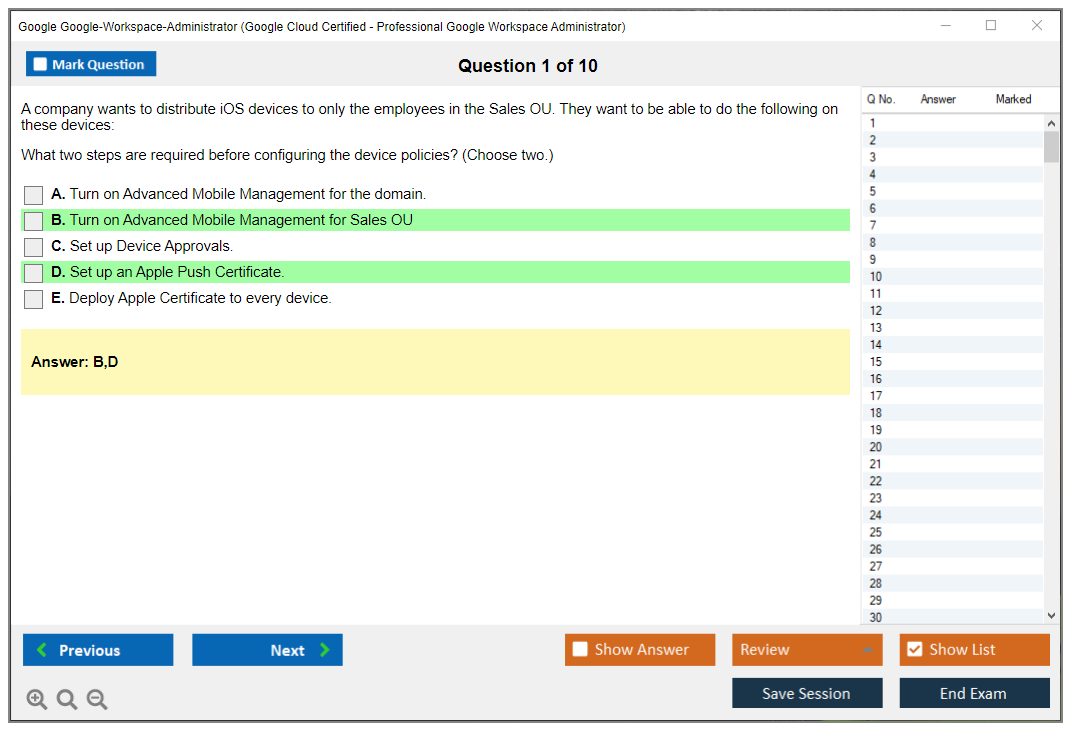
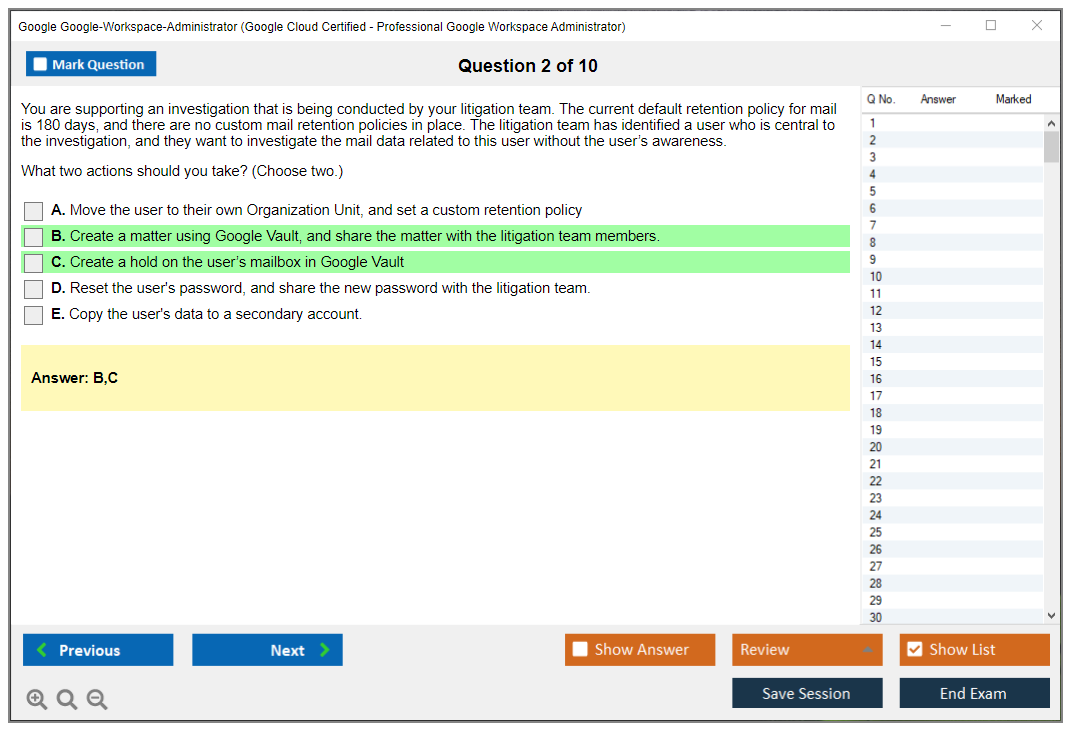
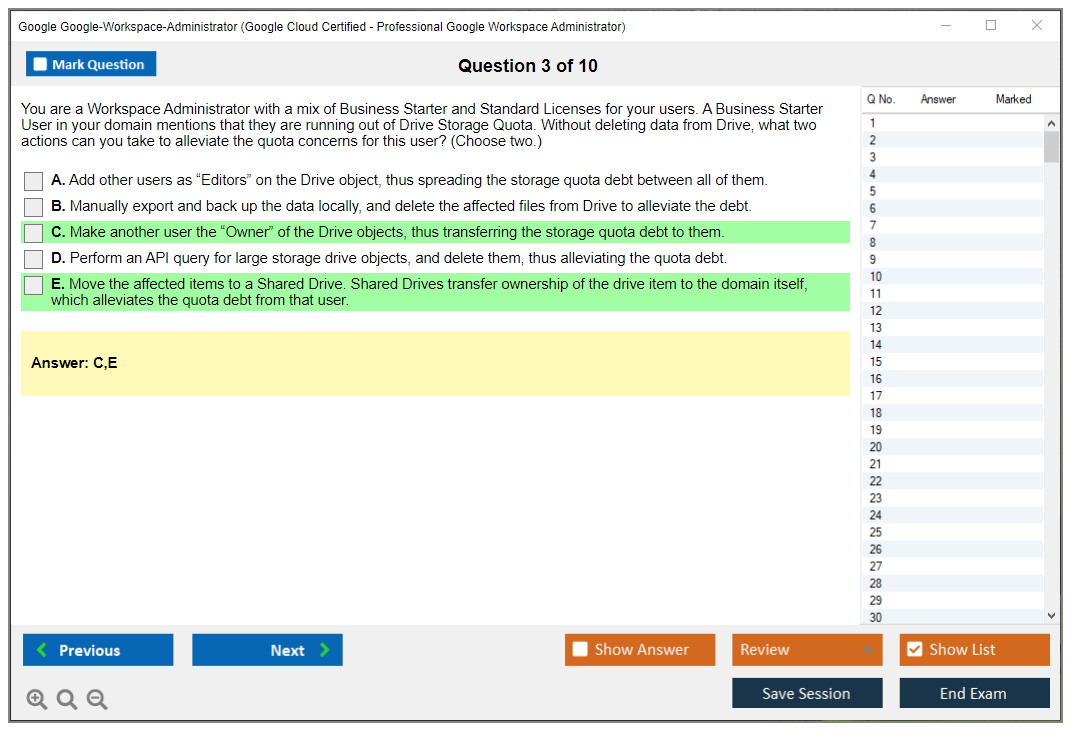
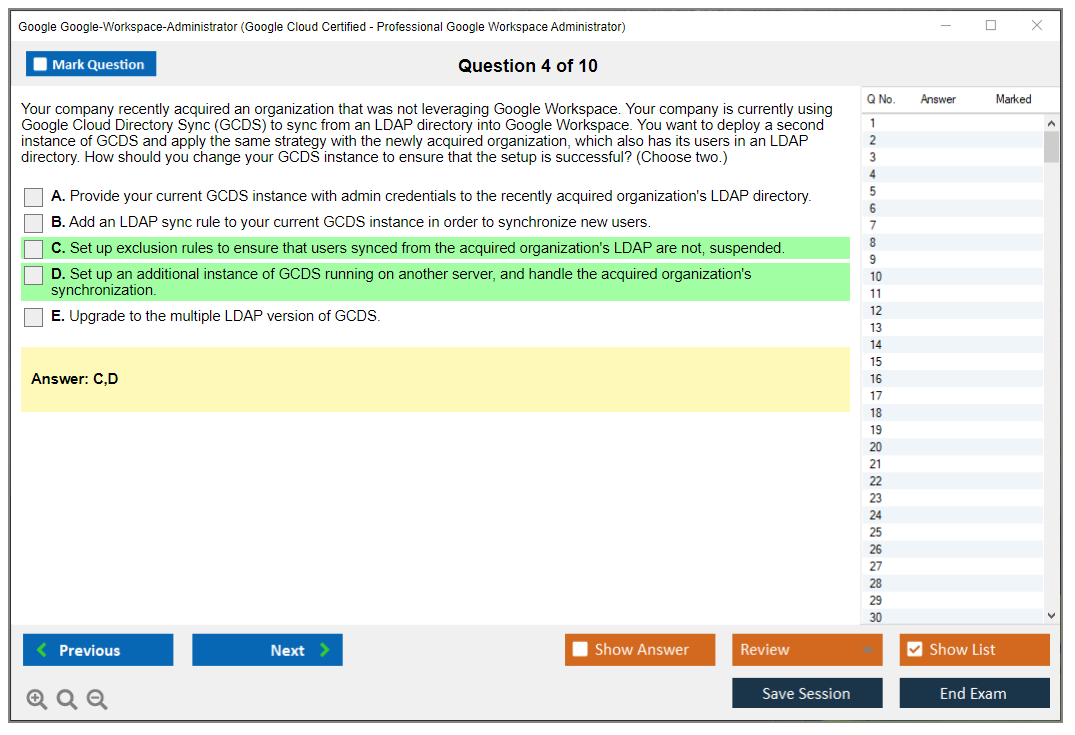
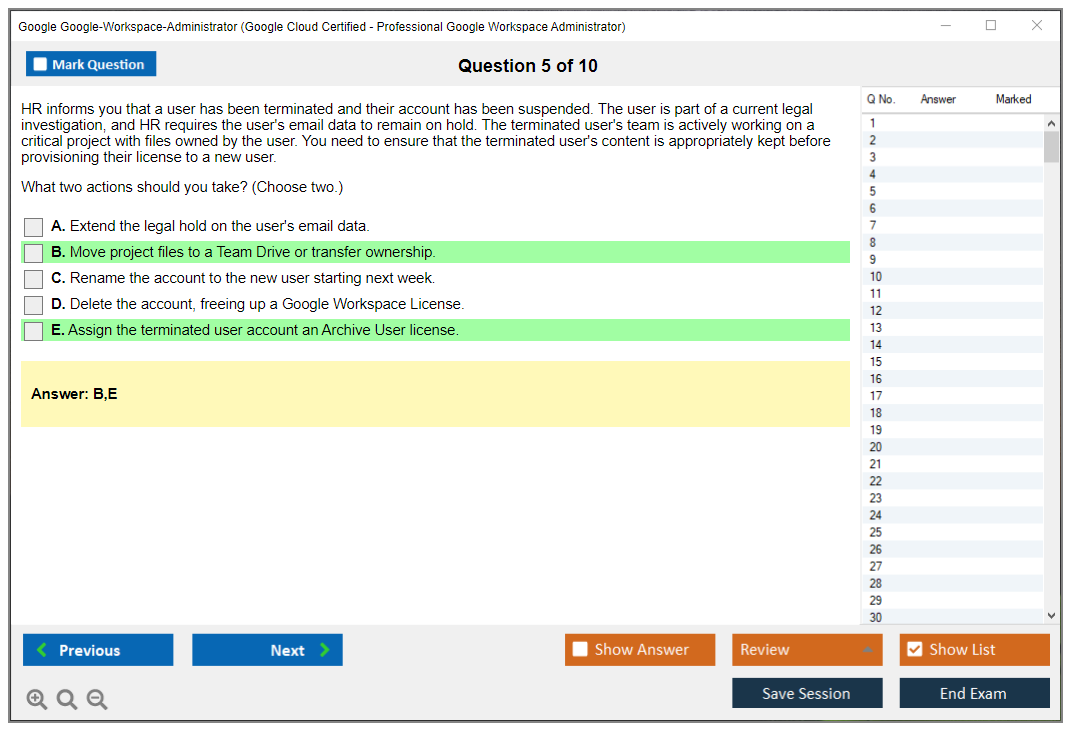
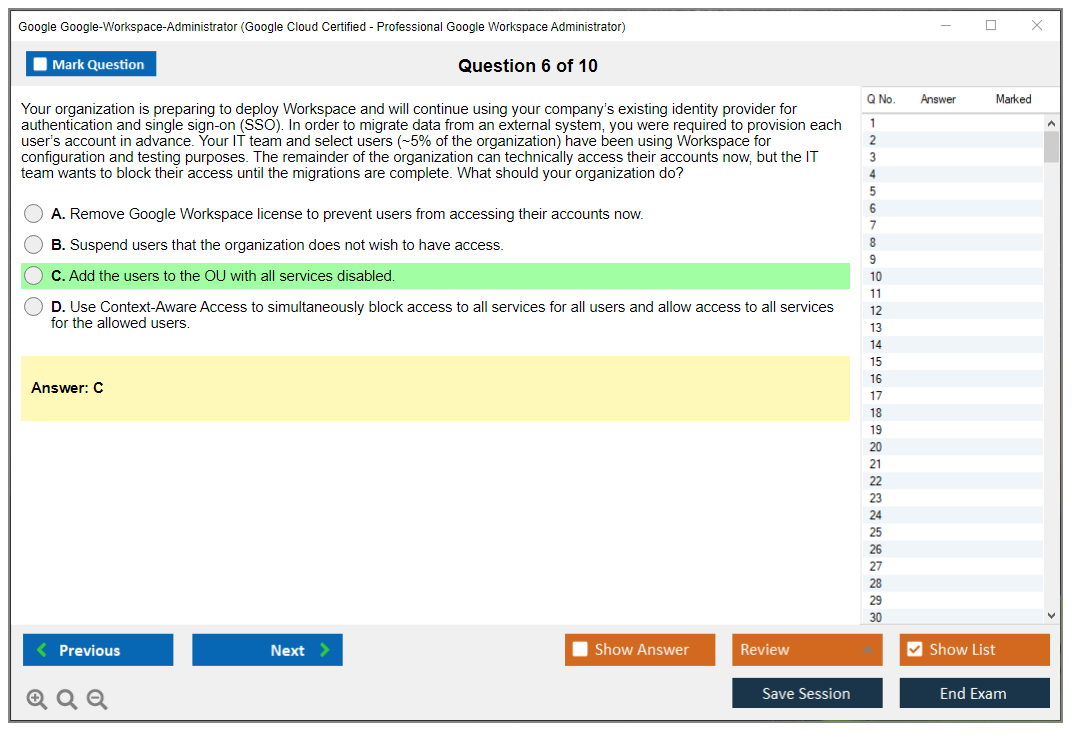
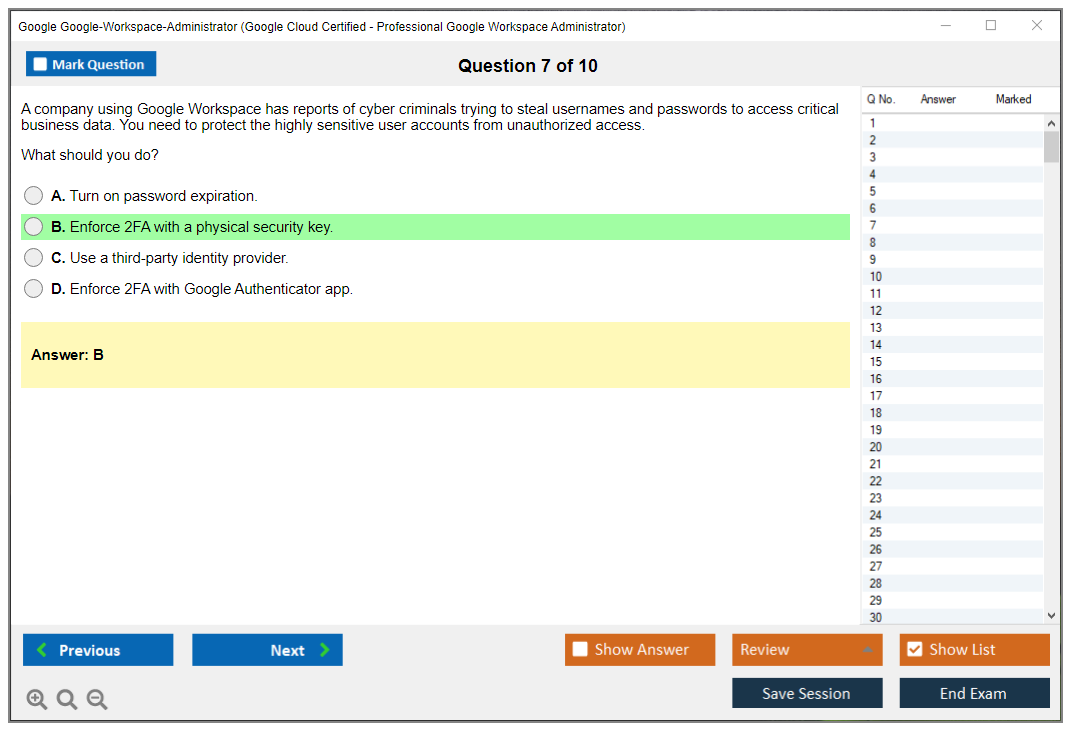
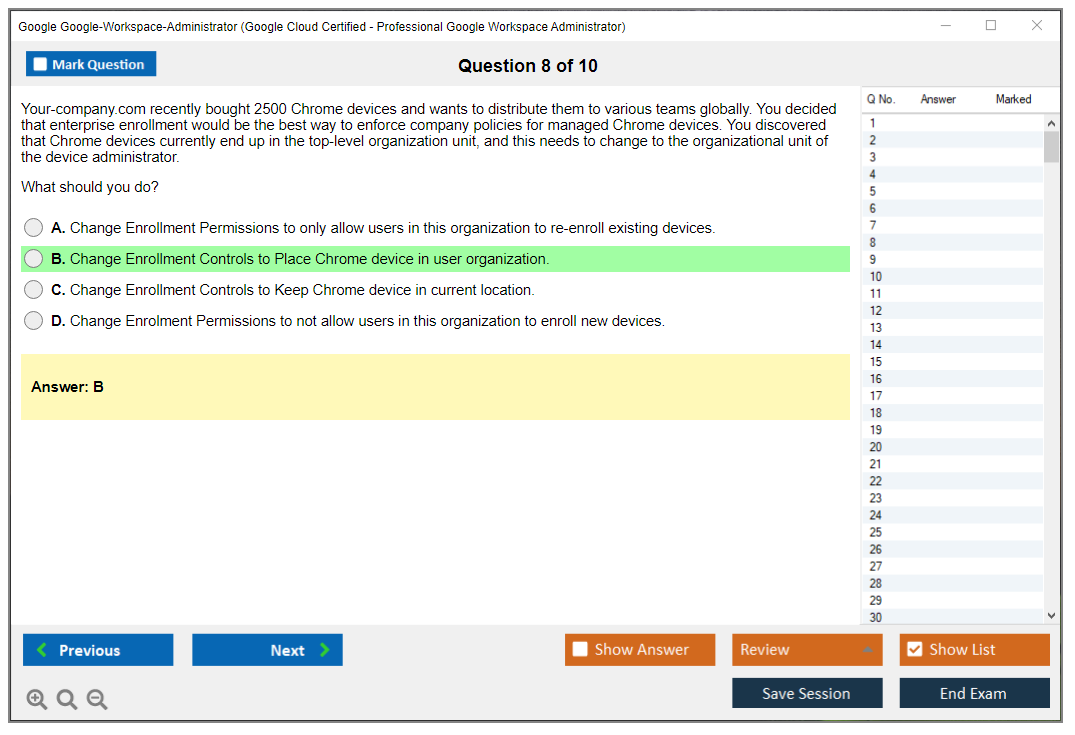
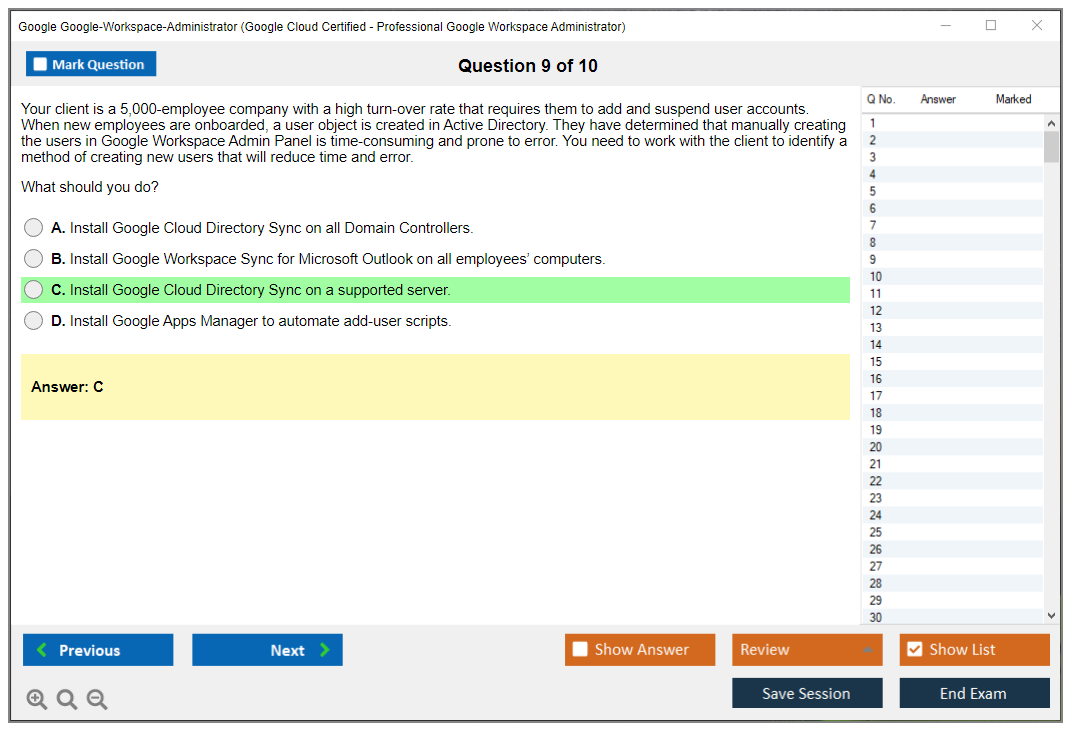
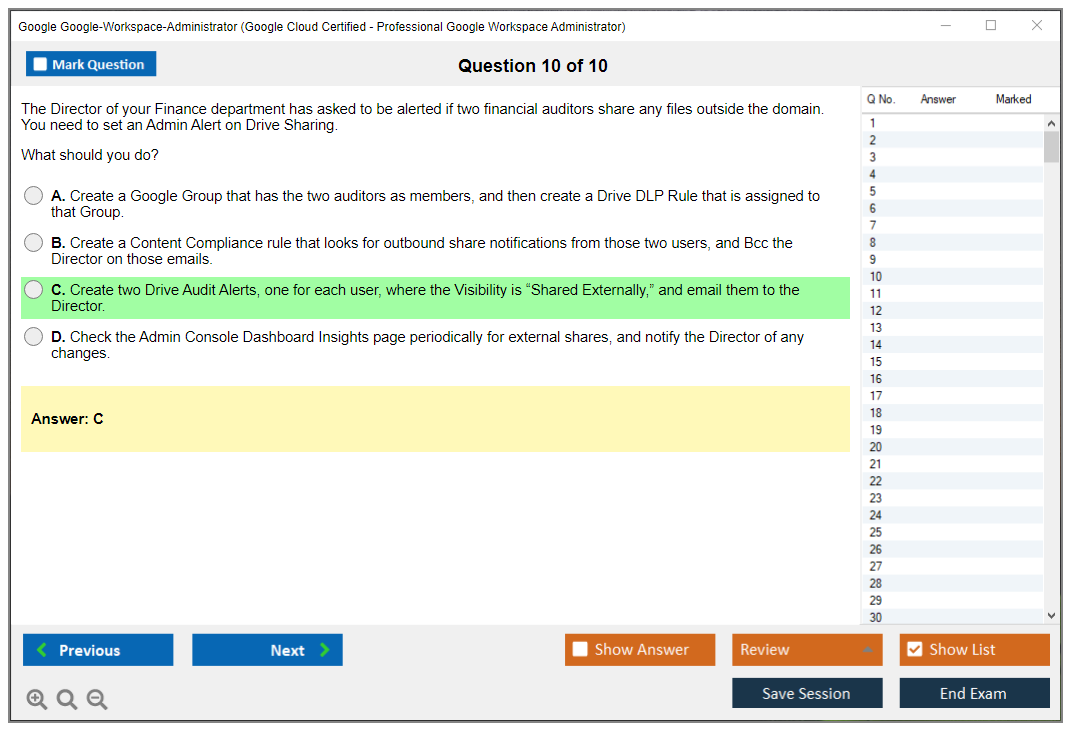
Dumpsarena Google Google Cloud Certified - Professional Google Workspace Administrator (Google-Workspace-Administrator) Free Practice Exam Simulator Test Engine Exam preparation with its cutting-edge combination of authentic test simulation, dynamic adaptability, and intuitive design. Recognized as the industry-leading practice platform, it empowers candidates to master their certification journey through these standout features.
What is in the Premium File?
Satisfaction Policy – Dumpsarena.co
At DumpsArena.co, your success is our top priority. Our dedicated technical team works tirelessly day and night to deliver high-quality, up-to-date Practice Exam and study resources. We carefully craft our content to ensure it’s accurate, relevant, and aligned with the latest exam guidelines. Your satisfaction matters to us, and we are always working to provide you with the best possible learning experience. If you’re ever unsatisfied with our material, don’t hesitate to reach out—we’re here to support you. With DumpsArena.co, you can study with confidence, backed by a team you can trust.
Google Google-Workspace-Administrator Exam FAQs
Introduction of Google Google-Workspace-Administrator Exam!
The Google Workspace Administrator exam is a certification exam designed to test and validate your ability to configure, manage, and administer Google Workspace. It covers topics such as user and group administration, security and data governance, messaging and collaboration, and more.
What is the Duration of Google Google-Workspace-Administrator Exam?
The Google Workspace Administrator Certification exam is a two-hour exam consisting of 60 multiple-choice and performance-based questions.
What are the Number of Questions Asked in Google Google-Workspace-Administrator Exam?
The Google Google-Workspace-Administrator exam consists of 60 multiple-choice questions.
What is the Passing Score for Google Google-Workspace-Administrator Exam?
Google does not publish the passing score for its Google Workspace Administrator certification exam. However, the exam is marked out of 100 and the passing score is typically 70 or higher.
What is the Competency Level required for Google Google-Workspace-Administrator Exam?
The Google-Workspace-Administrator exam requires a competency level of Intermediate. Candidates should have at least one year of experience managing users, data, and services in a Google Workspace environment. Additionally, they should also have experience managing Google Workspace services, including Gmail, Drive, Calendar, Chat, and Meet.
What is the Question Format of Google Google-Workspace-Administrator Exam?
Google Workspace Administrator exams are delivered in a multiple-choice format. Questions can include multiple-choice, multiple-answer, and drag-and-drop.
How Can You Take Google Google-Workspace-Administrator Exam?
The Google-Workspace-Administrator exam can be taken online or at a testing center. To take the exam online, you will need to create an account at the Google Cloud Platform website and purchase an exam voucher. Once you have purchased your voucher, you will be able to schedule your exam date and time. To take the exam at a testing center, you will need to contact the testing center directly to find out their exam requirements and schedule.
What Language Google Google-Workspace-Administrator Exam is Offered?
The Google Workspace Administrator Exam is offered in English.
What is the Cost of Google Google-Workspace-Administrator Exam?
The Google Workspace Administrator Exam costs $150 USD.
What is the Target Audience of Google Google-Workspace-Administrator Exam?
The Google Workspace Administrator Exam is designed for those who manage and configure Google Workspace core services for users in an organization. This includes users who are involved in the day-to-day management of Google Workspace services such as Gmail, Calendar, Drive, and other core services. It is also suitable for those who are responsible for the overall security and compliance of a Google Workspace domain.
What is the Average Salary of Google Google-Workspace-Administrator Certified in the Market?
The average salary for a Google Workspace Administrator is $72,744 per year in the United States. Salaries typically range from $50,000 to $100,000.
Who are the Testing Providers of Google Google-Workspace-Administrator Exam?
Google provides official practice tests for the Google Workspace Administrator exam. You can purchase the practice tests from the Google Cloud Platform website. The practice tests are designed to help you prepare for the exam and assess your knowledge.
What is the Recommended Experience for Google Google-Workspace-Administrator Exam?
The recommended experience for the Google Workspace Administrator Exam includes:
• Experience with managing Google Workspace users, data, and settings.
• Experience with Google Workspace Admin Console and related tools.
• Experience with Google Workspace services, including Gmail, Calendar, Drive, Sites, and Groups.
• Knowledge of Google Workspace security and compliance features.
• Experience with network and system administration.
• Experience with scripting and automation.
• Understanding of mobile device management.
• Understanding of directory synchronization tools.
What are the Prerequisites of Google Google-Workspace-Administrator Exam?
The Google-Workspace-Administrator Exam requires that applicants have at least one year of experience managing an enterprise-level G Suite or Cloud Identity domain, as well as a working knowledge of Google Cloud Platform products and services. Additionally, applicants must demonstrate an understanding of G Suite security, compliance, and data governance.
What is the Expected Retirement Date of Google Google-Workspace-Administrator Exam?
The official website to check the expected retirement date of Google Google-Workspace-Administrator exam is https://cloud.google.com/certification/workspace-administrator.
What is the Difficulty Level of Google Google-Workspace-Administrator Exam?
The Google Workspace Administrator exam is rated as an intermediate level exam. It is designed to assess the knowledge and skills of individuals who have experience administering Google Workspace.
What is the Roadmap / Track of Google Google-Workspace-Administrator Exam?
The Google-Workspace-Administrator Exam is designed to assess an individual’s ability to manage and configure Google Workspace services. The certification roadmap for this exam includes the following steps:
1. Complete the Google Workspace Fundamentals course.
2. Pass the Google Workspace Fundamentals exam.
3. Complete the Google Workspace Administrator course.
4. Pass the Google Workspace Administrator exam.
5. Earn the Google Workspace Administrator Certification.
What are the Topics Google Google-Workspace-Administrator Exam Covers?
The Google Workspace Administrator Exam covers a wide range of topics related to managing and administering a Google Workspace account. The main topics include:
1. Google Workspace Core Services: This topic focuses on the core services of Google Workspace such as Gmail, Calendar, Drive, and Docs. It covers topics such as configuring settings, managing users and groups, and troubleshooting.
2. Security: This topic covers security best practices for Google Workspace, including setting up two-factor authentication, enforcing password policies, and managing access to data.
3. Mobility: This topic covers managing mobile devices and applications in Google Workspace. It includes topics such as configuring mobile device management, setting up mobile device policies, and managing mobile app access.
4. Reporting and Analytics: This topic covers reporting and analytics in Google Workspace. It includes topics such as setting up reports and dashboards, analyzing usage data, and troubleshooting.
5
What are the Sample Questions of Google Google-Workspace-Administrator Exam?
1. How can a Google Workspace Administrator control access to Google Drive files?
2. What are the various ways to manage user accounts in Google Workspace?
3. How can a Google Workspace Administrator monitor user activity in Google Workspace?
4. How can a Google Workspace Administrator set up mobile device management policies?
5. What are the best practices for securing Google Workspace data?
6. What are the various ways to manage user access to Google Workspace?
7. How can a Google Workspace Administrator troubleshoot common issues with Google Workspace?
8. What are the different methods for backing up Google Workspace data?
9. How can a Google Workspace Administrator manage user access to Google Apps?
10. What are the different methods for auditing Google Workspace data?
Google Google-Workspace-Administrator (Google Cloud Certified - Professional Google Workspace Administrator) Google Cloud Certified, Professional Google Workspace Administrator: Overview Google Cloud Certified, Professional Google Workspace Administrator: Overview This cert matters. The Professional Google Workspace Administrator certification isn't just some cloud badge you slap on your LinkedIn profile hoping recruiters notice. It's Google's way of proving you actually understand how to operate their productivity suite at massive enterprise scale, not just click through the admin console praying you don't accidentally break email for three thousand users while the CEO's in the middle of a board presentation. This certification validates full expertise in deploying, configuring, and managing Google Workspace services across enterprise environments. We're talking organizations with hundreds or thousands of users where one wrong configuration setting can tank an entire department's... Read More
Google Google-Workspace-Administrator (Google Cloud Certified - Professional Google Workspace Administrator)
Google Cloud Certified, Professional Google Workspace Administrator: Overview
Google Cloud Certified, Professional Google Workspace Administrator: Overview
This cert matters.
The Professional Google Workspace Administrator certification isn't just some cloud badge you slap on your LinkedIn profile hoping recruiters notice. It's Google's way of proving you actually understand how to operate their productivity suite at massive enterprise scale, not just click through the admin console praying you don't accidentally break email for three thousand users while the CEO's in the middle of a board presentation.
This certification validates full expertise in deploying, configuring, and managing Google Workspace services across enterprise environments. We're talking organizations with hundreds or thousands of users where one wrong configuration setting can tank an entire department's productivity for the day. The exam proves you can handle real-world complexity that comes with managing Gmail, Drive, Calendar, Meet, Chat, and all those other services making up the Workspace ecosystem.
Security's massive here.
The certification validates your ability to implement security controls, access policies, and compliance frameworks within Google Workspace. I mean, this is literally where organizations dump their most sensitive communications and proprietary data, so Google wants confirmation you can lock things down properly. Wait, that reminds me of this one client who insisted on giving everyone admin access because "it was easier." Took us three weeks to clean up that mess after someone deleted half the shared drives. Anyway, two-step verification, context-aware access, data loss prevention, all that security infrastructure you need preventing executives from accidentally broadcasting confidential merger documents to every single person in the company directory.
User lifecycle management gets tested heavily. From provisioning fresh accounts through the offboarding process when people leave, you've gotta demonstrate capability handling diverse organizational structures. Think mergers, departmental reorganizations, contractors versus full-time employees. Complexity multiplies fast.
You'll also prove proficiency troubleshooting complex issues using audit logs, reporting tools, and Google support resources. The troubleshooting scenarios can be absolutely brutal because they often combine multiple service interactions creating these nightmare situations. A user can't access a shared Drive file. Is it sharing permissions, organizational unit policies, license assignment, or something completely different you haven't even considered yet?
Endpoint management's another major domain. Mobile devices, ChromeOS deployments, browser policy enforcement across different operating systems. Organizations need administrators understanding how to manage the entire endpoint ecosystem, not just cloud services floating somewhere in Google's data centers.
Data governance matters more every year with regulations piling up like dirty dishes during finals week. The certification verifies knowledge of retention policies, eDiscovery procedures, and Data Loss Prevention implementation. If your legal team needs preserving and searching email for some lawsuit, you better know how to use Vault properly without accidentally destroying evidence or violating preservation orders.
Migration expertise gets validated too. Recognizes your capability designing and executing migration strategies from legacy systems to Google Workspace. Whether it's Microsoft Exchange, IBM Notes, or some ancient on-premises system running on hardware from 2008, you need understanding the migration tools and methodologies that won't result in data loss or weeks of email downtime.
Hybrid identity scenarios come up constantly in enterprise environments. The certification demonstrates understanding of single sign-on configurations and directory integration patterns. Most large organizations aren't running pure Google Cloud identity. They're integrating with Active Directory, Okta, or other identity providers their security teams insisted on keeping.
Finally, the certification validates skills in change management, user training coordination, and stakeholder communication for Workspace initiatives. Technical skills alone won't cut it. You've gotta communicate effectively with executives who barely understand email attachments, train end users who resist any change whatsoever, and manage organizational change that comes with platform transitions nobody really wanted but someone in leadership decided was happening anyway.
Who should take this exam (target roles)
Google Workspace Administrators managing day-to-day operations for organizations of 100+ users are the primary audience. If you're already in this role or moving into it, this certification makes sense. Below that user count, you probably won't encounter enough complexity justifying the exam cost and preparation time investment.
IT administrators transitioning from Microsoft 365, on-premises Exchange, or other collaboration platforms to Google Workspace definitely benefit from structured learning. The certification provides organized education for platform differences and proves you've adapted your skills. I've seen Exchange admins absolutely struggle with Workspace's different mental model. The certification process forces thinking Google's way instead of applying old Microsoft assumptions.
System administrators responsible for identity management, security policies, and compliance in cloud environments should consider this seriously. Cloud engineers focusing on SaaS administration and Google Cloud Platform integration with productivity tools also fit well here. The certification complements infrastructure-focused Google Cloud certs if you're building full skillset across Google's offerings.
IT consultants and solution architects designing Google Workspace deployments for enterprise clients can charge more with this credential on their resumes. Security professionals implementing access controls, threat protection, and data governance in collaborative environments need the specific Workspace knowledge this certification validates beyond general security principles.
Compliance officers and auditors working with Google Workspace data retention, eDiscovery, and regulatory requirements sometimes pursue this to better understand platform capabilities instead of relying entirely on what IT tells them. Technical support specialists providing advanced troubleshooting for Google Workspace users and administrators improve effectiveness with certification-level knowledge versus just Googling error messages.
Project managers overseeing Google Workspace migrations, rollouts, or major configuration changes gain credibility even without being hands-on administrators clicking through settings daily. MSPs offering Google Workspace administration as part of their service portfolio often require or strongly push certification for technical staff representing their expertise to clients.
Career benefits and professional recognition
Real talk here.
This certification differentiates candidates in competitive job markets where Google Workspace adoption continues accelerating faster than most people expected five years ago. When you're competing against other candidates with similar years of experience and comparable LinkedIn profiles, the certification breaks the tie decisively.
It provides formal validation of skills that employers specifically seek when hiring Workspace administrators for enterprise environments. Job descriptions list this certification as preferred or required, especially for positions managing deployments over a thousand users. Opens opportunities for higher compensation, with certified professionals often commanding 15-25% salary premiums compared to non-certified peers in similar roles doing identical work.
The certification establishes foundation for advanced Google Cloud certifications and broader cloud career pathways beyond just productivity tools. Many professionals use this as their entry point into the Google Cloud ecosystem before pursuing the Professional Cloud Architect or Professional Cloud Security Engineer credentials requiring deeper infrastructure knowledge.
Consultants can charge premium rates.
Consultants can charge premium rates and win contracts requiring certified expertise on the project team. I've worked with consulting firms that won't even submit proposals for Workspace deployments without certified staff on the roster because clients explicitly require it in RFPs. Creates networking opportunities through Google Cloud certified professional communities and events where you connect with other professionals facing similar challenges in different industries.
Look, it demonstrates commitment to professional development and staying current with cloud technologies that change quarterly. That matters when managers evaluate promotion candidates or consider who gets challenging new projects with visibility to senior leadership. Provides confidence tackling complex enterprise deployments and high-stakes troubleshooting scenarios without constantly second-guessing your decisions or calling Google support for basic issues.
The certification enhances credibility when presenting recommendations to stakeholders, executives, and technical teams who question everything. Instead of "I think we should configure it this way based on experience," you're bringing certified expertise to the table backed by Google's validation. Positions professionals for leadership roles in IT departments focused on cloud-first strategies abandoning traditional on-premises infrastructure.
How this certification fits within the Google Cloud certification ecosystem
This certification sits alongside other Google Cloud professional-level certifications but focuses specifically on Workspace rather than GCP infrastructure like compute or storage. That's an important distinction people sometimes miss. You won't find much about Compute Engine, Cloud Storage buckets, or Kubernetes cluster management here.
It complements the Associate Cloud Engineer, Cloud Architect, and Cloud Security Engineer certifications for full Google Cloud expertise spanning productivity and infrastructure. Some professionals pursue multiple certifications demonstrating breadth across Google's cloud offerings to employers and clients.
It is an entry point for IT professionals transitioning to cloud administration without requiring deep GCP infrastructure knowledge about networking or containers. You don't need understanding VPCs, load balancers, or container orchestration succeeding with Workspace administration. The barrier to entry's lower than infrastructure-focused certifications requiring development experience.
The certification fits with Google's vision of integrated cloud services spanning productivity tools and technical infrastructure they're bundling together more aggressively. Google positions Workspace and GCP as complementary parts of unified cloud strategy rather than separate product lines managed by different teams.
Provides a pathway.
It provides a pathway for Workspace specialists to expand into broader Google Cloud Platform services over time as their careers develop. Starting with Workspace administration builds familiarity with Google's management interfaces, identity concepts, and support processes that transfer to other Google Cloud services sharing similar architectural patterns.
Google Cloud partners recognize this as a qualifying credential for partnership tiers and specializations unlocking marketing benefits. Partner organizations often require specific numbers of certified professionals across different certification tracks maintaining partnership status. It's valued by organizations seeking Google Workspace Enterprise Plus deployments requiring certified administrator oversight per licensing agreements.
The certification appears in job postings for roles managing Google Workspace at scale beyond small business deployments. It complements vendor-neutral certifications like CompTIA, ITIL, or ISC2 credentials with specific Google platform expertise employers need. The combination of vendor-neutral and vendor-specific certifications demonstrates both broad IT knowledge and deep platform expertise that generalists lack.
This certification represents growing recognition that SaaS administration requires specialized knowledge comparable to infrastructure management, not just basic troubleshooting. The days of treating Workspace administration as something anyone with basic IT skills can handle by watching YouTube tutorials are over.
Key statistics and market context for the certification in 2026
Google Workspace serves over 10 million paying businesses globally, creating sustained demand for certified administrators who actually know what they're doing. That's not counting free Gmail users or education accounts, just paying business customers who need professional administration preventing disasters.
Organizations average 2-3 certified Workspace administrators per 1,000 users in enterprise deployments based on staffing patterns I've observed across industries. Smaller organizations might have one admin juggling everything, while large enterprises build teams of specialists focusing on security, devices, or compliance separately.
Job postings mentioning Google Workspace Administrator skills increased 40% year-over-year from 2023-2025 according to job market data aggregators tracking IT positions. Remote work trends continue driving sophisticated Workspace deployments requiring professional-level administration expertise beyond basic user provisioning. Organizations that previously managed with basic configurations now need advanced security controls, device management policies, and compliance features they didn't even know existed.
Hybrid work models create complex security and device management scenarios that certified administrators are specifically trained handling through exam preparation. Employees working from corporate offices, home offices, coffee shops, and client sites on personally-owned and corporate devices present challenges requiring sophisticated policy frameworks balancing security and usability.
Regulatory compliance requirements like GDPR, HIPAA, and CCPA make certified expertise valuable for legal risk mitigation organizations can't ignore. Organizations face serious consequences for data breaches, improper data retention, or failed eDiscovery responses during litigation. Certified administrators understand compliance tools and best practices preventing expensive mistakes.
Google's continued feature releases (AI capabilities, advanced security tools, enhanced collaboration features) ensure certification content remains relevant instead of becoming outdated. The exam gets updated regularly reflecting new Workspace capabilities and administration approaches Google develops.
Pass rates hover around this.
Pass rates for the Professional Google Workspace Administrator exam typically range 60-70%, indicating meaningful difficulty and value versus rubber-stamp certifications everyone passes. It's not a certification you pass just by showing up and clicking random answers. The exam requires both knowledge and practical experience succeeding consistently.
The market context in 2026 shows no signs of Workspace adoption slowing down despite economic uncertainties affecting IT budgets. Organizations continue migrating from legacy systems, and those already on Workspace keep expanding usage of advanced features they initially ignored. That creates ongoing demand for administrators who can implement and manage those capabilities at professional levels organizations require.
Exam Details: Format, Cost, Passing Score, and Scheduling
Exam details: format, cost, passing score, and scheduling
If you're aiming for the Google Workspace Administrator certification, the logistics matter more than people admit. Not the glam stuff. The boring stuff. Because the exam is professional-level, and the fastest way to blow a solid prep plan is showing up with the wrong ID name, booking the wrong delivery option, or misunderstanding how multi-select scoring works.
Also. Two hours goes fast. Really fast. Faster than you think.
The Professional Google Workspace Administrator exam is built around practical admin judgment, not trivia, and that changes how you should think about format, cost, passing, and scheduling. You're not getting asked "what is Vault" like it's a flashcard. Honestly, you're getting asked something like "your legal team needs retention for a specific OU but not contractors, and you also have to avoid breaking Drive sharing for a partner domain, what do you change first and where do you verify it," which is where people who only read docs get wrecked.
Exam format (questions, length, delivery)
The exam typically comes in at about 50 to 60 questions, and they're a mix of multiple-choice and multiple-select. Multiple-select's the sneaky part. There's no partial credit, so if it says "choose two" and you pick one right and one wrong? You get zero for that question. Harsh. Normal for cert exams. Still harsh.
Two hours. No pause button. Plan your pacing.
You get a 2-hour time limit, which works out to roughly 2 to 2.5 minutes per question if you do the math, but the thing is it's not evenly distributed because some questions are one-liners and some are mini incident reports with enough context to feel like a ticket that got dumped on you at 4:55 PM on a Friday. Scenario questions eat time, and the exam leans into them, because Google wants to know you can manage Google Workspace users and groups, lock down access, and keep services working without randomly torching productivity.
Expect scenario-based prompts. Tons of "you are the admin for a 2,000-user org" type setups. You'll be asked to apply policies, interpret what a setting does, and pick the option that solves the problem with the least collateral damage. Look, memorizing menu paths helps, but the exam's more about understanding what happens next, like how a change in sharing settings interacts with Gmail and Drive security settings, or what happens when you enforce 2-step verification while half the company still uses legacy IMAP clients.
Questions span all the Google Workspace Administrator exam objectives, but there's usually a noticeable emphasis on the stuff that breaks real companies when it's misconfigured.
Security. Identity. Core services.
That means you should expect heavier weight on security, user management, and service configuration, even though the blueprint covers more. You'll likely see questions about context-aware access, OAuth app controls, admin roles, external sharing, retention rules, and troubleshooting deliverability or access issues. Some prompts include screenshots of the Admin console, audit log snippets, or configuration screens. Not every question, but enough that you should be comfortable recognizing what you're looking at quickly.
Troubleshooting shows up too. Sometimes as multi-step logic, where the "right" answer's basically the best next action. Like, verify a log first, confirm scope (OU vs group), then adjust policy, then test with a pilot user. That kind of flow. The exam writers love that because it filters out people who change settings blindly.
One thing people overthink is penalties. There's no penalty for incorrect answers, so you should attempt everything. No hero points for leaving blanks. If you're down to two options, pick one and move on.
Delivery-wise, this is computer-based testing through Kryterion, either at a testing center or via remote proctoring. The exam's available in English, and other language options can exist depending on region and demand, but don't assume. Check during registration so you don't get stuck on exam day with a language mismatch.
If you're the kind of person who wants extra reps before sitting for the real thing, a Google Workspace Administrator practice test can help with timing and question style. And yeah, I'm a fan of doing at least one timed run. I've seen people use the Google-Workspace-Administrator Practice Exam Questions Pack as a pacing tool more than a "memorize questions" thing, which is the right mindset if you don't want surprises.
Exam cost (price, taxes/fees, retake policy considerations)
The Google Workspace Administrator exam cost is straightforward on paper: $200 USD for a standard attempt. That's consistent with other Google Cloud professional-level exams like Cloud Architect and Data Engineer. In practice, the final amount can shift a bit depending on where you live, currency conversion, and whether your testing location adds taxes or local fees.
Two hundred dollars. Not nothing. Not insane either.
Payment during registration's typically by major credit card. Visa, MasterCard, American Express, the usual. There's no membership fee, no subscription, no "pay us monthly for access to the privilege of booking." You pay per attempt. That's it.
Now the annoying part. Retakes. If you fail, the retake policy normally requires you to wait 14 days before trying again, and you pay the full fee again. So if you're treating attempt one as a "warm-up," you're basically lighting money on fire. Not gonna lie, I've seen people do it, and then they're stressed because they have to wait two weeks and their employer reimbursement window's weird.
Cancellations and no-shows matter too. If you cancel too late, typically less than 72 hours before the scheduled time, you can lose the fee. No-show's usually a total loss. That's one of those policies you assume won't apply to you until your kid gets sick or your flight's delayed or your internet decides to cosplay as dial-up.
I had a buddy who scheduled his exam for a Tuesday morning, confident he'd be fine. Woke up Monday night with food poisoning. Tried to reschedule at 2 AM, already past the window. Lost the full two hundred bucks and had to wait another two weeks feeling like an idiot. Now he books everything with a four-day buffer and won't shut up about it at happy hour.
Vouchers exist, but they're not guaranteed. Sometimes Google Cloud training partners offer vouchers, and orgs doing volume certification pushes can get discounts. If you're at a mid-size or enterprise shop, ask your manager or enablement team if there's a corporate program. Plenty of companies'll cover it through professional development budgets, and the Google Workspace Administrator certification is an easy sell if your job touches email, identity, endpoint controls, or compliance.
And yeah, compared to training courses that run $1,500 to $3,000, the exam fee's pretty accessible. The exam's the cheap part. The expensive part's your time, especially if you're building hands-on skills around Workspace compliance and auditing and device policies while also handling real tickets.
If you want to spend a little to reduce risk? I mean, I'm fine with that. A decent Google Workspace Administrator study guide plus a timed question bank can prevent the "I didn't realize how picky multiple-select would be" moment. I've seen candidates pair official docs with the Google-Workspace-Administrator Practice Exam Questions Pack and treat it like a checklist for weak areas, which is a much healthier approach than trying to brute-force memorize.
Passing score (what Google publishes vs. what candidates should know)
The thing everyone asks: the Google Workspace Administrator passing score. Google does not publicly disclose an exact number. No "you need 72%." No "you need 43 correct." You get a Pass/Fail result, and that's basically it.
No number. No percentile. Just outcome.
Scoring's typically scaled, meaning the exam accounts for question difficulty across different versions so the standard stays consistent even when the question pool rotates. That's why comparing your experience to someone else's can get weird. You might get more heavy scenario questions while they got more straightforward ones.
You'll see a lot of people estimate the passing threshold in the 70 to 75% range. That's an industry vibe, not an official statement. Treat it like gossip you can use for motivation, not a target you should aim at. If you prep to barely pass, you'll probably fail, because scaled scoring and weighted domains don't care about your spreadsheet math.
Also, not all questions are equal. Some questions can carry more weight, especially complex scenarios. Security-heavy items often feel like they matter more, and even if the weighting isn't visible, that's where "professional-level expectations" show up. If you're shaky on admin roles, OAuth controls, 2SV enforcement, SSO implications, and alerting? You're playing on hard mode.
Multiple-select rules matter here again: no partial credit. You must select all correct options and avoid incorrect ones. That alone's why borderline readiness is risky. Anecdotally, people who feel like they're landing 80%+ in practice tend to pass, and people who are hovering around "I think I'm at 65 to 70%" are in the danger zone.
Failing candidates usually get diagnostic feedback by domain, like "needs improvement in security." It's not super detailed, but it's enough to guide your next pass through the Google Workspace Administrator exam objectives. If you do fail, take that feedback seriously and go hands-on, because the exam punishes shallow recognition. You need to be able to explain why a policy belongs at the OU level, when a group's better, and what logs you'd check when something breaks.
How to register and schedule (testing options, ID requirements)
Registration starts at webassessor.com/googlecloud, which is Google's official exam platform. You create an account, fill in your details, and pick the exam. Use accurate info. The name on your account needs to match your ID exactly, and I mean exactly, because testing centers can and will deny you if it doesn't match.
No exceptions. No refunds. Fix it early.
When you search for the Professional Google Workspace Administrator exam, you'll choose delivery: testing center or online proctored. Testing centers are Kryterion locations. You can search by city or postal code, see available dates, and choose a slot. The common slots are morning and early afternoon on weekdays, with some Saturday availability depending on location.
Remote proctoring's the flexible option. Often 24/7 availability in many regions. It's great if you work odd hours or live far from a center, but it comes with rules that people underestimate. You need stable internet, a webcam, a microphone, and a private space. You'll do a system check, and you'll likely have to do a room scan. Clean desk. Closed door. No extra monitors. No "my roommate will be quiet." They mean alone.
Schedule at least 24 to 48 hours ahead if you can, but if you want a popular time, plan 1 to 2 weeks out. End-of-quarter gets busy because teams try to hit goals. Same with early January because everyone's on the "new year new cert" kick.
The confirmation email matters. It includes date, time, location or remote instructions, and ID requirements. Read it. Print it if you're anxious. Save it somewhere you can reach without logging into five different accounts.
Exam day requirements and what to expect at the testing facility
Testing center day's pretty standardized. Show up 15 minutes early. Earlier if you get stressed by traffic. You'll check in, show your government-issued photo ID (driver's license, passport, national ID), and the proctor'll verify your details. Your ID name must match your registration name. If it doesn't, you may get turned away.
Then you stash your stuff. Phone, bag, notes, smartwatch, anything remotely "smart." Lockers are provided. You don't bring reference materials into the room. The center usually gives you a laminated noteboard or scratch paper. That's what you get.
Some centers do biometric verification like a palm scan or photo. Don't take it personally. It's anti-proxy testing. Proctors monitor you on camera, and if you're constantly looking away or, wait, am I allowed to say this? Mumbling, they might warn you. Honestly, if you tend to read questions out loud, train yourself out of it before exam day.
Remote proctoring has its own stressors. Do the system check at least 30 minutes before. You'll share your screen, show your workspace, and you need a quiet room. Bathroom breaks can be allowed, but the clock keeps running, and too many breaks can trigger additional checks. Keep water nearby. Handle your setup beforehand.
Results usually show up within 7 to 10 business days in your Webassessor dashboard and via email. If you pass, you'll get a digital certificate and badge, often within a couple weeks. Physical certificates generally aren't the default anymore.
If you want to stack the odds in your favor right before the exam, do one last timed run with something like the Google-Workspace-Administrator Practice Exam Questions Pack and focus on why you missed items, not just what you missed. The exam's about judgment under time pressure, and the fastest improvement usually comes from tightening your mental model around policies, scope, and troubleshooting order, especially across endpoint and device management in Google Workspace where settings can be deceptively "one click" but have big blast radius.
That's the deal. Format's scenario-heavy, cost's predictable but retakes sting, the passing score's opaque, and scheduling's easy until you ignore the details. Get the boring logistics right, and you can spend your brainpower on the part that matters: being the admin who can keep a Workspace tenant secure and functional without breaking everyone's Monday morning.
Exam Objectives (Domains) for Professional Google Workspace Administrator
User lifecycle management (accounts, groups, org units)
This is huge. You'll spend maybe 40% of your admin time here, and the exam really digs into this domain because if user management falls apart, everything else crumbles too.
Creating user accounts seems straightforward, right? Just click a button. But the exam wants you understanding the massive difference between manually adding individual users versus executing bulk CSV uploads when you're onboarding, say, 500 new employees all at once. The CSV format gets screwed up because someone added an extra column without updating the headers and suddenly you've got users scattered across completely wrong organizational units with broken email aliases and you're spending the next six hours untangling that mess.
You need understanding user profile attributes way beyond name and email. Custom fields become critical when you're tracking employee ID numbers, cost centers, building locations. All that stuff HR insists on synchronizing. Email aliases get tested constantly. The exam throws scenarios where someone needs multiple email addresses pointing to one account.
Google Cloud Directory Sync is massive for this domain. Coming from an Active Directory environment? GCDS automates provisioning instead of manual account creation. The exam will test whether you understand sync rules, attribute mapping, sync frequency, what happens when someone gets deleted in AD versus just suspended. This is where tons of candidates struggle because they haven't actually deployed GCDS in production environments.
Groups are trickier than most people realize. Distribution lists for email. Security groups for access control. Collaborative inboxes that function like shared mailboxes. The exam expects you knowing dynamic groups with membership rules based on attributes like department or location. Setting up a group that automatically adds everyone in the Sales OU sounds simple until you realize you need excluding contractors while including remote sales people from different OUs.
Organizational unit design matters a lot.
You can structure by geography (North America OU, EMEA OU), by department (Sales, Engineering, Finance), by security level (Executives, Standard Users, Contractors). The exam throws scenarios where you're applying different policies at different OU levels and understanding inheritance patterns. Set a policy at the root OU? It flows down to child OUs unless you explicitly override it lower down.
Policy application through OU hierarchy gets tested heavily. You might need Gmail external sharing blocked at root but enabled for Marketing OU. Or Drive external sharing completely locked down for Finance but wide open for Sales. Understanding how settings inherit and override is key.
User offboarding gets tested from security AND compliance angles. Someone leaves. Do you suspend first or delete immediately? How do you transfer ownership of their Drive files and Calendar events? What about email delegation so their manager accesses their inbox? The exam wants you knowing the proper sequence and why it matters for data retention and legal holds.
License management across different Workspace editions trips people up constantly. You might have Business Starter for contractors, Business Standard for most employees, Business Plus for executives who need Vault and advanced security features. The exam tests whether you know which features come with which license and how to assign add-on services like Voice or AppSheet.
Delegated administration is about distributing management tasks without giving everyone super admin privileges. You create custom roles with specific permissions like "can reset passwords for Sales OU" or "can manage groups but not delete users." The exam loves scenario questions where you're designing least-privilege admin roles for help desk staff or department managers.
Password policies and account security get tested alongside 2SV but belong in lifecycle management too. How long before passwords expire? Can users reuse their last five passwords? What recovery options do you enable: security questions, phone numbers, recovery email addresses?
Troubleshooting user access issues? That's where theory meets practice on the exam. User can't access Gmail? Check their license. Check if they're suspended. Check which OU they're in and what policies apply. Are they in a security group blocking access? The exam gives you symptoms and you diagnose the root cause.
Service configuration (Gmail, Drive, Calendar, Meet, Chat)
Look, this domain covers the actual Workspace applications and there's so much depth here. Gmail configuration alone could be half the exam.
Email routing rules are fundamental.
Inbound routing for handling mail from the internet, outbound routing for sending through specific gateways or third-party archiving services. Content compliance rules that scan messages for keywords and quarantine or reject them. The exam gives you business requirements and asks you designing the routing rule configuration.
Email authentication with SPF, DKIM, and DMARC prevents spoofing and improves deliverability. You need knowing what each one does. SPF lists which servers can send email for your domain. DKIM adds cryptographic signatures to outbound messages. DMARC tells receiving servers what to do if SPF or DKIM fail. The exam tests whether you can troubleshoot authentication failures and understand the DNS records involved.
Advanced Gmail settings include delegation where one user accesses another's mailbox, vacation responders with date ranges and custom messages, email retention through Vault integration. The exam expects you knowing how these interact with organizational policies.
Drive sharing settings control the entire collaboration model. Can users share files externally? With anyone who's got the link or only specific domains? What's the default access level: view, comment, or edit? You configure these at OU level and the exam tests complex scenarios where different departments need different sharing policies based on data sensitivity.
Shared drives replaced Team Drives and function differently than My Drive. They're owned by the organization not individuals so when someone leaves their shared drive content stays accessible. You manage membership, set access levels, configure content management policies like preventing editors from changing access and sharing settings. The exam covers when to use shared drives versus regular Drive folders.
Calendar resource management for conference rooms and equipment gets tested more than you'd expect. Setting up building hierarchies, managing auto-acceptance rules, handling conflicts, working hours for different time zones. I've seen exam questions about troubleshooting why a conference room isn't appearing in autocomplete or why bookings aren't being accepted. A colleague once spent three days debugging a phantom "VIP Conference Room" that kept appearing in searches but didn't actually exist. Turned out someone had created a resource, deleted it improperly, and left orphaned data floating in the directory.
Meet configuration includes recording permissions which become important for compliance. Who can record meetings? Where are recordings stored? What about dial-in numbers for PSTN access and meeting size limits based on license edition? The exam tests whether you know feature availability across different Workspace plans.
Chat spaces and external communication policies matter for security. Can users chat with people outside your domain? Do you allow space creation by everyone or restrict it? Bot integrations for automation and third-party app connections get tested especially around OAuth permissions and data access.
Sites creation and sharing follows similar patterns to Drive but with different use cases. Who can create Sites? Can they be shared externally? The exam might ask about visibility settings and how Sites integrate with Drive for file attachments.
Google Groups for Business settings determine who can post to groups, moderation requirements, member visibility. The exam tests scenarios where you need a group allowing external posting for customer support versus internal-only discussion groups.
Vault integration with Gmail, Drive, and Chat for retention is technically a compliance topic but belongs here too because you're configuring how long service data's retained and what's subject to legal holds.
Forms data collection policies and response limits control survey and data gathering. The exam covers settings like requiring sign-in, limiting to one response per user, storing responses in Drive with appropriate permissions.
Third-party app access through OAuth permissions? Huge for security. Which apps can access user data? What scopes are they requesting? The exam tests your ability evaluating app permissions and configuring domain-wide delegation for automated integrations.
Security and access control (2SV, SSO, context-aware access)
Security's probably the most important domain for real-world admins and the exam reflects that with heavy testing.
2-Step Verification enforcement across your organization is baseline security now. But you need knowing enrollment periods that give users time setting up before enforcement kicks in. Security keys for phishing-resistant authentication. The exam covers rollout strategies and what happens when users lose their second factor.
SAML-based single sign-on with third-party identity providers? Complex stuff.
You're essentially delegating authentication to Okta or Azure AD or Ping Identity. The exam wants you understanding SAML assertions, attribute mapping, how SSO interacts with password policies, what happens during IdP outages. You need configuring the SAML app in your IdP and then configuring the SSO profile in Workspace Admin Console and if either side's wrong authentication fails completely.
Context-aware access policies based on device security status, IP address ranges, and geographic location give you dynamic access control. A user on a managed device from the office gets full access. Same user on an unmanaged device from a coffee shop gets blocked or forced to 2SV. The exam tests policy design for different risk scenarios.
Password strength requirements, reuse restrictions, and expiration policies still matter even with SSO. How many characters minimum? Must include special characters? Can't reuse last 10 passwords? Expires every 90 days? The exam covers how these policies apply and their interaction with SSO.
Session length controls and re-authentication requirements add another security layer. How long before a user needs signing in again? Do sensitive operations like changing security settings require immediate re-authentication even within an active session?
Advanced Protection Program for high-risk users like executives and IT administrators provides enhanced security with mandatory security keys and additional protections. The exam tests when to enroll users in APP and what restrictions it imposes.
OAuth app access controls prevent unauthorized third-party applications from accessing user data. You can whitelist trusted apps and block risky ones. The exam covers evaluating OAuth scopes and managing app permissions at scale.
Security alerts for suspicious activities generate notifications for unusual login locations, government-backed attack warnings, device compromises. The exam expects you knowing how to configure alert recipients and response procedures.
API access controls and service account permissions enable automated integrations while maintaining security. The exam tests principles like least-privilege for service accounts and API scope restrictions.
Custom admin roles implement least-privilege access by giving admins only the permissions they need. Instead of making everyone super admin you create roles like "User Management Admin" or "Groups Admin" with specific limited permissions.
Secure LDAP provides directory authentication for legacy applications without full Active Directory integration. The exam covers when to use secure LDAP versus GCDS versus SAML SSO.
Security Sandbox in Gmail provides advanced phishing and malware protection by analyzing attachments and links in a virtual environment. The exam tests when Sandbox quarantines messages and how users can request release.
Trusted domains for external collaboration let you relax certain restrictions for partner organizations while maintaining security boundaries with the general public.
DLP rules prevent sensitive data sharing by scanning content for patterns like credit card numbers, social security numbers, or custom patterns you define. The exam covers rule creation, actions like block or warn, and exceptions.
Data governance and compliance (Vault, retention, eDiscovery, DLP)
Compliance is where legal and IT intersect and the exam tests this heavily because mistakes have serious consequences.
Real talk here.
Vault retention rules for email, Drive, Chat preserve data according to business and legal requirements. You might retain email for seven years but Chat for only 30 days. The exam covers creating rules applying to specific OUs or date ranges.
Custom retention policies based on search criteria let you apply different retention to different content types. Maybe marketing emails get shorter retention than financial correspondence. The exam tests your ability designing retention strategies that meet compliance requirements without retaining everything forever.
Litigation holds preserve data for legal proceedings by preventing deletion even if retention periods expire. Users can continue working normally but their data's preserved. The exam covers hold scope, duration, and what happens when holds conflict with retention rules.
eDiscovery searches across services use advanced search operators to find relevant content. The exam expects you knowing search syntax for date ranges, specific senders or recipients, keywords, file types. You might need finding all emails from a specific person during a date range containing certain keywords.
Exporting search results in MBOX or PST formats enables legal review and production to opposing counsel. The exam covers export options, size limits, and maintaining chain of custody.
Vault matter lifecycle management tracks cases from creation through search and export to closure. Audit trails record who accessed what and when. The exam tests proper matter management procedures.
Data Loss Prevention rules detect and prevent sensitive information sharing through pattern matching and content inspection. You define what's sensitive then configure actions like block, quarantine, or warn users. The exam covers rule design, testing, and exception handling.
Content compliance rules scan messages and files as they're created or shared and can quarantine or reject policy violations. This is different from DLP because it's proactive scanning not just pattern matching.
Data region policies control geographic storage location for compliance with data residency requirements. Some industries or countries require data stored within specific regions. The exam tests when to use data regions and limitations.
Data export and backup strategies using Takeout for user-initiated exports or Vault for admin-controlled exports or third-party backup solutions for disaster recovery. The exam covers the differences and when to use each approach.
Audit log retention for compliance with regulatory frameworks needs proper configuration. How long do you keep admin console logs, login logs, Drive access logs? Different regulations have different requirements.
Endpoint and device management (mobile, ChromeOS, browser)
Device management extends Workspace security to the endpoints users work from and this domain's growing in importance.
Mobile device enrollment for iOS and Android enables policy enforcement on smartphones and tablets accessing corporate data. The exam covers enrollment methods and user experience.
Mobile device policies include password requirements, encryption enforcement, remote wipe capabilities for lost or stolen devices. You can configure different policies for different device types or user groups.
Android Enterprise management with work profiles separates personal and corporate data on the same device. Users get personal privacy while IT maintains control over work apps and data. The exam tests work profile configuration and app deployment.
iOS device management through Apple Push Certificate and MDM profiles requires setup through Apple Business Manager. The exam covers certificate renewal and profile deployment.
ChromeOS device management starts with enrollment during initial setup. Devices get policies based on OU placement. Kiosk mode locks devices to specific apps for single-purpose use cases like digital signage or point of sale. The exam covers enterprise enrollment and policy application.
Chrome browser policies for Windows, Mac, Linux through Chrome Browser Cloud Management extend control to browsers on non-ChromeOS devices. You can control extensions, homepage settings, security policies. The exam tests browser management scenarios.
Device approval workflows require administrator approval before devices can access corporate data. This prevents unknown devices from connecting even with valid credentials.
Certificate-based authentication provides stronger device security than passwords and enables context-aware access policies based on device trust level.
Chrome extensions and application management through whitelists and blacklists controls what software runs in managed browsers. The exam covers extension deployment and blocking unwanted extensions.
Endpoint verification assesses device security posture before granting access by checking encryption status, OS version, screen lock configuration. Devices that don't meet requirements get blocked or limited access.
Monitoring, reporting, and troubleshooting (audit logs, alerts, investigation tools)
Final domain focuses on operational aspects keeping Workspace running smoothly and catching problems early.
Admin audit logs track every change made in the Admin Console including user creation, policy changes, settings modifications. The exam expects you knowing how to search logs and interpret results when troubleshooting.
Login audit logs show authentication events including successful logins, failed attempts, suspicious activities. You can track who accessed what and from where. The exam covers using login logs to investigate security incidents.
Drive audit logs record file access, sharing changes, permission modifications. When someone complains a file disappeared you check Drive logs to see who deleted it and when.
Security investigation tool provides centralized interface for investigating security incidents across multiple log sources. You can search for a specific user or device and see all related security events.
Alert center aggregates security and operational alerts including suspicious logins, device compromises, email phishing attempts, service outages. The exam tests alert configuration and response procedures.
Reports on usage patterns, adoption metrics, storage consumption help with capacity planning and identifying training needs. If nobody's using Chat maybe you need better rollout communication.
Email log search traces message delivery for troubleshooting. User didn't receive an email? Search email logs to see if it was delivered, bounced, quarantined as spam, blocked by content compliance rules.
The exam loves giving you troubleshooting scenarios where you need using multiple tools to diagnose issues. User can't access a shared drive? Check their license, their OU policies, the shared drive membership, audit logs for recent changes. Methodical troubleshooting wins on the exam just like in real life.
Understanding how these monitoring and reporting capabilities connect to other domains ties everything together. You configure retention rules in Vault but monitor them through audit logs. You set security policies but verify effectiveness through security alerts and investigation tools.
If you're preparing for the Professional Google Workspace Administrator certification these domains represent the full scope you need mastering, and they align pretty well with real-world admin responsibilities which makes the cert actually useful unlike some vendor exams.
Conclusion
Putting it all together for your certification path
Look, you've seen how massive the Professional Google Workspace Administrator exam really is. it's clicking around the Admin Console. The thing is, they're testing whether you can really manage Google Workspace users and groups when situations get complicated, lock down Gmail and Drive security settings without torpedoing everyone's productivity, and handle Workspace compliance and auditing when the pressure's actually on.
The exam cost? Not cheap. Your time isn't either. So going in unprepared is basically lighting money on fire, and your confidence along with it. You wouldn't roll out a new security policy to 5,000 users without testing it first, right? Same exact logic here. Validate what you know before sitting for the real thing.
What actually separates people who pass on the first try from those who don't? Practice. Real practice. Not just skimming the study guide or binging videos, but working through realistic questions that mirror the exam objectives. The scenarios Google hits you with aren't straightforward "what button do you click" stuff. They're messy, sometimes deliberately so.
A user suddenly can't access shared drives after an org unit move. Mobile devices aren't enforcing your shiny new password policy. You've got three different compliance requirements that seem to conflict, or maybe they don't? This is where a solid Google Workspace Administrator practice test becomes critical. You need to see how concepts interconnect before exam day ambushes you.
Endpoint and device management trips up tons of candidates because it spans ChromeOS, mobile, and browser management with different policy scopes across each. And don't even get me started on Vault retention rules versus Drive retention. People mix those up constantly, and I get why. It's confusing until you've dealt with both in actual scenarios, not just read about them. Actually, I once watched someone accidentally delete six months of legal hold data because they didn't grasp the distinction. Took three weeks to sort out. You need real exposure to these scenarios in a low-stakes environment first, where mistakes don't cost you $200 and three months of waiting.
If you're serious about passing the Google Workspace Administrator certification, grab the Google Workspace Administrator Practice Exam Questions Pack at /google-dumps/google-workspace-administrator/. It's built around the actual exam domains: user lifecycle, service config, security controls, data governance, the whole package. Work through it multiple times.
Understand why wrong answers are wrong, not just which answer happens to be right.
The Professional Google Workspace Administrator exam rewards practical experience, sure, but strategic preparation closes the gap. Get your hands dirty with practice questions, build that admin console muscle memory, and you'll walk in ready. No question.
Show less info
Comments
Hot Exams
Related Exams
Looker LookML Developer Exam
Google Analytics Individual Qualification
Google Cloud Certified - Professional Cloud Network Engineer
Google LookML Developer
Google Certified Professional - Cloud Architect (GCP)
Google Cloud CertifiedGenerative AI Leader Exam
Google Cloud Certified - Professional Google Workspace Administrator
Google Developers Certification - Associate Android Developer (Kotlin and Java Exam)
Looker Business AnalystExam
Google AdWords Fundamentals
Google Cloud Digital Leader exam
Google Cloud Certified - Professional Cloud DevOps Engineer Exam
Google Certified Professional - Cloud Developer
Google Cloud - Apigee Certified API Engineer
Google Professional Machine Learning Engineer
Google Cloud Certified - Professional Cloud Database Engineer
How to Open Test Engine .dumpsarena Files
Use FREE DumpsArena Test Engine player to open .dumpsarena files


DumpsArena.co has a remarkable success record. We're confident of our products and provide a no hassle refund policy.

Your purchase with DumpsArena.co is safe and fast.
The DumpsArena.co website is protected by 256-bit SSL from Cloudflare, the leader in online security.