1z0-071 Practice Exam - Oracle Database 12c SQL
Reliable Study Materials & Testing Engine for 1z0-071 Exam Success!
Exam Code: 1z0-071
Exam Name: Oracle Database 12c SQL
Certification Provider: Oracle
Corresponding Certifications: Oracle PL , Oracle PL/SQL Developer Certified Associate


Free Updates PDF & Test Engine
Verified By IT Certified Experts
Guaranteed To Have Actual Exam Questions
Up-To-Date Exam Study Material
99.5% High Success Pass Rate
100% Accurate Answers
100% Money Back Guarantee
Instant Downloads
Free Fast Exam Updates
Exam Questions And Answers PDF
Best Value Available in Market
Try Demo Before You Buy
Secure Shopping Experience
1z0-071: Oracle Database 12c SQL Study Material and Test Engine
Last Update Check: Mar 18, 2026
Latest 378 Questions & Answers
Training Course 168 Lectures (6 Hours) - Course Overview
45-75% OFF
Hurry up! offer ends in 00 Days 00h 00m 00s
*Download the Test Player for FREE
Printable PDF & Test Engine Bundle
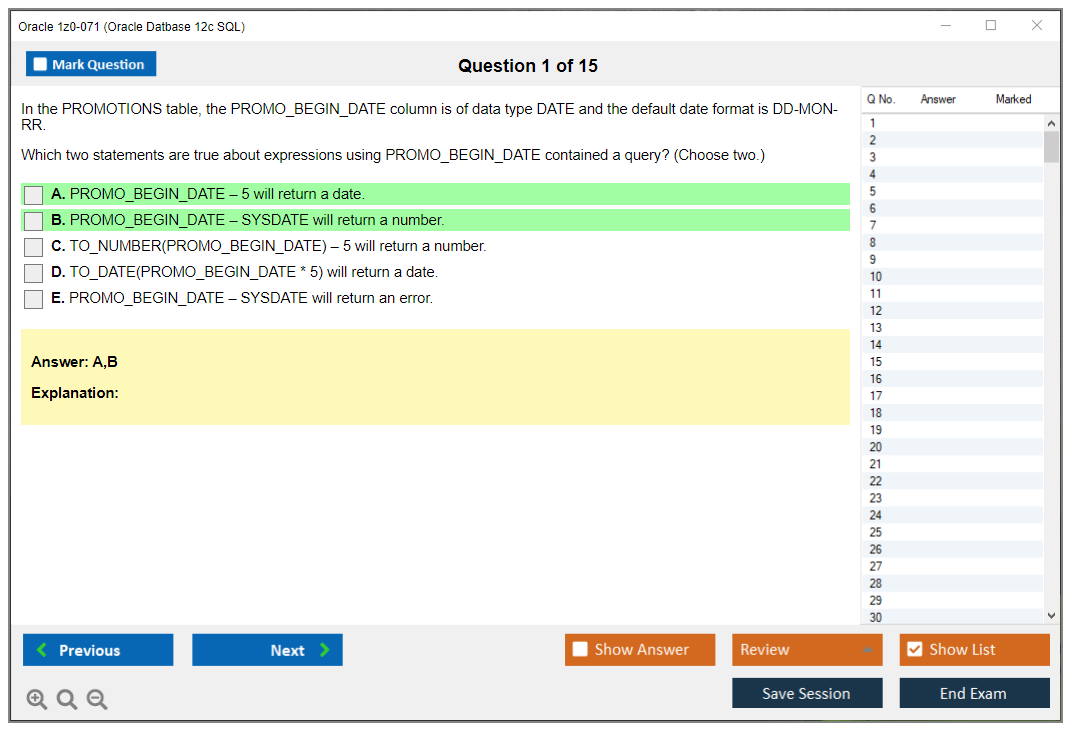
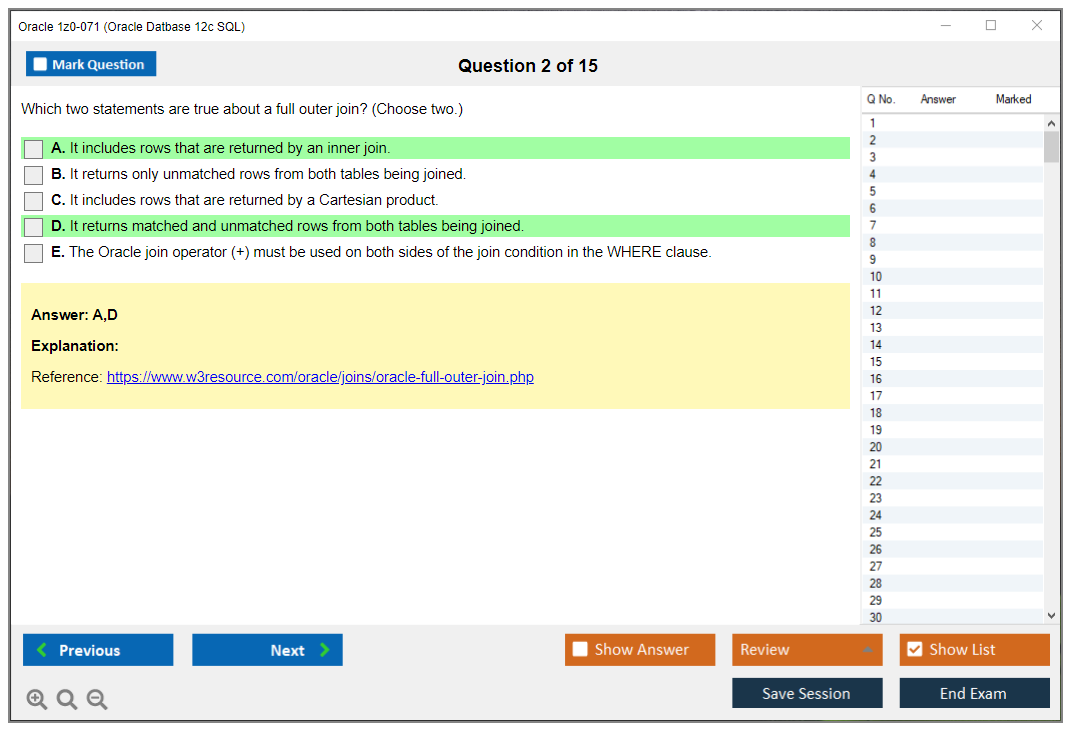
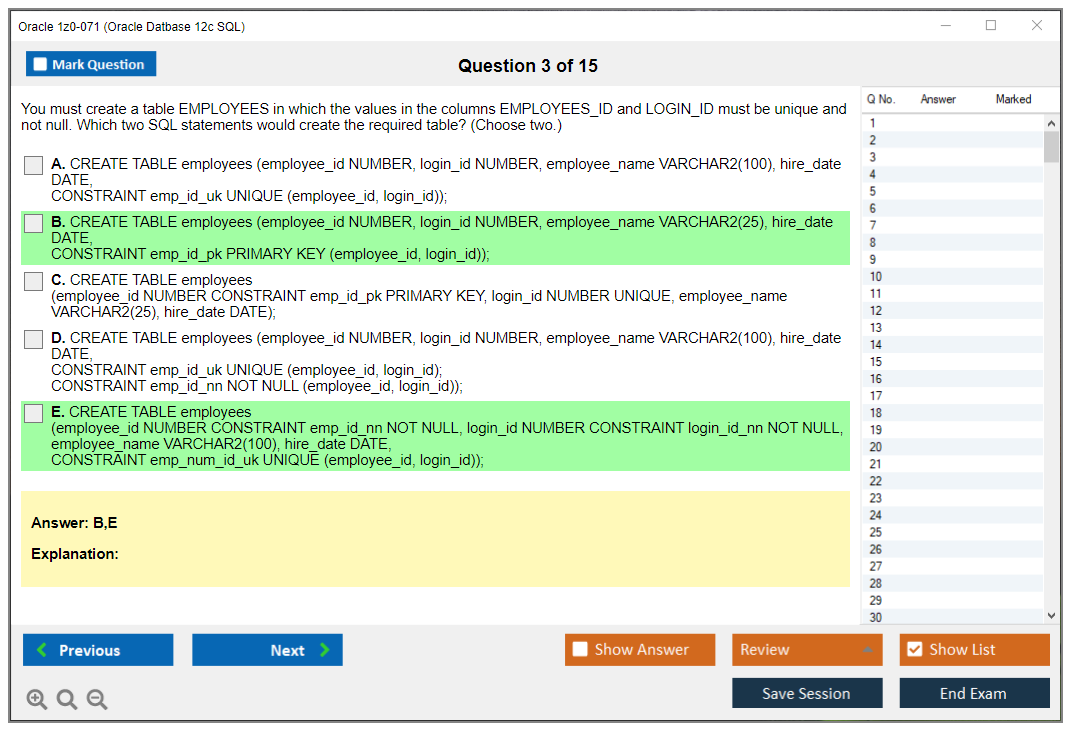
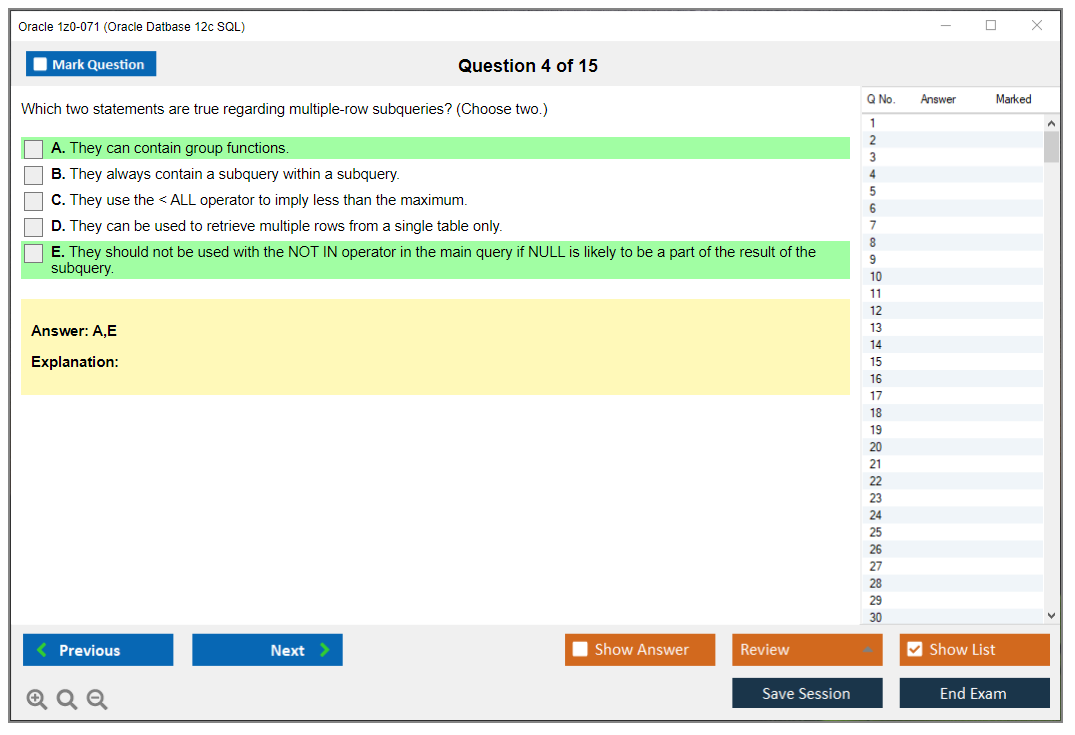
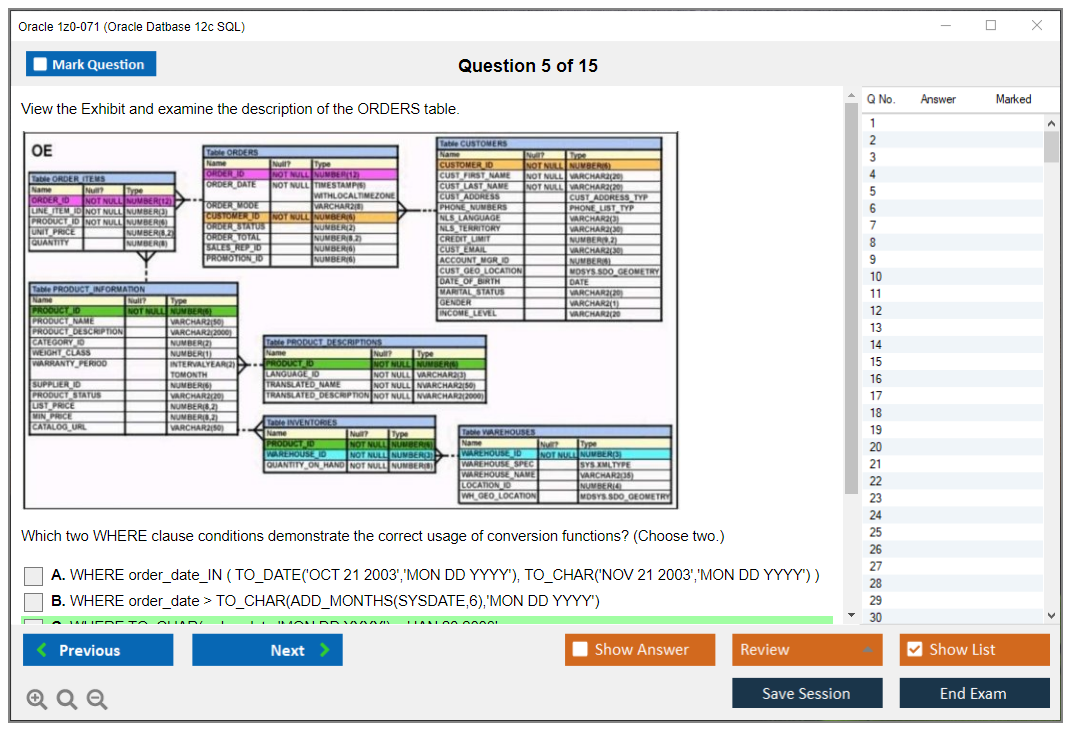
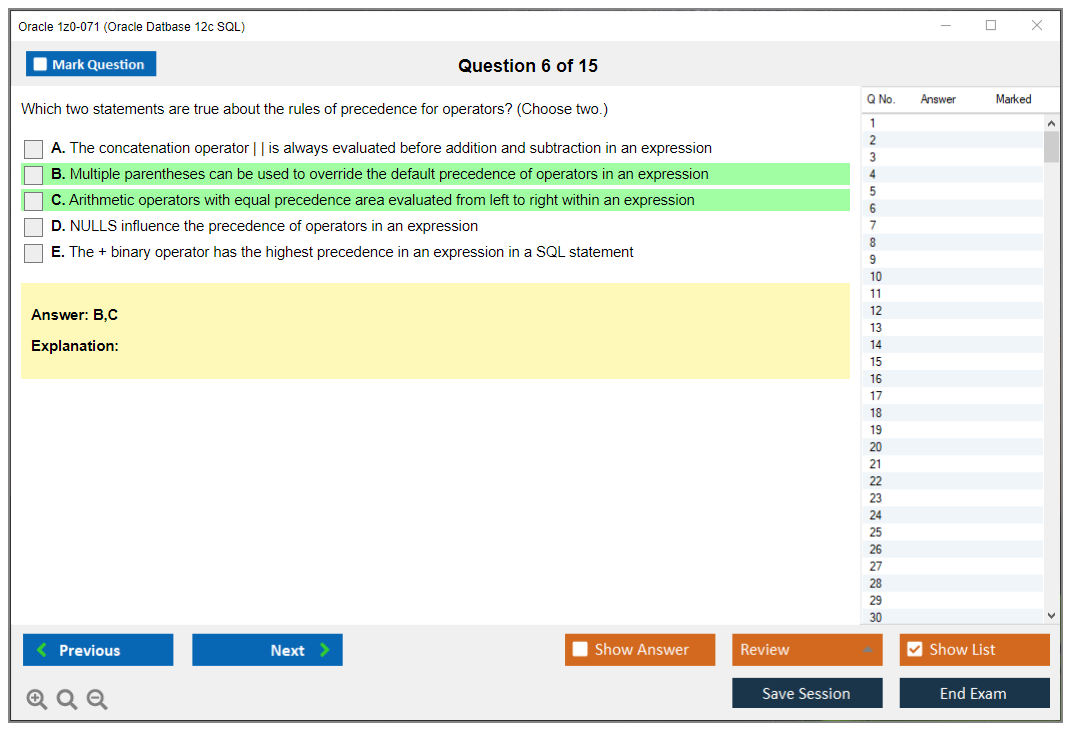
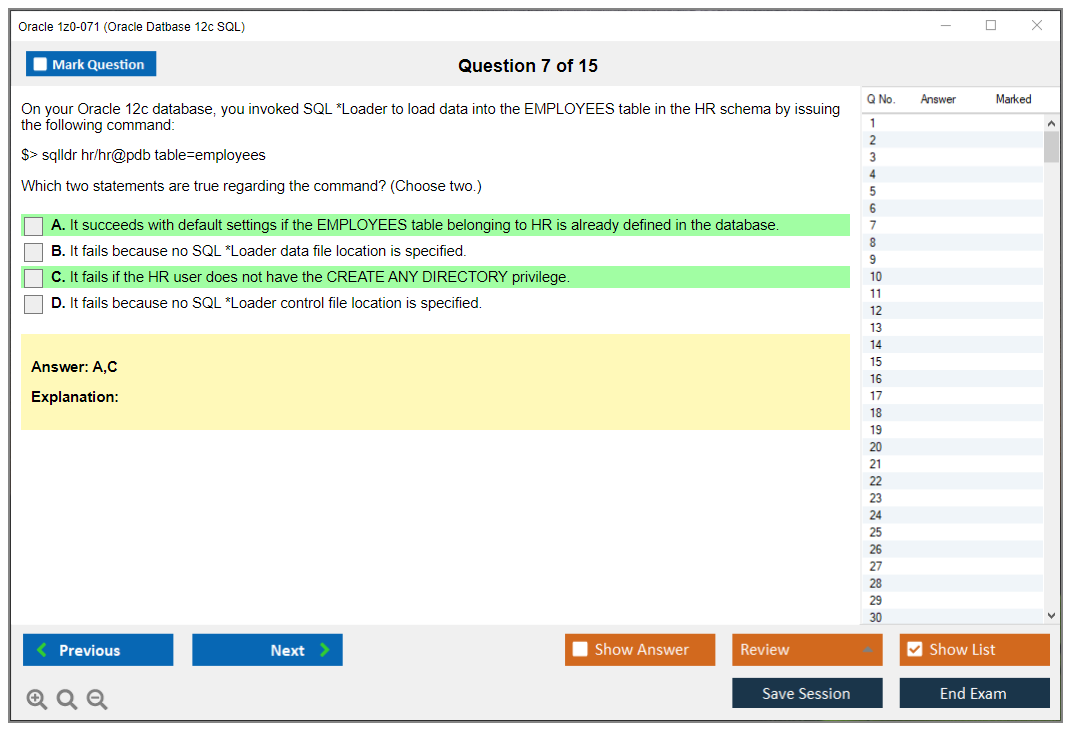
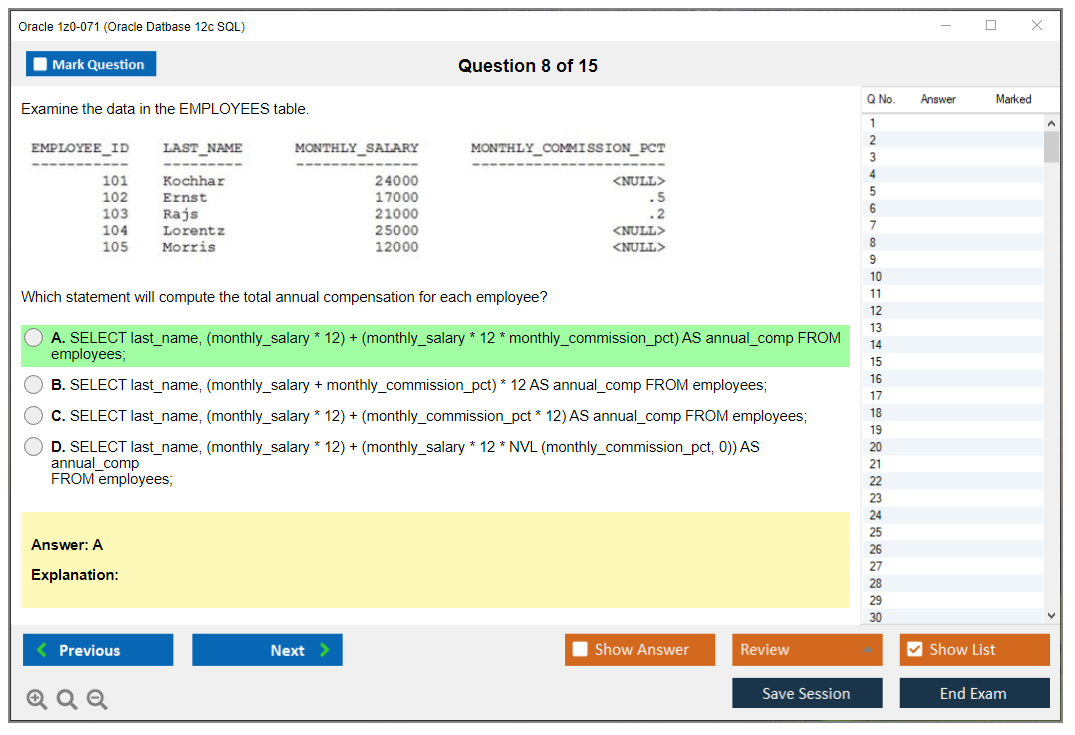
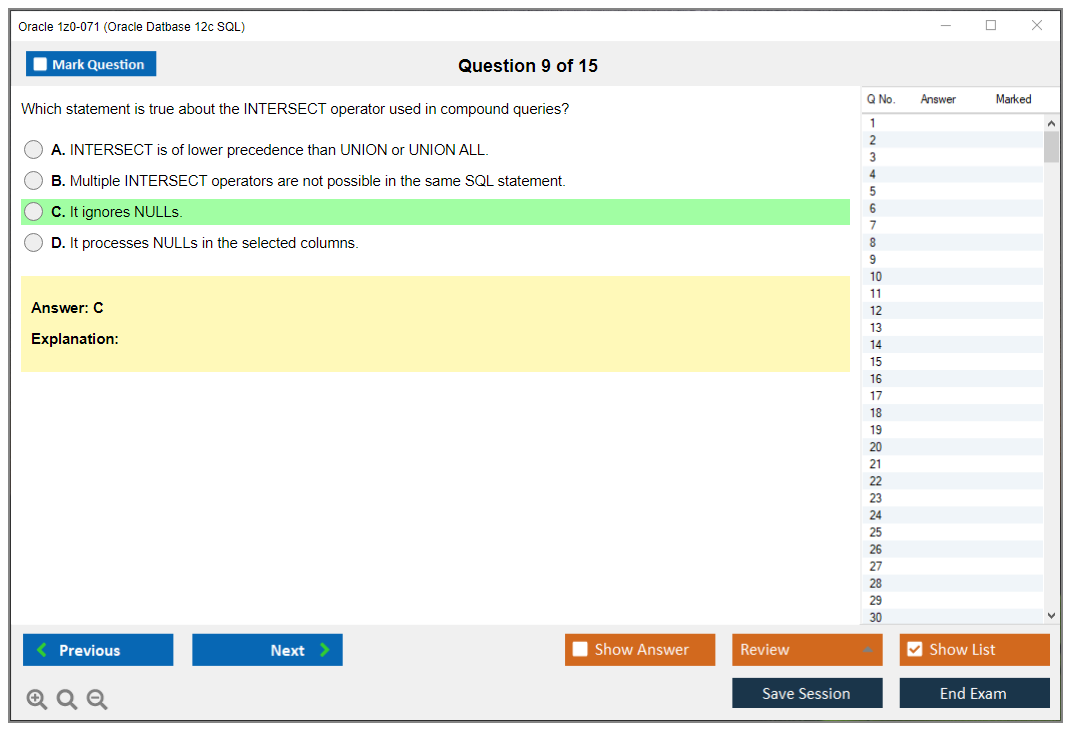
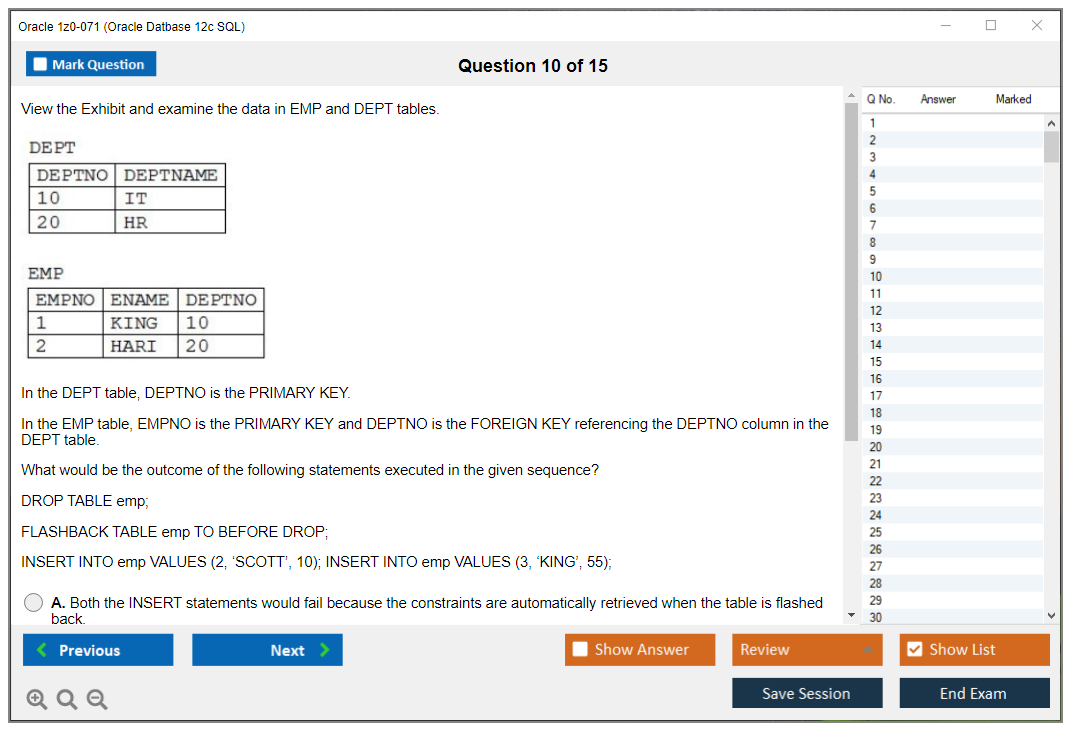
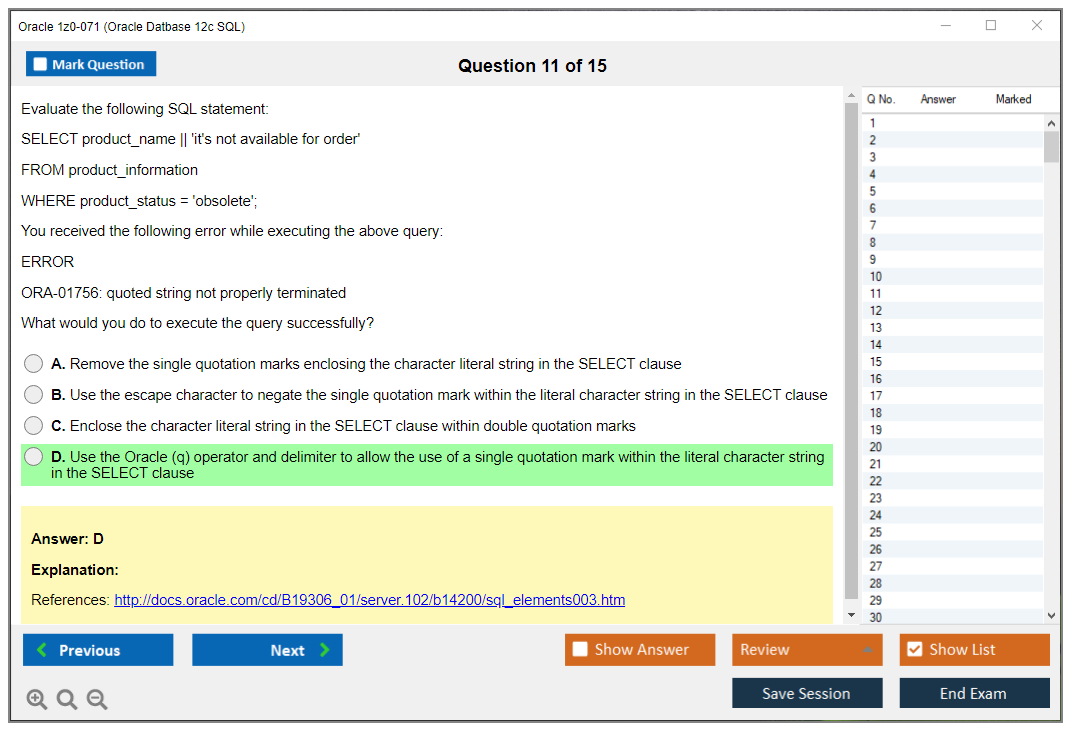
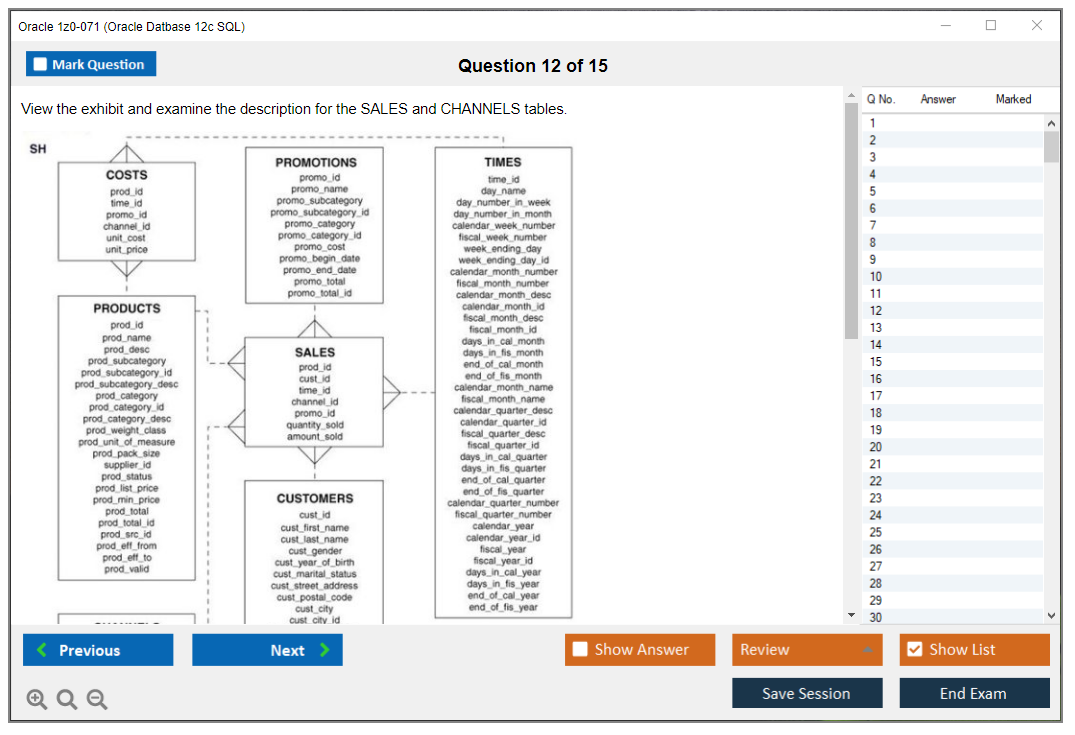
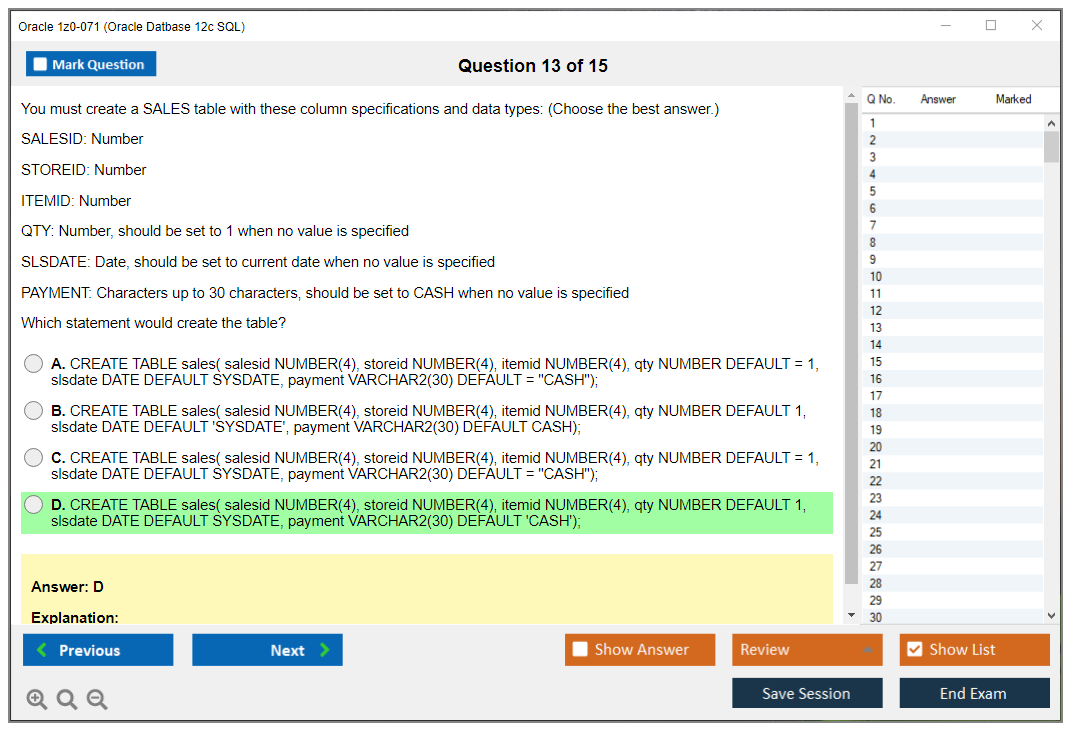
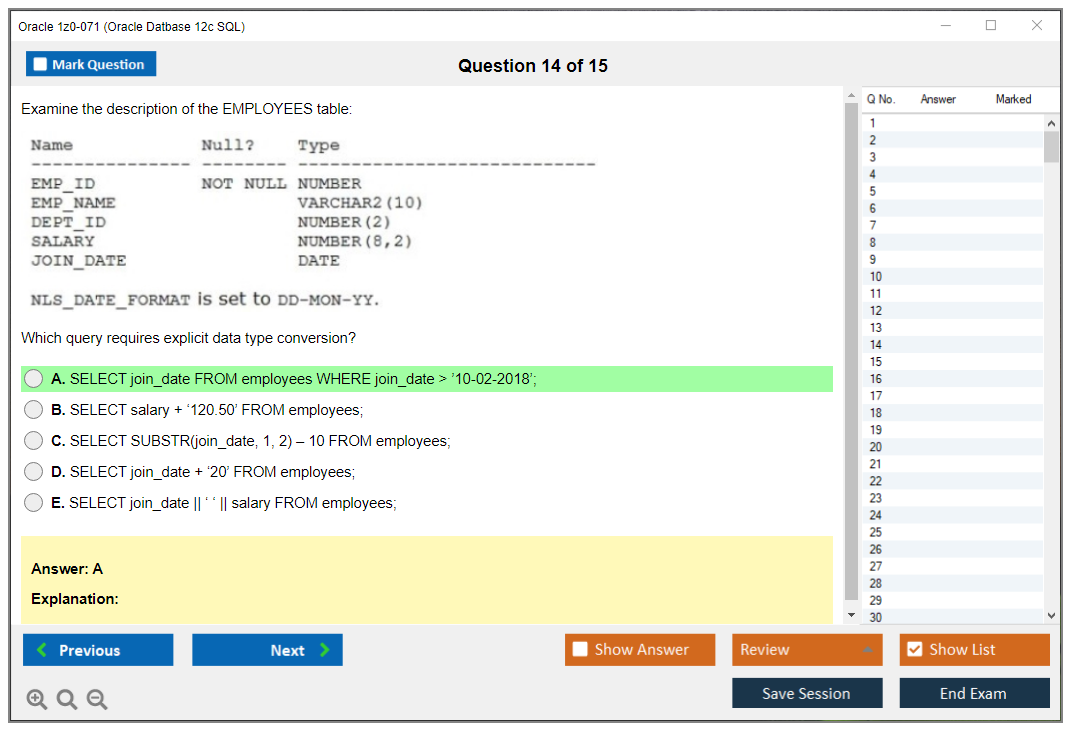
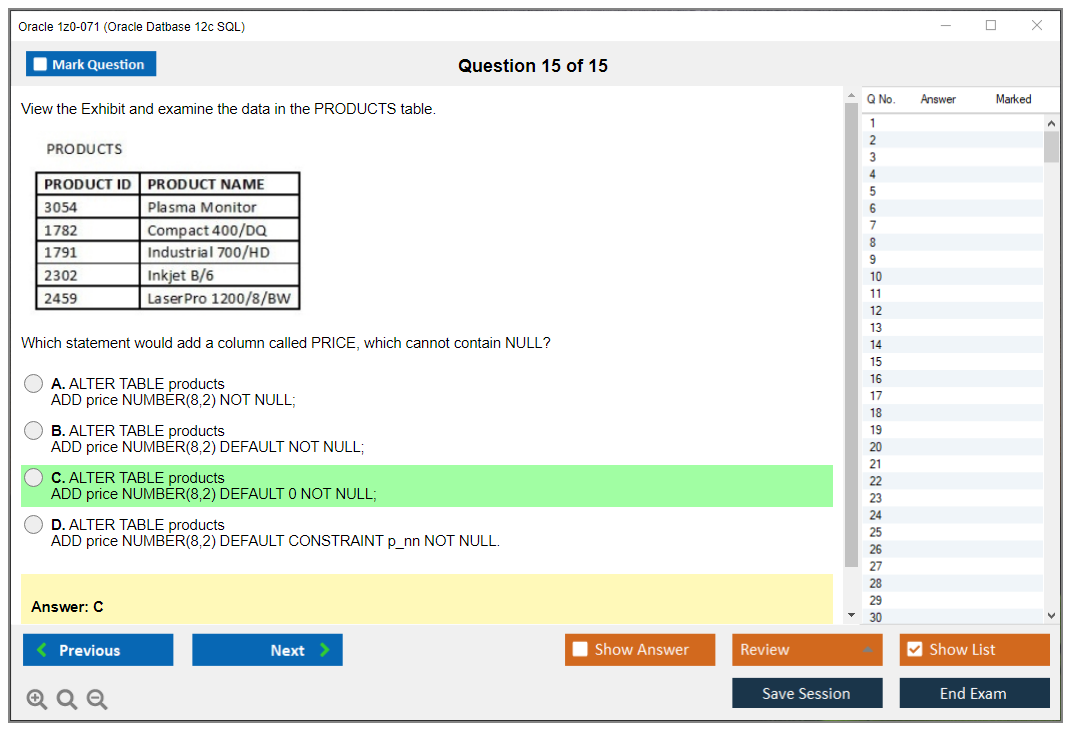
Dumpsarena Oracle Oracle Database 12c SQL (1z0-071) Free Practice Exam Simulator Test Engine Exam preparation with its cutting-edge combination of authentic test simulation, dynamic adaptability, and intuitive design. Recognized as the industry-leading practice platform, it empowers candidates to master their certification journey through these standout features.
What is in the Premium File?
Satisfaction Policy – Dumpsarena.co
At DumpsArena.co, your success is our top priority. Our dedicated technical team works tirelessly day and night to deliver high-quality, up-to-date Practice Exam and study resources. We carefully craft our content to ensure it’s accurate, relevant, and aligned with the latest exam guidelines. Your satisfaction matters to us, and we are always working to provide you with the best possible learning experience. If you’re ever unsatisfied with our material, don’t hesitate to reach out—we’re here to support you. With DumpsArena.co, you can study with confidence, backed by a team you can trust.
Oracle 1z0-071 Exam FAQs
Introduction of Oracle 1z0-071 Exam!
Oracle Database 12c SQL (1z0-071) is an Oracle certification exam. It tests a candidate's knowledge of SQL and their ability to use the Oracle Database 12c product. The exam covers topics such as SQL fundamentals, data manipulation, data definition, and database objects. It also covers advanced topics such as subqueries, joins, views, and stored procedures.
What is the Duration of Oracle 1z0-071 Exam?
The Oracle Database SQL 1z0-071 exam is a 90-minute exam consisting of 73 multiple-choice questions.
What are the Number of Questions Asked in Oracle 1z0-071 Exam?
There are a total of 73 questions on the Oracle 1z0-071 exam.
What is the Passing Score for Oracle 1z0-071 Exam?
The passing score for the Oracle 1z0-071 exam is 65%.
What is the Competency Level required for Oracle 1z0-071 Exam?
The Oracle 1z0-071 exam is an entry-level certification exam for Oracle Database 12c SQL. It is designed to test the knowledge and skills of candidates in the areas of SQL fundamentals, data manipulation, and database objects. The exam requires a basic understanding of SQL and database concepts, as well as the ability to write and execute SQL statements. The recommended competency level for this exam is Associate.
What is the Question Format of Oracle 1z0-071 Exam?
The Oracle Database 12c SQL 1z0-071 exam consists of multiple choice, fill-in-the-blank, and scenario-based questions.
How Can You Take Oracle 1z0-071 Exam?
The Oracle 1z0-071 exam can be taken in either an online or testing center format. The online format requires a laptop or desktop computer with internet access, while the testing center format requires that you travel to a designated location to take the exam. Both formats require that you register with Oracle and pay the appropriate exam fee.
What Language Oracle 1z0-071 Exam is Offered?
The Oracle 1z0-071 exam is offered in English only.
What is the Cost of Oracle 1z0-071 Exam?
The cost of the Oracle 1z0-071 exam is $245 USD.
What is the Target Audience of Oracle 1z0-071 Exam?
The Oracle 1z0-071 exam is designed for individuals who have experience working with the Oracle Database 12c and want to become an Oracle Certified Associate. This certification is intended for database administrators, application developers, and system administrators who want to demonstrate their knowledge of the Oracle Database 12c.
What is the Average Salary of Oracle 1z0-071 Certified in the Market?
The average salary for those who have earned the Oracle 1z0-071 certification is around $90,000 per year.
Who are the Testing Providers of Oracle 1z0-071 Exam?
Oracle certification exams can be taken through Pearson VUE and Oracle University.
What is the Recommended Experience for Oracle 1z0-071 Exam?
The recommended experience for the Oracle 1z0-071 exam is basic knowledge of Oracle Database 12c, SQL, PL/SQL, and database administration. Candidates should also be able to use the Oracle Enterprise Manager Cloud Control 12c, Oracle Database Cloud Service, Oracle Database Exadata Cloud Service, and Oracle Database Backup Service.
What are the Prerequisites of Oracle 1z0-071 Exam?
The Oracle Database 12c SQL 1z0-071 exam is designed for applicants who have a basic understanding of SQL fundamentals, including the ability to query, insert, update, and delete data. The exam also requires knowledge of database objects such as tables, views, and indexes. Additionally, prior knowledge of data types, constraints, and functions is necessary.
What is the Expected Retirement Date of Oracle 1z0-071 Exam?
The official website for Oracle 1z0-071 exam is http://education.oracle.com/pls/web_prod-plq-dad/db_pages.getpage?page_id=5001&get_params=p_exam_id:1Z0-071. On this page, you can find the current expiration date for the exam.
What is the Difficulty Level of Oracle 1z0-071 Exam?
The Oracle 1z0-071 exam is considered to be of intermediate difficulty. It requires a strong understanding of database concepts, as well as the ability to apply those concepts to real-world scenarios.
What is the Roadmap / Track of Oracle 1z0-071 Exam?
The Oracle 1z0-071 Exam is a certification exam that tests a candidate’s knowledge and skills on the Oracle Database 12c SQL. It is a requirement for the Oracle Database 12c Administrator Certified Associate certification. This exam contains 70 multiple-choice questions, and the candidate must score at least 65% to pass. The exam is divided into 5 sections: Basic SQL, Data Manipulation, Database Objects, Data Retrieval, and Advanced SQL. Each section has its own set of objectives that must be mastered in order to pass the exam. The exam is designed to test a candidate’s ability to understand, analyze and apply the concepts learned.
What are the Topics Oracle 1z0-071 Exam Covers?
Oracle 1z0-071 exam covers the following topics:
1. SQL Fundamentals: This section covers the basics of Structured Query Language (SQL) such as data manipulation language, data definition language, and data control language. It also covers topics such as table creation, data retrieval, and data manipulation.
2. Database Objects: This section covers the various database objects such as tables, views, indexes, sequences, and synonyms. It also covers topics such as table constraints, triggers, and sequences.
3. Data Types and Data Manipulation: This section covers topics such as data types, data manipulation, and data integrity. It also covers topics such as SQL functions, data conversion, and date and time functions.
4. Database Security: This section covers topics such as database security, authentication, authorization, and user privileges. It also covers topics such as database auditing and database encryption.
5. Database Performance and Tun
What are the Sample Questions of Oracle 1z0-071 Exam?
1. What is the purpose of the ALTER SYSTEM SET command?
2. What is the purpose of the CREATE USER command?
3. What are the different types of constraints available in Oracle Database 12c?
4. What are the different types of triggers available in Oracle Database 12c?
5. How can you grant privileges to a user in Oracle Database 12c?
6. What is the purpose of the DBMS_OUTPUT package?
7. How can you create a stored procedure in Oracle Database 12c?
8. How can you create a view in Oracle Database 12c?
9. What is the purpose of the PL/SQL EXCEPTION clause?
10. How can you create a sequence in Oracle Database 12c?
Oracle 1z0-071 (Oracle Database 12c SQL) Oracle 1Z0-071 (Oracle Database 12c SQL) Exam Overview Introduction to the Oracle 1Z0-071 exam The Oracle 1Z0-071 certification is one of those credentials that actually matters in the database world. I mean, it's another piece of paper. This exam validates your SQL proficiency specifically for Oracle Database 12c environments, and honestly, if you're working with Oracle systems or want to, this is where you start. The certification targets database administrators, developers, and data analysts who need to prove they can handle foundational SQL skills in real Oracle environments. SQL is everywhere. But Oracle SQL has its quirks. Wait, let me clarify that. The 1Z0-071 exam tests whether you can write queries that actually work in production Oracle databases, manipulate data without breaking things, create database objects properly, and understand how relational databases function under the hood. Not gonna lie, it's more practical than a lot of... Read More
Oracle 1z0-071 (Oracle Database 12c SQL)
Oracle 1Z0-071 (Oracle Database 12c SQL) Exam Overview
Introduction to the Oracle 1Z0-071 exam
The Oracle 1Z0-071 certification is one of those credentials that actually matters in the database world. I mean, it's another piece of paper. This exam validates your SQL proficiency specifically for Oracle Database 12c environments, and honestly, if you're working with Oracle systems or want to, this is where you start. The certification targets database administrators, developers, and data analysts who need to prove they can handle foundational SQL skills in real Oracle environments.
SQL is everywhere. But Oracle SQL has its quirks. Wait, let me clarify that. The 1Z0-071 exam tests whether you can write queries that actually work in production Oracle databases, manipulate data without breaking things, create database objects properly, and understand how relational databases function under the hood. Not gonna lie, it's more practical than a lot of certifications out there.
What is the 1Z0-071 certification?
Oracle's official credential. That's what this is. It proves you know your stuff with SQL on Oracle Database 12c. We're talking about competency in writing SELECT statements that don't make DBAs cry, performing DML operations (INSERT, UPDATE, DELETE, MERGE), creating tables and views, and understanding the relational concepts that Oracle implements.
The exam covers single-row functions, group functions, joins (inner, outer, self), subqueries, and set operators like UNION and INTERSECT. Those powerful analytic functions separate beginners from people who actually know SQL. You'll also deal with transaction control. Data definition language basics. Querying the data dictionary.
What makes this different from generic SQL knowledge? Oracle-specific syntax, functions like NVL and DECODE, hierarchical queries with CONNECT BY, and the way Oracle handles NULL values and implicit conversions. These details trip people up constantly.
Certification positioning
The 1Z0-071's an entry-level Oracle certification, but don't let that fool you. It's the foundation for pretty much every advanced Oracle Database certification path. You pass this, and suddenly the Oracle Database Administration I certification becomes accessible. Same goes for PL/SQL development tracks and specialized roles.
This exam establishes your credibility in the Oracle technology stack, which honestly matters when you're interviewing at companies running Oracle ERP systems, financial applications, or massive data warehouses. It's recognized globally. Hiring managers know exactly what it means when they see 1Z0-071 on your resume.
Who should take Oracle Database 12c SQL?
Database developers who write SQL daily need this. Business intelligence analysts pulling reports and building dashboards should have it. Application developers working with Oracle backends? Absolutely.
Data warehouse specialists benefit from this certification. Oracle DBAs starting their careers do too. SQL programmers wanting vendor-specific validation. IT professionals transitioning from other database platforms. I've seen people from non-Oracle backgrounds take this exam to pivot their careers, which is smart if you think about it. Moving from SQL Server or MySQL means the 1Z0-071 proves you can adapt to Oracle's ecosystem. The syntax differences aren't massive, but they're significant enough that employers want proof you know them.
Career benefits
Job prospects improve. That's the big one. Look at job postings for database roles at banks, insurance companies, government agencies. Oracle certifications show up constantly in requirements or preferred qualifications. You'll see salary advancement opportunities because certified professionals command higher rates than those without credentials.
This certification validates your SQL expertise in a way that's harder to dispute than just listing "SQL" on your resume. It's also a prerequisite for advanced Oracle certifications, so if you want to eventually tackle Oracle Database Administration II or specialized tracks like Oracle Data Integrator, you're building that foundation here.
Employers worldwide recognize Oracle certifications. Multinational corporations, consulting firms like Accenture and Deloitte, technology companies building on Oracle stacks all value this credential.
Exam relevance in 2026
Here's something important. Despite Oracle Database 19c and 21c being available (and 23c coming), the 12c SQL fundamentals remain highly relevant. Why? Because core SQL syntax and concepts stay consistent across Oracle versions. The SELECT statement in 12c works the same in 21c. Joins haven't changed. Set operators? Identical.
Oracle adds features in newer versions, sure, but the foundational SQL tested in 1Z0-071 applies across versions 11g through 21c and beyond. Companies still run 12c in production. I've worked with plenty of organizations that haven't upgraded yet due to application dependencies or simply because what they have works. One bank I consulted for was still running 11g as their primary system in 2024 because their risk assessment application couldn't handle the migration without a complete rewrite. Sometimes the old stuff just sticks around longer than you'd expect.
The skills you demonstrate with this certification translate directly to newer Oracle versions, which is why the exam stays relevant even as Oracle releases new database versions.
Global recognition and industry demand
Multinational corporations accept this certification as proof of Oracle SQL competency. Government agencies with strict qualification requirements recognize it. Consulting firms use it as a baseline for staffing Oracle projects. Technology companies building products on Oracle databases want team members who have it.
Current job market trends show consistent demand for Oracle SQL skills across finance (banks, investment firms). Healthcare (hospital systems, insurance). Retail (supply chain, inventory systems). Telecommunications (billing, customer data). Government sectors (federal, state, local databases). The thing is, if you search for Oracle SQL jobs you'll find hundreds of openings requiring exactly what this exam tests.
Real-world applications
Report generation. That's where certified professionals apply these skills. Writing complex queries to extract business metrics from operational databases. Data analysis tasks require joining multiple tables, aggregating results, and filtering datasets precisely. Application development involves writing SQL that performs well under load and handles edge cases correctly.
Database maintenance uses these SQL skills for data cleanup, migrations, and transformations. Business intelligence work relies heavily on the analytic functions and aggregation techniques covered in the exam. I've used every topic from this exam in production work. It's not academic.
Integration with Oracle ecosystem
The 1Z0-071 fits within broader Oracle certification paths perfectly. Pass this, and you can pursue the Oracle Database Administrator track with 1Z0-082 and 1Z0-083. Or go toward PL/SQL development. Or specialize in areas like Oracle WebLogic Server administration or Oracle Application Express development.
Many Oracle certifications assume you already know SQL, which makes sense because without that foundation you're basically lost from day one. The 1Z0-071 proves that foundation exists, making advanced topics easier to tackle. It's the entry point to the entire Oracle ecosystem.
Comparison with other SQL certifications
Different beasts entirely. The Oracle 1Z0-071 differs from Microsoft SQL Server certifications in syntax (T-SQL vs Oracle SQL), built-in functions (different names and behaviors), and vendor-specific features like Oracle's MERGE statement versus SQL Server's approach. MySQL certifications cover similar concepts but lack Oracle's advanced analytic functions and hierarchical query capabilities. PostgreSQL has its own extensions and approaches.
Oracle SQL includes features like CONNECT BY for hierarchical queries. ROLLUP and CUBE for advanced grouping. A rich set of analytic functions that other databases implement differently or not at all.
Value proposition and certification longevity
This certification demonstrates practical ability to retrieve, manipulate, and analyze data using Oracle SQL rather than just theoretical knowledge. The exam includes scenario-based questions requiring you to write actual SQL or predict query results. You can't fake your way through it.
Oracle SQL skills remain relevant throughout a technology career despite evolving database technologies and cloud platforms. Even as companies move to cloud databases, many use Oracle Cloud Infrastructure running Oracle Database. The SQL fundamentals don't disappear. They adapt to new deployment models while keeping the core syntax and concepts intact.
Oracle 1Z0-071 Exam Cost and Registration
Oracle 1Z0-071 (Oracle Database 12c SQL) exam overview
What is the 1Z0-071 certification?
The Oracle 1Z0-071 exam tests SQL skills within the Oracle Database 12c environment, and honestly, it's Oracle's method of verifying that you understand actual query-writing mechanics rather than just regurgitating SELECT * syntax. Compact name. Significant career weight, though.
Recruiters definitely notice it.
If you're after the Oracle Database 12c SQL certification, this exam's your mandatory checkpoint. It spans Oracle SQL fundamentals while demanding comfort with Oracle-specific behaviors like date manipulation quirks, NULL handling peculiarities, and functions that don't quite match what you'd encounter in SQL Server or PostgreSQL environments.
Who should take Oracle Database 12c SQL?
DBAs building career foundations. Analysts perpetually frustrated by "I only know basic queries" limitations. Application developers regularly interfacing with Oracle databases who're exhausted from constant guesswork.
The thing is, it's equally valuable as a confidence checkpoint when you're attempting to demonstrate competency with SQL queries and joins in Oracle under timed, evaluated conditions. Not theoretical knowledge, but practical execution measured and graded.
Oracle 1Z0-071 exam cost and registration
1Z0-071 exam cost (price, taxes, retake fees)
The baseline 1Z0-071 exam cost sits at $245 USD as a standard examination fee, though treating that figure as absolutely fixed would be naive since regional pricing variations and currency exchange volatility can substantially alter your final checkout amount.
Several factors influence the actual price:
- Taxes (VAT/GST): Throughout numerous jurisdictions like the European Union, India, Australia, and similar regions, consumption taxes stack onto the base price. Your final payment exceeds $245 even though the "exam price" technically remains constant. That addition stings.
- Discounts: Oracle University promotional campaigns and academic initiatives can slash costs dramatically sometimes, but you've gotta catch these opportunities and satisfy their requirements.
- Currency conversion: Local currency payment introduces month-to-month price drift, and unfortunately it doesn't always favor your wallet.
Retakes? Simple concept. Annoying reality. Full price. Again.
No discounted second-attempt pricing whatsoever. So failing today and retrying next week means another complete exam fee, which explains my intensity about thorough preparation instead of gambling on random 1Z0-071 practice tests discovered in questionable PDFs. I once knew someone who took it three times before passing. That's $735 total. You do the math on whether better prep might've been worth it upfront.
Oracle University discounts
Oracle University periodically launches promotions reducing exam costs by around 20% to 30%, frequently aligning with major events (Oracle OpenWorld), training bundle packages, or seasonal marketing pushes.
Worth stating explicitly: these promotions appear and vanish. Eligibility fine print can be finicky regarding which exams qualify plus mandatory scheduling deadlines, so verify current offers before assuming you'll capture that discount.
Academic pricing
Students enrolled through Oracle Academy institutions can typically access reduced academic rates, usually around a 50% discount, but it's "I've got a .edu email address, promise." Expect legitimate student identification and institutional verification processes. Documentation. Processing delays. Still absolutely worthwhile.
Where to register (Oracle Certification / Pearson VUE)
Registration operates through Oracle's CertView portal at certview.oracle.com, linked to your Oracle Single Sign-On account, while actual exam delivery happens via Pearson VUE's testing infrastructure.
Two systems. I know. That's standard operating procedure here. Your Oracle profile houses your certification history permanently, and Pearson VUE is where you select appointments and complete the actual examination.
Registration process step-by-step
Create (or access) your Oracle account. Work through into CertView. Locate the 1Z0-071 listing. Select your delivery method, then schedule and pay.
More granularly, the workflow typically follows:
- Establish Oracle SSO, ensuring your legal name appears correctly. No nicknames or abbreviations. Minor error. Major check-in nightmare.
- Log into CertView and establish Pearson VUE linkage when prompted.
- Choose the Oracle certification exam registration option for 1Z0-071.
- Decide between test center or online proctoring.
- Select date and time, then finalize payment.
Email confirmation arrives afterward. Save it. Screenshot it. Keep it accessible.
Pearson VUE test center locations
Pearson VUE operates 5,000+ authorized testing centers spanning 180 countries, and you can search by postal code or city name while viewing availability calendars.
Some centers are excellent. Quiet, clean, professional. Others are.. an experience. When you've got options, choose locations with abundant open slots because that typically indicates frequent exam administration and knowledgeable staff.
Online proctoring option
OnVUE remote testing permits exam completion from home or office environments with webcam monitoring, plus system requirements and environmental restrictions they enforce rigorously.
One critical warning: complete a room scan, clear your workspace entirely, remove extra monitors, maintain silence. If your internet connection's unreliable, don't play hero. Visit a test center and eliminate that stress variable.
Scheduling flexibility and rescheduling rules
Appointments run year-round, and most locations offer morning, afternoon, and occasionally evening slots. Book 2 to 4 weeks ahead for optimal choice, particularly around quarter-end work crunches and academic examination periods.
Rescheduling stays free if executed 24 hours before the appointment. Cancel within 24 hours or no-show and you typically forfeit the complete fee. Painful lesson. Set multiple reminders.
Exam format specifications
Exam format (questions, time limit, delivery options)
The exam's computer-based with 78 multiple-choice questions (the count can fluctuate slightly), and you receive 120 minutes. Upon completion, you typically see immediate preliminary results on screen.
Question varieties include single-answer multiple choice, multiple-answer multiple choice, and scenario-based questions demanding SQL knowledge application, not mere keyword recognition. Expect heavy "what query produces this output" and "which two statements are true" emphasis.
The testing interface? Oracle's exam delivery platform. You can work through questions freely, mark for review, and there's a calculator tool. For online exams, you also get a whiteboard-style tool, which feels awkward initially but works fine once you practice sketching logic like join paths or GROUP BY notes.
Passing score and scoring details
1Z0-071 passing score (what to expect)
People constantly inquire about the 1Z0-071 passing score, and I mean, fair question, money's at stake. Oracle has historically published passing scores for numerous exams, but it can change and relying on some random blog post screenshot from 2019 isn't wise strategy.
My perspective: treat the passing target like you need comfortable clearance above "barely passing" because scaled scoring and question weighting can make two attempts feel completely different even when your SQL competency remains identical that week.
How the exam is scored (scaled scoring, question types)
Oracle exams commonly employ scaled scoring and mixed question difficulty. Multi-answer questions can be brutal since you either know the topic or you don't, and partial credit rules aren't something I'd stake my budget on unless Oracle states it explicitly for this specific exam.
What happens if you fail (retake policy)
You pay again. Full fee. Then schedule again through Pearson VUE. That's literally it.
Not gonna sugarcoat this: the retake policy's the primary reason I tell people to decelerate, study the 1Z0-071 exam objectives thoroughly, and complete sufficient practice that you're not learning JOIN syntax during the actual test.
Oracle 1Z0-071 difficulty: what to expect
Difficulty level by skill background (beginner vs experienced)
Is the Oracle SQL exam difficulty high? Context-dependent. If you've written SQL weekly for a year, it feels reasonable. If you're a beginner, it can feel like the exam's written in a foreign dialect, because Oracle's particular about date formats, NULL behavior, and legacy syntax that still appears.
Challenging day. Manageable week. That's my assessment.
Common challenges (joins, subqueries, set operators, functions)
Joins trip people constantly, especially outer joins and WHERE filters that accidentally convert an outer join into an inner join. The interruption's real when you realize your result set vanished. Subqueries get complex with correlated ones. Set operators are easy to memorize and easy to misapply. Functions are where people hemorrhage points rapidly, especially implicit conversions and date arithmetic.
If you're studying, concentrate extra effort on NULL logic and conversions. Microscopic rules. Massive impact.
How long to study (realistic timelines)
If you're new to SQL, think 6 to 10 weeks with hands-on practice. If you already work with SQL, 2 to 4 weeks is realistic, but only when you're executing real queries, not just reading 1Z0-071 study materials like it's leisure fiction.
1Z0-071 exam objectives (official topic breakdown)
The official Oracle Database 12c SQL exam topics usually cluster around:
- SELECT basics, filtering, sorting
- joins (inner, outer, self-joins)
- subqueries (single-row, multi-row, correlated)
- set operators (UNION, UNION ALL, INTERSECT, MINUS)
- single-row functions, conversions, date functions
- grouping with GROUP BY and HAVING
- analytic functions like OVER and ranking
- DML (INSERT, UPDATE, DELETE, MERGE)
- transactions (COMMIT, ROLLBACK, SAVEPOINT)
- basic DDL, constraints, views, sequences
- querying the data dictionary
You don't need DBA expertise. You do need query output reasoning ability.
Prerequisites and recommended experience
Are there prerequisites for 1Z0-071?
No formal prerequisites exist. You can register and attempt it whenever. That's the straightforward part.
Recommended hands-on experience (Oracle DB + SQL practice)
Use Oracle SQL Developer or Oracle LiveSQL with sample schemas. Type queries. Break them intentionally. Fix them. That's where you really learn Oracle SQL fundamentals.
Helpful prior knowledge (relational concepts, normalization basics)
Primary keys, foreign keys, cardinality, and why joins function mechanically. You don't need to recite normal forms verbatim, but understanding relationships ensures your join logic isn't just intuition.
Best study materials for Oracle 1Z0-071
Official Oracle resources (exam page, docs, learning paths)
Start with the exam page and the objectives list. Then Oracle Database SQL Language Reference for clarification when something surprises you, like how Oracle treats empty strings as NULL in numerous cases.
Books and courseware (SQL fundamentals + Oracle-specific SQL)
A solid SQL fundamentals book works fine, but ensure it's Oracle-aware. Some generic SQL books won't cover Oracle-specific functions and quirks appearing in the exam.
Hands-on labs (sample schemas, SQL Developer, LiveSQL)
LiveSQL's great because setup's basically nonexistent. SQL Developer's great because it resembles work environments. Pick one and commit.
Study plan by week (beginner/intermediate tracks)
Beginners: dedicate week one and two to SELECT, WHERE, ORDER BY, and functions, then attack joins and grouping intensely, then subqueries and analytics. Intermediate: compress that timeline and allocate extra time toward analytics, complex join filters, and the more obscure conversion rules.
Oracle 1Z0-071 practice tests and question practice
How to choose quality practice tests (topic coverage, explanations)
If a practice test doesn't explain why an answer's correct, it's not teaching you. It's just scoring you. Explanations matter profoundly. Coverage matters.
Practice test strategy (timed sets, error log, weak-area drills)
Complete timed sets in 20 to 30 question chunks, maintain an error log, and rewrite the query until you can explain it verbally. That's how you transition from "I saw this once" to "I can answer it under pressure."
Sample question types to expect (scenario-based SQL)
Expect "choose two" questions, output-based questions, and scenarios where a query fails due to datatype conversions or group function rules.
Exam-day tips and test-taking strategy
Time management and pacing
Two minutes per question average works fine, but don't get paralyzed. Mark it. Move forward. Circle back.
Avoiding common traps (NULL logic, join filters, implicit conversions)
NULL comparisons using equals. Outer join filters in WHERE instead of ON. Implicit conversion when comparing strings to dates or numbers. Those are the classic point hemorrhages.
What to bring / testing rules (online vs test center)
Bring a government-issued photo ID with a signature, and the name must match your registration exactly. They enforce this strictly at test centers and during online check-in. No "close enough."
Certification validity, renewal, and next steps
Does 1Z0-071 require renewal?
Oracle policies vary by program and certification era, so check your CertView status for current rules tied to your credential. Some certs are version-specific, and employers often care more about "can you do the work now" than the exact year stamp.
Oracle recertification/upgrade paths (newer SQL exams, role-based certs)
After passing, consider newer Oracle Database certifications or role-based certs matching your job like admin paths or cloud database options depending on what your workplace runs.
What to do after passing (next Oracle certs and career roles)
Update CertView. Add it to LinkedIn. Then build something proving it, like a portfolio of queries or a small schema project, because honestly the combination of cert plus proof beats either one alone.
FAQ (based on people also ask)
How much does the Oracle 1Z0-071 exam cost?
Standard fee is $245 USD, with regional pricing differences and possible VAT/GST added depending on your country, plus occasional Oracle University discounts.
What is the passing score for 1Z0-071?
Oracle can change scoring details, so confirm in the official exam listing, but plan to exceed the minimum comfortably rather than aiming for the thinnest pass.
Is Oracle 1Z0-071 difficult?
For beginners, yes, mainly because Oracle SQL has strict rules and tricky edge cases. For experienced SQL users, it's very doable with targeted prep.
What are the objectives for Oracle Database 12c SQL (1Z0-071)?
Core areas include SELECT fundamentals, joins, subqueries, set operators, functions, grouping, analytic functions, DML, transactions, and basic DDL plus metadata queries.
What are the best study materials and practice tests for 1Z0-071?
Use the official objectives, Oracle docs for clarification, hands-on query practice in LiveSQL or SQL Developer, and practice tests that include solid explanations, not just answer keys, if your goal is really how to pass Oracle 1Z0-071.
Passing Score and Scoring Details
1Z0-071 passing score (what to expect)
You need 63% to pass. That's it.
The Oracle Database 12c SQL exam requires a 63% passing score to earn your certification, which translates to roughly 49 correct answers out of 78 total questions. The exact number can shift slightly depending on which form of the exam you get that day, though honestly most people don't think about that until after.
Oracle doesn't just count up your right answers and divide. They use what's called scaled scoring, ranging from 0-100%. This system accounts for the fact that some exam versions might be slightly harder or easier than others, so your buddy who took it last month might've had a totally different set of questions with different difficulty levels, but you both need that same 63% threshold. Kind of like how standardized tests work, except Oracle never publishes their actual conversion tables.
Here's the thing. You can miss about 29 questions and still walk out certified. I mean, that's not an invitation to guess wildly, but it does take some pressure off. You don't need perfection here.
The score report? Immediate. You'll know within seconds whether you passed. The official documentation appears in your CertView account within 30 minutes, showing your exact percentage. No letter grades. No honors distinction. Just pass or fail. Whether you scrape by at 63% or crush it at 95%, the certification looks identical on your resume and in Oracle's system.
How the exam is scored (scaled scoring, question types)
Oracle's scaled scoring methodology is honestly a bit of a black box, but here's what we know for sure: each question carries equal weight regardless of how hard it is or which exam objective it covers.
With 78 questions total, each one's worth approximately 1.28% of your final score. That equal weighting is actually pretty straightforward compared to some other certification exams that use adaptive testing or variable question values, which can get confusing fast. A simple SELECT statement question counts the same as some gnarly nested subquery with three joins.
The multiple-choice questions come in different flavors. Some have one correct answer, others require you to select multiple correct options. Here's where it gets annoying. On those multi-answer questions, you need all correct choices selected and all incorrect choices unselected to get credit. Miss one correct option or accidentally check one wrong box? Zero points. No partial credit whatsoever.
I've seen people complain about this on forums, saying they "almost" got questions right. Oracle doesn't care. It's binary. Either you demonstrated competency on that specific concept or you didn't, and this makes questions about joins, set operators, or analytic functions particularly tricky since they often have multiple valid answer components.
Your score report breaks down performance by exam objective domains. You'll see whether you were strong or weak in areas like "Using Single-Row Functions" or "Displaying Data from Multiple Tables Using Joins," but you won't get question-level feedback. Oracle won't tell you which specific questions you missed or what the correct answers were. This domain-level reporting is useful if you fail and need to retake, since it highlights exactly where to focus your study efforts.
Not gonna lie, the lack of question-level feedback frustrates people, especially if you're just a point or two away from passing. But it protects exam security. Oracle can reuse questions across different exam administrations without worrying about answers getting leaked.
What happens if you fail (retake policy)
Failing sucks, honestly.
You get the full score report showing your percentage and how you performed in each domain area, but no certification. The good news? You can retake the exam, though you'll need to wait 14 days between attempts. That mandatory waiting period gives you time to study your weak areas rather than just immediately throwing another $245 at the problem. Yeah, full exam fee every single time.
There's no limit on retake attempts. You could theoretically take this exam twenty times if you're stubborn enough and have deep pockets, but honestly, if you're failing multiple times, the issue probably isn't bad luck with question selection. It's gaps in your actual SQL knowledge. I'd suggest getting serious about hands-on practice rather than just memorizing practice test answers.
The 14-day waiting period? Strictly enforced. You literally cannot book another attempt until those two weeks have passed. Use that time wisely. If your score report showed you bombed the analytic functions section, spin up Oracle's LiveSQL environment and write dozens of OVER clauses until they're second nature. If joins killed you, work through every possible join scenario with sample data.
Your exam history stays in CertView permanently, including failed attempts. Some people worry about employers seeing failed attempts, but that's not really how it works. Third-party verification through CertView only confirms whether you currently hold a valid certification, not your entire testing history. Your failures are visible to you and Oracle, not to random HR departments running background checks.
When you do pass eventually, the certification is awarded right away. No asterisk noting it took you three tries. The digital certificate appears in CertView immediately, and if you order a physical certificate, it ships within 4-6 weeks.
Strategic implications of the passing threshold
Understanding that 63% threshold actually shapes how you should approach both studying and test-taking in pretty significant ways.
During preparation, it means you need competency across all exam objectives but don't need to be an absolute expert in every nuanced corner of Oracle SQL. Focus on the high-weight topics like joins, subqueries, and functions first, then fill in gaps in lower-frequency areas like data dictionary queries.
When you're actually sitting in the exam, knowing you can miss 29 questions helps with time management. If you're completely stumped on a question about some obscure conversion function you've never used, mark it for review and move on. Don't burn five minutes on a single 1.28% question when you could be confidently answering three others in that time.
That said? Don't go into the exam planning to miss 29 questions. Build a buffer. Aim for 75-80% during your practice tests using resources like the 1z0-071 Practice Exam Questions Pack so you have cushion on exam day when nerves kick in or you encounter a few questions on topics you didn't expect.
The scoring also means every question truly matters equally. Unlike some certifications where case study scenarios are worth more, a simple question about the ORDER BY clause counts just as much as a complex nested subquery question. Don't make assumptions about which questions are "worth more" based on difficulty.
Oracle's psychometric validation process means these questions have been tested and calibrated. Beta exams (when Oracle releases new exam versions) take 8-12 weeks to score because they're collecting data on question performance. By the time you take a production exam, those questions have proven reliability metrics. This is why there's no formal appeals process, actually. Disputed questions get weeded out during beta testing.
Comparing this to other IT certifications, the 63% passing score is pretty standard. CompTIA exams typically hover around 70-75%, Cisco often uses 80% and up, and Microsoft varies widely. Oracle's threshold reflects that this is an entry-level SQL credential, not an expert-level specialization. It's testing fundamental competency, not mastery.
If you're also considering other Oracle certifications, the 1z0-082 (Oracle Database Administration I) and 1z0-083 (Oracle Database Administration II) exams use similar scoring methodologies, though their passing thresholds might differ slightly. The consistent scaled scoring approach across Oracle's certification portfolio means your test-taking strategies transfer between exams.
Oracle 1Z0-071 Difficulty: What to Expect
Oracle 1Z0-071 (Oracle Database 12c SQL) exam overview
The Oracle 1Z0-071 exam is Oracle's core SQL test for Database 12c, and honestly, it's basically the gatekeeper for the Oracle Database 12c SQL certification. You're proving you can read requirements, write correct SQL, and not fall apart when Oracle throws a weird corner case at you. Short. Practical. Annoying sometimes.
Who should take it? Anyone trying to get hired into an Oracle-heavy shop, developers who keep getting stuck translating "business asks" into SQL (we've all been there), analysts who want a credential that hiring managers actually recognize, and DBAs who want to formalize skills they already use daily but maybe never studied "the Oracle way" for. Which is kinda ironic when you think about it.
Oracle 1Z0-071 exam cost and registration
1Z0-071 exam cost depends on country and taxes, but expect roughly the standard Oracle exam price range. Often around the USD $245 mark before tax. Look, Oracle pricing changes and local VAT is a thing, so check the exam page right before you pay. Retakes cost money too. No pity discounts.
Register through Oracle Certification, then schedule with Pearson VUE. That's the normal flow for Oracle certification exam registration. Online proctoring's usually an option, and test centers are still common. Either way, don't wait until the last minute, because scheduling windows get weird around weekends and end-of-quarter.
Format-wise, you're looking at 78 questions in 120 minutes. Works out to about 92 seconds per question if you're doing the math. Fast. Tight. If you're the type who rereads every prompt five times, you'll feel the clock breathing on you.
Passing score and scoring details
The 1Z0-071 passing score gets published by Oracle and can change, but most candidates experience it as "you need to be solid across the objectives, not just good at SELECT and GROUP BY." Also, Oracle uses scaled scoring, so don't obsess over raw percentages people post online. Different forms can feel harder.
Question types? Mostly multiple choice, sometimes multiple select. Read that part carefully. I mean, missing a "choose two" is the dumbest way to lose points.
Failing isn't the end of the world. You wait, you pay again, you retake. Honestly, the bigger issue's morale, because people fail and then stop practicing SQL for a month, which is like deciding to get worse on purpose.
Oracle 1Z0-071 difficulty: what to expect
Overall, I'd call Oracle SQL exam difficulty "moderate" if you already have 3 to 6 months of real SQL time. Meaning you've written queries that someone else depended on, not just watched videos. For absolute beginners it's challenging, because Oracle's syntax quirks and the exam's scenario style can feel like getting graded on tiny details you didn't know mattered. Which honestly can be frustrating. For experienced database professionals, it's manageable, mostly a matter of mapping your habits to the 1Z0-071 exam objectives and cleaning up blind spots.
Complete beginners? They hit the steepest wall. Plan 3 to 4 months of intensive study and 100+ hours of prep, because you're learning relational concepts, SQL grammar, and Oracle-specific behavior all at once. The exam will absolutely punish "kind of understand it" thinking, especially around NULLs, joins, and date handling.
Developers coming from MySQL, SQL Server, or PostgreSQL usually land in the moderate range. You can often get ready in 4 to 6 weeks if you study with intent, because you already think in sets and predicates. But you need to rewire muscle memory for Oracle functions, Oracle date math, some legacy join syntax, and stuff like DUAL and sequences that don't feel the same across engines.
Experienced Oracle SQL users? Pretty straightforward. Two to three weeks of review, a run through good 1Z0-071 practice tests, then focus on whatever you never use at work. Like analytic ranking functions if your day job's mostly CRUD. It's less "learn" and more "formalize what you already do so the exam recognizes it."
Now the pain points.
Joins and relationships are a classic trap. Multi-table joins with filters placed in the wrong spot, outer joins behaving differently depending on whether the condition's in the ON clause versus WHERE, self-joins that look symmetrical but aren't, cross joins that explode row counts. The fact Oracle still acknowledges the old (+) syntax means you can get tripped up even if you prefer ANSI joins. Tiny. Details.
Subqueries? Another one. Correlated subqueries can be conceptually simple but easy to misread under time pressure. Oracle loves asking where a subquery can live (SELECT list, FROM clause, WHERE clause) and which operators match single-row versus multi-row results, meaning = versus IN versus ANY versus ALL. Plus, there's the unspoken "this might run terribly" angle, where a query's logically right but you're supposed to notice a better structure. Not fun.
Set operators show up more than people expect. UNION vs UNION ALL is obvious until you forget that UNION removes duplicates, and then your "correct" answer's wrong because the output row count changes. INTERSECT and MINUS are simple in concept but picky about column compatibility and ordering rules. Also, ORDER BY at the end of set operations catches people constantly.
Single-row functions? Pure memorization mixed with practice. SUBSTR, INSTR, TRIM, CONCAT, NVL, NVL2, NULLIF, COALESCE, TO_CHAR, TO_DATE, TO_NUMBER. Oracle's function library's deep, and the syntax specifics matter, especially date format models. This is where good 1Z0-071 study materials pay off, because random notes won't cover the edge cases.
NULL handling's the stealth boss. Oracle's three-valued logic (TRUE, FALSE, NULL) breaks beginner brains. Comparisons with NULL don't behave like comparisons with values. Aggregations treat NULL in their own way. Joins can "lose" rows. Sorting can surprise you, and = NULL is just wrong because you need IS NULL. This shows up everywhere, so you can't isolate it to one chapter and move on.
GROUP BY and aggregations are deceptively hard. HAVING vs WHERE. DISTINCT inside aggregates. Grouping by expressions. Counting NULLs versus counting rows. People who "know SQL" still blow questions here because they rush and don't simulate the result set in their head. Which, honestly, I do that too sometimes.
Analytic functions are where the exam starts feeling like a professional-level SQL test. OVER, PARTITION BY, ORDER BY inside the analytic clause, ROW_NUMBER vs RANK vs DENSE_RANK, and LAG/LEAD. If you've never used analytics, you'll need reps. If you have used them, you still need to know Oracle's exact behavior.
Date/time manipulation's also spicy. Oracle date arithmetic, format models, EXTRACT, MONTHS_BETWEEN, ADD_MONTHS, timestamps versus dates, and time zones. A lot of candidates "sort of" know dates, then the exam asks a question that depends on a format mask character you always Google at work.
DML operations show up with teeth. UPDATE with subqueries, multi-table INSERT styles, MERGE syntax, DELETE with correlated subqueries, and transaction implications. You don't need to be a DBA, but you do need to know what the statement actually does, and what it does when the subquery returns multiple rows.
Implicit vs explicit conversions matter too. Oracle'll convert types for you sometimes, but the rules aren't magical, and performance can take a hit. The exam likes predictable results, which usually means you pick the explicit conversion function.
Scenario-based questions are a big part of why this exam feels harder than "SQL 101." You'll get a business requirement, then four SQL options that all look plausible, and you have to mentally execute them, notice NULL behavior, spot a join filter mistake, and pick the one that matches the output. All while the clock's running. Great.
Oracle-specific syntax traps are real. DUAL table usage. ROWNUM vs ROW_NUMBER. DECODE vs CASE. The legacy outer join operator (+). sequence.NEXTVAL and CURRVAL. Hierarchical queries with CONNECT BY. You don't need to love them, but you do need to recognize them.
Study time expectations are pretty predictable. Beginners should plan 12 to 16 weeks at 8 to 10 hours a week, mixing concept learning with hands-on labs and practice exams. Intermediate folks usually do 6 to 8 weeks at 6 to 8 hours weekly, mostly closing Oracle-specific gaps and drilling weak areas. Experienced users can often do 3 to 4 weeks at 5 to 6 hours weekly, mainly exam calibration and patching the weird topics you never touch.
Compared to other Oracle exams, this is easier than PL/SQL (1Z0-149) and easier than Database Administration (1Z0-082). It's comparable to fundamental MySQL or SQL Server certs, with the caveat that Oracle's quirks make it feel more pedantic.
Success rates? Industry chatter tends to land around 60 to 70% first attempt pass rate for adequately prepared candidates. Way lower for people who wing it with a weekend cram. I had a coworker once who thought he could study Friday night and pass Saturday morning because "SQL is SQL." He was back at his desk Monday looking defeated and $245 poorer, which would've been funny if he hadn't spent the next week complaining about "trick questions" that were really just standard NULL handling.
1Z0-071 exam objectives (official topic breakdown)
The Oracle Database 12c SQL exam topics cover the full spread of Oracle SQL fundamentals: SELECT basics (projection, filtering, sorting), joins, subqueries, set operators, single-row functions, grouping and HAVING, analytic functions, DML (INSERT/UPDATE/DELETE/MERGE), transactions (COMMIT/ROLLBACK/SAVEPOINT), basic DDL with constraints, views and sequences, and light data dictionary querying.
You don't need to memorize every dictionary view, but you do need to recognize common ones and understand what metadata's available.
Prerequisites and recommended experience
No formal prerequisites. But look, you want hands-on. Install Oracle XE if that's still your thing, or just use Oracle LiveSQL and SQL Developer. Write queries daily. Break them. Fix them. That's how SQL queries and joins in Oracle become normal instead of scary.
Helpful prior knowledge: relational concepts, keys, basic normalization, and comfort reading table relationships. If you don't know what a foreign key implies, joins'll feel like guessing.
Best study materials for Oracle 1Z0-071
Start with Oracle's official exam page and docs mapped to the 1Z0-071 exam objectives. Then add a solid SQL book or course that's Oracle-aware, not generic. Generic SQL courses are fine for foundations, but they won't prepare you for Oracle date format masks, NVL vs COALESCE behavior questions, or the exam's Oracle-isms.
Hands-on labs matter more than notes. Use HR and SH sample schemas. Recreate questions in a scratch schema. Make your own "wrong queries" list.
If you want a focused question bank, the 1z0-071 Practice Exam Questions Pack is $36.99 and can be useful when you're past the learning phase and you're trying to measure speed, accuracy, and gaps. I mean, don't make it your only resource. Use it to find what you're missing, then go back to docs and labs.
Oracle 1Z0-071 practice tests and question practice
Quality matters. Some practice tests are just trivia dumps with no explanations, and that trains you to memorize, not to reason. Pick ones that explain why the wrong answers are wrong, because that's literally the exam's whole game.
My preferred strategy? Timed sets. Then an error log. Then targeted drills, like "20 questions only on subqueries" until your brain stops flinching. The 1z0-071 Practice Exam Questions Pack fits nicely here if you treat it like a diagnostic, not a cheat sheet.
Expect scenario-based SQL prompts. You'll read a requirement, see a table sketch, then pick the statement that produces the right result. Practice that exact motion.
Exam-day tips and test-taking strategy
Time management's everything. First pass, answer what you know fast. Mark the time-sinks. Come back if you've got time left. Don't get emotionally attached to a question.
Avoid common traps: NULL logic, join filters in the wrong place, and implicit conversions that change results. Also watch for ROWNUM tricks, because Oracle's ordering behavior with ROWNUM is a classic "gotcha" if you don't wrap the query.
Bring what the testing rules require. If you're online, your room setup'll be checked. If you're at a center, arrive early and don't bring extra stuff. Pearson VUE's strict.
Certification validity, renewal, and next steps
Oracle changes certification programs over time. Some certs don't "expire" the way others do, but employers care about current skills, not a badge date, so keep your SQL sharp and be ready to point to real work.
After passing, consider PL/SQL next (1Z0-149) if you're heading toward Oracle development, or administration paths if you're moving into DBA work. If you're actively prepping, you can use the 1z0-071 Practice Exam Questions Pack again in the final week to stress-test pacing.
FAQ (based on people also ask)
How much does the Oracle 1Z0-071 exam cost?
The 1Z0-071 exam cost varies by region and tax, but it's typically in Oracle's standard exam pricing range. Often around $245 USD plus taxes. Verify on Oracle's site before purchase.
What is the passing score for 1Z0-071?
The 1Z0-071 passing score gets set by Oracle and may change. Treat it as a target that requires broad coverage across objectives, not dominance in one topic.
Is Oracle 1Z0-071 difficult?
For 3 to 6 months of SQL experience, moderate. For beginners, difficult and time-heavy. For experienced Oracle SQL users, it's mostly review plus practice tests.
What are the objectives for 1Z0-071?
The 1Z0-071 exam objectives include SELECT fundamentals, joins, subqueries, set operators, functions, grouping, analytics, DML, transactions, basic DDL, views, sequences, and data dictionary basics.
What study materials and practice tests work best?
Oracle docs plus hands-on labs first, then targeted 1Z0-071 practice tests with explanations. Add a structured question bank like the 1z0-071 Practice Exam Questions Pack when you're ready to measure readiness and speed, not when you're still learning what JOIN means.
1Z0-071 Exam Objectives (Official Topic Breakdown)
Exam objective domain structure
Oracle doesn't mess around. They publish official exam topics organized into 12-15 major domains, each containing specific skills and knowledge areas they're actually gonna test. This isn't some vague outline. It's a detailed roadmap of what you need to know, covering everything from basic SELECT statements to complex analytical functions and DDL operations. Each domain breaks down into sub-objectives that tell you exactly what syntax, concepts, and scenarios you should master.
The structure's actually helpful once you stop being intimidated by it. Some domains are massive (like joins and subqueries), while others are smaller focused areas like set operators or transaction control.
Weighting and emphasis
The thing is, Oracle doesn't publish exact percentage weights for each domain, which honestly drives everyone crazy when they're studying. But if you look at enough practice exams and talk to people who've taken it, a pattern emerges pretty clearly: SELECT queries, joins, functions, and subqueries comprise approximately 60% of exam content. That's more than half the exam right there.
Not gonna lie, this weighting makes sense because those topics are foundational to everything else you'll do with SQL in the real world. You can't write useful database applications without understanding how to pull data from multiple tables or filter results properly. The rest covers DML operations, DDL basics, views, sequences, and some data dictionary stuff, but those feel almost secondary compared to the heavy emphasis on querying.
Basic SELECT syntax
Everyone starts here. Column projection, table specification, result set understanding. These're the building blocks. You need to know the difference between selecting all columns with the asterisk versus specifying individual columns by name. Column aliases using the AS keyword show up constantly, and you should know that AS is actually optional (though using it makes code way more readable).
They'll test whether you understand what a result set actually is and how Oracle processes your SELECT statement. Simple stuff, right? But they'll throw tricky variations at you.
WHERE clause filtering
WHERE clauses're everywhere. You need to know comparison operators inside and out: =, <, >, <=, >=, !=, <>. Yeah, both != and <> mean "not equal." Oracle supports both, which is kinda redundant but whatever. Logical operators like AND, OR, and NOT get combined in all sorts of ways, and operator precedence matters a ton. If you don't understand that AND evaluates before OR, you'll get questions wrong.
Parentheses grouping's key for controlling evaluation order. The exam loves to test complex WHERE conditions with multiple ANDs and ORs mixed together. You need to predict which rows'll actually get returned.
Pattern matching with LIKE
LIKE's one of those operators that seems simple until you really dig into it. Wildcard characters're % for multiple characters and _ for single character matches. The ESCAPE clause lets you search for literal percent signs or shows when you need them in your pattern. Case sensitivity's another consideration. Oracle's default collation is case-sensitive for LIKE comparisons, though this can vary based on database settings.
I've seen exam questions that trip people up with nested wildcards or patterns that match unexpected rows, so practice this.
IN and BETWEEN operators
List-based filtering with IN's super common in real SQL and definitely on the exam. You can use IN with literal value lists or with subqueries (we'll get to those). Range filtering with BETWEEN handles inclusive range boundaries. Both endpoints're included in the results. Combining these with the NOT operator (NOT IN, NOT BETWEEN) gets tested frequently.
One gotcha: BETWEEN 10 AND 20 includes both 10 and 20. Beginners sometimes think it's exclusive, which'll cost you points.
NULL value handling
NULLs're probably the most misunderstood concept in SQL, and Oracle knows it. You can't use = NULL or != NULL. You must use IS NULL and IS NOT NULL operators. NULL behavior in comparisons follows three-valued logic (true, false, unknown), which has implications for how WHERE clauses filter results. Any comparison involving NULL returns unknown, which gets treated as false in a WHERE clause.
This trips up so many people on exam questions. If you don't truly understand NULL logic, you'll miss several questions guaranteed.
Sorting results with ORDER BY
ORDER BY handles single and multiple column sorting. You specify ASC for ascending (the default) or DESC for descending order. NULL sorting behavior's important. By default, NULLs sort last in ascending order and first in descending order, but you can override this with NULLS FIRST or NULLS LAST. You can reference columns by position number instead of name, though that's considered poor practice in production code.
They'll definitely test multi-column sorting and NULL positioning.
DISTINCT keyword
DISTINCT eliminates duplicate rows. Seems straightforward, but there're performance implications when you apply DISTINCT to large datasets because Oracle has to compare rows and eliminate duplicates. The relationship between DISTINCT and GROUP BY for achieving uniqueness's something the exam explores. Sometimes GROUP BY's a better approach.
Inner joins
Absolutely fundamental. You need to know ANSI SQL-92 syntax using INNER JOIN..ON as well as the older implicit join syntax with comma-separated tables and WHERE clause conditions (honestly, that older syntax still shows up in legacy code constantly, so Oracle tests both). Equijoin conditions use equality operators, while non-equijoin conditions use other comparison operators.
They'll throw complex join scenarios at you with multiple conditions and expect you to predict the result set. Outer joins build on this foundation, so nail inner joins first. One time I saw someone ace every other section but bomb the joins portion because they'd only memorized syntax without understanding the logic. Don't be that person.
Outer joins
LEFT OUTER JOIN, RIGHT OUTER JOIN, and FULL OUTER JOIN all preserve rows from one or both tables even when there's no match. Understanding NULL-extended rows's critical. When a row from the preserved table has no match, Oracle fills in NULLs for the other table's columns. Oracle's proprietary syntax using the (+) operator still appears on the exam even though it's ancient, so you need to recognize it.
I mean, nobody writes new code with (+) anymore, but Oracle keeps testing it anyway.
Self-joins
Joining a table to itself using table aliases's a common pattern for hierarchical data relationships. The classic example's employee-manager scenarios where both employee and manager IDs exist in the same table. They love these scenarios because they require understanding how aliases differentiate between the same table referenced multiple times.
Cross joins
Cartesian products. That's what you get when you join tables without any join condition. Every row from one table pairs with every row from the other. CROSS JOIN syntax makes this explicit. Honestly, accidental cross joins're a common SQL mistake, but there're legitimate use cases for generating combinations intentionally.
Natural joins and multiple table joins
NATURAL JOIN automatically matches columns with identical names, which sounds convenient but creates risks and limitations when column names change or when you've got unintended name matches. Many DBAs avoid natural joins entirely. When joining three or more tables, you need to understand join order optimization basics and how complex join conditions work. The 1z0-082 database administration track covers optimization in more depth, but the SQL exam tests basic understanding.
Join condition placement
Matters for both performance and readability. ON clause versus WHERE clause filtering. Join conditions belong in ON clauses, while row filtering belongs in WHERE clauses. This distinction's especially important with outer joins, where WHERE clause conditions can unintentionally convert your outer join into an inner join.
Single-row subqueries
Subqueries returning one row and one column can be used with standard comparison operators like =, <, >. You can place these in SELECT, WHERE, or HAVING clauses. They'll test whether you understand when a subquery'll return exactly one row versus potentially multiple rows.
Multi-row subqueries
When subqueries return multiple rows, you need operators that handle sets: IN, ANY, and ALL. The comparison logic with ANY and ALL confuses people. ANY means "compared to at least one value" while ALL means "compared to every value." These show up on exam questions that require careful reading.
Multi-column and correlated subqueries
Multi-column subqueries return multiple columns and support both pairwise comparisons (comparing columns as a set) and non-pairwise comparisons (comparing columns independently). Correlated subqueries reference columns from the outer query, which changes execution flow. The subquery runs once for each outer row. EXISTS and NOT EXISTS operators're super efficient for correlated subqueries and get tested extensively.
Subqueries in FROM and SELECT clauses
Inline views (subqueries in the FROM clause) let you treat a query result as a table. Column aliasing becomes required for inline views. Scalar subqueries in the SELECT list must return a single value. If they return no rows, Oracle substitutes NULL. Understanding when and why to use subqueries in different clauses's a key exam skill.
Set operators: UNION, UNION ALL, INTERSECT, MINUS
UNION combines result sets while eliminating duplicates. UNION ALL preserves duplicates and runs faster. Column count and datatype compatibility requirements apply to all set operators. Your queries must return the same number of columns with compatible types. INTERSECT finds common rows between queries, while MINUS finds rows in the first query not in the second (order matters with MINUS).
Set operator rules dictate that column names derive from the first query and ORDER BY goes at the end of the compound query. Combining multiple set operations requires understanding precedence rules and using parentheses to control evaluation order.
Character, numeric, and date functions
Single-row functions're a huge exam area. Character functions include UPPER, LOWER, INITCAP, CONCAT, SUBSTR, LENGTH, INSTR, TRIM/LTRIM/RTRIM, REPLACE, and LPAD/RPAD. Numeric functions cover ROUND, TRUNC, MOD, CEIL, FLOOR, ABS, POWER, SQRT. Date functions like SYSDATE, ADD_MONTHS, MONTHS_BETWEEN, NEXT_DAY, LAST_DAY, and date-specific ROUND/TRUNC all appear regularly.
You need hands-on practice with these, not just memorization.
Conversion and general functions
TO_CHAR, TO_DATE, and TO_NUMBER handle datatype conversions, and format models're critically important. They'll test your ability to predict output formats. General functions like NVL (two-parameter NULL substitution) and NVL2 (three-parameter NULL handling) manage NULL values in expressions, while NULLIF compares two values and returns NULL if they're equal.
Honestly, if you master these objective areas with actual hands-on practice in Oracle Database 12c SQL environments, you'll be well-prepared for the exam's challenges.
Conclusion
Putting it all together
Let's be real here. The Oracle 1Z0-071 exam? It's not some impossible mountain you're climbing, but don't kid yourself into thinking minimal prep will cut it. You'll need a game plan that tackles everything from Oracle SQL fundamentals to those analytic functions that always blindside you at the worst moments. The passing score? 63%. Sounds doable until you're staring at hyper-specific questions about NULL handling or correlated subqueries that make you second-guess everything.
Certification exams reward actual hands-on experience way more than rote memorization of syntax ever could. You could read documentation all day about SQL queries and joins in Oracle, but until you've personally written a few hundred queries and debugged why your LEFT JOIN is returning garbage instead of the dataset you expected, the exam objectives won't truly click. That's just how it works. I remember spending an entire afternoon once trying to figure out why a CASE statement kept returning unexpected results, only to discover I'd misunderstood how Oracle evaluates NULLs in comparisons. Frustrating as hell, but that kind of mistake teaches you more than ten practice questions.
The 1Z0-071 exam cost? Around $245. Not pocket change. So obviously you want to pass on your first attempt if possible, which means tracking down quality 1Z0-071 study materials that really mirror test day scenarios. Not just generic SQL tutorials that work fine for MySQL or SQL Server but completely miss Oracle-specific quirks. Practice tests matter. A lot. Not gonna sugarcoat it. I've watched people bomb this exam because they studied theory endlessly but never timed themselves or faced the pressure of scenario-based questions.
One resource that keeps popping up in study groups is the 1z0-071 Practice Exam Questions Pack. It's designed specifically around current exam objectives, covering set operators, DML operations, and those irritating Oracle SQL functions and analytics that trip everyone up. The explanations don't just give you answers. They help you grasp why something's correct, which matters when you're trying to internalize concepts rather than just pattern-match your way through.
Bottom line? You've got this, but only with focused effort. Build your study plan. Get your hands dirty with actual Oracle Database instances. Time yourself relentlessly. Review weak areas until they're strengths. The certification's worth it career-wise, and the SQL skills you'll sharpen? They'll serve you for years no matter which database platform you eventually work with.
Show less info
Hot Exams
Related Exams
Oracle Business Intelligence Foundation Suite 11g Essentials
Oracle Hyperion Data Relationship Management Essentials
Oracle Utilities Customer Cloud Service 2022 Implementation Professional
Oracle Database Security Administration
JD Edwards EnterpriseOne Configurable Network Computing 9.2 Implementation Essentials
Java SE 8 Programmer II
Oracle Exadata Database Machine and Cloud Service 2017 Implementation Essentials
Oracle E-Business Suite R12 Project Essentials
Java SE 11 Developer
Oracle WebLogic Server 12c: Administration I
Oracle Cloud Platform Application Development 2020 Specialist
Oracle Hyperion Financial Management 11 Essentials
Oracle WebLogic Server 12c Essentials
Oracle CX Commerce 2022 Implementation Essentials
Oracle WebLogic Server 12c: Advanced Administrator II
Java EE 7 Application Developer
How to Open Test Engine .dumpsarena Files
Use FREE DumpsArena Test Engine player to open .dumpsarena files


DumpsArena.co has a remarkable success record. We're confident of our products and provide a no hassle refund policy.

Your purchase with DumpsArena.co is safe and fast.
The DumpsArena.co website is protected by 256-bit SSL from Cloudflare, the leader in online security.