H12-211 Practice Exam - HCNA (Huawei Certified Network Associate)
Reliable Study Materials & Testing Engine for H12-211 Exam Success!
Exam Code: H12-211
Exam Name: HCNA (Huawei Certified Network Associate)
Certification Provider: Huawei
Corresponding Certifications: HCIA , Huawei Certification


Free Updates PDF & Test Engine
Verified By IT Certified Experts
Guaranteed To Have Actual Exam Questions
Up-To-Date Exam Study Material
99.5% High Success Pass Rate
100% Accurate Answers
100% Money Back Guarantee
Instant Downloads
Free Fast Exam Updates
Exam Questions And Answers PDF
Best Value Available in Market
Try Demo Before You Buy
Secure Shopping Experience
H12-211: HCNA (Huawei Certified Network Associate) Study Material and Test Engine
Last Update Check: Mar 18, 2026
Latest 413 Questions & Answers
Training Course 27 Lectures (4 Hours) - Course Overview
45-75% OFF
Hurry up! offer ends in 00 Days 00h 00m 00s
*Download the Test Player for FREE
Printable PDF & Test Engine Bundle
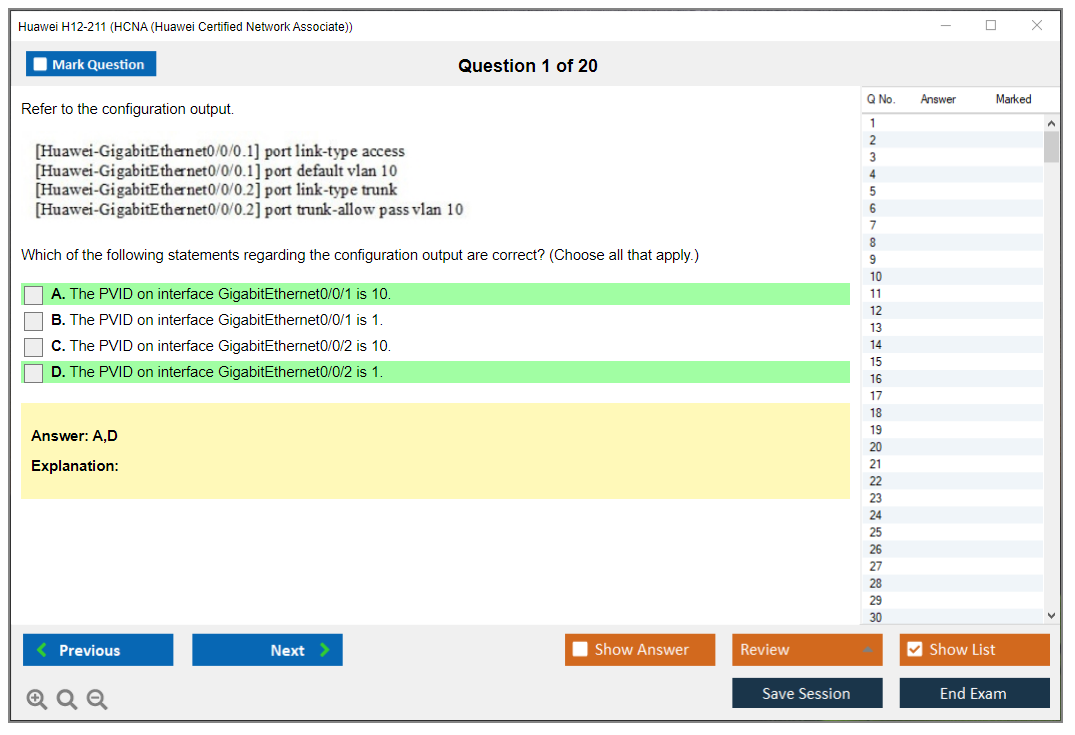
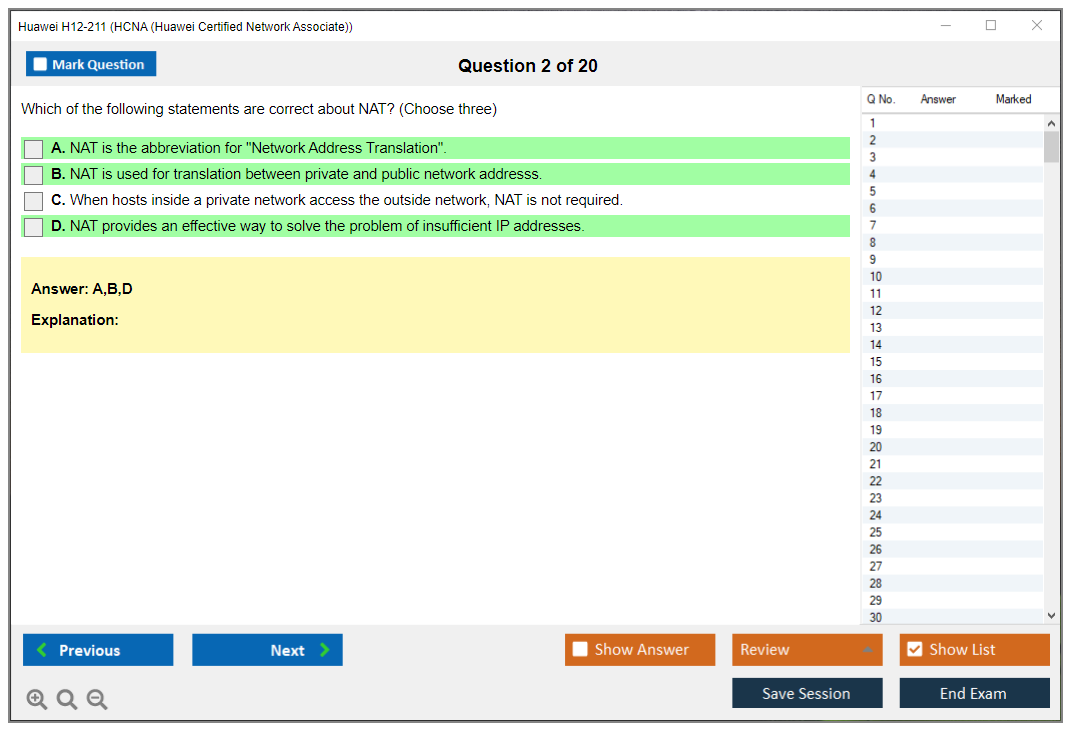
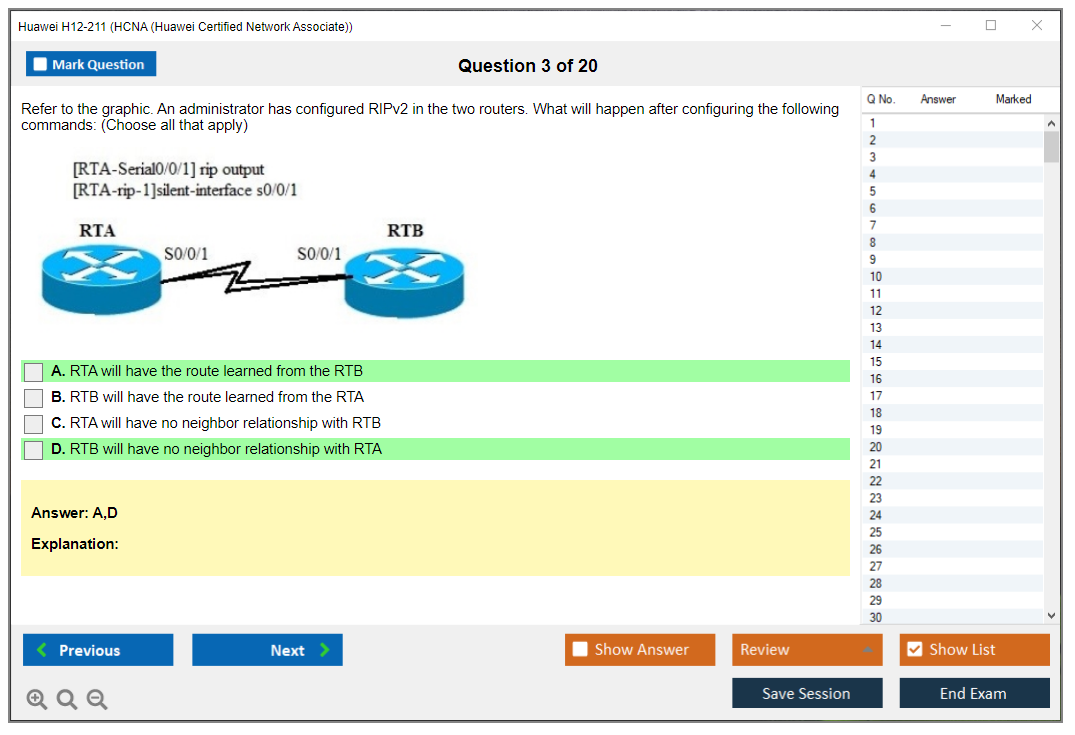
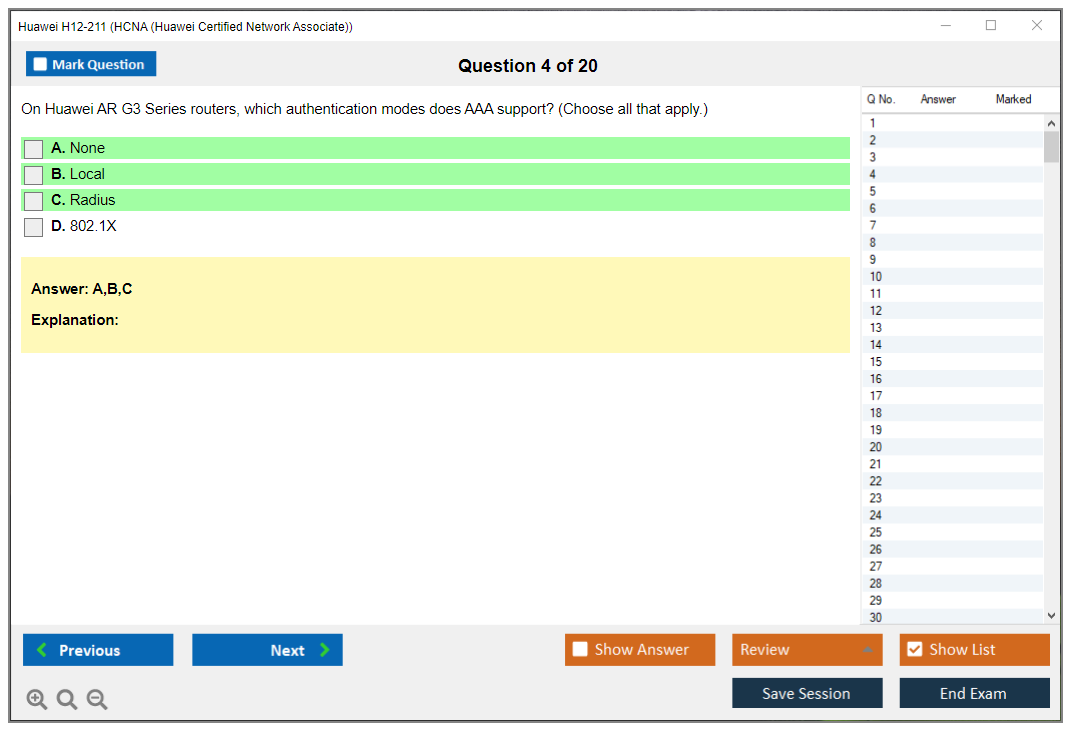
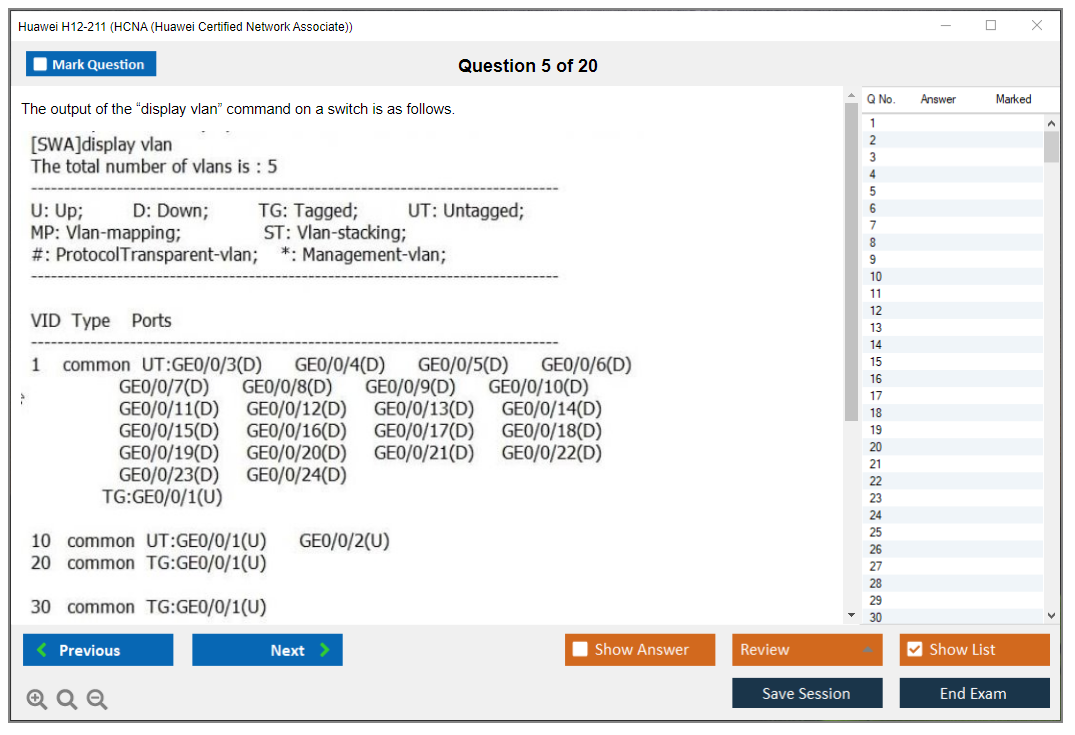
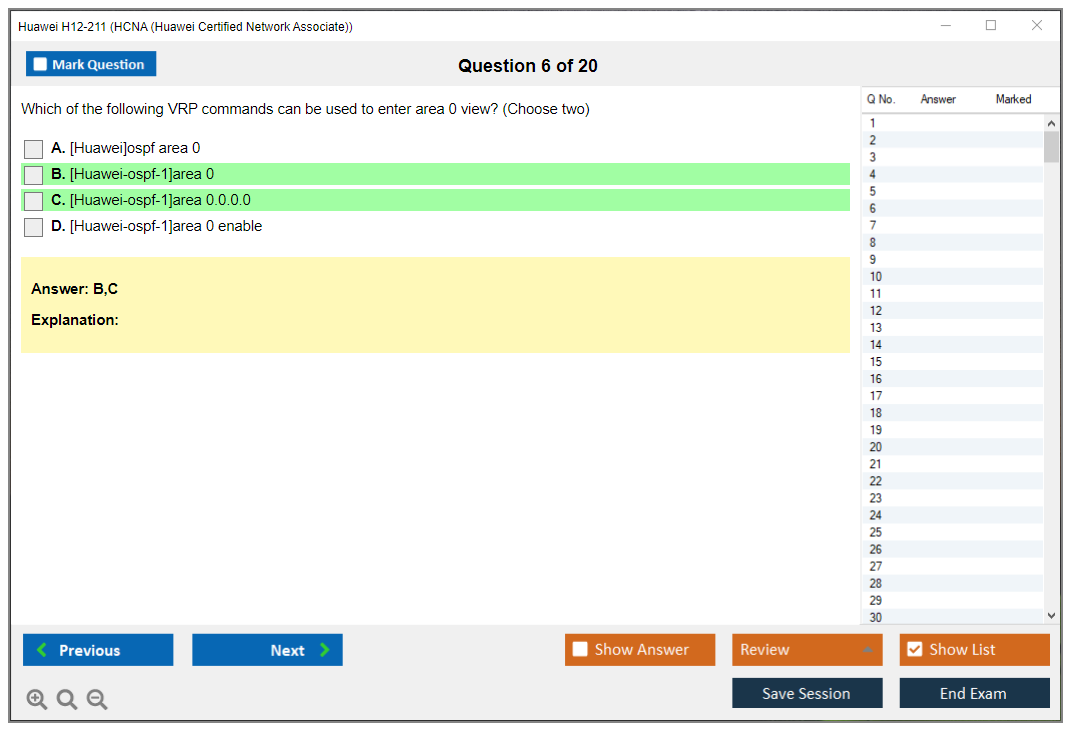
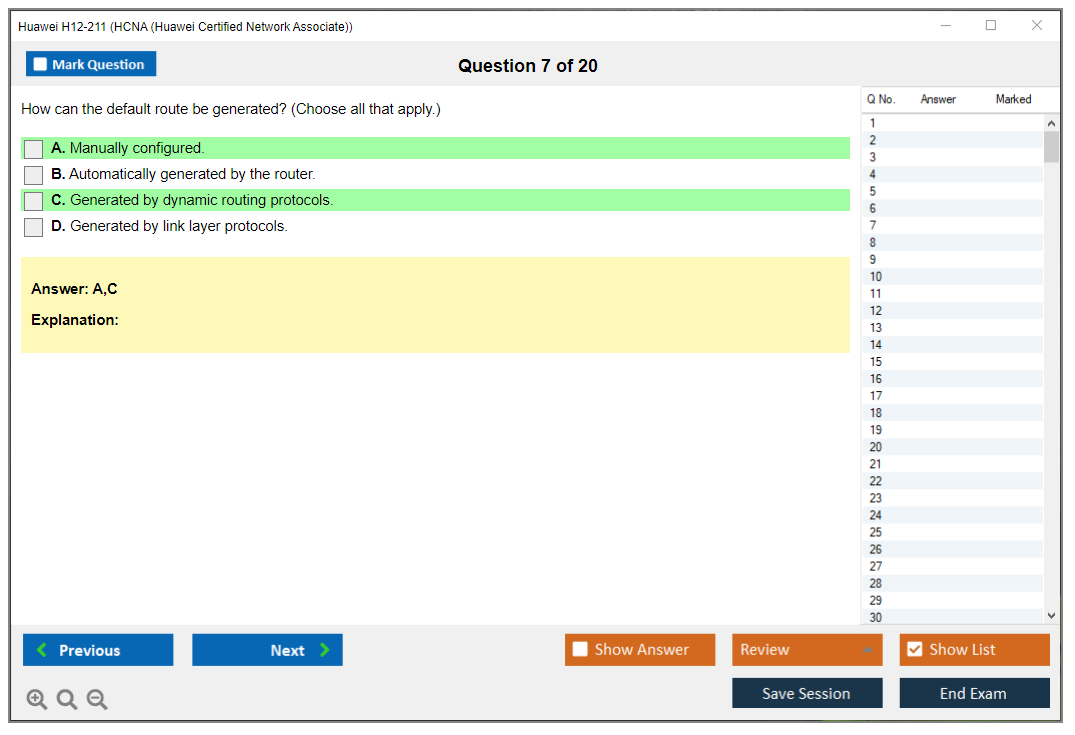
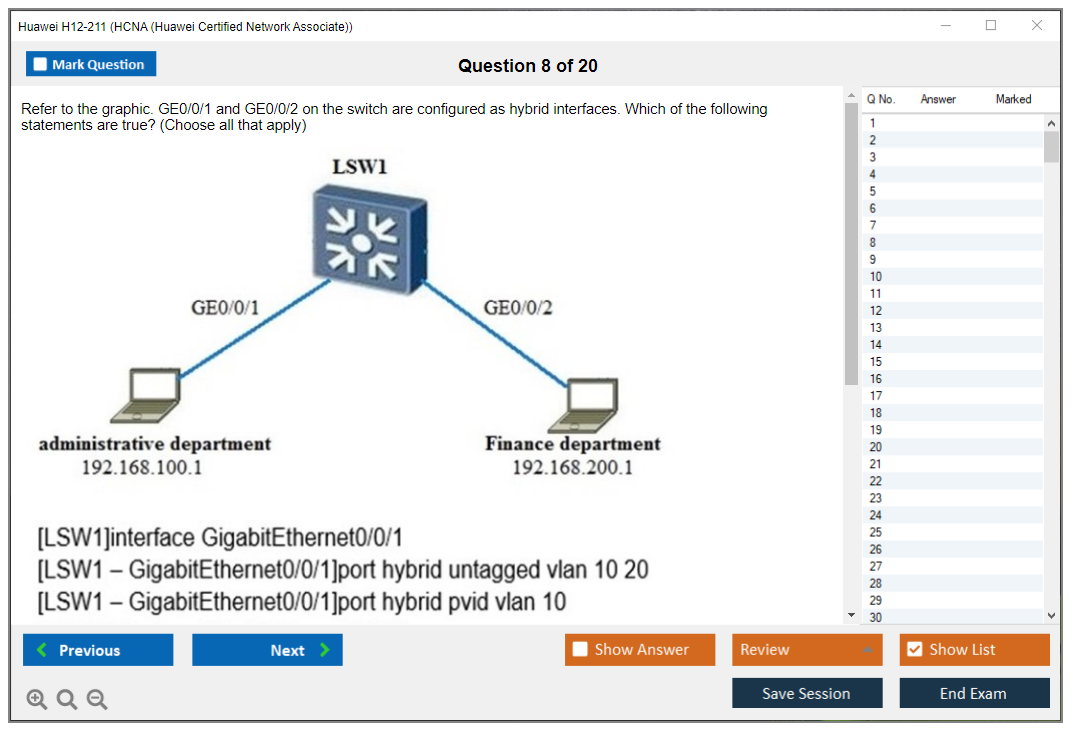
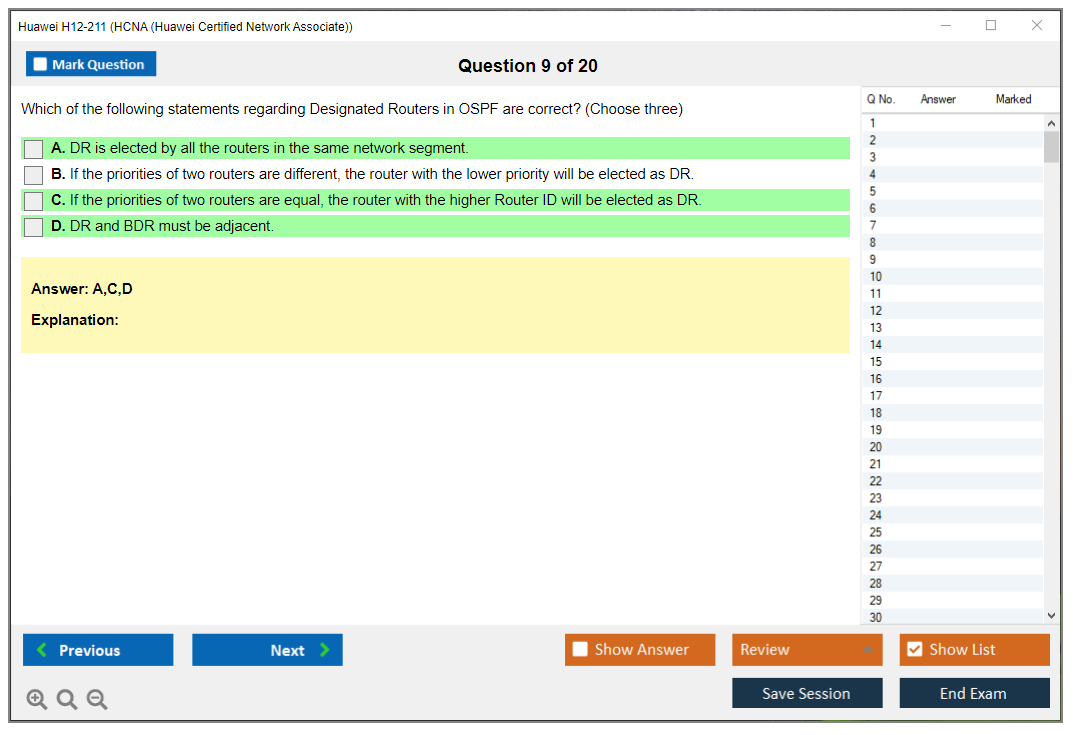
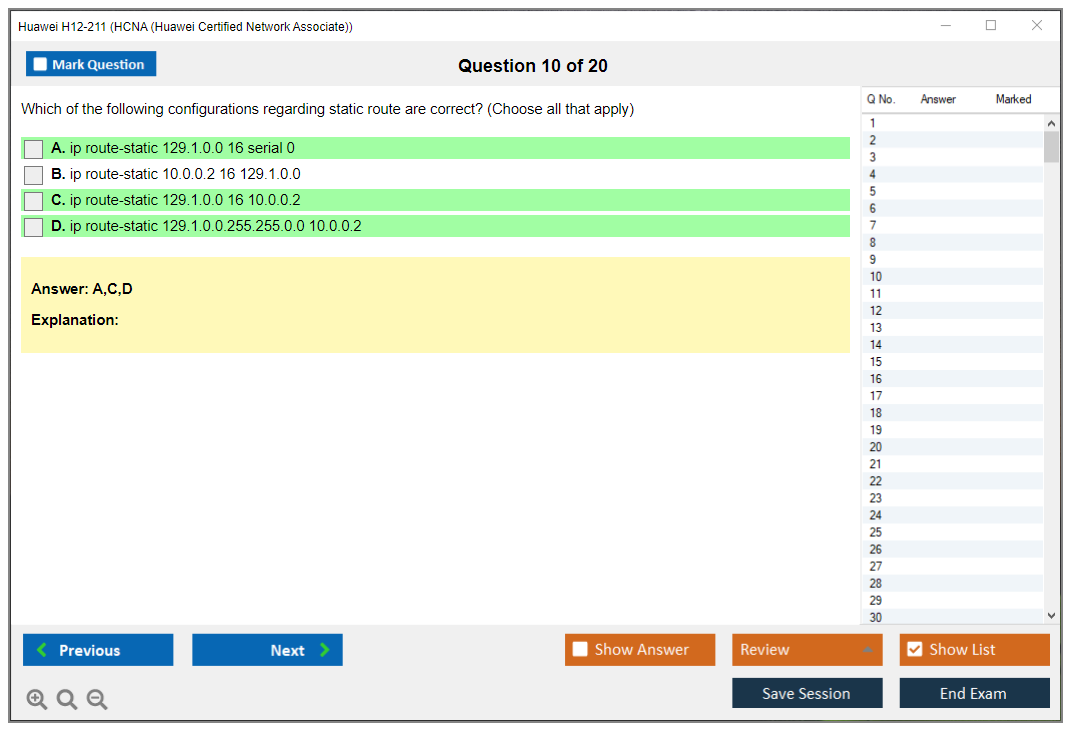
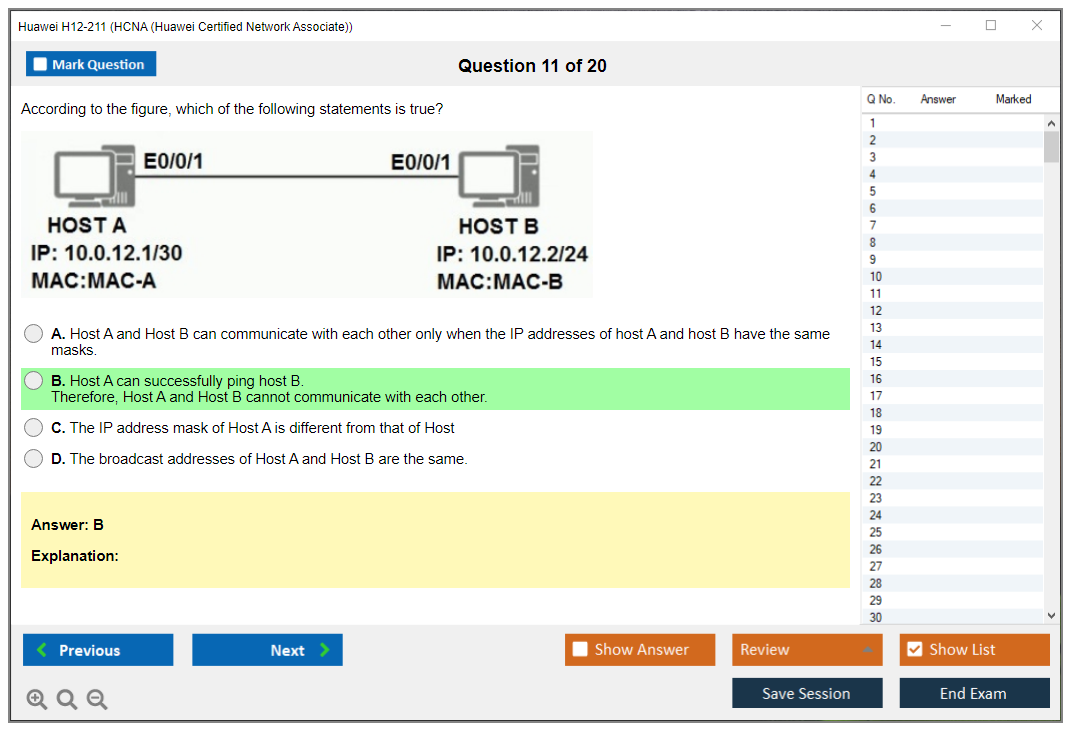
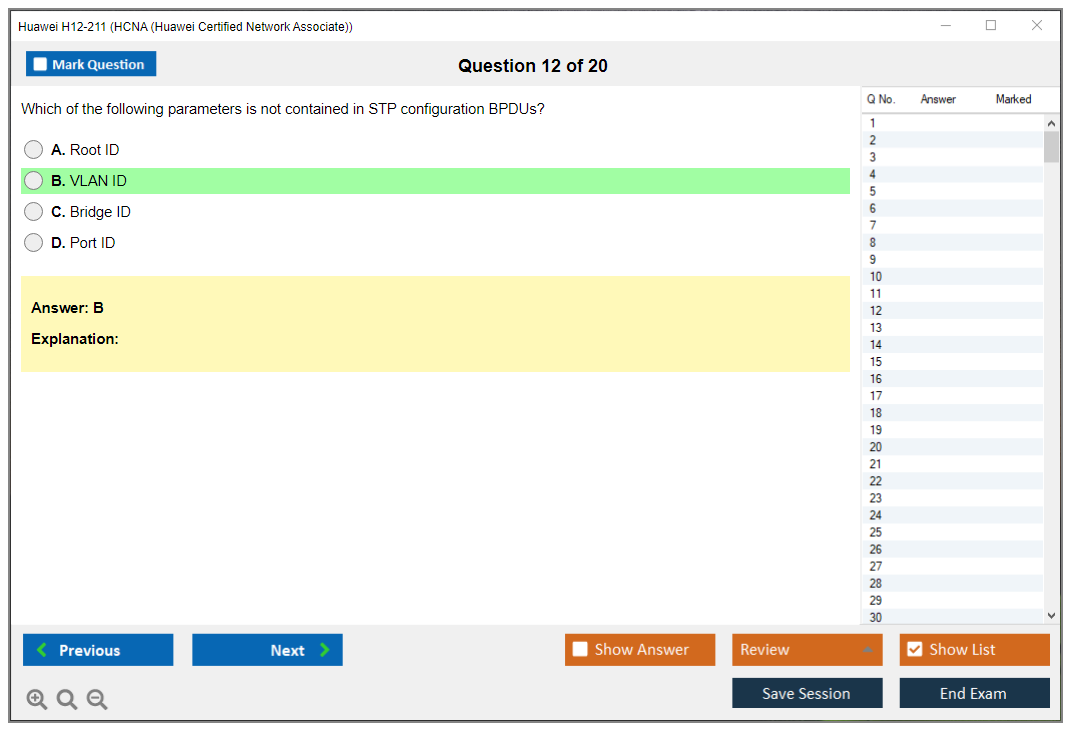
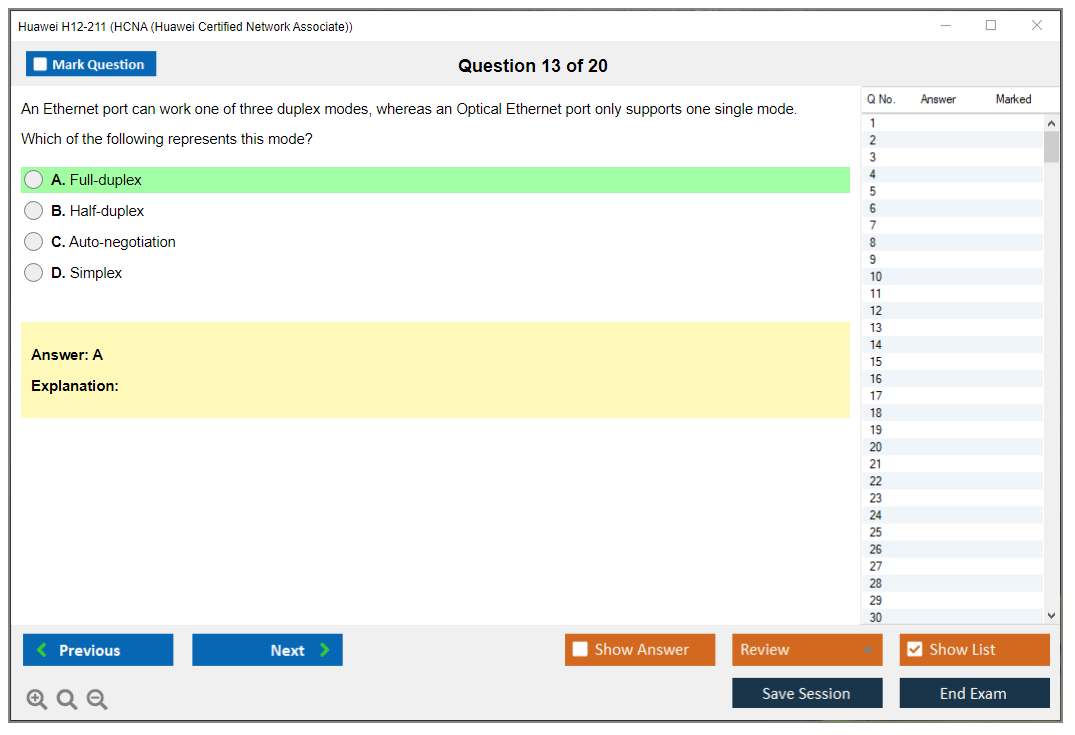
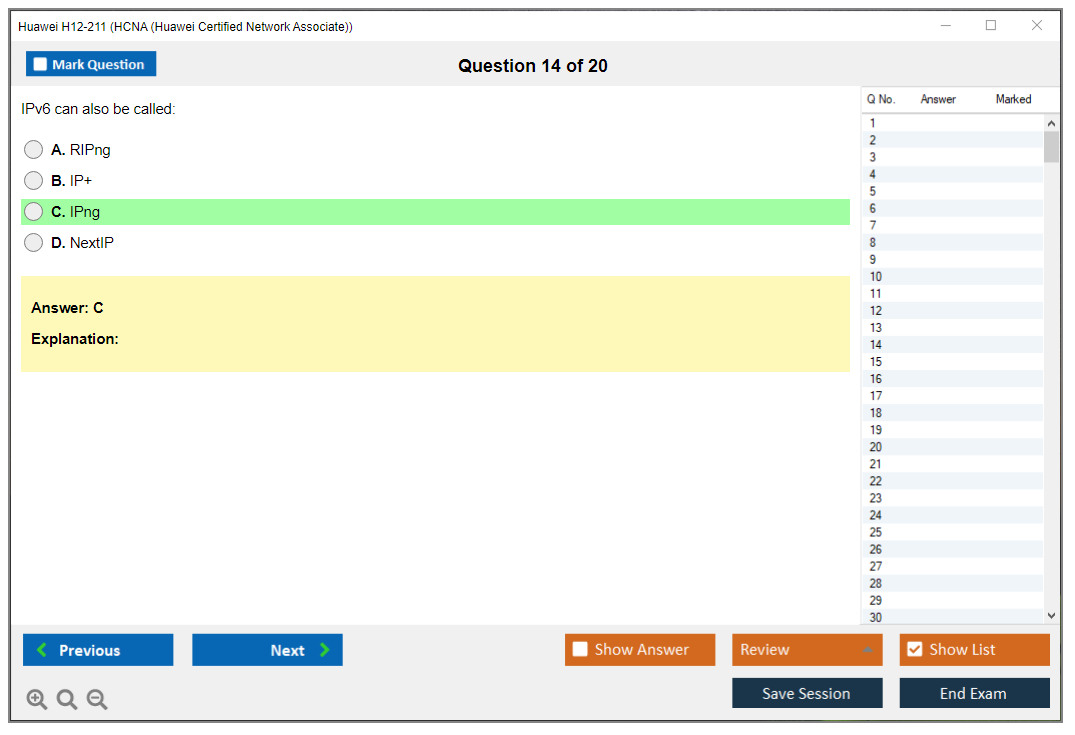
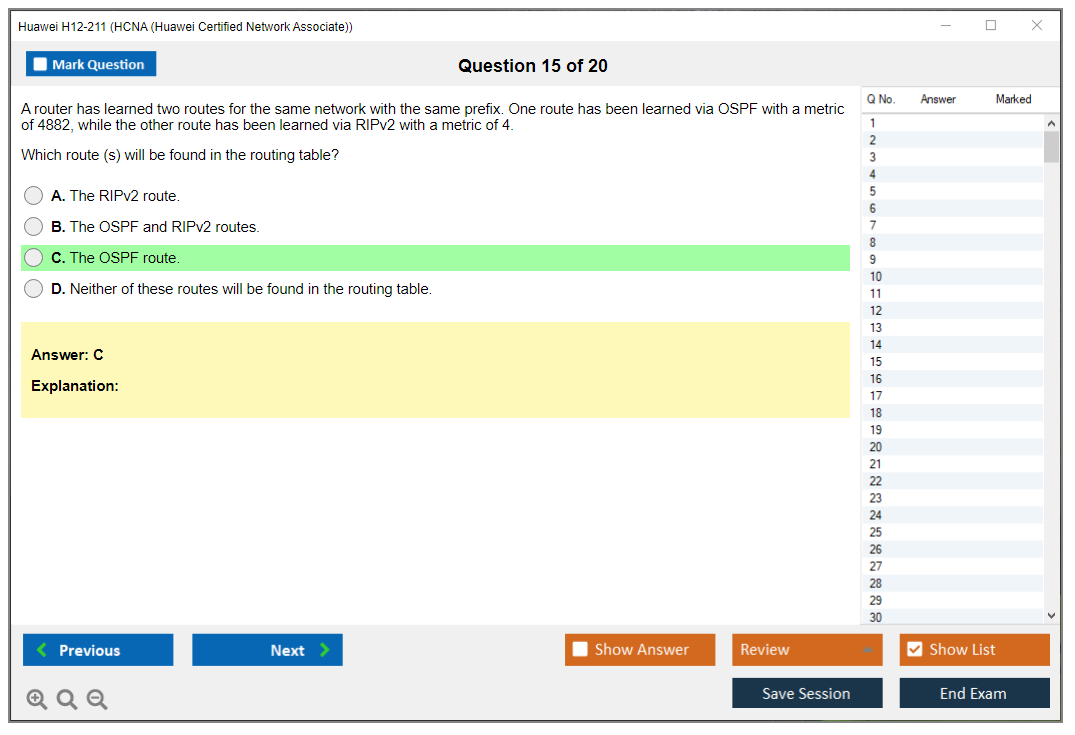
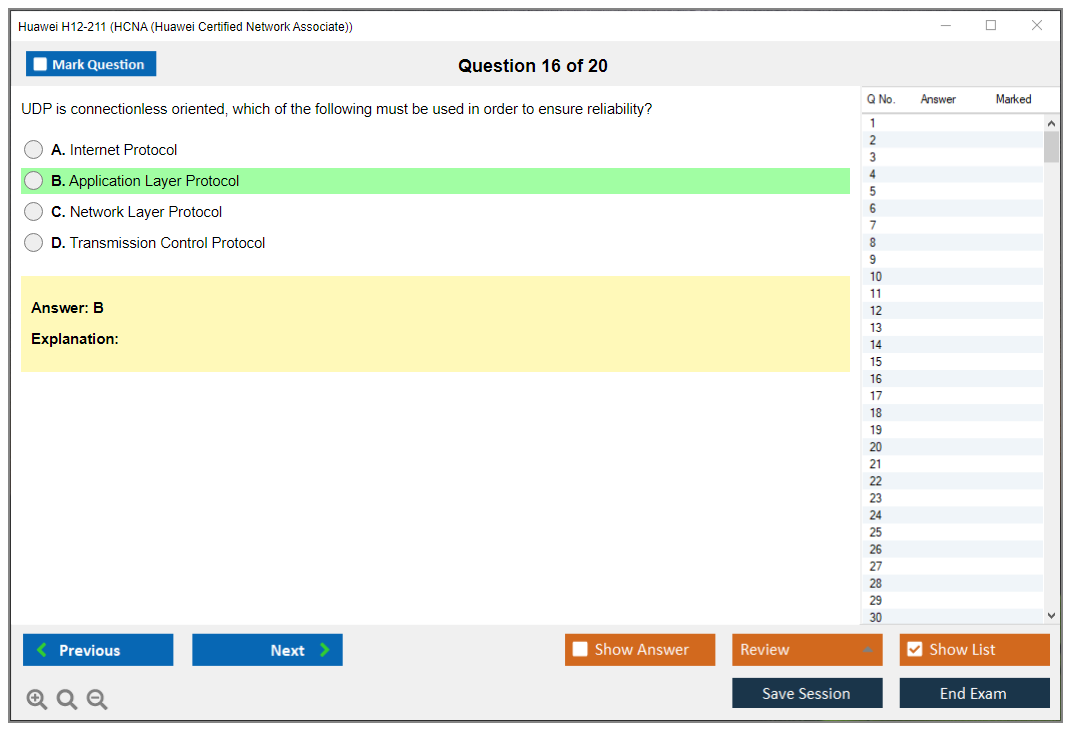
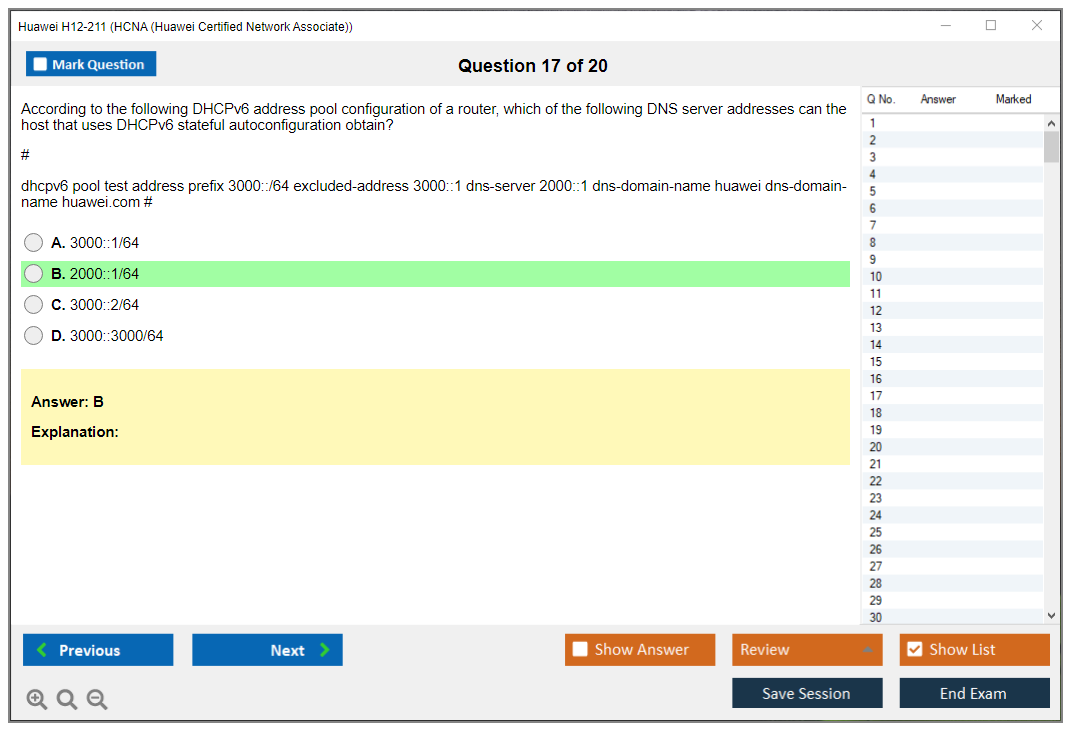
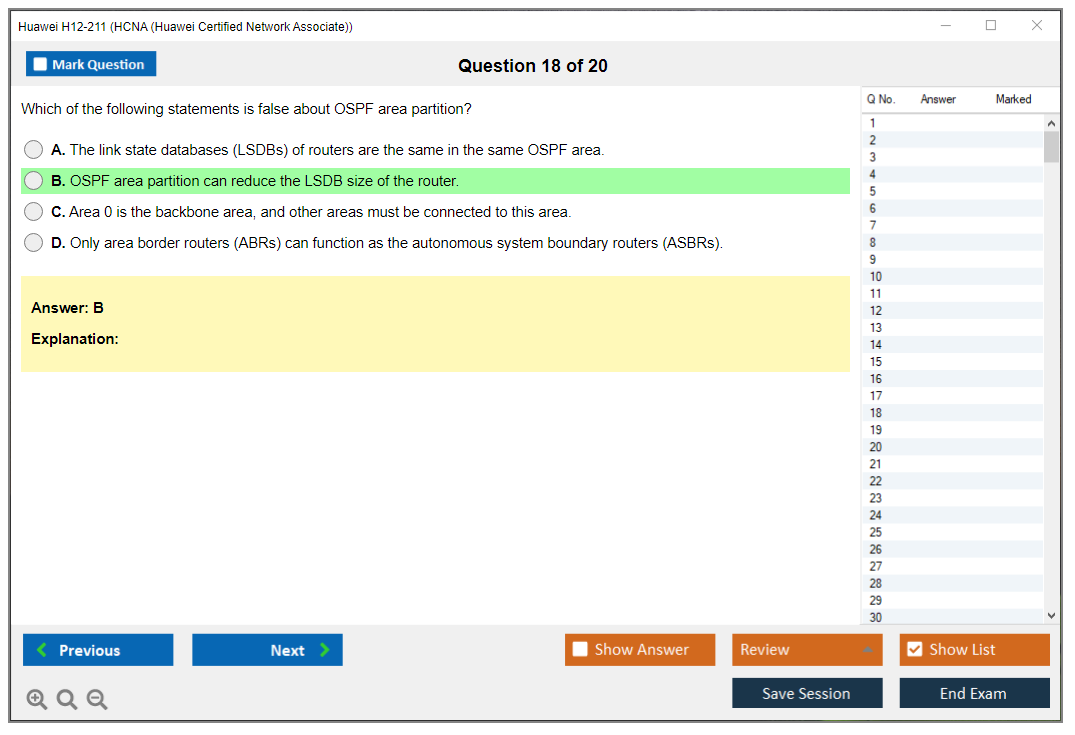
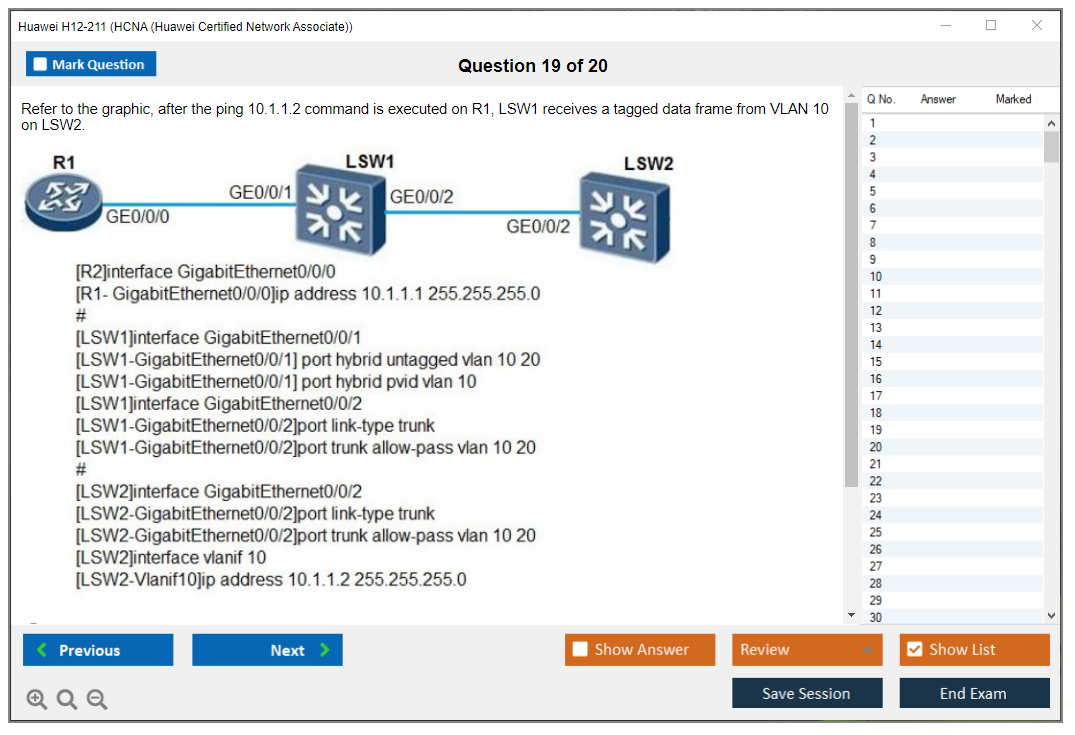
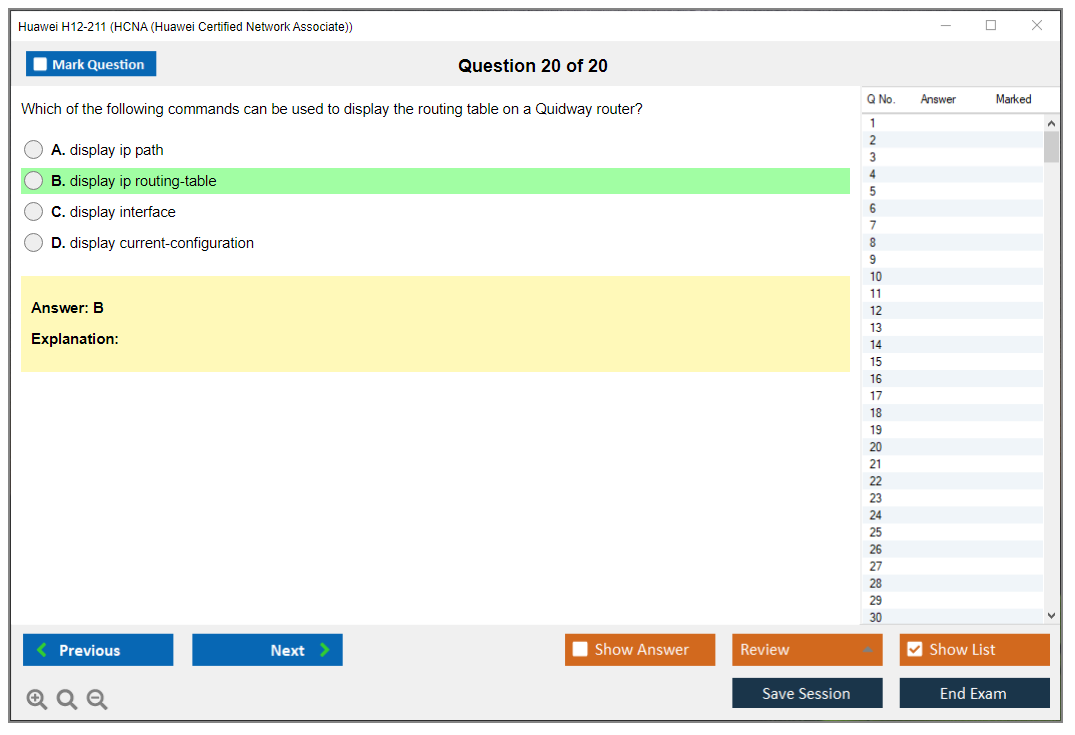
Dumpsarena Huawei HCNA (Huawei Certified Network Associate) (H12-211) Free Practice Exam Simulator Test Engine Exam preparation with its cutting-edge combination of authentic test simulation, dynamic adaptability, and intuitive design. Recognized as the industry-leading practice platform, it empowers candidates to master their certification journey through these standout features.
What is in the Premium File?
Satisfaction Policy – Dumpsarena.co
At DumpsArena.co, your success is our top priority. Our dedicated technical team works tirelessly day and night to deliver high-quality, up-to-date Practice Exam and study resources. We carefully craft our content to ensure it’s accurate, relevant, and aligned with the latest exam guidelines. Your satisfaction matters to us, and we are always working to provide you with the best possible learning experience. If you’re ever unsatisfied with our material, don’t hesitate to reach out—we’re here to support you. With DumpsArena.co, you can study with confidence, backed by a team you can trust.
Huawei H12-211 Exam FAQs
Introduction of Huawei H12-211 Exam!
The Huawei H12-211 exam is an HCIA-Routing & Switching certification exam. It tests a candidate's knowledge and skills related to basic routing and switching, as well as basic IPv6 knowledge. It is designed to validate a candidate's ability to install, configure, and troubleshoot medium-sized networks.
What is the Duration of Huawei H12-211 Exam?
The Huawei H12-211 exam is a 90-minute exam consisting of 65 multiple-choice questions.
What are the Number of Questions Asked in Huawei H12-211 Exam?
There are a total of 125 questions in the Huawei H12-211 exam.
What is the Passing Score for Huawei H12-211 Exam?
The passing score for the Huawei H12-211 exam is 600 points out of 1000.
What is the Competency Level required for Huawei H12-211 Exam?
The Huawei H12-211 exam requires a basic to intermediate level of knowledge in Huawei Networking technologies.
What is the Question Format of Huawei H12-211 Exam?
The Huawei H12-211 exam consists of multiple choice and simulation questions.
How Can You Take Huawei H12-211 Exam?
The Huawei H12-211 exam is available in both online and in-person testing center formats. For the online format, you can register for the exam on the Huawei website, and then take the exam from the comfort of your home or office. For the in-person format, you will need to register for the exam at a local testing center, and then take the exam at the designated time and location.
What Language Huawei H12-211 Exam is Offered?
The Huawei H12-211 exam is offered in English.
What is the Cost of Huawei H12-211 Exam?
The cost of the Huawei H12-211 exam varies depending on the country and region. Generally, the exam fee is around $150 USD.
What is the Target Audience of Huawei H12-211 Exam?
The Huawei H12-211 exam is designed for individuals who want to become an HCIA-Routing & Switching certified professional. This exam is intended for networking professionals who have a basic understanding of routing and switching protocols, network security, and the ability to configure, maintain, and troubleshoot basic network infrastructure.
What is the Average Salary of Huawei H12-211 Certified in the Market?
The average salary for professionals with Huawei H12-211 certification is around $75,000 per year.
Who are the Testing Providers of Huawei H12-211 Exam?
Huawei offers an official H12-211 exam which can be taken at a Huawei authorized testing center. The exam is administered by Pearson VUE.
What is the Recommended Experience for Huawei H12-211 Exam?
The recommended experience for the Huawei H12-211 exam is at least one year of experience in networking technology, including basic knowledge of IP addressing, network security, and routing protocols. Additionally, knowledge of Huawei products and solutions is recommended.
What are the Prerequisites of Huawei H12-211 Exam?
The Prerequisite for Huawei H12-211 Exam is that the candidate must have a basic understanding of networking and computer fundamentals, including LANs, WANs, TCP/IP, routing protocols, and related concepts.
What is the Expected Retirement Date of Huawei H12-211 Exam?
There is no official website to check the expected retirement date of the Huawei H12-211 exam. However, you may contact the Huawei certification team to get the most up-to-date information.
What is the Difficulty Level of Huawei H12-211 Exam?
The difficulty level of the Huawei H12-211 exam is considered to be medium to difficult.
What is the Roadmap / Track of Huawei H12-211 Exam?
The Huawei H12-211 certification roadmap consists of the following steps:
1. Become familiar with the H12-211 exam objectives.
2. Complete the recommended training courses.
3. Take practice tests to assess your knowledge.
4. Schedule and take the H12-211 exam.
5. Receive your Huawei certification.
6. Maintain your certification by taking continuing education courses.
What are the Topics Huawei H12-211 Exam Covers?
The Huawei H12-211 exam covers the following topics:
1. Network Fundamentals: This section covers the fundamentals of computer networks, including network topologies, protocols, and architectures.
2. Routing Technologies: This section covers the fundamentals of routing protocols, including RIP, OSPF, and BGP.
3. WAN Technologies: This section covers the fundamentals of WAN technologies, such as PPP, HDLC, and Frame Relay.
4. Security Technologies: This section covers the fundamentals of security technologies, such as firewalls, VPNs, and intrusion detection systems.
5. IPv6 Technologies: This section covers the fundamentals of IPv6 technologies, such as IPv6 addressing, routing, and tunneling.
6. Network Management and Troubleshooting: This section covers the fundamentals of network management, including troubleshooting techniques and network monitoring tools.
What are the Sample Questions of Huawei H12-211 Exam?
1. What is the purpose of a Layer 2 switch?
2. What are the advantages of using a Huawei H12-211 router?
3. What is the difference between a Layer 2 and Layer 3 switch?
4. How does a Huawei H12-211 router handle traffic routing?
5. What is the function of the Spanning Tree Protocol?
6. What are the benefits of using Quality of Service (QoS) on a Huawei H12-211 router?
7. How can you configure a Huawei H12-211 router to provide secure remote access?
8. What is the purpose of a Virtual Local Area Network (VLAN)?
9. How does a Huawei H12-211 router handle network address translation (NAT)?
10. What is the purpose of the Dynamic Host Configuration Protocol (DHCP)?
Huawei H12-211 (HCNA (Huawei Certified Network Associate)) Huawei H12-211 HCNA Exam Overview and Introduction What is the H12-211 (HCNA) certification? The Huawei H12-211 HCNA exam sits at the foundation of Huawei's three-tier certification framework, which climbs from HCNA to HCNP and then HCIE. Your entry ticket, basically. This Huawei Certified Network Associate routing and switching credential proves you actually understand the basics, not just theory from a textbook. We're talking practical knowledge of IP addressing, switching fundamentals, routing protocols, and network services that keep enterprise networks alive. If you're an entry-level network engineer trying to break into the field, or maybe IT support staff who wants to level up beyond helpdesk tickets, this exam matters. It covers network fundamentals like OSI and TCP/IP models, Ethernet basics, IPv4 and IPv6 addressing (yeah, you'll subnet until you dream in binary), VLANs, trunking, and STP concepts. Static and dynamic... Read More
Huawei H12-211 (HCNA (Huawei Certified Network Associate))
Huawei H12-211 HCNA Exam Overview and Introduction
What is the H12-211 (HCNA) certification?
The Huawei H12-211 HCNA exam sits at the foundation of Huawei's three-tier certification framework, which climbs from HCNA to HCNP and then HCIE. Your entry ticket, basically. This Huawei Certified Network Associate routing and switching credential proves you actually understand the basics, not just theory from a textbook. We're talking practical knowledge of IP addressing, switching fundamentals, routing protocols, and network services that keep enterprise networks alive.
If you're an entry-level network engineer trying to break into the field, or maybe IT support staff who wants to level up beyond helpdesk tickets, this exam matters. It covers network fundamentals like OSI and TCP/IP models, Ethernet basics, IPv4 and IPv6 addressing (yeah, you'll subnet until you dream in binary), VLANs, trunking, and STP concepts. Static and dynamic routing. Security fundamentals like ACLs and NAT. It's thorough enough to prove you're not just guessing when someone asks you to troubleshoot a VLAN mismatch.
The certification's recognized globally as proof you can work with Huawei networking technologies, which opens pathways to advanced Huawei certifications and specialized tracks. Once you nail HCNA, you could branch toward HCIP-Datacom-Core Technology V1.0 or even chase the expert-level HCIE-Datacom V1.0 if you're feeling ambitious. The thing is, once you nail HCNA, you could branch toward specialized areas or just keep climbing the ladder. I spent about six months debating whether to go deep on wireless or stick with core routing after passing mine, which probably wasn't the most productive use of time but whatever.
Evolution and current status of the H12-211 exam in 2026
The HCNA certification program's evolved quite a bit since Huawei first launched it. Recent updates to the exam blueprint for 2026 have aligned the H12-211 exam objectives with current networking industry standards. You'll see integration of modern networking concepts like SDN awareness and automation basics, though it's still mostly focused on routing and switching fundamentals. This isn't your grandfather's networking exam anymore.
Compared to previous versions? The 2026 H12-211 exam objectives put more weight on hands-on troubleshooting scenarios and less on pure memorization. They've tweaked the question distribution to reflect what junior network engineers actually encounter in production environments. The exam format still includes multiple-choice and scenario-based questions, but there's heavier focus on understanding why configurations work rather than just knowing syntax. Which makes it tougher but way more valuable career-wise.
Within Huawei's broader ICT certification ecosystem, H12-211 feeds into multiple specialization paths. You could go toward HCIA-WLAN V3.0 for wireless, HCIA-Security V4.0 for security focus, or stick with the datacom track through HCIA-Datacom V1.0.
Who should take the Huawei HCNA H12-211 exam
Entry-level network administrators seeking vendor-specific credentials should absolutely consider this. IT professionals transitioning into networking roles find it valuable because it's less intimidating than diving straight into Cisco's ecosystem if you've never configured a switch before. System administrators expanding their skill sets benefit too, especially if your organization runs Huawei gear and you're tired of calling vendors for basic configs.
College students and recent graduates in IT or computer science fields use HCNA as resume padding that actually means something. Career changers entering the networking field appreciate that HCNA certification requirements are minimal (basically just "understand what a network is"). Technical support engineers working with Huawei equipment need this to move beyond tier-1 support tickets into actual network engineering roles.
Existing networking professionals adding Huawei expertise to their portfolio often find the H12-211 exam difficulty reasonable if they already hold something like CCNA. The concepts translate, just the CLI syntax differs. Which is refreshing.
Career benefits and opportunities with HCNA certification
Job roles accessible with HCNA certification include network technician, junior network engineer, NOC analyst, and technical support specialist positions. Salary expectations vary wildly by region. In Asia-Pacific markets where Huawei dominates, you might see 15-20% salary bumps over non-certified peers. In Africa and parts of the Middle East where Huawei infrastructure is everywhere, the market value is substantial. Really substantial.
Employer recognition matters more than people admit. If you're applying to telcos, ISPs, or enterprises running Huawei equipment, having HCNA on your resume signals you won't need three months of vendor training before touching production gear. Geographic markets where Huawei certification holds particular value include China (obviously), Southeast Asia, Africa, Eastern Europe, and increasingly Latin America.
How HCNA certification works alongside other vendor certifications is interesting. Pairing it with Cisco CCNA creates a multi-vendor profile that screams "I'm not locked into one ecosystem." Career progression pathways after achieving HCNA status typically move toward HCNP-level specializations or lateral moves into adjacent domains like HCIA-Cloud Service V3.0. The flexibility's pretty nice.
Key differentiators of Huawei HCNA versus competitor certifications
The comparison with Cisco CCNA certification reveals some details. Scope-wise, they're similar. Both cover routing, switching, network fundamentals. Depth varies though. CCNA digs deeper into certain protocols while HCNA puts more weight on Huawei-specific implementations. Focus areas differ slightly: HCNA includes more focus on Huawei VRP (Versatile Routing Platform) operating system quirks, which you'll either love or find mildly irritating depending on your temperament.
Unique aspects of Huawei networking philosophy include their approach to device management and their specific take on network automation. Huawei-specific technologies and protocols covered in the network fundamentals Huawei certification include things you won't see on Cisco exams, though some of it feels like reinventing the wheel with different syntax.
Cost-benefit analysis? The H12-211 exam cost typically runs $200-300 USD depending on your testing center, which is comparable to or slightly cheaper than CCNA. Market positioning matters. Choose HCNA over alternatives when you're targeting markets with heavy Huawei presence or when your employer specifically uses Huawei gear. Multi-vendor strategy considerations suggest getting both HCNA and CCNA if you want thorough networking expertise that travels across vendor boundaries, which makes total sense in today's multi-vendor environments.
For hands-on prep, Huawei eNSP lab practice is critical. Download it free from Huawei's site and build topologies until VLAN configuration feels like muscle memory. The H12-211 passing score sits around 600 out of 1000. Results come back within 24-48 hours usually. Quick turnaround.
HCNA Certification Prerequisites and Eligibility Requirements
Huawei H12-211 (HCNA) exam overview
The Huawei H12-211 HCNA exam is Huawei's entry-level networking cert exam, usually marketed around Huawei Certified Network Associate routing and switching basics. It's aimed at people who want proof they can talk network fundamentals and do simple configs without panicking.
New to networking? Switching jobs? Trying to get past HR filters? Those are the common reasons I see people go after it. Especially if they're in regions where Huawei gear is everywhere and "Cisco-only" advice doesn't match the workplace. I've met warehouse guys who spent eight months studying at night just to get out of manual labor jobs, and this cert was the ticket because local ISPs actually cared about it.
Prerequisites for HCNA (H12-211)
Okay, official part first. Huawei does not publish hard gatekeeping requirements for this test. No prior certs demanded. No degree check happening. Definitely no "must have X years experience" form to complete before they let you schedule. The HCNA certification prerequisites are basically "register, pay, show up."
That open enrollment policy? Real deal. It's one of the nicer parts of the Huawei cert track because it lets career changers take a swing without first buying into a whole ladder of prerequisites that don't actually prove you can configure anything worth mentioning.
Age restrictions? Usually handled by the testing provider rules, not Huawei's marketing page. Many exam programs default to 18+ for independent registration. If you're younger you may need parental consent or a guardian agreement depending on your country and test center. Check local policy before booking.
Language options vary wildly by region and delivery partner, but you'll typically see English available and sometimes Chinese, plus other languages depending on the market. Don't assume anything here. Verify the language during scheduling because switching it later can be a genuine mess that wastes your time and money.
Accessibility accommodations exist. Extra time, separate room, assistive tech, that sort of thing. You've gotta request them ahead. The exact process depends on where you test, and they'll usually ask for documentation ahead of time, not the day-of.
Recommended background knowledge and experience
No mandatory background doesn't mean "walk in cold."
The baseline expectation feels like network fundamentals plus light hands-on experience that proves you won't freeze when you see a command prompt or a topology diagram with five routers and three switches connected in ways that initially look confusing but actually follow typical enterprise patterns.
You should be comfortable with the OSI model and TCP/IP. Not memorize-every-field comfortable, but you need to understand why ARP exists, what a default gateway does, and what happens when a host talks outside its subnet. The H12-211 exam objectives tend to assume you can reason about traffic flow without needing hand-holding through every single step of packet forwarding and decision logic.
Subnetting fundamentals matter. A lot. People lose time here because they can't quickly tell if two IPs are in the same network or what the usable range is. Also know basic IPv6 ideas even if IPv4 dominates your day job.
Know what routers, switches, and hubs are, and why hubs are basically trivia now. Add basic VLAN concepts to that mental model because even "associate" exams love VLAN and trunk questions.
CLI comfort? Helps a ton. You don't need to be a wizard, but you should be able to read command output without freezing. Understand the idea of configuration modes and saving changes.
Binary and hexadecimal show up in sneaky ways. IP math, masks, and sometimes MAC addressing logic. You're not doing cryptography here, but number systems shouldn't feel alien.
Know common acronyms too. DNS, DHCP, NAT, ACL, STP, ARP. If those look like alphabet soup, give yourself a week to get familiar before hardcore HCNA R&S exam preparation.
Technical skills that provide a foundation for success
This is where career reality kicks in. The exam is one thing. The job expectations? Another universe entirely.
Computer literacy is table stakes. Windows navigation. Basic Linux familiarity. Knowing what an IP config screen is. Being able to find logs without clicking randomly like you're playing minesweeper with production systems hoping nothing explodes.
Troubleshooting mindset matters more than people admit. You'll do better if you can think in steps, test one change at a time, and avoid "I changed five things and now I don't know what fixed it."
Read network diagrams. Even simple ones. Icons, links, subnets, where the gateway lives, fragments of larger topologies. Diagrams show up everywhere in this field.
Client-server basics help too. What's a client request, what's a server response, what ports and protocols are common, and why "the app is down" often means "DNS is broken."
Also, get comfortable reading documentation. Huawei docs, command references, and config guides are written in a very specific style. If you can't skim for the one line you need, labs take forever and you'll hate your life.
Comparison with CCNA and other vendor prerequisites
Real talk here.
Cisco's CCNA also doesn't have strict prerequisites anymore, but culturally people treat it like a bigger mountain. The HCNA path tends to feel a bit more approachable for complete beginners. Mostly because the scope and the surrounding ecosystem (training, expectations, hiring signals) are different, not because the networking concepts are magically easier.
Prior vendor certs help, but they're not required. If you've studied CCNA topics, you'll recognize a ton. VLANs, trunks, basic routing, NAT, ACL concepts. The transfer is real, but the CLI syntax and the way Huawei phrases questions can trip you up. Don't assume "Cisco brain" automatically equals a pass.
If you're deciding which to do first, base it on your local job market and what gear you can practice on. If your area is heavy Huawei, start here and build upward. If every posting screams "CCNA required," do Cisco first and then cross-certify later. The fundamentals overlap and you can map concepts across with a little deliberate study.
Recommended preparatory courses and self-study options
Huawei official training exists in instructor-led and online formats, and it's the most aligned with the exam blueprint. It's also not always cheap, so mix it with HCNA study materials like official docs and labs.
For free intros? Coursera and edX networking fundamentals courses are fine. YouTube can carry you far if you're disciplined. Books help too, especially general networking primers that explain switching and routing without vendor hype.
If you want hands-on without buying hardware, do Huawei eNSP lab practice. Build VLANs. Set trunks. Add static routes. Test ping paths, then break it on purpose and fix it. That's where the learning sticks, and it's also how you avoid depending on a sketchy H12-211 question bank that may or may not reflect current exam content or teach you anything useful beyond memorization.
Time investment: absolute beginners usually need 2 to 4 weeks just to get the prerequisite knowledge stable, then additional time for exam-specific study and labs. Some people push faster, but speed studying often shows up later as "I passed, but I can't configure anything."
Quick notes people always ask about
How much does the Huawei H12-211 exam cost? The H12-211 exam cost varies by country and provider, so check the registration portal for your region before budgeting.
What is the passing score for H12-211 (HCNA)? The H12-211 passing score can be reported differently depending on exam version and provider, so confirm it on the official listing you're booking through.
Is the H12-211 exam hard for beginners? The HCNA exam difficulty is manageable if you do subnetting practice and real labs, but it's rough if you only read slides and hope.
What are the best study materials for HCNA H12-211? Mix official courseware, Huawei docs, eNSP labs, and at least one reputable H12-211 practice test to find weak spots.
How do I renew the HCNA certification after passing H12-211? The HCNA renewal policy changes by program track over time, so verify the current validity period and recert options on Huawei's certification page before you plan your next step.
H12-211 Exam Cost, Registration, and Logistics
Breaking down the H12-211 exam cost
The Huawei H12-211 HCNA exam typically runs around $200 USD. That's your baseline number. Sometimes you'll see it jump to $300 depending on where you're testing and whatever Pearson VUE decides that quarter, but $200 is what most folks actually end up paying. Regional pricing gets weird fast though. If you're testing outside the US, you're dealing with currency conversion plus local market adjustments that can push that number in unexpected directions. I've seen people in Europe pay closer to €220-250, which works out to more in USD after conversion.
Payment methods? Pretty standard stuff. Credit cards work fine. Some regions accept PayPal or local payment processors through Pearson VUE's system.
Student discounts exist but they're not automatic. You gotta actively check with Huawei Learning or your local Huawei training partner. Corporate bulk purchases? Yeah, if your company's buying exam vouchers for a team, there's usually negotiating room there. Compared to Cisco's CCNA (which runs $300), the H12-211 is actually more affordable, making it a decent entry point if you're deciding between vendor certifications. And who isn't comparing prices these days?
But that $200 isn't your total cost. This is where people get surprised. You need study materials, right? Official Huawei courseware might run another $100-300 if you're buying direct. Practice tests, maybe $50-100 depending on the provider you choose. And if you fail? You're paying that full exam fee again. Stings. So budget $400-600 total for your first attempt including prep materials, and add another $200-300 buffer for a potential retake just to be safe.
Where to actually register for this thing
Pearson VUE's your testing partner here. You can't just show up somewhere random and take the H12-211. You gotta go through their system, which is pretty standardized at this point. First step is creating a Pearson VUE account if you don't have one already. Then you'll need a Huawei certification account through their official learning portal. These two systems need to talk to each other, so make sure you're using the same email address for both or you'll hate yourself later when things don't sync.
Registration's straightforward enough. Once you're logged into Pearson VUE, search for H12-211 or "HCNA" in their exam catalog. Select your preferred test center location. They've got a search tool showing you the nearest authorized centers based on your zip code or city. Time slots vary wildly though. Some centers have daily availability. Others might only run Huawei exams twice a week, which can be annoying if you're on a tight schedule.
Online proctored options? Remote testing has expanded massively since 2020, and Pearson VUE does offer OnVUE online proctoring for many exams. Check if H12-211's available in your region through this option. Requirements are strict though. You need a webcam that works, stable internet (hardwired's better than WiFi), and a completely clear workspace. I mean completely clear. No papers, no phones, no second monitors visible. Someone's watching you the entire time through that webcam. Feels weird at first but you adjust.
On a related note, I once had a friend who got flagged during an online exam because his cat jumped onto the desk mid-test. The proctor stopped everything, made him lock the cat out of the room, and restart the whole check-in process. Cost him like twenty minutes of testing time. So if you've got pets, plan accordingly.
For ID requirements, bring a government-issued photo ID. In the US that's a driver's license or passport. The name on your ID must exactly match the name on your Pearson VUE registration or they won't let you test, and you'll forfeit that exam fee without any sympathy.
When to schedule and timing tricks
Book your exam 2-4 weeks out after you've finished your core studying. This gives you buffer time for final review and practice tests without letting your knowledge get stale, which happens faster than you'd think. I've seen people book too early (six months out when they're just starting) and then scramble to reschedule multiple times. Don't do that.
Morning slots work better. Your brain's fresher, test centers are less crowded, and you're not spending all day stressed about an afternoon exam hanging over your head. Avoid Mondays if possible. Test centers can have technical issues after weekend maintenance. Friday afternoons are usually wide open because nobody wants to potentially ruin their weekend with a failed exam, which makes them great if you're confident.
Peak testing periods hit around university semester ends (May, December) when students are cramming certifications before graduation. Summer months and early January tend to have better availability.
Reschedule and cancellation policies you need to know
Pearson VUE requires 24-48 hours notice for rescheduling without penalty. Miss that window and you're paying a rescheduling fee or potentially forfeiting the entire exam cost. The exact cutoff's usually 24 hours, but check your specific exam's policy because it can vary by region.
Full cancellations rarely get you a complete refund. You might get partial credit toward a future exam, but expect to lose at least some portion of that fee. No-shows? You lose everything. Period. The system marks you as a no-show and you're out the full amount with zero recourse.
Emergency exceptions exist for medical situations or documented emergencies, but you'll need proof and you'll be dealing with Pearson VUE customer service, which is hit or miss depending on who answers your ticket. The rescheduling process itself is easy through their website though. Just log in, find your scheduled exam, and select a new date and time if available slots exist.
What happens if you fail
There's typically no mandatory waiting period between H12-211 attempts, but you're paying full price again. That's another $200-300 depending on your region. Adds up fast. Huawei doesn't offer discounted retakes like some vendors do. You can attempt the exam multiple times, but if you're on your third attempt, something's wrong with your study approach and you need to reassess before throwing more money at it.
Scores report right away. You'll know if you passed before you leave the center, which is both great and terrifying depending on how it goes. For retakes, I'd wait at least two weeks to properly review your weak areas. Use that failed attempt as a diagnostic tool since Pearson VUE provides a score report showing which exam objectives you struggled with most.
Exam day logistics
Show up 15-30 minutes early. Check-in takes time, especially if there's a line or if the testing center staff is dealing with someone else's drama, which happens more often than you'd expect. You'll go through identity verification where they check your ID against your registration carefully. They'll photograph you. Then comes the locker situation. Everything goes in a locker without exception. Phone, wallet, watch, jacket, everything except your ID.
The testing center provides scratch paper and pencils. No calculators for this exam. You won't need one anyway since it's not math-heavy. Breaks aren't officially scheduled for the H12-211 since it's a shorter exam, but if you absolutely need to step out, you can request one. The clock keeps running though.
After you finish, you'll get your score report right there on screen. Print it or save it digitally right then. Then you're done. They'll retrieve your stuff from the locker and you're out the door.
For more advanced Huawei certifications after passing HCNA, you might look into the HCIP-Datacom-Core Technology V1.0 track or even the HCIE-Datacom V1.0 if you're really ambitious down the road. The HCIA-Datacom V1.0 is another solid entry-level option that overlaps with HCNA content, which can be strategic.
H12-211 Exam Format, Structure, and Passing Score
Huawei H12-211 (HCNA) exam overview
The Huawei H12-211 HCNA exam is the classic entry point for Huawei networking, especially if you're aiming at Huawei Certified Network Associate routing and switching roles or you just want a vendor-flavored take on network fundamentals Huawei certification topics. Quick reality check here. It's not a "watch two videos and wing it" test, but it's also not some research paper you'd write for grad school or anything like that. It's a timed, objective exam that rewards people who can read carefully, remember defaults, and think like a junior network admin under pressure. The kind who's got three tickets open and a phone ringing.
Most candidates? Early-career IT folks. Help desk people trying to break out. Or sysadmins who keep getting pulled into "hey can you look at this switch" tickets and finally decided to make it official. Career-wise, it's a decent signal. Not magic, but useful enough if you're building credibility.
H12-211 exam cost and registration
People always ask how much does the Huawei H12-211 exam cost? Honestly? It depends on region, currency, and the test delivery partner, so treat any single number you see online as "typical, not guaranteed." You'll see different pricing across countries. Sometimes training partners bundle vouchers, which makes comparisons messy as hell. Also, don't forget travel time if you're doing a test center. Nobody talks about that hidden cost.
Registration's usually via Huawei's certification portal and approved testing partners, with options that vary by geography. Read the reschedule and retake policy before you pay. Seriously. Policies can be strict, and if you're budgeting, the retake matters just as much as the first fee. Maybe more. This is also where you confirm HCNA certification prerequisites (usually none officially), plus any ID rules they're picky about.
H12-211 passing score and exam format
Let's talk format. The Huawei H12-211 HCNA exam is pretty predictable once you've seen enough vendor tests. Expect about 60 to 70 questions and a 90-minute time limit. That puts you at roughly 1 to 1.5 minutes per question, but that's an average, not a promise you can bank on. Some questions are freebies. Others? They'll eat four minutes if you let them.
Question types you can run into:
Multiple-choice single answer. Bread and butter stuff. Read every option though, because Huawei loves near-miss wording that'll trip you up.
Multiple-choice multiple answer. No partial credit here, so if you're not sure, you need a strategy, not vibes.
True/false statements. Fast, but easy to overthink if you second-guess yourself.
Drag-and-drop matching. Usually definitions, protocol behaviors, or mapping concepts together.
Fill-in-the-blank. Often commands, outputs, or key terms, and spelling can matter. Typos kill you.
Simulation-based questions (sometimes). Not always present, but you should be ready for "what would you configure next" logic, especially if you've done Huawei eNSP lab practice beforehand.
Navigation-wise, the exam interface typically lets you move forward/back, review a summary, and mark questions for review. Use that feature. Look, the thing is, the best time management trick is boring: do a first pass, answer what you know cold, flag the time-sinks, then come back with whatever minutes you've got left. Don't let one nasty STP or routing scenario hold your whole score hostage. I've seen people do that and regret it.
Now the H12-211 passing score. You'll usually see a threshold around 600 out of 1000 (think 60%, roughly), but it's reported as a scaled score, not "you got 42 right" in raw terms. Scaled scoring exists because different versions of the test can vary slightly in difficulty, and vendors don't want pass rates swinging wildly just because you got a harder set of questions that particular day. The scale's basically a normalization layer. Score range is typically 0 to 1000, and higher means stronger performance, but passing is still passing. No extra prize for showboating.
Compared to other vendors? Same general neighborhood as entry-level certs. But the feel can be different. Huawei wording can be picky in ways Cisco isn't. Also, no partial credit for multiple-answer questions is where people get absolutely burned, because "mostly right" still becomes "wrong" in the computer's eyes.
Question difficulty distribution and adaptive testing
Is it adaptive? In most cases, the H12-211 isn't marketed as a CAT-style adaptive exam where the next question changes based on your last answer. So assume a fixed set per attempt. Same for everyone that day. Difficulty still varies though, obviously. You'll see a mix of easy recall questions, medium "apply this concept" scenarios, and a few that feel hard because they combine topics or use output interpretation in tricky ways.
Do all questions carry equal weight? Vendors don't always say, and that's the point. Keep you guessing. You should assume weights can vary and behave accordingly: don't rush the questions that look "simple but important", and don't spend seven minutes chasing one monster item that might be worth the same as a gimme. Time allocation should match complexity, but with a cap. I like a soft rule: if you can't make progress in 90 seconds, flag it, move on, and protect the rest of the exam from collateral damage.
I knew someone who spent half the exam on three questions because they refused to move on. They failed by maybe ten points. Don't be that person.
Exam scoring and results reporting
You typically get immediate provisional results at the end. Pass or fail on the screen. The official score report often lands within 24 to 48 hours, depending on the system and delivery channel they're using. The report usually includes your scaled score, pass/fail status, and a section-by-section performance breakdown tied to H12-211 exam objectives domains like switching, routing, fundamentals.
That breakdown? Gold if you're retaking. It tells you what to fix, not just "study more" in some vague way. Access is normally through the Huawei certification portal, where you can also track status and download proof for employers. Digital badge and certificate issuance can take a bit longer than the provisional result, so don't panic-refresh your email every hour.
Score interpretation and performance analysis
People ask what is the passing score for H12-211 (HCNA)? It's usually that 600/1000 neighborhood, but what passing really demonstrates is basic competence across switching, routing basics, and operations. Not mastery or wizardry. A higher score doesn't unlock extra benefits in the real world. Hiring managers rarely care if you got 610 or 910, honestly.
Still, set a personal target above the minimum. Not for bragging rights, but because it gives you margin if you hit a bad batch of questions or have an off day. Use the section scores to decide what you do next: more HCNA R&S exam preparation labs, more reading, or more practice questions in weak areas. If you want repetition without dropping cash on another full course, a H12-211 Practice Exam Questions Pack can help you find weak spots fast, and it's cheaper than failing again. I mean, retakes cost more than pride does.
Language options and accommodations
Language matters more than people admit, the thing is. The exam's commonly available in English and Chinese, and sometimes other languages depending on region and delivery partner, so confirm at booking time. If you're not a native speaker, plan for slower reading speed. That affects time management more than subnetting does, honestly, because you're parsing wording while also doing the technical work.
Accommodations for disabilities are typically available, including extra time provisions, but you must apply ahead of time with documentation through the testing provider's process. Not day-of. Translation tools and dictionaries are usually not allowed unless explicitly provided by the vendor, so don't assume you can bring anything in with you.
If you're building your prep stack, combine HCNA study materials, Huawei docs, and labs. Hands-on matters. Then validate with an H12-211 practice test approach to check readiness. And if you want something plug-and-play for repetition and pattern recognition, the H12-211 Practice Exam Questions Pack is a decent add-on, just don't treat any H12-211 question bank as a substitute for actually understanding VLANs, trunks, routing protocols, ACL basics, and troubleshooting methodology. Wait, let me be clear here. Don't. Also, keep an eye on HCNA renewal policy rules in your track, because validity periods and recert paths can change without much fanfare, and you don't want your shiny new cert expiring quietly while you're focused on other things.
Full H12-211 Exam Objectives and Domains
The network fundamentals domain covers your foundation
Okay, so here's the deal.
The network fundamentals section? It's worth 20-25% of the Huawei H12-211 HCNA exam, and honestly, this is where you'll either feel totally confident or suddenly realize you've been skipping way too much of the boring theory stuff. You need to actually understand the OSI reference model and its seven-layer architecture. I'm not talking about just memorizing those layer names like some grocery list, but really knowing what's happening at physical, data link, network, transport, session, presentation, and application layers.
The exam digs into physical layer functions and media types (copper, fiber, wireless characteristics), data link layer protocols with MAC addressing concepts, and how network layer IP addressing actually works. Transport layer? Gets specific attention with TCP versus UDP comparison. Connection-oriented reliability versus connectionless speed, three-way handshakes, port numbers, all that stuff. Upper layers and application protocols matter too, plus you've gotta trace the encapsulation and de-encapsulation process as data moves down and up the stack.
TCP/IP model knowledge is equally critical. The four-layer TCP/IP architecture (Network Interface, Internet, Transport, Application) and how it maps to OSI layers comes up repeatedly. You'll identify common protocols at each layer: HTTP, FTP, DNS, DHCP and where they operate. Protocol data units matter. Segments at transport layer, packets at network layer, frames at data link, bits at physical.
Ethernet fundamentals? They cover frame structure and fields like preamble, destination MAC, source MAC, type/length, FCS. CSMA/CD operation and collision domains are testable even though modern switched networks mostly eliminated collisions. Which, the thing is, feels outdated but still shows up. Know your Ethernet standards: 10BASE-T, 100BASE-TX, 1000BASE-T specifications. Half-duplex versus full-duplex operation impacts performance significantly. Broadcast domains and network segmentation concepts set up VLAN discussions later.
Binary, decimal, and hexadecimal conversions? Not optional.
Converting between numbering systems quickly helps with subnetting calculations and understanding hexadecimal representation in MAC addresses. I once spent an entire weekend just drilling conversions because I kept freezing up on practice tests, and honestly that weekend saved me during the actual exam when time pressure kicked in.
IP addressing and subnetting requires practice, not just reading
This domain accounts for 15-20% and honestly separates people who actually practice from people who just read chapters and hope for the best. IPv4 addressing fundamentals start with address structure and dotted decimal notation. Four octets, each 0-255, representing 32 bits total. Address classes (A, B, C, D, E) and their ranges still appear on the exam even though CIDR replaced classful networking in real networks ages ago.
Public versus private IP address spaces per RFC 1918 is basic knowledge: 10.0.0.0/8, 172.16.0.0/12, 192.168.0.0/16. Special-use addresses include loopback (127.0.0.0/8), APIPA (169.254.0.0/16), and multicast ranges. Understanding network and host portions of IP addresses leads directly into subnet masks. I mean, this is where things get interesting.
Subnet masks and CIDR notation form the core skill set. Default subnet masks for each address class (255.0.0.0 for Class A, 255.255.0.0 for Class B, 255.255.255.0 for Class C) are just the starting point. Custom subnet masks and variable-length subnetting let you create appropriately-sized networks without wasting addresses. CIDR notation using prefix length (/24, /26, /30) is faster than writing out full masks once you're comfortable with it.
Subnetting techniques require actual calculation practice. You need to determine subnet requirements based on host count, calculate number of subnets and hosts per subnet for given masks, find valid subnet ranges and address blocks, and identify network and broadcast addresses reliably under time pressure. Which isn't exactly fun but absolutely necessary. The H12-211 Practice Exam Questions Pack includes subnet calculation problems that mirror real exam difficulty at $36.99.
Not gonna lie, VLSM concepts trip people up.
Supernetting basics extend subnetting skills. Route summarization confuses folks initially because you're working backward from what subnetting taught you.
IPv6 addressing introduction covers address format and hexadecimal representation (eight groups of four hex digits), IPv6 address types like unicast, multicast, anycast. No broadcast in IPv6, which feels weird at first. Abbreviation rules (leading zero suppression, :: for consecutive zero groups) and prefix notation. Basic IPv6 configuration on Huawei devices appears in lab scenarios.
Switching and VLANs demand hands-on configuration experience
This 20-25% domain tests both concepts and configuration, and you can't fake your way through it. Layer 2 switching concepts include how switches learn MAC addresses, populate CAM tables, and make forwarding decisions for unicast, broadcast, and unknown unicast frames. Switches eliminated collision domains that hubs created, but broadcast domains still span all ports in a VLAN.
VLAN technology? Brilliant stuff.
It separates broadcast domains logically without physical segmentation, which saves money and cable management headaches. You'll explain VLAN purpose and benefits: security through traffic separation, performance via broadcast control, organizational flexibility that makes network admins cry tears of joy. VLAN types include data VLANs for user traffic, voice VLANs for IP phones, management VLANs for device administration. Port-based VLAN membership assignment is standard, though dynamic methods exist.
VLAN configuration on Huawei switches uses specific syntax you need to practice with actual equipment or simulators. Inter-VLAN communication requires Layer 3 routing since VLANs are separate broadcast domains. This concept connects to routing domain knowledge and sets up scenarios where HCIA-Datacom V1.0 skills overlap.
VLAN trunking carries multiple VLANs across single physical links, which is more elegant than running separate cables for each VLAN. Trunk links versus access links serve different purposes. Trunks between switches, access links to end devices. IEEE 802.1Q frame tagging adds 4-byte tags to identify VLAN membership. Native VLAN handles untagged frames on trunk links (default VLAN 1 on many platforms, though changing it improves security). Configuring trunk ports on Huawei devices and managing allowed VLAN lists prevents unnecessary traffic flooding.
Spanning Tree Protocol prevents loops in redundant topologies. Bridge loops cause broadcast storms that crash networks fast. Like, frighteningly fast if you've ever seen one happen. STP operation involves root bridge election using bridge priority and MAC address, different port roles (root, designated, blocked), and port states that progress through blocking, listening, learning, forwarding. RSTP improvements reduce convergence time significantly. Basic STP configuration and verification commands appear in practical scenarios.
Routing fundamentals connect everything together
The routing domain (20-25%) builds on addressing knowledge and honestly ties everything together conceptually. Routers forward packets between networks using routing tables containing network destinations, next-hop addresses, and metrics. Administrative distance determines route preference when multiple sources provide routes to same destination. Lower AD wins. Longest prefix match rule selects most specific route, which seems counterintuitive until you work through examples.
Static routing configuration on Huawei routers requires exact syntax because routers aren't forgiving about typos. Static routes work great for small networks and stub networks with single exit points. Floating static routes provide backup paths using higher AD values. Clever design really. Static default routes (0.0.0.0/0) point to gateway of last resort.
Dynamic routing protocols scale better than static routes for obvious reasons. Distance vector protocols (RIP) share routing tables with neighbors, while link-state protocols (OSPF) build topology databases that give better visibility. IGP versus EGP distinction matters. Interior versus exterior gateway protocols serve different purposes. Routing metrics might include hop count, bandwidth, delay, reliability, load depending on protocol. Convergence speed and routing update efficiency impact network stability during failures.
RIP basics cover operation, RIPv1 versus RIPv2 differences (classful vs classless, authentication support), timers like update, invalid, holddown, flush, and limitations such as the 15-hop maximum and slow convergence that feels ancient by today's standards. Basic RIP configuration appears in lab tasks, though OSPF gets more emphasis in modern networks.
OSPF? Now we're talking.
As a link-state protocol it offers hierarchical design through areas, which helps scalability tremendously. OSPF router types (internal, backbone, ABR, ASBR) and LSA basics set foundation for studies you'll need later. Single-area OSPF configuration, neighbor relationships, adjacencies, and DR/BDR election on multi-access segments all appear on H12-211. If you're planning to pursue HCIE-Datacom V1.0 eventually, solid OSPF fundamentals here save time later.
Network services and device management complete the picture
The final domain (15-20%) covers practical services that you'll actually use constantly in real jobs. DHCP automates IP address assignment through the DORA process: Discover, Offer, Request, Acknowledge. Cute acronym that everyone remembers. DHCP server, client, and relay agent roles enable centralized address management across networks. Configuring DHCP server on Huawei devices with address pools and lease parameters is hands-on testable material.
NAT conserves public IPv4 addresses by translating private addresses, which became absolutely critical as IPv4 addresses ran out. Static NAT maps one private to one public address, dynamic NAT uses pools, and PAT (NAT overload) maps many private addresses to one public IP using different port numbers. This one's most common in small offices. Inside local, inside global, outside local, outside global address terminology confuses people initially but matters for troubleshooting NAT issues.
ACL basics for traffic filtering use standard ACLs (source IP only) or extended ACLs (source, destination, protocol, ports for granular control). ACL processing follows top-down logic with implicit deny at the end. Catches people off guard if they forget that. Wildcard masks in Huawei ACL configuration work opposite to subnet masks. 0 means match, 255 means ignore, which feels backward. ACL application to interfaces (inbound before routing decision, outbound after) affects traffic flow differently.
Device access methods? Critical stuff.
They include console (initial setup, password recovery scenarios), Telnet (unencrypted remote access that's still around somehow), and SSH (encrypted remote access that you should always prefer). Privilege levels control command access, user authentication prevents unauthorized changes, password encryption protects credentials in configuration files from casual viewing. Banner configuration displays messages during login, often underutilized for security warnings.
The practice test options at $36.99 cover all these domains with question distribution matching actual exam weighting, which beats studying everything equally when some topics carry more points than others. For broader Huawei certification paths, check HCIP-Datacom-Core Technology or HCIA-Security V4.0 depending on your career direction.
Best HCNA Study Materials and Learning Resources
Huawei H12-211 (HCNA) exam overview
The Huawei H12-211 HCNA exam is basically the entry point tons of people use to prove they've got network fundamentals Huawei certification skills down, plus they can actually configure real devices using Huawei's CLI style. It's usually called Huawei Certified Network Associate routing and switching, so you're gonna see switching topics, routing concepts, basic operations. Not just memorizing definitions or whatever. Short exam, though. Massive surface area. That combo's really annoying.
New grads? Yeah. Helpdesk people trying to level up? Absolutely. Junior network techs needing a vendor badge to stand out? For sure. Look, if you're already messing with VLANs and static routes at your job, you'll move through this faster, but the thing is even total beginners can pass if you take lab work seriously instead of treating it like some memorization Olympics.
H12-211 exam cost and registration
How much does the Huawei H12-211 exam cost? The H12-211 exam cost shifts around depending on your region and local currency, and honestly that's not me dodging the question. That's literally how Huawei testing partners handle pricing across different markets. Check the booking page for your specific country and double-check taxes, because sometimes that "headline" number isn't what you actually pay. Screenshot the fee. Keep it for reimbursement if your company covers certs.
Registration typically goes through Huawei's exam partner portal and whichever test centers are near you. Depending where you live you might spot online proctoring as an option, but don't just assume it exists everywhere because it doesn't. Read the ID requirements. Then read them again. Random gotcha that trips people up? Name mismatch between your ID and registration.
Reschedule and retake policies also bounce around by location, so peek at the cancellation window before you drop money on it. If you're someone who constantly changes dates, factor that into your planning upfront because the cheapest exam is always the one you only book once.
H12-211 passing score and exam format
What is the passing score for H12-211 (HCNA)? The H12-211 passing score gets reported by Huawei's testing system, and you should verify the current number on the official exam page for your specific track because scoring policies sometimes shift between versions. Not gonna lie, people get weirdly fixated on the exact score. Just focus on actually knowing your stuff.
Format-wise? Expect timed questions mixing theory and scenario-style items. You'll definitely want to be comfortable reading configs and interpreting command outputs, not just defining what acronyms stand for. Results usually pop up right after you finish or shortly after depending on delivery method, so plan your day assuming you might walk out either totally pumped or irritated and desperately needing coffee.
H12-211 exam objectives (what you need to know)
The H12-211 exam objectives are basically your roadmap. If you ignore them you'll absolutely drift into random YouTube rabbit holes that feel productive but don't match what you're actually graded on. I mean, we've all been there.
Network fundamentals pop up everywhere. OSI/TCP-IP models, Ethernet behavior, IPv4/IPv6 basics, and the kind of subnetting that seems simple until you're timed and suddenly second-guessing yourself. Switching basics usually means VLANs, trunk configuration, basic STP concepts, and what actually happens when you mess up VLAN tagging. Routing basics often covers static routing plus an overview of dynamic routing protocols, along with how to verify and troubleshoot routes from the CLI.
Network services and operations are those "glue" topics: ACL basics, NAT basics, practical steps for fixing broken configs. Security bits typically include device access control, AAA concepts at a high level, and basic hardening habits that keep your gear from getting owned.
Prerequisites for HCNA (H12-211)
HCNA certification prerequisites are typically minimal officially, meaning you don't need another cert first. That doesn't mean it's easy, though. It just means Huawei isn't blocking your registration.
Recommended background? Basic networking knowledge and some CLI familiarity, because if you've never typed commands or checked interface status, you'll burn half your study time just learning how to think in show commands and config modes. Helpful prior knowledge includes CCNA-level fundamentals, especially subnetting and VLAN logic, even if you've never actually taken CCNA or touched Cisco gear.
H12-211 difficulty: how hard is the HCNA exam?
Is the H12-211 exam hard for beginners? The HCNA exam difficulty is "beginner-friendly" only if you treat labs as absolutely non-negotiable. If you try to read your way through switching and routing without touching equipment, you'll get absolutely wrecked by problem scenarios because you won't have the muscle memory for what normal output actually looks like.
Common pain points? Subnetting under time pressure. VLAN and trunk configuration mistakes. STP logic that feels abstract until you see it fail. Also, those problem scenarios where two answers look right unless you've actually broken a lab topology and fixed it yourself.
Study timelines depend entirely on your background. Two to three weeks if you already work with switches daily. Four to six weeks if you're newer and need repetition to build confidence. Be consistent. Don't cram the night before.
Actually, speaking of timelines, I once watched someone spend six solid weeks prepping for this thing, passed with a great score, then completely forgot half the material within two months because they never touched a switch again after test day. Kind of defeats the purpose if you're not planning to actually use this stuff.
Best study materials for Huawei H12-211 (HCNA)
If you're hunting for HCNA study materials, start with Huawei's own resources. Seriously, just start there. The official track usually matches exam tone and terminology way better than random third-party notes you find on forums.
Official Huawei learning resources include the Huawei Learning Portal, official courseware packages, and Huawei documentation libraries. The portal's where you'll typically find structured lessons, modules, and sometimes aligned course content that mirrors the objectives precisely. The big win here is that Huawei's wording and feature names are the exact same wording you'll see on exam questions, which sounds minor until you're staring at a question where one term is slightly different and you panic for absolutely no reason.
Docs and configuration guides are also seriously underrated, especially for command syntax, default settings, and verification outputs, but don't try reading them front to back like some novel. Use them like reference material while you're labbing.
Books and guides can help fill gaps, but pick ones that actually match the current exam version and spend more pages on configuration and verification than on networking history lessons. Labs matter infinitely more than pretty explanations.
For hands-on work, Huawei eNSP lab practice is the main move for most people because it's accessible and lets you build topologies, practice VLANs, trunks, routing, and ACL basics without buying physical hardware. If you can grab a cheap used switch later, cool, but eNSP gets you most of the way there for HCNA R&S exam preparation.
Simple study plan? Week one covers fundamentals and subnetting drills plus basic switching labs. Week two tackles VLAN/trunk/STP plus verification commands. Week three hits static routing and problem-solving. Week four addresses services like ACL/NAT and mixed scenario labs. Add extra weeks if you're completely new to networking.
H12-211 practice tests and exam prep strategy
A H12-211 practice test is really useful, but only if it's feedback-driven rather than just score-chasing. Do a question set, review every wrong answer thoroughly, then rebuild a mini-lab around the topic you missed. Track weaknesses systematically. Fix them methodically.
People constantly ask about H12-211 question bank options, and yeah they're everywhere online, but be careful here. Memorizing dumps is exactly how you pass once and then completely fail during a job interview when someone asks you to explain why a trunk isn't carrying VLAN 20 traffic. If you want a structured pack to pressure-test your prep at the end, the H12-211 Practice Exam Questions Pack is $36.99 and fits nicely at the end of your study cycle, when you're validating coverage rather than trying to learn networking from answer keys. I mean, that's honestly the right way to use practice material.
Hands-on checklist before exam day: create VLANs and verify membership, set access ports correctly, build trunk links between switches, verify with display commands, configure basic STP settings and watch topology changes, add static routes and check routing tables, test reachability with ping and traceroute, apply simple ACL rules then confirm what traffic actually gets blocked.
Final week? One or two full mock exams under timed conditions, targeted labs on whatever weak areas you've identified, and light review of objectives without cramming new material. Also, revisit the H12-211 Practice Exam Questions Pack for timed practice runs, because pacing is absolutely a real thing that catches people off guard.
HCNA renewal and validity (H12-211)
How do I renew the HCNA certification after passing H12-211? The HCNA renewal policy depends on Huawei's current validity period for your specific certification track, so confirm the expiration dates in your Huawei certification portal account. Renewal typically means either retaking a recertification exam or earning a higher-level Huawei cert before your current one expires. Don't wait until the last minute. Calendar it now.
Frequently asked questions (H12-211 HCNA)
What are the best study materials for HCNA H12-211? Official Huawei Learning Portal and courseware first, then eNSP lab environments for hands-on practice, then practice exams like the H12-211 Practice Exam Questions Pack to check your actual readiness.
Can I pass H12-211 without experience? Yeah, but only if you lab constantly and stop guessing your way through configurations.
Are practice tests enough to pass HCNA? Honestly? No. They're a mirror showing what you know, not a teacher building knowledge.
Conclusion
Wrapping up your H12-211 path
Okay, real talk here.
The Huawei H12-211 HCNA exam isn't some insurmountable mountain, but honestly, it's not exactly a walk in the park either. I mean, you'll need to actually put in the work if you're serious about getting into Huawei networking or you need this cert for work. You've got a clear path forward now, though. You know the H12-211 exam cost (around $200 USD depending on where you test), you understand the H12-211 passing score sits at 600 out of 1000, and you've seen exactly what the H12-211 exam objectives cover. Network fundamentals, switching basics, routing protocols, and those network services that every network admin deals with daily.
The HCNA exam difficulty? Well, it really depends on where you're starting from. Beginners need more time with Huawei eNSP lab practice and getting comfortable with the VRP command line, while folks with CCNA-level background can probably knock this out in 3-4 weeks of focused study. Either way, hands-on practice matters way more than just reading documentation.
I mean, the HCNA certification prerequisites are minimal (basically none officially), but that doesn't mean you should walk in cold. The thing is, you need those network fundamentals Huawei certification tests solidly in your brain. Subnetting. VLAN configuration. Basic routing concepts. The HCNA study materials from Huawei are decent, but they're dry as hell, so mix in some video content and definitely spend quality time in eNSP building topologies until you can configure VLANs and trunks without constantly Googling commands.
Don't forget the renewal part.
Your cert typically expires after three years, so you'll need to either recertify or move up to HCNP to keep your credentials active. The HCNA renewal policy catches people off guard sometimes. Plan for that now rather than scrambling when you get the expiration notice. I had a coworker who let his CCNA lapse back in 2019 and ended up having to retake the whole thing from scratch when his company suddenly required current certs for a new contract. Not fun.
One thing that helped me (and pretty much everyone I know who passed) was working through realistic practice questions that match the actual exam format. Not gonna lie, the H12-211 question bank you practice with makes a huge difference in your confidence level on test day. If you're looking for quality HCNA R&S exam preparation materials that actually reflect what Huawei throws at you, check out the H12-211 Practice Exam Questions Pack at /huawei-dumps/h12-211/. It's worth running through several H12-211 practice test sessions before you book your exam slot. Wait, actually, run through them multiple times if you can.
You've got this.
Start with the fundamentals, lab everything you learn, and don't skip the practice exams. The Huawei Certified Network Associate routing and switching credential opens doors, especially if you're targeting enterprise environments or telecom companies that run Huawei gear. Get after it.
Show less info
Hot Exams
Related Exams
HCIA-Big Data V3.0
HCIA-5G-RAN V3.0 Exam
HCS-Pre-sales-Digital Power V1.0
HCIA-Cloud Service V3.0
HCIE-Cloud Computing (Written) V2.0
Huawei Certified ICT Professional - Constructing Terminal Security System
Huawei Certified ICT Professional - Wireless Local Area Network- Planning and Optimizing Enterprise WLAN
HCIA-Storage V4.5
Huawei Certified ICT Professional - Constructing Infrastructure of Security Network
Huawei Certified Pre - sales Associate-ECC
HCIP-Security (Fast track) V1.0
HCIP-Storage V5.0
Huawei Certified Pre-sales Associate-Storage-ENU
HCIP-Cloud Computing V4.0
HCIA-Data Center Facility V2.0
HCIP-Video Conference V2.0
How to Open Test Engine .dumpsarena Files
Use FREE DumpsArena Test Engine player to open .dumpsarena files


DumpsArena.co has a remarkable success record. We're confident of our products and provide a no hassle refund policy.

Your purchase with DumpsArena.co is safe and fast.
The DumpsArena.co website is protected by 256-bit SSL from Cloudflare, the leader in online security.