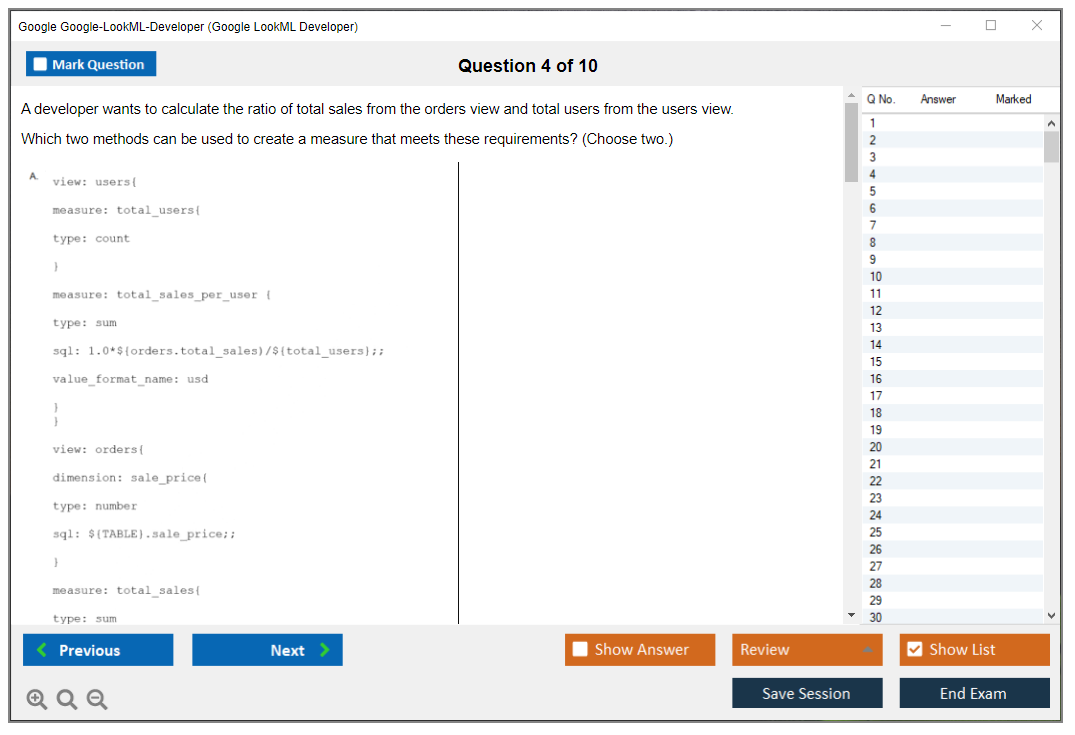
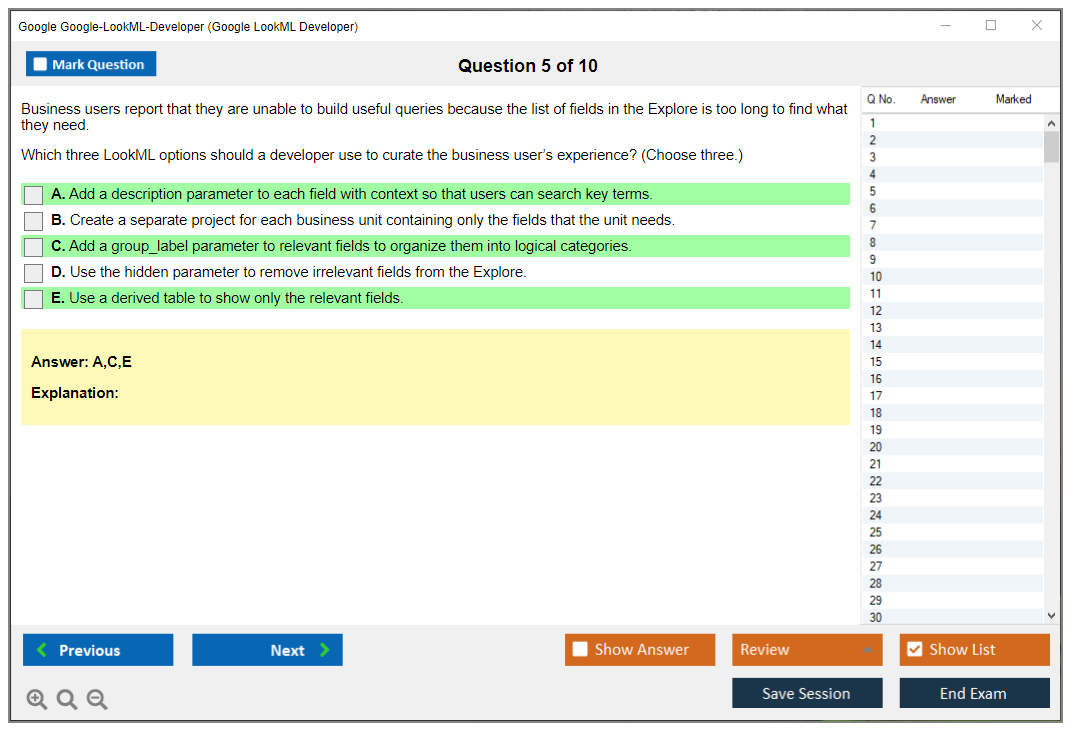
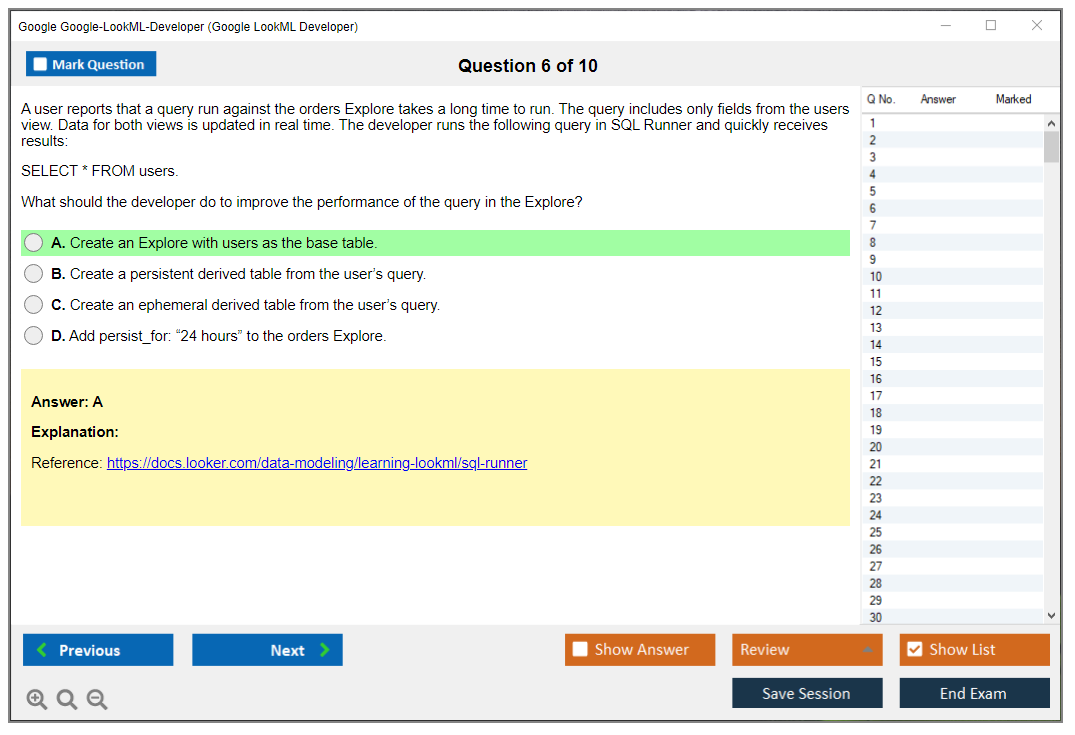
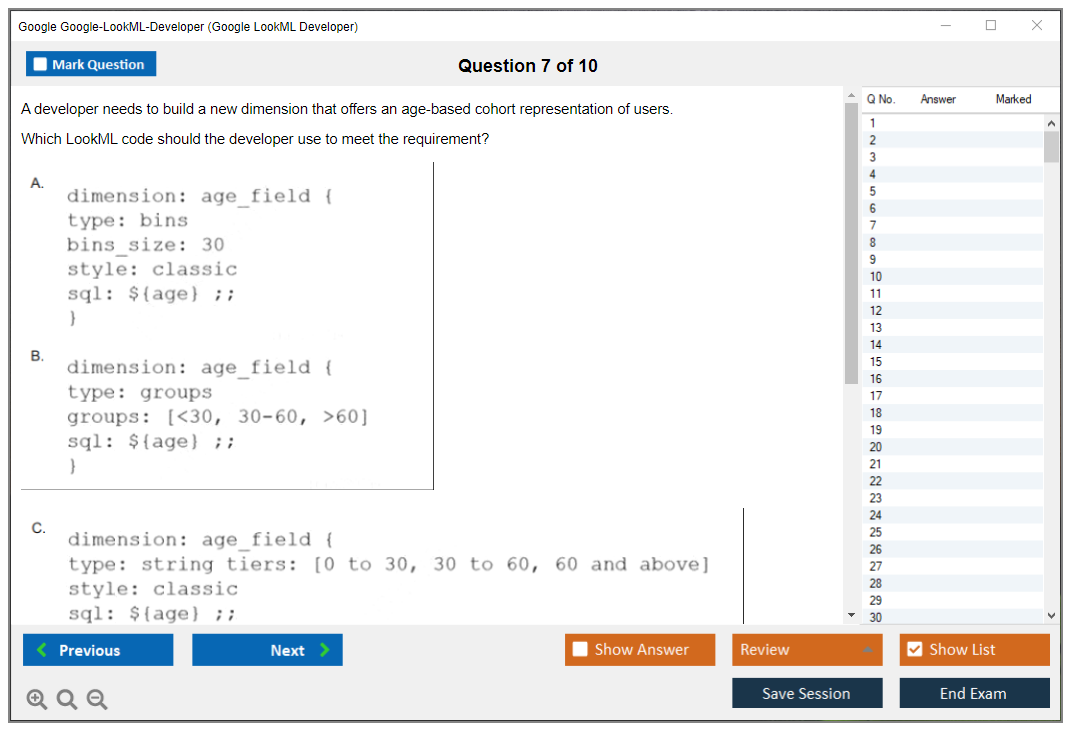
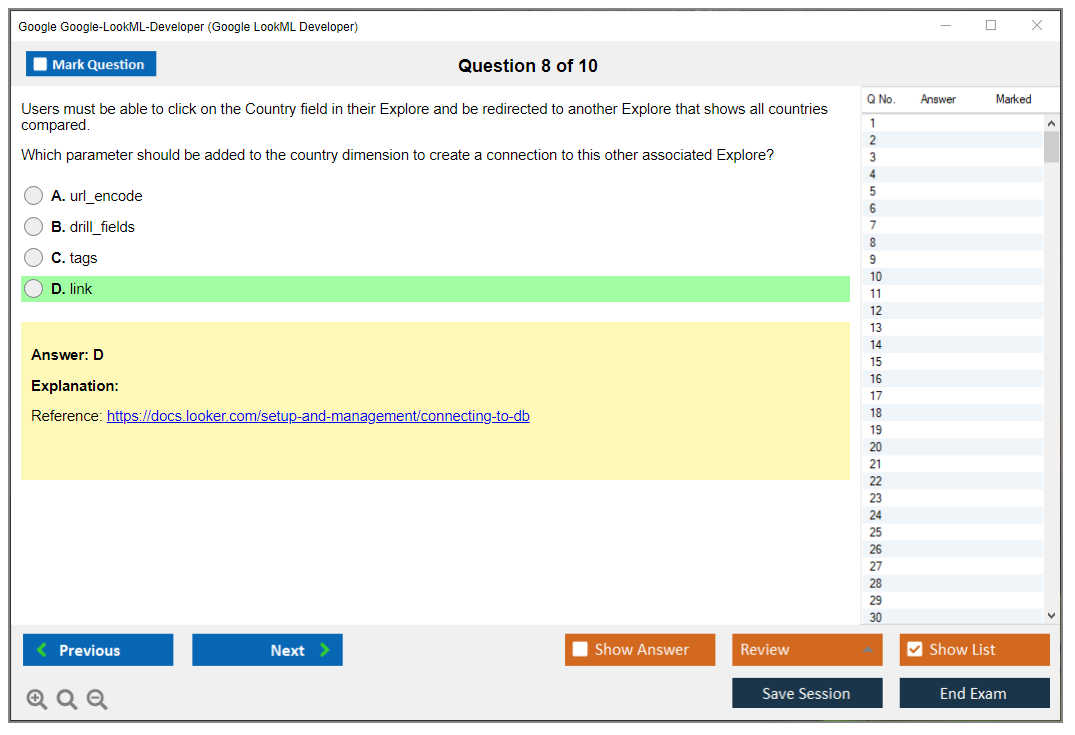
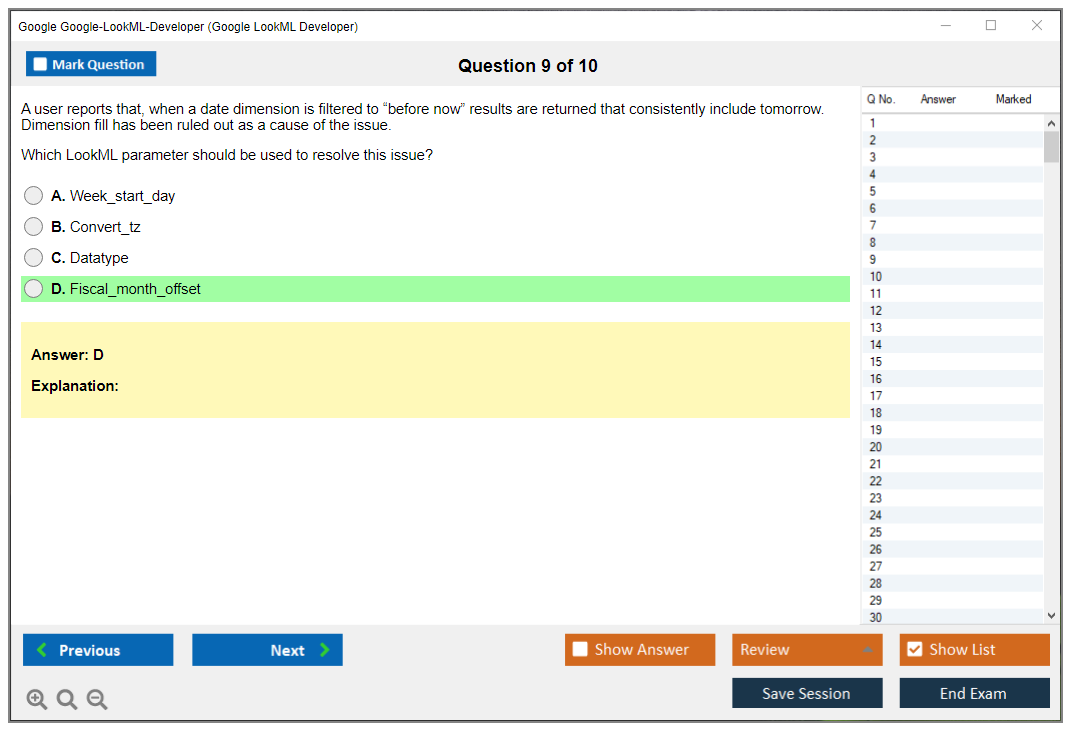
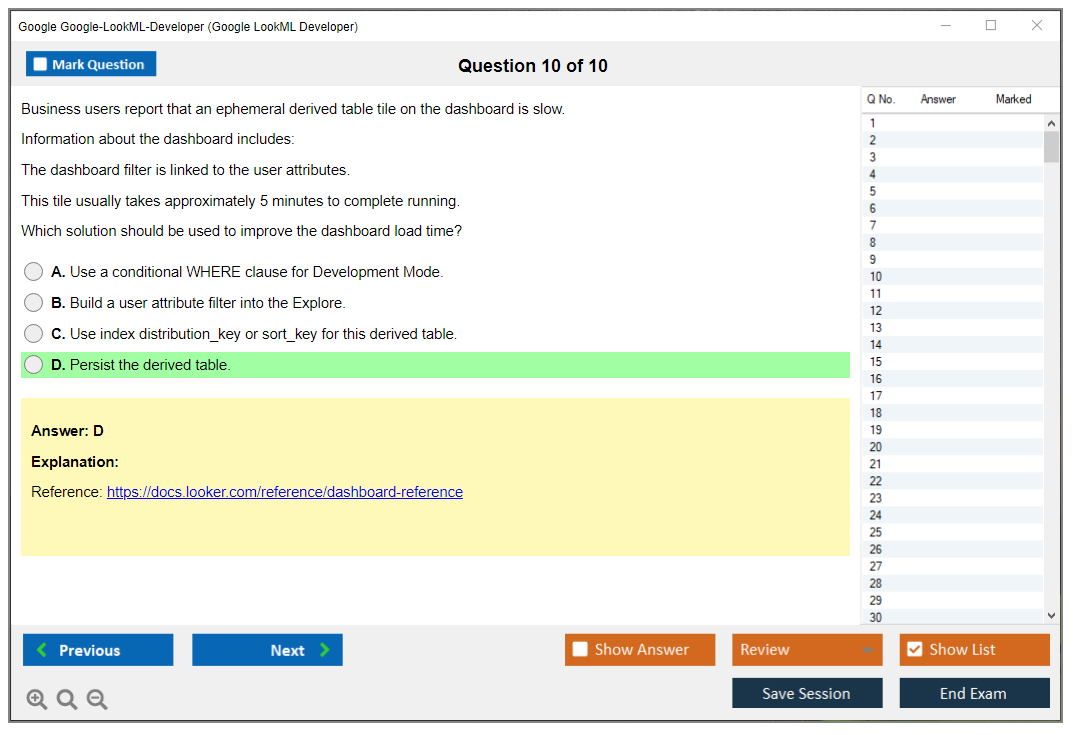
Google Google-LookML-Developer (Google LookML Developer)
Google LookML Developer Certification (Google Google-LookML-Developer) Overview
What the Google-LookML-Developer certification validates
The Google LookML Developer certification's a professional-level credential proving you can actually build and maintain LookML models in Looker. This exam goes way beyond just knowing what Looker is. You've gotta demonstrate real proficiency in data modeling, version control workflows, and implementing business intelligence solutions people can really use, not just fancy dashboards nobody touches. It validates that you understand LookML syntax deeply enough to write clean, maintainable code transforming raw database schemas into user-friendly explores and dashboards.
When Google acquired Looker back in 2019, they didn't just slap their logo on it and walk away. The certification program evolved from its original Looker-only roots into part of Google Cloud's broader certification portfolio, meaning it now fits with enterprise data analytics standards and fits into the larger ecosystem of Google Cloud credentials like the Professional Data Engineer or Professional Cloud Architect certs.
Big deal.
This credential specifically tests your ability to design semantic layers making sense to business users. These are the folks who'll actually click around your explores. You're proving you can create dimensions and measures accurately representing business logic, configure explores exposing the right data relationships, implement join logic that doesn't create fan-outs or chasm traps, and optimize performance through derived tables and persistent derived tables (PDTs). Look, if you've ever explained to a stakeholder why their revenue number's wrong because of a many-to-many join, you know exactly why this stuff matters.
Who should take this exam (job roles and experience level)
Data analysts wanting to move beyond just consuming data in Looker should consider this certification. BI developers? Obvious candidates. Analytics engineers (that relatively new role sitting between data engineering and analytics) definitely benefit from this credential because LookML development's often core to what they do. Data engineers building the pipelines feeding into Looker also find value here, though they might pair it with something like the Professional Cloud Database Engineer certification.
Technical professionals responsible for building self-service analytics solutions are the sweet spot. If you're the person who gets asked "can you add this dimension to that explore?" or "why's this dashboard so slow?" then yeah, this certification speaks directly to your day-to-day work. You should have at least 6-12 months of hands-on experience developing LookML models in production environments before attempting this exam. Not just playing around in a sandbox, but actual exposure to multiple data sources, real business use cases, and the inevitable troubleshooting accompanying both.
Honestly, trying to pass this without production experience's gonna be rough. The exam includes scenario-based problems where you analyze actual LookML code snippets, identify issues, and recommend fixes. You can't fake that kind of pattern recognition if you've never debugged why a derived table isn't rebuilding or why user attributes aren't filtering correctly. I once spent an entire afternoon tracking down a PDT rebuild failure that turned out to be a timezone configuration issue. That kind of weird, frustrating experience teaches you things no documentation ever will.
Exam format and key details (what to expect on test day)
You'll take this exam online through a proctored system, typically using Kryterion or similar testing platform with remote supervision. That means someone's watching you through your webcam the entire time, your browser gets locked down so you can't look stuff up, and you need a quiet private room with a clean desk. They're serious about exam security. No notes, no second monitors, no phone within reach.
Multiple-choice and multiple-select questions dominate the format. Some questions give you a block of LookML code and ask you to identify what's wrong or what'd happen if you deployed it. Others present business requirements and ask which LookML pattern would best satisfy them. The thing is, there's usually multiple approaches that technically work, but only one that's actually best practice. You're looking at approximately 50-60 questions total, and you'll have somewhere between 90-120 minutes completing everything. No breaks allowed once you start.
Question difficulty varies wildly. Some are straightforward syntax questions (does this dimension definition work?). Others require you to think through join paths, aggregate functions, and how different modeling choices affect query performance in complex data environments with multiple fact tables and slowly changing dimensions. The exam covers all the objective domains with varying point values based on complexity, though Google doesn't publish the exact scoring rubric.
It's primarily offered in English right now. There might be additional language options depending on regional demand and how Google's localization strategy evolves, but don't count on taking it in your native language unless that happens to be English.
Required prerequisites (official vs recommended)
Here's the good news: no mandatory prerequisite certifications required. You don't need to pass the Associate Cloud Engineer or any other Google Cloud cert before tackling this one. That said, foundational knowledge's absolutely essential. You need to understand SQL. Not just SELECT statements, but joins, subqueries, window functions, and aggregations. Data warehousing concepts matter too: star schemas, snowflake schemas, fact and dimension tables, grain, slowly changing dimensions.
Basic Looker platform navigation's a must.
If you don't know how to work through between development mode and production, how to validate your LookML changes, or how the Git workflow integrates with Looker's IDE, you're gonna struggle. Like, really struggle, not just find it challenging. The exam assumes you've actually used Looker, not just read about it.
Recommended background includes hands-on experience with version control systems, particularly Git. LookML development happens in a Git-based workflow where you create branches, commit changes, submit pull requests, and merge to production. Understanding concepts like branching strategies, merge conflicts, and code review processes helps tremendously.
You should've built several complete LookML projects before attempting this exam. That means defining views from database tables, creating explores with multiple joins, implementing derived tables for complex transformations, building reusable dimension groups, and optimizing slow queries. If you've only ever modified existing LookML written by someone else, that's not enough depth.
LookML fundamentals (projects, views, explores)
The exam heavily tests your understanding of LookML project structure. This is foundational stuff that appears throughout. Projects contain model files and view files organized in directories, with specific naming conventions and include patterns. You need to know how model files define explores and control access, while view files define dimensions, measures, and the underlying SQL logic.
Views map to either database tables, SQL-based derived tables, or native derived tables. Each approach has different performance characteristics and use cases. The exam'll present scenarios where you need to choose the right view type based on requirements like data freshness, query complexity, or computational cost.
Explores are how end users actually access data in Looker. They define which views can be queried together, what joins connect them, and what fields are available. Basically the entire user experience. You'll need to demonstrate understanding of explore parameters, from_clause, join parameters, and how to structure explores for optimal user experience. Symmetric aggregates, aggregate awareness, and handling of many-to-many relationships definitely appear on the exam.
Dimensions, measures, and modeling best practices
Creating accurate dimensions and measures is core LookML work. The exam tests whether you know when to use different dimension types: string, number, date, tier, yesno. You'll encounter questions about dimension groups for dates and times, and when to use parameters versus filters.
Measures require understanding of aggregate functions. Sum, count, count_distinct, average, min, max. But it goes deeper. You need to know about filtered measures, measures referencing other measures, and how to handle division with proper null checking. Type: count_distinct questions appear frequently, especially around cardinality estimation and performance implications.
Best practices get tested through scenario questions. Should this calculation be a dimension or a measure? When should you use a SQL-based calculation versus LookML parameters, or wait, should you even be doing this in LookML at all, or push it upstream to your ETL? How do you name fields so they're intuitive for business users? The exam rewards thoughtful modeling balancing technical correctness with usability.
Joins, relationships, and symmetric aggregates
Join logic's where many LookML developers struggle, and the exam knows it. You'll face questions about different join types (left_outer, inner, full_outer, cross) and when each is appropriate. SQL_on clauses, relationship parameters (one_to_one, one_to_many, many_to_one, many_to_many), and how they affect aggregate calculations all appear on the exam.
Symmetric aggregates solve the fan-out problem in many-to-many relationships. If you don't understand why joining an orders table to an order_items table can inflate revenue totals, and how symmetric aggregates fix this, you'll miss questions. The exam presents real scenarios with multiple join paths and asks you to identify problems or recommend solutions.
Seriously critical stuff.
Join paths and always_filter requirements help control query behavior. Understanding these features and when to use them demonstrates advanced modeling skills the exam specifically validates.
Version control and deployment (Git workflow, dev/prod)
LookML development happens in a Git-based workflow mirroring modern software development practices. You develop in personal branches, validate changes in development mode, submit pull requests for review, and merge to production after approval. The exam tests whether you understand this workflow and can troubleshoot common issues.
Questions cover topics like resolving merge conflicts, reverting problematic changes, understanding the production/development mode toggle, and managing LookML validation errors. You should know how Looker integrates with Git providers (GitHub, GitLab, Bitbucket) and what happens during the deploy process.
Development mode lets you make changes without affecting production users. The exam'll ask about scenarios where you need to test changes safely, coordinate with other developers, or roll back deployments. Understanding branch management, pull request workflows, and deployment best practices is necessary.
If you're studying for this exam, definitely check out the Professional Cloud DevOps Engineer certification too. There's overlap in the version control and deployment concepts, even though that cert covers broader infrastructure topics. The Google LookML Developer certification's specialized, focused, and directly applicable if you're building analytics solutions on Looker within the Google Cloud ecosystem.
Google LookML Developer Exam Cost
Google LookML Developer certification (Google Google-LookML-Developer) overview
What the Google-LookML-Developer certification validates
The Google LookML Developer certification validates you can model data in Looker without creating chaos in the semantic layer. You're expected to work comfortably with the Looker modeling language (LookML), understand how Looker explores and views connect, and build models that actually make sense for real analysts clicking around wondering why their numbers shifted overnight.
Not a "write perfect SQL" badge, honestly. It's more like, can you translate business questions into clean models, choose the right grain, dodge fanouts, and maintain performance when someone throws on five filters plus a date pivot? The thing is, plenty of people know SQL but completely bomb the semantic modeling part, which is what this exam actually tests.
Who should take this exam (job roles and experience level)
If your title includes Looker developer, analytics engineer, BI engineer, or data engineer who somehow became the Looker owner, this cert's for you. Great for data analysts already editing LookML who want legitimacy instead of feeling like they're breaking things every time they touch a join.
New to BI? Pump the brakes. Haven't built a couple real models yet? The exam'll feel like reading a cookbook in another language where every recipe assumes you already own specialty equipment you've never heard of.
Exam format and key details (what to expect on test day)
Proctored multiple-choice format with scenario questions. These exams love "what would you do" prompts where two answers look identical until you spot one tiny word about symmetric aggregates or relationship types that changes everything.
One shot. Timed. You'll receive an official score report afterward, and passing gets you the digital badge plus directory listing.
Google LookML Developer exam cost
Exam fee (price) and what's included
Standard exam registration typically runs $125 to $200 USD, mid-tier for Google Cloud certifications. Not the cheapest credential ever, but also not those $400+ beasts where you're reconsidering your grocery budget.
Regional pricing varies. Currency fluctuations, local taxes, and Google's regional strategies shift the number depending on registration location, and your checkout price is what matters because blog posts age like milk anyway.
Payment methods include the usual suspects: Visa, MasterCard, American Express, debit cards, sometimes PayPal or other digital platforms depending on your region's testing provider.
Base fee covers one exam attempt, preliminary scoring, official score report, digital certification badge upon passing, and inclusion in Google's certification directory. Clean and straightforward.
Additional costs (training, retakes, practice tests)
What's NOT included: training courses, study materials, practice exams, retakes, prep resources. Where budgets explode. People budget for the exam, then realize they also want labs, courses, practice tests to settle their nerves.
Retakes aren't free. Each additional attempt generally requires paying the full standard fee again, no guaranteed retake discounts currently. That "I'll just take it once to see what happens" strategy gets pricey fast.
Training investments vary wildly. Google Cloud and Looker training ranges from $0 for free self-paced resources to $500 to $2,000 for instructor-led courses and bigger learning paths. Looker documentation's free, and docs plus community posts cover tons if you'll actually read and build alongside them.
Practice tests usually cost $20 to $80 per test from third parties, with bundles offering better per-attempt pricing. Study guides and books matching current LookML Developer objectives tend to run $30 to $60.
Sneaky cost? Hands-on access. Looker instances for practice might offer limited-time free trials, but paid subscriptions can hit $3,000 to $5,000+ annually for full platform access. Most individuals rely on employer access, trials, or training environments.
Realistic total preparation cost: $200 to $1,000 for most people, depending on existing knowledge and whether you're paying for training. Employer sponsorship's common, by the way. Company uses Looker? Ask. Many organizations cover exam fees and training from professional development budgets.
Tax deductibility might apply for continuing education in some jurisdictions. Consult a tax professional because I'm definitely not your accountant.
Discounts exist but shift constantly. Google sometimes offers voucher and discount programs through partners, schools, events, often 25 to 50% off. Student and academic discounts appear through academic programs but aren't universal. Bulk pricing for organizations happens when companies certify multiple employees and negotiate voucher deals.
I once watched someone spend 40 minutes debugging a fanout issue that turned out to be a many-to-many join they'd set as one-to-many. They had their LookML cert and everything. Point is, the exam teaches you structure but real troubleshooting still takes mileage.
Google LookML Developer passing score
Is the passing score published?
Usually? Google doesn't publish the LookML Developer passing score as a plain public number you can reverse-engineer. Searching "LookML Developer passing score" hoping for "700/1000" carved in stone? You'll probably come up empty.
How scoring typically works (domains/weighting considerations)
Scoring reflects performance across domains, and weighting matters. Bomb joins, relationships, and symmetric aggregates? Knowing syntax trivia won't save you. Treat exam objectives like a checklist, that's basically what the scoring blueprint is anyway.
Google LookML Developer exam difficulty
Difficulty level (beginner/intermediate/advanced)
Intermediate. Definitely not beginner-friendly. Only edited dimensions and changed labels? You're gonna have a rough time.
What makes the exam challenging (common pain points)
Hard parts mirror production pain points. Join logic. Correct grains. Why numbers double unexpectedly. When derived tables make sense. How Looker caching and PDTs behave. The Looker Git deployment workflow, people love ignoring version control until it bites them hard.
Also? Scenario questions test judgment over memorization.
How long to study based on experience (0 to 6 months+)
Zero LookML experience? Plan 8+ weeks and get serious hands-on time. Built models at work? Maybe 2 to 4 weeks of focused review and practice. Already the person everyone pings for Looker weirdness? 1 to 2 weeks tightening gaps and running practice questions.
Time invested represents opportunity cost. Figure 40 to 120 hours depending on background. Real time. Evenings. Weekends.
Google LookML Developer exam objectives (skills measured)
LookML fundamentals (projects, views, explores)
How projects structure, how views define fields, how explores present data to users. Foundational. Surprisingly easy to mess up if you don't respect naming and organization.
Dimensions, measures, and modeling best practices
Model cleanly: correct types, sensible SQL, consistent naming, measures that don't lie. A lot of "best practices" boil down to "don't surprise your analysts," honestly.
Joins, relationships, and symmetric aggregates
Where people fail. Understand join types, relationship settings, fanouts, when symmetric aggregates matter. Can you explain why count distinct changes after adding a dimension from a joined table? Then you're probably fine.
Derived tables, PDTs, and performance considerations
LookML derived tables and PDTs appear constantly in real work. Know when to use them, what persistence means, how performance and caching impact user experience. Users will absolutely blame you when dashboards take 45 seconds to load.
Access control concepts (model sets, user attributes, where applicable)
Don't need to be a security engineer, but understand building blocks like user attributes and how access gets controlled in the modeling layer, where applicable in your setup.
Version control and deployment (Git workflow, dev/prod)
Branches. Deploying to production. Handling conflicts. The Looker Git deployment workflow isn't hard, but people skip it until they're overwriting each other's work at 5 pm on a Friday.
Testing, validation, and troubleshooting LookML
Validation errors, content validator checks, broken fields, SQL runner debugging. Troubleshooting's a skill. A daily one.
Prerequisites for the LookML Developer certification
Required prerequisites (official vs recommended)
Usually no strict hard prerequisites like "must hold X cert first," but recommended experience is legit. Google says "hands-on experience"? Believe them.
Recommended background (SQL, data warehousing, BI concepts)
Know SQL basics, data warehouse concepts like fact versus dimension tables, BI concepts like aggregation and grain. Those words fuzzy? Fix that before paying for an exam attempt.
Hands-on experience checklist (what you should have built)
Minimum: one model with multiple explores, several joins, a couple correctly aggregating measures, at least one derived table, and you've pushed changes through dev to prod without breaking everything. Actually built. Not theoretical.
Best study materials for Google LookML Developer
Official Google/Looker documentation to prioritize
Start with Looker's docs on LookML, explores/views, joins/relationships, derived tables, PDTs, permissions concepts. Docs are free and solid, closest thing to the source of truth.
Recommended courses and learning paths
Need structure? Take a course. Experienced already? You can probably skip paid instructor-led options and stick with targeted modules plus hands-on practice.
Hands-on labs and sample projects (what to practice)
Build a mini semantic layer on a public dataset. Add explores and views. Create derived tables. Break it intentionally. Fix it. That's the whole job anyway.
Study plan (1 to 2 weeks, 4 weeks, 8 weeks options)
1 to 2 weeks: review objectives, read docs, one practice test, patch weak spots. 4 weeks: docs plus hands-on modeling twice weekly, one simulator, tons of join drills. 8 weeks: start from basics, add SQL refreshers, build a full project, then practice tests.
Google LookML Developer practice tests and exam prep
Practice test options (official and third-party)
Official options can be limited, so most people end up with third-party practice exams. Pick scenario-heavy ones, not just definition flashcards.
Practice question types to master (scenario-based modeling)
Want questions about why metrics change, what relationship setting fits, when to use a PDT, how to structure explores and views for usability.
How to review missed questions effectively
Don't just read the explanation and move on. Recreate the scenario in Looker if possible. Can't? Write out the grain and join path on paper like a total weirdo. It works.
Final-week checklist (mock exam + weak areas)
Do a timed mock. Revisit joins and aggregates. Skim docs for anything you keep missing. Sleep properly. Seriously.
Renewal and validity (recertification) for Google LookML Developer
Certification validity period (if published)
If the certification has a published validity window, it's often 2 to 3 years in the Google ecosystem. Check the current LookML Developer renewal policy page when closer, because these rules shift.
Renewal requirements (exam retake vs CE)
Renewal frequently means retaking an exam rather than collecting continuing education credits, so budget for periodic exam fees every couple years if you want to maintain active status.
Keeping skills current (release notes, new features)
Read Looker release notes, watch modeling feature changes, pay attention to how your organization handles Git, PDT schedules, performance tuning. The exam's one thing, but the job's the job.
FAQ: Google Google-LookML-Developer (LookML Developer)
Cost, passing score, and difficulty (quick answers)
How much does the Google LookML Developer exam cost? Usually $125 to $200 USD, plus regional differences. What's the passing score for the Google-LookML-Developer exam? Often not plainly published, so focus on domains. How hard is the LookML Developer certification? Intermediate, heavy on real modeling judgment.
Best study materials and practice tests
What're the best study materials for the LookML Developer exam? Looker docs first, then a solid Google Looker LookML Developer study guide if you find one aligned to current objectives, plus hands-on building. Add a LookML Developer practice test if you need confidence.
Objectives, prerequisites, and renewal summary
LookML Developer prerequisites are mostly practical experience, not paperwork. Exam objectives cover views/explores, joins, derived tables, access concepts, Git deployment, troubleshooting. Does the LookML Developer certification require renewal? Often yes, typically every 2 to 3 years, and you should plan for the fee again.
Return on investment's real if Looker's part of your career path. Plenty of people recoup costs through raises, promotions, or better job offers within 6 to 12 months, but the bigger win is you stop shipping models that break when someone adds one more dimension.
Google LookML Developer Passing Score
Google LookML Developer passing score, why you won't find a number
Okay, here's the deal. If you're hunting for the exact passing score for the Google LookML Developer certification, you're gonna be disappointed. Google doesn't publish that number. They just don't tell you "you need 72% to pass" or anything remotely like that. It's intentional.
The thing is, they keep it vague because they want flexibility to adjust the cut score based on how difficult each version of the exam turns out to be. Not every exam form is identical in difficulty, so they use something called scaled scoring to level the playing field. If you get a slightly harder version, the passing threshold might be a bit lower. If yours is easier, maybe it's higher. You won't know which version you got or what the magic number was.
Industry folks generally guess that most professional certs like this fall somewhere between 65-75% of total points. That's based on similar Google Cloud certifications like the Professional Cloud Architect or Professional Data Engineer exams, but no one outside Google's psychometric team knows for sure. I mean, it's all speculation. Actually, it's not even educated guessing half the time, just people repeating what they heard in forums.
How the scoring actually works (or probably works)
Google uses scaled scoring rather than raw percentages. What's that mean? Instead of just counting up how many questions you got right and dividing by the total, they apply statistical adjustments to account for differences in exam difficulty across different forms. Pretty standard in professional certification. The Associate Cloud Engineer exam does the same thing.
When you finish the exam, you get a pass or fail result immediately on screen. That's it. No numerical score. No "you got 68%" or anything useful like that. Just pass or fail, which is kind of frustrating if you're the type who wants to know exactly how you did.
The official score report you get later might break down your performance by domain. You'll see stuff like "below target," "near target," or "above target" for each major section. LookML fundamentals, derived tables, joins and relationships, version control, whatever. But again, no actual percentages or point totals.
This domain-level feedback is actually more useful than a single number if you fail, because it tells you where to focus your study efforts for the retake. If you're "below target" on PDTs and performance optimization but "above target" on basic views and explores, you know what to hit hard next time.
Which reminds me of a guy I knew who kept retaking the exam without checking his domain feedback. He just studied everything equally each time. Third attempt, he finally looked at the breakdown and realized he was bombing the version control section every single time. Passed on the fourth try after spending two weeks just on Git workflows.
No partial credit, weighted questions, all that fun stuff
Multiple-choice and multiple-select questions are scored all-or-nothing. You either get it completely right or you get zero points. No partial credit for picking three out of four correct answers on a multi-select question. Pretty standard but worth knowing.
More complex scenario-based questions (the ones where they give you a business requirement and ask you to design a LookML solution) probably carry more weight than simple recall questions about syntax. Google doesn't disclose the exact weighting, but it makes sense that a question testing your ability to architect a solution would be worth more than one asking you to identify a parameter name.
The passing score represents what Google considers minimum competency for real-world LookML development work. They use subject matter experts (actual experienced Looker developers) and psychometric specialists to run formal standard-setting studies. These experts review each question and decide "would a minimally competent LookML developer know this?" and set the bar accordingly.
What happens after you take it
You get preliminary results on screen right when you finish. If you pass, congrats. You can start updating your LinkedIn immediately. If you fail, well, you know right away that you're gonna need to study more and schedule a retake.
There's no score appeal process. None whatsoever. Google's determination is final. If you think a question was ambiguous or unfair, tough luck. You can't challenge it after the fact. This is different from some other certification programs that allow formal appeals, but it's how Google runs things across their cert portfolio including the Cloud Digital Leader and Professional Cloud Security Engineer exams.
Your score is confidential. Google won't share it with employers or anyone else without your explicit permission. If you fail, your boss doesn't automatically get notified (unless you tell them, obviously).
Strategy implications for your prep
Not knowing the exact passing score means you can't aim for "just barely passing." You need to study for mastery across all exam domains. Some people try to game certifications by focusing only on high-weight areas and ignoring stuff that might be less represented, but with the LookML Developer exam, you really need well-rounded knowledge.
The exam objectives cover LookML projects and version control workflows, views and explores, dimensions and measures, joins and symmetric aggregates, derived tables and PDTs, performance optimization, testing and validation, and access control concepts. You can't skip any of these areas and expect to pass reliably.
If you're coming from a data engineering background and already passed something like the Professional Cloud Database Engineer exam, you might have strong SQL and data modeling skills but weak Git workflow knowledge. Or maybe you're a BI analyst who knows Looker from the user side but hasn't built many PDTs. Maybe you're great at writing measures but terrible at understanding caching behavior. Whatever your gaps are, you need to address them. There's no shortcut here.
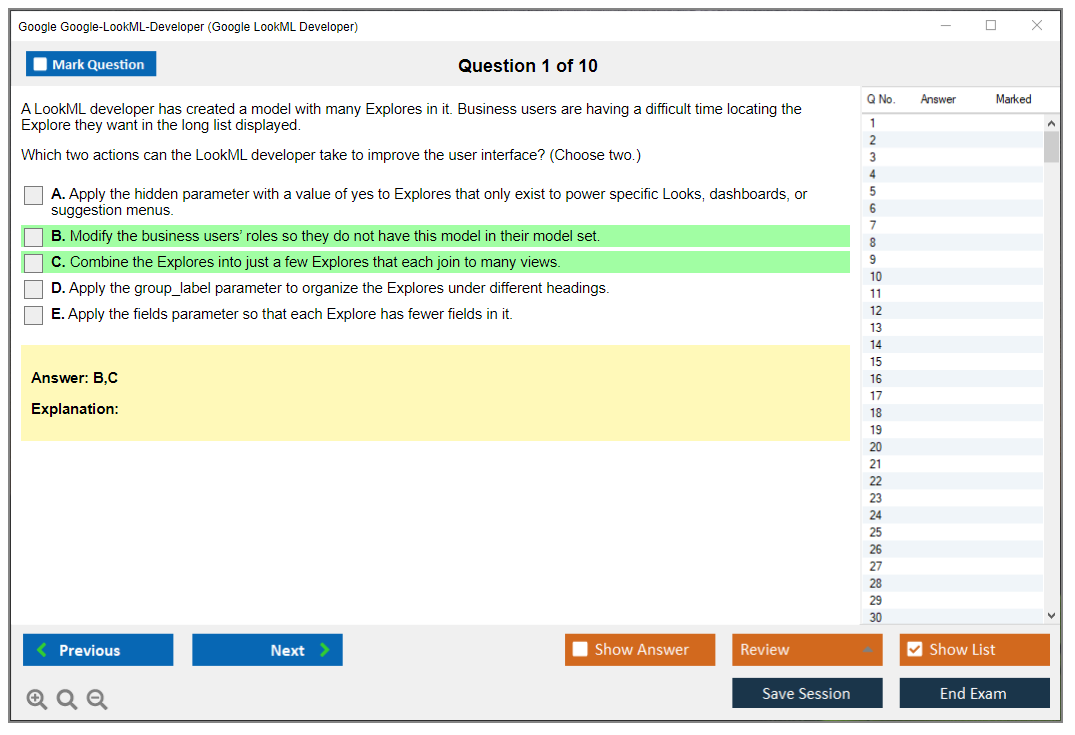
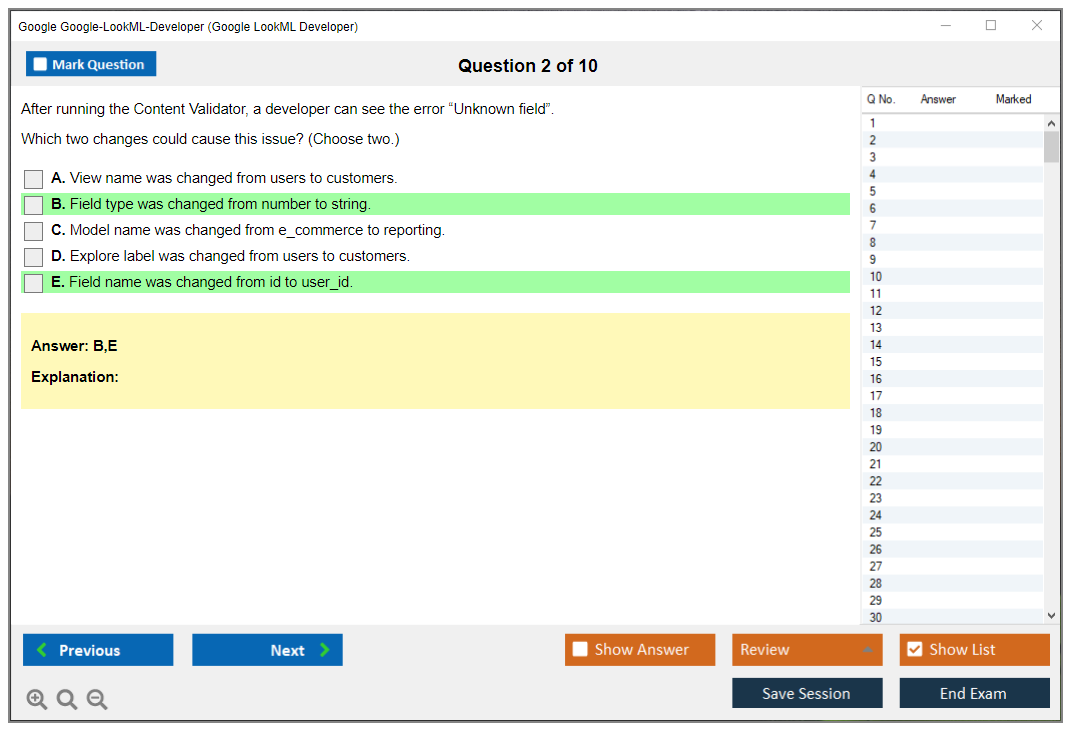
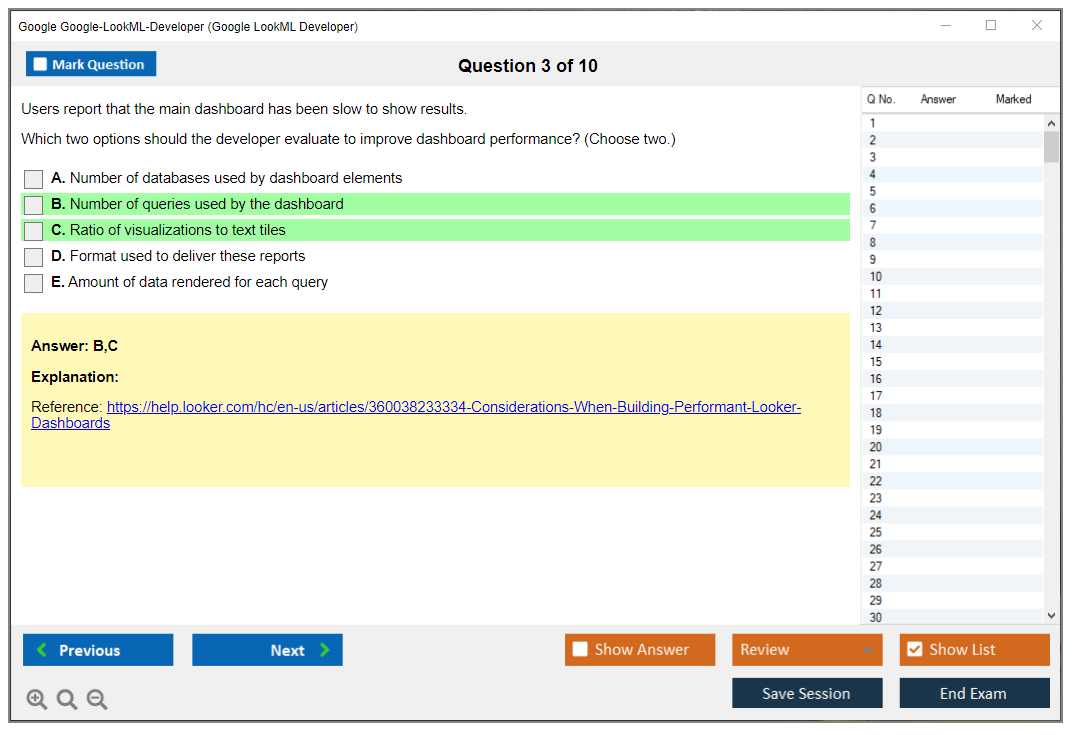
Using a Google LookML Developer Practice Exam Questions Pack can help you identify weak areas before test day. At $36.99, it's a pretty affordable way to get realistic practice questions and see where you're struggling. I'm not gonna lie, scenario-based questions are harder to practice for than recall questions, but seeing the question formats helps.
Beta exams and score adjustments
If you take a beta version of the exam (when Google first launches it or makes major updates), scoring might be delayed. They need to collect performance data from enough candidates to run proper psychometric analysis and set appropriate passing standards. Beta test-takers sometimes wait weeks or even months for results. Annoying as hell, honestly.
Google periodically recalibrates passing scores when exam content gets significantly updated or when performance data suggests the current standard is too hard or too easy. They don't announce these adjustments publicly, so the passing score might be different next year than it is today.
Pass rates and difficulty considerations
Google doesn't publish official pass rate statistics. Like, at all. Anecdotally, adequately prepared candidates seem to pass at rates somewhere between 60-75%, but that's just based on forum discussions and informal surveys, not official data.
What makes adequately prepared? Hands-on experience building actual LookML models. Understanding of SQL and data warehousing concepts. Familiarity with Git workflows. Study time ranging from a few weeks to a few months depending on your background. Someone who's been a Looker developer for a year will need less prep than someone transitioning from another BI tool.
The exam difficulty is generally considered intermediate to advanced. It's not as broad as something like the Professional Cloud Architect exam that covers tons of GCP services, but it goes deep on LookML specifics. You need to know not just syntax but best practices, performance implications, and how to troubleshoot common modeling issues.
Bottom line on the passing score mystery
You won't find the number. Google won't tell you. Period. Preparing for "probably 65-75% but we're not sure" isn't that helpful anyway. Focus on really learning the material across all exam domains, get hands-on practice building real models, and use practice tests to identify gaps. That's the only reliable strategy when the target keeps moving and you can't see it clearly anyway.
Google LookML Developer Exam Difficulty
Google LookML Developer certification (Google Google-LookML-Developer) overview
The Google LookML Developer certification is one of those exams that sounds "BI-ish" on paper, then you sit down with it and realize it's really testing whether you can model data like an adult. Not just write a view file. Not just copy a join block from a coworker. Real modeling choices.
Look, the Google Google-LookML-Developer exam pushes past basic Looker UI comfort and straight into Looker modeling language (LookML), query behavior, and why your explore either screams fast or crawls like it's stuck on a bad warehouse slot allocation. Some questions feel like they were written by someone who's cleaned up a messy production model at 2 a.m., because they're not about "what is a dimension," they're about "why is this exploding row counts and what's the least-bad fix."
What the Google-LookML-Developer certification validates
You're being tested on whether you can build and maintain Looker explores and views that match business logic, don't lie with aggregates, and don't melt the database. Also, whether you understand how Looker actually generates SQL, how LookML derived tables and PDTs behave, and how Git and deployments affect real teams.
Some of it's conceptual. A lot is "read this code and predict what happens."
Who should take this exam (job roles and experience level)
BI developers. Analytics engineers. Data engineers who got dragged into Looker modeling. Also BI analysts who're already editing LookML weekly and are tired of being told "that's not how symmetric aggregates work."
Brand new to LookML? Honestly, wait.
Exam format and key details (what to expect on test day)
Expect scenario questions. Expect code snippets. Expect multi-layered questions where one option fixes the join but ruins performance, and another option keeps performance but breaks aggregation correctness, and you've gotta pick the one that matches the scenario requirements. Time pressure's moderate, not panic mode, but you can't casually reread every question five times.
Short questions exist. Some aren't short at all. You'll notice fast.
Google LookML Developer exam cost
Exam fee (price) and what's included
People ask, "How much does the Google LookML Developer exam cost?" The exact LookML Developer certification cost can vary by region and testing provider rules, and Google doesn't always make it super obvious on a single static page forever. So I'm not gonna pretend there's one eternal number carved into stone.
Check the current listing in the registration portal before you commit. Do that first. Not later.
Additional costs (training, retakes, practice tests)
This is where cost sneaks up. If you buy formal training, add that. Retake? Add that. Targeted practice? Also add that. I mean, a decent LookML Developer practice test is often cheaper than failing once because you didn't realize how picky the exam gets about join relationships and aggregate awareness.
If you want a focused prep option, the Google-LookML-Developer Practice Exam Questions Pack ($36.99) is the kind of thing people use when they're done "reading docs" and want to pressure-test recall and decision-making.
Google LookML Developer passing score
Is the passing score published?
"What's the passing score for the Google-LookML-Developer exam?" Google doesn't consistently publish a single public LookML Developer passing score the way some vendors do, at least not in a way that stays easy to find and unambiguous.
So plan like you need to be solid everywhere. Not perfect. Solid.
How scoring typically works (domains/weighting considerations)
Expect domain weighting. That means you can't ignore Git workflow or performance stuff and hope to brute-force syntax questions. The exam tends to reward people who can reason across domains, like understanding that a modeling fix changes SQL shape, which changes performance, which changes whether PDTs are appropriate, which changes build timing and deployment risk.
Google LookML Developer exam difficulty
Difficulty level (beginner/intermediate/advanced)
"How hard is the LookML Developer certification?" Overall difficulty rating lands somewhere between intermediate and advanced. That's the most honest label. The Google LookML Developer certification is way more challenging than entry-level data analytics certs because it assumes you already think in modeling patterns and SQL behaviors, not just charts and filters.
Three words here. Not beginner friendly. At all. Seriously.
What makes the exam challenging (common pain points)
The technical depth is the big separator. Questions go beyond basic LookML syntax and into complex join logic, performance tuning, weird aggregation patterns, and architectural decisions. You'll see scenario-based complexity where the prompt reads like a real ticket, and you've gotta translate business context into the right LookML approach, then spot why a current model's wrong.
Code interpretation's huge. You're reading snippets and deciding what breaks, what silently returns wrong totals, what causes fanouts, and what change fixes it without side effects. And the multi-layered question design is real, like join type plus relationship parameter plus aggregate awareness plus performance implications, all crammed into one question so you can't "single-topic" your way through.
I've been reading Looker community forums for a while now, and you see the same questions pop up constantly. People get tripped up on fanout issues, they struggle with understanding when to denormalize versus keep things normalized, and there's this whole debate about whether you should cache everything or build PDTs selectively. The exam knows where practitioners get confused in the real world and leans into those exact pressure points.
Common pain points I see people complain about:
- Symmetric aggregates, because they look simple until you're juggling many-to-many relationships and the business wants totals that don't double count, and the wrong fix "works" for one dashboard but lies everywhere else.
- LookML derived tables and PDTs, because optimizing them's half modeling and half warehouse behavior, and you need to know when persistent derived tables are worth the build cost versus when ephemeral derived tables are fine and safer.
- Complex joins and many-to-many handling, which is basically the boss level of Looker modeling when you're under time pressure.
- Weird date/time stuff, which is where people who "kind of know SQL" find out they don't, especially when time zones and fiscal calendars creep in.
Trick answers show up too. Some options sound right if you skim. The thing is, if you read carefully, they violate best practices or introduce subtle aggregation bugs. Documentation familiarity helps a lot here, because Looker has opinions, and the exam likes the official opinions.
How long to study based on experience (0 to 6 months plus)
If you're under 6 months of LookML, you'll probably struggle with the depth and the "production realism" of the scenarios. With 6 to 12 months of regular LookML development, it's challenging but passable with focused prep, especially if you drill join patterns, aggregate awareness, and PDT decisions. With a year or more across diverse projects, the exam feels manageable, though you still need prep because version-specific knowledge matters and Looker changes over time.
Also, practical experience dependency's real. People who only study theory can explain parameters but can't diagnose why an explore's returning duplicated revenue. Hands-on devs usually spot that instantly.
Google LookML Developer exam objectives (skills measured)
LookML fundamentals (projects, views, explores)
You need comfort with projects, model files, view files, explores, and how Looker resolves references. Looker explores and views're the whole game.
Dimensions, measures, and modeling best practices
Expect measure types, SQL parameter behavior, and "what happens when." Also modeling conventions and maintainability, especially if you're self-taught and learned by copying random snippets.
Joins, relationships, and symmetric aggregates
Joins plus relationship's where things get spicy. You'll see many-to-one, one-to-many, many-to-many, and questions that basically ask "which one prevents fanout while matching the business grain." Symmetric aggregates show up as a pain point for a reason.
Derived tables, PDTs, and performance considerations
Persistent derived tables versus ephemeral derived tables. Cache behavior. Aggregate awareness. Query optimization. Not gonna lie, you can't wing this section, because the wrong choice can be "correct" logically but wrong operationally, and the exam cares about both.
Access control concepts (model sets, user attributes where applicable)
You don't need to be a security engineer, but you should know how access patterns affect modeling decisions and what user attributes can and can't do.
Version control and deployment (Git workflow, dev/prod)
The Looker Git deployment workflow matters. Questions about development mode, pull requests, deploy processes, and collaboration workflows can trip up people with zero DevOps exposure, because they don't think about conflicts, reviews, and production stability.
Testing, validation, and troubleshooting LookML
This is where code reading comes back. Validation errors. Logic errors. Performance issues that only show up at scale.
Prerequisites for the LookML Developer certification
Required prerequisites (official vs recommended)
Official prereqs might be light. Recommended prereqs aren't.
Recommended background (SQL, data warehousing, BI concepts)
Strong SQL proficiency requirements apply. If you don't understand joins, grouping, windowing concepts, and query planning basics, LookML'll feel like magic until it doesn't, and the exam will punish that.
Hands-on experience checklist (what you should have built)
At least one real model with multiple explores, a few derived tables, a PDT decision you can justify, and a Git-based workflow where you actually deployed changes with other humans.
Best study materials for Google LookML Developer
Official Google/Looker documentation to prioritize
The official docs matter a lot because best practices and recommended approaches show up in answers. If you're the type who only watches videos, you're gonna miss the fine print.
Recommended courses and learning paths
Structured training helps. People who took formal Looker training usually report better alignment with exam content and fewer "wait, they wanted it that way?" moments.
Hands-on labs and sample projects (what to practice)
Build joins at different grains. Break stuff on purpose. Fix it. Practice PDT tradeoffs. Practice aggregate awareness setups.
Study plan (1 to 2 weeks, 4 weeks, 8 weeks options)
If you're advanced, 1 to 2 weeks of targeted practice can work. Intermediate folks often need 4 weeks. Newer folks, 8 weeks plus real project time, because reading alone doesn't build intuition.
Google LookML Developer practice tests and exam prep
Practice test options (official and third-party)
Practice test correlation's usually decent if the questions are scenario-based and not just term definitions. A quality LookML Developer practice test gives you a reliable benchmark for readiness.
The Google-LookML-Developer Practice Exam Questions Pack is one of those "check yourself" resources people grab when they want volume plus exam-style framing, and at $36.99 it's cheaper than guessing wrong on exam day.
Practice question types to master (scenario-based modeling)
Business requirements translation. Troubleshooting broken explores. Performance decisions. Git workflow gotchas. Multi-concept questions.
How to review missed questions effectively
Don't just note the right answer. Recreate the scenario in a scratch project and prove to yourself why the wrong options fail, because the exam loves plausible wrong answers.
Final-week checklist (mock exam plus weak areas)
One full mock under time. Review weak domains. Re-read docs for the topics you keep missing. Sleep.
Renewal and validity (recertification) for Google LookML Developer
Certification validity period (if published)
"Does the LookML Developer certification require renewal?" Google's LookML Developer renewal policy can change, and validity periods're sometimes program-specific, so verify the current policy when you register.
Renewal requirements (exam retake vs CE)
Often it's a retake model. Sometimes there're updates that effectively force you to refresh anyway because features deprecate and new ones appear.
Keeping skills current (release notes, new features)
Read release notes. Keep an eye on deprecations. The exam reflects current platform capabilities, so old habits can be a liability.
FAQ: Google Google-LookML-Developer (LookML Developer)
Cost, passing score, and difficulty (quick answers)
Cost varies by region and provider, and your real spend depends on prep and retakes. Passing score isn't consistently published in a single clear place, so assume you need broad competence. Difficulty sits between intermediate and advanced, with estimated first-time failure rates around 25 to 40 percent floating around the community, which tracks with what I've seen from people who walk in underprepared.
Best study materials and practice tests
Docs plus hands-on builds. Add structured training if you're self-taught and suspect gaps. Use scenario-heavy practice, like the Google-LookML-Developer Practice Exam Questions Pack, when you want to simulate the real exam feel.
Objectives, prerequisites, and renewal summary
Expect deep LookML plus SQL plus Git workflow plus performance and modeling judgment. Bring at least 6 to 12 months of real practice if you want this to feel "hard but fair," not "why did I do this to myself."
Google LookML Developer Exam Objectives (Skills Measured)
LookML fundamentals (projects, views, explores)
Right off the bat? Project organization hits hard.
The Google LookML Developer certification exam doesn't mess around with project organization and file structure. You've gotta understand how LookML projects are organized, and I'm not talking about just memorizing file types but actually knowing why views live in certain directories and how models reference them. If you can't explain the relationship between a view file and an explore definition, honestly, you're gonna struggle here.
View files? Foundation of everything. The exam tests whether you can create clean view definitions, configure view-level parameters properly, and organize fields in ways that actually make sense for end users. Look, it's about getting syntax right. You need to show that you understand how views map to underlying tables or queries and how field organization impacts the user experience in Looker.
Model files tie it together.
Expect questions about connection configuration, model-level parameters, and how models control which explores users can access. The exam validates that you understand the architectural role models play, not just their syntax. Explore definitions get deep coverage because they're where dimensional modeling comes alive in LookML. You'll face scenarios requiring you to configure explore parameters, set up joins between views, and control visibility. The Google Google-LookML-Developer exam doesn't just ask "what parameter hides an explore?" It presents business scenarios where you need to decide which configuration approach solves the problem.
Field parameter syntax and validation
Mastering field syntax? That's what separates passing candidates from failing ones.
The exam tests your knowledge of dimensions, measures, filters, and parameters with precision. Proper use of curly braces, indentation, and nested structures matters. One misplaced bracket in a code snippet question and you've missed points, simple as that.
LookML validators and linters aren't just nice-to-have tools, I mean, come on. The certification exam expects you to interpret error messages, identify syntax violations from code examples, and know how to maintain code quality standards. I've seen practice questions that show you broken LookML and ask what's wrong. No hints, just your understanding of validation rules doing the heavy lifting.
Documentation best practices? More weight than expected.
You need to know when to use descriptions versus labels, how group_labels organize fields in the UI, and why self-documenting models matter for self-service analytics. Look, if you've never implemented thorough documentation in a real project, this section will expose that gap quickly. Naming conventions questions test whether you follow consistent patterns. The exam might show you a project with mixed naming styles and ask which refactoring approach improves maintainability, similar to how the Google Cloud Certified - Associate Cloud Engineer exam tests cloud resource naming standards.
Dimensions, measures, and modeling best practices
Dimension types get extensive coverage.
You need fluency with string, number, date, time, yesno, and tier dimensions. Not just syntax but when each type's appropriate, and the exam presents business requirements and asks which dimension type solves them.
Dimension groups for dates and times deserve special attention because they're heavily tested, and honestly, you must understand how dimension_group declarations work, which timeframes to configure for different analytical needs, and how SQL references tie to underlying date columns. Ever tried debugging a timezone issue in production? That kind of pain teaches you real fast why proper date handling matters in the first place. If you haven't built dimension groups with custom timeframe lists? Not ready yet.
Measure types span count, sum, average, min, max, count_distinct, and specialized aggregations. The exam validates that you know which measure type to use for specific business metrics and how aggregation logic differs between types. Measure filters add another layer. Implementing filtered measures using the filters parameter to create conditional aggregations tests both syntax knowledge and analytical thinking.
Type conversion? Trips up unprepared candidates.
You need to understand implicit versus explicit conversion, when to use the sql parameter for custom type casting, and how to avoid type-related errors that break explores. The exam includes scenarios where type mismatches cause issues and you must identify the fix.
HTML and link parameters come up regularly. Value formatting too. Questions test whether you can enhance field displays using html parameters, configure link parameters for drill-through navigation, and apply value_format correctly for currencies, percentages, and custom number formats. Hidden fields also appear. You should know when to hide intermediate calculations while keeping end-user field lists clean.
Primary key designation? Critical for join behavior.
The exam tests whether you can identify appropriate primary keys in views and understand how designation affects aggregation accuracy, which honestly can make or break your explore results.
Drill fields configuration validates your ability to create intuitive drill-down experiences. You'll face questions about defining drill_fields that guide users through logical dimensional hierarchies, much like how the Google Certified Professional - Cloud Architect (GCP) exam tests solution design thinking.
Joins, relationships, and symmetric aggregates
Join types form a major exam domain.
You need practical understanding of left_outer, inner, full_outer, and cross joins. Not just definitions but when each type's correct for specific data relationships, and the exam presents ER diagrams or business scenarios requiring you to select the right join type.
Join syntax gets tested through code review questions. Proper join declarations include sql_on conditions, relationship parameters, and type specifications. If you can't spot a malformed join in sample LookML, you'll lose points, plain and simple.
One-to-one relationships seem simple but the exam tests subtle implications for aggregation and field availability, whereas one-to-many relationships require deeper understanding. You must handle fanout correctly and implement appropriate aggregation strategies to prevent inflated metrics. Many-to-one joins for dimension lookups are straightforward. Many-to-many scenarios? They separate experienced developers from beginners.
Many-to-many relationships demand advanced techniques.
The exam tests whether you understand bridge table approaches, symmetric aggregates, or alternative modeling patterns. Symmetric aggregate declarations specifically appear in scenario questions where many-to-one-to-many join paths would cause incorrect aggregation without proper configuration.
The relationship parameter usage gets tested to ensure you can declare join cardinality correctly, which affects how Looker optimizes queries and presents fields. Not gonna lie, relationship declarations combined with symmetric aggregates create some of the trickiest exam questions. You need hands-on experience to confidently answer them, similar to the expertise required for the Google Professional Data Engineer Exam.
Derived tables, PDTs, and performance considerations
Derived tables transform complex logic modeling.
The exam tests both SQL-based derived tables and native derived tables, expecting you to know when each approach's appropriate and how to implement them correctly. You'll face questions about referencing fields from derived tables, handling parameters in SQL, and managing dependencies.
Persistent Derived Tables (PDTs)? Significant exam weight.
They're essential for performance optimization, so you need to understand PDT triggers, rebuild strategies, sql_trigger_value configurations, and how persistence differs from ephemeral derived tables. Questions might present performance problems and ask which PDT configuration solves them.
Performance considerations extend beyond PDTs. The exam tests your knowledge of aggregate awareness, persistent tables for expensive calculations, and indexing implications. You should understand how LookML choices affect query performance and database load.
Version control and deployment workflow
Git workflow knowledge? Mandatory.
The exam expects you to understand development mode, production mode, how to commit changes, create pull requests, and manage conflicts. Questions test whether you know proper deployment procedures and how to roll back problematic changes.
Testing and validation procedures get covered. Not just syntax validation but logical testing of explores, verifying join correctness, and troubleshooting unexpected query results. You need systematic approaches to identifying why an explore returns wrong data or why certain fields don't appear.
The Google LookML Developer certification validates full competency across these domains, with core modeling concepts weighted most heavily in the final score. Each question assesses practical application through scenario analysis, requiring you to show understanding beyond simple recall.
Conclusion
Wrapping up: is the Google LookML Developer certification worth it?
Here's the deal. The Google LookML Developer certification isn't gonna magically land you some corner office, but it does show you can model data without creating a total mess. Working with Looker currently? Want to? This credential tells hiring managers you really understand the difference between a dimension and a measure, and honestly, tons of people throwing "BI experience" on their resume absolutely don't.
The exam covers everything. Basic view creation, explore building, then jumps into advanced stuff like persistent derived tables and Git deployment workflow. Not brutally hard if you've spent real time building Looker models, but it'll definitely expose gaps if you've only been clicking around the UI. The scenario-based questions really test whether you know how to structure symmetric aggregates or troubleshoot fanout issues, not just regurgitate syntax you memorized last week.
One thing candidates underestimate? The hands-on requirement here.
You can't just memorize the LookML Developer study guide and wing it. The exam expects you've built actual explores, debugged join paths, optimized PDTs for performance. Stuff that takes hours of trial and error to internalize. Spend time in a dev environment breaking things and fixing them. That's where learning happens.
Cost's reasonable compared to other cloud certs, and since there's no published passing score you just need to demonstrate competency across all exam objectives. Most folks with six months of daily LookML work can pass with 4-6 weeks of focused prep, assuming they're filling knowledge gaps around access control concepts and version control best practices.
Not gonna lie. Hardest part for many candidates? The modeling theory. Understanding when to use derived tables versus native views, or how user attributes interact with model sets. These aren't things you're picking up from casual Looker usage or watching a few YouTube tutorials on your lunch break.
My old manager used to say certification prep is basically detective work against yourself. You're hunting down what you think you know but actually don't. Annoying but accurate.
If you're serious about passing on your first attempt, don't skip practice tests. They're key. Real scenario-based questions help you think like exam writers and identify weak spots before test day. The Google-LookML-Developer Practice Exam Questions Pack gives you that realistic exam experience with detailed explanations, which honestly beats guessing what "good enough" looks like when you're modeling explores or debugging validation errors.
Bottom line? Get hands-on, focus on tricky modeling scenarios, and use quality practice materials. This cert validates real skills that matter in data teams.