

Google Associate Android Developer Certification Overview
Look, if you're serious about Android development and want something concrete to show for your skills, the Google Associate Android Developer certification is one of those credentials that actually means something. Not gonna lie, I've seen plenty of certifications that are basically pay-to-play, but this one requires you to actually build stuff. It's designed for developers who have somewhere between 1-3 years of Android experience, or maybe you've done some solid training and feel ready to prove yourself.
The whole point? Validating competence.
This certification demonstrates that you can build functional Android applications using both Kotlin and Java. Yeah, both languages. Google wants to make sure you're not just a one-trick pony. Honestly, versatility matters more than most developers realize when they're starting out, especially if you're switching jobs or trying to break into a new team. This isn't about memorizing API documentation or knowing every obscure Android lifecycle callback by heart. It's about sitting down, opening Android Studio, and creating apps that meet Google's quality and performance standards. That's what separates it from a lot of other tech certifications out there.
What you're actually proving when you pass this thing
When you earn this certification, you're showing employers that you can handle both Kotlin and Java for Android development. Kotlin's the preferred language now, but tons of legacy codebases still run on Java, so knowing both is really valuable. More valuable than the tutorials make it seem, anyway. You'll need to demonstrate that you can design and implement user interfaces following Material Design guidelines, which is huge because so many apps out there look like they were designed in 2012.
The certification validates your understanding of Android app architecture and component lifecycle management. Sounds boring but is actually where most junior developers struggle. Activities, Fragments, Services: you need to know when each makes sense and how they interact. You'll also need to prove skills in data persistence using local databases (Room's the modern approach), shared preferences for simple key-value storage, and file storage when you need something more custom.
Networking matters constantly.
Real apps pull data from somewhere, right? So you'll need to handle asynchronous operations properly without freezing the UI or causing memory leaks. And believe me, that's harder than it sounds when you're dealing with configuration changes and background threads simultaneously. The exam also covers testing, debugging, and optimizing Android applications. Not just writing code that works on your emulator, but code that performs well on actual devices with varying specs and Android versions. Plus you need familiarity with Android Studio IDE and the whole development tools ecosystem. Gradle, ADB, Logcat, the profiler tools, all that stuff.
Who should actually consider taking this exam
Junior to mid-level Android developers seeking formal credential validation are the obvious candidates. But I've also seen computer science graduates transitioning into mobile app development careers use this to bridge the gap between academic knowledge and industry expectations. Something universities still struggle with, if we're being completely honest about it. Self-taught programmers especially benefit because, look, when you don't have a traditional CS degree, certifications carry more weight.
iOS or web developers expanding their skill set to include Android platform make up another chunk of test-takers. If you already understand MVC or MVVM from web development, the transition isn't terrible. Freelancers and contractors often need certification to attract higher-value clients. It's just easier to justify your rates when you have Google's name backing your skills. Career changers from other IT fields moving into mobile development can use this as proof they've actually mastered the platform, not just dabbled with a few tutorials. Some developers work in organizations requiring formal certification for advancement, which is honestly kind of frustrating but also reality.
Why this certification actually matters for your career
Resume credibility increases dramatically.
The certification enhances resume credibility when applying for Android developer positions, obviously. More specifically, it meets hiring requirements for many companies seeking certified Android developers. Some places won't even look at your application without it, especially larger enterprises with strict HR policies. Which I have mixed feelings about, since great developers exist without certifications, but that's how gatekeeping works in corporate environments. It shows commitment to professional development and staying current with technology. Sounds like corporate speak but actually matters when you're competing against dozens of other candidates.
You get a competitive advantage in crowded junior and mid-level developer job markets. The certification's often associated with higher salary ranges compared to non-certified developers. I've seen estimates suggesting 10-15% bumps, though that varies wildly by location and company. It's recognized globally by tech companies, startups, and enterprise organizations, so if you're considering relocating or working remotely, it travels well. Think of it as a stepping stone toward senior developer roles and specialized certifications, maybe eventually moving into architecture or leadership positions.
How this fits into Google's bigger picture
This is the entry-level certification in Google's Android developer certification pathway. It complements other Google certifications like the Associate Cloud Engineer or Firebase specializations if you're building full-stack mobile solutions. The exam fits with Google's Android development best practices and recommended architectures. Jetpack libraries, MVVM patterns, all the modern approaches they push in their documentation.
Google updates it periodically to reflect current Android platform capabilities and Jetpack libraries, which means what you learn actually stays relevant. Unlike some certifications that feel outdated the moment you pass them. It's part of the Google Developers Certification program with standardized quality assurance, so you're not dealing with some fly-by-night training company that might disappear next year. Similar to how the Cloud Digital Leader certification validates cloud knowledge, this one proves mobile development competency.
What makes this different from other Android certs
First off, it focuses specifically on Android platform rather than general mobile development. You're not learning React Native or Flutter here, just native Android. The exam emphasizes practical coding assessment over multiple-choice theoretical questions. You actually build something. Which is refreshing. It covers both Kotlin and Java unlike some certifications focusing on a single language, giving you more flexibility in the job market.
Direct Google affiliation matters.
It's directly affiliated with Google rather than third-party training organizations. That brand recognition matters. You need to demonstrate real-world app development skills in a timed environment, not just answer questions about what you would theoretically do. The format's closer to what you'd experience in a technical interview, honestly.
What the actual exam looks like
The certification uses a performance-based assessment requiring actual Android app development. Candidates complete a coding project within a specified timeframe. We're talking hours, not days. You'll need to implement features, fix bugs, and optimize an existing codebase. They don't just give you a blank slate and say "build an app." You're working with something that already exists and needs improvement.
You need working knowledge of Android Studio and the development environment because you're doing this on your own machine. Which means environmental setup can trip you up if you're not careful, something I didn't fully appreciate until my first attempt. They evaluate code quality, functionality, and adherence to Android best practices. Writing sloppy code that technically works won't cut it. You need clean architecture, proper resource management, and code that follows Google's style guidelines.
Long-term benefits beyond just getting hired
The certification establishes a foundation for advanced Android specializations and architectures. Once you've got this under your belt, moving into more complex patterns or specialized domains becomes easier. Way easier than jumping straight into advanced topics without this baseline. It opens opportunities for technical leadership and mentoring roles because you've got formal validation of your knowledge. Some people use it to transition into cross-platform development frameworks like Flutter, since understanding native Android makes you a better Flutter developer.
Content creation becomes viable.
It provides credibility for creating technical content, courses, or consulting. If you want to blog about Android development or create Udemy courses, having the certification makes people more likely to trust your expertise. And it supports entrepreneurial ventures in app development and publishing. Investors and partners take you more seriously when you've got Google's stamp of approval.
This certification isn't a magic bullet that'll land you a senior developer role tomorrow. But for developers with some real experience who need formal validation, it's one of the more worthwhile credentials out there. Just make sure you can actually build apps before you attempt it, because the performance-based format doesn't let you fake your way through.
Exam Details: Format, Cost, and Registration
Exam cost: what you'll pay (and what you might forget)
The Google Associate Android Developer certification is one of the few name-brand certs in Android that doesn't absolutely wreck your wallet right out of the gate.
Here's the basic Associate Android Developer certification cost math. Standard examination fee? $149 USD (subject to change, so yeah, verify on the official Google site before you expense it or pitch it to your manager). Taxes can show up depending on where you live. Some countries may see regional pricing variations based on purchasing power parity. Not everywhere gets that discount, but it exists in some places, and honestly it can swing the real total more than you'd expect.
Payment's pretty normal. Google typically accepts major credit cards, PayPal, and sometimes regional payment options depending on your country and payment processor. Screenshot your receipt. Seriously. Finance teams love "proof."
One thing I like? No recurring fees. No annual maintenance. No "pay $99 to keep the badge active" garbage after you pass. You pay for the attempt, you do the work, you either pass or you don't. Feels clean.
Retakes cost the same, though. If you don't pass on the first attempt, the retake fee is typically the same as the initial cost, because it's basically "buy another attempt." Not gonna lie, that's the part that makes people overthink downloading the project since that timer's real.
Extra costs are where people get surprised. Random stuff everywhere. Budget for:
- Associate Android Developer study materials: can be free (docs) or paid (courses, books). I mean, you can spend $0 or you can spend $300 without even trying hard.
- An Associate Android Developer practice test or two. Some are decent, some are fluff, and none perfectly mirror the real thing because the real thing's hands-on.
- Development environment setup: Android Studio's free, but your laptop might not be. If you're running 8GB RAM and a spinning disk from 2016, you're about to have a really bad weekend.
Employer reimbursement's common. Lots of tech companies will reimburse certs if it's tied to your role, your growth plan, or a performance goal. Ask. Even smaller shops sometimes say yes if you frame it as "I'll bring back a checklist and share what I learned."
Compared to other professional certifications? It's a relatively affordable entry point. AWS certs, security certs, even some vendor exams can easily run higher once you add mandatory training. This one's mostly you, Android Studio, and your ability to ship.
Exam format: what you actually do during the exam
This isn't your usual multiple-choice grind.
The Associate Android Developer exam (Kotlin and Java) is a performance-based practical assessment. You're writing code, running the app, fixing behavior, and submitting a working project. No bubble sheets, no trick wording, just you versus the bug you introduced at 2 a.m.
You download a partially completed Android application project. The tasks are typically a mix of "build this feature" and "fix what's broken." Think: implement a screen flow, wire up data, correct lifecycle handling, stop a crash, clean up UI behavior, or make a background task behave. It's very aligned with real work, which is why people say it's fair but stressful.
The time limit's 48 hours. Important detail here: the 48-hour timer starts when you download the project package, not when you open Android Studio, so don't download it "just to peek." Look, I've seen people do that and then spend the next two days negotiating with their calendar like it's a hostage situation. My friend did this once and ended up coding through her kid's birthday party with her laptop balanced on the kitchen counter between pizza boxes and wrapping paper. Not recommended.
After you finish, you submit the completed project through the designated submission portal. Then your work goes through a review process that evaluates:
- functionality (does it do what the tasks asked)
- code quality (is it readable and sane)
- best practices adherence (Android patterns, lifecycle awareness, not doing network calls on the main thread, that kind of thing)
There's also an exit interview component, usually 10 to 15 minutes on video, where you discuss your implementation choices. That interview's scheduled after submission and run through a video conferencing platform. This part freaks some people out, but it's usually straightforward: explain what you built, why you did it that way, where you struggled, and what you'd improve with more time. Be ready to talk like an engineer, not like a student.
Quick note on keywords people search: the exam objectives matter more than any rumored Associate Android Developer passing score, because this isn't a points game you can hack with test-taking tricks. It's closer to "can you build Android features without breaking everything."
Technical requirements: your setup can make or break you
You're expected to use Android Studio, and the latest stable version is the safe play. Don't run Canary unless you like pain. The project's compatible with Windows, macOS, and Linux, so use what you're productive on.
You need a way to run the app.
A physical Android device is nice. An emulator works too, but it eats RAM and CPU, and on some machines it's like watching paint dry. Minimum system requirements are usually stated as 8GB RAM, plus enough storage for Android Studio, SDKs, Gradle caches, and the emulator images. Honestly, 16GB RAM feels like the realistic baseline if you don't want to fight your machine while also fighting your code.
You also need a stable internet connection for downloading the project and submitting it. Download early. Submit early. Don't wait until minute 2879 of 2880 and then discover your upload fails because your router decided to reboot for fun.
During the exam, access to official Android documentation and developer resources is permitted. That's big. Use it. This is basically "real dev mode," where knowing how to find the right doc page fast is part of the skill.
Version control knowledge is helpful but not required for submission. Still, I'd personally use Git locally even if the portal doesn't care, because being able to revert a bad refactor at 3 a.m. is priceless. Local commits. Branch if you want. Just don't let tooling become the project.
Registration: step-by-step without the mystery
Registration's pretty standard for Google Developers Certification Android.
- Create or sign in to your Google Developers account at developers.google.com.
- Find the Android Developer Certification section.
- Read the requirements and the Associate Android Developer exam objectives. Don't skim. The exam tends to punish vague prep.
- Complete the registration form with your personal and professional info.
- Pay through the secure payment gateway.
- Get the confirmation email with exam access credentials and instructions. Save it. Archive it. Forward it to your "certs" folder.
- Download the exam project package within the validity period, typically 12 months from purchase.
- Complete the project, submit it, then schedule the exit interview.
That's it.
No PearsonVUE-style testing center drama. No webcam proctor staring at you because you scratched your nose.
Scheduling: flexible, but the timer is unforgiving
There are no fixed exam dates. You can start the project whenever you're ready, as long as it's within the one-year purchase window. The moment you download the files, the 48-hour clock starts, so pick a window where you can actually focus.
This is where personal productivity patterns matter. Night coder? Start Friday evening. Morning brain? Start Saturday at dawn. Parents with chaos schedules? Maybe take a day off work and do it midweek. The thing is, the best plan's the one where you don't get interrupted every 30 minutes and lose context.
After you submit, the exit interview's scheduled based on mutual availability with assessors. It's typically available within 1 to 2 weeks of submission, and it's flexible across time zones. Don't ghost it. You generally need to complete the interview within the allowed timeframe, which is often within 60 days of project submission.
Retakes, deadlines, refunds, and the fine print people skip
If you fail, you can retake after a 14-day waiting period. You buy a new attempt at the standard cost. There's usually no limit on the number of retakes, and each attempt comes with a new project with different requirements. Failed attempts typically don't show on a public profile, which is good because nobody needs your "I learned Gradle the hard way" phase on display.
You should get feedback that points to areas needing improvement. It won't be a line-by-line code review, but it's enough to guide the next round of prep. Do more practice, build a small app, fix your weak spots, then try again.
Validity rules are strict.
The voucher's commonly valid for 12 months. You must download and complete within that window. Extensions aren't typically granted unless you have documented extenuating circumstances, and late submissions aren't accepted. If you miss the 48-hour deadline, that attempt's usually forfeited. Harsh. Real.
Accommodations exist. If you need accessibility accommodations, request them during registration with supporting documentation. Extended time, assistive technologies, and other adjustments can be considered, but you've gotta ask early, not the day before.
Language support's another reality check. The exam's primarily in English, and the interview's in English too. Non-native speakers can absolutely pass, but you need to be comfortable discussing technical decisions out loud without freezing up.
Refunds and cancellation: there's often a limited refund window, typically 14 days from purchase if you haven't downloaded the project. Once you download the files? No refunds. Approved refunds usually take 7 to 10 business days to process. Policies change, so check current terms before buying if you're on the fence.
And yeah, people ask about the Android certification renewal policy. For this cert, there's generally no annual fee, but Google can change program rules, retire certifications, or update expectations over time. Treat it like a snapshot of your skills plus a signal that you can deliver under pressure, not a forever-pass that replaces real experience.
Passing Score and Results
No magic number here.
Google doesn't publish a specific passing score like "you need 75% to pass" or anything clean like that. The whole evaluation is complete, which means they look at your entire project and interview performance rather than tallying up points. You get pass or fail. That's it. No percentage, no "you scored 87 out of 100," nothing like that. I mean, it's frustrating if you're the type who wants to know exactly where you stand, but it makes sense for a performance-based cert.
How Google actually decides if you passed
Both parts matter here.
The coding project you submit and the exit interview. You can't bomb one and ace the other, period. They evaluate whether you demonstrate competency across all the areas they care about, and there's no partial credit situation happening. Either you show you can build Android apps at an associate level or you don't.
The project evaluation looks at functionality first because your app needs to actually work. All required features need to function as specified without critical bugs crashing everything. But that's just table stakes. They also examine your code quality. Is it clean, readable, well-organized? Are you following Kotlin or Java conventions properly? I've seen developers who can make stuff work but their code looks like a disaster zone, and that won't fly here.
Architecture matters more than a lot of people expect. You need to show appropriate use of Android components and patterns. If you're just throwing everything into Activities with no separation of concerns, that's gonna be a problem. They want to see you understand things like MVVM, proper repository patterns, and how Jetpack components fit together. Best practices around lifecycle management, resource handling, and error handling all get scrutinized too.
Your UI implementation should follow Material Design guidelines and accessibility standards. Performance is another big one. Memory leaks or excessive resource consumption will hurt you. And yeah, they expect to see testing. Both unit tests and UI tests that actually prove your code's reliable, not just token tests you threw in at the last minute.
What happens during the interview portion
The exit interview isn't just a formality.
This is where they assess your technical communication skills, which catches some people off guard. You need to explain your implementation decisions clearly. Why'd you choose this approach for architecture? How'd you handle this particular challenge?
They look at your problem-solving approach and reasoning. Can you walk through specific code sections and explain their purpose? What was your debugging strategy when things broke during development? I've heard from people who passed that demonstrating awareness of alternative approaches and trade-offs really helped. It shows you're not just copying patterns blindly but actually understanding the decisions you're making.
Justification for best practices is huge here. When they ask why you chose certain patterns, you better have good answers beyond "that's what the tutorial said." You need to understand Android fundamentals at a conceptual level, not just memorize syntax.
Quick tangent: I once knew a developer who could recite every lifecycle callback in order but couldn't explain when to actually use onSaveInstanceState versus a ViewModel. obviously, that interview didn't go well. Knowledge without context is pretty useless in these situations.
Timeline for getting your results back
After you submit your project, you get an immediate automated confirmation email. Nothing fancy, just acknowledgment they received it. The initial project evaluation typically takes 3-5 business days, which feels like forever when you're waiting.
If your project passes that initial technical review, they schedule your exit interview. Then final results usually come within 7-10 business days after the interview. The pass/fail notification arrives via email to whatever address you registered with. Successful candidates get their digital certificate and badge right away upon passing, which is pretty cool. You can update your LinkedIn immediately.
Failed candidates do get feedback highlighting areas needing improvement, but don't expect a detailed code review. It's more general guidance organized by the major exam objective categories.
Understanding what feedback you actually get
Here's where it gets sparse.
You don't receive detailed scoring breakdowns regardless of whether you pass or fail. For failures, the feedback focuses on which competency areas were weak. Like maybe your architecture patterns needed work or your testing was insufficient, but you won't get specific code-level critique pointing to line 47 in your MainActivity or whatever.
You can request general clarification through support channels if the feedback isn't clear, but they're not gonna give you a play-by-play. Passing candidates get even less detail because, well, you passed. The focus throughout is on demonstrating minimum competency rather than achieving some high score to brag about. Similar to how the Professional-Cloud-Developer cert works, it's about proving you can do the job.
If you're preparing and want to practice with realistic scenarios, the Associate-Android-Developer Practice Exam Questions Pack at $36.99 can help you understand the evaluation criteria better, though the real exam is project-based rather than multiple choice.
Your digital certificate and how verification works
When you pass, everything's digital.
You get a certificate via email with a unique credential ID that employers can verify. There's a digital badge you can stick on LinkedIn, in your email signature, wherever you want to show it off. Google maintains a public certification directory so companies can actually verify your credential is legit and not just something you Photoshopped.
The certificate shows your name, the certification title, and the date you earned it. No physical certificate gets mailed to you. It's all digital credentials now, which makes sense for a tech certification. The certificate remains valid according to Google's certification validity policy, though that's a whole separate conversation about renewal.
What to do when you fail
Not gonna lie, failing sucks.
But it happens, especially on performance-based exams where you can't just memorize answers. First thing: actually read the feedback carefully to identify your specific knowledge gaps. Don't just schedule a retake immediately.
Focus your additional study on the areas highlighted in the failure notification. If they said your architecture was weak, build practice projects specifically targeting those patterns. Work through official Android codelabs and tutorials relevant to your gaps. The Android developer communities on Reddit and Stack Overflow can be super helpful for peer learning and getting questions answered.
You have to wait a minimum 14-day period before scheduling a retake anyway, so use that time productively. Make sure you're thoroughly prepared before dropping money on another attempt. Building complete practice apps that hit all the exam objectives is way more valuable than just reading documentation. Similar to how people prep for the Associate-Cloud-Engineer exam, hands-on practice beats passive study every time.
If you think something went wrong
There's a limited appeals process.
But it's really for technical issues during the exam. Like if the submission system crashed or something broke on Google's end. You've got 14 days from receiving results to submit an appeal.
Appeals get reviewed case-by-case by the certification team. Technical failures during submission might get you a retake opportunity. But just disagreeing with the pass/fail determination? That's generally not grounds for appeal. They're not gonna re-evaluate your project just because you think you deserved to pass.
If you've got a legitimate technical issue with detailed explanation and supporting evidence, contact certification support. Otherwise, take the feedback, improve your skills, and try again after the waiting period.
The whole system is designed to be consistent with industry-standard performance-based certification approaches. It's not perfect, but it does test whether you can actually build Android apps rather than just answer trivia questions about Android APIs.
Exam Objectives: What You'll Be Tested On
What "objectives" really means on this exam
The Google Associate Android Developer certification isn't a trivia contest. It's more like "here's a half-working app, now fix it and add features without breaking everything else." That's why the Associate Android Developer exam objectives read like a checklist of stuff you'd do in real apps, under time pressure, with Android Studio open, and bugs waiting for you like potholes on a bad highway.
Some topics feel "big" on paper. Others? Everywhere. Lifecycle stuff. Always lifecycle.
And yeah, it's Kotlin and Java friendly, but the concepts are identical, and the exam doesn't care if your solution's pretty. It cares if it works and matches requirements.
Core Android app components (Activities, Fragments, Intents)
Activities are still a main character. You've gotta be comfortable creating them, wiring navigation between them, and keeping them alive through the chaos of rotation and process death. Expect to deal with lifecycle and state like it's rent. You can't skip it.
Know these callbacks cold: onCreate, onStart, onResume, onPause, onStop, onDestroy. Not just what they are. What belongs where. UI setup in onCreate. Start listening in onStart or onResume. Stop listening in onStop. Release expensive things in onDestroy if you must, but people misuse onDestroy constantly because it feels "final" even though it's not guaranteed to run. Which is a problem.
Configuration changes matter. Screen rotation's the classic example, but language changes and resource updates are basically the same category. Android tears down and recreates your Activity unless you do something special. The exam likes testing whether you preserve state properly with onSaveInstanceState, ViewModel, or SavedStateHandle, and whether you understand what should not be stored there. Giant objects or open connections, for instance.
Fragments are fair game too. Especially implementation, lifecycle patterns, and how they communicate. You should be able to pass data via fragment arguments, talk back to an Activity, and coordinate between fragments without creating a tangled mess. Fragment transactions also show up: add versus replace, removing fragments, using the back stack properly. One detail worth drilling: if you replace fragments without adding to back stack, back button behavior changes. The exam expects you to notice when navigation feels wrong.
Intents are core. Explicit intents for jumping within your app. Implicit intents for "share this text", "open this URL", "pick an image", that sort of thing. Intent filters are where you declare what your app can handle, so you might need to edit the manifest to accept an incoming intent and route it to the right screen. Small manifest mistakes? They can ruin a task.
Content providers, broadcast receivers, services, and the Application class are in scope, but don't assume the exam becomes a framework archaeology expedition. You mostly need practical competence: read from a provider, respond to a broadcast, start a service correctly given modern background limits. Use Application for initialization and global state when it makes sense. Also, don't store everything in Application just because you can. That's how apps become haunted.
UI and layouts (Views/Compose if applicable, resources)
View-based UI's a big deal: ConstraintLayout, LinearLayout, RelativeLayout, FramLayout. ConstraintLayout's the one you're expected to be productive in, because it's what you'll use to build responsive screens without nesting five layouts deep like it's 2014 and we didn't know better.
RecyclerView is basically guaranteed somewhere. You need the adapter pattern, a working ViewHolder, and you should understand item click handling without doing weird stuff like storing Views globally. Item decoration and animations might appear as requirements, but usually it's "make it look right" more than "invent a custom ItemAnimator." Still, you should know where decorations fit in.
Material components show up in real tasks: buttons, text fields, cards, top app bars, navigation drawers. Theme and style issues are sneaky here. If your TextInputLayout looks wrong, it's often because you're using the wrong theme parent or missing MaterialComponents theme setup. (I once spent forty minutes on a button color that turned out to be a parent theme inheritance issue, which taught me to check themes first, not last.)
Custom views are on the objectives list. That means you should at least know the basics: extend View or ViewGroup, read custom attributes, override onDraw, and handle touch events when needed. Will you build a full custom chart? Probably not. But you might fix a view that isn't measuring correctly or isn't responding to input.
Jetpack Compose fundamentals are listed "if applicable" and that's the vibe. If the exam version you take includes Compose tasks, you'll need composable functions, state, and recomposition basics. If you're coming from Views, the mental switch is: you don't "update a widget," you update state and let UI recompose. That trips people up fast.
Resources matter more than folks think. Strings, dimensions, colors, styles, themes, localization. You should know how to use values-night, values-sw600dp, and localized values-es folders, and you should understand why hardcoding strings is a mistake beyond "lint complains."
Responsive design and accessibility aren't optional. Different screen sizes, densities, orientations. And accessibility: content descriptions, touch target sizes, keyboard navigation, TalkBack behavior. A lot of candidates ignore this until the last week, then wonder why tasks take forever.
Animations can appear in lightweight form: property animations, transitions, maybe MotionLayout. Menu systems too: options menu, context menu, popup menu, action bar integration. Dialogs and notifications are also in play. AlertDialog, custom dialogs, notification channels, and notification styles. Channels in particular are the modern gotcha. If you forget them, notifications silently fail on newer Android versions. Which is a brutal way to lose time.
Data persistence (Room/SQLite, preferences, files)
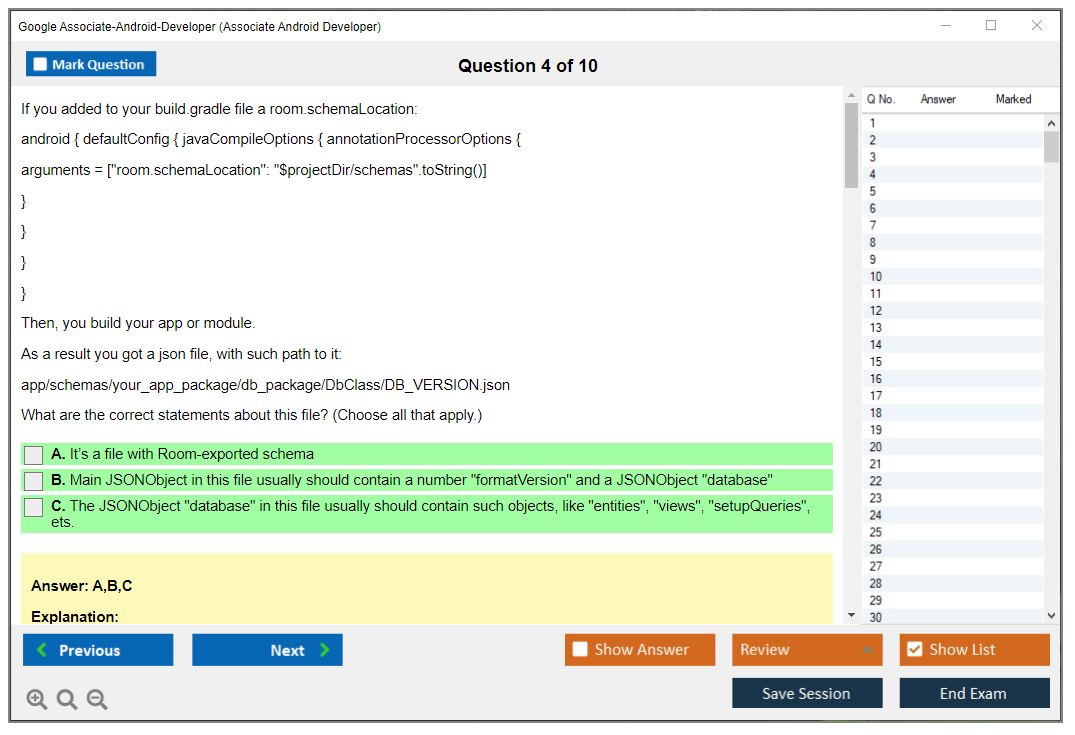
Room's the main event for persistence. You need entities, DAOs, the database class, relationships, and migrations. And look, migrations are where candidates bleed points because it feels "advanced," but the exam loves realistic scenarios like "add a column without nuking user data." You should understand version bumps and migration objects, not just fallbackToDestructiveMigration() like a villain.
SQLite fundamentals still matter when Room isn't appropriate, or when you need to reason about raw queries and cursors. You don't need to become a database admin. But you should know transactions. And you should recognize when you're doing work on the main thread and risking ANR.
SharedPreferences is still around for primitive data. Expect storing booleans, small strings, maybe a simple settings screen. Encrypted preferences might be mentioned, so at least know they exist and why plain prefs aren't for secrets.
File storage's broader now because scoped storage changed the rules. Internal storage's straightforward. External storage requires you to respect scoped storage, use the right APIs, request permissions only when needed. Content URIs matter here: MediaStore and the Storage Access Framework. If a task asks you to pick a document or save an image, you should know when you get a content:// URI and how to read it via ContentResolver.
Data serialization's practical: JSON parsing with Gson or Moshi. Data binding's also in the objectives, meaning you may need to bind UI to data sources so updates propagate without you manually calling findViewById everywhere. Repository pattern shows up again here, because the exam likes clean separation between "where data comes from" and "who displays it." Caching strategies are fair game too, mostly basic: in-memory cache, disk cache, invalidation when stale.
Networking and background work (WorkManager, services)
Networking: expect Retrofit/OkHttp patterns, parsing JSON or XML into objects, handling auth. OAuth and token-based auth can appear as "attach this header" tasks. API key management can show up as "don't hardcode secrets," though in exam-land you'll probably use placeholders or gradle properties.
Network security's a theme: HTTPS by default, maybe certificate pinning conceptually, secure transmission. Error handling isn't optional. You need to handle timeouts, failures, retries without freezing the UI. Coroutines are the common approach now: suspend functions, viewModelScope, exception handling. RxJava's on the list "if relevant," meaning you should recognize it and read it, but I wouldn't bet the whole exam on writing Rx chains from scratch unless the current blueprint leans that way.
Image loading libraries like Glide, Picasso, or Coil are common because writing your own image loader is pain. WebSockets might show up as a concept for real-time stuff, but it's more likely you'll just handle "live updates" with polling or a streaming-style API than build a full chat client.
Network monitoring's another sneaky one: detect connectivity changes and adapt behavior. The modern answer's usually ConnectivityManager callbacks, not the old broadcast receiver hacks that got restricted.
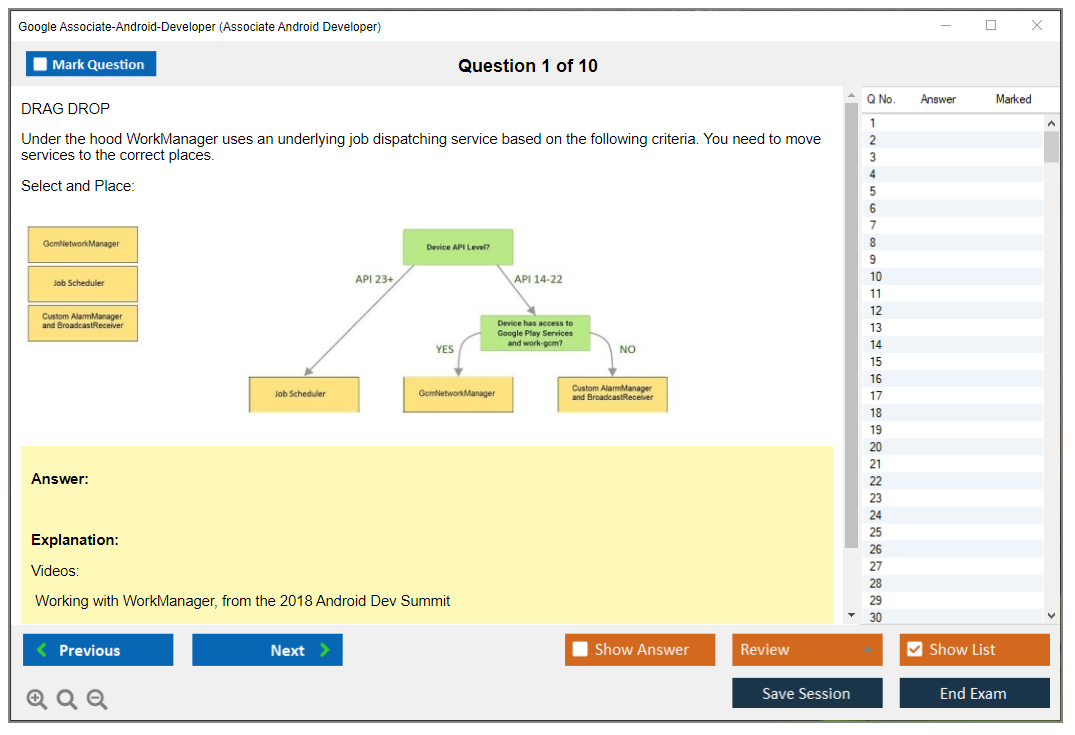
Background work's where WorkManager shines. You need to schedule deferrable guaranteed work, set constraints like network required or charging. Understand that WorkManager isn't for "run every second forever." Foreground services are for long-running operations users notice, with a persistent notification. JobScheduler and AlarmManager are alternatives, but modern Android background execution limits mean you can't just start background services whenever you feel like it. The exam'll expect you to respect those rules. Android does.
Architecture patterns (MVVM, repositories, Jetpack)
MVVM's basically the default. You should separate concerns: Activity/Fragment for UI, ViewModel for UI state and logic, repository for data. ViewModel surviving configuration changes is a key point, and so is using SavedStateHandle when you need restoration after process death.
LiveData and StateFlow both appear in modern apps. The exam may accept either depending on project setup. You should know lifecycle awareness, because observers that outlive the UI cause leaks and weird updates.
Dependency injection might be manual or Hilt/Dagger. If it's Hilt, you need to understand modules, @Inject, component scopes, and how DI makes testing easier. Navigation component's also a common exam target: navigation graphs, safe args, deep links. Paging library and DataStore are on the objectives list too, which usually translates to "recognize the pattern and wire it correctly" rather than "invent paging from scratch."
Lifecycle awareness can show up as LifecycleObserver or lifecycle-aware components when you need to start and stop things at the right time without sprinkling logic across every callback.
Testing and debugging (unit/UI tests, Android Studio tools)
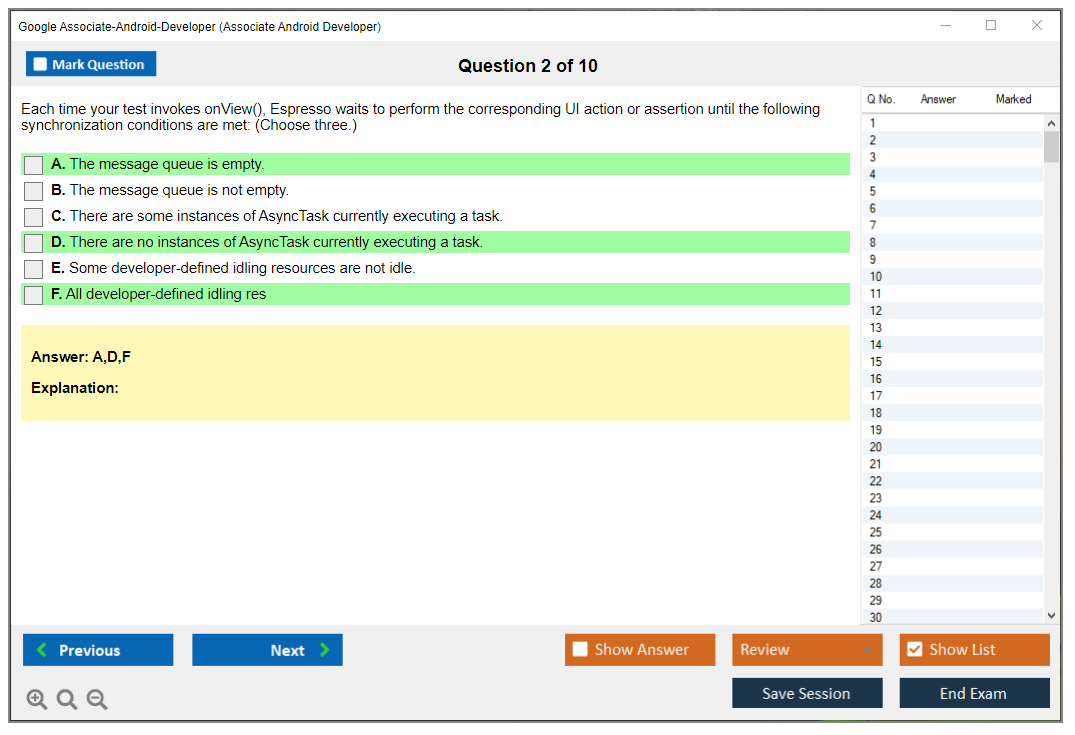
Testing's split between unit tests and instrumented tests. JUnit for ViewModels, repositories, business logic. AndroidJUnit4 and Espresso for UI and framework-level behavior. Mocking's part of the deal: Mockito or MockK, test doubles, controlling dependencies. TDD's listed, but the exam vibe's more "you should be able to write tests" than "write the whole app test-first." Knowing how to structure code so it's testable helps a lot.
Debugging tools matter more than people admit. Android Studio debugger, breakpoints, watches, evaluate expression. Logcat filtering and log levels. Layout Inspector for view hierarchy issues. Profilers for CPU, memory, network. LeakCanary for memory leaks. The thing is, the fastest way to fail tasks is to refuse to debug and just guess. Refusing to debug means you're flying blind and wasting time on symptoms instead of root causes.
App quality (permissions, performance, lifecycle)
Runtime permissions are a recurring pain point. You need to request permissions, handle denial, explain rationale when needed, declare permissions correctly in the manifest. Battery optimization's another: reduce power use, understand Doze and App Standby behavior, don't schedule wasteful background work.
Memory management's practical: avoid leaks, handle bitmaps without blowing up the heap, don't keep references to Activities in singletons, be careful with long-lived coroutines. Startup optimization's also in scope: don't initialize everything on cold start, do lazy setup where appropriate, keep the main thread responsive to prevent ANRs.
Security best practices show up as "don't store secrets in plain text," validate input, avoid injection-style issues. Localization's part of quality too: multiple languages, RTL layouts, region-specific resources.
This is the stuff that separates "I can build a demo" from "I can ship an app."
If you're also wondering about logistics like Associate Android Developer certification cost, Associate Android Developer passing score, and the Android certification renewal policy, keep reading the other sections. Objectives tell you what to study, but the rules tell you how to plan your time and retake strategy. And yeah, doing at least one solid Associate Android Developer practice test and building your own checklist from mistakes is basically required if you want to walk in calm.
Conclusion
Wrapping up: your next move
Look, here's the deal. The Google Associate Android Developer certification isn't some magic bullet that'll instantly land you senior roles at FAANG companies. Nothing works like that. But here's what it does do: it forces you to actually build something under pressure, not just regurgitate theory you've memorized from YouTube videos without ever opening Android Studio yourself. That hands-on exam format weeds out people who've only watched tutorials, and that's refreshing in a world full of paper certifications that mean basically nothing.
The certification cost runs around $149. That's reasonable compared to some vendor exams that hit $300+. You're getting validated on both Kotlin and Java across real Android app components, UI work, data persistence with Room, background processing, and all those Jetpack components that modern Android development actually uses when you're shipping real products to actual users who'll complain if anything breaks.
The exam objectives aren't arbitrary. They map to what you'd encounter building production apps. Everything from handling activity lifecycles to implementing proper architecture patterns like MVVM.
Passing score details? Not publicly posted by Google, which is kinda annoying if you ask me, but from what developers report it seems like you need solid performance across all sections since it's project-based evaluation not just multiple choice bubble-filling. No prerequisites exist officially but let's be real, if you haven't built at least 2-3 Android apps from scratch and spent time debugging in Android Studio you're gonna struggle. The time constraints alone will get you. I remember my first app took me three weeks just to figure out why the RecyclerView wasn't scrolling properly, turns out I'd nested the layout wrong, and the practical nature of this assessment doesn't give you that kind of breathing room.
The difficulty level hits that intermediate sweet spot. Beginners who've done their homework can pass. Experienced devs won't find it trivial. Common challenges include time management during the coding portion, debugging weird issues when you're nervous, and remembering API specifics without autocomplete holding your hand.
For study materials, lean heavily on official Android Developers guides and the Kotlin documentation. Build actual projects that touch every exam objective. A note-taking app covers persistence. A weather app handles networking. A workout tracker gets you into WorkManager territory. Theory only gets you halfway there.
Real talk?
Before you schedule, run through an Associate Android Developer practice test to identify weak spots. The Associate-Android-Developer Practice Exam Questions Pack gives you that reality check on where you actually stand versus where you think you stand, especially on those tricky architecture and testing sections that trip people up consistently.
This certification renewal policy doesn't require recertification currently, but don't coast on that. Android evolves fast. Jetpack Compose is already changing UI development significantly. Stay current, keep building, and use this cert as a starting point not a finish line you celebrate and forget about.

Finish the review with a conclusion that summarizes your overall opinion. Make sure to give substantiation from your experience to back up your claims.
Start with a preface that gives an overview of your experience with the product and what you set up to be the most useful.