

Oracle 1Z0-900 Java EE 7 Application Developer Certification Complete Guide
Look, I'm not gonna lie. When I first heard about the Oracle 1Z0-900 Java EE 7 Application Developer certification, my initial reaction was "wait, isn't Java EE kinda old news?" But here's the thing: enterprise systems don't just vanish overnight. Fortune 500 companies are still running critical applications on Java EE 7, and honestly, someone needs to maintain, extend, and migrate those systems. That's where this certification comes in.
The Oracle 1Z0-900 Java EE 7 Application Developer certification validates your ability to build multi-tiered enterprise applications using the full stack of Java EE 7 technologies. We're talking EJB 3.2, JPA 2.1, JAX-RS 2.0, CDI 1.1, Servlet 3.1, JMS 2.0, Bean Validation 1.1, and WebSocket 1.0. That's a lot but necessary if you're serious about backend work. it's about knowing one piece of the puzzle. You need to understand how these components work together in real production environments. The certification proves you can architect, develop, and deploy scalable, reliable, and secure enterprise applications, which is exactly what companies need when they're looking to fill backend systems engineer roles or enterprise Java architect positions.
Why Java EE 7 still matters in 2024
Sure, Java EE evolved into Jakarta EE. The platform moved to the Eclipse Foundation, got rebranded, and we've seen Jakarta EE 8, 9, and 10 releases. But the migration path isn't instant. Banks, insurance companies, government agencies are all running Java EE 7 applications that've been stable for years. Rewriting everything would cost millions and introduce unnecessary risk. Instead, these organizations need developers who understand the platform deeply enough to maintain it, add features, and eventually migrate to Jakarta EE when the time's right.
The skills you demonstrate with the 1Z0-900 certification translate directly to Jakarta EE work. The APIs didn't fundamentally change between Java EE 7 and Jakarta EE 8, mostly namespace updates from javax. to jakarta.. If you know JPA 2.1, you'll pick up JPA 2.2 and 3.0 without breaking a sweat. Same goes for JAX-RS, CDI, and the rest of the stack. This certification gives you a foundation that's valuable both for legacy system work and modern Jakarta EE development.
Who should pursue this certification
This exam targets intermediate to advanced Java developers who've moved beyond basic Java SE programming and want to prove their enterprise development chops. If you've been building web applications, working with frameworks like Spring or Hibernate, and you want to understand the underlying specifications those frameworks build upon, this is your exam. It's also perfect for developers transitioning from frontend work or other languages into Java enterprise development, assuming you've got solid Java fundamentals already.
Career-wise? The 1Z0-900 opens doors to roles like enterprise Java architect, full-stack developer (with Java backend focus), backend systems engineer, and application integration specialist. I've seen certified Java EE developers command 8-15% higher salaries compared to their non-certified peers, especially when they can demonstrate hands-on experience with the technologies. Your mileage may vary depending on location and company size, obviously. Companies that rely on Oracle technologies, and there are many, recognize Oracle certifications immediately during hiring processes.
Breaking down the exam structure
The 1Z0-900 exam typically contains 70-90 multiple-choice questions, though Oracle occasionally adjusts the exact count. You get 150 minutes to complete it, which honestly feels tight when you're dealing with scenario-based questions that require you to reason through transaction boundaries or JPA cascade behaviors. The exam's computer-based, delivered through Pearson VUE test centers or via online proctoring if you prefer taking it from home.
The 1Z0-900 exam cost runs approximately $245-$295 USD depending on your region and current Oracle pricing. Yeah, it's not cheap. Oracle University sometimes runs promotions where you can bundle training with exam vouchers at a discount, so watch for those if budget's tight. I've also seen employers willing to cover certification costs, especially if you can make the business case that it'll help with a specific project or client engagement.
The 1Z0-900 passing score sits at 66%, though some exam versions might have cutoffs between 63-66%. Oracle doesn't publish exact passing scores publicly anymore, but industry consensus and candidate reports suggest 66% is the standard threshold. That means you need to get roughly 46-60 questions correct out of 70-90, depending on the exam version you receive. It's not impossible, but it requires solid preparation across all exam objectives. You can't just master JAX-RS and wing the rest.
Prerequisites and recommended background
Officially? Oracle doesn't mandate any prerequisite certifications for the 1Z0-900. You could theoretically walk in off the street and take it. Practically speaking though, that's a terrible idea. You really should have the equivalent knowledge of the Oracle Certified Associate Java SE 8 Programmer certification, or better yet, the Java SE 8 Programmer II level. If you don't understand Java generics, lambdas, collections, and exception handling cold, you'll struggle with the enterprise concepts.
I'd recommend at least 1-2 years of actual Java EE development experience before attempting this exam. Not just reading about it. Actually building applications. Deploy something to GlassFish or WildFly or Payara. Write REST endpoints with JAX-RS. Map entities with JPA and deal with the inevitable lazy initialization exceptions. Inject dependencies with CDI and figure out why your beans aren't getting picked up. This hands-on experience is what separates people who pass from people who memorize practice questions and then fail.
How difficult is the 1Z0-900 exam really
Real talk here.
The 1Z0-900 exam difficulty lands solidly in the intermediate to advanced range. It's definitely harder than the Java SE programmer exams because you're dealing with multiple technologies and their interactions, which creates this whole ecosystem of complexity you need to work through mentally. The breadth alone is challenging. You can't focus on just one area and expect to pass. Transaction management across EJB boundaries, JPA entity lifecycle states, CDI scope interactions, JAX-RS content negotiation. These topics require deep understanding, not surface-level familiarity.
Common challenges candidates report include distinguishing between container-managed and bean-managed transactions, understanding when to use stateless vs stateful vs singleton EJBs, remembering the exact JPA cascade and fetch strategies, and knowing the details of CDI qualifiers vs alternatives. The exam loves scenario questions where you need to identify the correct approach for a given requirement or spot the bug in sample code.
Industry estimates suggest a 60-70% pass rate on first attempt for candidates who've prepared properly. That drops significantly for people who rely solely on brain dumps or try to cram without hands-on practice. The exam tests practical knowledge. You need to have debugged these technologies in real applications to develop the intuition needed to answer scenario questions correctly.
Study timeline and preparation approach
For candidates with 1-2 years of Java EE experience, plan on 8-12 weeks of dedicated study. If you're transitioning from Java SE or coming from frameworks like Spring without deep Java EE specification knowledge, budget 16-20 weeks. This isn't a weekend certification.
The study approach that works best combines hands-on practice with specification reading. The specs are boring as hell but they're accurate. Build a complete application that uses all the major components: REST API layer with JAX-RS, persistence with JPA, business logic in EJBs, dependency injection throughout with CDI, validation with Bean Validation, and security constraints. Make it do something real. A simple e-commerce system, task tracker, or inventory manager. Deploy it to an actual application server and deal with all the configuration headaches. I once spent three hours tracking down a typo in a persistence.xml file. Annoying? Sure. But that kind of frustration teaches you more than any tutorial ever could.
Don't over-rely on Spring or Hibernate knowledge. I see this mistake constantly. Developers who've used Spring for years assume they understand dependency injection, but CDI has different scoping rules and lifecycle behaviors. Same with Hibernate users taking the JPA portions. Hibernate adds features beyond the JPA spec, and the exam tests spec compliance, not vendor extensions. You need to know what's in Java EE 7 specifications versus what's framework-specific.
Core exam objectives you'll face
The web tier section covers Servlet 3.1 fundamentals including request/response lifecycle, filters, listeners, and async processing. You'll need to know servlet mapping patterns, how to handle multipart file uploads, and WebSocket 1.0 basics for real-time communication. This section usually carries moderate weight in the overall exam.
JAX-RS 2.0 for REST services? Heavily tested. Expect questions on resource classes and methods, path parameters vs query parameters, content negotiation with Accept headers, exception mappers, filters and interceptors, and the client API for consuming REST services. You should be comfortable writing both server and client code.
The JPA 2.1 section dives deep. Entity mapping, relationships (one-to-one, one-to-many, many-to-many), cascade types, fetch strategies (eager vs lazy), JPQL queries, the Criteria API, and transaction management. Locking mechanisms and entity lifecycle states show up frequently. This is one of the weightier sections.
EJB 3.2 coverage includes stateless, stateful, and singleton session beans, understanding when to use each type, transaction attributes (Required, RequiresNew, Mandatory, etc.), timer services, interceptors, asynchronous methods, and security annotations. The interaction between EJB and CDI is tested, which trips people up because the contexts overlap in confusing ways.
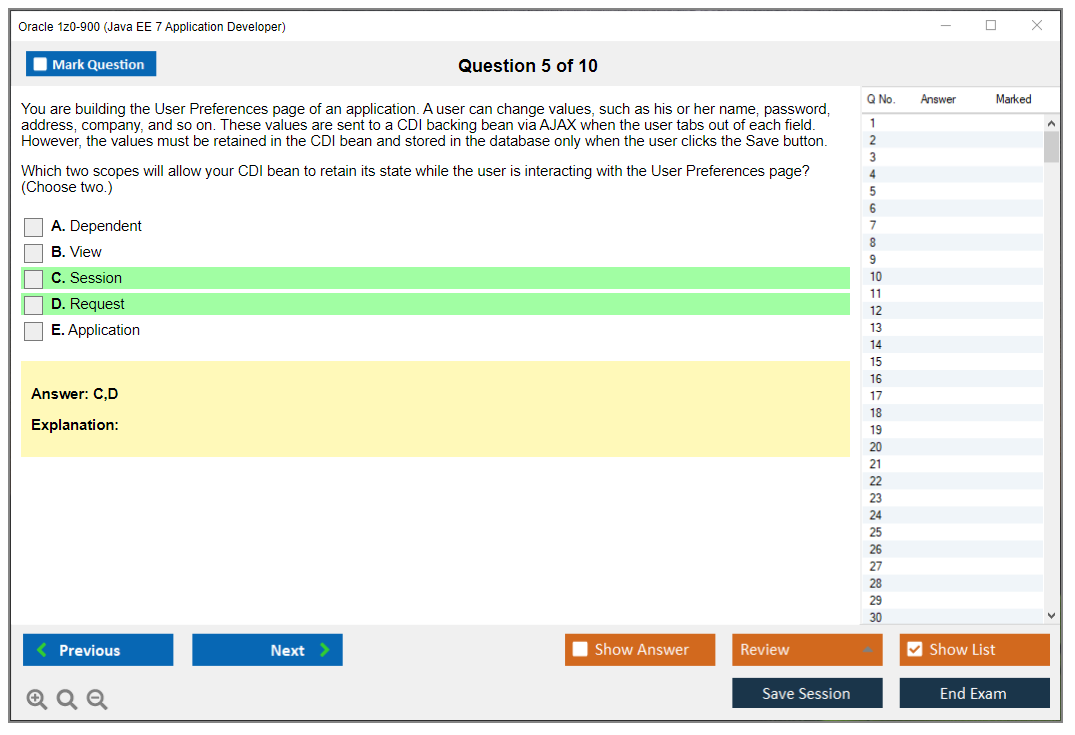
CDI 1.1 questions focus on dependency injection fundamentals. Bean scopes (RequestScoped, SessionScoped, ApplicationScoped, etc.), qualifiers for disambiguation, alternatives for deployment-specific implementations, interceptors and decorators, and producer methods. Understanding the CDI container lifecycle and when beans get created or destroyed is key.
JMS 2.0 covers message producers and consumers, point-to-point vs publish-subscribe models, message-driven beans, and message reliability patterns. This section's lighter but still requires practical knowledge.
Bean Validation 1.1 and Java EE security round out the objectives. You need to know built-in constraint annotations (@NotNull, @Size, etc.), custom validator creation, validation groups, and basic authentication/authorization concepts in Java EE.
Best study resources for 1Z0-900
Official Oracle documentation is your foundation. The Java EE 7 tutorial that Oracle published is full and freely available. The actual specifications for each technology (JPA, JAX-RS, EJB, etc.) are downloadable PDFs. They're dry reading, but they're authoritative.
For books, look for Java EE 7 specific titles that cover the full platform. Avoid anything focused on Java EE 6 or earlier because the API changes matter. Third-party study guides exist but verify they're specifically for the 1Z0-900 exam, not generic Java EE overviews.
Video courses can supplement but shouldn't be your primary resource. They're good for seeing deployment and configuration in action, but you need to do the work yourself. Set up GlassFish or WildFly on your machine, deploy applications, check logs when things break, and figure out why.
Practice tests are valuable for identifying weak areas and getting comfortable with Oracle's question style, which has this particular rhythm you'll recognize once you've seen enough examples. Look for practice exams that provide detailed explanations, not just correct answers. The explanations teach you the reasoning process you'll need during the actual exam. Make sure any practice material's updated for Java EE 7 specifically. Older Java EE 6 practice questions won't cover features like JAX-RS 2.0 client API or JPA 2.1 schema generation.
Practical preparation strategy
Build projects. I can't stress this enough. Create a sample application that uses JAX-RS for REST endpoints, JPA for database access, EJB for business logic, and CDI for wiring everything together. Add Bean Validation to your entities. Implement security with Java EE security annotations. Deploy it to an application server and actually test it.
When something doesn't work, and it won't, debug it. Read the server logs. Understand why your @Stateful bean isn't maintaining state or why your JPA query returns empty results. These debugging experiences build the intuition you need to answer scenario questions.
Create flashcards or notes for the details you need to memorize: transaction attribute behaviors, JPA cascade types, CDI scope lifecycles, HTTP status codes for JAX-RS responses. Quiz yourself regularly.
Take timed practice exams under realistic conditions. 150 minutes for 70-90 questions means roughly 2 minutes per question. Some questions you'll answer in 30 seconds. Others might take 5 minutes if they're complex scenarios. Practice your time management.
Exam day execution
Read questions carefully. Oracle loves to include distractors that are almost correct but violate spec in subtle ways. If a question asks about JPA behavior, think about what the specification says, not what Hibernate does by default.
Eliminate obviously wrong answers first. Usually you can narrow it down to 2-3 plausible options, then reason through which fits with Java EE specifications.
Flag questions you're uncertain about and come back if time permits. Don't let one difficult question eat up 10 minutes while you have 30 unanswered questions remaining.
Certification maintenance and next steps
Oracle certification policies have evolved over the years. The 1Z0-900 credential itself doesn't technically "expire," but Oracle has retired the exam as Java EE evolved to Jakarta EE. You can still list it on your resume and LinkedIn. The knowledge remains valid and valuable for enterprise systems work.
For staying current, explore Jakarta EE certifications as they become available. The transition from Java EE 7 to Jakarta EE 8 is minimal, mostly namespace changes. Jakarta EE 9 and 10 introduce more significant updates worth learning.
Consider complementary certifications like Oracle WebLogic Server Administration if you work with Oracle's application server specifically, or Oracle Database Administration to strengthen your full-stack enterprise capabilities. The MySQL Database Administrator certification pairs well if you're working with open-source databases alongside Java EE applications.
Return on investment analysis
The certification cost of $245-$295 plus study materials (maybe another $100-200 for books and practice exams) and your time investment of 100-200 hours spread over 8-20 weeks is significant. But the salary impact for certified Java EE developers, that 8-15% increase I mentioned, can translate to $5,000-$15,000 annually depending on your base salary. The ROI becomes positive within the first year for most developers.
Beyond salary? The certification helps with job mobility. Enterprise organizations that rely on Java EE often filter candidates by certifications during initial screening. Having the 1Z0-900 on your resume gets you past that filter and into interviews you might otherwise miss.
Understanding the technology ecosystem
Java EE 7 represented a major push toward developer productivity and HTML5 support when it released in 2013. The platform included significant updates like the JAX-RS client API, JPA schema generation, simplified JMS API, and WebSocket support. These weren't trivial additions. They fundamentally improved how developers built enterprise applications.
The technologies work together in a cohesive way. JAX-RS resources use CDI for dependency injection to get EJB business services, which use JPA to persist data, with Bean Validation ensuring data integrity, all running in a container that manages transactions and security. Understanding these interactions, not just individual APIs, is what the exam really tests.
Final thoughts on exam preparation
The Oracle 1Z0-900 Java EE 7 Application Developer certification isn't a shortcut or a paper credential you can earn through memorization alone. It requires genuine understanding of enterprise Java development principles and hands-on experience with the technologies. If you put in the work, building applications, reading specifications, practicing with realistic questions, you'll pass and you'll have skills that immediately apply to real-world enterprise development challenges.
The exam difficulty's fair. It's not trying to trick you with obscure edge cases or syntax trivia. It tests whether you understand how to build production enterprise applications using Java EE 7 specifications. Prepare accordingly and you'll succeed.
Understanding Oracle 1Z0-900 Exam Prerequisites and Recommended Experience
Quick orientation before you stress about "requirements"
Let's clear the air: Oracle doesn't mandate any prior certifications for the 1Z0-900 Java EE 7 Application Developer exam. No gatekeeping. No "must have X first." You can pay, schedule, and sit.
That said. Reality's different.
The Oracle 1Z0-900 Java EE 7 Application Developer certification assumes you already write Java like it's your day job, because honestly, the exam isn't testing whether you can reason about Java EE 7 behavior when multiple specs collide, logs are yelling, and the "right answer" is the one that matches the spec wording, not the one you used at work in 2019.
What the certification actually proves
This credential's basically Oracle's stamp that you can build a classic Java EE 7 app: web tier, REST, persistence, business logic, dependency injection, messaging, validation, and security basics. You'll see spec-driven edge cases. You'll see lifecycle questions. You'll see "which annotation does what here" stuff that feels petty until you've debugged it at 2 a.m.
It's also very vendor-neutral in a weird way, because Java EE's specification-driven with multiple vendor implementations. GlassFish, Payara, WildFly. Same spec, different defaults, different logging, sometimes different "gotchas." The exam cares about the spec.
I've noticed something odd about these vendor-neutral exams over the years. They create this strange mental habit where you start second-guessing your actual production experience because the spec says one thing and your app server's been doing something slightly different for three years and nobody noticed. It's unsettling in a useful way, actually.
Who should take it
If you're already building enterprise Java apps, or you're trying to break into a backend role where "Java EE experience" keeps showing up in job posts, this's a decent signal. Not magic. A signal.
New grads can do it too, honestly, but you'll need a lot more lab time because "I read the tutorial" doesn't equal "I can predict container behavior."
Career outcomes and roles
This fits with Java EE developer, backend engineer, enterprise application developer, and "internal business systems" teams where stuff's still WAR/EAR based and deployed to an application server that's been around longer than some interns. Banks. Insurance. Government vendors. Big companies with big audit trails.
1Z0-900 exam cost
People ask about 1Z0-900 exam cost early, because budgets are real. Oracle exam pricing can vary by country and taxes, but you're usually looking at a rough range around USD $245 to $300-ish once regional pricing and tax/VAT show up.
Look, don't trust blogs (including mine) for the final number. Verify on the official Oracle certification exam listing and the authorized testing provider checkout page for your region, because Oracle does change pricing and bundles.
Exam format and delivery
Oracle typically delivers these through Pearson VUE. That means test center or online proctoring, depending on what Oracle currently offers for that exam code. The question style's the usual multiple-choice and multiple-select, and it's extremely picky about wording.
Time limit and number of questions can change, so check the official exam page right before you schedule. I mean it. Oracle updates listings quietly sometimes.
Passing score for 1Z0-900
The 1Z0-900 passing score is published on Oracle's exam page, and it can change. Historically it's been listed as around the mid-60% range (often cited as 65%), but treat that as "commonly reported" and not "guaranteed forever." Always confirm on Oracle's site the week you book.
What you're actually studying (exam objectives map)
The 1Z0-900 exam objectives read like a checklist of Java EE 7 specs you've seen on slides but maybe didn't wire together in one app. The fastest way to lose weeks is studying each API in isolation and never deploying anything.
Web tier fundamentals (Servlet 3.1)
You need the request/response cycle cold. Filters compared to listeners. When sessions get created. Cookie behavior. Async servlets, which people skip because "we don't use that."
Also know where WebSocket 1.0 fits conceptually, because it's easy to confuse "HTTP request lifecycle" with "long-lived socket session" and then answer a question wrong because you assumed a filter runs on everything forever.
REST services (JAX-RS 2.0)
For JAX-RS 2.0 RESTful services, focus on resource modeling, HTTP methods, status codes, and content negotiation. Providers. MessageBodyReader/Writer. The client API too.
REST questions often hide in plain sight: the method annotations look right, but the media types or parameter binding rules make one option the only spec-correct answer.
Persistence (JPA 2.1)
JPA 2.1 and JPQL is where the exam starts feeling like an argument with your past self. Entity relationships, cascade types, fetch strategies, and JPQL semantics.
Transactions show up here even if the question pretends it's only about mappings. Persistence context behavior gets tested hard. Detached entities. Merge compared to persist. Flush timing. It's all fair game.
Business layer (EJB 3.2)
Enterprise JavaBeans (EJB) 3.2 topics usually cover stateless/stateful/singleton beans, interceptors, timers, async methods, transactions, and security basics. Container-managed transactions. Transaction attributes. What runs in what context.
Not gonna lie, lots of people get burned on lifecycle and concurrency rules for singleton beans, because they remember "singletons exist" but forget the threading implications and the annotations that control access.
Dependency injection (CDI 1.1)
CDI 1.1 dependency injection is deceptively simple until qualifiers, alternatives, producers, scopes, and interceptors enter the chat.
Decorators are on the list too, and yes, you should be able to explain why a decorator isn't the same as an interceptor, even though both "wrap" behavior.
Messaging and integration (JMS 2.0)
JMS 2.0's usually about producers/consumers, message types, reliability concepts, and message-driven beans. You don't have to be a messaging wizard, but you do need the mental model: async communication, ack modes, and what the container handles.
Validation and security (Bean Validation 1.1 plus basics)
Bean Validation constraints, custom validators at a high level, and how validation hooks into JAX-RS and JPA in real apps.
Security here's fundamentals: authentication compared to authorization, role-based access, HTTPS, and awareness of common web issues from OWASP Top 10. Nothing too wild. Still important.
Real-time/web features (WebSocket 1.0)
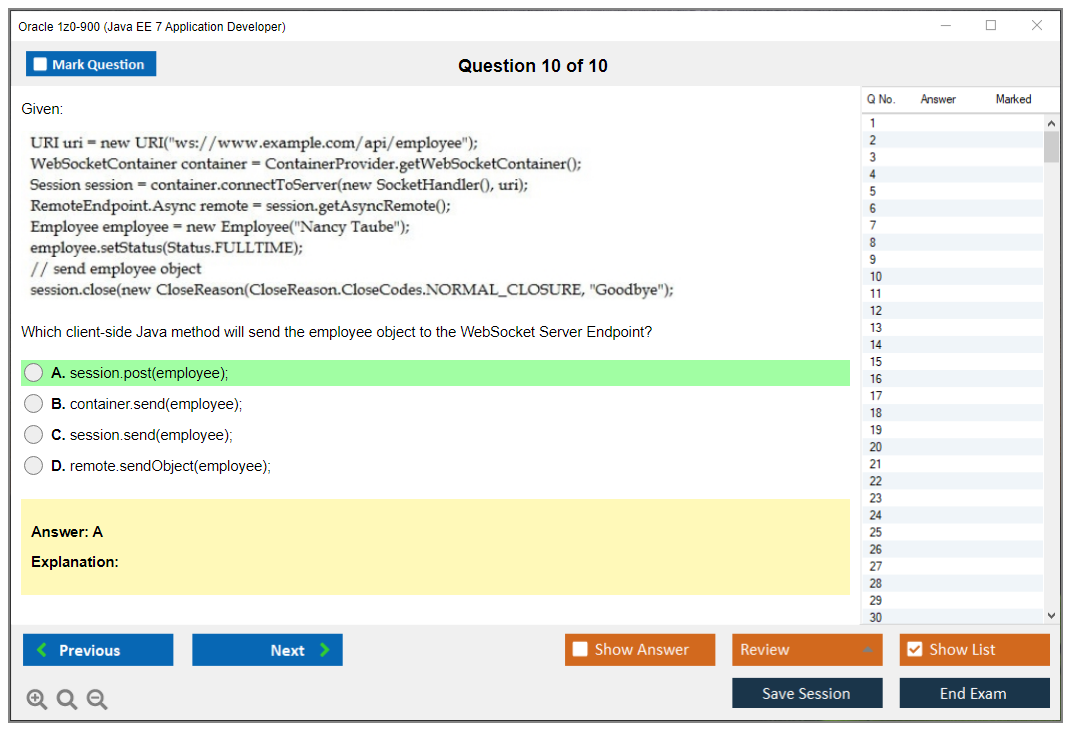
WebSocket endpoints, sessions, encoders/decoders, and basic lifecycle. This is one of those topics people cram last minute, then regret it because the API's small but the rules are specific.
Required prerequisites (official compared to practical)
Officially, again: Oracle Java EE 7 certification prerequisites are basically "none." Oracle doesn't require OCA first. Oracle doesn't require training first.
Practically, you need Java SE competence. If you're shaky on the language, Java EE will feel like five frameworks yelling at you at once.
A common recommendation is the Oracle Certified Associate Java SE 7 or Java SE 8 Programmer cert as groundwork, not because the paper matters, but because the prep forces you to stop guessing about the language.
Java SE proficiency you should already have
Solid understanding of core Java concepts including collections, generics, concurrency, I/O, and exception handling.
Collections matter. Map/Set/List behavior. Iteration pitfalls. Generics variance basics. Concurrency primitives and executor concepts, at least enough to reason about thread safety and container-managed threading rules.
Exceptions matter more than people admit. Checked compared to unchecked. Wrapping. Transaction rollback behavior when exceptions are thrown. That kind of thing.
Object-oriented programming mastery (yes, really)
You need deep knowledge of inheritance, polymorphism, encapsulation, and design patterns.
Patterns that show up a lot in enterprise apps: Singleton, but not the meme version. The one with concurrency concerns, container-managed singletons, and "what's one instance" in a clustered environment. Factory is common around building clients, entity managers, and integration components, and it's also a test-friendly way to reason about object creation. Observer and Decorator show up both as classic GoF concepts and as "this reminds me of CDI events" or "this looks like a CDI decorator."
DAO, Service Layer, MVC, Front Controller. Those enterprise patterns aren't just trivia. They help you recognize what the question's describing even when it avoids naming the pattern.
Web app fundamentals you can't skip
Understanding HTTP protocol, request-response cycle, sessions, cookies, and web application architecture.
I mean, if you've never debugged a session issue, you'll miss why one answer's wrong. Statelessness. Idempotency. Redirect compared to forward. Caching headers. Basic stuff, but it shows up everywhere.
Database and SQL competency
You should be able to write complex SQL queries and understand JDBC basics, transactions, and relational database design principles.
JPA doesn't delete SQL from your life. It hides it until it matters, then it matters a lot. Joins. Indexes. Normalization. Transaction isolation levels conceptually. ACID properties. Transaction boundaries. Distributed transactions at least as a definition and why they're painful.
XML and JSON processing
You don't need to be a full-time data format nerd, but you should be comfortable parsing and generating XML/JSON documents and understand serialization concepts.
JAX-RS makes this feel automatic with providers, then the exam asks which provider kicks in, or what annotation changes the output, and suddenly you're thinking about message body writers again.
Tools you should be comfortable with
Build tools matter. Maven or Gradle for dependency management, project structure, and build lifecycle. Pick one and get fluent enough that you can add dependencies, manage scopes, run tests, build a WAR, and not get stuck on "why's my jar not found."
Git fundamentals too. Branching, merging, pull requests, resolving conflicts. You don't need wizard-level rebase skills, but you need to function on a team.
And an IDE: Eclipse, IntelliJ IDEA, or NetBeans. Debugger use. Breakpoints. Inspecting variables. Deployment configs. Honestly, half the value of IDE comfort is speed when you're doing labs.
Application server exposure (non-negotiable)
Hands-on experience deploying to at least one Java EE 7 compliant server: GlassFish 4.x, WildFly 8-10, or Payara 4.x.
Deploying is a skill. Packaging (WAR/EAR), deployment descriptors, server config, datasource setup, JNDI names, and reading server logs when something fails at startup. A lot of "I know JPA" confidence dies the first time the server boot fails because of a persistence.xml mismatch.
Recommended experience level and coding hours
If you want my blunt take: minimum professional experience should be 12-18 months of active Java EE development work on production applications.
No job yet? Then simulate it. You'll want 200-300 hours of hands-on Java EE coding across multiple technology areas. Not tutorials only. Real code. Bugs included.
Also get exposure to project complexity: build something with at least 3-4 Java EE technologies integrated, like JPA plus EJB plus JAX-RS plus CDI, plus validation and a tiny bit of security. A single "hello REST" service won't prepare you for container behavior questions.
Testing knowledge that actually helps
Know JUnit. Understand integration testing and basic strategies for enterprise components. Mocking can help, but integration tests are where you learn what the container really does.
One long lab session where you write tests against a REST endpoint backed by JPA and transactions will teach you more than five days of reading.
Troubleshooting skills (the quiet prerequisite)
Be able to read server logs, debug application issues, and use profiling tools at a basic level. Thread dumps, heap basics, connection pool metrics. Caching and connection pooling concepts.
Also logging frameworks: SLF4J, Log4j, or java.util.logging. You don't need to memorize every config file format, but you should know how to emit logs and find them.
Spec awareness and reading docs
Comfort with working through Java EE 7 Javadocs and specs matters because the exam is spec-based. If you've never read the actual JAX-RS or CDI spec sections, some questions will feel like trick questions. Wait, they're not tricks. They're quotes.
Documentation skills are part of the job anyway. Read requirements, translate to code, and verify behavior against the spec when implementations differ.
Microservices context (helpful, not required)
This exam is Java EE 7, not a cloud-native checklist. Still, understanding how Java EE components fit in modern distributed architectures helps you reason about REST boundaries, stateless services, async messaging, and why transactions don't magically span microservices.
Cloud platform awareness is nice too. Deploying Java EE apps to cloud environments happens, but it's not usually the core of exam questions.
Continuous integration familiarity
Basic CI/CD knowledge helps in real life: pipelines that run tests, build artifacts, and deploy. Again, not the center of the exam, but it makes your practice project feel like a real project, which makes your learning stick.
How hard is it (difficulty reality check)
The 1Z0-900 exam difficulty is, in my opinion, solidly intermediate leaning advanced, mostly because it mixes specs and expects you to know where the boundaries are.
Common pain points candidates hit: transaction boundaries and rollback rules across EJB/JPA, JPA mapping edge cases and persistence context behavior, CDI lifecycle compared to EJB, interceptors versus decorators, JAX-RS content negotiation details and provider selection, async processing rules and what the container allows.
How to estimate readiness: take objective-by-objective checklists, do timed drills, and aim for consistent scores on practice sets, not one lucky run.
Best study materials (what I'd actually use)
Official Oracle resources first: the exam topics page, the Java EE 7 tutorial, and the relevant spec PDFs when you get confused.
Then books and references. Not ten of them. One good Java EE 7 overview plus focused docs for JPA/JAX-RS/EJB/CDI.
Hands-on labs are the multiplier. Build a mini project: REST API plus JPA plus EJB plus CDI plus validation plus security basics, deploy it, break it, fix it, repeat.
If you want practice questions with a tighter exam vibe, a pack like 1z0-900 Practice Exam Questions Pack can help you identify weak spots faster. Don't treat it like a cheat code. Treat it like a mirror.
Practice tests and a sane prep strategy
A good 1Z0-900 practice test setup is a mix: small topic quizzes for weak areas and at least a couple full-length timed mocks to build pacing.
What to look for: explanations that point to the spec, mapping back to objectives, and questions that reflect Java EE 7 versions. Vague explanations are a red flag. Wrong-version APIs are another.
A rough 2 to 6 week plan depends on your background, but the structure is simple: pick 2-3 objectives per week, ship lab features that force those APIs to interact, and then do practice sets. If you're using 1z0-900 Practice Exam Questions Pack or any other question bank, review every miss and reproduce the behavior in code at least sometimes, because memory fades and experiments stick.
Exam-day tips. Sleep. Read the question twice. Watch for "most appropriate" wording. Eliminate distractors that violate the spec even if they feel plausible.
Gap assessment and validating prerequisites yourself
The smartest move is a gap assessment against the official objectives. Print them. Put a checkbox next to each. Rate your confidence. Then prove it with code.
My favorite prerequisite validation approach is building a small Java EE 7 application that touches all major technologies: a simple inventory system works. JAX-RS endpoints, CDI injection, EJB service layer, JPA entities and queries, Bean Validation constraints, a secured admin endpoint, JMS for an async notification, and a WebSocket for a live update if you want extra pain.
That one project forces you to set up your environment too: app server, database, build tool, IDE, and deployment workflow. And if you can do that without constantly guessing, you're ready to take a real 1Z0-900 study guide seriously and move into exam mode.
Renewal, validity, and what happens when exams retire
Oracle certifications don't always "expire" like some vendor creds, but Oracle does retire exams. When that happens, you can't earn it anymore, and the status in Oracle's systems can shift to "retired" while still showing you earned it.
Verify current policy on Oracle's certification pages. Policies change, and I'm not gonna pretend a blog post can freeze time.
If renewal or "staying current" matters for your career, the
1Z0-900 Exam Objectives and Java EE 7 Technology Domains
How Oracle organizes the exam blueprint
The 1Z0-900 isn't just some random question dump. Oracle structures this thing around seven major technology domains mapping directly to Java EE 7 specs. Each domain targets different platform parts: servlets, REST services, persistence, business logic, dependency injection, messaging, validation. If you've worked with Java EE before, you know these aren't isolated islands. They connect in real apps.
The exam doesn't test vendor fluff whatsoever. Questions pull from official API specifications, meaning you need to know how EntityManager.persist() actually works according to JPA 2.1 spec, not just how your favorite tutorial implements it. This specification-based approach trips up tons of people who've only used frameworks abstracting away details.
Understanding objective weighting matters way more than most candidates realize. Some domains carry 15-20% of total questions, others might only hit 5-10%. Spend equal time on every domain? You're wasting study hours. I've seen people obsess over WebSocket encoders (tiny percentage) while barely touching JPA relationships (huge chunk). Prioritize based on weight, then circle back.
Request and response fundamentals you actually need
Servlet 3.1 lifecycle mastery starts with the trinity: init(), service(), and destroy(). Container calls init() once when servlet loads. Configure resources here, read initialization parameters, set up connections. Then service() handles every single request, delegating to doGet(), doPost(), whatever. Finally destroy() cleans up before shutdown. Sounds simple, right?
Exam questions love edge cases though. What happens if init() throws an exception? Servlet never goes into service. Can you call destroy() manually? Nope, container-only. ServletContext vs ServletConfig: context is application-wide, config's per-servlet. These distinctions show up constantly.
HttpServletRequest and HttpServletResponse APIs are your bread and butter for handling actual traffic. Parameter extraction with getParameter() and getParameterValues(), header manipulation using getHeader() and setHeader(), response streaming with getOutputStream() or getWriter(). You need to know when to use which. Binary data goes through OutputStream, character data through Writer. Mix them? Exceptions.
Filters, listeners, and async patterns
Servlet filters create processing chains wrapping requests and responses before they hit your servlet. Filter chain processing works like Russian dolls. Each filter calls chain.doFilter() to pass control to the next filter or final servlet. Request wrapping lets you modify incoming data, response wrapping captures output for logging or transformation. The exam loves asking about filter ordering and what happens if a filter doesn't call doFilter() (request stops dead).
Context listeners, session listeners, attribute listeners give you hooks into lifecycle events. ServletContextListener fires when your app starts and stops. HttpSessionListener tracks session creation and destruction. ServletRequestAttributeListener notices when request attributes change. Real-world use case: I've used context listeners initializing database pools and session listeners tracking active users. Exam tests which listener fires when and in what order.
Asynchronous servlet processing changed everything for long-running operations. AsyncContext API lets you hand off request processing to another thread, freeing up servlet container thread pool. You start async mode with request.startAsync(), do your work in a separate thread, then call AsyncContext.complete() when done. The async-supported configuration flag must be true in your servlet annotation or deployment descriptor, otherwise you'll get runtime errors.
Timeout handling prevents requests from hanging forever. Set a timeout, register an AsyncListener handling timeout events. I once debugged an app where someone forgot the timeout config and requests just accumulated until memory ran out. Not pretty.
File uploads and modular web apps
File upload handling in Servlet 3.1 uses @MultipartConfig annotation and Part API, which is way cleaner than old Commons FileUpload libraries. Annotate your servlet with @MultipartConfig, maybe set max file sizes and temp locations. Then call request.getParts() getting all uploaded parts or request.getPart("fieldname") for a specific file. Each Part gives you filename, content type, input stream, size. You can write it directly to disk with part.write() or process the stream yourself.
Web fragments let you build modular web applications where JAR files contribute their own configuration through web-fragment.xml files in META-INF. Ordering matters when multiple fragments define overlapping configuration. You control it with
Non-blocking I/O through ReadListener and WriteListener interfaces handles streams efficiently without tying up threads. Register a ReadListener on input stream, implement onDataAvailable(), onAllDataRead(), and onError(). Container calls your methods when data arrives, when stream ends, or when something breaks. WriteListener works the same way for output. This pattern shines for streaming large responses or processing uploads without blocking.
Security and session tracking
Security constraints in web.xml define declarative security: which URLs require which roles, transport guarantees (HTTPS), authentication methods. Role-based access control maps abstract roles like "manager" to actual users and groups configured in your application server. Programmatic security gives you finer control with request.isUserInRole(), request.getUserPrincipal(), and request.authenticate().
Session tracking mechanisms include cookies (most common), URL rewriting (fallback when cookies disabled), and SSL session IDs. HttpSession API manages user sessions across multiple requests. Cookie handling involves HttpServletResponse.addCookie() and HttpServletRequest.getCookies(). Session persistence depends on your container. Some write sessions to disk or databases for failover, others keep everything in memory.
JSP and Expression Language essentials
JSP fundamentals still appear on this exam even though modern apps often skip JSPs entirely. Expression Language 3.0 added lambda expressions and collection operations. You can write ${items.stream().filter(i -> i.price > 50).toList()} right in a JSP. JSTL tags (
JSP lifecycle mirrors servlets. JSPs compile into servlet classes, then follow init/service/destroy. Translation phase converts JSP to Java source, compilation phase creates class file, initialization calls jspInit(), request processing uses _jspService(), and cleanup calls jspDestroy().
REST resource fundamentals
JAX-RS 2.0 dominates a significant chunk of exam objectives. Resource classes use @Path defining base URIs. Resource methods use @GET, @POST, @PUT, @DELETE handling HTTP verbs. URI template parameters like @Path("/users/{id}") extract path segments, combined with @PathParam("id") in method parameters. This is REST 101, but exam digs into edge cases like multiple path parameters, regular expression constraints, and matrix parameters.
Content negotiation through @Produces and @Consumes determines which media types your resource handles. A method annotated @Produces(MediaType.APPLICATION_JSON) returns JSON, @Produces(MediaType.APPLICATION_XML) returns XML. Runtime automatically serializes and deserializes using entity providers. When a client sends an Accept header, JAX-RS picks the best matching method.
Query parameters, matrix parameters, header parameters, cookie parameters: each has its own annotation. @QueryParam grabs URL query strings. @MatrixParam extracts semicolon-delimited parameters in path segments. @HeaderParam reads HTTP headers. @CookieParam accesses cookies. Path parameters use @PathParam as mentioned. Knowing which to use when? Critical.
Entity providers and exception handling
Entity providers implement MessageBodyReader and MessageBodyWriter for custom serialization. Say you want to support a custom format beyond JSON and XML. You write a provider, annotate it with @Provider, implement isReadable() and readFrom() for reading and isWritable() and writeTo() for writing. Runtime discovers and registers your provider automatically.
Exception mapping converts Java exceptions into HTTP responses. Implement ExceptionMapper@Provider, and return a Response in the toResponse() method. When your resource throws YourException, JAX-RS catches it and uses your mapper building the HTTP response: status code, error message, whatever you want. This keeps exception handling centralized instead of scattered across every resource method.
JAX-RS client API and advanced features
JAX-RS client API consumes REST services from Java code. Start with ClientBuilder.newClient(), create a WebTarget pointing to your base URI, build an Invocation, and process the Response. Fluent API makes it readable: client.target("http://api.example.com").path("/users").request(MediaType.APPLICATION_JSON).get(User.class). Way cleaner than old HttpURLConnection approach.
Filters and interceptors provide hooks into request and response processing. ContainerRequestFilter and ContainerResponseFilter run on server side. ClientRequestFilter and ClientResponseFilter run on client. Execution order matters. Annotate with @Priority controlling sequencing. Use cases include logging, authentication, compression, whatever you need injecting into processing pipeline.
Validation integration brings Bean Validation constraints directly into your resource methods. Annotate parameters with @NotNull, @Size, @Email, and JAX-RS validates them automatically before calling your method. Invalid input generates a 400 Bad Request response. You can also validate return values making sure your API sends clean data.
Asynchronous processing in JAX-RS uses @Suspended AsyncResponse parameters. Your method returns immediately while processing continues on another thread, then you call asyncResponse.resume() with result when ready. Server-sent events (SSE) build on this for pushing updates to clients. 1z0-819 covers some of these patterns in the context of modern Java SE, but the Java EE angle's different.
JPA entity mapping and relationships
Entity mapping fundamentals start with @Entity marking your class as persistent, @Table specifying database table name, @Id marking primary key field, and @GeneratedValue controlling key generation strategies (AUTO, IDENTITY, SEQUENCE, TABLE). Primary key strategies matter because IDENTITY works great with MySQL auto-increment but doesn't support batch inserts efficiently, while SEQUENCE works well with Oracle and PostgreSQL.
Relationship mappings connect entities. @OneToOne links one entity instance to exactly one instance of another. @OneToMany and @ManyToOne form the two sides of a one-to-many relationship. @ManyToMany creates many-to-many with a join table. Cascade types (PERSIST, MERGE, REMOVE, REFRESH, DETACH, ALL) determine which operations propagate to related entities. Fetch strategies matter too. EAGER loads related entities immediately, LAZY defers loading until you access the relationship. Performance impact can be massive.
Embedded objects using @Embedded and @Embeddable let you extract reusable components that aren't entities themselves. An Address embeddable can be embedded in Person, Company, wherever you need address fields. @AttributeOverride changes column names when same embeddable's used multiple times in one entity.
Inheritance and EntityManager operations
Inheritance strategies determine how class hierarchies map to tables. SINGLE_TABLE puts all classes in one table with a discriminator column. JOINED creates separate tables for each class with foreign keys linking them. TABLE_PER_CLASS makes completely independent tables. Use @Inheritance(strategy=InheritanceType.JOINED) and @DiscriminatorColumn configuring it. Each strategy has trade-offs. SINGLE_TABLE's fast but wastes space on null columns, JOINED normalizes data but requires joins, TABLE_PER_CLASS duplicates shared columns.
EntityManager API provides core persistence operations. persist() makes a transient entity managed and schedules it for insert. merge() copies detached entity state into a managed entity. remove() marks a managed entity for deletion. find() loads an entity by primary key. getReference() returns a lazy proxy without hitting database. flush() forces pending changes to database immediately. Understanding entity states (transient, managed, detached, removed)? Critical for the exam.
JPQL and Criteria API
JPQL query language looks like SQL but operates on entities and their attributes instead of tables and columns. SELECT clauses specify what to retrieve. FROM clauses define entity ranges. WHERE clauses filter results. Joins come in several flavors: INNER JOIN for matching rows only, LEFT JOIN to include non-matching rows from left side, FETCH JOIN to eagerly load relationships in one query. Aggregate functions (COUNT, SUM, AVG, MIN, MAX) and subqueries provide powerful data analysis.
Criteria API builds type-safe dynamic queries at runtime. Start with CriteriaBuilder from EntityManager, create a CriteriaQuery specifying result type, define a Root for your entity, build Predicate conditions, and execute through EntityManager. It's verbose compared to JPQL but catches errors at compile time and handles dynamic WHERE clauses well. I've used it for search screens where users pick from dozens of optional filters.
Named queries defined with @NamedQuery get compiled when persistence unit loads, improving performance. Native queries using @NamedNativeQuery execute raw SQL when you need database-specific features. Parameter binding works with positional parameters (?1, ?2) or named parameters (:name, :age), protecting against SQL injection.
Transactions and locking
Transaction management in JPA uses EntityTransaction for resource-local transactions. Call getTransaction(), then begin(), do your work, finally commit() or rollback() on errors. Container-managed transactions (covered in EJB section) handle this automatically in Java EE environments, which is usually better.
Locking strategies prevent conflicts when multiple transactions access same data. Optimistic locking with @Version adds a version column that increments on each update. If another transaction modified the row, your commit fails with an OptimisticLockException. Pessimistic locking with LockModeType (PESSIMISTIC_READ, PESSIMISTIC_WRITE, PESSIMISTIC_FORCE_INCREMENT) acquires database locks immediately, blocking other transactions. Optimistic works great for low-contention scenarios, pessimistic for high-contention.
Caching happens at two levels. First-level cache (persistence context) is mandatory and lives within a single EntityManager, making sure you get same instance for repeated finds. Second-level cache is optional and shared across EntityManagers, configured per entity with @Cacheable. Query result caching stores query results, enabled with hints. Proper cache configuration can boost performance but introduces complexity.
EJB session beans and lifecycle
Session bean types serve different purposes. @Stateless beans don't maintain conversational state between method calls, making them poolable and scalable. Use them for stateless business logic, service facades, DAOs. @Stateful beans hold client-specific state across multiple method calls: shopping carts, multi-step wizards, conversational workflows. @Singleton beans have exactly one instance per application, perfect for caching, application-wide resources, or coordination points.
Local and remote interfaces control client access. @Local restricts access to clients in same JVM, avoiding serialization overhead. @Remote allows clients in different JVMs but requires serializable parameters and return types. No-interface view lets clients inject bean class directly without defining an interface, simplifying development when you don't need remote access.
Lifecycle callbacks hook into bean lifecycle events. @PostConstruct runs after dependency injection completes. @PreDestroy runs before container removes bean. Stateful beans add @PrePassivate before container swaps bean to disk and @PostActivate after reloading it from disk. These callbacks initialize resources, clean up connections, handle serialization concerns.
Timers, async methods, and transactions
EJB timer service schedules automatic method execution. @Schedule creates calendar-based timers with cron-like expressions: @Schedule(hour="2", minute="0") runs daily at 2 AM. @Timeout marks the method to call when a programmatic timer fires. Programmatic timers created through TimerService offer more control: single-action, interval, or calendar-based. I've used timers for nightly batch jobs, periodic cleanup tasks, scheduled reports.
Asynchronous methods annotated with @Asynchronous return immediately while container executes method on a separate thread. Return type Future lets client check completion status or retrieve result later. Fire-and-forget methods return void, useful for audit logging or notifications that don't need a response.
Transaction management's huge on this exam. Container-managed transactions use @TransactionAttribute with six modes: REQUIRED (join existing transaction or start new one, most common), REQUIRES_NEW (always start new transaction, suspending current), MANDATORY (must have active transaction or fail), SUPPORTS (use transaction if present, non-transactional otherwise), NOT_SUPPORTED (suspend any transaction), NEVER (fail if transaction exists). Understanding when each mode applies separates people who pass from people who don't.
Conclusion
Final thoughts on tackling Oracle 1Z0-900
Look, the Oracle 1Z0-900 Java EE 7 Application Developer certification isn't something you'll pass by skimming blog posts the night before. The exam objectives are dense. You're dealing with JPA 2.1 and JPQL queries that can trip you up on entity relationships, EJB 3.2 transaction boundaries that seem straightforward until you hit a scenario question, and CDI 1.1 scopes that blur together if you haven't written enough beans. The 1Z0-900 exam difficulty sits somewhere between "doable if you've built real apps" and "brutal if you only studied theory."
Hands-on time matters.
You need practical experience with Servlet 3.1 filters, JAX-RS 2.0 resource methods, and WebSocket 1.0 endpoints on an actual app server like GlassFish or WildFly. There's just no substitute for deploying code and watching it fail in creative ways that textbooks never mention.
The 1Z0-900 exam cost usually runs $245 to $295 depending on your region, which makes retakes expensive. You want to nail it first try. The 1Z0-900 passing score is typically 66% (verify on Oracle's site since they adjust occasionally), which sounds generous until you realize how specific the questions get about Bean Validation 1.1 constraints or JMS 2.0 delivery modes. I've seen candidates who knew Java SE inside-out still struggle because the exam assumes you've debugged persistence contexts and session bean lifecycles under load. Not just how to configure them, but why they behave the way they do when things go sideways. There's a difference.
Speaking of session beans, I once spent two hours tracking down why a stateful bean kept losing conversational state between requests. Turned out the load balancer wasn't configured for sticky sessions. That kind of pain teaches you more than any study guide ever will, but it also eats up time you might not have before the exam.
Your best move? Build something end-to-end: a REST API with JAX-RS handling JSON, JPA entities mapped with @OneToMany and @ManyToOne, stateless EJBs orchestrating transactions, CDI injecting dependencies, maybe a WebSocket chat feature for fun. Then drill the 1Z0-900 exam objectives one by one with a solid 1Z0-900 study guide that maps to those eight domains.
Practice tests are non-negotiable.
You need to see how Oracle words questions around async servlets or JPQL join syntax. Their phrasing can be maddeningly specific about edge cases you'd never encounter in typical development work but absolutely must recognize when 60 seconds are ticking down per question.
Once you've covered the theory and labs, the final step is testing yourself under real conditions. The 1z0-900 Practice Exam Questions Pack gives you scenario-based questions with explanations tied directly to Java EE 7 specs, so you're not just memorizing answers but understanding why a stateful bean behaves differently than a singleton or how JAX-RS content negotiation picks a media type. Use it as your benchmark. If you're consistently hitting 75 to 80% on timed runs, you're ready. Otherwise you know exactly which objectives need more lab work before you drop that exam cost on the real thing.
