312-50 Practice Exam - Certified Ethical Hacker Exam
Reliable Study Materials & Testing Engine for 312-50 Exam Success!
Exam Code: 312-50
Exam Name: Certified Ethical Hacker Exam
Certification Provider: ECCouncil
Certification Exam Name: Certified Ethical Hacker


Free Updates PDF & Test Engine
Verified By IT Certified Experts
Guaranteed To Have Actual Exam Questions
Up-To-Date Exam Study Material
99.5% High Success Pass Rate
100% Accurate Answers
100% Money Back Guarantee
Instant Downloads
Free Fast Exam Updates
Exam Questions And Answers PDF
Best Value Available in Market
Try Demo Before You Buy
Secure Shopping Experience
312-50: Certified Ethical Hacker Exam Study Material and Test Engine
Last Update Check: Mar 19, 2026
Latest 629 Questions & Answers
Training Course 181 Lectures (16 Hours) - Course Overview
45-75% OFF
Hurry up! offer ends in 00 Days 00h 00m 00s
*Download the Test Player for FREE
Printable PDF & Test Engine Bundle
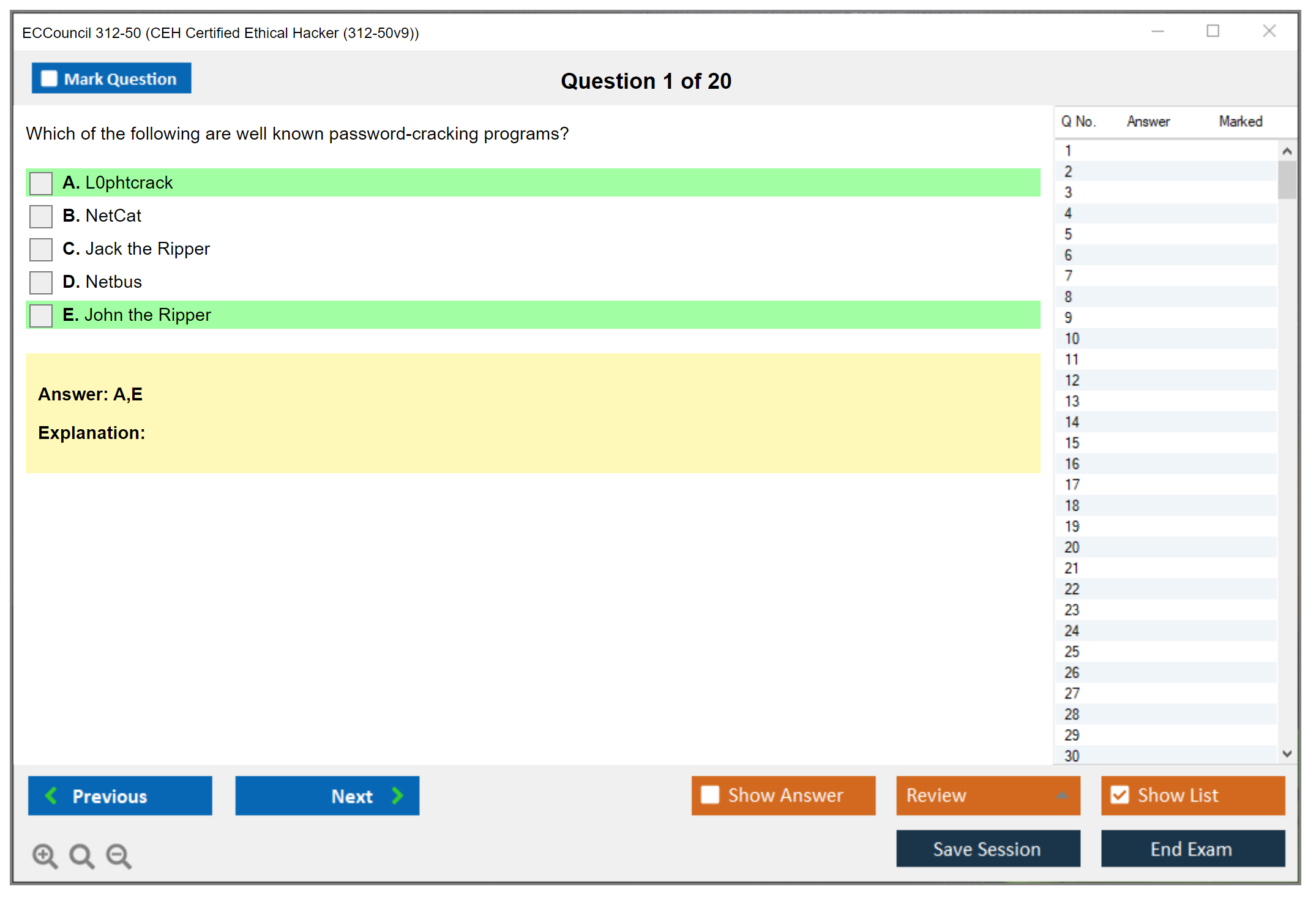
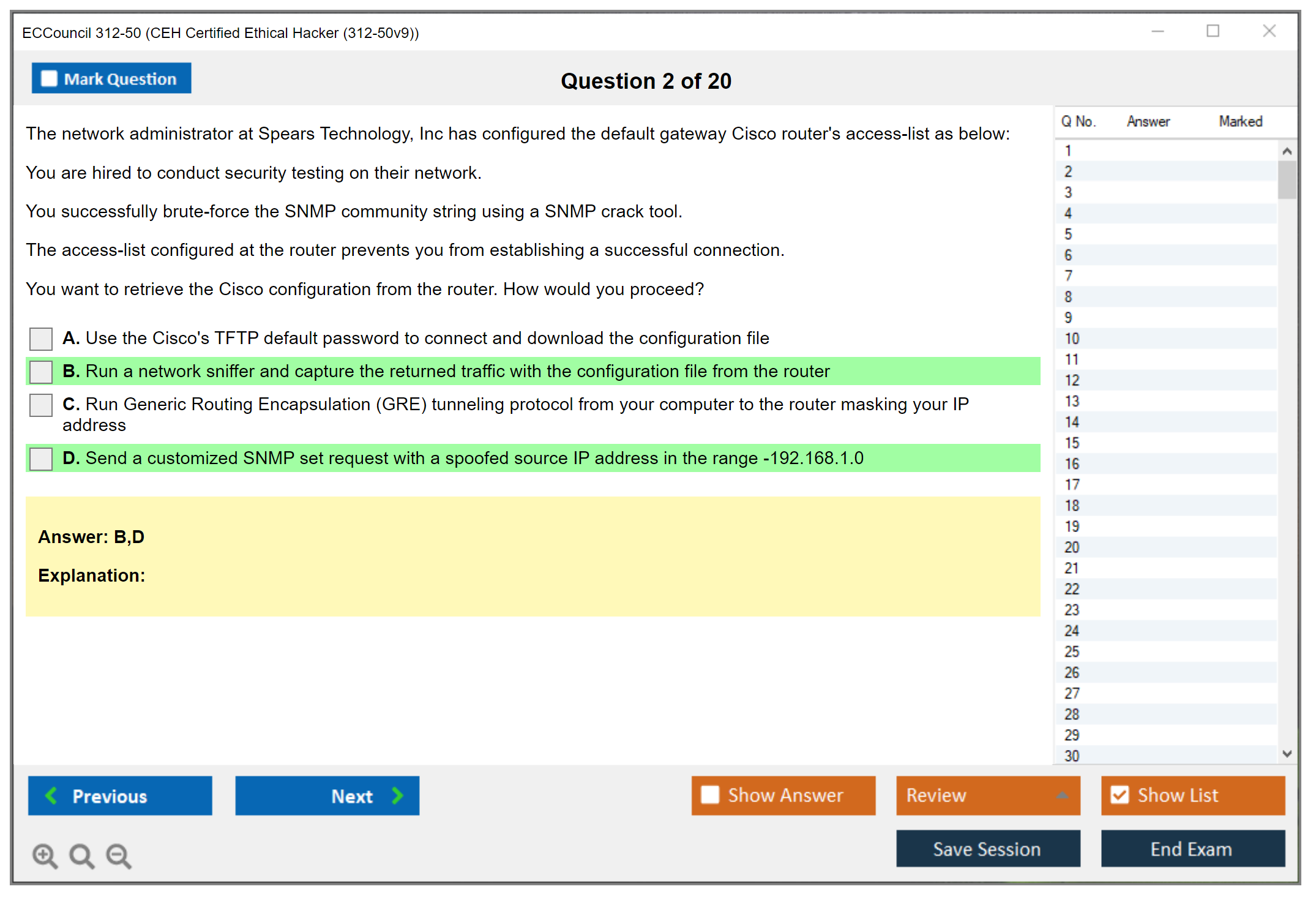
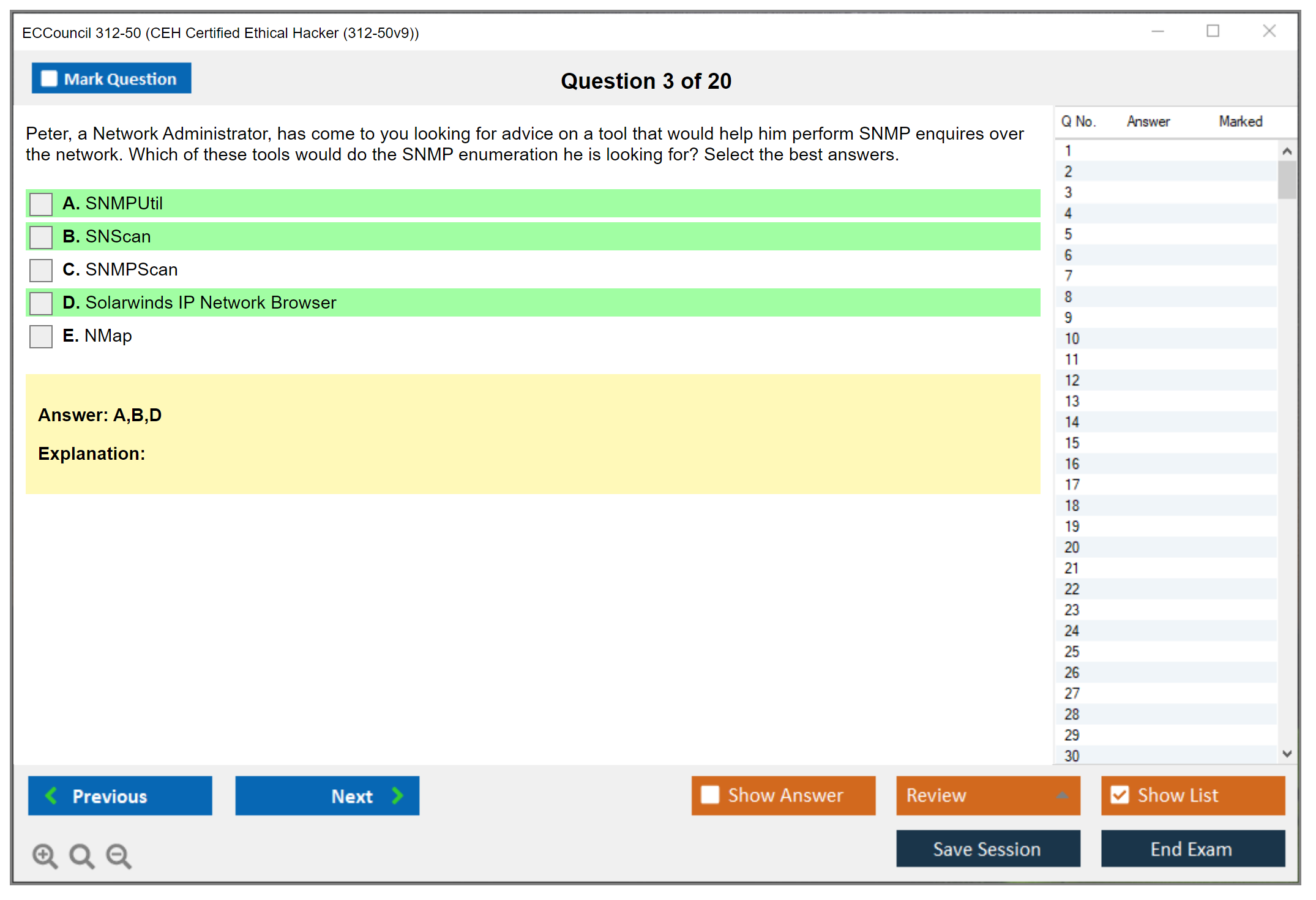
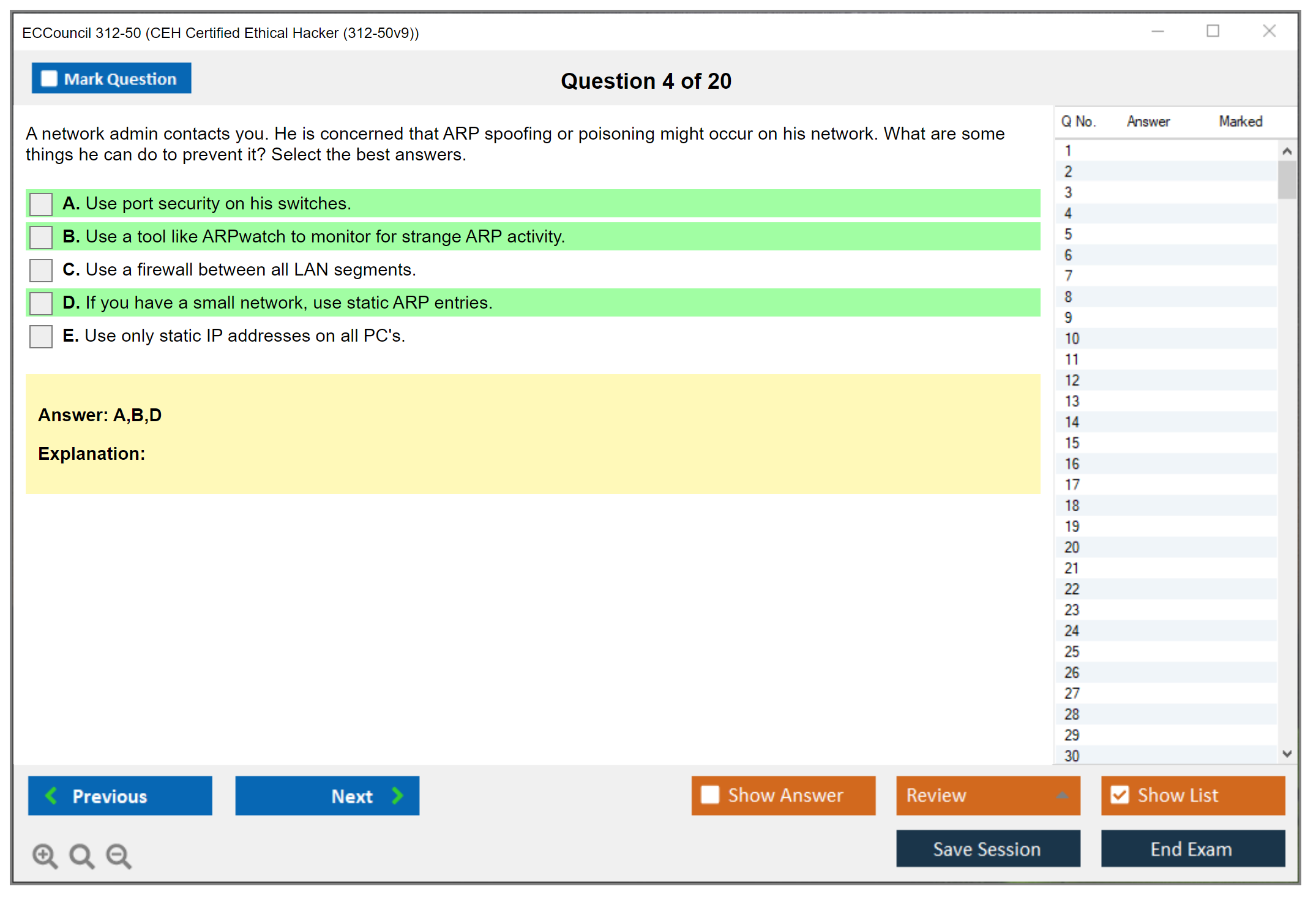
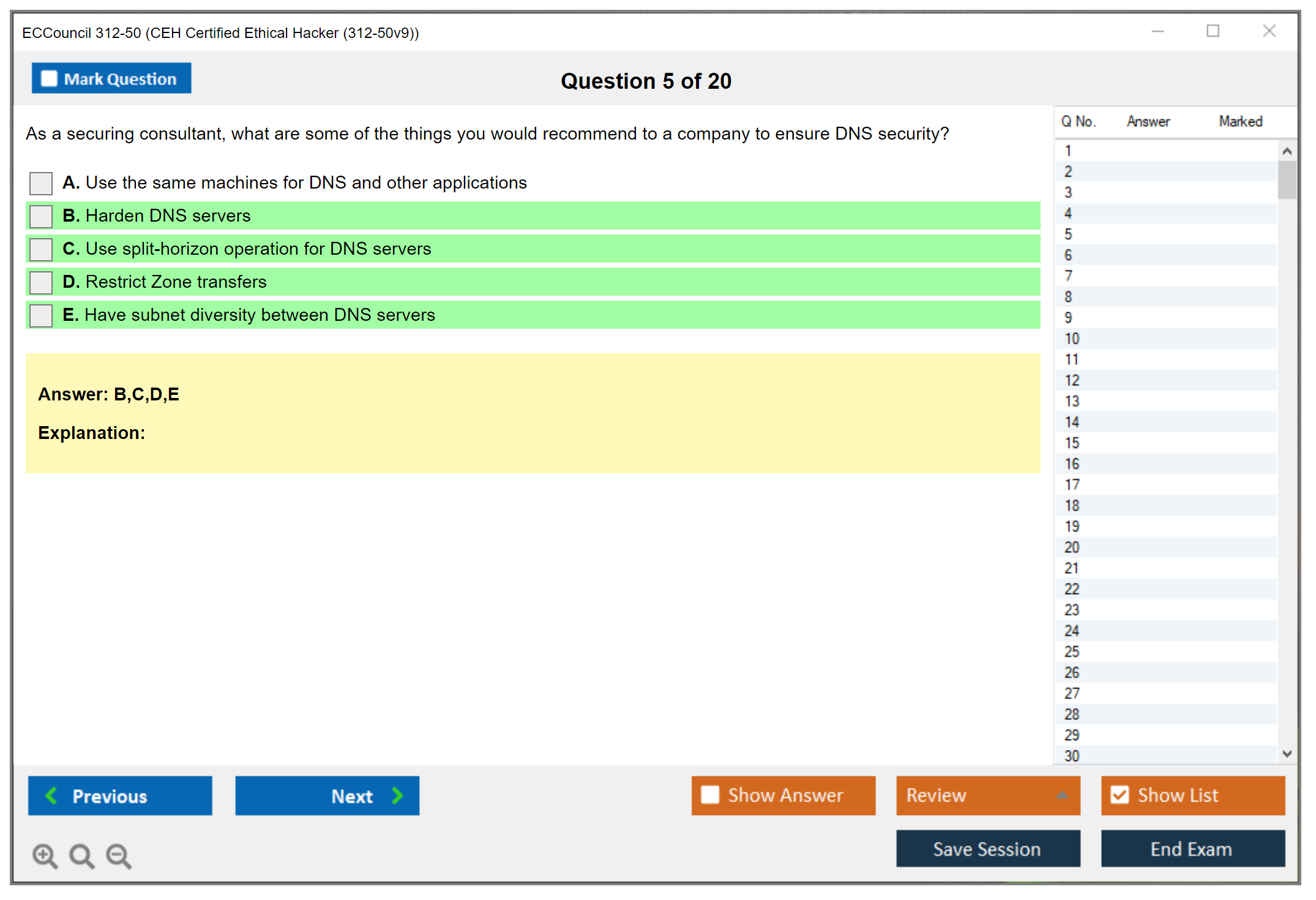
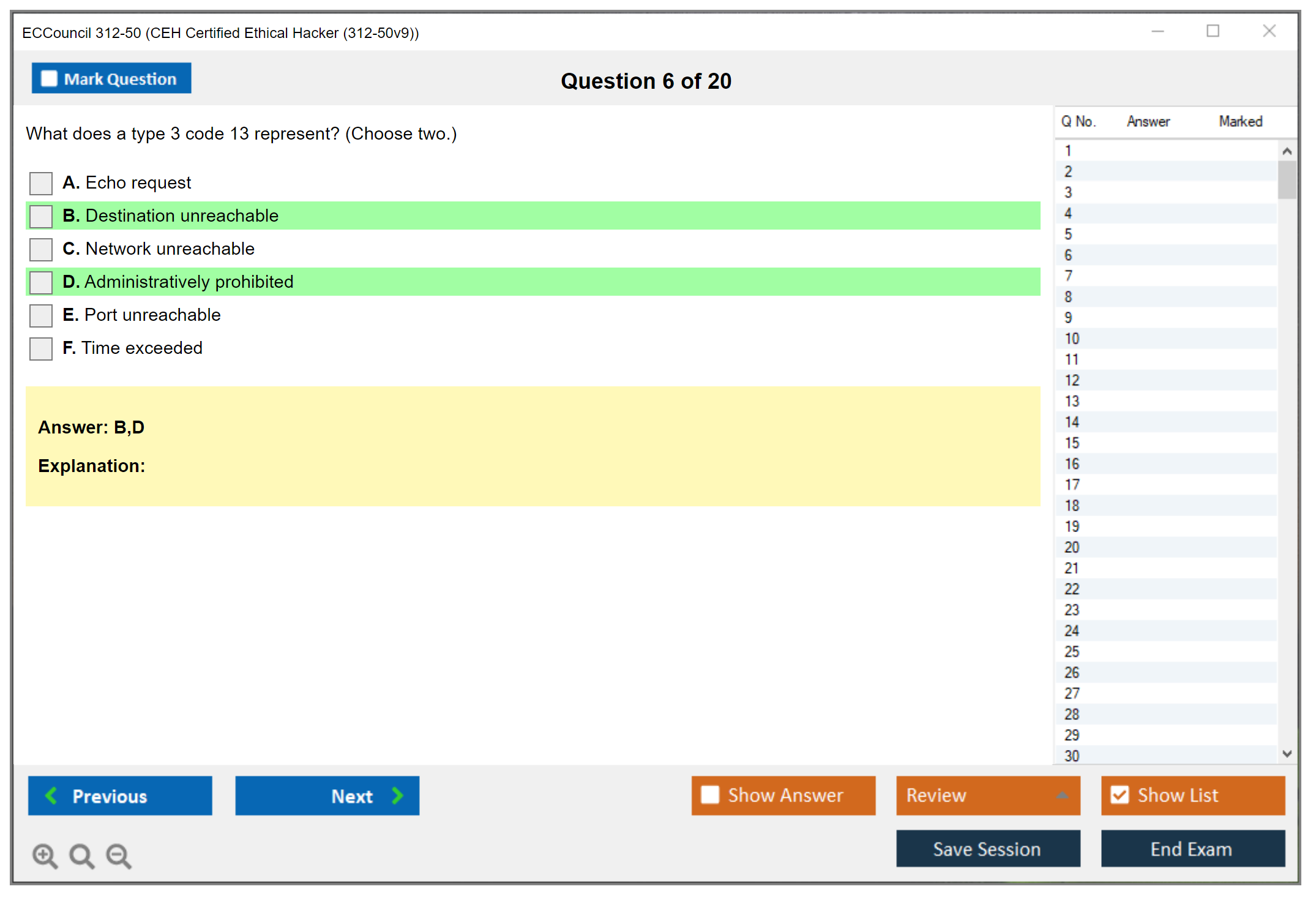
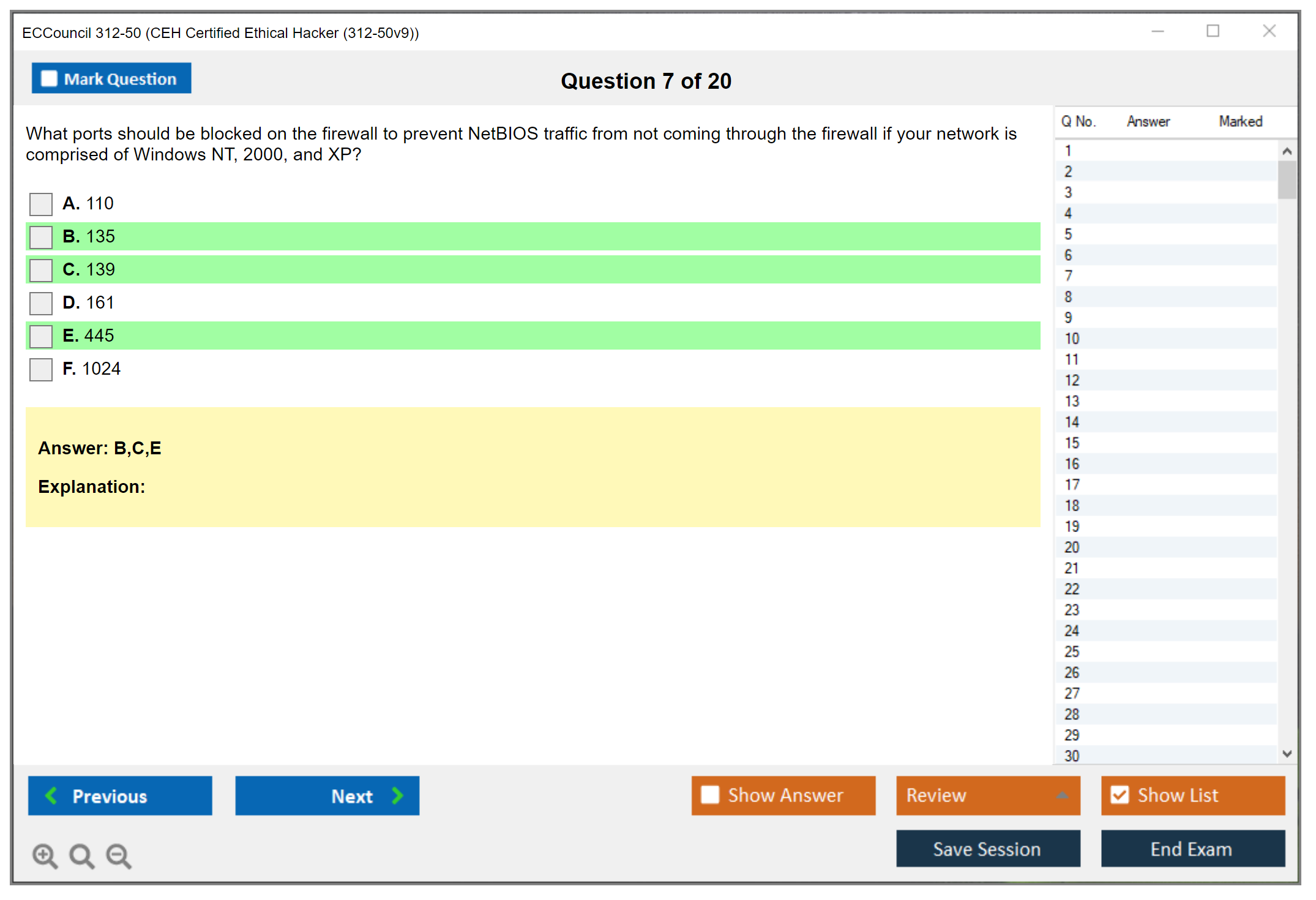
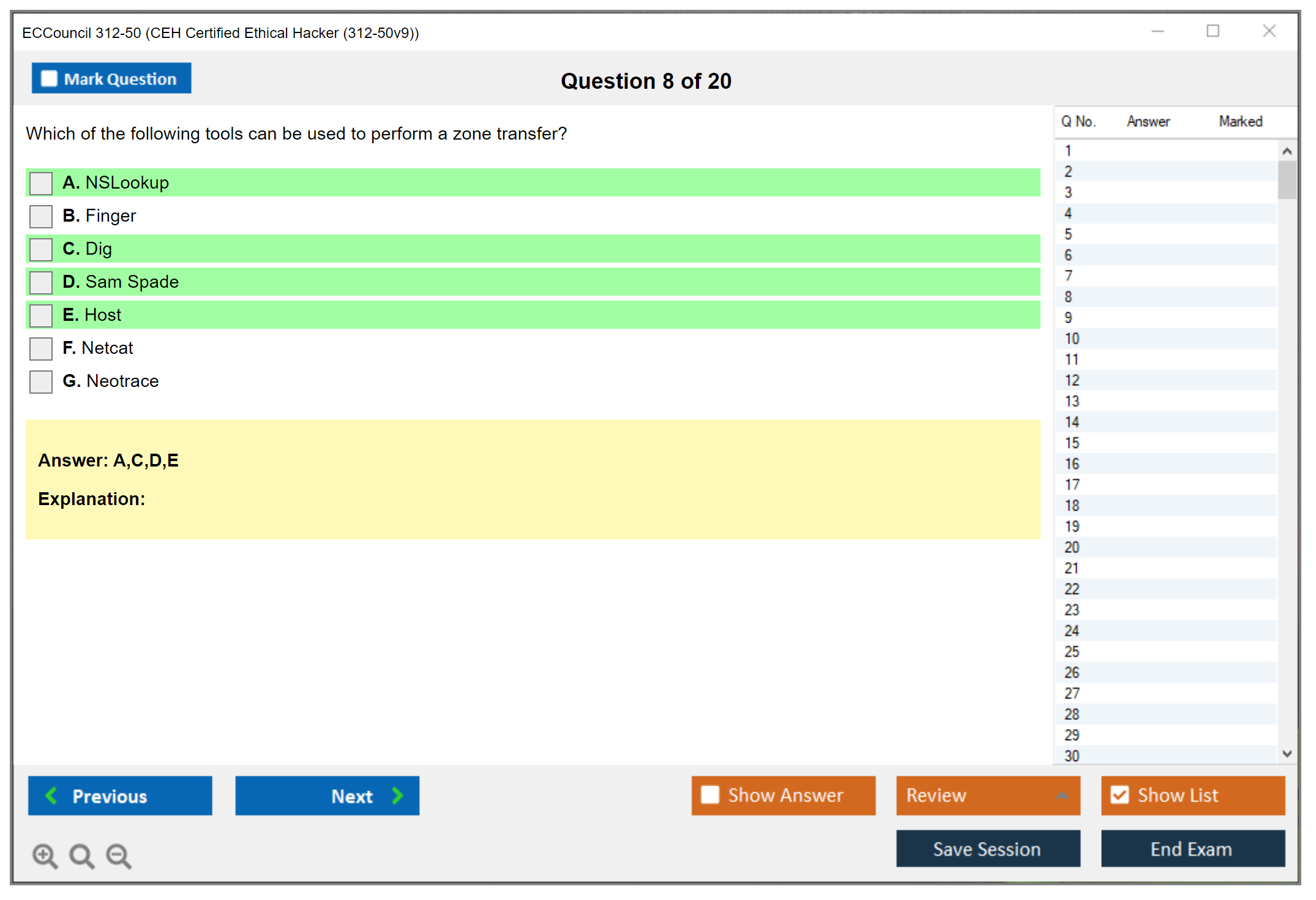
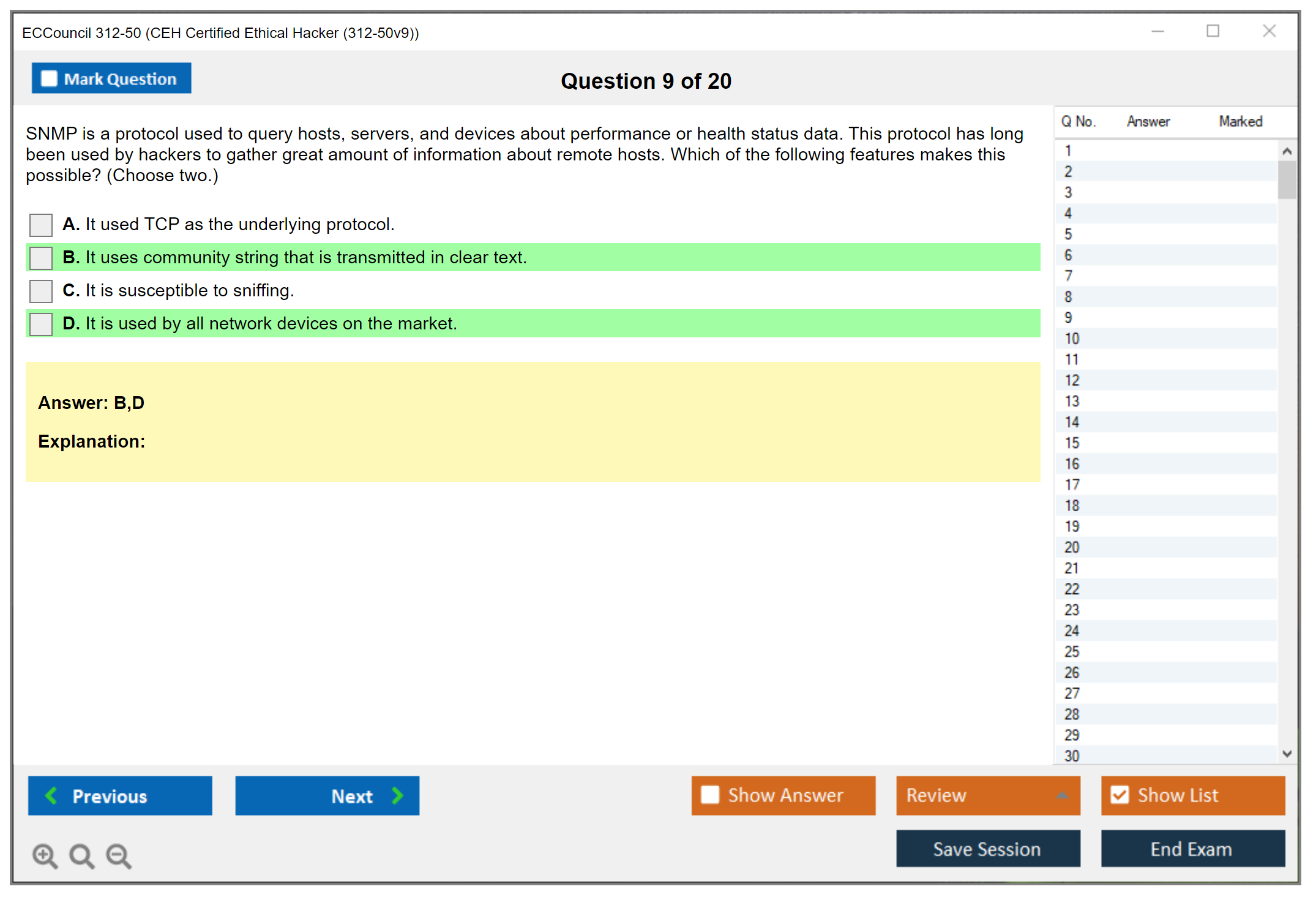
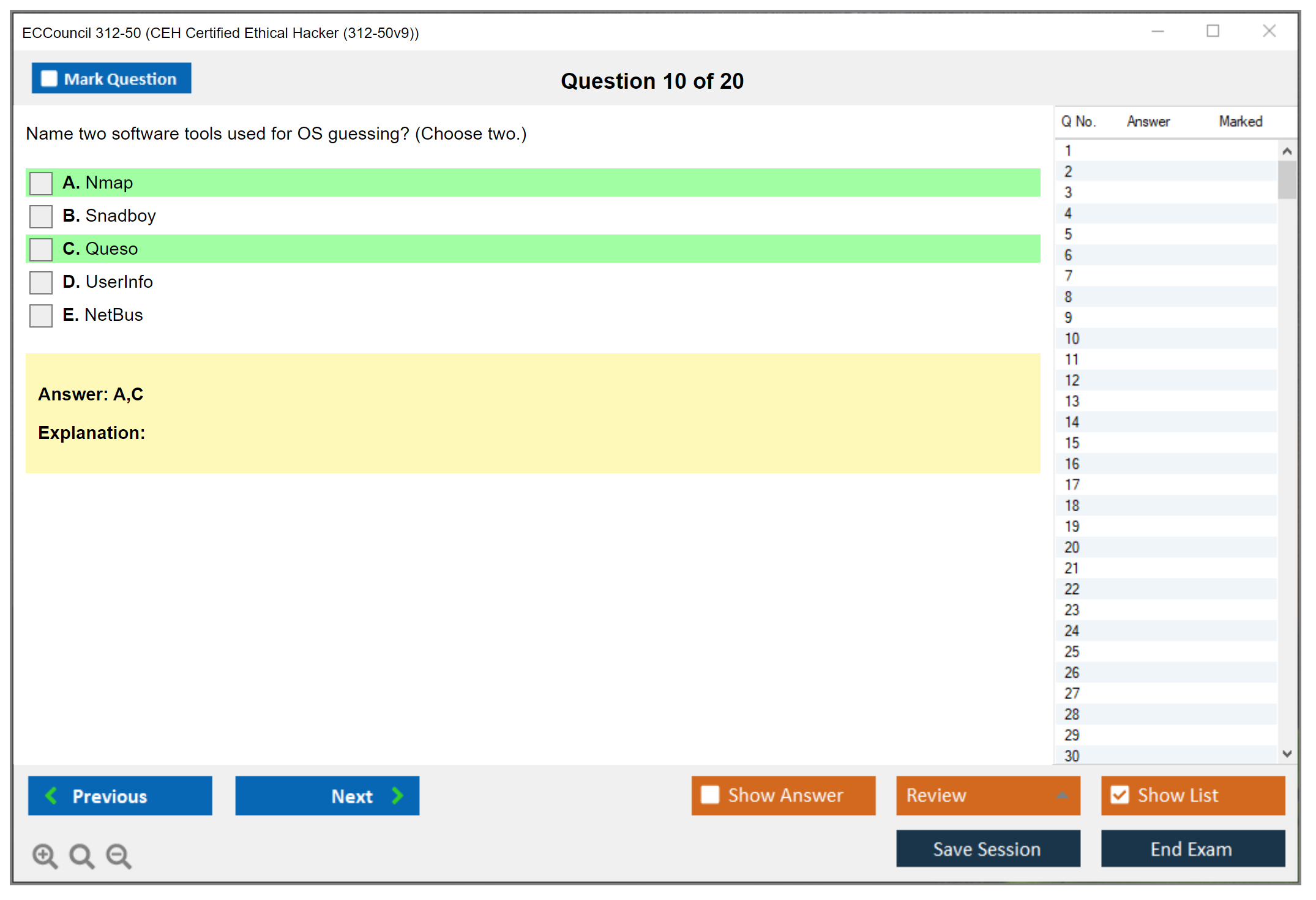
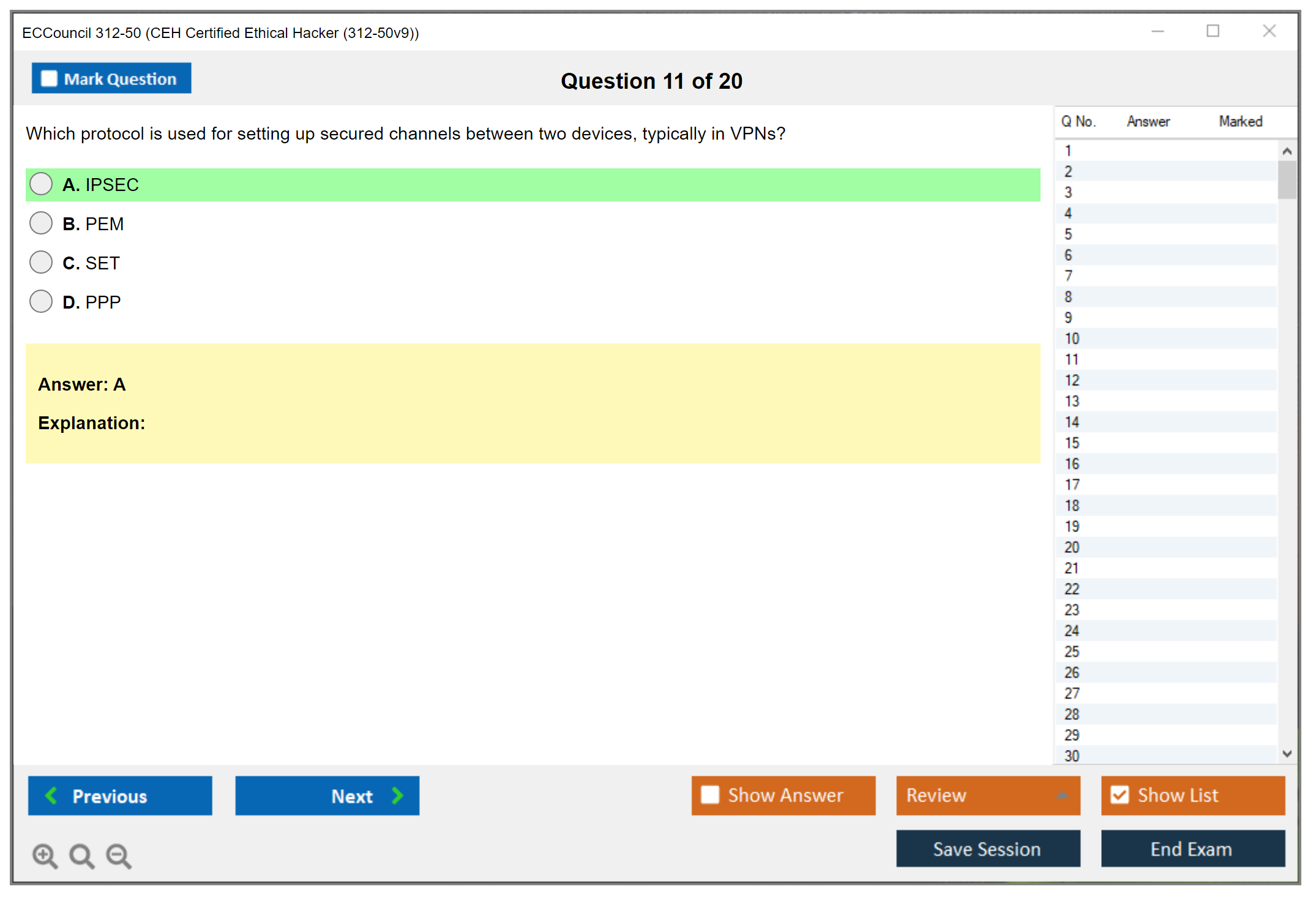
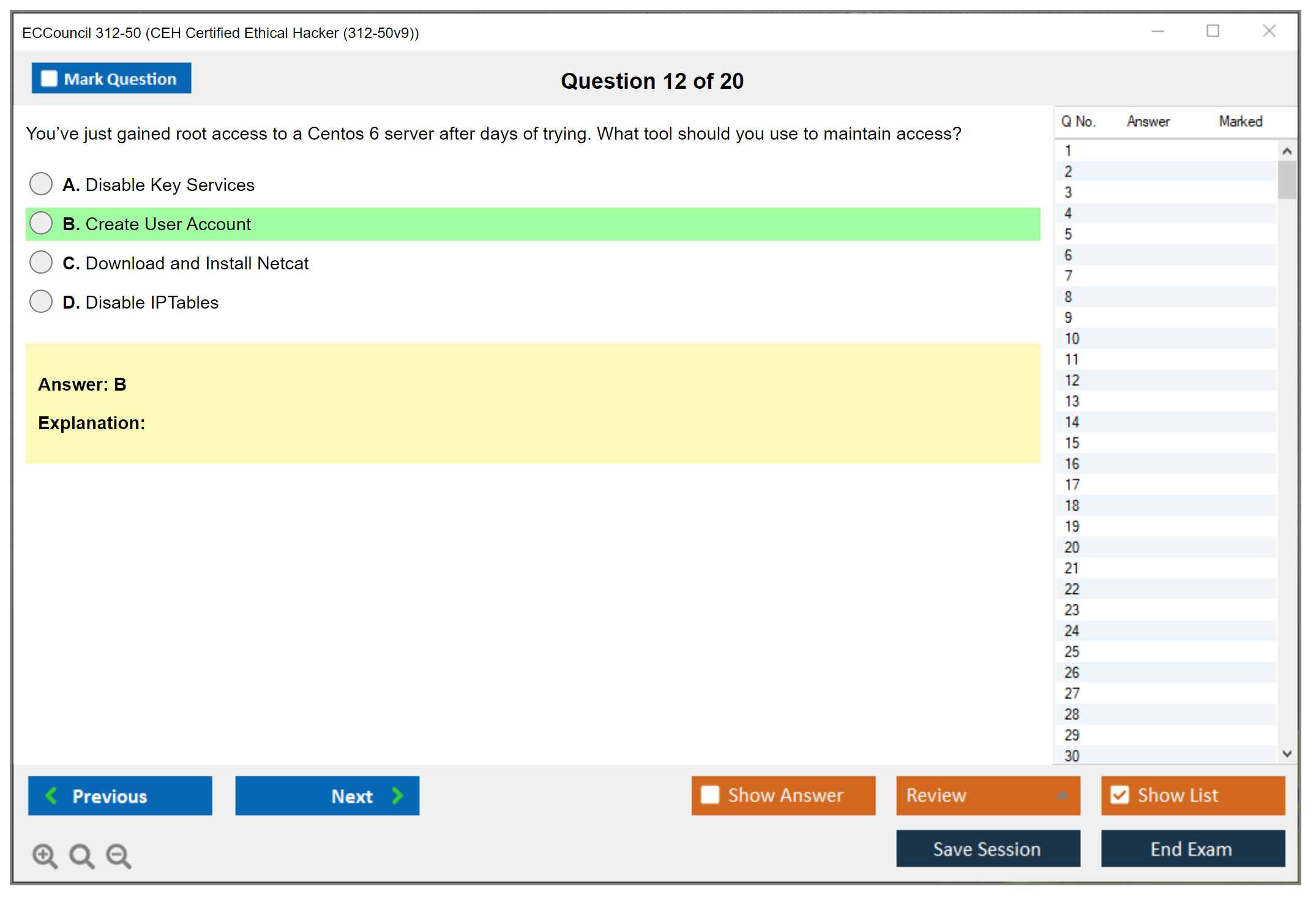
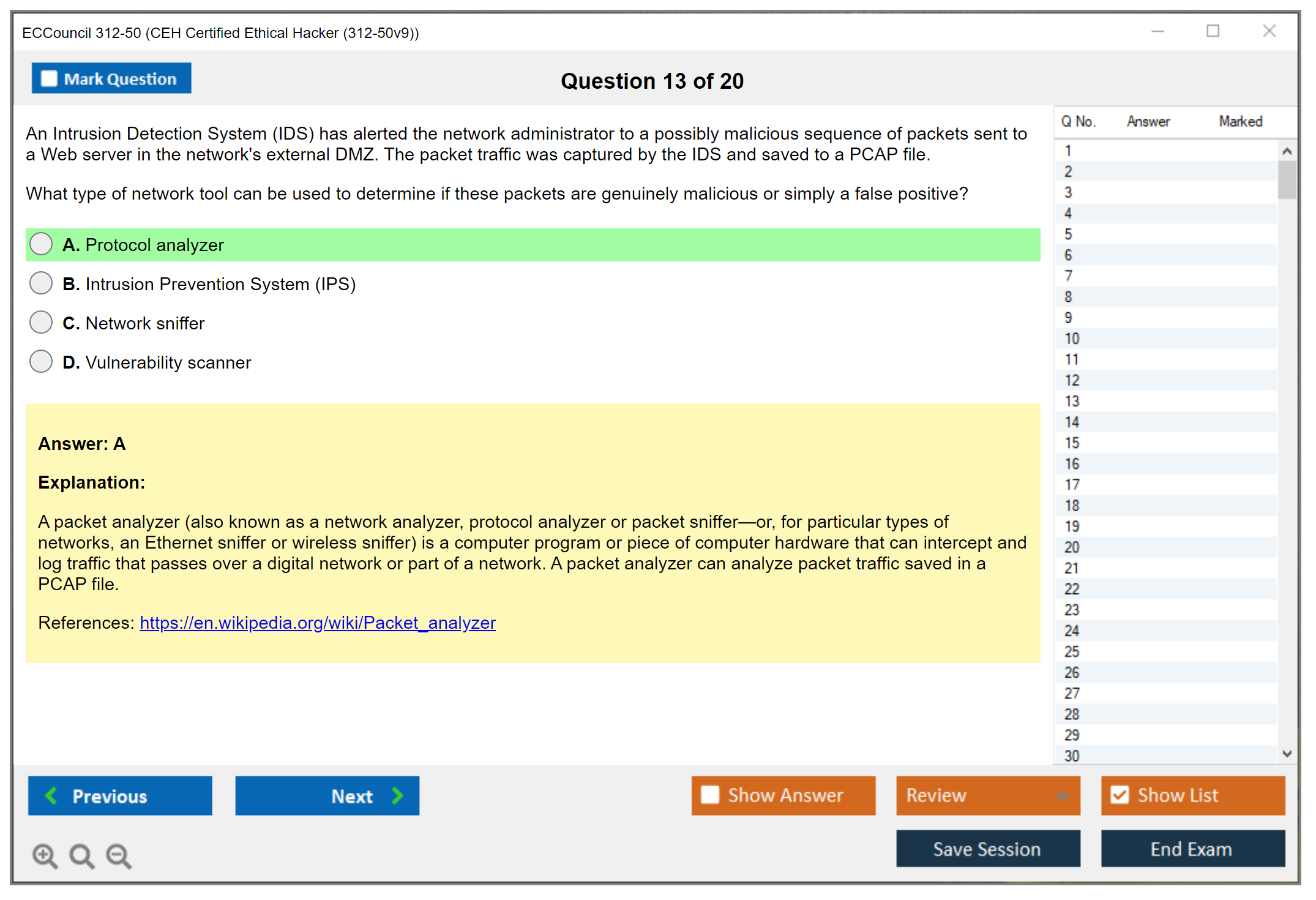
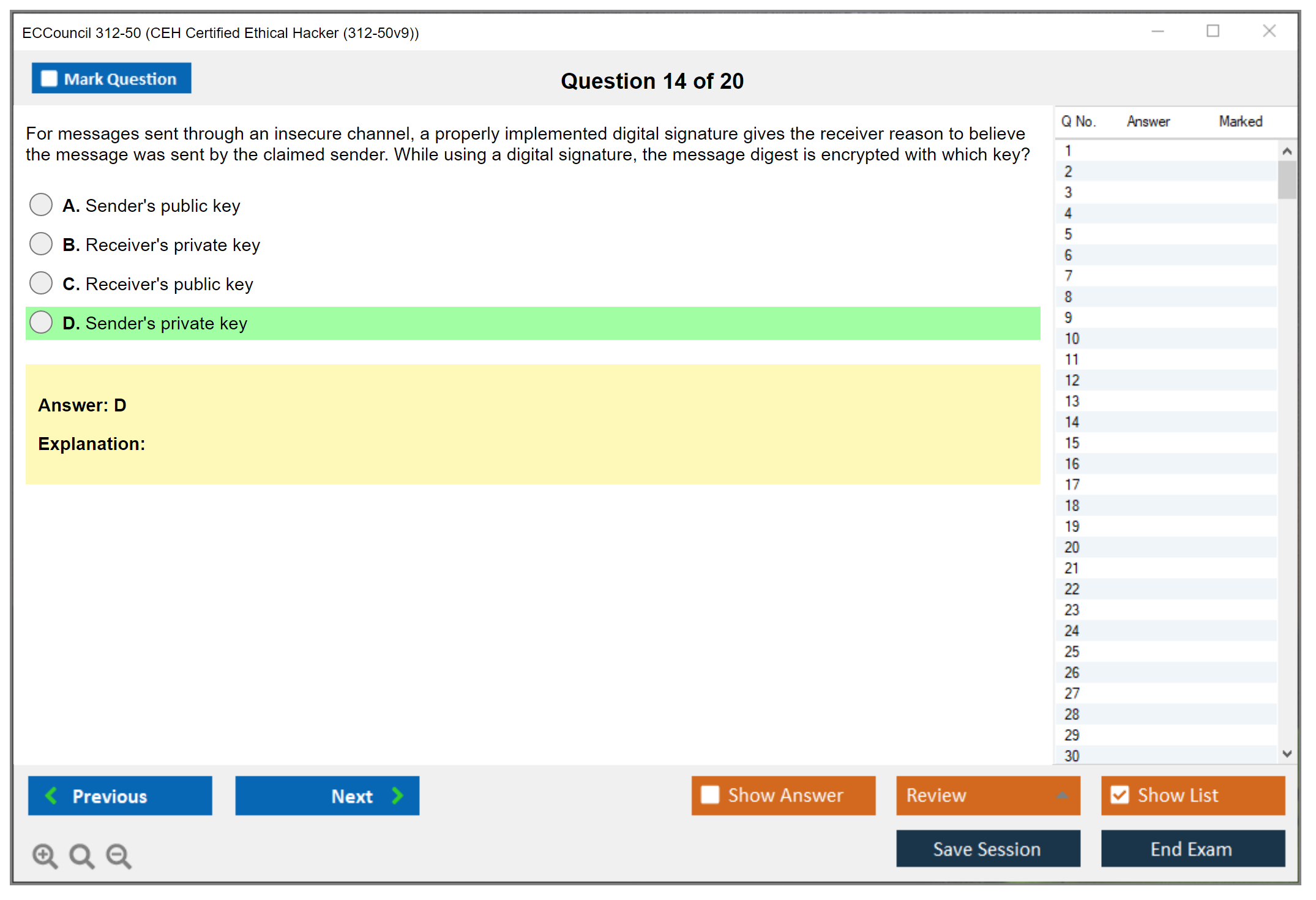
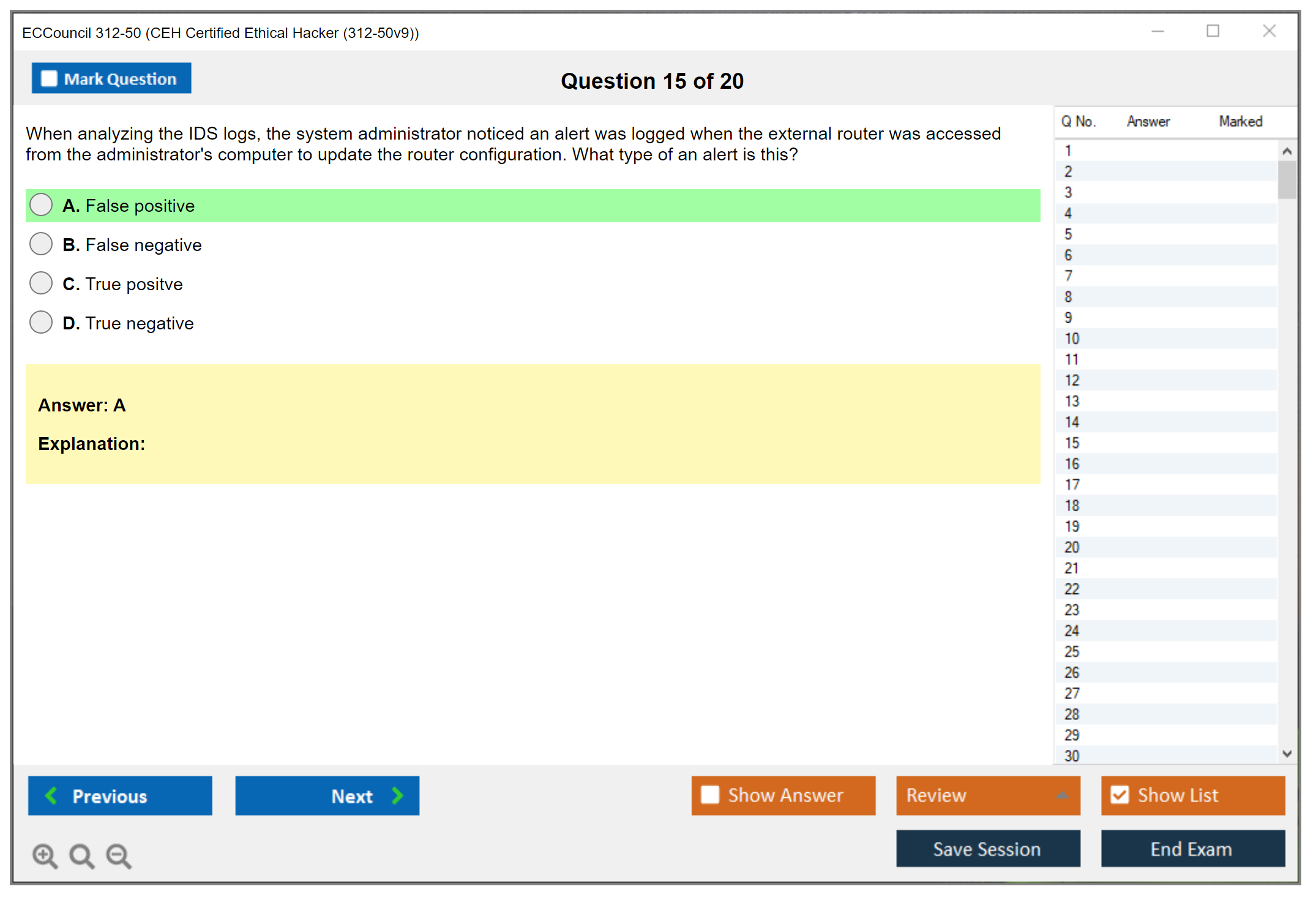
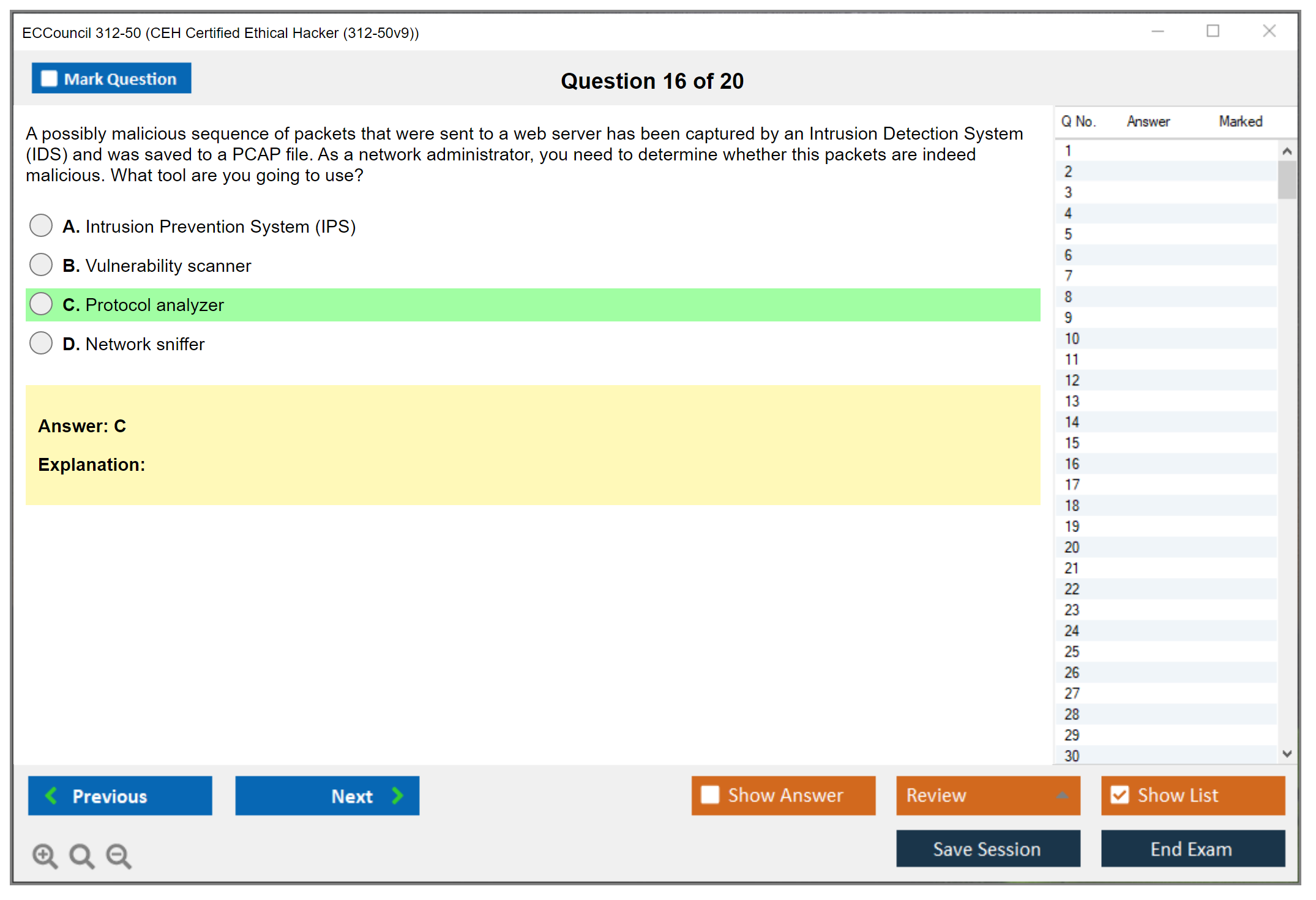
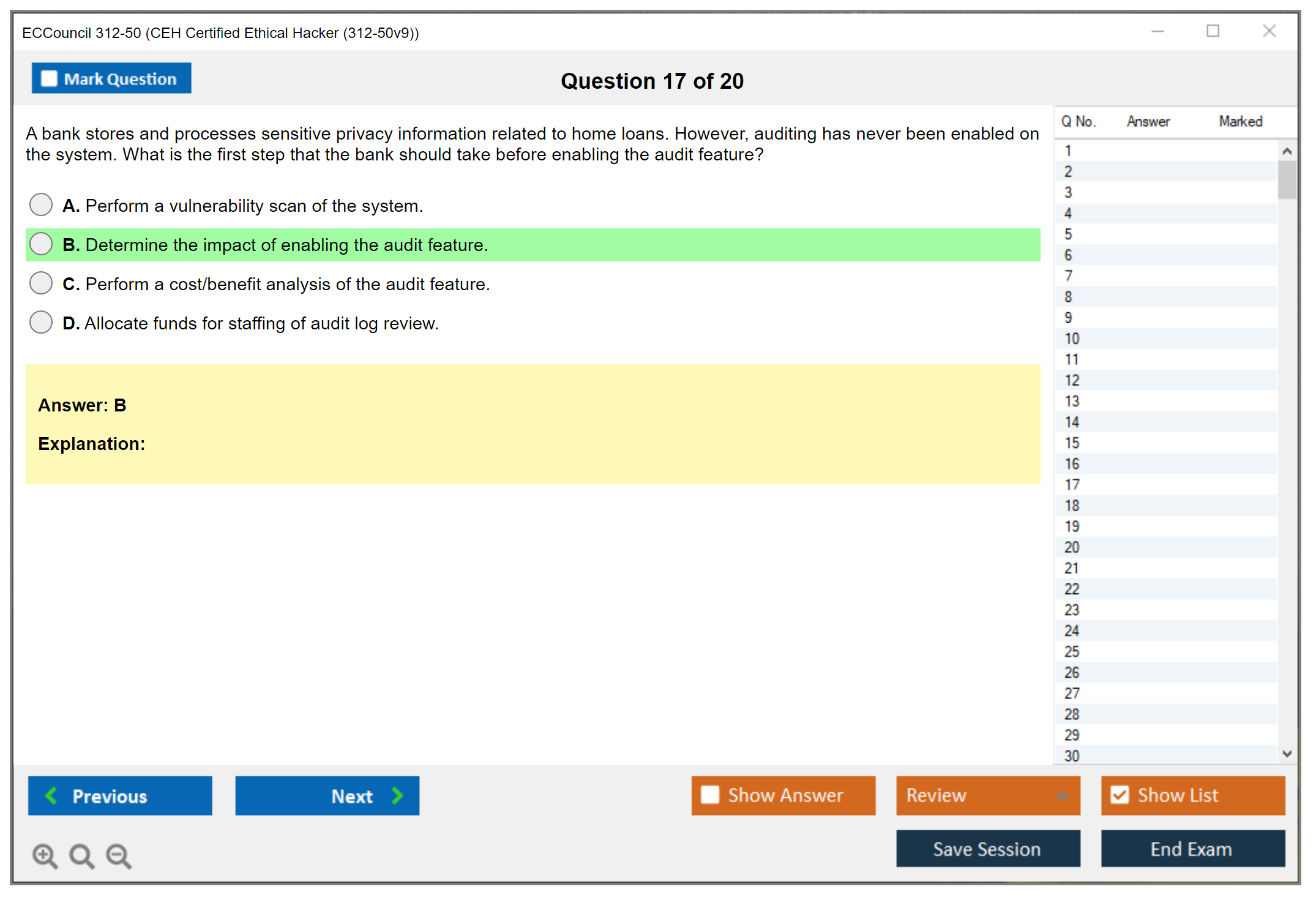
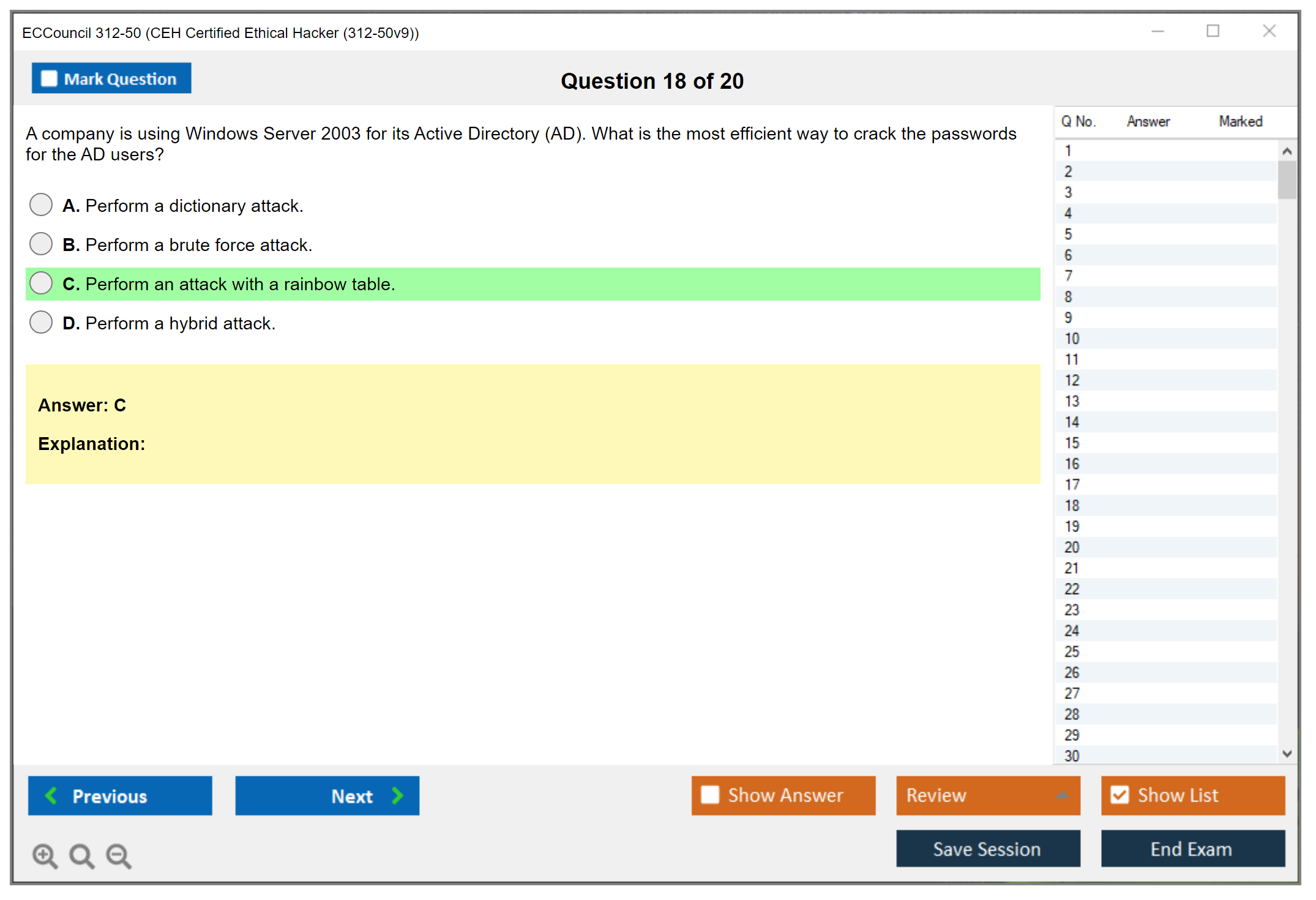
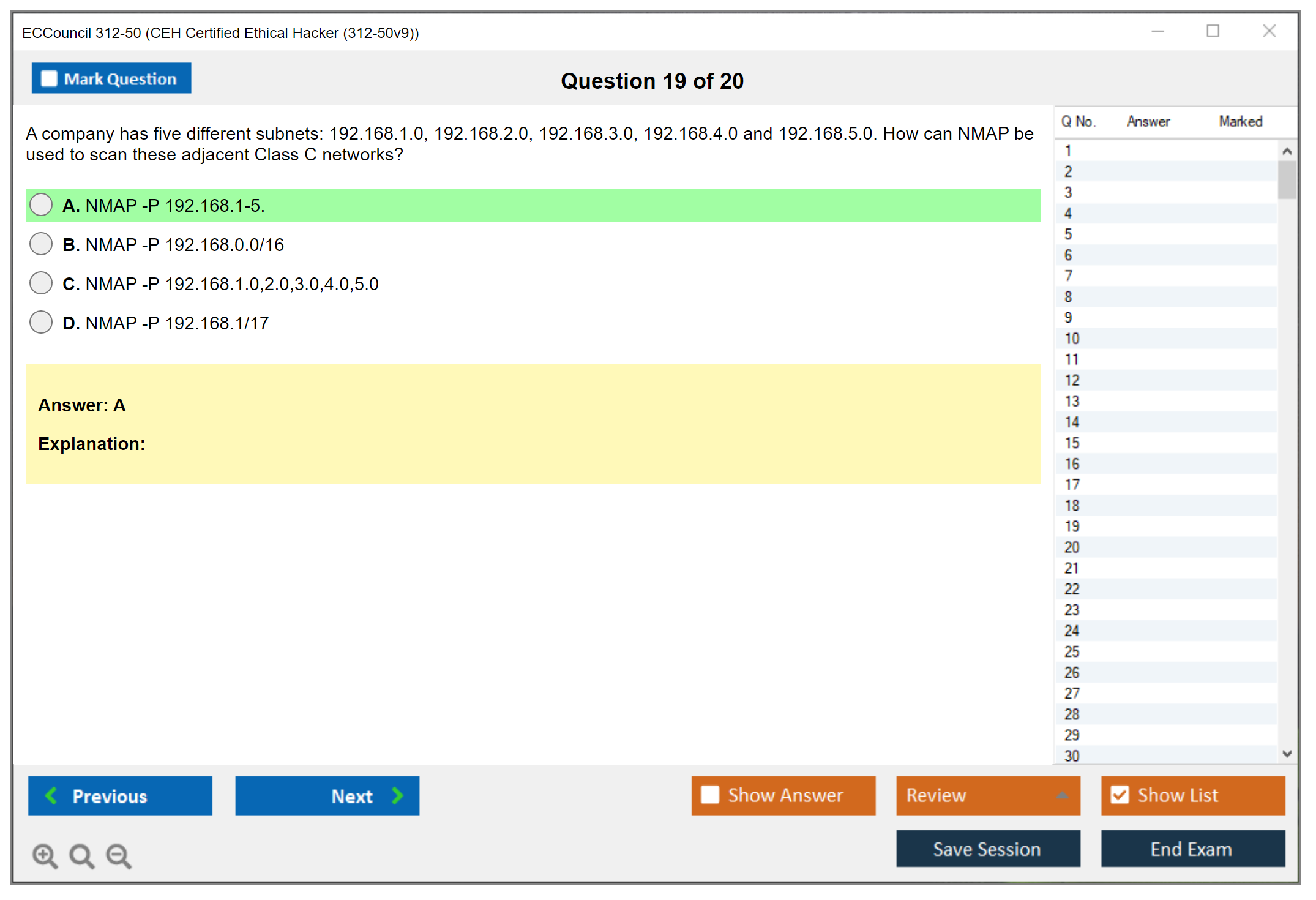
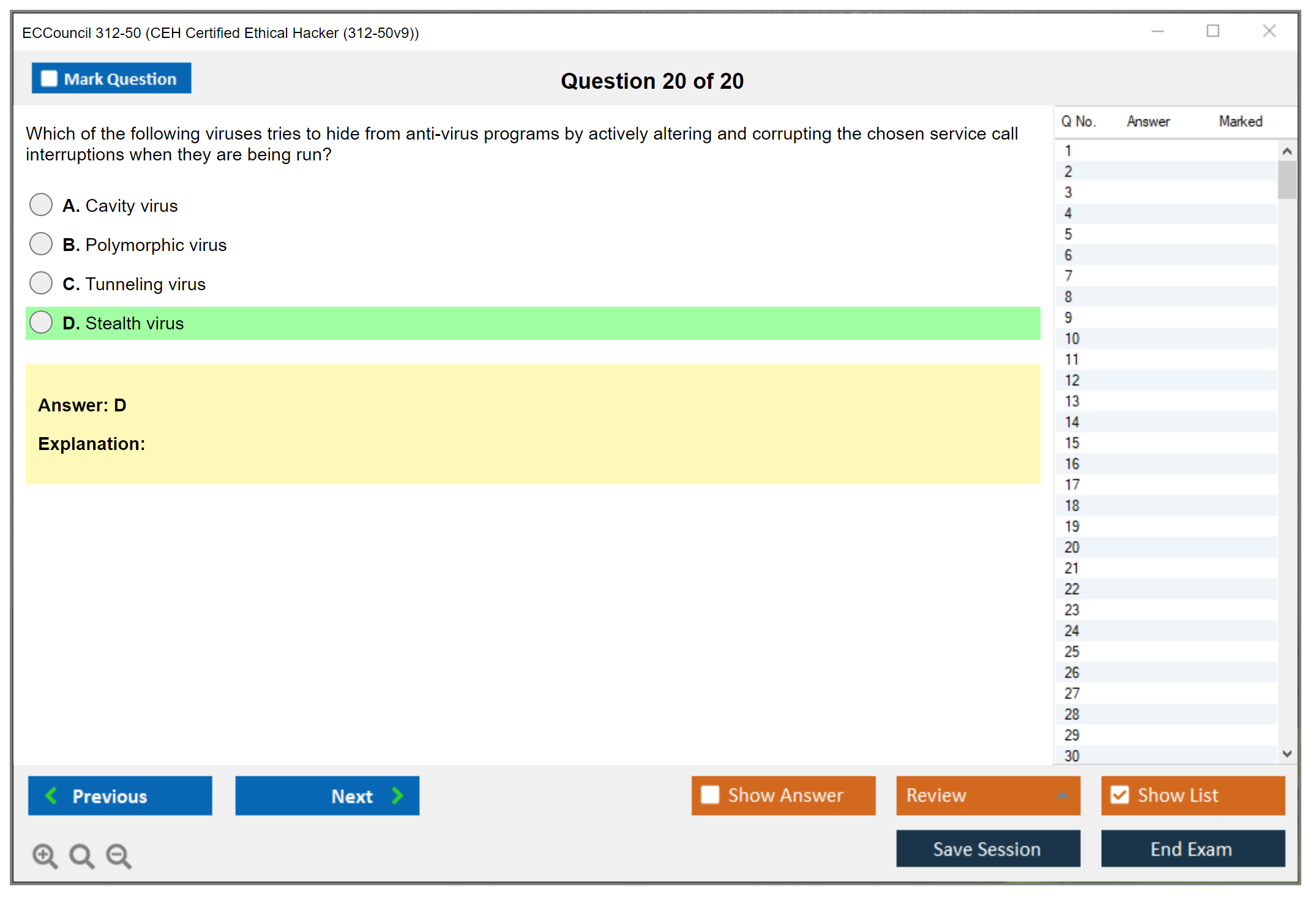
Dumpsarena ECCouncil Certified Ethical Hacker Exam (312-50) Free Practice Exam Simulator Test Engine Exam preparation with its cutting-edge combination of authentic test simulation, dynamic adaptability, and intuitive design. Recognized as the industry-leading practice platform, it empowers candidates to master their certification journey through these standout features.
What is in the Premium File?
Satisfaction Policy – Dumpsarena.co
At DumpsArena.co, your success is our top priority. Our dedicated technical team works tirelessly day and night to deliver high-quality, up-to-date Practice Exam and study resources. We carefully craft our content to ensure it’s accurate, relevant, and aligned with the latest exam guidelines. Your satisfaction matters to us, and we are always working to provide you with the best possible learning experience. If you’re ever unsatisfied with our material, don’t hesitate to reach out—we’re here to support you. With DumpsArena.co, you can study with confidence, backed by a team you can trust.
ECCouncil 312-50 Exam FAQs
Introduction of ECCouncil 312-50 Exam!
ECCouncil 312-50 is the exam for the Certified Ethical Hacker (CEH) certification. It is a comprehensive exam that tests a candidate's knowledge and skills in ethical hacking and information security. The exam covers topics such as network security, system hacking, cryptography, and web application security.
What is the Duration of ECCouncil 312-50 Exam?
The duration of the ECCouncil 312-50 exam is 4 hours.
What are the Number of Questions Asked in ECCouncil 312-50 Exam?
There are 125 questions on the ECCouncil 312-50 exam.
What is the Passing Score for ECCouncil 312-50 Exam?
The passing score required in the ECCouncil 312-50 exam is 70%.
What is the Competency Level required for ECCouncil 312-50 Exam?
The ECCouncil 312-50 exam is designed to test the knowledge and skills of a Certified Ethical Hacker (CEH). To pass the exam, candidates must demonstrate a comprehensive understanding of the topics covered in the CEH certification program. The exam is divided into five domains, each of which covers a different area of ethical hacking. The competency level required to pass the exam is Expert.
What is the Question Format of ECCouncil 312-50 Exam?
The ECCouncil 312-50 exam contains multiple-choice, fill-in-the-blank, and drag-and-drop questions.
How Can You Take ECCouncil 312-50 Exam?
The EC-Council 312-50 exam is available in both an online format and an in-person format. For the online format, you will need to register and pay for the exam on the EC-Council website. Once registered, you will be provided with an access code and instructions on how to take the exam. For the in-person format, you will need to register and pay for the exam at an EC-Council approved testing center. Once registered, you will be provided with a voucher and instructions on how to take the exam.
What Language ECCouncil 312-50 Exam is Offered?
ECCouncil 312-50 Exam is offered in English.
What is the Cost of ECCouncil 312-50 Exam?
The cost of the ECCouncil 312-50 exam is $250 USD.
What is the Target Audience of ECCouncil 312-50 Exam?
The target audience for the ECCouncil 312-50 exam is IT professionals who wish to demonstrate their knowledge of the EC-Council Certified Ethical Hacker (CEH) v10 certification program and its implementation. This exam is specifically designed for those who have a strong technical background in the area of ethical hacking, security auditing, and countermeasures. Professionals who are looking to validate their knowledge and skills in the area of ethical hacking may benefit from taking this exam.
What is the Average Salary of ECCouncil 312-50 Certified in the Market?
The average salary for professionals with the EC-Council 312-50 exam certification varies depending on the experience, skills, and location of the individual. Generally, the salary range for individuals with this certification can range from $50,000 to $150,000 annually.
Who are the Testing Providers of ECCouncil 312-50 Exam?
The ECCouncil 312-50 exam is administered by the ECCouncil and can be taken at an approved testing center. You can find a list of approved testing centers on the ECCouncil website.
What is the Recommended Experience for ECCouncil 312-50 Exam?
The recommended experience for the ECCouncil 312-50 exam is a minimum of two years of information security experience. This experience should cover topics such as network security, incident management, cryptography, security architecture, security operations, software security, application security, and risk management.
What are the Prerequisites of ECCouncil 312-50 Exam?
The prerequisites for taking the ECCouncil 312-50 exam include having at least two years of experience in the Information Security field, and being familiar with the topics covered in the course material. It is also recommended that individuals have a good understanding of the concepts of security operations, security engineering, and risk management.
What is the Expected Retirement Date of ECCouncil 312-50 Exam?
The official website for the EC-Council 312-50 exam is https://www.eccouncil.org/programs/certified-ethical-hacker-ceh/. There is no information available on the expected retirement date of the exam.
What is the Difficulty Level of ECCouncil 312-50 Exam?
The Difficulty Level of ECCouncil 312-50 exam is rated as Advanced.
What is the Roadmap / Track of ECCouncil 312-50 Exam?
The EC-Council Certified Ethical Hacker (CEH) 312-50 exam is a certification track and roadmap that tests a candidate's knowledge and skills in ethical hacking and penetration testing. It is designed to validate a candidate's ability to recognize and analyze vulnerabilities in target systems and use the appropriate tools and techniques to protect them from malicious attacks. The exam covers a wide range of topics, from network and system security to cryptography and web application security. Candidates must demonstrate an understanding of the principles of ethical hacking and demonstrate the ability to apply the concepts to real-world scenarios.
What are the Topics ECCouncil 312-50 Exam Covers?
The ECCouncil 312-50 exam covers the following topics:
1. Network Security: This topic covers the fundamentals of network security, including firewalls, intrusion detection systems, and network security policies. It also covers the use of encryption, authentication, and access control techniques to protect networks.
2. Cryptography: This topic covers the fundamentals of cryptography, including symmetric and asymmetric encryption algorithms, digital signatures, and public key infrastructure. It also covers the use of cryptography to protect data in transit and at rest.
3. Security Policies and Procedures: This topic covers the fundamentals of security policies and procedures, including risk assessment, incident response, and security awareness training. It also covers the use of best practices and standards to ensure compliance with security policies.
4. Security Auditing: This topic covers the fundamentals of security auditing, including vulnerability scanning, penetration testing, and log analysis. It also covers the use of audit tools and
What are the Sample Questions of ECCouncil 312-50 Exam?
1. What is the purpose of the Security Onion platform?
2. What type of attack is a buffer overflow?
3. What is the purpose of a honeypot?
4. What is the purpose of a NIDS?
5. What is the purpose of a HIDS?
6. What is the difference between a false positive and a false negative?
7. What is the difference between a vulnerability scan and a penetration test?
8. What is the purpose of a penetration test?
9. What is the purpose of a risk assessment?
10. What is the purpose of a security policy?
What Is the EC-Council 312-50 (CEH) Exam? The industry standard for ethical hacking credentials The ECCouncil 312-50 CEH exam is the industry-recognized credential for validating ethical hacking and penetration testing knowledge. Honestly? If you're serious about offensive security, this is probably the cert that HR departments and hiring managers actually recognize. The Certified Ethical Hacker 312-50 certification demonstrates proficiency in identifying vulnerabilities and weaknesses in target systems using the same tools and techniques as malicious hackers, but in a lawful and legitimate manner. EC-Council (International Council of E-Commerce Consultants) developed this ethical hacking certification to standardize knowledge across information security professionals who perform authorized security assessments. Real talk, before CEH existed, everyone was just claiming they could "hack stuff" without any real benchmark. Now there's at least a baseline. The certification validates... Read More
What Is the EC-Council 312-50 (CEH) Exam?
The industry standard for ethical hacking credentials
The ECCouncil 312-50 CEH exam is the industry-recognized credential for validating ethical hacking and penetration testing knowledge. Honestly? If you're serious about offensive security, this is probably the cert that HR departments and hiring managers actually recognize. The Certified Ethical Hacker 312-50 certification demonstrates proficiency in identifying vulnerabilities and weaknesses in target systems using the same tools and techniques as malicious hackers, but in a lawful and legitimate manner.
EC-Council (International Council of E-Commerce Consultants) developed this ethical hacking certification to standardize knowledge across information security professionals who perform authorized security assessments. Real talk, before CEH existed, everyone was just claiming they could "hack stuff" without any real benchmark. Now there's at least a baseline.
The certification validates skills across reconnaissance, scanning, enumeration, system hacking, malware threats, social engineering, denial of service, session hijacking, web application hacking, SQL injection, wireless network hacking, mobile platform attacks, IoT vulnerabilities, cloud computing security, and cryptography. That's a lot of ground to cover. CEH credential holders understand the attack surface, threat vectors, and defensive countermeasures necessary to protect organizational assets.
Government recognition and workplace value
Organizations worldwide recognize CEH as a benchmark for hiring penetration testers, security analysts, security consultants, and ethical hackers. Government agencies, including the U.S. Department of Defense, have approved CEH under DoD Directive 8140/8570.01-M for Information Assurance Technical Level II and Level III positions. This matters if you're going after government contracts or federal jobs where cert requirements aren't really negotiable.
The certification has evolved through multiple versions to address emerging threats and technologies, which I'll get into more below. But the core value proposition? Same deal. Prove you understand how attackers think and operate.
Who actually benefits from CEH
Information security professionals seeking to formalize their ethical hacking knowledge and penetration testing fundamentals should consider this cert. Network administrators and system administrators transitioning into offensive security roles find it helpful too, though not gonna lie, the jump from defensive to offensive work takes more than just a cert.
Security auditors benefit significantly. Risk assessment professionals too. Anyone needing to understand attacker methodologies. IT professionals responsible for network security assessment and vulnerability management can use CEH to level up. Cybersecurity analysts looking to expand their skill set beyond defensive security operations often pick this up as their first offensive cert.
Penetration testers seeking vendor-neutral certification to complement hands-on experience grab CEH because clients want to see credentials on proposals. Compliance officers and security managers who need to understand technical security testing methodologies sometimes pursue it, though honestly, the 712-50 (EC-Council Certified CISO) might be more their speed.
Recent graduates with networking or security backgrounds entering the cybersecurity field often start here. Military and government personnel fulfilling DoD 8140 (formerly 8570) certification requirements basically have to get it. Consultants who conduct security assessments and need recognized credentials for client engagements live and die by certs like this. Career changers with strong IT foundations looking to specialize in offensive security see CEH as an entry point, and security operations center (SOC) analysts wanting to understand attacker tactics, techniques, and procedures (TTPs) find the content valuable for threat hunting.
I've noticed something weird, actually. Most people who pass CEH don't go straight into pentesting jobs. They end up in vulnerability management or GRC roles first. Nobody really talks about that, but the cert opens doors you wouldn't expect.
Decoding the 312-50 designation and version numbers
312-50 represents the official exam code for the Certified Ethical Hacker certification, distinguishing it from other EC-Council credentials. The thing is, the "312" series designates EC-Council's ethical hacking track, while "50" specifically identifies the core CEH credential. You'll see other 312-series exams like 312-38 (Certified Network Defender) or 312-49v10 (Computer Hacking Forensic Investigator), but 312-50 is the flagship.
The CEH v12 exam (or CEH v13 in 2026) represents the version number indicating content updates, new attack vectors, and emerging technologies. EC-Council periodically releases new versions, typically every 18-24 months, to keep pace with evolving cybersecurity threats and industry developments. Version numbers like 312-50v11, 312-50v12, or the upcoming 312-50v13 reflect curriculum updates, but all versions award the same "Certified Ethical Hacker" credential.
Candidates taking 312-50 receive whichever version's current at the time of their exam registration. Previous version holders automatically hold the current CEH certification without retaking exams, though they must maintain it through continuing education. The exam code 312-50 remains constant across versions, while the version designation appears in course materials and training resources.
Understanding the version helps candidates select appropriate study materials aligned with current CEH exam objectives. Older study guides (v10, v11) may miss newer topics like advanced cloud security, containerization vulnerabilities, or updated wireless attack techniques. I mean, EC-Council maintains backward compatibility in the certification itself. All CEH holders, regardless of version passed, hold equivalent credentials.
Training providers typically specify version numbers when advertising their CEH 312-50 study guide materials, while the exam voucher simply references 312-50. This can confuse people shopping for prep materials, but just match your study resources to the current exam version and you're good.
What makes this exam different from other security certs
CEH focuses heavily on offensive techniques and attacker methodologies rather than defensive controls. Compare that to something like Security+ which covers a broad security foundation, or 312-39 (Certified SOC Analyst) which is all about defense. CEH wants you to think like the bad guys.
It's different.
The certification covers web application hacking basics, wireless attacks, cloud vulnerabilities, and IoT security issues that you won't find as deeply covered in older security certs. Look, the content breadth is both a strength and a challenge. You need to know a little about a lot of attack vectors rather than going super deep on one area.
If you're mapping out a cybersecurity certification roadmap, CEH typically sits somewhere between foundational certs and advanced offensive credentials like OSCP. Some people grab 212-82 (Certified Cybersecurity Technician) first, then CEH, then maybe 312-85 (Certified Threat Intelligence Analyst) or 212-89 (EC Council Certified Incident Handler) depending on their career direction.
The practical application of CEH knowledge shows up in vulnerability assessments, penetration testing engagements, security audits, and red team operations. Honestly, the cert alone won't make you a skilled pentester. You need hands-on lab work and real-world experience. But it gives you the conceptual framework and tool knowledge to build on.
CEH 312-50 Exam Overview
The ECCouncil 312-50 CEH exam is EC-Council's multiple-choice test for the Certified Ethical Hacker credential, and honestly, it's meant to prove you understand the ethical hacking process end to end, not that you can run one tool once and call it a day. It's a classic "do you know the words, the workflow, and the right next step" exam, with plenty of questions that feel like a security team ticket you'd see in real life. You know, the messy ones where two answers both sound plausible but only one actually solves the problem without breaking something else.
It's popular. For a reason.
HR recognizes it. Government job listings recognize it. And if you're building a cybersecurity certification roadmap, CEH is often the first "ethical hacking certification" people hear about, even if it's not the only option.
Who the CEH certification is for
This fits best for junior to mid security folks, help desk or sysadmin people trying to pivot, and analysts who keep getting pulled into network security assessment tasks and want something formal on the resume. It also works for students who need a vendor name that recruiters won't argue with.
Not for everyone. Not for tool-only learners. Not for people who hate memorizing terms.
CEH 312-50 vs CEH versioning and what "312-50" means
Certified Ethical Hacker 312-50 is the exam code, not the "version." The version is the blueprint generation, like the CEH v12 exam, and you'll see training pages and prep content split out for v11, v12, and now newer updates. If you're comparing, here are the quick reference pages: 312-50v11, 312-50v12, and 312-50v13. The code stays stable, the blueprint evolves, and EC-Council periodically updates the question pool so people can't just memorize a static set of answers forever.
What the test actually feels like
The exam is 125 multiple-choice questions. Four options per question. You get 4 hours, which works out to about 1.9 minutes each, and that sounds generous until you hit a couple long scenario prompts with logs, a diagram, and two "best answer" choices that both look annoyingly correct.
No hands-on stuff. No lab sims. No "type the command" boxes.
Exam format, question types, and duration
You're answering questions that assess theoretical knowledge, practical application, tool identification, attack methodology understanding, and scenario-based problem-solving. That mix matters, because some items are straight vocabulary and some are "you ran a scan, here's the output, what does it mean," and those are very different brain modes when you're 2.5 hours in and trying to stay sharp.
Expect a lot of variety: concept-based questions on penetration testing fundamentals, tool questions where you need to recognize what something like Nmap, Nikto, Burp Suite, Metasploit, or Wireshark is doing, and output-interpretation items where you read command-line output, log lines, code snippets, or even packet capture excerpts. Some questions include exhibits like network topology diagrams or scan results, and honestly those are often easier if you've ever done the work, because your eyes can pattern-match faster than your memory can. I mean, assuming you've actually stared at enough scan results to know what "open|filtered" versus "closed" actually means in context.
Scenario-based questions are a big chunk. They'll give you a real-world situation, sometimes multi-paragraph, and you're expected to analyze the incident, pick the likely exploitation technique, recommend remediation, or choose the correct countermeasure. The exam also covers recognition of vulnerability types and picking appropriate defensive actions, including legal and best-practice procedure questions about authorization, scope, reporting, and professional conduct.
Equal weight, all questions.
There's no negative scoring. You also don't get told which ones you missed during the test, so you can't "learn" mid-flight.
Delivery options (test center vs online proctoring)
You can take it at Pearson VUE test centers or through EC-Council's online proctoring (ECC EXAM portal). Both formats have identical content, duration, and scoring standards, and both typically provide an immediate preliminary pass/fail once you submit, with the official score report arriving later.
Test centers are boring in a good way. Quiet room, standardized machines, on-site proctors, and you don't have to worry about your home Wi-Fi hiccuping right when you're reading a packet capture. Online proctoring is convenient if you're remote or just hate commuting, but it comes with system checks, webcam and microphone requirements, and an environmental scan where you prove your desk's clean and your room is private.
One annoying policy detail: in some proctored formats, you can't skip questions and come back later, though that varies by delivery method. So time management and decisiveness matter, and the "I'll mark it and return" habit might not be available.
CEH 312-50 cost and fees
CEH exam cost is one of those questions everyone asks because it can swing a lot based on whether you buy training, bundles, or vouchers through promos. Exam voucher prices generally land in a range, and what's included can vary (sometimes you see retake options or practice access bundled, sometimes not).
Training's the bigger variable.
Official courseware plus iLabs can get expensive fast, while third-party platforms can be cheaper but may not map perfectly to the current CEH exam objectives. Retakes and rescheduling fees depend on the terms of your voucher and the scheduling platform, so read the fine print before you assume you can move the date around freely.
Budget reality. Plan for one retake. Hope you don't need it.
CEH 312-50 passing score (how scoring works)
The exam uses a scaled scoring system from 0 to 1000, and it's criterion-referenced, meaning you're measured against a defined standard, not curved against other test-takers. The CEH passing score can vary by form because different question sets have different difficulty levels, which is why you'll see ranges instead of one fixed number published everywhere.
Also, EC-Council employs computer-adaptive testing elements in some delivery formats, adjusting question difficulty based on candidate responses. Not every candidate gets the same exact ride, which is another reason obsessing over "what number equals pass" is less useful than getting consistently solid across all domains.
Your score report won't tell you which questions you got wrong. It typically gives domain-level feedback, and that's what you use for a retake plan, plus an error log from your own practice.
CEH 312-50 difficulty: how hard is the exam?
Hard for beginners. Doable with prep. Annoying when rushed.
The difficulty is mostly breadth. The exam tests both breadth and depth across the domains rather than letting you specialize, so you can't just be "the web app person" and ignore everything else like wireless, cryptography basics, incident handling, or reporting. Terminology also trips people up. The exam loves formal names for things you might casually describe at work.
Common mistakes: overthinking "best answer" questions, misreading exhibits, confusing similar tools, and treating CEH like a pure memorization exam when the scenario questions are asking for sequencing and intent. Study time depends on background. If you're new, plan weeks, not days. If you've done real assessments, you'll still need to align your knowledge to the blueprint language, which can feel weirdly pedantic if you're used to just "getting stuff done" without worrying whether you call it enumeration or reconnaissance.
I once spent twenty minutes trying to convince myself that a question about SMB enumeration was trick-worded, only to realize I was mixing up two completely different Nmap switches. Sometimes the exam's not testing depth, it's testing if you can keep your tools straight under mild stress.
CEH knowledge areas and domains
Questions span 20 domains covering the ethical hacking lifecycle from reconnaissance through reporting. That includes recon and enumeration, scanning, vulnerability types, exploitation concepts, web application hacking basics, network attacks, wireless, malware concepts, evasion ideas, and protective countermeasures, plus legal and ethics.
The key is mapping objectives to tasks. Recon becomes "what would you gather first and why." Scanning becomes "what does this output imply." Exploitation becomes "which technique fits the constraints." Reporting becomes "what do you document and how do you communicate risk." That's the mental model that makes the exam feel less random.
EC-Council updates the pool periodically. Expect refreshed phrasing and newer tool references, even though the exam itself is still multiple-choice.
Prerequisites and eligibility requirements
EC-Council has official eligibility paths. One is going through official training, and the other is qualifying via documented experience. Requirements can change, so verify on the current policy page before you schedule.
Recommended background is basic networking, TCP/IP, DNS, HTTP, Linux command line, and baseline security concepts like authentication, authorization, hashing vs encryption, and common vulnerability classes. A simple lab helps even though the exam isn't hands-on, because it makes tool output and attack flow stick in your head.
Wireshark time helps. So does Burp. Linux matters.
Best study materials for CEH 312-50
Start with official resources if you can, because the wording often mirrors the blueprint. Courseware, iLabs, and the published blueprint are the anchor. Then layer third-party books and a CEH 312-50 study guide that matches your version (v11 vs v12 matters more than people admit). Videos are great for first-pass learning, but you need practice questions to train exam pacing and reduce silly mistakes. The thing is, watching someone else run a scan doesn't prepare you for interpreting unfamiliar output under time pressure.
Flashcards work for ports, tool purposes, and definitions, but don't live there. If you can't explain when to use a tool and what its output implies, the flashcard win won't translate to scenarios.
CEH 312-50 practice tests and exam prep strategy
Use CEH 312-50 practice tests to identify weak domains, not to chase a perfect score. Take a baseline early, then do targeted review, then take another full exam under time. The review method I like is simple: keep an error log with the domain, why you missed it, and the "tell" you should've noticed in the question, because honestly most CEH misses are pattern recognition failures, not lack of raw knowledge.
Final week checklist: confirm exam logistics, do one timed full run, review your error log, and sleep like you mean it. During the exam, watch the clock, but don't sprint and misread exhibits. Time remaining's displayed throughout, so pace yourself.
CEH certification renewal and continuing education
CEH certification renewal is tied to EC-Council's continuing education system (ECE credits) and a renewal cycle, plus fees and deadlines you don't wanna ignore. Credits can come from training, work activities, events, and sometimes publishing, depending on what EC-Council accepts at the time you submit. Miss the deadline and you may be dealing with reinstatement steps, and that's just wasted time and money.
If you're planning a longer path, look at adjacent EC-Council certs like 212-89 for incident handling or 312-39 for SOC work, because those can naturally generate learning and credits while also making you more employable.
CEH career value and next certifications
Roles that ask for CEH include SOC analyst roles, junior pentest roles, security analyst positions, and some compliance-heavy environments that like recognizable vendor certs. Compared with Security+ and PenTest+, CEH's more brand-driven and vocabulary-heavy, while OSCP is more hands-on and lab-driven. Different vibe. Different pain.
After CEH, you can go red-team heavier or round out blue-team depth. If you want management, 712-50 is a different track entirely.
CEH 312-50 FAQ
Is CEH worth it in 2026?
If your target jobs list CEH, yes. If your goal is pure hands-on pentesting skill, you may want something more practical alongside it, though I'd argue the two aren't mutually exclusive if you're strategic about it.
Can you pass CEH without official training?
Sometimes, yes, if you meet eligibility rules and you prep properly, but don't underestimate how specific the blueprint wording can be.
What score do you need to pass CEH 312-50?
It's a scaled score from 0 to 1000 with a criterion-based passing standard, and the passing threshold can vary by exam form.
How much does CEH cost all-in?
All-in depends on voucher pricing, whether you buy official training and labs, and whether you need a retake, so plan a range instead of one number and decide what you're willing to pay for structure versus self-study.
Look, I'm not gonna sugarcoat this. The CEH exam cost is just the tip of the iceberg when you're budgeting for this certification. The total investment varies significantly based on training choices, exam vouchers, and preparation resources, and that's where a lot of people get surprised when they start adding everything up.
What you're actually paying for beyond the exam itself
The standalone ECCouncil 312-50 CEH exam voucher runs you somewhere between $950 and $1,199 USD when you buy it directly from EC-Council. One shot. That's just for one attempt at passing. But here's the thing. Most people don't just walk in and take the exam cold, y'know? EC-Council structures pricing to encourage official training enrollment while offering flexibility for experienced professionals, which means they've basically set up a system where you either prove you've got two years of infosec work experience or you take their training.
That training? It's where the real money starts flowing out of your wallet. Official EC-Council training ranges from $850 for self-paced online options to $3,500+ for instructor-led courses that include labs and the exam voucher. The iLearn self-study packages typically cost between $850 and $1,200, and they throw in digital courseware, videos, and that exam voucher I mentioned earlier. Instructor-led training through authorized centers will set you back $2,500 to $4,000 for those intensive 5-day courses.
The official bundles usually include courseware, hands-on iLabs access, practice exams, and one exam voucher, so you're getting more than just a PDF and a prayer. Still a chunk of change though.
Third-party options that won't drain your savings account
Here's where it gets interesting. Third-party CEH 312-50 study guide materials from providers like Udemy, Cybrary, and Pluralsight run anywhere from $20 to $500. Way cheaper, right? The catch is these don't satisfy EC-Council's training requirement for voucher eligibility unless you've got that work experience documented. Books from Sybex, McGraw-Hill, and Pearson will cost you $40 to $80 and work great as supplementary resources.
Hands-on lab platforms are another expense people forget about. Hack The Box, TryHackMe, PentesterLab charge $10 to $20 monthly for practical experience. You might think that's optional, but the CEH is getting more practical with each version (312-50v13 being the latest iteration), and you need that hands-on time. You really need it if you want to pass comfortably.
Bootcamp-style programs from various training providers may cost $3,000 to $5,000 but compress everything into one or two weeks. Self-study approaches using free resources and third-party materials can reduce total costs to under $1,500 including the exam, but you need that work experience proof.
For what it's worth, our 312-50 Practice Exam Questions Pack at $36.99 gives you a solid checkpoint for readiness without breaking the bank. I've seen people use practice tests as their primary gauge of whether they're ready to schedule that expensive exam attempt. It's honestly not a bad strategy. My old coworker Dave probably took six different practice exams before he finally scheduled the real thing, which drove the rest of us crazy because he kept talking about his scores during lunch, but he passed on the first try so maybe the paranoia paid off.
When things don't go as planned (retakes and rescheduling)
Retake exam vouchers cost the same as initial attempts. No discount for second or subsequent tries. That's $950 to $1,199 all over again. Brutal, honestly. EC-Council requires you to wait 14 days after a failed attempt before retaking. After a second failure you're waiting 30 days. Beyond the third attempt? 90-day waiting periods between retakes.
Rescheduling fees apply when you change exam appointments within 24 to 48 hours of the scheduled time, typically $50 to $100. Cancellations made more than 48 hours before the scheduled exam generally allow rescheduling without penalty, but no-shows forfeit the entire exam voucher cost. Gone. No refund, no rescheduling.
Some training bundles include one free retake voucher, which is basically insurance against initial failure. The financial risk of retakes emphasizes why thorough preparation matters before you attempt the exam. It's not something you wanna wing just because you've got a Friday afternoon free.
Regional variations and corporate pricing structures
Regional pricing variations exist, with some countries offering adjusted rates based on purchasing power parity. I've seen different pricing in India, parts of Southeast Asia, and Latin America compared to US and EU rates. Sometimes significantly lower, which makes sense given local salary differences. Corporate training programs and group purchases may negotiate volume discounts not available to individual candidates, sometimes substantial ones if you're bringing ten or more people through training.
Government and military personnel may access reduced pricing or funded training through agency professional development programs. Many employers offer certification reimbursement programs that cover partial or complete CEH-related expenses, so check with your HR department before you start pulling out your credit card.
Is the investment actually worth it?
The certification investment should be evaluated against career advancement potential, salary increases, and job market competitiveness. Look, if you're comparing CEH to something like 712-50 (CCISO) or even 312-85 (CTIA), you're looking at different career trajectories and different ROI calculations. CEH still carries weight in certain sectors, especially government contracting.
The exam voucher includes one attempt at the 312-50v12 exam (or whichever version is current) and access to the ECC EXAM portal or Pearson VUE scheduling system. Vouchers typically remain valid for 12 months from purchase date. They're non-transferable and tied to your EC-Council account, so you can't sell it to a buddy if you change your mind.
The fee includes one score report and digital badge upon successful completion. Candidates who fail receive a score report with domain-level performance feedback to guide remediation efforts, which is actually pretty useful for identifying where you need to focus. At least they give you something for your thousand bucks.
What's actually included vs what you'll need to buy separately
The voucher price doesn't include study materials, practice exams, lab environments, or preparatory courses. EC-Council occasionally offers promotional pricing during cybersecurity awareness events or conference partnerships, so keep an eye out around events like Black Hat or RSA Conference. Those discounts don't come often, but when they do, they're worth grabbing.
Educational institutions and training partners may offer exam vouchers as part of academic programs at reduced student rates. If you're a student, definitely explore this option. It can save you hundreds of dollars.
Candidates should budget for exam fees, study materials, potential retake costs, and optional hands-on lab access when calculating total investment. All-in, you're probably looking at $1,500 minimum for a self-study approach with third-party materials, or $3,000 to $4,000 if you go the official training route. That's real money, and it's worth thinking through your approach before you commit.
If you're coming from other EC-Council certs like 212-82 (CCT) or 312-38 (CND), you've already got some foundation that might reduce your study time and material costs. The training investment should align with individual learning preferences, existing knowledge, and time availability. Not everyone needs that $3,500 instructor-led course if they've been working in security for years.
The ECCouncil 312-50 CEH exam is the multiple-choice test tied to the Certified Ethical Hacker credential, and honestly, it's designed to prove you understand ethical hacking certification basics without needing to be a full-time red team operator. It's broad. Sometimes painfully broad, I mean. But it maps to what a lot of entry to mid security roles expect: you can talk attacks, spot weak configs, and explain what you'd check during a network security assessment.
This one fits people aiming for SOC analyst, junior pentester, security analyst, or "security engineer who gets dragged into everything" jobs. Also folks in IT who want a cybersecurity certification roadmap step that's recognized by HR filters, which, let's be real, matters more than we'd like to admit when you're trying to get past automated resume screening. Not glamorous. Still useful.
Beginners can do it. Expect a learning curve. Terminology hits hard.
CEH 312-50 vs CEH versioning (v11/v12) and what "312-50" means
"312-50" is the exam number for Certified Ethical Hacker 312-50, while v11, CEH v12 exam, v13 are the content versions behind the scenes. Look, EC-Council updates the blueprint and question pools over time, and they'll tweak emphasis, add newer attack patterns, and retire older stuff. Wait, actually they sometimes keep outdated material longer than you'd expect. But the exam code stays the identifier employers and testing vendors recognize.
You're typically looking at 125 questions, mostly multiple choice, though the format can occasionally include scenario-based clusters where one situation spawns several related questions that test whether you can connect the dots between reconnaissance findings and exploitation steps. Time is usually 4 hours. Questions range from simple definitions to "which step comes next" scenarios. Some are straight memorization. Others are tool and workflow flavored, like web application hacking basics or recon methodology.
Read carefully. Words matter. Trick phrasing happens.
You can sit at a test center or do online proctoring. Online is convenient, but honestly it can feel like a compliance interrogation: desk scans, camera angles, no random breaks, and you'll want a clean room and stable internet. Test center is less drama, more commute, though I've heard mixed stories about check-in wait times depending on location.
Exam voucher price ranges and what's included
The CEH exam cost swings depending on region, promos, and whether training is bundled. A voucher commonly lands somewhere in the several-hundred-dollar range, and bundles can go much higher, sometimes pushing past a thousand if you're getting the full official courseware package. The voucher usually covers one attempt. Retakes are extra. Always read the fine print on expiration dates because that's where people get burned.
Training costs (official vs third-party)
Official training is expensive. No way around it. Third-party options can be way cheaper and still solid, especially if you already have penetration testing fundamentals and just need a structured pass through the CEH exam objectives.
Some people self-study. Some people bootcamp. Both can work.
Retake fees and rescheduling considerations
Retakes cost money, and rescheduling rules depend on the vendor and how close you are to exam day. If you think you're not ready, move it early. Waiting until the last 24 to 48 hours is how you donate cash, and honestly nobody wants to throw away voucher money on a test they knew they weren't prepared for.
Passing score range and why it can vary
Here's the part everyone googles: the CEH passing score isn't a fixed percentage, and EC-Council doesn't publish the exact number you need. The ECCouncil 312-50 CEH exam uses a scaled scoring system from 0 to 1000, not a simple "you got 78%" style grade.
Scaled scoring exists because different exam forms can vary in difficulty, even when they're built from the same blueprint. That means two people can sit the exam on the same day, answer different question sets, and still be judged fairly against the same competency bar. Harder form? Slightly lower required scaled score. Easier form? Slightly higher threshold. That equating process is psychometrics doing its thing, and it's pretty standard across big cert bodies like (ISC)², CompTIA, and Microsoft.
EC-Council keeps the exact passing standard confidential, and yes, that's annoying when you're trying to plan. Industry chatter and candidate reports usually put the threshold somewhere around 600 to 750 on the 1000-point scale, and people commonly say you need roughly 60 to 75% correct, but that number's unofficial because raw score doesn't translate cleanly to scaled score. Two candidates could get the same number correct out of 125 and still end up with different scaled scores if they had different forms with different question weights, which sounds unfair until you realize the whole point is making sure everyone meets the same competency level regardless of which version they got.
And about those weights, because this is where folks get confused. The scoring algorithm can weigh questions differently based on difficulty, topic importance, and psychometric properties. So a "hard" question in a high-signal domain may effectively matter more than an easy definition check. Not always obvious. Not something you can game. Criterion-referenced scoring is the idea here: you're measured against a fixed competency benchmark, not against other test takers.
By the way, I once watched someone blow through all the "easy" questions in 20 minutes flat thinking they'd bank time for the hard stuff. Doesn't work that way. The easy ones still count, sometimes more than you'd think if you're missing foundational knowledge the whole exam assumes you have. Pacing matters, but so does accuracy on what looks simple.
EC-Council also periodically reviews and adjusts the passing standard based on subject matter expert recommendations and job task analysis, and that's why you'll see tiny shifts between versions like v11, CEH v12 exam, and v13, even though the scale stays 0 to 1000 and the certification meaning stays consistent.
How to interpret your score report
After you finish, you usually get a preliminary pass/fail right away at the test center or via the proctoring flow. The official score report shows up by email within about 5 business days. It includes your scaled score as a three-digit number like 725 out of 1000, plus a clear "Pass" or "Fail" indicator at the top.
You don't get detailed subscores. You get one numerical score. You also get domain-level performance feedback across the 20 knowledge areas, shown as "Above Target," "Near Target," or "Below Target." It's helpful. It's also vague on purpose. The report won't tell you which questions you missed, and it won't reveal exact domain subscores, because they don't want you reconstructing the item bank.
No rescoring requests. No appeals. Computer scored.
If you fail, the domain feedback is the whole point. "Below Target" domains are your retake plan. "Near Target" means patch gaps and do more practice. "Above Target" means you're doing fine there, but honestly don't ignore it completely since everything feeds the overall score, and sometimes people bomb a section they thought they knew well.
The difficulty isn't one thing. It's breadth, memorization, and the way questions are written. You'll bounce from cryptography concepts to scanning to malware behavior to web app issues, and the switch-ups can fry your brain if you only studied in one lane, which is a common mistake among people who come from strictly networking or strictly development backgrounds.
Common mistakes include overfocusing on tools without understanding why you'd use them, skipping boring fundamentals, and relying on sketchy dumps. If you want practice that feels like exam pacing, I'd rather see people use a legit pack like the 312-50 Practice Exam Questions Pack and then review misses with a real CEH 312-50 study guide, not just spam-click answers until they "score high."
Study time depends on background. Beginners might need 8 to 12 weeks. Experienced IT folks can compress it, but only if they already know networking, Linux basics, and common security terminology.
CEH 312-50 exam objectives and domains
You get 20 knowledge areas, and they cover the usual suspects: recon, scanning, enumeration, vulnerabilities, web, wireless, cryptography, cloud-ish concepts, and operational stuff like reporting. The CEH exam objectives are basically a menu of what can show up, and the trick is mapping them to real tasks: what would you do first, what evidence matters, what's noisy, what's stealthy, what's safe in scope.
If you're studying off practice questions, tie every miss back to an objective. That's how practice becomes prep instead of trivia night. The 312-50 Practice Exam Questions Pack can help with repetition, but your notes need to explain the why, not just the letter answer.
There are official eligibility paths, usually either approved training or relevant experience. Recommended background is basic TCP/IP, common ports, Linux commands, and security fundamentals. A small lab helps. Nothing fancy. A couple VMs, a vulnerable web app, a scanner, and time. Honestly, time matters more than hardware because you need to break things repeatedly until the methodology clicks.
Official courseware exists, and it's aligned, but pricey. Third-party books and a solid CEH 312-50 study guide often explain concepts more clearly, especially when you're dealing with topics like session hijacking or SQL injection where the official slides can feel kind of surface-level. Video courses help if you need structure. Hands-on labs matter because otherwise "network security assessment" stays theoretical.
Flashcards are underrated. Notes beat highlighting. Practice needs review.
Quality practice questions matter more than quantity. Do a few timed sets to build stamina, then do slow review sessions where you write an error log: objective, why you missed it, what the correct concept is, and what clue you missed in the question wording. If you want a ready-made bank to drill, the 312-50 Practice Exam Questions Pack is a decent option at $36.99, but only if you actually review, because raw scoring on CEH 312-50 practice tests won't predict your scaled score cleanly.
Final week, tighten basics: ports, HTTP behaviors, common attacks, and what each tool output means. Exam day, pace yourself. Flag and move. Don't get stuck proving you're right, because the thing is, you can burn ten minutes on one question and still miss it, which tanks your time budget for easier questions later.
CEH certification renewal runs on EC-Council's continuing education model with ECE credits and fees on a cycle. What counts can include training, work tasks, events, and publishing, depending on their current policy. Track deadlines early. Lapses are a pain to fix, and I mean a real pain, because re-certifying after expiration sometimes costs more than just maintaining it would've.
CEH shows up in job listings. Not always because hiring managers love it, but because HR knows the acronym. If you want more hands-on credibility later, you'll hear people compare CEH to PenTest+, Security+, and OSCP. CEH is broad and recognized. OSCP is lab-heavy. Security+ is foundational. PenTest+ sits in between.
If your target roles ask for it, yes. If you're chasing pure hands-on pentest roles, you may pair it with labs and a tougher practical cert later.
Yes, if you meet eligibility requirements and you can self-study well. Plenty of people do, though you'll need to submit proof of work experience or sometimes pay an application fee instead of taking the official course.
Nobody outside EC-Council can give you the exact number. Expect a scaled threshold that often gets reported around 600 to 750 out of 1000, with raw correctness commonly reported around 60 to 75%, unofficially.
It depends on voucher pricing, training choices, and whether you need a retake. Plan for the voucher plus study materials, and budget extra if you're not consistently scoring well on practice.
Why everyone stresses about this thing
The ECCouncil 312-50 CEH exam sits in that weird middle zone where it's not entry-level easy but also not OSCP-level brutal. Honestly, most people find it moderately to highly difficult, which depends more on what you're bringing to the table than the exam itself. If you've got solid networking fundamentals and you've actually touched security tools in a lab environment, you're starting from a much better place than someone who just read the official courseware cover to cover.
The difficulty isn't about impossibly hard technical questions. It's about scope, really. The exam covers 20 domains, and EC-Council wants you to know a little bit about everything rather than being a deep expert in one area. You need to understand reconnaissance techniques, scanning methodologies, enumeration processes, system hacking, malware threats, sniffing, social engineering, denial of service, session hijacking, evading IDS/firewalls, hacking web servers and applications, SQL injection, wireless network hacking, mobile platform attacks, IoT vulnerabilities, cloud computing security, and cryptography basics. That's a lot of ground to cover in one sitting.
The breadth problem hits differently
Here's what trips people up more than anything else: you can't just master three topics and hope they show up. The Certified Ethical Hacker 312-50 exam pulls questions from across all those domains, and you might see two questions on cryptography followed by one on IoT hacking followed by three on web application vulnerabilities. The context switching alone exhausts your brain.
Scenario-based questions make up a big chunk of the exam. These aren't "what port does FTP use?" questions. They're more like "An attacker has gained initial access to a Windows system and wants to maintain persistence while avoiding detection. Which of the following techniques would be most effective given these particular constraints?" You need to think through the scenario, understand the attacker mindset, and apply hands-on knowledge rather than regurgitate memorized facts.
Tool knowledge is non-negotiable
The CEH v12 exam loves asking about particular tools. Not just "what does Nmap do?" but "which Nmap flag combination would you use in this exact situation?" or "what does this specific Wireshark filter syntax accomplish?" You need hands-on familiarity with dozens of tools: Nmap, Metasploit, Wireshark, Burp Suite, SQLmap, John the Ripper, Hashcat, Nikto, Hydra, Aircrack-ng, and a bunch of others.
I've seen people who studied exclusively from books struggle hard because they can't visualize tool output or recognize command syntax variations. If you haven't actually run these tools and seen their output, you're guessing on a big portion of questions. The CEH 312-50 practice tests help here, but nothing replaces actual lab time.
How hard is the CEH exam for beginners really
Complete beginners without IT background? Yeah, this'll be rough. You're looking at 6-9 months of serious study if you're starting from zero. The exam assumes you understand TCP/IP networking, the OSI model, how DNS works, basic Windows and Linux administration, and fundamental security concepts. Without that foundation, every topic becomes twice as hard because you're learning prerequisites and exam content at the same time.
Someone with 2-3 years of IT experience in networking or system administration? Maybe 3-4 months of focused study. You've got the foundation, you just need to layer on the security-related knowledge and tool usage. People already working in security roles often report 6-8 weeks of prep being sufficient, though that depends on how closely their daily work fits with penetration testing fundamentals.
The CEH 312-50 study guide materials from EC-Council recommend 3-4 months with regular study, which seems about right for the average candidate with some IT background.
Time pressure is real but manageable
You get 4 hours for 125 questions, which works out to about 1.9 minutes per question. That sounds like plenty until you hit a scenario question that requires reading three paragraphs and evaluating four detailed answer choices. Some questions you'll answer in 20 seconds. Others will take 3-4 minutes if you're working through the logic carefully.
The candidates who struggle most with time are the overthinkers. They second-guess themselves, change answers multiple times, and burn minutes on questions they should flag and return to later. The CEH passing score sits around 60-75% depending on the exact exam form, so you don't need perfection. Missing 30-40 questions and still passing is completely normal.
My cousin took this exam last year and spent nearly 15 minutes on a single wireless security question because he kept going back and forth between two answers that both seemed plausible. He passed, but barely, and afterward he said that one question probably cost him three easier ones he never got to review properly. Sometimes you just have to make your best guess and move on.
Terminology confusion kills scores
EC-Council uses particular terminology that doesn't always match what you'd use in real-world security work or what other certification bodies use. They distinguish between "hacking" and "cracking." They have exact definitions for "white hat," "black hat," and "gray hat" that you need to know for the exam even if industry usage varies. They categorize attacks in ways that might differ from NIST frameworks or other standards.
This terminology precision matters because wrong answers often use plausible-sounding terms that are technically incorrect in EC-Council's framework. You might know the concept cold but still miss the question because you selected the answer using industry terminology instead of CEH-specific terminology.
Common mistakes that tank attempts
Not enough hands-on practice is mistake number one. Reading about SQL injection isn't the same as actually exploiting a vulnerable web app in a lab. People who rely solely on video courses and books without touching tools frequently fail because they can't recognize tool output or understand practical application.
Ignoring weak domains is mistake number two. If you hate cryptography and skip those chapters, you're gambling that the exam won't ask many crypto questions. Spoiler: it will. Every domain matters, and the CEH exam objectives spread questions across all 20 areas.
Taking the exam too early happens constantly. People think "I've watched all the videos and read the official courseware, I'm ready!" Then they score 55% and need to pay retake fees. The CEH 312-50 practice tests should be showing 75%+ scores before you schedule the real thing, and even then you want multiple practice tests from different sources to avoid memorizing particular questions.
Where difficulty actually comes from
The breadth of coverage creates the primary difficulty barrier. You're expected to understand network security assessment methodologies, web application hacking basics, wireless security, mobile security, IoT vulnerabilities, and cloud security all in one exam. Each of those topics could be its own certification, but CEH wants you to demonstrate competency across all of them.
Tool-related questions demand not just awareness but functional knowledge. Knowing that Metasploit exists isn't enough. You need to understand modules, payloads, encoders, auxiliary functions, and post-exploitation capabilities. Same with Nmap, Wireshark, Burp Suite, and every other tool in the CEH toolkit.
Scenario questions require critical thinking under time pressure. You can't just pattern-match to memorized answers. You need to analyze the situation, understand attacker objectives, evaluate detection risks, and select the most appropriate technique from multiple plausible options. Wait, actually, it's more complicated than that because context matters hugely depending on the network environment you're dealing with.
The ethical hacking certification tests application, not just recall, which naturally increases difficulty compared to pure memorization exams. You need to think like an ethical hacker, not just remember facts about ethical hacking.
Is it harder than other security certs
Compared to Security+? CEH's definitely harder due to greater depth and tool focus. Security+ is broader but shallower. Compared to Certified Cybersecurity Technician (CCT)? CEH's more advanced and assumes more prerequisite knowledge. Compared to OSCP? CEH's easier because it's multiple choice rather than practical penetration testing, but it covers more domains than OSCP's focused approach.
The EC-Council Certified Security Analyst (ECSA) builds on CEH and goes deeper, so CEH sits as a solid intermediate certification. It's harder than entry-level but not as brutal as advanced practical exams.
The thing is, the CEH exam difficulty's fair for what it's trying to accomplish. It's testing whether you have broad competency in penetration testing fundamentals and ethical hacking concepts. That requires real knowledge, practical experience, and the ability to apply concepts in different scenarios. You'll need to put in real study time and lab work to pass, but it's absolutely doable with proper preparation.
Conclusion
Look, you've made it through all the domains, all the exam logistics, all the renewal headaches. Now what?
The ECCouncil 312-50 CEH exam isn't some magic ticket that turns you into an elite hacker overnight. It's a structured, pretty thorough checkpoint that proves you understand penetration testing fundamentals, network security assessment, and the ethical hacking methodology that real organizations actually care about. Yeah, it's broad. Sometimes frustratingly so. But that breadth is exactly why hiring managers still put "CEH preferred" in job postings for security analyst and junior pentester roles.
Getting through the CEH 312-50 study guide material takes most people 2-3 months of consistent effort, sometimes longer if you're new to infosec. I mean, you're covering everything from footprinting to web application hacking basics to social engineering to cryptography. That's a lot of context-switching. The CEH exam objectives span 20 knowledge domains, and honestly, you can't just memorize your way through this one. You need to understand why an attacker would use a particular tool in a given scenario, not just what the tool does.
The CEH passing score sits around 60-85% depending on the version and adaptive difficulty. The CEH exam cost runs $950-1,200 for the voucher alone. Not cheap. Which is exactly why you don't want to walk into that test center (or fire up that online proctoring session) unless you're really ready. CEH 312-50 practice tests are non-negotiable here. You need to see how EC-Council phrases questions, how they mix in those scenario-based problems, where your knowledge gaps actually are versus where you think they are.
Here's the thing about the Certified Ethical Hacker 312-50. It's one of those certs where your prep quality matters way more than your prep quantity. You can watch 100 hours of videos and still bomb if you haven't actually practiced applying concepts. Build labs, break things in controlled environments, use those practice questions to identify weak domains, then drill into those areas on purpose. I spent way too long on enumeration tools early on when I should've been fixing my cryptography gaps, which honestly almost bit me during the actual exam.
Once you pass, don't forget the CEH certification renewal requirements kick in after three years. You'll need 120 ECE credits, which sounds annoying but honestly isn't bad if you're staying active in the field through training or conferences.
If you're serious about passing on your first attempt and not burning another $600+ on a retake, grab a solid 312-50 Practice Exam Questions Pack before you schedule. Real exam-style questions with detailed explanations make the difference between "I think I'm ready" and actually being ready. You've already invested the time learning this stuff. Make sure you can demonstrate it when it counts.
Show less info
Hot Exams
Related Exams
Certified Network Defender (CND)
EC-Council Certified Security Analyst (ECSA) v10 : Penetration Testing
EC-Council Certified Encryption Specialist (ECES)
Certified Ethical Hacker Exam (CEHv13)
Certified Ethical Hacker Exam (CEH v11)
Certified EC-Council Instructor (CEI)
Computer Hacking Forensic Investigator (v9)
Ethical Hacking and Countermeasures V8
EC-Council Certified Secure Programmer (ECSP)
Certified Cybersecurity Technician (CCT)
Certified SOC Analyst (CSA)
EC-Council Certified CISO (CCISO)
EC-Council Certified Security Analyst (ECSA)
Certified Ethical Hacker Exam
Certified Ethical Hacker Exam (CEHv12)
Computer Hacking Forensic Investigator
How to Open Test Engine .dumpsarena Files
Use FREE DumpsArena Test Engine player to open .dumpsarena files


DumpsArena.co has a remarkable success record. We're confident of our products and provide a no hassle refund policy.

Your purchase with DumpsArena.co is safe and fast.
The DumpsArena.co website is protected by 256-bit SSL from Cloudflare, the leader in online security.