300-820 Practice Exam - Implementing Cisco Collaboration Cloud and Edge Solutions (300-820 CLCEI)
Reliable Study Materials & Testing Engine for 300-820 Exam Success!
Exam Code: 300-820
Exam Name: Implementing Cisco Collaboration Cloud and Edge Solutions (300-820 CLCEI)
Certification Provider: Cisco
Certification Exam Name: CCNP Collaboration


Free Updates PDF & Test Engine
Verified By IT Certified Experts
Guaranteed To Have Actual Exam Questions
Up-To-Date Exam Study Material
99.5% High Success Pass Rate
100% Accurate Answers
100% Money Back Guarantee
Instant Downloads
Free Fast Exam Updates
Exam Questions And Answers PDF
Best Value Available in Market
Try Demo Before You Buy
Secure Shopping Experience
300-820: Implementing Cisco Collaboration Cloud and Edge Solutions (300-820 CLCEI) Study Material and Test Engine
Last Update Check: Mar 21, 2026
Latest 93 Questions & Answers
45-75% OFF
Hurry up! offer ends in 00 Days 00h 00m 00s
*Download the Test Player for FREE
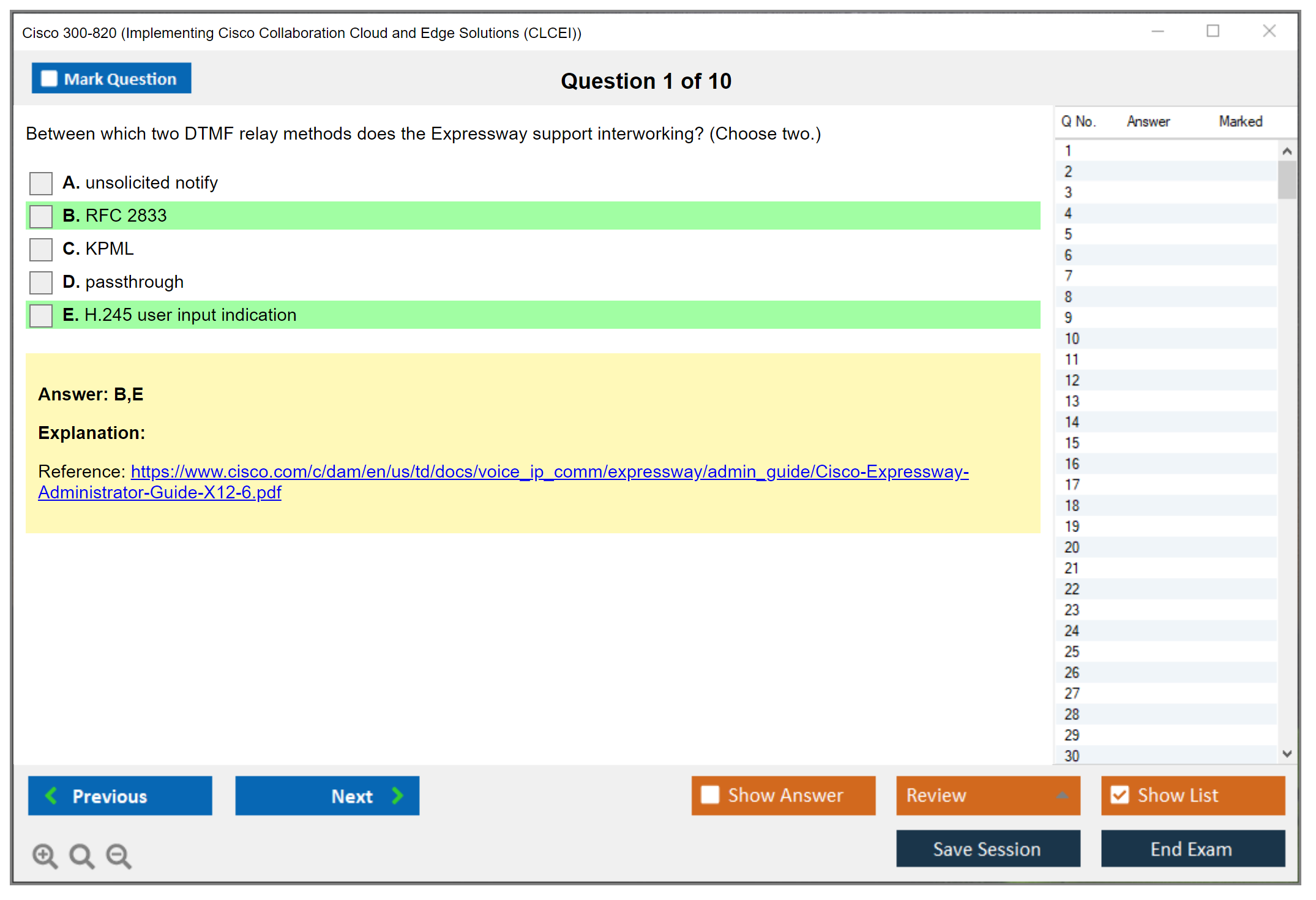
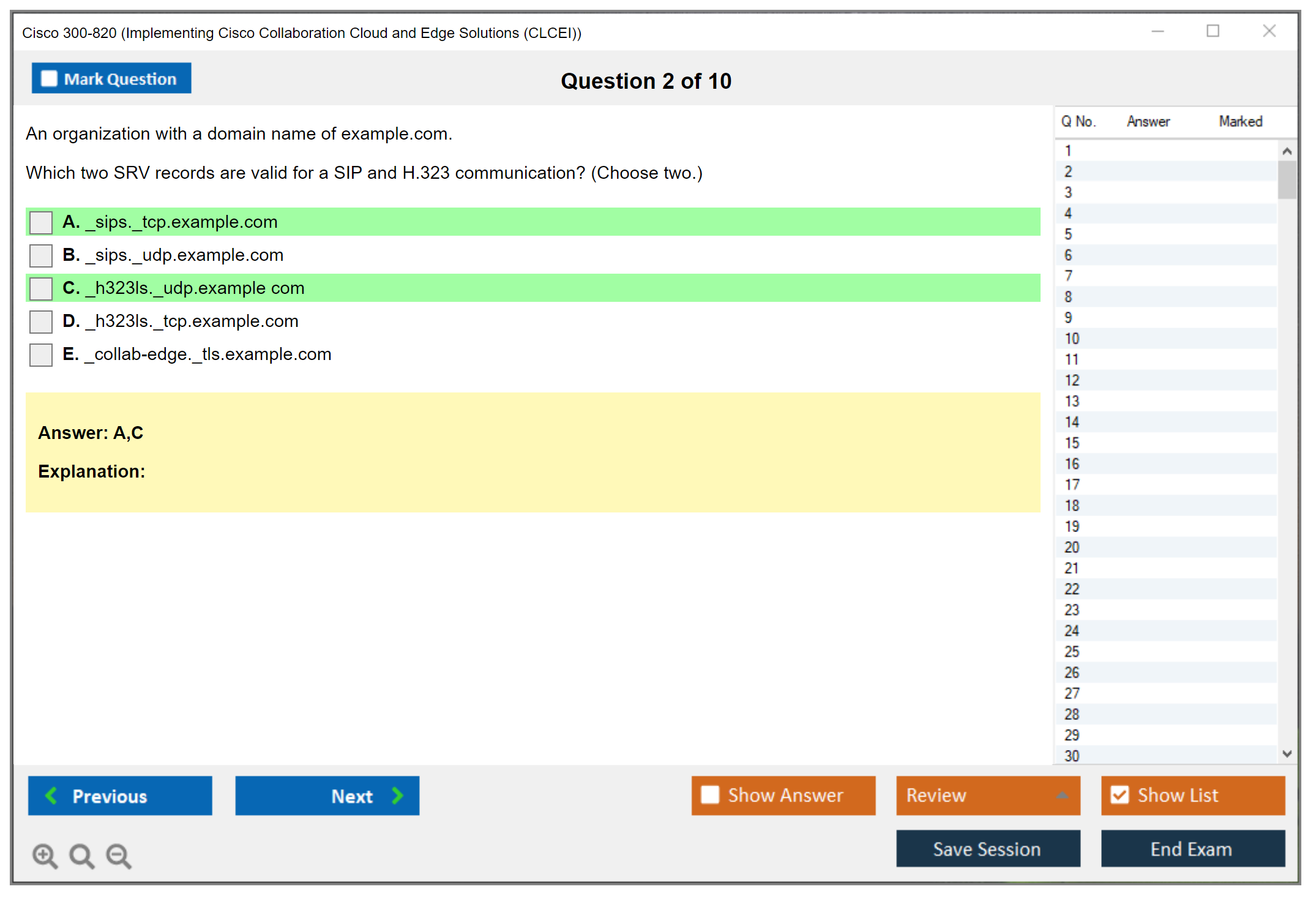
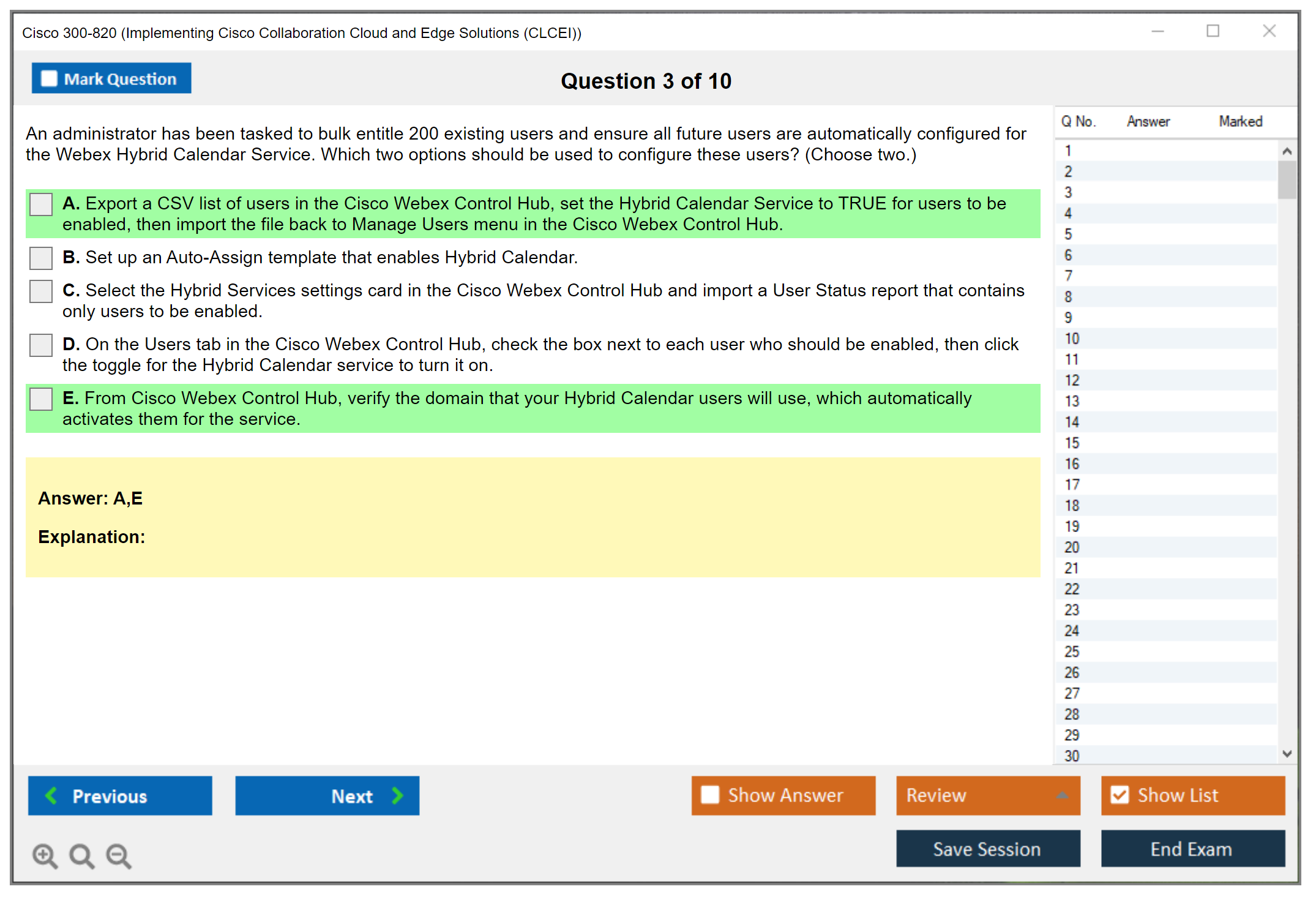
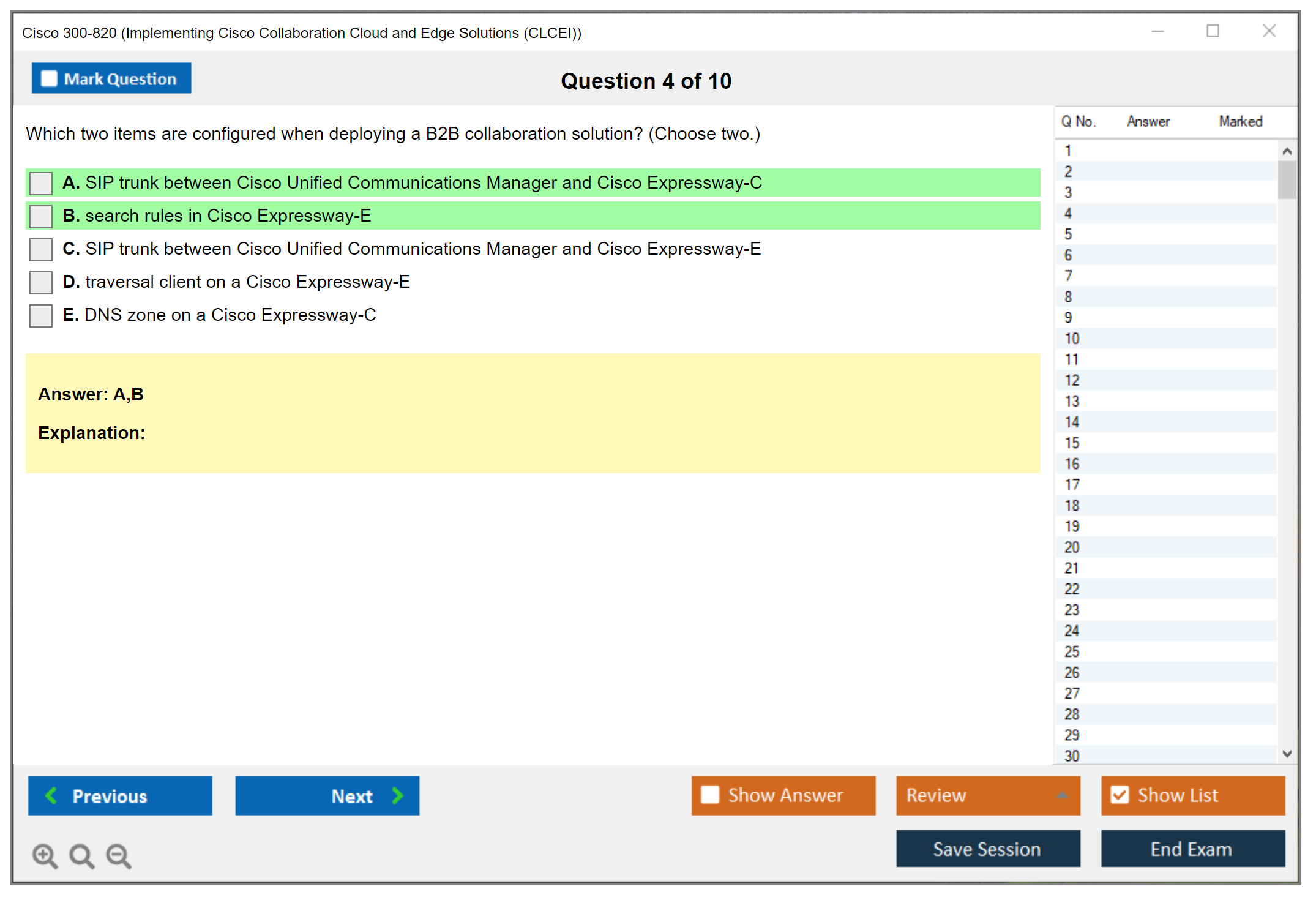
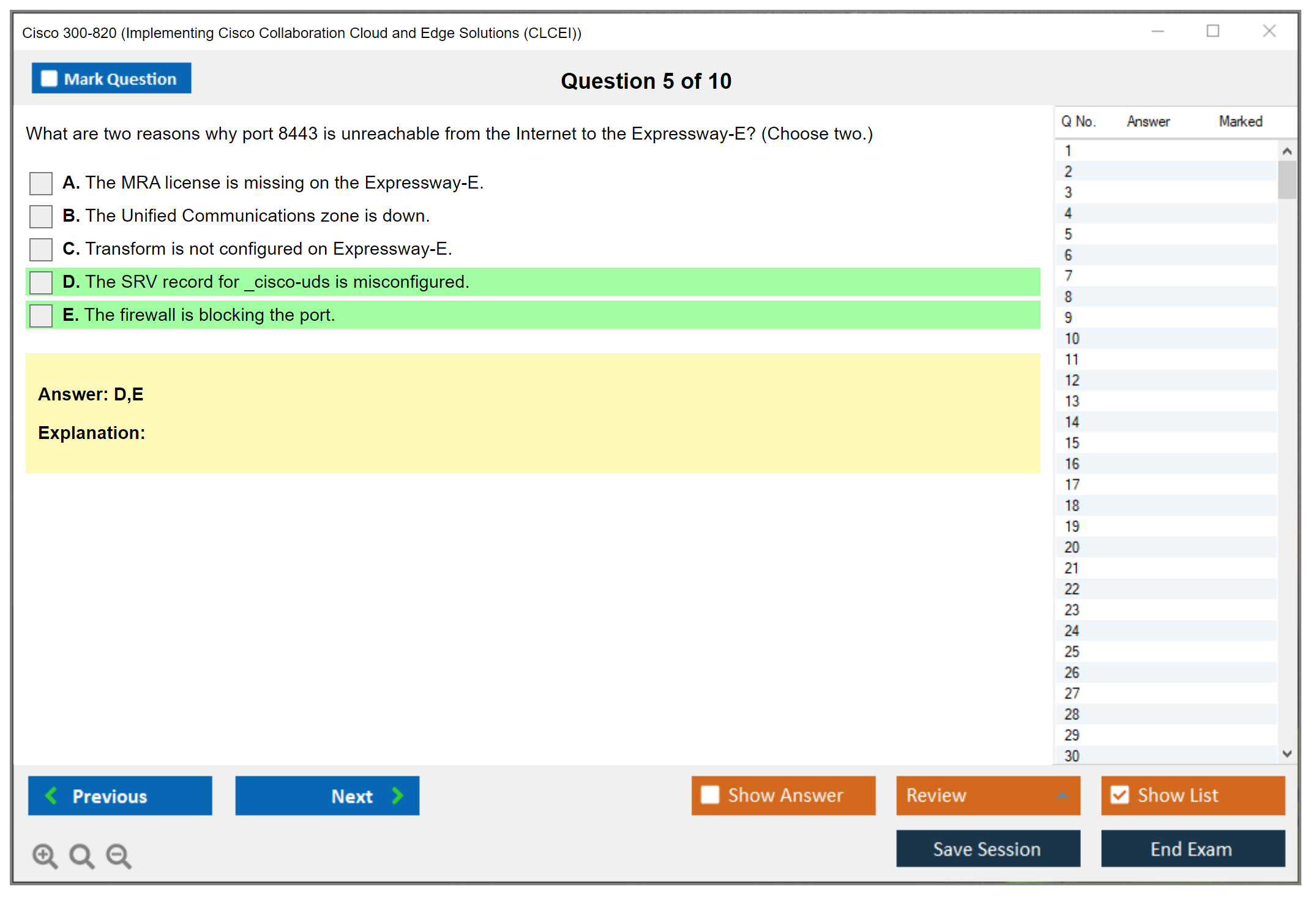
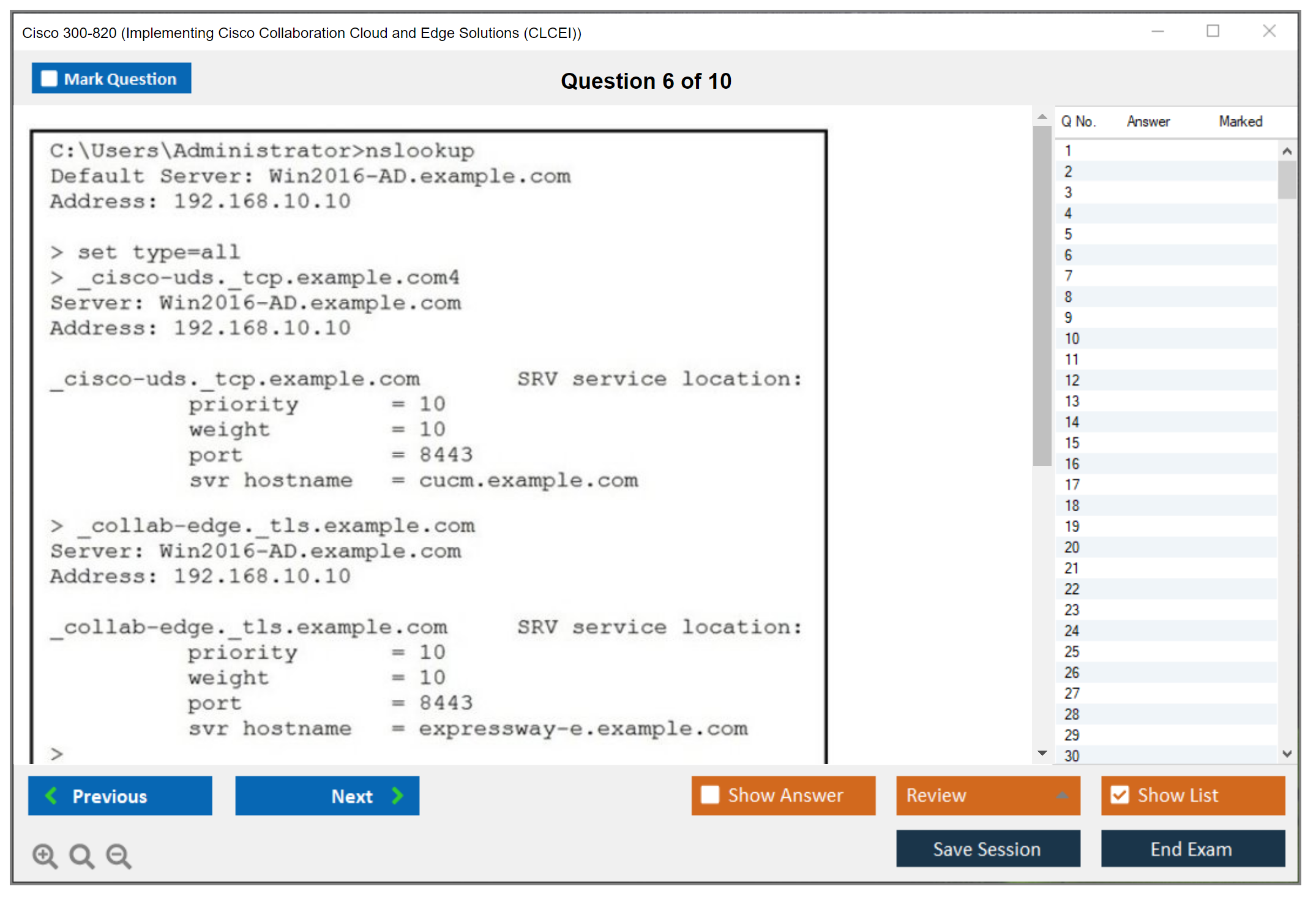
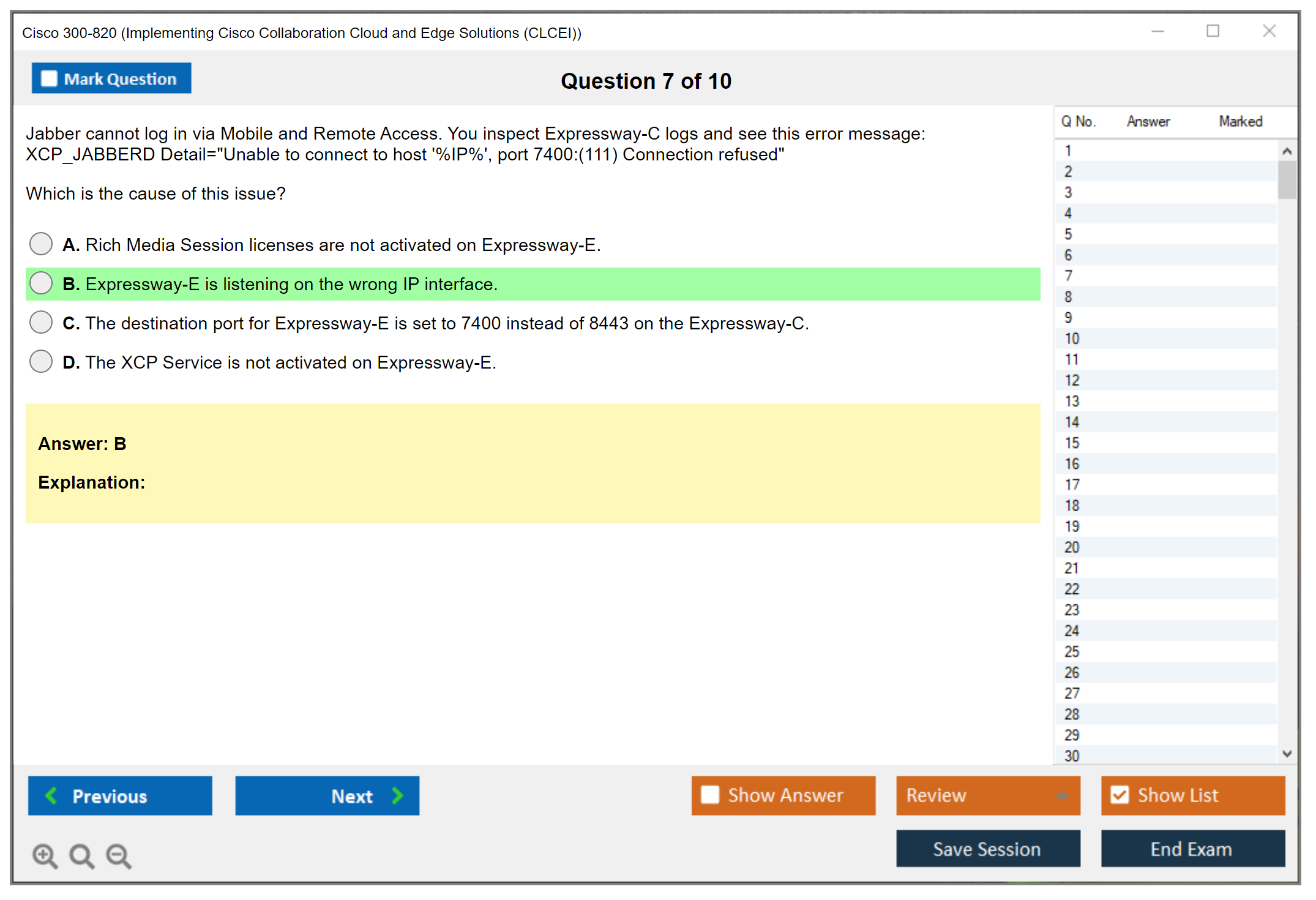
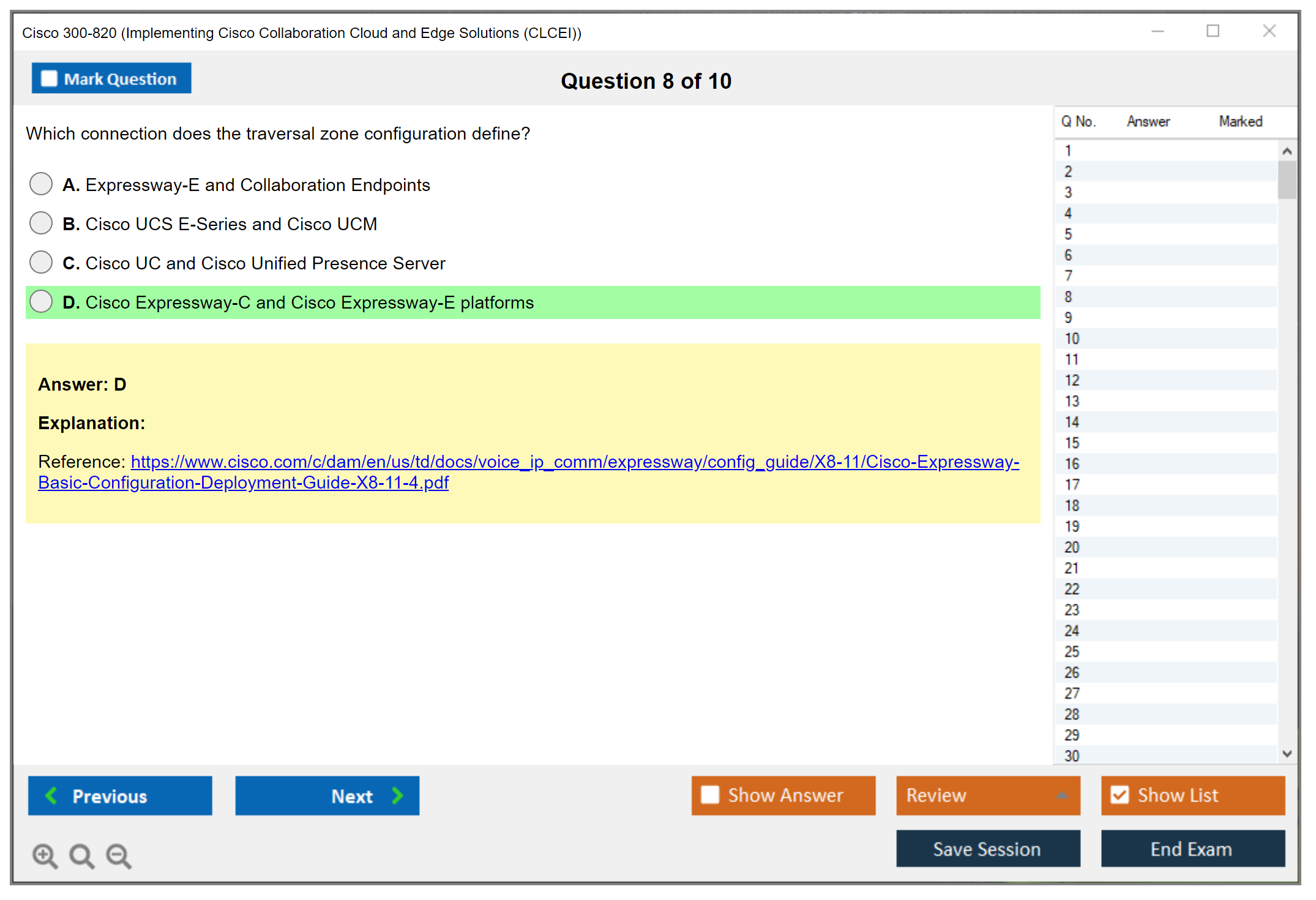
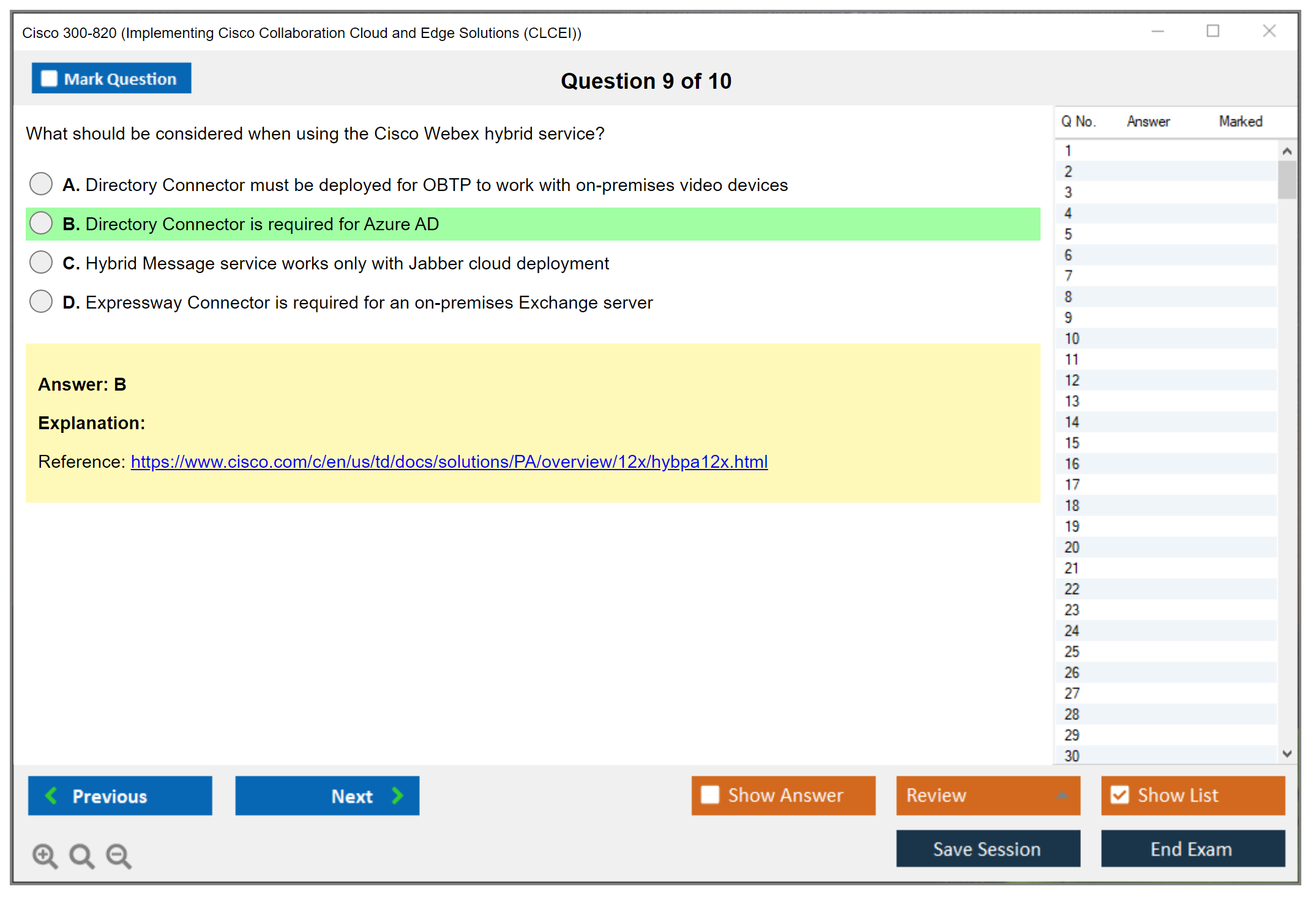
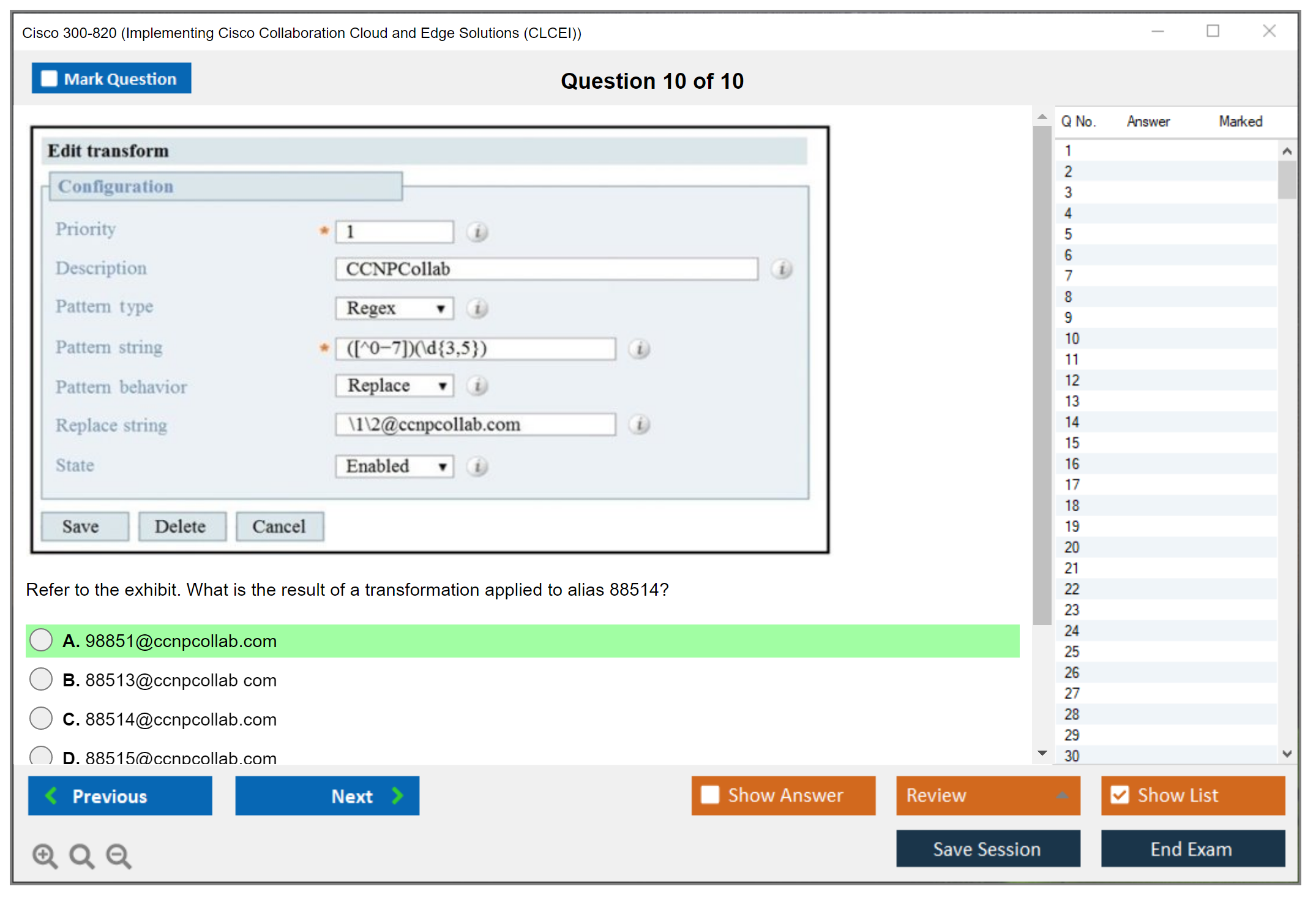
Dumpsarena Cisco Implementing Cisco Collaboration Cloud and Edge Solutions (300-820 CLCEI) (300-820) Free Practice Exam Simulator Test Engine Exam preparation with its cutting-edge combination of authentic test simulation, dynamic adaptability, and intuitive design. Recognized as the industry-leading practice platform, it empowers candidates to master their certification journey through these standout features.
What is in the Premium File?
Satisfaction Policy – Dumpsarena.co
At DumpsArena.co, your success is our top priority. Our dedicated technical team works tirelessly day and night to deliver high-quality, up-to-date Practice Exam and study resources. We carefully craft our content to ensure it’s accurate, relevant, and aligned with the latest exam guidelines. Your satisfaction matters to us, and we are always working to provide you with the best possible learning experience. If you’re ever unsatisfied with our material, don’t hesitate to reach out—we’re here to support you. With DumpsArena.co, you can study with confidence, backed by a team you can trust.
Cisco 300-820 Exam FAQs
Introduction of Cisco 300-820 Exam!
The Cisco 300-820 Implementing Cisco Collaboration Cloud and Edge Solutions (CLCEI) exam is a 90-minute exam associated with the Cisco Certified Specialist - Collaboration Cloud and Edge Implementation certification. This exam tests a candidate's knowledge of deploying, configuring, and troubleshooting Cisco Collaboration Cloud and Edge solutions. Topics include Cisco Meeting Server, Cisco Webex Teams, Cisco Webex Meetings, Cisco Webex Calling, Cisco Webex Control Hub, Cisco Expressway, Cisco Unified Communications Manager, and Cisco Unified Communications Manager Express.
What is the Duration of Cisco 300-820 Exam?
The Cisco 300-820 exam is 90 minutes long.
What are the Number of Questions Asked in Cisco 300-820 Exam?
There are approximately 90-110 questions on the Cisco 300-820 exam.
What is the Passing Score for Cisco 300-820 Exam?
The passing score for the Cisco 300-820 exam is 700 out of 1000.
What is the Competency Level required for Cisco 300-820 Exam?
The Cisco 300-820 exam is a professional-level exam that requires a high level of knowledge and experience. Candidates should have a minimum of three to five years of experience in designing and implementing Cisco enterprise networks. They should also have a thorough understanding of Cisco technologies, such as routing, switching, security, and wireless. Additionally, candidates should have a good understanding of network design principles and best practices.
What is the Question Format of Cisco 300-820 Exam?
The Cisco 300-820 exam consists of multiple-choice and drag-and-drop questions.
How Can You Take Cisco 300-820 Exam?
Cisco 300-820 exam is available online through Pearson VUE and in testing centers in select locations. To take the exam, you must first register at the Pearson VUE website and then select a testing center location. When you register, you will need to provide a valid email address, a valid form of identification, and payment. Once you have registered, you will receive an email with your exam confirmation number and further instructions. On the day of your exam, you must arrive at the testing center at least 15 minutes before your scheduled exam time. You will be required to check-in, provide your exam confirmation number, and present your valid form of identification. You will then be allowed to begin your exam.
What Language Cisco 300-820 Exam is Offered?
The Cisco 300-820 exam is offered in English.
What is the Cost of Cisco 300-820 Exam?
The cost of the Cisco 300-820 exam is $300 USD.
What is the Target Audience of Cisco 300-820 Exam?
The target audience for the Cisco 300-820 exam is network security professionals who have experience configuring and troubleshooting Cisco products for enterprise networks. Candidates should also have a deep understanding of cloud-native security solutions and the ability to design and implement secure access solutions using Cisco products.
What is the Average Salary of Cisco 300-820 Certified in the Market?
The average salary for someone with a Cisco 300-820 certification is around $102,000 per year. This salary can vary depending on the company, position, and experience level.
Who are the Testing Providers of Cisco 300-820 Exam?
The Cisco 300-820 exam is offered by Pearson VUE and Prometric. Pearson VUE and Prometric are authorized testing centers for Cisco exams.
What is the Recommended Experience for Cisco 300-820 Exam?
The recommended experience for the Cisco 300-820 exam includes having a working knowledge of Cisco technologies and solutions, related hardware and software, and an understanding of network and security concepts. Candidates should also have a minimum of 5 years of experience implementing and troubleshooting Cisco network solutions, as well as experience with Cisco SecureX, Cisco SD-WAN, and other related technologies.
What are the Prerequisites of Cisco 300-820 Exam?
The prerequisite for the Cisco 300-820 exam is a valid CCNP certification or any CCIE certification. Candidates must also possess an understanding of the technologies associated with the Cisco 300-820 exam topics, such as automation, security, cloud, and infrastructure.
What is the Expected Retirement Date of Cisco 300-820 Exam?
The official website to check the expected retirement date of Cisco 300-820 exam is: https://learningnetwork.cisco.com/s/exam-retirement-dates.
What is the Difficulty Level of Cisco 300-820 Exam?
The difficulty level of the Cisco 300-820 exam is medium.
What is the Roadmap / Track of Cisco 300-820 Exam?
The Cisco 300-820 Exam is part of the Cisco Certified DevNet Professional certification track. It is a two-hour exam that tests a candidate's knowledge of developing applications and automating workflows using Cisco platforms. The exam covers topics such as application development, automation, security, and network programmability. The exam is designed to assess a candidate's ability to design, develop, and troubleshoot applications and automation solutions using Cisco technologies.
What are the Topics Cisco 300-820 Exam Covers?
The Cisco 300-820 exam covers the following topics:
1. Implementing Network Security: This topic covers the implementation of security controls, secure network design, secure access control, and the use of encryption and authentication technologies.
2. Troubleshooting Network Security: This topic covers the troubleshooting of security issues, including the identification and resolution of security threats.
3. Implementing Network Access Control: This topic covers the implementation of access control technologies, including identity management and authentication.
4. Implementing Secure Network Infrastructure: This topic covers the implementation of secure network infrastructure, including virtual private networks, firewalls, and intrusion detection systems.
5. Implementing Secure Network Services: This topic covers the implementation of secure network services, including secure web services, secure email, and secure file transfer.
6. Implementing Secure Network Automation: This topic covers the implementation of secure network automation, including policy enforcement, network segmentation, and
What are the Sample Questions of Cisco 300-820 Exam?
1. What type of wireless security is used to protect wireless networks?
2. What is the purpose of the Cisco Identity Services Engine?
3. What is the purpose of the Cisco TrustSec solution?
4. What are the benefits of using Cisco AnyConnect Secure Mobility Client?
5. How can you configure a secure remote access solution using Cisco Adaptive Security Appliance?
6. What is the purpose of the Cisco Firepower Threat Defense system?
7. How can you configure a secure wireless network using Cisco Wireless LAN Controller?
8. How can you configure a secure network using Cisco Network Access Control?
9. What is the purpose of the Cisco Web Security Appliance?
10. How can you configure a secure network using Cisco Identity Services Engine?
Cisco 300-820 CLCEI Exam Overview and Introduction Look, if you're working in collaboration technologies right now, you've probably noticed how everything's moving toward this weird hybrid setup where nothing's fully on-premises anymore but also not completely in the cloud either. That's exactly what the Cisco 300-820 CLCEI exam is all about. What this certification actually validates The Cisco 300-820 CLCEI (Implementing Cisco Collaboration Cloud and Edge Solutions) exam isn't some entry-level cert you knock out in a weekend. This is professional-level stuff that proves you know how to deploy, configure, and troubleshoot Cisco collaboration solutions that span both cloud and on-premises environments. I mean, most organizations aren't just ripping out their entire UC infrastructure and going full cloud overnight, right? They're running these complex hybrid setups that need someone who understands both worlds. The exam focuses heavily on technologies like Cisco Expressway, Webex Edge... Read More
Cisco 300-820 CLCEI Exam Overview and Introduction
Look, if you're working in collaboration technologies right now, you've probably noticed how everything's moving toward this weird hybrid setup where nothing's fully on-premises anymore but also not completely in the cloud either. That's exactly what the Cisco 300-820 CLCEI exam is all about.
What this certification actually validates
The Cisco 300-820 CLCEI (Implementing Cisco Collaboration Cloud and Edge Solutions) exam isn't some entry-level cert you knock out in a weekend. This is professional-level stuff that proves you know how to deploy, configure, and troubleshoot Cisco collaboration solutions that span both cloud and on-premises environments. I mean, most organizations aren't just ripping out their entire UC infrastructure and going full cloud overnight, right? They're running these complex hybrid setups that need someone who understands both worlds.
The exam focuses heavily on technologies like Cisco Expressway, Webex Edge architecture, and all those hybrid services connectors that make everything work together. You'll need to demonstrate practical knowledge of MRA (Mobile and Remote Access) configuration, hybrid calling setups, calendar integration, and honestly a bunch of other stuff that comes up constantly in real deployments. Not gonna lie, this certification reflects what you'd actually be doing day-to-day as a collaboration engineer in 2026.
Who should consider taking this exam
Collaboration engineers are obvious candidates.
But I've also seen unified communications specialists transition into this space pretty successfully, especially if they've been managing traditional voice systems and want to expand into cloud integration. Network administrators who are pivoting toward collaboration technologies can benefit too, though they'll need to spend extra time on the collaboration-specific components.
Systems integrators working with Webex solutions basically need this. IT professionals responsible for managing hybrid cloud collaboration deployments will find the skills directly applicable to their work environments. The sweet spot is really someone who's already got some collaboration experience but needs to formalize their knowledge of cloud and edge architectures. The thing is, if you've been fumbling through Expressway deployments or trying to figure out why your Webex hybrid services keep breaking, this exam will force you to understand the underlying principles properly.
How it fits into Cisco's certification structure
The 300-820 is one of the concentration exam options for achieving the CCNP Collaboration certification. You'd first need to pass the 350-801 CLCOR core exam, then choose a concentration exam like this one to complete your CCNP. It demonstrates advanced skills in implementing modern collaboration edge and cloud architectures, which honestly sets you apart from folks who only know traditional on-premises UC systems.
Some people also look at the 300-815 CLACCM as an alternative concentration, which focuses more on advanced call control and mobility services. Your choice?
Depends on whether your work leans more toward cloud integration (300-820) or call routing and mobility features (300-815). Kind of like choosing between being really good at plumbing or electrical work when you're building a house. Both matter, but you've got to pick one to specialize in first.
The shift toward hybrid everything
Here's the thing about collaboration tech evolution: we're in this weird transition period that's probably going to last another five years minimum. Companies invested millions in their on-premises UC infrastructure, so they're not throwing it away. But they also want the flexibility and features of cloud services like Webex. The 300-820 exam content reflects this industry shift perfectly.
You're dealing with Webex Edge architecture that connects cloud services to your on-premises environment. Expressway connectivity solutions handle secure traversal for remote workers. Various hybrid services connectors sync calendars, enable cloud-based meeting join from desk phones, and all that integration work that makes end users happy. Wait, this isn't theoretical stuff. This is what organizations are implementing right now.
Why companies actually care about this certification
Organizations implementing Webex hybrid services need professionals who understand both traditional collaboration infrastructure and cloud integration points. I've seen job postings specifically asking for CCNP Collaboration with cloud experience, and guess what exam validates that? The business value is pretty straightforward: certified engineers can design and deploy these hybrid solutions without expensive consultants coming in for every little configuration change.
Digital transformation initiatives? Almost always include collaboration components.
Companies want to enable remote work, improve meeting experiences, integrate with productivity tools. All of that requires someone who can bridge the gap between legacy systems and cloud services. The skills validated by this exam are exactly what's needed for those projects.
What domains you'll actually be tested on
The certification validates proficiency across several key areas. Cisco Expressway deployment and troubleshooting takes up a significant chunk. You need to understand both Expressway-C and Expressway-E, how they work together, certificate management, and all the firewall traversal stuff that makes remote access actually work.
Webex Edge architecture implementation is another major domain. This includes understanding how different edge components interact with cloud services, what data flows where, and how to troubleshoot connectivity issues when things break. Hybrid calling is particularly important because it affects how users make and receive calls when you're mixing cloud and on-premises systems.
Calendar integration might sound simple, but there's a lot to it. MRA configuration comes up constantly in real deployments. Then there's all the various Webex hybrid services and connectors. Each one has its own deployment requirements, dependencies, and troubleshooting approaches.
Hands-on skills matter more than memorization
Unlike purely theoretical certifications (and honestly, some of the older Cisco exams fell into this trap), the 300-820 puts weight on hands-on implementation skills. You can't just memorize configuration commands and pass. You need to demonstrate practical knowledge of configuring, integrating, and troubleshooting real-world collaboration cloud and edge solutions.
The exam scenarios often present problems you'd encounter in actual deployments. Users can't join Webex meetings from their desk phones. MRA stopped working after a certificate renewal. Hybrid calendar service isn't syncing properly. You need systematic troubleshooting approaches, understanding of log analysis, and knowledge of where to look when specific symptoms appear.
Security and networking foundations you can't skip
Significant exam coverage includes secure traversal architectures, which is basically how you get collaboration traffic through firewalls and NAT devices without punching giant security holes in your network. Certificate management is huge. X.509 certificates, certificate chains, trust relationships, renewal processes. If you don't understand PKI fundamentals, you're going to struggle with probably 30% of the exam content.
Network security principles matter too. You need to understand DNS resolution thoroughly because so many collaboration issues trace back to DNS problems. Firewall traversal. NAT configurations. QoS implementations for ensuring call quality. All of this networking foundation stuff applies directly to collaboration edge solutions. If you came up through the collaboration track without a strong networking background, you might want to review some 350-401 ENCOR material on these topics.
Career impact and what happens after you pass
Professionals holding the CCNP Collaboration with CLCEI specialization typically qualify for senior collaboration engineer roles, solution architect positions focused on UC and collaboration, and specialized Webex deployment consultant opportunities. I've seen salary bumps ranging from 10 to 20 percent after completing CCNP Collaboration, though obviously that varies by market and experience level.
The certification operates on a three-year validity cycle now, with continuing education options for renewal. You can earn continuing education credits through training, exams, or even Cisco Live sessions. Or you can just retake an exam. Either this concentration exam, the core exam, or even pursue a higher-level certification like CCIE Collaboration.
Skills stay relevant. Why?
Because hybrid deployments aren't going anywhere soon. Even as more workloads move to the cloud, there's always going to be integration work, legacy system support, and complex deployment scenarios that require this exact skill set.
Cisco 300-820 Exam Cost, Registration, and Logistics
What this exam actually is
The Implementing Cisco Collaboration Cloud and Edge Solutions (300-820) is the Cisco 300-820 CLCEI exam. It sits right in the middle of on-prem collaboration and Webex territory, honestly. Not theory or fluff. Real deployment decisions you'd make when things break at 2 AM.
You're dealing with Cisco Webex Edge architecture, Cisco Expressway deployment and troubleshooting, hybrid calling and calendar integration, MRA (Mobile and Remote Access) configuration, and Webex hybrid services and connectors. Sounds like five separate jobs because, I mean, it kinda is. Anyone who's configured MRA while troubleshooting certificate errors knows exactly what I'm talking about here.
Who should bother taking it
Chasing CCNP Collaboration? This counts as a concentration exam option, so it pairs with the core. Simple enough.
The real reason's career-shaped, though. If you're already touching Expressway, certs, DNS, firewall pinholes. If you've been dragged into "why's MRA broken again" calls. The Cisco 300-820 CLCEI exam lines up with what you're doing. Never seen a certificate chain error in production? Brace yourself.
Exam cost for 2026 (and what "varies" really means)
The Cisco CLCEI certification exam cost for 2026 is $400 USD in most markets. That's the number you should plan around when budgeting this thing. Pricing can shift by country and region because Pearson VUE charges in local currency and Cisco does regional pricing adjustments. You might see a slightly different total at checkout depending on where you're sitting.
Still basically the same tier. You're not gonna wake up and find it's suddenly $900 unless something weird happens with a local tax or currency swing. I once saw someone in Australia complain about paying $600 AUD, then they realized exchange rates and local VAT meant it was almost exactly the same as the US price. Math checks out, turns out.
How it compares to other Cisco exam price points
That $400 price point's right in line with other CCNP concentration exams. Above most associate level exams that hover around $300. Way below the expert level pain, like the CCIE lab that's roughly $1,600 just to sit down and sweat through eight hours.
This matters if you're budgeting a whole certification run. The exam fee's the predictable part. Everything around it's where people accidentally light money on fire.
The real budget: what you'll spend beyond the voucher
Plan for the extras. Seriously.
Study materials usually land in the $100 to $500 range. Depends on whether you're buying a book, a video course, or a couple different sources because one of them didn't click. Cisco CLCEI study materials can be cheap if you live in docs and whitepapers. Expensive if you need structure.
Official instructor-led training's the wallet breaker, though. Cisco collaboration cloud and edge solutions training through a Learning Partner can run $2,000 to $4,000. Worth it for some people, not for others, but it's a real line item if your employer isn't paying.
Practice exams are another one. A Cisco 300-820 practice test from a legit vendor might be $50 to $150, and then there's lab cost. Maybe it's free because you've got access at work. Maybe you spin up a virtual lab. Maybe you pay for a hosted environment, maybe you burn time in a sandbox. Not always cash, but always cost.
Registering through Pearson VUE (the clean path)
Registration's straightforward. Do it carefully, though. Name mismatches and account confusion cause the dumbest exam day disasters.
1) Go to pearsonvue.com/cisco and create or log into your Pearson VUE account. 2) Search for exam code 300-820. 3) Pick your delivery option: testing center or online proctoring. 4) Choose the appointment time and complete payment.
That's it. Mostly. The catch? Making sure your profile details match your ID exactly. Middle names, hyphens, spacing, all that annoying stuff.
Linking Cisco Learning Network and Pearson VUE (don't skip this)
Look, your score showing up matters. Linking your Pearson VUE testing history with your Cisco account's how your results get credited toward CCNP Collaboration. How they show up in the Cisco certification tracker.
Do it early. Not after you pass and you're refreshing the tracker every hour like a maniac.
Testing center vs online proctored: which one I'd pick
Testing center's the boring reliable option. Controlled environment, fewer variables, you show up, you take the test, you leave.
Online proctoring via Pearson VUE OnVUE is convenient, but it's picky as hell. One weird webcam driver issue or a roommate making noise and suddenly you're having a bad day that could've been avoided with a twenty-minute drive. If you've got a clean home office, stable internet, and you're comfortable with strict rules, it's fine. If your setup's chaotic, go to a center.
Online proctoring requirements (the stuff that trips people)
You need a private, quiet room. Stable internet connection. Working webcam and microphone. Government-issued ID. Clean desk. No notes, no extra monitors, no "I'll just keep my phone face down." They mean none.
Also? Run the OnVUE system test at least 24 hours before your scheduled exam. Not the morning of. Do it the day before so you've got time to troubleshoot OS permissions, corporate VPN weirdness, or security software that decides Pearson's app is suspicious.
Scheduling, rescheduling, cancellations
Appointments are usually available year-round. Most metro areas have decent testing center coverage. You can often find business hours slots, and sometimes evening or weekend availability depending on capacity.
Rescheduling and cancellation's the big rule people forget: Pearson VUE lets you reschedule or cancel without penalty if you do it at least 24 hours before the appointment. Inside 24 hours? You typically forfeit the exam fee. No mercy. Plan accordingly.
Exam day logistics: check-in, ID, and what you can't bring
For a testing center exam, arrive about 15 minutes early. For online, start check-in about 30 minutes before your time because you'll do photos, ID capture, and workspace inspection. The thing is, it always takes longer than you think.
Identification rules are strict. Bring two valid forms of ID. At least one must be government-issued photo ID with signature, like a passport or driver's license. The name must exactly match what you registered with. Exactly. If your Cisco 300-820 prerequisites include anything, it's "be an adult about your paperwork."
Prohibited items are basically everything: phones, smartwatches, notes, bags, reference material. Testing centers usually provide lockers. Online exams mean you remove it all from the room or out of reach. The proctor can end your session if you don't comply.
Accommodations if you need them
Cisco and Pearson VUE do offer accommodations for candidates with documented disabilities. You request accommodations through Pearson VUE's process and provide documentation. It can take time, so don't schedule the exam for next week and then start the paperwork.
Vouchers, bundles, and work paying for it
If your company buys multiple vouchers, there may be volume discounts. Cisco Learning Credits can also change the math. Cisco Learning Partners sometimes bundle training plus an exam attempt. Ask. People forget to ask and then pay retail.
Group exam administration's also a thing. If an org's training a batch of engineers, dedicated sessions can be arranged through Learning Partners or authorized centers. Less chaotic than everyone trying to find their own slot.
Retakes and waiting periods (aka plan for failure like a pro)
If you fail, retake rules apply. The waiting period's 5 days before your first retake, 15 days before a second retake, and 30 days for subsequent attempts within a 12-month period.
That spacing matters. If you're trying to hit a deadline for a role change or partner requirement, don't schedule attempt one on the last possible day. People do this. It goes badly.
Results timeline and what you'll see
You get a preliminary pass/fail right after you finish. Official score reports usually show up in your Cisco certification tracker within 48 hours once systems sync.
Doesn't show? That's when the Cisco Learning Network and Pearson VUE account integration stuff comes back around. It's almost always an account linking issue, not a missing score.
Language and international considerations
The exam's available in English and Japanese. When you schedule, verify language availability at your chosen location because not every testing center offers every language for every slot.
Also, taxes can apply depending on your region. That's part of why your $400 USD plan might show up as a different final total.
Quick answers people search for
How much does the Cisco 300-820 CLCEI exam cost? Usually $400 USD, with regional variation.
What's the passing score for the 300-820 CLCEI exam? Cisco doesn't publish a fixed universal number for every form, so treat any specific score you see online as questionable. Focus on mastering the Cisco 300-820 exam objectives instead.
How hard's the Cisco 300-820 exam? If you've done Expressway, MRA, and hybrid services in real environments, it's fair. Haven't? It's rough.
What are the objectives for Implementing Cisco Collaboration Cloud and Edge Solutions (CLCEI)? Expect edge architecture, Expressway, Webex hybrid services, and troubleshooting-heavy scenarios.
How do I prepare for the Cisco 300-820 CLCEI exam (study materials and practice tests)? Mix docs with a lab, add a reputable practice test, and spend extra time on certificates, DNS, and the "hybrid" glue that breaks in production.
Cisco 300-820 Passing Score, Exam Format, and Structure
What 825 out of 1000 actually means
The Cisco 300-820 CLCEI exam requires a passing score of 825 out of 1000 points. That's 82.5%, which sounds more intimidating than it should. Cisco uses scaled scoring, so you're not actually looking at 82.5% of questions answered correctly. It's more complicated than that.
Your raw score (the actual number of questions you get right) gets converted to this 300-1000 scale. Why? Different exam versions have slightly different difficulty levels. Cisco adjusts scores so that passing one version means roughly the same competency as passing another version. Makes sense when you think about exam security, but it's confusing when you're trying to figure out how many questions you can afford to miss.
You won't know exactly how many questions you need to get right. The exam typically has 55-65 questions, but Cisco doesn't publish the exact count for your specific version. Some questions might be worth more than others based on domain weighting. The Configuration and Management of Webex Edge section makes up 35-40% of your score, while troubleshooting is only 10-15%. Miss a bunch of troubleshooting questions and you might still pass. Bomb the Webex Edge section? You're probably toast.
Time pressure and exam format realities
Ninety minutes total.
You get 90 minutes to complete the Implementing Cisco Collaboration Cloud and Edge Solutions (300-820) exam. Sounds reasonable until you do the math. That's about 80-100 seconds per question depending on your version. Not gonna lie, that's tight when you hit simulation questions that require actual thinking and careful analysis of what's being presented.
The question types vary more than people expect. Yeah, there are standard multiple-choice single-answer questions where you pick one option. But there are also multiple-choice multiple-answer questions that say "select all that apply." These are brutal because there's no partial credit. You need ALL correct answers selected and ZERO incorrect ones to get points. Miss one correct answer or add one wrong answer and you get nothing for that question.
Drag-and-drop matching exercises show up too. You might match Expressway components to their functions or sequence deployment steps. Then there are simulation-based scenarios where you're presented with a configuration challenge or troubleshooting situation. You need to identify correct commands, diagnose issues, or choose appropriate deployment options based on what you see in the simulated environment.
I've talked to people who spent 5 minutes on a single simulation question trying to work through all the variables. That eats into your time budget fast.
The tutorial doesn't count against you
Before the 90-minute timer starts, you go through a pre-exam tutorial. A lot of candidates rush through this, but honestly? Take your time here. The timer doesn't start until you finish the tutorial and begin the actual exam.
The tutorial shows you how to work through questions, mark items for review, and use the exam interface. Learn this stuff during the tutorial instead of figuring it out on question 15 when you're already stressed and second-guessing your career choices. You can move forward and backward through questions, mark tough ones for later review, and see a summary screen showing which questions you haven't answered yet.
No breaks during those 90 minutes though. The clock runs continuously. Use the restroom before you start. Sounds obvious, but I've heard stories of people losing focus in the last 20 minutes because they didn't plan ahead. My cousin once told me about a guy who failed by twelve points because he spent the last fifteen minutes distracted instead of reviewing flagged questions. Basic stuff, really.
Immediate results and what comes next
You get preliminary pass/fail notification immediately after submitting the exam. The screen shows your scaled score and whether you hit that 825 threshold. If you're testing at a Pearson VUE center, you see this before leaving the testing room. Online proctored exams show results before ending the session.
The official score report breaks down your performance by domain. You'll see percentage scores for Configuration and Management of Webex Edge, Configuration and Management of Expressway (30-35% of exam), Hybrid Services (20-25%), and Troubleshooting. This breakdown's incredibly useful if you don't pass. You know exactly which areas to focus on for your retake.
The 300-820 uses a fixed-form format, not computer-adaptive testing. Everyone gets the same number of questions, and the difficulty doesn't adjust based on your previous answers. This is different from some other certification exams you might've taken. It also means that really hard question you just answered? Doesn't mean the exam thinks you're doing well or poorly. It's just a hard question. Period.
Experimental questions nobody tells you about
Here's something frustrating: some exams include unscored experimental questions. These are being evaluated for future exam versions but don't count toward your score. The problem? You can't tell which questions are experimental and which ones count. You have to treat every question like it matters because, well, it might.
This is why aiming for exactly 825 is a terrible strategy. You want a buffer. If you're consistently scoring 85-90% on quality 300-820 practice tests, you're probably ready. That gives you room for experimental questions, questions you misread under pressure, and topics you didn't study as thoroughly as you should've.
Comparing this to other CCNP concentration exams
The 300-820 format fits with other CCNP concentration exams in terms of structure and requirements. If you've taken something like the 350-801 CLCOR or 300-815 CLACCM, the format feels familiar. Same 90-minute duration, similar question counts, same 825 passing score. Cisco maintains consistency across the CCNP program, which actually helps if you're pursuing multiple certifications.
A passing 300-820 score counts as a concentration exam toward CCNP Collaboration certification. You need to pass the CLCOR core exam plus one concentration exam like the 300-820. Your passing score also provides continuing education credits that can renew other Cisco certifications you hold. The certification itself stays valid for three years, though your passing score remains in Cisco's system indefinitely. At least that's what they claim.
Domain weighting matters more than you think
Different topics carry different weights, and this affects your study strategy. Configuration and Management of Webex Edge is huge at 35-40% of your total score. That's roughly a third of the exam focused on Webex Edge architecture, deployment, and integration. Expressway deployment and troubleshooting takes up another 30-35%.
Look, if you master just these two domains, you're already covering 65-75% of the exam. That's the bulk of it right there. Hybrid Services (hybrid calling, calendar integration, directory sync) adds another 20-25%. Troubleshooting rounds out the final 10-15%.
Some people make the mistake of studying everything equally. That's inefficient. Spend proportional time on high-weight topics. Yeah, you still need to know troubleshooting fundamentals and MRA configuration, but if you're running out of study time, prioritize Webex Edge and Expressway content. Just being practical here.
Quality practice materials make the difference
Using dumps or brain dumps might seem tempting when you see that 825 passing score, but honestly? They hurt more than they help. The exam questions change between versions, and memorizing specific answers doesn't build the real-world knowledge you need. Knowledge you'll actually use on the job, not just for passing some test. Plus, Cisco can invalidate your certification if they detect you used prohibited materials.
Better approach: focus on hands-on labs and scenario-based practice. The 300-820 Practice Exam Questions Pack offers realistic question formats at $36.99, which is way cheaper than the exam retake fee if you fail. Combine that with actual lab work on Expressway, Webex hybrid connectors, and edge architecture configurations.
If you've already passed the 350-401 ENCOR or similar professional-level exams, you know that Cisco tests practical application, not just theory. The 300-820 follows the same philosophy. You need to understand how Webex Edge components interact with on-premises infrastructure, how to troubleshoot certificate issues in Expressway deployments, and how hybrid services connect cloud and edge environments.
Final-week strategy and mental preparation
In your last week before the exam, shift from learning new material to reinforcing what you know. Review your weak domains based on practice test results. Don't cram new topics at this point. You won't retain them under exam pressure anyway, trust me on this.
Make sure you understand the exam interface and question navigation. The review screen functionality is your friend. Mark questions you're unsure about, answer everything else first, then come back to the marked ones. Don't leave anything blank. There's no penalty for guessing, and you might get lucky. Sometimes you know more than you think you do.
Remember that 90 minutes goes faster than you expect. Pace yourself at roughly 1.5 minutes per question. If you hit a simulation that's taking 4-5 minutes, that's fine, but compensate by moving quicker through straightforward multiple-choice questions.
The 825 passing score isn't impossible, but it demands solid preparation across all exam domains. Treat the 300-820 like any professional certification: respect the difficulty, study smart not just hard, and build practical skills that'll actually help you in real Cisco collaboration deployments. That's the whole point anyway, right?
Cisco 300-820 Difficulty Level and Common Challenges
The Cisco 300-820 CLCEI exam is Cisco's way of checking whether you can connect the old-school on-prem collaboration world to Webex cloud services without breaking call routing, security, or user experience. It's officially called Implementing Cisco Collaboration Cloud and Edge Solutions (300-820), and the scope's very "edge heavy": Expressway, MRA (Mobile and Remote Access), hybrid services connectors, Webex Edge stuff, and the glue that holds it together like DNS and certificates.
This isn't a pure config-memory test. Some of it is, sure. But a lot of it feels like "here's a messy hybrid customer, what do you fix first, what dependency did they miss, and why's the certificate chain failing only from the internet."
Who should take it (and who should avoid it for now)
If you're already doing Cisco collaboration in the real world, especially anything with Expressway and Webex hybrid services and connectors, you're the target. Consultants, obviously. UC engineers. People who get dragged into "our CEO can't join meetings from home" incidents.
If you've never touched certificates, DNS SRV records, or firewall traversal, look, you can still pass, but you're gonna feel the Cisco 300-820 prerequisites gap hard. This exam assumes you can think like a network and security person while also thinking like a collaboration person. That's where lots of candidates get absolutely wrecked, honestly.
Exam cost and registration basics
Cisco 300-820 exam cost (price and fees)
People ask this constantly: "How much does the Cisco 300-820 CLCEI exam cost?" Cisco pro-level exams're typically priced at $400 USD (regional pricing and taxes vary). That's the normal "Cisco CLCEI certification exam cost" expectation most folks see at checkout, but don't be shocked if your country adds fees.
If you want cheaper prep than a full course, I mean, you can mix official docs with a paid question pack. I've seen people pair study with a 300-820 Practice Exam Questions Pack when they need repetition and pacing practice, not as a replacement for labs.
Where to register (Pearson VUE) and delivery options
You register through Pearson VUE. You can usually pick test center or online proctored. Online's convenient, but it adds its own stress. One minor webcam issue and suddenly your "hybrid calling and calendar integration" knowledge doesn't matter.
Passing score and format (what you can and can't control)
Passing score expectations
Another common one: "What is the passing score for the 300-820 CLCEI exam?" Cisco doesn't publish a fixed number you can bank on across attempts. You get a score report, and the real game's: cover the blueprint, don't bomb a whole domain, and don't waste time arguing with trick wording.
Time, question style, scoring reality
You've got about 90 minutes, and the time pressure's real because scenario questions are wordy. Some items feel like "multiple valid approaches" too, which is annoying because you're not choosing what works in your environment. You're choosing what Cisco thinks is the best practice for the scenario.
Also, details matter. CLI snippets. GUI paths. Specific config parameters. Not every question's that way, but enough are that sloppy memorization bites you.
How hard it is, really
Overall difficulty level
So, "How hard is the Cisco 300-820 exam?" Moderately difficult to challenging's the fairest label. The thing is the theoretical content is manageable if you've lived in Cisco collab for a while, but the practical side's where it spikes: troubleshooting MRA, sorting certificate chains, understanding data flows between on-prem Unified CM and Webex cloud services, and knowing what breaks when DNS is slightly wrong.
Three short truths. Not beginner friendly. Not purely CCNP ROUTE-style. Hybrid brain pain.
Compared to other CCNP Collaboration exams
Most candidates I talk to rate it slightly harder than 300-810 (CLICA). That matches my take. CLICA's more straightforward "call control and apps" stuff, while 300-820 drags you into hybrid integration scenarios where one missing SAN entry can kill your day.
Versus 300-815 (CLACCM), it's comparable overall, but the pain's different. CLACCM can be heavy on call control and media resources. CLCEI's heavy on edge, identity, trust, and internet-facing design decisions.
The biggest challenges people hit (and why)
The prerequisites knowledge gap
The sneaky difficulty isn't collaboration at all. It's networking fundamentals like DNS behavior, certificate trust, NAT/firewall traversal, and how clients resolve services from inside versus outside.
If you don't already understand SRV records, certificate chains, intermediate CAs, and why "it works internally" means nothing for MRA, you're gonna spend half your study time just becoming a part-time PKI admin. That's normal. Still painful. I knew a guy who spent three weeks just wrapping his head around certificate validation before he even looked at Expressway configuration, which honestly might've been the smart move in retrospect.
Hybrid architecture complexity
Hybrid architectures force you to visualize flows across multiple components: Unified CM, Expressway-C/E, Webex cloud, connectors, directory sync, identity, and sometimes Exchange or Microsoft 365. There're a lot of integration points where it "sort of connects" but fails in one direction only.
You need to be able to read a scenario and mentally trace signaling and auth. From a Jabber client on LTE hitting Expressway-E, traversing to Expressway-C, then to Unified CM, while certificates validate across names that depend on external DNS you don't control. That's a long sentence because that's how it feels in production.
Expressway config and troubleshooting
Cisco Expressway deployment and troubleshooting is a top-tier difficulty area. Certificate chains. Traversal zones. Search rules, transform rules, wait, firewall pinholes. Neighbor zones. And the worst part's that you can configure something that looks correct and still fail because the certificate doesn't match the exact FQDN the client's using.
One detail worth drilling: certificates and name matching. People focus on "do I have a cert installed" and forget SAN entries, trust of intermediates, and which side needs to trust which CA. Then they're staring at logs with TLS alerts and guessing.
Other Expressway gotchas I see mentioned a lot: incorrect traversal zone settings, search rule priority weirdness, and misreading what should go on Expressway-E instead of Expressway-C. Quick mention, but yeah, they show up.
MRA complexity (the classic trap)
MRA (Mobile and Remote Access) configuration looks easy on a diagram. Then you try it. You've got SIP federation concepts, certificate validation, DNS records, and multi-hop call signaling paths. Any one of those can fail silently until you pull the right logs.
MRA troubleshooting also punishes random guessing. You need a method. Check DNS first. Validate certs and names. Confirm firewall ports and NAT. Then move up the stack. If you don't have that habit, the exam's troubleshooting questions eat your time fast.
Webex Edge learning curve
Cisco Webex Edge architecture topics're newer for a lot of engineers, especially Webex Edge for Devices and Webex Edge for Calling. The mental model's different from traditional on-prem deployments, because device management and PSTN connectivity models can shift depending on whether you're cloud-registered, hybrid, or still anchored on-prem.
It's not impossible. It's just unfamiliar. And unfamiliar's what makes people call an exam "hard."
Hybrid calling and dial plan logic
Hybrid calling scenarios're where smart people overthink. You've got dial plans, route patterns, trunks, calling policies, and the question's basically: "where should this call go, and why'd it go somewhere else."
You must be able to reason about call routing between on-prem and cloud based on patterns and policies, not vibes. Yes, it's easy to mix up what lives in Unified CM instead of what's controlled in Webex Control Hub, especially if you don't touch it every week.
Calendar integration troubleshooting (OAuth headaches)
Calendar's deceptively nasty. Hybrid calendar service integration with Exchange or Office 365 pulls in OAuth, Exchange Web Services, permissions, service accounts, and multi-step troubleshooting. It's not hard because it's advanced collaboration. It's hard because Microsoft auth problems're rarely obvious, and the logs're not written for your feelings.
DNS and certificates: the repeat offenders
The exam hits certificate management and PKI requirements a lot: CSR generation, chains, trust relationships, renewal, and troubleshooting failures across components. Same for DNS configuration requirements for hybrid services: SRV records, A records, split-horizon DNS, external resolution.
Failed candidates keep reporting the same pitfall topics: certificate mismatches, DNS errors, firewall blocks, OAuth failures, traversal zone misconfigs. That list's boring. That list's real.
Connectors, security, and "the stuff that changes"
Webex hybrid services connector deployment adds another layer: connector architecture, resource requirements, deployment models, troubleshooting for Calendar, Message, Call, Directory connectors. You don't need to memorize every screen, but you do need to know dependencies and sequencing, because service dependencies and prerequisite configurations show up in scenario questions.
Network security and firewall traversal challenges matter too. Required ports. Protocols. Traffic flows. Security best practices. Not gonna lie, the worst feeling's knowing the concept but blanking on which direction the connection initiates, because that changes what you open on the firewall.
Also, multi-vendor integration scenarios pop up. Microsoft Teams. Exchange. Active Directory. Third-party SIP trunks. You don't need to be a Microsoft architect, but you can't be allergic to the ecosystem.
Rapid tech updates're the final annoyance. Webex cloud services change. Docs update. Screens move. So when you're picking Cisco CLCEI study materials, prefer current Cisco docs and labs, and treat random screenshots in old PDFs with suspicion.
How to prep without losing your mind
Hands-on beats reading. Period. Lack of hands-on experience's the most common barrier I see. People read about Expressway, feel confident, then get destroyed by a question that's basically "interpret this log excerpt and pick the next step."
Use a practice test to build pacing and identify weak domains, not to replace labs. If you want something structured for repetition, the 300-820 Practice Exam Questions Pack can help you practice under a clock, and it's cheap enough that it doesn't feel like you're buying another course. Still, you need a lab, even if it's a sandbox.
Final week tips? Go tactical. Review Cisco 300-820 exam objectives line by line. Rehearse troubleshooting steps. Memorize the annoying DNS and cert details.
Quick FAQ style answers people want
Cost, score, difficulty at a glance
How much does the Cisco 300-820 CLCEI exam cost? Usually about $400 USD plus local taxes/fees. What is the Cisco 300-820 passing score? Cisco doesn't publish a fixed score you can rely on. How hard is the Cisco 300-820 exam? Moderate-to-challenging, especially if you're weak on DNS/certs and edge troubleshooting.
Objectives, prerequisites, and prep resources
What are the objectives for Implementing Cisco Collaboration Cloud and Edge Solutions (CLCEI)? Think Expressway, MRA, Webex Edge, hybrid services, call routing, security, troubleshooting. Use the official blueprint as your checklist. Are there Cisco 300-820 prerequisites? No formal ones, but you want solid networking, security basics, and real collab exposure. How do I prepare (study materials and practice tests)? Mix Cisco docs, labs/sandboxes, and timed questions. If you need timed reps, the 300-820 Practice Exam Questions Pack is one option. Just don't let it replace building and breaking a config yourself.
Cisco 300-820 Exam Objectives and Blueprint Deep Dive
Looking at the Cisco 300-820 CLCEI exam, this certification sits in a pretty specific niche within the collaboration world. It's all about bridging on-premises UC infrastructure with Webex cloud services, which is where most enterprises are heading these days. Not gonna lie, this exam tests some complex integration scenarios that you'll actually use in production environments.
What the blueprint actually covers
Real talk here. The Cisco 300-820 CLCEI exam breaks down into four major domains, though the weighting isn't evenly distributed. Configuration and Management of Webex Edge takes up the lion's share at 35-40%, followed by Expressway configuration at 25-30%, Hybrid Services implementation at 20-25%, and Troubleshooting rounding out the rest at 10-15%. That first domain alone is basically worth studying until your eyes cross because it's almost half the exam.
The blueprint organizes everything around real-world deployment scenarios you'd encounter when connecting legacy Cisco UC gear to the cloud. Here's the thing: most organizations have invested heavily in on-prem Call Manager deployments, video endpoints, and conferencing infrastructure. They're not ripping all that out. They want cloud benefits without starting from scratch, which is exactly what this exam validates you can deliver.
Breaking down that massive Webex Edge domain
Since Webex Edge configuration dominates 35-40% of the exam, let me walk through what you're actually dealing with here. This isn't just "click some buttons in a web portal" stuff. It's understanding the architectural implications of connecting devices and calling services to Webex.
Webex Edge for Devices is probably the most straightforward component, but there's depth here. You're configuring cloud management for endpoints that are still registered to on-premises Unified CM, and the exam wants you to understand device registration modes (cloud-aware versus cloud-upgraded), how firmware updates get pushed from the cloud, and the control plane versus management plane separation. I spent hours in my lab just testing different registration scenarios because the documentation only gets you so far, ya know?
Look, Webex Edge for Calling gets complicated fast. Way faster than you'd expect. You're implementing PSTN connectivity through Webex Calling while potentially maintaining existing Unified CM trunks. The exam digs into trunk configuration, dial plan integration between cloud and on-prem, call routing policies, and how calls flow between different environments. One question might give you a scenario where certain users are on Webex Calling while others remain on Unified CM, and you need to figure out the routing. Not fun if you haven't actually deployed this.
Webex Edge Audio optimization? It's all about media path efficiency. When on-premises users join Webex Meetings, you don't want their media tromboning through the internet when there's a local Expressway available. Configuring Edge Audio means understanding SIP signaling flows, media traversal, and how to reduce latency for a better meeting experience. The exam definitely tests your knowledge of when Edge Audio kicks in versus when it doesn't.
I've actually seen network admins get tripped up on this because they assume all meeting traffic should hairpin through their firewall for "security." That mindset costs you points on exam day and creates terrible user experiences in production. Sometimes the optimal path breaks your mental model of how traffic "should" flow.
Expressway deployment and configuration details
The second domain covers Expressway at 25-30% of the exam. If you haven't worked with Expressway-C and Expressway-E pairs before, you're in for a learning curve. Maybe even a steep one depending on your background. This isn't like configuring a router where concepts translate from other vendors. Expressway has its own logic around zones, search rules, transforms, and traversal architecture.
Mobile and Remote Access (MRA) configuration? Huge here. You're enabling remote users to register their Jabber clients or video endpoints through the Expressway-E without requiring a VPN, which sounds simple until you dive into the details. The exam tests your understanding of certificate requirements (and there are many), DNS records, firewall traversal, authentication flows, and how calls route through the traversal zone. I've seen people fail this exam specifically because they didn't grasp certificate chain validation or SAN requirements. It's brutal.
Business-to-business (B2B) calling through Expressway is another major topic that deserves attention. Setting up secure SIP trunking between organizations requires understanding DNS SRV records, certificate validation between domains, and search rule configuration. The exam might give you a scenario where B2B calls aren't completing and ask you to identify the misconfiguration. Could be DNS, could be certificates, could be search rule order. The thing is, troubleshooting this in a test environment versus production feels completely different.
Hybrid Services that actually matter
The Hybrid Services domain at 20-25% covers the connectors that extend on-premises functionality into Webex. Stuff you'll definitely encounter if you're working in enterprise environments. Hybrid Calendar Service integration with Exchange or Office 365 enables One Button to Push (OBTP) for video endpoints and meeting join features in Webex Teams. The exam wants you to understand connector deployment, Office 365 permissions, Exchange Web Services configuration, and troubleshooting calendar integration issues.
Hybrid Call Service (HCS)? Basically Webex Calling delivered through your on-premises Unified CM deployment. You're configuring cloud-based calling features while maintaining local PSTN connectivity and dial plan control, which creates some interesting architecture challenges. The exam covers trunk configuration between Unified CM and Webex, call routing policies, feature parity considerations, and migration strategies from on-prem to cloud calling.
Directory synchronization through Hybrid Directory Service keeps user information consistent between Active Directory and Webex. This seems simple until you start dealing with attribute mapping, synchronization schedules, filtering rules, and handling sync errors. Not gonna lie, directory sync issues cause more support tickets than almost anything else in hybrid deployments.
Troubleshooting when things break
The troubleshooting domain only represents 10-15% of the exam, but don't underestimate it. These questions often separate people who've actually deployed this stuff from those who just memorized documentation. There's a real difference in how you approach problems when you've been in the trenches. You need to know where to look for logs, what normal SIP call flows look like, how to interpret Expressway diagnostics, and common failure scenarios.
Certificate issues are everywhere in collaboration environments. Like seriously everywhere. The exam tests whether you can identify expired certificates, validate certificate chains, verify SAN entries, and troubleshoot TLS negotiation failures. Half the troubleshooting scenarios I've seen in production boil down to certificates. Wrong common name, missing intermediate CA, clock skew causing validation failures, all sorts of fun stuff.
Call routing problems require understanding the entire signaling path from endpoint through Unified CM or Expressway to the destination. The exam might present packet captures or log excerpts and ask you to identify where calls are failing. You need to know SIP response codes, what a proper INVITE looks like, and how to trace calls through multiple systems. This is where lab time really pays off.
How this exam fits the bigger picture
The Implementing Cisco Collaboration Cloud and Edge Solutions (300-820) exam is a concentration exam for the CCNP Collaboration certification. You need to pass the 350-801 CLCOR core exam first, then choose this as one of your concentration options. No way around that sequence. If you're coming from a traditional UC background with mostly on-premises experience, this exam forces you to think differently about architecture and design.
The prerequisites aren't officially enforced, but realistically you need solid collaboration fundamentals before attempting this. Understanding SIP signaling, call routing concepts, certificate management, and DNS is non-negotiable. If those topics are shaky, go back and strengthen your foundation. Maybe start with the 200-301 CCNA if networking basics aren't solid, then move up through the collaboration track.
Cost and logistics you should know
The Cisco 300-820 exam cost runs $300 USD, which is standard for Cisco professional-level exams. Not cheap, but competitive with other vendor certifications. You register through Pearson VUE and can take it at a testing center or through online proctoring. The passing score isn't published by Cisco anymore. They use scaled scoring that adjusts for question difficulty, which I honestly find kinda frustrating. Most people report needing to correctly answer around 70-75% of questions, but that's anecdotal.
Exam duration is 90 minutes with 55-65 questions, mostly multiple choice and multiple select. Some scenario-based questions with exhibits require more time, so pace yourself. Look, 90 minutes sounds like plenty until you hit a complex troubleshooting scenario with logs and diagrams to interpret. Then suddenly you're watching the clock.
Study materials that actually help
Official Cisco training for the Cisco 300-820 CLCEI exam includes the Implementing Cisco Collaboration Cloud and Edge Solutions course. It's expensive but thorough if your employer will pay for it. The structured approach helps if you're short on time. The Cisco Learning Network has study groups and practice questions, though quality varies.
Hands-on lab time? Non-negotiable for this exam. You need actual Expressway servers (virtual is fine), Unified CM, and ideally a Webex organization to practice hybrid services. Cisco DevNet sandboxes provide some infrastructure, but setting up your own lab environment forces you to work through configuration details that stick better than just reading about them. The thing is, you remember what you break and fix yourself.
For related skills, the 300-815 CLACCM exam covers advanced call control which complements this material nicely. The 300-430 ENWLSI exam shares some troubleshooting methodologies if you're working in environments with both wireless and collaboration deployments. Actually pretty common in modern enterprises.
The certification remains valid for three years, with recertification options including passing another professional-level exam, earning continuing education credits, or advancing to expert-level certifications. Most people just take another exam since it forces you to stay current with evolving technologies, which honestly isn't a bad approach given how fast this field changes.
Conclusion
You made it.
That's not nothing. Slogging through Expressway configs, Webex Edge architecture, all those MRA troubleshooting scenarios that make your head spin. The Cisco 300-820 CLCEI exam isn't just some box you tick off on your cert path. It's one of those tests that actually proves you can handle real-world hybrid collaboration deployments instead of just regurgitating theory someone else wrote.
Here's the thing about the Cisco 300-820 exam cost and all that prep work: yeah, it's an investment. No sugarcoating that. But the skills you pick up studying for Implementing Cisco Collaboration Cloud and Edge Solutions (300-820)? They translate directly to what enterprises are deploying right this second. Everyone's moving to cloud or hybrid models, you've seen it, and someone needs to know how to integrate on-premises Unified CM with Webex services without breaking everything in spectacular fashion. That someone could be you.
Your study strategy matters way more than logging endless hours. Focus on the Cisco 300-820 exam objectives that trip people up. Hybrid calling, calendar integration, certificate troubleshooting, DNS dependencies (always DNS, isn't it?). Get your hands dirty with labs. Real labs, not just reading docs and pretending you'd know what to do when things go sideways.
The Cisco 300-820 passing score sits around 825-850, fluctuates a bit, which means you need solid understanding across all domains instead of just memorizing one or two areas and hoping for the best.
Don't skip practice tests. I can't stress this enough. Quality Cisco CLCEI study materials include realistic scenario-based questions that mirror what you'll see on exam day. You need to develop that troubleshooting instinct for when Expressway-C won't register with Expressway-E, or why MRA users suddenly can't authenticate and everyone's panicking. Theory only gets you so far. Then you're just guessing.
I spent about three weeks once trying to figure out why a client's hybrid calendar wouldn't sync, turned out to be a firewall rule nobody thought to mention. That kind of thing teaches you more than any documentation ever will.
If you want to test your readiness before dropping money on the actual exam, grab the 300-820 Practice Exam Questions Pack at /cisco-dumps/300-820/. It'll show you exactly where your knowledge gaps are, whether that's Webex hybrid services configuration, connector deployment, or edge security policies. Better to find out during practice than during the real thing when that timer's counting down and your palms are sweating.
Not gonna lie, this exam's challenging.
But passing it puts you in a specific category of engineers who understand both legacy collaboration infrastructure and modern cloud integration, and that's valuable in ways that'll pay off down the road. Now go schedule that test and prove you've got this.
Show less info
Hot Exams
Related Exams
Implementing Cisco Advanced Call Control and Mobility Services (CLACCM)
Automating and Programming Cisco Security Solutions (300-735 SAUTO)
Cisco Express Foundation for Field Engineers
Video Infrastructure Implementation (VII)
SP Optical Technology Field Engineer Representative
Developing Applications for Cisco Webex and Webex Devices (DEVWBX)
Cisco Mobile Backhaul for Field Engineers
SMB Specialization for Engineers
Cisco Collaboration Architecture Sales Essentials (CASE)
Implementing Cisco Application Centric Infrastructure - Advanced (DCACIA)
Cisco Express Foundation for Account Managers (CXFA) Exam
Implementing Cisco Connected Physical Security 2 Exam
Implementing Cisco Enterprise Network Core Technologies (350-401 ENCOR)
Cisco Cloud Collaboration Solutions
Securing the Web with Cisco Web Security Appliance (300-725 SWSA)
Implementing Cisco SD-WAN Solutions (300-415 ENSDWI)
How to Open Test Engine .dumpsarena Files
Use FREE DumpsArena Test Engine player to open .dumpsarena files


DumpsArena.co has a remarkable success record. We're confident of our products and provide a no hassle refund policy.

Your purchase with DumpsArena.co is safe and fast.
The DumpsArena.co website is protected by 256-bit SSL from Cloudflare, the leader in online security.