SSCP Practice Exam - Systems Security Certified Practitioner
Reliable Study Materials & Testing Engine for SSCP Exam Success!
Exam Code: SSCP
Exam Name: Systems Security Certified Practitioner
Certification Provider: ISC2
Corresponding Certifications: ISC 2 Credentials , SSCP


Free Updates PDF & Test Engine
Verified By IT Certified Experts
Guaranteed To Have Actual Exam Questions
Up-To-Date Exam Study Material
99.5% High Success Pass Rate
100% Accurate Answers
100% Money Back Guarantee
Instant Downloads
Free Fast Exam Updates
Exam Questions And Answers PDF
Best Value Available in Market
Try Demo Before You Buy
Secure Shopping Experience
SSCP: Systems Security Certified Practitioner Study Material and Test Engine
Last Update Check: Mar 20, 2026
Latest 1074 Questions & Answers
Training Course 94 Lectures (5 Hours) - Course Overview
45-75% OFF
Hurry up! offer ends in 00 Days 00h 00m 00s
*Download the Test Player for FREE
Printable PDF & Test Engine Bundle
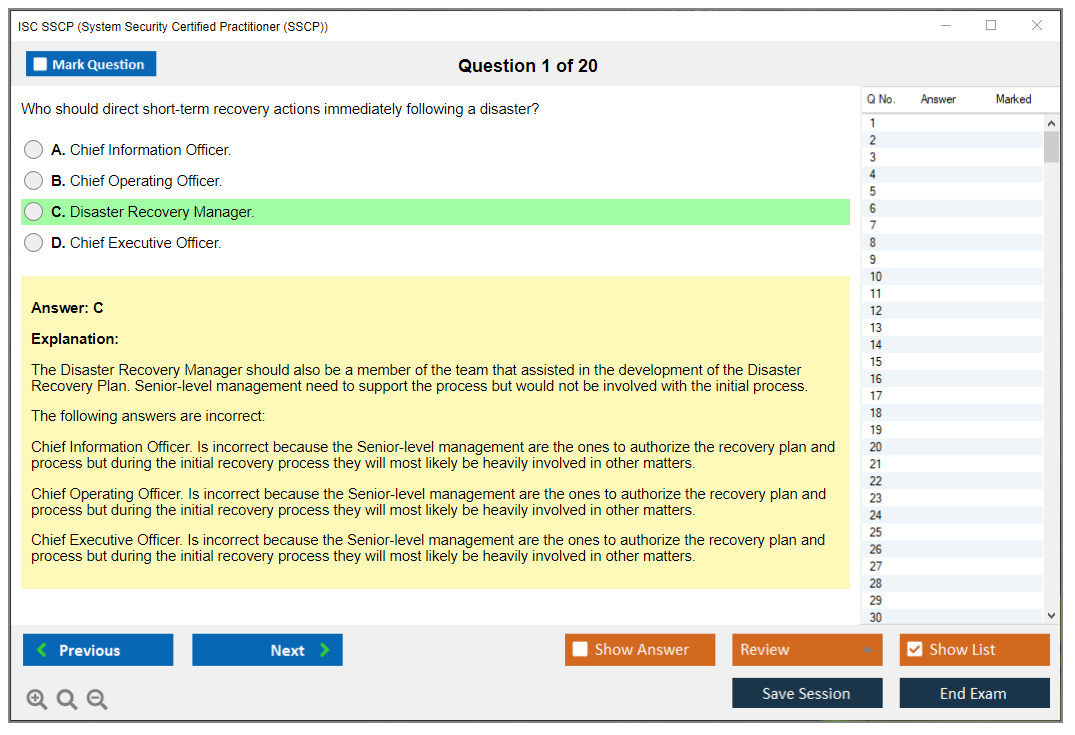
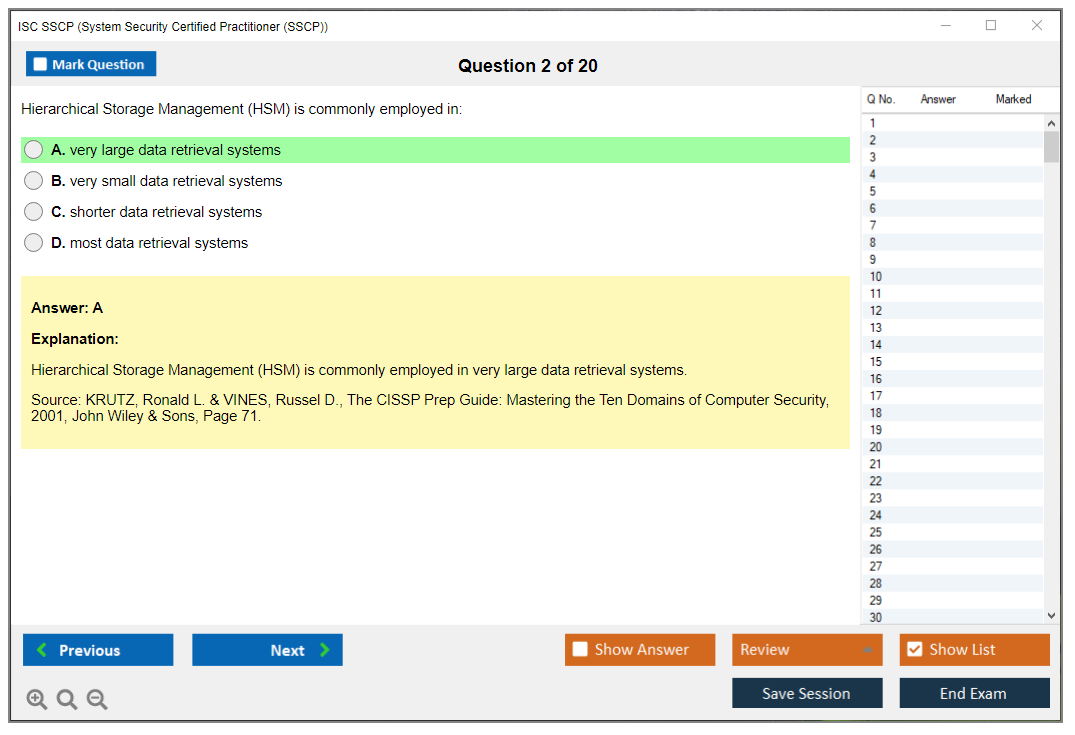
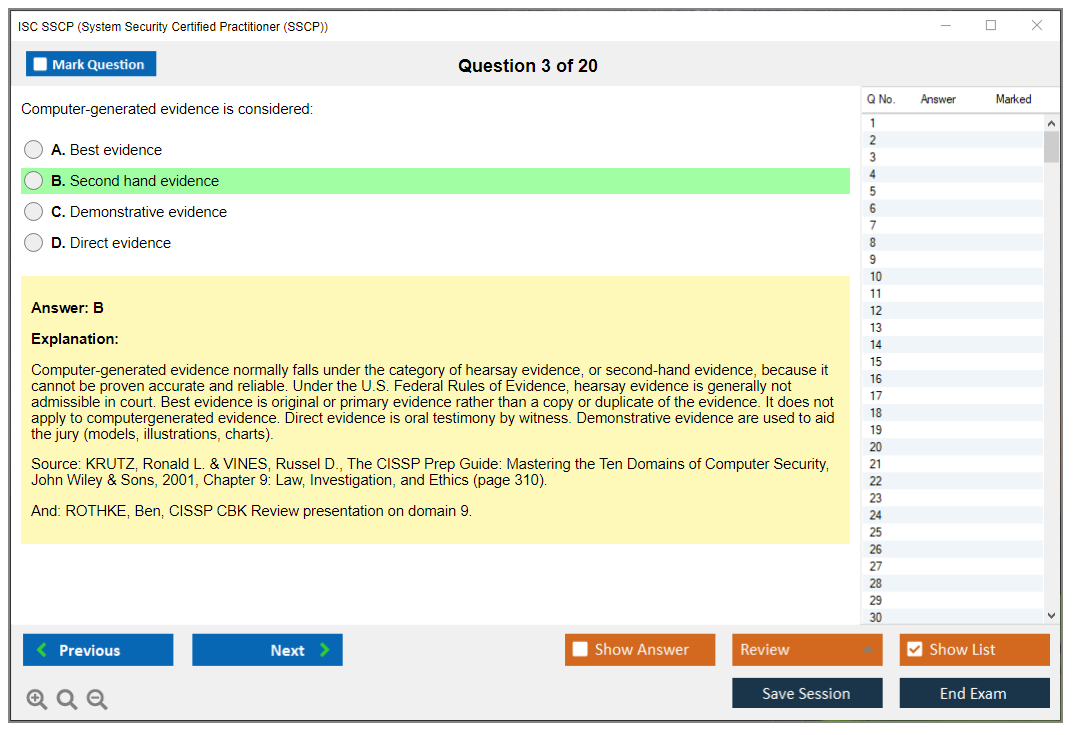
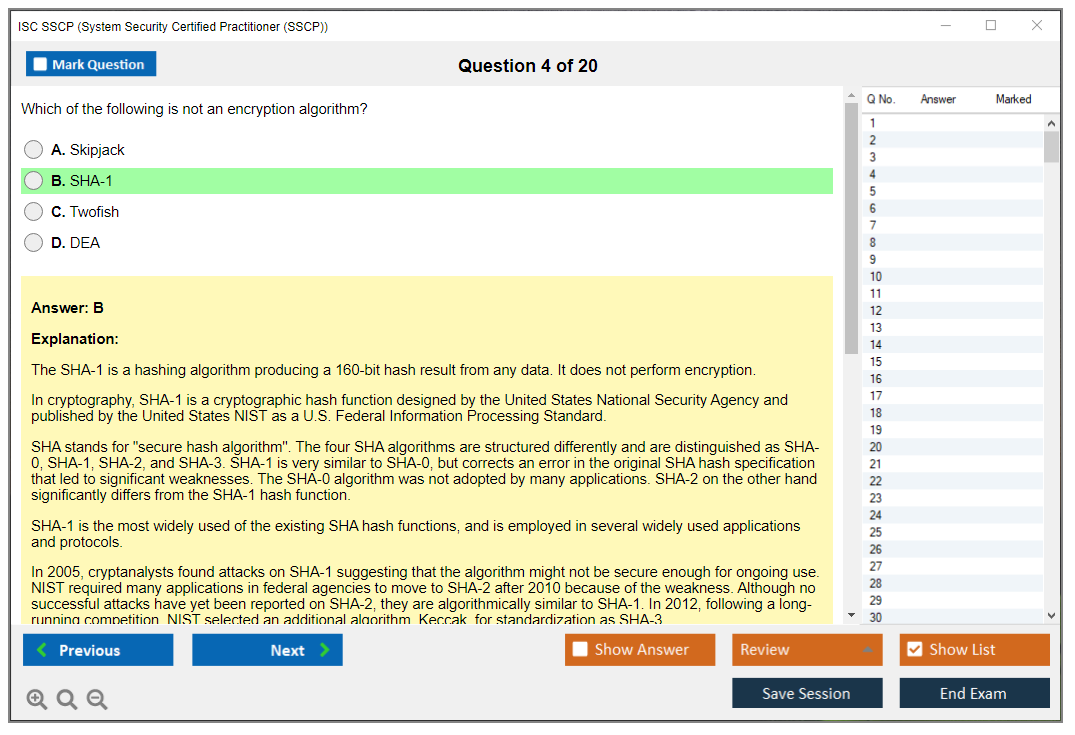
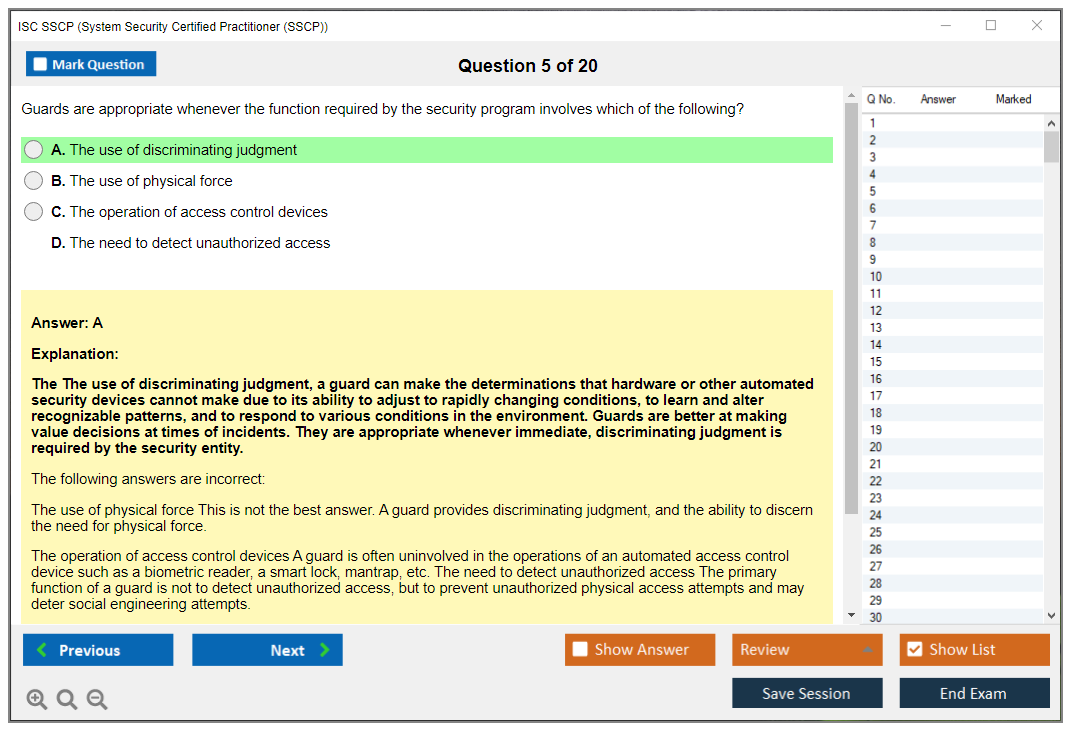
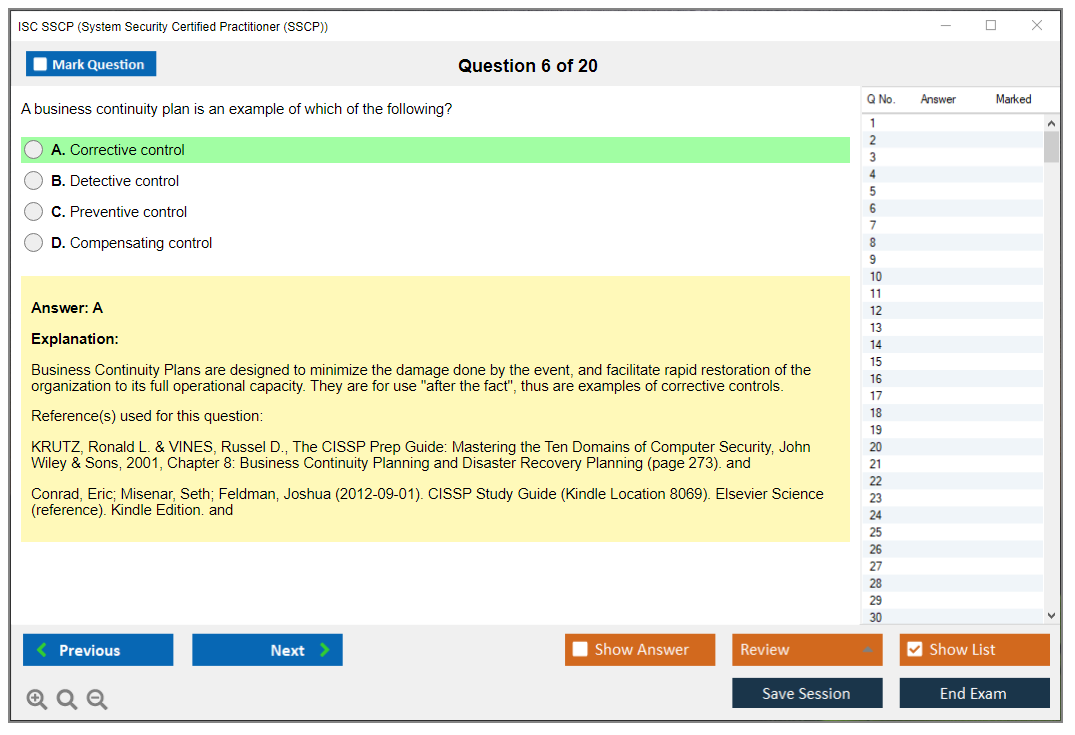
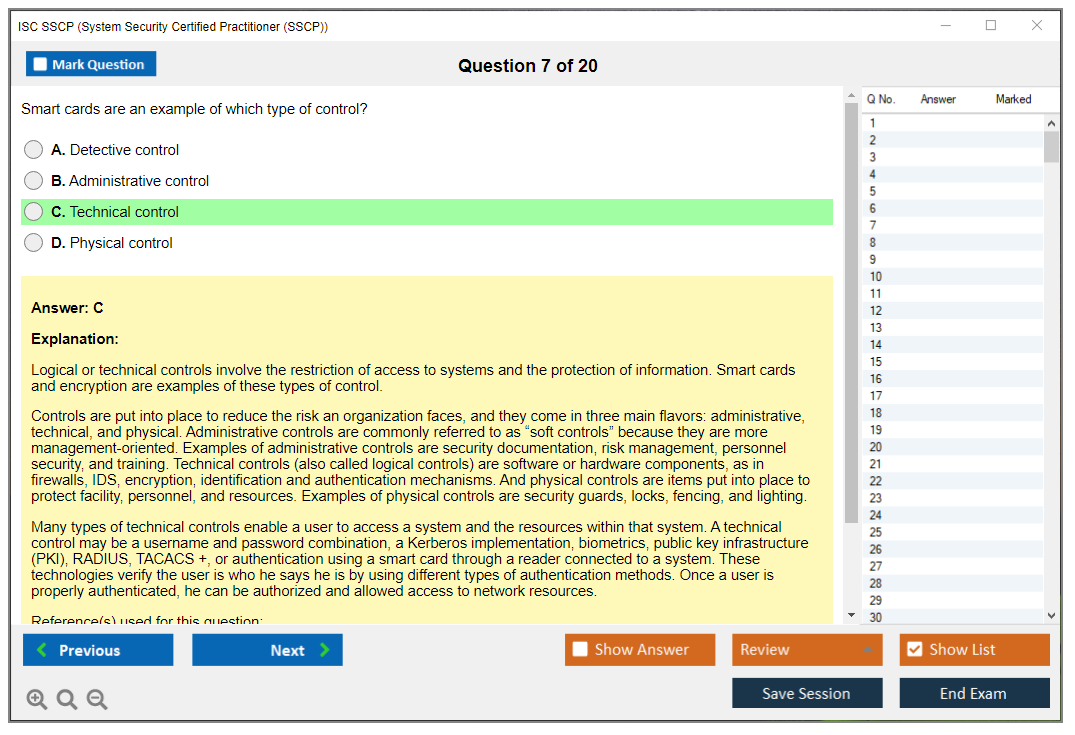
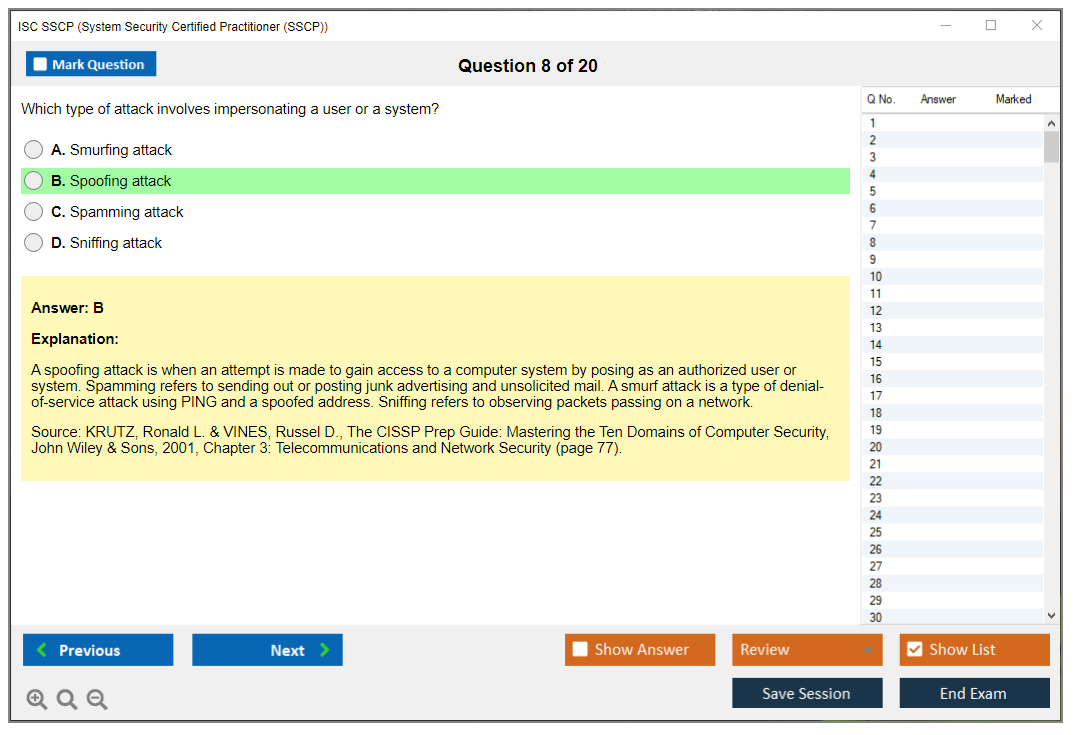
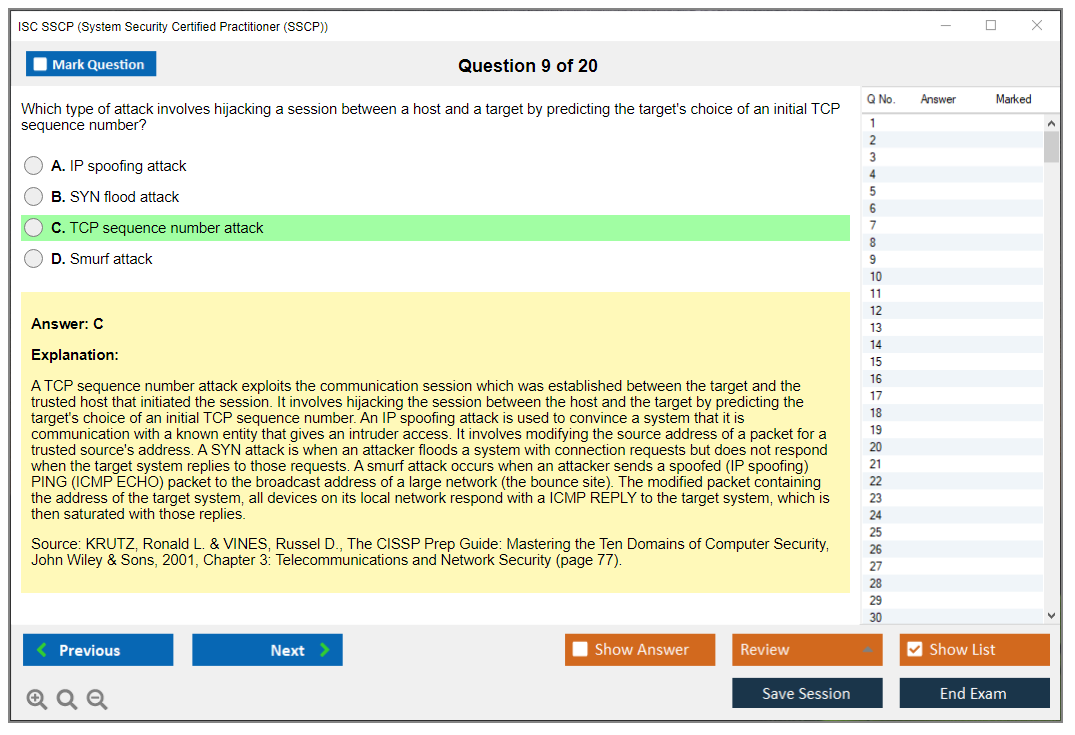
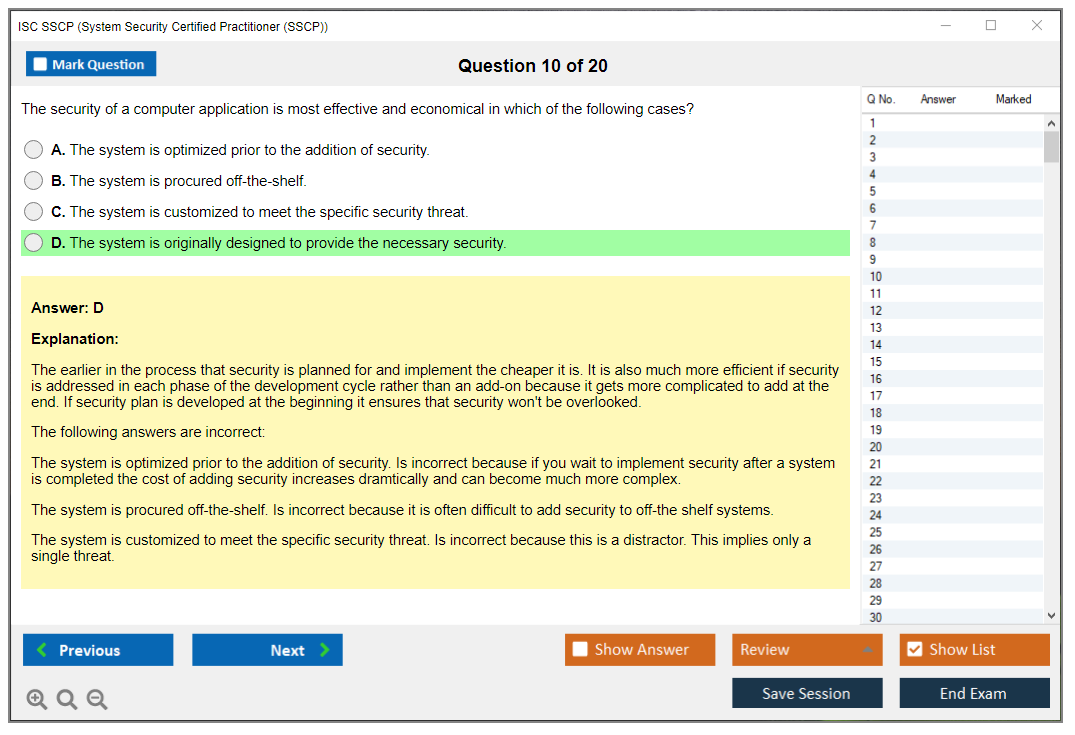
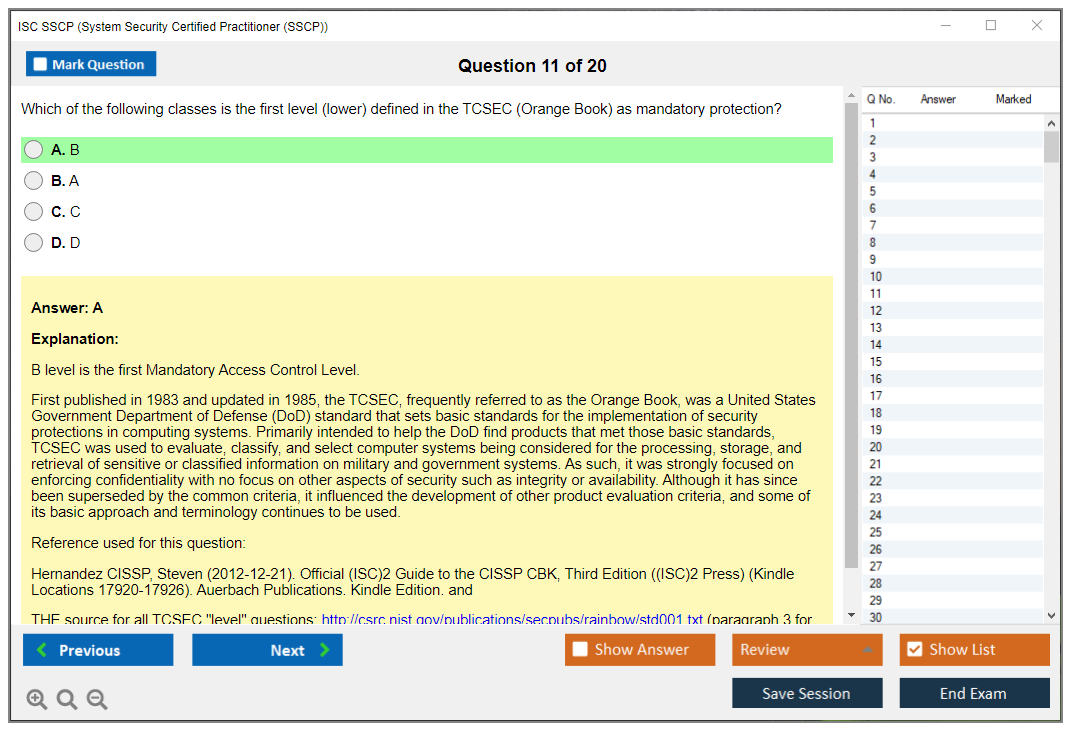
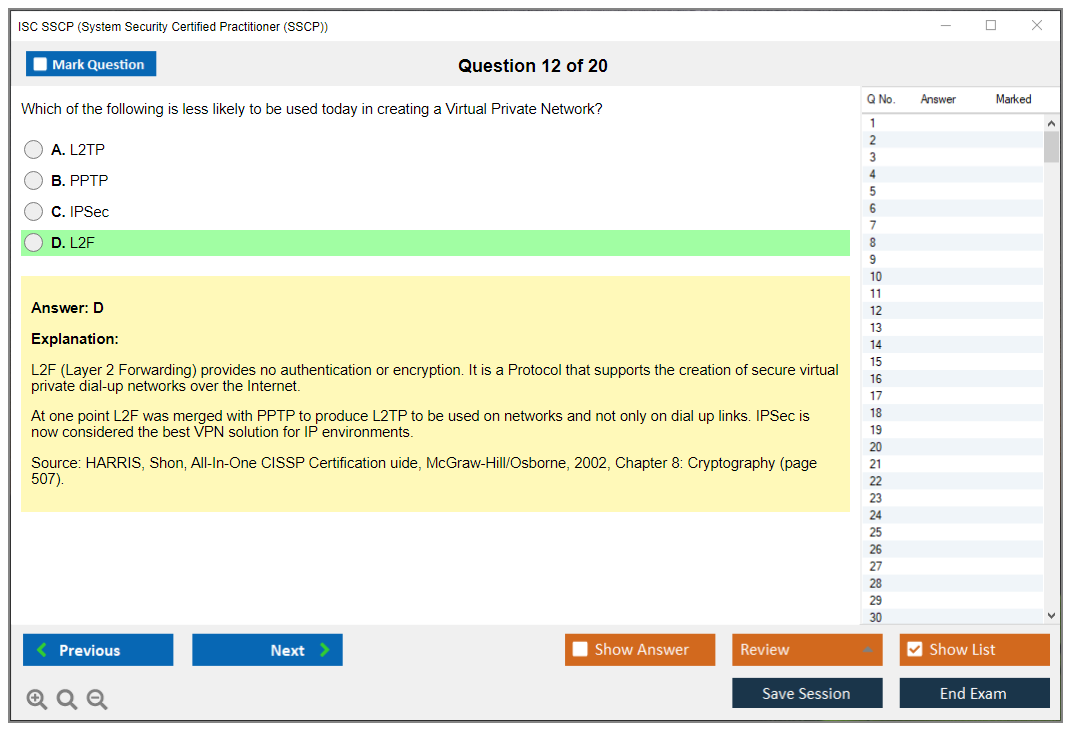
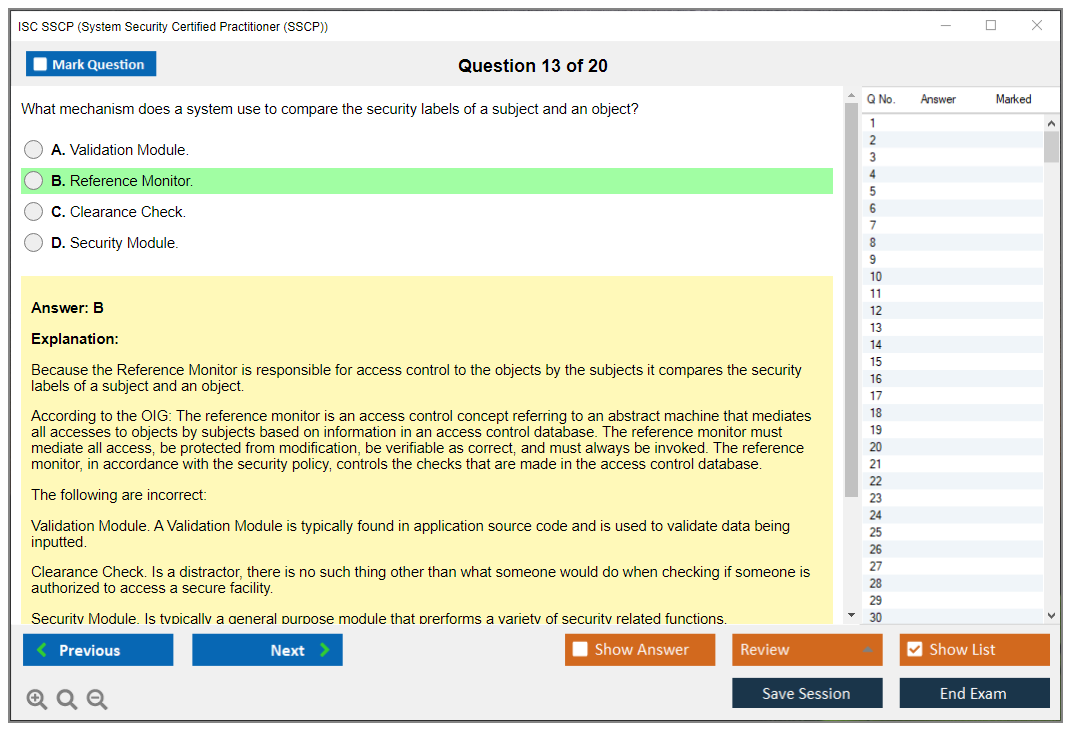
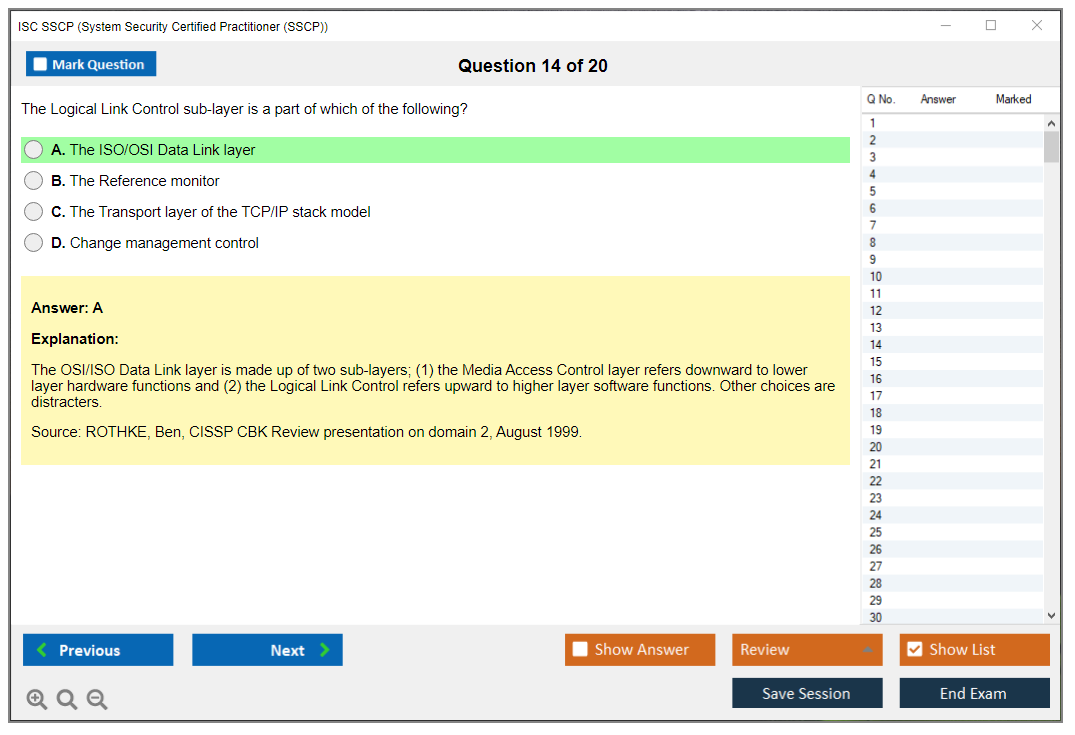
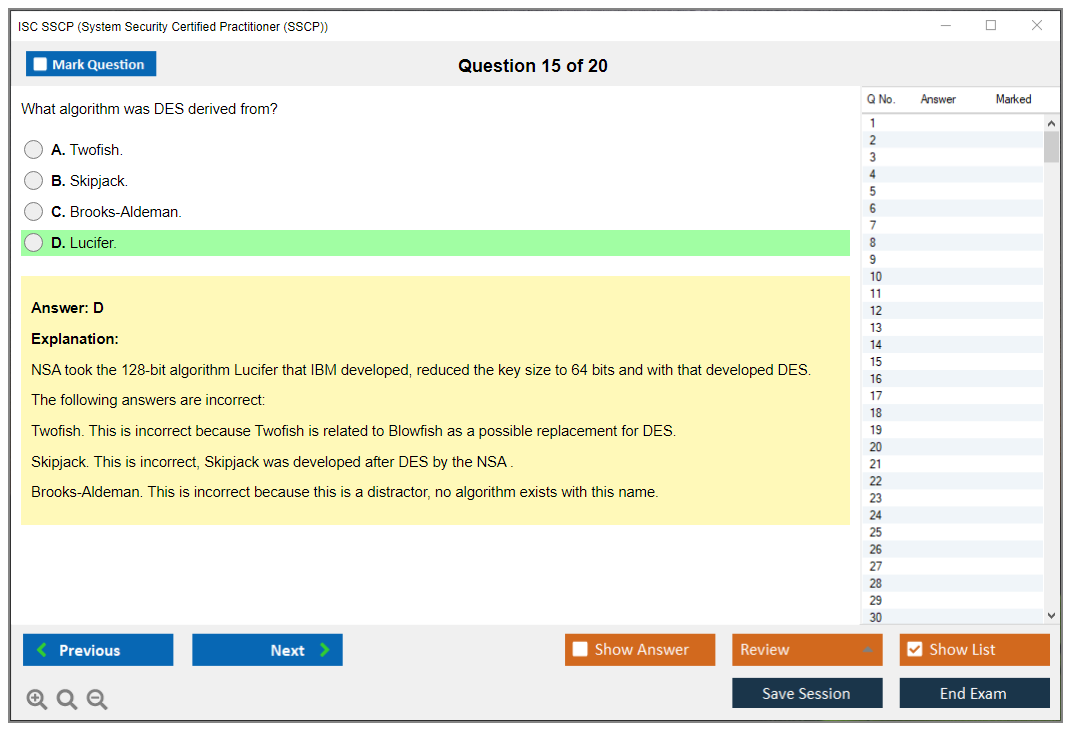
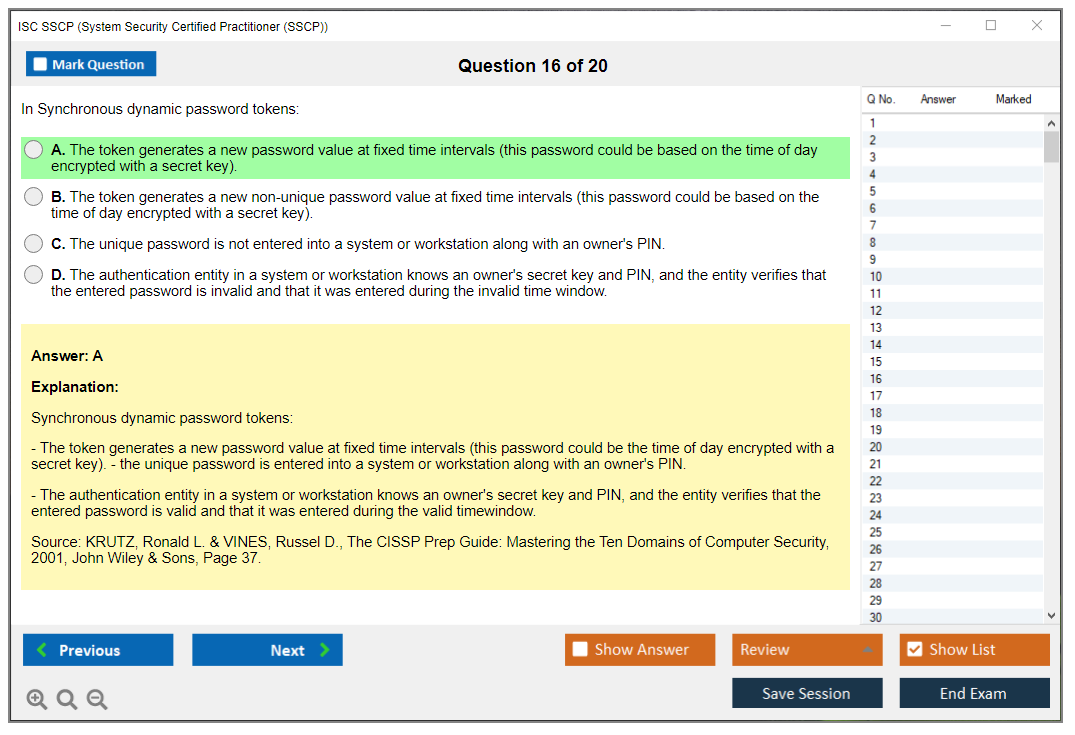
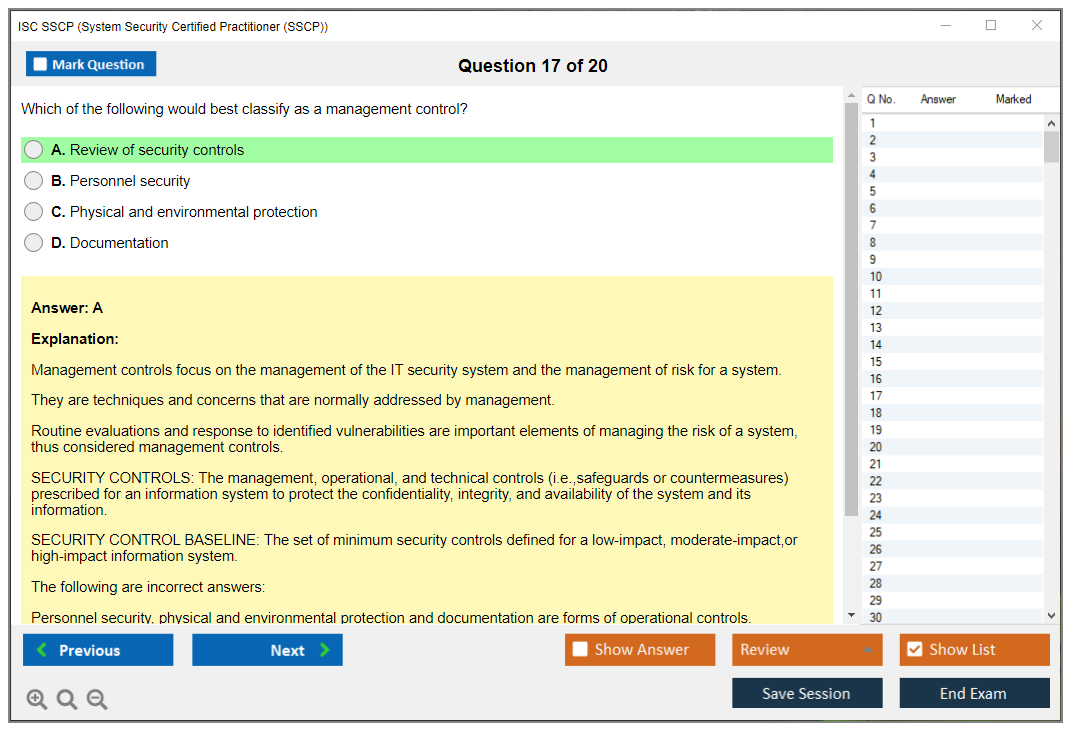
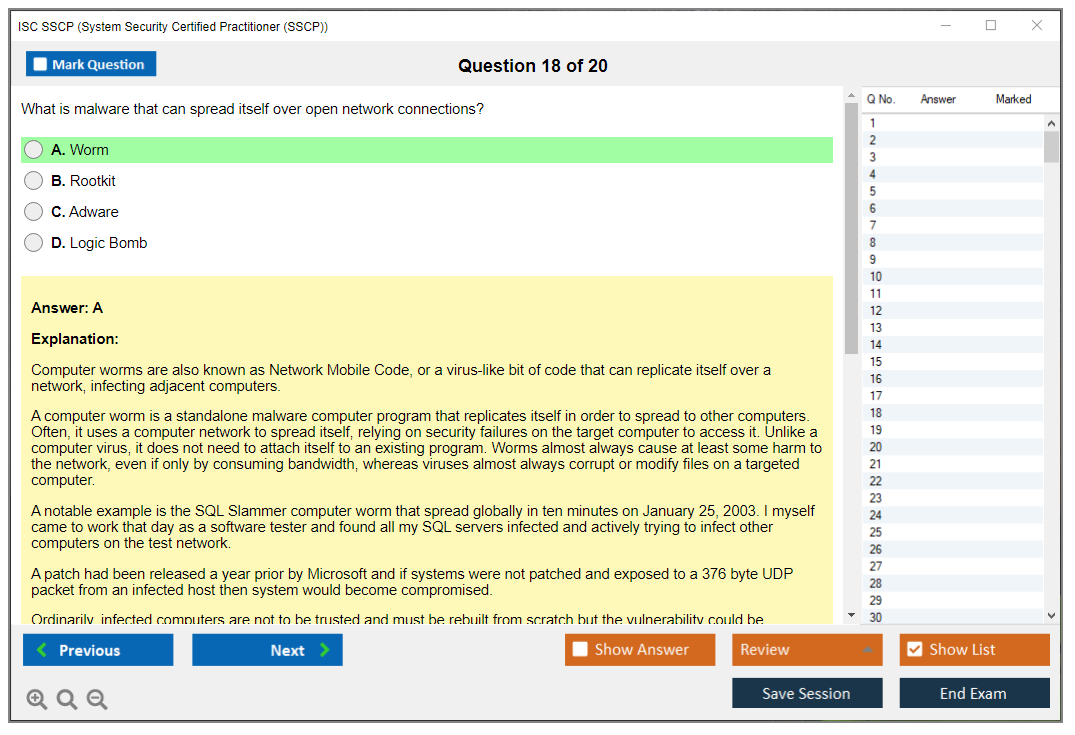
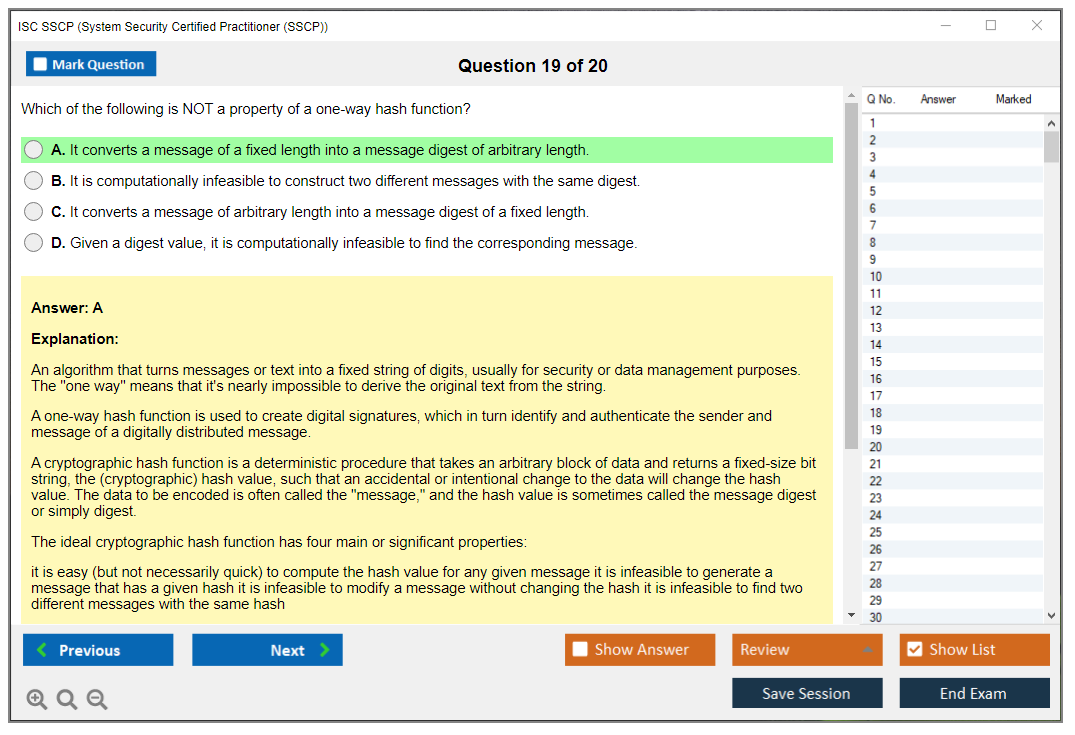
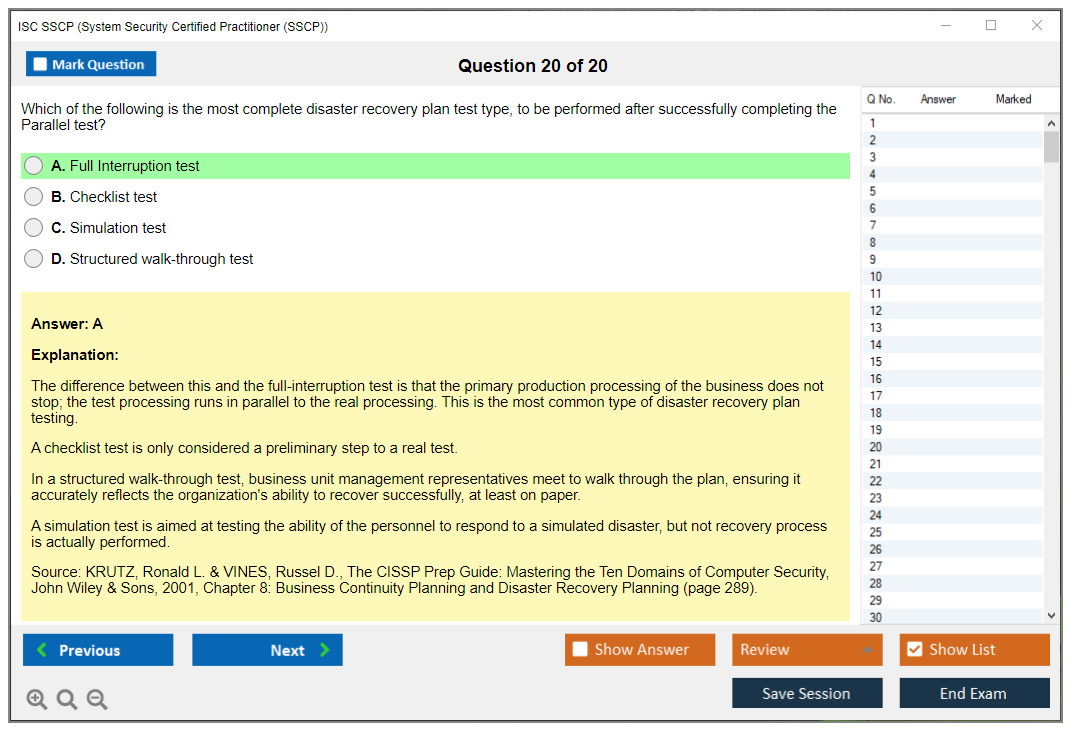
Dumpsarena ISC2 Systems Security Certified Practitioner (SSCP) Free Practice Exam Simulator Test Engine Exam preparation with its cutting-edge combination of authentic test simulation, dynamic adaptability, and intuitive design. Recognized as the industry-leading practice platform, it empowers candidates to master their certification journey through these standout features.
What is in the Premium File?
Satisfaction Policy – Dumpsarena.co
At DumpsArena.co, your success is our top priority. Our dedicated technical team works tirelessly day and night to deliver high-quality, up-to-date Practice Exam and study resources. We carefully craft our content to ensure it’s accurate, relevant, and aligned with the latest exam guidelines. Your satisfaction matters to us, and we are always working to provide you with the best possible learning experience. If you’re ever unsatisfied with our material, don’t hesitate to reach out—we’re here to support you. With DumpsArena.co, you can study with confidence, backed by a team you can trust.
ISC2 SSCP Exam FAQs
Introduction of ISC2 SSCP Exam!
ISC SSCP (Systems Security Certified Practitioner) is an internationally-recognized cybersecurity certification that tests a candidate's knowledge and skills in the areas of system security, risk management, incident response, access control, encryption and more. It is designed to validate an individual's technical competency in the field of information security and can be used to demonstrate their ability to design, implement, and manage a secure infrastructure.
What is the Duration of ISC2 SSCP Exam?
The ISC SSCP exam is a three-hour exam consisting of 125 multiple-choice questions.
What are the Number of Questions Asked in ISC2 SSCP Exam?
The ISC SSCP exam consists of 125 multiple-choice questions.
What is the Passing Score for ISC2 SSCP Exam?
The passing score required in the ISC SSCP exam is 700 out of a maximum possible score of 1000.
What is the Competency Level required for ISC2 SSCP Exam?
The International Information Systems Security Certification Consortium (ISC)2 SSCP exam requires a minimum of 3-5 years of work experience in the IT security field, plus completion of the SSCP certification course. In addition, applicants must demonstrate knowledge and skills in seven domains, including access control, security operations and administration, risk identification, analysis and management, cryptography, and other topics related to IT security.
What is the Question Format of ISC2 SSCP Exam?
The ISC SSCP exam consists of 125 multiple-choice questions. The questions are designed to test a candidate's knowledge of the seven domains of the SSCP Common Body of Knowledge (CBK).
How Can You Take ISC2 SSCP Exam?
The ISC SSCP exam is available to be taken online or at a testing center. To take the exam online, you must register for an account with the ISC and purchase the exam. Once you have purchased the exam, you will receive an email with the exam link and instructions on how to take the exam. To take the exam at a testing center, you must register for an account with the ISC and then register for the exam at a Pearson VUE testing center. Once you have registered, you will receive an email with the exam date, time, and location.
What Language ISC2 SSCP Exam is Offered?
The ISC SSCP exam is offered in English.
What is the Cost of ISC2 SSCP Exam?
The cost of the ISC SSCP exam is $599.
What is the Target Audience of ISC2 SSCP Exam?
The target audience for the ISC SSCP Exam is IT professionals who are looking to demonstrate their knowledge and skills in the areas of system and network security. These professionals may include system administrators, security analysts, security engineers, and security consultants.
What is the Average Salary of ISC2 SSCP Certified in the Market?
The average salary for someone with an ISC SSCP certification is around $90,000 per year.
Who are the Testing Providers of ISC2 SSCP Exam?
ISC2 (International Information Systems Security Certification Consortium) is the official provider of the SSCP exam.
What is the Recommended Experience for ISC2 SSCP Exam?
The recommended experience for the ISC SSCP exam is 3-5 years of cumulative, paid, full-time work experience in one or more of the seven domains of the SSCP Common Body of Knowledge (CBK). This experience should include hands-on technical and/or managerial experience in the implementation, operations, and/or administration of IT systems.
What are the Prerequisites of ISC2 SSCP Exam?
The prerequisite for ISC SSCP Exam is that the candidate must have a minimum of one year of experience in the information security field. The candidate must also have a strong understanding of the seven domains of the SSCP Common Body of Knowledge (CBK).
What is the Expected Retirement Date of ISC2 SSCP Exam?
The official online website to check the expected retirement date of the ISC SSCP exam is the ISC2 website. The link is https://www.isc2.org/Certifications/SSCP.
What is the Difficulty Level of ISC2 SSCP Exam?
The difficulty level of the ISC SSCP exam is considered to be moderate.
What is the Roadmap / Track of ISC2 SSCP Exam?
The certification roadmap for the ISC SSCP exam is as follows:
1. Complete the SSCP certification training course.
2. Pass the SSCP exam.
3. Complete the ISC SSCP Certification Practical Application (CAPA) exam.
4. Pass the ISC SSCP Certification Practical Application (CAPA) exam.
5. Complete the ISC SSCP Certification Advanced Application (CAA) exam.
6. Pass the ISC SSCP Certification Advanced Application (CAA) exam.
7. Receive the ISC SSCP certification.
What are the Topics ISC2 SSCP Exam Covers?
ISC SSCP exam covers seven domains:
1. Access Controls: This domain covers the concept of access control, including physical and logical access, authentication, authorization and identity management. It also covers topics such as access control models, security architecture, and audit and monitoring.
2. Security Operations and Administration: This domain covers the concepts of security operations and administration, including security policies and procedures, user access management, system and application security, and incident response.
3. Risk Identification, Monitoring, and Analysis: This domain covers the concepts of risk identification, monitoring, and analysis, including risk management frameworks, threat and vulnerability management, and risk assessment.
4. Incident Response and Recovery: This domain covers the concepts of incident response and recovery, including incident response planning, response and containment, and recovery and restoration.
5. Cryptography: This domain covers the concepts of cryptography, including encryption algorithms, key management, digital signatures, and public key infrastructure.
What are the Sample Questions of ISC2 SSCP Exam?
1. What are the three primary goals of information security?
2. What are the key components of a security architecture?
3. What is the purpose of a security policy?
4. Describe the differences between a risk assessment and a vulnerability assessment.
5. What is the difference between a security incident and a security breach?
6. What is a business continuity plan and how is it used?
7. What is the purpose of risk management?
8. What are the different types of authentication methods?
9. Describe the different types of access control models.
10. What is the difference between a firewall and an intrusion detection system?
ISC2 SSCP (Systems Security Certified Practitioner) What is the ISC2 SSCP Certification and Why It Matters for Cybersecurity Professionals What is the ISC2 SSCP certification? Look, the ISC2 SSCP certification basically proves you can actually do security work, not just talk a big game at meetings. This Systems Security Certified Practitioner credential validates hands-on technical skills for people who implement, monitor, and manage IT infrastructure using security best practices. It separates those who really understand how to configure firewalls, harden systems, respond to incidents, and maintain network security from those who merely regurgitate buzzwords they heard at conferences. Anyone can sound smart throwing around "zero trust" and "defense in depth," right? The certification covers seven security domains. Through a tough exam. Plus experience verification. Unlike purely theoretical certifications that test memorization, SSCP distinguishes mid-level security folks who've shown... Read More
ISC2 SSCP (Systems Security Certified Practitioner)
What is the ISC2 SSCP Certification and Why It Matters for Cybersecurity Professionals
What is the ISC2 SSCP certification?
Look, the ISC2 SSCP certification basically proves you can actually do security work, not just talk a big game at meetings. This Systems Security Certified Practitioner credential validates hands-on technical skills for people who implement, monitor, and manage IT infrastructure using security best practices. It separates those who really understand how to configure firewalls, harden systems, respond to incidents, and maintain network security from those who merely regurgitate buzzwords they heard at conferences. Anyone can sound smart throwing around "zero trust" and "defense in depth," right?
The certification covers seven security domains. Through a tough exam. Plus experience verification. Unlike purely theoretical certifications that test memorization, SSCP distinguishes mid-level security folks who've shown real competency across access controls, security operations, risk identification, incident response, cryptography, network security, and systems security. The actual stuff that keeps organizations running safely.
Not a beginner cert. Not management either. SSCP sits perfectly for technical practitioners doing actual security work.
Within the entry-level cybersecurity certification ISC2 portfolio, SSCP positions itself as the technical practitioner credential, bridging critical gaps between foundational knowledge and advanced strategic roles. Think of it this way: Certified in Cybersecurity (CC) gets your foot in the door. SSCP proves you can handle genuine security responsibilities without constant supervision. And CISSP elevates you into strategic management territory where you're making organizational decisions rather than implementing technical controls.
Who the SSCP is for (roles and career fit)
Ideal candidates? Network administrators handling security tasks, security analysts working SOCs, systems administrators needing security understanding. Basically IT people transitioning into dedicated security roles who need vendor-neutral validation.
Career roles that benefit from SSCP certification include security operations center analysts, security administrators, network security engineers, security consultants, and systems engineers with security responsibilities. Positions requiring practical implementation skills rather than purely strategic thinking. The cert really opens doors because organizations increasingly require SSCP or equivalent certifications for positions involving security control implementation, compliance monitoring, incident response coordination, and security infrastructure management across industries from finance to healthcare to government.
The certification shows competency in practical security tasks. You're implementing controls. Monitoring logs. Responding when things go sideways. That makes it particularly valuable for hands-on technical roles where you need proof you know your stuff beyond just claiming expertise. I've noticed hiring managers spend way less time questioning your abilities when you've got SSCP listed, which saves everyone time during the interview dance.
SSCP vs other certifications (e.g., Security+, CySA+, CISSP)
Here's where it gets interesting. Compared to CompTIA Security+, SSCP requires documented work experience and covers substantially more advanced topics with greater technical depth that reflects real-world complexity. Security+ is solid for entry-level folks starting out, but SSCP positions itself as a natural progression for experienced practitioners who've been in the trenches dealing with actual incidents. The depth difference? Real. SSCP expects you to analyze complex situations involving multiple variables and select appropriate security controls considering organizational constraints, not just recognize terminology from flashcards.
CySA+ focuses specifically on threat detection. SSCP provides broader coverage across security administration, operations, access controls, risk management, and incident response. Basically everything practitioners do daily.
SSCP is an excellent stepping stone toward CISSP certification because they share similar domain structure and knowledge requirements, but SSCP focuses on implementation while CISSP focuses on management and strategic decision-making. Many professionals use SSCP to build toward CISSP's more stringent five-year experience requirement, gaining both the knowledge foundation and the documented work experience needed for that more advanced credential.
SSCP exam overview
The exam tests application. You'll face questions presenting situations and asking you to choose the best security control, response, or implementation approach given specific constraints. Not memorization. Application under pressure.
The ISC2 SSCP domains get regularly reviewed and updated by subject matter experts to ensure alignment with current job roles and evolving security challenges that practitioners actually face in production environments. The seven domains cover access controls, security operations and administration, risk identification monitoring and analysis, incident response and recovery, cryptography, network and communications security, and systems and application security. Each weighted differently based on job task importance. Some domains carry more weight on the exam, but you need solid understanding across all of them because security work doesn't respect neat boundaries.
Global recognition by employers across industries including finance, healthcare, government, technology, and critical infrastructure sectors enhances career mobility substantially. I've seen SSCP holders move between industries way easier than people with vendor-specific certifications because the knowledge transfers. Security principles remain consistent even when the specific tools change.
SSCP exam cost
Let's talk money. The SSCP exam cost runs $249 USD for ISC2 members and $249 for non-members as of recent pricing. Not bad compared to some vendor certifications that cost $400+ for a single attempt. But that's just the exam voucher, right? You've got training costs, study materials, practice tests. Those expenses add up quickly. Budget maybe $500-1000 total depending on your preparation approach and whether you go with official materials, third-party resources, or bootcamps.
Then there's the annual maintenance fee. $125 once you're certified. You'll also need continuing professional education credits to maintain the cert, which might involve paid training or conferences depending on how you accumulate them.
Factor that into your long-term cost analysis.
SSCP prerequisites and eligibility
Here's something important that trips people up: you need one year of cumulative work experience in one or more of the seven SSCP domains. Actual paid work, not just "I configured a firewall at home for fun" or academic projects from college. If you don't have the year of experience yet, you can still take the exam and become an Associate of ISC2, then you've got two years to accumulate the required experience before your Associate status expires.
After passing, you need endorsement. From someone who can verify your experience, preferably another ISC2 certified professional who knows your work. The endorsement process takes a few weeks typically, sometimes longer if ISC2 decides to audit your application, so keep your documentation handy including detailed descriptions of your security-related job responsibilities.
SSCP difficulty: how hard is the exam?
Is the SSCP exam hard?
Yeah, it's challenging.
Not impossible, but it requires serious preparation and genuine understanding rather than surface-level familiarity. The difficulty comes from the scenario-based questions that test your ability to apply knowledge rather than just recall facts from study guides. Questions where you need to think through implications, consider organizational context, and choose the best answer when multiple options seem partially correct.
Common challenges? The broad domain coverage means you can't just focus on your comfort zone and ignore areas you don't work with daily. The nuanced questions where multiple answers seem correct require careful analysis. And the time pressure of 125 questions in 3 hours means you can't overthink every question without risking running out of time.
People who struggle usually haven't spent enough time with hands-on practice or haven't studied the domains they don't work with daily, creating knowledge gaps that get exposed on exam day.
Study timelines vary wildly. Someone with five years of security experience might need 6-8 weeks of focused study. Someone newer to security might need 3-4 months. It depends on your background and how much quality study time you can dedicate weekly.
Best SSCP study materials
Official ISC2 resources matter here. They're written by the people who create the exam, so alignment is tight. The Official Study Guide covers all domains in detail with explanations that reflect how ISC2 thinks about security. The official practice tests help you understand question formats and identify weak areas requiring additional study. Some people swear by the official training course, though it's pricey and might not fit every budget or learning style.
Third-party books like Sybex and McGraw-Hill provide different perspectives. I'd recommend getting at least two different study resources because different authors explain concepts differently, and something that doesn't click in one book might make perfect sense when another author approaches it from a different angle or uses different examples.
Hands-on practice is critical though. You can't just read about security controls and expect to understand how they work in practice. Set up virtual labs, play with security tools, practice incident response scenarios using free resources or home lab environments. The SSCP practice tests help build test-taking skills, but real experience cements the knowledge in ways that reading never can.
SSCP practice tests and exam prep strategy
Quality practice exams are gold. They help you identify knowledge gaps before exam day, get comfortable with question formats and the way ISC2 phrases questions, and build test-taking stamina for sitting through a three-hour exam. Look for practice tests that explain why answers are correct and incorrect. That's where real learning happens rather than just memorizing which letter to choose.
Use practice exams strategically. As diagnostic tools early in your study to identify weak areas. Then as confidence builders near exam day. Don't just memorize practice test answers. That's a trap because the actual exam will present different scenarios testing the same underlying concepts.
Final week? Review your weak domains using multiple resources. Do timed practice tests simulating exam conditions. Get your mind right mentally. Don't cram new material the night before, that just creates confusion and anxiety.
Good sleep matters. Show up confident.
SSCP renewal requirements (CPEs and maintenance)
Once certified, you need 20 continuing professional education credits annually (60 over three years) to maintain your certification in good standing. CPE requirements keep you current with evolving security practices, technologies, and threats that emerge constantly in this field. What counts toward CPEs? Professional development courses, security conferences, publishing articles, volunteering for security initiatives, even self-study with proper documentation proving you actually did the work.
The renewal cycle runs three years. Miss your renewal deadline and you lose the certification. Not fun after all that work earning it initially. Budget time for CPE activities throughout your certification period and track them diligently in your ISC2 account so you're not scrambling at the last minute to document credits you earned but didn't record properly.
Why SSCP matters for your career
SSCP certification holders report average salary increases of 15-25% compared to non-certified peers in similar roles performing identical work. That's real money for career advancement, not just a line on your resume. Median salaries range from $75,000 to $95,000 depending on geographic location, years of experience, and industry sector, with higher compensation in major metropolitan areas and industries like finance and healthcare that face strict regulatory requirements.
The credential satisfies Department of Defense Directive 8570.01-M requirements for Information Assurance Technical Level II positions across military and government contractor roles. If you're working government contracts or military cybersecurity roles, SSCP checks that compliance box without needing additional certifications.
Organizations benefit from employing SSCP-certified practitioners through improved security posture and reduced risk exposure. The certification provides structured validation of skills that might otherwise be difficult to assess through resumes or interviews alone. Hiring managers know what SSCP means without requiring extensive technical screening.
You can do the work.
Professional networking opportunities through ISC2 membership connect you with the global security community, providing access to resources, research, and peer knowledge sharing that's really valuable as threats evolve constantly. The vendor-neutral nature ensures your skills remain transferable across different technologies and platforms rather than being locked into specific products that might become obsolete.
As cybersecurity workforce gaps continue expanding globally with demand outpacing supply of qualified professionals, SSCP certification provides competitive differentiation in job markets where qualified security practitioners remain in high demand across industries.
It's worth it.
SSCP Exam Structure, Format, and Domain Breakdown
What is the ISC2 SSCP certification?
The Systems Security Certified Practitioner certification is ISC2's "working security practitioner" credential. Not research-focused. Not management. It's for folks who actually touch systems, networks, endpoints, access controls, and incident workflows. People who've gotta prove they can make smart security decisions when things get messy.
This is a solid entry-level cybersecurity certification ISC2 option, but don't mistake "entry-level" for easy. The thing expects you to think like a security admin juggling controls, uptime demands, organizational policy, and unpredictable human behavior all at once. Sometimes you're staring at two answers that both seem reasonable but only one's actually correct.
Who the SSCP is for (roles and career fit)
Security analyst (junior level). Sysadmin who suddenly got security dumped in their lap. Network admin configuring firewall rules and troubleshooting VPN tickets. Help desk staff transitioning into IAM work. Anyone working SOC shifts who wants a credential that's more operations-heavy than pure governance paperwork.
Some folks take it after Security+. Others take it instead. Really depends what you're doing day to day.
SSCP vs other certifications (e.g., Security+, CySA+, CISSP)
Security+ is broader and more "survey course" vibes. SSCP feels more like, "Okay, here's the situation unfolding. What do you do next, and what control actually fits this scenario?" CySA+ leans harder into detection and analysis, plus blue-team workflows. CISSP is bigger, more managerial, and a different kind of pain altogether.
SSCP has ISC2 flavor. That means more standards vocabulary and process thinking baked in.
SSCP exam overview
The SSCP exam is 150 total items. That breaks down into 125 scored questions plus 25 unscored pretest questions. Here's the kicker: candidates can't tell which questions are scored versus pretest, so you've gotta treat every single question like it matters.
Three hours. 180 minutes. That's roughly 1.2 minutes per question, which sounds manageable until you're staring at a lengthy scenario that wants you to pick the single best control. Then you realize you can't read like a sleepy human and still finish on time.
Exam format (question types, length, time)
All questions are multiple-choice with four answer options (A, B, C, D). No select-all. No matching. No drag and drop nonsense. You pick one best answer.
But don't confuse "multiple-choice" with "easy test." Questions are scenario-based and application-focused rather than simple recall. You're usually asked to analyze a messy situation and decide what security action or control fits best, not just regurgitate a term from flashcards.
The exam uses Computer Adaptive Testing (CAT) methodology where question difficulty adjusts based on candidate performance. Get one right, and you'll probably see more challenging items next. Miss one, and the algorithm adjusts accordingly. CAT format means each candidate receives a unique exam adjusted to their demonstrated knowledge level. The adaptive algorithm is constantly trying to determine competency across all domains, not just the ones you personally like or feel confident about.
One more CAT reality. You can't skip questions and return later. Answer it. Move on. That's it, no going back.
Exams are administered at Pearson VUE testing centers worldwide. Availability includes multiple languages like English, German, Spanish, French, Japanese, Korean, and Chinese. You can usually find a center near you, but schedule early because popular slots vanish fast. I once tried booking three days before an exam and the closest available center was 90 miles away, which taught me that lesson the hard way.
SSCP exam objectives (domains) and what each covers
ISC2 SSCP domains are seven areas, each with a weighting that shapes how many questions you're likely to see. Domain weighting keeps you honest. No passing by being "the crypto person" only.
Domain 1: Security Operations and Administration (16%). This is where a lot of real-world work lives: implementing security infrastructure, protecting resources, incident response basics, disaster recovery, and investigations. It covers logging and monitoring systems, preventive maintenance, patch management, change management processes, and coordinating security awareness training. If you've ever had to argue for patch windows or chase missing logs during an incident, you'll recognize the vibe here.
Domain 2: Access Controls (15%). Authentication, authorization, accountability, models, and physical plus logical restrictions. Expect identity management systems, multi-factor authentication, RBAC, MAC, and DAC concepts. The trick here is reading what the business actually needs, then choosing a model that matches the requirement. Not the one you think is coolest or most elegant.
Domain 3: Risk Identification, Monitoring, and Analysis (15%). Risk assessments, threat analysis, vulnerability identification, and treatment strategies. Quantitative and qualitative risk analysis shows up, plus risk registers, control selection, implementation, and continuous monitoring for new threats. People underestimate this domain because it sounds "paperwork-y," then the exam hits them with prioritization questions where every option is partially right.
Domain 4: Incident Response and Recovery (13%). Detection, classification, response procedures, evidence handling, recovery, and post-incident analysis. You'll see detection systems, escalation procedures, containment, eradication, recovery validation, and lessons learned documentation. Tiny detail matters here. Chain of custody, when to isolate, when to preserve evidence. Those are the kinds of choices the scenarios poke at.
Domain 5: Cryptography (10%). Encryption concepts, algorithms, key management, digital signatures, certificates, and protocol implementation. Symmetric vs asymmetric, hashing, PKI, TLS, and cryptographic lifecycle management. This one's smaller by weight, but the questions can be sharp because they mix crypto theory with deployment reality, like certificate handling or choosing the right control for data in transit.
Domain 6: Network and Communications Security (16%). Architecture, secure design, attacks, devices, and secure communications. OSI and TCP/IP models, segmentation, firewalls, IDS/IPS, VPNs, wireless security, and network access control. Mentioned casually: expect attack patterns too, but usually framed as "what control mitigates this threat" rather than "name the attack type."
Domain 7: Systems and Application Security (15%). Endpoint security, malware defense, app security principles, secure development, hardening. Operating system hardening, mobile device security, virtualization security, cloud security considerations, and secure software development lifecycle principles. This is where practical admin thinking really matters, because the "best" answer often depends on scope, impact, and what you can actually enforce in the environment.
Each domain requires more than memorization. You need understanding of how concepts apply to messy real-world environments. Questions often integrate knowledge across multiple domains, like a scenario that starts as a network issue, turns into access control problem, then ends with incident handling and documentation requirements all tangled together.
SSCP passing score (how scoring works)
People ask about the SSCP passing score constantly. ISC2 uses scaled scoring for many exams, and CAT complicates the "how many did I get right" mindset because the algorithm's evaluating your ability level across the blueprint. Not giving you a simple percent grade. The practical takeaway? You don't game it. You answer carefully, keep moving, and don't spiral after a tough question.
SSCP cost and fees
SSCP exam cost varies by region and policy updates, so check ISC2's current pricing before you buy anything nonrefundable. Then add the stuff nobody budgets for: SSCP study materials, maybe a SSCP training course if you learn better with structure, and SSCP practice tests if you need reps.
Extra costs can include retake fees if you fail. That happens, it's not uncommon. Ongoing, there's an annual maintenance fee for keeping the certification active, plus continuing education expenses.
SSCP prerequisites and eligibility
SSCP prerequisites include work experience expectations from ISC2, but there's also the Associate of ISC2 route if you pass the exam before you meet the experience requirement. That matters for career changers coming from non-IT backgrounds.
You'll also deal with endorsement and documentation requirements. Not hard exactly, just don't procrastinate it, because people pass and then let the admin part drag on forever.
Recommended background knowledge? Basic networking. Basic Windows or Linux admin. Familiarity with tickets, change control, and why least privilege is more than a slogan you say at meetings.
SSCP exam difficulty: how hard is the exam?
SSCP exam difficulty depends on two things: whether you've actually done the work, and whether you can read scenarios without overthinking. Compared to Security+, SSCP often feels more applied. Less trivia, more "what's the best next step given constraints," which is harder for folks who only studied definitions from a book.
Common challenges? Time management, second-guessing yourself, and missing one keyword like "most cost-effective" or "first action" buried in the question. Another one: mixing up what you want to do versus what policy or compliance actually requires.
Study timeline. If you're already in IT and touch security tasks regularly, 4 to 8 weeks is realistic. If you're new, plan longer and do labs, not just reading.
SSCP practice tests and exam prep strategy
SSCP practice tests help if you use them right. Not as a scoreboard, as a diagnostic tool.
Review wrong answers aggressively, and write down why the correct choice is better. Not why yours was "kind of okay." Aim for consistency across domains, because domain weighting means you can't ignore a weak area and hope it doesn't show up.
Final week tips? Sleep properly. Light review. Confirm Pearson VUE logistics. Bring the right ID documents. Eat something normal. CAT punishes panic because you can't mark items and come back later.
SSCP renewal requirements (CPEs and maintenance)
SSCP renewal requirements include continuing professional education credits and maintenance fees on a renewal cycle. The exact CPE count and cycle length can change by policy, so verify in your ISC2 portal, but the idea's simple: keep learning, log it, pay the fee, don't let it lapse.
What counts for CPE? Training, webinars, relevant work activities in some cases, conferences, sometimes even teaching. Track it monthly. Waiting until the last minute is a bad time.
SSCP FAQ
How much does the ISC2 SSCP exam cost?
Check ISC2 for current SSCP exam cost by region, because pricing and taxes can differ significantly.
What is the passing score for the SSCP exam?
ISC2 uses scaled scoring and CAT, so focus on domain mastery rather than chasing a percent target.
Is the SSCP exam hard compared to Security+?
Often yes, because it's more scenario-driven and expects practitioner judgment, not just recognition or recall.
What are the SSCP prerequisites and work experience requirements?
There's an experience expectation, plus an Associate of ISC2 option if you pass first and earn experience after.
How do I renew my SSCP certification and how many CPEs do I need?
You renew by meeting CPE requirements and paying maintenance fees during the cycle. Confirm the current numbers in ISC2's official renewal policy documentation.
SSCP Exam Cost, Fees, and Total Investment Breakdown
Breaking down what you'll actually spend on SSCP
Understanding what you'll shell out for ISC2 SSCP certification matters before diving in. The SSCP exam cost runs $249 USD with ISC2 membership, $349 without. That's reasonable for intermediate security credentials, especially versus what you'd spend on something like CISSP.
Now here's the interesting part. ISC2 membership costs just $50 yearly, which means you save $100 on exam fees by joining first. You pocket $50 before considering other member perks like webinars, research publications, networking opportunities, and professional development resources that extend way beyond exam prep itself.
Vouchers stay valid one year. That's generous flexibility for scheduling when you're actually ready, not when deadlines force decisions.
When things don't go according to plan
Retake fees? Same pricing. $249 members, $349 non-members. This alone should push you toward thorough prep since nobody wants paying twice. You'll wait 30 days after failing before retaking, though there's no lifetime attempt limit. Still, each failed attempt adds up when factoring both money and time lost.
Study materials are where costs start adding up
Beyond exam fees, SSCP study materials represent your next investment chunk. Ranges vary wildly depending on learning preferences and chosen resources.
The Official ISC2 SSCP Official Study Guide typically runs $60-80, providing full coverage aligned directly with exam objectives and question styles mirroring what you'll actually encounter. The Official ISC2 SSCP Official Practice Tests book costs around $40-50 containing hundreds of practice questions with detailed explanations. These two resources alone can get you pretty far with disciplined studying.
ISC2's official training course is where prices jump. We're talking $799 to $2,799 depending on self-paced online versus instructor-led formats. That structured learning with expert instruction appeals to people needing external accountability or preferring guided learning over self-study approaches.
Third-party providers offer alternatives. Pluralsight, LinkedIn Learning, and Cybrary have SSCP prep courses ranging from $29-299 monthly subscriptions to $300-600 standalone courses. Video-based training from ITProTV or CBT Nuggets typically costs $59-99 monthly subscription access. The subscription model works well if knocking out studying within one or two billing cycles.
I knew someone who cycled through three different video platforms before finding one that clicked. Sometimes you just need to hear the material explained a certain way, and what works for your coworker might put you to sleep. Worth trying free trials before committing to annual plans.
Practice tests deserve their own budget line
SSCP practice tests from vendors like Boson, Transcender, or Kaplan range $99-199. They provide realistic exam simulations with performance analytics, hundreds of questions, detailed explanations, performance tracking, and customizable quizzes targeting weak areas. I've found these invaluable for identifying knowledge gaps pre-exam. Our SSCP Practice Exam Questions Pack runs $36.99 giving another solid readiness-testing option without breaking banks.
Hands-on lab environments through platforms like Cybrary or INE may cost $49-99 monthly but provide practical experience reinforcing theoretical domain knowledge. Not everyone needs these, but if you're light on real-world security experience, they bridge gaps.
Used or previous-edition materials reduce costs but risk leaving knowledge gaps in updated domains. The thing is, exam content changes, so weigh savings against potentially outdated information.
The ongoing investment you need to remember
Annual Maintenance Fee (AMF) of $65 must be paid by all certified SSCP holders maintaining active status. This represents ongoing investment beyond initial certification covering ISC2's costs for certification program maintenance, continuing education resources, and member services supporting professional development throughout your certification lifecycle. Factor this into long-term planning.
Realistic total investment expectations
Budget $500-1,500 total for first-time certification including examination fee, membership, study materials, practice tests, and potential training courses. That's a wide range. Your actual spend depends on learning style, existing knowledge, and how much structured help needed.
Many employers reimburse certification costs as professional development investments. Ask about tuition assistance or certification reimbursement programs before paying out of pocket. Some organizations purchase examination vouchers in bulk at discounted rates, potentially reducing per-employee costs for teams pursuing ISC2 SSCP certification.
Military members, veterans, and government employees may qualify for discounted examination fees through special ISC2 programs supporting public sector cybersecurity workforce development. Financial assistance programs including ISC2's scholarship opportunities may help candidates facing financial barriers, with applications typically opening annually.
The hidden costs nobody talks about
Time investment represents significant indirect cost. Most candidates spend 40-120 hours studying depending on experience level and existing security knowledge. Opportunity costs of study time should factor into total investment calculations, particularly when balancing preparation with full-time employment and personal responsibilities.
Failed examination attempts multiply total costs through retake fees and extended study periods. This shows the value of thorough preparation (possibly using resources like our SSCP Practice Exam Questions Pack) before scheduling initial attempts.
Is the investment actually worth it?
Return on investment typically shows up within 6-12 months through salary increases, promotions, or expanded job opportunities enabled by SSCP credentials. I've seen people get significant bumps just adding this cert to resumes. The certification investment should be viewed as career-long assets rather than one-time expenses, with credential value appreciating through years of professional practice and continuing education.
If considering other ISC2 certifications, CC (Certified in Cybersecurity) offers more entry-level options, while CCSP or CISSP represent next-level credentials after getting SSCP secured. Each has its own cost structure and career implications, but SSCP hits a sweet spot for intermediate practitioners looking to validate security operations knowledge without massive investments required for CISSP.
Bottom line? Yes, costs exist. But compared to other professional certifications across IT fields, SSCP remains relatively affordable while delivering solid career ROI. Plan budgets, use membership savings, and invest in quality prep materials matching learning styles. The upfront investment pays dividends over career trajectories.
SSCP Prerequisites, Eligibility Requirements, and the Endorsement Process
What is the ISC2 SSCP certification?
Honestly? Sweet spot territory. ISC2 SSCP certification is not your intro-level "click through security basics" quiz, but it also does not drown you in CISSP management-speak for eight hours straight. The thing is, it's actually technical and practical in ways that matter when you're already elbow-deep in systems work and suddenly security becomes your problem whether you signed up for it or not.
Short version: it fits people already touching networks, systems, or audit functions who have realized security responsibilities are not going away anytime soon.
Who the SSCP is for (roles and career fit)
Practitioners. That's the vibe here: security administrators, network admins suddenly handling security tasks, systems administrators, security analysts, IT auditors, and military folks doing network defense or information systems security officer gigs.
You're expected to understand controls and implementation, not just regurgitate definitions from a glossary you memorized the night before. Access control implementation shows up as normal work, along with monitoring, incident response, vulnerability management, policy implementation, and even security awareness coordination, because let's be real, that's what most actual security jobs turn into after the first week when the welcome-aboard excitement wears off.
Career changers doing adjacent IT work? Fits. Recent grads who can pass the exam but still need time accumulating the experience requirement? Also fits.
SSCP vs other certifications (e.g., Security+, CySA+, CISSP)
Security+ casts wider. More entry-level. CySA+ leans blue-team analyst work specifically, while CISSP is the big governance-heavy beast expecting years of experience before you even walk in.
SSCP is the "I can actually run these controls" credential. Not gonna lie, if you're doing hands-on administration and want vendor-neutral recognition from ISC2 without waiting years to qualify, SSCP makes sense.
SSCP exam overview
Where people overthink everything. It's not trivia night at your local bar. It's scenario-heavy, forcing you to pick the "best" answer, which means understanding how businesses actually operate, how security supports them, and where you cannot just lock everything down because the company still has to, you know, function and make money.
Exam format (question types, length, time)
Multiple-choice questions. Time-boxed. Computer-based testing.
You're managing pacing as much as knowledge here, because long scenario questions can absolutely eat minutes fast if you're not careful. Also? The SSCP exam objectives matter way more than whatever random topic you're crossing your fingers will not appear. Stick to the blueprint.
SSCP exam objectives (domains) and what each covers
Seven ISC2 SSCP domains total. You do not need to memorize some marketing list verbatim, but you absolutely need to understand scope: access controls, security operations, network and communications security, systems and application security, incident response, risk identification, and governance-type fundamentals.
Broad coverage, yes, but still operational in nature rather than purely theoretical. Experience across multiple ISC2 SSCP domains strengthens your application when endorsement time rolls around, though concentrated experience in fewer domains still counts if you hit that one-year threshold and the work is really security work.
SSCP passing score (how scoring works)
People ask about SSCP passing score like it's a simple percentage they can memorize. ISC2 uses scaled scoring, and they do not publish "you need exactly 78%" type clarity anywhere, so treat it like this: aim to be consistently strong across domains, because limping through half the content and hoping your favorite area carries you is honestly a terrible plan that fails more often than it works.
SSCP cost and fees
Money matters, right? Budget matters. And yeah, people constantly forget about the ongoing costs beyond just the exam itself. I saw someone once complain online about the renewal fees two years in, like the AMF was some surprise plot twist nobody mentioned. It's listed right there in the candidate materials, but I guess nobody reads those anymore.
SSCP exam cost (voucher/exam fee)
SSCP exam cost varies by region and whatever local taxes apply, but plan for the exam fee plus whatever your training plan ends up costing. If your employer pays, great. If not, you're making tradeoffs between books, courses, and practice exams based on what you can actually afford.
Additional costs (training, books, practice tests, retake fees)
Training can run cheap or expensive depending on your path. Self-study with a decent book and structured notes works fine for many people, but some folks really need a SSCP training course to stay accountable and not procrastinate for six months straight.
Practice tests? Help a lot, honestly. If you want extra reps before test day, a focused resource like SSCP Practice Exam Questions Pack can be useful, especially if you treat it as feedback instead of some magic shortcut that will do the learning for you. Retakes cost money too. That's the "hidden fee" people do not plan for and then get surprised by later.
Ongoing costs (annual maintenance fee)
You will have annual maintenance fees once certified, plus continuing education expectations that are not optional. Put it on your calendar now. Seriously, I mean it. Do not be that person scrambling at the last minute.
SSCP prerequisites and eligibility
This part trips people up way more than the actual exam does, because passing the test and becoming fully certified are related but not the same thing. Different steps, different timelines, different requirements.
Work experience requirements (and Associate of ISC2 option)
SSCP prerequisites require a minimum of one year cumulative work experience in one or more of the seven SSCP Common Body of Knowledge domains. That year must be paid full-time or part-time work involving actual security-related responsibilities like implementation, monitoring, or administration of security controls in real environments.
Part-time counts proportionally, which matters. Example: 20 hours weekly over two years equals one year full-time equivalent experience. That's a big deal for people who did security tasks while in school, while contracting on the side, or while splitting time across multiple teams with different responsibilities.
Experience must fall within the five years immediately preceding your application for certification. Current and relevant, not something you did back when Windows XP was still a thing people actually used in production.
Internships, volunteer work, and academic projects typically do not satisfy the experience requirement unless they involved substantive security implementation responsibilities under professional supervision with real stakes. Honestly, "I configured a firewall in a class lab for a grade" is not remotely the same as "I maintained firewall rules in production with change control processes and incident tickets tied to actual business impact." One is learning, the other is the actual job with consequences.
No experience yet? You can still sit for the exam, pass it, then earn "Associate of ISC2" status. That pathway is very real for entry-level candidates, recent grads, and career changers who want to validate knowledge now while building the work history later.
Associates have six years from the exam pass date to gain the required work experience and submit for endorsement to full SSCP certification. During that Associate period, you still get many ISC2 member benefits and you can display your Associate status while you build experience. It's not a fake badge or consolation prize, it's a legitimate stepping stone.
One more thing people try to argue about constantly: degrees or other certifications do not substitute for the work experience requirement, period. They help you prepare for the exam, they show foundational knowledge, but they do not waive the one-year work requirement no matter how much you wish they did.
Required documentation and endorsement process
After you pass, you complete an endorsement application describing your qualifying work experience in detail. Write real descriptions here. What controls did you actually implement, what did you monitor, what incidents did you respond to, what tools did you touch, what outcomes did you drive or contribute to. Fragments are fine in your personal notes, but in the application itself, be clear and specific.
You need an endorser, either a current CISSP or SSCP in good standing, or someone who can validate your professional experience and character with credibility. That endorser should have direct knowledge of your work or a solid professional reputation connection and be willing to vouch that you meet requirements and will follow the ethics rules.
No endorser in your network? ISC2 can provide endorsement after reviewing your submitted experience documentation independently. That's actually common for people in small shops, international candidates, or folks whose security team has literally zero certified people on it.
Audits happen randomly. ISC2 may request employment verification letters, position descriptions, or supervisor contact info to validate what you claimed, so document your experience before you even test. Keep role descriptions, ticket examples you can reference, change logs, tooling lists like SIEM platforms, IDS implementations, endpoint protection, firewall platforms you managed. Keep it professional and non-sensitive obviously, but detailed enough that you can prove you actually did the work.
Timeline wise, endorsement processing typically takes 4 to 6 weeks after submission, though complicated cases can drag longer when extra documentation gets requested or something needs clarification.
Also, you must agree to follow the ISC2 Code of Ethics: protect society, act honorably and legally, provide competent service, advance the profession. Violations can get your certification suspended or revoked, and I mean, that's exactly how it should be if you're going to carry a professional credential that actually means something.
Background checks are not routinely required for SSCP certification itself, but certain employers and government roles may require separate checks or clearances depending on the work. That's a different thing entirely though.
International candidates have identical requirements regardless of location, which is fair. Military cybersecurity experience typically qualifies too, and roles like cybersecurity analyst or network defense analyst usually map cleanly to the domains if you describe the work well in your application.
Recommended background knowledge before taking SSCP
Networking fundamentals matter. Operating system administration experience matters. Basic security principles, obviously. Familiarity with common tools in actual use.
That's the baseline you need. Framework familiarity like NIST CSF or ISO 27001 helps, not because the test is a governance marathon, but because you will see governance context in scenario questions and you need to know why a control exists, who owns it, and how it fits into the bigger picture rather than just what it does technically.
Hands-on experience with firewalls, IDS, SIEM platforms, and endpoint protection helps a lot when exam questions get into implementation tradeoffs. So does understanding business operations, because the exam loves "best answer" scenarios where the technically strict option is absolutely not the operationally realistic one and you have to know the difference.
SSCP difficulty: how hard is the exam?
SSCP exam difficulty depends entirely on whether you have actually done the work or just read about it. If you have monitored alerts, handled access requests, participated in incident response, and lived inside change management processes, the questions feel familiar and reasonable.
If your background is mostly theory from books? The exam feels slippery and frustrating. Lots of "what would you do first" and "what's the best control here" decision-making that does not have obvious answers unless you have been in those situations.
Best SSCP study materials
Use the official ISC2 materials if you like structured coverage that aligns perfectly with exam objectives. Mix in third-party books if you need alternate explanations that click better with how your brain works. Add labs if you're weak technically and need hands-on reinforcement.
For repetition and pattern recognition, SSCP practice tests are really useful if you do review properly. Take a set, identify why you missed questions, map those misses back to SSCP exam objectives, then restudy that specific slice and retest. If you just chase scores without understanding why answers are right or wrong, you will get fooled on test day.
If you want more targeted drilling, SSCP Practice Exam Questions Pack is one solid option. Just treat it like a mirror showing you what you do not know yet, not a cheat code that will magically do the learning for you.
SSCP practice tests and exam prep strategy
Quality matters way more than quantity here. Avoid random question dumps with wrong answers and zero explanations that just confuse you more. You want practice exam questions that teach you how ISC2 words scenarios and why one answer beats another in their scoring rubric.
Score targets? I like seeing consistent high performance before booking the real thing. Not perfection necessarily, but consistency across domains so you're not relying on luck.
Final week prep: sleep properly, do light review, do not cram entirely new topics the night before unless you really enjoy stress and anxiety.
After you pass: SSCP certification steps
Pass the exam, then submit endorsement application, then wait for approval. That's the pipeline. Three distinct steps, not one.
Once endorsed and approved, you get certification issuance and can officially claim the credential on resumes and LinkedIn. Digital badge and verification follow through ISC2's system automatically.
And if you're still building experience as an Associate, keep tracking your duties month by month so you're not trying to reconstruct your entire work history later from half-remembered ticket systems and faded memories.
SSCP renewal requirements (CPEs and maintenance)
SSCP renewal requirements include a renewal cycle with CPE credits and annual fees you cannot skip. Track your continuing education as you go throughout the year. Conferences, training, relevant work projects, writing articles, courses can all count depending on ISC2's current rules.
Miss deadlines and you risk lapses in certification status, and honestly, nobody wants to explain that awkward gap to a manager or during a job interview.
SSCP FAQ
How much does the ISC2 SSCP exam cost? Depends on location and local taxes, but plan for the exam fee plus whatever you spend on study materials.
What is the passing score for the SSCP exam? Scaled scoring system, not a simple percentage you can memorize, so aim for strong coverage across all domains.
Is the SSCP exam hard compared to Security+? Harder in judgment calls and scenario evaluation, less pure "term memorization" than Security+ tends to be.
What are the SSCP prerequisites and work experience requirements? One year paid security work in one or more SSCP domains within the last five years, or pass first as an Associate and finish experience within six years.
How do I renew my SSCP certification and how many CPEs do I need? Follow ISC2's CPE and fee rules for SSCP renewal requirements, and track credits continuously so you're not scrambling at the last minute like everyone always does.
If you're serious about getting quality reps before test day, SSCP Practice Exam Questions Pack is a decent add-on. Just keep your focus on understanding concepts, not mindlessly memorizing answer patterns.
SSCP Exam Difficulty: What Makes It Challenging and How to Prepare Effectively
What makes the SSCP exam so challenging?
Here's the deal. The ISC2 SSCP certification exists in this frustrating middle space that really surprises people. It's harder than entry-level stuff like Certified in Cybersecurity but it doesn't match the absolute nightmare difficulty of CISSP. That in-between spot? That's what gets you.
The thing is, this exam doesn't care if you've crammed definitions into your brain. Instead, you're getting real-world scenarios thrown at you, and you've gotta apply everything you know while the clock's ticking. Questions present security incidents or configuration nightmares, then force you to pick the best action from multiple choices that all look totally reasonable when you first read them.
Here's what destroys most people. You're staring down 125 questions across 150 minutes, which breaks down to roughly 1.2 minutes per question. Before you say "that's plenty of time," just stop right there because it absolutely isn't enough when each scenario demands careful reading, contextual understanding, eliminating misleading options, and choosing the single best answer among selections that might all technically work in different situations.
I remember during my own prep thinking I had this timing thing figured out until I hit a practice exam where three consecutive questions were these sprawling network diagrams with compliance requirements layered on top. Burned through eight minutes before I even realized it.
The Computer Adaptive Testing format messes with your head
The CAT format is both genius and maddening. Answer stuff correctly, and the system cranks up difficulty like it's got something to prove. This means when you're actually performing well, you'll feel like you're drowning because harder questions just keep coming. I've heard from candidates who left absolutely certain they bombed it, only to discover they passed with impressive scores.
The mental game's brutal. You can't skip anything and circle back later. CAT doesn't work that way. Every answer locks in permanently and shapes what appears next. That finality builds pressure that multiplies as you push through, especially hitting stretches where you're legitimately unsure about your choices.
Scenario-based questions with plausible distractors
The SSCP objectives stretch across seven domains covering security operations, incident response, access controls, network security. Everything basically. Questions yank concepts from this massive knowledge pool and disguise technical details inside realistic scenarios. You might encounter a network architecture diagram showing some vulnerability, then you've gotta identify the best fix while juggling business needs, technical limitations, and security standards all at once.
What makes this really challenging? The wrong answers. They're not obviously garbage answers tossed in randomly. They're carefully designed options that'd work in certain contexts or solve part of the problem but aren't the optimal solution when you factor in everything. You need deep understanding, not just surface recognition, to catch the subtle problems with incorrect choices.
You could know multifactor authentication boosts security. Great. But then the question asks about securing legacy systems that literally can't support MFA, and suddenly that knowledge means nothing without understanding alternative controls, compensating measures, and risk management frameworks to pick the right answer for that specific situation.
The breadth of coverage across seven domains
This is where SSCP gets truly exhausting. You can't dominate network security or access controls and expect to slide through easily. The exam demands competency across every single domain.
Security Operations and Administration covers monitoring, logging, incident handling, disaster recovery. This domain by itself covers SIEM configuration through backup strategies. Some candidates absolutely nail technical security domains but crash here because they haven't worked operational roles dealing with security administration daily.
Access Controls explores authentication, authorization, identity management, least privilege principles. Questions test whether you grasp not just mechanisms but when each one applies. Physical security gets tested. Logical controls. Biometrics. Everything's fair game.
Risk Identification, Monitoring and Analysis wants you assessing threats, calculating risk, recommending appropriate responses. The quantitative risk analysis parts wreck people uncomfortable with calculations, even though advanced math skills aren't required.
The Incident Response and Recovery domain drops scenarios where something's already gone sideways, and you determine proper response procedures, evidence handling, or recovery priorities. Cryptography tests algorithm understanding, key management, PKI, deciding between symmetric versus asymmetric encryption. Network and Communications Security covers protocols, network architecture, secure design principles, common attacks. Finally, Systems and Application Security addresses endpoint security, vulnerability management, secure development concepts, malware. Did I just list basically everything in cybersecurity?
See the issue? That's an overwhelming knowledge base, and even seasoned security professionals typically have deep expertise in maybe two or three domains while other areas stay weaker. The exam doesn't accommodate your specialization. It tests everything equally.
Technical depth varies but never gets superficial
Some questions dive surprisingly deep into technical weeds. You might need understanding specific protocol behaviors, recognizing attack patterns from packet-level data, or troubleshooting complex access control setups. Other questions test high-level security management concepts and decision frameworks.
This variation makes preparation tricky because predicting whether the exam tests your ability configuring specific security technology or understanding when that technology's appropriate becomes impossible. Both question types appear, frequently within identical domains.
Time pressure compounds every other challenge
That 1.2-minute average per question? Sounds fine until you consider complexity. You're reading scenarios carefully (some span several paragraphs), understanding what's actually asked, evaluating four or five plausible-sounding answer options, eliminating wrong choices, selecting the best remaining option. Do that 125 consecutive times without mental fatigue or careless errors.
Time management becomes its own skill you've gotta practice with SSCP practice tests before test day. Some candidates burn three minutes on difficult questions, then frantically rush through final 20. Others move too quickly, misread scenarios, select wrong answers they'd have caught with slower reading.
How SSCP compares to other certifications
SSCP exam difficulty ranks above CompTIA Security+ but below CISSP regarding technical depth and scenario complexity. Security+ tests foundational knowledge with straightforward questions. CISSP expects managerial perspective and broader experience spanning eight domains. SSSP targets practitioners implementing and managing security systems, so questions focus on practical application over strategic decision-making.
Considering CCSP or CSSLP instead? Know these are specialist certifications. CCSP goes deep on cloud security, CSSLP on secure software development. SSCP provides broader practitioner-level coverage, which means less depth in specific areas but substantially more breadth overall.
Prerequisites and how they affect difficulty
SSCP prerequisites require one year cumulative work experience across one or more domains. You can take the exam without meeting this and become an Associate of ISC2, but you'll need satisfying experience requirements within two years for certification.
That experience requirement exists deliberately. The exam assumes practical knowledge from actually doing security work, not just studying theory. Candidates with relevant experience generally find the exam challenging yet passable. Those coming straight from academic programs or career transitions often struggle lacking practical context that makes scenario-based questions more intuitive.
Effective preparation strategies
Start with Official ISC2 SSCP Study Guide and Common Body of Knowledge. These resources define exactly what's covered and provide authoritative domain content. Don't skip chapters in domains where you feel confident. The exam tests everything, and overconfidence in familiar areas causes careless mistakes.
SSCP study materials from multiple sources help because different authors explain concepts differently. Sometimes concepts seeming confusing in one book make perfect sense when explained differently elsewhere. Focus on understanding principles rather than memorizing facts.
Practice exams? Non-negotiable. You need quality SSCP practice tests mimicking scenario-based question style and difficulty. Take full-length practice exams under timed conditions building stamina and time management skills. Review every missed question, understand why correct answers are correct and why each wrong answer fails.
Build hands-on experience wherever possible. Set up virtual labs practicing access controls, network security configurations, incident response procedures. Technical domains especially benefit from practical reinforcement beyond just reading concepts.
Most candidates need three to six months consistent study, depending on background experience. Someone with five years in security operations might need two months focusing on weaker domains. Career changers might need six months covering everything from scratch.
SSCP passing score uses scaled systems from 100 to 900, with 700 required for passing. You don't need answering every question correctly, but you do need demonstrating competency across all domains. The CAT format adjusts to your performance, so focus on accuracy rather than racing through questions.
Common pitfalls and how to avoid them
Underestimating this exam based on "practitioner-level" descriptions? That's mistake number one. Just because it's not CISSP doesn't mean it's remotely easy. Respect exam difficulty and prepare accordingly.
Neglecting weak domains is another trap. You're tempted focusing study time on areas where you're already strong because it feels productive, right? Force yourself spending extra time on uncomfortable domains. That's where you'll lose points.
Not practicing with scenario-based questions enough means hitting exam day unprepared for question style. Flashcards and definition memorization won't cut it. Work through practice scenarios requiring analysis and judgment calls.
Is the difficulty worth it?
SSCP exam difficulty reflects certification value in job markets. It's challenging enough meaning something to employers but achievable for practitioners with solid experience and preparation. The Systems Security Certified Practitioner certification demonstrates practical competency that entry-level certs don't, translating to better job prospects and higher salary potential.
The exam's hard. No sugarcoating that reality. But it's hard in ways that make sense for what the certification represents. Prepare thoroughly, practice extensively with quality materials, respect the challenge. That's your path to passing.
Conclusion
Wrapping up your SSCP path
Let's be real here. The Systems Security Certified Practitioner certification won't magically transform anything overnight, but it validates your technical security knowledge in ways employers actually recognize, especially when you're trying to break into cybersecurity or leveling up from help desk roles where you've been stuck troubleshooting password resets.
The SSCP exam cost? Around $249. Honestly not terrible compared to what you'll blow on coffee during those late-night study sessions (trust me on this one). Now, the SSCP passing score sits at 700 out of 1000, which might sound pretty straightforward until you remember the adaptive testing format means every single question gets weighted differently based on difficulty and how you're performing in real-time. You seriously can't just memorize dumps and pray.
Here's what actually works: start with the official ISC2 SSCP domains, get your hands dirty with labs instead of just passively reading, and don't skip SSCP practice tests. The exam difficulty? That really depends on your background. Someone who's been doing network security or access control work for a year or two will have a completely different experience than someone coming straight from general IT roles where security was just a side concern.
Most people spend 2-3 months studying. But that timeline shifts dramatically based on whether you're working full-time while prepping (which, let's face it, most of us are). I burned through an entire season of terrible reality TV on my second monitor during practice sessions, which probably wasn't the best study method but at least kept me from losing my mind completely.
The SSCP prerequisites require one year of paid work experience in one or more of the seven domains. Though you can take the exam first and become an Associate of ISC2 while you accumulate that experience. Not gonna lie, the endorsement process adds a few weeks after you pass, but it's honestly not complicated. And yeah, SSCP renewal requirements mean 20 CPEs every three years plus a $65 annual maintenance fee. Factor that in.
Serious about passing? First attempt matters because retakes cost money and time. Solid SSCP study materials matter. Books help, training courses help more, but honestly nothing beats realistic SSCP practice exam questions that mirror the actual test format. That's where our SSCP Practice Exam Questions Pack comes in. It's designed to expose your weak domains before exam day hits. Think of it as your safety net, the thing that shows you what you don't know before it costs you.
Get the experience. Put in the hours.
You'll get there.
Show less info
Comments
Hot Exams
Related Exams
Certificate of Cloud Security Knowledge (v5.0)
Salesforce Tableau CRM Einstein Discovery Consultant
PRINCE2 Practitioner (PR2P)
Riverbed Certified Solutions Associate
Systems Security Certified Practitioner
ISSAP Information Systems Security Architecture Professional
Certified Cloud Security Professional (CCSP)
Certified Authorization Professional
Certified in Cybersecurity
ISSEP Information Systems Security Engineering Professional
HealthCare Information Security and Privacy Practitioner
Certified Information Systems Security Professional (CISSP)
Information Systems Security Management Professional
Information Systems Security Architecture Professional
Information Systems Security Engineering Professional
Certified Secure Software Lifecycle Professional
How to Open Test Engine .dumpsarena Files
Use FREE DumpsArena Test Engine player to open .dumpsarena files


DumpsArena.co has a remarkable success record. We're confident of our products and provide a no hassle refund policy.

Your purchase with DumpsArena.co is safe and fast.
The DumpsArena.co website is protected by 256-bit SSL from Cloudflare, the leader in online security.