CCBA Practice Exam - Certification of Capability in Business Analysis (CCBA)
Reliable Study Materials & Testing Engine for CCBA Exam Success!
Exam Code: CCBA
Exam Name: Certification of Capability in Business Analysis (CCBA)
Certification Provider: IIBA
Certification Exam Name: Certification of Capability in Business Analysis


Free Updates PDF & Test Engine
Verified By IT Certified Experts
Guaranteed To Have Actual Exam Questions
Up-To-Date Exam Study Material
99.5% High Success Pass Rate
100% Accurate Answers
100% Money Back Guarantee
Instant Downloads
Free Fast Exam Updates
Exam Questions And Answers PDF
Best Value Available in Market
Try Demo Before You Buy
Secure Shopping Experience
CCBA: Certification of Capability in Business Analysis (CCBA) Study Material and Test Engine
Last Update Check: Mar 18, 2026
Latest 421 Questions & Answers
Training Course 54 Lectures (6 Hours) - Course Overview
45-75% OFF
Hurry up! offer ends in 00 Days 00h 00m 00s
*Download the Test Player for FREE
Printable PDF & Test Engine Bundle
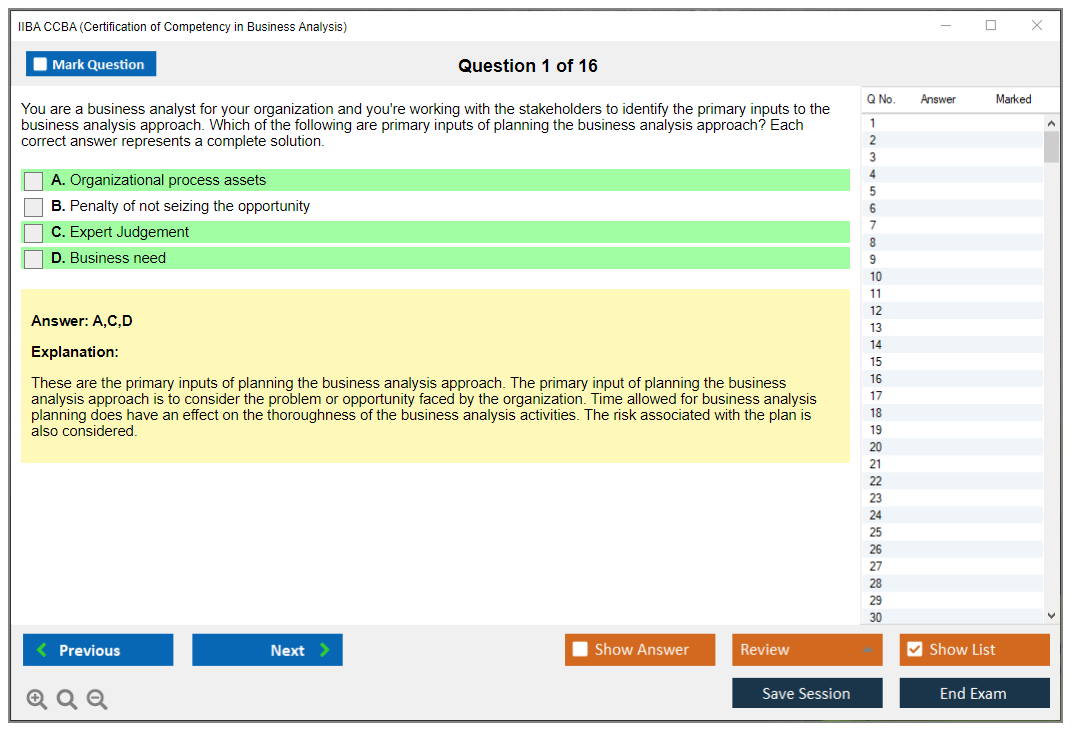
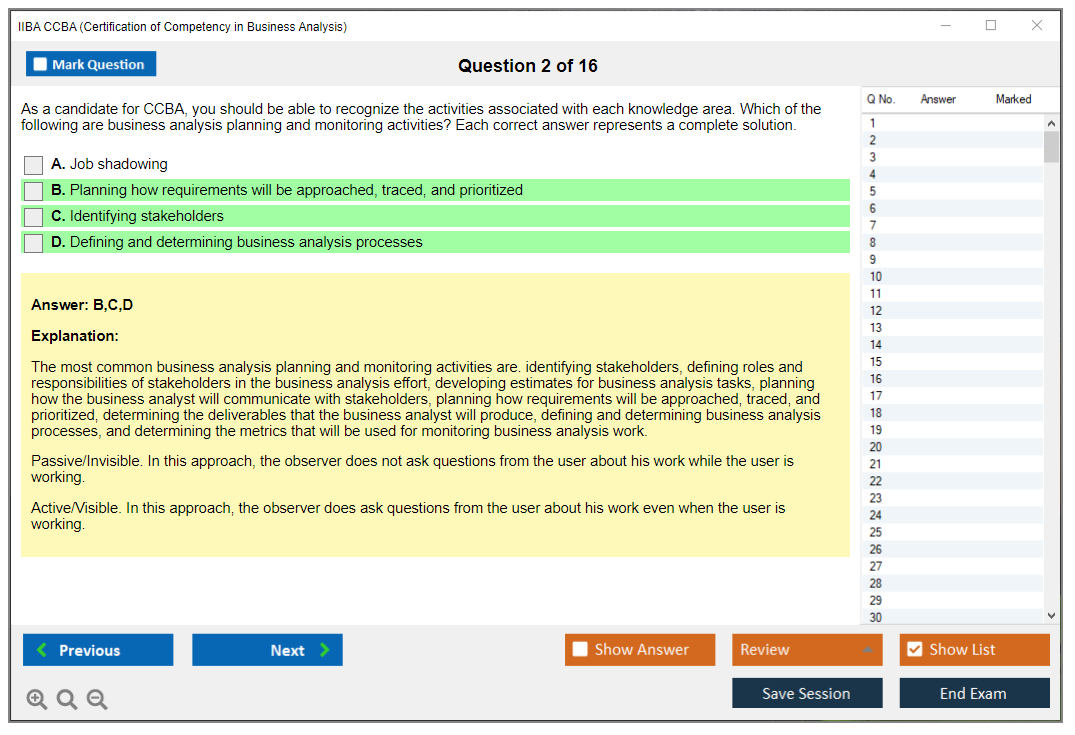
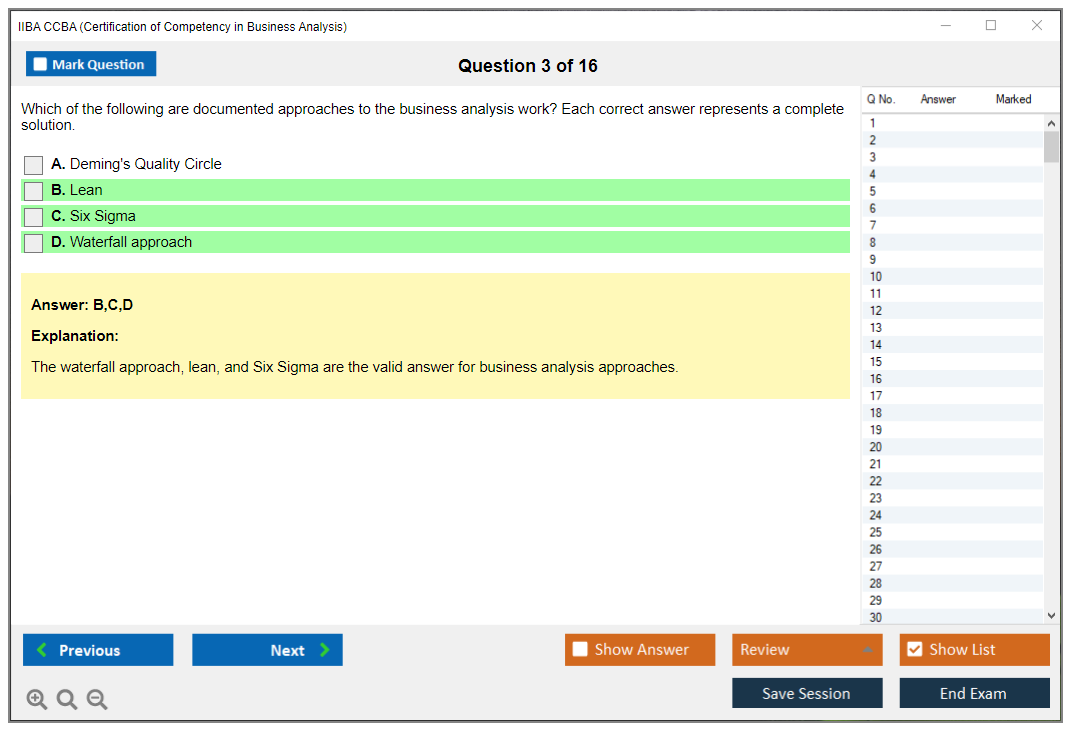
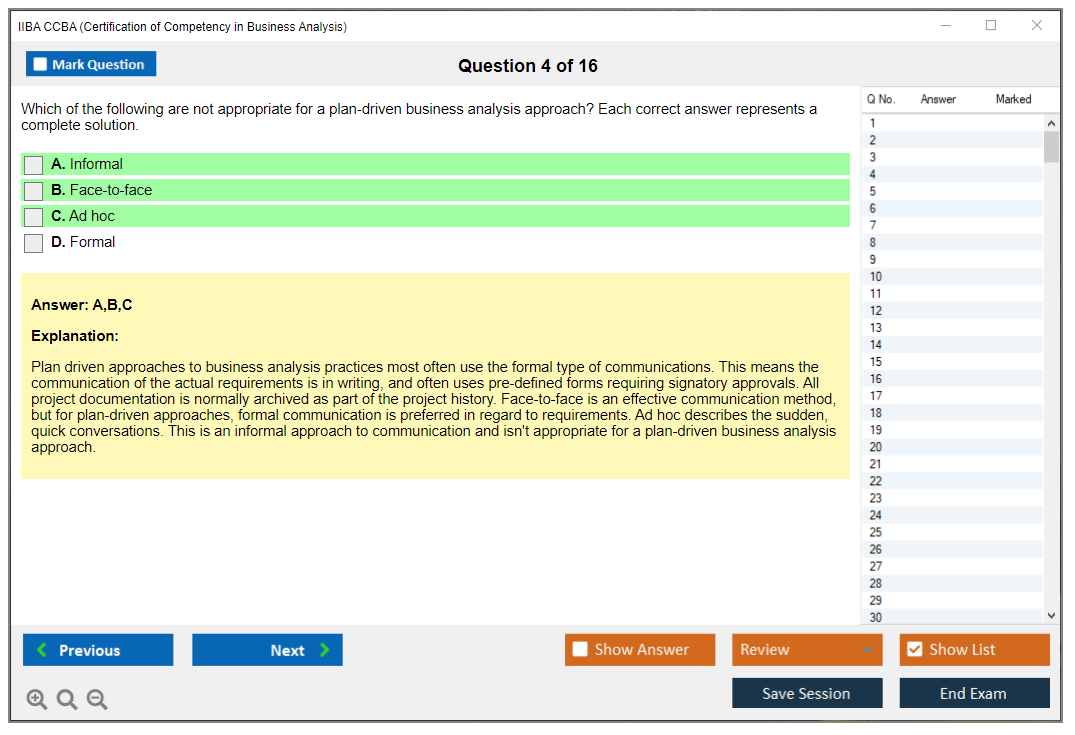
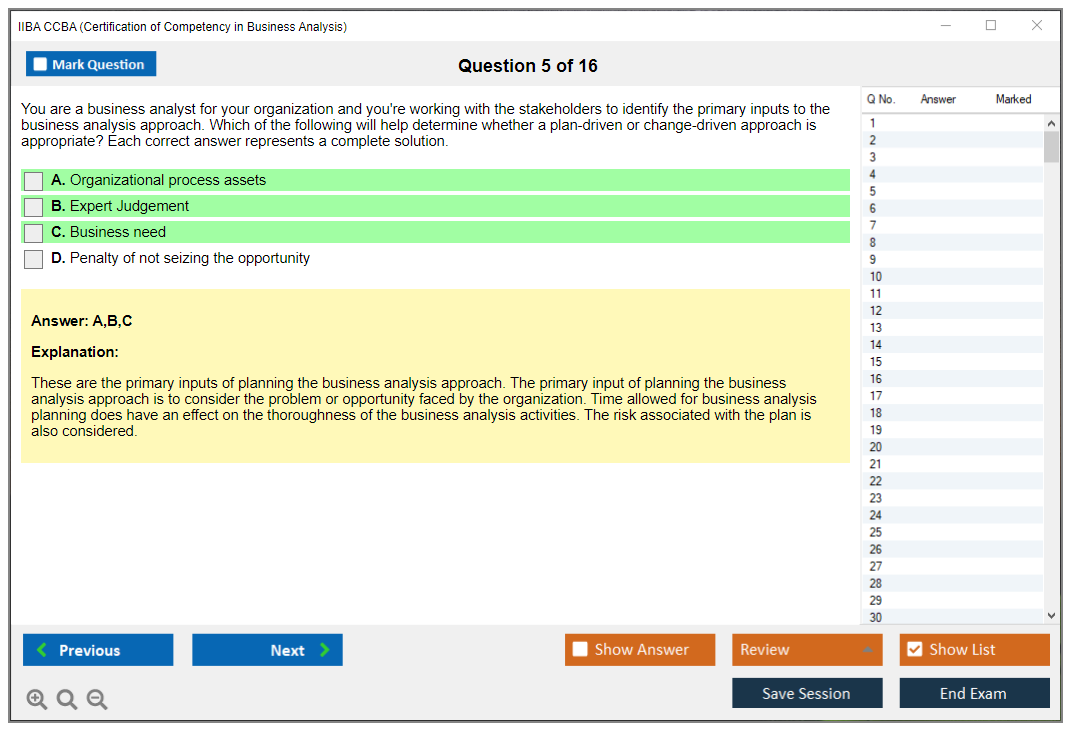
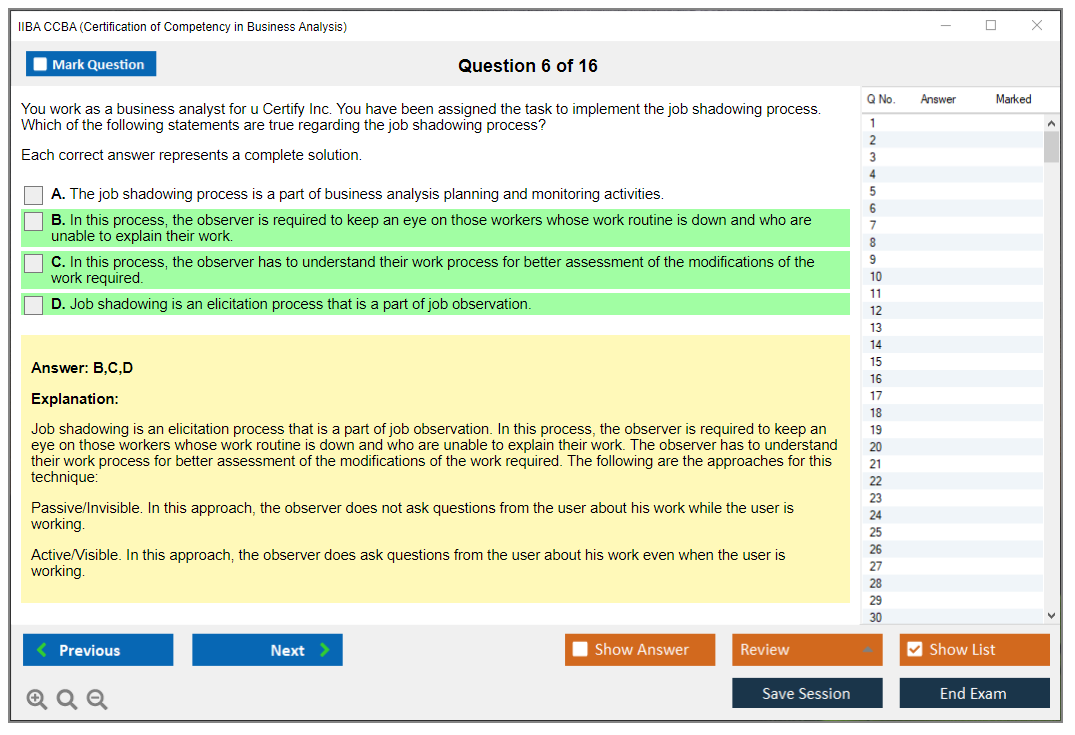
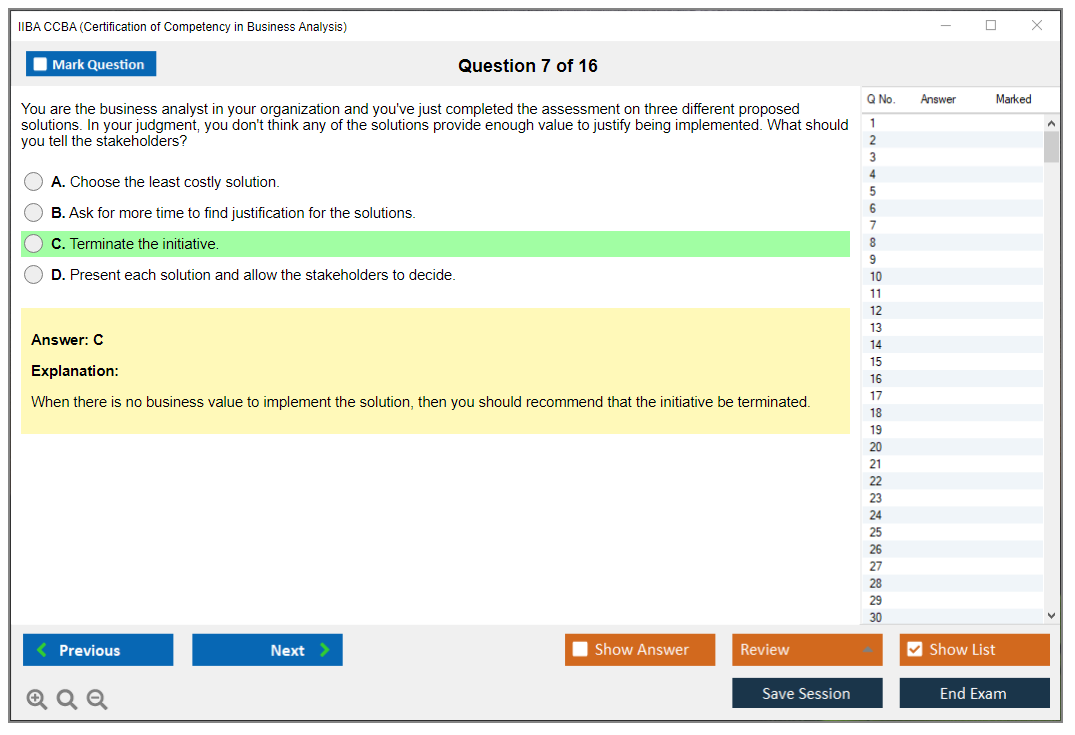
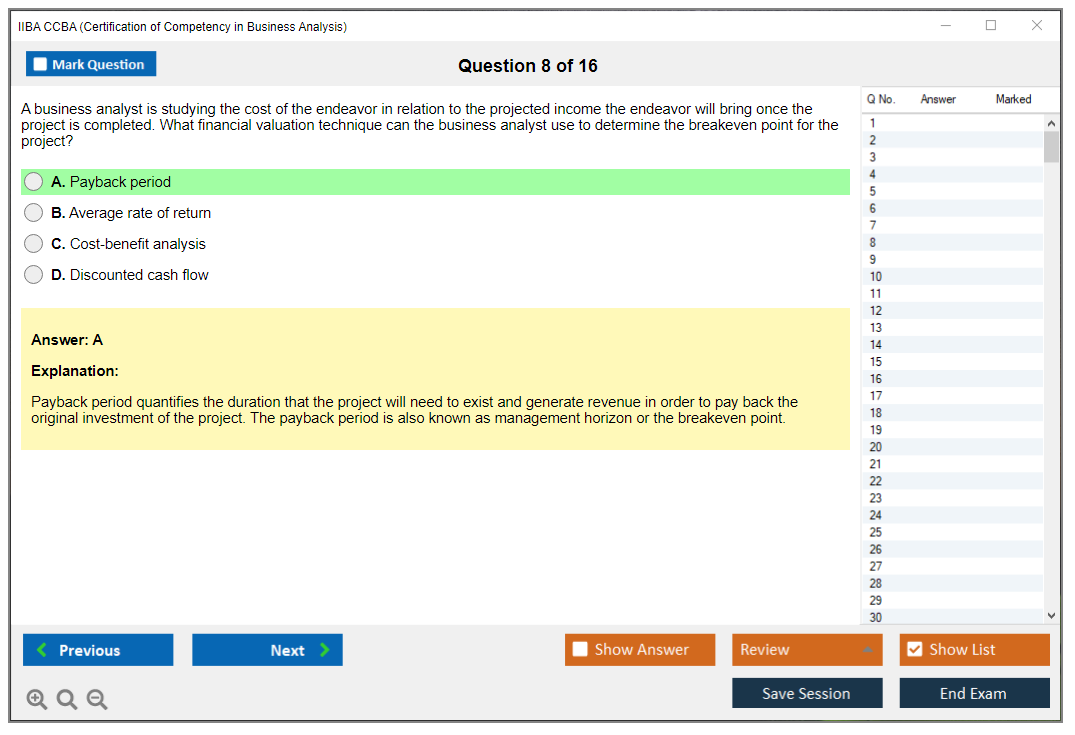
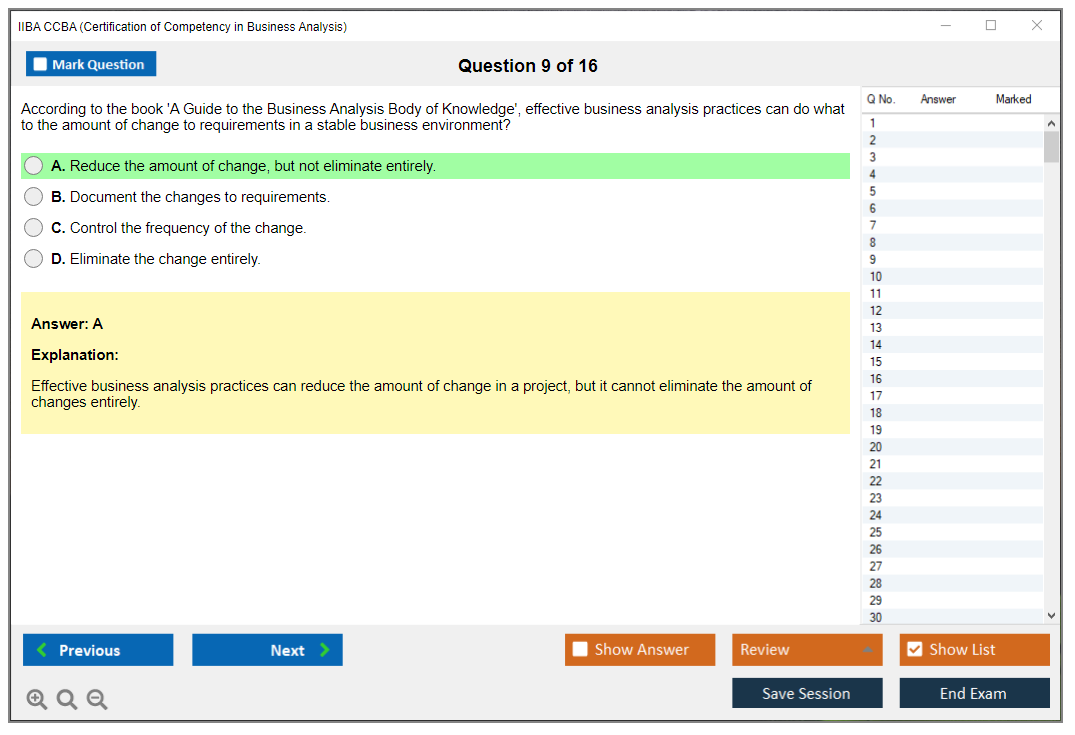
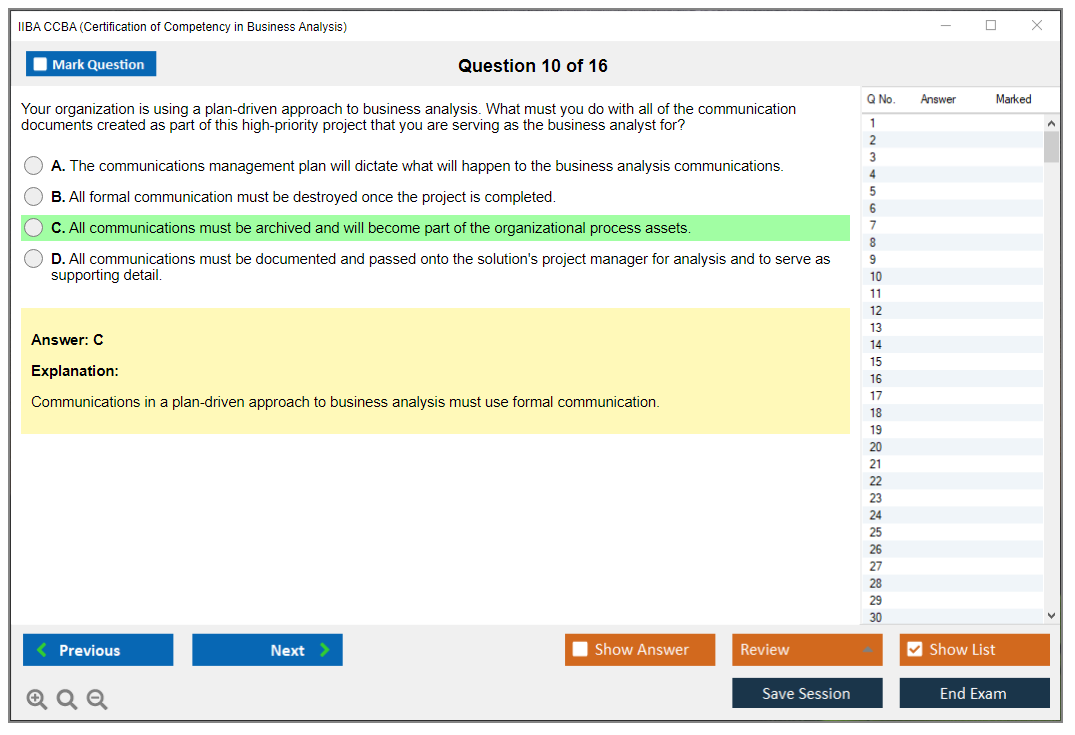
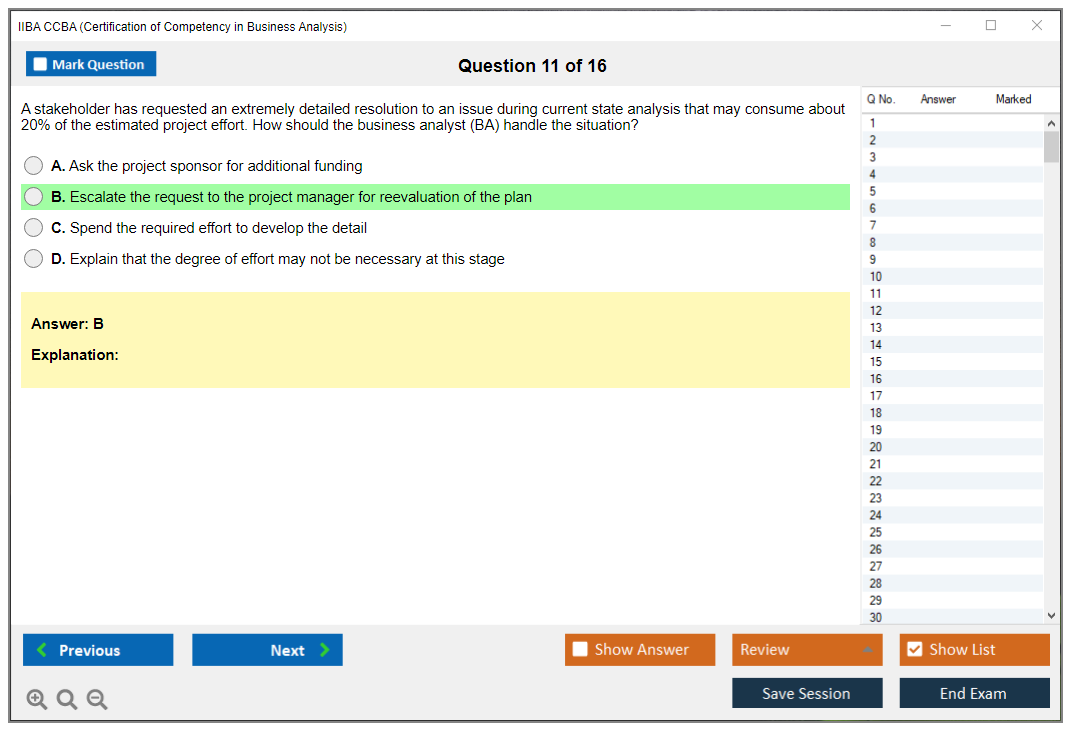
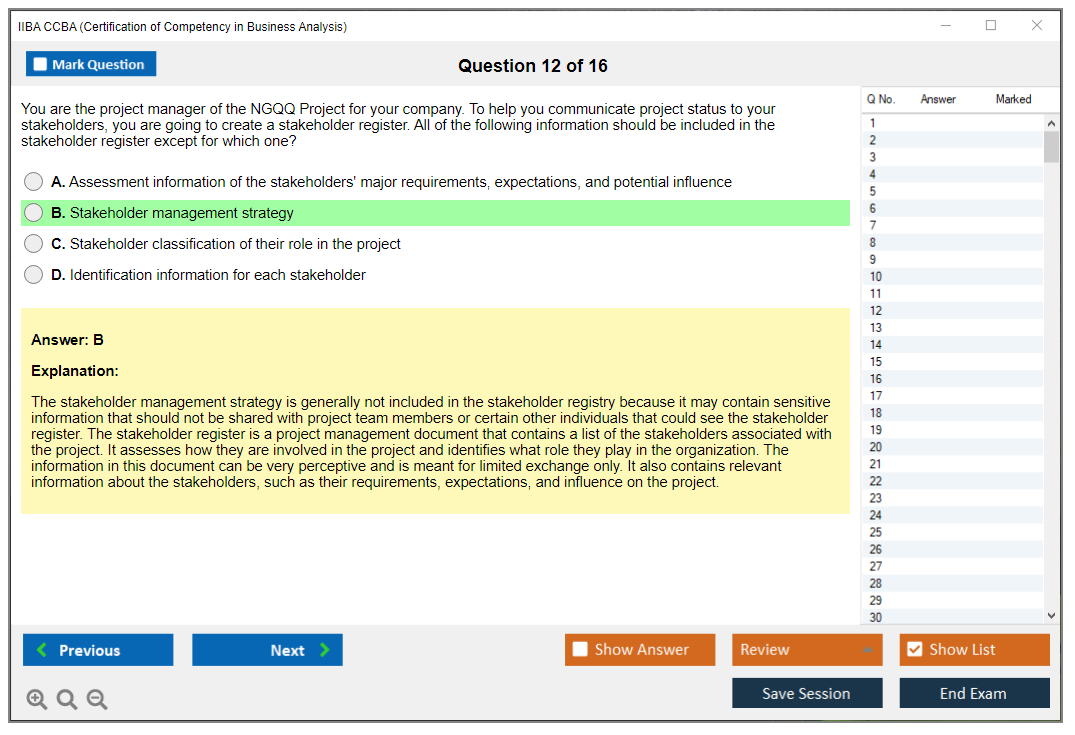
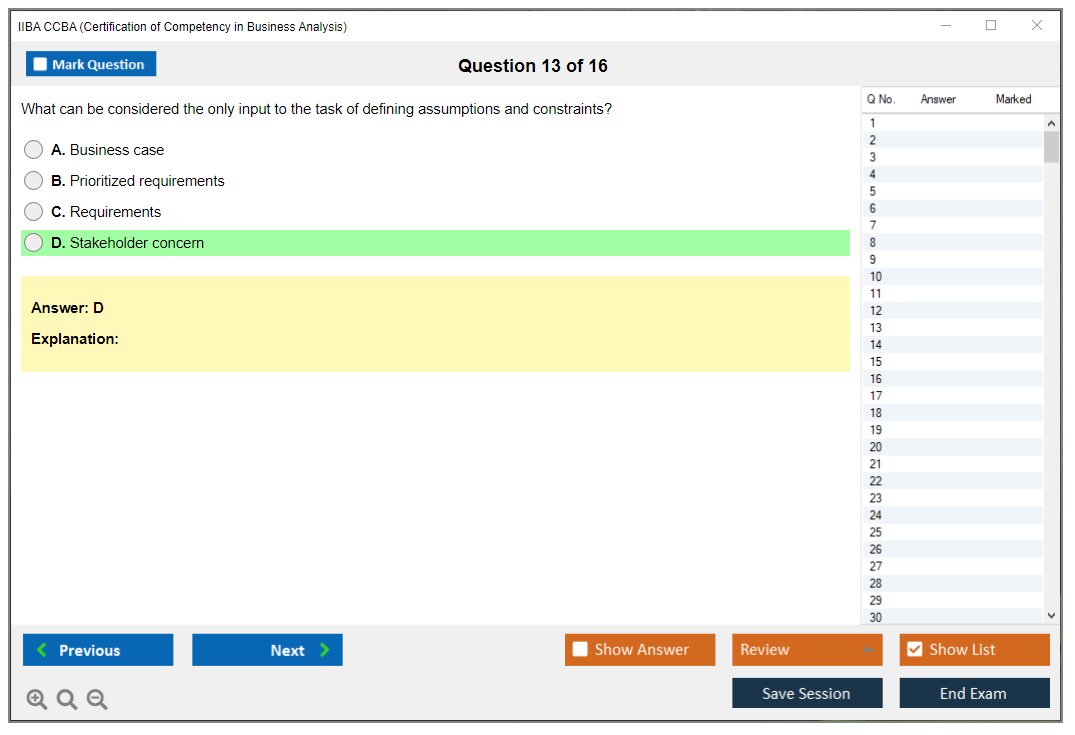
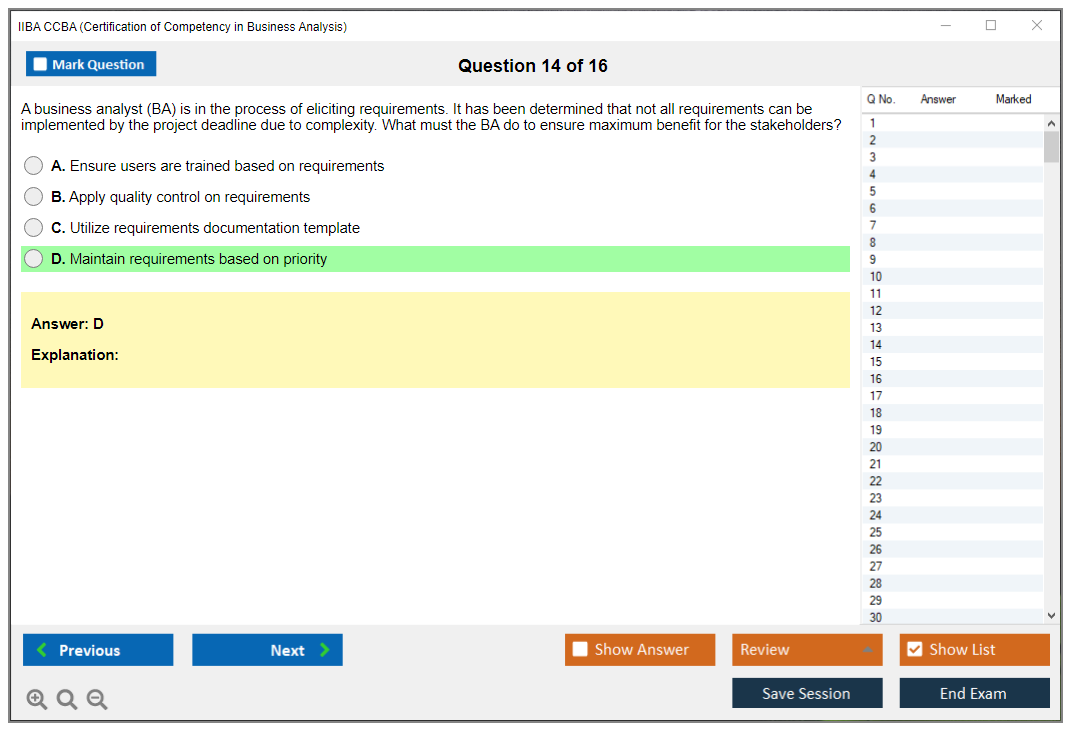
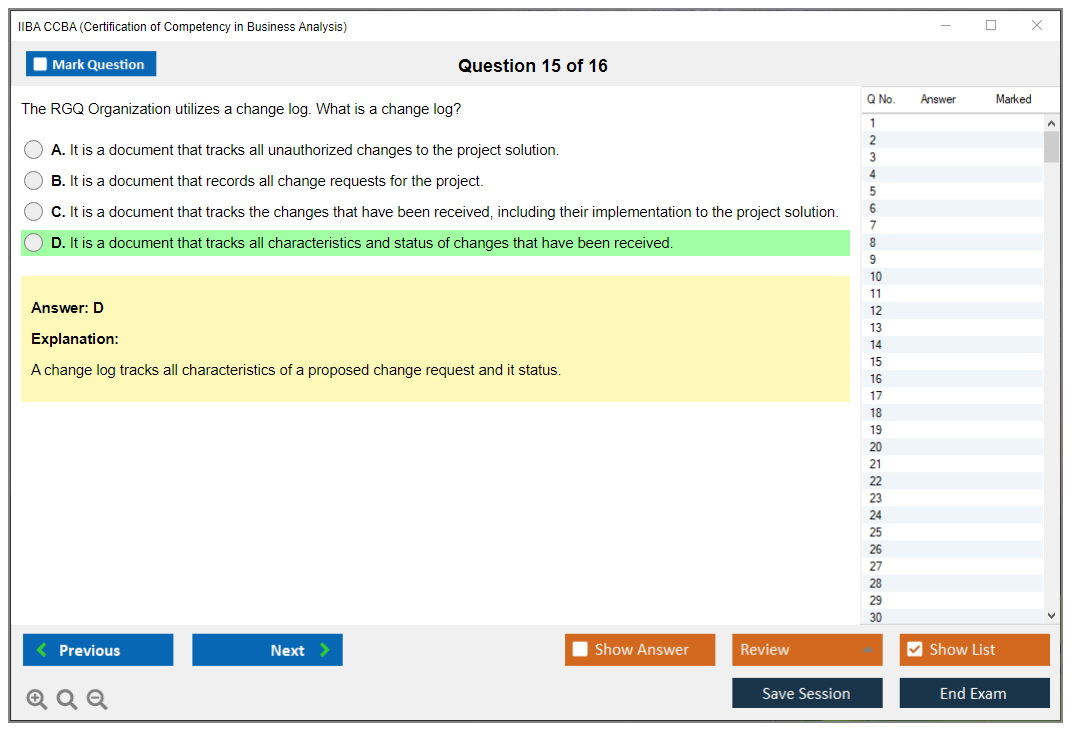
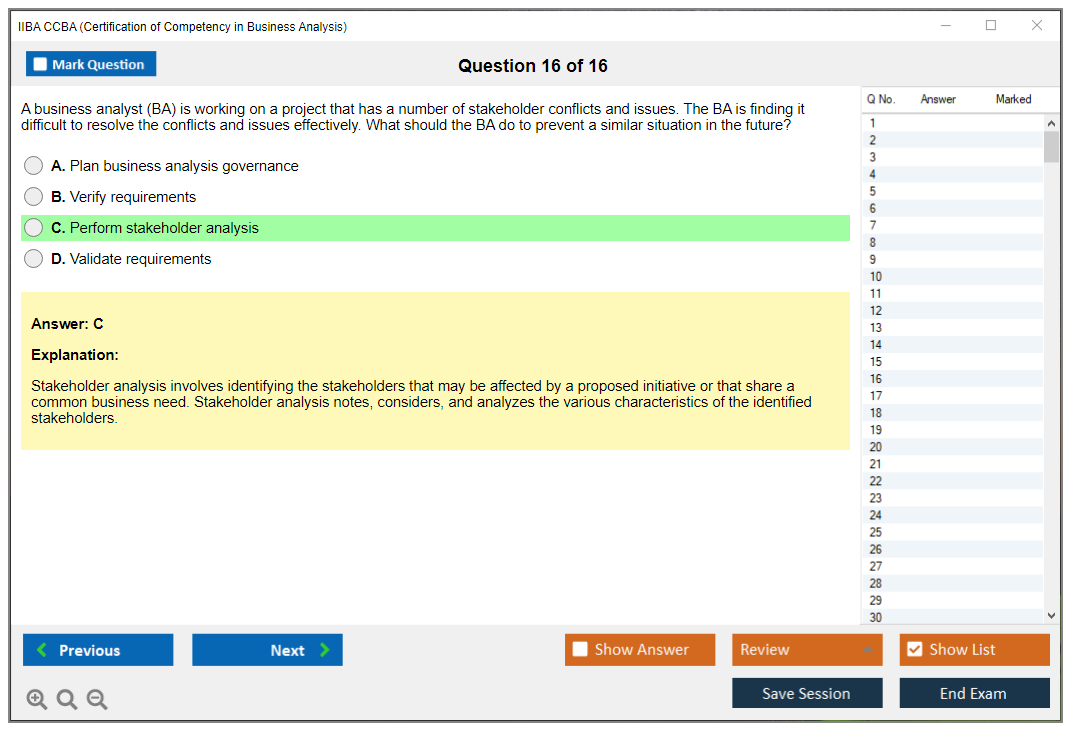
Dumpsarena IIBA Certification of Capability in Business Analysis (CCBA) (CCBA) Free Practice Exam Simulator Test Engine Exam preparation with its cutting-edge combination of authentic test simulation, dynamic adaptability, and intuitive design. Recognized as the industry-leading practice platform, it empowers candidates to master their certification journey through these standout features.
What is in the Premium File?
Satisfaction Policy – Dumpsarena.co
At DumpsArena.co, your success is our top priority. Our dedicated technical team works tirelessly day and night to deliver high-quality, up-to-date Practice Exam and study resources. We carefully craft our content to ensure it’s accurate, relevant, and aligned with the latest exam guidelines. Your satisfaction matters to us, and we are always working to provide you with the best possible learning experience. If you’re ever unsatisfied with our material, don’t hesitate to reach out—we’re here to support you. With DumpsArena.co, you can study with confidence, backed by a team you can trust.
IIBA CCBA Exam FAQs
Introduction of IIBA CCBA Exam!
The International Institute of Business Analysis (IIBA) Certified Competency in Business Analysis (CCBA) is a professional certification for business analysts. It is designed to recognize the skills and knowledge of experienced business analysts. The CCBA certification is based on the IIBA's Business Analysis Body of Knowledge (BABOK) and requires applicants to demonstrate their knowledge and experience in areas such as requirements management, stakeholder engagement, and solution assessment and validation.
What is the Duration of IIBA CCBA Exam?
The IIBA CCBA exam is a two-hour, multiple-choice exam consisting of 120 questions.
What are the Number of Questions Asked in IIBA CCBA Exam?
There are 150 multiple-choice questions on the IIBA CCBA exam.
What is the Passing Score for IIBA CCBA Exam?
The passing score required for the IIBA CCBA exam is a scaled score of at least 67%.
What is the Competency Level required for IIBA CCBA Exam?
The minimum level of competency required to take the IIBA CCBA exam is Professional Competency.
What is the Question Format of IIBA CCBA Exam?
The International Institute of Business Analysis (IIBA) Certified Competency in Business Analysis (CCBA) exam consists of multiple-choice questions. There are no essays or other types of questions.
How Can You Take IIBA CCBA Exam?
The IIBA CCBA exam can be taken online or at a testing center. To take the exam online, you must register with the IIBA and purchase a voucher. Once you have purchased the voucher, you will be able to access the exam from a secure online portal. To take the exam at a testing center, you must register with the IIBA and make an appointment to take the exam at a Pearson VUE testing center.
What Language IIBA CCBA Exam is Offered?
The IIBA CCBA exam is offered in English.
What is the Cost of IIBA CCBA Exam?
The cost of the IIBA CCBA exam is $435 USD.
What is the Target Audience of IIBA CCBA Exam?
The IIBA CCBA Exam is designed for business analysts with at least three to five years of experience in the field. It is intended for professionals who want to demonstrate their knowledge and expertise in the business analysis domain.
What is the Average Salary of IIBA CCBA Certified in the Market?
The average salary for a Certified Business Analysis Professional (CBAP) or Certified Competency in Business Analysis (CCBA) is around $90,000 per year.
Who are the Testing Providers of IIBA CCBA Exam?
The International Institute of Business Analysis (IIBA) is the official provider of the Certified Business Analysis Professional (CBAP) and Certification of Competency in Business Analysis (CCBA) exams. The IIBA provides the exam through its partner, PeopleCert, a global certification and examination institute.
What is the Recommended Experience for IIBA CCBA Exam?
The recommended experience for IIBA CCBA certification is typically a minimum of 3750 hours of project experience in the past 5 years, with a minimum of 900 hours in leading and directing activities related to business analysis. There are also a number of educational requirements that must be met, such as a four-year degree or equivalent and 21 hours of business analysis training.
What are the Prerequisites of IIBA CCBA Exam?
The Prerequisite for the IIBA CCBA Exam is that you must hold a current and valid certification from the International Institute of Business Analysis (IIBA). This certification can be either a Certified Business Analysis Professional (CBAP) or a Certification in Business Analysis (CCBA).
What is the Expected Retirement Date of IIBA CCBA Exam?
The official website for the IIBA Certified Business Analysis Professional (CBAP) and Certification of Competency in Business Analysis (CCBA) exams is https://www.iiba.org/certification/. You can find the information about the expected retirement date of the CCBA exam on this page.
What is the Difficulty Level of IIBA CCBA Exam?
The IIBA CCBA exam is considered to be of moderate difficulty. It is designed to test your knowledge and understanding of the business analysis field, and the exam is composed of multiple-choice and scenario-based questions.
What is the Roadmap / Track of IIBA CCBA Exam?
The IIBA CCBA Certification Track/Roadmap is a comprehensive program designed to help individuals become certified in business analysis. The program consists of three levels: Certification of Competency in Business Analysis (CCBA), Certified Business Analysis Professional (CBAP), and Certification of Capability in Business Analysis (CCBA). Each level requires a specific number of professional development hours, an exam, and a portfolio submission. The CCBA exam is a three-hour exam that tests an individual’s knowledge and understanding of business analysis concepts, practices, and techniques. The exam is designed to assess an individual’s ability to apply business analysis principles and practices to real-world scenarios.
What are the Topics IIBA CCBA Exam Covers?
The IIBA CCBA exam covers six topics:
1. Business Analysis Planning and Monitoring: This topic covers the development of a business analysis plan, monitoring of the plan and its implementation, and the use of tools and techniques to ensure successful completion.
2. Elicitation and Collaboration: This topic covers the techniques used to gather information from stakeholders, the use of collaboration to ensure stakeholder buy-in, and the development of requirements based on the gathered information.
3. Requirements Life Cycle Management: This topic covers the management of the requirements life cycle, from the initial gathering of requirements to the implementation of the requirements.
4. Strategy Analysis: This topic covers the analysis of an organization’s strategic objectives and the development of a business analysis plan to meet those objectives.
5. Solution Evaluation: This topic covers the evaluation of potential solutions and the selection of the most appropriate solution.
6. Underlying Competencies: This topic
What are the Sample Questions of IIBA CCBA Exam?
1. What is the purpose of the Business Analysis Body of Knowledge (BABOK)?
2. What is the difference between business process modeling and business process re-engineering?
3. Describe the steps involved in the requirements elicitation process.
4. What is the purpose of a business requirements document?
5. Name three techniques used in requirements gathering.
6. What is the purpose of a stakeholder analysis?
7. What is the difference between a use case and a user story?
8. What are the three main components of a business case?
9. What is the purpose of a process flow diagram?
10. Describe the differences between agile and waterfall methodologies.
IIBA CCBA (Certification of Capability in Business Analysis (CCBA)) What Is the IIBA CCBA Certification? The IIBA CCBA certification is the mid-tier business analyst credential offered by the International Institute of Business Analysis. It sits right between the entry-level ECBA and the advanced CBAP in IIBA's three-tier framework, which means it targets working professionals who've moved past the basics but aren't quite ready for senior-level strategic roles yet. Look, if you've been doing business analysis work for a few years and want formal recognition, this is probably where you should be looking. The Certification of Capability in Business Analysis validates that you can actually apply BA techniques in real projects, not just memorize definitions from a textbook. What CCBA actually proves about your skills CCBA certification demonstrates competency across the six knowledge areas outlined in the IIBA BABOK Guide v3. That's the standardized framework everyone references when... Read More
IIBA CCBA (Certification of Capability in Business Analysis (CCBA))
What Is the IIBA CCBA Certification?
The IIBA CCBA certification is the mid-tier business analyst credential offered by the International Institute of Business Analysis. It sits right between the entry-level ECBA and the advanced CBAP in IIBA's three-tier framework, which means it targets working professionals who've moved past the basics but aren't quite ready for senior-level strategic roles yet.
Look, if you've been doing business analysis work for a few years and want formal recognition, this is probably where you should be looking. The Certification of Capability in Business Analysis validates that you can actually apply BA techniques in real projects, not just memorize definitions from a textbook.
What CCBA actually proves about your skills
CCBA certification demonstrates competency across the six knowledge areas outlined in the IIBA BABOK Guide v3. That's the standardized framework everyone references when talking about what business analysts should know and do. We're talking business analysis planning and monitoring, elicitation and collaboration, requirements life cycle management, strategy analysis, requirements analysis and design definition, and solution evaluation.
The exam tests whether you can apply these concepts in realistic scenarios. I mean, you'll see questions that present messy stakeholder situations or requirements conflicts, and you need to pick the best approach based on BABOK principles. it's "what does this term mean" but more like "given these project constraints and this stakeholder dynamic, what should you do next?"
This certification validates you understand both predictive (waterfall) and adaptive (agile) approaches. Honestly, that's huge because most organizations now work in hybrid environments where you need flexibility. Employers want proof you can handle whatever methodology they're using or, more likely, whatever chaotic mix they've cobbled together.
Who should pursue CCBA certification
Mid-level business analysts? Perfect fit.
Professionals with around 3-5 years of experience are the primary audience. If you've worked on multiple projects, facilitated requirements workshops, written business requirements documents, and dealt with stakeholders who change their minds every week (sometimes every day, let's be real), you're probably ready.
Professionals transitioning from ECBA who've gained sufficient hands-on experience make up another big group. Some people grab the entry-level cert early in their career, then come back for CCBA once they've logged enough hours doing actual BA work.
The certification also appeals to consultants, project managers, and product owners who handle BA responsibilities even if their job title doesn't say "business analyst." I mean, if you're gathering requirements and working with stakeholders to define solutions, you're doing business analysis whether your business card says so or not.
And let's be real. Many people pursue CCBA as a stepping stone toward CBAP. It's a smart progression path. Actually, I've noticed that people who plan this route from the start tend to stay more motivated through the study process because they see where they're headed.
When to choose CCBA vs the other IIBA certifications
The ECBA requires minimal experience, maybe 900 hours or so, and focuses on foundational knowledge.
Perfect if you're new to the field or transitioning from another role, but honestly, the limited prerequisites mean it doesn't carry quite the same weight with hiring managers who've seen hundreds of resumes.
CCBA requires 3,750 hours of business analysis work experience over the past seven years. That's roughly two years of full-time work, give or take. The exam assesses competency-based scenarios rather than just knowledge recall.
CBAP demands 7,500 hours of experience and targets senior-level professionals who lead BA initiatives, mentor others, and work at a strategic level. The questions get harder. The scenarios more complex.
CCBA is the sweet spot for working professionals with proven track records who want career advancement but aren't yet at the expert level. Not gonna lie, the prerequisites filter out people who aren't serious, which keeps the certification meaningful.
Market demand and career benefits
Employers globally recognize CCBA as proof of standardized BA skills. When you're competing for positions or promotions, having this credential separates you from candidates who only list "requirements gathering" on their resume without any validation, and trust me, those resumes are everywhere.
The career progression benefits? Tangible.
Higher salary potential, leadership opportunities, increased credibility with stakeholders who actually listen when you speak. Digital transformation initiatives across IT, finance, healthcare, government, and consulting all need skilled business analysts who can bridge technical teams and business stakeholders.
Organizations increasingly want structured business analysis methodologies. They want people who understand frameworks, not just folks who wing it based on intuition. CCBA proves you know the discipline. Some organizations still value experience over credentials, sure, but the trend is definitely shifting toward certification.
Certification maintenance requirements
Valid for three years. Done.
After that, you need to renew by earning Continuing Development Units (CDUs) through professional development activities.
IIBA expects you to stay current with evolving practices, which honestly makes sense given how fast business analysis techniques and tools are changing. You can earn CDUs through training courses, attending conferences, volunteering with IIBA chapters, publishing articles, or other qualifying activities. There's a renewal fee involved too.
The maintenance requirement actually makes the certification more valuable because it signals you're keeping your skills sharp, not resting on credentials you earned years ago and then forgot about while doing the same tasks on autopilot.
Whether you're already working as a BA or transitioning into the role, CCBA provides formal validation that opens doors and demonstrates commitment to the profession beyond just showing up to work every day.
CCBA Exam Objectives and Knowledge Areas
What is the IIBA CCBA certification?
The IIBA CCBA certification is basically the "I've been doing BA work for a while and I can prove it" credential. It targets mid-level professionals who've already logged real project hours but aren't quite living in CBAP territory yet.
Who CCBA is for (and when to choose it vs ECBA/CBAP)
Look, if you're brand new, ECBA makes more sense. If you're leading enterprise programs and arguing about portfolio strategy every week, CBAP is probably your target. CCBA? It's the middle ground. The sweet spot. Honestly, that's where a huge chunk of working business analysts actually live.
What CCBA validates in business analysis skills
This exam aligns to IIBA BABOK Guide v3, and the objectives focus on how you apply the work, not how well you recite page numbers. You're expected to recognize what technique fits, identify which artifact is missing, know which stakeholder you should pull in, and figure out what you do next when requirements start melting down halfway through a release. Definitions matter, sure. But the CCBA exam difficulty? It comes from interpretation.
CCBA exam objectives (what the exam covers)
The CCBA exam objectives map directly to the six BABOK knowledge areas, and the weightings aren't subtle. Some domains are "nice to know." One domain is "you will live here."
The exam leans hard into scenario-based questions. Short setup. Messy context. Conflicting stakeholder asks. Then a multiple-choice question that's basically: what would you do. Not "what is elicitation." More like "you ran a workshop, got disagreement, sponsor is impatient, what's the best next action." That's why memorization-only study plans tend to faceplant.
BABOK knowledge areas mapped to CCBA
Business analysis planning and monitoring (15% of exam)
This area covers the prep work that too many teams skip and then wonder why everything turns into chaos. You'll see objectives around planning the BA approach and governance, stakeholder engagement planning, and improving BA performance using metrics.
Key tasks show up a lot: plan BA approach, plan stakeholder engagement, plan BA governance. I mean, you don't need to write a 40-page governance plan in real life, but you do need to know when governance matters, who approves what, and how you track whether your BA work is actually effective or just theater.
Elicitation and collaboration (20% of exam)
Elicitation grabs a big chunk.
Not just "run an interview." You're tested on preparing for elicitation, conducting sessions, confirming results, communicating BA information, and managing collaboration when humans act like, well, humans.
Techniques matter here. Brainstorming, document analysis, focus groups, prototyping. The exam tends to ask which one fits a constraint like limited stakeholder time, unclear scope, political tension, or a process that nobody has documented for five years. One detailed example: prototyping isn't only for UI teams, and honestly, a quick mock can flush out hidden assumptions fast when stakeholders keep saying "I'll know it when I see it," which is basically half of BA life anyway.
Requirements life cycle management (17% of exam)
This is where requirements stop being a document and start being a living thing you control. Tracing requirements across the lifecycle is a core theme, plus maintaining requirements for reuse, prioritizing, assessing changes, and getting approvals.
You'll want comfort with a requirements traceability matrix, baseline management, and change control. Prioritization techniques show up too: MoSCoW, Kano, weighted ranking. Not gonna lie, weighted ranking is the one people mess up because it feels mathy, but the exam usually keeps it conceptual. Choose the approach that makes sense given the situation and the stakeholders involved.
Strategy analysis (13% of exam)
Strategy analysis is the "why are we doing this" domain. Current state analysis, future state, transition requirements, risk assessment, business case, and change strategy.
Expect techniques like SWOT analysis, gap analysis, root cause analysis, benchmarking. Here's the thing. The questions often hide the real problem behind symptoms. A stakeholder says "the system is slow," but your best next step might be root cause analysis, not jumping into a solution wish list. Fragments. Signals. Follow them.
I've seen people skip this section because of the lower weighting and then regret it. Strategy questions can feel abstract until you realize they're asking about your ability to connect work back to actual business value, which is kind of the whole point of being an analyst in the first place.
Requirements analysis and design definition (30% of exam)
This is the largest domain.
Thirty percent.
So yeah, if your study plan treats it like just another chapter, you're going to have a bad time.
You're tested on specifying and modeling requirements, verifying and validating quality, defining requirements architecture, defining design options, and recommending solutions. Models matter: process flows, data models, use cases, user stories, wireframes. The exam likes to see whether you understand what each model is good at and what it's bad at, and when to verify versus validate because those are easy to mix up when you're stressed and the clock is ticking and your brain's doing that thing where everything looks correct.
Solution evaluation (5% of exam)
Small weighting, but it shows up. Measuring solution performance against business needs, analyzing performance measures, recommending improvements. Think KPIs, acceptance criteria, solution validation. One detailed point: acceptance criteria isn't the same as a requirement statement, and a lot of scenario questions try to bait you into picking the "pretty requirement" instead of the measurable check that actually tells you whether something works.
Task and competency focus areas
Across all domains, the exam quietly tests competencies: analytical thinking and problem-solving, behavioral characteristics like ethics and organizational awareness, business knowledge application, communication, interaction skills with diverse stakeholders, and tools/technology proficiency. You won't get asked "are you ethical." You'll get a scenario where the ethical choice is the correct BA move, and the shortcuts all look tempting.
How exam objectives translate to question format
Scenario-based questions dominate.
One best answer.
And the best answer? It's usually the one that follows BABOK logic and reduces risk, even if another option sounds faster or more appealing to an impatient sponsor.
Expect "what would you do next" decisions, technique selection, stakeholder handling, and quality checks. The exam is about applying BABOK techniques to realistic problems, not winning a vocabulary contest. Also, the CCBA passing score isn't published as a simple number by IIBA, so don't build your confidence around chasing some magic percent that doesn't exist.
How to use the objectives to build a study plan
Weight your time by the percentages. Go heavy on requirements analysis and design definition (30%), then elicitation (20%), then requirements life cycle management (17%). Make domain-specific study blocks. Use CCBA study materials like BABOK v3 plus a decent question bank that doesn't just regurgitate definitions.
Practice scenarios. A lot. CCBA practice tests are where you find your weak spots, and you should track misses by domain so you don't keep rereading sections you already know. Quick note: people obsess over CCBA certification cost, the IIBA membership fee and exam fee, and CCBA renewal requirements with CCBA continuing development units (CDUs), but passing comes down to doing the applied thinking well, under time pressure, with imperfect information. That's the job anyway.
CCBA FAQ
How much does the IIBA CCBA certification cost? It depends on member vs non-member pricing, plus training and retakes, so budget beyond just the exam fee. What is the passing score for the CCBA exam? IIBA doesn't publish a fixed passing score. Is the CCBA exam hard compared to ECBA or CBAP? Harder than ECBA, easier than CBAP, mostly because it expects experience-based judgment. What are the prerequisites to apply for CCBA? You'll need BA work hours, professional development hours, and references per IIBA's current rules. How do I renew my CCBA certification and how often? Renewal runs on IIBA's cycle and you maintain it with fees and CDUs.
CCBA Prerequisites and Eligibility Requirements
Overview of CCBA eligibility criteria set by IIBA
Look, getting your CCBA isn't like just signing up for an exam. IIBA has specific gates you need to clear before they'll even let you schedule the test. All requirements must be met before application approval, which honestly makes sense because they're trying to maintain the credential's value. You can't fake your way through this one.
The verification process? Thorough. You'll submit documentation during the application process that proves you've done actual business analysis work. IIBA reviews everything, and yeah, they sometimes randomly audit applications requiring even more supporting docs. It's a pain, but it keeps the certification meaningful.
Work experience requirements
Here's the big one: you need minimum 3,750 hours of business analysis work experience within the past 7 years. That's roughly 1.8 years of full-time BA work. But here's where people screw up constantly..these hours must be in BA-specific tasks, not general project work. You can't just claim every hour you've worked on projects and call it business analysis.
Qualifying activities? Requirements elicitation and documentation, which is the bread and butter stuff. Stakeholder analysis and engagement counts. Process modeling and improvement absolutely qualifies. Solution assessment and validation, business case development, gap analysis and feasibility studies all qualify as legitimate BA work that IIBA recognizes.
But then there's the stuff that doesn't count. General project management without BA focus? Nope. Pure technical development or coding? That's not BA work even if you were on a BA team. Administrative or cleaner work doesn't qualify. Management activities without direct BA involvement won't help you hit that 3,750-hour mark either.
The good news is part-time and contract work counts with hours calculated proportionally. If you worked 20 hours a week doing BA work, those hours still count. Multiple roles can be combined to meet the hour requirement, which is helpful if you've bounced around different positions or companies. I knew someone who pieced together three contract gigs over five years to hit the threshold, and it worked out fine once she organized her documentation properly.
How to calculate and document your hours
Use IIBA's experience verification form..don't try to reinvent the wheel here. Break down by project and role because vague descriptions will get flagged during review. Map activities to BABOK knowledge areas, which shows you actually understand what business analysis includes according to IIBA's framework.
Be specific. BA responsibilities versus other duties. If you were doing BA work 60% of the time and project coordination the other 40%, you can only claim 60% of those hours. Keep records of projects, dates, and BA deliverables. Honestly, I recommend creating a spreadsheet now even if you're not applying yet because trying to reconstruct this stuff from memory later is brutal.
Education requirements
You need a minimum of 21 hours of professional development or training in business analysis. Must be completed within the past 4 years, so that online course you took in 2018? Probably doesn't count anymore depending on when you're reading this.
Qualifying education includes formal BA courses and workshops, IIBA chapter events and webinars, university courses in BA or systems analysis or related fields, corporate training programs with BA content, and online courses with certificates of completion. The certificate part matters because you need proof.
Non-qualifying education trips people up. General business courses without BA focus don't cut it. Self-study without formal instruction, like reading the BABOK on your own, doesn't count toward these 21 hours. On-the-job training without structured curriculum also won't help you here. The key thing is proving structured learning happened, not just that you absorbed knowledge somewhere.
Tips for meeting education requirement
IIBA membership provides access to free webinars counting toward hours, which is actually a solid reason to join before you need the cert. Many employers offer BA training programs that qualify. Online platforms like Udemy, Coursera, and LinkedIn Learning offer affordable options, though you need to make sure they provide completion certificates.
IIBA chapters host local events and study groups that count. Combine multiple short courses to reach the 21-hour minimum. Not gonna lie, this is probably the easiest requirement to meet if you're strategic about it.
Professional references
Two references required.
At least one must be a current CCBA or CBAP holder. This requirement catches people off guard because finding someone with the certification who knows your work isn't always easy. References verify your BA experience and professional conduct.
Cannot be family members or close personal friends. IIBA checks for conflicts of interest. Should be supervisors, clients, or colleagues familiar with your BA work who can speak specifically about what you've done.
How to request references effectively
Ask well in advance of your application deadline because people are busy and forget. Provide context about CCBA certification and requirements so they understand what they're endorsing. Share your resume and project list to help them write a detailed reference rather than something generic that doesn't actually show your capabilities or distinguish you from other candidates they might've worked with.
Confirm their IIBA certification status if applicable. Follow up politely if they haven't completed the reference form after a week or two.
Application process and timeline
Online application through the IIBA website is straightforward enough. Application review typically takes 5-10 business days, though I've seen it happen faster. May be selected for random audit requiring additional documentation like project artifacts or training certificates.
Once approved? You've got 12 months to schedule and take the exam. That's plenty of time to study, but don't waste it.
Common application mistakes to avoid
Inflating BA hours with non-qualifying activities is the biggest mistake. IIBA can spot this during audits. Submitting education without proper documentation gets your application delayed or rejected. Incomplete or vague experience descriptions make reviewers question whether you actually did BA work.
Not mapping experience to BABOK knowledge areas shows you don't understand the framework. Choosing references who don't meet requirements wastes everyone's time. Missing supporting documentation if audited can disqualify your application entirely.
Special considerations
Military experience can count if it involved BA activities. Don't assume it doesn't qualify just because it was military work. International candidates follow the same requirements regardless of location. Experience in any industry or methodology qualifies, whether you worked agile, waterfall, or hybrid approaches. Even volunteer BA work can count toward the hour requirement, which helps career changers.
The ECBA has lighter requirements if you're not there yet, while CBAP requires significantly more experience for senior practitioners.
CCBA Exam Format, Passing Score, and Scoring
Question types, time limit, and delivery (online/in-person)
The IIBA CCBA certification exam? Pretty straightforward on paper. 130 multiple-choice questions. You get 3.5 hours (that's 210 minutes) and it's closed book. Clear enough, right?
Here's what actually trips people up, though: the feel of the questions is completely different from what you'd expect if you've only done, like, basic cert prep before. They're scenario-based and you're picking the single best answer, not the "technically also kinda true" option you'd get away with on some easier tests where memorization carries you through. Look, you can memorize BABOK terms all day. This exam keeps dragging you back to judgment calls. What would a competent BA do next, with this constraint, with that stakeholder, with the project already halfway on fire?
Questions spread across the six BABOK knowledge areas. That distribution matters for how you study and how you pace yourself. You'll see Requirements Analysis and Design Definition again and again until you start thinking in traceability matrices.
No penalty for wrong answers. Guess. Always.
Honestly, leaving blanks is the only "wrong" move here. The scoring doesn't punish you for taking a shot when you can eliminate even one option.
You've got two delivery options: Pearson VUE test center, or online proctored from home or the office. Same exam content and difficulty either way, so don't overthink the "online is easier" myth. It isn't.
Online proctoring is convenient, sure. The scheduling flexibility is real. But it comes with the strictest rules: private room, clear desk, no interruptions, webcam on, and you'll do a room scan. Also, the technical requirements check is mandatory. Do it early, because don't be that person discovering their corporate VPN blocks the proctoring app 20 minutes before check-in.
Test center has its own quirks, but it's controlled. No surprise doorbells. No roommate walking in. No random Wi-Fi drop. You'll usually store your stuff in a locker, and some locations use extra identity checks like a palm vein scan. If your home environment is unpredictable? The test center is the calm option. Boring. Good.
I spent way too long once trying to find the perfect ergonomic chair for my home testing setup before realizing that wasn't the variable that mattered. The variable was whether I could actually focus without my brain latching onto every ambient noise. Turns out I can't, which is why I'm a test center person now.
CCBA exam format specs and domain distribution
Here's the practical breakdown that should drive your prep, especially if you're doing CCBA practice tests to simulate the real thing:
- Requirements Analysis and Design Definition: roughly 39 questions (30%). This is the big one. If you're weak here, you feel it.
- Elicitation and Collaboration: around 26 questions (20%). Expect stakeholder messiness.
- Requirements Life Cycle Management: about 22 questions (17%). Trace, prioritize, approve, manage changes. Repeat.
- Business Analysis Planning and Monitoring: maybe 20 questions (15%). Planning artifacts show up more than people expect.
- Strategy Analysis: something like 17 questions (13%). Business need, future state, risk, assumptions.
- Solution Evaluation: only 6 questions (5%). Small slice, still testable. Don't skip it.
If you want a shortcut for "what should I study the hardest," it's right there in the weights. But don't get cute and ignore Solution Evaluation just because it's six questions. I mean, six questions is enough to flip a pass to a fail if the rest is borderline.
CCBA passing score: what IIBA publishes (and what it doesn't)
Everybody asks about the CCBA passing score. IIBA does not publish an exact number. No "you need 92 out of 130" or "72% minimum." That's intentional.
You'll see candidate reports floating around estimating the passing threshold around 70 to 75%. That estimate is plausible. Still just an estimate though.
Also, the exam isn't scored like a simple classroom test where every question is worth one point and the total percentage is the whole story.
The important idea is this: your result reflects competency across knowledge areas, not just raw total correct. You can't assume "I nailed Requirements Analysis, I can bomb Strategy Analysis and still pass" because the model is trying to confirm you're a capable mid-level BA, not a specialist who got lucky on question distribution.
How the CCBA exam is scored (competency-based/domain weighting)
IIBA uses a competency-based scoring model with psychometric scaling. That's a mouthful. The point is fairness across exam versions.
Different exam forms can have slight difficulty variations, because question pools change. Psychometric scaling adjusts for that. That's why IIBA won't lock itself into a public passing percentage. The "same" 75% could mean different competency depending on which set of questions you got. They're not trying to be mysterious for fun, they're trying to keep the standard consistent.
Weighted scoring also reflects domain importance. Requirements Analysis and Design Definition carries more weight than Solution Evaluation because it's 30% of the exam, and because it maps to what BAs spend a ton of time doing on real projects. If you're deciding where to put your last two weeks of study time? That weight is your hint.
If you want to pressure-test your readiness, do timed question sets by domain, then full mock exams. And yeah, I'm a fan of buying a structured pack if it saves you time hunting for decent items, like this CCBA Practice Exam Questions Pack when you want volume plus pacing practice without building your own spreadsheet from scratch.
What your score report shows
After you submit, you'll get an immediate preliminary result on screen. Pass or fail.
That's it. No numeric score.
Official results typically arrive within 2 to 3 business days via email. Your report breaks down performance by knowledge area as above, at, or below the competency level. If you failed, that diagnostic feedback is the only useful thing to obsess over. It tells you where your prep plan was fantasy.
Exam rules, policies, and time management
No reference materials allowed. Closed book means closed book. An on-screen calculator is provided if needed, and you'll get scratch paper or a whiteboard depending on whether you're at a test center or online.
Breaks aren't included in the 3.5-hour time limit. So if you take one, the clock keeps moving. Use breaks strategically, not emotionally.
Time math: 210 minutes for 130 questions is about 1.6 minutes per question. Some will take 20 seconds. Others will take 3 minutes because the scenario is long and the answers are annoyingly close. Flag hard questions and move on. Eliminate obviously wrong answers first. Then guess if you must.
Not gonna lie, "perfect certainty" is how people run out of time.
If you're looking for repetition to make those scenario questions feel normal, do more timed sets than you think you need. One more mention because people ask me what I used with clients: the CCBA Practice Exam Questions Pack is a decent way to force that pacing, and it's cheaper than burning a retake fee from poor time control.
CCBA Certification Cost and Total Budget
Understanding what you're really spending on CCBA
The CCBA certification isn't just that exam fee you see on the IIBA website. That's part of it, sure, but if you're trying to budget this thing properly, you need to think way bigger than one number. Your total investment changes a lot depending on whether you get an IIBA membership, what kind of study materials actually work for how you learn, and whether you pass on the first try or need another shot. Getting clear on all these expenses upfront helps you plan your budget realistically and figure out whether the ROI makes sense for where your career is right now.
Why IIBA membership matters for your wallet
Annual IIBA membership costs $125 USD for standard individual membership.
That might feel like an extra expense you'd rather skip, but it's probably the smartest $125 you'll spend in this entire process. The membership gets you a substantial discount on the exam fee itself, which I'll break down shortly, but that's just the beginning of what you're actually getting here.
Membership benefits beyond just saving on exam fees
When you become an IIBA member, you get access to free webinars and educational resources that would otherwise cost hundreds of dollars. The networking opportunities through local chapters are actually useful if you're trying to break into mid-level BA roles or pivot industries. You also get digital access to the BABOK Guide and other publications, which matters because the BABOK alone runs $150 for non-members. Career resources, job boards, discounts on IIBA events and conferences.. all this stuff adds up fast. I've watched people spend way more trying to piece together these resources independently without the membership.
By the way, those local chapter meetings can be hit or miss depending on where you live. Some chapters are super active with monthly events and guest speakers, while others barely meet twice a year. Worth checking out your local situation before you bank too heavily on that aspect.
The math that makes membership a no-brainer
Here's where it gets obvious.
IIBA members pay $395 USD for the CCBA exam. Non-members? $545 USD.
That's a $150 savings sitting right there, which already covers your $125 membership fee and leaves you $25 ahead before you even factor in the BABOK digital access or literally any other benefit. If you're planning to take the CCBA certification seriously, join IIBA before you apply. It's not even close to a debate.
Current exam fees and payment details
As of 2026, exam fees are locked at $395 USD for IIBA members and $545 USD for non-members. These fees can change though, so verify current pricing on the IIBA website before you finalize your budget. Payment happens when you schedule your exam appointment through Pearson VUE. They accept credit card, PayPal, or organizational purchase order if your employer's covering it.
What happens if you need to retake or reschedule
The retake exam fee? Same as the original exam fee. $395 for members, $545 for non-members.
That stings.
You have to wait 30 days before retaking the exam after a failed attempt, and there's a maximum of three attempts per year allowed. Rescheduling fees are structured to punish procrastination. Free rescheduling if you do it 48+ hours before your appointment. Late rescheduling between 24-48 hours costs $50 USD. No-show or cancellation within 24 hours? You forfeit the full exam fee. Just gone.
To dodge retake costs entirely, don't schedule your exam until your practice test scores are consistently hitting 75% or higher. Preferably higher. Build buffer time into your study plan instead of cramming. Take practice exams under actual timed conditions, not just casually reviewing questions while scrolling through your phone or watching Netflix in the background.
Study materials and what they actually cost
The BABOK Guide v3 is essential.
Digital download for IIBA members is included with your membership, which again reinforces why membership is the smart move here. Print version runs $75-100 USD if you prefer physical books you can highlight and flip through. Non-member digital access is $150 USD, which seems ridiculous when membership itself only costs $125.
CCBA exam prep courses vary wildly in price and quality. Self-paced online courses run $200-500 USD depending on comprehensiveness and how polished the platform is. Live instructor-led training jumps to $1,000-2,500 USD, which feels like a lot but sometimes proves worth it if you struggle with self-study or need accountability. Corporate group training typically costs $800-1,500 per person if your company sends multiple people together.
Practice tests and question banks matter for actual exam readiness. Don't skip this part. Individual practice exams cost $30-75 USD each depending on the provider. Full question banks run $100-200 USD for access to hundreds or thousands of questions. The CCBA Practice Exam Questions Pack at $36.99 gives you solid preparation without destroying your budget. IIBA also offers an official practice exam. Check their current pricing because it changes.
Study guides and supplementary books add another $40-60 USD for dedicated CCBA guides. Supplementary BA books run $30-50 USD each if you need deeper knowledge in specific areas.
Free resources you shouldn't ignore
IIBA chapter study groups are free with membership and super helpful for staying motivated when you're three weeks into studying and losing steam. YouTube tutorials, free webinars, online forums, study communities, flashcard apps, free practice questions scattered across the internet.. all of this exists and can reduce your costs if you're disciplined about actually using them consistently.
Real-world budget scenarios
Low-budget scenario (member, self-study): around $650 USD total. That breaks down to $125 membership, $395 exam fee, $100 practice tests, and maybe $30 for used study guides or digital materials you find secondhand.
Typical scenario (member, moderate prep): around $1,200 USD. You're looking at $125 membership, $395 exam fee, $400 online prep course, $80 BABOK print version, $150 practice tests, $50 supplementary materials.
High-investment scenario (instructor-led training): around $2,900 USD. Membership $125, exam fee $395, live training course $2,000, full study package $300, multiple practice exams $80.
If you fail and need a retake? Add another $395-545 to whatever scenario you're in.
Whether the investment pays off
Average salary increase for CCBA holders runs 10-20% according to most industry surveys and salary reports. The certification is often required or strongly preferred for mid-level BA positions, especially in larger organizations or regulated industries like finance or healthcare. Career advancement opportunities and professional credibility improve noticeably. It's not magic, but it opens doors that stay closed otherwise. Most people see ROI within 6-12 months through salary increase or landing a new position they couldn't access before. Comparing the investment to similar certifications like CBAP or even entry-level options like ECBA, CCBA sits in a sweet spot for mid-career professionals who've got some experience but need formal validation. The costs are manageable and the returns are real if you're positioned correctly in the market and actually use the credential properly.
CCBA Exam Difficulty and Preparation Time
What is the ## Primary keyword and why it matters for CCBA
Look, here's the deal. The CCBA exam? It's no walk in the park, honestly. Most folks underestimate how much prep they'll need.
The difficulty level varies wildly depending on your background. If you've been doing business analysis work for a couple years, you're gonna have a different experience than someone who's completely new to the field, right? The thing is, IIBA designed this certification to test real-world application, not just memorization. That makes it trickier than you'd think.
Preparation time matters. A lot.
You're looking at anywhere from 60 to 120 hours of study time, though I've seen people need way more. Actually, let me backtrack here because the hours depend on so many factors. Are you taking a formal course? Self-studying with just the BABOK Guide? Big difference.
Here's what's interesting (and kinda frustrating): the exam covers six knowledge areas from the BABOK, and they're not weighted equally. You can't just skim through everything and hope for the best. Some sections require deeper understanding than others. I spent way too much time on Requirements Life Cycle Management at first when I should've been drilling Strategy Analysis harder.
My honest take? Don't rush it. I know people who crammed in three weeks and failed. Then there're those who spread their studying over three months with consistent daily practice. They passed with much better scores and actually retained the knowledge, which is the whole point anyway.
The difficulty also comes from the question format. They're scenario-based, meaning you need to apply concepts to realistic business situations rather than regurgitate definitions. That requires a completely different level of comprehension if you ask me.
Primary keyword is IIBA CCBA certification, and look, that phrase really matters because it's literally what folks type when they're trying to figure out if the Certification of Capability in Business Analysis (CCBA) is actually worth the time, the stress, and yeah, the money too. CCBA sits in this sweet spot of business analyst certification for mid-level professionals. You've done actual project work and now you want a credential that signals you can handle BA tasks without someone holding your hand the whole time.
Who CCBA is for (and when to choose it vs ECBA/CBAP)
ECBA is for newer folks. CBAP's for the people who basically live inside BABOK already. CCBA? It's for the middle. Not entry-level, but also not "I've been a BA for 12 years and can recite BABOK in my sleep." If you've been doing requirements, stakeholder wrangling, and scope control for a few years, CCBA's usually the right call, honestly.
What CCBA validates in business analysis skills
It validates you can apply BABOK thinking to messy situations. Not just memorization. The exam likes scenarios, tradeoffs, and that "best answer" logic, which is why CCBA exam difficulty is rarely described as easy even by folks who pass on the first try. That tells you something right there.
CCBA exam objectives (what the exam covers)
The CCBA exam objectives map directly to the IIBA BABOK Guide v3, and you should treat those objectives like a checklist. Seriously, print them. Mark them up with highlighter. Build your entire plan around them, because random studying feels super productive until you hit question 38 and realize you never got solid on a technique's purpose versus its output. Then you're just guessing.
BABOK knowledge areas mapped to CCBA
You're dealing with the BABOK knowledge areas, with weighting distributed across domains. Business Analysis Planning and Monitoring. Elicitation and Collaboration. Requirements Life Cycle Management. Strategy Analysis. Requirements Analysis and Design Definition. Solution Evaluation. That's the core framework.
Task and competency focus areas
Expect tasks, inputs, outputs, and techniques. Also expect soft skill judgment calls. Stuff like "what should the BA do next" when stakeholders disagree on scope. Annoying? Yes. Realistic? Unfortunately. I've seen people ace every knowledge question and still bomb because they couldn't read a stakeholder situation worth a damn.
How to use the objectives to build a study plan
Tie each objective to notes, then to practice questions, then circle back to review. That loop's the whole game. One pass through the guide isn't a plan. I mean, it's just reading.
CCBA prerequisites and eligibility requirements
CCBA prerequisites aren't optional, and people waste so much time here by applying too early. The exam's one thing, but the application is its own gate.
Work experience requirements (business analysis hours)
You need documented BA work experience hours. IIBA specifies the number and recency in the application rules. Track your projects now, not later when you're scrambling. Old calendars. Jira tickets. SOWs. Whatever proves you actually did BA tasks.
Education requirements
There's an education requirement too, and it's usually the easiest checkbox to hit. Still, don't guess what counts. Verify what IIBA accepts.
Professional development (training hours)
You also need professional development hours, and this is where people scramble last minute. Training can be courses, bootcamps, employer training, some conferences even. Keep completion proof for everything.
References and application tips (common mistakes to avoid)
References matter more than you'd think. Pick people who can respond quickly and can describe your BA work specifically. Common mistake: describing "project management" work as BA work and hoping nobody notices. They notice every time.
CCBA exam format, passing score, and scoring
The exam's multiple choice, timed, and delivered online or at a test center depending on availability in your area. It's not math-hard. It's reading-hard. Short sentences that pack meaning. Long scenarios that twist. Fatigue that creeps up.
Question types, time limit, and delivery (online/in-person)
You'll see scenario-based questions and "best answer" choices that feel way too similar. Time's tight if you read slowly, so pacing is a skill you practice beforehand, not something you discover on exam day when you're already stressed.
CCBA passing score: what IIBA publishes (and what it doesn't)
People ask about the CCBA passing score constantly. Like, all the time. IIBA doesn't publish a simple fixed number like "70% and you're done." That drives folks nuts. You get a competency-based result and performance by domain, so treat passing like "strong across most areas" rather than chasing some magic percentage that doesn't actually exist.
How the CCBA exam is scored (competency-based/domain weighting)
Domains are weighted differently, and your weaker areas can drag you down even if you crushed one section. So your plan can't be all "I'll just ace elicitation and hope for the best." That's not how it plays out when the results come back.
CCBA cost (fees and total budget)
CCBA certification cost is way more than just the exam button you click. It's application fee plus exam fee plus maybe membership plus prep stuff you'll need.
Exam fees (member vs non-member)
You'll pay an exam fee, and it's noticeably lower if you're an IIBA member. This is where IIBA membership fee and exam fee math comes in. Sometimes membership's worth it. Sometimes it isn't, depending on timing and whether you'll also use member pricing later for other stuff.
IIBA membership cost considerations
Membership can also help if you plan to earn CCBA continuing development units (CDUs) through IIBA events or chapters down the road. If you're not actually going to participate, don't pretend you will just to justify the cost.
Retake fees and rescheduling costs
Retakes cost money. Rescheduling can too. Budget for at least one "life happens" moment, because life absolutely loves exam weeks for throwing curveballs.
Total cost examples (low/typical/high scenarios)
Low scenario: exam fee plus BABOK. Typical: membership plus exam plus a course plus question bank. High: course, multiple question banks, retake, plus lost time at work. The high scenario's avoidable, but only if you plan like an adult from the start.
CCBA difficulty: how hard is the exam?
Consensus? Moderately difficult, requiring steady prep and real BABOK understanding. CCBA exam difficulty comes from interpretation, not trivia you can cram. You're constantly choosing the "most BABOK" answer, even if in your workplace you'd do something else because of politics or resource constraints.
Factors that increase difficulty (BABOK interpretation, scenario questions)
Scenario questions are sneaky as hell. Two answers might both be "reasonable," but only one matches BABOK intent for that specific task and that exact moment in the scenario. That's where people burn time and confidence fast, especially when they haven't practiced enough under timed conditions beforehand.
CCBA vs ECBA vs CBAP difficulty comparison
Compared to ECBA, CCBA's harder because it assumes experience and pushes more scenario judgment instead of definition recall. Compared to CBAP, CCBA's usually less intense, with fewer "everything is connected to everything" moments that make your brain hurt, but it still expects that you know the framework cold and can apply it without panicking when the clock's running.
How much study time most candidates need
Most candidates need 4 to 8 weeks if they already work as BAs, longer if they're translating experience from adjacent roles like project management. Some people do it in two weeks flat. They're either brilliant, lucky, or lying. Not gonna lie, the ones who pass comfortably usually did consistent practice questions throughout their prep, not just at the end.
Best CCBA study materials (what to use)
CCBA study materials should be boring and effective. Your goal's pattern recognition, not entertainment.
BABOK guide v3 (primary reference)
IIBA BABOK Guide v3 is the anchor text. Don't read it like a novel cover to cover. Read it like you're building a map of how everything connects.
IIBA resources and official prep options
IIBA has official resources and training partners listed on their site. Some are really great. Some feel like expensive summaries you could've made yourself. Check sample lessons first before dropping cash.
Recommended books, notes, and study guides
A good study guide that explains "why this answer is best" is worth way more than another stack of notes that just repeat BABOK. Mentioning the rest casually: YouTube explainers can fill gaps, chapter study groups keep you accountable, employer-provided BA training sometimes counts for development hours.
Flashcards, mind maps, and study sprints
Flashcards help for techniques and definitions when you're on the bus. Mind maps help for understanding the flow between tasks and knowledge areas. Study sprints (focused 25-minute blocks) are how you stay sane without burnout.
CCBA practice tests and question banks
CCBA practice tests are where you find your blind spots before they cost you the exam.
What makes a good CCBA practice test
Good questions force you to apply concepts, not just recall definitions. Explanations matter way more than the score itself. If the question bank can't explain why the wrong answers are wrong in BABOK terms, it's basically junk food for your brain. Fills you up but doesn't help.
How many practice questions you should do
Do enough that you stop being surprised by the question style and phrasing. For many people that's a few hundred questions minimum. Some need more depending on experience. Keep going until your weak domains stop flipping week to week in your practice results.
How to review wrong answers (and track weak domains)
Track misses by domain and by mistake type specifically. Misread scenario details. Forgot definition. Confused outputs with outcomes. Then fix the cause, not just the symptom by rereading that one section.
Exam-day readiness checklist using practice scores
You want stable practice performance across domains, good timing that leaves buffer, and low panic when you see weird questions. Also: sleep the night before, valid ID, test setup verified if online. Basic stuff, but people still mess it up when they're stressed.
CCBA renewal requirements (maintaining your certification)
CCBA renewal requirements are ongoing, and they're not hard exactly, but they are annoying if you ignore them until the last minute.
Renewal cycle and timing
Renewal happens on a cycle set by IIBA. Check your specific date. Don't wait until the last month before it expires. You'll hate yourself and the scramble.
CDUs/continuing education requirements
You'll need CCBA continuing development units (CDUs) over the renewal period. Earning them's easy if you keep learning anyway through your work.
Renewal fees and audit considerations
There's a renewal fee you'll pay, and audits can happen randomly. Save documentation as you go throughout the cycle. Receipts from courses. Certificates of completion. Event agendas.
How to earn CDUs (work, training, volunteering, writing, speaking)
Work-based learning counts in some categories, training's the obvious path everyone takes, volunteering with IIBA chapters works, and writing articles or speaking at events can add up if you do it consistently over time.
CCBA study plan (4 to 8 weeks example)
Week 1: planning and monitoring plus techniques basics. Get the vocabulary down. Week 2: elicitation and collaboration with scenario drills so you practice stakeholder decisions. Week 3: requirements life cycle management, lots of "change control" thinking that trips people up. Week 4: requirements analysis and design definition, then solution evaluation which people underestimate.
Weeks 5 to 7 if you have them: rotate full practice exams, patch weak domains that keep showing up in your wrong answers, reread specific BABOK sections that you're still fuzzy on. Keep your notes brutally short because long notes lie to you about actual understanding versus just having written something down.
Final week is practice exams plus targeted review, and the thing is, this is where you stop learning new material and start learning how you personally make mistakes under time pressure. That's what the real test is measuring more than people want to admit when they're focused on "studying harder."
CCBA FAQ
How much does the IIBA CCBA certification cost? It depends on member versus non-member pricing, your prep choices, and whether you need a retake or not. What is the passing score for the CCBA exam? IIBA doesn't publish a fixed percentage cutoff, so focus on domain strength across the board. Is the CCBA exam hard compared to ECBA or CBAP? Harder than ECBA for sure, usually easier than CBAP, and still moderately difficult overall. What are the prerequisites to apply for CCBA? BA work hours documented, professional development hours completed, education verified, and references lined up. How do I renew my CCBA certification and how often? Renew on IIBA's cycle by earning CDUs and paying the renewal fee, with documentation ready if you're randomly audited during the process.
Conclusion
Final thoughts on tackling the CCBA
Look, the IIBA CCBA certification isn't something you just wake up and decide to pass on a whim. Real preparation required. You need understanding of the BABOK Guide v3, and honestly, a commitment to thinking like a mid-level business analyst who can handle complex requirements elicitation and stakeholder management scenarios. The kind of stuff that doesn't come from skimming a PDF the night before. The CCBA exam difficulty is legit. It's designed to separate people who've memorized definitions from those who can actually apply business analysis concepts in messy real-world situations.
Not entry-level stuff. The CCBA prerequisites alone tell you this. You need those 3,750 hours of business analysis work experience, 21 hours of professional development, and you've gotta demonstrate you've worked across multiple BABOK knowledge areas. That's intentional. IIBA wants to certify capability, not just awareness. And yeah, the CCBA certification cost adds up, especially when you factor in IIBA membership fee and exam fee, study materials, and potentially a retake if things don't go your way the first time. But for business analyst certification for mid-level professionals, it's one of the few credentials that actually carries weight with hiring managers and project teams.
Here's what I'd focus on in your final prep stretch: nail down the CCBA exam objectives by mapping every knowledge area to your study sessions. Use quality CCBA study materials that go beyond surface-level summaries of the BABOK. Prioritize CCBA practice tests over passive reading. The thing is, the CCBA passing score sits around 70%, but the competency-based scoring means you can't just memorize. You need to demonstrate understanding across domains. Mixed feelings here, honestly. Practice exams reveal where you're weak way better than any study guide, but they're also kinda brutal on your confidence at first.
I bombed my first round of practice tests and nearly convinced myself I wasn't ready, but turned out that panic was actually useful. Showed me exactly which knowledge areas needed work.
Don't forget about CCBA renewal requirements either. You'll need those CCBA continuing development units (CDUs) every three years, so plan how you'll earn them through work, training, or volunteering with IIBA chapters, which actually counts. It keeps the cert relevant and honestly keeps you growing as a BA.
If you're serious about passing on your first attempt, I'd suggest checking out the CCBA Practice Exam Questions Pack. It's built specifically around the current exam objectives and gives you the scenario-based question practice you actually need, not just theory dumps. The more realistic practice you get before exam day, the less that 150-question timer is gonna rattle you.
You've got this. Just commit to the process.
Show less info
Comments
Hot Exams
Related Exams
Nokia Scalable IP Networks
Cisco Customer Success Manager (CSM)
IBM Spectrum Protect V8.1.9 Administration
SAP Certified Specialist - SAP Activate for Cloud Solutions Project Manager
BICSI Registered Communications Distribution Designer – RCDDv14
Specialist - Systems Administrator, VxRail Appliance Exam
IT Service Management Foundation based on ISO / IEC 20000
IBM Cloud Professional Architect v5
BICSI Registered Communications Distribution Designer - RCDD
SAP Certified Application AssociateSAP SuccessFactors Employee Central Core 1H/2022
HCNP-R&S-IENP (Huawei Certified Network Professional-Improving Enterprise Network Performance)
303-200: LPIC-3 Exam 303: Security, version 2.0
Certified Business Analysis Professional (CBAP)
Entry Certificate in Business Analysis (ECBA)
IIBA Agile Analysis Certification
Certification of Capability in Business Analysis (CCBA)
How to Open Test Engine .dumpsarena Files
Use FREE DumpsArena Test Engine player to open .dumpsarena files


DumpsArena.co has a remarkable success record. We're confident of our products and provide a no hassle refund policy.

Your purchase with DumpsArena.co is safe and fast.
The DumpsArena.co website is protected by 256-bit SSL from Cloudflare, the leader in online security.