

Huawei H12-711_V4.0 (HCIA-Security V4.0 Exam)
Huawei H12-711_V4.0 (HCIA-Security V4.0) Exam Overview
Understanding where HCIA-Security V4.0 sits in Huawei's certification ecosystem
The Huawei H12-711_V4.0 HCIA-Security V4.0 exam is your entry point into Huawei's security certification track. It sits at the base of their three-tier framework. You've got HCIA at the bottom (that's where we are), HCIP in the middle for professionals with actual field experience, and HCIE at the top for the experts who can architect entire security infrastructures while half-asleep.
Look, this certification matters in specific contexts. Real talk? If you're working with organizations that deploy Huawei infrastructure (especially across Asia-Pacific, Middle East, and African markets), this cert carries serious weight. Not gonna lie, in North America and parts of Europe it's less recognized than Cisco or CompTIA equivalents. But in emerging markets and service provider environments? Huawei's footprint is massive. The certification fits with current practices around threat detection, firewall management, and VPN implementation. The knowledge transfers even if you end up working with different vendors down the line.
What makes this interesting is how it integrates with Huawei's broader ICT certification portfolio. Most people don't realize these connections exist until they're already halfway through another cert. You might start with HCIA-Datacom V1.0 to understand networking fundamentals, then layer security knowledge on top. Or maybe you're coming from a HCIA-WLAN background and want to specialize. The paths intersect in useful ways.
For IT professionals entering network security, this cert validates you understand the fundamentals without requiring years of experience. That's the value proposition. It's achievable but still weighty enough to put on a resume when you're competing for junior security analyst roles.
What you're actually proving when you pass this thing
The HCIA-Security V4.0 certification validates a pretty full set of foundational skills.
At its core? You're demonstrating knowledge of network security principles and architecture. How security zones work, where to place controls, why defense-in-depth matters. You need to understand common security threats: DDoS, malware, social engineering, SQL injection, the usual suspects. Attack vectors matter because knowing HOW systems get compromised informs how you defend them.
Proficiency in basic security technologies is critical here. There's no way around it. You either know this stuff or you don't. Firewalls, obviously. VPNs for secure remote access and site-to-site connectivity. Intrusion detection and prevention systems that catch threats before they propagate through your entire network. You'll need to know when to use stateful inspection versus application-level filtering. Or why you'd choose IPsec over SSL VPN in certain scenarios.
The exam tests your capability to implement basic security policies and access control mechanisms. Stuff like configuring ACLs, setting up user authentication, applying the principle of least privilege. These are the building blocks. You also need familiarity with Huawei's security product portfolio (their USG firewalls, Seaco security management platform, etc.) and the management tools they provide. The emphasis is more on concepts than memorizing CLI commands, which is refreshing compared to some vendor exams.
Security operations fundamentals come into play too. What do you do when an alert fires? How do you distinguish false positives from actual incidents? Basic incident response processes matter. Cryptographic principles show up: symmetric versus asymmetric encryption, hashing, digital signatures, PKI basics. And you need to understand secure communication protocols like TLS, SSH, and how they protect data in transit.
There's also coverage of security compliance frameworks and best practices, though not as deeply as you'd see in something like CISSP. Think ISO 27001 awareness. Understanding why compliance matters for regulated industries. Knowing how security controls map to business requirements.
Side note here, but I've noticed that people obsess over memorizing port numbers when they study for these exams. Like they'll spend hours drilling TCP 443 and UDP 53 into their brains. But then they get into the field and realize nobody cares if you can recite port numbers if you can't actually troubleshoot why your VPN tunnel keeps dropping. Just something I've seen too many times.
Who actually benefits from taking H12-711_V4.0
Network administrators transitioning into security-focused roles are prime candidates. You already understand routing, switching, and network topology. Now you're adding the security layer. That's a natural progression and this exam structures that knowledge acquisition nicely.
IT professionals seeking to validate foundational security knowledge benefit too. Especially relevant if you're in a generalist role and want to demonstrate specialization. System engineers working with Huawei networking and security products obviously should consider this since it's vendor-specific validation.
Recent graduates pursuing cybersecurity careers can use this as a stepping stone. It's more achievable than jumping straight into advanced certs. It proves you've got structured knowledge rather than just theoretical coursework that may or may not apply to real-world scenarios where things break at 2 AM and nobody's around to help. Technical support specialists in enterprise or service provider environments find value here because understanding security concepts improves troubleshooting capabilities even when security isn't your primary focus.
Entry-level SOC analysts should absolutely look at this if they're in environments using Huawei gear. Same goes for consultants advising on basic network security implementations. Client confidence increases when you've got vendor certification backing your recommendations. And career changers entering information security? This provides structure to your learning path instead of randomly consuming YouTube videos and blog posts that may or may not be accurate or current.
Career impact and what comes after certification
Enhanced credibility when applying for junior security positions is the immediate benefit. No question. Hiring managers see the cert and know you've met a baseline standard. You're not just someone who claims to understand firewalls. You've proven it through a proctored exam.
The real strategic value is the foundation for progression to HCIP-Security and eventually HCIE-Security certifications. Huawei's track creates a clear advancement path. Each level opens doors to more senior positions with corresponding salary increases that actually matter when you're negotiating offers. In job markets across Asia-Pacific and emerging economies, this advantage is tangible. Companies deploying Huawei infrastructure actively recruit certified professionals because the knowledge gap is real and expensive to fill through on-the-job training.
Qualification for roles in organizations deploying Huawei infrastructure matters more than you might think. Telecom operators, large enterprises in developing markets, and government agencies in certain regions standardize on Huawei equipment. Your certification becomes a requirement, not just a nice-to-have.
Salary improvement potential exists. I'd be skeptical of anyone promising specific numbers, though. Certified professionals typically out-earn non-certified peers by 10-20% in comparable roles, but geography, experience, and negotiation skills matter more than the cert alone.
The pathway to specialized security domains is perhaps underrated here. Like, seriously, nobody talks about this enough. Once you've got HCIA-Security, branching into cloud security, endpoint protection, or security architecture becomes easier because you've established the fundamentals. You might pivot toward HCIA-Cloud Service with security specialization or go deep into storage security with HCIA-Storage knowledge layered on top.
How V4.0 differs from what came before
Updated content reflecting the current threat space is the biggest change. Thank goodness for that. Previous versions focused heavily on perimeter security and traditional network threats that honestly feel almost quaint now. V4.0 incorporates ransomware, supply chain attacks, and IoT vulnerabilities because that's what organizations actually face now when they wake up to encrypted servers and ransom notes.
Enhanced coverage of cloud security fundamentals and hybrid environments reflects reality. Nobody's running purely on-premises anymore unless they're stuck in 2010. You need to understand how security controls extend into cloud environments and how to secure data flowing between traditional datacenters and public cloud platforms.
Expanded sections on security automation and orchestration basics acknowledge that manual security operations don't scale. Even at the entry level, you should understand SOAR concepts and why automated response matters for common threats.
The revised exam structure includes more scenario-based questions rather than pure memorization, which is basically more realistic assessment of whether you can actually DO the job versus just recite definitions. You might get a network diagram with security requirements and need to identify the appropriate control placement. That tests understanding, not Google skills.
Updated Huawei product references reflect latest firmware and features. If you studied V3.0 materials, some of the management interfaces and feature sets have changed. There's greater emphasis on practical troubleshooting and configuration tasks. Expect questions that test whether you can actually implement controls, not just describe them theoretically.
For those considering the H12-711_V4.0 exam specifically, understanding these version differences matters if you're using older study materials or talking to people who took previous versions. The fundamentals remain consistent, but the application and emphasis have shifted meaningfully.
H12-711_V4.0 Exam Cost and Registration Process
Huawei H12-711_V4.0 (HCIA-Security V4.0) exam overview
The Huawei H12-711_V4.0 HCIA-Security V4.0 exam is Huawei's entry-level security cert exam for folks wanting vendor-backed baseline knowledge in network security concepts and Huawei-flavored security products. It's not a toy exam, but it's also not aimed at senior SOC folks who live in packet captures all day.
This cert validates you can talk security fundamentals and apply them. You're expected to recognize common controls, understand where firewalls/IPS/VPN fit, and interpret basic security operations concepts without freezing up. The Huawei security fundamentals exam angle matters here because Huawei wants you thinking in terms of secure network design plus security tech plus operations basics, not just memorizing terms.
Who should take it? New network engineers who keep getting pulled into security work. Junior security analysts wanting a vendor credential. People in regions where Huawei gear's common and hiring managers actually care about Huawei badges. Also career switchers, because HCIA-level certs can give you structure when you don't know what to study next. I spent about two months on this one myself, though I already had networking background, which helped more than I expected.
H12-711_V4.0 exam cost breakdown
The H12-711_V4.0 exam cost usually lands in the $200 to $300 USD range globally. That's the typical band you'll see for a lot of associate-level vendor exams, and Huawei's right in there, though sometimes it feels like the price jumps around depending on where you live and what currency conversion's doing that week.
Regional variation's real. Pearson VUE pricing can differ based on local currency, taxes, and market conditions, so candidates in different countries can see different totals at checkout. You'll even notice price differences between Pearson VUE testing centers across countries, and sometimes you'll see slightly different totals if you switch from a local center to online proctored delivery because of fee and tax handling. Annoying, but normal.
Discounts exist, but you've gotta hunt a bit. Authorized Huawei training partners sometimes sell vouchers at a reduced rate, and bulk purchases can knock down the per-exam cost if a team's certifying together. Academic pricing can also show up for students at qualifying institutions, but don't assume it's automatic. You usually need verification and it's not always available in every region.
Corporate options are a thing too. If your org's putting multiple employees through the Huawei security certification associate track, ask about volume licensing, vouchers, or purchase-order billing. Finance departments love predictable invoicing and Pearson VUE's used to that. Promotional pricing happens during special Huawei certification campaigns, but those are right-place-right-time deals, not something you can plan your life around.
Comparison-wise, Huawei typically competes in the same wallet zone as Security+ and some Cisco associate exams people mention like "CCNA Security" (which isn't the current brand the way it used to be, but the comparison still comes up in conversations). CompTIA Security+ is often priced similarly or a bit higher depending on region, while Cisco associate security paths can end up costing more once you add their recommended training ecosystem. Different value props, different employer recognition, same pain at checkout.
What the exam fee includes
Your exam fee's basically paying for one shot. A single attempt at the H12-711_V4.0 examination. That's it.
You also get Pearson VUE's testing infrastructure and proctoring services, whether you're in a physical testing center or doing online proctoring. After you finish, you typically get a digital score report immediately, which is helpful because you'll wanna know right now, not tomorrow.
If you pass, you'll get the official certificate. Usually digital's the default, and some programs also offer physical options depending on region and Huawei's current process. Passing also gets you listed in Huawei's certified professionals directory, and you'll usually have access to certification holder resources and community forums. Useful? Sometimes. Nice to have? Sure.
Additional costs to consider in your budget
The exam fee's the smallest line item for a lot of people because prep can get expensive fast if you go "official everything". Official training courses can run $500 to $1,500 depending on whether you do self-paced, virtual instructor-led, or in-person. A decent HCIA security training course can be worth it if you need structure, but if you already have networking basics, you might be fine with docs and labs.
Study materials add up too. Think $50 to $200 for textbooks, video courses, and a legit H12-711_V4.0 practice test subscription. Lab access's the sneaky one. You can spend nothing if you're resourceful, or $300 if you want cloud labs and guided exercises without building a home setup.
Retakes cost the same as the original exam in most cases, so budget for failure as a possibility. Travel can also be real money if you don't have a local Pearson VUE center, and not everybody does.
Time's the big hidden cost. Study hours plus exam day. That's PTO, childcare, missed freelance work, whatever your life looks like. People ignore that cost, then act surprised when they can't find time to finish.
Where and how to register for the exam
Most candidates register through the Pearson VUE testing network. You create a Pearson VUE account, then link it to your Huawei certification profile during the flow (the prompts are usually obvious, but sometimes you'll need to search the exam by code and confirm the program). Alternatively, some authorized Huawei training partners can handle registration via vouchers or direct scheduling support, which is nice if you hate admin work.
You'll choose between online proctored delivery and a physical testing center, assuming both're available in your area. Scheduling's usually pretty flexible, but it varies by city and season. If you're in a major metro area, you'll often see lots of slots. If you're not, you might be stuck with limited days, weird time windows, or a long drive.
Book 2 to 4 weeks in advance if you want your preferred date and time. Waiting until the last minute's how you end up taking an exam at 7:00 a.m. on a Tuesday because it's the only slot left.
Cancellation and rescheduling policies typically require 24 to 48 hours notice. Read the exact rule during checkout. Pearson VUE's strict, and "I forgot" doesn't refund anything.
Geographic availability and testing locations
Pearson VUE has centers in 180+ countries, so availability's broad, but density's not equal. Big cities get lots of sites. Smaller towns can have none. Remote or underserved regions sometimes need special arrangements through partners, or you go online proctored.
Online proctoring's the fallback for many people, but it comes with rules. Quiet room, clean desk, stable internet, no second monitor, no phone. And yes, they can be picky. Language options during registration often include English, Chinese, Spanish, and others depending on the exam delivery, so check what's offered when you schedule.
Payment methods and invoicing
Credit and debit cards're the standard payment method through Pearson VUE. For corporate candidates, purchase orders may be possible through company processes, vouchers, or partner arrangements, and that's usually how teams do it at scale.
Vouchers're common through training partners. Refund policies depend on whether you cancel within the allowed window and whether you used a voucher with its own restrictions. If you need an invoice for expense reimbursement, Pearson VUE usually lets you generate a receipt or invoice after purchase, and you should save it immediately because finance teams love to ask for it weeks later.
Registration confirmation and preparation
After registration, you'll get a confirmation email with your exam details. Date, time, delivery method, and testing center address if you're going in person. Read it. Actually read it.
Bring a government-issued photo ID, and make sure the name matches your registration. Testing centers'll block you for mismatches. At the center, personal items're prohibited, and you'll typically get a locker. Show up 15 to 30 minutes early because check-in can be slow, especially when multiple candidates arrive at once.
For online proctored exams, do the system test ahead of time. Webcam, mic, browser compatibility, network stability. Don't gamble on exam morning. Not gonna lie, the fastest way to ruin your day's realizing your corporate VPN or locked-down laptop won't pass the proctoring checks.
H12-711_V4.0 passing score and exam format
People ask about the HCIA-Security V4.0 passing score a lot. Huawei exams often use scaled scoring, and the exact passing mark can vary by exam version and policy updates, so treat any fixed number you see on random forums as "maybe". The safe move's to check the exam listing and the official score report details after you attempt.
Format-wise, expect timed multiple-choice and related question types, with scoring based on weighted objectives. The H12-711 exam syllabus is what you should align to, not someone's old brain dump from two years ago. Stick to the official outline and you'll be fine.
HCIA-Security V4.0 objectives (H12-711_V4.0 syllabus)
The Huawei HCIA-Security V4.0 objectives usually cover security fundamentals, network security concepts, and product-adjacent topics at a high level. Expect core concepts like threats, basic cryptography concepts, access control, and security policy thinking.
Network security tech shows up too. Firewalls, VPN ideas, intrusion prevention concepts. Then there's operations and monitoring basics, like logs, alerts, and incident handling at an intro level. Huawei solution topics can appear in a "what is this used for" way, not necessarily hardcore command-line work, but you should still understand where the tools fit.
Difficulty level, prerequisites, and study approach
The H12-711_V4.0 exam difficulty depends on your baseline. If you already know networking basics and you've touched security tools, it's manageable. If you're a true beginner, it can feel like drinking from a firehose because you're learning networking and security at the same time. That's the trap.
Officially, HCIA-Security V4.0 prerequisites are usually light or none, but recommended knowledge's not "none". Know TCP/IP basics, basic routing and switching concepts, and common security terms. Otherwise you'll spend half your prep time just decoding vocabulary.
For HCIA-Security V4.0 study materials, I like a mix. Official docs plus one structured course, then labs. Labs don't need to be fancy. Even light cloud lab access or simulated environments can help you connect concepts to behavior, and that's what sticks under exam pressure.
Practice tests're useful if they're legit. Use 'em to find weak areas, not to memorize answers. Avoid sketchy sources, because they're often wrong, outdated, or both, and they train you to pass trivia instead of understanding.
Certification renewal and validity (HCIA-Security)
People also ask about HCIA-Security certification renewal and the Huawei certification validity period. Huawei certifications commonly have a validity window, and renewal usually means recertifying via a newer exam version or upgrading to a higher-level cert within the security track, depending on Huawei's current policy.
Check Huawei's latest certification rules when you're close to expiration. Policies change, and you don't wanna find out after your cert lapses because you assumed it was lifetime.
FAQ (quick answers)
How much does the Huawei H12-711_V4.0 exam cost? Usually $200 to $300 USD, with regional variation and occasional discounts. What is the passing score for HCIA-Security V4.0 (H12-711_V4.0)? Often scaled, confirm via official exam info and your score report. Is the H12-711_V4.0 exam hard for beginners? It can be if you lack networking basics. With a plan and labs, it's doable. What are the objectives covered in the HCIA-Security V4.0 exam? Fundamentals, network security technologies, and intro security operations, aligned to the official H12-711 exam syllabus. How do I renew the Huawei HCIA-Security certification and how long is it valid? Validity's time-based in most cases, renewal's typically retest or upgrade, verify current Huawei policy before your expiration date.
H12-711_V4.0 Passing Score and Exam Format
What you need to know about the passing score
The HCIA-Security V4.0 passing score sits at 600 out of 1000 points. That's 60%.
Sounds straightforward, right? Well, here's the thing. Huawei doesn't just add up your correct answers and call it a day. They use what's called psychometric scaling, which is basically a fancy way of saying they normalize scores across different exam versions. Your buddy who took the test last month might've seen slightly different questions, but if you both score 600, you've demonstrated the same level of competency even though the actual questions weren't identical.
About scoring, honestly? Multiple-choice questions are all-or-nothing. You either pick the right answer or you don't. No partial credit whatsoever. But scenario-based questions? Those can have weighted scoring that changes everything. A complex network diagram question that tests your understanding of firewall placement, ACL configuration, and traffic flow analysis might be worth more than a basic definition question. Huawei doesn't publish the exact weights (exam security and all that), but you can bet the harder questions carry more points.
The score report shows up immediately. I mean, talk about nerve-wracking, right? You'll know within seconds whether you passed or failed. The report breaks down your performance by domain, showing you percentage correct in each major objective area. No question-by-question breakdown though. They're not about to reveal their entire question pool.
Understanding why Huawei uses a 1000-point scale
So why not just use percentages like a normal exam? Good question.
The 1000-point scale exists because of psychometric scaling and statistical analysis that happens behind the scenes. Different exam versions have different difficulty levels. It's impossible to make every version exactly the same. What Huawei does is adjust raw scores based on the overall difficulty of the specific question set you received.
Let's say you get a particularly tough version with harder questions. The scaling might adjust your raw score upward to compensate. Someone else gets an easier version, and their raw score gets adjusted downward. The end result? A scaled score out of 1000 that reflects true competency regardless of which question pool you drew from. This keeps things fair across thousands of test-takers.
The confidentiality around exact question weights and scoring algorithms is tight. Huawei isn't publishing that information, and honestly, knowing it wouldn't help you much anyway. What matters is understanding the material thoroughly enough that you can handle whatever comes your way.
I've heard people complain about the opacity of the scoring system, but think about it from their perspective. If they revealed every detail, the whole certification would lose credibility within a year.
Time management during the 90-minute exam
You get 90 minutes. Most versions have 60-70 questions, which gives you roughly 75-90 seconds per question on average. That might sound like plenty of time, but trust me, it goes faster than you think. Especially when you hit a complex scenario question with a network diagram and multiple configuration snippets to analyze. And you will hit those, believe me.
The clock keeps running throughout the entire exam. Need a bathroom break? The timer doesn't stop. No scheduled breaks are built in, so plan accordingly. I'd recommend hitting the restroom before you start and maybe going easy on the coffee that morning.
The exam interface lets you mark questions for review and jump back to them later. This is clutch. If you hit a question that's stumping you, mark it and move on rather than burning three minutes staring at it. Come back during your review time. Speaking of which, reserve 10-15 minutes at the end for final review. Go through your marked questions, double-check any multiple-answer questions (those are sneaky), and make sure you didn't accidentally skip anything.
Time remaining displays on screen throughout. Don't panic if you're 40 minutes in and only halfway through. Some questions take 20 seconds, others take two minutes.
Breaking down the question types
Multiple-choice single answer. That's the bulk. You get 4-5 options, pick one. These are usually your knowledge-based questions testing definitions, concepts, and straightforward technical facts.
Then you've got multiple-choice multiple answers where you need to select ALL correct options. These are harder because partial credit doesn't exist. Get one wrong and the whole question counts as incorrect.
True or false questions pop up occasionally. Drag-and-drop matching or sequencing questions test your understanding of process flows, like ordering the steps in a security incident response workflow or matching security technologies to their primary use cases.
Scenario-based questions are where things get interesting, or maybe I should say challenging? Mixed feelings here. You might see a network topology diagram with various security devices deployed, then answer questions about traffic flow, security policy effectiveness, or troubleshooting. These often reference Huawei's specific security solutions and product lines.
Fill-in-the-blank questions appear less frequently but they're possible, usually testing command syntax or specific technical parameters.
Simulation or configuration-based questions are limited at the HCIA level. This is an associate-level cert, not the HCIE-Datacom V1.0 or other expert-level exams where you'd expect more hands-on simulation components. You might see some basic configuration snippets to analyze, but don't expect full-blown lab simulations.
Working through the Pearson VUE testing interface
The H12-711_V4.0 exam runs on Pearson VUE. The interface is pretty straightforward. You've got previous and next buttons, a question list on the side showing which ones you've marked for review, and a basic calculator tool if you need it for subnetting or calculations.
Note-taking capabilities depend on the testing center. Some provide a physical whiteboard and marker, others give you digital notepad within the interface. Either way, you can jot down notes during the exam. This is useful for tracking your thought process on complex scenarios or working through elimination on tough multiple-choice questions.
Language selection is available if the exam's been translated into multiple languages, though English is the primary language for most Huawei exams. Before the timed portion starts, there's a tutorial that walks you through the interface. Don't skip this if you're unfamiliar with Pearson VUE. Those few minutes aren't counted against your exam time.
After you finish, there's usually a survey about the exam experience. These questions don't count toward your score, so you can be honest without worrying about it affecting your results.
What your score report actually tells you
Immediate pass or fail notification. That's just the beginning. The detailed score report shows performance by domain, giving you percentage breakdowns for each major objective area covered in the HCIA-Security V4.0 exam. This feedback is valuable whether you passed or failed because it identifies strengths and weaknesses.
Let's say you crushed the network security fundamentals section with 85% but only managed 55% on security operations and monitoring. That tells you exactly where to focus if you need to retake, or which areas to strengthen before moving up to HCIP-level security certifications.
The report won't give you question-by-question results. Exam security measures prevent that level of detail. But the domain-level breakdown is pretty useful.
Official certificate generation takes 5-10 business days typically. You'll get digital credentials through platforms like Credly, and you can access official transcripts through the Huawei certification portal. Employers can verify your certification status, which matters when you're job hunting or trying to prove your credentials for a project.
If you don't pass the first time
Look, failing sucks. It happens. The score report shows exactly which domains need work, so you're not studying blindly for your second attempt. There's typically no mandatory waiting period between attempts. You can schedule a retake as soon as you're ready (and willing to pay the exam fee again, which is something to consider from a H12-711_V4.0 exam cost perspective).
Statistics show second attempts have higher success rates because you've now seen the exam format and style. You know what to expect. Use that score report to adjust your study strategy. If you bombed the firewall configuration questions, spend more time with hands-on practice. If you struggled with security incident response concepts, hit the documentation harder.
There's no maximum attempt limit that I'm aware of, though financially you'll want to pass sooner rather than later. Each attempt costs money, and while the H12-711_V4.0 Practice Exam Questions Pack at $36.99 can help you prepare more effectively, multiple exam registration fees add up quickly. Like, really quickly if you're not careful.
Score validity and maintaining your certification
Your exam results are maintained in the Huawei certification system. You can access them through your certification portal account. The HCIA-Security certification renewal requirements come into play down the road. Huawei certifications typically have a three-year validity period. After that, you need to either retake the current version of the exam or earn a higher-level certification in the same track to keep your credentials current.
The digital badge and certificate remain accessible through your account even after the certification expires, but employers checking verification will see the expiration status. If you're planning to climb the Huawei certification ladder, earning an HCIP-level security cert automatically renews your HCIA credentials, which is a nice perk. It's similar to how advancing in other tracks like HCIA-Datacom V1.0 works. Higher certs validate the lower-level knowledge.
Bottom line? 600 points gets you across the finish line. The scoring methodology keeps things fair across different exam versions, and the immediate feedback helps you understand exactly where you stand. Manage your time wisely during those 90 minutes, understand the question formats, and you'll be in good shape to hit that passing score.
H12-711_V4.0 Exam Difficulty Level and Common Challenges
Huawei H12-711_V4.0 (HCIA-Security V4.0) exam overview
The Huawei H12-711_V4.0 HCIA-Security V4.0 exam is your associate-level checkpoint for Huawei security basics: firewall concepts, VPNs, AAA, some crypto, and the Huawei way of doing policy and CLI. It's security, but honestly, it's also networking. That matters.
Look, this cert proves you can speak "Huawei security fundamentals exam" without freezing when someone says security zones, policy matching, or IPsec proposals. You'll know enough to not create a firewall rule that accidentally opens the whole network. Small win. Big career signal, though.
What the HCIA-Security V4.0 certification validates
You're being tested on baseline security concepts plus Huawei implementation details, so you need to understand the "why" and also remember the "what command does that on Huawei." Some questions feel conceptual. Others? They feel like "do you recognize this syntax and behavior." Fragments. Acronyms everywhere.
Who should take the H12-711_V4.0 exam
If you're aiming for a Huawei security certification associate badge, work in an environment with Huawei gear, or want a vendor-flavored security cert that isn't as heavy as professional-level exams, this fits. If your daily life's already routing, VLANs, NAT, and ACLs, you're in decent shape. Maybe you're stuck in a NOC somewhere dealing with ticket after ticket of the same stupid config errors. This cert at least gives you a path forward.
H12-711_V4.0 exam cost and registration
Exam cost (price range and what affects it)
H12-711_V4.0 exam cost varies by region and testing partner, so don't be shocked if you see different numbers depending on your country and currency. Taxes and local pricing do their thing, honestly. Budget extra for a retake just in case, because that removes pressure and pressure makes people do dumb stuff on timed exams.
Where to register and how scheduling works
Usually you register through Huawei's certification portal and then schedule through the testing provider used in your region. Pick a slot when your brain works best, because morning people should stop pretending they're night people.
H12-711_V4.0 passing score and exam format
Passing score (how it's measured and what to expect)
People always ask about the HCIA-Security V4.0 passing score, and the annoying truth? Vendors can adjust scoring models, question pools, and weighting. You should treat the exam objectives as the contract, not a magic number. Still, you want a buffer, not a squeak-by.
Exam duration, question types, and scoring basics
Expect typical certification exam formats: single choice, multiple choice, maybe drag-and-drop style items depending on delivery. Time pressure's real. Not dramatic. Real.
H12-711_V4.0 difficulty level (is HCIA-Security V4.0 hard?)
Here's my take on H12-711_V4.0 exam difficulty: for candidates with networking fundamentals, it's moderate. Not easy, not brutal, somewhere in the middle that keeps you honest. For absolute beginners with no IT background, it can feel like getting hit with a dictionary and a command reference at the same time, because the exam assumes you already know TCP/IP, the OSI model, routing basics, and what NAT and ACLs do in the first place.
It's easier than HCIP-Security. No question there. But it still demands solid foundations, and it's comparable to CompTIA Security+ in overall difficulty, with the big difference being Huawei-specific focus and Huawei-specific product language. You gotta learn their vocabulary. Pass rates you'll hear about are commonly in the 60 to 75% range for first-time test-takers, and yes, higher if you complete an official course or an HCIA security training course because you get aligned to the wording and the exam's favorite angles.
Difficulty also swings wildly based on your background and prep quality, which is why two people can take the same exam and one calls it "fine" while the other feels like it was written in alien shorthand.
Difficulty factors (experience, networking/security baseline)
A few things push the needle:
Prior experience level: if you've spent even a year doing networking tickets, firewall changes, or VPN troubleshooting, the exam reads like familiar problems, not random trivia.
Hands-on exposure: labs matter. The thing is, reading about security zones isn't the same as building zones, writing rules, then watching traffic fail because you matched the wrong direction or forgot a route.
Study preparation: time invested and the quality of your HCIA-Security V4.0 study materials. Some resources teach concepts. Others just throw terms at you hoping something sticks.
Other stuff that matters too: language proficiency, test-taking comfort, technical aptitude, and your motivation when the content gets dry.
Common challenges and how to avoid them
Huawei-specific terminology and product names trip people up because your brain tries to translate everything from Cisco or generic security terms, and Huawei sometimes labels things differently or emphasizes different defaults. Then there's Huawei CLI detail. Not gonna lie, syntax details can cost you points even when you "understand" the topic.
Crypto's another pain point. Encryption vs hashing, certificate chains, what a CA actually does, how PKI pieces fit. VPN technologies show up too, like IPsec, SSL VPN, and GRE tunnels, and candidates often know what they are but can't reason through which component does what when the question gets scenario-based.
Firewall policy logic is the classic trap: zone concepts, rule matching order, and what happens when multiple policies could apply. Add attack and defense mechanisms, plus troubleshooting questions that require a systematic approach, and you've got the usual fail zones. Also? Time pressure. People rush. People misread. Then they regret it.
HCIA-Security V4.0 objectives (H12-711_V4.0 syllabus)
The Huawei HCIA-Security V4.0 objectives generally cover security fundamentals, network security tech, and baseline security operations. Think "associate level but real." You should also look up the official H12-711 exam syllabus for the exact domain breakdown because Huawei sometimes refreshes emphasis.
Security fundamentals and core concepts
CIA triad, threat types, basic crypto, identity concepts. You can't fake these. If you can't explain hashing to a friend without memorizing a sentence, you're not ready.
Network security technologies and controls
This is where NAT, ACLs, AAA, VPNs, firewall zones, and policy processing live. And yes, this is where people bleed points.
Security operations, monitoring, and incident basics
Logging, events, basic analysis thinking. Not SOC analyst depth. More like "do you know what to look at and why."
Typical Huawei security solution topics (high-level)
Huawei firewall features, common deployment ideas, and product-flavored terminology. Vendor focus. Period.
Prerequisites and recommended background
Official prerequisites (if any) vs. recommended knowledge
HCIA-Security V4.0 prerequisites are usually light on paper, but the recommended baseline? Not so much. You want TCP/IP, OSI, subnetting comfort, and basic routing/switching concepts. Security builds on networking, so if networking's shaky, everything becomes harder and slower.
Skills to have before attempting the exam
Be able to read an ACL and predict what matches. Be able to explain NAT types at least at a working level. Be able to reason through an IPsec setup without guessing.
Best study materials for HCIA-Security V4.0
Official Huawei learning resources (training, documentation)
Official training's boring sometimes, but aligned. If you can take the course, it often boosts first-time pass odds because you learn how Huawei phrases questions and what it thinks is "basic."
Books, notes, and supplemental learning paths
Mix sources. One set of notes for structure, another for clarity. And don't ignore networking refreshers if you've been away from it.
Hands-on labs and home practice setup
Hands-on exposure makes this exam feel way easier. Honestly, it's the difference between guessing and knowing. Use virtual labs if you can. If you've got access to Huawei gear at work, even better. Break stuff safely. Fix it. That learning sticks.
H12-711_V4.0 practice tests and exam prep strategy
Practice tests: what to use and what to avoid
A good H12-711_V4.0 practice test helps you find gaps and build timing. A bad one teaches you weird phrasing and wrong facts. If you want a targeted option, the H12-711_V4.0 Practice Exam Questions Pack is a paid pack ($36.99) that some candidates use as a checkpoint tool after studying, not as the whole plan. Same link again if you're comparing options: H12-711_V4.0 Practice Exam Questions Pack.
Sample study plan (2 to 6 weeks)
Week 1: networking refresh plus exam objective scan. Short days, no hero stuff.
Weeks 2 to 4: deep study plus labs, especially ACL/NAT/AAA/VPN, and long sessions on weekends help because you can build and troubleshoot without context switching every 20 minutes.
Weeks 5 to 6 (if you've got them): timed practice exams, review misses, redo labs from scratch.
Final-week checklist and exam-day tips
Score 80%+ consistently on decent practice tests. Explain concepts in your own words. Do hands-on configs without staring at notes. Be able to troubleshoot methodically. Wait, also cover all objectives without "I'll hope that's not on the exam."
Certification renewal and validity (HCIA-Security)
Certification validity period and renewal rules
Huawei certs have a Huawei certification validity period that can change by program, so verify the current HCIA-Security certification renewal rules in the official portal. Don't assume it's lifetime. It's usually not.
Recertification options and upgrade paths (next-level certs)
Recert can be retaking the current exam or moving up a level. If you're already thinking HCIP-Security, plan your study so this exam becomes your foundation, not a cram-and-forget event.
FAQ (quick answers)
Cost, passing score, difficulty, study materials, practice tests
How much does the Huawei H12-711_V4.0 exam cost? Varies by region and provider, so check your local pricing page.
What's the passing score for HCIA-Security V4.0 (H12-711_V4.0)? Huawei can adjust scoring, so focus on objectives and aim for strong practice scores.
Is the H12-711_V4.0 exam hard for beginners? Yes, steep curve without networking basics.
What're the objectives covered in the HCIA-Security V4.0 exam? Security fundamentals, network security controls (ACL/NAT/AAA/VPN/firewall), and basic security operations, plus Huawei-specific topics.
How do I renew the Huawei HCIA-Security certification and how long's it valid? Check the current policy in Huawei's certification portal for your track. Renewal rules and validity can change.
If you want one more prep option to sanity-check readiness near the end, here it is again: H12-711_V4.0 Practice Exam Questions Pack.
HCIA-Security V4.0 Exam Objectives and Syllabus Breakdown
Exam blueprint overview and domain weighting
The Huawei H12-711_V4.0 HCIA-Security V4.0 exam isn't your typical vendor cert where you memorize dumps and move on. It's built around six major domains that take you from basic security principles through hands-on implementation scenarios that'll actually challenge you. Here's the thing about domain weighting: some sections dominate with 25% of questions while others barely crack 10%. Understanding these percentages upfront transforms how you allocate study hours instead of wasting entire weekends on material that barely appears.
The exam's approach is deliberate. You'll encounter theoretical questions testing your grasp of the CIA triad, but then you'll also face scenario-based questions demanding you explain how to implement defense-in-depth using Huawei USG firewalls in production environments. Real networks don't care about textbook answers. This combination keeps the certification relevant because just regurgitating definitions doesn't translate to competence when you're managing actual security operations.
Huawei updates this regularly. V4.0 incorporates contemporary threat vectors and technologies that previous versions couldn't address. An exam covering 2018 security concepts wouldn't prepare anyone for today's ransomware-as-a-service models and supply chain compromises. The H12-711 exam syllabus gets refreshed to maintain current applicability, which is both beneficial and frustrating when you're working with outdated study guides.
Domain 1: Network security fundamentals (15-20% of exam)
This domain establishes everything else. Skip fundamentals thinking you'll coast on firewall syntax memorization, and you'll struggle with scenario questions requiring you to understand why specific controls exist in the first place.
Security basic concepts and principles begin with the CIA triad: Confidentiality, Integrity, Availability. Every security decision traces back to protecting one or more of these three pillars. Defense in depth isn't some buzzword. It's a practical architectural approach where multiple security layers compensate when individual controls fail. Security policy development sounds tedious until you realize policies drive technical implementations across the organization. Risk assessment basics teach you to evaluate threats and vulnerabilities systematically rather than reacting to whatever vendor blog post created panic last week.
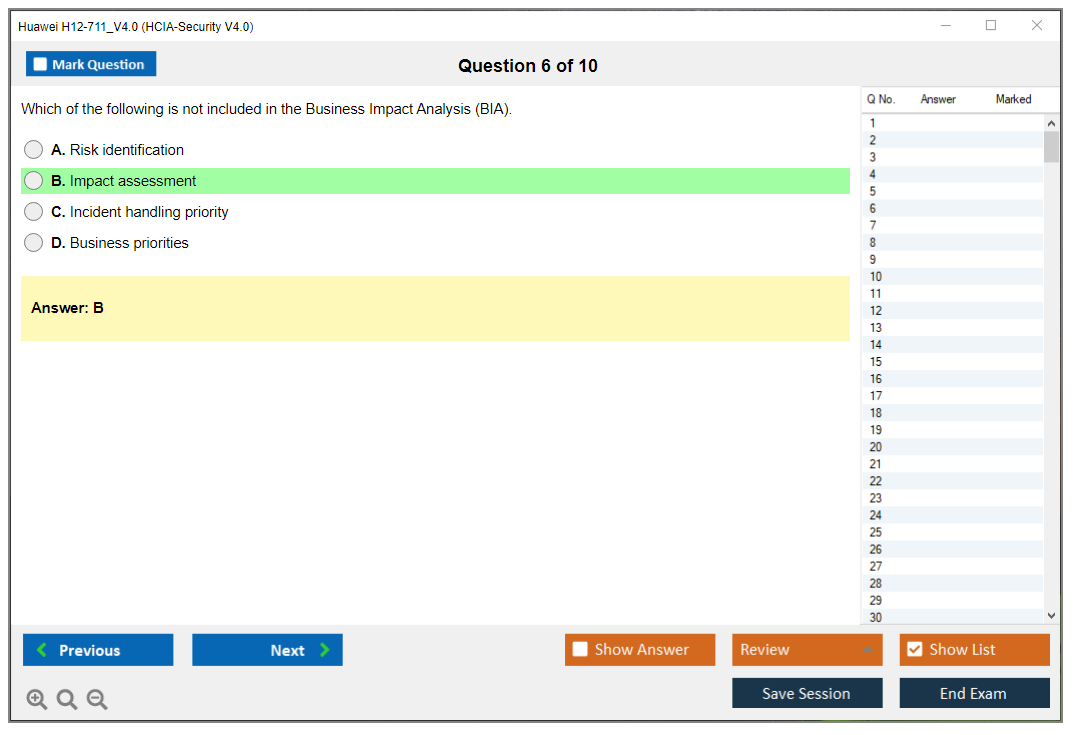
Prevention, detection, response, recovery. The security lifecycle provides the conceptual framework for everything else you'll encounter. Prevention includes system hardening and access controls. Detection covers continuous monitoring and alerting mechanisms. Response and recovery handle incidents when prevention measures fail despite your best efforts.
Common security threats and vulnerabilities receive extensive coverage throughout the exam. You'll need to differentiate malware types with precision. Viruses self-replicate by attaching to legitimate files. Worms spread independently across networks without human interaction. Trojans disguise themselves as legitimate software to gain initial access. Ransomware encrypts your data and extorts payment for decryption keys. Spyware silently steals sensitive information and sends it to external parties. Social engineering attacks exploit human psychology instead of technical vulnerabilities. Phishing uses fraudulent emails mimicking trusted sources, pretexting creates fabricated scenarios to extract information, baiting offers something tempting to trick victims into compromising security.
Network-based attacks include DoS/DDoS flooding targets with overwhelming traffic volumes, man-in-the-middle interception of communications, and various spoofing techniques manipulating source identities. Application-layer attacks like SQL injection and cross-site scripting target web applications and their underlying databases. Password attacks employ brute force methods trying every possible combination, dictionary attacks using lists of common passwords, or rainbow tables containing precomputed hashes for faster cracking. I once watched someone spend two hours troubleshooting what turned out to be a simple ARP spoofing attack, which would have been obvious with proper fundamentals.
Security standards and compliance frameworks provide organizational context for why companies implement specific controls beyond "good practice." ISO 27001/27002 information security management systems define internationally recognized best practices. NIST cybersecurity framework basics appear frequently throughout exam scenarios. GDPR and data protection principles matter especially for organizations handling EU citizen data or operating in European markets. Industry-specific requirements vary wildly: healthcare organizations deal with HIPAA, financial institutions face PCI-DSS mandates.
Security architecture principles teach proper network segmentation creating distinct security zones with different trust levels and access requirements. Zero-trust architecture concepts challenge the traditional perimeter-based security model that dominated for decades. Secure network topology design and strategic security device placement determine how your layered defenses actually function under attack conditions.
Domain 2: Cryptography and PKI (10-15% of exam)
Cryptographic fundamentals require understanding different algorithm types and their appropriate use cases in various scenarios. Symmetric encryption uses identical keys for both encryption and decryption operations. DES is completely obsolete and broken, 3DES represents legacy systems, AES is the current industry standard, SM4 is the Chinese national encryption standard you'll encounter. Asymmetric encryption uses mathematically related key pairs where one encrypts and the other decrypts. RSA remains widely deployed despite significant computational overhead. ECC provides equivalent security using considerably smaller key sizes. Diffie-Hellman enables secure key exchange without requiring prior shared secrets between parties.
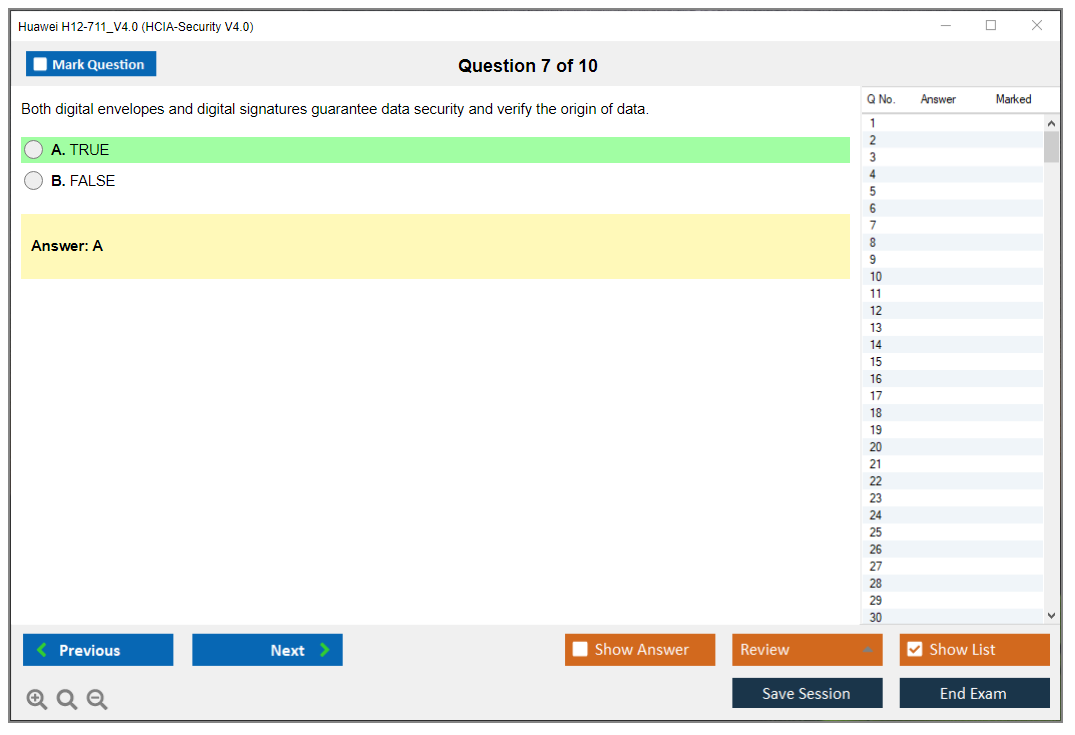
Hashing algorithms create fixed-size digests enabling integrity verification of data. MD5 is cryptographically broken and shouldn't be used except for legacy compatibility scenarios. SHA-1 is officially deprecated. SHA-256 and SHA-3 provide current security standards. SM3 is another Chinese standard appearing in Huawei implementations. Digital signatures combine hashing with asymmetric encryption to provide both authentication and non-repudiation guarantees. Message authentication codes use symmetric keys for integrity verification.
Poor key management undermines everything. Cryptographic key management lifecycle covers generation using sufficient entropy, secure distribution to authorized parties, protected storage preventing unauthorized access, regular rotation limiting exposure windows, and secure destruction when keys reach end-of-life.
Public Key Infrastructure creates scalable trust relationships through hierarchical Certificate Authority structures. Root CAs anchor entire trust chains. Intermediate CAs distribute operational load and limit root CA exposure. Digital certificates use standardized X.509 format with fields identifying the certificate subject, issuer identity, validity period boundaries, embedded public key, and various extensions defining usage constraints. Certificate enrollment requests new certificates, renewal extends validity before expiration deadlines, revocation immediately invalidates compromised certificates. Certificate Revocation Lists and OCSP provide different mechanisms for checking revocation status. Trust chains validate certificates by cryptographically verifying signatures sequentially up to a trusted root CA.
Cryptographic protocols apply these concepts to real-world communications. SSL/TLS secures network communications using negotiated cipher suites balancing security and performance. IPsec provides network-layer encryption for site-to-site and remote-access VPN implementations. SSH secures remote administrative access with strong authentication mechanisms. HTTPS combines standard HTTP with TLS encryption for secure web traffic protecting confidentiality and integrity.
Domain 3: Firewall technologies (20-25% of exam)
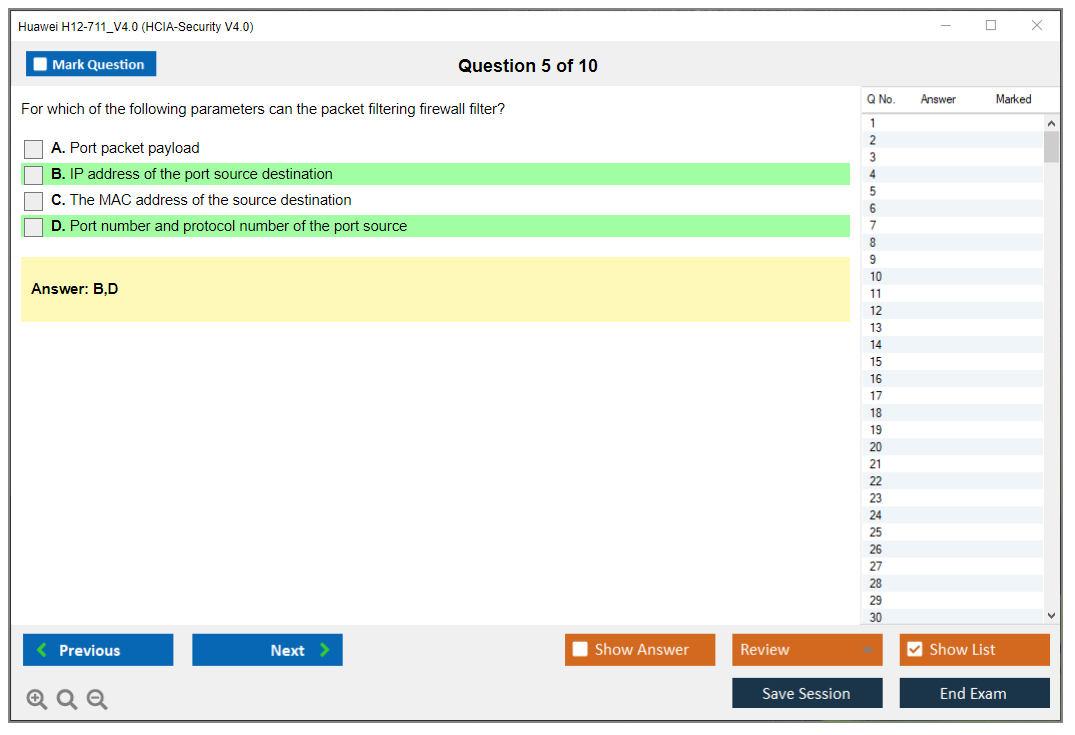
Heavy domain here. This represents up to a quarter of your entire exam score, so don't underestimate it. Firewall fundamentals start with basic packet filtering examining packet headers against configured rules. Stateful inspection tracks connection state information, automatically permitting return traffic for established sessions without explicit rules. Application-layer firewalls and deep packet inspection analyze actual payload content beyond simple header information. Next-generation firewalls integrate intrusion prevention systems, application awareness, and threat intelligence feeds into single platforms.
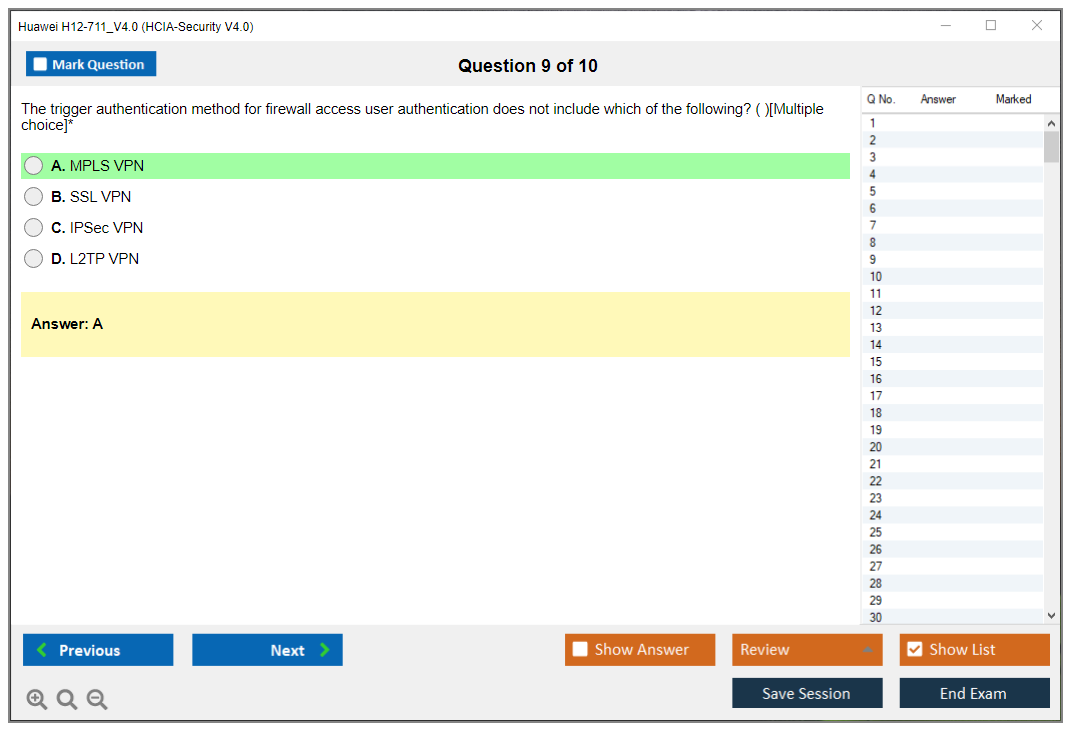
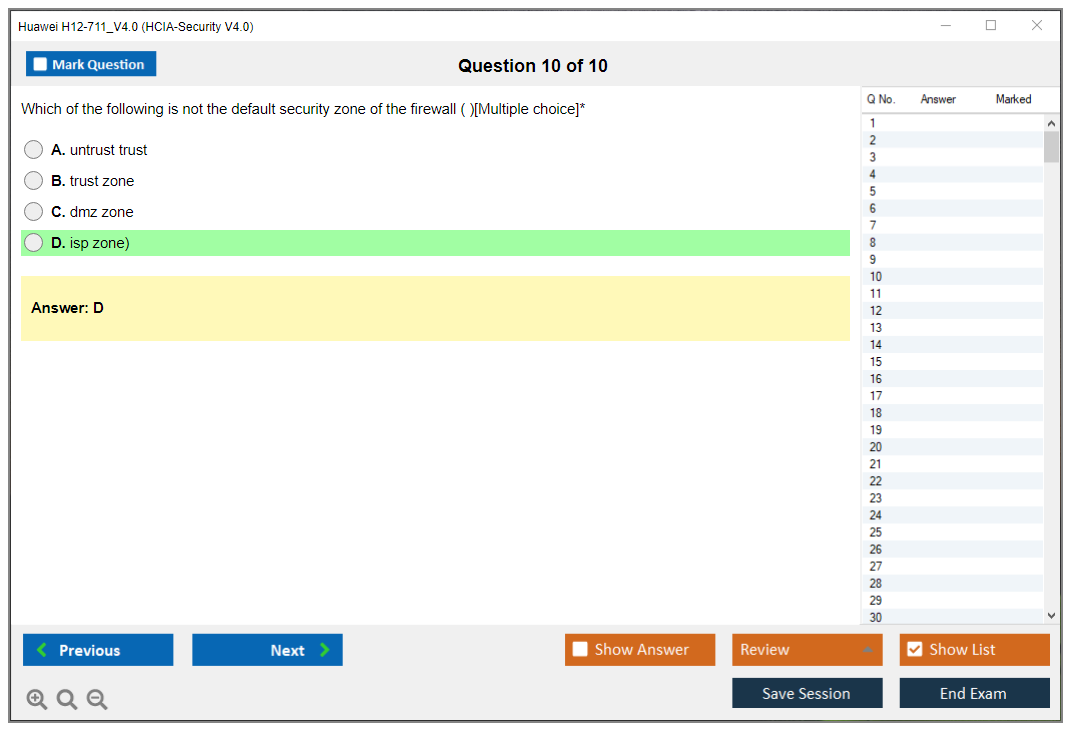
Security zones logically group interfaces by trust level: trust, untrust, DMZ, and custom zones. Traffic flowing between different zones requires explicit policy permission rather than default allow. Firewall deployment modes include routed mode where the firewall is a layer-3 hop in the network path, transparent mode operating at layer-2 without IP address requirements, and hybrid combinations serving specific architectural needs.
Huawei firewall product family focuses primarily on the USG (Unified Security Gateway) series across different performance tiers. You need to know different models' capabilities, performance specifications, and appropriate deployment scenarios for various organization sizes. Management interfaces include web-based UI for point-and-click administration, CLI for scripting and automation, and centralized management platforms for enterprise-scale deployments. High availability configurations maintain service continuity through active/standby failover or active/active clustering distributing load.
Firewall policy configuration is intensely practical and heavily tested on the exam. Security policies explicitly define permitted traffic flows between security zones based on multiple criteria. Rule ordering matters because firewalls process rules sequentially using first-match logic that stops evaluation once a rule matches. Source and destination zones, address objects, user identities, service definitions, and permit/deny actions combine to create granular policies. Service objects define applications by traditional port/protocol combinations or modern application signatures. Policy optimization removes shadowed rules that never match and consolidates overlapping entries improving performance. If you're studying for the H12-711_V4.0 practice test, expect multiple configuration scenarios testing policy logic and troubleshooting.
The HCIA-Security V4.0 exam builds directly on foundational networking knowledge you should already possess. If you're coming from routing and switching backgrounds like HCIA-Datacom, you'll find familiar networking concepts applied to security contexts and controls. Unlike specialized certifications such as HCIA-Storage or HCIA-WLAN that dive deep into specific technology areas, HCIA-Security crosses multiple domains requiring broader knowledge foundations. The exam difficulty sits somewhere between entry-level associate certifications and professional-level exams like HCIP-Datacom that demand advanced troubleshooting and design skills.
Understanding Huawei HCIA-Security V4.0 objectives requires recognizing how these different domains interconnect rather than treating them as isolated topics. Cryptography knowledge applies directly when configuring IPsec VPN tunnels within firewall policies. Threat understanding informs which security zones and granular policies you implement protecting specific assets. This integrated approach makes the certification valuable beyond just passing another exam and adding initials to your resume.
Conclusion
Wrapping this up
Look, the Huawei H12-711_V4.0 HCIA-Security V4.0 exam isn't something you can just wing. Honestly, you could try, but why waste the exam cost and your time? From everything we've covered (the Huawei HCIA-Security V4.0 objectives, the H12-711_V4.0 exam difficulty, the stuff about HCIA-Security V4.0 prerequisites) you should have a clear picture now of what's actually required to pass.
The HCIA-Security V4.0 passing score sits at 600 out of 1000. Sounds lower than it feels when you're staring at questions about Huawei security fundamentals exam topics you didn't study deeply enough. Happens more than people admit. The exam's not crazy hard if you've got some networking background and you've actually worked through the H12-711 exam syllabus properly, but beginners who skip the fundamentals? They struggle. A lot.
Here's the thing: your study approach matters way more than how many weeks you dedicate, and I mean that. You need solid HCIA-Security V4.0 study materials. Official Huawei security certification associate resources are good, but they're dry and sometimes assume you know more than you do. Frustrating when you're trying to grasp new concepts but the explanations skip foundational steps entirely.
Add in real-world practice. Set up labs. Break things and fix them. That's where the learning sticks, not just reading PDFs about security operations and network security technologies. I once spent three hours trying to configure a firewall rule that should've taken fifteen minutes, got angry, nearly gave up. But that frustration taught me more about rule precedence than any guide ever could.
The certification validity period is three years. Once you pass, you've got time before worrying about HCIA-Security certification renewal. But getting there requires prep that simulates the real thing. Theory's fine, textbooks are fine, but you absolutely need a quality H12-711_V4.0 practice test that mirrors actual exam questions. Not just random quiz banks that don't match the current version.
That's where something like the H12-711_V4.0 Practice Exam Questions Pack becomes really useful for your final prep phase. I'm talking about drilling realistic scenarios until the exam format feels boring. Until you spot trick questions before you finish reading them. Until the Huawei security solution topics are muscle memory.
Not gonna lie, the H12-711_V4.0 exam cost isn't cheap enough to gamble on being "mostly ready." Get properly ready. Use every resource that actually helps. Then schedule it and pass the first time.
