HPE6-A47 Practice Exam - Designing Aruba Solutions
Reliable Study Materials & Testing Engine for HPE6-A47 Exam Success!
Exam Code: HPE6-A47
Exam Name: Designing Aruba Solutions
Certification Provider: HP
Certification Exam Name: Aruba Certified Design Professional (ACDP) V1


Free Updates PDF & Test Engine
Verified By IT Certified Experts
Guaranteed To Have Actual Exam Questions
Up-To-Date Exam Study Material
99.5% High Success Pass Rate
100% Accurate Answers
100% Money Back Guarantee
Instant Downloads
Free Fast Exam Updates
Exam Questions And Answers PDF
Best Value Available in Market
Try Demo Before You Buy
Secure Shopping Experience
HPE6-A47: Designing Aruba Solutions Study Material and Test Engine
Last Update Check: Mar 19, 2026
Latest 68 Questions & Answers
45-75% OFF
Hurry up! offer ends in 00 Days 00h 00m 00s
*Download the Test Player for FREE
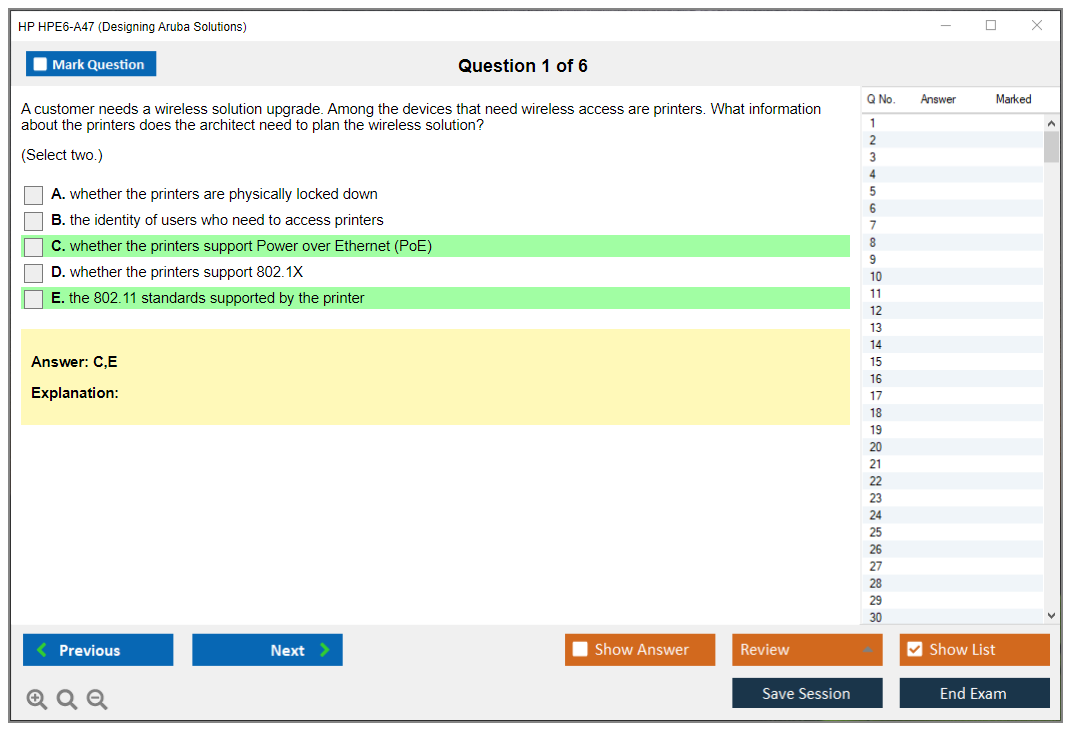
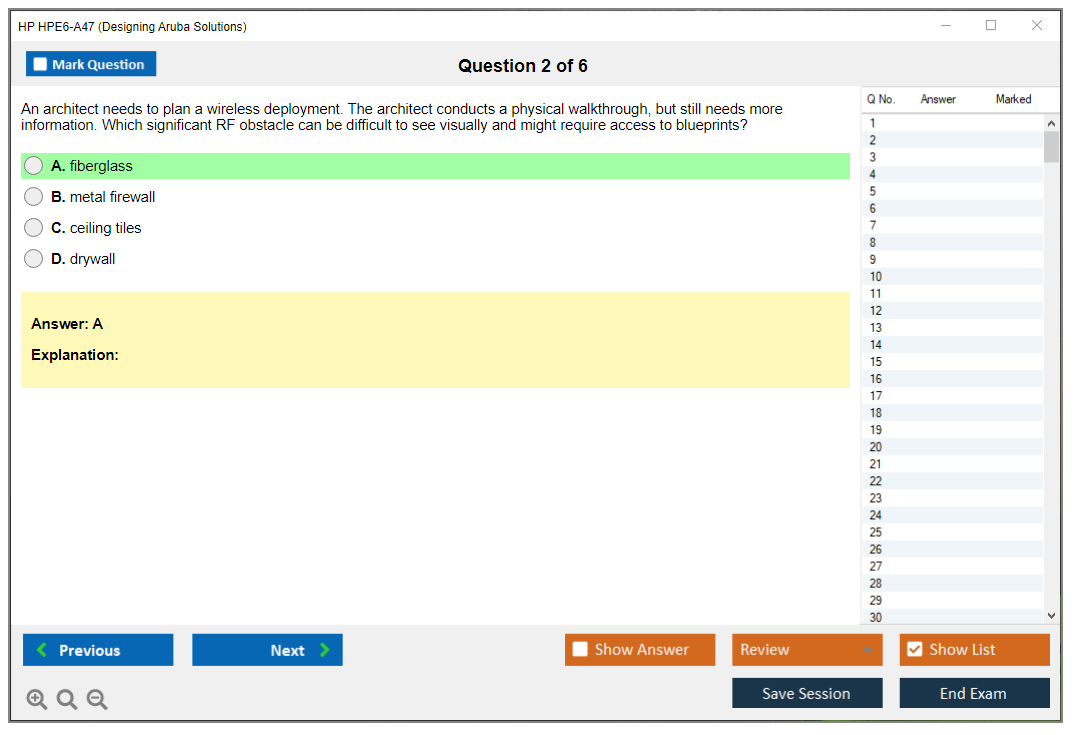
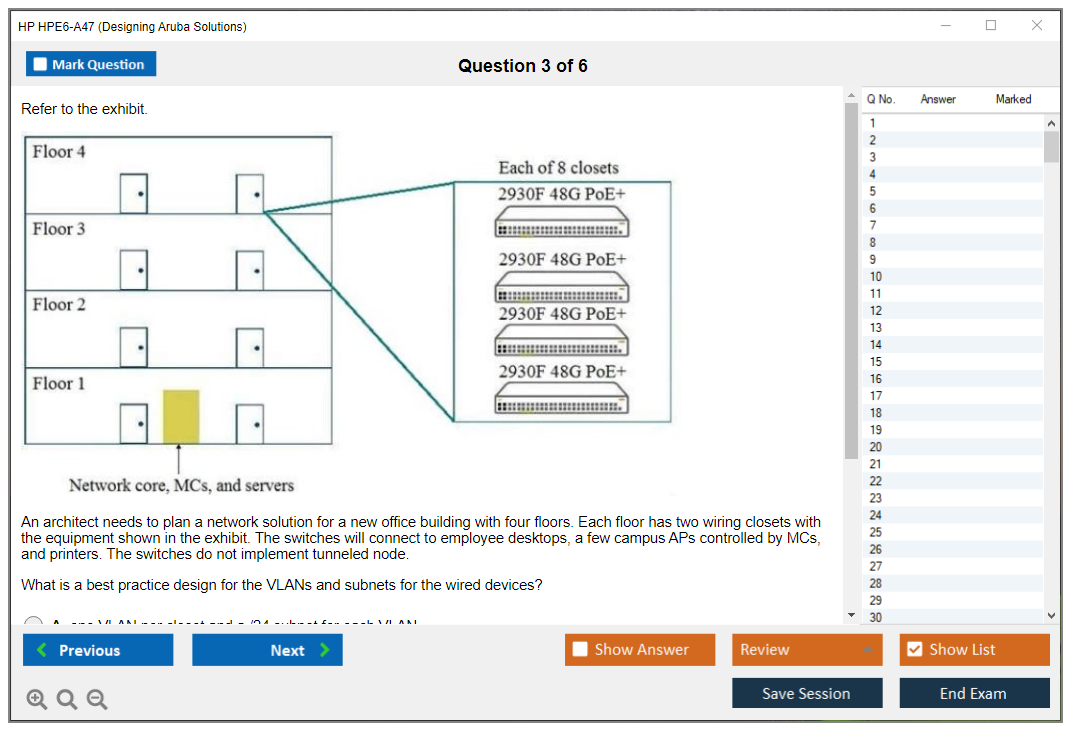
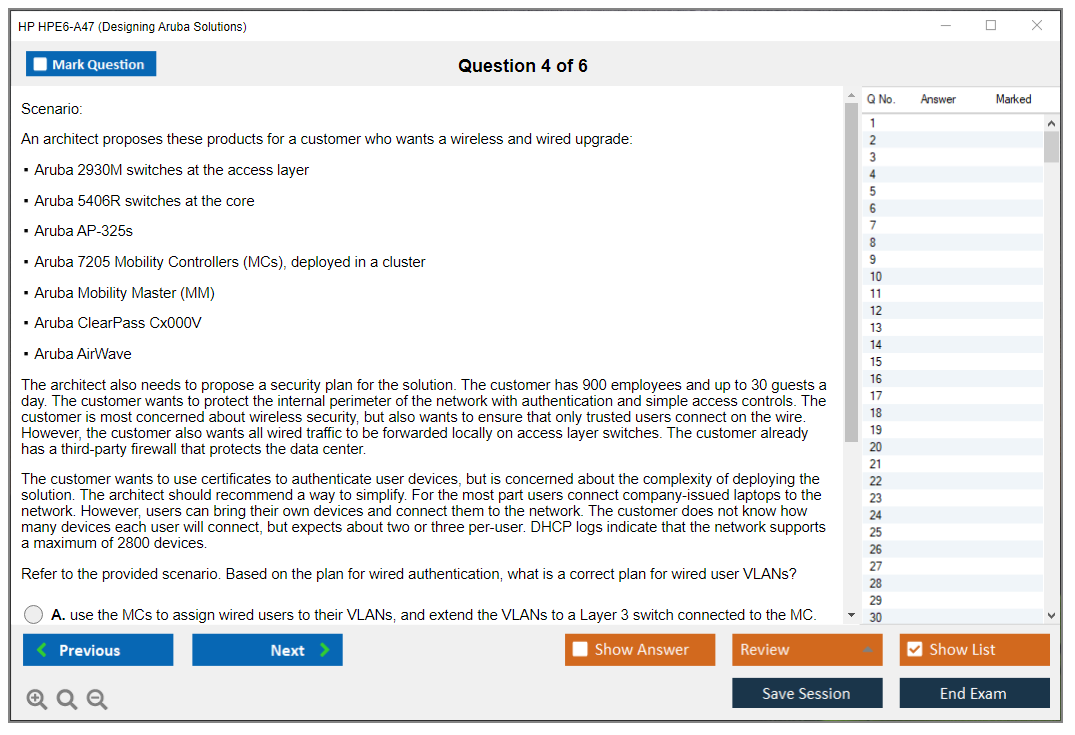
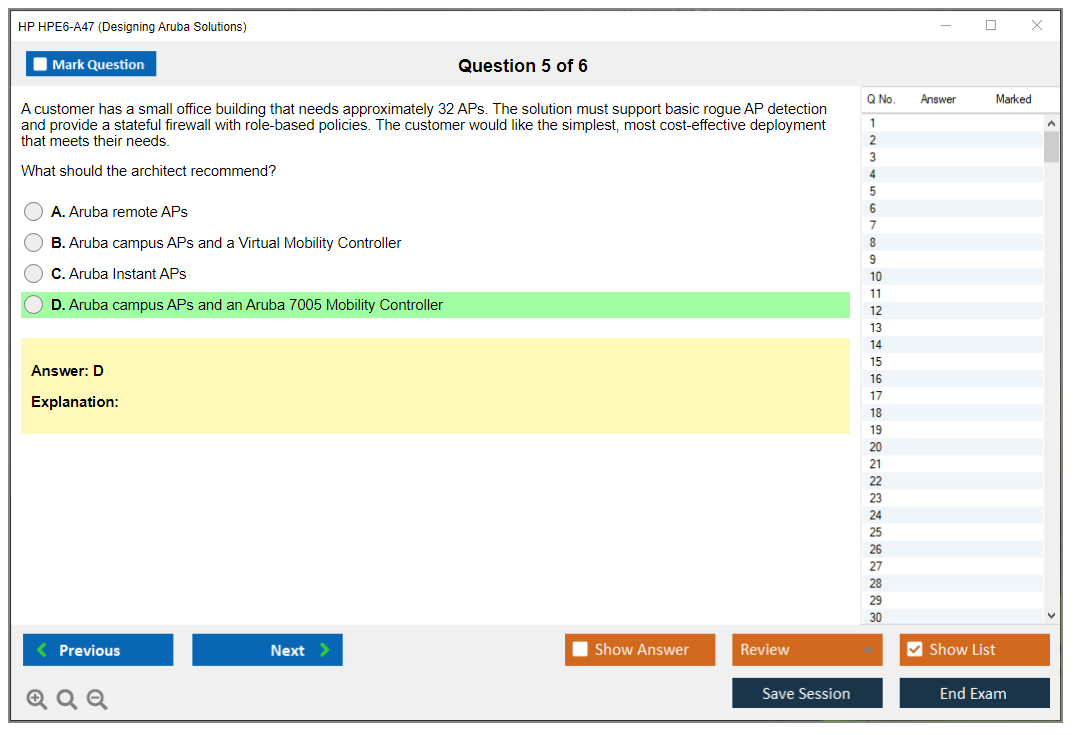
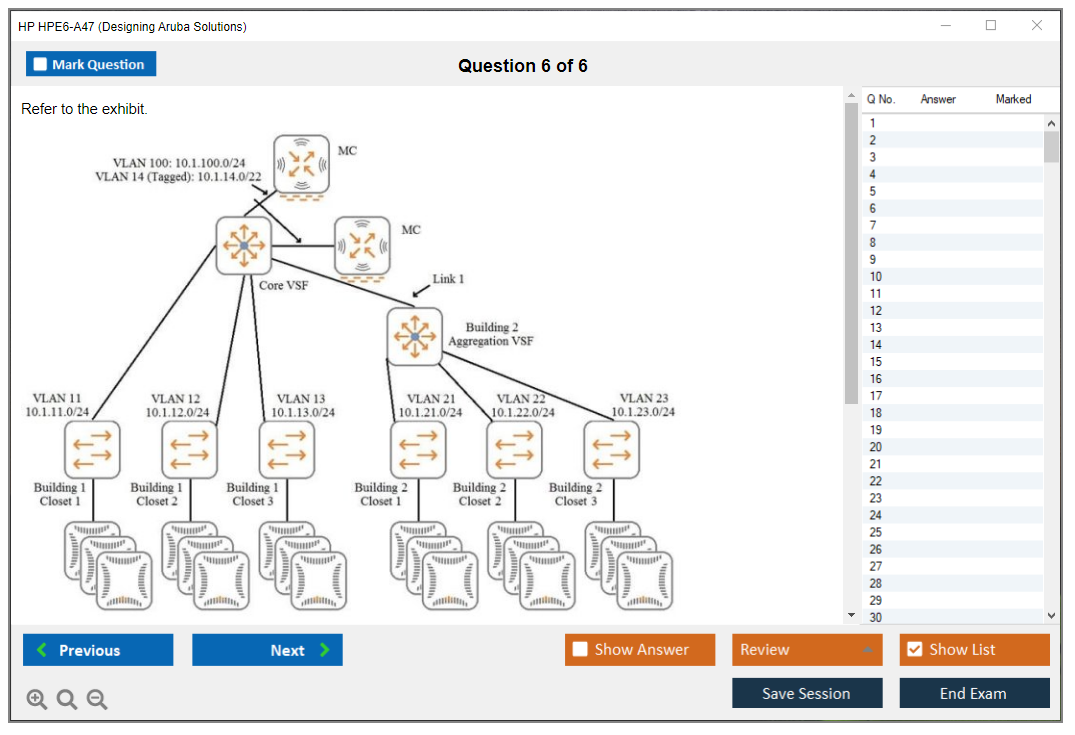
Dumpsarena HP Designing Aruba Solutions (HPE6-A47) Free Practice Exam Simulator Test Engine Exam preparation with its cutting-edge combination of authentic test simulation, dynamic adaptability, and intuitive design. Recognized as the industry-leading practice platform, it empowers candidates to master their certification journey through these standout features.
What is in the Premium File?
Satisfaction Policy – Dumpsarena.co
At DumpsArena.co, your success is our top priority. Our dedicated technical team works tirelessly day and night to deliver high-quality, up-to-date Practice Exam and study resources. We carefully craft our content to ensure it’s accurate, relevant, and aligned with the latest exam guidelines. Your satisfaction matters to us, and we are always working to provide you with the best possible learning experience. If you’re ever unsatisfied with our material, don’t hesitate to reach out—we’re here to support you. With DumpsArena.co, you can study with confidence, backed by a team you can trust.
HP HPE6-A47 Exam FAQs
Introduction of HP HPE6-A47 Exam!
The HP HPE6-A47 exam is an Aruba Certified Design Professional (ACDP) exam. It tests a candidate's knowledge and skills of designing, deploying and troubleshooting Aruba wired and wireless networks.
What is the Duration of HP HPE6-A47 Exam?
The HP HPE6-A47 exam is a 90-minute exam consisting of 60-70 questions.
What are the Number of Questions Asked in HP HPE6-A47 Exam?
There are 60 questions in the HP HPE6-A47 exam.
What is the Passing Score for HP HPE6-A47 Exam?
The passing score for the HP HPE6-A47 exam is 700 out of 1000.
What is the Competency Level required for HP HPE6-A47 Exam?
The HP HPE6-A47 exam requires a Competency Level of Advanced.
What is the Question Format of HP HPE6-A47 Exam?
The HP HPE6-A47 exam consists of multiple-choice, drag-and-drop, and simulation questions.
How Can You Take HP HPE6-A47 Exam?
The HPE6-A47 exam is available in both online and testing center formats. For the online format, you will need to register and pay for the exam on the HP website. Once you have registered and paid, you will be able to access the exam and take it at your own pace. For the testing center format, you will need to register and pay for the exam at a Pearson VUE testing center. Once you have registered and paid, you will be able to take the exam at the testing center on the scheduled date and time.
What Language HP HPE6-A47 Exam is Offered?
The HP HPE6-A47 exam is offered in English.
What is the Cost of HP HPE6-A47 Exam?
The cost of the HP HPE6-A47 exam is around $150 USD.
What is the Target Audience of HP HPE6-A47 Exam?
The target audience for the HP HPE6-A47 exam is IT professionals who want to demonstrate their knowledge and skills in designing, implementing, and troubleshooting Aruba Networking solutions. This includes network engineers, system administrators, and network architects.
What is the Average Salary of HP HPE6-A47 Certified in the Market?
The average salary for a professional who has passed the HP HPE6-A47 exam certification is around $90,000 per year.
Who are the Testing Providers of HP HPE6-A47 Exam?
The HP HPE6-A47 exam is a certification exam administered by Pearson VUE. Pearson VUE is an authorized provider of HP certification exams, and they offer testing centers around the world.
What is the Recommended Experience for HP HPE6-A47 Exam?
The recommended experience for the HP HPE6-A47 exam is at least one year of experience in deploying, configuring, and managing Aruba wired and wireless networks. This includes experience with Aruba Mobility Controllers, Aruba Access Points, Aruba AirWave, and Aruba ClearPass. Experience with ArubaOS, Aruba Central, and Aruba Instant is also beneficial.
What are the Prerequisites of HP HPE6-A47 Exam?
The HP HPE6-A47 exam requires that candidates have experience with Aruba OS, Aruba Mobility Controllers, Aruba Mobility Access Switches, Aruba ClearPass, Aruba AirWave, Aruba Central, and Aruba Instant. Candidates should also have knowledge of network security, network routing, network switching, and wireless networking.
What is the Expected Retirement Date of HP HPE6-A47 Exam?
The expected retirement date of the HPE6-A47 exam is not available online. You can contact HPE Support for more information.
What is the Difficulty Level of HP HPE6-A47 Exam?
The difficulty level of the HP HPE6-A47 exam is considered to be moderate. It is not an easy exam, but it is also not overly difficult.
What is the Roadmap / Track of HP HPE6-A47 Exam?
The certification roadmap for the HPE6-A47 exam includes the following steps:
1. Become familiar with the HPE6-A47 exam objectives.
2. Take a self-assessment to determine if you are ready to take the exam.
3. Take an online or classroom training course to prepare for the exam.
4. Purchase the exam voucher and schedule the exam.
5. Take the exam and receive your certification.
6. Maintain your certification by completing continuing education credits.
What are the Topics HP HPE6-A47 Exam Covers?
The HP HPE6-A47 exam covers the following topics:
1. Network Fundamentals: This topic covers the basics of networking, including the OSI model, IP addressing, and routing protocols.
2. Wireless Technologies: This topic covers the different types of wireless technologies, including Wi-Fi, Bluetooth, and cellular networks.
3. Network Security: This topic covers the fundamentals of network security, including authentication, encryption, and firewalls.
4. Network Troubleshooting: This topic covers the basics of network troubleshooting, including identifying and resolving common network issues.
5. Aruba Products and Solutions: This topic covers the different Aruba products and solutions, including the ArubaOS operating system, the Aruba Mobility Controller, and the Aruba Instant Access Point.
What are the Sample Questions of HP HPE6-A47 Exam?
1. What is the purpose of the HPE6-A47 exam?
2. What topics are covered in the HPE6-A47 exam?
3. How many questions are on the HPE6-A47 exam?
4. What is the passing score for the HPE6-A47 exam?
5. What types of questions are included in the HPE6-A47 exam?
6. What resources are available to help prepare for the HPE6-A47 exam?
7. What is the recommended study time for the HPE6-A47 exam?
8. What is the format of the HPE6-A47 exam?
9. How long is the HPE6-A47 exam?
10. What is the best way to approach the HPE6-A47 exam?
HP HPE6-A47 (Designing Aruba Solutions) HPE6-A47 (Designing Aruba Solutions) Exam Overview What is the HPE6-A47 exam and who should take it? The HPE6-A47 exam validates expertise in designing Aruba networking solutions for enterprise environments. It's not about configs. This isn't about configuring individual switches or access points. It's about translating business and technical requirements into full network architectures that actually solve real-world problems, the kind where customers describe their pain points and you've gotta create something that won't fall apart under pressure. The exam covers campus switching, wireless LAN design, security integration, and management platform selection. Basically everything you need when a customer says "we need a network that doesn't suck." Network architects should take this. Senior engineers and consultants working with Aruba technologies too. It demonstrates your ability to create scalable, resilient designs aligned with customer... Read More
HP HPE6-A47 (Designing Aruba Solutions)
HPE6-A47 (Designing Aruba Solutions) Exam Overview
What is the HPE6-A47 exam and who should take it?
The HPE6-A47 exam validates expertise in designing Aruba networking solutions for enterprise environments. It's not about configs. This isn't about configuring individual switches or access points. It's about translating business and technical requirements into full network architectures that actually solve real-world problems, the kind where customers describe their pain points and you've gotta create something that won't fall apart under pressure. The exam covers campus switching, wireless LAN design, security integration, and management platform selection. Basically everything you need when a customer says "we need a network that doesn't suck."
Network architects should take this. Senior engineers and consultants working with Aruba technologies too. It demonstrates your ability to create scalable, resilient designs aligned with customer objectives rather than just racking equipment and copying configs. Not gonna lie, this is part of HPE's Aruba Certified Design Professional (ACDP) certification track, which distinguishes candidates as design specialists rather than implementation-only technicians. I mean, there's nothing wrong with being an implementation expert. The thing is, the industry values people who can architect solutions before anyone touches a console cable.
What the HPE6-A47 exam validates
This Designing Aruba Solutions certification tests proficiency in gathering and analyzing customer requirements. Business drivers, technical constraints, budget limitations, all that messy real-world stuff that doesn't fit neatly into product datasheets. You'll need capability to design end-to-end Aruba solutions including wired, wireless, and security components, which means understanding how these pieces interact rather than treating them as isolated domains.
Knowledge of Aruba product portfolio matters here. Appropriate use cases for each platform is huge. Should you recommend AOS-CX or ArubaOS-Switch? When does Aruba Central make sense versus on-premises AirWave? The exam validates your understanding of design tradeoffs between performance, cost, scalability, and manageability. The kind of decisions that make or break a project six months down the road when everyone's forgotten the original constraints but your design's either holding up or collapsing spectacularly.
You'll also demonstrate ability to incorporate high availability and redundancy into network architectures. Nothing ends careers faster. I mean, designing a single point of failure into a hospital network is basically career suicide. Skills in creating bills of materials with proper licensing and support considerations matter too, since a technically perfect design that exceeds budget by 40% is just an expensive paperweight. Competence in validating designs against requirements and industry best practices rounds out the core skills, along with familiarity with Aruba management platforms and their architectural implications.
Who should take HPE6-A47 (target roles)
Network architects responsible for designing enterprise campus and branch solutions are the primary audience. Senior network engineers transitioning from implementation to design roles should absolutely consider this. It formalizes the architectural thinking you've probably been doing informally for years, those moments where you're mentally redesigning customer networks while pretending to listen during site surveys. Pre-sales engineers and solution consultants proposing Aruba-based architectures need this credential because customers want to see proof you know what you're talking about when you're sketching network diagrams on their whiteboard.
IT managers benefit here. Those overseeing network infrastructure planning and upgrades benefit from understanding design methodology even if they're not doing hands-on work. System integrators designing multi-vendor environments incorporating Aruba components will find this validates their cross-platform design skills. Consultants advising clients on wireless and wired network modernization basically need this to compete for contracts. Professionals seeking to validate design expertise for career advancement and engineers with hands-on Aruba experience ready to formalize architectural knowledge represent the sweet spot. You've got the practical foundation, now you're adding the structured design framework on top.
Relationship to HPE Aruba networking certification path
The HPE6-A47 builds upon foundational Aruba knowledge from associate-level certifications like the HPE6-A72 (Aruba Certified Switching Associate Exam) or HPE6-A70 (Aruba Certified Mobility Associate Exam). It complements implementation-focused certifications with design methodology, giving you the complete picture from concept to deployment. May serve as stepping stone to expert-level certifications like the HPE6-A80 (Aruba Certified Design Expert Written Exam) or specialty certifications in security or data center. Though honestly, you'll want real-world design experience between these levels or you're just collecting alphabet soup after your name.
This fits with HPE's competency-based certification framework. They're trying to map certifications to actual job roles rather than just product versions, which is refreshing compared to the old "memorize CLI commands" approach. Recognized by partners in HPE Partner Ready program for design competencies, it's often required or preferred for advanced partner tiers and specializations. If you're working for an Aruba partner or want to, this certification matters for their status with HPE.
Value proposition for certification holders
The Designing Aruba Solutions certification demonstrates credibility when presenting designs to stakeholders and customers. There's a gap between "I think this architecture will work" and "I'm certified in Aruba design methodology and here's why this approach meets your requirements based on established frameworks and proven methodologies."
It differentiates professionals in competitive job markets and consulting engagements where everyone claims to be a network architect. This proves it. Provides structured framework for approaching network design challenges, which sounds boring but actually saves you from reinventing the wheel every project. Validates ability to work independently on architectural projects without constant supervision or second-guessing. Look, it may unlock higher billing rates for consultants and contractors. Clients pay more for certified design expertise, that's just reality.
It keeps skills current with changing Aruba product lines and design methodologies. The HPE6-A73 (Aruba Certified Switching Professional Exam) and HPE6-A82 (Aruba Certified ClearPass Associate Exam) complement this nicely if you're building a complete Aruba certification portfolio. Combined with HPE0-V25 (HPE Hybrid Cloud Solutions), you're positioned to design integrated campus-to-cloud architectures that reflect modern enterprise requirements. Wait, actually that's becoming more important than pure campus design these days.
HPE6-A47 Exam Objectives - What to Study
HPE6-A47 (Designing Aruba Solutions) exam overview
What the HPE6-A47 exam validates
The HPE6-A47 exam is basically a design exam that expects you to think like the person who has to defend the solution in a meeting, not the person pasting configs at 2 a.m. You need to show you can turn messy requirements into an Aruba design that'll actually work, scale, and be supportable, with the tradeoffs written down somewhere people can find them later. No magic here. Just solid design logic.
Bring a pencil mentality.
Who should take HPE6-A47 (target roles)
Look, if you're a network engineer moving into pre-sales, a senior admin who now owns standards, or a consultant who keeps getting pulled into "can you sanity-check this Aruba campus network design," this fits you pretty well. Architects fit here. Lead engineers too. Anyone chasing the Designing Aruba Solutions certification as part of an HPE Aruba networking certification path, honestly.
HPE6-A47 exam objectives (what to study)
Aruba solution design methodology (requirements → design → validation)
This is the spine of the test. The whole thing kind of collapses without understanding this flow. Discovery first, then design, then validation, then documentation, then you loop back because stakeholders always change their mind. You should be comfortable gathering business requirements like growth plans (headcount, new buildings, M&A), budget cycles (capex now vs opex later), and strategic initiatives (zero trust, IoT expansion, cloud migration), because those directly change whether you pick Central, how much redundancy you buy, and how aggressive your rollout timeline is. Or if you're just setting yourself up for a painful conversation six months in.
Technical requirements? That's the other half. Existing switching, routing, IP plan, WAN constraints, apps that hate latency, real user profiles (task workers vs roamers vs scanners), and what authentication exists today. Site surveys matter too. Greenfield's easier: you can place APs where you want and design cabling cleanly. Brownfield is real life: weird walls, bad IDFs, and "that switch can't be touched." Translate all of it into constraints and success criteria, like "voice MOS target," "roaming handoff under X ms," "N+1 at core," "guest traffic isolated," and "support team can troubleshoot with current tools."
Documentation isn't a formality. You need high-level design (HLD) for the why and the shape, and low-level design (LLD) for the how, with rationale, assumptions, risks, and dependencies spelled out clearly. Then validation: design reviews, proof-of-concept testing, and simulation where it makes sense. My old boss used to say if you can't explain it in three minutes on a whiteboard, you don't really have a design yet. He was mostly right.
Write it down.
Campus switching and wired access design (VLANs, redundancy, segmentation)
Know the Aruba CX portfolio at a practical level: access vs aggregation vs core, and what features and scale expectations push you up the stack. VLAN design's easy to get wrong because people either create 3 VLANs for everything or 300 VLANs for no reason at all. You want segmentation that matches policy boundaries: users, IoT, voice, printers, building systems, and a tight management plane. The rest is details: naming conventions, IP addressing, DHCP relay, and where SVIs live.
Redundancy is where HPE6-A47 likes to poke around. STP still exists, but Aruba design often prefers VSF at the edge and VSX at distribution/core to reduce STP pain and improve convergence times without making everyone's life miserable. Link aggregation comes up a lot: plain LACP, and multi-chassis LAG when you're dual-homing into a VSX pair. QoS matters more than people admit, especially for voice, video, and those "one app that runs the business," and you should know how to think about trust boundaries and marking without turning the campus into a science project nobody can maintain.
PoE planning's also exam-friendly. Do the math. AP models, phone loads, IoT draw, class vs real consumption, and switch power supplies. None of it's optional. Uplink design and oversubscription ratios at access, aggregation, core. Migration scenarios too: integrating with old switching while you cut over, what stays L2, what moves L3, and how you avoid a weekend-long outage that gets you paged at 3 a.m. And yes, fabrics show up: EVPN/VXLAN concepts, when it's worth it, and how it changes troubleshooting and fault isolation.
WLAN design (RF considerations, capacity, roaming, SSIDs)
RF is physics. Not vibes. Frequency planning, channel width choices, transmit power strategy, and what happens when you go 40/80 MHz in a dense office and then wonder why co-channel interference eats your lunch every single day. Capacity planning should be tied to user density and apps: voice calls, Teams video, scanning, guest browsing, plus the ugly truth that client devices are the limiting factor half the time and there's nothing you can do about it.
AP placement's coverage vs capacity, and you need to explain why you picked one over the other. High-density designs like auditoriums and conference centers are their own beast: more APs, lower power, tighter channel plans, and careful expectations set with stakeholders who think Wi-Fi's magic. Roaming is another key topic. Study 802.11r, OKC, and opportunistic key caching, and when they help or break older clients, because they will break something. SSID architecture matters too: keep SSID count low, use per-SSID policies intelligently, and design guest access with isolation requirements that security will sign off on without a fight.
Also know interference mitigation: ARM, ChannelFly, spectrum analysis basics, and how you'd handle non-Wi-Fi interferers like microwave ovens or Bluetooth spam. Outdoor wireless adds mounting, weather, and backhaul constraints nobody thinks about until it rains. Mesh is a tool, not a default answer. Location services and analytics come up as design add-ons, usually tied to business outcomes someone in marketing cares about.
Security and policy design (NAC concepts, ClearPass use cases)
This section's heavy on Aruba ClearPass design thinking. It's probably where people lose the most points if they haven't touched ClearPass in production. NAC architecture and deployment models matter. ClearPass Policy Manager for AAA, plus integration with AD/LDAP/RADIUS that doesn't break every password change. Role-based access control design, where enforcement happens (switch, controller, gateway, firewall), and how dynamic segmentation can be done with roles, dynamic VLANs, tunneling, and firewall policies without creating a troubleshooting nightmare.
Onboarding flows for BYOD and guests, certificate-based 802.1X, and profiling strategies for device classification when users lie about what they're connecting. Posture assessment and remediation are fair game. Logging to SIEM, audit trails, and compliance (PCI-DSS, HIPAA) show up as "design constraints," not trivia you can skip over. Encrypted traffic visibility's worth thinking about too, mostly in terms of what you can and can't see and how that affects monitoring and incident response when something goes sideways.
Management and operations design (Aruba Central / monitoring / troubleshooting readiness)
You need to be able to defend cloud vs on-prem management in front of people who have strong, irrational opinions about both. Aruba Central architecture basics, subscription models, and multi-tenancy for MSP-style setups where you're managing fifty different customers. AirWave might appear for legacy or hybrid environments nobody's migrated yet. Then the operational stuff people skip: monitoring and alerting design, logging retention policies that won't fill your storage in a week, integration with ITSM like ServiceNow, and what tooling your NOC actually needs when the CEO's Wi-Fi drops during an earnings call.
Automation comes up too: APIs, webhooks, templates, and how far you can go without making day-2 ops worse than doing it manually. Firmware management, upgrade planning, backups, and disaster recovery for configs and management data that everyone forgets about until it's too late. Reporting. Dashboards.
Boring, but it's what keeps jobs.
High availability, resiliency, and scalability considerations
Controller redundancy models (active/standby, clustering, distributed) and what failover looks like in practice when things actually break. Convergence time requirements. Stateful vs stateless failover implications that change how users experience an outage. Geographic redundancy for multi-site deployments. Scaling limits across controllers, switches, and management platforms, plus how you accommodate future growth without buying everything upfront and blowing the budget. Performance under failure scenarios is a real design conversation, and yes, maintenance windows and near-zero downtime upgrades matter to people who can't afford to take the network down at 2 a.m. on a Sunday.
Bill of materials and licensing considerations (as applicable)
Sizing and SKU selection's part math, part explaining yourself to procurement and finance. Hardware SKUs for switches, APs, controllers/gateways. Licensing models (subscription vs perpetual, feature licensing). Support contracts that actually make sense. Spares strategy. Lead times that can wreck a project plan if you don't check them. Professional services scope, like install, config, and training that someone's gotta pay for. TCO over the lifecycle.
Practical stuff.
HPE6-A47 cost and registration
HPE6-A47 exam cost (what to expect)
HPE6-A47 exam cost varies by region and testing provider, so check the official HPE certification site before you expense it and hope your manager approves. Don't assume last year's price still applies.
Budgets change.
Where to register and how scheduling works
Registration's typically through the approved testing platform linked from HPE, Pearson VUE most likely. Pick remote proctoring vs test center based on your tolerance for proctor rules and webcam angles, honestly.
HPE6-A47 passing score and exam format
Passing score (how it's set and where to verify)
The HPE6-A47 passing score is set by HPE and can change with exam revisions, so don't trust what you read two years ago. Verify it in the current exam page or exam guide, not a random forum post from someone who might be wrong.
Question types and time management tips
Expect scenario-driven questions that test tradeoffs, not memorization. Read the constraint carefully. Then answer based on what they asked. Don't overthink the perfect world that doesn't exist.
HPE6-A47 difficulty: how hard is it?
Expected difficulty level (beginner/intermediate/advanced)
I'd call it intermediate-to-advanced because design means context, and context means experience you can't fake with a weekend of cramming. If you've only done small office Wi-Fi setups, you'll feel the gaps pretty quickly.
Common challenge areas (design scenarios, tradeoffs, troubleshooting-by-design)
People struggle with writing down assumptions and translating "we want secure guest" into an actual policy plan with enforcement points that make sense, plus the campus redundancy choices (VSF/VSX/STP) and RF capacity math that requires you to actually calculate things. It's not trickery.
It's breadth.
How much study time you may need (based on experience)
If you've designed a few campuses already, a few weeks of focused review can do it without too much pain. If you're newer to design work, plan longer and build mini design exercises where you defend your choices to an imaginary skeptical manager.
Prerequisites and recommended experience
Official prerequisites (if any)
HPE may not require a formal prerequisite certification, but the blueprint expects you to already know Aruba switching and WLAN concepts well enough to not get lost in the weeds.
Recommended background (Aruba switching, WLAN, security fundamentals)
Hands-on with AOS-CX switching, WLAN design best practices, and NAC basics that go beyond "turn on 802.1X and pray." Some exposure to Central helps a lot.
Related certifications and learning paths
Pairing this with other Aruba certs in switching or mobility makes the content click faster instead of feeling like random facts you're trying to memorize in isolation.
Best study materials for HPE6-A47
Official HPE Press / Aruba training courses
Start with official training aligned to the blueprint, because it keeps you honest and focused on what actually matters. Self-study's fine, but structure helps.
Official exam blueprint/objectives (primary source)
Your real HPE6-A47 study guide is the objectives list that HPE publishes. Print it. Check off items with notes on what you know cold and what you need to review again.
Documentation to focus on (design guides, validated reference architectures)
Read Aruba validated designs, Central docs, ClearPass design guidance, and AOS-CX redundancy docs until the patterns start making sense. Skip the marketing fluff.
Community resources (forums, webinars) and how to vet accuracy
Community content's fine for context and war stories, but verify claims against docs and release notes because people mix versions constantly and confidently say wrong things.
HPE6-A47 practice tests and exam prep strategy
Practice tests vs. exam dumps (what to avoid)
Avoid dumps completely. They rot your understanding and can get you banned from the program. Use legit practice questions to find weak spots and pressure-test your recall, like the HPE6-A47 Practice Exam Questions Pack if you want structured drilling without pretending it replaces actual design knowledge.
Building a realistic lab (Aruba Central, AOS-CX, WLAN simulator/gear)
A small virtual or physical lab helps more than you'd think: AOS-CX switching, Central trial if you can get one, and at least one AP to validate RF and SSID choices in something that's not a simulator. Not fancy.
Just real.
Scenario-based practice plan (requirements gathering → design proposal)
Do this exercise: write a one-page customer profile, list business and technical requirements, propose an HLD with rationale, then add LLD details like SKUs and port counts, then write validation steps and risks, and then revise everything after you "discover" a constraint like limited PoE budget or an IDF with no UPS and see how your design changes. That loop's the exam in a nutshell.
Final-week checklist and revision plan
Re-read objectives line by line. Redo weak domains until they're not weak anymore. Run timed question sets under pressure. If you want extra reps, hit the HPE6-A47 Practice Exam Questions Pack again and annotate why each wrong answer's wrong instead of just clicking through to see the score.
Renewal and recertification for HPE6-A47
Certification validity period (where to confirm)
HPE6-A47 renewal requirements and validity periods change depending on HPE's current program rules, so confirm on the official certification page tied to your cert ID instead of trusting outdated blog posts.
Renewal options (retake, higher-level cert, continuing education, if available)
Usually it's retake the exam or earn a higher cert in the track, depending on the program rules at the time you need to renew. Check both options before you commit.
Keeping skills current (new ArubaOS/AOS-CX/Central updates)
Track release notes religiously. Aruba features move fast, especially in Central and AOS-CX, and what was true six months ago might not be the best practice anymore.
FAQ (quick answers)
Cost, passing score, difficulty (summary)
What is the HPE6-A47 exam and who should take it? Designers and lead engineers targeting the Designing Aruba Solutions certification who need to prove they can build defendable solutions. How much does the HPE6-A47 exam cost? Region-dependent, verify on the official site before budgeting. What is the passing score for HPE6-A47? Check the current exam guide directly from HPE. How hard is the HPE6-A47 exam? Broad and scenario-heavy, harder if you lack real design experience.
Best study materials and practice tests (summary)
What are the best resources and practice tests for HPE6-A47? Blueprint plus official training and design docs first, then targeted practice like the HPE6-A47 Practice Exam Questions Pack to pressure-test recall and find gaps you didn't know existed.
Objectives, prerequisites, and renewal (summary)
What are the HPE6-A47 exam objectives? Requirements-to-design-to-validation across campus, WLAN, security, ops, HA, and BOM with real tradeoff thinking. Prereqs: not always formal, but you need real Aruba fundamentals or you'll drown. Renewal: confirm current policy before you
HPE6-A47 Exam Cost and Registration
HPE6-A47 exam cost - what to expect
Okay, money talk first. Because honestly, that's what you're really here for, right? The HPE6-A47 exam usually lands somewhere between $200 and $400 USD. Pretty typical for HPE certification exams at this level. Not gonna sugarcoat it though, it stings a bit when you're paying out of pocket.
The thing is, that price isn't set in stone everywhere you go. Where you take the exam matters more than you'd think. Currency conversions get messy. What runs $250 stateside might look totally different in Europe or Asia once local pricing structures and exchange rates do their thing, so whatever number you spotted online, don't treat it like it's carved in granite.
Best move? Hit up the official HPE Education Services website for current exact pricing in your specific region. Seriously, that's your only reliable source because pricing shifts around and budgeting incorrectly would suck.
Lucky break potential: some employers actually cover this cost. If you're at a company doing Aruba deployments or holding HPE partner status, there's a legitimate shot they'll fund your exam through professional development budgets. Ask your manager before swiping that credit card. Honestly worth the potentially awkward conversation. Volume discounts exist through HPE Partner programs when companies need multiple exam vouchers, something worth exploring if colleagues are also chasing certifications.
Nobody wants to hear this part: retake fees match the original cost exactly. No discount for bombing it and going again. You're paying full freight every single time, which, look, I'll be honest, makes thorough preparation even more critical from a wallet perspective.
Bundled training packages sometimes deliver better value than buying exam vouchers solo. If official training was already on your radar, crunch the numbers on package deals versus separate purchases. Might surprise you. Keep eyes peeled for promotional periods too. HPE occasionally discounts exam vouchers, though these aren't exactly common. Monitor HPE announcements and partner communications if your timeline's flexible.
My cousin actually failed his first attempt because he rushed the prep, thinking he could wing it based on work experience alone. Cost him another $300 and a bruised ego. Don't be that guy.
Where to register and how scheduling works
Pearson VUE handles delivery. Standard setup for IT certs these days, pretty much everyone uses them. You'll create an account on the Pearson VUE website, then hunt down the HPE6-A47 exam specifically. The interface is intuitive enough once you're working through it.
Online proctored exams might work as an alternative to physically showing up at test centers. This option exploded after 2020 and it's really convenient if your home setup checks the boxes: webcam, microphone, quiet private space where nobody's barging in mid-exam asking what's for dinner.
Schedule whatever date and time works based on your area's test center availability. I'd book 2-4 weeks ahead if you want your preferred slot, especially in smaller markets with fewer testing locations. Wait, actually, last-minute scheduling can work but you'll probably get stuck with 7 AM on a Saturday or something equally terrible.
Rescheduling and cancellation policies deserve attention. You typically need 24-48 hours advance notice if plans change. Late cancellations usually mean you forfeit the entire fee, which absolutely sucks but that's the deal they're offering.
Show up 15 minutes early. Test centers are strict about check-in procedures, no flexibility there. Valid government-issued photo ID required on exam day, no exceptions whatsoever. They provide scratch paper or whiteboard and basic calculator if calculations come up, so don't stress about bringing supplies.
Personal items stay outside. Phones, bags, notes, smart watches, everything goes into lockers. They're serious about exam security, borderline paranoid honestly but understandable.
Online proctored version? You'll endure system checks and ID verification before starting. The proctor watches through your webcam the entire duration. Feels bizarre initially but you adapt. Make sure your testing space is really clean and clear because they will absolutely make you pan around the room with your webcam showing everything.
Exam voucher options and purchase channels
Direct purchase from HPE Education Services works, or go through authorized training partners. Corporate training accounts sometimes have pre-purchased exam allocations just sitting there unused, so if you're at a larger organization check with training or IT departments first before spending your own money.
HPE Partner Ready members may receive exam vouchers as program benefits depending on partnership tier. Worth investigating if your company's already in the partner ecosystem.
Vouchers typically stay valid for 12 months from purchase date. Don't let them expire. I've watched people lose money that way and it's really frustrating to witness. Verify the voucher applies specifically to HPE6-A47 and not just "any HPE exam" because some vouchers are exam-specific, which catches people off guard.
Training course enrollments often bundle an exam voucher into package pricing, potentially better value than separate purchases. Before your voucher expires, test that the code actually works during scheduling. Better discovering issues early than midnight before your planned exam.
If you're eyeing related Aruba certifications like the HPE6-A66 or advancing toward professional-level certs such as the HPE6-A73, understanding cost structures now helps budget your entire certification trajectory properly.
HPE6-A47 Passing Score and Exam Format
HPE6-A47 (Designing Aruba Solutions) exam overview
The HPE6-A47 exam is the Design-focused Aruba test that checks whether you can turn business requirements into a working design, not just recite CLI commands. It's about choices. Tradeoffs. And explaining why.
What the Designing Aruba Solutions certification validates is your ability to design an Aruba campus network design, a WLAN, and the management and security pieces around it, including Aruba Central architecture and (often) Aruba ClearPass design decisions. If you've been living in implementation land, this exam forces you to think like the person writing the proposal, the HLD/LLD, and the "here's what we're buying and why" slide. Makes it way more interesting than memorizing commands, honestly.
Who should take it? Look, if you're a network engineer moving toward architect, presales, consulting, or senior design ownership, this one makes sense. If you've never designed RF, never done requirements workshops, and you mostly copy configs from the last project, you're gonna feel the pain.
HPE6-A47 exam objectives (what to study)
Start with the HPE6-A47 exam objectives on the official blueprint. Always. That doc is the closest thing you'll get to a contract for what shows up.
Aruba solution design methodology is usually requirements, then design, then validation. Sounds basic. It isn't. You'll get scenarios where the "right" answer is the one that matches the requirement constraints and the operational reality, like support model, growth, and network requirements and high availability design. Not the fanciest feature. Fancy doesn't always equal functional when you're supporting it at 3am, right? Actually, I once sat through a design review where someone spec'd redundant controllers in different buildings but forgot about the latency between sites. Looked great on paper until you thought about how fast-roaming needs sub-50ms coordination. That kind of oversight will wreck you here.
Campus switching and wired access design topics tend to orbit VLANs, segmentation, redundancy, and where you terminate policies. Expect AOS-CX design thinking, not syntax trivia. WLAN design best practices show up a lot too, and you need to be comfortable with RF constraints, capacity planning, roaming behavior, SSID design, and what happens when you cram too many requirements into one SSID.
Security and policy design often points at NAC concepts and Aruba ClearPass design use cases. Not every question is "pick this feature." Some are "which approach will fail less at 2am."
Management and operations design leans into Aruba Central architecture, monitoring expectations, and what you need in place so troubleshooting doesn't become a guessing game. You want telemetry that actually helps, not just pretty dashboards. Also, bill of materials and licensing considerations can appear. Annoying, but real.
HPE6-A47 cost and registration
The HPE6-A47 exam cost varies by region and testing program, so don't trust random forum posts from 2021. Go to the official HPE exam page, then follow the scheduling link to the test provider to see your local price and currency.
Where to register is straightforward through the HPE certification site and their testing partner. Scheduling works like any other computer-based exam: pick a slot, pick test center or online proctoring if offered, and confirm your ID requirements. Boring admin stuff. Still important.
HPE6-A47 passing score and exam format
Passing score first, because everybody asks about the HPE6-A47 passing score like it's a magic number. HPE exams typically land in the 65% to 75% correct range as a "passing-ish" target, but the exact passing score for HPE6-A47 may not be publicly disclosed by HPE. That's not a conspiracy. It's just how many vendors run exams.
How it's set? Generally, the vendor sets a cut score based on exam design and psychometrics, then uses scaled scoring so different versions of the exam (different question mixes, slightly different difficulty) can still be graded fairly. That means your raw percentage correct may not equal the reported score you imagine in your head. Scaled scoring is basically the vendor saying, "this form was harder, so we adjusted," or the opposite.
Where to verify: Only trust the official HPE6-A47 exam page and the current exam description for any published passing score information. If it's not there, assume it's not meant to be public. Passing score remains consistent across different exam delivery dates in the sense that the standard stays the same, even if the questions rotate.
Results are reported as pass/fail immediately upon exam completion, and the score report typically indicates your performance in each exam objective domain. If you fail, you still get diagnostic feedback showing weak areas for improvement. That feedback matters more than the number, because it tells you which domains were underwater.
Now the format. Expect approximately 60 to 70 questions, and you should verify the current count on the HPE website because these numbers change. Time allocation is typically 90 to 120 minutes. Do the math and that's around 1.5 to 2 minutes per question if you want breathing room for review.
Question types: multiple-choice single answer is the most common. Multiple-response shows up too, and not gonna lie, that's where people bleed points because there's no partial credit. If it says "select two," and you select one correct and one wrong, you're done. Scenario-based questions are big in this exam, and they'll give you a design situation, constraints, and competing goals, then ask for the BEST or MOST appropriate option. Read keywords carefully, especially BEST, MOST, NOT. They're not decoration. Those keywords completely change what they're asking for.
You may also see drag-and-drop matching or sequencing. Simulations are less common but possible, so don't panic if you see one. Usually, all questions are weighted equally unless otherwise specified, so don't spend 8 minutes trying to resurrect one monster scenario.
Time management tips that actually work: flag difficult questions for review and return after grabbing the easy wins, because you want momentum and points in the bank. No penalty for guessing, so answer everything even if you're unsure. Budget 10 to 15 minutes at the end for flagged questions. For scenarios, skim for key details first like scale, availability targets, management platform, security requirements, and constraints, then read the ask, then go back for the specifics.
Also, eliminate obviously incorrect answers. Sounds like test-taking fluff, but it changes your odds fast.
Exam delivery environment and technical considerations
This is computer-based testing with a point-and-click interface. There's usually a tutorial before the exam starts and it doesn't count against your exam time. You can mark questions for review and move backward/forward. A timer is on-screen showing remaining time.
A basic calculator may be available. Scratch paper or a whiteboard is typically provided in a test center. No access to external resources, documentation, or notes during the exam, so don't plan on "I'll just look up the licensing thing real quick." Online proctored exams use screen recording and webcam monitoring, and technical issues should be reported immediately to the proctor. Breaks usually aren't permitted. One sitting. Plan your water accordingly.
HPE6-A47 difficulty: how hard is it?
I'd call the HPE6-A47 exam intermediate leaning advanced if you've never owned design decisions. The hard part isn't remembering what Aruba Central is. It's picking the option that fits the scenario's constraints, especially when two answers look "fine" but one is operationally cleaner or scales better.
Common challenge areas include design scenarios with tradeoffs, troubleshooting-by-design thinking (what will be easiest to operate), and mixing wired, WLAN, and policy into one coherent answer. Study time depends on your background. If you've done real projects, it's review plus practice. If you're new to design, expect weeks, not days.
Prerequisites and recommended experience
Official prerequisites may be light or none, but recommended background is real: Aruba switching, WLAN fundamentals, and security basics. Having hands-on with AOS-CX concepts, RF planning, and policy/NAC will save you.
Related certs in the HPE Aruba networking certification track can also set you up, especially if your prior learning was implementation-heavy and you need the design framing.
Best study materials for HPE6-A47
Start with the official blueprint and Aruba design docs, including validated reference architectures and design guides tied to campus, WLAN, and Central. Then add training. HPE Press or Aruba courses help mostly because they teach how HPE wants you to think, which matters more than you'd expect when interpreting vague questions.
Community resources are fine, but vet them. If it's a random slide deck with no sources, treat it like rumor.
A decent HPE6-A47 study guide plus targeted docs is usually enough, assuming you do scenario practice and not just passive reading.
HPE6-A47 practice tests and exam prep strategy
Practice tests help with pacing and spotting weak domains. Exam dumps are a fast way to get banned and, honestly, to become the person who can't design anything when the job needs you.
If you want structured practice, use a legit HPE6-A47 practice test product like this HPE6-A47 Practice Exam Questions Pack for $36.99, then map every miss back to the blueprint domain and write a one-paragraph "why" for the right answer. Do that, and your second pass is way sharper. I'd rather see you do 200 questions thoughtfully than 800 questions on autopilot, because muscle memory without understanding gets you nowhere.
Build a realistic lab if you can. Aruba Central trial, AOS-CX switching in a virtual setup where possible, and at least a basic WLAN planning exercise. Scenario-based practice plan: collect requirements, pick an architecture, justify high availability choices, then sanity-check operations. Final week: one timed run, review weak domains, revisit the official objectives, and do another timed run.
Also, if you're buying practice material, keep it consistent. That same HPE6-A47 Practice Exam Questions Pack is something you can loop through twice, and the second run is where you'll feel whether you're improving or just memorizing.
Renewal and recertification for HPE6-A47
For HPE6-A47 renewal requirements, confirm validity period on the official HPE certification site because policies change. Renewal options often include retaking the exam or passing a higher-level cert in the track, and sometimes continuing education options exist depending on program rules.
Keeping skills current is simple: track ArubaOS, AOS-CX, and Central updates, because design best practices drift over time.
FAQ (quick answers)
What is the HPE6-A47 exam and who should take it? Designers, senior engineers, consultants, presales, anyone doing Aruba solution design decisions.
How much does the HPE6-A47 exam cost? Check the official listing for your region, because the HPE6-A47 exam cost can vary.
What is the passing score for HPE6-A47? HPE often doesn't publicly disclose the exact number, but many HPE exams sit around 65% to 75%, with scaled scoring.
How hard is the HPE6-A47 exam? Medium to tough if you're new to design scenarios and tradeoffs.
What are the best resources and practice tests for HPE6-A47? The blueprint, Aruba design docs, a solid HPE6-A47 study guide, and a practice tool like the HPE6-A47 Practice Exam Questions Pack to fix pacing and weak domains.
HPE6-A47 Difficulty - How Hard Is It?
Expected difficulty level (beginner/intermediate/advanced)
The HPE6-A47 exam isn't entry-level stuff. HP classifies it as professional-level certification, which means they expect you to already know your way around networking fundamentals and Aruba tech before you even register. I'd rate it intermediate to advanced depending on where you're coming from. If you've been working with Aruba gear for a couple years, it probably feels intermediate. Fresh out of associate-level certs like the HPE6-A66? Yeah, this'll feel advanced.
The design focus makes it harder than implementation-only exams. Memorizing commands and configurations is way easier than actually designing a solution from scratch where you're pulling together multiple concepts at once. RF principles, switching architecture, security policies, capacity planning. All of it has to work together in realistic scenarios that mirror what you'd encounter in production environments. The scenario-based questions test applied knowledge, not just whether you can recall facts. You get a customer requirement, some constraints, maybe a budget limitation, and you need to propose something that actually works.
Candidates with only theoretical knowledge struggle. I mean really struggle. Without hands-on experience touching Aruba switches, controllers, or ClearPass, you're guessing at how things behave in production. On the flip side, implementation folks who've never done design work face their own learning curve. Building what someone else designed is different from being the person making those architectural decisions.
It's more challenging than associate-level Aruba certifications, think HPE6-A72 or HPE6-A70. The difficulty is comparable to other vendor professional-level design certs. HP doesn't publish pass rates, but anecdotal reports suggest moderate difficulty. Not impossible, but you need to prepare properly.
Common challenge areas (design scenarios, tradeoffs, troubleshooting-by-design)
Evaluating design tradeoffs kills people. You get scenarios where cost conflicts with performance, or security requirements clash with user experience. Choosing the right answer means understanding which business driver takes priority, and that's not always obvious from the question.
Selecting appropriate Aruba products from their broad portfolio is trickier than it sounds. They've got multiple switch families, various controller models, different ClearPass appliance sizes. You need to know when to use AOS-CX versus AOS-S, when a 7000-series controller makes sense versus going cloud-managed with Central. Calculating capacity requirements for wireless and wired infrastructure requires actual math, client density, throughput needs, redundancy factors.
Designing for high availability without over-engineering solutions is an art. Sure, you could make everything redundant, but that's not always the right answer when the customer has budget constraints or limited IT staff to manage complexity. Understanding licensing implications and total cost of ownership matters more at this level than in implementation exams. Integrating Aruba solutions with third-party systems comes up frequently. Active Directory, existing firewalls, SIEM platforms.
Applying RF principles to real-world WLAN design scenarios requires more than knowing channel widths. You're dealing with building materials, interference sources, roaming requirements, all that messy real-world stuff. Sizing ClearPass deployments for authentication loads and redundancy isn't just picking an appliance size. You need to understand authentication methods, policy complexity, database replication.
The scenario questions require multi-step reasoning. You eliminate suboptimal choices, recognize when designs violate best practices or introduce single points of failure, balance security requirements with operational simplicity. Questions test edge cases and exception scenarios rather than typical deployments. Interpreting vague or conflicting customer requirements happens all the time in real design projects, and it happens on this exam too.
I once spent three hours arguing with a customer about whether they really needed layer-3 mobility or if they just thought they did because some sales engineer mentioned it. Turned out their "roaming requirement" was people walking between two conference rooms. That kind of requirement clarification shows up in these questions.
Understanding subtle differences between similar Aruba features and when to use each is critical. When to use role-based versus location-based policies, or when tunneled node versus distributed forwarding makes sense.
How much study time you may need (based on experience)
Experienced Aruba professionals with 2+ years need maybe 4-8 weeks of focused study. You already know the products. You just need to formalize your design methodology and fill knowledge gaps.
Network engineers new to Aruba should budget 8-12 weeks including hands-on lab time. You're learning the product portfolio from scratch while also learning design principles.
Professionals with design experience in other vendors, say you've done Cisco or Juniper design work, probably need 6-10 weeks. The concepts transfer, but Aruba's specific implementation and product features require dedicated study time.
Entry-level candidates without networking background? Not recommended without prerequisites. Seriously. Go get HPE3-U01 or similar foundational knowledge first.
These timelines assume 10-15 hours per week dedicated to exam prep. Hands-on lab practice should be 40-50% of total study time. Design documentation review and case study analysis are critical. Practice exams and scenario walkthroughs should intensify in the final 2 weeks. I recommend the HPE6-A47 Practice Exam Questions Pack at $36.99 for realistic scenario practice.
Candidates with recent Aruba training may need less independent study time. Those relying solely on self-study without formal training may need additional weeks. Real-world design project experience can cut down your study time if you've already designed campus networks or WLAN deployments, because you're just validating your knowledge against Aruba's methodology.
Factors that influence individual difficulty perception
Prior experience with network design methodology and documentation makes a huge difference. If you've written design proposals before, the exam format feels familiar. Familiarity with Aruba's product portfolio and competitive alternatives helps you make informed selections. Hands-on access to Aruba equipment for validation of design concepts is almost mandatory for success.
Exposure to diverse deployment scenarios matters too. Enterprise, education, healthcare, they all have different requirements. Understanding business drivers and translating them to technical requirements is a skill some people naturally have and others need to develop. Comfort level with scenario-based questions versus factual recall varies by person. Test-taking skills and ability to eliminate incorrect answers efficiently can easily swing your score 10-15 points.
The HPE6-A47 Practice Exam Questions Pack helps with that elimination strategy. It's way better than sketchy dumps that just give you memorization fodder without teaching you how to actually think through design problems.
Prerequisites and Recommended Experience for HPE6-A47
HPE6-A47 (Designing Aruba Solutions) exam overview
The HPE6-A47 exam is HPE's design-focused Aruba test that expects you to read a scenario, pull out requirements, and produce a design that makes sense on paper and in the real world. Not some abstract whiteboard fantasy that collapses when a real budget or timeline shows up. Not a config quiz. Not a "what command shows X" trivia game. Design thinking.
The Designing Aruba Solutions certification vibe? "I can plan this network and defend the choices." If you've only ever followed step-by-step deployment guides, this exam's where that habit gets exposed fast because the questions push tradeoffs, constraints, and what you'd actually do when the customer's wish list conflicts with budget or operational reality. Happens on literally every project.
What the HPE6-A47 exam validates
Real talk. It validates that you can translate business needs into an Aruba solution. Requirements. Constraints. Risks. Validation. This includes Aruba campus network design, WLAN design best practices, and how management choices like Aruba Central architecture change operations and troubleshooting later, not just during the initial rollout, but six months down the road when someone's on vacation and problems start surfacing.
Also? it's picking hardware. You're expected to think through policy, segmentation, scale, and network requirements and high availability design without hand-waving or assuming "IT'll figure it out later."
Who should take HPE6-A47 (target roles)
Network designers. Senior admins moving into architecture. Consultants doing proposals. Pre-sales engineers who need to stop guessing.
If your day job's mostly ticket work, you can still pass, but you'll need to build design muscles on purpose. Maybe shadowing design meetings, reviewing RFPs, or running your own "what if" scenarios during downtime. I once watched someone ace this after spending three months just reading old proposals their team had written, reverse-engineering the decisions, then testing those assumptions in a home lab built from discarded switches. Weird path but it worked.
HPE6-A47 exam objectives (what to study)
Start with the HPE6-A47 exam objectives from HPE. That blueprint's the map. Everything else is noise.
Aruba solution design methodology (requirements to design to validation)
This is the spine of the whole exam, the thing holding everything together. You gather requirements, identify constraints, propose an architecture, then validate it with testing and operational planning. The exam loves asking "what did you forget" style questions that punish people who jump straight to gear selection without understanding what problem they're actually solving.
Campus switching and wired access design (VLANs, redundancy, segmentation)
Expect design decisions around VLAN strategy, segmentation methods, and redundancy approaches on the wired side. Stuff that sounds boring until it breaks. AOS-CX concepts show up indirectly because the exam cares about outcomes like resiliency and operational simplicity, not memorizing syntax.
WLAN design (RF considerations, capacity, roaming, SSIDs)
RF math isn't the only thing, though people fixate on it. Roaming behavior, SSID strategy, capacity planning, and what you do in high-density areas matter just as much. Short version? Designs fail when you treat Wi-Fi like magic.
Security and policy design (NAC concepts, ClearPass use cases)
You need security fundamentals and policy thinking. Not paranoia, but practical "who gets access to what" logic. Aruba ClearPass design topics tend to revolve around use cases: onboarding, role-based access, posture checks, guest workflows, and how policy ties back to segmentation across wired and wireless without creating operational nightmares.
Management and operations design (Aruba Central / monitoring / troubleshooting readiness)
Central changes the story completely. Monitoring, templates, group design, licensing, and operational workflow all shift when you're cloud-managed versus controller-on-prem. The exam leans on "can you run this thing" not just "can you install it once and walk away."
High availability, resiliency, and scalability considerations
This is where people get sloppy. Redundant links, controller or gateway resiliency, failure domains, growth planning. Stuff that seems obvious until you're troubleshooting a midnight outage caused by a single point of failure nobody documented. You should be comfortable describing why your design won't melt during maintenance windows.
Bill of materials and licensing considerations (as applicable)
Not every question's a BOM math problem, but you should understand licensing and subscriptions at a high level, especially if you're proposing Central-managed designs where subscription models affect long-term costs.
HPE6-A47 cost and registration
HPE6-A47 exam cost (what to expect)
HPE6-A47 exam cost varies by country and testing provider, so don't trust random blog numbers from 2019. Check HPE's exam page or Pearson VUE listing for your region. Employers sometimes have voucher programs, and training partners may bundle an attempt with a course. Worth asking.
Where to register and how scheduling works
You register through the official testing provider linked from HPE. You can book remote proctoring or a test center depending on availability and personal preference. Some people can't focus at home, others hate test centers. Scheduling's straightforward. The hard part? Being ready.
HPE6-A47 passing score and exam format
Passing score (how it's set and where to verify)
HPE6-A47 passing score can change, and HPE doesn't always keep it prominently fixed in public posts or exam pages. Verify on the official exam page and treat any third-party number as a guess. People obsess over the score when they should obsess over scenario practice. Knowing the cutoff doesn't help if you can't answer the questions.
Question types and time management tips
Mostly multiple-choice and scenario-based questions. Manage time by doing one pass for confident answers, flagging the "design debate" questions where two options look reasonable, then coming back with fresh eyes. Don't spend six minutes arguing with yourself on question four.
HPE6-A47 difficulty: how hard is it?
Expected difficulty level (beginner/intermediate/advanced)
Intermediate to advanced. This is design work, not entry-level networking. The lack of mandatory prereqs doesn't mean beginner-friendly. It means HPE trusts you to self-assess, which is generous and also kinda dangerous.
Common challenge areas (design scenarios, tradeoffs, troubleshooting-by-design)
Tradeoffs are the trap, the thing that catches experienced folks who think they know the "right" answer. You'll see questions where two answers look fine, but only one fits the stated constraints like limited IT staff, compliance requirements, or a need for centralized operations. Another pain point? "Troubleshooting-by-design," where you're asked what you'd include so problems are easier to isolate later. Logging, monitoring hooks, segmentation boundaries. Stuff that doesn't affect day-one functionality but saves your bacon during incidents.
How much study time you may need (based on experience)
If you have one to two years hands-on Aruba switching and WLAN work, you might prep in four to eight weeks with focused practice, assuming you're actually practicing design thinking, not just reading PDFs passively. If you're new to Aruba, plan longer, because you're learning product behavior and design patterns at the same time. Like learning chess strategy before you know how the pieces move.
Prerequisites and recommended experience
Official prerequisites (if any)
HPE doesn't mandate prerequisite certifications for HPE6-A47 exam registration. No gatekeeping at the booking page. Candidates can schedule and attempt the exam without proving prior qualifications. Self-assessment's on you, and that's both convenient and dangerous because it lets underprepared folks burn an attempt and walk away thinking they're "bad at tests" when they were really missing the fundamentals. Like trying to take a calculus exam after skipping algebra.
Some training partners may require prerequisites for course enrollment, which is separate from exam registration. Employer-sponsored candidates may have internal prerequisites imposed, like "hold X cert first" or "finish the internal bootcamp." Lack of prerequisites doesn't indicate the exam's suitable for beginners. It just means HPE isn't policing who clicks the "schedule" button.
Recommended background (Aruba switching, WLAN, security fundamentals)
Minimum one to two years hands-on is a fair baseline, and I mean real work. Campus switching changes, WLAN rollouts, troubleshooting client issues that don't make sense until you dig into RF or VLAN configs, and dealing with segmentation and policy enforcement. You should understand L2 and L3 design basics, routing and redundancy concepts, Wi-Fi RF fundamentals beyond "5GHz is faster," and security building blocks like RADIUS, roles, and NAC flows without needing to Google every term.
If you've touched Aruba Central architecture and can explain why you'd pick one management approach over another, not just "Central's cloud" but actual operational tradeoffs, you're in a much better spot. Same for ClearPass. You don't need to be a ClearPass wizard writing custom enforcement policies, but you should be able to design around it without guessing or treating it like a mystery box.
Related certifications and learning paths
If you want structure, follow an Aruba track that builds from associate into professional design skills, then align your study plan to the HPE6-A47 study guide materials and the official blueprint, which changes occasionally, so grab the current version. Also check HPE6-A47 renewal requirements early, so you're not surprised later by recert rules or expiration timelines.
Best study materials for HPE6-A47
Official courses help a lot. The exam blueprint is the main source, your north star. Aruba validated reference architectures and design guides? Gold. They show you how experienced architects think through problems, which is exactly what the exam tests.
Community resources are fine as supplements, but vet them carefully. If a post can't cite a doc version, software release, or design assumption, treat it like a campfire story. Entertaining, maybe useful, but not exam prep.
HPE6-A47 practice tests and exam prep strategy
A good HPE6-A47 practice test is useful for timing and weak-spot detection, not memorization. Exam dumps? Career self-own. Build a small lab if you can, even virtual for management workflows and policy testing, and practice writing mini designs from prompts: requirements, constraints, proposed architecture, and why you chose each component. Defend your design like you're presenting to a skeptical customer or your boss who hates spending money.
Final week strategy. Review objectives methodically. Re-read design guides, especially sections you skimmed earlier. Do timed practice sets.
Renewal and recertification for HPE6-A47
Certification validity periods change, so confirm current rules on HPE's site rather than trusting old forum posts. Renewal might be retake, a higher-level cert, or another option depending on the program structure. Keep up with ArubaOS, AOS-CX, and Central changes, because design answers age fast. What worked in 2020 might be outdated or flat wrong by 2024.
FAQ (quick answers)
Cost, passing score, difficulty (summary)
Cost depends on region and provider listing. Check official sources. Passing score's set by HPE and should be verified on the official page, not guessed from Reddit. Difficulty? Intermediate to advanced.
Best study materials and practice tests (summary)
Start with HPE6-A47 exam objectives, official training, and Aruba design docs, the stuff HPE actually references when writing questions. Use a reputable HPE6-A47 practice test for timing and identifying gaps, not memorization or shortcut hunting.
Objectives, prerequisites, and renewal (summary)
No mandatory prereqs to book, which sounds easy but isn't. Recommended one to two years hands-on Aruba switching, WLAN, and security basics. Check HPE6-A47 renewal requirements before you test so your cert plan doesn't fall apart later when you realize you needed to recert six months ago.
Conclusion
Wrapping up your HPE6-A47 path
Look, the HPE6-A47 exam isn't one of those tests you can cram for over a weekend. You've gotta think like a network architect here, honestly, not just memorize commands like some robot. The Designing Aruba Solutions certification proves you can actually sit down with a customer, dig into their campus network requirements, and build something that won't completely fall apart when 500 students try to stream video during lunch. I mean that's the whole point right?
Here's what works.
Treat the HPE6-A47 study guide materials as a framework, not some rigid checklist you just tick off. You can't just read about WLAN design best practices and call it done. The thing is, you need to understand why you'd choose centralized versus distributed forwarding in different scenarios, how Aruba ClearPass design fits into the security posture, and when high availability actually matters versus when it's just budget bloat (and trust me, sometimes it totally is). The exam objectives push you to make tradeoffs, which is exactly what you'll be doing in real life anyway.
The HPE6-A47 exam cost and passing score requirements? Pretty standard for professional-level vendor certs, but don't let that fool you into underestimating the difficulty here. This is a design exam. They're testing whether you can balance technical requirements with business constraints, factor in Aruba Central architecture for cloud management, and not paint yourself into a corner six months down the road when someone asks for an expansion. I actually worked with a guy who made that exact mistake on a hospital deployment. Had to rip out half the infrastructure because he didn't think through mobile device growth. Expensive lesson.
Real talk: practice tests are where you figure out what you actually don't know. Reading documentation about Aruba campus network design is helpful, sure, but scenario-based questions expose the gaps fast. Like, uncomfortably fast. You might think you understand redundancy until a practice question asks you to justify the cost difference between stacking and VSF in a three-building deployment, and suddenly you're second-guessing everything.
Not gonna lie, the HPE Aruba networking certification track is worth it if you're serious about wireless and campus networking. Mixed feelings about vendor certs in general, but this one's solid. The renewal requirements keep you honest about staying current (annoying but necessary), and the skills translate directly to real deployments. Just make sure you're actually learning the design thinking, not just memorizing dumps. Honestly, I shouldn't even have to say this.
If you want solid preparation that mirrors the actual exam format, the HPE6-A47 Practice Exam Questions Pack gives you scenario-based questions that test design decisions, not just random facts. It's built around the current exam blueprint and helps you work through the kind of thinking the HPE6-A47 exam demands. Good luck. You've got this if you put in the work.
Show less info
Comments
Hot Exams
Related Exams
Selling HP Business Personal Systems Hardware 2020
Aruba Certified Switching Expert Written Exam
Delta - Building HPE Hybrid IT Solutions
Aruba Certified ClearPass Professional (ACCP) 6.7
Aruba Certified Network Security Associate Exam
Selling HP Supplies 2020
Aruba Certified Design Associate Exam
Aruba Certified Network Technician Exam (ACNT)
Aruba Certified ClearPass Expert Written Exam
HP Scanjet N9120
Aruba Certified Mobility Associate Exam
Using HPE Containers
HPE Storage Solutions
HPE Hybrid Cloud Solutions
Building HPE Hybrid IT Solutions (Rev. 19.41)
Aruba Certified Edge Professional Exam
How to Open Test Engine .dumpsarena Files
Use FREE DumpsArena Test Engine player to open .dumpsarena files


DumpsArena.co has a remarkable success record. We're confident of our products and provide a no hassle refund policy.

Your purchase with DumpsArena.co is safe and fast.
The DumpsArena.co website is protected by 256-bit SSL from Cloudflare, the leader in online security.