EPM-DEF Practice Exam - CyberArk Defender - EPM
Reliable Study Materials & Testing Engine for EPM-DEF Exam Success!
Exam Code: EPM-DEF
Exam Name: CyberArk Defender - EPM
Certification Provider: CyberArk
Corresponding Certifications: Defender , CyberArk Certification


Free Updates PDF & Test Engine
Verified By IT Certified Experts
Guaranteed To Have Actual Exam Questions
Up-To-Date Exam Study Material
99.5% High Success Pass Rate
100% Accurate Answers
100% Money Back Guarantee
Instant Downloads
Free Fast Exam Updates
Exam Questions And Answers PDF
Best Value Available in Market
Try Demo Before You Buy
Secure Shopping Experience
EPM-DEF: CyberArk Defender - EPM Study Material and Test Engine
Last Update Check: Mar 18, 2026
Latest 60 Questions & Answers
45-75% OFF
Hurry up! offer ends in 00 Days 00h 00m 00s
*Download the Test Player for FREE
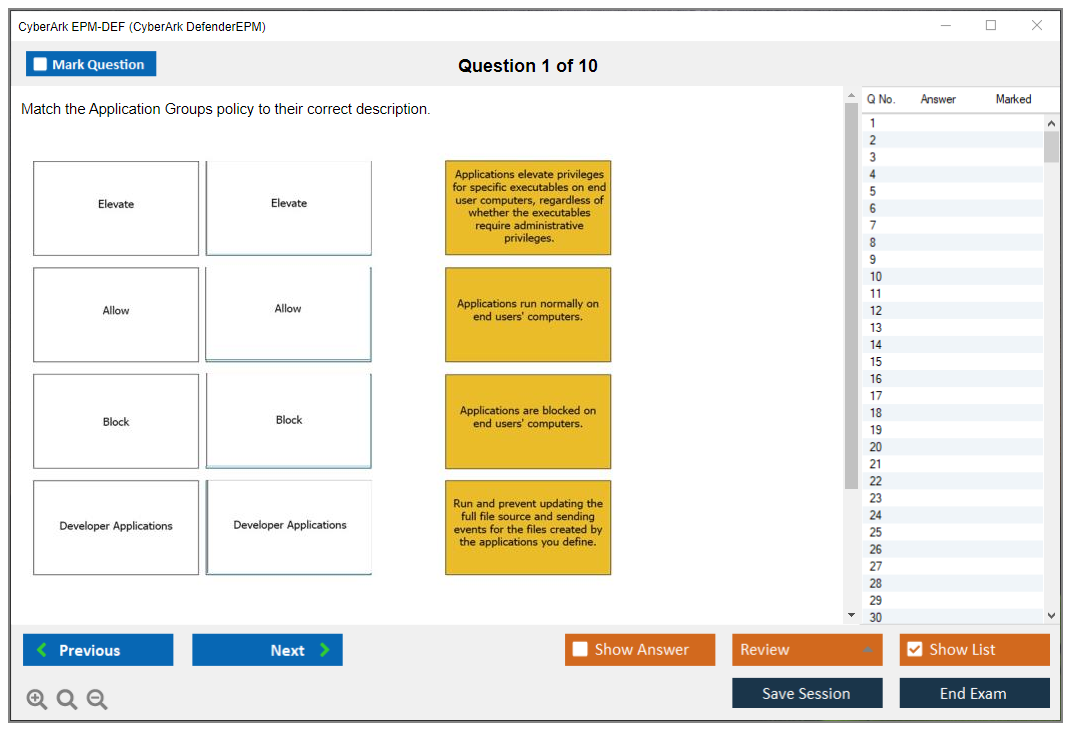
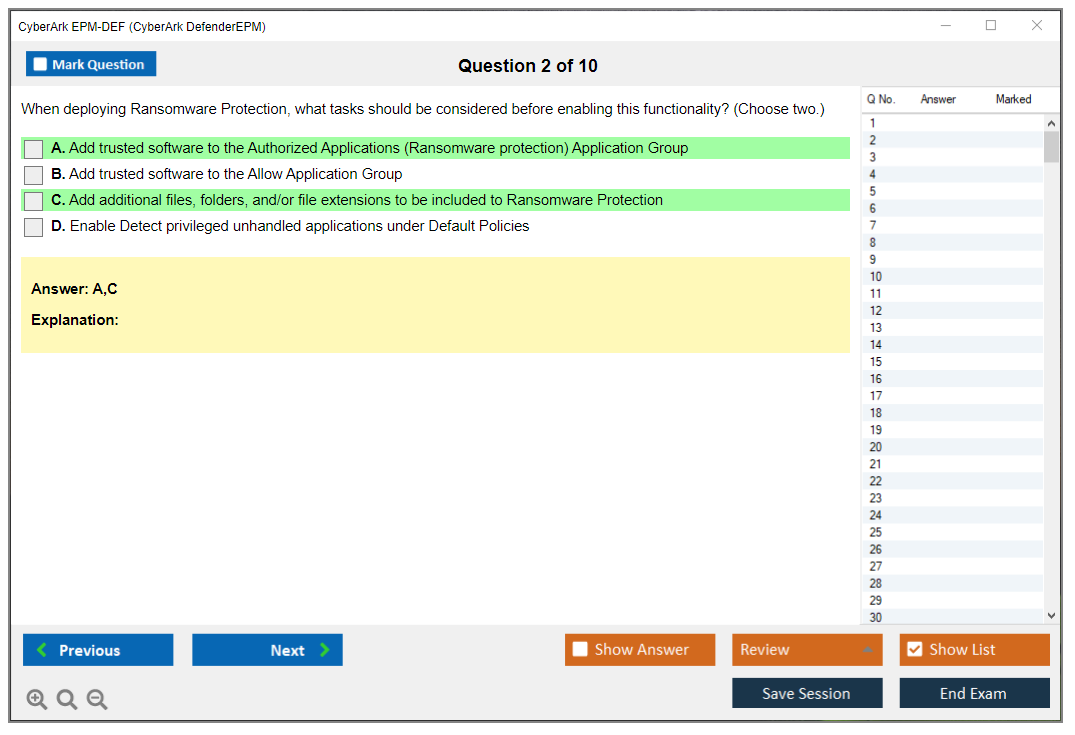
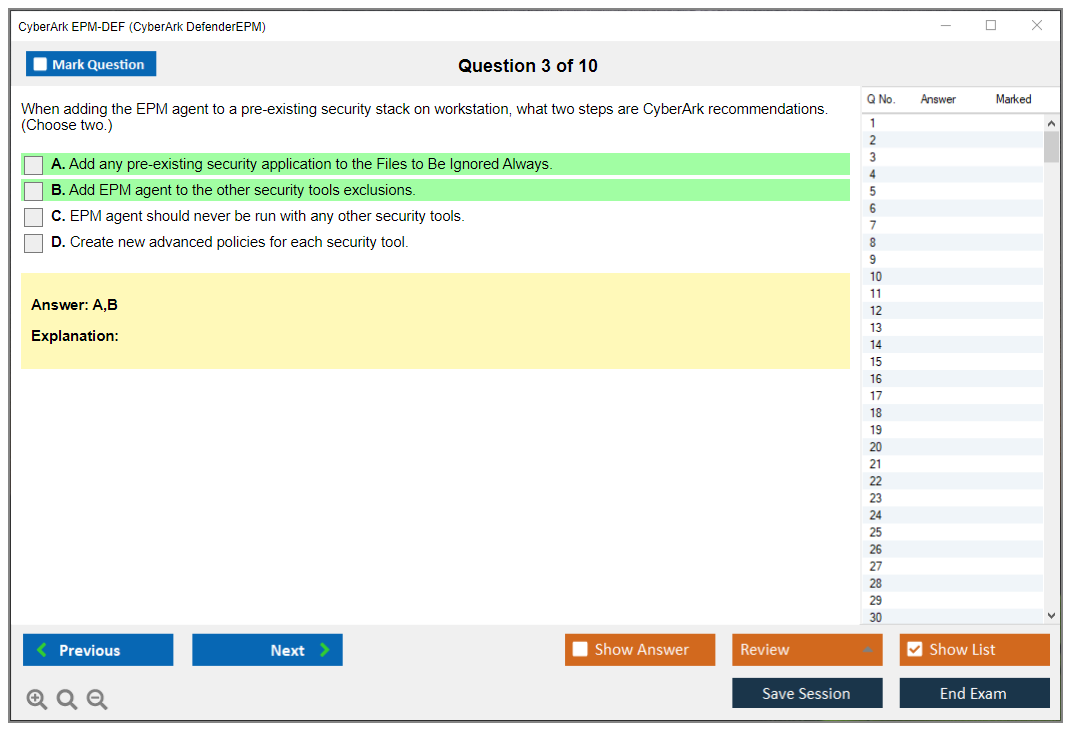
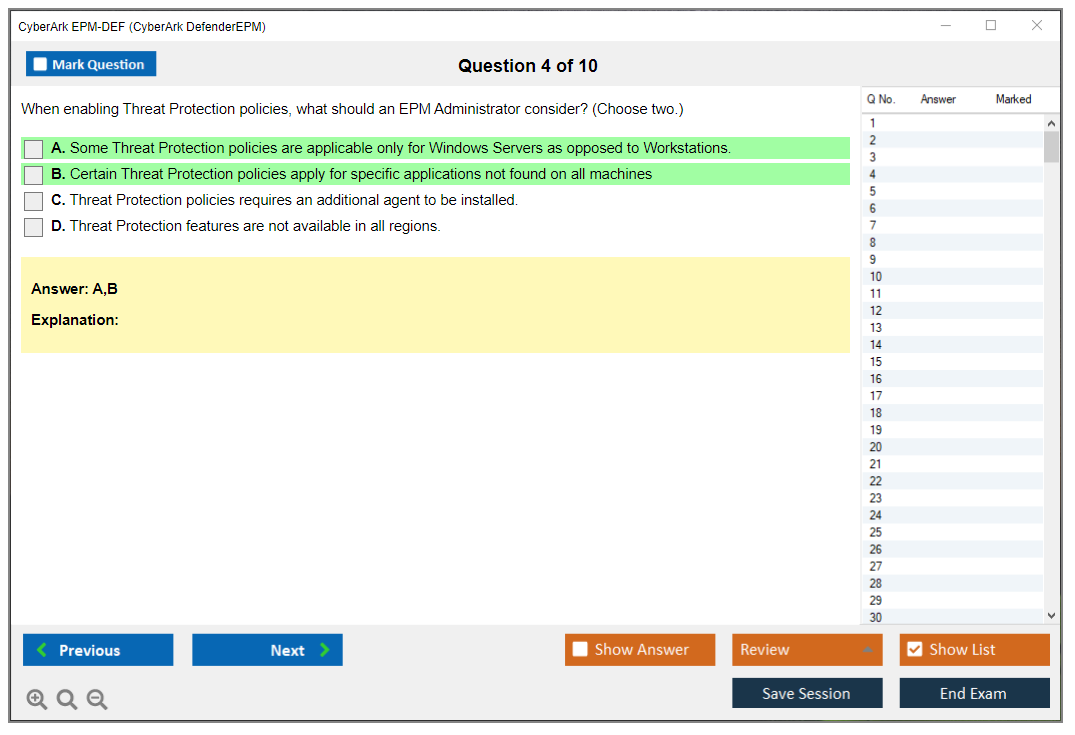
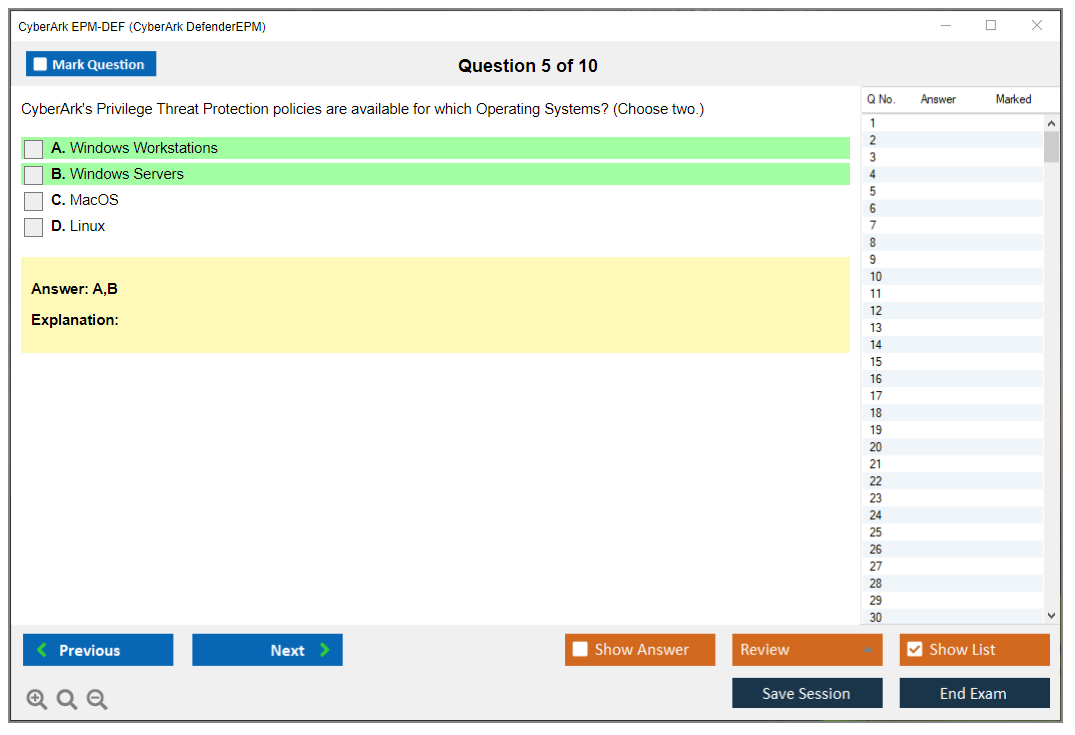
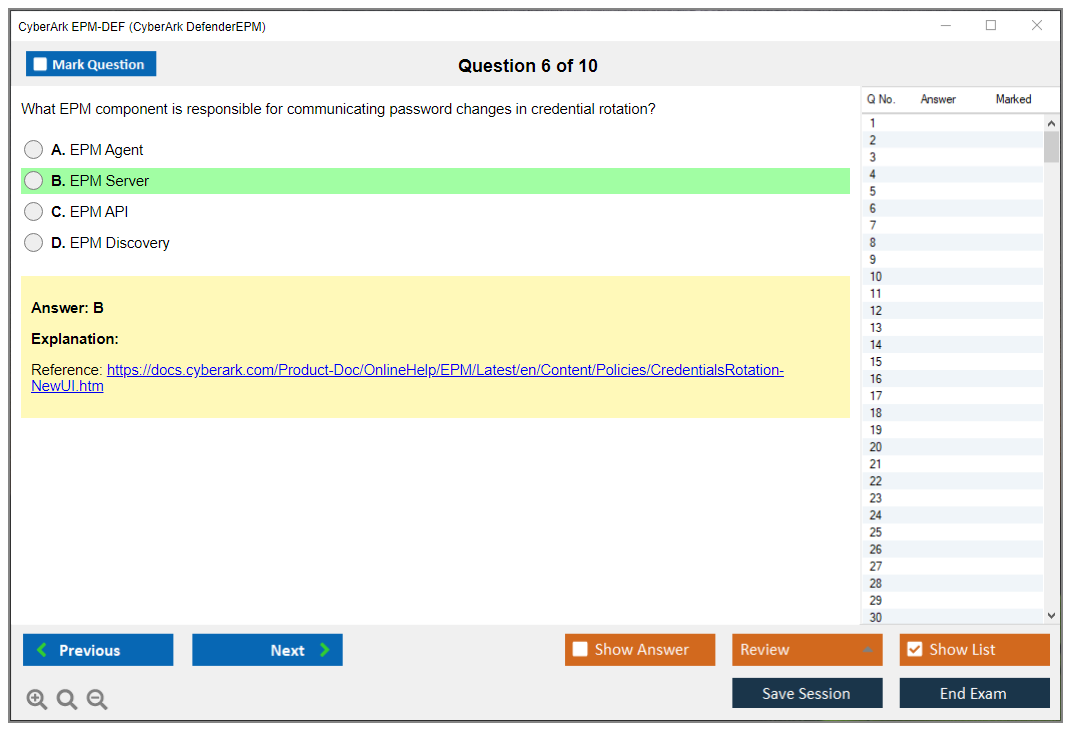
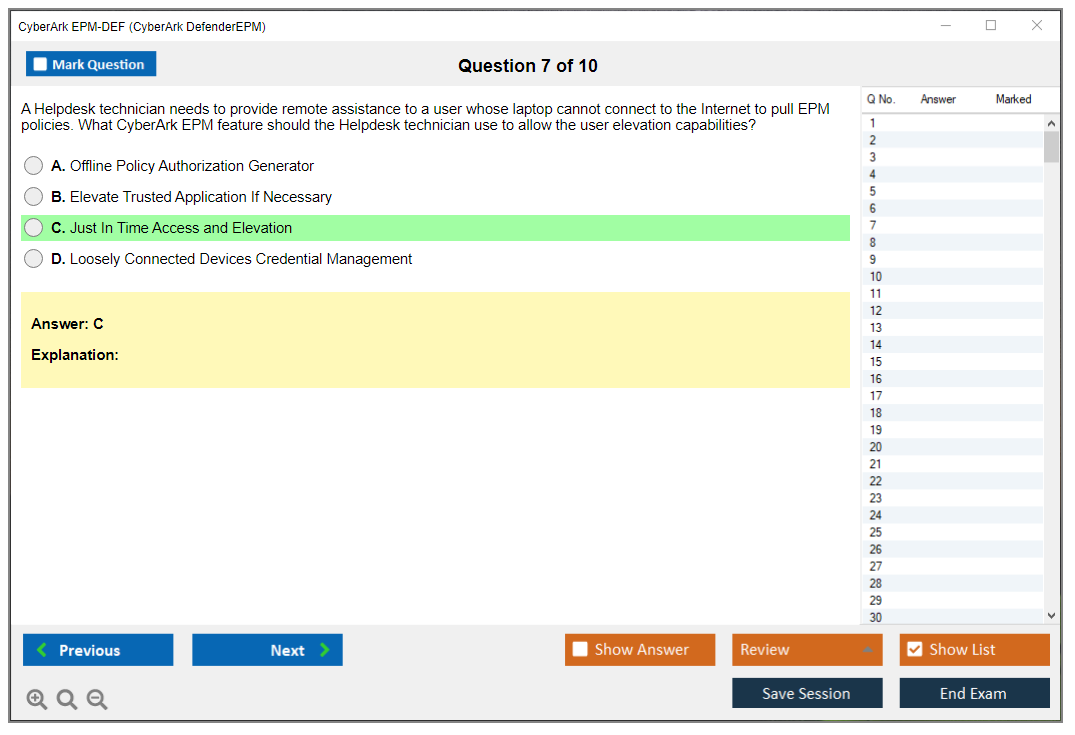
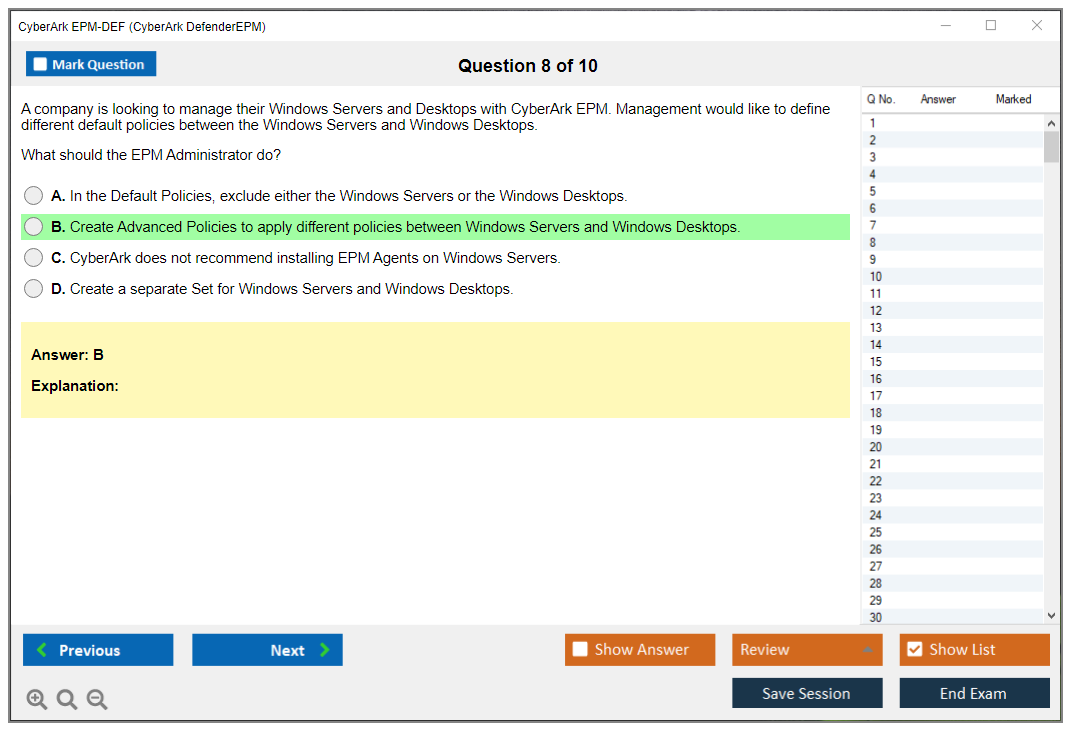
Dumpsarena CyberArk CyberArk Defender - EPM (EPM-DEF) Free Practice Exam Simulator Test Engine Exam preparation with its cutting-edge combination of authentic test simulation, dynamic adaptability, and intuitive design. Recognized as the industry-leading practice platform, it empowers candidates to master their certification journey through these standout features.
What is in the Premium File?
Satisfaction Policy – Dumpsarena.co
At DumpsArena.co, your success is our top priority. Our dedicated technical team works tirelessly day and night to deliver high-quality, up-to-date Practice Exam and study resources. We carefully craft our content to ensure it’s accurate, relevant, and aligned with the latest exam guidelines. Your satisfaction matters to us, and we are always working to provide you with the best possible learning experience. If you’re ever unsatisfied with our material, don’t hesitate to reach out—we’re here to support you. With DumpsArena.co, you can study with confidence, backed by a team you can trust.
CyberArk EPM-DEF Exam FAQs
Introduction of CyberArk EPM-DEF Exam!
The duration of CyberArk EPM-DEF Exam is 90 minutes.
What is the Duration of CyberArk EPM-DEF Exam?
CyberArk DefenderEPM (EPM-DEF) Exam is a certification exam designed to test the competency of individuals in managing and securing privileged accounts using CyberArk Defender EPM. The exam is intended for security professionals who are responsible for managing privileged accounts and implementing security policies to prevent cyber attacks. The exam covers various topics such as installation and configuration of CyberArk Defender EPM, managing privileged accounts, implementing security policies, and monitoring privileged accounts. The exam consists of multiple-choice questions and is conducted online. The duration of the exam is 90 minutes, and the passing score is 70%. The exam is designed to test the practical skills and knowledge of individuals in managing and securing privileged accounts using CyberArk Defender EPM. Successful completion of the exam demonstrates the individual's competency in implementing and managing security policies to prevent cyber attacks.
What are the Number of Questions Asked in CyberArk EPM-DEF Exam?
The number of questions asked in CyberArk EPM-DEF Exam is not specified.
What is the Passing Score for CyberArk EPM-DEF Exam?
The passing score for CyberArk EPM-DEF Exam is 70%.
What is the Competency Level required for CyberArk EPM-DEF Exam?
The competency level required for CyberArk EPM-DEF Exam is intermediate to advanced.
What is the Question Format of CyberArk EPM-DEF Exam?
The question format of CyberArk EPM-DEF Exam is multiple-choice questions.
How Can You Take CyberArk EPM-DEF Exam?
The CyberArk EPM-DEF exam can be taken both online and at testing centers. The online exam can be taken from the comfort of your own home or office, while the testing center option requires you to physically go to a designated testing center. The online exam is proctored and monitored to ensure the integrity of the exam. To take the online exam, you need a reliable internet connection, a webcam, and a quiet, distraction-free environment. The testing center option is also proctored and monitored, and you will need to schedule an appointment at a testing center near you. The choice between online or testing center is up to you and your personal preference.
What Language CyberArk EPM-DEF Exam is Offered?
The CyberArk EPM-DEF exam is offered in English language only.
What is the Cost of CyberArk EPM-DEF Exam?
The cost of the CyberArk EPM-DEF exam is $200.
What is the Target Audience of CyberArk EPM-DEF Exam?
The CyberArk EPM-DEF exam is designed for security professionals who are responsible for managing privileged accounts and access in their organizations. This includes security administrators, engineers, architects, and consultants who work with CyberArk solutions.
What is the Average Salary of CyberArk EPM-DEF Certified in the Market?
The average salary of a CyberArk EPM-DEF certified professional in the market varies depending on the job role, experience, and location. According to Payscale, the average salary for a CyberArk administrator is $87,000 per year, while a CyberArk consultant can earn up to $150,000 per year. However, these numbers are subject to change and may vary based on individual circumstances.
Who are the Testing Providers of CyberArk EPM-DEF Exam?
Pearson VUE is the testing provider for CyberArk EPM-DEF Exam.
What is the Recommended Experience for CyberArk EPM-DEF Exam?
CyberArk recommends that candidates have at least 6 months of experience working with CyberArk Privileged Access Security solutions.
What are the Prerequisites of CyberArk EPM-DEF Exam?
There are no prerequisites for CyberArk EPM-DEF Exam, but CyberArk recommends that candidates have experience with CyberArk Privileged Access Security solutions.
What is the Expected Retirement Date of CyberArk EPM-DEF Exam?
The expected retirement date for CyberArk EPM-DEF Exam is December 31, 2022. You can check for updates on the official CyberArk certification website: https://www.cyberark.com/services/training-certification/certification
What is the Difficulty Level of CyberArk EPM-DEF Exam?
The difficulty level of CyberArk EPM-DEF Exam is considered moderate to high. It requires a good understanding of CyberArk Endpoint Privilege Manager (EPM) architecture, installation, configuration, policy creation, and management. It also requires knowledge of CyberArk EPM integration with other CyberArk solutions and third-party products.
What is the Roadmap / Track of CyberArk EPM-DEF Exam?
CyberArk EPM-DEF Exam is part of the CyberArk Defender certification track, which also includes CyberArk Defender - Sentry (CAU201) and CyberArk Defender - Vault Administrator (CAU301).
What are the Topics CyberArk EPM-DEF Exam Covers?
The CyberArk EPM-DEF Exam covers topics such as CyberArk Endpoint Privilege Manager (EPM) architecture, installation, configuration, policy creation, and management. It also covers topics related to CyberArk EPM integration with other CyberArk solutions and third-party products.
What are the Sample Questions of CyberArk EPM-DEF Exam?
Sample questions of CyberArk EPM-DEF Exam include questions related to CyberArk EPM architecture, installation, configuration, policy creation, and management. It also includes questions related to CyberArk EPM integration with other CyberArk solutions and third-party products.
CyberArk EPM-DEF (CyberArk Defender - EPM) CyberArk EPM-DEF Certification Overview The CyberArk EPM-DEF certification is one of those credentials that doesn't get talked about as much as the big PAM certifications, but it's becoming incredibly relevant. This industry-recognized credential validates your expertise in CyberArk Endpoint Privilege Manager, demonstrating you can actually implement least privilege enforcement, application control policies, and endpoint security management across enterprise environments. Not just read about it in some manual gathering dust on your desk, but actually deploy and manage it when things go sideways at the worst possible moment. Endpoints are where attacks happen. Ransomware doesn't magically appear in your vault. It hits user workstations first. The CyberArk Defender EPM exam validates your technical skills in deploying, configuring, and managing CyberArk EPM solutions to protect those endpoints from ransomware, malware, and credential theft... Read More
CyberArk EPM-DEF (CyberArk Defender - EPM)
CyberArk EPM-DEF Certification Overview
The CyberArk EPM-DEF certification is one of those credentials that doesn't get talked about as much as the big PAM certifications, but it's becoming incredibly relevant. This industry-recognized credential validates your expertise in CyberArk Endpoint Privilege Manager, demonstrating you can actually implement least privilege enforcement, application control policies, and endpoint security management across enterprise environments. Not just read about it in some manual gathering dust on your desk, but actually deploy and manage it when things go sideways at the worst possible moment.
Endpoints are where attacks happen. Ransomware doesn't magically appear in your vault. It hits user workstations first. The CyberArk Defender EPM exam validates your technical skills in deploying, configuring, and managing CyberArk EPM solutions to protect those endpoints from ransomware, malware, and credential theft through privilege elevation and application control. Practical stuff that matters when you're trying to stop an actual breach at 2am.
What the EPM-DEF certification validates
This certification proves you know how to work with CyberArk's Endpoint Privilege Manager in real-world scenarios. Policy creation and management. Agent deployment and configuration. Application elevation rules. Credential protection mechanisms. Ransomware prevention. Threat detection and response. The exam is heavily weighted toward practical implementation skills rather than theoretical knowledge, which I appreciate because you can't just memorize definitions and pass. I've seen people try that approach and it doesn't end well.
You need actual experience with the CyberArk EPM console. Policy configuration. Agent troubleshooting. Real-world deployment scenarios where things don't always go according to the documentation. Anyone who's deployed EPM agents across a few thousand Windows endpoints knows that theory and practice are very different things.
Who should take the CyberArk Defender EPM exam
The target audience for this certification includes security administrators, endpoint security specialists, IAM professionals, CyberArk administrators, SOC analysts, and IT security consultants responsible for endpoint privilege management implementations. If you're managing Windows and macOS endpoint security, implementing application control policies in CyberArk EPM, protecting credentials on endpoints, or preventing unauthorized privilege escalation, this certification makes sense for your career path. It demonstrates you've got the chops to back up your resume claims.
Not gonna lie, this is pretty specialized. You wouldn't pursue EPM-DEF as your first IT certification. It fits best for people already working in security roles who need to prove their endpoint privilege management capabilities. Maybe you're a security admin who's been tasked with rolling out EPM across your organization. Or you're a consultant who needs to demonstrate expertise to clients who've been burned before.
The career value of the EPM-DEF credential goes beyond just having another certification on LinkedIn. Real talk? It demonstrates specialized knowledge in endpoint privilege management training, boosts job prospects in cybersecurity roles, validates hands-on experience with CyberArk EPM deployment and configuration, and can increase earning potential. Organizations implementing CyberArk solutions actively look for certified professionals because they know you can hit the ground running without months of training.
Role in the CyberArk certification pathway
The EPM-DEF sits at the Defender level, focused specifically on Endpoint Privilege Manager. It complements other CyberArk credentials like CDE (Defender), CCA (Certified Administrator), and various Sentry certifications. The typical certification path often involves gaining foundational CyberArk knowledge first, maybe through the PAM-DEF track. Though I should mention that some people skip straight to EPM if that's where their job focus already is.
This is different from the vault-focused certifications. While PAM-DEF covers privileged access management infrastructure and vault management, EPM-DEF specifically focuses on endpoint security rather than PAM infrastructure or secrets management covered in other tracks. You might also pursue ACCESS-DEF if you're working with identity security, but EPM is its own beast.
Some people go for CAU302 (Defender + Sentry) to cover multiple areas, but if endpoints are your primary focus, EPM-DEF gives you that deep dive. Mixed feelings on that approach. Broader knowledge versus deeper specialization, you know? And when renewal time comes around, you'll be looking at EPM-CDE-RECERT to maintain your credential.
Speaking of which, I once worked with someone who collected CyberArk certifications like Pokemon cards. Had seven of them framed in his office. Impressive, sure, but he couldn't troubleshoot a basic agent connectivity issue to save his life. That's why I respect the EPM-DEF's focus on actual implementation skills over just passing tests.
Industry demand and real-world applications
There's growing need for professionals who can implement least privilege enforcement on endpoints, protect against privilege escalation attacks, and manage application whitelisting and blacklisting policies. Every organization I've worked with is dealing with this. Ransomware attacks keep happening. Credential theft is constant. Traditional antivirus isn't enough anymore.
The business impact of certified professionals is measurable. You can reduce attack surface on endpoints, implement zero-trust endpoint security, cut down ransomware risk, simplify privilege management, and improve security posture measurement. When you can demonstrate ROI like preventing a single ransomware incident that would've cost millions, suddenly that certification investment looks pretty smart.
Technology ecosystem coverage includes Windows endpoints, macOS environments, Active Directory integration, SIEM integration, cloud-managed EPM deployments, and hybrid infrastructure scenarios. You're not working in isolation. EPM needs to integrate with your existing security stack, your directory services, your monitoring tools. The certification validates you understand these integration points.
Alignment with security frameworks and compliance
The EPM-DEF certification supports compliance with NIST, ISO 27001, CIS Controls, and zero-trust security models through demonstrated endpoint privilege management capabilities. This matters when auditors show up asking how you're enforcing least privilege. "I have a CyberArk EPM-DEF certification and here's our implementation" carries weight.
Compliance frameworks emphasize this. All of them. Privilege management and endpoint security appear in every major framework I've encountered. CIS Controls specifically call out application whitelisting and least privilege enforcement. NIST frameworks require privileged access management. Having certified professionals implementing these controls shows due diligence and technical competence.
What makes this certification valuable
The EPM-DEF credential is globally recognized by enterprises implementing CyberArk solutions and valued by security teams. It demonstrates commitment to endpoint security best practices and continuous professional development. Unlike some vendor certifications that are just marketing exercises, this one actually requires you to know the product deeply.
The hands-on requirement matters. You can't pass this by reading whitepapers. You need to have configured policies, deployed agents, troubleshooted elevation issues, dealt with application compatibility problems, and actually managed EPM in production or lab environments. That practical focus means when someone has EPM-DEF, they've done the work and earned it the hard way.
The certification prepares you for advanced CyberArk specialist roles where you're not just following runbooks but designing endpoint security strategies, architecting policy frameworks, and solving complex privilege management challenges across diverse environments. That's where the real career growth happens. Moving from implementation to architecture and strategy.
EPM-DEF Exam Details and Logistics
CyberArk EPM-DEF (CyberArk Defender, EPM) certification overview
The CyberArk EPM-DEF certification is the CyberArk Defender badge focused on Endpoint Privilege Manager, and the official exam name/code you'll see is CyberArk Defender, EPM (EPM-DEF). It's part of the Defender track, aimed at proving you can run the product, not just talk about least privilege like it's some abstract philosophy class where nobody actually does anything.
This one's for people who touch endpoints daily. Admins, security engineers, folks stuck cleaning up local admin sprawl that's been festering for years because nobody wanted to deal with it. Also anyone who has to explain, again and again, why "just make everyone local admin" is not a plan. It's exhausting. Very real, though.
What the EPM-DEF certification validates
Look, it validates you can apply endpoint privilege management concepts inside CyberArk EPM, and that you understand how policy decisions affect users, app installs, and security outcomes in ways that matter beyond checking boxes. You're expected to know how least privilege enforcement on endpoints actually works day to day, what breaks when you get aggressive (and you will get aggressive at some point), and how to recover without rolling back everything because one finance app screamed.
Who should take the CyberArk Defender, EPM exam
If you're doing endpoint privilege management training, building controls for Windows/macOS fleets, or you're the person writing application control policies CyberArk EPM and getting yelled at when something blocks, congrats, you're the target. If you've only watched a sales demo and read a blog post, you'll feel the gap fast. Really fast.
EPM-DEF exam details
This is a computer-based exam delivered through Pearson VUE. You can take it at a testing center or do the online proctored format at home. Both are fine. One has fluorescent lighting and mystery keyboards that might've seen better decades, the other has proctors who get weird about your eyes drifting off-screen for two seconds like you're planning a heist.
Exam format and question types
The CyberArk Defender EPM exam usually lands in the "multiple-choice plus real-world-ish scenarios" bucket, which is standard for vendor certs these days. Expect multiple-choice single answer, multiple-choice multiple answers, scenario-based questions with exhibits and config snippets, and some drag-and-drop matching or ordering that tests whether you actually know the sequence.
A typical breakdown looks like:
Multiple-choice single answer (about 50 to 60%). These are the "do you know the product and concepts" questions, and they go fast if you've been hands-on, slow if you're guessing.
Multiple-choice multiple answers (about 20 to 30%). These burn time because you second-guess yourself constantly, and one wrong selection usually tanks the whole item, which feels harsh but whatever.
Scenario-based questions (about 10 to 20%). These are worth paying attention to because they can be multi-point and they test whether you can reason about CyberArk EPM deployment and configuration when constraints show up. The thing is, these separate people who've actually done this from people who just memorized definitions.
Drag-and-drop (about 5 to 10%). Usually straightforward. Sometimes annoyingly picky.
Number of questions and time allocation
You'll typically see 60 to 75 questions covering the EPM-DEF exam objectives, give or take depending on the version. The timer is 90 minutes, which isn't generous, but it's not brutal either, as long as you don't treat every question like it's a philosophical debate that requires three paragraphs of internal monologue. Flag and move. Come back later.
Scenario questions can be worth multiple points, so you can't only optimize for speed. You need accuracy too. The trick is pacing: knock out the easy wins early, bank time, then spend it where the exhibits and configuration-focused items demand actual thinking.
EPM-DEF exam cost
The EPM-DEF exam cost is usually around $250 to $300 USD, but it varies by region and sometimes by testing center because nothing's ever simple. You pay when you register, obviously. Vouchers do pop up through authorized training partners or CyberArk promos, so if your employer is paying, it's worth asking procurement to check for discounts before they blindly swipe the card and call it a day.
EPM-DEF passing score
The EPM-DEF passing score is typically in the 70 to 75% range, but CyberArk doesn't always publish a hard number, which is frustrating. Pearson VUE exams like this often use scaled scoring that accounts for question difficulty, so two people can feel like they got "the same number wrong" and still land differently. Annoying. Normal, though.
Exam registration and scheduling
Registration is the standard Pearson VUE flow: create an account, search for the EPM-DEF exam, pick testing center versus online proctoring, choose a date and time, then pay and pray your calendar doesn't explode before the appointment. Testing centers usually have business-day slots. Online proctoring is more flexible, including evenings and weekends, which is great if your job is already eating your calendar like it's an all-you-can-eat buffet.
Book 2 to 4 weeks ahead if you care about prime times and don't want weird slots. If you're fine with whatever random Tuesday morning is left, you can gamble later, but don't blame me if you get 6 AM or something. I once scheduled a CCNA recert for what I thought was 2 PM and it turned out to be 2 AM because I clicked the wrong timezone. That was a learning experience.
Rescheduling and cancellation usually works if you do it 24 to 48 hours before the appointment. Miss that window and you may forfeit the fee. Read the policy during checkout. Don't assume it's chill.
Online proctoring and testing center logistics
Online proctoring requirements are not complicated, but they are strict and weirdly specific: stable internet (rule of thumb: 1 Mbps up and down minimum, more is better because buffering mid-exam is nightmare fuel), webcam, microphone, quiet private room, and a government-issued ID that actually matches your registration name. You'll do a system check before the exam starts. Do it the day before too. Wi-Fi surprises are not fun, trust me.
Testing centers want the usual: government-issued photo ID that matches your registration name, show up 15 minutes early (not 5, not 10, fifteen), and expect lockers for your stuff because no personal items in the room, ever. They typically give scratch paper or a whiteboard, which is fine. A calculator may exist in the Pearson VUE interface, but for EPM-DEF it's usually not needed unless you're doing something really weird.
Exam delivery technology and score reporting
The exam runs on the Pearson VUE testing platform, which is functional if not exactly beautiful. You can flag questions for review, and scenario exhibits open in their own windows, which is fine until you're juggling tiny screens and squinting at config snippets like you're decoding ancient scrolls. When you finish, you usually get a preliminary pass or fail immediately, then the official score report shows up within 24 to 48 hours in your Pearson VUE account (and often via email, assuming it doesn't land in spam).
Score reports typically include pass or fail plus domain-level performance, so you can see which areas hurt you and which ones you crushed. No question-by-question breakdown, though. So yeah, you won't get to screenshot your "one question that was unfair" and argue about it on Reddit.
Retakes, certification delivery, and employer verification
Retakes: commonly there's no waiting period after the first attempt, then a 14-day wait after the second failed attempt, with additional waits possible after that because at some point they want you to actually study instead of brute-forcing it. Each attempt costs the full fee again. That alone is a reason to do at least one serious EPM-DEF practice test pass before you schedule, not after you fail twice and your budget's gone.
After you pass, the digital certificate usually shows in the CyberArk certification portal within 5 to 7 business days, sometimes faster if you're lucky. You'll get a downloadable PDF and a verification badge for LinkedIn and email signatures, which feels good for about a week until you realize nobody reads email signatures anyway. Employers can verify through CyberArk's certification database, and you'll have a unique certification number. That's the part hiring managers like because it's quick to check and harder to fake.
Accommodations are available if you need them, but you have to request through Pearson VUE and provide documentation. Start early because processing time is real and bureaucracy doesn't care about your exam date.
Internationally, Pearson VUE coverage is broad, so most countries have options, but pricing and availability vary wildly. Check local rules before you assume you can test next week because some regions are weird about scheduling.
EPM-DEF exam objectives (what you'll be tested on)
CyberArk doesn't hand you "the exact questions," obviously, but the EPM-DEF exam objectives map to the work you do in EPM if you've actually done the work. If you haven't, well, that's the problem.
Endpoint Privilege Manager concepts and architecture
Expect architecture basics: tenants, agents, policy flow, and where decisions get made (server-side versus client-side, that kind of thing). Also core concepts like least privilege enforcement on endpoints, why it matters beyond compliance checkboxes, and what "good" looks like when users still need to get work done instead of calling you every five minutes because Word won't open.
Policy creation and least-privilege enforcement
You'll get questions that feel like, "Which policy would you apply here?" or "What setting prevents X from happening while allowing Y?" The hard part is when two answers sound plausible and you're sitting there second-guessing yourself. This is where hands-on beats reading every single time, no contest.
Application control, elevation, and credential protection
Application control policies CyberArk EPM style: allow, deny, improve, all that. Elevation rules and how they interact with user context. Allow and deny logic that gets messy fast if you're not careful. Sometimes you'll see configuration-focused items that basically ask, "Do you know what happens when this control is too broad?" and the answer is usually chaos. Credential protection concepts can show up too, especially where elevation and user context matter more than people think.
Deployment, configuration, and agent management
This is the operational stuff: rollout planning, agent deployment considerations (phased versus big-bang, fun times), config choices that matter, and handling endpoints that don't behave because of course some won't. If you've ever done a staged deployment, you'll recognize the patterns instantly and feel weirdly validated. If you haven't, these questions feel abstract and kind of unfair.
Monitoring, reporting, and troubleshooting
Reporting and audit views, basic troubleshooting flow, and knowing what to check first when policies cause friction (spoiler: check the logs, always check the logs). Not a pure log-analysis exam, but you should be comfortable with the monitoring mindset and not panic when something breaks.
Prerequisites and recommended experience
Official prerequisites (if any) versus recommended background
There usually aren't hard prerequisites that block you from scheduling, which is nice. But recommended background is very real: some time administering endpoints, comfort with security controls that go beyond "install antivirus and hope," and at least a bit of CyberArk EPM exposure so you're not learning vocabulary during the exam.
Skills checklist before attempting EPM-DEF
Know how policies are structured. Understand what common elevation scenarios look like. Be able to explain an app block to a frustrated user without panicking or making it worse. Be able to read a scenario, infer intent, and pick the setting that matches it instead of the one that sounds vaguely right. Practice matters here.
Helpful related certifications or product knowledge
If you already know CyberArk concepts from other modules, cool, you'll transfer some of that. If you've done Windows endpoint management (Group Policy, Intune, whatever), even better because the mindset overlaps. And if you've built any privilege management or application control elsewhere, you'll transfer that thinking faster than someone coming in cold.
Difficulty: how hard is the CyberArk EPM-DEF exam?
What makes EPM-DEF challenging
It's not math hard or "memorize 500 ports" hard. It's "product behavior under constraints" hard, which is worse in some ways because you can't just cram flashcards and win. The exam mixes conceptual questions with configuration decisions, and if you only studied a CyberArk EPM-DEF study guide without touching the console, you'll get caught by wording that assumes you've actually configured something and seen what happens when it goes sideways.
Common pitfalls and topics candidates underestimate
People underestimate scenario questions and overestimate their memory of terminology, which is a bad combo. Also, multi-select questions wreck confidence because you can know 80% and still miss the scoring, which feels unfair but that's how it works. Partial credit isn't really a thing here.
Who typically passes on the first attempt
Admins and engineers who have done at least one real deployment phase, even a pilot, tend to pass first try because they've seen the product behave under pressure. Folks who are brand new to endpoint privilege management training tend to need a second swing, unless they build a lab and grind practice questions hard enough to compensate for lack of real-world exposure.
Best study materials for CyberArk EPM-DEF
Official CyberArk training and documentation
Start with the official training and docs because the exam language mirrors vendor language, which is not fun but necessary if you want answers to make sense. Third-party stuff can help, but if it contradicts the official docs, the official docs win every time on exam day.
Hands-on labs and environment setup
If you can, set up a small lab: a couple endpoints, policies, a test app that needs elevation, and a way to observe results without breaking production (please don't test in production). Even basic CyberArk EPM deployment and configuration practice makes the scenario items feel obvious instead of mysterious, and it's way more effective than rereading the same PDF five times.
Study plan (1 to 2 weeks / 1 month / 6 weeks)
If you've used EPM at work, 1 to 2 weeks of focused review is often enough to fill gaps and refresh memory. If you're learning it fresh, give yourself a month and don't skip the lab work. If you're juggling work chaos, six weeks keeps it sane and reduces the chance you burn out halfway through. Don't cram tired. It doesn't work.
EPM-DEF practice tests and exam prep strategy
Practice test sources and what to look for
An EPM-DEF practice test is useful if it matches objective wording and forces you to explain why the wrong answers are wrong, not just "B is correct, trust me bro." Avoid sketchy dumps. They're tempting, especially when you're stressed, but they also teach you nothing and can get you banned if CyberArk catches on, which they sometimes do.
Mapping practice questions to objectives
As you practice, tag each miss to an objective area and be honest about why you missed it. That's how you build a targeted "how to pass CyberArk EPM-DEF" plan instead of rereading everything and hoping muscle memory kicks in, which it won't.
Final-week readiness checklist
Do one timed run under exam conditions. Review weak domains, not everything. Confirm Pearson VUE logistics, ID, room setup, and system test so you're not troubleshooting your webcam ten minutes before go-time. Sleep properly. Boring advice. Works, though.
Renewal and maintaining your CyberArk certification
EPM-DEF renewal requirements
Renewal rules can change, so check CyberArk's current policy in the certification portal instead of assuming it's good forever. Some tracks require recertification after a set period or when major versions change, which makes sense but also means you can't just coast.
Recertification options and timelines
Typically this means retaking an updated exam or completing an approved recert path if offered, which is sometimes easier than a full retest. Don't assume lifetime validity because that's rarely how vendor certs work anymore.
Continuing education / staying current with EPM updates
Stay current by tracking release notes, policy feature changes, and reporting updates. If your org upgrades EPM, treat it like study time because it often matches what future exams expect. Real-world exposure doubles as exam prep, which is efficient if you think about it.
FAQ (CyberArk EPM-DEF)
Cost, passing score, difficulty (quick answers)
How much does the CyberArk EPM-DEF exam cost? Usually $250 to $300 USD depending on region.
What is the passing score for the CyberArk EPM-DEF exam? Commonly around 70 to 75%, sometimes scaled.
How hard is the CyberArk Defender, EPM (EPM-DEF) exam? Medium if you've configured EPM, rougher if you've only studied concepts and hoped for the best.
Best study materials and practice tests
Use official training and docs first, then validate with labs and
EPM-DEF Exam Objectives and Content Domains
Understanding EPM concepts and architecture
This domain covers 15-20% of your exam. It's foundation stuff you can't skip. You need to understand what makes EPM tick at a structural level.
EPM Manager is your central management console where all the magic happens. It's where you build policies, monitor events, and basically control your entire endpoint privilege strategy. The EPM Agents are the software sitting on every endpoint executing those policies and reporting back what's happening. There's a database behind the scenes storing everything: configurations, events, policies, all of it. The policy engine makes decisions about whether to allow or block actions. Then you've got your event collection and reporting infrastructure which gathers telemetry from thousands of endpoints and makes sense of it all.
Now architectural understanding gets interesting because you're dealing with client-server communication that needs to be reliable even when endpoints go offline. This happens more than you'd think in remote work scenarios where network connectivity isn't always stable. The agents talk to the manager using specific protocols, and understanding that data flow matters when you're troubleshooting why a policy isn't applying. Credential protection mechanisms prevent tools like Mimikatz from stealing passwords right out of memory. Application elevation workflows determine how users get temporary admin rights without actually knowing any passwords.
Deployment models vary wildly depending on organization needs. On-premises EPM Manager gives you complete control but you're managing infrastructure. Cloud-hosted SaaS EPM means CyberArk handles the backend while you focus on policy. Hybrid scenarios combine both, which can get complex fast. Multi-tenant considerations matter if you're a service provider managing EPM for multiple clients. Geographic distribution becomes critical when you've got offices worldwide and network latency affects agent communication.
Integration points? That's where EPM becomes part of your broader security ecosystem rather than an isolated tool. Active Directory integration pulls user and computer information automatically so you're not manually managing everything. SIEM integration forwards security events so your SOC sees privilege elevation attempts alongside other security telemetry. Some organizations integrate with ticketing systems for elevation approval workflows. Vulnerability scanning tool integration helps identify which applications actually need elevated privileges. EDR platform connections let you correlate privilege abuse with other endpoint suspicious activities. I once saw a deployment where they skipped the SIEM integration initially to save time, and three months later they were drowning in local logs with no way to correlate events across their infrastructure. Don't make that mistake.
Licensing is endpoint-based. You're paying per protected device. Capacity planning matters because if your EPM Manager can't handle 10,000 agents checking in at once, you've got problems. Performance considerations for large deployments include database sizing, network bandwidth, and how frequently agents sync policies. High availability configurations use multiple managers so you don't have a single point of failure.
Policy creation and least privilege enforcement
This is your heaviest domain at 25-30% of the exam content. It's where theory meets practice, and this is where most people either get it or struggle.
CyberArk EPM gives you several policy types and understanding when to use each one matters. Application elevation policies let specific apps run with higher privileges. Application restriction policies block stuff you don't want running at all. Credential theft protection policies guard against password dumping tools. Ransomware protection policies detect and block suspicious file encryption behaviors. Publisher trust policies determine which software publishers you inherently trust.
Policy design principles center around least privilege. Users run with minimal permissions by default. Zero-trust policy frameworks assume breach and verify everything. Balancing security with user productivity is the eternal struggle because if you lock things down too tight, users find workarounds. They always do, trust me. Policy inheritance means child organizational units get policies from parents unless you override. Precedence rules determine which policy wins when multiple apply to the same scenario.
Application control in EPM is sophisticated. Whitelisting allows only approved applications. Blacklisting blocks known bad ones. Publisher-based controls trust anything signed by Microsoft or Adobe or whoever you designate. Hash-based identification looks at the file hash so even if an attacker renames malware, it's still blocked. Path-based rules are less secure but sometimes necessary for legacy apps. Certificate-based trust decisions verify digital signatures before allowing execution.
Elevation policies handle privilege escalation scenarios. Just-in-time privilege elevation gives users temporary admin rights that expire automatically. User-initiated elevation with justification requires users to explain why they need elevated access, creating an audit trail. Automatic elevation based on conditions might trigger when specific applications launch. Temporary admin rights management ensures privileges don't persist longer than needed. Elevation approval workflows route requests through managers or security teams.
Policy conditions and triggers add granularity. User-based conditions apply policies differently based on who's logged in. Computer-based conditions might treat workstations differently than servers. Time-based restrictions can prevent elevation requests outside business hours. Network location conditions treat office devices differently than remote workers. Application-specific triggers respond to particular programs launching. Multi-factor authentication requirements add an extra verification step for sensitive elevations.
Policy testing is key before rolling policies to production. Test mode lets policies run without actually blocking anything so you see impact without breaking workflows. Impact analysis tools show how many users or applications a policy would affect. Gradual rollout strategies deploy to pilot groups before everyone. Policy simulation capabilities let you preview results. Validation in lab environments catches problems before they hit production.
Application control, elevation, and credential protection
This domain represents 20-25% of exam content and focuses on specific protection mechanisms. These are the features that actually stop attacks in progress.
Application elevation mechanisms are more nuanced than just "run as administrator." Run as administrator elevation gives full admin rights but that's often overkill. Service account elevation uses a privileged service account without exposing its password to the user. Specific privilege elevation grants only the permissions an application actually needs, not full admin. Credential injection for applications automatically provides credentials to apps that require them. Elevation without exposing passwords means users never see or know privileged credentials.
Credential theft protection techniques combat attackers stealing passwords from memory through several layers. LSA protection prevents non-protected processes from reading Local Security Authority memory. Credential Guard integration uses virtualization-based security to isolate credentials. Blocking credential dumping tools prevents Mimikatz and similar utilities from running. Protecting LSASS memory guards the Local Security Authority Subsystem Service process. Preventing pass-the-hash attacks stops attackers from using stolen NTLM hashes. Securing cached credentials protects stored domain credentials.
Ransomware protection features detect suspicious behaviors. Behavioral detection looks for processes rapidly modifying large numbers of files. Blocking suspicious file encryption behaviors stops ransomware before it encrypts your data. Protecting backup files and system restore points prevents ransomware from deleting recovery options. Preventing unauthorized service modifications stops malware from disabling security tools.
Application compatibility management is where you spend real time in production. Many applications were designed poorly and require administrative privileges when they shouldn't. Legacy application support means dealing with 15-year-old software nobody wants to rewrite. Managing software installations and updates requires elevation but you want to control how it happens. Handling driver installations is particularly sensitive because bad drivers can crash systems.
EPM deployment, configuration, and agent management
Another 20-25% of exam content covers getting EPM installed and maintaining it. Deployment done wrong creates headaches for years.
EPM Manager installation involves database configuration, SSL certificate management, running through the initial setup wizard, and ensuring network requirements and firewall rules allow agent communication. More complex than it sounds in enterprise networks with multiple security zones. Agent deployment methods vary by organization size and existing infrastructure. Group Policy deployment works well in traditional Windows environments. SCCM or Intune deployment fits modern endpoint management strategies. Manual installation is fine for small deployments or testing. Silent installation parameters enable scripted deployments. Mass deployment strategies for enterprise environments might combine multiple methods.
Computer and user organization in EPM mirrors your actual organizational structure. Creating organizational units logically groups endpoints. Assigning computers to sets enables targeted policy application. User group management determines which policies apply to which users. Policy assignment to organizational units follows inheritance models where child OUs inherit parent policies unless overridden.
Agent health monitoring ensures your EPM infrastructure is actually working. Checking agent connectivity verifies endpoints are communicating with the manager. Verifying policy synchronization confirms the latest policies reached agents. Monitoring agent version compliance identifies outdated agents needing upgrades. Troubleshooting communication failures involves checking network connectivity, firewall rules, and certificate validity.
Monitoring, reporting, and troubleshooting
The final domain covers 15-20% of exam content and focuses on operational aspects. This is day-to-day reality after deployment.
Event monitoring and analysis in EPM provides security visibility into privilege usage across your environment. Real-time event viewing shows elevation requests as they happen. Filtering events by type helps you focus on what matters. Identifying security incidents means spotting unusual privilege escalation patterns. Analyzing elevation requests reveals which applications actually need admin rights. Detecting policy violations shows attempts to bypass controls.
Reporting capabilities range from compliance reports for auditors to technical reports for security teams. Pre-built reports cover common scenarios. Custom report creation lets you answer specific questions. Executive dashboards provide high-level security posture visibility. Application usage reports show what software is actually running. Policy effectiveness reports measure whether your controls are working.
SIEM integration is critical. If you see a privilege escalation followed by suspicious network traffic, that's potentially an incident worth investigating right away. Syslog configuration forwards events to your SIEM. CEF format event forwarding uses Common Event Format for standardization.
Troubleshooting methodology starts with identifying symptoms. Agent connectivity issues might indicate firewall problems or certificate expiration. Policy not applying correctly could be precedence issues or synchronization failures. Application elevation failures require checking policy conditions and application identification. Performance problems might stem from database issues or too many agents per manager.
If you're serious about passing the CyberArk Defender EPM exam, understanding these domains deeply matters more than memorization. The EPM-DEF Practice Exam Questions Pack helps you identify weak areas before sitting for the actual exam. Candidates who've worked with EPM in production environments have a significant advantage because they've encountered these scenarios firsthand. There's really no substitute for hands-on experience with troubleshooting weird edge cases. The exam tests whether you can actually deploy, configure, and maintain EPM in a real enterprise environment, not just whether you've read documentation. Consider looking at related certifications like PAM-DEF if you're building a broader CyberArk credential portfolio.
Prerequisites and Recommended Experience for EPM-DEF
CyberArk EPM-DEF (CyberArk Defender, EPM) certification overview
The CyberArk EPM-DEF certification is basically the "prove you can run Endpoint Privilege Manager without breaking everyone's laptops" badge. Short version. Practical. Exam-focused.
What the EPM-DEF certification validates
Look, EPM isn't a toy product. You're expected to understand what happens when you take local admin away, how policies impact real apps, how to roll out agents without creating a helpdesk fire, and how to read the console when something goes sideways. The CyberArk Endpoint Privilege Manager certification angle here is less about memorizing marketing terms and more about showing you can build least privilege enforcement on endpoints while still letting people do their jobs.
One thing I like about EPM exams? They tend to reward "I've done this" knowledge. Not perfect, but close. If you've spent time on application control policies CyberArk EPM style, and you've had to troubleshoot an agent that refuses to talk back, you'll recognize the patterns.
Who should take the CyberArk Defender, EPM exam
If you're administering EPM, planning a rollout, or you're the security person who got voluntold to own endpoint privilege management training, you're the target. Windows admins moving into security also fit well. Same for SOC or endpoint security folks who want to understand how privilege control ties into ransomware containment and credential theft reduction.
Not gonna lie, if you've never touched Windows internals or AD, it's going to feel like learning to drive in a manual car on a hill.
EPM-DEF exam details
This part matters. Why? Because people obsess over logistics, then forget to build a lab. Happens constantly.
Exam format and question types
CyberArk changes exam delivery details sometimes, but expect standard proctored certification exam vibes. Mostly scenario questions. Some "what would you do next" stuff. You'll want to read the EPM-DEF exam objectives carefully because the questions tend to mirror the product workflow: deploy, configure, control, troubleshoot, report.
EPM-DEF exam cost
People ask about EPM-DEF exam cost a lot, and honestly you should check CyberArk's current listing or the testing provider at the time you book because prices move. If your employer's paying, awesome. If you're self-funding, budget for one attempt plus some study material, and decide upfront if you're willing to pay for a retake.
EPM-DEF passing score
Same deal with the EPM-DEF passing score. CyberArk doesn't always publish a simple "720 out of 900" type number publicly, and some vendors use scaled scoring. Treat it like this: aim for mastery of the objectives, not the minimum score, because on exam day you can get a question mix that hits your weak spots repeatedly. I mean, that's just how testing works sometimes. You could know 80% of the material cold and still sweat through sections you didn't prioritize.
Exam registration and scheduling
Registration's open, which is kind of the point. No gatekeeping. You pick a date, pay, show up prepared. The "prerequisite" is basically your own confidence and your ability to not panic when the questions get specific.
EPM-DEF exam objectives (what you'll be tested on)
You'll see the same themes across the EPM-DEF exam objectives, even if CyberArk tweaks wording.
Endpoint Privilege Manager concepts and architecture
Know the moving parts. Manager, console, agents, how communication works, and what dependencies matter. Be able to explain CyberArk EPM deployment and configuration in a way that makes sense to a Windows admin and a security manager, because the exam likes that "translate between worlds" skill.
Policy creation and least-privilege enforcement
This is the heart. Policies that remove admin rights, allow elevation only when needed, control apps, and enforce least privilege principles without destroying productivity. You should understand how rules get evaluated and how exceptions are handled, because real environments always have exceptions.
Application control, elevation, and credential protection
Expect questions around elevation workflows, controlling executables, and thinking about code signing and publisher certificates. If you've never dealt with "this app updates itself and breaks hashing rules," you're missing a big chunk of the reality.
Deployment, configuration, and agent management
Agent rollout methods matter. GPO, SCCM, Intune, manual installs for testing. Also upgrades. Also what to do when endpoints are off-network. This is where PowerShell and basic automation help a lot. The thing is, automation isn't just nice to have. It's how you scale beyond ten endpoints without losing your mind.
Monitoring, reporting, and troubleshooting
Reporting isn't just for pretty dashboards. It's how you prove controls work, find noisy apps, and troubleshoot issues. If you can't interpret events, policy hits, and agent health, you're going to struggle.
Prerequisites and recommended experience
This is the section people want. Here's the straight talk.
Official prerequisites (if any) vs. recommended background
Officially? There are no mandatory prerequisites to register. That's not marketing fluff. The CyberArk EPM-DEF certification is open to anyone willing to attempt it. But the exam assumes you've done the work, or at least simulated it closely.
Recommended hands-on experience is where the real prerequisite lives. I mean, you can cram terminology, sure, but EPM is an operational product, and you can't fake your way through deployment scenarios if you've never actually deployed anything. A good baseline is 6 to 12 months working with CyberArk Endpoint Privilege Manager in production or a serious lab, including policy creation, agent deployment, and troubleshooting scenarios that are messy and not "happy path."
Skills checklist before attempting EPM-DEF
Want a practical checklist? This is it. Short. Sharp. No fluff.
You should be able to install and configure the EPM Manager. Cleanly. You should be able to deploy agents in more than one way, because the exam and real life both assume you can adapt. You should be able to create policies, test them, roll them back, and explain why a rule matched or didn't match. Comfort with troubleshooting agent connectivity matters, including DNS and certificates, because "agent offline" is a daily event somewhere. You should be able to generate reports and interpret them, not just click export.
One item I'll explain in detail: policy testing. In EPM, the difference between "I think this rule works" and "I know this rule works" is whether you validated it on multiple endpoint types, with different user contexts, and with at least one annoying line-of-business app that does weird child-process behavior and triggers rules you didn't expect. Honestly, LOB apps are where most rollouts hit turbulence. If you haven't lived through that, you're going to miss context the exam assumes you have. Another one worth slowing down on? Troubleshooting connectivity. If you don't understand client-server communication, name resolution (DNS), and certificate-based authentication basics, you'll waste hours blaming the agent when it's really the network path or trust chain.
I once spent an entire afternoon tracking down what looked like an agent bug only to discover the firewall team had quietly changed a rule without documenting it. Fun times. That kind of real-world mess teaches you more than any video course can.
The rest. Reporting. Console navigation. Role assignments. Routine admin stuff.
Helpful related certifications or product knowledge
Having CyberArk Defender (CDE) first is a nice foundation, and it aligns well with how CyberArk frames identity and endpoint controls. Security+ also helps if endpoint threats and terminology are new. Microsoft identity fundamentals can fill AD gaps fast. GSEC is great if you're going broad.
CyberArk ecosystem familiarity is optional but useful. If you've seen PAS/PAM concepts, you'll understand CyberArk's security philosophy faster, and you'll adapt to their documentation style without feeling like you're reading a foreign language.
Difficulty: how hard is the CyberArk EPM-DEF exam?
What makes EPM-DEF challenging
The CyberArk Defender EPM exam gets tricky because it blends Windows admin reality with security decision-making. You're not just configuring a product. You're balancing risk, usability, and deployment constraints, and the questions often expect you to pick the safest answer that still works operationally.
Common pitfalls and topics candidates underestimate
Windows fundamentals get underestimated. So does application management. People forget that app installation, updates, compatibility issues, and code signing are basically daily life in EPM. Wait, let me rephrase that. They're not just daily life. They're the stuff that generates 90% of your support tickets if you get policies wrong. Networking basics also trip folks up, especially ports, firewall rules, and TLS certificate issues. Database basics too, since EPM uses SQL Server, and you should at least understand connection strings, backups, and what "database is down" means for the service.
Who typically passes on the first attempt
Admins who've actually deployed EPM agents, tuned policies, and handled real tickets tend to pass faster. Folks who only watched videos and never built a lab usually struggle, even if they're smart.
Best study materials for CyberArk EPM-DEF
Official CyberArk training and documentation
If you can take the CyberArk EPM Administrator course, do it. CyberArk University modules help too, especially if you need structured endpoint privilege management training. Documentation matters, but read it with a lab open, otherwise it turns into passive reading.
Hands-on labs and environment setup
Build a lab. Seriously.
Use VMware, Hyper-V, or VirtualBox. Create multiple Windows VMs, mix Windows 10, Windows 11, and at least one Server OS. Simulate AD if you can. Practice agent deployment and configuration, then break it on purpose and fix it.
Study plan (1,2 weeks / 1 month / 6 weeks)
If you already run EPM, 40 to 60 hours can be enough, mostly reviewing objectives and tightening weak areas. If you're new to CyberArk, plan 80 to 120 hours with hands-on practice. If endpoint security concepts are new, you're looking at 120 to 160 hours because you'll need foundational learning on ransomware, malware behaviors, credential theft patterns, and endpoint hardening basics.
EPM-DEF practice tests and exam prep strategy
Practice test sources and what to look for
Practice questions help if they map to objectives and explain why answers are right. If you want something targeted, the EPM-DEF Practice Exam Questions Pack is a cheap way to pressure-test your readiness, especially if you treat it like a diagnostic and then go back to the lab to validate what you missed.
Mapping practice questions to objectives
Take every missed question and tag it to an objective: architecture, policy logic, deployment, troubleshooting, reporting. Then go reproduce it in your lab. That's how to pass CyberArk EPM-DEF without relying on luck. If you're using the EPM-DEF Practice Exam Questions Pack, don't just re-answer until you memorize it. Rebuild the scenario. Make the endpoint misbehave. Then fix it.
Final-week readiness checklist
Can you explain EPM architecture confidently? Can you deploy agents and confirm they're healthy? Can you create multiple policy types and predict outcomes? Can you troubleshoot common issues independently? Can you read reports and extract useful meaning? If yes, book it.
Renewal and maintaining your CyberArk certification
EPM-DEF renewal requirements
CyberArk renewal rules can change by program, so verify the current policy in CyberArk University or the certification portal. Some tracks require renewal windows or continuing education style updates.
Recertification options and timelines
Sometimes the "recert" is taking a newer version exam, sometimes it's an upgrade path. Don't guess. Check the official page when you're within a few months of expiration.
Continuing education / staying current with EPM updates
EPM changes with agent versions, console updates, and new control features. Keep a small lab around, even after you pass. It saves you later.
FAQ (CyberArk EPM-DEF)
Cost, passing score, difficulty (quick answers)
How much does the CyberArk EPM-DEF exam cost? Check CyberArk or the exam provider at booking time, because the EPM-DEF exam cost can change.
What is the passing score for the CyberArk EPM-DEF exam? The EPM-DEF passing score may be scaled or not clearly published, so prep to the objectives, not a number.
How hard is the CyberArk Defender, EPM (EPM-DEF) exam? Moderate if you've run EPM for real, rough if you're learning Windows, security, and EPM at the same time.
Best study materials and practice tests
How do I prepare for the CyberArk EPM-DEF exam with practice tests and labs? Build a VM lab, follow official training, and use objective-mapped questions like the EPM-DEF Practice Exam Questions Pack to find weak spots, then validate fixes hands-on.
Objectives, prerequisites, and renewal
What are the objectives covered on the EPM-DEF exam? Architecture, policy creation, application control and elevation, deployment and agent management, monitoring and troubleshooting.
Are there prerequisites? No formal registration prerequisites, but 6 to 12 months hands-on is the real gate.
What if I have knowledge gaps? If Windows admin is weak, take Windows courses first. If AD is fuzzy, learn AD basics. If security concepts are new, study endpoint threats and best practices before grinding exam questions.
Difficulty Level: How Hard Is the CyberArk EPM-DEF Exam?
Overall difficulty: what you're actually up against
Not gonna lie. The CyberArk EPM-DEF exam sits firmly in the moderate to moderately difficult range if you've been working with Endpoint Privilege Manager in an actual environment. But here's the thing. If you're trying to pass this purely through theoretical study or just skimming documentation? Yeah, you're gonna struggle hard.
The difficulty really depends on your background. Someone who's deployed EPM agents across a few thousand endpoints, wrestled with policy conflicts that made no sense at 2 AM, and debugged why some application absolutely won't improve properly has a completely different experience than someone who just watched training videos and called it prep. The practical experience gap? Massive.
What the numbers actually tell us
CyberArk doesn't publish official pass rate statistics. Drives me crazy. We're all just guessing here. But based on industry feedback, conversations with folks who've actually taken it, and what training partners quietly mention when they think nobody's listening, you're looking at maybe 60-70% first-attempt pass rate for candidates with genuine hands-on experience.
That drops hard for people relying on theoretical prep alone, probably into the 40s or lower. Not terrible numbers compared to some vendor exams I've seen. But they also mean roughly one in three experienced practitioners still fails on their first try. That should tell you something.
Why EPM-DEF actually challenges people
The scenario-based questions are what trip up most candidates. You'll get presented with a situation. Maybe a deployment that's partially failing, or users complaining about application behavior after the latest policy update. And you need to troubleshoot systematically, thinking through dependencies and potential conflicts like you would during an actual incident. These aren't "what does this acronym mean" questions where you can just cram flashcards.
Policy design questions are particularly nasty. There's often more than one valid approach, and you need to identify the best approach, which requires understanding CyberArk's recommended practices, not just what technically works in production. I've seen people get frustrated because they chose an answer that would absolutely function in production, but it wasn't the optimal solution according to CyberArk's design philosophy. Is that fair? Maybe not, but that's the exam.
The configuration details aren't intuitive either. EPM has a lot of settings that seem similar but behave differently in subtle ways. You can't just wing it based on general security knowledge. You need to know the specific parameters, how they interact, and what happens when you combine certain options. Sort of like the difference between knowing cars exist versus actually being able to rebuild a carburetor. One gets you through casual conversation, the other gets you through this test.
Breadth versus depth: you need both
Here's what makes this exam particularly demanding. It covers a lot of EPM features like agent deployment, policy creation, application control, credential protection, reporting, SIEM integration, troubleshooting. But it also tests deep understanding of core concepts within each area. Can't just have surface-level familiarity.
You need to understand the reasoning behind EPM's design. Why does agent communication work the way it does? How does policy precedence actually resolve conflicts when multiple rules apply? What's happening under the hood when credential theft protection kicks in?
You need both architectural knowledge and hands-on configuration skills. Questions might ask you to design a solution (architectural thinking) and then immediately follow up with questions about specific settings required to implement it (configuration knowledge). It's this combination that makes it tough.
The practical versus theoretical split
This is heavily weighted toward practical application. I'd estimate 70-80% of the exam, maybe more. There's very little emphasis on memorizing definitions or reciting features. Instead, it expects you to know how to do things, not just what those things are called.
The exam tests decision-making constantly. You'll see questions like "A user needs to run Application X with elevated privileges but shouldn't be able to run arbitrary commands. What's the best policy configuration?" That requires understanding policy types, rule conditions, and best practices all at once. Can't fake that.
Topics people consistently underestimate
Agent deployment troubleshooting is way more complex on the exam than people expect. it's "install the agent and you're done." You need to understand network requirements, certificate validation, communication protocols, and what to check when agents go offline or fail to register properly.
Policy precedence and conflict resolution details catch a lot of people. The documentation covers this, sure, but the exam tests edge cases and scenarios where multiple policies could apply at once. Understanding the exact resolution order and how exceptions work is critical.
Credential protection technical mechanisms go deeper than most candidates prepare for. You need to understand what's actually being protected, how the protection works at a technical level, and troubleshooting when applications break because of it.
Reporting and SIEM integration details are easy to gloss over during study, but the exam absolutely tests them. Performance optimization considerations also show up more than expected. Understanding what impacts agent performance and how to tune settings matters.
Characteristics of tricky questions
Watch out for questions with multiple seemingly correct answers. The exam loves these. All the options might be technically valid, but you need to identify the best practice recommendation. This requires knowing CyberArk's preferred approaches, which means spending time with official training materials, not just your own production experience.
Scenario questions sometimes give you incomplete information. Forces you to make reasonable assumptions. That feels unfair but reflects real-world situations where you don't have perfect visibility into every variable.
Negative questions ("which is NOT a valid configuration") require careful reading. I always mark these during practice because they're easy to misread under time pressure.
Questions testing exception cases rather than normal operation appear frequently. Like, instead of asking how something normally works, they'll ask what happens when a specific unusual condition occurs. Keeps you on your toes.
Technical detail level: it gets specific
You need to know specific configuration parameters. Not just general concepts. Exact policy syntax and available options matter here. The exam might show you troubleshooting log entries or error messages and ask you to identify the problem. That's impossible without having actually looked at EPM logs during real troubleshooting sessions.
Integration requirements with other systems get specific too. Version-specific features and limitations show up. You can't assume that everything works the same across all EPM versions.
Time pressure is real but manageable
You get 90 minutes. Somewhere between 60-75 questions, which works out to roughly 60-75 seconds per question. That's tight for scenario questions that require reading a paragraph, analyzing the situation, and evaluating multiple options carefully.
Some questions you'll knock out in 20 seconds. Others will take two minutes of careful thought. Moving quickly through the straightforward ones banks time for the scenarios. I always recommend marking questions you're unsure about and circling back rather than burning three minutes trying to logic your way to certainty.
The time pressure makes it harder to second-guess yourself too much. Which might be a blessing? Analysis paralysis kills performance on exams like this.
If you're coming from PAM-DEF or CAU201, you'll find EPM-DEF has a different flavor. The endpoint focus means more emphasis on agent behavior and local privilege elevation rather than vault architecture. But the scenario-based question style is similar across CyberArk's Defender track certifications.
Conclusion
Wrapping up your EPM-DEF path
Okay, so listen. The CyberArk EPM-DEF certification? It's not something you just casually waltz into expecting to pass without breaking a sweat because it validates actual, real-world skills around endpoint privilege management training and demonstrates you really understand locking down endpoints while somehow not driving users absolutely insane with restrictions they can't work around. That's really what EPM's all about, isn't it? Building application control policies that function in actual production environments where humans need to accomplish tasks daily.
Getting serious about how to pass CyberArk EPM-DEF means going way beyond skimming documentation.
The exam objectives? They're full. Everything from least privilege enforcement on endpoints to the sometimes chaotic reality of CyberArk EPM deployment and configuration scenarios gets tested. You'll encounter questions about policy creation testing whether you truly grasp the difference between completely blocking an application versus improving it under particular conditions. Wait, I'm getting ahead of myself here. The EPM-DEF passing score sits at 70%, which honestly sounds manageable until you're actually facing scenario-based questions demanding you troubleshoot why an agent's not reporting correctly or why a credential theft prevention policy just failed spectacularly.
EPM-DEF exam cost? Runs around $150. Sometimes it's bundled with training packages pushing the price higher. Not gonna sugarcoat it, that's actually reasonable compared to other vendor certs I've seen. My last AWS renewal cost nearly double that, and I'm still bitter about it. But the thing is, investing in endpoint security exam preparation materials makes total sense when you weigh it against failing and shelling out for a retake.
Practice tests? Absolutely critical.
I mean quality questions mirroring the actual exam format, not some watered-down generic security trivia that doesn't prepare you for anything. You need scenarios involving application control policies CyberArk EPM style, questions forcing you to work through agent deployment headaches, and troubleshooting situations that really test your understanding of the platform architecture instead of just memorized definitions.
The CyberArk Endpoint Privilege Manager certification really opens doors in organizations taking zero trust seriously. Every company wrestling with ransomware and credential theft is evaluating EPM solutions right now. Having EPM-DEF on your resume signals you're not just another admin mindlessly clicking through setup wizards without understanding what's happening under the hood.
Before scheduling your CyberArk Defender EPM exam, grab the EPM-DEF Practice Exam Questions Pack. It's honestly among the better methods for identifying knowledge gaps before test day arrives. Map those practice questions back to exam objectives, focus on weaker areas, and you'll walk in feeling confident instead of just hoping you happened to study the right material.
Show less info
Comments
Hot Exams
Related Exams
OMG-Certified UML Professional Advanced Exam
Riverbed Certified Solutions Professional - Storage Delivery Exam
Service Provider Professional (JNCIP-SP)
ISO 31000 - Certified Lead Risk Manager
Linux Certified Professional (LCP) Powered by LPI
Architecting a Citrix Networking Solution
Administration of Veritas InfoScale Availability 7.3 for UNIX/Linux
HCIA-Security V4.0 Exam
Alcatel-Lucent Interior Routing Protocols and High Availability
PeopleCert DevOps Engineer Exam
CyberArk Defender - EPM
CyberArk Sentry PAM
CyberArk CDE Recertification
CyberArk Defender - PAM
CyberArk Defender + Sentry
CyberArk CDE Recertification
How to Open Test Engine .dumpsarena Files
Use FREE DumpsArena Test Engine player to open .dumpsarena files


DumpsArena.co has a remarkable success record. We're confident of our products and provide a no hassle refund policy.

Your purchase with DumpsArena.co is safe and fast.
The DumpsArena.co website is protected by 256-bit SSL from Cloudflare, the leader in online security.