CCSK Practice Exam - Certificate of Cloud Security Knowledge (v5.0)
Reliable Study Materials & Testing Engine for CCSK Exam Success!
Exam Code: CCSK
Exam Name: Certificate of Cloud Security Knowledge (v5.0)
Certification Provider: Cloud Security Alliance
Certification Exam Name: Cloud Security Knowledge


Free Updates PDF & Test Engine
Verified By IT Certified Experts
Guaranteed To Have Actual Exam Questions
Up-To-Date Exam Study Material
99.5% High Success Pass Rate
100% Accurate Answers
100% Money Back Guarantee
Instant Downloads
Free Fast Exam Updates
Exam Questions And Answers PDF
Best Value Available in Market
Try Demo Before You Buy
Secure Shopping Experience
CCSK: Certificate of Cloud Security Knowledge (v5.0) Study Material and Test Engine
Last Update Check: Mar 18, 2026
Latest 120 Questions & Answers
Training Course 44 Lectures (4 Hours) - Course Overview
45-75% OFF
Hurry up! offer ends in 00 Days 00h 00m 00s
*Download the Test Player for FREE
Printable PDF & Test Engine Bundle
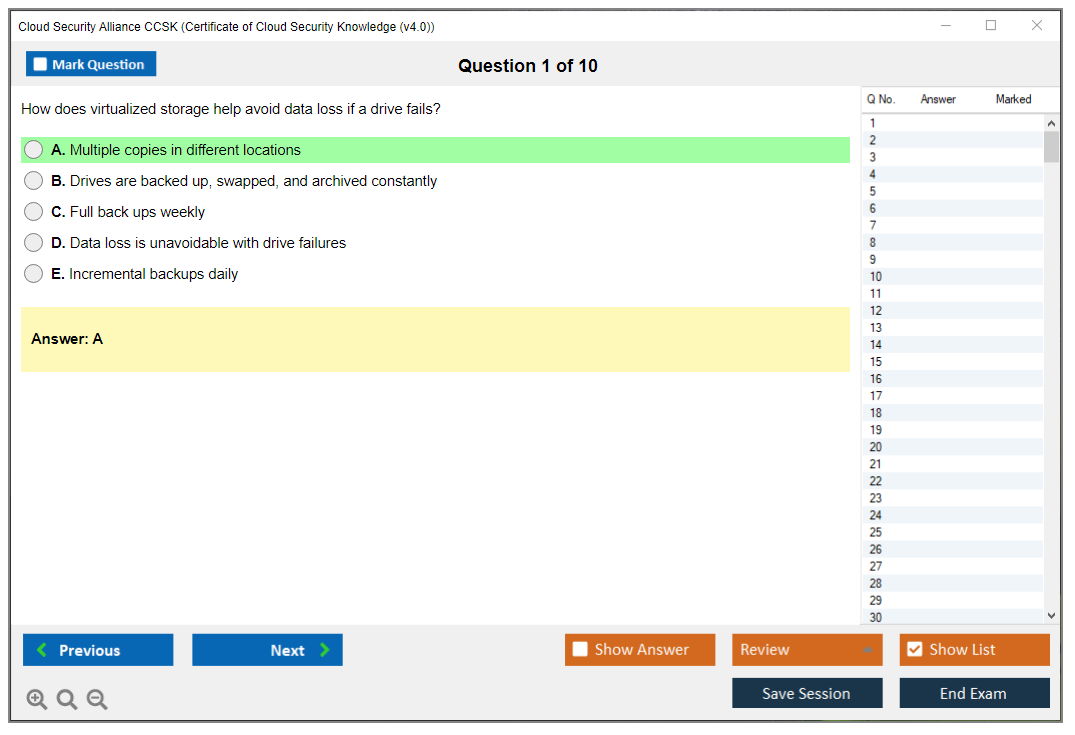
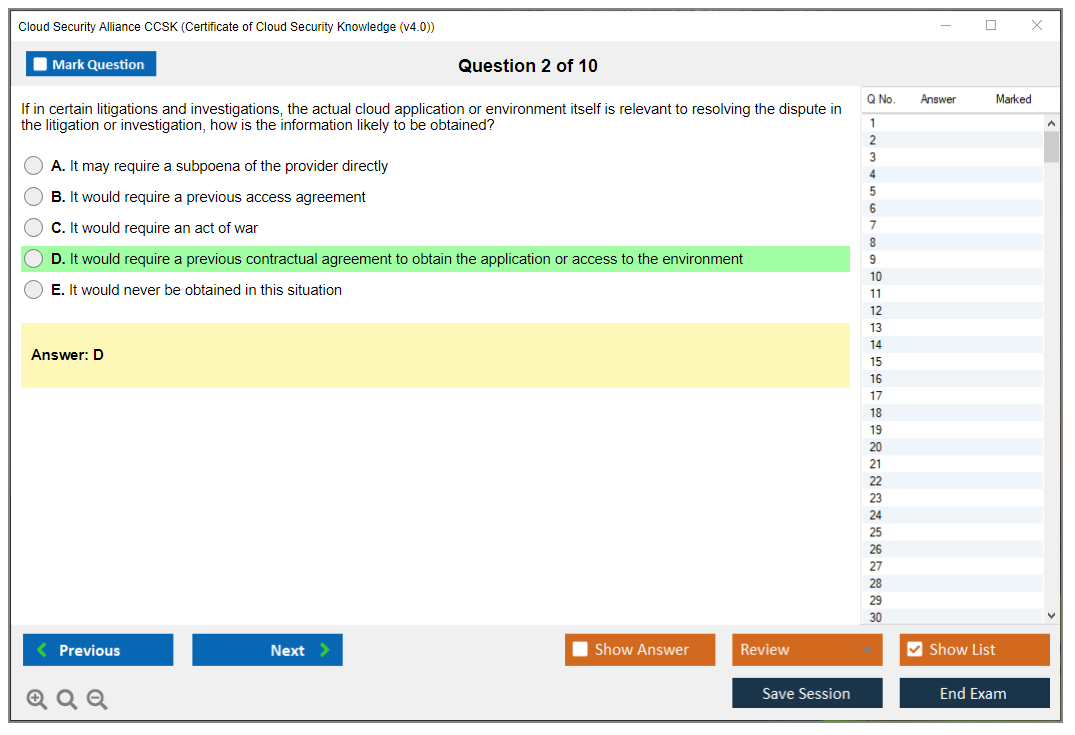
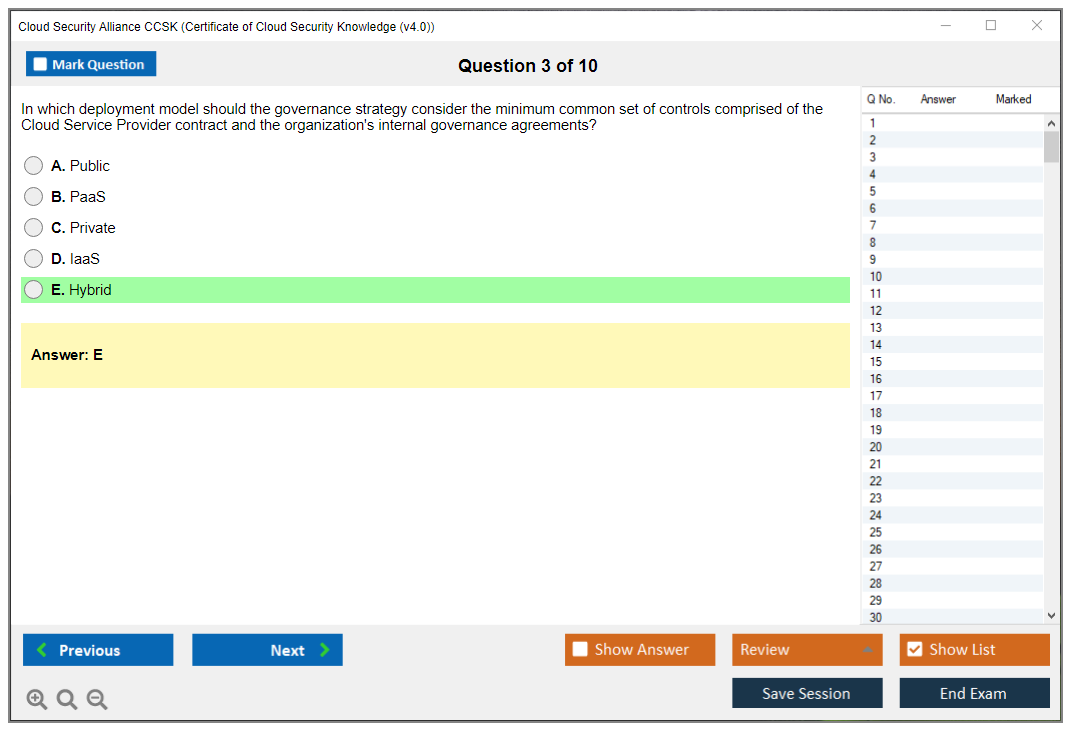
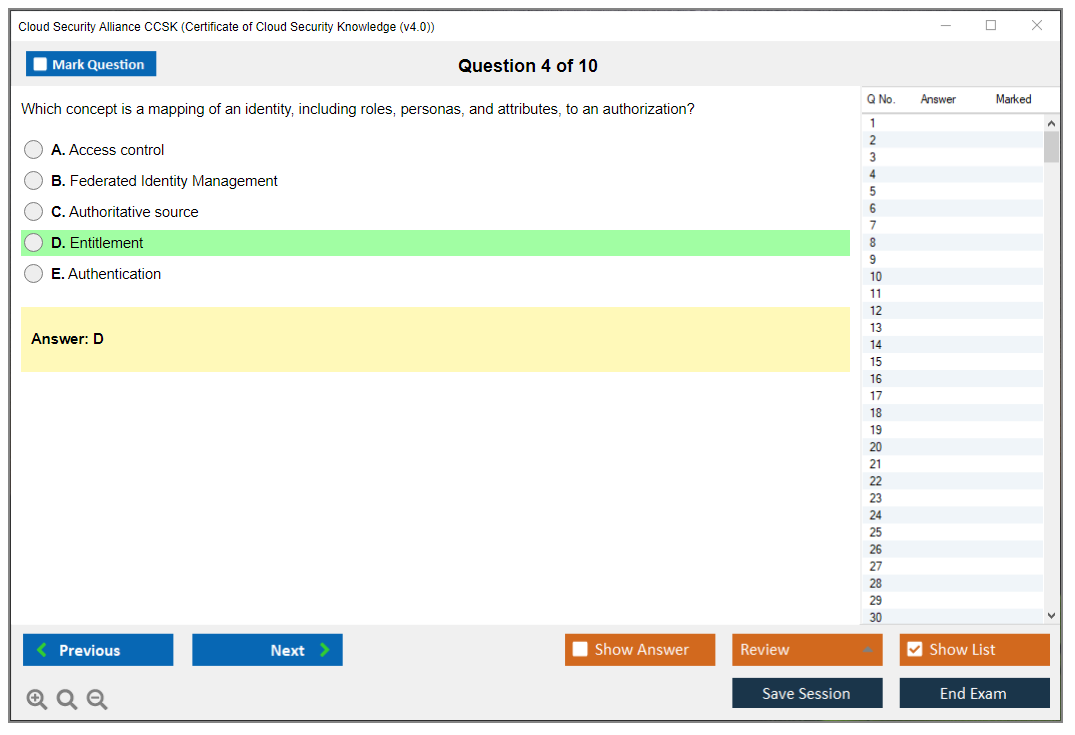
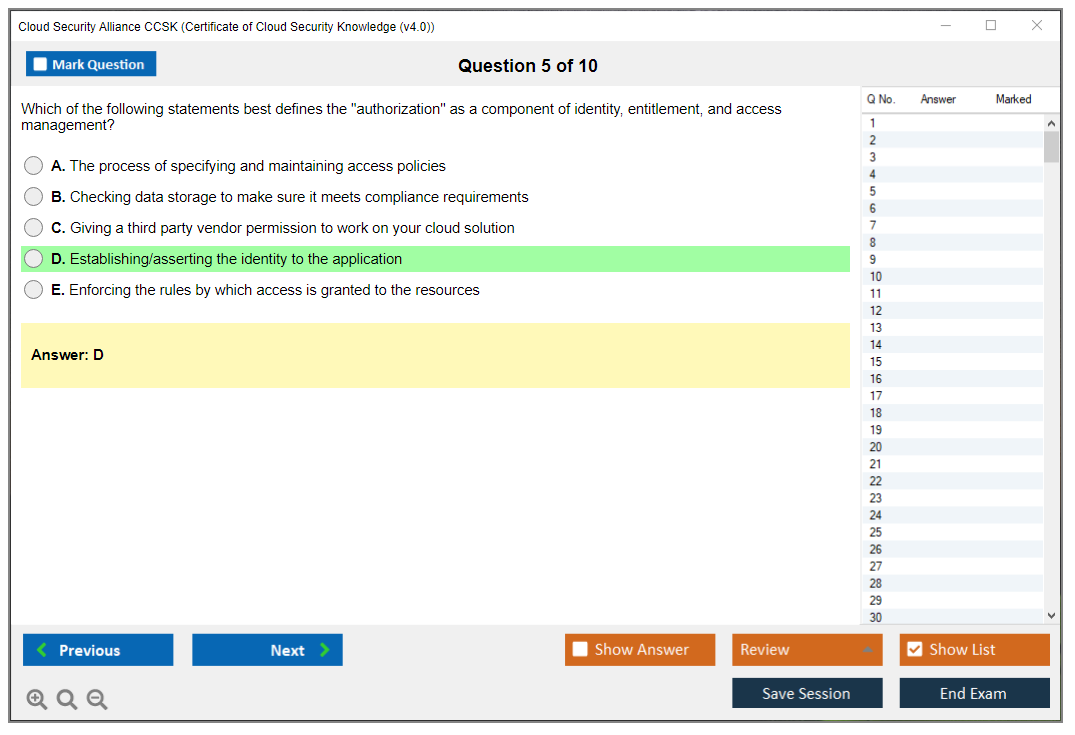
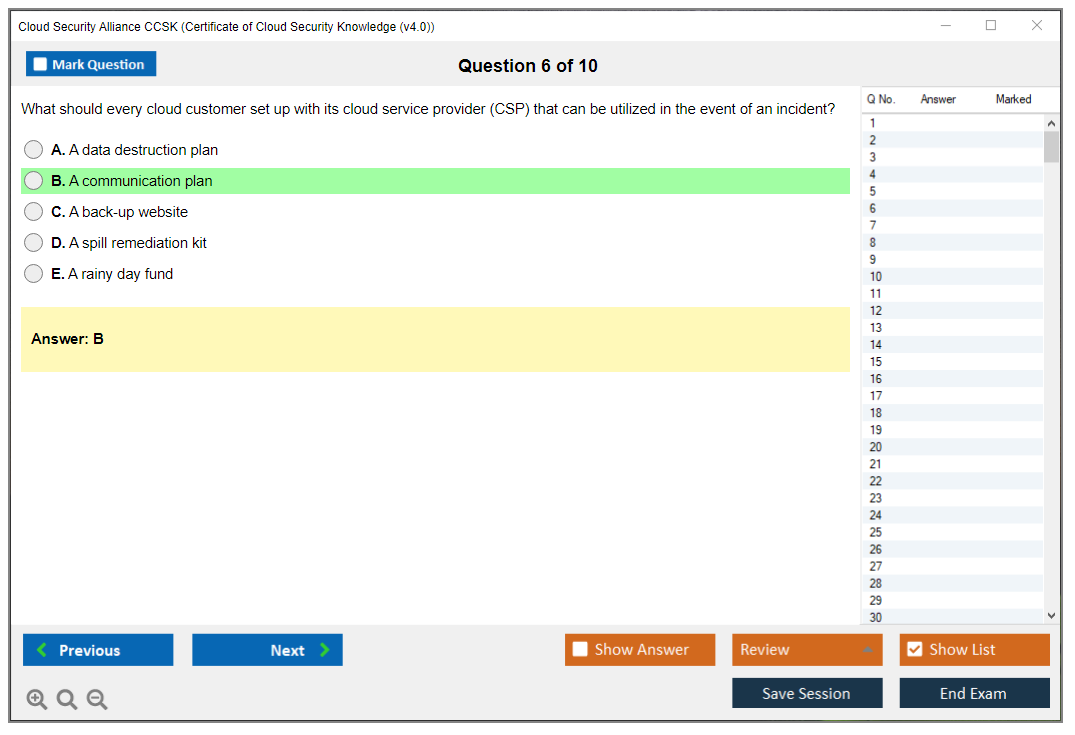
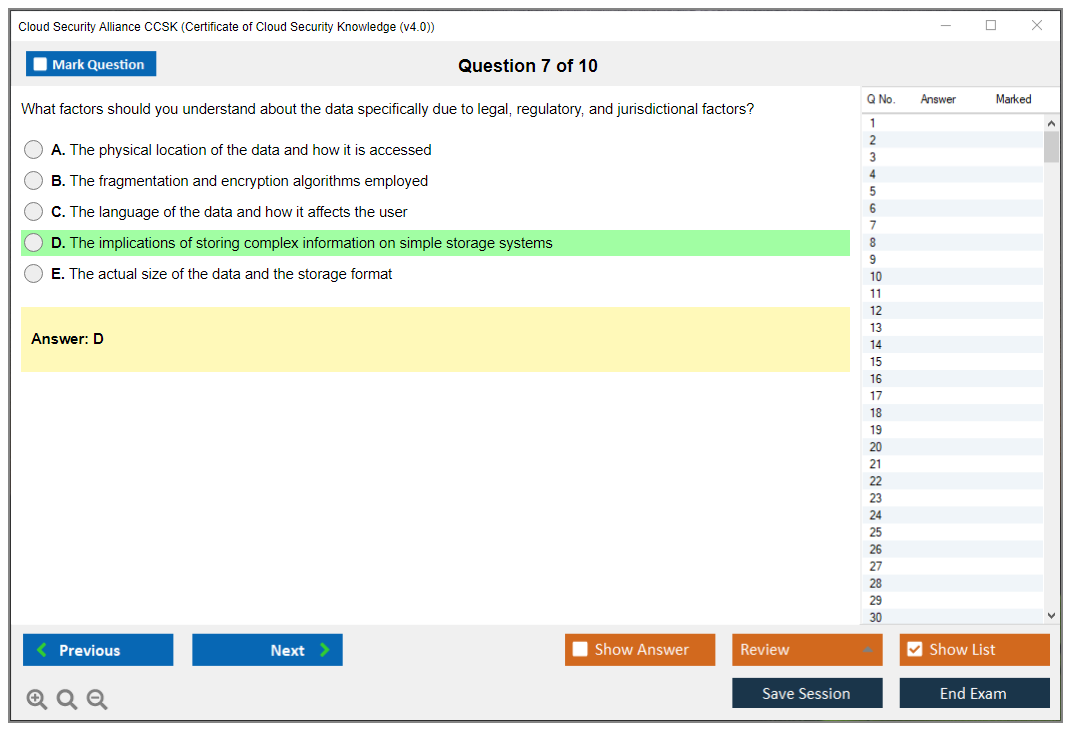
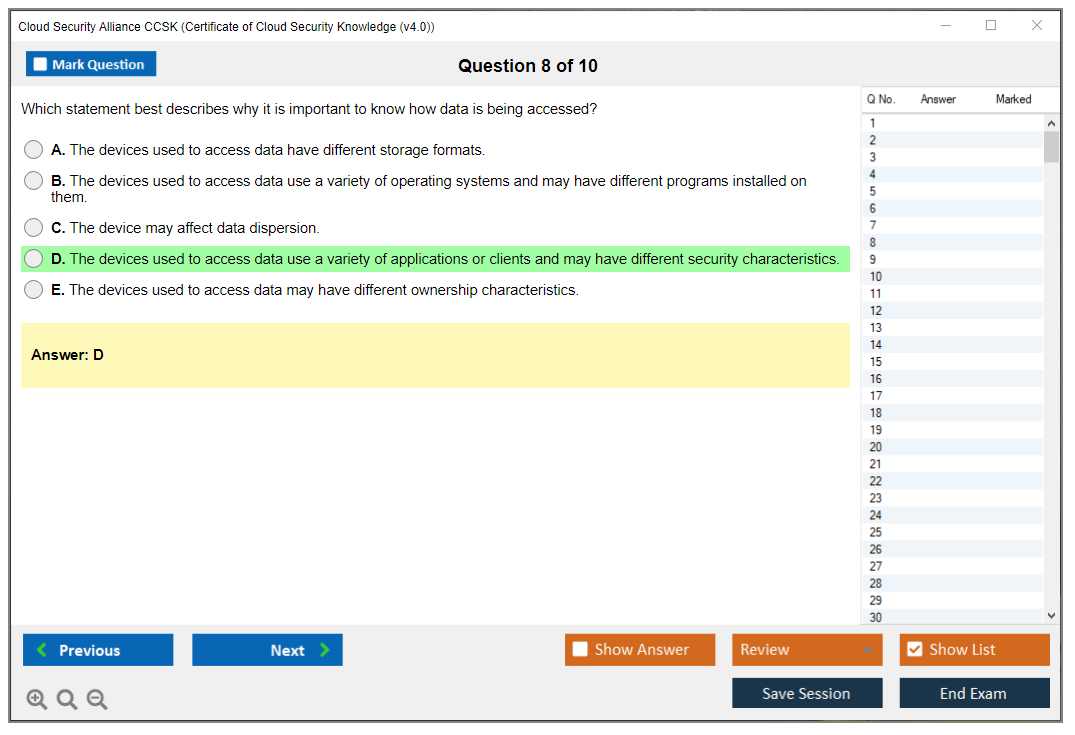
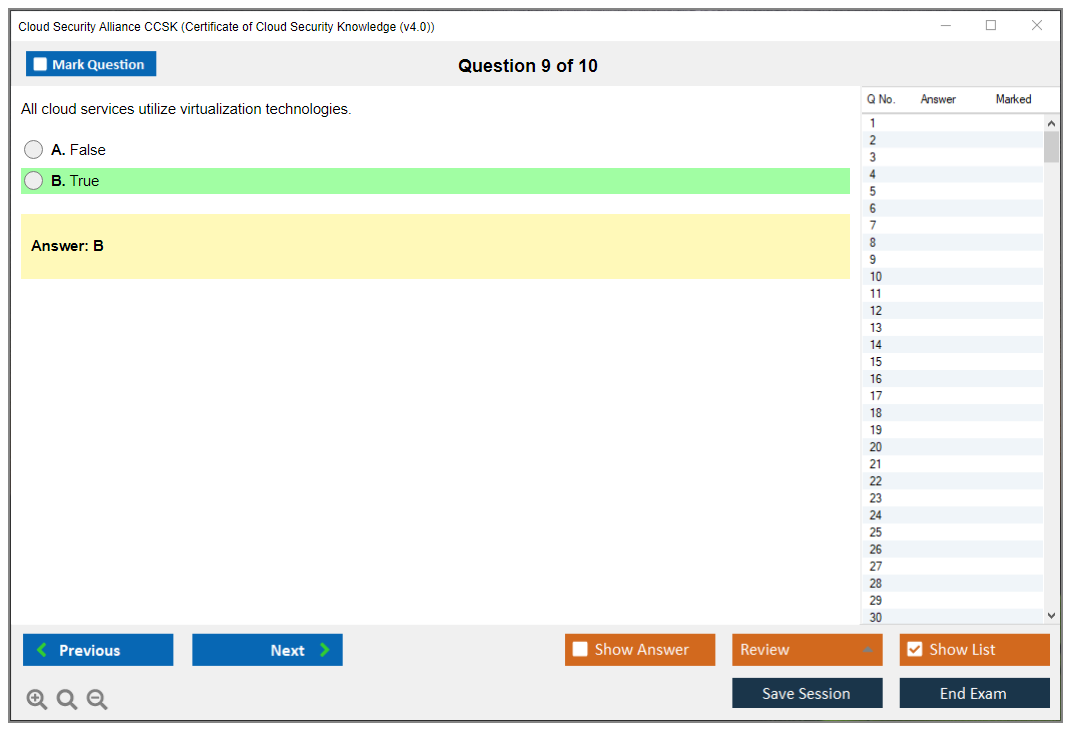
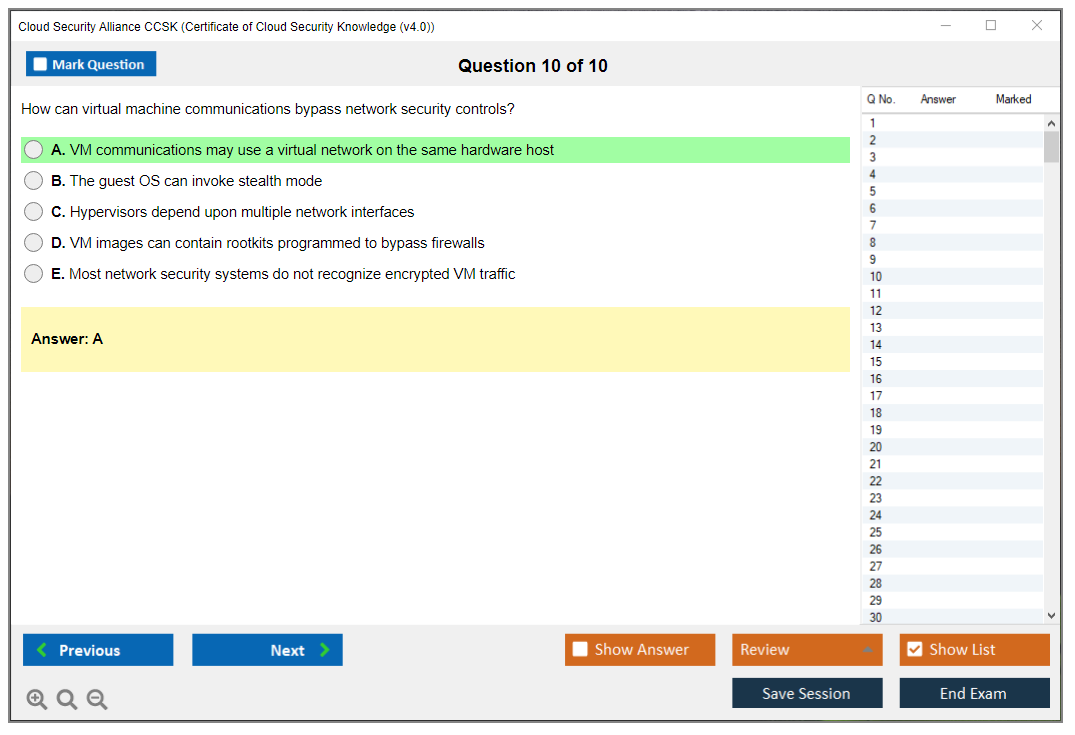
Dumpsarena Cloud Security Alliance Certificate of Cloud Security Knowledge (v5.0) (CCSK) Free Practice Exam Simulator Test Engine Exam preparation with its cutting-edge combination of authentic test simulation, dynamic adaptability, and intuitive design. Recognized as the industry-leading practice platform, it empowers candidates to master their certification journey through these standout features.
What is in the Premium File?
Satisfaction Policy – Dumpsarena.co
At DumpsArena.co, your success is our top priority. Our dedicated technical team works tirelessly day and night to deliver high-quality, up-to-date Practice Exam and study resources. We carefully craft our content to ensure it’s accurate, relevant, and aligned with the latest exam guidelines. Your satisfaction matters to us, and we are always working to provide you with the best possible learning experience. If you’re ever unsatisfied with our material, don’t hesitate to reach out—we’re here to support you. With DumpsArena.co, you can study with confidence, backed by a team you can trust.
Cloud Security Alliance CCSK Exam FAQs
Introduction of Cloud Security Alliance CCSK Exam!
The Cloud Security Alliance (CSA) Certificate of Cloud Security Knowledge (CCSK) is a certification program that validates an individual's knowledge and understanding of cloud security. The CCSK exam is a multiple-choice exam that covers topics such as cloud security architecture, cloud data security, cloud platform security, and cloud application security.
What is the Duration of Cloud Security Alliance CCSK Exam?
The Cloud Security Alliance (CSA) Certified Cloud Security Knowledge (CCSK) exam is a 90-minute, multiple-choice exam.
What are the Number of Questions Asked in Cloud Security Alliance CCSK Exam?
The Cloud Security Alliance Certified Cloud Security Knowledge (CCSK) exam consists of 125 multiple-choice questions.
What is the Passing Score for Cloud Security Alliance CCSK Exam?
The passing score required for the Cloud Security Alliance CCSK exam is 75%.
What is the Competency Level required for Cloud Security Alliance CCSK Exam?
The Cloud Security Alliance CCSK exam requires a basic understanding of Cloud Computing concepts and an intermediate-level understanding of security and risk management.
What is the Question Format of Cloud Security Alliance CCSK Exam?
The Cloud Security Alliance CCSK exam is composed of multiple-choice and true/false questions.
How Can You Take Cloud Security Alliance CCSK Exam?
The Cloud Security Alliance (CSA) offers the Certificate of Cloud Security Knowledge (CCSK) exam online and in testing centers. The online exam is administered through the Pearson VUE testing platform and can be taken at any Pearson VUE testing center. The in-person exam is administered through the Kryterion testing platform and can be taken at any Kryterion testing center.
What Language Cloud Security Alliance CCSK Exam is Offered?
The Cloud Security Alliance CCSK exam is offered in English.
What is the Cost of Cloud Security Alliance CCSK Exam?
The Cloud Security Alliance CCSK exam is offered for a fee of $295 USD.
What is the Target Audience of Cloud Security Alliance CCSK Exam?
The Cloud Security Alliance Certificate of Cloud Security Knowledge (CCSK) exam is designed primarily for cloud security professionals, IT security professionals, and cloud architects. It is also suitable for anyone with an interest in cloud security, such as systems administrators, software developers, security auditors, and IT managers.
What is the Average Salary of Cloud Security Alliance CCSK Certified in the Market?
The average salary for someone who has achieved the Cloud Security Alliance CCSK exam certification varies depending on the individual's experience, location, and other factors. Generally, however, the certification can lead to an increase in salary of up to 20%.
Who are the Testing Providers of Cloud Security Alliance CCSK Exam?
The Cloud Security Alliance (CSA) provides the CCSK exam. The exam is administered through Pearson VUE, a global leader in computer-based testing. Pearson VUE offers a network of testing centers around the world, so you can take the exam at a location that is convenient for you.
What is the Recommended Experience for Cloud Security Alliance CCSK Exam?
The Cloud Security Alliance (CSA) recommends that candidates for the CCSK exam have a minimum of two years of experience working in the information technology field. The experience should include knowledge of cloud computing, network security, identity and access management, and data protection. The CSA also recommends that candidates have a thorough understanding of the CSA guidance and best practices.
What are the Prerequisites of Cloud Security Alliance CCSK Exam?
The Cloud Security Alliance (CSA) requires that all candidates for the CCSK exam have at least two years of experience in information security, cloud computing, and/or IT in order to be eligible to take the exam. Candidates must also have a basic understanding of cloud security principles, cloud architecture and services, and cloud security risks and controls.
What is the Expected Retirement Date of Cloud Security Alliance CCSK Exam?
The official website for the Cloud Security Alliance CCSK exam is https://cloudsecurityalliance.org/certification/ccsk/. On this page, you can find information related to the CCSK exam, including the expected retirement date.
What is the Difficulty Level of Cloud Security Alliance CCSK Exam?
The Cloud Security Alliance CCSK exam is considered to be an intermediate level exam. It is designed to test the knowledge and skills of individuals who are already familiar with cloud security concepts.
What is the Roadmap / Track of Cloud Security Alliance CCSK Exam?
The Cloud Security Alliance (CSA) Certificate of Cloud Security Knowledge (CCSK) Exam is a certification track/roadmap designed to provide professionals with the knowledge and skills to secure cloud computing environments. The CCSK Exam is the first step in the CSA certification track and is designed to validate a candidate’s understanding of the core security principles and best practices for deploying and managing cloud computing environments. The CCSK Exam covers topics such as cloud security architecture, cloud security operations, cloud security governance, and cloud security compliance.
What are the Topics Cloud Security Alliance CCSK Exam Covers?
The Cloud Security Alliance (CSA) Certified Cloud Security Knowledge (CCSK) exam covers the following topics:
1. Cloud Computing Concepts: This section covers the basics of cloud computing, such as the types of cloud services, architectures, and deployment models.
2. Governance, Risk, and Compliance: This section covers topics such as risk management, legal and regulatory compliance, and data privacy and security.
3. Cloud Architecture and Operations: This section covers topics such as cloud architecture design, security controls, and cloud operations.
4. Data Security: This section covers topics such as data encryption, data access control, and data loss prevention.
5. Security and Networking: This section covers topics such as network security, identity and access management, and security monitoring.
6. Cloud Application Security: This section covers topics such as application security, vulnerability management, and secure software development.
7. Incident Response and Disaster Recovery:
What are the Sample Questions of Cloud Security Alliance CCSK Exam?
1. What are the key components of the Cloud Security Alliance's Cloud Controls Matrix?
2. What is the purpose of the Cloud Security Alliance's Consensus Assessments Initiative Questionnaire?
3. What are the four primary categories of cloud security controls?
4. What are the differences between a cloud provider's security measures and a customer's security measures?
5. What are the steps in the process of assessing a cloud provider's security posture?
6. What are the best practices for implementing cloud security controls?
7. What are the benefits of using cloud security tools?
8. What are the risks associated with using cloud computing services?
9. What are the best practices for maintaining cloud security?
10. What are the key considerations when selecting a cloud security solution?
Cloud Security Alliance CCSK (Certificate of Cloud Security Knowledge (v5.0)) Cloud Security Alliance CCSK v5.0 Certification Overview What is the CCSK (Certificate of Cloud Security Knowledge)? So, CCSK v5. Vendor-neutral credential. The Cloud Security Alliance developed this certification to validate your foundational understanding of cloud security principles, best practices, and frameworks that apply across AWS, Azure, Google Cloud, and multi-cloud environments. Basically everywhere you'd actually work in the real world. Unlike platform-specific certs that lock you into one ecosystem, this one focuses on conceptual knowledge that matters regardless of which cloud provider you're dealing with on any given Tuesday. It's based on CSA Security Guidance v5 and the Cloud Controls Matrix (CCM) v4, which are the industry's go-to frameworks for cloud security. Everything from the cloud shared responsibility model to governance risk and compliance. Honestly, they're pretty thorough, though... Read More
Cloud Security Alliance CCSK (Certificate of Cloud Security Knowledge (v5.0))
Cloud Security Alliance CCSK v5.0 Certification Overview
What is the CCSK (Certificate of Cloud Security Knowledge)?
So, CCSK v5. Vendor-neutral credential.
The Cloud Security Alliance developed this certification to validate your foundational understanding of cloud security principles, best practices, and frameworks that apply across AWS, Azure, Google Cloud, and multi-cloud environments. Basically everywhere you'd actually work in the real world. Unlike platform-specific certs that lock you into one ecosystem, this one focuses on conceptual knowledge that matters regardless of which cloud provider you're dealing with on any given Tuesday.
It's based on CSA Security Guidance v5 and the Cloud Controls Matrix (CCM) v4, which are the industry's go-to frameworks for cloud security. Everything from the cloud shared responsibility model to governance risk and compliance. Honestly, they're pretty thorough, though dense. The CCSK v5 represents the latest update aligned with modern cloud security challenges including zero trust architecture, DevSecOps integration, and supply chain security considerations that weren't nearly as prominent in earlier versions.
What makes this cert interesting is you don't need hands-on cloud platform experience. It focuses on conceptual knowledge instead of clicking through AWS consoles or setting up Azure security groups. That said, understanding cloud architecture basics definitely helps when you're reading about security controls and how they map to different service models. Context matters.
It's recognized globally. Entry-to-intermediate level.
For security professionals transitioning into cloud roles or anyone needing to validate their cloud security knowledge to employers and clients, the CCSK demonstrates commitment to cloud security best practices without locking you into one vendor's ecosystem. Honestly gives you more flexibility long-term.
Who should take CCSK v5 (roles and experience levels)?
Security analysts and engineers moving into cloud security roles are probably the most obvious fit. If you've been doing traditional network security or endpoint protection and your organization's migrating to the cloud, this cert gives you the framework knowledge you need to actually speak the language without sounding clueless.
Cloud architects needing security design knowledge benefit too. Coming from pure infrastructure background? You can design beautiful cloud architectures all day, but if you don't understand security domains and controls, you're gonna have problems during audits. Nobody wants that conversation.
IT auditors desperately need this.
Compliance professionals working with cloud environments find the Cloud Controls Matrix alone worth the study time because it maps controls across different frameworks. Risk management professionals handling cloud governance, system administrators transitioning to cloud infrastructure, and DevOps engineers putting security controls in place all find value here, though their motivations differ.
Look, security consultants advising on cloud migrations basically need this cert to maintain credibility in client meetings. When you're sitting across from a client discussing their cloud security posture, having the CCSK shows you understand the shared responsibility model and aren't just winging it based on some blog posts you skimmed. IT managers overseeing cloud security programs use it to get up to speed quickly on what their teams are actually dealing with day-to-day. Some of them haven't touched technical work in years but still need to make informed decisions about tooling and priorities.
Entry-level professionals building cloud security foundations can start here, though honestly you'll want some basic IT security knowledge first. Jumping in completely cold might be rough. Experienced professionals seeking vendor-neutral validation often grab this before or alongside platform-specific certs to round out their credentials and demonstrate breadth.
CCSK vs CCSP vs Security+ (which one to choose)
Entry-to-intermediate versus advanced. Big difference.
The CCSK is entry-to-intermediate level while CCSP is an advanced professional certification requiring five years of IT experience with three in security. Not gonna lie, that's a significant difference in prerequisites that changes who can even attempt it. CCSK has no formal prerequisites, making it way more accessible if you're early in your career or transitioning from another field where you've got transferable skills but not the years of documented experience.
The exam formats differ substantially too, and this matters more than people think. CCSK is 60 questions in 90 minutes, and you can take it open-book if you want, which honestly reduces some of the memorization pressure. CCSP is 125 questions in four hours, closed-book only, and it's exhausting. Like mentally draining in ways that test endurance as much as knowledge. The CCSK exam cost is notably less than CCSP, which matters if you're paying out of pocket or your employer has limited training budget and you need to justify the investment.
Content-wise, CCSK focuses on CSA guidance and the Cloud Controls Matrix, while CCSP covers six domains including the (ISC)² Common Body of Knowledge with deeper technical detail. Both are vendor-neutral, but CCSK is more accessible and practical as a starting point before tackling the beast that is CCSP. The CCSK requires no renewal or continuing education credits, whereas CCSP requires CPE credits every three years to maintain the certification. Ongoing time and sometimes money.
For CCSK (Certificate of Cloud Security Knowledge (v5.0)), you're building foundation knowledge that prepares you for CCSP success later if you decide to pursue it, so it's not wasted effort.
Now comparing CCSK to Security+ is interesting because they serve different purposes even though people constantly ask which is "better." Security+ is a broad IT security foundation covering general security concepts like cryptography, network security, threats, and vulnerabilities across traditional and some cloud environments. It's the jack-of-all-trades approach. CCSK is cloud security specific, focusing entirely on cloud architectures, service models, and cloud-specific controls without spending time on legacy systems.
Security+ is entry-level for any security role. Recognized for DoD 8570 compliance.
That matters hugely if you're pursuing government or defense contractor positions where certifications literally determine job eligibility. CCSK isn't on the DoD approved list, which is a dealbreaker for some career paths. But CCSK provides way deeper cloud governance and compliance knowledge than Security+ ever touches. It's not even close in terms of cloud-specific depth.
Security+ may be better for general security careers where cloud is just one component of a broader infrastructure. CCSK is for cloud-focused paths where you need to understand IaaS, PaaS, and SaaS security distinctions in detail and explain them to stakeholders. Honestly, holding both demonstrates broad security knowledge with cloud specialization, which looks great on a resume and gives you flexibility in job searches.
Career value and market demand for CCSK v5
The demand keeps growing. Organizations migrate workloads constantly.
Cloud security expertise demand continues growing across industries as organizations migrate workloads and realize they don't fully understand the security implications until something breaks or an auditor asks uncomfortable questions. The CCSK works well alongside platform-specific certifications like AWS Security Specialty or Azure Security Engineer by providing the conceptual foundation that applies everywhere, which becomes increasingly valuable as you work across different environments.
It strengthens your resume for cloud security analyst and architect positions because it demonstrates understanding of cloud security frameworks to employers who are tired of candidates claiming cloud expertise without backing it up with anything beyond "I used AWS once." For consulting roles requiring multi-cloud security knowledge, this cert is particularly useful since clients often run hybrid environments across multiple providers and need someone who can think beyond one platform's quirks.
The CCSK supports salary negotiations. Validated expertise matters.
Look, certifications alone don't guarantee higher pay. We all know that. But they give you use when discussing compensation, especially if you're moving from traditional security into cloud security roles where demand exceeds supply and employers are competing for qualified candidates. It's a data point in your favor during those conversations.
It prepares candidates for tougher certifications like CCSP by covering foundational concepts you'll need for that exam, so you're not starting from scratch. Government agencies and enterprises with cloud initiatives recognize the CCSK, and it boosts credibility when discussing cloud security with stakeholders who may not have technical backgrounds but understand that CSA is a respected organization whose frameworks actually matter in the industry.
The competitive advantage in the cloud security job market comes from demonstrating you've invested time in understanding cloud security beyond just clicking through tutorials or watching YouTube videos. Employers value vendor-neutral knowledge because it shows you can think across platforms rather than being locked into one ecosystem. Honestly makes you more useful as environments inevitably become more complex.
What's new in CCSK v5.0
CCSK v5.0 updated to reflect CSA Security Guidance v5 content, which is a pretty significant refresh from v4. Not just minor tweaks, but substantial content changes. The beefed-up coverage of zero trust architecture principles reflects how the industry has shifted toward zero trust models, and the exam now includes questions about putting zero trust into practice in cloud environments rather than just perimeter-based security that everyone's moving away from anyway.
Expanded DevSecOps coverage. CI/CD security integration.
These topics address the reality that security needs to be baked into development pipelines from the start rather than bolted on afterward when you realize you've got problems. Container and Kubernetes security got new content because everyone's running containers now and the security challenges are different from traditional VMs. Orchestration adds complexity that creates new attack surfaces. Supply chain security and software composition analysis sections expanded quite a bit, reflecting concerns about dependency vulnerabilities and third-party components after high-profile incidents made everyone paranoid.
Privacy regulations including GDPR and CCPA considerations got updates because compliance requirements keep shifting and cloud providers keep adding features to help meet them, though honestly implementation still varies. Incident response in cloud environments received expanded coverage, including how logging, monitoring, and forensics work differently when you don't control the physical infrastructure and can't just pull a hard drive.
Multi-cloud and hybrid cloud security guidance is new, acknowledging that most organizations don't just pick one cloud provider and call it done. They end up with AWS for this, Azure for that, maybe some GCP, and legacy on-prem systems all talking to each other. The updated threat space and attack vectors specific to cloud include newer attack patterns like cryptojacking, API abuse, and cloud-native malware that traditional antivirus doesn't catch.
Cloud governance risk and compliance frameworks align with the updated Cloud Controls Matrix v4, which reorganized and expanded controls in ways that make more sense for modern environments. Serverless security considerations are now included since Lambda functions, Azure Functions, and similar services have different security models than traditional compute. You can't just apply VM security practices and hope for the best.
Improved identity and access management best practices reflect the critical role IAM plays in cloud security, where misconfigurations are like the number one cause of breaches. Updated encryption and key management guidance covers newer key management service features and best practices that have matured as services evolved.
For anyone considering CCZT (Certificate of Competence in Zero Trust) as a follow-up, the CCSK v5.0 zero trust content provides a solid foundation for that more specialized certification, so there's a logical progression if you want to go deeper.
The CCSK passing score is 80%, meaning you need 48 out of 60 questions correct. Honestly isn't too difficult if you've studied the CSA Security Guidance thoroughly and understood the concepts rather than just memorizing. The open-book option helps, but you can't rely on searching for every answer during the exam since you only have 90 minutes and that time disappears faster than you'd think. Most people find the CCSK difficulty level manageable with 2-4 weeks of focused study, depending on their existing security background and how much time they can dedicate daily.
CCSK v5 Exam Details: Format, Cost, Passing Score, and Policies
Cloud Security Alliance CCSK v5.0 certification overview
What is the CCSK (Certificate of Cloud Security Knowledge)?
The CCSK v5 certification comes from Cloud Security Alliance as their vendor-neutral credential centered on the Certificate of Cloud Security Knowledge body of knowledge, primarily the CSA Security Guidance v5 alongside practical mapping from the CCM (Cloud Controls Matrix). It's not some "configure this specific cloud service" exam. Think of it more like: do you actually understand what solid cloud security looks like, why it's architected that way, and how governance risk and compliance (GRC) fits when everything's shared and abstracted?
Short version? Concepts over commands. Lots of judgment calls.
The thing is, that's exactly why it matters if you're trying to speak like an architect, auditor, or security lead rather than just sounding like someone who operates tools.
Who should take CCSK v5 (roles and experience levels)?
This exam honestly hits best for folks already touching cloud security decisions, even lightly. Security analysts transitioning into cloud work. Cloud engineers constantly pulled into risk discussions. GRC people needing to stop guessing what "shared responsibility" actually means in practice. If you're writing controls, reviewing vendor evidence, or conducting security design reviews, you'll get real value here.
Brand new to cloud? You can still pass. But you'll feel time pressure since questions assume you can reason through the cloud shared responsibility model without re-reading basics five times. Some people approach it like a massive CCSK v5 study guide project, which works, but it's honestly a grind. Truthfully, I've seen people pass with minimal cloud experience who just memorized well, and I've seen veterans with years of AWS work stumble because they couldn't translate hands-on knowledge into the policy language CSA prefers.
CCSK vs CCSP vs Security+ (which one to choose)
Security+ stays broad and entry-friendly. CCSP goes deeper, heavier, costs more, and ties into the (ISC)² ecosystem. The Cloud Security Alliance CCSK occupies a sweet middle spot: laser-focused on cloud security principles, faster to attempt, way less about memorizing ports and protocols.
One sentence? CCSK is "cloud brain." CCSP is "cloud brain plus policy weightlifting."
Budget-wise, it's easier to justify out of pocket, especially comparing CCSK exam cost against CCSP ($599) and Security+ (often around $392 depending on region and discounts).
CCSK v5 exam details (format, cost, passing score)
CCSK exam format (questions, time limit, delivery, open-book policy)
The CCSK v5 exam format looks straightforward on paper: 60 multiple-choice questions within 90 minutes. That's 1.5 hours. No essays. No simulations. But don't get comfortable. Many questions are scenario-based, and you can burn serious time second-guessing what the question writer "really wants."
Two formats exist. Open-book and closed-book.
Open-book lets you access the CSA Security Guidance v5 PDF during the exam. Closed-book means memory only, which changes your study approach and pacing strategy completely.
Online proctoring handles delivery. You take it from home or office, assuming stable internet and meeting room requirements. The proctoring software monitors for integrity, and yes, it's picky. Clear desk, no extra monitors, no phone, you stay in camera view.
No negative marking. Missed questions don't hurt extra. That matters strategically.
Question style runs mostly conceptual. You'll encounter straightforward knowledge checks alongside more complex "what should you do next" scenarios forcing you to apply cloud security principles instead of parroting definitions. Some items expect you to recognize how the CCM (Cloud Controls Matrix) relates to governance and assurance, even when the question doesn't scream "this is CCM material."
Language options help. The exam's available in multiple languages including English, Spanish, German, and Japanese, helping global teams standardize without everyone suffering through mental translation.
CCSK exam cost
Standard exam registration typically runs $395 USD (prices change, so verify in the portal before purchasing). There's also a CCSK Plus bundle combining exam and official training, usually around $795 USD.
Cost notes people miss:
- CSA membership may provide discounted vouchers. Corporate volume discounts exist when organizations buy bulk. Details vary, you have to ask or check membership perks.
- No additional fee for online proctored delivery. What you pay is what you get.
- Retakes cost identical to first attempt. Full price again, $395.
Training's separate. Official or partner courses sold separately often run $495 to $695. Third-party CCSK practice test options tend toward $30 to $100 depending on depth and subscription model.
Something I appreciate here: the CSA Security Guidance v5 downloads free from CSA's website, so baseline materials don't require buying giant books. Also, there's no annual maintenance fees and no recurring renewal bill, a refreshing break from "pay forever" certification models.
Payment typically goes through credit card via CSA portal. Exam vouchers are generally valid for 12 months from purchase, and here's a policy detail people ignore until it hurts: no refunds after voucher activation. Plan your schedule before clicking buttons.
CCSK passing score (what you need to pass and how scoring works)
Passing depends on format choice:
- Open-book passing score: 80%, meaning 48 out of 60.
- Closed-book passing score: 70%, meaning 42 out of 60.
That lower closed-book threshold is basically CSA acknowledging reality: if you can't consult guidance, you're facing more difficulty. No partial credit exists. It's multiple-choice.
You get your score immediately post-submission, with pass/fail on screen. There's also a detailed score report showing performance by domain, which matters because there's no minimum per-domain requirement. Overall score only. So you can be weak in one area and still pass, but if you fail by a couple questions, you're retaking everything.
Digital certificate delivery usually happens fast, often within 24 to 48 hours after passing. Physical certificate's typically available by request for extra fee, and your credential includes a unique verification number.
CSA doesn't publish question weighting or difficulty weighting, so don't waste energy trying to game the math. Study the full range of CCSK exam objectives and assume anything in guidance can appear.
Exam retake policy (what happens if you fail)
Retakes are simple and mildly annoying. There's no mandatory waiting period. You can schedule immediately. There's also no limit on attempts. The catch? Cost: you must buy a new voucher at full price, and CSA generally doesn't offer free retakes or voucher extensions.
Each attempt stands independent. You might see different questions. Your previous score doesn't carry forward.
My opinion: don't rage-retake. Use the domain report.
If you missed by a narrow margin, it's still a full retake, so your best move targets weak domains and tightens scenario reasoning. Also, consider switching formats. Some people excel open-book because they verify wording quickly, while others do better closed-book since searching eats time and they overthink.
CCSK v5 objectives (what the exam covers)
Domain-by-domain breakdown of CCSK v5 objectives
Questions cover all domains from CSA Security Guidance v5. Expect broad sweep: cloud architecture concepts, governance, risk, compliance, identity, data security, logging, incident response, vendor management, and the messy reality of shared responsibility.
Some topics feel "policy-ish." Some feel technical. Both matter.
Mapping objectives to CSA Security Guidance v5 and CCM
A chunk of the exam basically asks: can you map principles to controls and assurance language? That's where CCM enters. You don't need memorizing every control ID, but you absolutely need understanding how a control framework expresses expectations, how you'd assess a provider, and how you'd explain gaps without sounding like you're guessing.
Commonly tested topics (IAM, encryption, key management, logging, GRC)
IAM appears frequently, especially around least privilege, federation, and what shifts when identity's centralized. Encryption and key management show up in "who owns the keys" and "what's the risk if the provider manages them" style questions. Logging and monitoring usually appear as scenario prompts. I mean, what evidence would you need, what's reasonable to collect, and how you'd detect abuse in cloud-native environments?
CCSK prerequisites and recommended background
CCSK prerequisites (is experience required?)
There aren't formal prerequisites in strict sense. No required years of experience. No mandatory training. But realistically, you want comfort with cloud basics, security fundamentals, and risk thinking.
Recommended knowledge (networking, IAM, risk, cloud architecture basics)
You should understand basic networking, authentication vs authorization, and common cloud service models. You also need ability to read a scenario and think like a security reviewer, not like someone hunting for a single "right tool."
Who benefits most (security analysts, architects, auditors, GRC)
Security analysts get better at cloud-specific reasoning. Architects gain cleaner ways to discuss controls and governance. Auditors and GRC folks acquire better language for evidence, responsibility boundaries, and provider evaluation.
CCSK difficulty and how to prepare
CCSK difficulty (what makes it challenging)
People ask constantly, "How hard is the CCSK certification compared to Security+ or CCSP?" It's harder than Security+ in cloud specificity and scenario reasoning, but usually not as heavy as CCSP in breadth and exam atmosphere. The tricky part? The conceptual phrasing and the fact cloud security involves lots of "it depends," yet the exam still wants the best answer.
How long to study for CCSK v5 (beginner vs experienced)
Experienced in cloud security or GRC? You can prep in a couple weeks of focused reading and practice. Newer? Plan a month or more, since you'll be learning governance language while learning cloud concepts at the same time.
Typical pitfalls (misreading shared responsibility, controls mapping, governance)
Biggest pitfall is misreading responsibility boundaries. Another's assuming on-prem habits map directly to cloud. And a classic: treating the CCM like trivia instead of like a control conversation tool.
Best CCSK v5 study materials (official + supplemental)
Official study materials (CSA references you should use)
If you only use two things, make them these:
- CSA Security Guidance v5 (free, and it's the exam's core reference)
- CSA Cloud Controls Matrix (CCM) (understand how controls are expressed and assessed)
ENISA cloud security resources get referenced heavily by the community too, mostly as sanity check for risk framing and common threats, but don't treat ENISA like primary source if you're trying to match how CSA words things.
Recommended books, courses, and labs (what helps most)
Courses help when you need structure. Labs are optional for this exam, but doing basic cloud logging, IAM policy review, and key management exercises makes scenarios feel less abstract. Not gonna lie, reading only PDFs can get you across the line, but hands-on exposure makes you faster and more confident.
Study plan checklist by week (2-week / 4-week / 6-week options)
Two-week plan works for experienced folks: read guidance, map key concepts to CCM, then hammer practice questions. Four-week plan's safer for most people. Six-week plan suits beginners or anyone balancing work chaos.
CCSK practice tests and exam-day strategy
CCSK practice tests (what to look for in quality questions)
A quality practice test should be scenario-heavy, explain why wrong answers are wrong, and align to current CCSK exam objectives. Avoid dumps. They train you to memorize noise. The real exam's more about reasoning.
How to use practice exams effectively (review method, weak-area loops)
Don't just retake the same bank until you memorize it. Review every miss, trace it back to exact section in CSA Security Guidance v5, and write a one-paragraph note explaining the concept in your own words. That's how you fix the thinking error.
Open-book strategy (how to index references and search fast)
Open-book's not "relax." It's "search fast." Build a quick index of topics and keywords, and practice finding sections quickly. If you're hunting for five minutes per question, you'll run out of time and still miss items due to stress.
CCSK renewal, validity, and maintaining the credential
CCSK renewal (does it expire, and how recertification works)
People also ask, "Does CCSK require renewal or continuing education (CPEs)?" The typical policy's simple: no renewal requirements and no annual maintenance fees. That's honestly one of the nicest parts of this cert. Keep an eye on CSA policy updates, though, because version updates can shift what employers expect, even if the credential itself doesn't "expire."
Continuing education expectations (if applicable) and policy changes to watch
No formal CPE tracking's usually required. Still, cloud changes fast, so your real renewal is staying current with provider patterns, IAM trends, and governance expectations.
When to upgrade (moving from earlier versions to CCSK v5)
If you hold an older CCSK, upgrading makes sense when job postings or your team's standards start calling out v5 content, or when you notice your mental model's stuck in older cloud assumptions.
CCSK v5 FAQ (Cost, passing score, difficulty, prep)
Quick answers to the most searched questions
How much does the CCSK v5 exam cost? Standard registration's typically $395 USD, with training bundles around $795.
What is the passing score for the CCSK exam? 80% open-book (48/60) and 70% closed-book (42/60).
How hard is the CCSK certification compared to Security+ or CCSP? Usually harder than Security+ for cloud-specific reasoning, generally lighter than CCSP overall, but still not "easy."
What study materials are best for CCSK v5 (CSA Guidance, CCM, ENISA)? Start with CSA Security Guidance v5, add the CCM, and use ENISA as supplemental context.
Does CCSK require renewal or continuing education (CPEs)? Typically no CCSK renewal requirements and no maintenance fees, but employers may prefer the latest version over time.
And if you're wondering about CCSK prerequisites, think "recommended background" not gatekeeping: basic cloud concepts, security fundamentals, and ability to reason through shared responsibility and cloud governance risk and compliance (GRC) scenarios under time pressure.
CCSK v5 Exam Objectives: Full Domain Breakdown
Breaking down the CCSK v5 exam domains
Here's the deal. The CCSK v5 certification from Cloud Security Alliance isn't some watered-down multiple choice quiz. It's actually a full test covering eight major domains, and honestly, each one could be its own certification if CSA wanted to torture people. I'm gonna walk through what you're actually signing up for here, because the exam objectives are dense and if you don't know what's coming, you're gonna have a rough time even with the open-book format.
The exam tests you on everything from basic cloud architecture concepts to the nitty-gritty details of incident response in multi-tenant environments. That's a lot to absorb in one sitting, which is probably an understatement. But breaking it down domain by domain makes it way more manageable, and you start seeing how the pieces connect. That's what separates people who pass from people who just memorize terms.
Domain 1 gets into cloud fundamentals (but not the easy stuff)
First domain covers cloud computing concepts and architectures. Sounds basic right?
Wrong.
Yeah, you need to know IaaS versus PaaS versus SaaS, but the exam digs into the security implications of each service model, not just definitions you could grab off Wikipedia. The shared responsibility model shows up everywhere in this exam. Understanding exactly where provider responsibility ends and yours begins for each service model is critical. Like, really make-or-break critical for probably thirty percent of the questions.
Multi-tenancy and isolation mechanisms matter a lot here. You're expected to understand how virtualization works at a technical level, not just "virtual machines exist." Containers, microservices, serverless architectures.. they all have different security profiles and the exam will test whether you actually get the differences or you're just throwing around buzzwords at happy hour.
The thing is, they also cover edge computing, distributed cloud, VPCs, and software-defined networking. Storage architectures get detailed attention: object storage versus block versus file systems in cloud contexts. The management plane and API security? Super important. You need to understand how orchestration and automation tools can become attack vectors if misconfigured.
Domain 2 is where governance and risk assessment live
This is the domain where a lot of technical people struggle because it's less about configuring firewalls and more about frameworks, policies, and organizational structures that make their eyes glaze over. Cloud governance isn't sexy but it's absolutely essential, and the exam knows it.
Risk assessment methodologies specific to cloud are different from traditional IT risk assessment. Honestly, it's almost like learning a new language. The CCSK practice test questions I've seen really hammer on how to apply risk treatment strategies in cloud scenarios. When do you accept risk versus transfer it versus mitigate it?
Regulatory compliance is huge here. GDPR, HIPAA, PCI DSS, SOC 2.. you need to know what each one requires and how cloud complicates compliance in ways that make legal teams nervous. Data residency and sovereignty aren't theoretical concepts. They're real constraints that affect architecture decisions.
The Cloud Controls Matrix (CCM) framework gets tested extensively. It's one of CSA's core frameworks and you should be intimately familiar with how to use it. Same with the Consensus Assessments Initiative Questionnaire (CAIQ). These aren't just acronyms to memorize. You need to understand how they work in practice for vendor assessments and third-party risk management.
Vendor risk management is actually one of the trickiest areas because you're dealing with contracts, SLAs, and legal language, not just technical controls you can configure. Audit and assurance in cloud environments requires understanding compliance inheritance. How you can rely on your provider's certifications and where you can't.
Domain 3 tackles legal and privacy issues
Legal, privacy, and compliance is where things get complicated across jurisdictions. Like, really headache-inducing complicated. Data protection regulations vary wildly by country and region, and cloud makes it worse because data can physically reside anywhere.
Privacy by design isn't just a nice principle. The exam expects you to know how to implement it in cloud architectures with actual controls, not vague hand-waving. Cross-border data transfer mechanisms like Standard Contractual Clauses and Binding Corporate Rules matter when you're architecting global cloud solutions.
eDiscovery in cloud environments is way harder than on-premises because you often don't have direct access to physical systems. Intellectual property considerations, liability, accountability.. all these legal concepts have specific cloud implications that the exam tests.
Data processing agreements and understanding controller versus processor relationships under GDPR? Yeah, you need to know that cold. Breach notification requirements differ by regulation and jurisdiction, and the exam might throw scenarios at you where you need to figure out which rules apply when you've got users in three countries. I once spent two hours on a call with legal trying to untangle a data breach notification timeline that spanned EU, California, and Singapore regulations. Not fun, but that kind of messy reality is exactly what this domain prepares you for.
Domain 4 covers information governance and data security
This domain is massive. Data lifecycle management in cloud environments requires understanding how data moves, transforms, and eventually gets deleted. Sounds simple until you realize data copies itself like rabbits in distributed systems. Data classification and labeling strategies form the foundation for most security controls, and you need to understand practical implementation, not just theory.
Encryption at rest and in transit seems straightforward until you get into key management architectures that'll make your head spin. Where do keys live? Who has access? What happens if you lose them? These questions have real consequences in cloud environments and the exam knows it.
Tokenization and data masking techniques provide alternatives to encryption in some scenarios. Data loss prevention (DLP) in cloud contexts requires understanding both cloud-native and third-party solutions. Database security in cloud environments involves shared responsibility considerations and specific controls for different database types.
Backup and recovery strategies need to account for cloud-specific risks like region failures or provider outages that can take down entire availability zones. The CCSK certification really emphasizes understanding practical data security implementations, not just knowing buzzwords to drop in meetings.
Domain 5 is all about identity and access management
IAM in cloud is fundamentally different from traditional network security. Like, night-and-day different. You can't just rely on network perimeter controls when there's no perimeter. Identity becomes the perimeter, which is why this domain is so important.
Authentication mechanisms range from basic passwords to multi-factor authentication to biometrics to certificates. The exam expects you to know when each is appropriate and what the trade-offs are. Authorization models like RBAC (role-based access control), ABAC (attribute-based), and PBAC (policy-based) each have use cases and limitations you need to understand.
Federation and single sign-on architectures enable users to access multiple services with one identity, which is convenient but also creates single points of failure. Understanding SAML, OAuth, and OpenID Connect isn't optional. These protocols are how modern cloud authentication works. Identity providers and service providers have specific relationships and trust models you need to understand.
Privileged access management in cloud environments is extra tricky because admin access often happens through APIs rather than traditional login mechanisms that you can monitor easily. Just-in-time and just-enough-access principles reduce risk by limiting access duration and scope.
Service accounts and non-human identities are everywhere in cloud, and managing them securely requires different approaches than user accounts. They don't forget passwords or click phishing links, but they've got their own risks. Zero trust architecture is increasingly important, and the exam tests whether you understand it as an actual security model or just marketing fluff.
Domain 6 focuses on security operations and incident response
Security monitoring in cloud environments requires different tools and approaches than on-premises setups that you might be used to. Log aggregation and analysis strategies need to account for distributed systems, multiple services, and massive scale.
Cloud SIEM solutions help centralize security event management but configuring them correctly requires understanding what logs matter and how to correlate events across services. Threat detection and response in cloud often involves automated responses because manual investigation can't keep up.
Incident response procedures specific to cloud need to account for limited forensic access, shared infrastructure, and provider dependencies that can slow you down. Digital forensics in cloud environments is really challenging because you rarely have physical access to systems and evidence might be ephemeral.
Vulnerability management and patch management work differently in cloud, especially with auto-scaling and immutable infrastructure. Configuration management and hardening require infrastructure-as-code approaches and continuous validation rather than one-time setups.
Domain 7 covers infrastructure security controls
Network security in cloud uses constructs like VPCs, security groups, and network access control lists rather than traditional hardware firewalls sitting in racks. Understanding how these work and how to configure them securely is essential. Misconfigured security groups are probably responsible for half the breaches you read about. Honestly.
DDoS protection, web application firewalls, and API gateways provide defense layers but only if configured correctly. Load balancers affect security in ways that aren't always obvious. VPN and secure connectivity options vary by provider and use case.
Compute security includes VM hardening, container security, and serverless security considerations. Each with unique attack surfaces and mitigation strategies. Hypervisor security and isolation mechanisms are foundational to cloud security but often overlooked because they're the provider's problem, right? Well, kinda, but you still need to understand them.
Infrastructure as code security is becoming critical as more organizations adopt IaC tools like Terraform and CloudFormation. Configuration management tools can introduce vulnerabilities if not secured properly, which is ironic considering they're supposed to improve security. Microsegmentation and network isolation provide defense in depth but require careful planning.
Domain 8 addresses application security and DevSecOps
Secure SDLC in cloud needs to account for rapid deployment cycles and infrastructure automation that traditional security processes weren't designed for. DevSecOps principles integrate security throughout the development pipeline rather than bolting it on at the end like some kind of afterthought.
CI/CD pipeline security is critical because compromised pipelines can inject vulnerabilities into production at scale. Like, massively terrifying scale. Container security involves image scanning, runtime protection, and understanding the container attack surface. Kubernetes security best practices are essential as K8s becomes the de facto orchestration platform.
Application security testing types (SAST, DAST, IAST) each have strengths and weaknesses that make them suited for different scenarios. API security and management requires understanding authentication, authorization, rate limiting, and input validation. Secrets management in applications is a common weak point that the exam definitely covers.
The shift-left security approach moves security earlier in development, and understanding how to implement this practically separates good answers from mediocre ones that sound nice but don't actually work. If you're preparing for the exam, our CCSK Practice Exam Questions Pack for $36.99 covers all eight domains with scenario-based questions that mirror the actual exam format.
Understanding how these domains connect
Here's what makes CCSK v5 actually valuable: the domains aren't isolated silos that you can study separately and call it done. Real cloud security requires understanding how governance decisions affect infrastructure implementation. How identity management enables data protection. How legal requirements constrain architecture choices.
The exam tests this interconnected understanding through scenario questions that span multiple domains in ways that'll catch you off guard if you've just memorized facts. You might get a question about data residency that requires knowing both legal requirements (Domain 3) and infrastructure capabilities (Domain 7), plus compliance frameworks from Domain 2. Or an incident response scenario that touches on logging (Domain 6), IAM (Domain 5), and contractual obligations (Domain 2).
That's why memorizing definitions won't cut it. Period. You need to understand how cloud security actually works in practice, how different controls interact, where responsibility boundaries lie. The CCSK v5 exam objectives reflect this reality, which is honestly what makes the certification worth pursuing instead of just another checkbox.
The Certificate of Cloud Security Knowledge isn't just another cert to stack on LinkedIn and forget about. It's a full framework for thinking about cloud security across technical, governance, and legal dimensions. And yeah, it's challenging, but that's kinda the point. Certs that everyone passes aren't worth much.
CCSK Prerequisites and Recommended Background Knowledge
Cloud Security Alliance CCSK v5.0 certification overview
What is the CCSK (Certificate of Cloud Security Knowledge)?
The CCSK v5 certification is Cloud Security Alliance's vendor-neutral proof that you understand cloud security concepts, controls, and governance. It ties closely to CSA Security Guidance v5, the CCM (Cloud Controls Matrix), and a lot of the "how do we actually control risk in cloud" thinking that shows up in real audits and real security programs.
Not hands-on labs. Not provider badges. Pure knowledge focus.
The thing is, that's actually the whole point. CCSK is for people who need to speak cloud security clearly across teams, whether you're the one writing the policies, building guardrails, reviewing vendor risk, or trying to stop S3 bucket style mistakes before they happen.
Who should take CCSK v5 (roles and experience levels)?
Look, you don't have to be a cloud engineer to get value from it. I've seen it click for SOC analysts who keep getting cloud alerts they don't understand, auditors who want to map controls without sounding lost, and appsec folks who need a cleaner mental model for the cloud shared responsibility model. Honestly, even some project managers who just got tired of nodding along in security reviews while internally freaking out.
Good role fits: Security analyst. GRC or audit. Cloud architect. IT manager.
It also works for career changers because there's no gatekeeping on paper. The content is broad enough that you can build a vocabulary fast, then decide if you want to go deeper into AWS/Azure/GCP later. Or stay on the governance side and live in policies, risk registers, and control mapping forever.
CCSK vs CCSP vs Security+ (which one to choose)
Security+ is general security foundations, usually the first stop for people new to security. CCSP is deeper and more "enterprise security cert" in vibe. It often assumes you already have years of experience and can connect the dots across architecture, operations, and compliance without being handheld through every concept like you're five.
CCSK sits in a weird sweet spot: more cloud-focused than Security+, less "big certification program" than CCSP, and way more tied to CSA artifacts like the CCM. Which is practical if you touch vendor questionnaires or cloud governance risk and compliance (GRC) work. If you're trying to build cloud security credibility without marrying one cloud provider, CCSK is a solid move.
CCSK v5 exam details (format, cost, passing score)
CCSK exam format (questions, time limit, delivery, open-book policy)
The CCSK exam is typically delivered online, and it's known for being open-book. That sounds easy until you realize open-book rewards people who prepared an index and know where things live. Not people who plan to "just search the PDF" while the clock runs out and their brain melts into useless mush.
Timing matters. Search skills matter. Prep still matters.
Questions are multiple choice. They're usually written to test understanding of concepts like governance, shared responsibility, control domains, and how to think about cloud risk rather than memorizing one vendor's product names or button clicks.
CCSK exam cost
For CCSK exam cost, CSA pricing can change. There may be training bundles or discounts depending on where you buy it and whether you get a retake option, so check the official CSA site right before you register. Old blog posts get stale fast. The main point: it's not priced like an entry-level $99 micro-credential, but it's also not always as expensive as the bigger "pro" security certs once you factor in mandatory training.
CCSK passing score (what you need to pass and how scoring works)
For CCSK passing score, CSA publishes the current requirement in their exam info, and you should treat that as the source of truth. Passing scores can be expressed as a percentage or points depending on version and delivery. The annoying truth is that your real target should be higher than the minimum anyway because time pressure plus tricky wording can drop your score more than you expect.
Aim above the line. Don't skate by. You'll regret it.
Exam retake policy (what happens if you fail)
Retakes depend on how you purchased the exam and the current CSA policy. Some bundles include a retake, some don't, and the waiting period rules can vary. I mean, plan like you only want to take it once. Paying twice hurts and it also messes with your momentum and confidence.
CCSK v5 objectives (what the exam covers)
Domain-by-domain breakdown of CCSK v5 objectives
CCSK exam objectives cover a mix of cloud security governance, cloud architecture concepts, control frameworks, and operational security topics like logging, incident response, and data protection. Expect a lot of "how should an org think about this" instead of "click these buttons in console" or "memorize this command syntax."
You'll see themes repeat: identity, data, visibility, third-party risk, and accountability. If you come from pure technical backgrounds, the governance-heavy parts can feel squishy at first. Like "why are we talking about policies." But that's where many cloud failures actually start. Not in the code, in the decisions upstream.
Mapping objectives to CSA Security Guidance v5 and CCM
This is where CCSK gets very CSA-ish. CSA Security Guidance v5 is the reading backbone, and the CCM is the control mapping tool you keep coming back to. If you've never used the CCM (Cloud Controls Matrix), you should, because it's basically a structured way to talk about cloud controls across domains and map them to other standards without reinventing your entire framework from scratch every time.
CCM matters. Guidance matters. Both show up constantly.
Commonly tested topics (IAM, encryption, key management, logging, GRC)
Commonly tested areas tend to include IAM concepts (authentication vs authorization, federated identity), encryption basics and key management responsibilities, logging and monitoring expectations, and governance topics like risk management and compliance mapping. Also, shared responsibility. Wait, did I mention that already? Over and over. People miss questions because they assign the wrong responsibility to the customer vs provider, especially in SaaS scenarios where the lines get blurry.
CCSK prerequisites and recommended background
CCSK prerequisites (is experience required?)
Here's the part a lot of people overthink: CCSK prerequisites are basically "none" in the formal sense. No mandatory prerequisites or prior certifications are required. No minimum years of IT or security experience mandated. No formal education requirements either, so yes, a degree is not necessary. It's open to anyone interested in cloud security knowledge, and that includes career changers who want their first cert to be cloud-flavored without being vendor locked.
Zero gatekeeping. Zero experience checkbox. Zero required cert stack.
That said, CSA effectively expects you to self-police your readiness. Self-assessment of readiness is recommended before registration. That's a polite way of saying, "If you've never heard of DNS and you don't know what authentication means, this will be a rough weekend." CSA recommends basic IT and security understanding, and familiarity with cloud concepts is helpful but not required. Also, no specific cloud platform experience is needed, like AWS, Azure, or GCP. I actually like that, because it keeps the exam focused on principles instead of trivia about where some button lives in a console.
It's suitable for both technical and non-technical roles, which is real. A GRC analyst can pass it. A security engineer can pass it. A product manager who lives near cloud decisions can pass it. There are no age restrictions or geographic limitations baked into the credential itself, but you do need enough English proficiency if you're taking the exam in English. The questions and the reference docs are written in formal security/framework language that can be dense and a little exhausting if you're not used to reading documentation that sounds like it was written by a committee of auditors.
Self-motivated learning capability is important. No one drags you. You do the work.
And the real "requirement" is time. Time commitment for self-study is the main requirement, because open-book doesn't mean open-time. The people who struggle are usually the ones who didn't build an index, didn't practice searching, and didn't do even a basic CCSK v5 study guide plan before clicking "start exam."
Recommended knowledge (networking, IAM, risk, cloud architecture basics)
If you want the exam to feel fair, show up with some foundational knowledge. Not expert level. Just enough that the CSA material isn't your first exposure to the topic.
A good baseline includes basic networking concepts like TCP/IP, DNS, routing, and firewalls. You don't need to calculate subnets in your head, but you should understand what happens when traffic moves from a client to an API endpoint over HTTPS, what DNS is doing, and why a firewall rule is not the same thing as identity-based access control.
Security fundamentals matter too: CIA triad, defense in depth, least privilege, segmentation, and basic threat thinking. Then operating systems. Windows and Linux basics, logs, permissions, and what "hardening" generally means. Add basic knowledge of databases and data storage, because cloud data services and storage classes come with different security and compliance implications. The exam likes to test whether you understand data sensitivity and where controls apply.
IAM is huge. You should be comfortable with authentication vs authorization, MFA, federation, roles, and the general concept of access reviews. Encryption and cryptography basics matter, especially around what encryption does and does not do, and how key management changes in cloud. Awareness of common security threats and vulnerabilities helps too, like misconfiguration, insecure APIs, credential stuffing, overly permissive access, and supply chain risk. Honestly, just assume misconfiguration is the answer until proven otherwise.
Risk management and compliance show up a lot, because CCSK is tied to cloud governance risk and compliance (GRC) thinking. Know the basics: risk = likelihood + impact, what a control is, what an audit looks for, and why policies exist beyond making people feel important. Familiarity with IT service management concepts helps, because incident response, change management, and problem management don't disappear in cloud. They just get faster and more automated.
Cloud awareness helps. Service models (IaaS, PaaS, SaaS), deployment types (public, private, hybrid), and the cloud shared responsibility model are the minimum. If you can't explain who's responsible for what in each service model, you're going to have a bad time. Basic understanding of virtualization technology is useful because it explains isolation, multitenancy, and why hypervisor-level controls matter. Awareness of web technologies and protocols like HTTP/HTTPS and APIs is also important, because cloud is API-driven and a lot of security controls are enforced through identity, policy, and API permissions rather than physical network wiring.
Governance stuff matters too, like general business and IT governance concepts. The exam isn't shy about accountability, third-party risk, and control ownership. And finally, problem-solving and analytical thinking skills, because many questions are scenario-ish and you have to pick the "most correct" control or approach. Not the one that sounds comforting or makes you feel like a hero.
Also, quick tangent: the weirdest gap I've seen people have is around the idea of "control inheritance." Like they get the concept of shared responsibility, but then they freeze when asked what happens when a cloud provider implements encryption at rest and the customer still needs to prove compliance. You inherit some risk reduction, but you don't inherit the accountability. That mental model trips up a lot of otherwise solid candidates.
Who benefits most (security analysts, architects, auditors, GRC)
People who benefit most are the ones who sit at the intersection of "cloud is happening" and "risk is real." Security analysts who triage cloud alerts. Cloud architects who want a control framework backbone. Auditors and GRC folks who need to map requirements to controls using tools like CCM without guessing. Also, project managers and IT leaders who keep getting pulled into cloud decisions and want to stop nodding along in meetings while silently panicking inside.
CCSK difficulty and how to prepare
CCSK difficulty (what makes it challenging)
The difficulty isn't math or syntax. It's breadth, terminology, and the way CSA language can feel abstract if you've only done on-prem security. The hardest part for many people is mapping responsibilities correctly and thinking in service-model terms. SaaS vs PaaS vs IaaS changes what you control, what you configure, and what you can even audit.
How long to study for CCSK v5 (beginner vs experienced)
If you're new to IT, you might need several weeks just to build the base vocabulary. Then another chunk of time to read CSA Security Guidance v5 and understand it without feeling like you're drowning in acronyms. If you've been in security or cloud already, you can compress it, but you still need time to organize notes and practice finding things quickly for open-book.
Typical pitfalls (misreading shared responsibility, controls mapping, governance)
The classic pitfalls are misreading shared responsibility, confusing "policy" with "technical control," and getting lost in control mapping. People also underestimate how much governance content there is. Then they walk in thinking it's all encryption and firewalls and get punched in the face by risk and compliance questions.
Best CCSK v5 study materials (official + supplemental)
Official study materials (CSA references you should use)
If you do one thing, read the official references. CSA Security Guidance v5 is the main one. The CCM is the practical control matrix you should get comfortable scanning. ENISA cloud security resources are commonly referenced and are worth at least skimming so the terminology doesn't feel foreign when it pops up mid-exam.
Recommended books, courses, and labs (what helps most)
A course can help if you need structure, but don't treat it like a replacement for reading the source material. The exam wording tends to reflect the CSA docs more than some instructor's slides. Labs are optional, but a basic cloud fundamentals lab can make concepts like IAM policies, logging, and storage permissions feel real, which helps retention.
Study plan checklist by week (2-week / 4-week / 6-week options)
Two-week plans work if you already know networking, IAM, and cloud basics. You're basically just aligning your knowledge to CSA. Four weeks is comfortable for most working adults. Six weeks is fine if you're new and you want breathing room, or if life keeps happening and you need flexibility.
CCSK practice tests and exam-day strategy
CCSK practice tests (what to look for in quality questions)
A good CCSK practice test should feel like the CSA docs, not like random cloud trivia. It should force you to choose between similar-sounding governance answers and test whether you can apply the CCM mindset.
How to use practice exams effectively (review method, weak-area loops)
Don't just take a practice test and celebrate the score. Review every missed question, find the supporting section in CSA Security Guidance v5 or the CCM, and write a one-sentence "why" note. Then retest the weak areas. Boring? Yes. Effective? Also yes.
Open-book strategy (how to index references and search fast)
Open-book works when you pre-build an index: key terms, page numbers, section titles, and your own cheat sheet of "where do I find IAM vs encryption vs GRC." Searching raw PDFs mid-exam is slow, and it's a trap unless you already know what phrase CSA uses.
CCSK renewal, validity, and maintaining the credential
CCSK renewal (does it expire, and how recertification works)
For CCSK renewal requirements, check CSA's current policy. Renewal/validity rules can change between versions and delivery models. Some candidates assume it's like CPE-heavy certs, others assume it never expires. The truth depends on the version and CSA's current program rules.
Continuing education expectations (if applicable) and policy changes to watch
If CSA adjusts renewal expectations, you'll want to know early so you're not scrambling later. Keep an eye on official updates, not forum guesses or some guy's blog post from 2019.
When to upgrade (moving from earlier versions to CCSK v5)
If you have an older CCSK, upgrading to v5 makes sense when your org is aligning to newer CSA guidance, when job postings start calling out v5 specifically, or when you want your knowledge current around modern cloud governance and control mapping.
CCSK v5 FAQ (cost, passing score, difficulty, prep)
Quick answers to the most searched questions
How much does the CCSK v5 exam cost? Check the CSA site for current CCSK exam cost, because pricing and bundles change.
What is the passing score for the CCSK exam? The official CCSK passing score is published by CSA for the current exam delivery. You should aim above it because open-book time pressure is real.
How hard is the CCSK certification compared to Security+ or CCSP? Harder than Security+ on cloud governance and control frameworks, lighter than CCSP on "experience-based" depth, and way more focused on CSA artifacts like the CCM.
What study materials are best for CCSK v5 (CSA Guidance, CCM, ENISA)? Start with CSA Security Guidance v5, add the CCM (Cloud Controls Matrix), then use ENISA resources to reinforce terminology and risk thinking.
Does CCSK require renewal or continuing education (CPEs)? CCSK renewal requirements depend on CSA's current
Conclusion
So, is the Cloud Security Alliance CCSK v5 certification worth your time?
Okay, real talk. I've been around the cloud security block enough to spot the difference between fluff and substance. CCSK? it's resume candy. This thing really reshapes how you approach shared responsibility models and the cloud governance risk and compliance (GRC) space. Like, it actually changes your mental framework, which sounds cheesy but it's true.
The study materials hit different. The CSA Security Guidance v5 and the Cloud Controls Matrix (CCM)? You'll catch yourself pulling those up months later when you're knee-deep in architecture reviews or compliance audits, thinking "wait, what did that section say about.." It's one of those rare situations where exam prep materials translate directly to job function.
Now, the CCSK v5 certification makes sense if you're already in security and eyeing that cloud pivot. Exam cost won't murder your budget like CCSP or similar heavyweight certs. The CCSK passing score threshold hovers around 80%, which feels achievable if you've done the work. Yeah, it's open-book. But here's the catch: you absolutely cannot learn material during those 90 minutes. I mean, the clock's brutal. You need instant recall on where concepts live in the references, plus ninja-level search skills.
Memorization? That's not your enemy. The real challenge is mapping controls across different environments and grasping why certain approaches function in multi-tenant scenarios. Honestly, if your understanding of the cloud shared responsibility model stays surface-level, or you're fuzzy on how IAM boundaries morph between IaaS and PaaS, you're gonna have a bad time. Those abstract-feeling CCSK exam objectives? They spawn the gnarliest scenario questions every single time.
Study materials carry extra weight here. The CCSK v5 study guide from CSA builds your foundation, but one read-through? Not even close to sufficient. You've gotta drill yourself repeatedly on control interactions. Practice exams are where theory meets reality.
I actually took a break last week to help a colleague prep for this thing. We spent two hours just on identity federation. Two hours. But watching that lightbulb moment when he finally got why SAML assertions matter in cross-domain trust relationships? Worth it. That's the kind of depth you need going in.
Get serious about practice testing
Here's my actual recommendation: work through official materials until the Certificate of Cloud Security Knowledge domains feel familiar, then immediately grab the CCSK Practice Exam Questions Pack at /cloud-security-alliance-ccsk/. It mirrors actual exam focus areas surprisingly well, plus it exposes your weak spots before they trigger an expensive retake situation.
The explanations reference source documents directly. You're building exam-day muscle memory without realizing it. Since CCSK prerequisites stay minimal, preparation quality outweighs credentials every time. Focused study plus simulated exam conditions? You'll crush it. Oh, and don't forget CCSK renewal requirements post-certification. Staying current with cloud security shifted from "nice to have" to mandatory survival skill.
Show less info
Comments
This can help to make sure you are well- prepared for the test. Overall, the CCSK Exam instrument is an excellent way to prove your proficiency in the platform.
The customer service is also excellent and they are always available to answer any questions you have. In addition, they offer practice examinations, which gives you the occasion to test your knowledge before taking the factual test.
Hot Exams
Related Exams
HCIA-Data Center Facility V2.0
Nutanix Certified Professional (NCP) 5.10 Exam
SAP Certified Associate - Design Thinking
Mac Integration Basics
Aruba Certified Mobility Associate Exam
SAP Certified Application AssociateSAP Ariba Integration with Cloud Integration Gateway
Certified Blockchain Business Foundations
SAFe Practice Consultant SPC (6.0)
IBM Cognos Analytics Author V11
Aruba Certified Switching Professional Exam
SAP Certified Application Associate - SAP BusinessObjects Web Intelligence 4.2
Veeam Certified Engineer 2021
Fundamentals of Financial Accounting
Genesys Cloud Certified Professional - Contact Center Administration
CyberSec First Responder (CFR) Exam
Certificate of Cloud Security Knowledge (v5.0)
How to Open Test Engine .dumpsarena Files
Use FREE DumpsArena Test Engine player to open .dumpsarena files


DumpsArena.co has a remarkable success record. We're confident of our products and provide a no hassle refund policy.

Your purchase with DumpsArena.co is safe and fast.
The DumpsArena.co website is protected by 256-bit SSL from Cloudflare, the leader in online security.