300-430 Practice Exam - Implementing Cisco Enterprise Wireless Networks (300-430 ENWLSI)
Reliable Study Materials & Testing Engine for 300-430 Exam Success!
Exam Code: 300-430
Exam Name: Implementing Cisco Enterprise Wireless Networks (300-430 ENWLSI)
Certification Provider: Cisco
Certification Exam Name: CCNP Enterprise


Free Updates PDF & Test Engine
Verified By IT Certified Experts
Guaranteed To Have Actual Exam Questions
Up-To-Date Exam Study Material
99.5% High Success Pass Rate
100% Accurate Answers
100% Money Back Guarantee
Instant Downloads
Free Fast Exam Updates
Exam Questions And Answers PDF
Best Value Available in Market
Try Demo Before You Buy
Secure Shopping Experience
300-430: Implementing Cisco Enterprise Wireless Networks (300-430 ENWLSI) Study Material and Test Engine
Last Update Check: Mar 18, 2026
Latest 138 Questions & Answers
45-75% OFF
Hurry up! offer ends in 00 Days 00h 00m 00s
*Download the Test Player for FREE
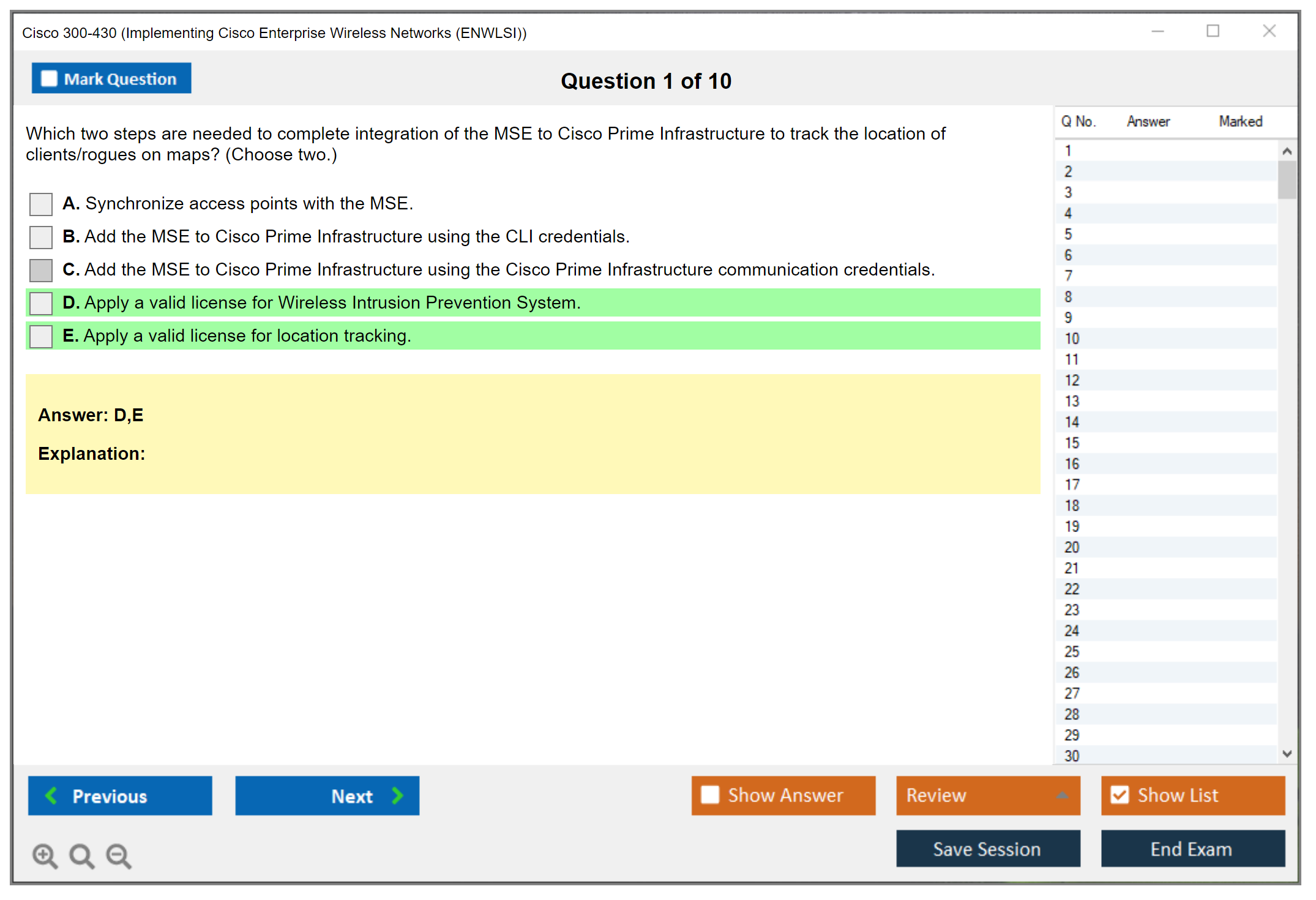
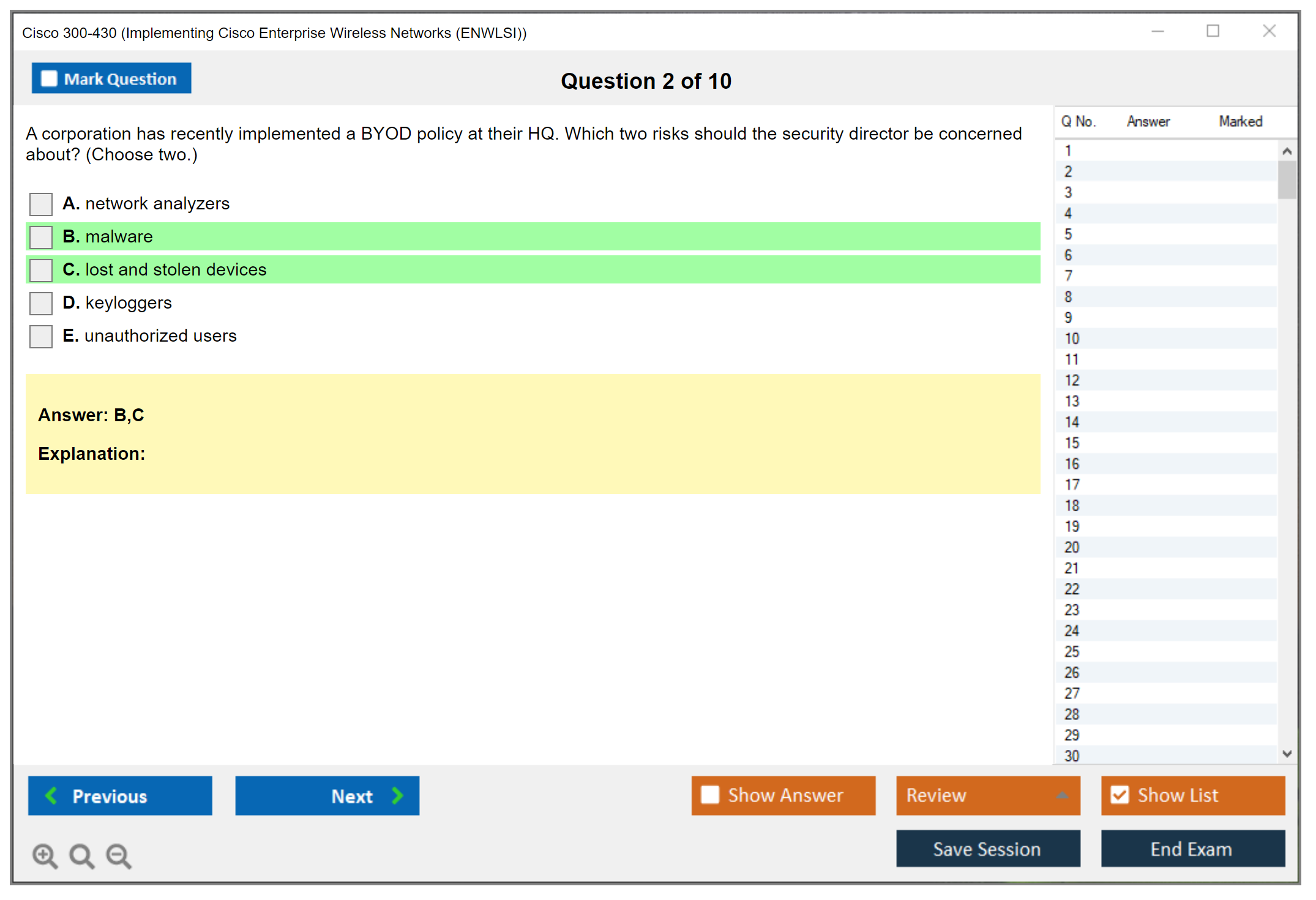
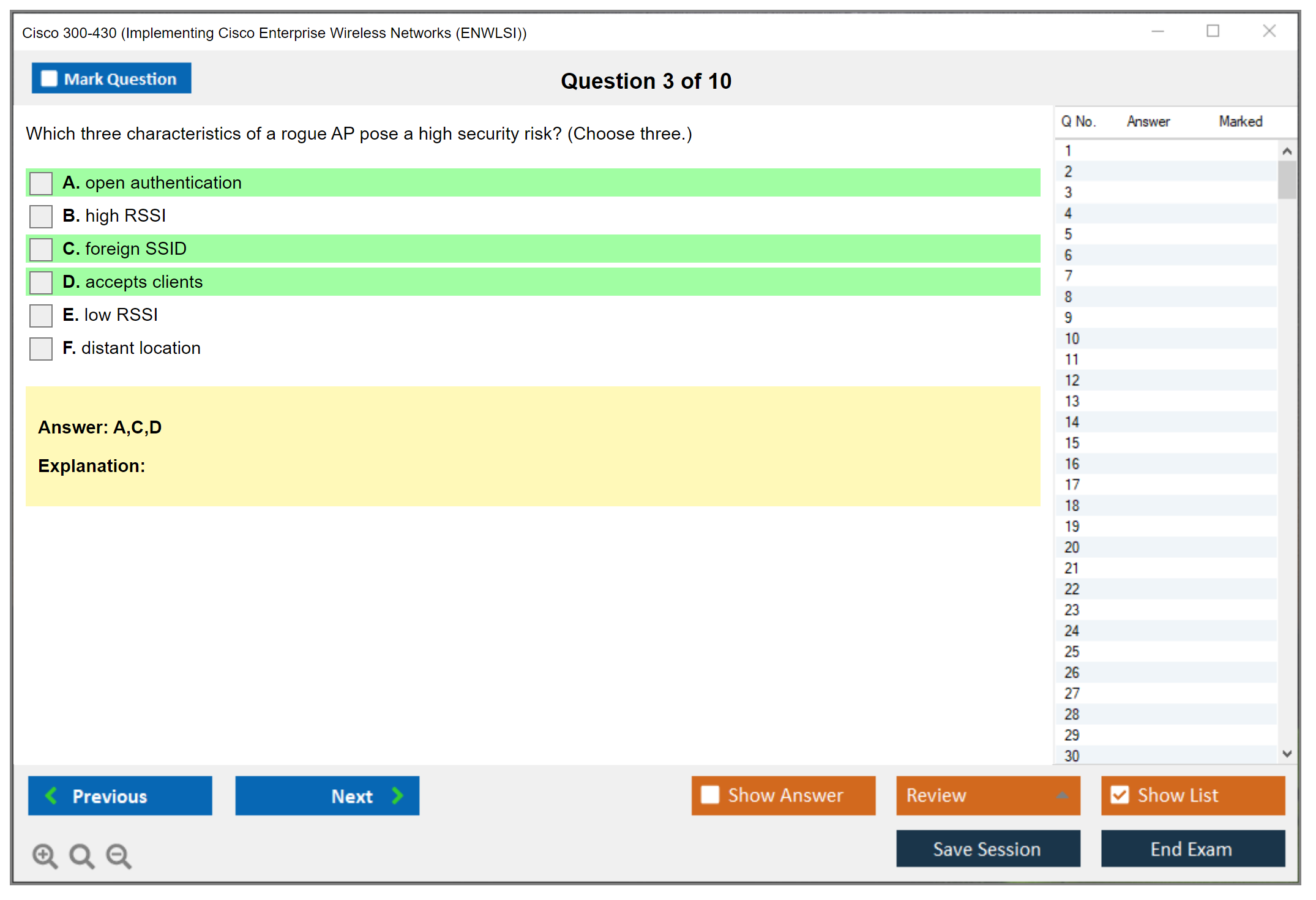
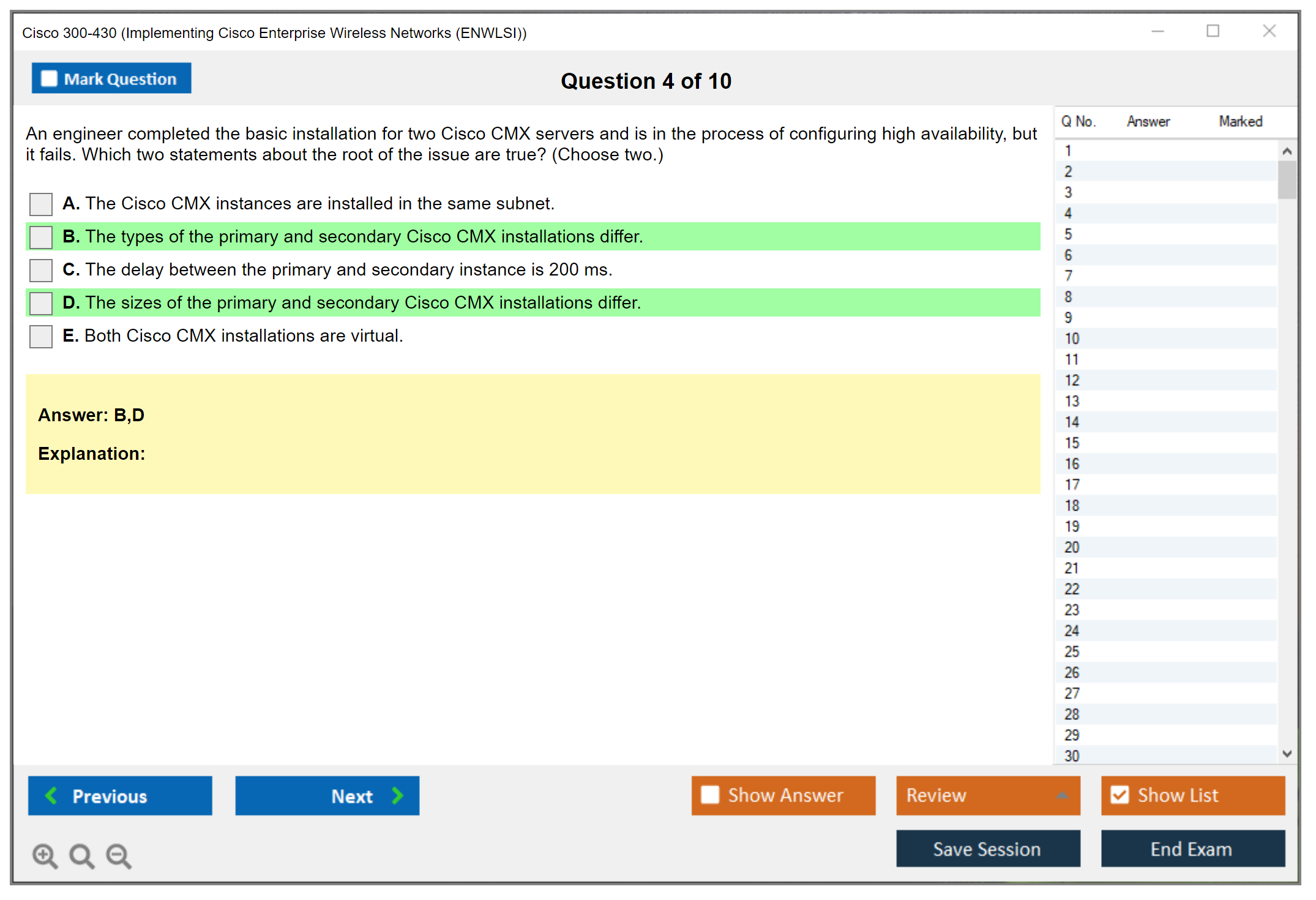
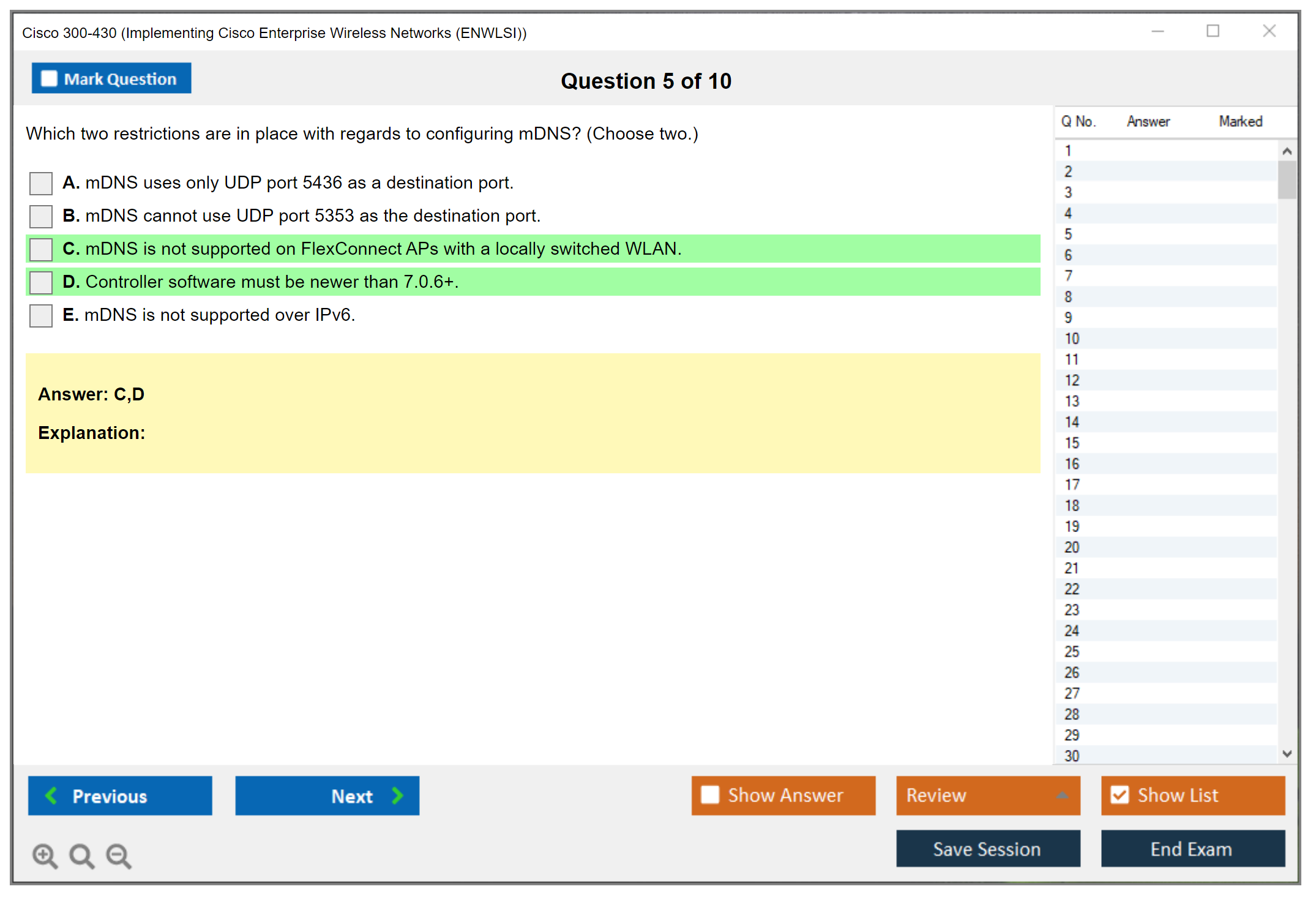
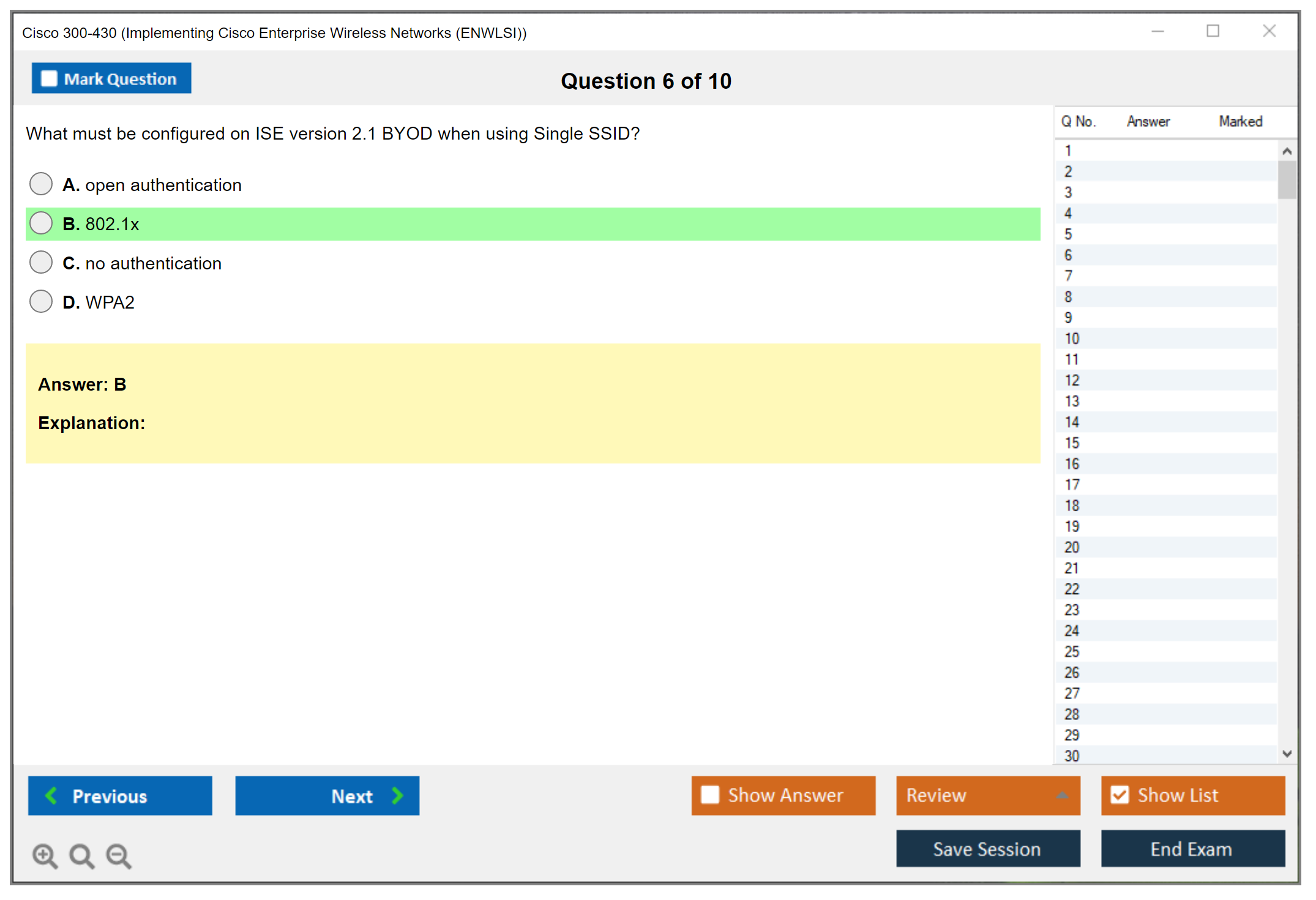
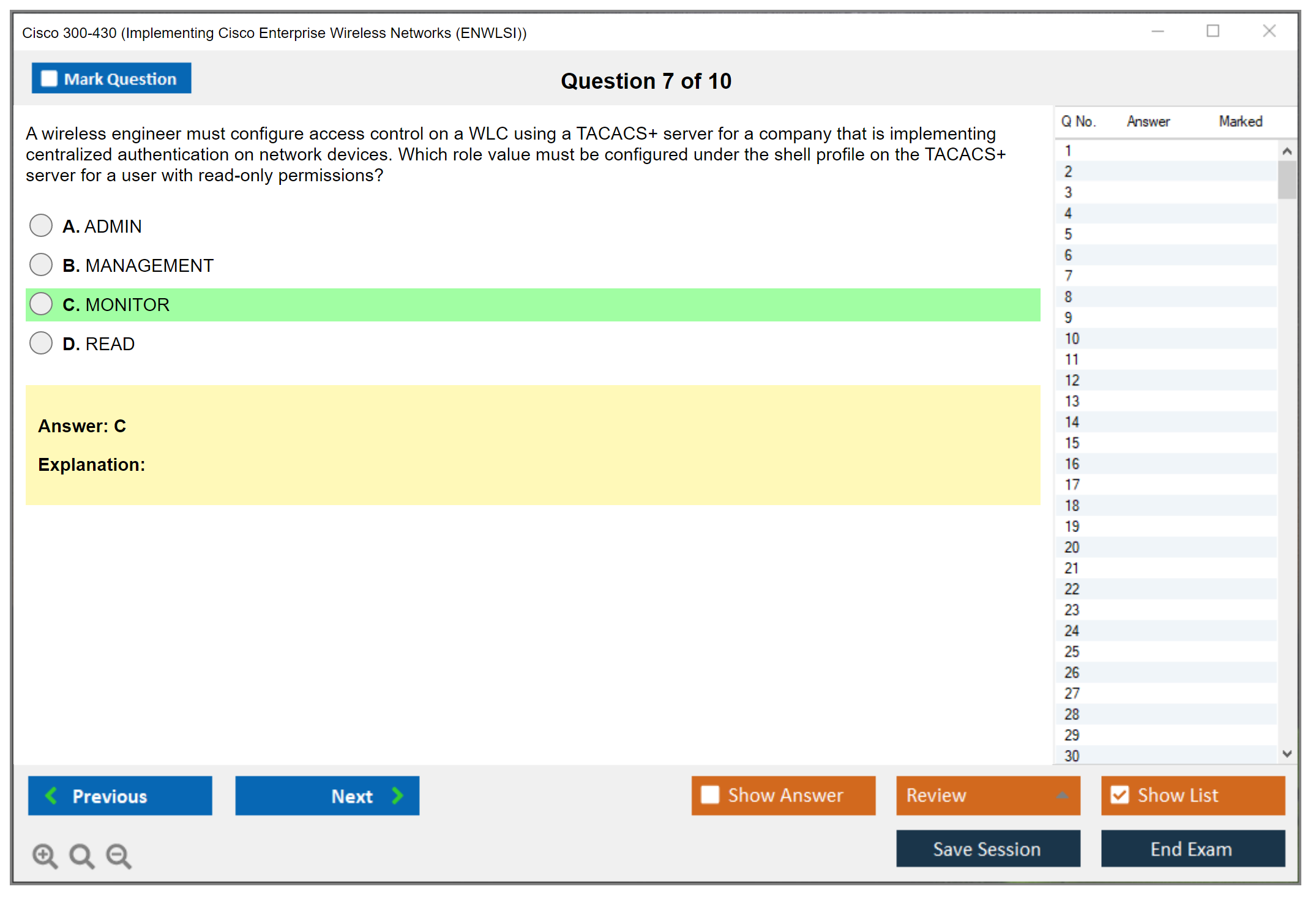
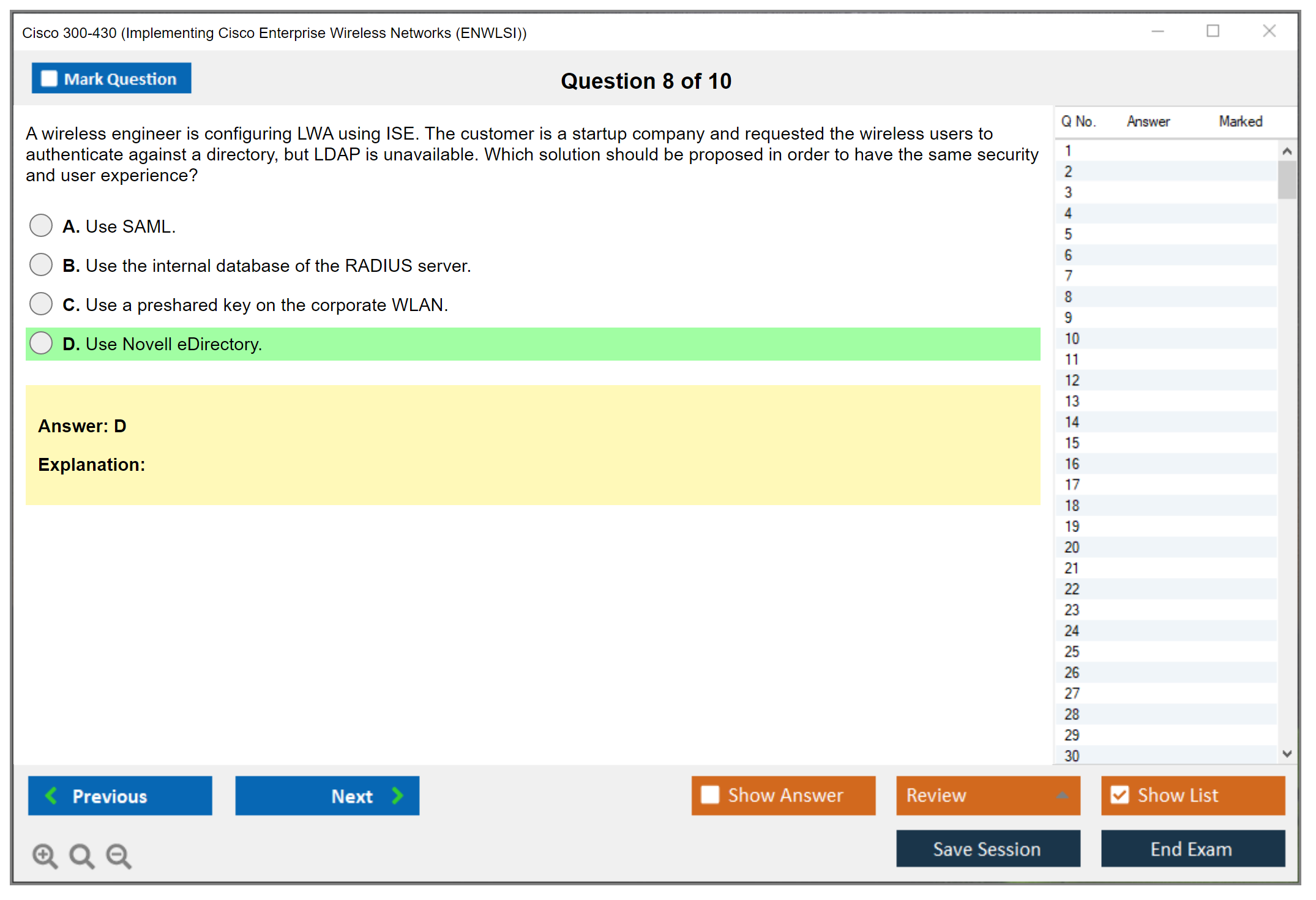
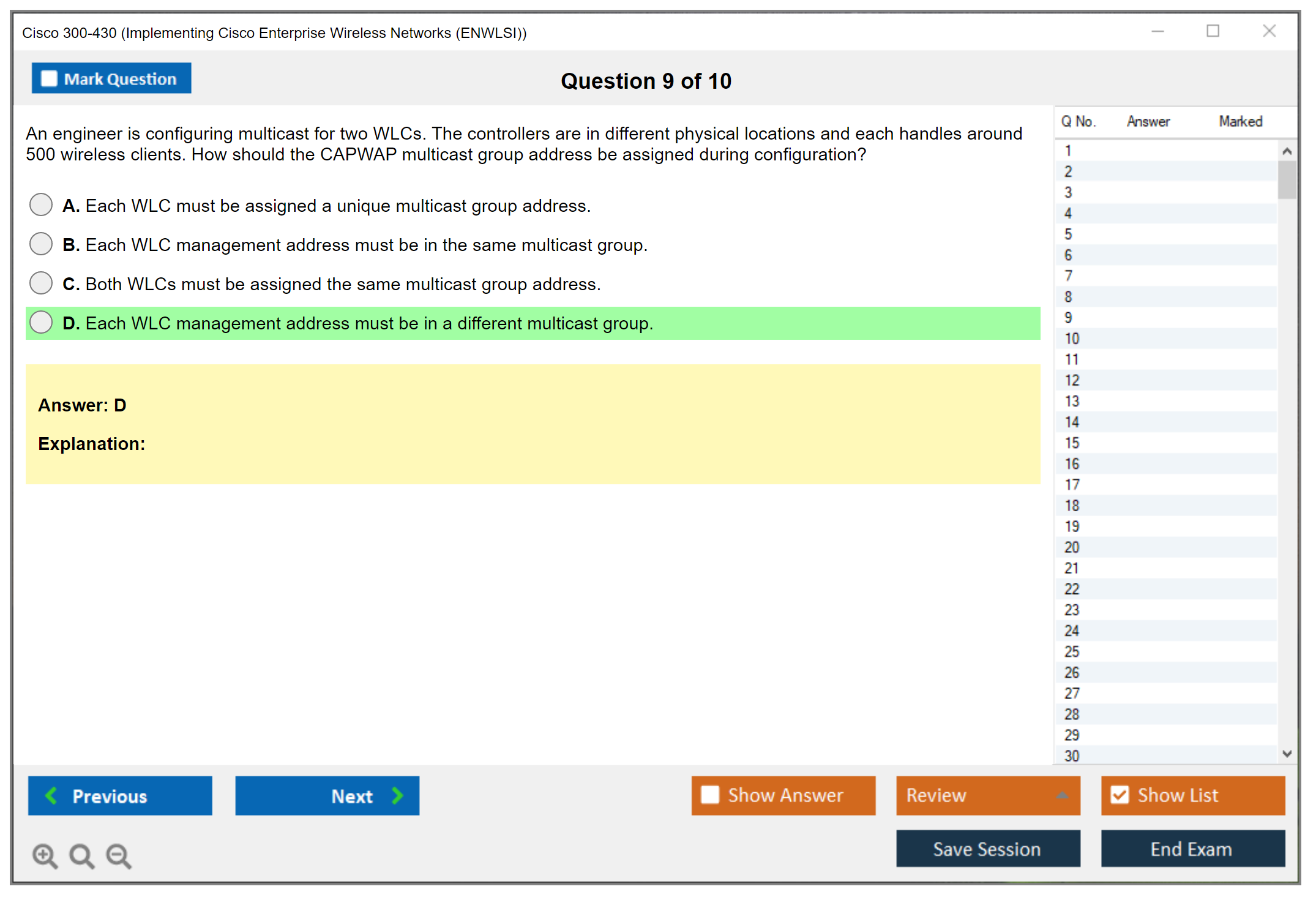
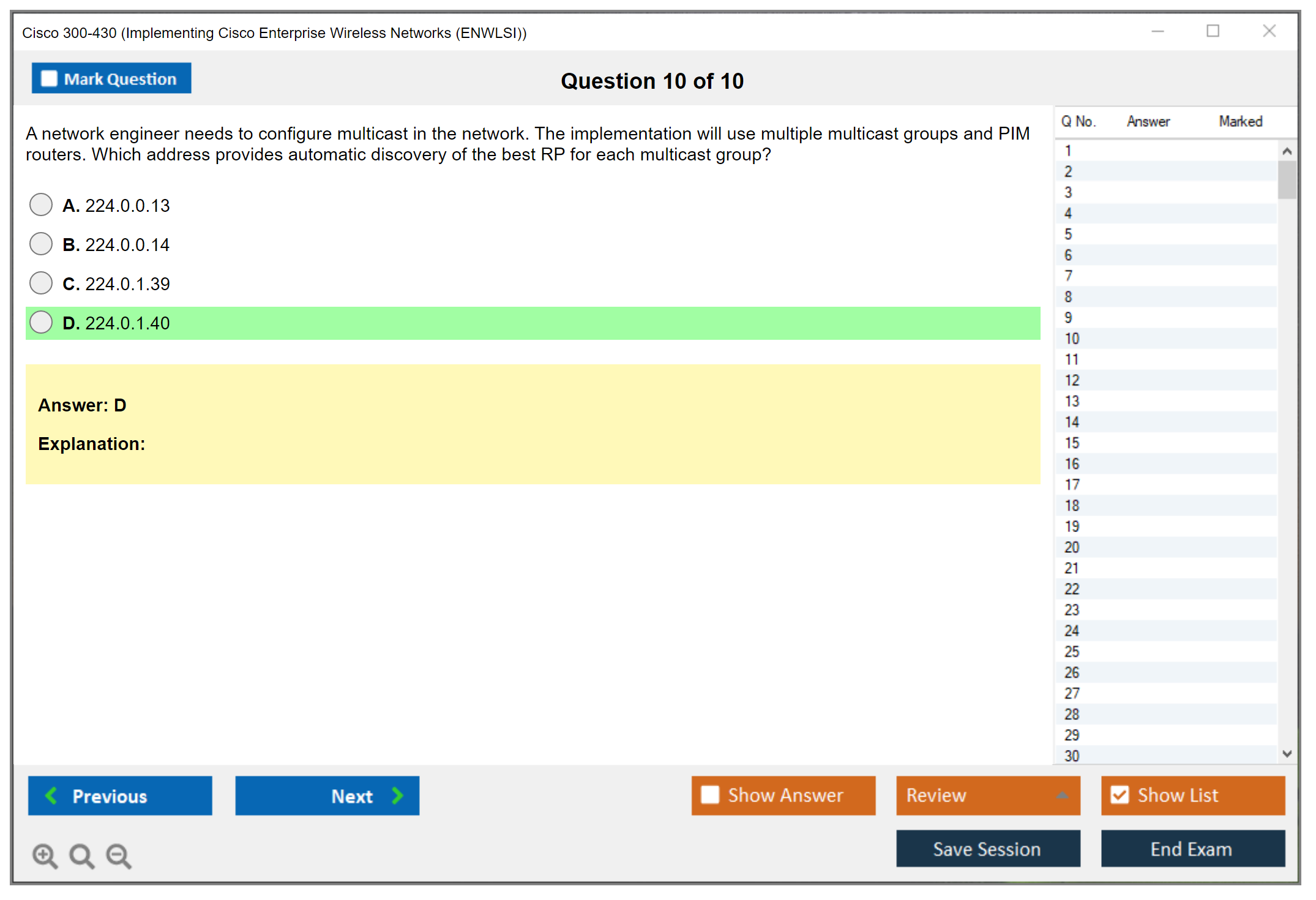
Dumpsarena Cisco Implementing Cisco Enterprise Wireless Networks (300-430 ENWLSI) (300-430) Free Practice Exam Simulator Test Engine Exam preparation with its cutting-edge combination of authentic test simulation, dynamic adaptability, and intuitive design. Recognized as the industry-leading practice platform, it empowers candidates to master their certification journey through these standout features.
What is in the Premium File?
Satisfaction Policy – Dumpsarena.co
At DumpsArena.co, your success is our top priority. Our dedicated technical team works tirelessly day and night to deliver high-quality, up-to-date Practice Exam and study resources. We carefully craft our content to ensure it’s accurate, relevant, and aligned with the latest exam guidelines. Your satisfaction matters to us, and we are always working to provide you with the best possible learning experience. If you’re ever unsatisfied with our material, don’t hesitate to reach out—we’re here to support you. With DumpsArena.co, you can study with confidence, backed by a team you can trust.
Cisco 300-430 Exam FAQs
Introduction of Cisco 300-430 Exam!
The Cisco 300-430 Implementing Cisco Enterprise Wireless Networks (ENWLSI) exam is a 90-minute exam associated with the CCNP Enterprise and Cisco Certified Specialist - Enterprise Wireless Implementation certifications. This exam tests a candidate's knowledge of implementing and troubleshooting enterprise wireless networks, including wireless controller architectures, wireless security, and wireless network optimization.
What is the Duration of Cisco 300-430 Exam?
The Cisco 300-430 exam is 90 minutes long.
What are the Number of Questions Asked in Cisco 300-430 Exam?
There are approximately 65-75 questions on the Cisco 300-430 exam.
What is the Passing Score for Cisco 300-430 Exam?
The passing score for the Cisco 300-430 exam is 700 out of 1000.
What is the Competency Level required for Cisco 300-430 Exam?
The Cisco 300-430 exam is designed to test the knowledge and skills of a professional in the field of enterprise networking. The exam is intended for individuals who have a minimum of three to five years of experience in enterprise networking. The exam covers topics such as network design, implementation, and troubleshooting. To pass the exam, candidates must demonstrate a comprehensive understanding of the topics covered.
What is the Question Format of Cisco 300-430 Exam?
Cisco 300-430 exam consists of 55-65 multiple-choice and multiple-answer questions.
How Can You Take Cisco 300-430 Exam?
The Cisco 300-430 Deploying Cisco Enterprise Wireless Networks exam can be taken either online or in a testing center.
If you choose to take the exam online, you'll need to register with Pearson VUE and pay the exam fee. After registering, you'll receive an email with a link to the exam. Once you click the link, you'll be taken to the Pearson VUE website where you can complete the exam.
If you choose to take the exam in a testing center, you'll need to register with Pearson VUE and pay the exam fee. After registering, you'll receive an email with a confirmation number. You'll need to take this confirmation number to the testing center, where you can complete the exam.
What Language Cisco 300-430 Exam is Offered?
The Cisco 300-430 exam is offered in English.
What is the Cost of Cisco 300-430 Exam?
The cost of the Cisco 300-430 exam is $300 USD.
What is the Target Audience of Cisco 300-430 Exam?
The target audience of the Cisco 300-430 exam is IT professionals who are looking to validate their knowledge and skills in designing and implementing Cisco Enterprise Wireless Networks. This exam is aimed at Wireless Network Engineers, Solution Architects, and Wireless System Administrators who have three to five years of experience in designing and deploying Cisco Enterprise Wireless networks.
What is the Average Salary of Cisco 300-430 Certified in the Market?
The average salary for a professional who holds a Cisco 300-430 exam certification varies from country to country and depending on the market demand for certified professionals. Generally speaking, salaries for certified professionals can range anywhere from $60,000 - $150,000 per year.
Who are the Testing Providers of Cisco 300-430 Exam?
The Cisco 300-430 exam can be tested through a variety of vendors, such as Pearson VUE, Certiport, and Kryterion. Each of these vendors provide their own test centers and materials for the 300-430 exam.
What is the Recommended Experience for Cisco 300-430 Exam?
The recommended experience for the Cisco 300-430 exam is having at least three to five years of hands-on experience with designing, deploying, operating, and troubleshooting Cisco Enterprise Network Core Technologies, as well as implementing advanced technologies such as SD-WAN, automation, and WLAN. Additionally, you should have knowledge of network programmability, network automation, and software-defined architectures.
What are the Prerequisites of Cisco 300-430 Exam?
The Cisco 300-430 exam requires candidates to have a valid Cisco CCNP Enterprise certification or equivalent knowledge and skills. Candidates should also have at least one to three years of experience working with enterprise networking technologies, including routing and switching, network services, network security, network programmability, automation, and cloud. Additionally, the exam requires knowledge of the Cisco Digital Network Architecture (DNA) Center, Cisco Identity Services Engine (ISE), and Cisco Meraki.
What is the Expected Retirement Date of Cisco 300-430 Exam?
The official website to check the expected retirement date of Cisco 300-430 exam is https://www.cisco.com/c/en/us/training-events/training-certifications/exams/current-list/300-430.html.
What is the Difficulty Level of Cisco 300-430 Exam?
The Cisco 300-430 exam is considered to be of a medium difficulty level. It requires a solid understanding of Cisco technologies and concepts, as well as the ability to apply that knowledge to real-world scenarios.
What is the Roadmap / Track of Cisco 300-430 Exam?
The Cisco 300-430 exam is part of the Cisco Certified DevNet Professional certification track. This exam tests a candidate's knowledge and skills related to developing and maintaining applications and automating workflows using Cisco platforms. The exam covers topics such as Cisco Application Centric Infrastructure (ACI), Cisco DNA Center, Cisco SD-WAN, Cisco Meraki, Cisco Webex Teams, and Cisco DevNet tools and resources. The 300-430 exam is the fourth and final exam of the Cisco Certified DevNet Professional certification track. It is preceded by the 300-410, 300-415, and 300-420 exams.
What are the Topics Cisco 300-430 Exam Covers?
The Cisco 300-430 exam covers the following topics:
1. Designing Cisco Enterprise Wireless Networks: This topic covers the fundamentals of designing and deploying enterprise wireless networks, including wireless LAN controllers, access points, and wireless security.
2. Troubleshooting Cisco Enterprise Wireless Networks: This topic covers troubleshooting techniques for enterprise wireless networks, including common issues and solutions.
3. Implementing Cisco Enterprise Wireless Networks: This topic covers the implementation of enterprise wireless networks, including the configuration of controllers, access points, and wireless security.
4. Managing Cisco Enterprise Wireless Networks: This topic covers the management of enterprise wireless networks, including monitoring, maintenance, and optimization.
What are the Sample Questions of Cisco 300-430 Exam?
1. What is the purpose of the Cisco Intent-based Networking architecture?
2. How does Cisco DNA Center enable secure and automated network management?
3. What are the benefits of using WAN automation in the Cisco SD-WAN solution?
4. How does Cisco SD-WAN provide secure connectivity between branch offices and cloud applications?
5. What is the Cisco SD-WAN architecture and how does it work?
6. What are the key components of Cisco's Software-Defined Access solution?
7. How does Cisco DNA Center support policy-based segmentation?
8. What are the benefits of using Cisco's TrustSec technology?
9. How does Cisco's Network Assurance Engine help ensure network health and performance?
10. What are the key components of Cisco's Network Programmability framework?
Cisco 300-430 (Implementing Cisco Enterprise Wireless Networks (300-430 ENWLSI)) Cisco 300-430 ENWLSI Exam Overview What is the Cisco 300-430 ENWLSI exam and its role in CCNP Enterprise certification Okay, here's the deal. The Cisco 300-430 ENWLSI exam (officially called Implementing Cisco Enterprise Wireless Networks) is one of those concentration exams you'll need for the CCNP Enterprise certification, which is basically Cisco's way of saying "you've moved way beyond entry-level networking and actually know your stuff." This particular exam zeros in on enterprise wireless infrastructure. We're talking corporate campuses, massive branch deployments, all that complex stuff where you're juggling management of dozens or even hundreds of access points simultaneously. The exam's laser focused on the Trigger 9800 series wireless controllers. These're the newer IOS-XE based controllers that basically replaced the old AireOS platform, and honestly, if you've been working in the wireless space... Read More
Cisco 300-430 (Implementing Cisco Enterprise Wireless Networks (300-430 ENWLSI))
Cisco 300-430 ENWLSI Exam Overview
What is the Cisco 300-430 ENWLSI exam and its role in CCNP Enterprise certification
Okay, here's the deal.
The Cisco 300-430 ENWLSI exam (officially called Implementing Cisco Enterprise Wireless Networks) is one of those concentration exams you'll need for the CCNP Enterprise certification, which is basically Cisco's way of saying "you've moved way beyond entry-level networking and actually know your stuff." This particular exam zeros in on enterprise wireless infrastructure. We're talking corporate campuses, massive branch deployments, all that complex stuff where you're juggling management of dozens or even hundreds of access points simultaneously.
The exam's laser focused on the Trigger 9800 series wireless controllers. These're the newer IOS-XE based controllers that basically replaced the old AireOS platform, and honestly, if you've been working in the wireless space for any length of time, the shift to 9800 was kind of a massive deal. You're dealing with models like the 9800-CL (that's the cloud-based virtual controller), 9800-40, 9800-80, plus the 9800-L for smaller deployments. ENWLSI also digs deep into Cisco DNA Center integration, which's their network assurance and monitoring platform. Super useful for troubleshooting and keeping constant tabs on wireless health across any enterprise environment.
This exam isn't just another test. It validates you can actually implement, configure, and troubleshoot real-world wireless networks. FlexConnect for remote sites, guest access configurations, mobility and roaming optimization. All the essential stuff that keeps users connected when they're walking around a building or moving between floors.
The thing is, the exam aligns perfectly with what enterprises actually need right now, especially as Wi-Fi 6 and security standards like WPA3 become standard. I remember when WPA3 first rolled out and everyone was still clinging to WPA2 because, well, changing security protocols across thousands of devices is nobody's idea of fun. But here we are.
How 300-430 fits within the CCNP Enterprise certification path
Here's how it works.
You can't just jump straight to ENWLSI with CCNP Enterprise. First, you've gotta pass the 350-401 ENCOR (Implementing Cisco Enterprise Network Core Technologies) core exam. That's your foundation. Routing, switching, wireless basics, security, automation, the whole package. Once you've knocked that out, you get to pick a concentration exam, and ENWLSI's one of six options available to you.
The other concentrations include stuff like 300-410 ENARSI (advanced routing), 300-415 ENSDWI (SD-WAN), and 300-420 ENSLD (network design). You only need one concentration to earn CCNP Enterprise, but here's the cool part: you can take multiple concentration exams and earn separate CCNP certifications for each one, which honestly opens up a lot of flexibility for specialization. So if you're a wireless specialist who also wants to prove SD-WAN chops, go for it and collect both.
This whole setup's part of Cisco's revamped certification model from 2020. They ditched the old rigid tracks and moved to a competency-based approach. Way more flexible. It also means ENWLSI can serve as a stepping stone if you're eyeing the CCIE Enterprise Wireless track down the road, though honestly, CCIE's a whole different beast altogether.
Target audience and career benefits
So who should take this?
Network engineers who live and breathe wireless deployments. If you're managing Cisco wireless infrastructure in an enterprise environment, this certification basically proves you know what you're doing and can handle the complexity. It's also great for folks moving up from CCNA level who want to specialize. General networking knowledge's valuable, sure, but wireless expertise opens very specific doors that generalists can't access.
Think about it: every company needs wireless now, and we're not talking basic home-office setups anymore. High-density deployments, voice over wireless, real-time location services, all kinds of demanding applications that require specialized knowledge. Wireless specialists're in serious demand, and having ENWLSI on your resume tells employers you can handle enterprise-grade challenges without breaking a sweat.
Career-wise? This certification can lead to roles like wireless network engineer, network architect, or senior infrastructure engineer. Salary-wise, it depends on your market and experience, but CCNP-level certs generally bump your earning potential compared to CCNA alone. Sometimes significantly. Plus, it's recognized globally, which's huge. Cisco certifications carry weight pretty much everywhere.
Key technology areas covered
The exam blueprint covers a ton.
You'll deal with Trigger 9800 deployment models: embedded, cloud, on-prem appliances, and the mobility express option. Each with different use cases. High availability configurations're critical too, because nobody wants their entire wireless network going down if one controller fails.
Access point provisioning's a big chunk of the exam. How do APs join controllers? How do you manage firmware updates? What about RF tuning and channel assignments? You need to understand RRM (Radio Resource Management) and how Cisco's auto-RF features work, though you'll also need to know when to override automatic settings because automation isn't always perfect.
Security's absolutely huge. We're talking 802.1X authentication with ISE (Identity Services Engine), PSK (pre-shared key) setups, WPA2, WPA3, and the newer Enhanced Open standard that addresses public Wi-Fi concerns. Guest access is its own complicated animal. Anchor controllers, web authentication, external captive portals, all requiring different configurations. You'll also need to know FlexConnect inside and out, especially for branch offices where the WAN link might go down but you still need local wireless switching to keep operations running.
DNA Center plays a significant role in network assurance. How do you use it for wireless monitoring effectively? How do you read telemetry data and troubleshoot client connectivity issues? Then there's QoS, prioritizing voice traffic, handling video streams properly, making sure bandwidth-hungry apps don't completely wreck the user experience for everyone else.
Troubleshooting's where a lot of people stumble hard. You need to know how to capture and analyze wireless packets, interpret debug outputs correctly, and use tools like Packet Capture (on the 9800) and DNA Center's built-in analytics effectively. Client connectivity problems can be maddeningly complex. Authentication failures, DHCP issues, RF interference, roaming problems. You absolutely need a methodical approach to isolate root causes rather than just guessing randomly.
Exam format and what to expect on test day
Format's straightforward.
The 300-430 ENWLSI exam's computer-based, delivered through Pearson VUE. You can take it at a testing center or, in some regions, as an online proctored exam from home if you prefer that environment. Closed-book format, so no notes, no documentation, nothing. Just you and the exam software.
You'll see multiple question types thrown at you. Standard multiple choice, sure, but also drag-and-drop scenarios, simulation questions where you're actually configuring a 9800 or troubleshooting a realistic scenario, and maybe some fill-in-the-blank questions. The simulations're critical. Cisco wants to know you can actually do the work in a real environment, not just memorize facts from a book.
Results come immediately after you finish, which's both a blessing and a curse. You get a pass/fail notification right there, plus a detailed breakdown showing how you performed in each exam section. If you fail, that breakdown's super helpful for figuring out what to study harder next time. Not gonna lie, the wait for that result screen to load's absolutely nerve-wracking.
Certification validity and professional value
Your CCNP Enterprise certification (including ENWLSI) is valid for three years exactly. After that, you need to recertify to maintain the credential. You can do this by passing any CCNP-level exam, taking the ENCOR core exam again, or (and this's newer) earning Continuing Education credits through training courses, events, or even publishing technical content that contributes to the community.
The credential's verifiable through Cisco's certification tracker, and you get a digital badge to slap on LinkedIn or your email signature, which employers actually notice. Employers recognize it globally as proof of wireless expertise and hands-on capability. it's a line on a resume. It's a signal that you've invested serious time and effort into mastering a specialized skill set that many engineers don't have.
Salary impact? Hard to pin down exact numbers because markets vary wildly, but CCNP-level certifications generally correlate with higher pay compared to CCNA or no certification at all. More importantly, it opens doors to senior roles and specialized positions that might not even consider candidates without proven wireless credentials.
Exam updates and staying current
Cisco updates exam content periodically. The current version of ENWLSI puts heavy weight on Trigger 9800 controllers running IOS-XE. If you studied wireless years ago on AireOS controllers, you'll find significant differences. The platforms work completely differently.
Legacy content's mostly gone or heavily de-emphasized now. DNA Center integration's way more prominent now than in older wireless exams, reflecting how enterprises actually manage networks today. WPA3 and Enhanced Open're covered extensively, reflecting real-world security standards. Wi-Fi 6 (802.11ax) concepts show up too: things like OFDMA, TWT, and how it improves high-density deployments where older standards struggled. Cloud-based management concepts've also crept in, acknowledging that not every deployment's purely on-premises anymore.
Always check Cisco's official exam topics page before you start studying seriously. They publish a detailed blueprint showing exactly what's covered, and occasionally they'll release new versions with updated content that reflects technology changes. You don't want to spend weeks studying material that's been removed or miss new topics that were just added.
The 300-425 ENWLSD (Designing Cisco Enterprise Wireless Networks) is the design-focused counterpart to ENWLSI, by the way. If you're interested in the planning and architecture side of wireless rather than just implementation, that's definitely worth checking out after you nail the implementation exam.
Prerequisites and Recommended Experience for 300-430 ENWLSI
Cisco 300-430 ENWLSI exam overview
What is 300-430 ENWLSI?
The Cisco 300-430 ENWLSI exam tests wireless skills for CCNP Enterprise. It proves you can build, secure, and troubleshoot enterprise WLANs the Cisco way, mostly through Trigger 9800 and modern design ideas like segmentation, policy, and telemetry. This isn't home router wireless. It's the enterprise kind where everything matters and nothing's ever simple enough.
This exam's very config heavy, but it's also opinionated about design, roaming behavior, and what "good" RF and security look like when users are moving around with real apps and real expectations that you'll somehow meet.
Who should take this exam?
Wireless engineers. Network engineers who got voluntold into Wi-Fi (yeah, that happens more than people admit) and folks supporting campuses, hospitals, warehouses, or branch networks where FlexConnect's a thing and guest access is always "urgent."
If you've only ever clicked around a controller GUI once, get some lab time first before you even think about scheduling.
300-430 ENWLSI cost and registration
Exam cost (price and taxes)
Cisco concentration exams like this're typically priced at $300 USD, plus local taxes or exam delivery fees depending on your country. The tax part's what surprises people, not the base price, so budget a little extra and don't act shocked when the total climbs.
Where to register (Pearson VUE) and retake policy basics
Registration's through Pearson VUE. Cisco's retake rules can change, so verify the current waiting period, but expect a cooldown between attempts, and a longer wait if you keep missing it. Scheduling pressure's real, so don't book it until your labs feel boring and repetitive.
Passing score and exam format
Passing score (what Cisco publishes vs. what to expect)
Cisco doesn't consistently publish a fixed passing score for every exam in a nice "you need 825" format, and scores can vary by version. What you should expect: you can feel like you did "fine" and still fail, because weak areas stack up fast when the blueprint's broad and unforgiving.
Number of questions, time limit, and question types
Expect a typical pro-level format. Timed, multiple-choice and multi-select, drag and drop, and scenario questions that'll test your patience. Sometimes the wording's the real exam. Long prompts with tiny details buried inside. Read twice.
300-430 ENWLSI difficulty: what to expect
Difficulty level and why candidates struggle
Yes, Cisco wireless exam 300-430's hard for a lot of people, and it's usually not because they don't know what an SSID is or can't spell "authentication." Candidates struggle because the test mixes RF design and site survey basics with controller configuration choices, then throws roaming, security, and troubleshooting on top. It expects you to know which knob matters and which knob's just noise.
Also, the Trigger 9800 mindset's different if you grew up on AireOS. Policy profiles, tags, fabric concepts adjacent to SD-Access, telemetry, and assurance language that feels like learning a new dialect. It's a lot. The exam doesn't slow down.
Recommended experience level
Minimum? I'd say 1 to 2 years hands-on with Cisco wireless solutions, even if part of that's labbing and part of it's real tickets at work where things break at inconvenient times. You want enough time in the chair to have seen sticky clients, "it only fails in that conference room" mysteries, and the joy of debugging 802.1X at 8:05 a.m. when everyone's waiting.
300-430 ENWLSI prerequisites and recommended skills
Formal prerequisites (if any)
Cisco's got a real gate here, and people miss it constantly.
For the Cisco ENWLSI certification path (this is the concentration exam toward CCNP Enterprise) you must pass 350-401 ENCOR (Implementing and Operating Cisco Enterprise Network Core Technologies) first. That core exam's the foundation requirement. Period. Alternative route: you can also satisfy the core requirement by passing the CCIE Enterprise Infrastructure lab or the CCIE Enterprise Wireless lab exam, but if you've done either of those, you're probably not reading this section.
No workaround. No shortcuts.
No "I passed ENWLSI so I'm good" situations. There's no standalone certification available without meeting the core requirement, and Cisco's certification tracking system automatically checks your history. You're not manually emailing PDFs and hoping someone believes you or processes them quickly.
One more thing people hate hearing: you generally cannot schedule ENWLSI exam without valid ENCOR pass in the system (or the CCIE lab alternative). If your account records're messy, fix that early, because waiting until the week you want to test is pain nobody needs.
ENCOR matters because it provides foundational enterprise networking knowledge needed for specialization. The prerequisite part isn't arbitrary. Candidates need baseline routing, switching, and infrastructure skills that actually matter. Wireless isn't isolated. Your WLAN rides the wired network, and if the wired side's messy, Wi-Fi looks guilty every single time.
Practical prerequisites (wireless + enterprise networking knowledge)
This's where you can be honest with yourself. Can you explain 802.11 a/b/g/n/ac/ax at a working level, not a Wikipedia level where you just regurgitate specs? Do you know what channel width does to capacity and reuse, and why power levels can hurt you even when coverage "looks stronger" on a pretty heatmap?
You should be comfortable with RF principles including frequency, channels, and power levels, plus wireless site surveys and RF planning concepts. Not necessarily a full Ekahau wizard on day one (you don't need to be a certified survey expert), but enough to reason about co-channel interference, DFS weirdness, and why that one AP shouldn't be blasting at max power just because it can.
Security's another big one. You need real comfort with wireless security (802.1X, WPA2/WPA3), authentication flows that actually work, and troubleshooting AAA when it doesn't. And roaming, both Layer 2 and Layer 3 roaming concepts. If you've never seen a roam break a voice call, the exam'll still ask you to fix it like you've seen it a hundred times.
Then add tools. Exposure to wireless troubleshooting tools and methods matters a lot. Basic packet analysis skills for wireless traffic inspection's a quiet superpower that'll save you repeatedly. Wireshark isn't optional forever. It's the flashlight when everything else's dark.
Enterprise networking skills that support ENWLSI preparation
ENCOR content shows up indirectly everywhere. Strong switching and VLAN concepts matter because SSIDs map to VLANs, trunks break at 3 a.m., native VLAN misconfigurations happen in the stupidest ways, and you still have to carry client traffic to the right place. Routing protocols and enterprise network design show up when you talk about mobility, anchor controllers, guest traffic paths, and segmentation boundaries that make or break security posture.
Network security principles including AAA and 802.1X're huge, plus QoS mechanisms and traffic prioritization because voice and video over Wi-Fi's where "good enough" dies fast and users complain loudly. Proficiency in Cisco IOS-XE command-line interface helps too, because Trigger 9800 troubleshooting often becomes "show commands, then more show commands, then one command you forgot existed but solves everything."
High availability and redundancy designs matter. Controllers fail. Links flap.
You need to know what that does to clients and how fast they recover. Multicast concepts show up in real deployments for things like wireless video applications. Even if you don't love multicast (and who does, really), you should at least recognize when it's the cause of weird behavior.
Specific Cisco product experience that helps exam preparation
If you want the exam to feel fair, get time on the actual stack Cisco expects you to know.
Start with Cisco Trigger 9800 configuration: tags, policy profiles, WLANs, RF profiles, mobility, and the general "this is IOS-XE, not AireOS" vibe that throws people off. Add experience deploying and managing Cisco Aironet or Trigger access points, because AP modes, image management, and client behavior're where theory turns into tickets that won't close themselves.
Cisco DNA Center shows up too, especially Cisco DNA Center wireless assurance concepts that're increasingly part of how Cisco thinks about operations. You don't need to be a DNA Center architect, but you should know what it is, what it reports, and how assurance thinks about health metrics and client experience scores.
Exposure to Cisco ISE for wireless authentication helps a ton, because policy sets, EAP types, certificates, and posture conversations're part of real enterprise Wi-Fi that actually works securely.
Other stuff that helps, mentioned casually but worth having on your radar: Prime Infrastructure migration ideas, FlexConnect deployments for branch offices, guest access flows, and Cisco Spaces or location services concepts.
Lab environment access and practice recommendations
You need lab access. Period. No debate.
Reading a 300-430 ENWLSI study guide helps, but you only get confident by breaking things and fixing them repeatedly until the process becomes muscle memory.
I'd start with Trigger 9800-CL (Cloud) first. It's realistic enough for home lab work, and you can practice the workflow repeatedly until it stops feeling weird and foreign. Then get at least one physical or virtual access point for testing, because "controller config" without a client joining's like learning switching without ever plugging in a cable, which is pointless.
After that, build topologies in CML or EVE-NG if you can, and use Cisco dCloud labs when you need pre-built wireless scenarios fast without spending hours on setup. DevNet sandbox environments can help too, especially if you want to practice APIs or just see what "clean" looks like when Cisco builds it. If you're doing security seriously, add ISE or at least an equivalent RADIUS server that'll let you test auth flows. And keep Wireshark around for WLAN troubleshooting and packet analysis. It's not optional.
Time investment and study commitment expectations
For most people, plan 60 to 100 hours of real study time, not passive video time while doing email or pretending to focus. Real time, with labs and notes and "why did that fail" moments that force you to think.
If you already have wireless experience, 8 to 12 weeks's a normal timeline. If you're newer to Cisco wireless technologies, 12 to 16 weeks's more realistic, because you're learning the product and the exam at the same time, and that's slower than people admit or want to believe.
Daily hands-on lab practice's important. Regular review of ENWLSI exam objectives's how you avoid surprise gaps that tank your score. Use a 300-430 ENWLSI practice test occasionally, spaced out, to find weak spots, not to memorize questions like some shortcut exists.
Final week? Go hard.
Rebuild a WLAN from scratch, walk through AAA, test roaming, check assurance views, and do one last pass through every blueprint line item like a checklist you're paranoid about missing. That's how you walk into exam day calm, which's half the win right there.
300-430 ENWLSI Exam Cost, Registration, and Logistics
What the 300-430 ENWLSI actually costs you
The standard exam fee? $400 USD. That's your baseline price in the United States, but regional pricing is all over the place depending on where you're booking from. Other countries deal with local currency conversion plus taxes that can shift that number around pretty noticeably. Some jurisdictions slap on VAT or miscellaneous fees, so you might hit checkout and find yourself staring at a higher total than expected.
Individual exam registration doesn't qualify for discounts. Cisco simply doesn't offer promo codes or seasonal sales with certification exams. That said, if you're employed by a larger organization, corporate voucher programs sometimes provide bulk pricing arrangements, which makes it absolutely worth checking with your training or HR department about. Cisco Learning Credits represent another avenue if you've accumulated them through training purchases or partner programs, and you can redeem those credits toward exam vouchers. Honestly feels like catching a break when you're already hemorrhaging cash on study materials.
Here's what trips people up: retake fees match the initial exam cost exactly. No discount if you fail. So if you tank the Cisco 300-430 ENWLSI exam and need round two, you're dropping another $400. That's precisely why practice exams deserve serious attention. Burning through attempts at full price becomes financially painful fast.
Registering through Pearson VUE
You register through Pearson VUE. That's Cisco's testing vendor. Start by creating an account at home.pearsonvue.com/cisco if you haven't set one up already. Make absolutely certain you link your Cisco Certification Tracking System (CTS) ID to your Pearson VUE profile. This step matters tremendously because your exam results and certification records connect directly back to that ID. Skip this linkage and you'll be untangling a bureaucratic nightmare with Cisco support later.
Profile ready? Search for exam code 300-430 in the Pearson VUE catalog. You'll encounter options for physical testing center locations versus online proctored delivery. Pick a date and time slot matching your schedule, keeping in mind that availability fluctuates wildly based on location and demand. Some testing centers only schedule slots a couple days weekly. Others stay completely booked for weeks if you're situated in a busy metropolitan area.
Payment processes through credit card or exam voucher during checkout. You'll receive a confirmation email containing your exam details and candidate ID. Save that message. Rescheduling or cancellation works up to 24 hours before your appointment, but anything inside that window means you forfeit the complete fee. Not gonna sugarcoat it. I've watched people lose $400 because they panicked last-minute and missed the cancellation deadline.
Testing center or online proctored: what's the move?
Physical testing centers deliver a controlled, distraction-free environment where you show up, they secure your belongings in a locker, and you sit in a quiet room with a computer while a proctor monitors everything. Straightforward process. For first-time certification candidates, I typically suggest the testing center route since there's fewer technical variables to manage.
OnVUE online proctoring permits you to take the exam from home or any private space with stable internet and a webcam. Before exam day, you'll execute a system check verifying your setup satisfies technical requirements: internet speed, webcam quality, microphone functionality, all that. Rural areas or frequent travelers benefit from online proctoring's flexibility, but technical issues can absolutely derail the entire experience. I mean, I've encountered stories of people losing their connection mid-exam or having the proctor flag them for something completely innocuous like glancing away from the screen momentarily. Testing centers maintain backup systems and on-site technical support. When something breaks, they can usually resolve it or reschedule you without financial penalty.
Look, online proctoring performs beautifully when conditions align. When it doesn't? Absolute nightmare scenario. Never done an online proctored exam before? Maybe experiment with a lower-stakes certification first to acclimate yourself to the format, because the 300-430 ENWLSI practice test materials already cost enough without layering on stress from technical failures.
Random tangent: I once knew a guy who scheduled his exam for a Saturday morning at home, thinking he'd be sharp and rested. Forgot his neighbors were having major plumbing work done that day. Jackhammering started right as he launched the exam. Proctor made him either continue with the noise or reschedule and lose his slot. He pushed through and somehow passed, but man, what a way to test your concentration.
Retake policy and waiting periods
Fail your first attempt? Five calendar days before retaking. Second attempt follows the same pattern, another 5-day wait. Third failure? Now you're staring at a 30-day waiting period, and fourth attempt plus all subsequent attempts maintain 30-day waits. Waiting periods calculate from your exam date, not when results arrive (which are immediate for most questions, though the final pass/fail determination can require a few minutes to process).
No cap exists on total retake attempts. Good and bad. Good because persistence eventually pays off. Bad because it's remarkably easy to keep throwing money at the problem without really addressing the foundational gaps in your knowledge. If you fail twice, honestly, pause and reassess your entire study plan before scheduling that third attempt. Maybe you need more hands-on time with Trigger 9800 controllers or deeper exploration of Cisco DNA Center wireless assurance topics. Retaking without modifying your approach just incinerates cash.
What to bring on exam day
Two forms of valid, government-issued ID. Required. Your primary ID must display your name, photo, and signature. Driver's license or passport typically satisfies this, and the name on your ID has to match your Pearson VUE profile exactly, character for character, or they refuse to let you test. I've witnessed people get turned away over a middle initial discrepancy.
Arrive 15 to 30 minutes early since testing centers run check-in procedures, and tardiness might result in them denying you entry. No personal items allowed in the testing room. Zero bags, phones, watches, notes, nothing. Testing centers provide secure lockers for your possessions and supply scratch paper (usually a laminated booklet) plus a pen. You can't bring your own materials.
No breaks during the exam. Plan accordingly if you've got a small bladder or need to stretch periodically. Some testing centers offer noise-canceling headphones or earplugs if ambient noise bothers you, though the exam environment stays pretty sterile. Just you, a computer, and a camera documenting your every movement.
Online proctored? The proctor will request you pan your webcam around the room before starting, checking for unauthorized materials, and they'll ask you to display your desk surface and remove anything they flag as problematic. Wear something comfortable but not distracting. No hats, no hoodies covering your ears, because the proctor can terminate your exam if they suspect you're violating policy. Just follow the rules and don't provide them ammunition to flag you.
Why the 300-430 ENWLSI exam matters for your career
This exam represents one concentration option for CCNP Enterprise. You need to pass the core exam (350-401 ENCOR) plus one concentration to earn the complete CCNP Enterprise certification. Wireless makes solid sense if you work in environments featuring heavy WLAN deployments or if you're targeting wireless-focused roles specifically. The exam covers Trigger 9800 WLC configuration, client connectivity, roaming, wireless security (802.1X, WPA2/WPA3), QoS, and monitoring through DNA Center. It's not purely theoretical. You absolutely need hands-on experience with these technologies to pass.
Already working with Cisco wireless gear? This certification validates your skills and opens doors to senior network engineer or wireless specialist positions. Pivoting into wireless from routing and switching or data center backgrounds? It's a strategic way to broaden your skill set and enhance your marketability. The 300-430 ENWLSI study guide materials and practice questions offer your strongest approach for targeted preparation, especially when lab access is limited.
Exam day logistics you can't ignore
Double-check your confirmation email the day before. Verify you've got the correct testing center address or, if online, that your system check still passes. Technical requirements shift occasionally. Discovering your webcam malfunctioned the morning of the exam ranks among the worst possible scenarios.
Testing at a center? Map out your route and parking situation. Some centers occupy office buildings with confusing layouts or restricted parking. Showing up frazzled because you couldn't locate the place creates a terrible mental state for starting a high-stakes exam.
Online proctored exams require closing all unnecessary applications on your computer before launching the OnVUE software. The proctor will demand you close anything running in the background anyway, and it's simpler handling it beforehand. Ensure your phone is completely out of reach, not just silenced, but physically in another room. The proctor observes your testing space through the webcam, and if they spot a phone, it's game over instantly.
The $400 price tag represents a significant investment, particularly if you're self-funding. Budget for potential retakes and study materials realistically. The 300-430 Practice Exam Questions Pack at $36.99 is a fraction of the exam cost and can save you from needing a retake. I've watched people skip practice exams to save $40, then fail and lose $400. Do the math on that.
Pursuing multiple Cisco certifications? Investigate training bundles or partner programs that include exam vouchers, because sometimes you can save money by packaging training and exams together. Worth checking if you're also prepping for related exams like 300-425 ENWLSD or 300-410 ENARSI.
Passing Score, Exam Format, and Question Types
Passing score (what Cisco publishes vs. what to expect)
Cisco's scoring? Honestly, it's annoying. You want a number. They won't give you one.
For the Cisco 300-430 ENWLSI exam, the "passing score" floating around is usually somewhere in the 750 to 850 range on a 1000-point scale. That's what most candidates prep for, but here's the thing: Cisco doesn't publish the exact passing score publicly, and that's intentional, not some paperwork mess-up. It's a security move so people can't game the system by reverse-engineering score targets.
What matters for your prep: Cisco uses a scaled scoring system, which means you're not just getting "X questions right equals pass" in any straightforward way. The scale accounts for difficulty variations between different versions of the exam. One form might be slightly tougher, another slightly easier, and scaling keeps the pass standard consistent without making every single form identical.
Scaled scoring also means two things people forget:
A 790 on your attempt. A 790 on mine.
Those can represent different raw performance, different question pools, different weighting, different difficulty, but Cisco can still compare them as "the same level of competency" across versions. Look, it's not perfect but it's how most big cert vendors keep things fair(ish) when they're running hundreds of exam variations.
After you finish, your score report shows pass/fail plus section-level performance. Not your exact percent, not a question-by-question breakdown. You get domain feedback like "Architecture and Infrastructure" or "Troubleshooting" and whether you were above or below the target. If you fail, that report's basically your roadmap for what to hit next. It won't tell you "learn command X" but it'll tell you you're weak in, say, security and client connectivity, which probably means you were shaky on wireless security (802.1X, WPA2/WPA3) details, policy mapping, or maybe even ISE and AAA flow assumptions.
One more scoring detail people mess up: no partial credit for multiple-choice. If it's a single-answer question and you miss it, you miss it. If it's multiple-answer and you only pick some right choices, still wrong.
Clean.
Simulations are different, though. Simulation questions may award partial credit if you get part of a configuration correct but miss a required piece, which is why it's worth finishing a sim even if you're not 100% sure. A half-right Cisco Trigger 9800 configuration beats a blank one.
Number of questions, time limit, and question types
Time's the silent killer on this exam. Not the content. The clock.
The 300-430 ENWLSI exam is 90 minutes total, so 1 hour 30 minutes, and most versions land around 55 to 65 questions, which puts you in the ballpark of 1.5 to 2 minutes per question if you want to finish without panic-clicking the last five items. Quick math, not optional.
Some questions'll be fast. Some'll be slow. Some'll mess with you.
The time's displayed on screen the whole exam, which sounds helpful until you catch yourself staring at it every 30 seconds like it's a stress test. What you really want is a pace plan: if you're at question 20 and you've burned 45 minutes, you're in trouble because the back half often has the items that take longer, especially if you hit drag-and-drop plus a sim.
You can mark questions for review and come back later on most question types, and you should. If you're stuck between two answers and you're doing that thing where you reread the question six times hoping the correct option will glow, mark it and move. Bank time for the harder stuff, then circle back with whatever time's left.
One caveat, though, and people hate this: simulation questions usually can't be skipped and returned to. When you enter a sim, plan to finish it right then, which is why a lot of candidates do a quick scan of where they are in the exam and their remaining time before clicking into anything that looks like "configure" or "troubleshoot". If you're down to 12 minutes and you open a sim, you might be signing up for a forced guess-fest at the end.
A simple pacing strategy that works:
- Keep regular questions moving at roughly 1.5 minutes, and if you're over 2 minutes, flag it and go because you're burning time you'll need later for the stuff that actually requires thinking.
- Sim questions: budget 5 to 10 minutes each because you'll be clicking around GUI menus, confirming settings, and sometimes chasing a misconfig that's not where you expect it, like a WLAN policy profile mapping or an RF profile mismatch that only shows up after you sanity-check the basics.
And yeah, you really do want to complete all questions before time expires. Cisco exams don't give you a prize for perfect confidence, they reward coverage. Use your last chunk of time to review flagged questions and clean up obvious mistakes.
Now, question types.
You're gonna see standard multiple-choice, multiple-answer, drag-and-drop, and sims. The mix changes by version, but the skills behind them stay consistent with the ENWLSI exam objectives, especially implementation, security, and troubleshooting.
Multiple choice formats and strategies
Single-answer multiple choice is the classic "choose one correct answer," while multiple-answer is "choose two" or "choose three," and the question normally tells you how many to select. Read that line carefully because people misread it when they're rushing and then wonder why they failed by a hair.
Cisco distractors aren't random. They're built to test if you know the topic or if you memorized a phrase from a 300-430 ENWLSI study guide without understanding what it means in a real controller, so you'll get answers that are almost right but wrong platform, wrong order, wrong menu location, wrong default behavior.
My go-to approach:
Read the question. Then read all options. Then eliminate.
Elimination works because usually two options are obviously wrong if you actually know the tech, like confusing FlexConnect behavior, mixing up WPA2-Enterprise vs WPA3-SAE, or misunderstanding how RRM behaves. Also, watch for absolute terms like "always" and "never" because, not gonna lie, those are often traps in networking exams since wireless is full of "it depends" based on design, RF, and client behavior.
You'll also see configuration-based questions where the right answer's basically "which command is correct" or "which parameter belongs here," and that's where hands-on time on 9800 pays off because memorizing syntax is fragile but muscle memory from actually clicking through policy profiles, tags, and WLANs sticks.
If you're doing a 300-430 ENWLSI practice test, treat wrong answers like a lab checklist. Don't just note the correct letter, go recreate it in a 9800-CL if you can.
Drag-and-drop question types and approaches
Drag-and-drop questions feel easy until they're not. They usually ask you to match or order things, and Cisco likes using them for relationships where memorization alone breaks down.
Common patterns include:
- Matching configuration commands to scenarios
- Ordering deployment steps for a procedure
- Categorizing features by wireless controller platform
- Matching troubleshooting symptoms to root causes
- Organizing network components into architectural tiers
One important gotcha: all items must be placed for the answer to count, so if you leave one floating because you're unsure, you're basically turning a maybe-70%-right into a guaranteed wrong. Place everything, even if the last two are a coin flip.
The best way to handle these? Slow down and reread the prompt. Seriously, drag-and-drop's where people misread one word like "FlexConnect" vs "Central Switching" and then build the entire mapping wrong.
Also, use the screen layout. Visual clarity's your friend here. Cisco's literally giving you a whiteboard-style question, so take advantage of it and group obvious matches first, then deal with the tricky leftovers.
I've noticed something interesting about how people approach these matching questions differently depending on their learning style. Visual thinkers tend to do better right off the bat, while people who learned from CLI documentation sometimes struggle a bit because they're translating from text memory to spatial relationships. If you're in the second camp, practice a few extra drag-and-drop sets just to get comfortable with the format itself, not just the content.
Simulation questions and hands-on scenarios
Simulations are where this exam feels like a job. Finally.
Expect hands-on scenarios using a Trigger 9800 WLC interface, sometimes CLI, sometimes GUI, sometimes both. You might be asked to complete specific tasks like configuring a WLAN, mapping it to the right policy, adjusting RF settings, or fixing a client connectivity issue. You might also get a troubleshooting setup where something's broken and you need to identify the misconfiguration.
These are the time sinks. They're also score opportunities. Partial credit can happen.
Because sims can award partial credit, don't panic if you can't finish the "perfect" configuration. Get the core stuff right first: WLAN and policy mapping, tags, AAA bits if required, then circle around to tuning. This is also where knowledge of WLAN troubleshooting and packet analysis concepts helps, even if you're not literally opening Wireshark in the exam. You're thinking like a troubleshooter.
If you want practice that feels closer to exam pressure, that's where something like a 300-430 Practice Exam Questions Pack can be useful as a timed drill, especially for forcing decision-making speed, but honestly you still need lab reps for controller workflow because no question bank teaches you where settings live in the 9800 GUI.
Question distribution across exam domains
Cisco publishes domain weightings, and they're a decent predictor, but exact distribution varies by exam version.
Typical breakdown you should plan around:
- Architecture and infrastructure: roughly 20 to 25%
- Wireless implementation: roughly 30 to 35%
- Wireless security and client connectivity: roughly 20 to 25%
- Troubleshooting: roughly 15 to 20%
- Monitoring and optimization: roughly 10 to 15%
Implementation and configuration usually get the most love, which lines up with why this is a CCNP Enterprise wireless concentration exam and not a lightweight associate test. Troubleshooting also shows up everywhere, not just in the "Troubleshooting" section, because Cisco will embed troubleshooting thinking into architecture and security questions too.
If you fail, your score report'll call out the weaker domains. Use that, tighten the gaps with targeted labs, focused reading from your Implementing Cisco Enterprise Wireless Networks (ENWLSI) material, and timed sets from a 300-430 Practice Exam Questions Pack if you need repetition under a clock.
Repetition's boring. It works.
And yeah, if you're shopping around for a 300-430 ENWLSI practice test, avoid anything that feels like pure trivia dumps. You want questions that force you to think through controller behavior, RF design and site survey fundamentals, and how assurance tooling like Cisco DNA Center wireless assurance would point you toward the real problem. The exam rewards understanding, not vibes.
300-430 ENWLSI Exam Difficulty and What Makes It Challenging
300-430 ENWLSI difficulty: what to expect
The Cisco 300-430 ENWLSI exam sits firmly in moderate-to-difficult territory when you stack it against other CCNP Enterprise concentration exams. Not Cisco's absolute toughest creation, but it will test you.
Here's the thing: ENCOR covers a massive amount of ground. You're expected to understand routing, switching, wireless, security, automation, the whole enchilada. ENWLSI narrows that focus considerably, except now you have to go seriously deep on wireless. I mean really deep. Skimming wireless concepts won't get you anywhere here. You need solid understanding of RF propagation, antenna patterns, roaming protocols, plus how the Trigger 9800 actually handles client authentication flows in real-world scenarios.
If you've spent a couple years hands-on with wireless networks, you'll find this exam significantly more approachable than someone arriving from a purely wired networking background. Experience matters tremendously. I've watched network engineers with five solid years of routing and switching experience struggle harder than wireless specialists with just two years practical experience. The wireless domain operates with its own unique logic and peculiarities.
Pass rates? Cisco won't publish them. Frustrating, I know. But from forum discussions and study groups, first-attempt pass rates appear lower than some other concentration exams like ENARSI. Those hands-on components really catch people off guard.
Common reasons candidates fail the ENWLSI exam
Biggest failure point?
Lack of hands-on experience with Trigger 9800 controllers. You can study policy profiles and tag-based configurations endlessly, but until you've actually logged into a 9800 and configured FlexConnect with central authentication and local switching yourself, you won't truly internalize it. The exam's designed around this reality. Simulation questions immediately expose any gaps in your practical knowledge base.
People also fail because they approach this like a pure theory exam. They just memorize isolated facts. "802.11k handles neighbor reports, 802.11r manages fast roaming." Great, but do you really understand when you'd enable those features and what performance tradeoffs you're accepting? The exam demands you apply knowledge to scenarios you haven't explicitly studied beforehand.
Weak RF fundamentals kill candidates. I'm talking fundamental concepts like understanding dBm, signal-to-noise ratio, how channel width impacts throughput, co-channel interference versus adjacent channel interference. If your RF foundation is shaky, troubleshooting questions become almost impossible to work through successfully.
DNA Center wireless assurance features represent another massive blind spot for candidates. If you haven't used DNA Center in production environments, those questions feel like they're testing some completely different product altogether. The telemetry interpretation, the assurance workflows, how it correlates client issues across your network. It's all extremely specific to DNA Center's particular implementation approach.
There's also confusion between legacy AireOS and IOS-XE concepts. If you spent years working with 5520 controllers running AireOS, you might reflexively think in WLANs and interfaces terms. The 9800 uses policy profiles, site tags, policy tags, RF profiles instead. The mental framework is fundamentally different. People get tripped up mixing these old and new approaches together.
Time management? Very real. You've got 120 minutes total, and some simulation questions easily consume 15 to 20 minutes if you're not working efficiently. Rush through them and you'll make careless configuration mistakes. Spend too long and, wait, you've just run out of time for the remaining multiple-choice questions.
Technical areas candidates find most challenging
Advanced FlexConnect configurations consistently top the difficulty list. FlexConnect isn't simply "local switching versus central switching" anymore. You need deep understanding of central web authentication with FlexConnect (CWAN), which involves mobility tunnels, VLAN mapping, how DHCP functions in different operational modes. It's really complex stuff.
Multicast for wireless video applications? Another significant pain point. How exactly does multicast-to-unicast conversion work? When should you actually use it? How do you configure multicast optimization on the 9800? Most network engineers have limited multicast experience to begin with, and wireless layering adds considerable complexity.
The roaming protocols (802.11k, 802.11r, 802.11v) sound straightforward in theory. In practice, you need to know when to enable each one specifically, how they interact with each other, what client support looks like, and how to troubleshoot when fast roaming doesn't work as expected.
Troubleshooting client connectivity using packet captures demands a methodical approach. You might get a simulation where a client can't connect, and you need to analyze the four-way handshake, look for authentication failures, verify VLAN assignments. If you've never actually captured and analyzed wireless packets in Wireshark, you're basically guessing.
DNA Center wireless assurance workflows get tested pretty heavily. Understanding how DNA Center collects telemetry, correlates events, and presents health scores isn't exactly intuitive. The interface is highly specific, and questions often ask you to interpret dashboards or identify root causes based exclusively on DNA Center data.
QoS for wireless traffic is considerably more nuanced than wired QoS. You need understanding of DSCP markings, WMM (Wi-Fi Multimedia), how upstream QoS policies interact with wireless QoS, and how to configure QoS profiles on the 9800 specifically.
Guest anchor controller configurations with mobility tunnels still appear too. I once spent an entire afternoon trying to get a guest anchor working in a lab before I realized I'd missed a single NAT statement. Small details matter enormously with these setups.
Trigger 9800 controller-specific challenges
The 9800 runs IOS-XE, which means if you're accustomed to AireOS commands, you're essentially relearning the entire CLI from scratch. Commands are different. Configuration hierarchy is different. Even basic operations like checking AP status use completely different syntax.
The policy and tag-based model is conceptually different from older controllers. Instead of binding a WLAN directly to an interface, you create policy profiles, associate them with site tags or policy tags, then apply them to WLANs. It's more flexible architecturally but also more abstract initially. Understanding the relationship between policy profiles, site tags, policy tags, and RF profiles requires time investment.
Fabric-enabled wireless integration with SD-Access gets tested, and if you haven't worked with SD-Access environments, that entire section feels completely alien. How does a fabric-enabled WLAN differ from a traditional WLAN? How does LISP mobility actually work? What's the control plane node's role?
High availability configurations on the 9800 are more complex than people initially expect. You've got SSO (Stateful Switchover), N+1 redundancy, and AP SSO. Each has different requirements and failure behaviors. The exam loves asking about failover scenarios and what happens to clients during controller failures.
Embedded Wireless Controllers on Trigger switches add yet another deployment model. How does an EWC differ from a standalone 9800? What are the specific limitations? When would you use one versus the other?
Troubleshooting using IOS-XE diagnostic commands requires knowing which commands actually provide useful information. "show wireless client summary" versus "show wireless client mac-address detail." You need to know what each reveals and when to use them appropriately.
Migration from AireOS to IOS-XE is a real-world scenario that appears on the exam. It's not simply "export config, import config." There are conceptual differences, feature parity issues, and best practices for planning migrations correctly.
Simulation question difficulty factors
Simulations? That's where the exam separates people who really know wireless from people who memorized dumps. You've got limited time (maybe 15 minutes per simulation) to complete complex tasks. Could be configuring a WLAN with specific security settings, troubleshooting a client that won't authenticate, or setting up FlexConnect with local switching.
The interfaces are realistic but not always intuitive initially. You might get a GUI simulation that resembles DNA Center or the 9800 web interface, or a CLI simulation requiring exact command syntax. No autocomplete. Sometimes no command history. You're under pressure.
Troubleshooting simulations demand a methodical diagnostic approach. You can't just randomly click through menus or run commands hoping to stumble on the correct answer. You need to form hypotheses, test them systematically, and arrive at the actual root cause. If your troubleshooting methodology is weak, you'll burn valuable time without making real progress.
Partial configurations are common. You'll get scenarios where someone already configured part of a WLAN, but it doesn't work properly. You need to identify what's wrong and fix it. This tests whether you understand the complete configuration picture, not just how to build something from scratch.
You can't reference documentation during simulations. Everything comes from memory alone. Command syntax, parameter options, GUI navigation paths. All memorized. This is why hands-on practice is absolutely non-negotiable.
Verification is critical. Even if you think you configured everything correctly, you need to verify it actually works. That might mean checking client status, running show commands, or reviewing DNA Center dashboards. The simulation won't tell you if you're right until you explicitly verify functionality.
Knowledge depth required beyond memorization
The exam doesn't want you regurgitating facts. It wants you understanding why configurations work. Why would you use local authentication with FlexConnect instead of central authentication? What's the actual tradeoff? When does each approach make sense?
You need to apply concepts to novel scenarios. You'll get questions about environments you've never seen in study materials. Maybe a retail deployment with specific requirements, or a hospital network with compliance constraints. Can you take your foundational knowledge and solve new problems correctly?
Integration knowledge across domains matters tremendously. Wireless doesn't exist in isolation. You need understanding of how it interacts with switching (VLANs, trunking, PoE), routing (DHCP, DNS, gateway redundancy), and security (ISE integration, certificate authentication). If you only know wireless in isolation, you'll struggle with questions spanning multiple technologies.
Troubleshooting based on symptoms is core to the exam. You won't get "What command configures 802.11r?" You'll get "Clients are experiencing slow roaming between APs. What's the most likely cause?" You need to work backward from symptoms to root causes.
Design decision-making is tested. Why would you choose one AP model over another? How do you determine AP placement? What channel width should you use in high-density environments? These aren't memorization questions. They require informed judgment.
Strategies to overcome difficulty and improve success rate
Build a home lab.
Seriously. Download the 9800-CL (Trigger 9800 Cloud Controller) virtual appliance, spin up some virtual APs if possible, or at minimum practice the controller configuration extensively. The ENCOR exam benefits from labs too, but for ENWLSI it's basically mandatory.
Practice configuration scenarios repeatedly. Don't just configure a WLAN once and move on. Configure it ten times. Configure it with different security settings, different QoS policies, different FlexConnect modes. Build muscle memory.
Study official Cisco documentation, not just third-party books. Cisco's configuration guides for the 9800 are full and include best practices, limitations, and real-world examples. The exam pulls heavily from these guides.
Join study groups or online forums. Learning wireless in isolation is tough. Other people's questions will highlight blind spots you didn't know you had. Explaining concepts to others also reinforces your own understanding significantly.
Take multiple practice tests to identify weak areas. Don't just take one practice exam, see your score, and call it good. Take several, track which topics you consistently miss, and drill those specific areas.
Schedule adequate preparation time. Most people need 8 to 12 weeks of focused study if they're working full-time. If you're already working with wireless networks daily, maybe you can compress that timeline. But don't underestimate the depth required.
Focus on hands-on skills over passive reading. You can read about FlexConnect for hours, but until you've actually configured it, debugged it, and seen how it behaves, you don't really know it. Labs matter more than books for this exam.
Conclusion
Wrapping up your 300-430 prep
Okay, real talk here.
The Cisco 300-430 ENWLSI exam isn't something you'll breeze through with just theory. This is one of those CCNP Enterprise wireless concentration exams that really tests whether you've spent actual time configuring Trigger 9800 controllers and troubleshooting real wireless issues that pop up in production environments where everything's breaking at once and users are screaming about connectivity drops. You can memorize ENWLSI exam objectives all day, but if you haven't touched DNA Center wireless assurance or wrestled with 802.1X authentication problems in a lab, you're gonna struggle when the scenario questions hit.
The biggest mistake? Underestimating hands-on work.
The 300-430 ENWLSI practice test questions you drill with should mirror actual troubleshooting workflows. Packet captures, debug commands, RF design validation, the whole nine yards. A solid 300-430 ENWLSI study guide gives you the concepts but you need to translate that into muscle memory with real gear or good simulators. Actually, you need both if you're serious about passing this thing on your first attempt without dropping serious cash on retakes.
Implementing Cisco Enterprise Wireless Networks (ENWLSI) covers a ton of ground. Wireless security implementations with WPA2/WPA3, QoS tuning for voice and video over WLAN, client roaming behavior, site survey fundamentals. It all shows up. The Cisco wireless exam 300-430 pulls heavily from Trigger 9800 configuration scenarios so if you've only worked with older WLC platforms you'll need to bridge that gap fast. Like yesterday fast. Because the interface changes alone will throw you off during time-crunched exam conditions where every minute counts.
I spent way too long once trying to troubleshoot a roaming issue that turned out to be a sticky client problem, not the controller config I kept tweaking. Sometimes the obvious answer isn't the right one.
The good news?
Once you pass this thing your CCNP Enterprise credential gets way more marketable, especially if you're gunning for wireless-focused roles. Cisco enterprise wireless training investments pay off because enterprise Wi-Fi isn't getting simpler. It's getting more critical and more complex with IoT, high-density deployments, and security requirements that actually matter now.
Before you schedule your exam day I'd seriously recommend running through a full question set that covers all the blueprint areas. The 300-430 Practice Exam Questions Pack we put together is designed to expose the gaps in your knowledge before Pearson VUE does, with detailed explanations that actually teach you why wrong answers are wrong and how to approach similar problems on test day.
Give yourself enough runway. Build the labs. Break stuff and fix it. When you walk into that testing center you'll know whether you're ready. That confidence comes from reps, not hope.
Show less info
Comments
Hot Exams
Related Exams
Enterprise Networks Core and WAN Exam (ENCWE)
Cisco Certified Design Expert (CCDE v3.0)
Engineering Cisco Meraki Solutions (ECMS) v2.2
Cisco Collaboration Architecture Sales Essentials (CASE)
Developing Applications using Cisco Core Platforms and APIs (DEVCOR)
Implementing Cisco Service Provider VPN Services (300-515 SPVI)
Cisco Express Foundation for Field Engineers
Advanced Borderless Network Architecture Field Engineer
IoT Connected Safety and Security Account Manager
CCIE SP Cable Qualification Exam
Securing Networks with Cisco Firepower (300-710 SNCF)
Implementing Secure Solutions with Virtual Private Networks (SVPN)
Cisco Data Center Unified Computing Sales Specialist
Implementing and Configuring Cisco Identity Services Engine (SISE) v4.0 (300-715 SISE)
Cisco Cloud Collaboration Solutions
Cisco Small Business Technical Overview
How to Open Test Engine .dumpsarena Files
Use FREE DumpsArena Test Engine player to open .dumpsarena files


DumpsArena.co has a remarkable success record. We're confident of our products and provide a no hassle refund policy.

Your purchase with DumpsArena.co is safe and fast.
The DumpsArena.co website is protected by 256-bit SSL from Cloudflare, the leader in online security.