Cisco 300-415 (Implementing Cisco SD-WAN Solutions (300-415 ENSDWI))
Cisco 300-415 ENSDWI Exam Overview
What is Implementing Cisco SD-WAN Solutions (300-415)?
The Cisco 300-415 ENSDWI exam tests whether you actually know how to deploy and manage SD-WAN infrastructure, not just recite definitions from a glossbook. This professional-level certification validates your hands-on skills with vManage, vSmart controllers, vBond orchestrators, and WAN Edge devices. The core components that make Cisco's SD-WAN architecture work.
This isn't theory work.
The exam focuses on practical implementation abilities like device onboarding, template creation, policy configuration, security segmentation, and operational troubleshooting. You've gotta understand real-world scenarios that network engineers encounter when transforming traditional WAN setups into software-defined, cloud-ready, application-aware overlay networks. If you've only read about SD-WAN but never configured a policy or troubleshot why devices won't join the fabric, you're gonna struggle.
The 300-415 exam covers Cisco's SD-WAN solution architecture comprehensively. Both control plane and data plane operations get tested. Zero Touch Provisioning (ZTP) matters because that's how devices join the network without you manually configuring every single box. The thing is, OMP routing protocol is critical. It's how SD-WAN shares routing information across the overlay. And centralized management through vManage? That's where you'll spend most of your time in production environments.
You'll learn to set up traffic engineering using control policies and data policies. Configure application-aware routing so your VoIP doesn't compete with file transfers. Establish secure IPsec tunnels between sites. Deploy segmentation strategies for multi-tenant environments where different business units need isolation. Actually, I spent three months on a project where the segmentation policies were completely botched because someone treated it like VLAN tagging. It's not the same thing at all, and the troubleshooting nightmare taught me more than any lab scenario could.
The exam stresses hands-on configuration skills with both CLI and GUI-based vManage workflows. You need to understand template-based provisioning deeply. Feature templates, device templates, and configuration groups all work differently and serve specific purposes. I mean, if you can't explain when to use a feature template versus a device template, you're not ready.
Who should take the Cisco 300-415 exam?
Network engineers responsible for implementing and managing SD-WAN deployments in enterprise and service provider environments benefit most from this certification. If you're the person who gets called when the branch office can't reach headquarters or when application performance tanks, this exam validates the skills you actually use.
Network architects need this too.
You might understand the big picture conceptually, but this certification validates your technical implementation knowledge of Cisco's SD-WAN portfolio. It proves you can translate architectural diagrams into working configurations.
Systems engineers and technical consultants who provide pre-sales and post-sales support for Cisco SD-WAN solutions need recognized credentials. Customers want proof you know what you're talking about before they trust you with their network transformation project.
IT professionals transitioning from traditional routing and switching roles into software-defined networking benefit a lot here. SD-WAN represents a fundamental shift from device-by-device configuration to centralized policy management. This exam helps formalize that transition and advance career prospects with vendor-specific certification.
Network administrators managing existing SD-WAN deployments who want to formalize their skills should consider this. Maybe you inherited an SD-WAN environment and learned through trial and error. Getting certified validates what you've learned and fills knowledge gaps.
DevOps engineers and automation specialists working with network programmability need to understand SD-WAN APIs, automation workflows, and infrastructure-as-code approaches. The 300-415 exam covers these topics because modern SD-WAN management increasingly relies on automation rather than manual configuration.
What certification is 300-415 used for (specialist/track alignment)?
The 300-415 ENSDWI exam earns the Cisco Certified Specialist - Enterprise SD-WAN Implementation certification, a standalone specialist credential. You can stop there if you want. The specialist cert alone demonstrates validated expertise in one of the fastest-growing networking technologies.
This specialist certification is a concentration exam option for the CCNP Enterprise certification track. Passing both ENCOR (350-401) and ENSDWI (300-415) awards the full CCNP Enterprise certification, demonstrating full enterprise networking and SD-WAN implementation expertise. Not gonna lie, the CCNP Enterprise with SD-WAN concentration is highly marketable right now.
The specialist credential also counts toward Cisco's Continuing Education (CE) program. It provides credits that help maintain active certification status across multiple Cisco certifications, which matters if you're juggling several credentials and trying to avoid retaking exams every few years.
Organizations recognize the ENSDWI specialist certification as proof of validated skills in one of the fastest-growing areas of enterprise networking transformation. When companies post job requirements for SD-WAN engineers, they specifically mention this cert.
The certification fits with Cisco's broader enterprise architecture portfolio, complementing other specialist tracks in wireless, security, automation, and network design. If you're building a full skill set, combining ENSDWI with something like the Automating Cisco Enterprise Solutions (ENAUTO) certification makes you way more valuable.
Career paths for ENSDWI-certified professionals include SD-WAN engineer, network transformation consultant, enterprise architect, and cloud networking specialist roles. These positions typically pay well because SD-WAN expertise remains in high demand while qualified professionals are, wait, let me think about this, relatively scarce.
The credential demonstrates proficiency with Cisco's Viptela-based SD-WAN technology, which remains the industry-leading platform for software-defined WAN solutions. Cisco acquired Viptela and integrated it as their primary SD-WAN offering, so this certification validates skills with the dominant market solution.
Employers value the 300-415 certification as evidence that candidates can immediately contribute to SD-WAN projects without extensive additional training. When you're hiring for a critical infrastructure project, you want someone who can start configuring policies and troubleshooting issues on day one rather than spending weeks learning the platform.
Companies migrating from legacy MPLS networks to SD-WAN need engineers who understand both worlds. The 300-415 exam tests this bridging knowledge. You need to understand traditional routing protocols and how they interact with SD-WAN overlay networks. Branch offices still connect through various transport types (broadband, LTE, MPLS), and you need to manage all of them through unified policies.
The exam also validates your understanding of security within SD-WAN environments. Segmentation strategies matter. Secure connectivity between sites matters. Integration with security services all matter in production deployments. Honestly, if you're studying for this exam, spend serious time understanding how security policies work within the SD-WAN fabric, not just the routing and application-aware path selection features that get more marketing attention.
Cisco 300-415 ENSDWI Exam Cost and Registration
Cisco 300-415 ENSDWI exam overview
What is Implementing Cisco SD-WAN Solutions (300-415)?
Implementing Cisco SD-WAN Solutions (300-415) is the concentration exam that drills into Cisco SD-WAN operations and implementation. You're looking at vManage configuration, templates, policy, troubleshooting, and how the SD-WAN control and data plane actually behaves when everything goes sideways.
Real-world stuff here. You need to understand how vBond and vSmart controllers fit together, the mechanics of WAN edge onboarding, and why a policy change can quietly destroy reachability between segments if you don't think through the sequence properly. Labs help. A lot.
Who should take the Cisco 300-415 exam?
Network engineers touching SD-WAN in production environments. People managing migrations. Anyone responsible for keeping branches operational while security teams demand Cisco SD-WAN security and segmentation yesterday.
Also? If you're on-call when the overlay's up but "the app is slow," this exam is basically your weekly calendar in question form. I once spent four hours on a call where the actual problem was a policy precedence issue nobody wanted to admit existed.
What certification is 300-415 used for (specialist/track alignment)?
Passing the Cisco 300-415 ENSDWI exam earns you a Specialist credential tied to SD-WAN, and it also counts as a concentration exam toward Cisco professional-level tracks accepting SD-WAN concentrations, depending on how you're building your cert plan. Look, Cisco shuffles track packaging over time, so confirm the current alignment in the certification portal before you commit money and study weeks.
Cisco 300-415 ENSDWI exam cost and registration
Exam cost (pricing, taxes, and voucher considerations)
In the United States, the Cisco 300-415 ENSDWI exam costs $300 USD as of 2026, matching other Cisco professional-level concentration exams. That's the sticker price most people quote, and it adds up fast once you factor in labs, practice materials, and the fact that adult life loves scheduling conflicts.
Pricing varies by country and region. Currency conversion is part of it, but it's also VAT, local taxes, and regional pricing adjustments Cisco applies so the cost isn't wildly out of line across different economies. Some countries show a tax-inclusive price up front, while others add VAT or sales tax at checkout, so verify the final amount during registration and don't assume the first number you see is the real total.
Vouchers can change the math. The thing is, Cisco Learning Network Store occasionally runs promotions, bundle deals, or seasonal voucher sales knocking 10 to 25% off. Not always. Not predictable. Worth checking if you're not in a rush.
If you're at a company doing training at scale, corporate training accounts and Cisco Learning Credits bought through authorized learning partners can mean volume discounts. That's not the same as "my manager said training exists." It usually means someone in procurement already has a relationship and a budget line item.
Third-party authorized resellers sometimes sell exam vouchers with slight savings too, but you've gotta verify authenticity and expiration dates before you buy anything. If a deal looks weirdly cheap, it'll probably cost you more later, either in a denied voucher or a support ticket marathon ending with you paying full price anyway.
One more thing. Failed attempts require full payment for retakes, so ENSDWI exam cost isn't just $300. It's $300 times however many times you need, and that's why ENSDWI practice tests and readiness checks matter if you're budget-conscious.
Where to register and how scheduling works
You register through Pearson VUE, Cisco's authorized testing partner, using either the Pearson VUE site directly or the Cisco certification portal routing you there. You'll need a Cisco ID and a Pearson VUE account, and the legal name on both profiles needs to match your government-issued ID. No nicknames. No "close enough." This is where people lose a test day over a missing middle name, and it's painful.
Scheduling's usually decent in metro areas. You'll often see appointments within 1 to 3 weeks, sometimes sooner, while rural regions can have longer wait times and fewer slots. If your deadline's tied to a job change or a project role, book earlier than you think you need, because rescheduling's easier than hunting for an open seat two days before.
You can choose test center or online proctored delivery. Online proctoring's flexible, but you need reliable internet, a quiet private space, and the willingness to comply with strict room and desk rules. Test centers are more predictable, with dedicated workstations and fewer "my webcam driver updated" surprises.
Pearson VUE lets you schedule, reschedule, or cancel based on their policies. Cancellations at least 24 hours before the exam time typically qualify for a full refund. Within 24 hours you forfeit the fee, so don't book a slot you're not confident you can keep.
Retake policy basics (what to know before booking)
Cisco enforces waiting periods for retakes. After a first failure, you must wait 5 calendar days before attempting the same exam again. After a second failure it's another 5-day wait for the third attempt.
After a third failure? The waiting period jumps to 180 days, which is basically Cisco saying "stop speed-running this and go fix the fundamentals." Each retake's full price. No discounts, no "but I was close" exception.
The retake policy applies per exam code. Switching to a different concentration exam has no waiting period restrictions, but that's not a hack, it's a distraction if your goal's this credential.
Use the waiting period properly. Read the score report, map weak areas back to ENSDWI exam objectives, then go build labs around them: policy sequencing, control connections, or troubleshooting reachability across segmentation boundaries.
Cisco 300-415 ENSDWI passing score and exam format
Passing score (how Cisco reports scoring and what to expect)
Cisco doesn't publish a single universal passing score the way some vendors do. ENSDWI passing score can vary, and Cisco score reports are usually presented as a scaled score with section-level performance feedback rather than a simple "you needed 82%." So don't waste time chasing a magic number someone posted in a forum two years ago.
Exam format (question types, time, delivery method)
Expect typical Cisco formats: multiple choice, multiple response, drag-and-drop style items, and scenario questions testing whether you can reason through SD-WAN behavior. Delivery's via Pearson VUE at a test center or online proctored. Time limits and question counts can change, so confirm the current exam page before scheduling.
Score report and results timeline
You usually get pass/fail right after completion, with a score report breaking down performance by domain. Certification status updates can take a bit depending on system sync, but it's not a weeks-long wait in most cases.
Cisco 300-415 ENSDWI difficulty: what to expect
Difficulty level (beginner vs intermediate vs advanced)
This isn't beginner territory. It's intermediate-to-advanced if you don't work with SD-WAN daily, and "fair" if you do. The hard part's that SD-WAN has layers: overlay mechanics, controller roles, policy intent, and operational troubleshooting, all at once.
Common challenges (vManage, control plane, policy, troubleshooting)
Policy trips people up. Control policies vs data policies, the order things apply, and how segmentation changes routes and reachability. Troubleshooting's another big one, because you need to reason through the SD-WAN control and data plane, not just click around vManage hoping alarms explain themselves.
How to assess readiness before exam day
Do timed question sets, then lab the topics you miss. If you can't explain why a WAN edge onboarding step failed, or what a template variable does when pushed at scale, you're not ready yet. Simple.
Cisco 300-415 ENSDWI prerequisites and recommended experience
Official prerequisites (if any) vs recommended background
Cisco doesn't lock you behind formal ENSDWI prerequisites, but recommended background's real: routing fundamentals, basic security, and comfort reading configs and operational output. If BGP, VPN segmentation concepts, and controller-based architectures feel foggy, expect extra study time.
Recommended hands-on skills (routing, VPNs, policies, templates)
You want muscle memory for templates. Feature templates vs device templates, policy construction, and verification. Also, day-2 ops: monitoring, alarms, and why "green dashboard" can still mean application pain.
Lab environment suggestions (what to practice)
If you can, spin up a virtual SD-WAN lab. CML can help for surrounding routing scenarios, and Cisco-provided sandboxes are great when available. Practice a few scenarios deeply: bring-up, policy change, segmentation requirement, then break it and fix it.
Cisco 300-415 ENSDWI exam objectives (blueprint breakdown)
Core SD-WAN architecture and components (vManage/vSmart/vBond/WAN Edge)
Know controller roles, how control connections form, and what happens when certificates or reachability are off. This is where vBond and vSmart controllers stop being "boxes" and start being behavior.
Device onboarding, templates, and configuration workflows
WAN edge onboarding and templates are core. You should be comfortable with pushing changes safely, understanding variable mappings, and avoiding the classic template mistake where one wrong value rolls out to fifty branches.
Control policies and data policies (traffic engineering and segmentation)
This is the meat. Traffic engineering intent, segmentation design, and how policy affects routes and flows. Also, how you verify it without guessing.
Security features (segmentation, secure connectivity, key concepts)
Cisco SD-WAN security and segmentation shows up as design intent plus operational checks. Know what you're protecting, where enforcement happens, and how to confirm it.
Management, monitoring, and troubleshooting (operations and visibility)
You need to read what vManage tells you, but also validate with operational outputs and flow reasoning. Alerts are clues. Not answers.
Best study materials for Cisco 300-415 ENSDWI
Official Cisco learning and exam topics resources
Start with the official exam page and blueprint, then Cisco training courses if you can get them paid for, because they align tightly with ENSDWI exam objectives.
Recommended books, guides, and documentation
Cisco documentation's surprisingly good here, especially around policy and controller roles. Add a reputable study guide if you like structured reading.
Hands-on labs (simulators, CML/virtual SD-WAN, practice scenarios)
Hands-on beats rereading notes. Build a lab where you configure, verify, and troubleshoot, then repeat with a twist.
Study plan (2 to 6 weeks vs 8 to 12 weeks paths)
If you work on SD-WAN weekly, 2 to 6 weeks is realistic with focused labs and review. If you're learning from scratch, plan 8 to 12 weeks, because you'll need time for the concepts to stop feeling like vendor vocabulary and start feeling like network behavior.
Cisco 300-415 ENSDWI practice tests and exam prep strategy
Practice tests (what to look for in high-quality question banks)
Good ENSDWI practice tests explain why answers are right or wrong and stay current with exam versions. Avoid brain dumps. They train you to memorize, then punish you when Cisco swaps wording or asks the same concept sideways.
Practice exam strategy (timed sets, weak-area drilling, review loops)
Do timed blocks, review misses, lab the misses, then retest. That loop works. Randomly doing more questions without fixing the underlying gap's how people burn retake fees.
Common mistakes to avoid (memorization vs understanding, outdated dumps)
Outdated materials. Overfocusing on UI clicks instead of outcomes. Ignoring policies until the last week, which's a bad time to learn how segmentation interacts with routing and application behavior.
Cisco 300-415 ENSDWI renewal and recertification
How ENSDWI contributes to Cisco recertification (CE credits and policies)
Cisco updates recert rules over time, but generally passing eligible exams or earning Continuing Education credits can extend certification status. Check the current Cisco recert policy page when you're planning ENSDWI renewal and recertification, because details matter.
Renewal options (retake vs continuing education)
Retake's straightforward but costs money and time. CE credits can be cleaner if your employer pays for approved training, but you still need to track deadlines and eligible activities.
Keeping skills current (release changes, new features, ongoing labs)
SD-WAN changes. Features move. UI changes. Keep a small lab and revisit docs when new releases drop, especially around policy behavior and security features.
FAQs about Cisco 300-415 ENSDWI
Cost, passing score, difficulty, and prerequisites (quick answers)
How much does the Cisco 300-415 ENSDWI exam cost? $300 USD in the U.S. as of 2026, plus possible taxes, with regional pricing elsewhere. What's the passing score for the ENSDWI exam? Cisco doesn't publish a fixed universal number. Expect scaled scoring and domain feedback. Is Cisco 300-415 ENSDWI difficult? Yes, if you lack hands-on SD-WAN work. Manageable with lab time. What are the objectives for Implementing Cisco SD-WAN Solutions (300-415)? Architecture, onboarding/templates, policy, security/segmentation, and ops/troubleshooting. What are the best study materials and practice tests for ENSDWI? Official blueprint plus current docs and labs, then reputable practice banks that explain answers.
How long to study and what resources work best
Fast path if you already deploy SD-WAN. Longer path if you're learning controllers, policy, and operations at the same time, because that combo's where people get stuck.
What to do after passing (next exams/certifications and career paths)
Update your resume with the specialist credential, then aim your next step at what your job actually needs: more SD-WAN depth, a pro-level track completion, or a shift toward design and operations roles where you're the person defining policy and troubleshooting standards instead of just reacting to tickets.
Cisco 300-415 ENSDWI Passing Score and Exam Format
Understanding how Cisco scores the 300-415 ENSDWI exam
Look, the scoring system? Not straightforward.
Cisco uses this scaled scoring system ranging from 300 to 1000 points, and you'll typically need somewhere around 750-825 points to pass. Though honestly, that's not carved in stone since the exact passing threshold isn't publicly disclosed, which bugs some people but there's actually a legitimate reason behind their secrecy about it.
Cisco adjusts the passing score slightly between different exam versions to maintain consistent difficulty standards even when they're rotating questions or updating the pool with fresh content. If one version happens to have trickier questions, the passing score might get adjusted downward a bit so candidates aren't unfairly penalized. This scaled scoring methodology accounts for these question difficulty variations. Two people could answer different numbers of questions correctly but still both pass if the difficulty of their respective question sets was different.
Your raw score gets converted. That's the actual number of questions you got right, and it becomes that scaled score through psychometric analysis. I mean, it's not simply percentage-based calculation. You can't just assume you need 70% or 80% correct. The conversion factors in which specific questions you answered correctly and how difficult those particular questions were rated. This is why studying with reliable materials like the 300-415 Practice Exam Questions Pack becomes important, since you've gotta understand concepts deeply rather than memorizing answer patterns.
Immediate feedback happens.
When you finish, the testing workstation displays preliminary pass/fail results right there on the screen before you even leave the test center. Not gonna lie, that moment's either a huge relief or incredibly frustrating depending which way it goes. You'll know right away whether you need to start planning a retake or whether you can celebrate.
The official detailed score report? Takes longer. It becomes available in the Cisco Certification Tracking System within 24 to 48 hours after you complete the exam, breaking down your performance by exam domain and showing you categories like "Needs Improvement," "Below Target," "Target," or "Above Target" for each major section. They don't give exact percentages for each domain, which can be annoying if you're trying to pinpoint exactly where you struggled, but the categories give enough guidance to focus your study efforts if you need to retake.
If you fail, honestly, the diagnostic feedback actually becomes pretty valuable since the score report clearly shows which exam domains require additional study attention. Helps you focus your preparation for the next attempt rather than just studying everything again from scratch. That's the silver lining of a failed attempt. You get a roadmap for improvement.
What to expect with exam format and question types
The 300-415 ENSDWI exam? 55-65 questions.
You must complete them within 90 minutes, and time management's key here since that works out to roughly 80-100 seconds per question on average. Some questions you'll breeze through in 30 seconds, others will make you sweat for three minutes trying to remember vManage configuration details. You've gotta pace yourself strategically. I once spent nearly five minutes on a simulation question because I kept second-guessing my routing policy configuration, then had to rush through the last ten questions. Don't be that person.
Question formats vary quite a bit. You'll encounter multiple-choice single-answer questions (the standard "pick one" format), multiple-choice multiple-answer questions where you need to select several correct options, drag-and-drop matching exercises, simulation-based tasks, and testlet scenario questions. The variety keeps you on your toes.
Simulation questions? That's where things get real. These present you with virtual SD-WAN environments where you actually need to configure vManage settings, create device templates, or troubleshoot connectivity issues using realistic interfaces. You're not just recognizing the right answer, you're demonstrating that you can actually perform the task. These simulations test whether you've spent time in actual SD-WAN environments or quality lab simulations. If you've only read about SD-WAN without hands-on practice, simulations'll expose that gap immediately.
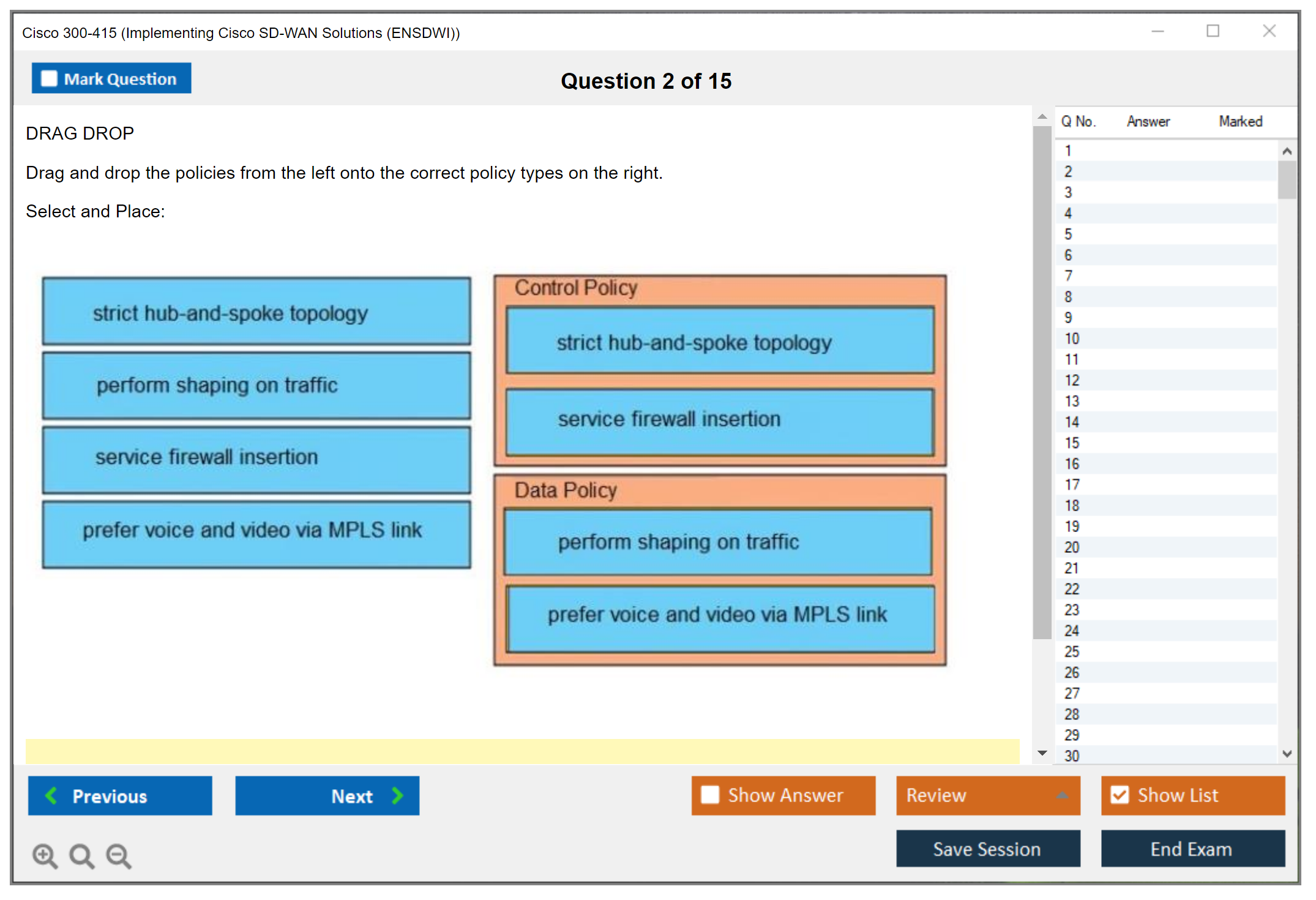
Drag-and-drop questions test conceptual understanding. They require you to match components correctly, sequence processes in the right order, or categorize features appropriately. These aren't necessarily harder than multiple-choice, but they require you to actively construct the answer rather than recognize it from a list.
Multiple-answer questions explicitly tell you how many options to select, something like "Choose 3 answers." Here's the thing: partial credit isn't awarded whatsoever. You must select all correct answers and no incorrect ones to earn points for that question. Missing one correct option or including one wrong option means zero points, which makes multiple-answer questions statistically more difficult than single-answer questions.
Testlet scenarios provide complexity. A complex business situation's followed by multiple related questions. For example, you might read about a company implementing SD-WAN across 50 branch sites with specific requirements for application performance, security segmentation, and WAN optimization, then you'll answer 4-5 questions based on that scenario. These test your complete understanding rather than isolated facts.
One critical aspect? You can't work through backward.
Once you've submitted an answer, that's it. This is different from some other certification exams that let you review and change answers, but once you click submit on a question, you move forward to the next question and can't return. This means you can't skip difficult questions planning to return to them later. You must make a decision on each question before proceeding. Some people find this stressful because it removes the safety net of reviewing answers at the end.
The testing interface includes basic tools like a notepad function for scratch work during the exam where you can jot down notes, work through calculations, or track information across testlet questions. However, physical note-taking materials? Prohibited in testing centers. You can't bring paper, pens, or anything else into the exam room.
If you take the exam through online proctoring (which has become increasingly common), you'll need a webcam, microphone, and stable internet connection since remote monitoring technology watches you throughout the exam to maintain integrity. The proctor can see your workspace, hear any sounds, and monitor your screen. You'll need a clean, quiet testing environment without interruptions. Some people prefer testing centers because of the controlled environment, while others like the convenience of testing from home. Similar proctoring requirements apply to other Cisco exams like the 300-435 (Automating Cisco Enterprise Solutions) and 300-635 (Automating Cisco Data Center Solutions).
When you'll receive your results and what they include
You get immediate preliminary results. On-screen right after finishing the exam, just pass or fail at that point, no detailed breakdown yet. If you passed, you'll typically receive an official certification confirmation email within 24 hours containing instructions for accessing your digital badge through Credly (formerly Acclaim) and providing guidance on updating your LinkedIn profile with your new credential.
The Cisco Certification Tracking System updates within 1-2 business days, displaying your new credential and providing access to downloadable digital certificates since Cisco stopped issuing physical certificates by default a while back. Everything's digital now, which is actually more convenient for sharing with employers or including in job applications. You can print the digital certificate if you want a physical copy for your wall or portfolio.
Cisco digital badges? Available soon.
Through Credly, they become available within 5-7 business days after passing, and these badges provide shareable, verifiable proof of your certification achievement. You can embed them on LinkedIn, personal websites, email signatures, or anywhere else you want to showcase your credentials. The badges link back to verification on Cisco's system, so employers can confirm authenticity.
If you failed the exam, your detailed score report appears within 24-48 hours in your certification account, showing your performance by exam domain and indicating where you were strong and where you need improvement. The feedback helps you create a focused study plan for your retake rather than just studying everything again without direction.
Score reports remain accessible indefinitely. Through the Cisco certification portal, you can reference them later during recertification cycles or when discussing your qualifications with prospective employers. This historical record of your certification path can actually be useful when you're pursuing advanced certifications later, since you can review which topics gave you trouble in earlier exams.
The 300-415 Practice Exam Questions Pack at $36.99 includes questions that mirror the actual exam format, helping you prepare for the various question types and time pressure you'll face so getting comfortable with the format before test day reduces anxiety and lets you focus on demonstrating your SD-WAN knowledge rather than figuring out how the exam interface works.
Understanding the scoring system and exam format? Helps you prepare more effectively. You know what to expect, how much time you have, and what types of questions will test your knowledge. That preparation confidence often makes the difference between passing and failing. The 300-415 exam tests real-world SD-WAN implementation skills, not just theoretical knowledge, so hands-on practice with vManage, control plane operations, and policy configuration's necessary alongside studying exam objectives.
Cisco 300-415 ENSDWI Difficulty: What to Expect
Cisco 300-415 ENSDWI exam overview
Cisco labels this professional-level, and honestly, that vibe hits immediately. You're expected to already understand networking fundamentals, then demonstrate you can actually deploy Cisco SD-WAN in environments where the WAN doesn't cooperate.
What is Implementing Cisco SD-WAN Solutions (300-415)?
Implementing Cisco SD-WAN Solutions (300-415) sits behind the Cisco 300-415 ENSDWI exam code. It zeroes in on constructing and running the Cisco SD-WAN overlay, bringing WAN Edge devices online, setting up policies, and fixing everything when the control plane or data plane decides to throw a tantrum.
Real tasks. Real outcomes.
Not just theory.
Who should take the Cisco 300-415 exam?
Network engineers handling WAN infrastructure. People supporting SD-WAN deployments. Anyone tired of being "the routing person" who wants to become "the SD-WAN person" without pretending they know more than they do.
Look, if you're coming straight from CCNA-only knowledge, you can pass, but you'll definitely feel gaps. The thing is, it assumes you've already wrapped your head around routing protocols, VPN concepts, and enterprise WAN design before it layers SD-WAN architecture and policy logic on top of all that.
What certification is 300-415 used for (specialist/track alignment)?
This exam counts toward Cisco specialist credit and syncs with Cisco's professional tracks, depending on your career direction. It's one of those exams hiring managers actually recognize because it connects to work people perform daily, not abstract concepts.
Cisco 300-415 ENSDWI exam cost and registration
Money and logistics matter. Especially when the exam's challenging enough that you don't want to "wing it" twice.
Exam cost (pricing, taxes, and voucher considerations)
The ENSDWI exam cost typically lands in the Cisco pro-level range (think several hundred USD), and taxes pile on more depending on your location. Vouchers can reduce costs, but check the fine print because some expire fast or lock to specific testing windows.
Where to register and how scheduling works
You register through Cisco's exam portal and book with Pearson VUE. You can test at a center or online. Online testing sounds convenient, I mean, but it's often stricter than expected, so verify your room setup and internet are reliable.
Retake policy basics (what to know before booking)
Cisco enforces retake rules and waiting periods. Review the current policy before booking, because failing by a narrow margin and realizing you can't retake for weeks when your job timeline's tight? That's brutal.
Cisco 300-415 ENSDWI passing score and exam format
People ask about the score like there's one magic number. It doesn't work that way.
Passing score (how Cisco reports scoring and what to expect)
Cisco doesn't publish a fixed ENSDWI passing score like some vendors do. You receive a score report showing section-level performance, and the pass/fail threshold varies by exam form. So yeah, plan like you need to be comfortably above "barely passing," because attempting to game the number's a losing strategy.
Exam format (question types, time, delivery method)
Expect multiple choice, multiple response, and scenario-based questions. Simulations can appear, and those spike difficulty because you must know where things live in the UI and what the config should look like, not just recognize vocabulary.
Timed. Proctored.
No pausing.
Score report and results timeline
Usually you get results immediately after. The detailed breakdown helps, but only if you actually use it to strengthen weak areas instead of rage-scrolling forums seeking reassurance.
Cisco 300-415 ENSDWI difficulty: what to expect
This is what everyone cares about, and yeah, the Cisco 300-415 ENSDWI exam isn't "light reading." It's intermediate-to-advanced, and the reason's straightforward: it tests implementation, not definitions.
Difficulty level (beginner vs intermediate vs advanced)
Beginner?
No.
Not remotely.
Intermediate-to-advanced fits because you need substantial hands-on SD-WAN implementation experience, or you need to cultivate that experience in a lab until your brain stops treating vManage like some cryptic puzzle box where buttons do mysterious things you don't fully understand yet. Candidates with only CCNA-level knowledge typically find ENSDWI challenging without extra study and practical lab work. The exam presumes solid fundamentals in routing and enterprise WAN concepts like MPLS, VPNs, QoS, plus routing protocols like BGP, OSPF, and yes, EIGRP still appears in actual networks.
Professional-level difficulty also means questions aren't just "what is OMP" but "here's what the fabric's doing, here's the symptom, what would you change and why." That's a completely different muscle than memorizing flashcards.
Traditional WAN folks feel a moderate bump too. Centralized management and template-based config sounds simple until you realize one variable or template attachment can wreck an entire site rollout. Now you're troubleshooting the control plane, the policy, and the human process simultaneously.
I once spent three hours debugging what turned out to be a single typo in a device variable. That kind of nonsense teaches you more than any video course ever will, but it's also the sort of real-world mess the exam loves to recreate in sanitized form.
Common challenges (vManage, control plane, policy, troubleshooting)
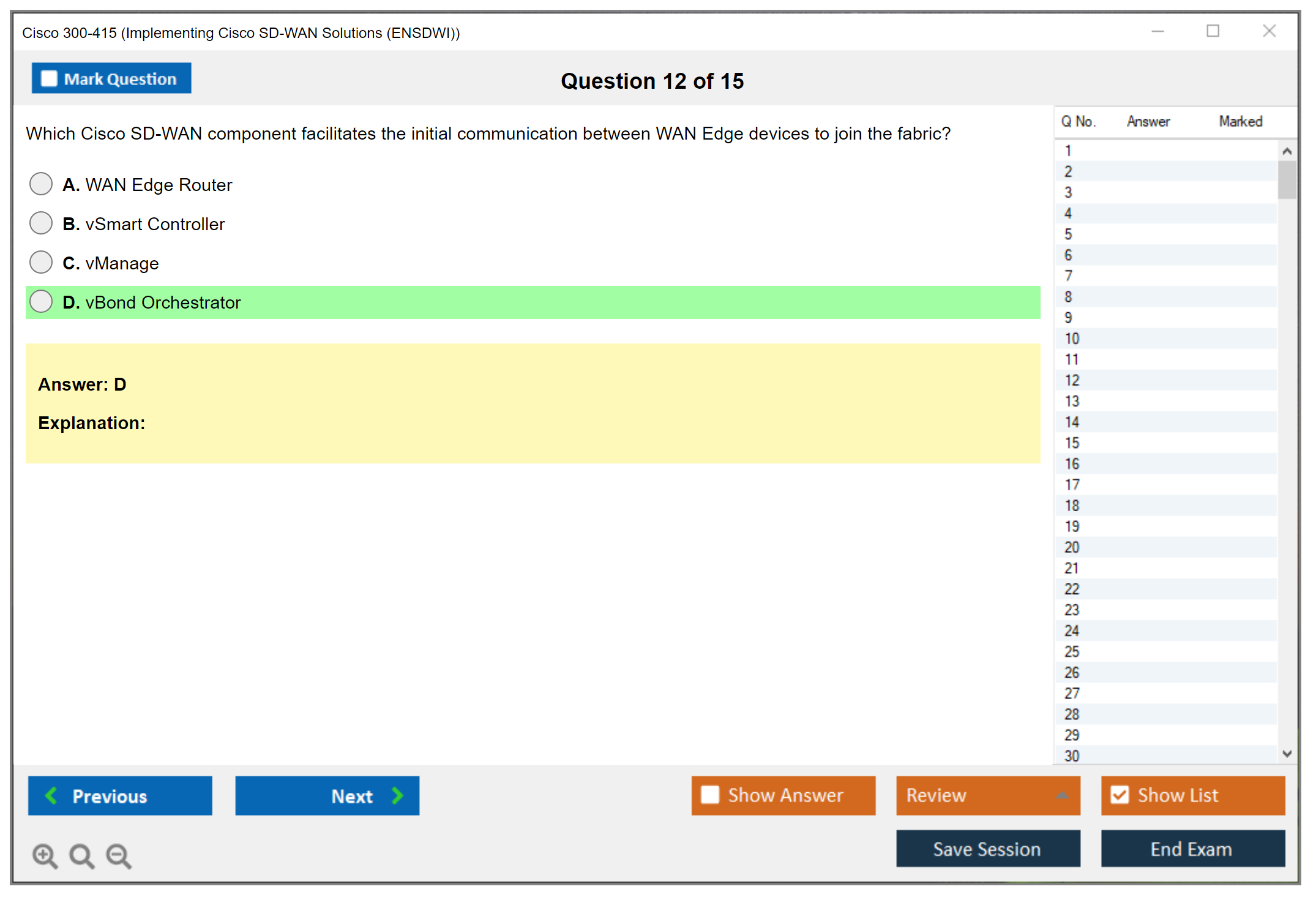
The first mental hurdle's the architecture. vManage, vSmart, vBond, WAN Edge. It's not permanently difficult, but it's conceptually dense initially. If you can't explain what each component does and how certificates and orchestration function, you'll get lost quickly when questions start blending onboarding, control connections, and policy.
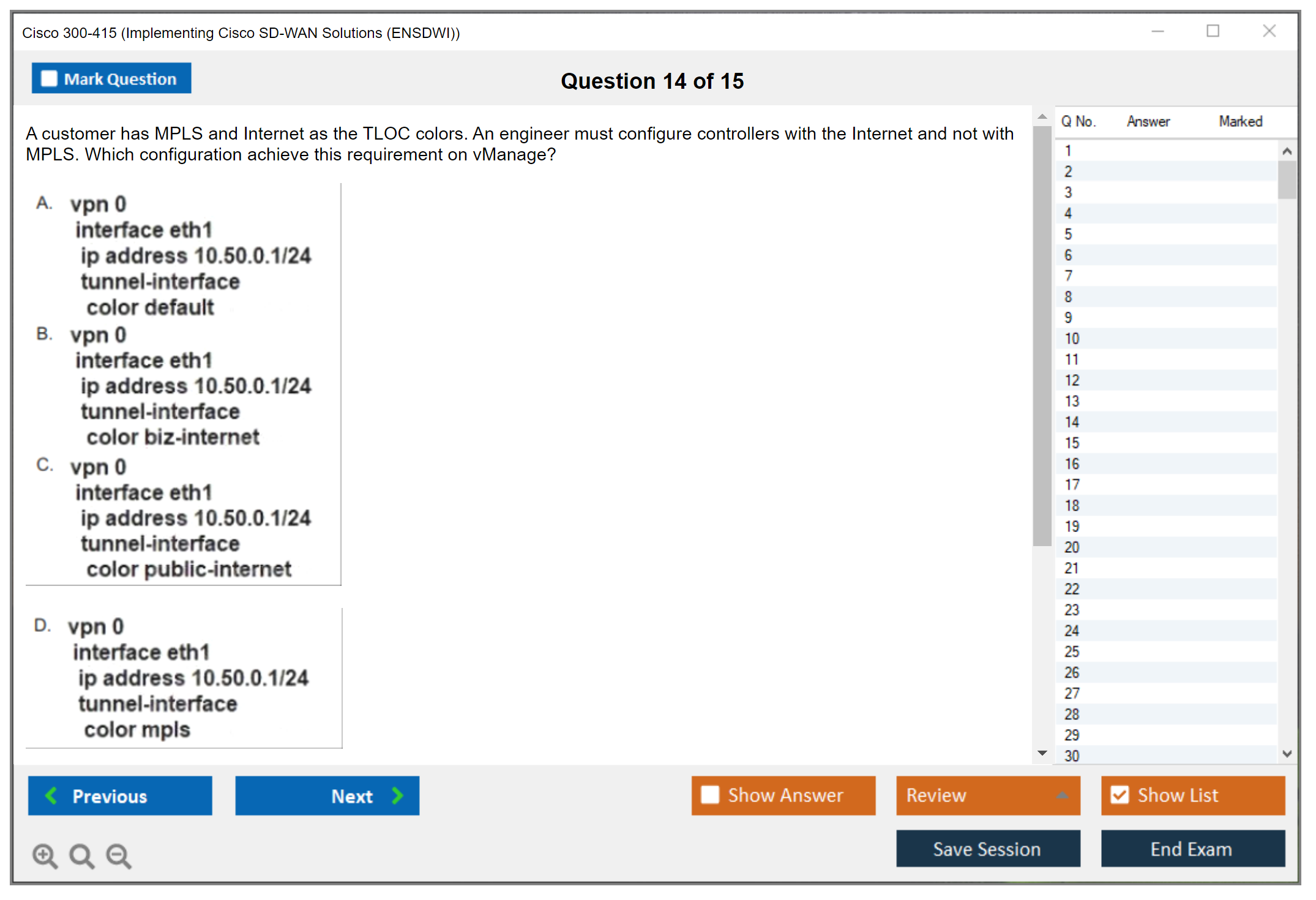
Control plane topics are where people hemorrhage points. OMP route exchange, TLOC concepts, how SD-WAN control and data plane differ, what "color" and "encap" actually mean, and how a route transforms into a forwarding decision. This isn't the place for surface-level memorization, because the exam adores scenarios where one detail's incorrect and you must spot it.
Policy's the other massive one. Control policies affect routing decisions and route propagation. Data policies affect traffic forwarding. That sentence's easy to repeat, honestly, but the challenging part's doing it under pressure when the question includes segmentation, app-aware routing, and service chaining all together and you must pick the right tool without second-guessing yourself.
Templates in vManage are sneaky-hard too. Feature templates, device templates, CLI templates, variables, attachment order, and what happens when you edit versus copy. WAN edge onboarding and templates are a must-practice item, not a read-about item.
Troubleshooting's where the exam feels like actual work. You need a systematic flow: check control connections, verify OMP, validate routes, confirm policies are doing what you think, then test data plane and SLA behavior. You also need to know where to look in vManage dashboards and what logs and counters matter, because "I would reboot it" isn't an acceptable exam answer.
Security adds more weight. Cisco SD-WAN security and segmentation, VPN segmentation, firewall policy integration, and service chaining are all manageable alone. Combined with routing and policy they get dense.
How to assess readiness before exam day
Timed practice exams matter. Not because they predict your exact score, but because they expose time sinks and weak domains when you can still address them.
Build a lab.
Seriously.
A complete SD-WAN lab with controllers and multiple edges, plus a few topology variants, transforms this from "I watched a course" into "I can implement this." If you don't have hardware, virtual SD-WAN with CML or a supported lab setup still teaches the workflows appearing in simulation-style questions, like Cisco SD-WAN vManage configuration, template pushes, and basic troubleshooting.
Review your practice test score reports and focus your next week on the worst areas, not your favorite ones. Also try explaining concepts out loud to a coworker or study buddy without notes. If you can't explain vBond and vSmart controllers and what they do during onboarding, you don't understand it yet.
My personal line's this: schedule only after you're consistently scoring 85% or higher on high-quality ENSDWI practice tests and you can complete common lab tasks without hunting through docs.
Cisco 300-415 ENSDWI prerequisites and recommended experience
Cisco doesn't require formal prerequisites. Reality does.
Official prerequisites (if any) vs recommended background
No official gate. But ENSDWI prerequisites in practice are strong routing fundamentals, comfort with VPNs and QoS, and genuine troubleshooting experience.
Recommended hands-on skills (routing, VPNs, policies, templates)
Be sharp on BGP and OSPF behavior. Know how segmentation operates. Be comfortable building policies without guessing. Know what happens when templates change and devices drift.
Lab environment suggestions (what to practice)
Practice onboarding flows. Practice policy edits and rollbacks. Break control connections intentionally and fix them. Get used to reading OMP and TLOC info until it feels normal.
Cisco 300-415 ENSDWI exam objectives (blueprint breakdown)
The ENSDWI exam objectives cover a wide spread. Breadth's part of the difficulty.
Core SD-WAN architecture and components (vManage/vSmart/vBond/WAN Edge)
Know roles, control connections, certificates, orchestration. Basic stuff, but tested in tricky ways.
Device onboarding, templates, and configuration workflows
This is where hands-on matters. Template hierarchy trips people up.
Control policies and data policies (traffic engineering and segmentation)
Understand what changes routing versus forwarding. Then do it with segmentation and app-aware routing in mind.
Security features (segmentation, secure connectivity, key concepts)
Segmentation, service chaining, firewall integration. Enough to be dangerous.
Management, monitoring, and troubleshooting (operations and visibility)
Dashboards, alarms, logs, and a clean troubleshooting sequence.
Best study materials for Cisco 300-415 ENSDWI
ENSDWI study materials should blend official and real-world practice.
Official Cisco learning and exam topics resources
Start with Cisco's official blueprint and training options. They map closely to exam objectives and keep you from wandering.
Recommended books, guides, and documentation
Cisco SD-WAN docs are dry, but accurate. Read the sections matching your weak areas, not random chapters at midnight.
Hands-on labs (simulators, CML/virtual SD-WAN, practice scenarios)
This is the make-or-break piece. If you want to feel calmer on exam day, build the lab muscle memory now.
Study plan (2 to 6 weeks vs 8 to 12 weeks paths)
If you already deploy SD-WAN, 2 to 6 weeks of focused review plus labs can suffice. If you're new to SD-WAN, 8 to 12 weeks is more realistic because you're learning concepts and building instincts simultaneously, and that takes repetitions.
Cisco 300-415 ENSDWI practice tests and exam prep strategy
Practice tests are helpful.
Dumps are a trap.
Practice tests (what to look for in high-quality question banks)
Look for explanations, updated coverage, and scenario-heavy questions. If you want a paid option, 300-415 Practice Exam Questions Pack is one you can incorporate into your prep, just don't make it your only source.
Practice exam strategy (timed sets, weak-area drilling, review loops)
Do timed sets. Review every miss. Then go lab the topic you missed until you can reproduce it without help. That loop's boring, the thing is, but it works.
Also, if you're using something like the 300-415 Practice Exam Questions Pack at $36.99, treat it like a diagnostic tool, not a cheat code.
Common mistakes to avoid (memorization vs understanding, outdated dumps)
Memorizing answer patterns fails the moment Cisco tweaks wording or presents a different scenario. Outdated material's another killer, because SD-WAN features and UI flows change over time.
Cisco 300-415 ENSDWI renewal and recertification
This part's less stressful, but you should plan ahead.
How ENSDWI contributes to Cisco recertification (CE credits and policies)
Cisco certification renewal can be handled through continuing education (CE) credits or exam passes, depending on your cert level and what you're maintaining. Check Cisco's current policy page because rules do change.
Renewal options (retake vs continuing education)
Retake's simple but expensive. CE credits can be smoother if your employer supports training budgets.
Keeping skills current (release changes, new features, ongoing labs)
Keep a small lab around. Even just monthly reps. SD-WAN's one of those areas where rust appears fast, especially in policy and troubleshooting.
FAQs about Cisco 300-415 ENSDWI
Cost, passing score, difficulty, and prerequisites (quick answers)
How much does the Cisco 300-415 ENSDWI exam cost? It's typically several hundred dollars plus tax, with occasional vouchers. What's the passing score for the ENSDWI exam? Cisco doesn't publish a fixed ENSDWI passing score. Expect section scoring and variable cut lines. Is Cisco 300-415 ENSDWI difficult? Yes, intermediate-to-advanced, especially with simulations. What are the objectives for Implementing Cisco SD-WAN Solutions (300-415)? Architecture, onboarding, templates, policy, security, operations, troubleshooting. Any ENSDWI prerequisites? No official ones, but CCNA-only folks should plan extra lab time.
How long to study and what resources work best
If you're new, plan longer and lab more. If you're experienced, compress the timeline but don't skip simulations and policy practice. ENSDWI practice tests help, and mixing in something like the 300-415 Practice Exam Questions Pack can tighten your feedback loop.
What to do after passing (next exams/certifications and career paths)
After you pass, keep going while the knowledge's fresh. Pair SD-WAN skills with security, automation, or enterprise design work, because that combo's what transforms "I passed an exam" into "I can own this network."
Cisco 300-415 ENSDWI Prerequisites and Recommended Experience
Official prerequisites vs recommended background
Here's the thing. Cisco doesn't actually mandate formal prerequisites for the 300-415 ENSDWI exam. You can literally register and walk in. Nobody's gonna check your certs at the door or verify you've passed anything else beforehand, which sounds great until you're sitting there staring at questions about OMP route redistribution wondering what language they're even written in.
That said, Cisco strongly recommends you've got knowledge equivalent to CCNA-level networking fundamentals before attempting professional-level concentration exams like ENSDWI. They're not just blowing smoke here. The exam blueprint assumes you already understand routing and switching concepts, IP addressing schemes, VLAN configurations, routing protocols like OSPF and BGP, VPN technologies, and network security principles without needing to explain them from scratch like you're five years old. If you're fuzzy on how OSPF adjacencies actually form or can't explain the difference between GRE and IPsec tunnels off the top of your head, you're gonna struggle hard with SD-WAN overlays. They build directly on all that foundation work you might've skipped.
Practical experience matters. A lot.
I mean, practical experience with enterprise networking environments provides context for understanding SD-WAN's role in WAN transformation and cloud connectivity strategies in ways that books simply can't replicate. I've watched people try cramming SD-WAN concepts without understanding why organizations even moved from MPLS to SD-WAN initially. They end up memorizing feature lists without grasping when or why you'd actually deploy specific configurations in production. You've gotta understand traditional WAN pain points like the cost structures, the inflexibility, the lead times, or else SD-WAN's advantages remain abstract talking points rather than obvious solutions to real problems you've personally dealt with.
Here's what really helps though. Candidates benefit from understanding traditional WAN technologies like MPLS, DMVPN, and IPsec configurations. Not just theory, but hands-on experience. When you've actually configured a DMVPN hub-and-spoke network yourself or troubleshot MPLS label switching issues at 2 AM, SD-WAN's advantages become immediately obvious rather than abstract marketing speak you're supposed to memorize. You'll really appreciate why automated tunnel establishment matters when you've manually configured fifty IPsec peers and wanted to scream. The architectural differences make intuitive sense when you've personally dealt with traditional WAN limitations like circuit provisioning times or inability to use multiple transport types at the same time.
I once spent an entire weekend rebuilding IPsec tunnels because one small authentication parameter was wrong across twelve sites. Automated fabric establishment suddenly looked pretty appealing after that nightmare.
Prior exposure to Cisco IOS/IOS-XE command-line interface helps tremendously when working with WAN Edge devices throughout your SD-WAN path. Even though vManage handles most configuration through templates and GUI workflows, you still absolutely need CLI skills for troubleshooting, verification, and understanding what's actually happening under the hood when templates don't deploy correctly or tunnels mysteriously fail. The Implementing Cisco Enterprise Network Core Technologies (350-401 ENCOR) covers much of this foundational IOS knowledge if you're looking to build those skills in a structured way rather than piecemeal.
Familiarity with network management tools, monitoring systems, and troubleshooting methods accelerates learning of vManage's operational capabilities compared to starting completely from scratch. If you've worked with Prime Infrastructure, DNA Center, or even open-source tools like Grafana or Prometheus, you'll pick up vManage's dashboard concepts and monitoring workflows way faster than someone who's only done CLI-based management their entire career and thinks GUIs are for weaklings.
Recommended hands-on skills: routing, VPNs, policies, templates
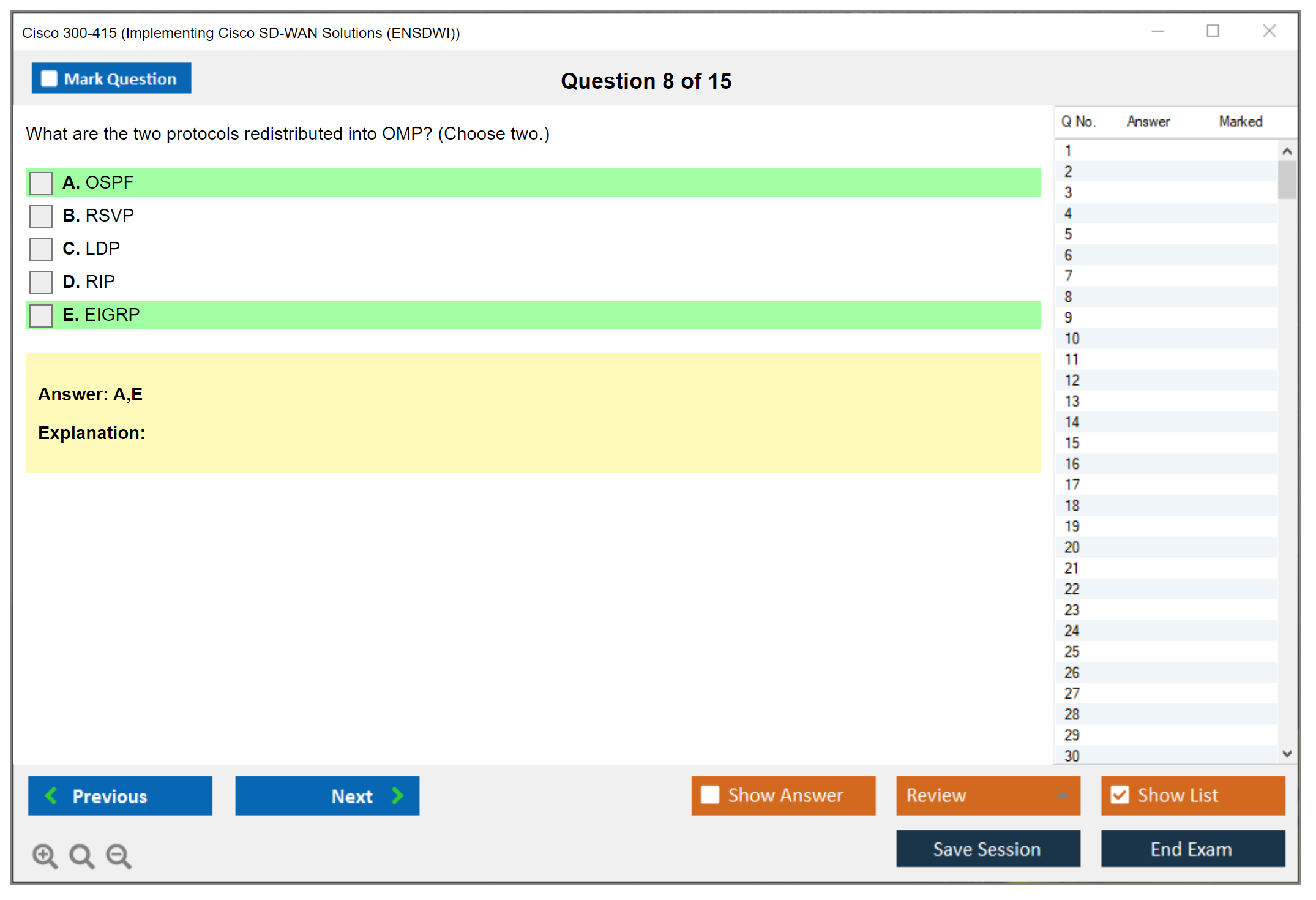
Configure and verify routing protocols. Including OSPF, EIGRP, and BGP in both traditional and SD-WAN overlay contexts. This is absolutely non-negotiable if you want to pass. You need to understand how OMP (Overlay Management Protocol) relates to traditional routing protocols, how routes are redistributed between underlay and overlay networks, and how to troubleshoot routing issues when things break in complex ways. I've watched candidates fail this exam specifically because they couldn't interpret OMP route tables or understand why certain routes weren't propagating to remote sites despite configuration looking correct.
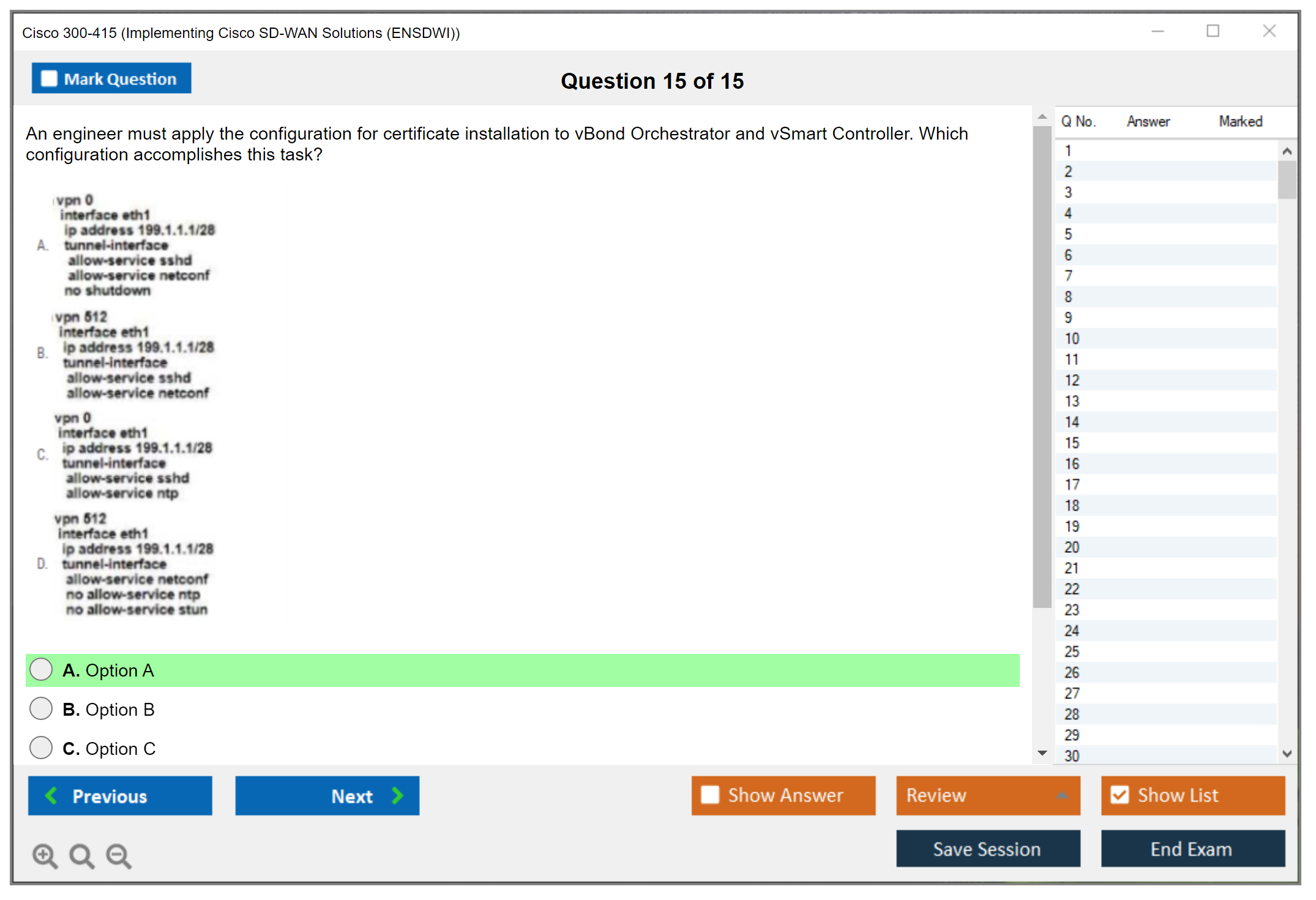
Establish IPsec tunnels and understand encryption mechanisms, authentication processes, and key exchange mechanisms that underpin SD-WAN secure fabric connectivity across the entire overlay network. The exam tests your knowledge of how certificates work in the SD-WAN authentication process, how control plane and data plane tunnels differ fundamentally, and what happens during tunnel establishment failures. You need to know the entire sequence and where things typically break.
Create and modify vManage feature templates for system settings, VPN configurations, interface parameters, and routing protocols using both GUI and CLI approaches because both legitimately matter in production. The GUI is easier initially but understanding the CLI template structure helps when troubleshooting or when you need to make bulk changes across hundreds of devices. Feature templates are modular components that define specific device functions like interfaces, routing protocols, or security policies.
Build device templates. Complex ones.
Build device templates that combine multiple feature templates and attach them to WAN Edge devices, understanding variable usage for site-specific customization and template versioning for change management across your SD-WAN fabric. This is where most actual configuration work happens in production environments, not one-off CLI commands. You'll need to know how to use variables for site-specific values like WAN IP addresses, manage template versions when making changes without breaking existing deployments, and troubleshoot attachment failures that happen for cryptic reasons. Template troubleshooting is honestly a huge exam topic that catches people off guard.
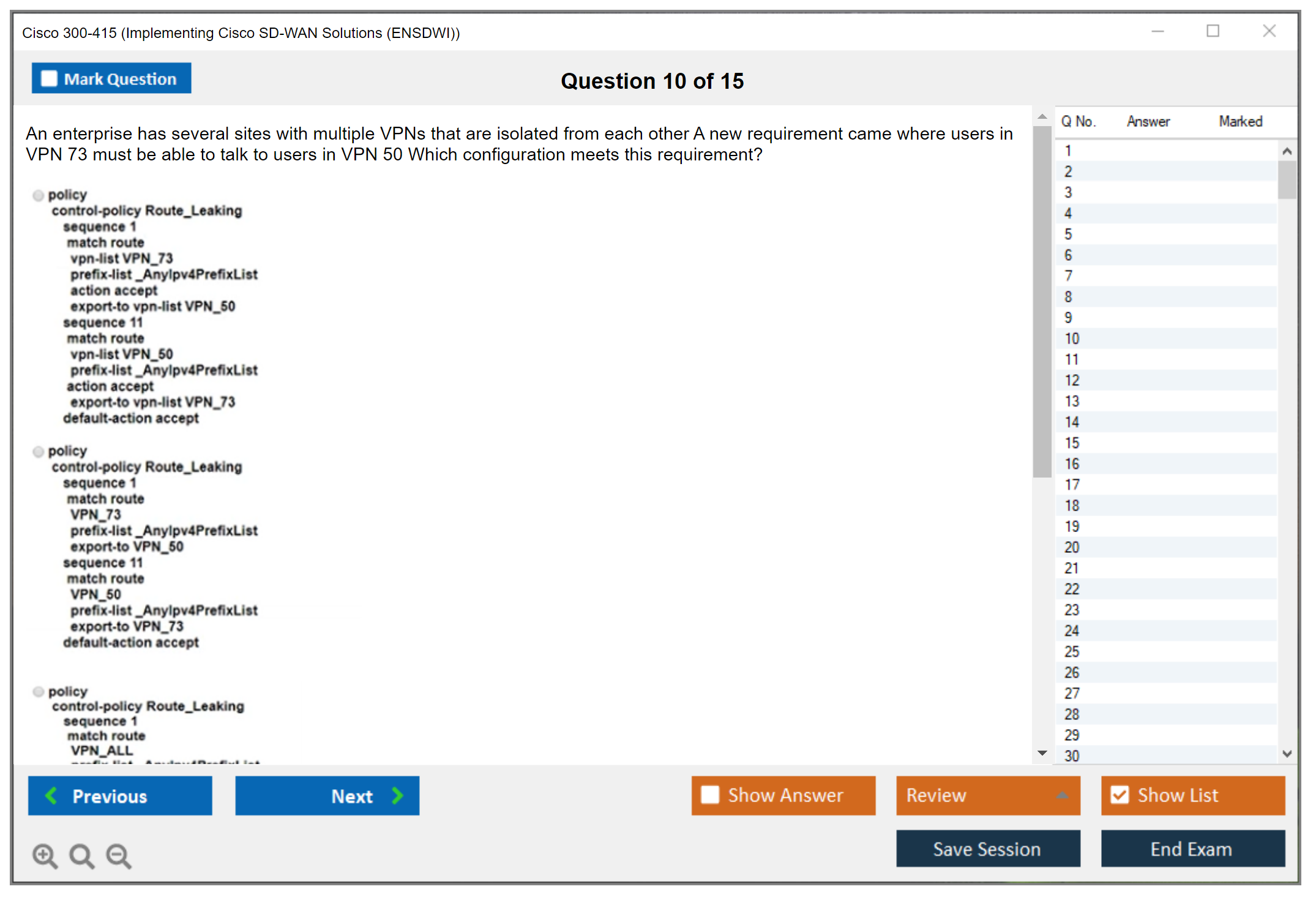
Implement control policies that influence OMP route advertisements, TLOC preferences, and routing decisions across the SD-WAN overlay network based on business requirements. Control policies determine which routes get advertised where, which is critical for network segmentation and traffic engineering in multi-tenant or security-conscious environments. You need hands-on practice creating policies that match specific routes, sites, or colors and then applying actions like accepting, rejecting, or modifying route attributes like preference or TLOC.
Configure data policies for traffic steering, QoS marking, firewall rules, and application-aware routing based on business requirements and SLA parameters that matter to your applications. Data policies are where SD-WAN really shines compared to traditional WAN architectures. You're matching traffic based on applications (using DPI), source/destination addresses, DSCP values, and then steering that traffic across specific transport links based on latency, loss, or jitter requirements. The Automating Cisco Enterprise Solutions (ENAUTO) exam also covers programmable approaches to policy management if you're interested in automation aspects beyond manual configuration.
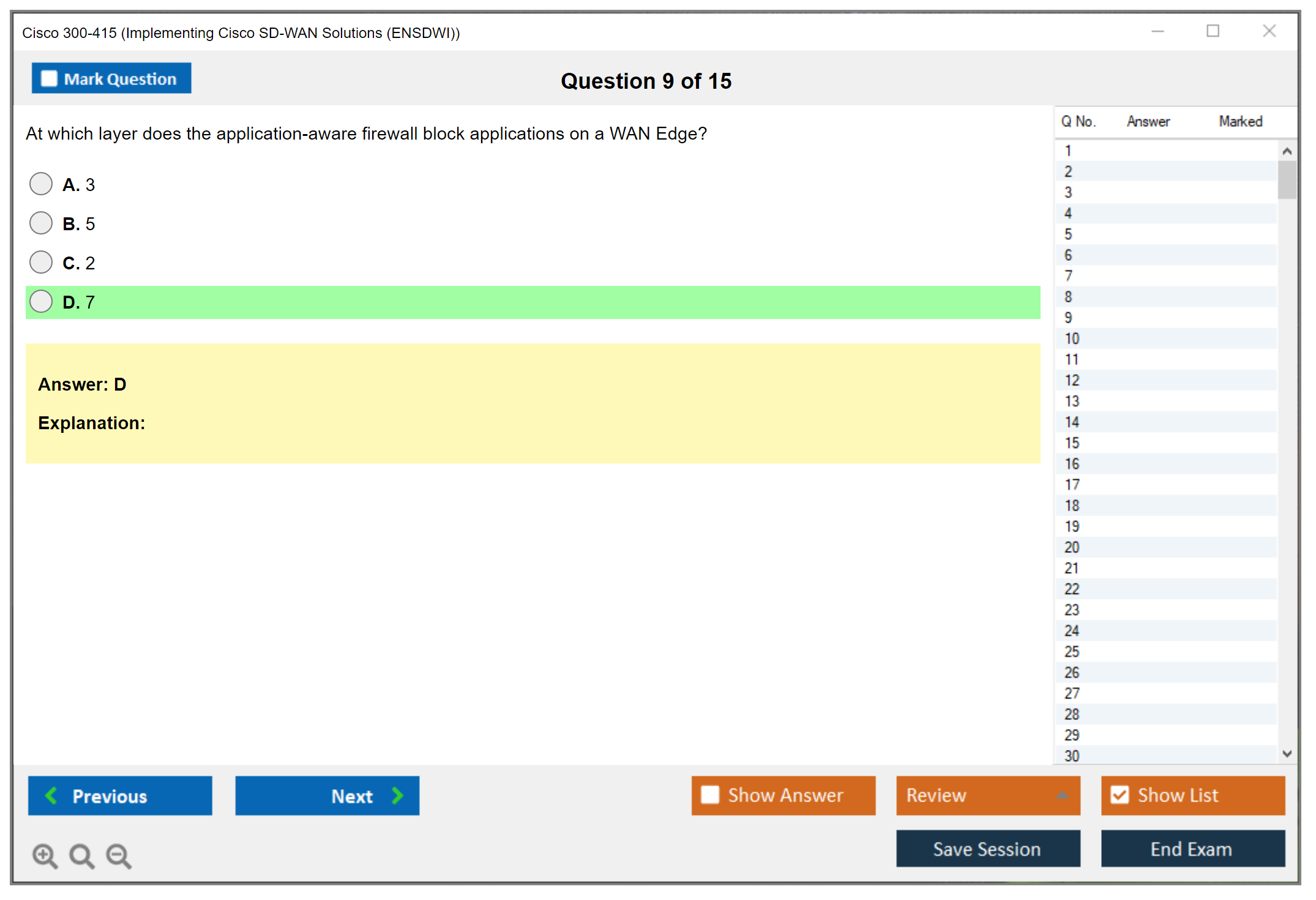
Deploy security features including zone-based firewalls, application-layer inspection, IPS integration, and URL filtering within SD-WAN policies. Security is integrated into the fabric, not bolted on as an afterthought. You need to understand how service chaining works when traffic needs to traverse multiple security functions, how to configure firewall zones and policies that make sense, and how to verify security policy application is actually happening. The Implementing and Operating Cisco Security Core Technologies (SCOR 350-701) provides broader security context that complements SD-WAN security features nicely if you're weak there.
Perform device onboarding using Zero Touch Provisioning (ZTP), understanding the critical role of vBond orchestrator and certificate-based authentication in the entire process. ZTP is how production deployments scale beyond ten sites. You need to know the entire onboarding sequence like how devices discover vBond through various methods, how certificate validation works using enterprise PKI, how devices download their configuration from vManage, and what happens when any step fails because troubleshooting broken ZTP is definitely on the exam.
Troubleshoot systematically. Always.
Troubleshoot control plane connectivity issues, data plane tunnel establishment, routing problems, and policy misconfigurations using vManage tools and CLI verification commands in combination. Troubleshooting probably comprises 30-40% of the exam weight based on most people's experiences. You need approaches for diagnosing why tunnels aren't forming between sites, why applications aren't routing correctly through policies, or why specific sites can't reach others despite configuration appearing correct.
Monitor SD-WAN performance using vManage dashboards, real-time statistics, historical analytics, and alarm management features to maintain operational awareness. Operational visibility is critical for both exam success and real-world deployments. You should be comfortable interpreting bandwidth utilization graphs, tunnel status indicators, application performance metrics, and using vManage's troubleshooting tools like traceroute, ping, and packet capture effectively.
Lab environment suggestions: what to practice
Cisco Modeling Labs (CML) provides the most authentic environment for SD-WAN practice, supporting virtual vManage, controllers, and edge routers with realistic topologies that mirror production. CML isn't free but it's really worth the investment if you're serious. You get actual Cisco images, proper scale testing capabilities, and the ability to build complex multi-site topologies that mirror production deployments rather than toy examples. If you're serious about passing this exam and actually understanding SD-WAN, CML is your best option hands down.
Cisco DevNet Sandbox offers free, reservable SD-WAN lab environments with pre-configured controllers and devices for hands-on exploration without infrastructure investment or setup time. Honestly this is amazing for getting started when you're just exploring concepts. You can reserve always-on or scheduled sandboxes, access them remotely from anywhere, and practice without building anything yourself or spending money. The catch is you're limited to what's pre-configured and reservation times are finite.
Personal lab setups using nested virtualization can run vManage and controllers on VMware Workstation, VirtualBox, or ESXi hosts with sufficient memory. Minimum 32GB RAM recommended realistically, though 64GB is better if you want comfortable performance. I've built labs on 32GB but you'll be resource-constrained and constantly juggling what's running. vManage alone wants 16GB, vSmart needs 4GB, vBond needs 2GB, and you need WAN Edge routers too plus the hypervisor overhead. Budget accordingly or suffer sluggish performance.
Cloud-based lab platforms exist. Sort of work.
Cloud-based lab platforms like EVE-NG or GNS3 can simulate SD-WAN components though performance and feature completeness may vary compared to official Cisco solutions depending on image versions. These work for learning basic concepts but sometimes have quirks with SD-WAN components that don't exist in real deployments. Still better than nothing if you're budget-constrained.
Practice scenarios should include building complete topologies from scratch, implementing various template types, creating complex policy structures, and troubleshooting intentionally broken configurations. Don't just follow cookbook labs mindlessly. Break stuff deliberately. Misconfigure policies on purpose and figure out how to fix them without looking at the answer immediately. That's how you develop real troubleshooting skills rather than memorizing happy-path configurations that never break.
Hands-on labs should cover all exam domains like architecture deployment, device onboarding, template management, policy implementation, security configuration, and operational troubleshooting across various scenarios. The Implementing Cisco SD-WAN Solutions (300-415 ENSDWI) exam blueprint maps directly to these areas so use it as your lab planning guide.
Allocate 40-60 hours. Minimum.
Allocate 40-60 hours of lab time across various scenarios to develop muscle memory for common configuration tasks and troubleshooting workflows that you'll need under exam pressure. This isn't overkill or some inflated number. SD-WAN has a lot of moving parts and you need genuine repetition to internalize workflows like template creation, policy attachment, and troubleshooting sequences rather than constantly referring to documentation.
Document lab exercises with configuration snippets, screenshots, and detailed notes to create a personal reference guide for exam review later. Your future self will thank you when you're reviewing two weeks before the exam and can't remember how you configured application-aware routing or control policies last month.
Practice time-constrained lab scenarios to simulate exam pressure and improve your speed at common tasks you'll need to perform quickly. The exam has time limits and you can't afford to spend fifteen minutes fumbling through template creation or ten minutes trying to remember where specific verification commands live. Build speed through repetition.
Conclusion
Wrapping up your 300-415 path
Look, here's the thing: the Cisco 300-415 ENSDWI exam isn't one you just casually walk into after skimming a PDF or watching a few YouTube videos the night before. It's a deep technical test that evaluates your real-world ability to design, deploy, and troubleshoot SD-WAN solutions using vManage, vSmart, vBond, and WAN Edge devices. If you've been working through the exam objectives, you already know the control and data plane concepts aren't surface-level. They require actual understanding of how traffic flows, how policies apply, and what happens when something breaks.
The exam cost? Significant. The passing score matters because you don't get unlimited attempts without paying again. That's why your prep strategy needs to be intentional, not scattershot. You could spend weeks configuring WAN edge onboarding and templates in a lab and still miss policy details if you're not drilling weak areas with focused practice.
Most people underestimate it.
Security and segmentation topics show up way more than expected, especially when combined with control policies that affect routing behavior across the overlay. That's where candidates get tripped up. I've seen folks nail the basic concepts but completely freeze when a question throws in a real scenario about policy interaction with VPN segmentation. It's brutal.
Your study materials should cover the full blueprint. Official Cisco resources? Solid but dry. Third-party books help contextualize concepts, though. Labs are non-negotiable. You can't fake hands-on experience when the exam asks about vManage configuration workflows or troubleshooting vSmart controller peering issues. Practice tests bridge the gap between knowing concepts and applying them under time pressure, which is where most candidates struggle during the actual exam.
For ENSDWI renewal and recertification, remember this exam counts toward your CE credits, but the clock starts ticking the moment you pass. Don't let your cert lapse because you forgot to track renewal timelines or assumed you'd handle it later. It happens more than you'd think.
After you've worked through your study plan, logged lab hours, and reviewed ENSDWI exam objectives until you're seeing vBond controllers in your sleep (honestly, maybe even dreaming about overlay tunnels), it's time to validate your readiness. The best way to gauge whether you're truly prepared? Test yourself with scenarios that mirror the actual exam format and difficulty. That's where a solid question bank makes all the difference. Not brain dumps, but quality practice that challenges your understanding of Implementing Cisco SD-WAN Solutions (300-415).
If you're serious about passing on your first attempt, check out the 300-415 Practice Exam Questions Pack at /cisco-dumps/300-415/. It's built to expose gaps you didn't know you had and sharpen your exam-day execution. Get after it.