CBSA Practice Exam - BTA Certified Blockchain Solution Architect
Reliable Study Materials & Testing Engine for CBSA Exam Success!
Exam Code: CBSA
Exam Name: BTA Certified Blockchain Solution Architect
Certification Provider: Blockchain
Corresponding Certifications: Blockchain Solution Architect , Blockchain Certification


Free Updates PDF & Test Engine
Verified By IT Certified Experts
Guaranteed To Have Actual Exam Questions
Up-To-Date Exam Study Material
99.5% High Success Pass Rate
100% Accurate Answers
100% Money Back Guarantee
Instant Downloads
Free Fast Exam Updates
Exam Questions And Answers PDF
Best Value Available in Market
Try Demo Before You Buy
Secure Shopping Experience
CBSA: BTA Certified Blockchain Solution Architect Study Material and Test Engine
Last Update Check: Mar 19, 2026
Latest 229 Questions & Answers
Training Course 64 Lectures (8 Hours) - Course Overview
45-75% OFF
Hurry up! offer ends in 00 Days 00h 00m 00s
*Download the Test Player for FREE
Printable PDF & Test Engine Bundle
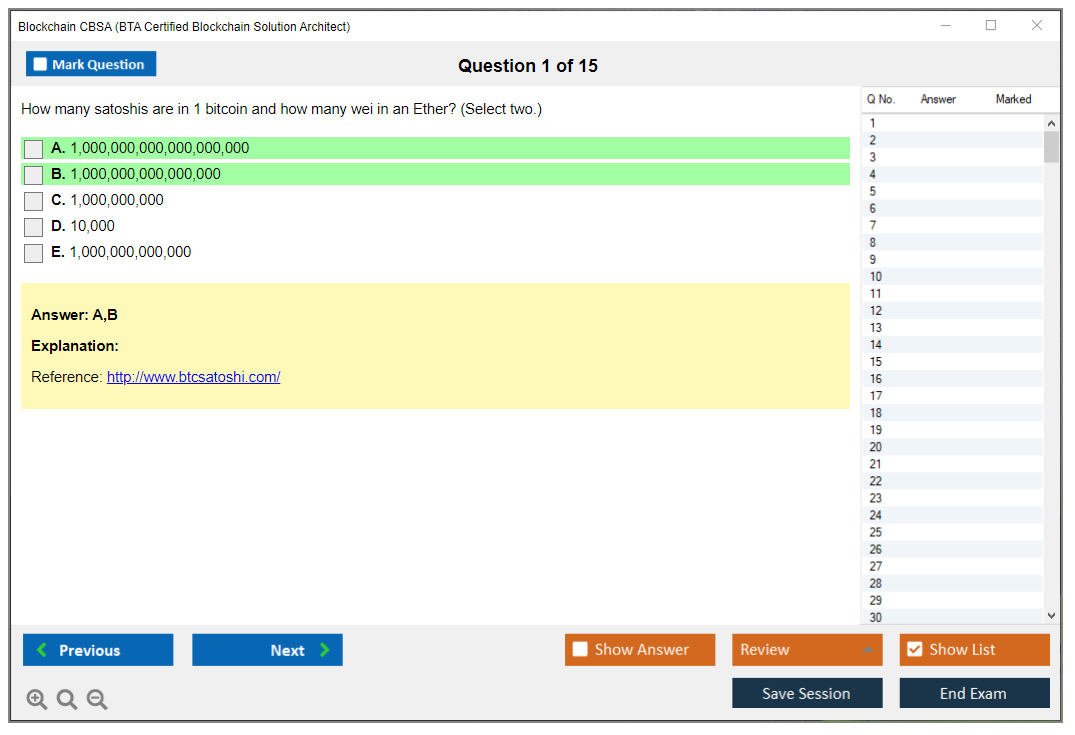
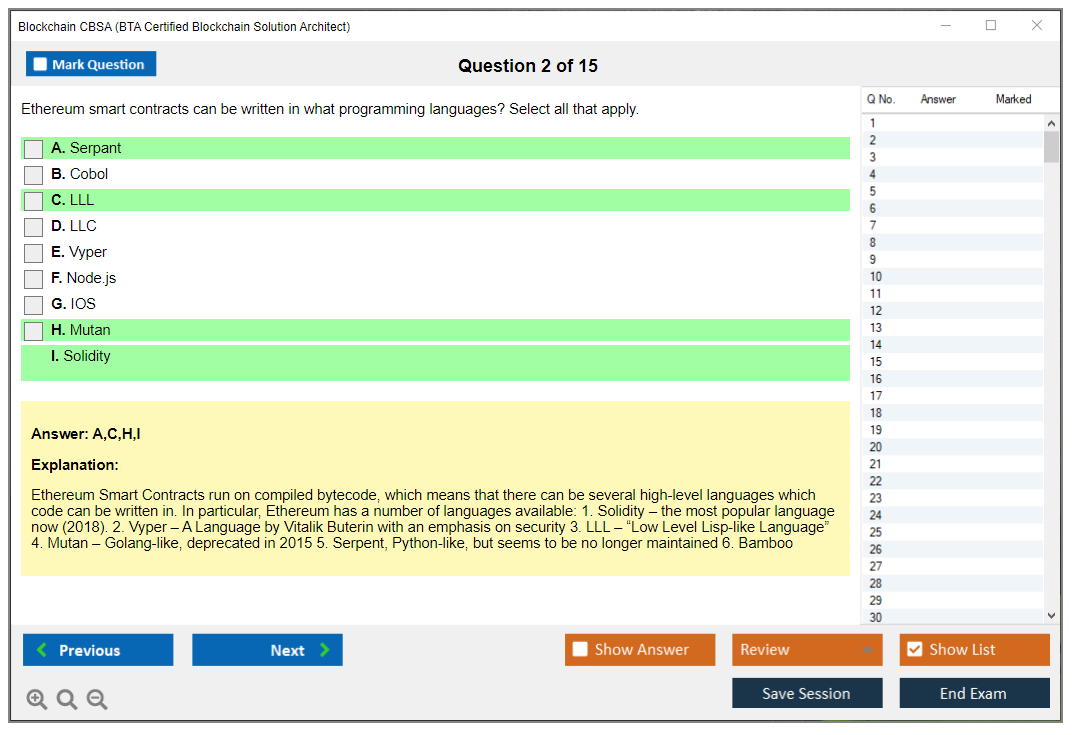
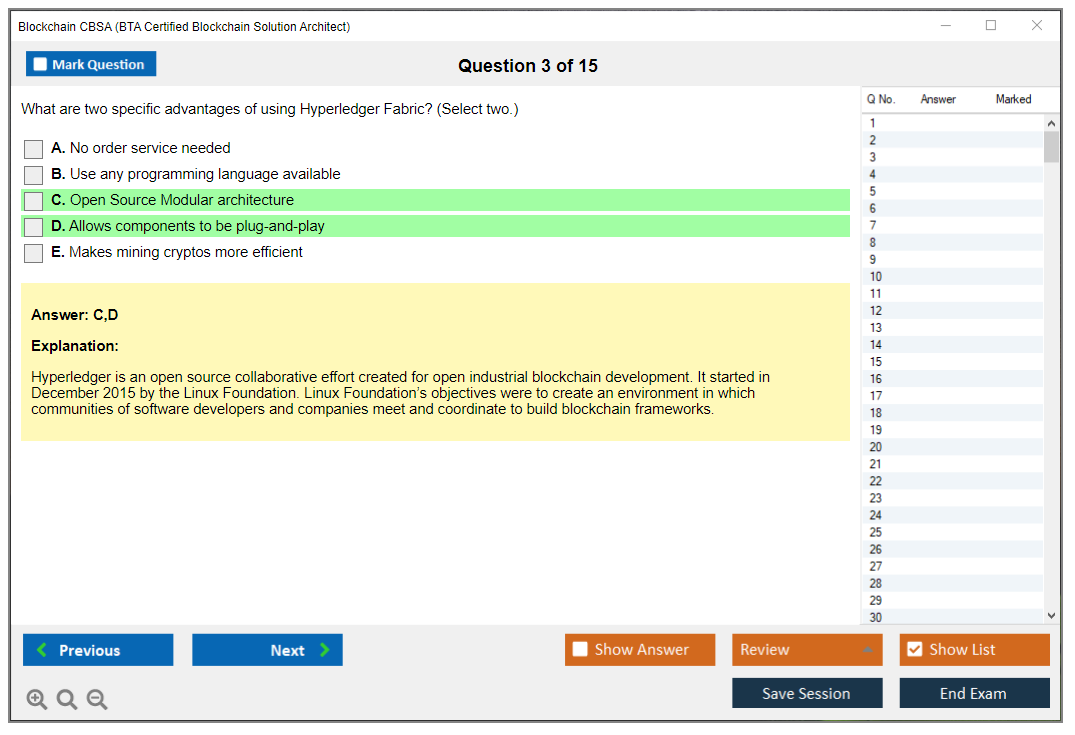
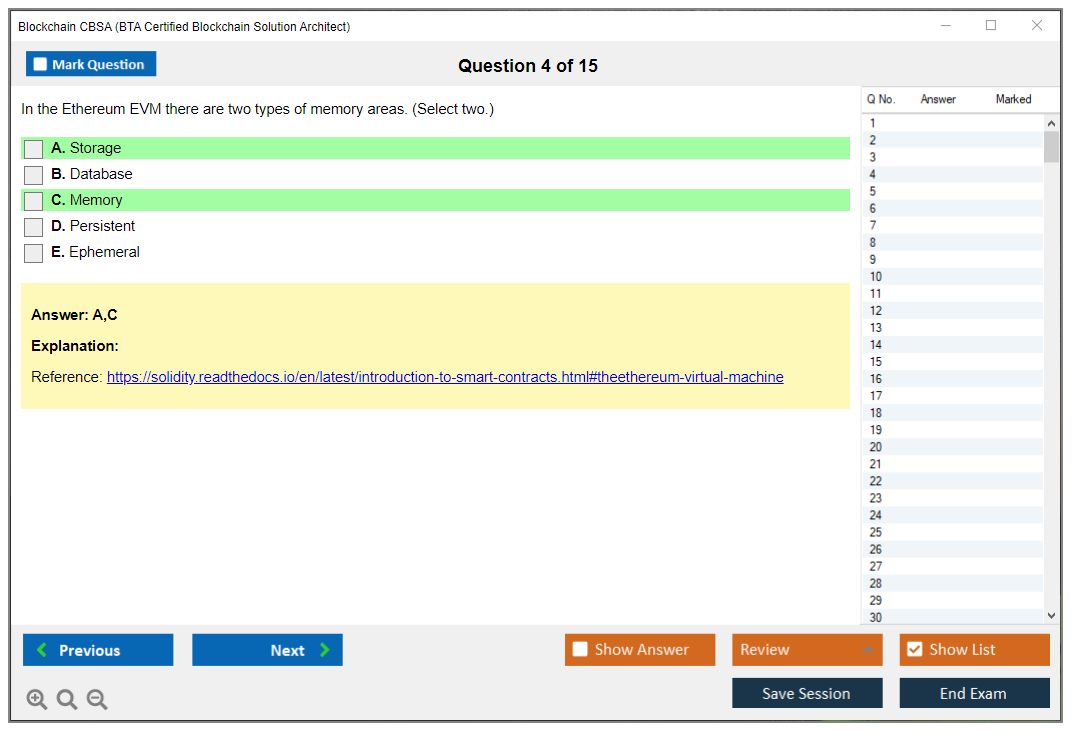
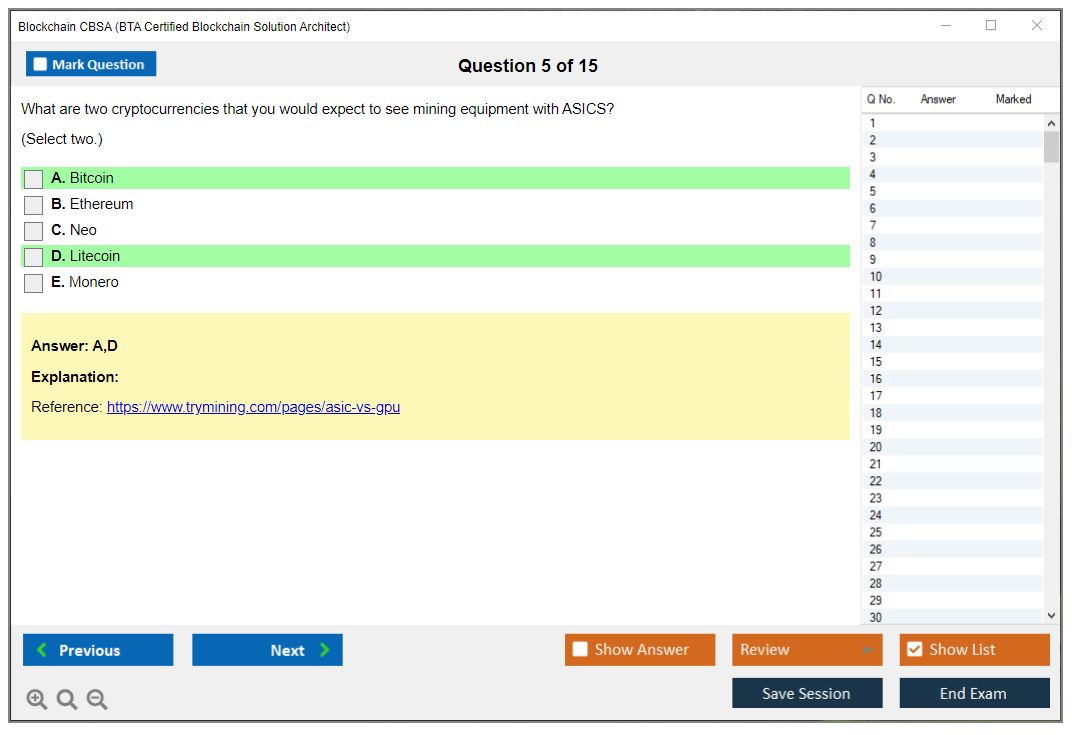
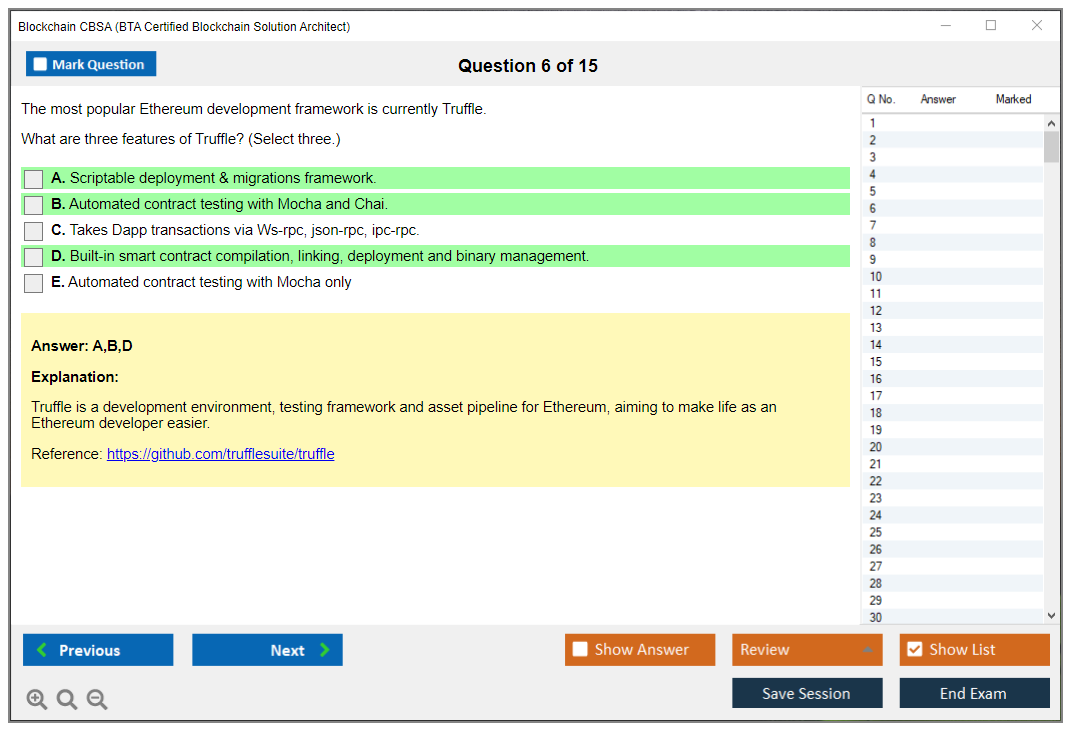
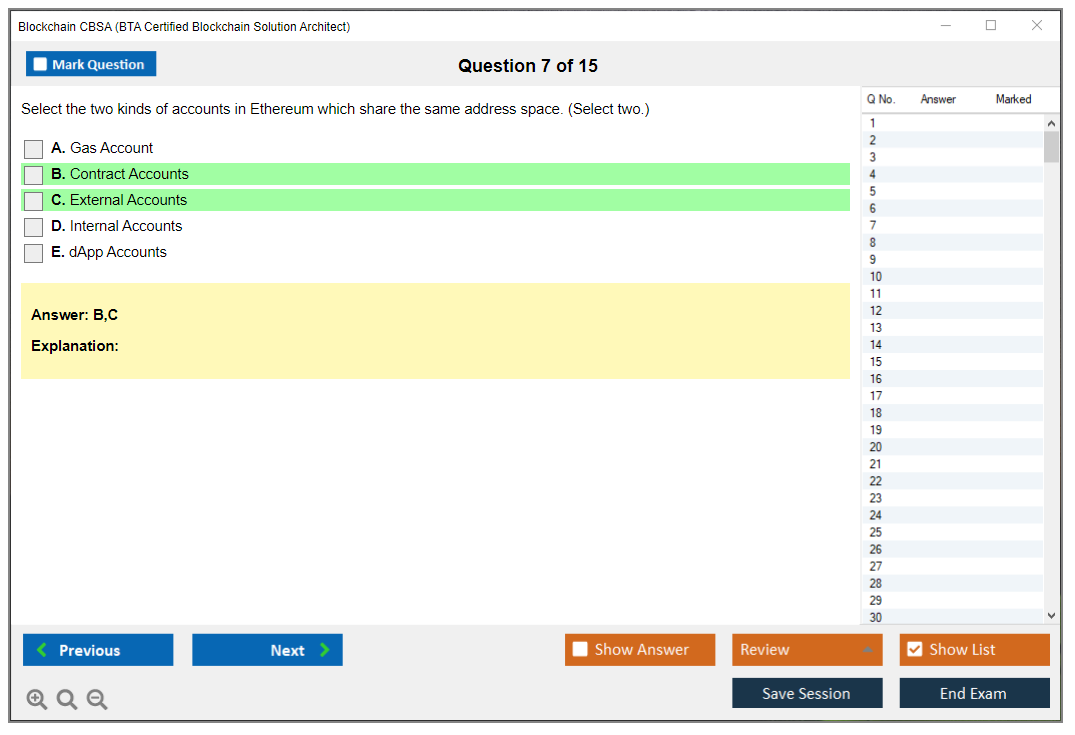
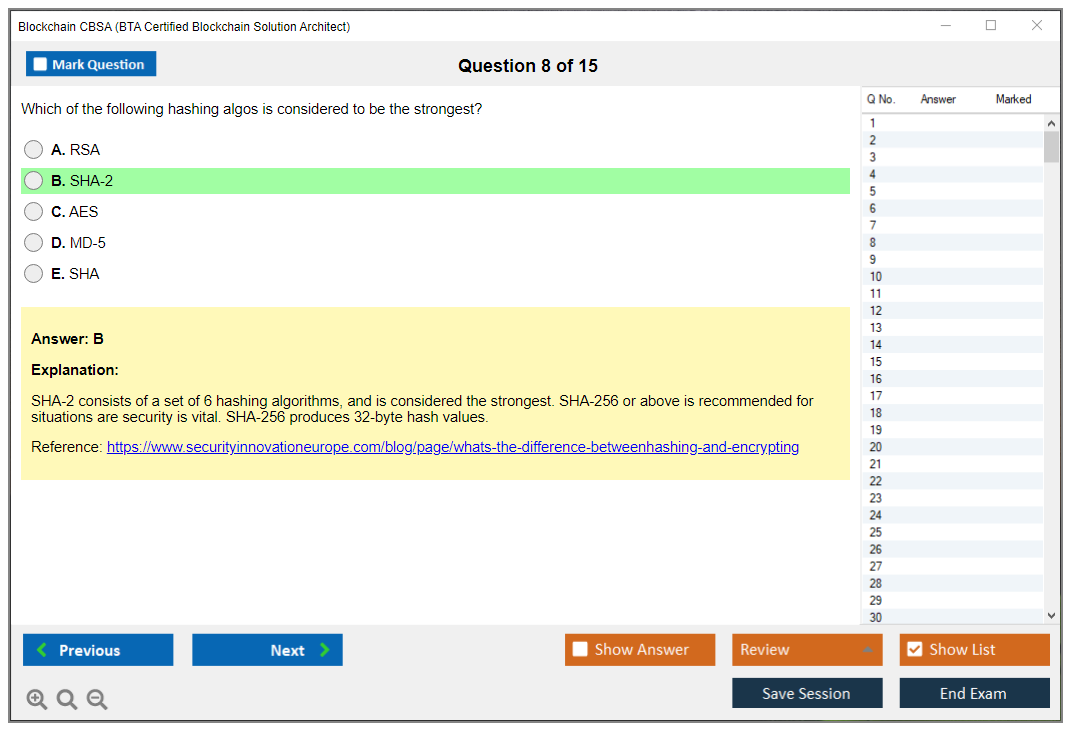
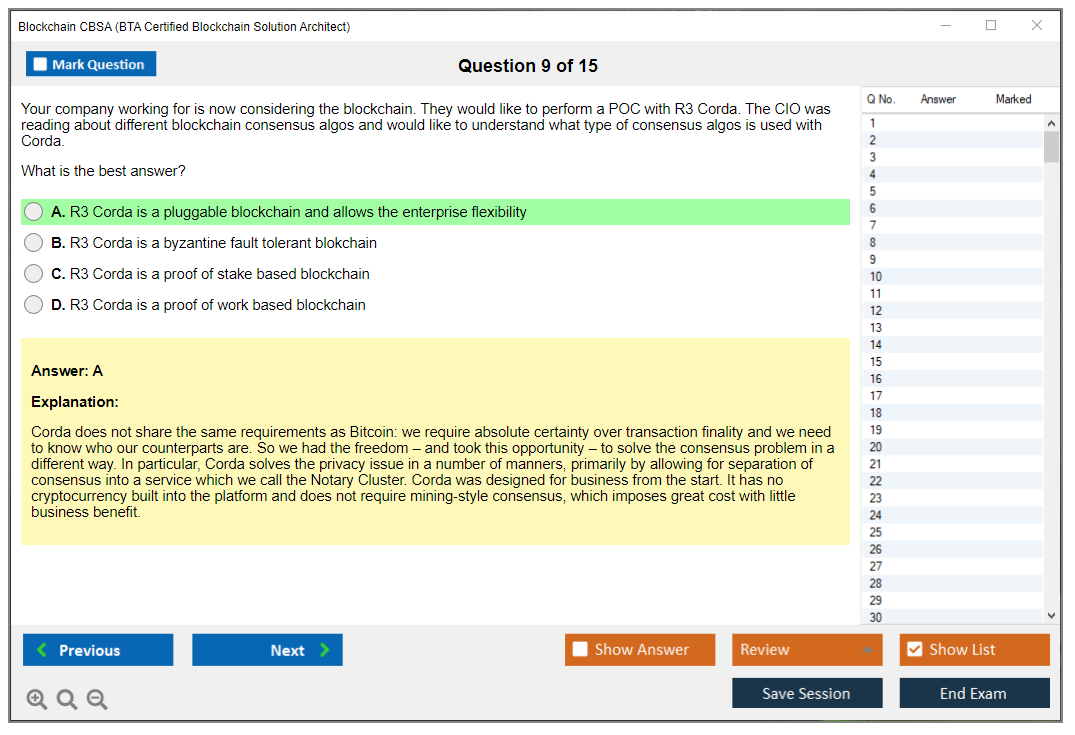
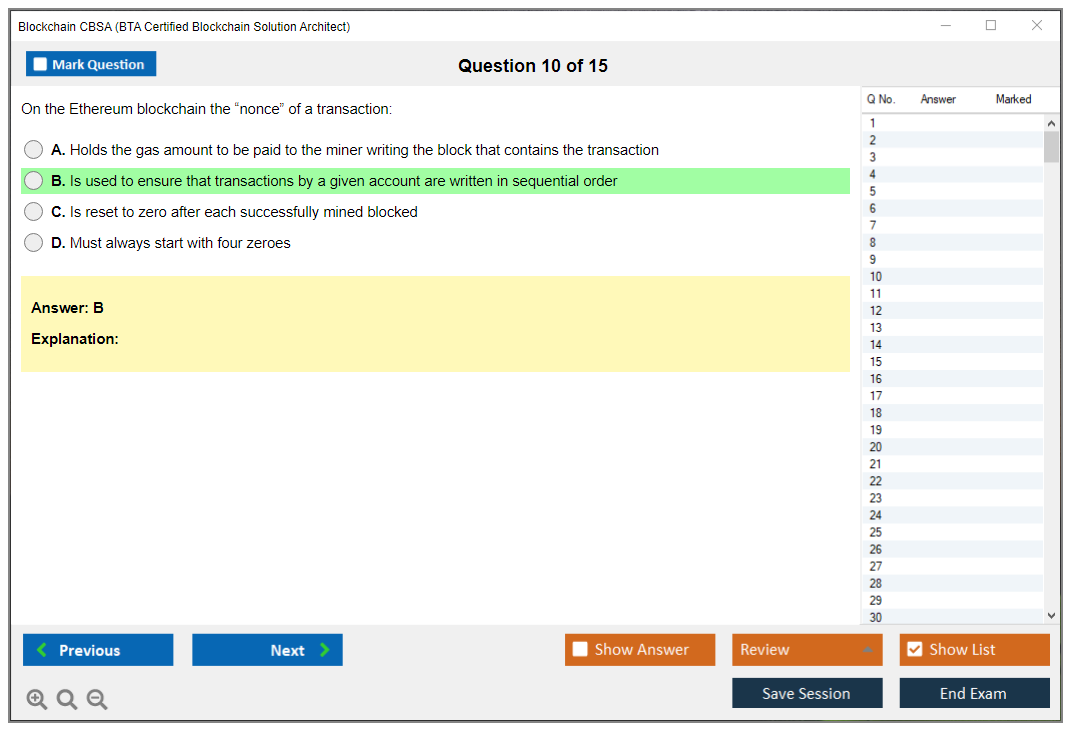
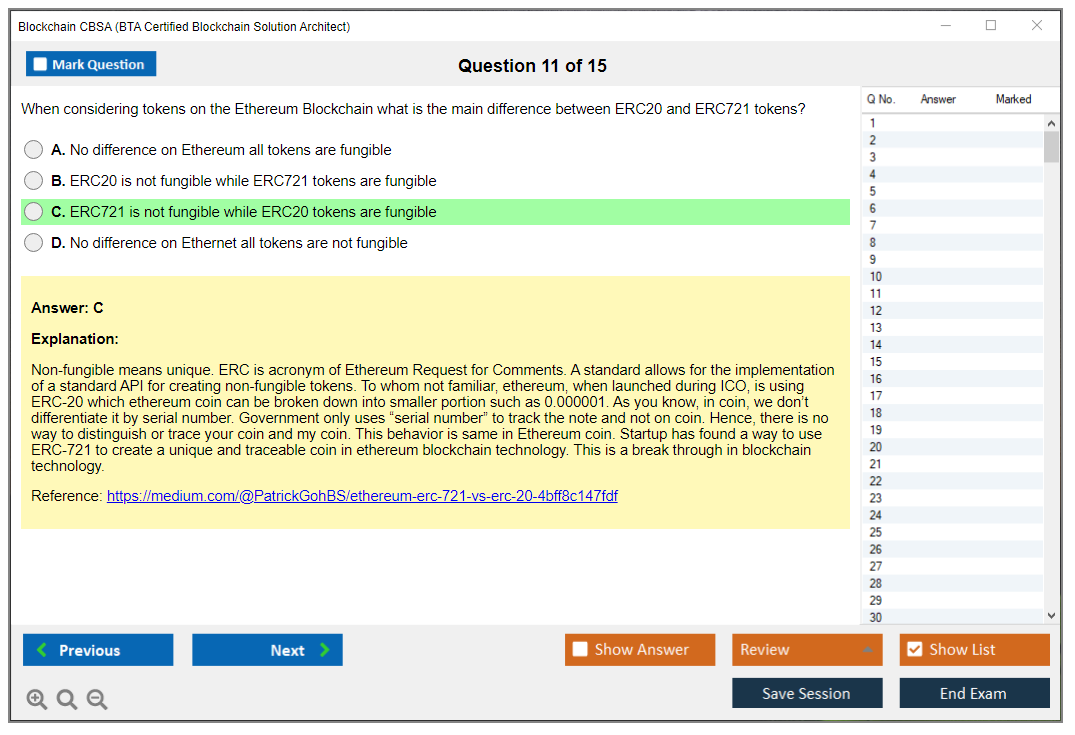
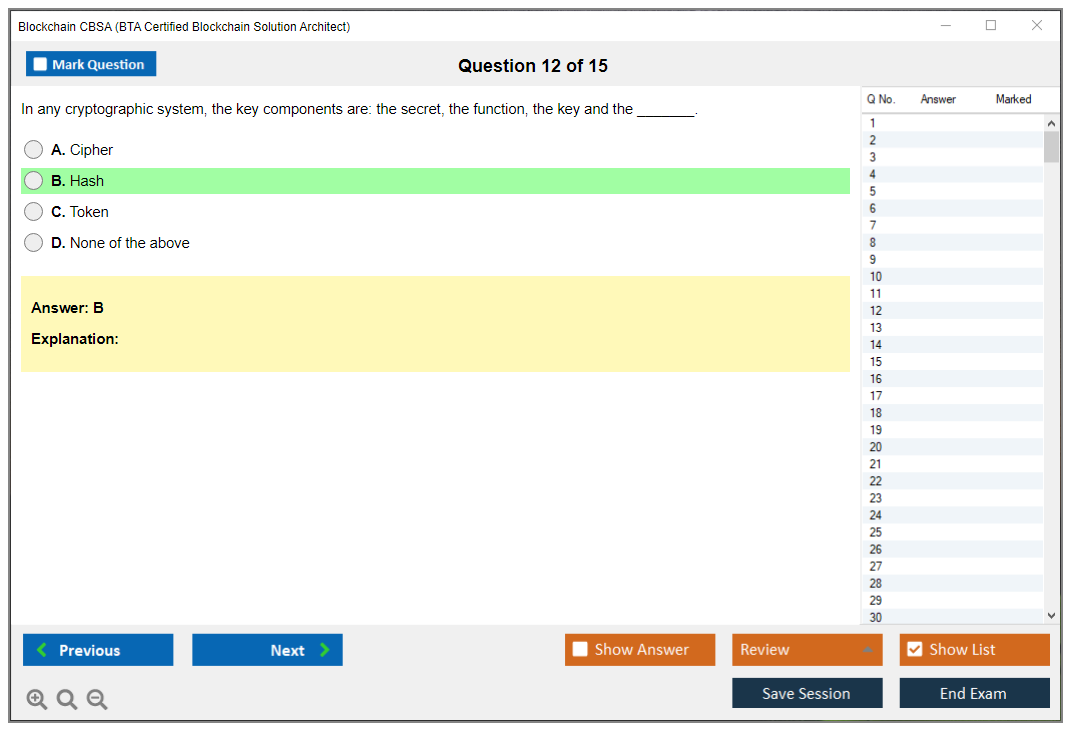
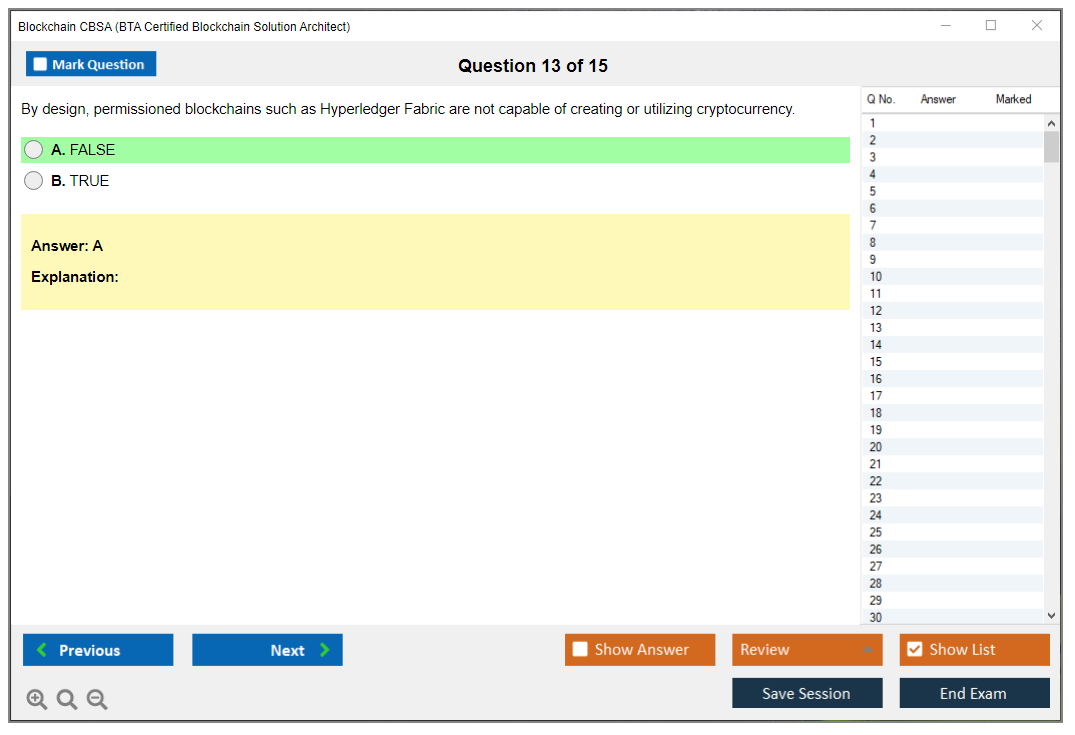
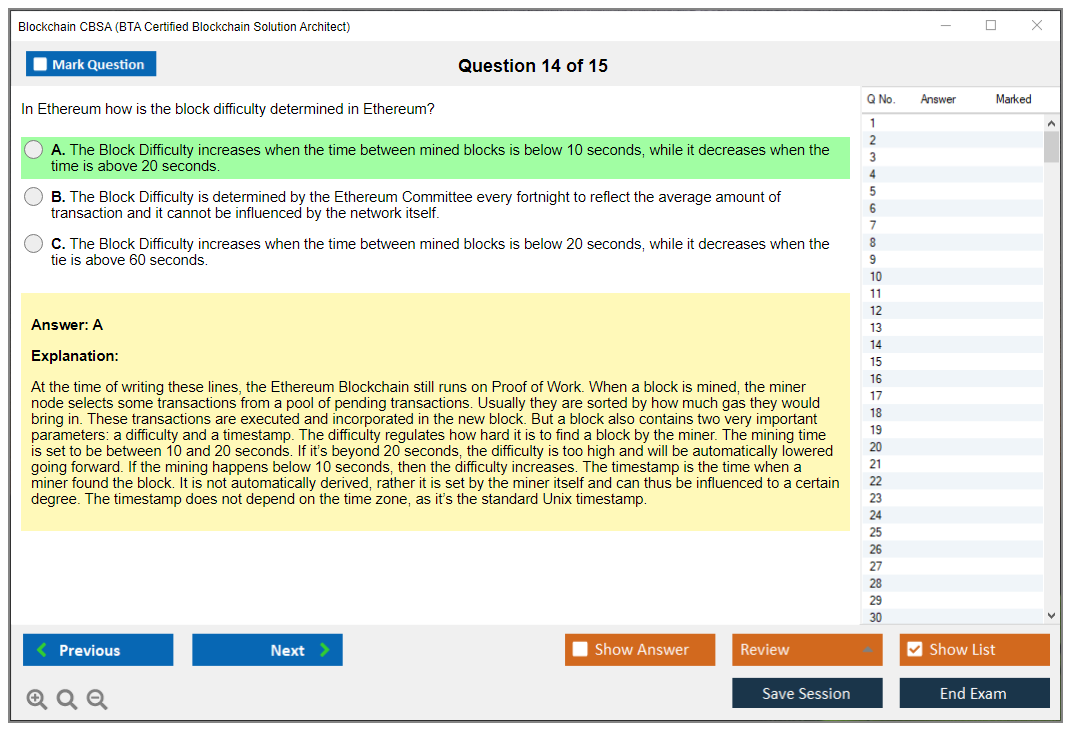
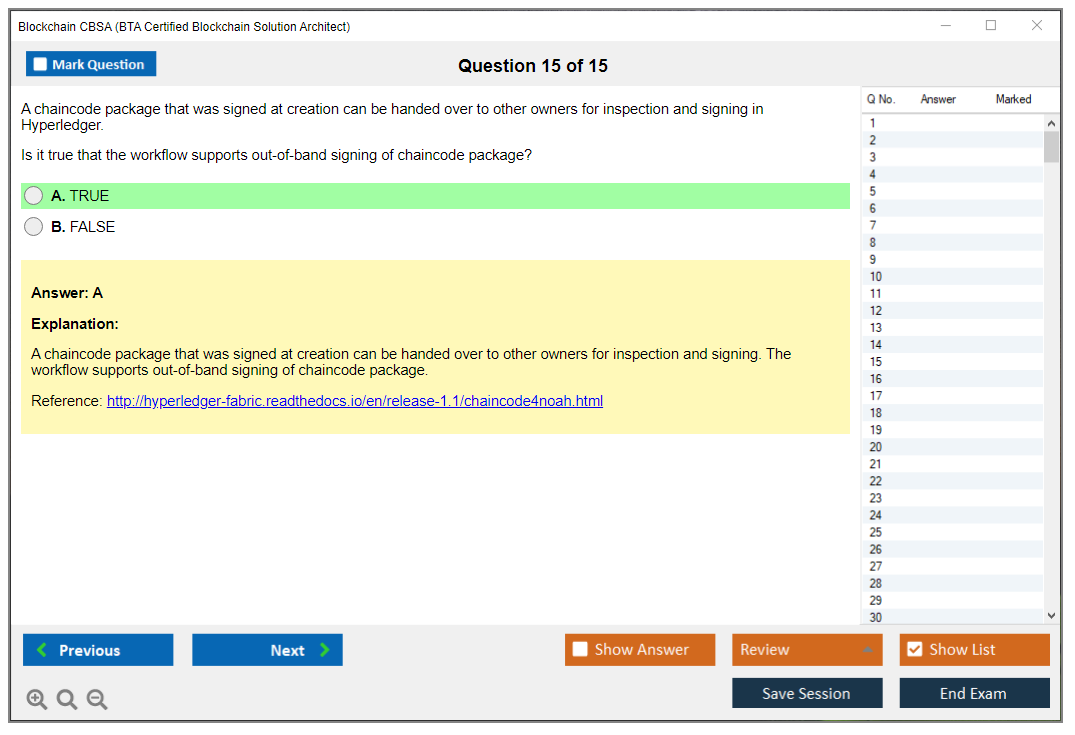
Dumpsarena Blockchain BTA Certified Blockchain Solution Architect (CBSA) Free Practice Exam Simulator Test Engine Exam preparation with its cutting-edge combination of authentic test simulation, dynamic adaptability, and intuitive design. Recognized as the industry-leading practice platform, it empowers candidates to master their certification journey through these standout features.
What is in the Premium File?
Satisfaction Policy – Dumpsarena.co
At DumpsArena.co, your success is our top priority. Our dedicated technical team works tirelessly day and night to deliver high-quality, up-to-date Practice Exam and study resources. We carefully craft our content to ensure it’s accurate, relevant, and aligned with the latest exam guidelines. Your satisfaction matters to us, and we are always working to provide you with the best possible learning experience. If you’re ever unsatisfied with our material, don’t hesitate to reach out—we’re here to support you. With DumpsArena.co, you can study with confidence, backed by a team you can trust.
Blockchain CBSA Exam FAQs
Introduction of Blockchain CBSA Exam!
The Certified Blockchain Solution Architect (CBSA) exam is a certification exam designed to assess an individual's knowledge and skills in designing and implementing blockchain solutions. The exam covers topics such as blockchain fundamentals, distributed ledger technology, smart contracts, blockchain architecture, and blockchain security.
What is the Duration of Blockchain CBSA Exam?
The duration of the Blockchain CBSA exam is two hours.
What are the Number of Questions Asked in Blockchain CBSA Exam?
There are a total of 60 questions on the Blockchain CBSA exam.
What is the Passing Score for Blockchain CBSA Exam?
The passing score required for the Blockchain CBSA exam is 70%.
What is the Competency Level required for Blockchain CBSA Exam?
The required competency level for the Blockchain CBSA exam is Professional.
What is the Question Format of Blockchain CBSA Exam?
The Blockchain CBSA Exam consists of multiple-choice questions.
How Can You Take Blockchain CBSA Exam?
The Blockchain CBSA exam can be taken either online or in a testing center. To take the exam online, you will need to register through the Blockchain Council website and pay the exam fee. Once you have registered, you will be provided with a link to take the exam. To take the exam in a testing center, you will need to register through the Blockchain Council website and pay the exam fee. Once you have registered, you will be provided with a voucher code that you can use to schedule your exam at a Pearson VUE testing center.
What Language Blockchain CBSA Exam is Offered?
The Blockchain Council of Science and Applications (CBSA) exam is offered in English.
What is the Cost of Blockchain CBSA Exam?
The cost of the Blockchain CBSA Exam is $199 USD.
What is the Target Audience of Blockchain CBSA Exam?
The target audience of the Blockchain CBSA Exam includes professionals in the blockchain industry, such as developers, entrepreneurs, data scientists, and other business professionals who wish to demonstrate their knowledge and understanding of the blockchain technology and its applications.
What is the Average Salary of Blockchain CBSA Certified in the Market?
The average salary for someone with a Blockchain CBSA certification varies depending on the individual's experience and the region in which they are located. Generally, salaries range from $50,000 to $150,000 per year.
Who are the Testing Providers of Blockchain CBSA Exam?
The Canadian Securities Administrators (CSA) is the primary organization responsible for administering the Blockchain CBSA exam. The CSA works with a number of third-party providers to offer the exam. These providers include Prometric, Pearson VUE, and Kryterion.
What is the Recommended Experience for Blockchain CBSA Exam?
The most recommended experience for taking the Blockchain CBSA Exam is having a minimum of two years of professional experience in blockchain technology. Additionally, having a basic understanding of blockchain concepts, such as distributed ledger technology, cryptography, consensus protocols, and smart contracts, is highly recommended. It is also beneficial to have experience with enterprise-grade blockchain networks, such as Hyperledger Fabric, R3 Corda, or Ethereum. Having knowledge of blockchain applications, such as cryptocurrency, payments, and digital identity, is also highly recommended.
What are the Prerequisites of Blockchain CBSA Exam?
The Prerequisite for Blockchain CBSA Exam is a minimum of two years of professional experience in the field of blockchain technology. Candidates must also have a Bachelor's degree or higher to be eligible to take the exam.
What is the Expected Retirement Date of Blockchain CBSA Exam?
The official website for the Blockchain CBSA exam is https://www.blockchain-council.org/blockchain-certified-security-analyst-cbsa/. On this website, you can find information about the exam, including the expected retirement date.
What is the Difficulty Level of Blockchain CBSA Exam?
The difficulty level of the Blockchain CBSA exam is considered to be intermediate. It is designed to test the knowledge and skills of those who have a basic understanding of blockchain technology, but are not experts.
What is the Roadmap / Track of Blockchain CBSA Exam?
The Certification Track/Roadmap Blockchain CBSA Exam is a certification exam offered by the Blockchain Council of Standards and Accreditation (BCSA). The exam tests a candidate's knowledge of blockchain technology and its applications. The exam covers topics such as blockchain fundamentals, smart contracts, distributed ledger technologies, and blockchain security. The exam is designed to help employers assess a candidate's understanding of blockchain technology and its potential to drive business transformation.
What are the Topics Blockchain CBSA Exam Covers?
The topics covered in the Blockchain CBSA exam include:
1. Introduction to Blockchain: This section covers the basics of blockchain technology, including its history, components, and use cases.
2. Cryptocurrencies: This section covers the fundamentals of cryptocurrencies, including the different types of coins, wallets, and exchanges.
3. Smart Contracts: This section covers the basics of smart contracts, including their structure, design, and execution.
4. Blockchain Platforms: This section covers the different types of blockchain platforms, including public and private networks, and the advantages and disadvantages of each.
5. Security and Governance: This section covers the security and governance of blockchain networks, including consensus algorithms, permissioned and permissionless networks, and network security.
6. Business Applications: This section covers the business applications of blockchain technology, including supply chain management, healthcare, and finance.
7. Regulatory Compliance: This section covers the legal and
What are the Sample Questions of Blockchain CBSA Exam?
1. What is a blockchain?
2. How does blockchain technology work?
3. What are the benefits of using blockchain technology?
4. What is a distributed ledger?
5. How does a blockchain network maintain its security?
6. What are the different types of blockchain networks?
7. What are the potential applications of blockchain technology?
8. What challenges does blockchain technology face?
9. How can blockchain technology be used to improve supply chain management?
10. What are the implications of blockchain technology for businesses?
Blockchain CBSA (BTA Certified Blockchain Solution Architect) Understanding the BTA Certified Blockchain Solution Architect (CBSA) Certification The BTA Certified Blockchain Solution Architect (CBSA) sits at the intersection of blockchain technology and enterprise architecture in a way that makes it one of the more interesting certifications in this space. Anyone can learn to code smart contracts or spin up a node, but designing entire blockchain systems that actually work in real organizations? That's a different beast entirely. It requires understanding not just the technical components but how they fit together in messy, real-world environments where legacy systems, corporate politics, and budget constraints all collide. Blockchain certifications are everywhere now. But CBSA does something specific. It validates you can architect solutions, not just build them. We're talking distributed ledger design patterns, consensus mechanism selection, smart contract architecture at scale,... Read More
Blockchain CBSA (BTA Certified Blockchain Solution Architect)
Understanding the BTA Certified Blockchain Solution Architect (CBSA) Certification
The BTA Certified Blockchain Solution Architect (CBSA) sits at the intersection of blockchain technology and enterprise architecture in a way that makes it one of the more interesting certifications in this space. Anyone can learn to code smart contracts or spin up a node, but designing entire blockchain systems that actually work in real organizations? That's a different beast entirely. It requires understanding not just the technical components but how they fit together in messy, real-world environments where legacy systems, corporate politics, and budget constraints all collide.
Blockchain certifications are everywhere now. But CBSA does something specific. It validates you can architect solutions, not just build them. We're talking distributed ledger design patterns, consensus mechanism selection, smart contract architecture at scale, security frameworks that don't fall apart under scrutiny, governance models that companies can actually live with, and integration strategies that connect blockchain to the legacy systems every enterprise is drowning in.
What CBSA validates (skills and job roles)
The certification proves you understand blockchain solution architecture across multiple platforms and use cases. Not just Ethereum. Not just Hyperledger. Everything. Which is kinda overwhelming at first but makes sense once you realize enterprises don't pick platforms based on what's cool.
You're expected to know when to use a permissioned network versus a public one, how to design for privacy in a transparent system (yeah, that contradiction), which consensus mechanism makes sense for a supply chain consortium versus a financial settlement network, and how to actually integrate blockchain with existing enterprise infrastructure without breaking everything. The exam covers distributed ledger fundamentals, architecture patterns, consensus and scalability trade-offs, smart contract design, security and identity management, governance frameworks, and deployment models. Plus some stuff about regulatory compliance that'll make your eyes glaze over but turns out to be critical when legal gets involved.
Who should take CBSA (architects, developers, consultants)
Solution architects first. This certification targets them specifically. Then enterprise architects, technical consultants who need to recommend blockchain strategies, senior blockchain developers ready to move beyond coding, IT managers evaluating blockchain projects, and technology leaders who have to make platform decisions with actual budget implications.
If you're still learning what a blockchain is, this isn't your starting point. BTA recommends two to three years of IT architecture experience and foundational blockchain knowledge. Ideally you've already done something like the CBBF certification or worked on a blockchain project. I've seen people jump straight to CBSA with general architecture backgrounds and they struggle. Not because they're not smart, but because blockchain architecture has these quirks that don't map cleanly to traditional distributed systems and you can't just apply your standard enterprise patterns and expect them to work.
Career relevance and what people actually make
Enterprises are adopting blockchain for supply chain tracking, trade finance, healthcare data exchange, identity management, and about a dozen other use cases that actually generate revenue or cut costs. The hype cycle peaked and crashed, sure, but the real implementations kept going quietly in the background.
Certified blockchain solution architects command $120,000 to $180,000 annually in major markets. Sometimes more if you're in financial services or consulting. The demand exists because there's this massive skills gap. Tons of people can talk about blockchain, way fewer can design systems that work. Companies need someone who can bridge business requirements and technical implementation, translate blockchain capabilities into actual enterprise solutions, and work through the dozens of platform options without just picking whatever's trendy.
CBSA vs developer certifications
Here's where CBSA differs from certs like CBDE or CBDH. Developer certifications focus on coding and implementation. You're writing Solidity, deploying chaincode, debugging transactions, optimizing gas costs. Important stuff.
CBSA concentrates on high-level architectural decisions. Platform selection. Design trade-offs. You need to know why you'd choose Hyperledger Fabric over Ethereum for a particular use case, not necessarily how to write the most elegant smart contract or optimize every last function call. You're aligning blockchain solutions with business requirements and technical constraints, which means understanding governance, compliance, scalability limitations, cost models, and integration patterns more than syntax.
Some developers find the CBSA exam frustrating because it's less about "here's a problem, write code" and more about "here's a business scenario, what architecture decisions do you make and why."
Vendor neutrality is the whole point
The certification covers Ethereum, Hyperledger Fabric, Corda, Quorum, and emerging technologies. This vendor-agnostic approach is the main value proposition and probably the smartest thing BTA did when designing this cert.
Most vendor certifications lock you into one ecosystem. You become an expert in that platform's architecture, which is valuable, but you lose perspective on what else exists. CBSA lets architects make platform decisions based on actual use case requirements like transaction throughput, privacy needs, consortium structure, regulatory constraints, existing infrastructure rather than vendor preferences or whatever platform you happen to know.
I've worked with architects who only knew one blockchain platform and you could see them trying to force every problem into that solution. It's the hammer-nail thing. CBSA pushes you to understand the strengths and limitations of different approaches so you can actually recommend the right fit.
Exam format and what to expect
Seventy multiple-choice questions. You get 90 minutes. It's delivered online through a proctored system, so you take it from home or office with a webcam watching you. Which feels weird but whatever, we've all gotten used to being surveilled by now.
The passing score is 70%, meaning you need 49 correct answers out of 70. That sounds reasonable until you're actually taking it and realize the questions aren't straightforward. They're scenario-based, often with multiple answers that are technically correct but one is most correct given the constraints in the scenario. You need to read carefully or you'll miss something key. The exam tests judgment and architectural thinking, not memorization.
CBSA exam cost and the money side
The exam voucher costs $195 if you buy it standalone. BTA offers training bundles that include the exam voucher plus courseware, which run around $795 to $995 depending on what's included. Retake fees? If you fail, they're the same as the original exam cost. Another $195.
The exam cost is reasonable compared to vendor certs from major tech companies that charge $300 or more per attempt. The training bundles are where it gets expensive, but they include video courses, labs, reference materials, and practice exams that you'd probably buy separately anyway.
How hard is this thing actually
The difficulty depends on your background. If you've architected distributed systems and worked on blockchain projects, it's challenging but manageable. Coming from a development background without much architecture experience? It's harder. If you're new to blockchain entirely, you're gonna have a bad time. I'd back up and get foundational knowledge first.
The exam assumes you understand not just blockchain concepts but architectural patterns, trade-off analysis, risk assessment, and enterprise constraints. Questions might describe a consortium scenario and ask you to evaluate governance models, or present performance requirements and have you select appropriate consensus mechanisms based on factors that aren't explicitly stated but you need to infer. You need practical judgment, not just theoretical knowledge.
What the exam actually covers (objectives breakdown)
The exam domains include blockchain fundamentals for architects. Understanding different ledger types, when to use blockchain versus traditional databases, basic cryptography without getting into the hardcore math. Architecture design patterns then cover public versus permissioned networks, hybrid approaches, consortium structures.
Consensus, scalability, and performance get deep. You're comparing Proof of Work, Proof of Stake, PBFT, Raft, and other mechanisms with their specific trade-offs. Understanding throughput limitations. Finality characteristics. Fork resolution, energy considerations. Smart contracts and application integration cover design patterns, upgradability, oracles, off-chain computation, integration with enterprise systems.
Security, privacy, identity, and key management are huge. Encryption approaches, zero-knowledge proofs, private transactions, identity frameworks, key management strategies for enterprise deployments where you can't just lose keys and shrug. Governance and compliance address decision-making structures, regulatory requirements, data residency, audit trails that'll satisfy auditors. Deployment models, operations, and monitoring cover cloud versus on-premise, node management, monitoring strategies, disaster recovery.
Study materials and how to prepare
BTA provides official courseware that maps directly to exam objectives. It's full but dense. You can't just passively watch the videos and expect to pass. You're looking at video lectures, reference documentation, architecture case studies, and design exercises that require actual thinking.
Six to eight weeks? The recommended study path is that if you're working full-time and have some blockchain background already. Two weeks is aggressive unless you're already deep in this stuff and just need to formalize your knowledge. Four weeks works if you can dedicate 10 to 15 hours per week consistently.
Supplement the official materials with platform documentation. Read the Ethereum architecture docs, Hyperledger Fabric documentation, Corda technical whitepapers. Not to memorize specifics, but to understand architectural approaches and design philosophies. Look at real-world case studies from companies implementing blockchain because those scenarios show up in exam questions. The Linux Foundation has good resources. Ethereum Enterprise Alliance publishes reference architectures.
Hands-on work matters even though this isn't a coding exam. Design sample architectures for different use cases. Walk through scenarios and make architectural decisions. Document your reasoning so you can review your thought process. The exam tests decision-making, and you develop that through practice, not reading.
Practice tests and exam strategy
BTA offers official practice exams that mirror the actual test format. These are honestly essential. You could probably pass without them if you've got tons of experience, but why gamble? Third-party practice tests exist but quality varies wildly. Some focus too much on trivia rather than architectural scenarios.
Use practice exams iteratively. Take one cold to identify weak areas and get humbled. Study those domains specifically. Take another to measure progress. Don't just memorize practice test answers because the actual exam uses different scenarios testing the same concepts with different details.
Common pitfalls? Overthinking questions. The most obvious answer is often correct, but you second-guess yourself. Not reading scenarios carefully and missing key constraints that determine the right answer. Getting stuck on difficult questions instead of moving forward and coming back.
Time management is critical with 70 questions in 90 minutes. That's about 77 seconds per question, which sounds like a lot but evaporates quickly. Mark difficult ones and return later. Eliminate obviously wrong answers first. Look for keywords in scenarios that point to specific architectural patterns you've studied.
Relationship to other BTA certifications
CBSA represents the advanced architectural track in BTA's certification pathway. It works alongside the CBSP (Certified Blockchain Security Professional) if you want deep security expertise beyond what CBSA covers. You might pair it with platform-specific developer certs like CBDE or CBDH if you're building full blockchain skills across architecture and implementation.
The progression typically goes like this: foundational cert like CBBF, then either developer track (CBDE/CBDH) or architecture track (CBSA), then specialization (CBSP for security). Though if you've got the background, jumping straight to CBSA works fine.
Renewal and maintaining the credential
CBSA currently doesn't have a formal renewal or continuing education requirement, which makes it different from some IT certifications that require annual fees or CE credits that feel like money grabs. Once you earn it, you keep it. This might change as BTA matures their certification program, but for now it's one and done.
That said, blockchain technology evolves fast. Zero-knowledge proofs, layer-2 scaling solutions, cross-chain interoperability, quantum-resistant cryptography. These weren't major architecture considerations a few years ago and now they absolutely are things you need to think about when designing systems. The certification gets you in the door, but staying current requires continuous learning regardless of formal requirements.
Why this certification matters
The CBSA addresses a real problem: the gap between blockchain hype and actual implementation that's cost companies millions chasing vapor. Companies don't need more people who can explain how blockchain works theoretically at conferences. They need architects who can design systems that solve business problems, integrate with existing infrastructure, meet regulatory requirements, and actually scale beyond proof-of-concept demos that impress executives but die in production.
This certification proves you can do that work across multiple platforms and use cases. It's not perfect. No certification is, and some of the exam questions feel a bit dated as the tech evolves. But it's vendor-neutral, focused on practical architecture, and recognized by enterprises and consulting firms as evidence of competency beyond basic blockchain knowledge.
If you're architecting blockchain solutions or want to move into that role, CBSA makes sense. Just don't expect it to be easy.
CBSA Certification Exam Details and Requirements
Overview: BTA Certified Blockchain Solution Architect (CBSA)
The BTA Certified Blockchain Solution Architect (CBSA) is BTA's architecture-focused credential for people who design blockchain systems, not just talk about them. It's part of the broader BTA blockchain certification lineup, but CBSA is where you're expected to make calls like "public or permissioned," "which consensus fits," and "how do we avoid turning key management into a dumpster fire."
This isn't beginner stuff. It's aimed at folks doing blockchain solution architecture work in the real world, or trying to pivot into it from classic solution architecture, cloud, security, or backend engineering.
What CBSA validates (skills and job roles)
CBSA validates that you can translate business needs into enterprise blockchain design choices, and defend those choices under constraints like compliance, throughput, privacy, and integration with existing systems. Architects mostly. Senior developers. Consultants. Some product people too.
Also, trade-offs. Tons of them.
Who should take CBSA (architects, developers, consultants)
If you're already a solution architect and your company keeps asking "should we use blockchain," this fits. If you build smart contracts and keep getting dragged into meetings about governance and identity, this fits too, because CBSA expects you to connect smart contract architecture to the bigger system around it.
If you've never designed distributed systems at all, slow down. Start with foundations first, because this exam assumes you've been around the block. I mean, literally seen how these systems behave when things go sideways in production.
CBSA exam details
Exam format (questions, duration, delivery method)
The CBSA certification exam is 70 questions total, mixing multiple-choice with scenario-based items. Delivered online with remote proctoring. And yeah, the scenario questions are the ones that get people, because they're not trivia. They're "here's a messy enterprise situation, pick the least bad architecture."
You get 90 minutes. All 70 questions. That's about 77 seconds per question, which sounds fine until you're reading a long scenario about consortium governance, data privacy, and cross-org onboarding while the clock is quietly judging you. Not gonna lie, time pressure is part of the test, so you need to read fast, decide, and move without second-guessing yourself into oblivion.
Scheduling's flexible. 24/7. Since it's an online proctored platform, you can take it from home or office as long as your setup passes the checks, and you typically get immediate preliminary results when you submit.
Exam objectives (domains covered)
BTA publishes CBSA exam objectives that map to the core architecture areas: platform selection, consensus, security, privacy, integration, governance, and operations. Expect plenty of "permissioned vs public blockchain" decision-making, plus questions that tie blockchain to identity, compliance, and enterprise integration patterns.
Some questions are direct. Many aren't, the thing is.
Passing score (what to expect and how it's set)
CBSA passing score is 70%, meaning 49 correct out of 70. That's a pretty standard certification threshold: high enough to filter out people guessing, low enough that you don't need perfection if you're strong in most domains and decent in the rest.
Exam cost (voucher price, training bundles, retake fees)
The standalone voucher is $249 USD, which is the number most people care about when they're self-funding. Training bundles run $649 to $899, depending on whether you pick self-paced e-learning or instructor-led options, and they usually include CBSA study materials, practice exams, plus one exam attempt.
Retakes are allowed after a 24-hour waiting period, and the retake voucher is $199 USD. There's no published limit on retake attempts, which is nice, but your wallet still feels it after a couple tries.
Difficulty level (what makes it challenging)
Difficulty's commonly described as intermediate-to-advanced, with an estimated 60 to 65% first-attempt pass rate. That tracks with what I see in architecture exams: people who try to brute-memorize terms get wrecked by scenario questions, while people who've actually designed systems can reason their way through even when they don't love the wording or when the "correct" answer feels slightly wrong based on real-world experience but technically fits with the framework they're testing against.
What makes CBSA challenging is the synthesis. You'll be asked to weigh competing approaches, understand subtle differences between consensus mechanisms, apply blockchain security and governance controls to a specific enterprise context, and avoid "perfect world" answers that ignore operations, onboarding, and compliance.
Prerequisites (recommended experience and knowledge)
No mandatory prerequisites exist. But BTA strongly recommends a foundational cert like CBBA or CBDH, around 2+ years of solution architecture experience, and hands-on exposure to at least one enterprise blockchain platform before attempting the Certified Blockchain Solution Architect exam.
The technical assumptions go beyond blockchain. Distributed systems concepts. Cryptographic fundamentals. Networking. Database design. General software architecture patterns. If those are rusty, you'll spend exam time translating basic concepts instead of answering questions.
Language note: the exam's currently only in English. That matters because scenario questions can be wordy, and small wording differences often separate the best answer from a tempting wrong one.
CBSA objectives (detailed breakdown)
Blockchain fundamentals for architects
You don't need to reinvent hashing on paper, but you do need to understand immutability, finality, transaction lifecycle, and where "blockchain" ends and the rest of the system begins. Expect architecture-level thinking, not math proofs.
Architecture design patterns (public vs permissioned, hybrid)
This is where permissioned vs public blockchain shows up constantly. Public chains give openness and composability, but you inherit public transparency, variable fees, and governance you don't control. Permissioned systems give identity controls and privacy options, but you now own governance, membership, and operational overhead.
Hybrid approaches appear too. Bridges. Anchoring. Off-chain storage patterns. Pick what fits the constraints, not what's trendy.
One thing nobody mentions enough: the social cost of permissioned chains. You're not just picking tech, you're signing up for years of consortium meetings where three companies argue about node requirements while the fourth ghost-reads Slack. But that's a whole other conversation.
Consensus, scalability, and performance considerations
Know the practical differences between common consensus approaches, what they imply for throughput and latency, and how they affect fault tolerance. Also know what scaling tricks are realistic for enterprise systems: batching, off-chain compute, data partitioning, and when "just add nodes" is a lie.
Smart contracts and application integration
Smart contract architecture is more than writing Solidity or chaincode. The exam tends to care about upgrade patterns, minimizing on-chain complexity, handling external data (oracles, events), and integrating with existing apps via APIs, messaging, and identity providers.
Security, privacy, identity, and key management
Key management is where projects go to die. HSMs, custody, rotation, revocation, signing flows, and separation of duties. Privacy models too: what data goes on-chain, what stays off, and how you prove things without leaking sensitive info.
Governance, compliance, and enterprise requirements
Consortium governance, onboarding/offboarding members, auditability, policy enforcement, and aligning with regulatory constraints. This is classic enterprise architecture, just with blockchain-specific wrinkles.
Deployment models, operations, and monitoring
Nodes need patching. Certificates expire. Networks fork. Monitoring matters. You should be comfortable with ops concerns like logging, metrics, incident response, and change control, because enterprise blockchain is still software you have to run.
How to prepare for the CBSA exam
Official study materials (BTA resources and courseware)
If you're trying to be efficient, start with BTA's official courseware and study guide. The bundles often include practice exams and structured content, and those materials tend to match the exam's tone and expectations better than random internet notes.
Recommended books, docs, and reference architectures
Use vendor docs and reference architectures for at least one platform you've touched, because the exam's architecture-heavy. Also read real-world design writeups about identity, privacy, and governance. You want examples of what breaks in production, not just diagrams.
Study plan (2-week / 4-week / 8-week options)
Two-week plan: only if you already do architecture work and just need to map your experience to the CBSA exam objectives. Four-week plan works for most people. Eight-week plan: if you're new to enterprise architecture or you're learning blockchain plus architecture thinking at the same time.
Pick one. Stick to it.
Hands-on labs (design exercises and architecture case studies)
Hands-on doesn't have to mean coding a full chain. Do design exercises: choose public vs permissioned for a scenario, define trust boundaries, sketch key management, decide what data's on-chain, and write down the trade-offs like you're explaining it to a security reviewer and a CFO in the same meeting.
CBSA practice tests and exam strategy
Best practice tests (official vs third-party)
Start with official CBSA practice tests if you can, because they're closer to the exam's style. Third-party tests can help for repetition, but quality varies a lot, and some are basically vocabulary quizzes.
How to use practice exams effectively (review + weak-area loop)
Don't just take a practice test and celebrate the score. Review every miss, and also review the ones you got right for the wrong reason. Then loop back into your weak domains, especially consensus trade-offs, security controls, and governance scenarios.
Common question types and pitfalls
Watch for "best" vs "first" vs "most appropriate" wording. Another pitfall is choosing the most technical answer when the scenario's really asking about governance or compliance. And yeah, sometimes two answers look right, but one ignores operational reality, like key rotation, onboarding, or audit requirements.
Time management and elimination techniques
With 90 minutes, you can't camp on a question forever. Do a quick first pass, flag the time-sinks, and come back. Eliminate obviously wrong answers fast, then decide between the remaining two by matching constraints in the scenario, not by picking your favorite technology.
CBSA renewal and maintaining certification
BTA's renewal and continuing education rules can change by program version, and some candidates buy vouchers without ever checking the fine print. So before you sit, confirm the current CBSA renewal period, whether CE credits exist, and any recertification fees on the official BTA page or in your candidate portal.
Annoying, yes. Necessary, also yes.
CBSA vs other blockchain certifications
CBSA vs Certified Blockchain Professional tracks
Many blockchain certs are knowledge checks. CBSA's closer to an architecture exam, where you're expected to reason through constraints and pick designs that survive security review and production operations.
When CBSA is the better fit (architecture-focused outcomes)
CBSA's the better fit when your job needs you to design systems, write architecture docs, run trade-off discussions, and defend choices around privacy, identity, and governance. If your goal's purely development, you might want something more smart-contract heavy first, then come back.
FAQs
What is the BTA CBSA certification?
It's BTA's architecture credential for designing blockchain solutions in enterprise contexts, focused on trade-offs, security, governance, integration, and operations.
How much does the CBSA exam cost?
Standalone voucher: $249 USD. Bundles: $649 to $899. Retake voucher: $199 USD. Group pricing can discount 10 to 25% for multiple seats.
What is the passing score for the CBSA exam?
70%, or 49 out of 70 questions correct.
How hard is the CBSA certification exam?
Intermediate-to-advanced, with scenario-heavy questions and an estimated 60 to 65% first-attempt pass rate.
How do I prepare for the CBSA exam (materials and practice tests)?
Use official CBSA study materials first, align your study to the published objectives, do scenario-based design drills, and run CBSA practice tests with a review loop that targets weak domains. Also make sure your remote proctoring environment meets requirements: private room, stable internet (at least 1 Mbps), webcam and mic, clean desk, no secondary devices, and valid government photo ID for the room scan and check-in.
CBSA Exam Objectives - Full Domain Breakdown
Breaking down what you're actually tested on
The CBSA exam? Not your typical cram-fest. It's about architecting blockchain solutions under pressure, and the objectives separate people who've actually designed distributed systems from folks who just skim whitepapers.
The exam splits into seven domains with different weightings. Some grab 20% of questions, others barely 5%. You need to know where to focus your study time because, honestly, not all domains are created equal. I mean, some areas just matter way more when you're sitting there staring at the actual test questions.
Domain 1 gets you started with the basics
This is 15% of your exam. Covers blockchain architecture fundamentals. We're talking distributed ledger structures, how nodes actually work together, network topologies that matter in production environments. Yeah, everyone claims they understand blockchain architecture until you ask them to explain why certain node types exist or how data moves across a mesh network versus a hub-and-spoke model. Then things get awkward real fast.
The questions here dig into what makes blockchain different from traditional databases. Not the surface-level "it's decentralized" answer, which is, look, they want you to understand architectural implications. Why you'd choose eventual consistency over immediate consistency. What immutability actually costs you in storage and performance. When append-only structure becomes a liability instead of a feature.
Consensus requirements separate theory from practice
Part of Domain 1. Worth calling out separately, though. Understanding distributed consensus requirements gets tested hard. The exam checks whether you know when Byzantine Fault Tolerance is actually necessary. Because not every blockchain needs it. Some use cases work fine with crash fault tolerance, simpler models that perform way better.
You'll see scenarios asking you to evaluate trust assumptions. If all participants are known entities in a consortium, do you really need the computational overhead of PoW? Probably not. That's just burning resources for security you don't need, which executives will rightfully question when they see the infrastructure bills.
There's this relationship between decentralization, security, and performance that trips people up constantly. More decentralization? Typically means slower performance. Tighter security often limits scalability. You can't optimize all three at once. The blockchain trilemma isn't just academic theory, it's the constraint you'll work within on every real project.
Domain 2 is where architecture decisions get real
This is 20% of your exam. The biggest chunk. Platform selection and design patterns. The scenarios here give you business requirements and ask which blockchain architecture fits. Public versus permissioned isn't about which is "better," it's about matching technical characteristics to business constraints.
Permissioned blockchains like Hyperledger Fabric or Corda make sense when you need identity management baked in, transaction privacy between specific parties, or performance that public networks can't deliver. But they come with governance complexity and reduced censorship resistance. Which creates political headaches nobody warns you about during implementation.
The exam will describe a use case, maybe supply chain tracking for a pharmaceutical consortium, and you need to architect the right solution. Consider regulatory compliance, performance requirements, and trust assumptions among participants. All of it matters.
Hybrid architectures are getting more common. Definitely tested. You might design a solution that settles high-value transactions on a public chain for security while handling high-throughput operations on a private sidechain. Or bridge assets between Ethereum and a Hyperledger network. These multi-chain environments introduce complexity around state synchronization, cross-chain messaging, and failure handling that the exam explores through scenario questions.
Consortium network design gets its own attention. How do you architect Hyperledger Fabric channels so competing companies can collaborate on shared data while keeping sensitive information private? What's the right notary configuration in Corda for a banking consortium? I spent three months once trying to convince a client that their seven-party consortium needed neutral infrastructure hosting, not just letting the biggest member run everything. Questions assess your ability to balance governance concerns (no single member should control the network) with operational efficiency.
Domain 3 dives deep into consensus and performance
18% of the exam focuses here. You need to know consensus mechanisms beyond surface definitions. PoW versus PoS isn't just energy efficiency. It's about finality guarantees, security assumptions under different attacker models, validator economics, and how quickly transactions actually confirm in production.
PBFT variants? Work great in permissioned settings. Don't scale beyond a few dozen validators though. Raft is even simpler, fast as hell, but assumes you trust all participants. The exam presents requirements like "must support 10,000 transactions per second with finality under 3 seconds across 50 organizations in different regulatory jurisdictions" and you need to select an appropriate consensus model or explain why the requirements themselves are unrealistic.
Scalability solutions are tested extensively. Sharding, state channels, optimistic rollups, ZK-rollups. Each has different security properties and appropriate use cases. State channels are perfect for high-frequency interactions between known parties but useless for broadcast scenarios. Rollups inherit security from the base layer but add latency and complexity, which matters more than people realize when you're trying to hit performance SLAs. You'll compare these approaches and justify architectural choices.
Performance optimization isn't theoretical here. Questions cover transaction batching strategies. Parallel processing limitations. State database selection (LevelDB versus CouchDB in Fabric, for example). Block size impacts on network propagation. How network topology affects throughput. This is the stuff that matters when your blockchain actually hits production and executives start asking why it's so slow.
Domain 4 covers smart contracts and integration
17% of questions. Tests smart contract architecture and application integration. Design patterns matter here. You need to know factory patterns for deploying multiple similar contracts, proxy patterns that enable upgradeability without losing state, access control implementations that are both secure and gas-efficient.
Oracle architecture is critical. Frequently misunderstood. How do you reliably bring off-chain data on-chain without creating a centralized point of failure that undermines your entire distributed architecture? The exam explores decentralized oracle networks, data authenticity verification, timing considerations when external data triggers contract execution, and fallback mechanisms when oracles fail or provide conflicting information.
Enterprise system integration? That's where blockchain meets reality. You're designing architectures that connect blockchain networks with ERP systems, existing databases, REST APIs, message queues. The whole legacy enterprise stack that isn't going anywhere regardless of how revolutionary blockchain supposedly is. How do you maintain transaction integrity when a blockchain transaction succeeds but the database update fails? What about the reverse? These scenarios test your understanding of distributed transaction patterns, eventual consistency models, and compensation logic.
Domain 5 tests security and privacy architecture
This is 15%. Honestly one of the most practical domains. Cryptographic key management in enterprise environments is complex. You can't just tell a Fortune 500 company to write down their seed phrase, which sounds absurd but I've literally heard consultants suggest it. The exam covers hierarchical deterministic wallets. Multi-signature schemes where multiple parties must approve transactions. Threshold cryptography. Hardware security modules for key storage. Key rotation strategies that don't break everything.
Identity architecture is evolving rapidly. Self-sovereign identity, decentralized identifiers, verifiable credentials. These aren't buzzwords on the exam, they're architectural components you need to implement while integrating with existing enterprise identity providers like Active Directory or Okta. How do you bridge distributed identity with centralized corporate systems without creating security gaps?
Privacy-preserving techniques get tested through scenarios. Zero-knowledge proofs let you prove something without revealing underlying data. When is that overhead worth it? Hyperledger Fabric's private data collections enable confidential transactions between subset of consortium members. How do you architect this without creating information asymmetries that undermine trust?
Security threat modeling is practical. 51% attacks, smart contract reentrancy vulnerabilities, network-level DDoS, oracle manipulation, front-running in DeFi applications. You need to identify threats relevant to specific architectures and propose countermeasures. The CBSA Practice Exam Questions Pack includes scenarios that mirror these real-world security challenges.
Domain 6 addresses governance and compliance
Only 10% of questions. Critical for enterprise deployments though. Blockchain governance isn't optional. Someone has to decide who can join the network, how software upgrades happen, what to do when participants dispute transaction validity. On-chain governance with token voting works for public networks but creates regulatory concerns for enterprises. Off-chain governance through consortia is cleaner legally but slower and more political.
Regulatory compliance? That's where blockchain's immutability becomes problematic. GDPR's right to erasure conflicts directly with append-only ledgers. How do you architect around this? Maybe encrypt data with keys that can be destroyed. Or store only hashes on-chain with actual data off-chain, which feels like cheating but sometimes that's the only solution that works legally. KYC/AML requirements for financial applications. Data residency regulations that require certain data stay in specific jurisdictions. Audit trails that prove compliance. These requirements shape architecture decisions and the exam tests whether you can balance compliance with blockchain's technical constraints.
Domain 7 covers operations and deployment
Just 5% of questions. But these are the details that sink production systems. Cloud versus on-premises deployment isn't about cost. It's about control, data sovereignty, performance predictability, and operational complexity. Containerization with Docker and Kubernetes is pretty much standard now, but the exam tests your understanding of high availability architectures. Disaster recovery planning. Infrastructure-as-code approaches that make blockchain networks reproducible and manageable.
Monitoring matters. Observability matters more. You need thorough monitoring tracking node health, consensus participation, transaction throughput, smart contract execution metrics, network performance. When something breaks at 3 AM, and it will, you need the right metrics and alerting to diagnose the problem quickly. This operational maturity is what separates toy projects from production systems.
Study materials that actually help
BTA provides official training. fits with exam objectives, but honestly the CBSA exam preparation materials you choose matter as much as the time you invest. Maybe more if you're on a tight timeline. You need resources that test architectural decision-making, not just definitions.
The exam costs $250 for the voucher. Not cheap. Retakes cost the same, which adds up fast if you're not prepared. The passing score is typically around 70%, but questions are weighted so don't assume all questions count equally. Some carry more impact on your final score.
Difficulty level? It's challenging if you haven't actually designed blockchain solutions. Reading documentation isn't enough, I mean, you need hands-on experience or at least deep case study analysis of real architectures. Compare this to other BTA certifications. CBDE focuses on development, CBSP on security operations, CBDH on Hyperledger development specifically. CBSA is the architecture overview that requires breadth across all these areas.
Most people need 6-8 weeks. Focused study, if they're coming from a software architecture background. If you're newer to distributed systems? Plan for 10-12 weeks. Practice tests are key, not to memorize answers, but to understand how questions frame architectural scenarios and what level of detail the exam expects in your reasoning.
The certification shows you can design blockchain solutions that actually work in enterprise environments. Not just on testnets. That's why the objectives span fundamentals through operations. Because architects need to understand the entire stack and every trade-off they're making, which sounds overwhelming but that's literally the job.
Preparing for the CBSA Exam - Study Materials and Resources
Overview - BTA Certified Blockchain Solution Architect (CBSA)
BTA Certified Blockchain Solution Architect (CBSA) is one of those credentials that signals you can do more than recite what a block is. It's about blockchain solution architecture, trade-offs, and explaining why Hyperledger Fabric beats Ethereum for one use case, then flipping that answer for another depending on what the client actually needs. Context matters way more than people admit when they're first learning this stuff. Architecture brain required. Some diagrams help, though honestly I've seen people pass who just memorized platform comparisons without really understanding the underlying distributed systems concepts, which catches up to them later in production environments where things break in unexpected ways.
What CBSA validates (skills and job roles)
CBSA certification maps to roles like solution architect, enterprise architect, lead engineer, and consultant who gets dragged into "should we use blockchain?" meetings. The exam's less about code and more about designing systems that won't implode when security, privacy, governance, performance, and integration show up at the same time. Which is basically every enterprise blockchain design conversation ever. Short version? Systems thinking wins.
Who should take CBSA (architects, developers, consultants)
If you already do distributed systems, API integration, identity, cloud, or data architecture, you're the target. Developers can pass too, but you'll need to zoom out from implementation details and think bigger picture. Consultants love it because it gives you a shared vocabulary for permissioned vs public blockchain decisions, smart contract architecture, and governance models without turning every client call into a philosophical argument that wastes billable hours.
CBSA exam details
Exam format (questions, duration, delivery method)
BTA exams vary by delivery partner over time, so I'm not gonna pretend there's one forever-format carved in stone somewhere. Expect a timed, proctored, multiple-choice style exam focused on scenarios and design decisions, not trivia. Check the current CBSA exam objectives page and your voucher email for the exact numbers before you schedule, because assumptions here bite hard.
Exam objectives (domains covered)
The CBSA exam objectives generally track what you'd expect: fundamentals, platform selection, consensus, security, privacy, smart contracts, integration, governance, and operations. This is where people get tripped up, honestly. They study "blockchain" and forget the "solution architect" part. Big mistake.
Passing score (what to expect and how it's set)
BTA doesn't always publish a static CBSA passing score in a way that's easy to quote, and not gonna lie, you shouldn't build your plan around a magic number anyway. Treat it like most professional certs: you need consistent performance across domains, because a single weak area like key management or governance can wreck you on scenario questions where every wrong answer compounds.
Exam cost (voucher price, training bundles, retake fees)
CBSA exam cost depends on whether you buy training bundles or a standalone exam voucher through BTA's current offers. The official 2-day course is often packaged with the exam, usually quoted around $649 to $899 with exam included, depending on promos and delivery method you choose. Retake fees can change too, so verify before you click buy. Budgeting surprises are the worst kind and nobody wants that conversation with their manager.
Difficulty level (what makes it challenging)
The hard part? Ambiguity. Questions tend to be "what's the best architecture" with constraints like multi-org consortium, regulatory audits, private data, and performance SLAs all stacked together. Another trap is platform-specific features that people gloss over during study. If you don't know Fabric endorsement policies or how Ethereum upgrade patterns work in production, you'll guess. Guessing hurts.
Prerequisites (recommended experience and knowledge)
No strict gatekeeping, but you'll have a better time if you already understand distributed systems basics, identity and access management, public key crypto concepts, and cloud networking. If TOGAF or microservices architecture principles are familiar, you'll move faster through the material. If none of that rings a bell? Plan extra time, maybe double.
CBSA objectives (detailed breakdown)
Blockchain fundamentals for architects
You need the "why" behind immutability, finality, and trust boundaries. Also where blockchain is a bad idea, because that shows up a lot more than people expect. Expect questions that sniff out cargo-cult architecture where someone just wanted blockchain for the resume.
Architecture design patterns (public vs permissioned, hybrid)
This is the permissioned vs public blockchain decision matrix in real life: privacy requirements, throughput, governance, onboarding, and who runs nodes matter more than hype. Hybrid patterns pop up too, like anchoring hashes on a public chain while keeping data private in a consortium network, which sounds simple until you actually design it.
Consensus, scalability, and performance considerations
Know what you get with PBFT-style designs, Raft, and Tendermint-like approaches, and what you pay for it operationally. Latency. Fault tolerance. Operational complexity that keeps people awake during incident calls. A lot of CBSA questions are basically distributed systems questions wearing a blockchain hat. Most candidates don't realize that until they're already taking the exam.
Smart contracts and application integration
Smart contract architecture isn't only writing Solidity. It's upgrade patterns, versioning, eventing, and integration with off-chain services that actually matter in production. You should be comfortable explaining where business logic belongs, and how to avoid shoving everything on-chain because it "feels decentralized" even when it makes zero architectural sense.
Security, privacy, identity, and key management
Key custody problems. HSMs. Certificate authorities. Transaction signing flows. Secrets management. Threat models that assume attackers aren't idiots. Fabric private data collections vs "encrypt it and pray" approaches. Look, security questions are where confident people get humble fast, myself included when I first hit this domain.
Governance, compliance, and enterprise requirements
Onboarding rules, voting mechanisms, change control, dispute handling, auditability, and regulatory constraints that lawyers actually care about. You'll see governance models because enterprise blockchain design is mostly people problems with technology consequences, not the other way around.
Deployment models, operations, and monitoring
Nodes run somewhere. Cloud, on-prem, Kubernetes, managed services that bill you monthly. Monitoring, logging, backup, incident response, and upgrade windows matter when things break at 2 AM. Architects who ignore ops get punished on scenario exams, trust me.
How to prepare for the CBSA exam
Official study materials (BTA resources and courseware)
Start with the official BTA study materials. The CBSA Study Guide from Blockchain Training Alliance is the primary resource for a reason: it tracks the exam objectives tightly, and it usually includes the diagrams, platform comparisons, and real-world case studies that mirror how the exam asks questions instead of generic theory that sounds good but doesn't help.
If you learn best with a human in the loop, the BTA instructor-led training course is a legit accelerator worth considering. It's typically a 2-day CBSA training (around 16 hours) with certified instructors, hands-on architecture exercises, and Q&A on messy scenarios like consortium onboarding, endorsement policies, privacy boundaries, and upgrade governance. It's often bundled in that $649 to $899 range with the exam voucher included so you're not paying twice.
Self-paced e-learning? That's the middle ground when schedules don't cooperate. BTA's on-demand video courses are good when you can't block two full days, and the lifetime access thing matters more than people admit. You will come back later when you're actually designing a production system and need a quick refresh on something specific.
Recommended books, docs, and reference architectures
Third-party CBSA study materials are useful, but only as supplements, not replacements for official content. Udemy can fill gaps on blockchain architecture concepts. Pluralsight has solid enterprise-ish learning paths. LinkedIn Learning is surprisingly decent for distributed systems and consensus mechanisms refreshers if you already have access. Pick one platform, don't collect them like trading cards.
Platform documentation? Non-negotiable. Read the official docs for Hyperledger Fabric, especially channels, endorsement policies, chaincode lifecycle, and private data features that exam scenarios love. Read Ethereum docs around EVM behavior, gas optimization, and upgrade patterns like proxies, because smart contract architecture questions love those details more than basic syntax. Skim Corda docs too, focusing on flows, states, and notaries, since CBSA scenarios sometimes reference why Corda behaves differently in enterprise settings compared to Fabric or Ethereum.
Books help if you want structured depth beyond scattered articles: "Mastering Blockchain" (Imran Bashir) for broad technical coverage, "Blockchain Basics" (Daniel Drescher) if you need the conceptual ground floor explained without condescension, "Mastering Ethereum" for smart contract architecture thinking, and a Fabric-specific guide for permissioned networks. Also worth having nearby: architecture references like TOGAF concepts, distributed systems patterns, microservices architecture principles, and cloud architecture best practices. Exam scenarios assume you can think like an architect, not a tutorial follower who only knows one tool.
White papers and specs? Optional until they aren't. Bitcoin whitepaper for fundamentals everyone references. Ethereum yellow paper if you want to understand execution precisely. Fabric architecture docs. Corda technical whitepaper. Consensus papers on PBFT, Raft, and Tendermint so you understand trade-offs. You don't need to memorize equations, but you do need to understand properties.
Study plan (2-week / 4-week / 8-week options)
For a 2-week intensive plan, do this if you've got the time and mental bandwidth. Week 1: finish the official study guide at 2 to 3 hours daily, review Fabric and Ethereum docs 1 to 2 hours daily, and hit domain-specific quizzes at the end of each day so you're not lying to yourself about retention. That's a trap. Week 2: take full practice exams, review every wrong answer until you understand why it's wrong, focus weak domains with targeted study, then do architecture case study exercises where you write down your rationale like you're presenting to a steering committee. That's basically the mental motion the exam wants from you.
A 4-week balanced plan is easier on your life and probably more sustainable for most people. Week 1: blockchain fundamentals and platform overview, about 8 to 10 hours total. Week 2: consensus, security, privacy, another 8 to 10 hours. Week 3: smart contracts, integration, governance, again 8 to 10 hours. Week 4: practice exams, weak area review, architecture exercises, more like 10 to 12 because practice takes time and can't be rushed.
An 8-week plan is for people with gaps or a day job that won't chill and let you focus. Weeks 1 to 2: foundations and platform deep-dives with hands-on labs. Weeks 3 to 4: advanced patterns, consensus, scalability. Weeks 5 to 6: security, privacy, governance, compliance. Weeks 7 to 8: integration patterns, practice exams, and case study analysis.
Hands-on labs (design exercises and architecture case studies)
Hands-on matters more than people think. Set up test networks on Hyperledger Fabric and Ethereum, design a multi-organization consortium with realistic onboarding constraints, try different consensus configurations where you can, and walk through a smart contract upgrade scenario that includes governance approval and rollback planning. Do at least one "platform selection" exercise where you force yourself to justify permissioned vs public blockchain with constraints like privacy, throughput, and regulator access stacked together. Awkward at first? Sure. Worth it later.
Case study analysis is underrated as a prep method. Look at IBM Food Trust, We.Trade, and MediLedger, and ask what they optimized for, what they sacrificed, and what you would do differently with today's tooling and constraints if you were the architect. Write it down somewhere. Fragments are fine. Trade-offs are the point, not perfection.
CBSA practice tests and exam strategy
Best practice tests (official vs third-party)
Official practice tests? Usually closest to the tone of the CBSA exam and worth prioritizing. Third-party packs can help, but quality varies wildly depending on who made them. If you want something focused and quick to cycle through, the CBSA Practice Exam Questions Pack is $36.99 and works well as a repetition tool between deeper study sessions, not as your only prep method.
How to use practice exams effectively (review + weak-area loop)
Don't just re-take until you memorize answers like flash cards. Take a practice test, tag every miss to a domain, then go back to the doc or study guide section and re-explain the concept in your own words, then re-test 48 hours later to see if it stuck. That delay matters more than cramming. Use the CBSA Practice Exam Questions Pack as your "did it stick?" check after you patch a weak area, not before.
Common question types and pitfalls
Watch for "best answer" wording that tricks people. Two options may be technically true, but one better fits governance, privacy, or operational constraints given in the scenario. Another pitfall that gets people: mixing up platform capabilities, like assuming Fabric behaves like Ethereum regarding finality or smart contract execution model when they're fundamentally different. Read slowly. Visualize the architecture. Eliminate aggressively.
Time management and elimination techniques
Time management during preparation matters more than cramming the week before. A good default split is 60% concept and architecture understanding, 30% practice questions plus weak-area review, and 10% hands-on, then adjust based on whether you're already an architect or still building that muscle over time. During the exam, kill obviously wrong answers first, then decide between the two "plausible" ones by matching the requirement that screams loudest. Usually privacy, governance, or performance.
CBSA renewal and maintaining certification
Renewal period and requirements (if applicable)
Renewal rules change across cert programs, so check BTA's current CBSA policy for expiration and renewal timing before assuming anything. If there's no renewal requirement listed for your version, treat your own skills as expiring anyway. Platforms move fast and yesterday's best practice becomes tomorrow's anti-pattern.
Continuing education / CE credits (if applicable)
If CE credits exist for your issuance, keep proof of training, conference attendance, or coursework somewhere organized. If they don't require it, still keep a learning log anyway. It helps when you're interviewing or justifying your expertise.
Recertification options and fees (if applicable)
If recertification is required, budget for it like any other professional expense that comes with the territory. Also, keep your study artifacts around. Notes, diagrams, and your practice question history, including from the CBSA Practice Exam Questions Pack, make the next round way easier when you're not starting from zero.
CBSA vs other blockchain certifications
CBSA vs Certified Blockchain Professional tracks
Many "professional" blockchain certs skew toward vocabulary and broad awareness that sounds impressive but doesn't go deep. CBSA is more architecture-heavy in practice. It expects you to choose designs, not just recognize terms on a slide deck.
When CBSA is the better fit (architecture-focused outcomes)
Pick CBSA when you're expected to design and defend systems in real meetings: platform selection, integration, governance, and security posture decisions that actually matter. If your job is writing smart contracts all day, you might still benefit, but you'll feel the exam pulling you toward enterprise constraints and away from pure dev concerns that live in IDE land.
FAQs
Cost, passing score, difficulty (quick answers)
What is the BTA CBSA certification? It's an architecture-focused BTA blockchain certification validating blockchain solution architecture skills across platforms and enterprise constraints. How much does the CBSA exam cost? CBSA exam cost varies by voucher vs training bundle, with the 2-day course often quoted around $649 to $899 with exam included. What is the passing score for the CBSA exam? The CBSA passing score isn't always presented as a simple fixed number publicly, so plan to be strong across domains.
Objectives, prerequisites, renewal (quick answers)
How hard is the CBSA certification exam? Harder than fundamentals certs because it's scenario-heavy and platform-aware. What are the CBSA exam objectives? Fundamentals, architecture patterns, consensus and scalability, smart contracts and integration, security and governance, plus ops. Any prerequisites? Recommended background in distributed systems, security basics, and architecture thinking.
Best study materials and practice tests (quick answers)
How do I prepare for the CBSA exam (materials and practice tests)? Start with the official CBSA Study Guide, add BTA training or e-learning if you want structure, read Fabric and Ethereum docs, then loop practice tests with weak-area review until your misses stop clustering by domain.
CBSA Practice Tests and Effective Exam Strategy
Best practice tests for CBSA preparation
Okay, real talk here.
The most valuable practice resource for the BTA Certified Blockchain Solution Architect certification is the official CBSA practice test that comes bundled with BTA's training packages. This thing features 70 questions mirroring the actual exam format, difficulty level, and domain distribution you'll encounter on test day. The detailed explanations for every answer option are really incredible because they don't just highlight what's correct. They break down why the incorrect answers miss the mark, which is how you actually internalize this material instead of just memorizing it.
You could skip official materials. Wing it with random tests. That's a recipe for disaster though, especially with CBSA certification. This exam tests architectural thinking, not regurgitating blockchain buzzwords.
The official practice exam from BTA mirrors the actual test structure so closely that you'll walk in knowing exactly what's coming. Each question includes explanations referencing specific CBSA exam objectives, helping you grasp how concepts interconnect across blockchain solution architecture, enterprise blockchain design, and smart contract architecture domains rather than isolated factoids.
Beyond official materials, quality third-party practice exams include Udemy CBSA prep courses bundling video lectures with question sets, and our CBSA Practice Exam Questions Pack at $36.99, providing additional scenario-based questions focused on real-world architecture decisions you'll face professionally. Not all practice tests deliver value though. Some are just keyword soup that won't prepare you for the architectural reasoning CBSA demands.
How to use practice exams effectively
Here's where preparation falls apart for most people. They treat practice tests like a final check. Total mistake.
Practice exams should work as diagnostic tools throughout your entire study process, not just at the end. Take a baseline practice test before even opening study materials. Yeah, you'll probably fail spectacularly, but you'll pinpoint weak areas immediately instead of wasting weeks reviewing stuff you've already mastered.
After working through official BTA resources and maybe supplementary materials on blockchain security, governance, or permissioned versus public blockchain architectures, take another practice test. Review every question. I mean every single one, including correct answers, because sometimes you guess correctly without actually understanding the underlying concept. The detailed explanations in the official BTA practice test are perfect for this review cycle since they connect each answer to core architectural principles.
I dedicated probably 40% of my CBSA prep time reviewing practice questions and studying explanations. Excessive? Maybe. But that's where learning actually crystallized, not passively reading guides. My brother thought I was crazy spending that much time on practice questions instead of just reading more documentation, but he also failed his first attempt, so there's that.
Create a weak-area loop: identify domains where you're consistently scoring below 70%, revisit study materials specifically targeting those topics, then attack those question types again. For me, consensus mechanisms and their scalability trade-offs needed five review cycles before concepts clicked. The CBSA passing score typically hovers around 70%, so you need consistent performance across all exam objectives, not just expertise in favorite blockchain topics.
Common question types and what trips people up
The Certified Blockchain Solution Architect exam loves scenario-based questions where you're presented with business requirements and must recommend appropriate blockchain architecture. These aren't straightforward "define X" questions. They're "given these enterprise requirements, scalability constraints, and compliance needs, which architecture pattern fits best?" challenges.
One question type consistently tripping people up involves choosing between public, private, and hybrid blockchain deployments. The exam presents scenarios with competing requirements (maybe transparency versus privacy, or decentralization versus performance) and you must make architectural trade-offs. Practice tests help you recognize these patterns since you'll encounter similar scenarios repeatedly with slight variations.
Another common pitfall? Questions about smart contract architecture and application integration. CBSA certification assumes you understand not just how smart contracts work technically (that's more CBDE or CBDH territory), but how to architect systems around them, including off-chain computation, oracle integration, and state management strategies.
Operational concerns surface frequently too. You'll need understanding of deployment models, operations, and monitoring considerations for blockchain solutions. The exam might ask about disaster recovery, node management, or performance monitoring architectures. These operational concerns separate solution architects from developers.
Time management and elimination techniques
The CBSA exam gives you 90 minutes for 70 questions.
That's 77 seconds per question. Sounds generous, right? It's really not. These questions demand careful reading and architectural reasoning, not quick recall. I finished with maybe five minutes remaining, and I'm a fast test-taker.
My strategy involved a quick first pass marking questions I wasn't immediately confident about, then dedicating extra time to those marked questions rather than second-guessing answers I'd already locked in. The BTA blockchain certification exam doesn't penalize wrong answers, so never leave anything blank. If time's running out, make educated guesses on remaining questions.
For elimination techniques, remember extreme answers usually miss the mark on architecture exams. If an answer suggests "always use public blockchains" or "never implement hybrid models," it's probably wrong because architecture revolves around context and trade-offs. The CBSA exam tests judgment, not memorization of absolute rules.
Watch for answers that are technically accurate but don't address the specific scenario. The question might ask about enterprise blockchain design for supply chain use cases, and one answer might correctly describe proof-of-work consensus operation, but if the scenario requires permissioned blockchain with known validators, that answer's irrelevant despite being factually correct.
Third-party resources worth considering
Beyond official materials and our CBSA practice questions, Udemy offers several CBSA prep courses with varying quality.
Look for courses including scenario-based questions and architectural case studies, not definition dumps. The instructor's blockchain background matters. You want someone who's actually designed enterprise blockchain solutions, not just studied them academically.
Some people find value cross-referencing materials for related certifications like CBSP for security architecture overlap, or even the business-focused CBBF to understand stakeholder requirements better. CBSA sits at the intersection of technical implementation and business requirements, so understanding both angles helps.
The official practice test combined with hands-on architecture exercises (like designing blockchain solutions for fictional enterprise scenarios) gave me better preparation than any third-party resource. Additional practice questions help if you need seeing concepts from multiple angles before they stick.
The key is using practice tests strategically throughout preparation, not just as a final check. Each practice session should inform your next study focus, creating that review loop until you're consistently scoring above the CBSA passing score across all domains. That's when you're ready.
Conclusion
Wrapping up everything you need to know
Look, getting your BTA Certified Blockchain Solution Architect credential isn't something you do on a whim. Seriously. This is a real commitment that validates you actually know how to design blockchain systems that work in the real world, not just trendy pitch decks. The CBSA certification puts you in a different conversation when enterprise clients or hiring managers are evaluating who understands blockchain solution architecture versus who just read a few Medium articles. It's night and day, honestly.
The exam format tests you across multiple domains. Smart contract architecture, consensus mechanisms, security frameworks, enterprise blockchain design. All of it matters, and I mean all of it. You're looking at 70 questions. The CBSA passing score requirements mean you can't just wing it and hope for partial credit magic because that strategy fails spectacularly every time. The CBSA exam cost is reasonable compared to other professional certs, but nobody wants to pay retake fees because they didn't prep properly.
Here's the thing. The BTA blockchain certification track is designed for people who are already working in this space or transitioning from traditional architecture roles. If you've got experience with distributed systems, cryptography fundamentals, or enterprise solution design, you're starting from a better place. No question. But even then, the specific knowledge around permissioned vs public blockchain tradeoffs and blockchain security and governance models requires focused study. You can't just assume your current skillset transfers perfectly.
Your prep strategy? It should combine official BTA resources with hands-on architecture exercises. Don't just memorize CBSA exam objectives. Actually sketch out system designs. Think through consensus trade-offs. Map out security boundaries. That's what separates candidates who pass from those who really nail it.
Practice tests are non-negotiable though. Not gonna lie, you need to see how questions are structured and where your weak spots are before exam day, otherwise you're basically gambling with your certification fees. The best way to identify gaps in your understanding of enterprise blockchain design or smart contract architecture is working through realistic scenarios under time pressure.
Funny thing is, I've seen people spend more time debating which study guide has the best cover design than actually using the materials. Priorities, right?
If you're serious about passing on your first attempt, check out the CBSA Practice Exam Questions Pack. It's built specifically for the Certified Blockchain Solution Architect exam format and covers all the domains you'll face. Way better than going in cold and discovering you misunderstood consensus algorithms or governance models when it's too late to fix it.
Show less info
Comments
Hot Exams
Related Exams
Using HPE Containers
Microsoft Dynamics 365 Business Central Functional Consultant
SAP Certified Associate - Management Accounting with SAP ERP 6.0 EhP7
Oracle Database Administration II
Microsoft Power Platform Solution Architect
IBM Spectrum Storage Solution Advisor V7
Huawei Certified Network Professional –Cloud DataCentre Operations
TMOS Administration
Enterprise Mobility Essentials for Sales Engineers
SAS Viya 3.5 Natural Language Processing and Computer Vision
SAP Certified Application Associate - SAP HANA 2.0 (SPS05)
BTA Certified Blockchain Security Professional
Certified Blockchain Business Foundations
BTA Certified Blockchain Developer – Hyperledger
BTA Certified Blockchain Developer - Ethereum
BTA Certified Blockchain Solution Architect
How to Open Test Engine .dumpsarena Files
Use FREE DumpsArena Test Engine player to open .dumpsarena files


DumpsArena.co has a remarkable success record. We're confident of our products and provide a no hassle refund policy.

Your purchase with DumpsArena.co is safe and fast.
The DumpsArena.co website is protected by 256-bit SSL from Cloudflare, the leader in online security.