ANS-C01 Practice Exam - Amazon AWS Certified Advanced Networking - Specialty
Reliable Study Materials & Testing Engine for ANS-C01 Exam Success!
Exam Code: ANS-C01
Exam Name: Amazon AWS Certified Advanced Networking - Specialty
Certification Provider: Amazon AWS
Certification Exam Name: AWS Certified Specialty


Free Updates PDF & Test Engine
Verified By IT Certified Experts
Guaranteed To Have Actual Exam Questions
Up-To-Date Exam Study Material
99.5% High Success Pass Rate
100% Accurate Answers
100% Money Back Guarantee
Instant Downloads
Free Fast Exam Updates
Exam Questions And Answers PDF
Best Value Available in Market
Try Demo Before You Buy
Secure Shopping Experience
ANS-C01: Amazon AWS Certified Advanced Networking - Specialty Study Material and Test Engine
Last Update Check: Mar 15, 2026
Latest 99 Questions & Answers
45-75% OFF
Hurry up! offer ends in 00 Days 00h 00m 00s
*Download the Test Player for FREE
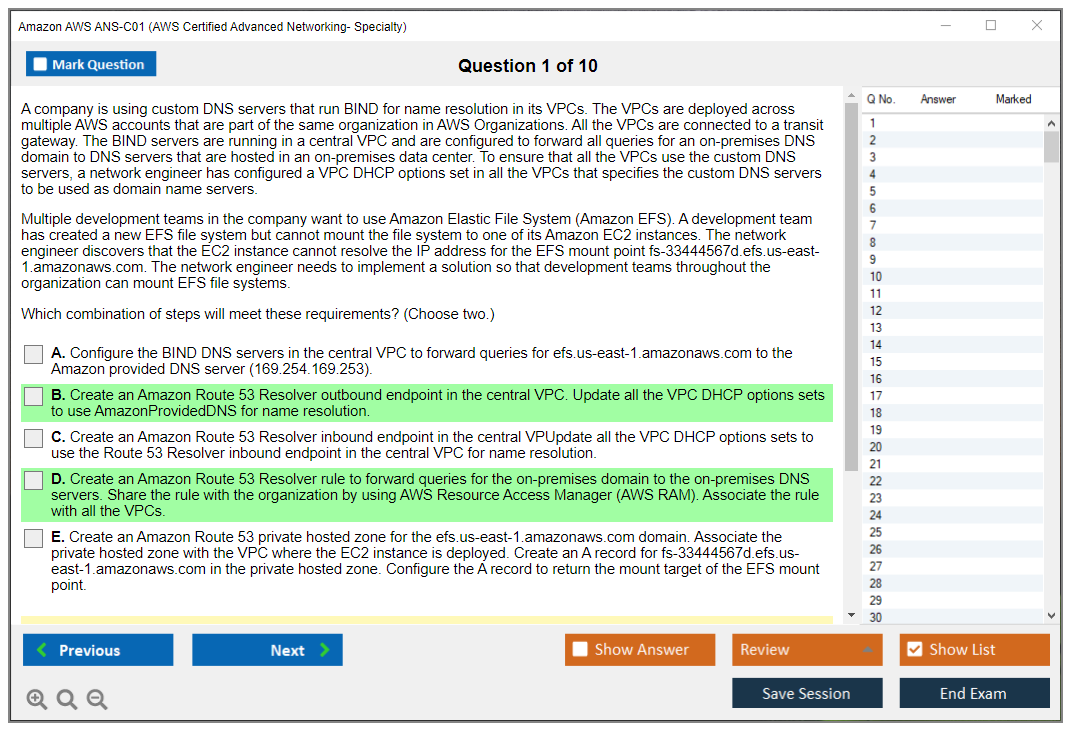
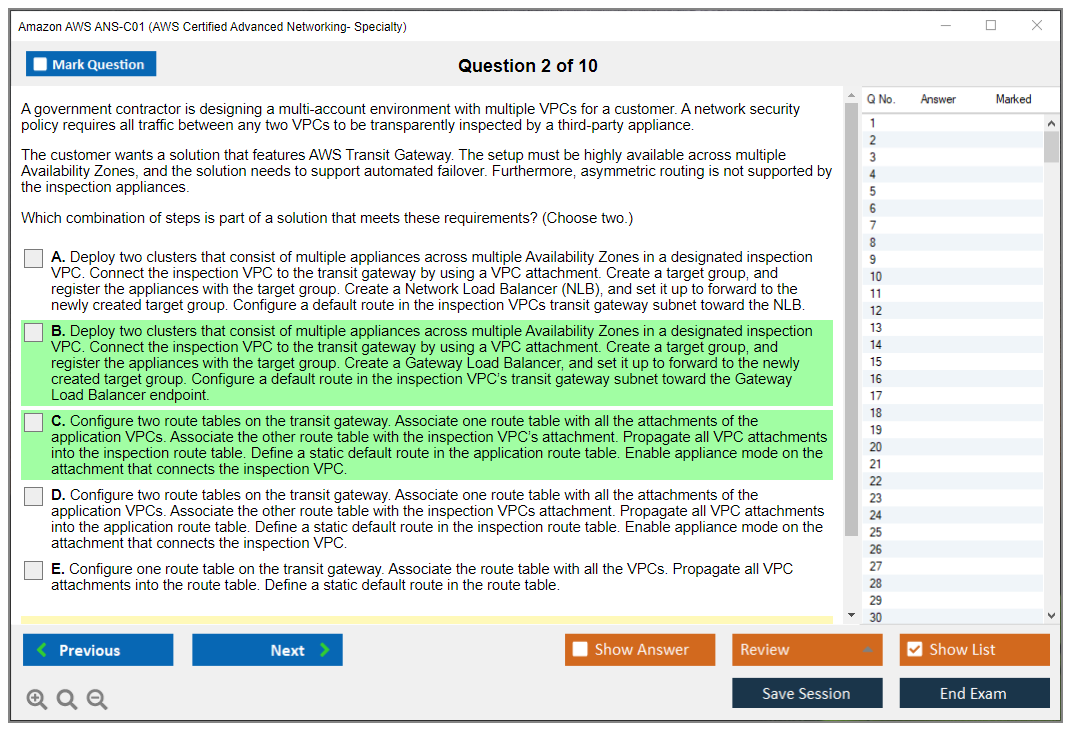
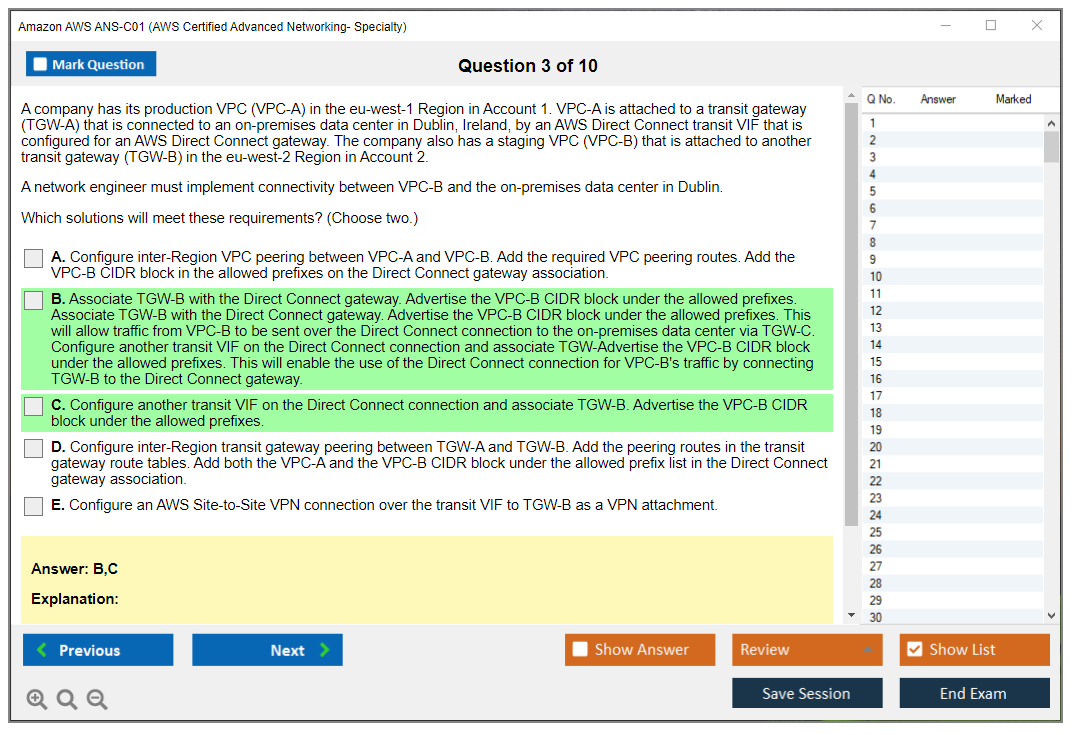
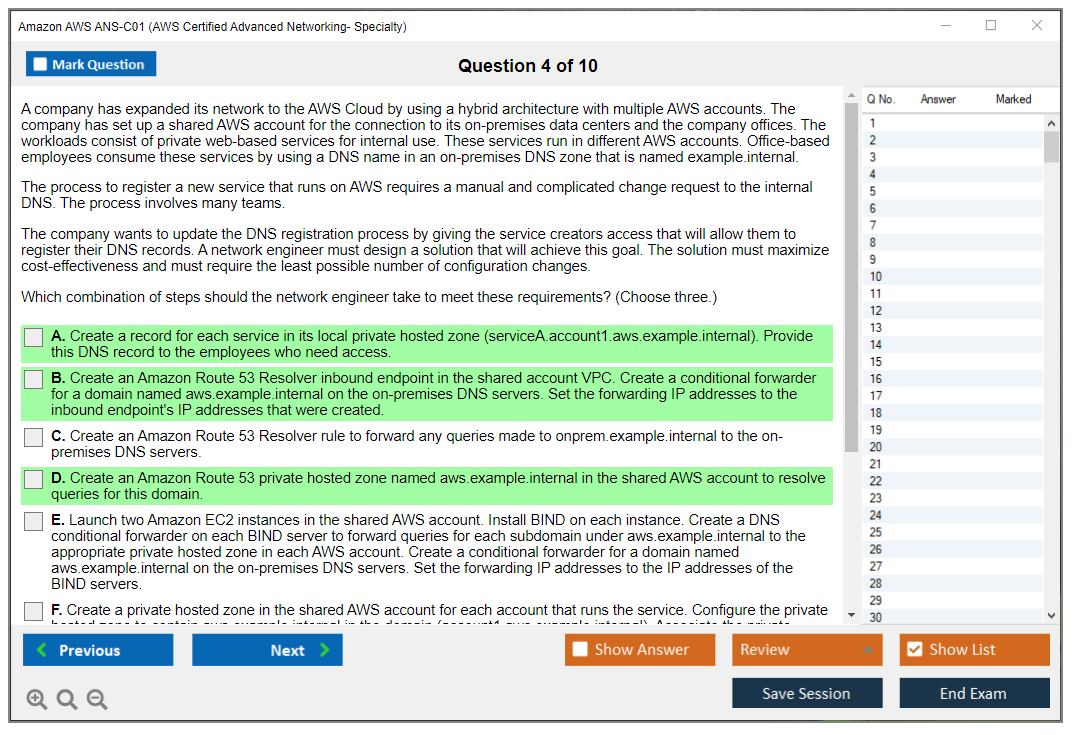
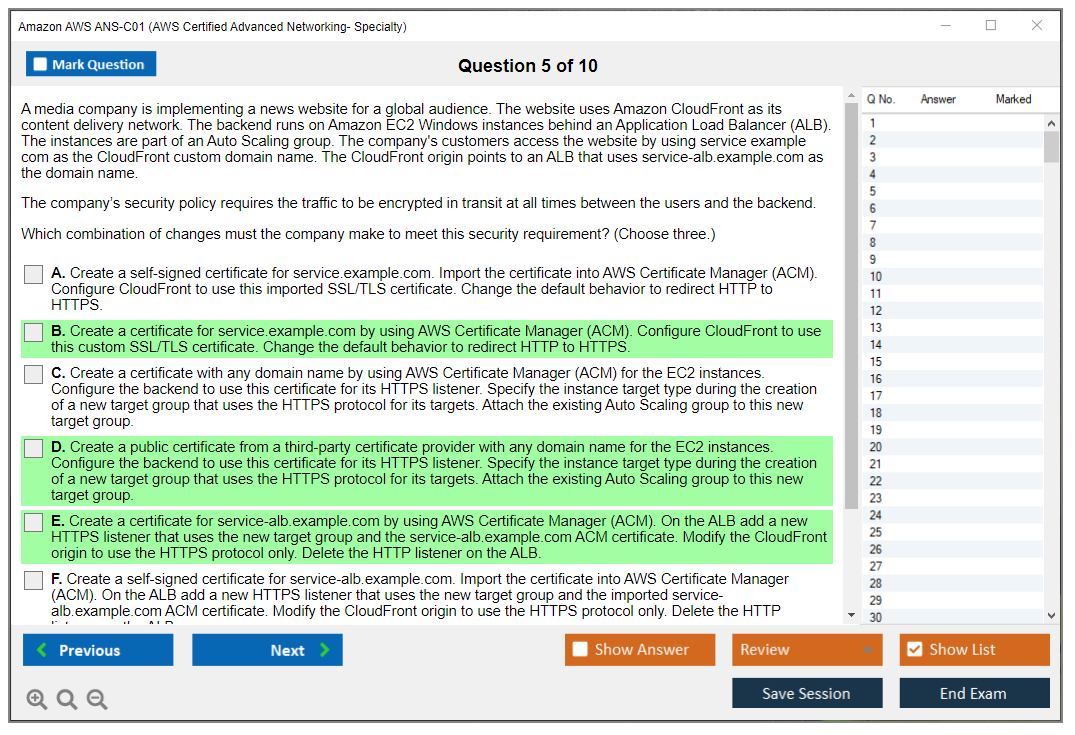
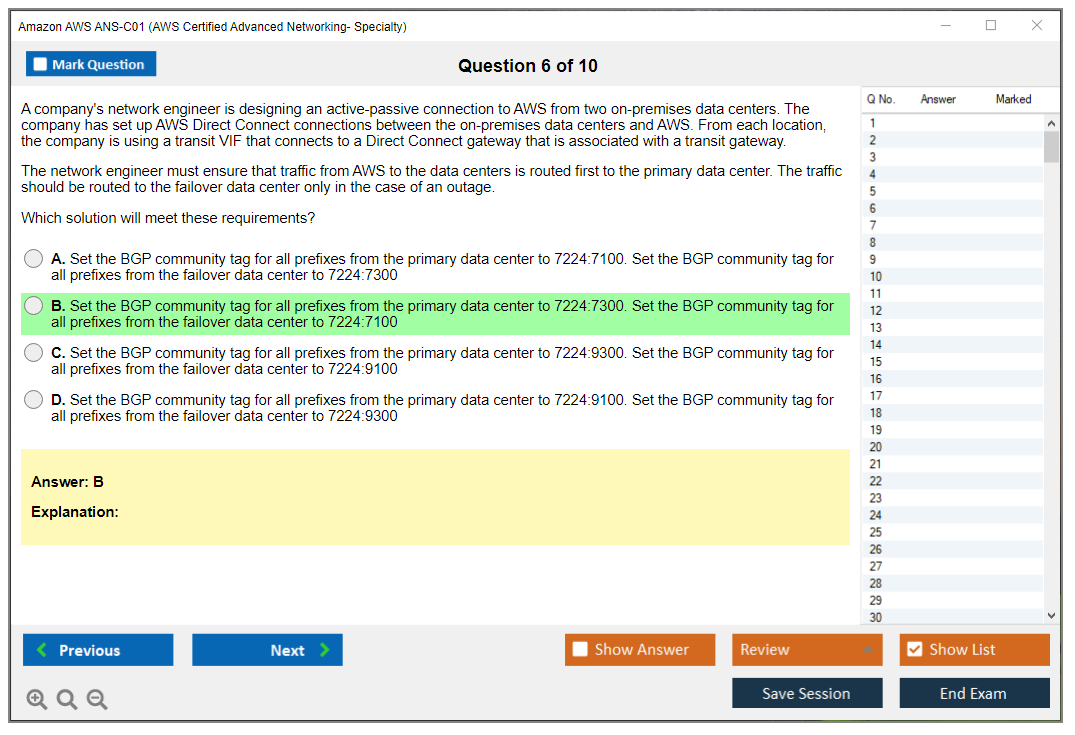
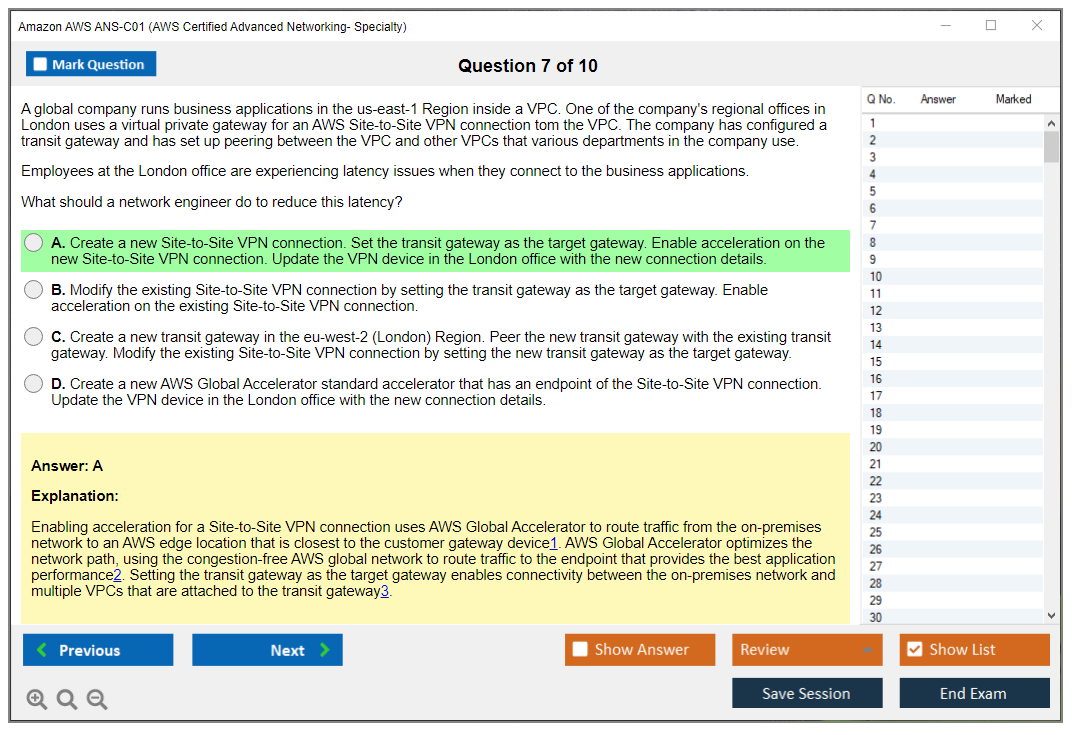
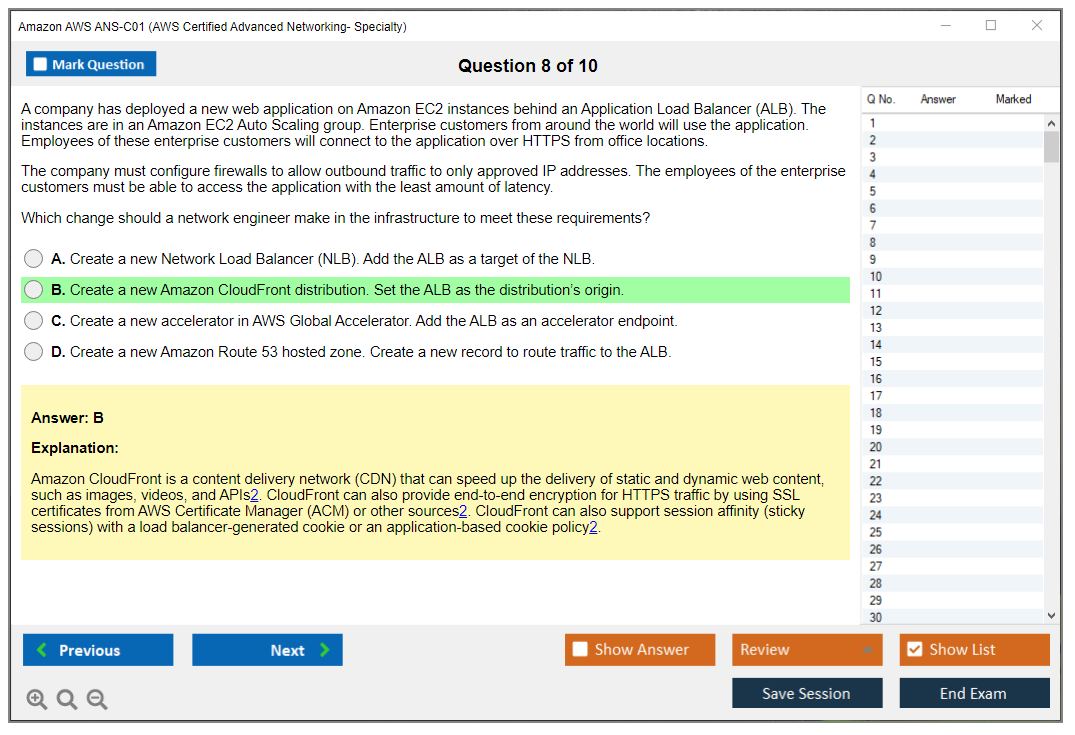
Dumpsarena Amazon AWS Amazon AWS Certified Advanced Networking - Specialty (ANS-C01) Free Practice Exam Simulator Test Engine Exam preparation with its cutting-edge combination of authentic test simulation, dynamic adaptability, and intuitive design. Recognized as the industry-leading practice platform, it empowers candidates to master their certification journey through these standout features.
What is in the Premium File?
Satisfaction Policy – Dumpsarena.co
At DumpsArena.co, your success is our top priority. Our dedicated technical team works tirelessly day and night to deliver high-quality, up-to-date Practice Exam and study resources. We carefully craft our content to ensure it’s accurate, relevant, and aligned with the latest exam guidelines. Your satisfaction matters to us, and we are always working to provide you with the best possible learning experience. If you’re ever unsatisfied with our material, don’t hesitate to reach out—we’re here to support you. With DumpsArena.co, you can study with confidence, backed by a team you can trust.
Amazon AWS ANS-C01 Exam FAQs
Introduction of Amazon AWS ANS-C01 Exam!
The duration of the Amazon AWS ANS-C01 exam is 170 minutes.
What is the Duration of Amazon AWS ANS-C01 Exam?
Amazon AWS ANS-C01 is an advanced-level certification exam that validates the skills and knowledge of candidates in designing and implementing advanced networking solutions using AWS services. The exam is designed for experienced network professionals who have a deep understanding of networking concepts and are proficient in using AWS services to build secure and scalable network architectures. The exam covers a broad range of topics, including designing and implementing hybrid IT network architectures, automating network tasks, and troubleshooting network issues. The exam consists of multiple-choice and multiple-response questions, and candidates have 170 minutes to complete it. The passing score for the exam is 750 out of 1000.
What are the Number of Questions Asked in Amazon AWS ANS-C01 Exam?
The Amazon AWS ANS-C01 exam consists of multiple-choice and multiple-response questions. The exact number of questions is not disclosed by AWS.
What is the Passing Score for Amazon AWS ANS-C01 Exam?
The passing score for the Amazon AWS ANS-C01 exam is 750 out of 1000.
What is the Competency Level required for Amazon AWS ANS-C01 Exam?
The Amazon AWS ANS-C01 exam is designed for experienced network professionals who have a deep understanding of networking concepts and are proficient in using AWS services to build secure and scalable network architectures.
What is the Question Format of Amazon AWS ANS-C01 Exam?
The Amazon AWS ANS-C01 exam consists of multiple-choice and multiple-response questions. The exact format of the questions is not disclosed by AWS.
How Can You Take Amazon AWS ANS-C01 Exam?
The Amazon AWS ANS-C01 exam can be taken either online or at a testing center. Online exams can be taken from the comfort of your own home or office, and are proctored remotely by a live proctor. Testing centers offer a traditional testing environment, with a proctor present in the room. Both options provide a secure testing environment and the same level of certification upon passing the exam. It is important to note that online exams require a stable internet connection, a webcam, and a quiet, distraction-free environment. Additionally, online exams must be scheduled in advance and have specific technical requirements that must be met.
What Language Amazon AWS ANS-C01 Exam is Offered?
The Amazon AWS ANS-C01 exam is offered in English, Japanese, Korean, and Simplified Chinese.
What is the Cost of Amazon AWS ANS-C01 Exam?
The cost of the Amazon AWS ANS-C01 exam is $150 USD.
What is the Target Audience of Amazon AWS ANS-C01 Exam?
The target audience for the Amazon AWS ANS-C01 exam is individuals who have experience designing and deploying scalable, highly available, and fault-tolerant systems on AWS. This includes solutions architects, systems administrators, and developers.
What is the Average Salary of Amazon AWS ANS-C01 Certified in the Market?
The average salary for an Amazon AWS ANS-C01 certified professional varies depending on factors such as location, experience, and job role. According to Payscale, the average salary for an AWS Certified Solutions Architect - Associate (which includes the ANS-C01 certification) is $121,000 USD per year in the United States.
Who are the Testing Providers of Amazon AWS ANS-C01 Exam?
The testing provider for the Amazon AWS ANS-C01 exam is Pearson VUE.
What is the Recommended Experience for Amazon AWS ANS-C01 Exam?
It is recommended that candidates have at least one year of experience in designing and operating applications on AWS before taking the ANS-C01 exam.
What are the Prerequisites of Amazon AWS ANS-C01 Exam?
There are no prerequisites for the ANS-C01 exam, but it is recommended that candidates have some experience with AWS.
What is the Expected Retirement Date of Amazon AWS ANS-C01 Exam?
The expected retirement date for the ANS-C01 exam is March 22, 2022. You can check for updates and official information on the AWS Certification website: https://aws.amazon.com/certification/
What is the Difficulty Level of Amazon AWS ANS-C01 Exam?
The Amazon AWS ANS-C01 exam is considered to be of moderate difficulty. However, the difficulty level may vary depending on the candidate's level of experience and knowledge of AWS services.
What is the Roadmap / Track of Amazon AWS ANS-C01 Exam?
The ANS-C01 exam is part of the AWS Certified Advanced Networking - Specialty certification. The roadmap for this certification includes passing the AWS Certified Cloud Practitioner exam, then the AWS Certified Solutions Architect - Associate or AWS Certified Developer - Associate exam, and finally the AWS Certified Advanced Networking - Specialty exam. More information can be found on the AWS Certification website: https://aws.amazon.com/certification/certified-advanced-networking-specialty/
What are the Topics Amazon AWS ANS-C01 Exam Covers?
The Amazon AWS ANS-C01 exam covers various topics related to AWS services such as AWS architecture, security, networking, databases, storage, and more.
What are the Sample Questions of Amazon AWS ANS-C01 Exam?
Sample questions for the Amazon AWS ANS-C01 exam can be found on the official AWS website or through various online resources. These questions cover a range of topics and can help candidates prepare for the exam.
Amazon AWS ANS-C01 (Amazon AWS Certified Advanced Networking - Specialty) AWS Certified Advanced Networking, Specialty (ANS-C01) Certification Overview AWS Certified Advanced Networking, Specialty (ANS-C01) Certification Overview Look, the AWS Certified Advanced Networking, Specialty (ANS-C01) isn't for everyone. This certification separates casual AWS users from professionals who actually architect production networks at scale. The kind that support real business operations handling thousands of concurrent connections, complex routing requirements, and security constraints that'd make your head spin. We're validating your ability to design multi-region architectures, implement hybrid connectivity solutions that survive real-world pressure, and troubleshoot network issues that send junior engineers running for help. Network engineers and architects who've been in the trenches? That's who this targets. Not gonna lie, if you're just starting with cloud networking, this ain't where you... Read More
Amazon AWS ANS-C01 (Amazon AWS Certified Advanced Networking - Specialty)
AWS Certified Advanced Networking, Specialty (ANS-C01) Certification Overview
AWS Certified Advanced Networking, Specialty (ANS-C01) Certification Overview
Look, the AWS Certified Advanced Networking, Specialty (ANS-C01) isn't for everyone. This certification separates casual AWS users from professionals who actually architect production networks at scale. The kind that support real business operations handling thousands of concurrent connections, complex routing requirements, and security constraints that'd make your head spin. We're validating your ability to design multi-region architectures, implement hybrid connectivity solutions that survive real-world pressure, and troubleshoot network issues that send junior engineers running for help.
Network engineers and architects who've been in the trenches? That's who this targets. Not gonna lie, if you're just starting with cloud networking, this ain't where you should begin.
What makes ANS-C01 different from other AWS certs
The thing is, ANS-C01 replaced the older ANS-C00 version. AWS didn't just slap new branding on it. They incorporated newer networking services like AWS Cloud WAN, VPC Lattice, and beefed-up Transit Gateway capabilities reflecting what enterprises actually need today. The previous version was already tough, but this update ensures you're learning relevant technologies instead of legacy approaches that nobody uses anymore.
Unlike associate-level certifications testing foundational knowledge (stuff you can memorize from documentation), this specialty demands deep understanding of complex networking concepts. We're talking BGP routing. CIDR planning that won't paint you into a corner six months down the road. Network segmentation strategies. Traffic engineering. You can't fake your way through scenario-based questions asking you to evaluate trade-offs between different architectural approaches, weighing cost against performance against security in ways that mirror actual business decisions.
I've seen people with AWS Certified Solutions Architect - Professional credentials struggle here because networking is just.. different. It's not about deploying EC2 instances or configuring S3 buckets. It's about understanding how packets actually move, why route propagation behaves certain ways, and what happens when your BGP AS_PATH gets manipulated. Or worse, when someone accidentally advertises your entire address space to the internet. I once saw that happen at a mid-sized SaaS company, three years back. Complete disaster. Took their entire platform offline for six hours while they scrambled to fix the route announcements and convince upstream providers it was a mistake, not a hijack attempt.
Who should actually pursue this certification
AWS recommends at least five years of hands-on experience implementing networking solutions. Two years working specifically with AWS networking services. That's not arbitrary gatekeeping. The exam tests practical knowledge you only gain from building real architectures, dealing with production incidents at 2 AM when everything's on fire, and making costly mistakes that taught you exactly why certain design patterns exist in the first place.
This certification proves particularly valuable for several roles. Cloud network architects. Senior network engineers managing complex infrastructures. Infrastructure architects responsible for enterprise cloud networking strategies. If you're designing networks supporting thousands of VPCs, handling petabytes of data transfer, or building millisecond-sensitive applications across global AWS regions, this certification validates you know what you're doing. That you've got the expertise to back up your architectural decisions.
Organizations benefit from certified professionals who can architect secure, resilient network infrastructures supporting mission-critical workloads. The certification distinguishes candidates in competitive job markets and often correlates with higher salary ranges. Having this on your resume signals you're not entry-level. You've put in the time and proven your expertise through rigorous examination.
Skills you'll actually validate
The AWS Certified Advanced Networking, Specialty (ANS-C01) validates advanced technical skills in designing and implementing AWS and hybrid IT network architectures at scale. You'll demonstrate expertise in network automation, security, and optimization across scenarios most engineers never encounter during their entire careers. Complex multi-account environments with stringent compliance requirements. Global applications requiring sub-100ms latency. Hybrid architectures integrating legacy on-premises systems with modern cloud services.
Key competencies include designing scalable, highly available, and cost-optimized network architectures using services like Amazon VPC, AWS Transit Gateway, AWS Direct Connect, and Amazon Route 53. But it's knowing these services exist. It's understanding when Transit Gateway makes sense versus VPC peering based on connectivity patterns and data transfer costs. Knowing that sometimes the "simpler" solution costs you thousands monthly in unnecessary data charges.
You need proficiency in AWS network design and implementation covering multi-account networking strategies, global network architectures, disaster recovery networking designs, and compliance-driven network segmentation. The exam covers advanced VPC concepts beyond basic subnet design. VPC peering limitations that bite you at scale. PrivateLink architectures. Transit Gateway routing domains. Network ACLs versus security groups and when each makes sense.
Understanding routing and BGP on AWS forms a foundation. Route propagation, path selection, AS_PATH manipulation, and BGP communities. If those terms sound foreign, you're not ready yet. Seriously, go spend more time with production BGP implementations first. Same goes for hybrid connectivity (VPN, Direct Connect), where you'll need deep knowledge of VPN configurations, Direct Connect virtual interfaces, LAG configurations, and failover scenarios that actually work when your primary connection dies instead of creating asymmetric routing nightmares.
ANS-C01 exam details
Exam format and what to expect
Scenario-based questions. Multiple choice plus multiple response formats.
You've got 170 minutes for 65 questions, which honestly sounds like plenty of time until you're actually sitting there dissecting these massive network architecture scenarios where you're juggling performance against cost against compliance requirements. Suddenly you're watching that clock way more nervously than you'd expected. The thing is, each question unfolds like a small consulting engagement.
AWS delivers the exam through Pearson VUE testing centers or online proctoring. The online option's convenient, though you'll need a quiet space and stable internet. Testing center experiences? They vary wildly depending on location. I once showed up to a center that shared a wall with what sounded like a CrossFit gym, which was less than ideal.
ANS-C01 exam cost and pricing
The ANS-C01 exam cost runs $300 USD. That's standard for AWS specialty certifications, though you're paying for validation of specialized expertise rather than general knowledge. Some employers cover certification costs, so check before paying out of pocket.
No hidden fees. Beyond the exam itself, anyway, though you might invest in study materials, practice tests, or training courses separately.
ANS-C01 passing score and how scoring works
The ANS-C01 passing score is 750 out of 1000. AWS uses scaled scoring, so it's not a simple percentage calculation. Some questions carry more weight than others, and unscored experimental questions appear on every exam.
You won't know which questions are experimental while testing, which honestly adds psychological pressure. The scaled scoring approach means you can't precisely calculate how many questions you need correct, but generally you're looking at roughly 75% accuracy.
ANS-C01 difficulty level
Let's be real. About ANS-C01 difficulty: this is one of the harder AWS certifications.
Many people consider it comparable to AWS Certified Solutions Architect - Professional in terms of complexity, though the focus differs.
What makes it challenging isn't memorizing service features. It's understanding how multiple networking components integrate into production-ready architectures that actually work in the real world without falling apart under load or budget scrutiny. Questions present scenarios where multiple answers could work, and you need to identify the best approach considering factors like cost, performance, compliance, and operational overhead.
The exam focuses on real-world application over memorization. You need hands-on experience with AWS networking services rather than theoretical knowledge alone. Reading documentation won't cut it when questions ask how to troubleshoot VPC Flow Logs showing unexpected traffic patterns or optimize Direct Connect configurations for specific workload requirements.
ANS-C01 exam objectives (domains)
Domain 1. Network design
Look, this domain's all about designing network architectures that're scalable, available, and cost-optimized. You'll see questions on multi-region architectures, disaster recovery designs, and choosing appropriate connectivity patterns.
Honestly? Expect scenarios testing your understanding of when to use Transit Gateway versus VPC peering, how to design hub-and-spoke topologies, and strategies for IP address planning that won't limit future growth down the line when your infrastructure inevitably expands beyond what anyone originally anticipated. I've seen too many networks painted into a corner with /24 subnets everywhere.
Domain 2. Network implementation
Implementation questions test whether you can actually build what you designed. Simple as that. This includes configuring VPCs, setting up Direct Connect connections, implementing routing policies, and deploying network security controls.
You need familiarity with CloudFormation for network automation, understanding of how Infrastructure as Code applies to networking, and knowledge of programmatic network configuration approaches that'll save you from clicking through the console like it's 2010.
Domain 3. Network management and operation
Management and operations cover monitoring, troubleshooting, and optimizing network performance. You'll need to interpret VPC Flow Logs, analyze CloudWatch metrics, identify performance bottlenecks, and resolve connectivity issues.
Questions might present log excerpts or metric graphs requiring you to diagnose problems and recommend solutions. Real-world stuff. This domain validates you can support networks post-deployment, not just build them initially and walk away hoping everything stays functional without constant babysitting.
Domain 4. Network security, compliance, and governance
Security topics include security group design at scale, network ACLs, AWS Network Firewall, AWS WAF integration, and DDoS protection using AWS Shield. You'll need understanding of how networking architectures support regulatory frameworks like HIPAA, PCI-DSS, and GDPR.
Expect questions about network segmentation strategies, implementing least privilege network access, and designing architectures that maintain compliance while still letting the business actually do something useful. It's a balancing act, no way around that.
What each domain emphasizes
Across all domains, the exam tests whether you can distinguish between knowing service features and understanding when to apply specific services to solve complex business requirements. There's a difference. You'll encounter questions covering VPC architecture and connectivity patterns, DNS architectures using Route 53 including health checks and routing policies, and network troubleshooting and monitoring on AWS across distributed environments that span multiple regions and availability zones needing consistent connectivity and performance.
Prerequisites and recommended experience
AWS Advanced Networking Specialty prerequisites
AWS doesn't enforce prerequisites. You can register for this exam without holding other certifications. However, that doesn't mean you should. The AWS Advanced Networking Specialty prerequisites in practice include solid networking fundamentals and substantial AWS experience that you've actually gotten your hands dirty with.
Most successful candidates already hold certifications like AWS Certified Solutions Architect - Associate or AWS Certified SysOps Administrator. These provide foundational AWS knowledge you'll build upon.
Recommended AWS and networking background
You need comfort with traditional networking concepts. Subnetting, routing protocols, network security, DNS, and load balancing matter here. If you're shaky on OSI model layers or can't explain how BGP path selection works, shore up fundamentals first.
Real talk here. On the AWS side, hands-on experience with VPC design, Transit Gateway deployments, Direct Connect implementations, and Route 53 configurations proves necessary. You should've built multi-VPC architectures. Configured VPN connections. Troubleshot network connectivity issues in production environments where things actually break and people start asking questions at 2 AM.
Understanding hybrid connectivity scenarios where AWS integrates with on-premises data centers is key. Many exam questions assume you're connecting cloud and traditional infrastructure, not building greenfield cloud-only networks. The thing is, this reflects reality better anyway. I once spent three weeks debugging a hybrid setup where the issue turned out to be a single misconfigured route table entry that nobody thought to check because "we already verified that part." Lesson learned.
Helpful prior certifications
While not required, holding AWS Certified Security - Specialty complements this certification nicely since network security overlaps significantly. The Solutions Architect Professional certification also helps because architectural thinking applies across domains.
Network professionals transitioning from traditional data center environments find this certification bridges on-premises networking knowledge with cloud-native networking approaches. Your existing expertise remains relevant, but you'll need to understand how AWS networking differs from traditional approaches (which can feel weird initially, honestly).
Best study materials for ANS-C01
AWS Advanced Networking Specialty study materials and resources
Start with the official exam guide from AWS. It outlines domains, weightings, and sample questions. AWS whitepapers on networking topics provide deep technical content, especially documents covering VPC design, hybrid connectivity, and network security best practices.
AWS documentation for networking services is required reading. I mean actually reading it, not skimming. Understand VPC, Transit Gateway, Direct Connect, Route 53, CloudFront, and newer services like Cloud WAN and VPC Lattice.
Third-party study guides and video courses exist. Quality varies wildly. You're investing time and money without knowing if the instructor actually gets it or they're just regurgitating. Look for AWS Advanced Networking Specialty study materials created by instructors with real-world networking experience, not AWS evangelists reading documentation at you. The difference shows up fast when they hit complex scenarios.
Training courses and structured learning
AWS Skill Builder offers official training paths for this certification. Instructor-led courses provide more structure but cost more than self-paced options. The value depends on your learning style and budget.
Some candidates benefit from bootcamp-style intensive training. Others prefer spreading study over months. Neither approach guarantees success without hands-on practice, which brings me to my next point.
Hands-on labs are non-negotiable
You need hands-on experience.
Work with VPC design. Transit Gateway configuration. Direct Connect setup (even in simulation). Route 53 advanced routing policies. Cloud WAN deployment. Reading about these services won't prepare you for scenario questions requiring deep understanding of how they actually behave in production environments.
Build multi-VPC architectures. Set up VPN connections. Configure BGP routing. Implement PrivateLink. Troubleshoot network connectivity issues. Make mistakes in lab environments so you don't repeat them during the exam.
ANS-C01 practice tests and exam prep strategy
ANS-C01 practice tests and choosing quality questions
Quality matters here.
ANS-C01 practice tests range from stellar to, honestly, pretty terrible. You want questions mirroring the exam's scenario-heavy format instead of those lame recall-style ones. Decent practice tests don't just mark you wrong. They actually break down why the right answer works and, just as important, why those other options fall flat. Real concepts instead of turning this into some memorization game.
AWS provides official practice exams, though they're frustratingly shorter than what you'll face on test day. Third-party providers like Tutorials Dojo and Whizlabs put together practice tests too, but here's the thing: you need to verify they've updated everything for ANS-C01 versus that older ANS-C00 exam.
Don't fall into the trap of just memorizing practice test answers because that will bite you later. If you're crushing practice tests but can't articulate why those answers are actually correct, you're not ready yet.
Study plan by timeline
Your study timeline? It depends on what you're bringing to the table experience-wise.
Someone deep in AWS networking for five years might only need 4-6 weeks of focused study. Someone making the jump from traditional networking environments might realistically need 3-4 months to get there. There's no universal answer.
A solid approach involves dedicating your initial weeks to reviewing all the domains, middle weeks grinding through hands-on labs, and those final weeks hammering practice tests while shoring up your weak spots at the same time. Don't cram this stuff. Networking concepts really require time to internalize. I've seen people burn through material in two weeks and then wonder why they can't troubleshoot a Transit Gateway peering scenario under pressure.
Common pitfalls and how to avoid them
Candidates mess this up constantly.
Many people underestimate the exam's difficulty level, assuming their general AWS knowledge will be enough. It won't. Others obsess over memorizing individual service features without grasping architectural trade-offs between different approaches. Some completely skip hands-on practice, mistakenly believing documentation reading prepares them for real-world scenarios.
You can dodge these mistakes by treating this as a specialty certification demanding specialized preparation, not just another AWS exam. If you're not regularly neck-deep in advanced AWS networking at your job, you need dedicated study time regardless of whatever other AWS certifications you've already collected.
ANS-C01 renewal and recertification
AWS Advanced Networking Specialty renewal policy
The AWS Advanced Networking Specialty renewal period is three years from when you pass. AWS wants to make sure certified professionals actually know the current stuff as their services change, and look, they update things all the time.
You can recertify by retaking whatever the current exam version is or by passing a higher-level certification. There isn't one higher than specialty in this track though. Most people just retake the specialty exam when renewal comes around. It's the straightforward path, you know?
Recertification options
AWS sometimes offers different recertification paths through training and assessments. But exam retakes are still the most common way. Check your AWS Certification account for what's available since policies shift and what works today might change next year.
The retake costs money. You pay the full exam fee again, which annoys some people, but it does push you to stay current instead of just riding on knowledge from three years ago that's probably outdated now anyway.
Keeping skills current
AWS drops new networking services constantly.
Cloud WAN, VPC Lattice, enhanced Transit Gateway capabilities all showed up recently. These things change how we build solutions in ways that weren't even possible when you first certified. Staying current means following AWS announcements, sure, but also messing around with new services in your own environment and figuring out how they fit into architectures you've already built.
Your certification proves you understood AWS networking at one specific point. That's all it does. Remaining valuable as a professional means learning continuously beyond that initial certification because technology doesn't wait around for anyone. Sometimes I think the three-year renewal period is actually generous given how fast things move. People who certified five years ago and never looked at AWS again would be pretty lost today with all the service mesh stuff and application networking layers that didn't exist back then.
FAQs
Is ANS-C01 worth it for network engineers?
Honestly? Yeah, it's valuable. Especially if you're already neck-deep in cloud environments or planning that jump from traditional networking. This matters. The certification validates specialized expertise that's increasingly valuable as enterprises adopt cloud architectures requiring sophisticated networking solutions, which frankly isn't going anywhere anytime soon.
How long should you study for ANS-C01?
Depends on your background.
Most people need 2-4 months with regular study, though I've seen folks already working extensively with AWS networking compress that timeline down to 4-6 weeks. Don't rush it, seriously. This exam punishes superficial preparation in ways that'll frustrate you. You really need that depth.
What's the best way to practice hybrid networking scenarios?
Build actual hybrid architectures in lab environments. Set up VPN connections, configure Direct Connect (or simulate it if you can't afford the real thing.. and who can?), test failover scenarios until you're dreaming about route tables. Implement hybrid DNS resolution too.
Reading case studies helps, sure, but hands-on practice cements understanding of how hybrid connectivity actually works versus just knowing the theory. Big difference there. I once spent three hours troubleshooting a BGP peering issue that turned out to be a single wrong ASN entry, which taught me more than any documentation ever could about attention to detail in these configs.
ANS-C01 Exam Details and Structure
AWS Certified Advanced Networking, Specialty (ANS-C01) overview
AWS Certified Advanced Networking, Specialty (ANS-C01) is the networking cert that stops being "can you click the console" and becomes "can you design this whole thing, keep it fast, keep it secure, and not bankrupt the company." It's for people who already live in routing tables, security boundaries, and hybrid connectivity (VPN, Direct Connect). And yes, it's picky.
Who it's for: Network engineers, cloud network architects, SREs who got dragged into VPC sprawl, and anyone owning AWS network design and implementation across multiple accounts and Regions. Folks doing enterprise migrations too. Not beginners. I mean, not even "I passed SAA last month" beginners.
Skills it validates (AWS networking at scale) is basically this: you can reason about VPC architecture and connectivity patterns, multi-VPC routing, segmentation, DNS behavior, load balancing, and how everything behaves when it's under pressure, which honestly is where most people learn they've been guessing. You'll also get hammered on routing and BGP on AWS, plus hybrid designs where on-prem isn't going away and the business wants "five nines" anyway.
ANS-C01 exam details
Exam format (question types, length, delivery)
The exam's 170 minutes. That's 2 hours and 50 minutes. Long enough to second-guess yourself into oblivion if you don't manage time.
You get 65 questions. Multiple-choice and multiple-response. Some're straight picks, others're "Select TWO" or "Select THREE," and the exam tells you how many to choose. No partial credit. If you miss one option on a multiple-response, you get nothing for that question. Harsh, but normal for AWS.
Delivery's either Pearson VUE testing centers or online proctoring. Pick your poison. Testing centers're controlled and predictable, and honestly that's why I like them, because home testing means one weird webcam glare or background noise and you're suddenly stressed about rules instead of the actual material. Online proctoring's still legit though, and if you live far from a center, it's a lifesaver, assuming your internet's stable and your room's actually private.
You can flag questions for review and move around freely. Do it. Answer the easy ones first. Also, there's no penalty for wrong answers, so leaving blanks is just donating points to AWS.
Time math works out to roughly 2.5 minutes per question with a little buffer, but some questions're quick while many decidedly are not. A bunch read like mini design reviews with distractors that'd work in a lab but would be dumb in production.
Cost (exam price and any additional fees)
The ANS-C01 exam cost is $300 USD. That's the specialty tier, same bucket as AWS Security, Database, and Machine Learning specialty exams. Not cheap, not outrageous either, but you feel it if you're self-funding.
There's a discount angle though. If you've passed any AWS Associate-level certification, AWS gives you a 50% discount voucher, bringing it down to $150 USD for eligible candidates. Look, that voucher's one of the best reasons to do an Associate first even if your job title's already "Senior Network Whatever." Money's money.
Vouchers you buy through AWS or authorized training partners're valid for one year from purchase date, which's nice if life gets chaotic and you need to reschedule your plans without wasting cash.
Passing score (how scoring works and what to expect)
The ANS-C01 passing score is 750 on a scaled range of 100 to 1000. People always ask "so what percent's that," and the practical answer's roughly around 75% correct, but it's not a clean percentage because AWS weights questions and uses scaled scoring.
Scaled scoring means AWS adjusts for difficulty differences between exam forms, so the standard stays consistent even if one version has nastier scenario questions than another. It's annoying if you want a simple grade, but it's fairer overall.
You get immediate pass/fail at the end. The detailed score report shows up within five business days in your AWS Certification Account, and it breaks results down by domain. If you fail, that breakdown's gold because it tells you which areas of ANS-C01 exam objectives are dragging you down.
Retakes: you wait 14 days after a fail, you pay again each time, and there's no limit on attempts, so yes, you can brute-force it, but your wallet'll notice.
Difficulty (what makes ANS-C01 challenging)
The ANS-C01 difficulty is high. Pass rates're often estimated around 60 to 70%, which's notably lower than associate-level exams that tend to land more like 75 to 85%. Not gonna lie, that tracks with what I see in real life too.
The hard part isn't memorizing service names. The hard part's multi-service scenarios where several answers're technically possible, but only one's the BEST given cost, performance, scalability, and operational overhead. You'll see distractors that'd work in a lab, but would be dumb in production. Those're the traps.
Expect scenarios with diagrams, config snippets, and architecture descriptions. You'll be reading about route propagation, asymmetric routing, overlapping CIDRs, firewall insertion, DNS split-horizon, and hybrid connectivity (VPN, Direct Connect) with BGP details sprinkled in. It's design plus operations, not trivia.
Also, AWS generally includes services and features announced up to six months before the exam version release date, so the newest thing you saw last week might not show up, and you shouldn't obsess over every brand-new announcement.
ANS-C01 exam objectives (domains)
AWS divides the ANS-C01 exam objectives into domains that map to what network teams actually do. Designing, building, operating, keeping it compliant. Simple words, spiky questions.
Domain 1: Network design
This's where you choose architectures. Transit Gateway vs VPC peering's a recurring theme. Cloud WAN might show up as an option too. You'll get asked to design for multi-account, multi-Region, shared services, and segmentation, and you need to understand blast radius, routing control, and cost implications, not just "can these VPCs talk."
Domain 2: Network implementation
Implementation's the "okay, now configure it" side. Route tables, TGW attachments, NAT and egress patterns, load balancers, DNS behavior, hybrid connectivity setup including BGP routing, route prioritization, and failure behavior.
One that people underestimate's how often the question's really about packet flow. Like, what path does traffic take from subnet A to on-prem, and what breaks if you add a second VPN tunnel, or a second Direct Connect, or a firewall appliance in the middle?
Domain 3: Network management and operation
Operations's monitoring, troubleshooting, and keeping changes from wrecking things. Expect VPC Flow Logs, Reachability Analyzer, CloudWatch metrics, Route 53 Resolver rules, and how to prove where the problem is when an app team says "network issue" with zero evidence.
This's also where time sinks happen on the exam because the scenarios're wordy, because they include symptoms, because multiple fixes "could" help. You're meant to pick the most direct, most supportable fix.
Domain 4: Network security, compliance, and governance
Security's layered controls. SGs vs NACLs, central inspection, PrivateLink endpoints, egress control, DNS filtering, multi-account governance patterns. Also compliance language. Sometimes the question's basically "how do we enforce this everywhere without manual drift," and the answer's architectural, not a single checkbox.
What each domain emphasizes (key services and scenarios)
If you want to anchor your studying, focus on the repeat players: VPC, Transit Gateway, Route 53 (including Resolver), Direct Connect, VPN types, load balancing, PrivateLink, and the troubleshooting stack. Then add the "gotchas" like overlapping CIDRs, multi-Region failover behavior, and BGP route selection. The thing is, you'll also see Network Firewall, GWLB, CloudFront with custom origins, and how on-prem DNS interacts with AWS.
Prerequisites and recommended experience
Prerequisites (official vs. recommended)
AWS doesn't hard-require another cert first. You can register and take ANS-C01 whenever. But that's the official answer. The real answer's you want prior AWS exposure plus real networking fundamentals, otherwise the question wording'll feel like a foreign language.
Recommended AWS and networking background (BGP, routing, hybrid, DNS)
You should be comfortable with routing concepts outside AWS. BGP attributes at a basic practical level, route propagation, prefix matching, NAT behavior, DNS recursion and forwarding, how asymmetric routing happens, and how it looks when it breaks.
On the AWS side, you need to understand how VPC routing differs from traditional networks, how TGW changes the game, and what "managed" means when AWS owns the underlay and you only control the edges.
Helpful prior certifications (e.g., Associate/Professional)
Associate certs help mostly because they force you into AWS vocabulary and console patterns, and they unlock the 50% discount voucher. Solutions Architect Associate plus SysOps's a common combo. Some folks come from Solutions Architect Professional and still find ANS-C01 harder in a different way, because this exam's narrower but deeper on network trade-offs.
Best study materials for ANS-C01
Study materials (official exam guide, whitepapers, docs)
For AWS Advanced Networking Specialty study materials, the AWS exam guide and sample questions're the baseline, not the finish line. Then you're in docs and whitepapers land. Honestly, most people fail because they study like it's a memorization test, and ANS-C01 punishes that.
Read docs on Transit Gateway routing, DX + VPN redundancy patterns, Route 53 Resolver, VPC endpoint behavior, and network troubleshooting tools. Don't just skim. Recreate the diagrams mentally.
Training courses (AWS Skill Builder / instructor-led options)
AWS Skill Builder can help structure the topics. Instructor-led courses can be great if you need a forced schedule and you can expense it. If you can't, don't panic. The exam's passable with self-study plus labs, but you need discipline and repetition. I once spent three weekends just breaking and fixing route propagation because I kept getting those questions wrong on practice tests, and that repetition saved me on exam day.
Hands-on labs (VPC, Transit Gateway, Direct Connect, Route 53, Cloud WAN)
Hands-on matters because packet flow's the whole exam. Build a multi-VPC environment with TGW, add inspection, break routing, fix it, log it. If you've got access to Direct Connect at work, great. If not, simulate hybrid with Site-to-Site VPN and focus on the concepts: route exchange, failover, and what happens when routes overlap.
ANS-C01 practice tests and exam prep strategy
Practice tests (how to choose high-quality questions)
ANS-C01 practice tests are useful if they're scenario-heavy and explain why wrong answers're wrong. If a practice test's mostly trivia, skip it. You want questions that force trade-offs: cost vs complexity, performance vs manageability, centralized vs distributed routing.
One detailed tip: after each practice set, write down the services you got wrong and the specific misunderstanding, like "confused Client VPN with Site-to-Site VPN use cases," and then go to docs and confirm with diagrams. That loop's where improvement happens.
Study plan by timeline (2/4/6+ weeks)
Two weeks's possible if you already do AWS networking daily. Four weeks's realistic for most experienced network engineers moving into AWS patterns. Six weeks or more if you're balancing work and you need extra reps on routing and DNS.
Keep sessions short sometimes. Twenty-five minutes, just diagrams. Then do longer blocks on weekends where you lab and review mistakes, because long scenario reading's part of the stamina test.
Common pitfalls and how to avoid them
Big pitfall: treating "can work" as "best." The exam loves options that're valid but operationally painful.
Another: ignoring cost. Some answers're technically perfect and financially silly. AWS expects you to notice.
Last: time management. Don't get stuck. Flag it, move on.
ANS-C01 renewal and recertification
Renewal policy and validity period
AWS Advanced Networking Specialty renewal works like other AWS certs. Valid for three years. Then you recertify.
Recertification options (retake vs. updated exam path)
You typically renew by passing the current version of the specialty exam again, not the old one. AWS may release updated versions as services evolve, so keep an eye on the certification page for version changes.
Keeping skills current (new services and networking feature changes)
AWS networking changes fast, but the fundamentals don't. Keep current by following TGW and Route 53 Resolver feature updates, and periodically revisiting hybrid patterns and monitoring tools, because those're the areas where small new features change the "best answer."
FAQs
How much does the AWS ANS-C01 exam cost?
The ANS-C01 exam cost is $300 USD. If you've passed any AWS Associate certification, you can apply the 50% discount voucher and pay $150 USD.
What is the passing score for AWS Advanced Networking, Specialty?
The ANS-C01 passing score is 750 on a scaled 100 to 1000 score range. Scaled scoring adjusts for difficulty differences between exam forms.
Is AWS Advanced Networking Specialty harder than Solutions Architect Professional?
Depends on your background. If you live in routing, BGP, and hybrid designs, ANS-C01 feels fair but intense. If your strength's broad architecture and apps, ANS-C01 can feel harder because it goes deeper on packet flow and AWS-specific networking edge cases.
What are the best study materials and practice tests for ANS-C01?
Best AWS Advanced Networking Specialty study materials are the official exam guide plus AWS docs and whitepapers for VPC, TGW, Route 53 Resolver, Direct Connect, and troubleshooting tools. For ANS-C01 practice tests, pick ones with long scenarios and strong explanations, not trivia dumps.
How do you renew the AWS Advanced Networking, Specialty certification?
AWS Advanced Networking Specialty renewal is every three years. You renew by passing the current exam version again, and then you keep the active status plus your digital badge and certificate, which you can share on LinkedIn and verify via the AWS Certification directory.
ANS-C01 Exam Objectives and Domain Breakdown
The ANS-C01 exam objectives are organized into four primary domains
Real talk here. The ANS-C01 exam objectives aren't some random collection of topics AWS threw together on a Tuesday afternoon. They've structured this thing into four distinct domains, each carrying different weight depending on what actually matters when you're running advanced networking in live production environments. This isn't your basic associate-level certification where everything magically gets the same attention and you can just memorize dumps and hope for the best.
Domain 1? Heaviest hitter. 30% of your exam.
Network Design is that big one, and honestly it makes complete sense because if you can't architect things correctly from the jump, everything downstream falls apart spectacularly. Domain 2 (Network Implementation) grabs 26%, which is where you actually construct what you've designed on paper. Then there's Domain 3 sitting at 20% covering Network Management and Operation, basically the daily grind of keeping networks alive and functional. Domain 4 closes things out at 24% with Network Security, Compliance, and Governance, which has become absolutely critical given how paranoid organizations need to be about breaches nowadays. My last job, we had a security audit that revealed gaps in our VPC configurations that could've been catastrophic. Turned an entire quarter into remediation mode.
The weighting? Matters tremendously. You can't allocate equal study time across everything and expect to walk out successful. I've watched people burn weeks drilling troubleshooting scenarios (Domain 3) only to get absolutely destroyed by architectural design questions they barely glanced at during prep. Not gonna sugarcoat it. You've gotta allocate preparation time proportionally to these percentages while still maintaining full coverage of all content areas.
Domain 1: Network Design accounts for 30% of exam content
This is where the exam really separates folks who've architected complex, multi-layered networks from those who've just configured a handful of VPCs following YouTube tutorials. Domain 1 expects you to design complete network architectures supporting multi-region connectivity, disaster recovery requirements that'll actually work when disaster strikes, hybrid integration with on-premises datacenters (which, the thing is, most enterprises still have), and scalable growth patterns that won't spectacularly collapse when your traffic suddenly doubles because marketing launched something viral.
VPC architecture and connectivity patterns establish the foundation here. You need VPC design principles understood at a level beyond "create a VPC with public and private subnets, done." We're discussing subnet strategies accounting for three years of future growth, route table configurations that don't accidentally create routing loops causing outages at 2 AM, and connectivity options between VPCs and external networks meeting specific latency and bandwidth requirements your applications actually demand.
CIDR planning appears constantly throughout exam scenarios in ways that'll catch you off guard if you haven't practiced. You'll encounter questions about RFC 1918 private address space allocation, avoiding IP conflicts when connecting multiple VPCs or integrating with on-premises networks running legacy addressing schemes, and planning for future expansion without having to re-IP your entire infrastructure later. I've made exactly this mistake in production. Not allocating sufficient address space. Fixing it later is really painful, expensive, and involves way too many late nights.
The connectivity design patterns you absolutely need mastered? VPC peering (with all its weird limitations that trip people up), Transit Gateway architectures scaling to hundreds of VPCs without becoming unmanageable, PrivateLink for secure service connectivity that doesn't traverse the public internet, and VPN or Direct Connect options for hybrid connectivity serving different use cases. Each pattern has specific scenarios where it shines. The exam loves testing whether you actually know when to deploy which one versus just memorizing definitions.
Multi-region scenarios get complicated ridiculously fast. Cross-region VPC peering, inter-region Transit Gateway peering configurations, Route 53 routing policies distributing global traffic intelligently, and global accelerator architectures all populate exam questions. You need understanding not just how these technologies work individually in isolation, but how they integrate together creating resilient global architectures that survive regional failures without customers noticing.
CloudFront design surfaces more frequently than you'd initially think when reviewing objectives. Origin configurations, caching strategies that actually improve performance rather than serving stale content, integration with AWS WAF for security. These aren't just theoretical concepts discussed in whitepapers. The exam presents real-world scenarios where you're choosing the right CloudFront setup meeting specific performance or security requirements under constraints.
DNS architecture with Route 53 is massive in this domain. Public and private hosted zones, resolver endpoints for hybrid DNS scenarios where you're integrating on-premises DNS infrastructure, health check configurations that reliably detect failures rather than creating false positives. All completely fair game. Some candidates overlook DNS when studying, which is honestly a strategic mistake because DNS appears woven throughout multiple domains in unexpected ways.
Domain 2: Network Implementation comprises 26% of exam questions
Here's where you actually construct stuff. Domain 2 tests whether you can grab an architectural design and deploy it correctly without breaking everything. Configuring VPCs, implementing routing that actually works, establishing connectivity between environments. This is hands-on knowledge you absolutely can't just memorize from whitepapers and blog posts.
AWS Transit Gateway implementation receives detailed coverage that goes deep. Route tables, associations, propagations, managing complex routing scenarios spanning multiple VPCs and on-premises networks. You need understanding how all these puzzle pieces fit together. I've encountered exam questions presenting a Transit Gateway scenario with highly specific routing requirements and asking you to identify the correct configuration approach from options that all look plausible at first glance. These aren't simple multiple-choice softballs.
Hybrid connectivity (VPN, Direct Connect) implementation is absolutely critical for this domain. Site-to-Site VPN configuration including tunnel options and BGP settings that determine failover behavior, Direct Connect virtual interface setup for different use cases (public vs. private vs. transit), LAG configuration for aggregated bandwidth requirements, redundant connectivity designs that actually provide failover instead of just looking good in diagrams. All required knowledge tested extensively.
VPC endpoints implementation covers gateway endpoints for S3 and DynamoDB (which are completely free, by the way, so use them liberally) and interface endpoints for other AWS services using PrivateLink technology behind the scenes. You need knowing when to deploy each type and how they affect routing tables and security group configurations in ways that aren't immediately obvious.
Network automation appears considerably more frequently in ANS-C01 compared to associate-level exams. Infrastructure as Code using CloudFormation or Terraform for consistent deployments, programmatic network configuration using AWS APIs and SDKs. These topics reflect how networking actually gets deployed at scale in modern cloud-native environments rather than clicking through consoles.
Load balancing implementation scenarios cover Application Load Balancer for HTTP/HTTPS workloads needing layer 7 intelligence, Network Load Balancer for TCP/UDP traffic requiring ultra-low latency measured in microseconds, and Gateway Load Balancer for deploying third-party virtual appliances inline. Target groups, listeners, health checks that actually work. You need knowing the operational details, not just the high-level conceptual differences.
Domain 3: Network Management and Operation represents 20% of exam content
Network troubleshooting and monitoring on AWS is what this entire domain focuses on relentlessly. Real-world scenarios where something's catastrophically broken and you need diagnosing and fixing it using AWS-native tools. This is where hands-on experience truly shows versus people who've only read documentation.
VPC Flow Logs? Essential troubleshooting tools you'll use constantly. Enabling them at VPC, subnet, or ENI levels depending on what you're investigating, analyzing flow log data identifying traffic patterns or security issues, understanding what information they capture and what they frustratingly don't capture. These details really matter. Flow logs have saved me countless hours when tracking down bizarre connectivity problems that made zero sense initially.
CloudWatch for network monitoring includes creating custom metrics for network-specific KPIs your team actually cares about, configuring alarms that trigger when something's really wrong (not constantly crying wolf), and building dashboards giving you real visibility into network performance rather than vanity metrics. The exam tests whether you understand what metrics are actually available natively and how to use them effectively rather than just "CloudWatch monitors stuff."
Troubleshooting connectivity requires systematic understanding of how AWS evaluates traffic flowing through your architecture. Route table evaluation order, security group stateful filtering, network ACL stateless filtering, and how these components interact in sometimes counterintuitive ways. You need tracing traffic through the entire path identifying where it's being blocked or misrouted. This is methodical detective work.
Network performance optimization surfaces in scenarios testing whether you know about enhanced networking capabilities (ENA, SR-IOV), placement groups for low-latency requirements where microseconds matter, jumbo frames (MTU 9001) for improved throughput on supported instances, and selecting appropriate instance types for network-intensive workloads. Some instance types have dramatically better networking performance than others at the same price point.
Cost optimization is surprisingly important throughout this domain. Data transfer pricing between AZs, regions, and out to the internet accumulates expensive charges ridiculously fast at scale. The exam includes scenarios where you're choosing cost-effective connectivity options or implementing strategies minimizing unnecessary data transfer costs that don't add value. When you're moving terabytes daily, these architectural decisions matter financially. I mean, we're talking thousands of dollars monthly.
Domain 4: Network Security, Compliance, and Governance accounts for 24% of questions
Security implemented at multiple network layers is what Domain 4 stresses throughout. Perimeter security, microsegmentation within VPCs isolating workloads, defense-in-depth strategies that survive when one layer fails. This goes way beyond just "configure a security group and call it secure."
Security group architectures at scale require understanding security group chaining (where one security group references another creating dynamic relationships), managing rules across multiple accounts using AWS Organizations and Resource Access Manager, and designing security group strategies providing necessary segmentation without becoming operationally unmanageable when you're running hundreds of applications.
Network ACLs as stateless firewalls have specific use cases where they're more appropriate than security groups despite being more painful to manage. Understanding when to use NACLs versus security groups, how their stateless nature fundamentally affects rule design and requires explicit allow rules for return traffic, and implementing defense-in-depth strategies intelligently using both. These concepts appear regularly in tricky scenario questions.
AWS Network Firewall provides advanced traffic filtering capabilities beyond what security groups and NACLs can accomplish. Stateful rule groups, domain list filtering blocking malicious domains, intrusion prevention capabilities detecting attacks. This is a newer service that's appearing more frequently in exam questions as AWS pushes it for enterprise deployments requiring advanced protections.
DDoS protection strategies using AWS Shield Standard (which is automatic and free for everyone) and Shield Advanced (which costs serious money but provides additional protections and 24/7 support) appear in scenarios testing whether you understand architecting for resilience against DDoS attacks at different scales. Integration with CloudFront, Route 53, and Elastic Load Balancing all factor into these defensive designs.
AWS WAF for application-layer security covers managed rules maintained by AWS and third parties, rate-based rules for throttling abusive clients, and integration points with Application Load Balancers and CloudFront distributions. You need understanding what WAF can and can't protect against realistically, and how to configure rules blocking malicious traffic without accidentally breaking legitimate users trying to access your applications.
Network compliance scenarios require understanding how to implement architectures meeting regulatory requirements like PCI-DSS, HIPAA, or GDPR. These aren't just theoretical checkboxes you mark in documentation. The exam presents situations where specific compliance requirements directly dictate network architecture decisions in ways that might conflict with cost optimization or performance goals.
If you're serious about passing ANS-C01, you absolutely need quality practice materials that mirror actual exam difficulty. The ANS-C01 Practice Exam Questions Pack at $36.99 provides realistic scenarios spanning all four domains. I've reviewed practice questions from various sources that miss the mark completely by focusing on rote memorization instead of scenario-based problem-solving, which is what the actual exam relentlessly tests.
Understanding how the domains interconnect
Here's something candidates don't always grasp initially. These four domains aren't isolated silos you study separately. Real exam questions frequently span multiple domains at once. You might encounter a scenario starting with a network design question (Domain 1) but then asking about implementation specifics (Domain 2) and security controls (Domain 4) all within the same multi-part question. This reflects how actual AWS networking projects work in reality. You're never doing purely design or purely implementation in complete isolation.
The domain breakdown guides your study approach and time allocation, but don't just study each domain separately in sequence and call yourself prepared. You need understanding how VPC design decisions affect security posture, how implementation choices impact operational complexity and troubleshooting difficulty, how security requirements constrain design options in ways that force architectural compromises. This complete understanding is really what separates candidates who pass from candidates who don't.
Honestly? If you're coming from the AWS Certified Solutions Architect - Associate (SAA-C03) or AWS Certified Solutions Architect - Professional, you'll recognize some foundational concepts but the depth required for ANS-C01 is significantly greater than what those exams demanded. We're discussing BGP route propagation details and path selection, Direct Connect LAG configurations and failover behavior, Transit Gateway route table association details that create unexpected routing. Stuff that barely gets mentioned in those other certifications.
The exam objectives aren't just some study checklist you mark off mindlessly. They're a reflection of what AWS considers necessary knowledge for someone legitimately claiming advanced networking expertise on their platform. Master these four domains at the depth AWS expects (not surface level), get hands-on practice with the key services in actual AWS accounts, and work through realistic practice scenarios that challenge your understanding. That's really the path to passing ANS-C01 and actually earning that specialty certification rather than just collecting badges.
Prerequisites and Recommended Experience for ANS-C01 Success
AWS Certified Advanced Networking, Specialty (ANS-C01) overview
AWS Certified Advanced Networking, Specialty (ANS-C01) is not your typical "watch some tutorials and pass" situation. This one separates people who actually design, operate, and troubleshoot real enterprise networks running on AWS from folks still getting comfortable with basic VPC concepts. It's built for people who already live in routes, failure domains, propagation rules, and blast radius calculations. Not aspirational stuff, but day job reality.
Who's it for? Network engineers, cloud network engineers, SREs who somehow got dragged into networking responsibilities, and architects constantly fielding questions like "why's this path asymmetric" without being able to dodge anymore. Honestly, it's for anyone managing hybrid environments with multiple accounts, multiple VPCs, and multiple on-prem sites where simple solutions collapse under scrutiny.
Skills validated here? AWS networking at scale, basically. That means VPC architecture and connectivity patterns, shared services, centralized egress and ingress, segmentation, DNS design. Plus the annoying-but-necessary parts like operational visibility, routing intent, and change control when you're juggling dozens (or hundreds) of attachments and route tables.
ANS-C01 exam details
Exam format (question types, length, delivery)
Standard AWS specialty exam structure. Multiple choice and multiple response. You take it at a test center or via online proctoring.
Time's generous enough that fatigue actually becomes a concern, and pacing matters because those "long scenario" questions devour minutes if you're rereading them constantly. Some questions? Straightforward. Many others? Not even close. Wordy stems. Routing diagrams you're mentally constructing while reading. A few will make you question whether you've ever actually configured a VPC before.
Cost (exam price and any additional fees)
How much does the AWS ANS-C01 exam cost? The ANS-C01 exam cost typically runs USD $300 (standard AWS specialty exam pricing). Additional fees depend on your choices: late rescheduling, traveling to testing centers, or purchasing third-party AWS Advanced Networking Specialty study materials and ANS-C01 practice tests.
Passing score (how scoring works and what to expect)
Another frequent question: What is the passing score for AWS Advanced Networking, Specialty? AWS employs scaled scoring, so there's no published "you need exactly X raw points" formula. You'll encounter people citing specific numbers, but the ANS-C01 passing score gets expressed as a scaled threshold that varies by exam form.
Expecting partial credit on multi-response questions? Don't. Treat them as "all correct or you're just giving away points."
Difficulty (what makes ANS-C01 challenging)
The ANS-C01 difficulty is legit. Memorizing services isn't the challenge. It's about juggling constraints: BGP behavior, hybrid connectivity (VPN, Direct Connect), routing intent inside Transit Gateway, DNS resolution paths, and security controls, then determining what happens when one link flaps or one route propagates somewhere it shouldn't.
Plus, this exam loves edge cases. Propagation versus static routes. Return path logic. Overlapping CIDRs. Multi-account connectivity patterns. That kind of pain.
ANS-C01 exam objectives (domains)
Domain 1. Network design
Design tests your instincts, honestly. Multi-VPC, multi-region, segmentation, centralized inspection, centralized egress, address planning. You've gotta be comfortable proposing actual target architectures, not just naming features.
Domain 2. Network implementation
Implementation's the "how." Route tables, attachments, endpoints, DNS settings, Direct Connect plus VPN combinations, and the actual mechanics of constructing what you designed. If you've only consumed videos, this domain exposes that gap immediately.
Domain 3. Network management and operation
Monitoring, troubleshooting, day-2 operations. Think flow logs, CloudWatch, Reachability Analyzer, routing diagnostics, and operational patterns preventing meltdowns during incidents. Change management matters here, because networking changes are never truly "small."
Domain 4. Network security, compliance, and governance
Security involves network controls plus policy constraints. NACLs versus security groups, centralized firewall patterns, encryption expectations, inspection routing, governance across accounts. Not just "turn on a firewall," more like "prove traffic can only go through the firewall."
What each domain emphasizes (key services and scenarios)
You'll encounter VPC, Transit Gateway, Direct Connect, Site-to-Site VPN, Route 53, ELB behaviors, VPC endpoints, and occasionally CloudFront or Global Accelerator adjacent networking concepts. Plus loads of network troubleshooting and monitoring on AWS themes. If your mental model of AWS networking is "subnet equals VLAN," you're headed for trouble.
Prerequisites and recommended experience
Prerequisites (official vs. recommended)
Here's where people get confused. The AWS Advanced Networking Specialty prerequisites officially include no mandatory prior certifications. You can register, pay, and take it whenever.
However, AWS strongly recommends holding an active AWS Certified Solutions Architect, Associate or possessing equivalent knowledge. That recommendation isn't arbitrary. The exam assumes you already speak AWS: IAM basics, multi-account patterns, high availability design, service limits, and how AWS constructs differ from on-prem infrastructure.
Experience-wise, AWS recommends at least five years of hands-on network solution design and implementation before attempting this specialty. Not five years of "I submitted tickets to the network team." Five years of making routing decisions and living with consequences.
They also recommend at least two years working specifically with AWS networking services in production. Not labs. Not "I built a VPC once." Production means change windows, outages, legacy constraints, messy requirements. That's what the exam replicates.
Recommended AWS and networking background (BGP, routing, hybrid, DNS)
Strong traditional fundamentals aren't optional. OSI layers. TCP/IP. Subnetting. Routing and switching basics. If you're hesitating on "what's the difference between a routing protocol and a routed protocol," stop and fix that foundation first.
IP addressing is critical. You need CIDR fluency: subnet masks, usable IP ranges, planning non-overlapping spaces across multiple VPCs and on-prem. And not just for today's needs, but for growth, M&A, new regions, new accounts, and that one team that'll absolutely pick an overlapping RFC1918 range if nobody stops them.
Then there's routing and BGP on AWS, where many brilliant people stumble. You should already understand BGP concepts like autonomous systems (AS), how eBGP differs from iBGP in intent, what route advertisement means, and how path selection works with attributes like AS_PATH, LOCAL_PREF, and MED. The exam expects you to reason about what AWS will prefer, what your on-prem will prefer, and what happens when you introduce redundancy with multiple Direct Connects, VPN backup, or multiple paths through Transit Gateway.
Hybrid experience matters tremendously. Real-world context with enterprise WAN technologies like MPLS and SD-WAN makes AWS hybrid questions feel normal rather than alien. You don't need carrier engineer depth, but you should know why enterprises use MPLS, what SD-WAN is attempting to solve, and how traditional VPN technologies behave when links jitter, MTU's misconfigured, or routes converge slowly.
DNS is another "quiet prerequisite." You should be comfortable with record types (A, AAAA, CNAME, MX, TXT), how recursive resolution works, zone delegation, split-horizon concepts, and security considerations. Route 53 isn't particularly hard, but DNS design in hybrid networks gets weird. Especially when mixing private hosted zones, inbound and outbound resolvers, on-prem DNS, and conditional forwarding.
Network security fundamentals appear constantly: firewalls, IDS/IPS, VPNs, encryption protocols, basic threat thinking. The ANS-C01 isn't purely a security exam, but it assumes you understand why certain designs are safer and what controls belong at which layer.
On the AWS side, you should have practical AWS network design and implementation experience. That means production VPCs: multi-tier architectures, public versus private subnets, route tables, internet gateways, NAT gateways, and the differences that matter during troubleshooting. Fragments matter here. Default routes, return routes, stateful versus stateless filtering.
Transit Gateway's basically a main character. You should have hands-on experience creating attachments, configuring route tables, managing propagation, building hub-and-spoke topologies. If you've never debugged why an attachment isn't receiving propagated routes or why a TGW route table association's wrong, you're missing the muscle memory the exam tests.
And hybrid connectivity. You want real work with hybrid connectivity (VPN, Direct Connect): setting up Site-to-Site VPN, understanding BGP versus static, knowing what happens when tunnels fail, combining VPN with Direct Connect for resiliency.
Direct Connect adds its own gotchas: location redundancy, LAG behavior, private VIF versus transit VIF, routing domains, coordination with whoever owns the physical path. It's not theoretical. I once watched a colleague spend three hours troubleshooting asymmetric routing because nobody documented which VIF was advertising which prefix. That experience teaches you things no whitepaper can.
Helpful prior certifications (e.g., Associate/Professional)
If you're asking what cert to do first, Solutions Architect Associate is the obvious baseline. SysOps can help for ops thinking. Networking folks sometimes skip architect certs and regret it because ANS-C01 questions assume you know how AWS services interact outside the network layer.
A pro-level cert can help, but it's not mandatory. What matters is whether you can read an architecture scenario and immediately see failure points, routing implications, and operational blast radius.
Best study materials for ANS-C01
Study materials (official exam guide, whitepapers, docs)
Use the official ANS-C01 exam objectives as your checklist. Then live in the docs for VPC, Transit Gateway, Direct Connect, Site-to-Site VPN, Route 53 Resolver, VPC endpoints, network security patterns.
Whitepapers help, but don't turn this into a reading marathon. You need to connect concepts to behavior. "What changes in the data plane when I do X." That's the mindset.
Training courses (AWS Skill Builder / instructor-led options)
AWS Skill Builder courses are fine for structure. Instructor-led can be excellent if you need a forcing function and someone to answer "but why" questions. Just don't assume a course equals readiness. This exam punishes passive learning.
Hands-on labs (VPC, Transit Gateway, Direct Connect, Route 53, Cloud WAN)
Do labs that mimic production patterns. Build a multi-VPC environment, connect via Transit Gateway, add segmentation, then break it intentionally and fix it using logs and analyzers.
If possible, touch Cloud WAN too, at least enough to understand where it fits and when Transit Gateway remains the better answer. Mentioning it because it appears more frequently now. Not always, but enough.
ANS-C01 practice tests and exam prep strategy
Practice tests (how to choose high-quality questions)
People ask: What are the best study materials and practice tests for ANS-C01? For ANS-C01 practice tests, choose ones that explain why each option's right or wrong and reference docs. If explanations are fluffy, skip it. The value's in the reasoning, not the score.
One detailed tip: Track every miss into a notes doc, but categorize it: routing logic, DNS behavior, security control placement, or service limits. After a week, you'll see your pattern, and that's what you fix.
Study plan by timeline (2/4/6+ weeks)
Two weeks? Possible only if you already do this job and just need exam shaping. Four weeks is realistic for experienced network engineers new-ish to AWS. Six-plus weeks if you're learning both AWS and enterprise networking concepts simultaneously, because that's legitimately a lot and burnout's real.
Build. Read. Test. Repeat. But keep building.
Common pitfalls and how to avoid them
Big pitfall: treating AWS networking like a direct clone of on-prem. Another: ignoring DNS until the end. Also: not practicing troubleshooting, which is where you learn what the system actually does, not what you wish it did.
And one more. Overlapping CIDRs. Sounds basic, yet it's behind so many hybrid problems that AWS can't magically fix for you.
ANS-C01 renewal and recertification
Renewal policy and validity period
AWS Advanced Networking Specialty renewal follows AWS cert validity rules, typically a multi-year validity period (AWS has been on a 3-year cycle). Check the current AWS policy page because dates and options can change.
Recertification options (retake vs. updated exam path)
Usually you renew by passing the current version of the exam again. Sometimes AWS introduces an updated exam code, and you follow that path. Either way, assume you'll need to stay current with service updates, because networking features evolve and the exam follows.
Keeping skills current (new services and networking feature changes)
Maintain a small lab. Read AWS networking announcements occasionally. And when your org adopts something new, volunteer to be the person who validates routing behavior and monitoring, because that's the exact experience ANS-C01 rewards.
FAQs
Is ANS-C01 worth it for network engineers?
If you're already doing cloud networking work, absolutely, because it maps to real responsibilities and helps you speak "AWS-native" networking instead of translating everything back into old mental models.
How long should you study for ANS-C01?
Depends on your background. If you have the five years of networking and the two years of AWS networking in production, you might only need a few weeks of focused prep. If not, give yourself the time. Cramming won't teach you routing instincts.
What's the best way to practice hybrid networking scenarios?
Build a mini hybrid in a lab: two VPCs, Transit Gateway, a simulated on-prem router (even a small virtual appliance), then test failure modes like tunnel loss, route changes, DNS resolution paths across boundaries. Make it misbehave. Fix it. That's the closest thing to "experience" you can manufacture.
Conclusion
Wrapping up your ANS-C01 path
Here's the deal. The AWS Certified Advanced Networking, Specialty isn't some weekend cramming situation. It's legitimately testing whether you've got the chops for VPC architecture and connectivity patterns, hybrid connectivity through VPN and Direct Connect, and the whole routing and BGP on AWS side constantly trips people up.
The ANS-C01 difficulty? It's legit. You're wrestling with scenarios involving multi-region Transit Gateway peering, BGP route manipulation, Direct Connect failover architectures, and network troubleshooting at a level most engineers never encounter in their day jobs. That's precisely why it carries weight. Employers recognize you can't fake your way through AWS network design questions demanding you choose between CloudHub versus Transit Gateway versus VPC peering for specific use cases with cost and performance tradeoffs.
The ANS-C01 exam cost sits at $300. Not cheap, honestly. With that 750 ANS-C01 passing score requirement, you better be prepared. I've watched plenty of network engineers with years of Cisco experience bomb this because they underestimated how different AWS networking is from traditional enterprise networking. The exam objectives cover four domains, but they're all connected in ways that make memorizing services basically useless without understanding the actual architectural patterns.
I had a colleague who spent two months just on Transit Gateway configurations. He built this elaborate lab environment with multiple accounts and regions, then realized halfway through he'd been configuring route tables backwards the entire time. Cost him maybe $80 in AWS charges but he said it was the best learning experience he had. Sometimes you need to screw things up properly to really get it.
Your best bet? Mix multiple AWS Advanced Networking Specialty study materials. The official exam guide, hands-on labs in your own AWS account (seriously, nothing beats breaking and fixing Transit Gateways yourself), and quality ANS-C01 practice tests mirroring the exam's scenario-based format. You need all three. Also, the AWS Advanced Networking Specialty renewal happens every three years, so you're committing to staying current with how rapidly AWS releases new networking features.
Before scheduling that exam, invest time with solid practice materials covering real-world scenarios. The ANS-C01 Practice Exam Questions Pack delivers the kind of detailed, scenario-heavy questions you'll actually face, with explanations helping you understand the why behind each answer. Because passing isn't just about the cert. It's about proving you can build production-grade AWS networks that actually work when things go sideways at 3am.
Show less info
Hot Exams
Related Exams
Information Security Foundation based on ISO/IEC 27002
AWS Certified: SAP on AWS - Specialty
AWS Certified Solutions Architect - Associate (SAA-C03)
AWS Certified Machine Learning - Specialty
AWS Certified SysOps Administrator - Associate
AWS Certified Data Analytics - Specialty
AWS Certified AI Practitioner Exam(AI1-C01)
AWS Certified Developer - Associate
AWS Certified Alexa Skill Builder-Specialty
AWS Certified SysOps Administrator - Associate (SOA-C02)
AWS Certified Database - Specialty
AWS Certified Security - Specialty
AWS Certified DevOps Engineer - Professional
Amazon AWS Certified Advanced Networking - Specialty
AWS Certified Solutions Architect - Professional
AWS Certified Cloud Practitioner
How to Open Test Engine .dumpsarena Files
Use FREE DumpsArena Test Engine player to open .dumpsarena files


DumpsArena.co has a remarkable success record. We're confident of our products and provide a no hassle refund policy.

Your purchase with DumpsArena.co is safe and fast.
The DumpsArena.co website is protected by 256-bit SSL from Cloudflare, the leader in online security.