DP-900 Practice Exam - Microsoft Azure Data Fundamentals
Reliable Study Materials & Testing Engine for DP-900 Exam Success!
Exam Code: DP-900
Exam Name: Microsoft Azure Data Fundamentals
Certification Provider: Microsoft
Corresponding Certifications: Microsoft Certified: Azure Data Fundamentals , Microsoft Azure


Free Updates PDF & Test Engine
Verified By IT Certified Experts
Guaranteed To Have Actual Exam Questions
Up-To-Date Exam Study Material
99.5% High Success Pass Rate
100% Accurate Answers
100% Money Back Guarantee
Instant Downloads
Free Fast Exam Updates
Exam Questions And Answers PDF
Best Value Available in Market
Try Demo Before You Buy
Secure Shopping Experience
DP-900: Microsoft Azure Data Fundamentals Study Material and Test Engine
Last Update Check: Mar 15, 2026
Latest 297 Questions & Answers
Training Course 32 Lectures (2 Hours) - Course Overview
45-75% OFF
Hurry up! offer ends in 00 Days 00h 00m 00s
*Download the Test Player for FREE
Printable PDF & Test Engine Bundle
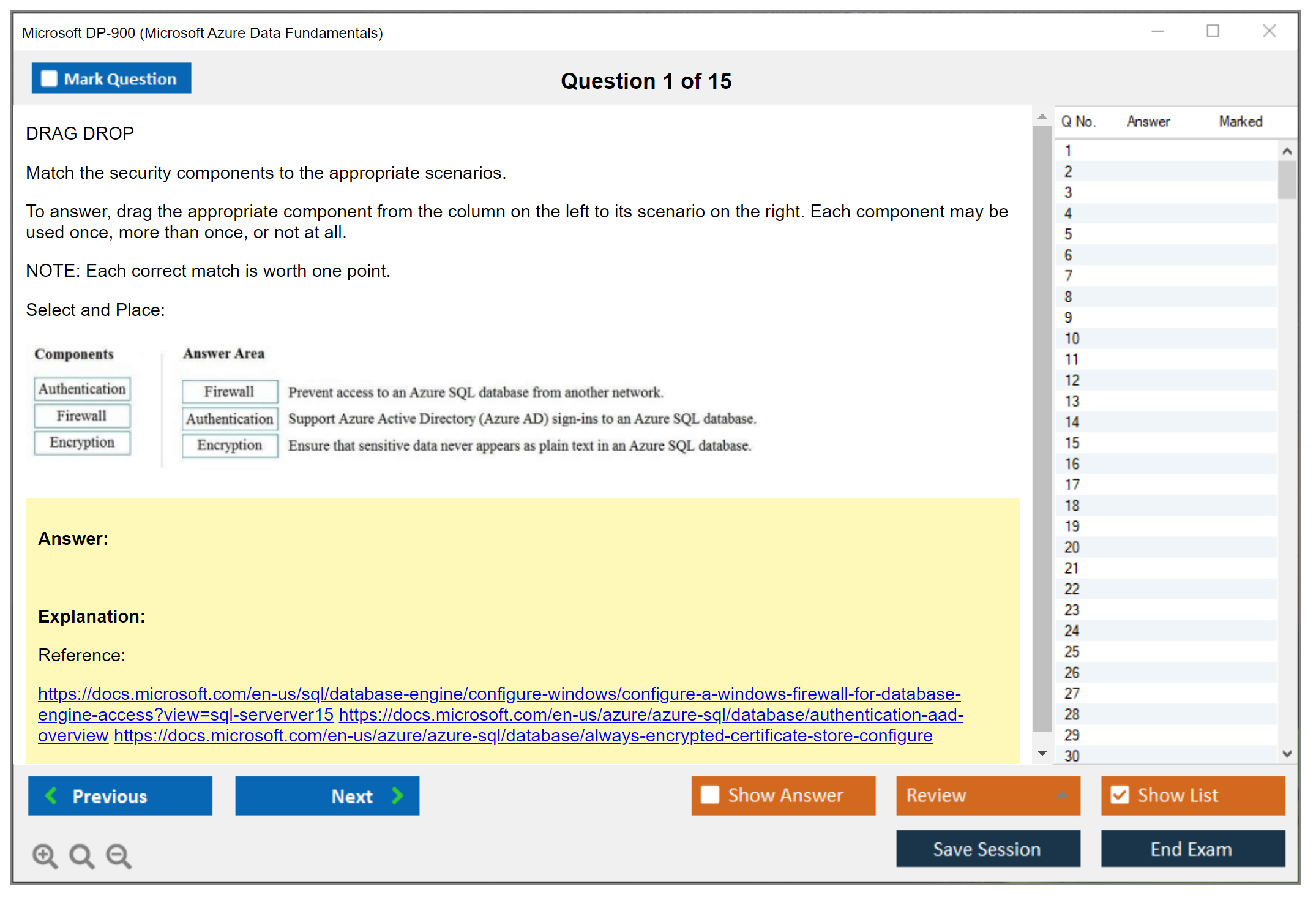
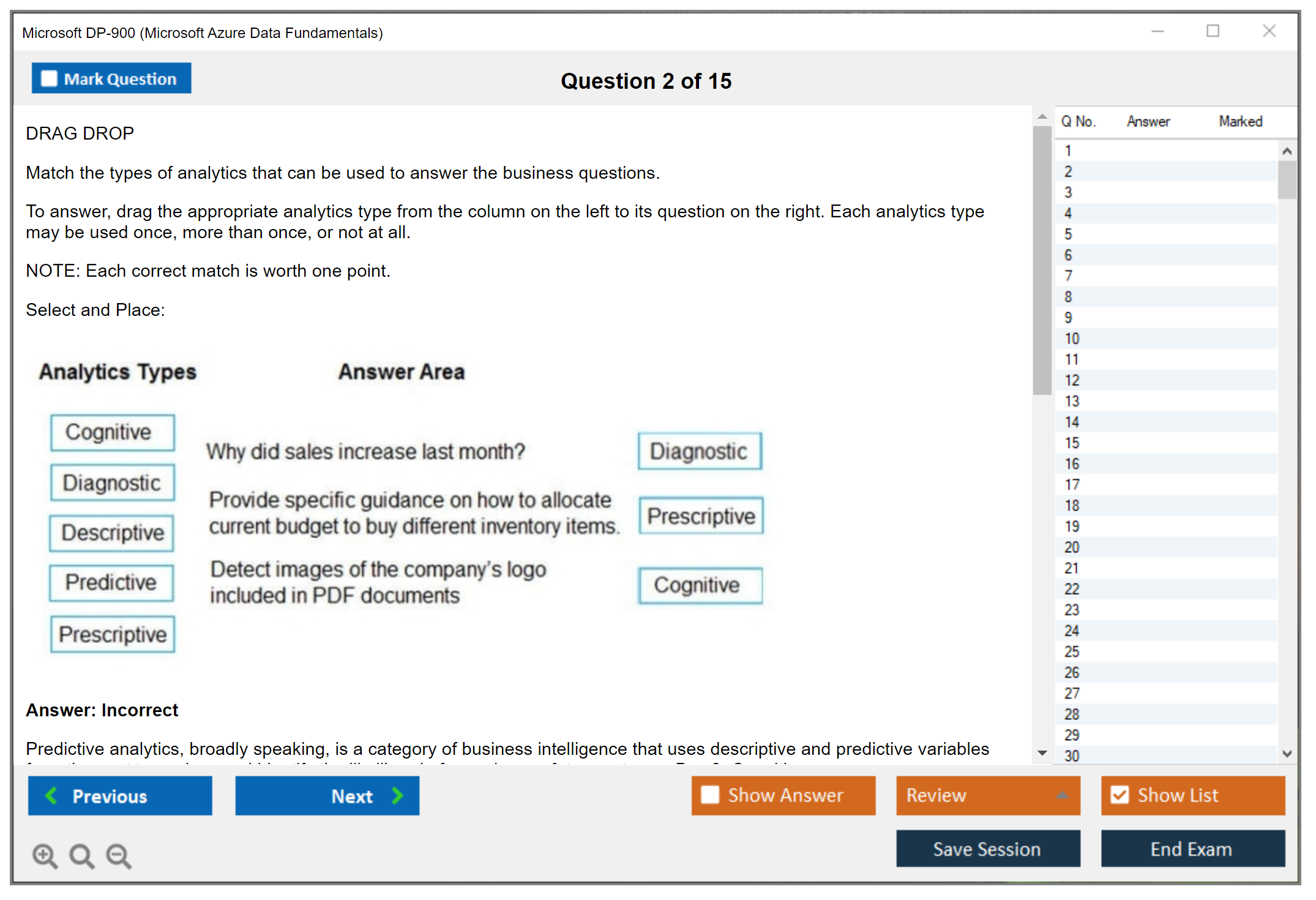
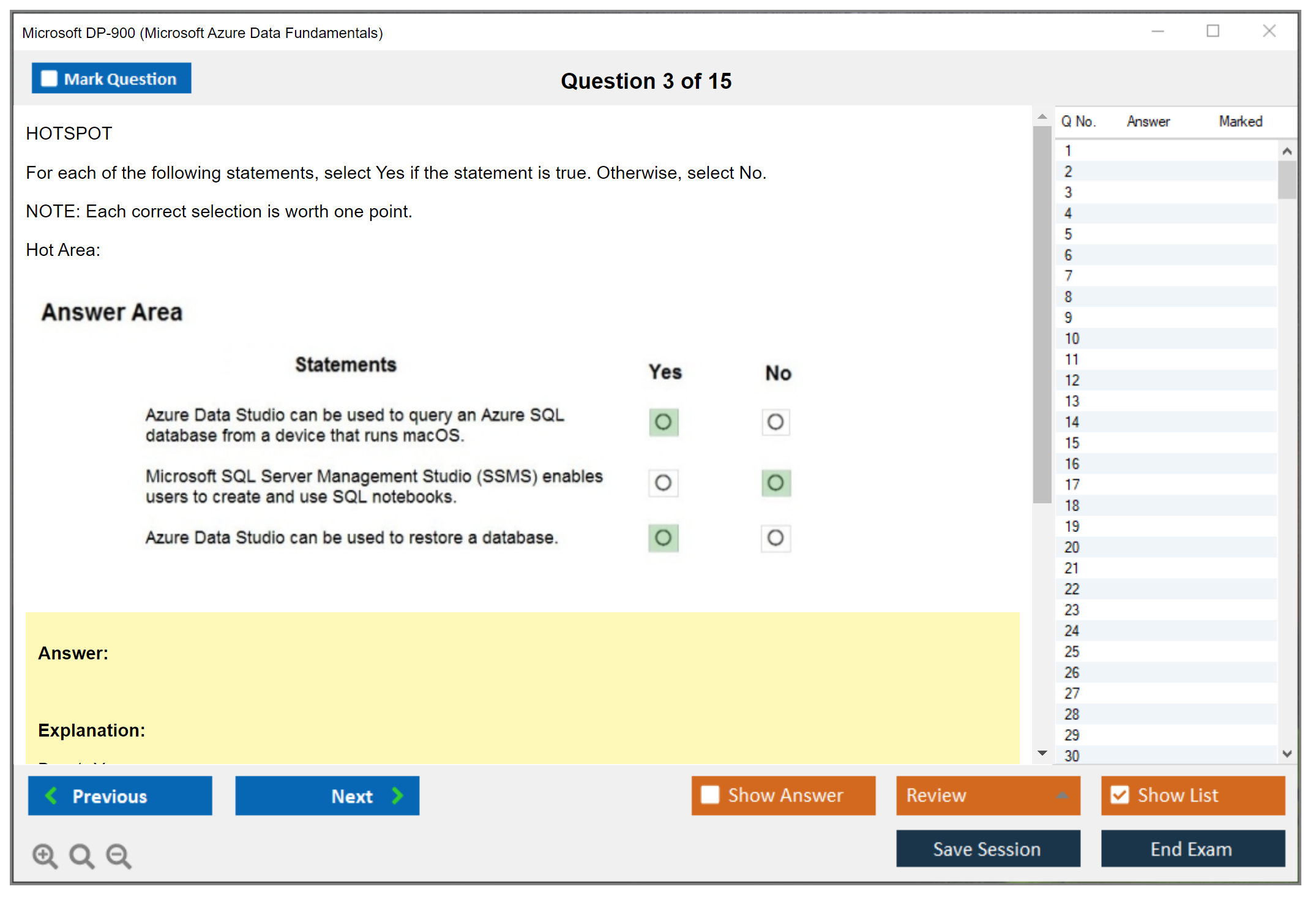
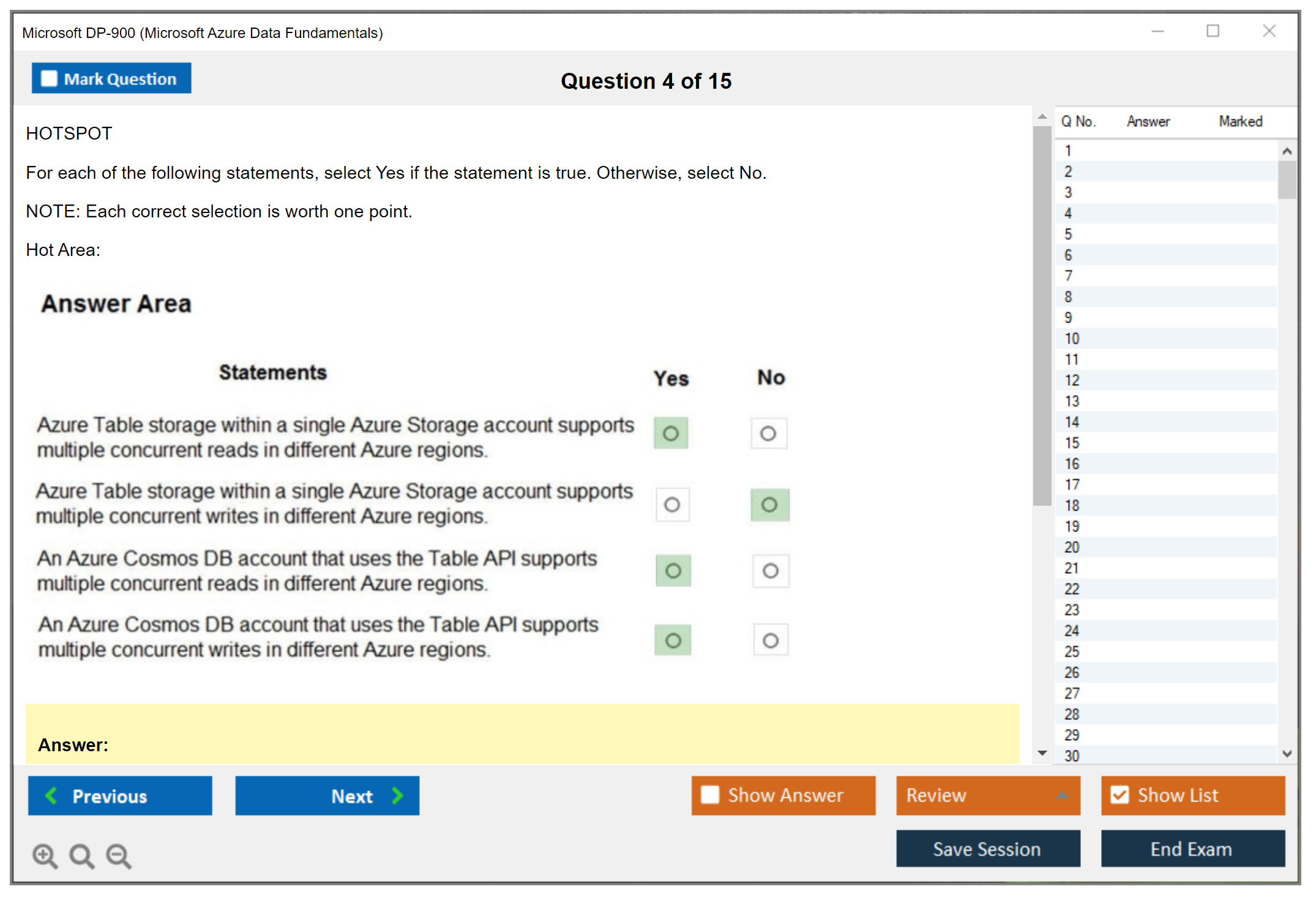
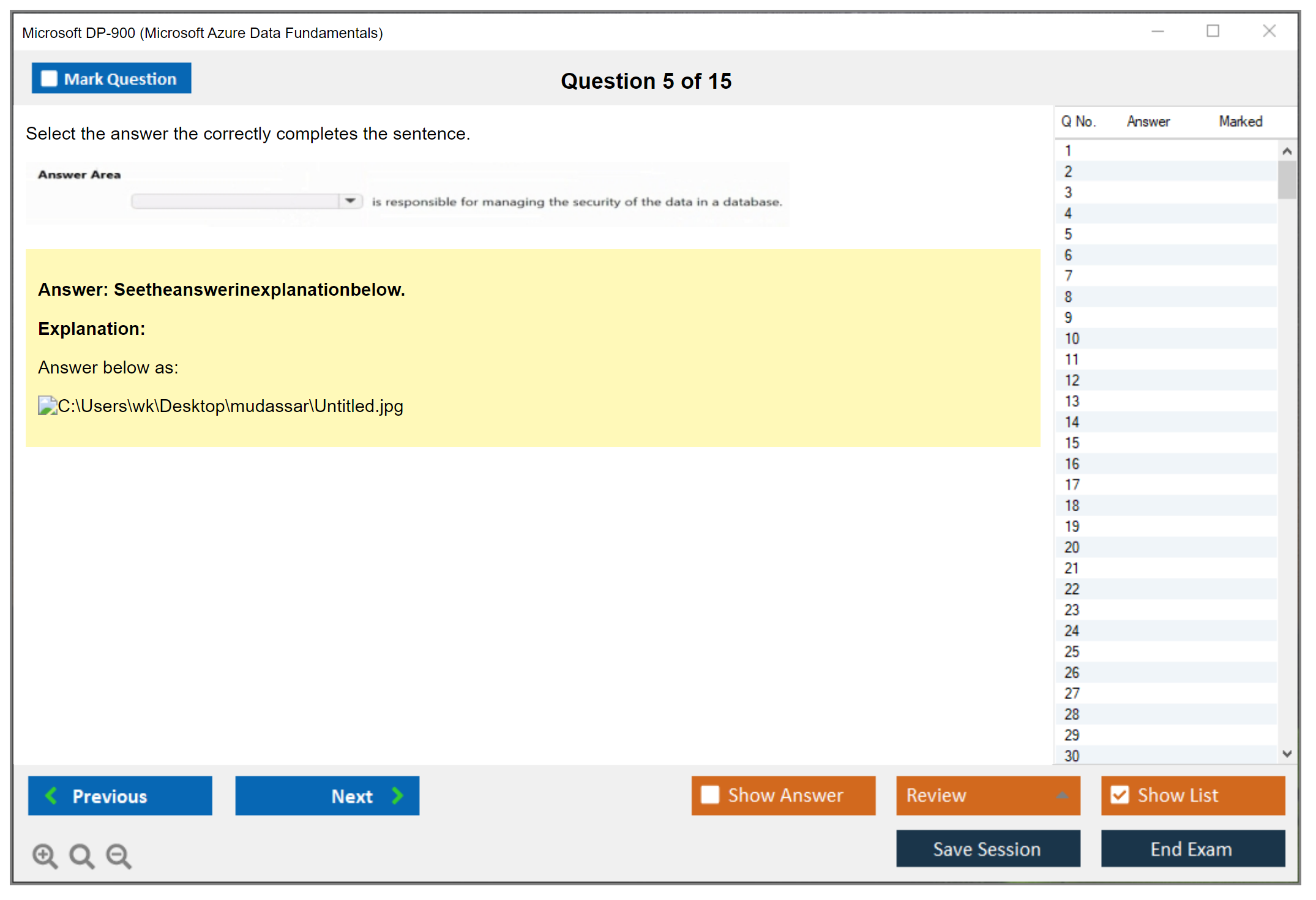
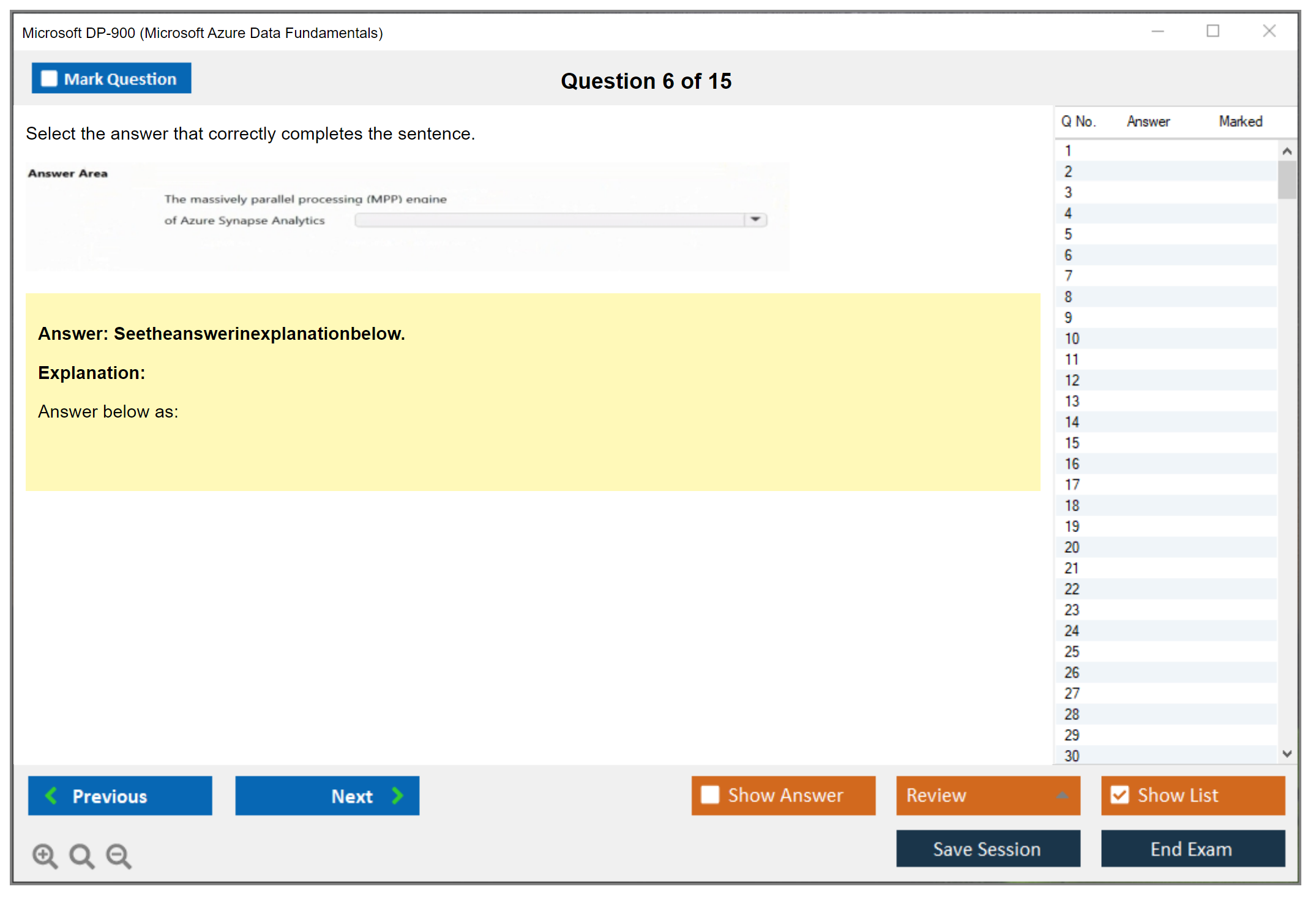
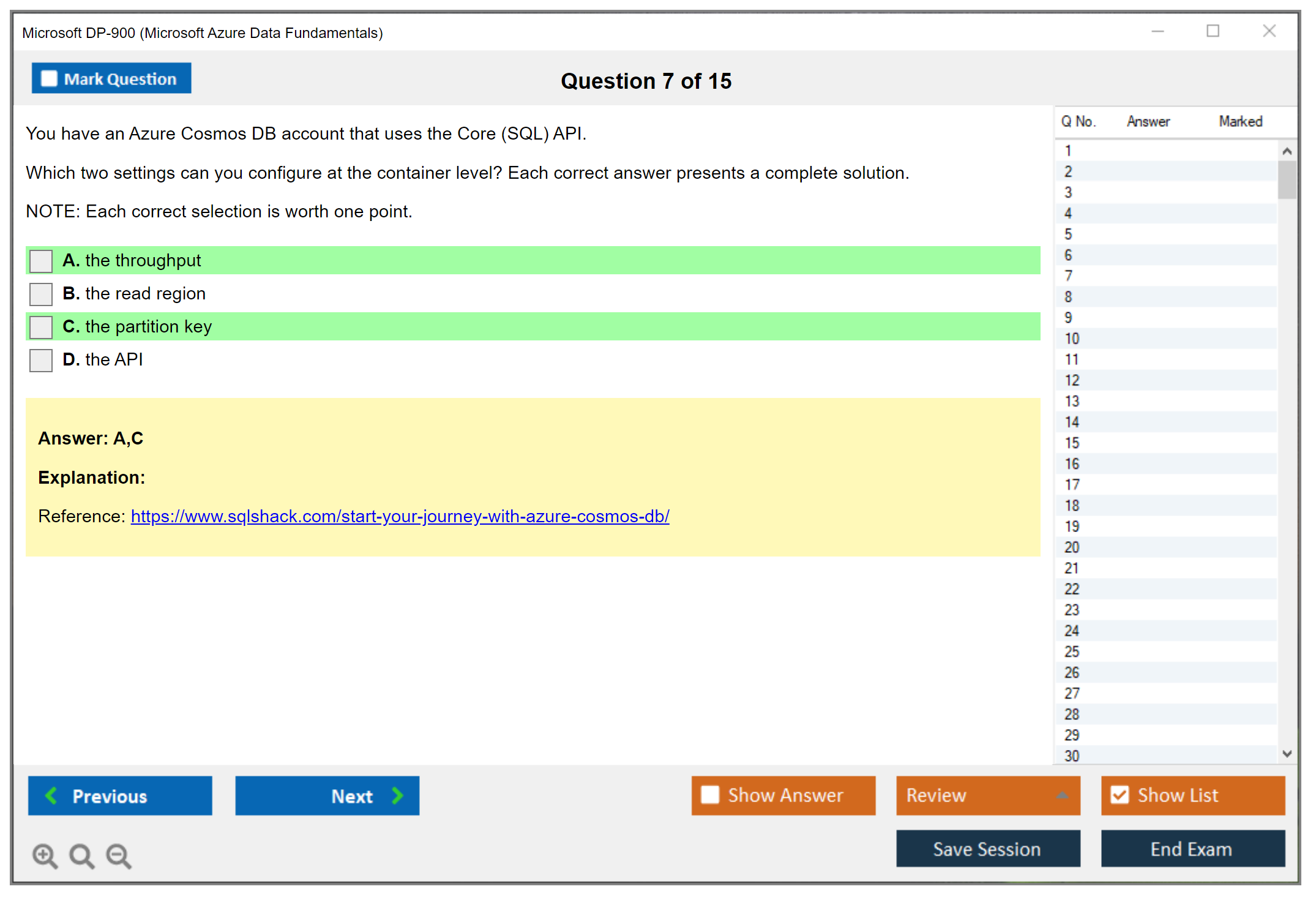
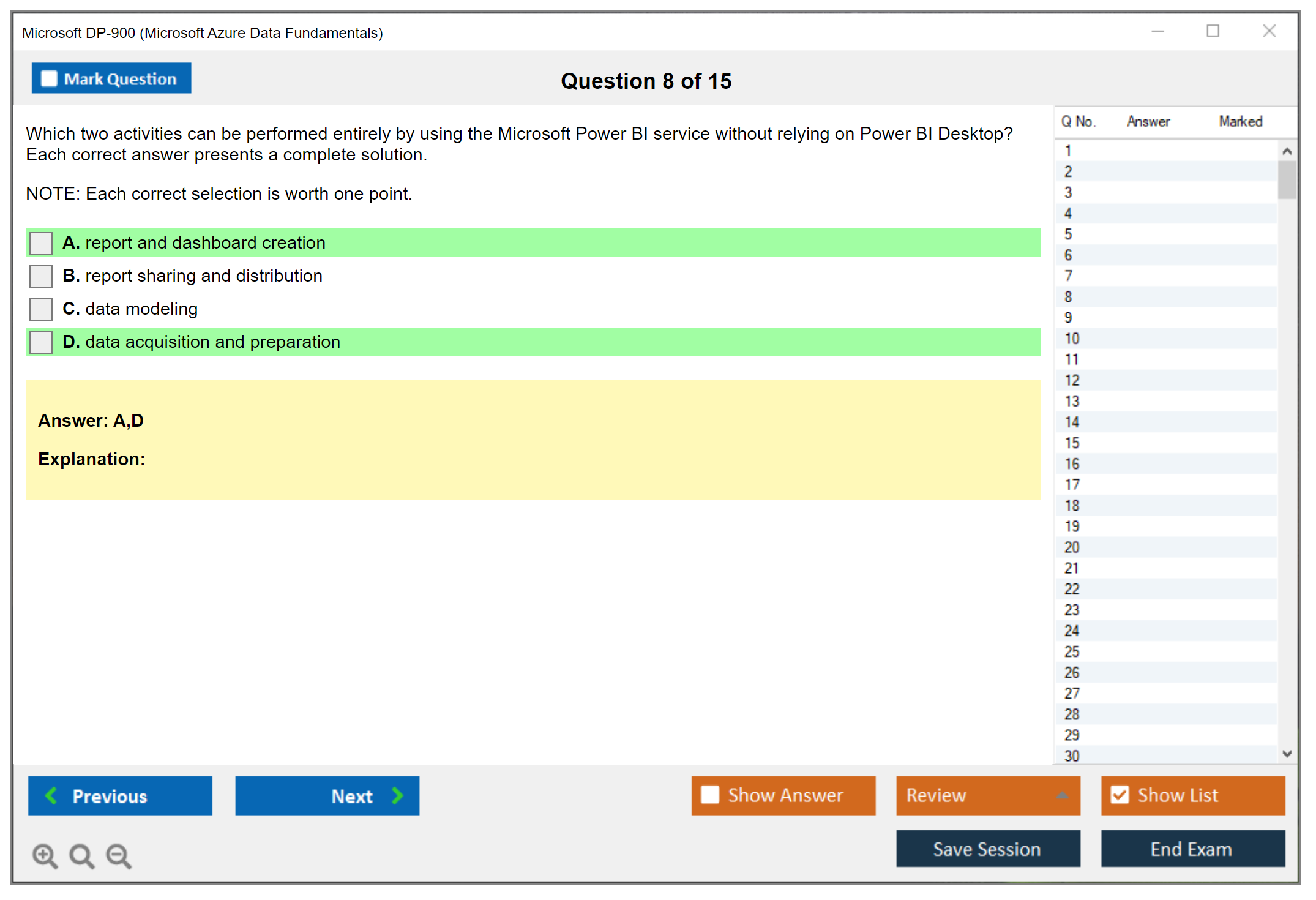
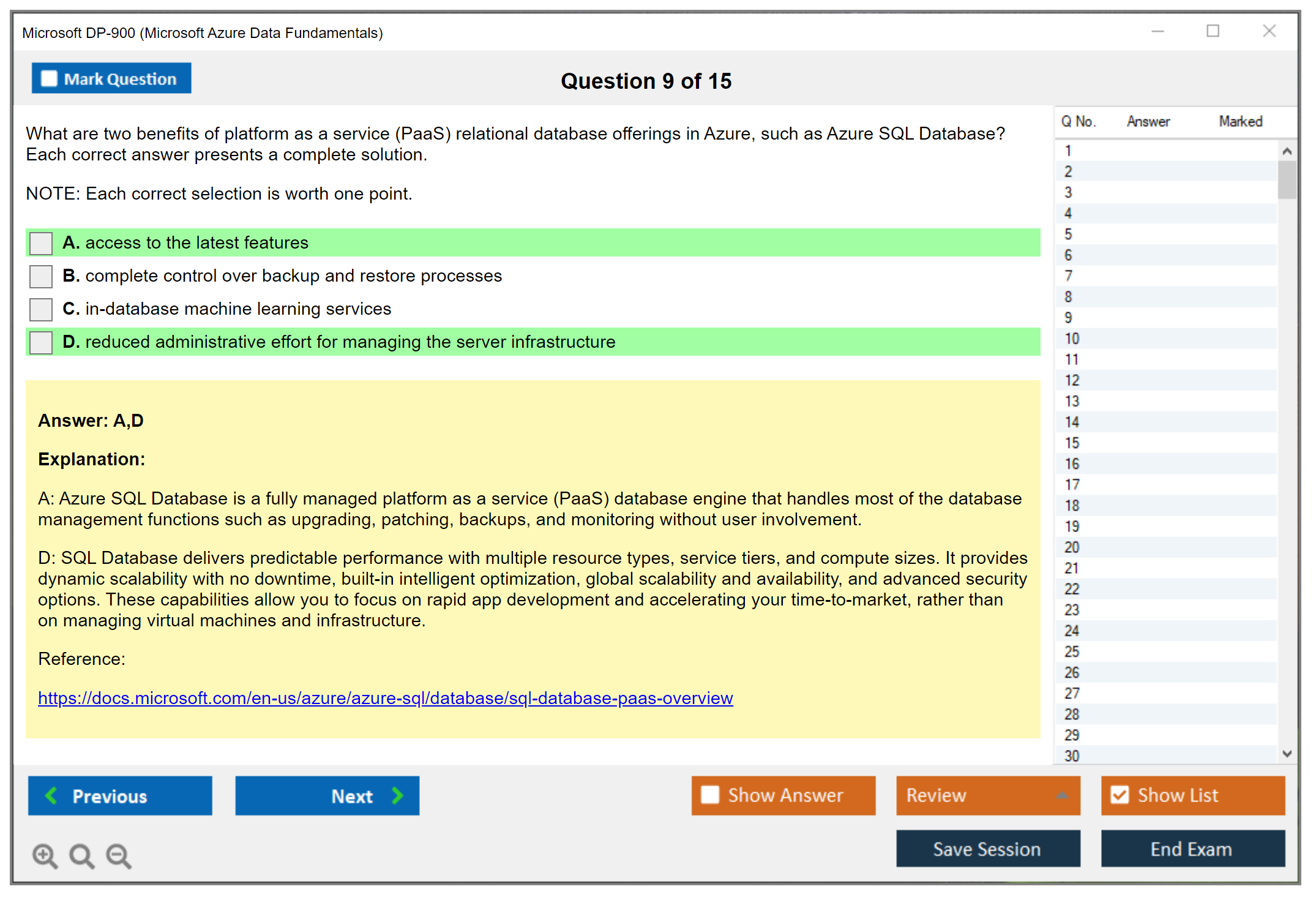
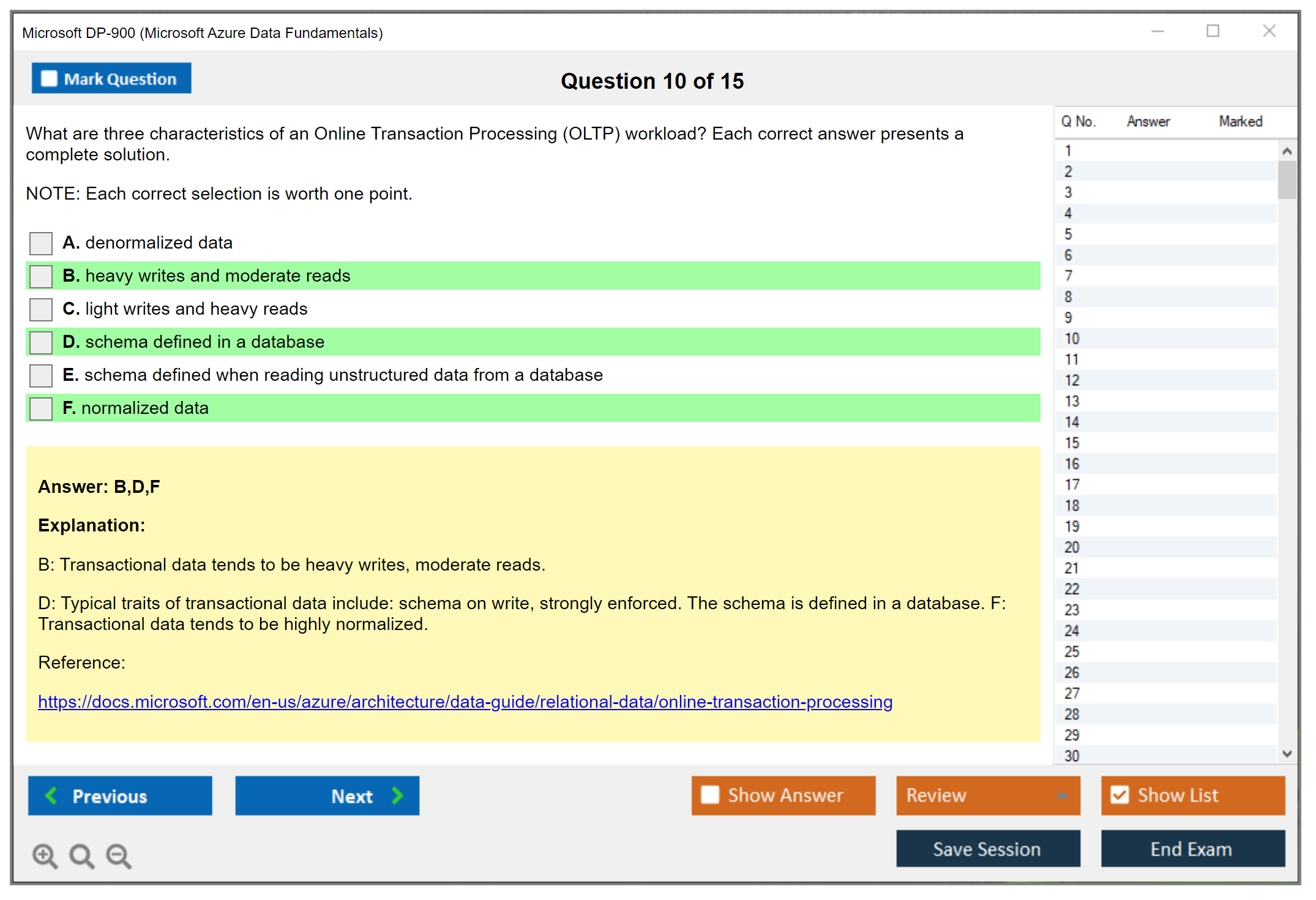
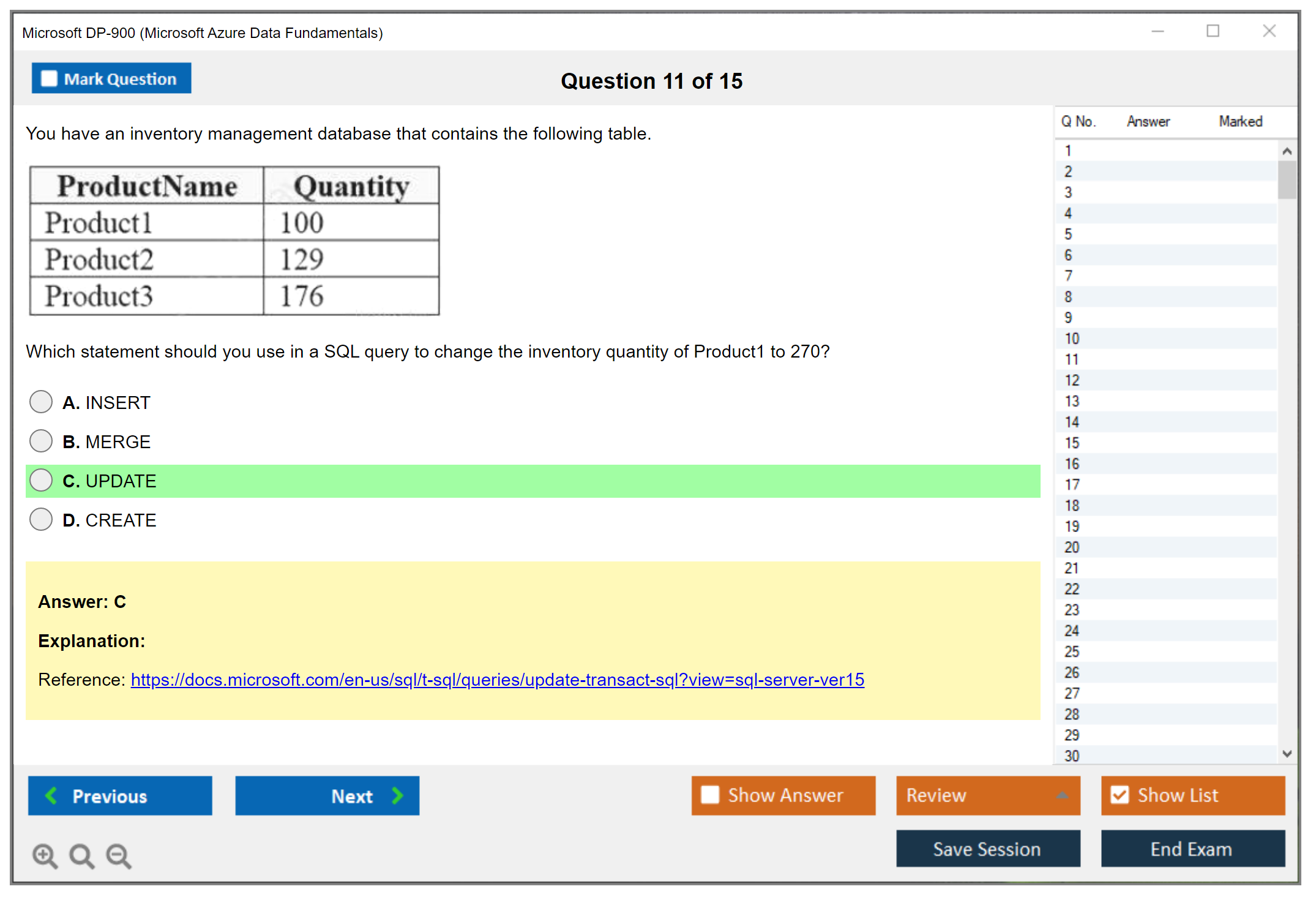
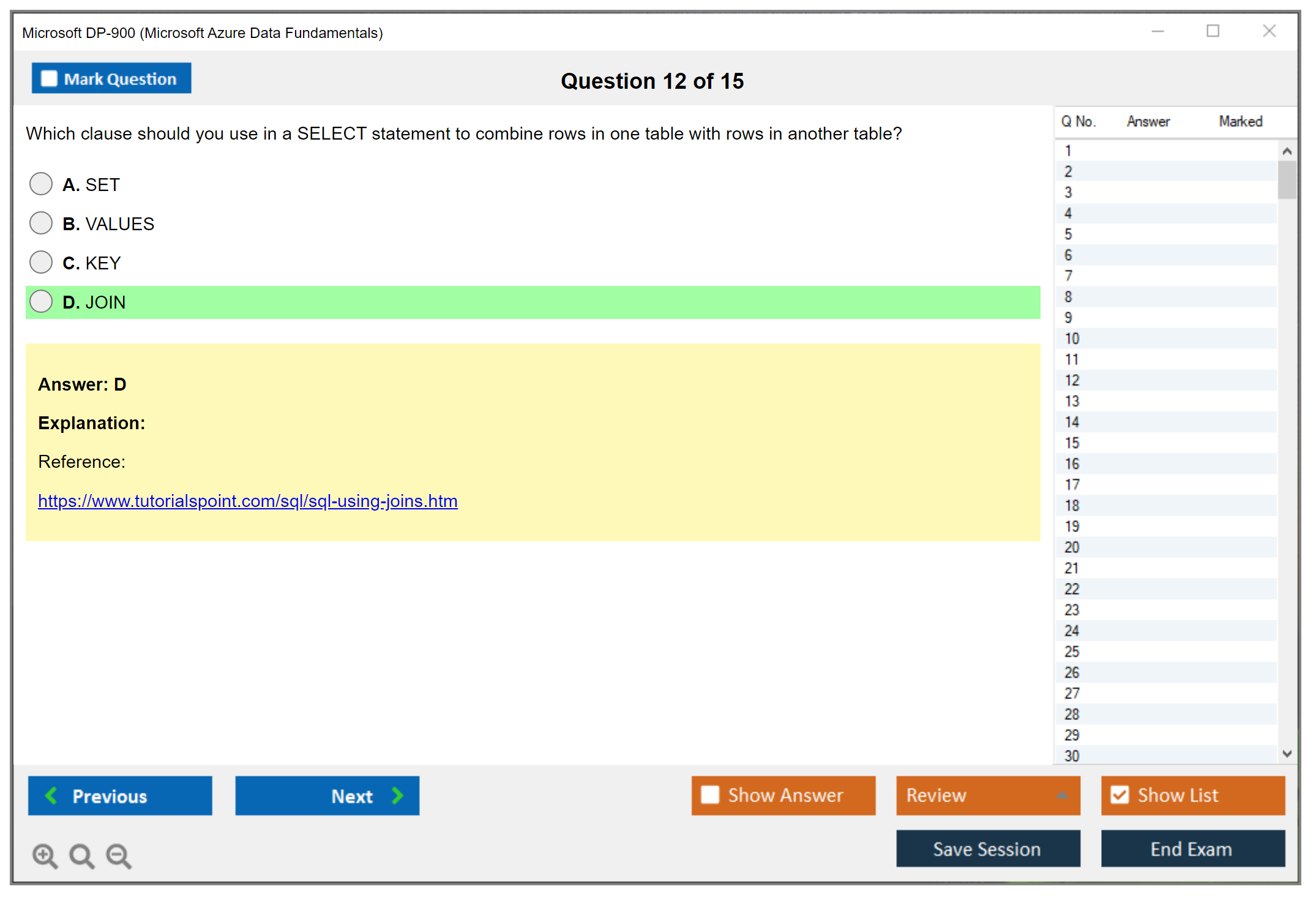
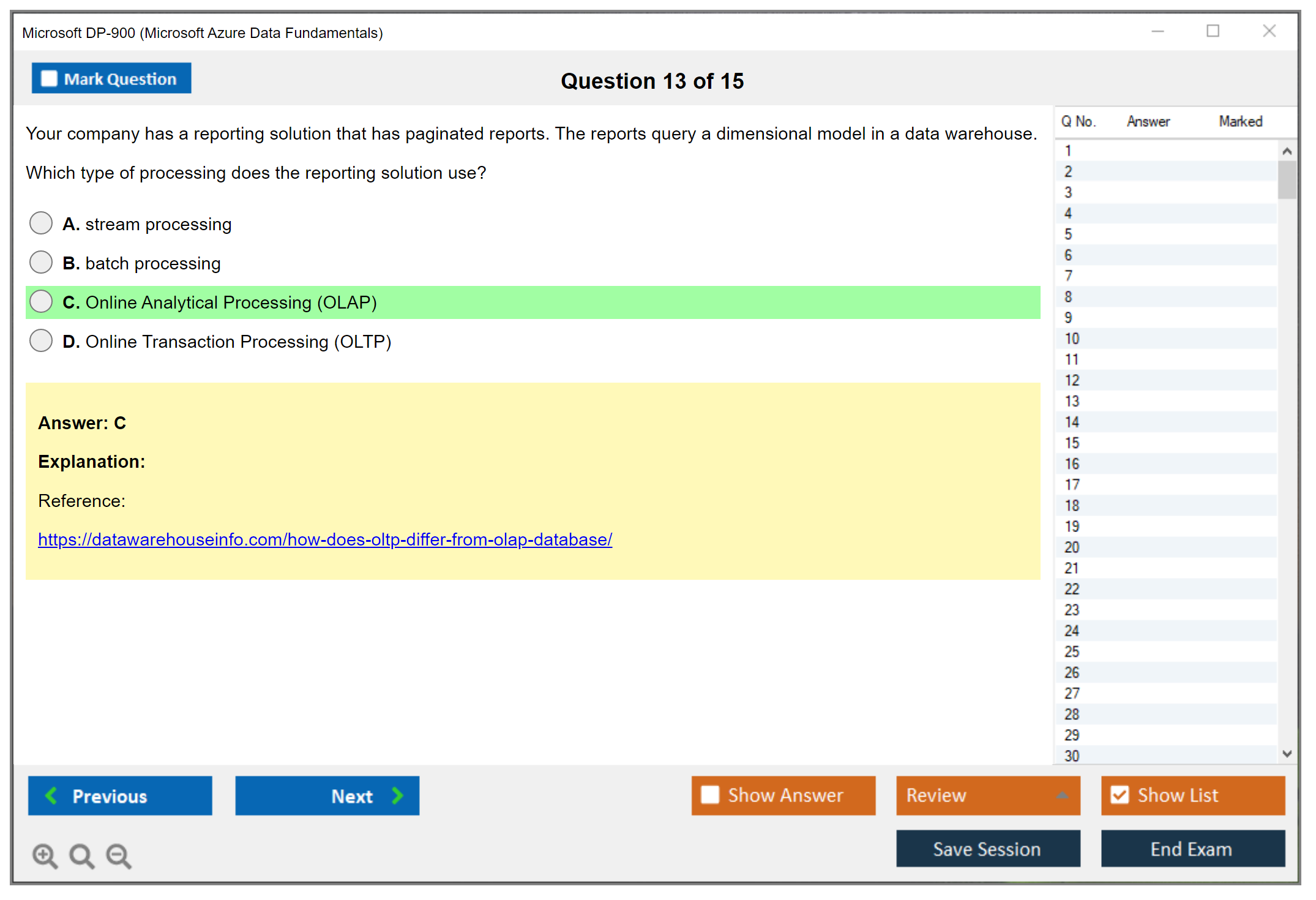
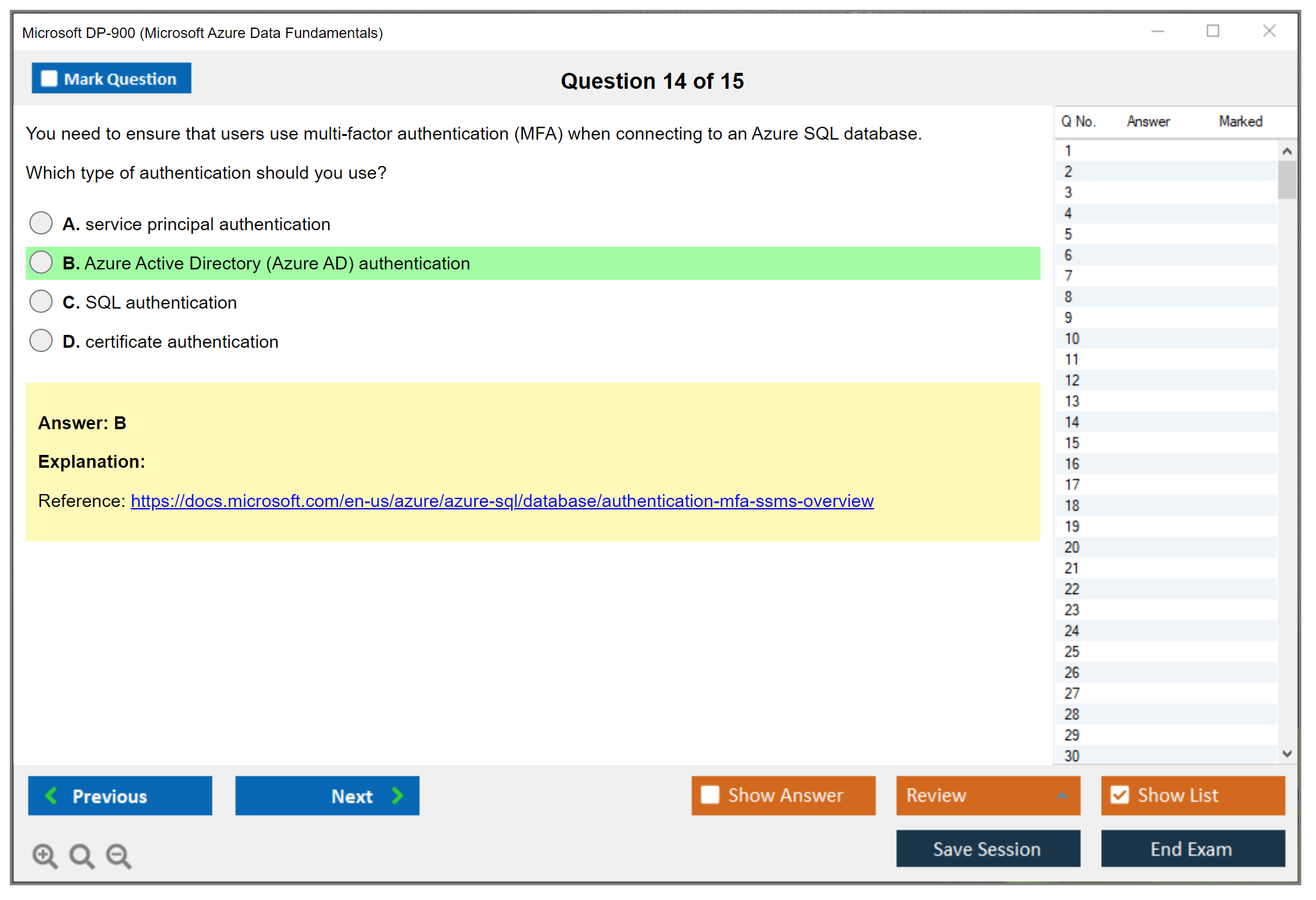
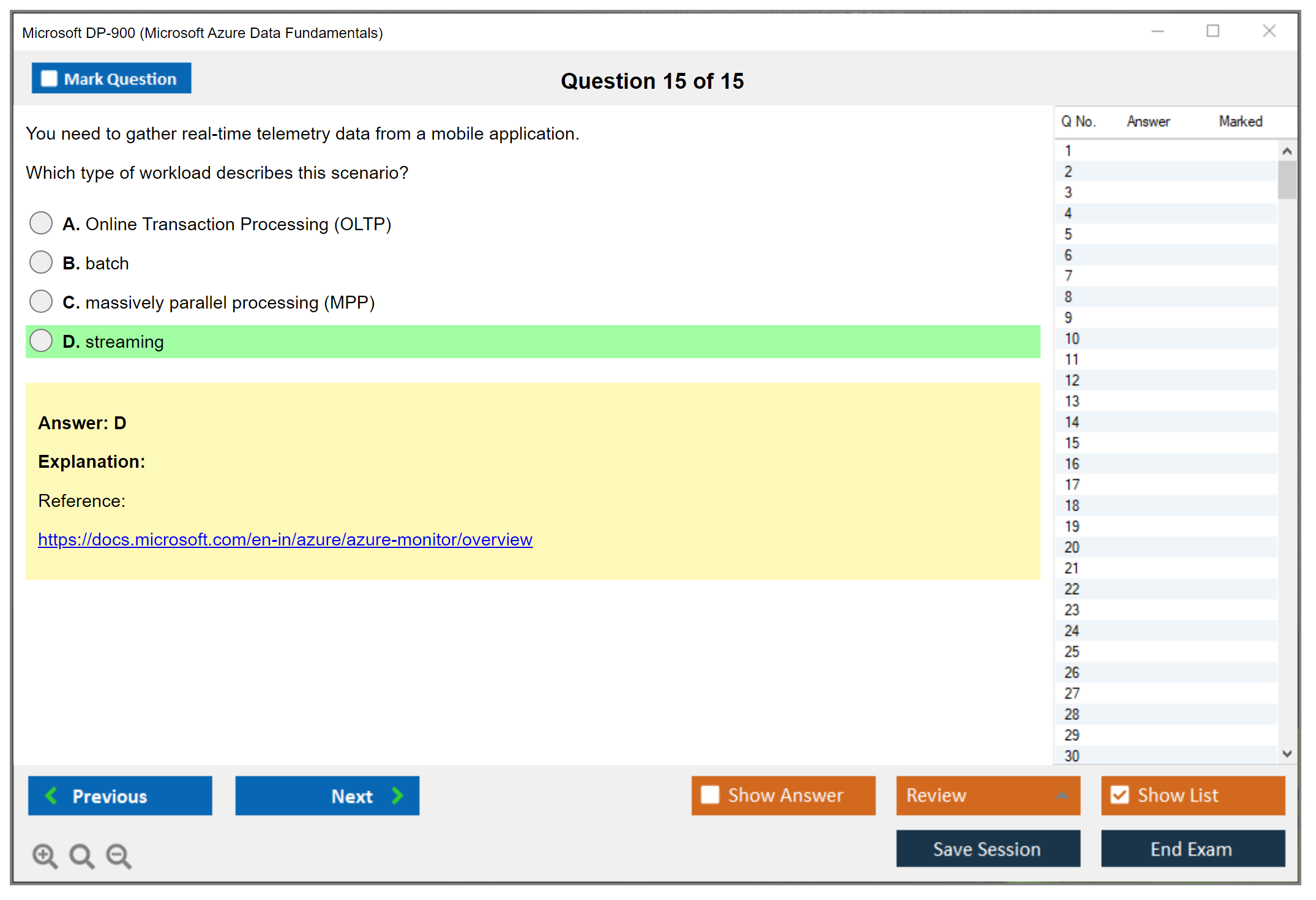
Dumpsarena Microsoft Microsoft Azure Data Fundamentals (DP-900) Free Practice Exam Simulator Test Engine Exam preparation with its cutting-edge combination of authentic test simulation, dynamic adaptability, and intuitive design. Recognized as the industry-leading practice platform, it empowers candidates to master their certification journey through these standout features.
What is in the Premium File?
Satisfaction Policy – Dumpsarena.co
At DumpsArena.co, your success is our top priority. Our dedicated technical team works tirelessly day and night to deliver high-quality, up-to-date Practice Exam and study resources. We carefully craft our content to ensure it’s accurate, relevant, and aligned with the latest exam guidelines. Your satisfaction matters to us, and we are always working to provide you with the best possible learning experience. If you’re ever unsatisfied with our material, don’t hesitate to reach out—we’re here to support you. With DumpsArena.co, you can study with confidence, backed by a team you can trust.
Microsoft DP-900 Exam FAQs
Introduction of Microsoft DP-900 Exam!
Microsoft DP-900 is a certification exam for the Microsoft Azure Data Fundamentals certification. It is designed to test a candidate's knowledge of the core data concepts and services in Azure. The exam covers topics such as data storage, data security, data analysis, and data integration.
What is the Duration of Microsoft DP-900 Exam?
The Microsoft DP-900 exam is a one-hour exam consisting of 40-60 questions.
What are the Number of Questions Asked in Microsoft DP-900 Exam?
There are 40-60 questions on the Microsoft DP-900 exam.
What is the Passing Score for Microsoft DP-900 Exam?
The passing score for the Microsoft DP-900 exam is 700 out of 1000.
What is the Competency Level required for Microsoft DP-900 Exam?
The Microsoft DP-900 exam requires a foundational level of knowledge and skills related to Microsoft Azure data fundamentals. Candidates should have a good understanding of the core Azure data services, data security, data management and data development in order to be successful on the exam.
What is the Question Format of Microsoft DP-900 Exam?
Microsoft DP-900 exam consists of multiple-choice, multiple-response, drag and drop, and build list questions.
How Can You Take Microsoft DP-900 Exam?
Microsoft DP-900 exam can be taken online or at a testing center. To take the exam online, you will need to register and pay for the exam through the Microsoft Learning website. To take the exam at a testing center, you will need to locate a testing center near you and register for the exam with the testing center. Once you have registered, you will be provided with instructions on how to take the exam.
What Language Microsoft DP-900 Exam is Offered?
Microsoft DP-900 Exam is offered in English.
What is the Cost of Microsoft DP-900 Exam?
The Microsoft DP-900 exam is offered for a cost of $165 USD.
What is the Target Audience of Microsoft DP-900 Exam?
The Microsoft DP-900 exam is designed for IT professionals who have experience implementing, managing, and monitoring an Azure data platform. This includes roles such as Database Administrators, Database Developers, Data Architects, and Business Intelligence professionals.
What is the Average Salary of Microsoft DP-900 Certified in the Market?
The average salary for a Microsoft Certified: Azure Data Fundamentals (DP-900) certified professional is approximately $98,000 per year.
Who are the Testing Providers of Microsoft DP-900 Exam?
Microsoft offers official practice tests for the DP-900 exam. These practice tests are available for purchase from the Microsoft Learning website. Additionally, there are third-party websites that offer practice tests for the DP-900 exam.
What is the Recommended Experience for Microsoft DP-900 Exam?
Microsoft recommends that candidates for the DP-900 exam have at least six months of hands-on experience with Microsoft Azure, including the following areas:
• Developing applications and services that are hosted on Azure
• Implementing security, identity, and storage solutions
• Monitoring and optimizing Azure solutions
• Configuring and troubleshooting virtual networking
• Managing Azure Active Directory (AD)
• Automating Azure tasks using scripting and automation tools
What are the Prerequisites of Microsoft DP-900 Exam?
The Microsoft DP-900 exam is designed to measure a candidate's ability to architect, deploy, secure, monitor, and optimize a Microsoft Azure data solution. The exam topics include security and governance, data storage, data processing, and data analysis. To prepare for the exam, Microsoft recommends hands-on experience with the Azure platform, a understanding of the Azure data services, and practical experience with designing and implementing Azure data solutions.
What is the Expected Retirement Date of Microsoft DP-900 Exam?
The official website to check the expected retirement date of Microsoft DP-900 exam is https://www.microsoft.com/en-us/learning/exam-list.aspx.
What is the Difficulty Level of Microsoft DP-900 Exam?
The Microsoft DP-900 exam is classified as an intermediate-level exam. This means that it is designed for those who have some experience with Azure Data Fundamentals, but who may need to brush up on some of the more advanced concepts.
What is the Roadmap / Track of Microsoft DP-900 Exam?
The Microsoft DP-900 Exam is a certification track/roadmap for professionals who want to demonstrate their expertise in deploying and managing solutions on Microsoft Azure. The exam covers topics such as deploying and managing Azure resources, configuring Azure services, and developing solutions on Azure. The exam is designed to help professionals demonstrate their ability to use the Azure platform to create and manage cloud solutions.
What are the Topics Microsoft DP-900 Exam Covers?
The Microsoft DP-900 exam covers the following topics:
1. Implementing Microsoft Azure Data Fundamentals: This topic covers the fundamentals of Azure Data, including data storage and processing architectures, data security, and the Azure Data platform.
2. Implementing Data Storage and Processing Solutions: This topic covers the implementation of data storage and processing solutions using Azure Data services, such as Azure Storage, Azure SQL Database, and Azure Data Lake.
3. Implementing Data Security Solutions: This topic covers the implementation of data security solutions using Azure Data services, such as Azure Active Directory, Azure Key Vault, and Azure Data Encryption.
4. Implementing Data Platform Solutions: This topic covers the implementation of data platform solutions using Azure Data services, such as Azure Data Factory, Azure Data Catalog, and Azure Machine Learning.
5. Monitoring and Troubleshooting Data Solutions: This topic covers the monitoring and troubleshooting of data solutions using Azure Data services,
What are the Sample Questions of Microsoft DP-900 Exam?
1. What is Azure Data Factory and how is it used to move and transform data?
2. What are the components of an Azure Data Factory pipeline?
3. What are the benefits of using Azure Data Factory?
4. How can you create and deploy a pipeline in Azure Data Factory?
5. What are the best practices for managing and monitoring Azure Data Factory pipelines?
6. What are the security considerations when using Azure Data Factory?
7. How can you use Azure Data Factory to integrate data from multiple sources?
8. What are the differences between Azure Data Factory and Azure Data Lake?
9. How can you use Azure Data Factory to automate data processing tasks?
10. What are the different types of data stores that can be used with Azure Data Factory?
Microsoft DP-900 (Microsoft Azure Data Fundamentals) What is the Microsoft DP-900 (Azure Data Fundamentals) Certification? What is the Microsoft DP-900 (Azure Data Fundamentals) certification? The DP-900 Microsoft Azure Data Fundamentals certification is a foundational credential proving you understand core data concepts and Microsoft's implementation through Azure data services. It's your entry ticket. Think of it like this: not super deep or technical, but broad enough to show employers you won't look completely lost when someone mentions relational databases, NoSQL, or analytics workloads in a meeting where everyone's nodding along like they totally get it. This certification targets people beginning their data path, honestly. You're not expected to architect massive data pipelines or tune SQL queries for performance. Instead, you're learning what different data types are, when you'd use Azure SQL Database versus Cosmos DB, and why someone would choose Synapse Analytics over... Read More
Microsoft DP-900 (Microsoft Azure Data Fundamentals)
What is the Microsoft DP-900 (Azure Data Fundamentals) Certification?
What is the Microsoft DP-900 (Azure Data Fundamentals) certification?
The DP-900 Microsoft Azure Data Fundamentals certification is a foundational credential proving you understand core data concepts and Microsoft's implementation through Azure data services. It's your entry ticket.
Think of it like this: not super deep or technical, but broad enough to show employers you won't look completely lost when someone mentions relational databases, NoSQL, or analytics workloads in a meeting where everyone's nodding along like they totally get it.
This certification targets people beginning their data path, honestly. You're not expected to architect massive data pipelines or tune SQL queries for performance. Instead, you're learning what different data types are, when you'd use Azure SQL Database versus Cosmos DB, and why someone would choose Synapse Analytics over Databricks for certain workloads. Breadth over depth. Which makes it perfect for career changers, business analysts, project managers, or anyone who needs to talk intelligently about data without necessarily being hands-on every day.
Microsoft designed DP-900 for candidates starting to work with data in the cloud. Maybe you're a business analyst who needs to understand what your data engineering team is actually building. Maybe you're a recent graduate trying to break into tech and you need a recognized credential. Or maybe you're an IT pro from a networking background who's pivoting toward data roles. The exam doesn't demand years of Azure experience. You could pass it with a few weeks of focused study if you're motivated and already understand basic database concepts.
Who should take DP-900?
Business analysts who need to understand data storage and processing options for making informed recommendations should consider this exam. You're constantly bridging business requirements and technical capabilities, right? Understanding whether your team should use a relational database or a document store for a new application makes those conversations way more productive. You won't be building the solution yourself, but you'll know enough to ask smart questions and spot when someone's suggesting an overly complex approach.
Project managers benefit massively.
I've seen PMs struggle in meetings because they don't understand the difference between batch processing and real-time streaming. With DP-900 knowledge, you'll grasp why your data engineer says a certain task will take three days versus three hours. You'll understand dependencies between services. You'll communicate better with stakeholders about timelines and technical constraints. Once you speak the language, everything clicks faster.
Sales and marketing professionals in technology companies who need to articulate Azure data solutions to potential customers find DP-900 incredibly useful. Not gonna lie, watching salespeople fumble through data discussions because they don't understand what their own product does is painful. This certification gives you the vocabulary and conceptual framework to have credible conversations. You'll understand customer pain points better and position Azure services more effectively.
IT professionals from non-data backgrounds (network administrators, system administrators, security folks) who want to transition into data-focused roles should start here. Look, you already understand IT fundamentals, cloud concepts, maybe even Azure basics if you've worked with virtual machines or networking. DP-900 adds the data layer to your knowledge. It's a natural progression that opens doors to roles like data engineer or database administrator, especially when you combine it with advanced certifications later.
Recent graduates need baseline knowledge.
Career changers entering the data field need to establish that baseline and earn a recognized credential. Academic programs teach theory, but employers want proof you understand practical implementation. DP-900 shows you've studied industry-standard tools and concepts. It won't land you a senior data engineer role, but it helps when you're competing for entry-level positions against dozens of other candidates.
Database administrators working with on-premises systems who want to understand cloud data services should pursue this. You know SQL Server or Oracle inside and out, but cloud services operate differently. DP-900 introduces you to managed services, serverless options, and how traditional database concepts translate to Azure. It's a gentle introduction that respects your existing expertise while expanding your skillset.
What skills and concepts DP-900 validates
Understanding of core data concepts including structured, semi-structured, and unstructured data formats forms the foundation. You'll need to explain what makes data structured (think rows and columns in a SQL table), semi-structured like JSON or XML with some organization but flexible schema, and unstructured stuff like videos, images, free-form text. The exam tests whether you can identify appropriate storage solutions based on data characteristics.
Knowledge of the difference between transactional and analytical workloads and appropriate Azure services for each is critical. Transactional systems handle day-to-day operations: processing orders, updating inventory, recording customer interactions. They need fast reads and writes for individual records. Analytical systems aggregate massive amounts of historical data to identify trends and support decision-making. Different optimization strategies, different Azure services. The exam loves asking which service fits which scenario.
Ability to describe relational vs non-relational data in Azure and when to use each approach comes up constantly. Relational databases organize data into tables with defined relationships between them. They're great when your data has consistent structure and you need complex queries joining multiple tables. Non-relational databases (also called NoSQL) handle varied data structures, scale horizontally more easily, and work better for certain use cases like storing user profiles or IoT sensor data. Azure offers both types, and you need to know when to recommend each.
Tables store data.
Understanding of relational database concepts including tables, indexes, views, and normalization gets tested pretty thoroughly. You don't need to normalize a database to third normal form during the exam, but you should understand what normalization means and why it matters. Indexes speed up queries. Views present data without storing it separately. These concepts have existed for decades, but they're still fundamental to working with Azure SQL Database or Azure SQL Managed Instance.
Knowledge of SQL fundamentals and how to use basic SQL statements for querying data gets tested through scenario-based questions. You won't write complex stored procedures, but you should recognize SELECT, INSERT, UPDATE, and DELETE statements. You should understand WHERE clauses filter results, JOIN combines data from multiple tables, and aggregate functions like SUM and COUNT summarize data. If you've never touched SQL, spend time learning basics before the exam.
Familiarity with Azure SQL Database, Azure SQL Managed Instance, and Azure Database for PostgreSQL/MySQL helps you answer service selection questions. These are Azure's relational database offerings, each with different management levels and capabilities. SQL Database is fully managed with serverless options. SQL Managed Instance provides near-complete SQL Server compatibility with minimal code changes for migrations. PostgreSQL and MySQL options support those popular open-source databases. The exam expects you to match services to scenarios.
Understanding of non-relational database types including key-value, document, column-family, and graph databases matters. Key-value stores are simplest: just pairs of keys and values, super fast for lookups. Document databases store JSON or XML documents, great for flexible schemas. Column-family databases organize data by columns instead of rows, optimizing certain query patterns. Graph databases model relationships between entities, perfect for social networks or recommendation engines. Each type solves specific problems.
Cosmos DB dominates everything.
Knowledge of Azure Cosmos DB capabilities, consistency levels, and use cases dominates the non-relational section. Cosmos DB is Microsoft's globally distributed, multi-model database service. It supports multiple APIs including SQL, MongoDB, Cassandra, and Gremlin. Understanding its five consistency levels (from strong to eventual) and knowing when each makes sense is important. The exam tests whether you can identify scenarios where Cosmos DB's global distribution and low latency matter.
Understanding of Azure Storage services including Blob Storage, File Storage, and Table Storage rounds out the storage knowledge. Blob Storage handles unstructured objects like images, videos, backups, and log files. File Storage provides SMB file shares accessible from cloud or on-premises. Table Storage offers a NoSQL key-value store for structured data. These aren't databases in the traditional sense, but they're critical components of Azure data solutions.
Knowledge of Azure Data Lake Storage and its role in big data analytics scenarios ties storage to analytics. Data Lake Storage (built on Blob Storage) provides hierarchical namespace and optimizations for analytics workloads. It's where you store massive amounts of raw data before processing it with services like Azure Synapse Analytics or Azure Databricks. Understanding why you'd use Data Lake Storage instead of regular Blob Storage helps answer architecture questions.
Understanding of analytics workloads on Azure (Synapse, Databricks, HDInsight) and when to use each service gets tested heavily. Azure Synapse Analytics integrates data warehousing and big data analytics, letting you query data using either serverless or provisioned resources. Azure Databricks provides Apache Spark-based analytics with collaborative notebooks. HDInsight offers managed Hadoop, Spark, Kafka, and other open-source frameworks. The exam presents scenarios and asks which service fits best. Understanding the strengths of each takes some study.
Power BI connects everything.
Familiarity with data visualization tools, particularly Microsoft Power BI and its integration with Azure data services, appears in several questions. Power BI connects to Azure data sources and creates interactive reports and dashboards. You don't need to be a Power BI expert, but you should understand it's the primary visualization tool in the Microsoft ecosystem and how it fits into the overall data architecture. Some questions ask how users consume insights after data processing completes.
Knowledge of batch and real-time data processing concepts and corresponding Azure services helps with architecture questions. Batch processing handles large volumes of data at scheduled intervals (think nightly ETL jobs). Real-time processing handles data as it arrives (think monitoring IoT sensors or analyzing clickstream data). Azure Stream Analytics, Azure Event Hubs, and Azure Functions support real-time scenarios. Azure Data Factory and Azure Synapse pipelines handle batch processing. Knowing which approach and services fit different requirements is key.
Understanding of data ingestion services including Azure Data Factory and Azure Stream Analytics appears throughout the exam. Data Factory orchestrates data movement and transformation across various sources and destinations. It's your ETL/ELT tool for building data pipelines. Stream Analytics processes streaming data using SQL-like queries. Both are fundamental to getting data into Azure and preparing it for analysis.
Awareness of data security, compliance, and governance considerations in Azure affects several questions. You should understand concepts like encryption at rest and in transit, role-based access control (RBAC), Azure Active Directory integration, and compliance certifications. Microsoft loves asking about security best practices, probably because data breaches are expensive and embarrassing. You won't configure security policies during the exam, but you'll need to identify appropriate security measures for scenarios.
Roles matter here.
Knowledge of data roles and responsibilities including data engineer, data analyst, database administrator, and data scientist helps contextualize why different Azure services exist. Data engineers build and maintain data infrastructure. Data analysts query data and create reports. Database administrators manage database systems. Data scientists build predictive models. Understanding these roles helps you recognize which services support which personas. The exam sometimes asks which role would use which tool for specific tasks.
DP-900 exam overview
The DP-900 exam measures your ability to describe core data concepts, identify considerations for relational and non-relational data, and understand analytics workloads on Azure. It's a 45-60 minute exam with typically 40-60 questions, though exact numbers vary since Microsoft uses adaptive testing and constantly updates question pools.
You'll encounter multiple question types. Standard multiple choice with one correct answer. Multiple choice with multiple correct answers (these explicitly tell you to select all that apply). Drag and drop where you match services to scenarios or arrange steps in order. Case studies that present a detailed scenario followed by several related questions. The case studies stress people out most because you can't skip around. You answer all questions for a case study before moving on, and you can't return to review them.
Scaled scoring ranges 100-1000.
The exam uses scaled scoring from 100-1000, and you need 700 to pass. Don't try to calculate your score during the exam. There's no straightforward relationship between questions answered correctly and your final score. Microsoft adjusts for question difficulty, and some questions are experimental (unscored) to test them for future exams. Just focus on doing your best on every question.
Exam format and question types
You'll see mostly scenario-based questions rather than pure memorization. Microsoft wants to know if you can apply knowledge to realistic situations, not just recite definitions. A typical question describes a company's requirements (maybe they need to store millions of IoT sensor readings with low latency worldwide) and asks which Azure service best meets those needs.
Some questions include exhibits: diagrams, configuration screenshots, or data samples you need to analyze. Take time to review exhibits carefully before answering. I've seen people rush through and miss critical details shown in the exhibit that change the correct answer.
Review questions at the end let you flag uncertain answers and return to them if time permits. Use this feature. If you're stuck between two answers, flag it, move on, and come back later with fresh perspective. Sometimes later questions jog your memory or provide hints that help with earlier flagged items.
DP-900 exam objectives (skills measured)
Microsoft publishes official exam objectives that break down exactly what's tested. As of recent updates, the exam covers four main areas:
Describe core data concepts (25-30%) includes understanding data types, file formats, data storage options, and differences between batch and streaming data. You'll need to explain structured versus unstructured data, identify appropriate storage solutions, and understand when to use transactional versus analytical systems.
Describe how to work with relational data on Azure (25-30%) covers relational database concepts, SQL basics, and Azure relational database services. You'll identify normalization benefits, understand table structures and relationships, recognize SQL statement types, and know when to use Azure SQL Database versus SQL Managed Instance versus open-source database options.
Describe how to work with non-relational data on Azure (25-30%) includes NoSQL database types, Azure Cosmos DB capabilities, and Azure storage services. You'll need to match NoSQL database types to scenarios, understand Cosmos DB consistency levels and APIs, and know when to use Blob Storage, Table Storage, or Data Lake Storage.
Describe an analytics workload on Azure (25-30%) covers modern data warehousing, real-time analytics, data visualization, and Azure analytics services. You'll identify appropriate services for data warehousing scenarios, understand differences between Azure Synapse Analytics, Databricks, and HDInsight, explain data ingestion methods, and recognize when to use Power BI for visualization.
DP-900 exam cost and scheduling
The DP-900 exam cost is $99 USD in most regions, though prices vary by country due to currency conversion and regional pricing. Microsoft occasionally offers discounts for students, Microsoft Learn Cloud Skills Challenge participants, or during special promotions. Check the official Microsoft certification website for current pricing in your region.
You can take the exam either online through Pearson VUE's remote proctoring or at a physical test center. Online proctoring lets you test from home but requires a webcam, stable internet connection, and quiet private space. The proctor monitors you through webcam and screen sharing throughout the exam. Test centers provide computers and controlled environments, which some people prefer despite the travel requirement.
Schedule your exam through the Microsoft certification dashboard after creating a Microsoft certification profile. You'll select your preferred date, time, and testing option. Book at least a week in advance to get your preferred slot, especially for test centers that fill up quickly. Online proctoring typically has more availability.
Reschedule and retake considerations
You can reschedule or cancel your exam up to 24 hours before your appointment without penalty. Within 24 hours, you forfeit the exam fee. Life happens. If you're sick or have an emergency, reschedule early rather than showing up unprepared or missing the exam entirely.
Retakes require waiting periods.
If you fail, you can retake the exam after 24 hours. Second failure requires a 14-day wait. After that, you wait 14 days between subsequent attempts. Microsoft limits retakes to five attempts per 12 months. Most people pass within two attempts if they study properly after the first failure, analyzing which topics they struggled with and reviewing those areas.
What is the DP-900 passing score?
The DP-900 passing score is 700 on a scale of 100-1000. This isn't 70% correct. Microsoft uses scaled scoring that adjusts for question difficulty. A question about basic relational database concepts might be worth fewer points than a complex scenario requiring you to evaluate multiple Azure services and choose the optimal solution.
You receive your score immediately after completing the exam. Pass or fail, you'll see your overall score and performance breakdowns by objective area. This feedback helps you understand strengths and weaknesses. If you fail, use the performance report to focus your study efforts before retaking.
How DP-900 scoring works
Microsoft doesn't reveal exact scoring algorithms, but scaled scoring ensures fairness across different exam versions. Two candidates might see different questions of varying difficulty, yet a score of 700 represents the same competency level for both. Some questions don't count toward your score. Microsoft includes experimental questions to evaluate them for future use. You can't tell which questions are experimental, so treat every question seriously.
Case study questions are scored as a group. You can't review or change answers after moving past a case study section, so read carefully and double-check your answers before proceeding. This trips up people who habitually skip around and review their work. You can't do that with case studies.
DP-900 difficulty: how hard is it?
DP-900 difficulty varies dramatically based on your background. If you're a database administrator with years of SQL experience transitioning to Azure, you'll find the exam relatively straightforward. If you're a marketing professional with zero technical background trying to understand data concepts, you'll need significant study time.
It's conceptual, really.
The exam tests breadth across many Azure services rather than deep technical skills in any one area. You don't need to write complex SQL queries or configure Databricks clusters. You need to understand what each service does, when you'd use it, and how it compares to alternatives. This conceptual
DP-900 Exam Overview: Format, Structure, and Objectives
What is the Microsoft DP-900 (Azure Data Fundamentals) certification?
DP-900 Microsoft Azure Data Fundamentals is Microsoft's gateway for folks wanting a Microsoft Azure data certification for beginners without drowning in deployment templates, networking rabbit holes, or "why's my private endpoint failing" nightmares. It's foundational stuff. Concept-heavy. Service mapping-heavy. And honestly, it's one of the cleaner Microsoft exams because it mostly tests what things actually are and when you'd pick them, not how fast you click through the Azure portal.
This cert's also a decent signal. Not magic. Not a job guarantee. But a signal.
If you're coming from Excel, help desk, app dev, or even straight up "career switcher with curiosity," DP-900 hands you the vocabulary to discuss data work without sounding like you're guessing. And if you already live in SQL Server land, it's a quick translation of your database brain into Azure service choices, plus some governance and analytics thrown in.
Who should take DP-900?
Look, DP-900's designed for people who need understanding of data platforms, not necessarily running them day-to-day. Data analysts who keep hearing "Synapse" in meetings. Junior data engineers wanting to stop mixing up Data Factory and Databricks. IT folks constantly getting pulled into cloud projects and craving context.
Also, if you're eyeing DP-203 later, DP-900's a warm-up that makes DP-203 feel less like getting hit by a truck.
What skills and concepts DP-900 validates
You're proving understanding of core data concepts, relational versus non-relational data in Azure, and what an analytics workload on Azure (Synapse, Databricks, HDInsight) typically looks like at a high level. Not tuning indexes. Not designing sharding keys. More like, "Which service fits this requirement, and what tradeoffs am I accepting?"
That's the vibe here.
DP-900 exam overview
DP-900's a 45 to 60 minute assessment with roughly 40 to 60 questions. The exact count shifts around because Microsoft rotates content and sometimes includes extra items for exam research, but the practical takeaway's simple: you don't have time to overthink every question, yet you do have enough time to read carefully and catch trick wording if you stay calm.
Time flies. Reading matters. Panic destroys scores.
Microsoft also designs questions testing conceptual understanding and practical application in real-world scenarios, which means you'll see "a company needs X" prompts where the answer's about decision-making, not memorizing a product page bullet list. And yeah, some questions test when NOT to use something, which is where lots of beginners get clipped because they only studied what a service can do, not what it's terrible at.
Exam format and question types
The exam format includes multiple question types: multiple choice, multiple answer, drag-and-drop, case studies, scenario-based questions, plus a few UI-style formats like hot area and build list. Unlike some advanced Azure exams, DP-900 typically doesn't include hands-on lab components or performance-based questions where you configure actual Azure resources. No labs. No portal build. Mostly thinking.
Question types you should expect:
- Multiple choice questions: one correct answer out of four, usually scenario flavored, sometimes definition flavored. Pretty standard fare.
- Multiple answer questions: you select two or more correct answers, and Microsoft tells you how many to pick, which is nice because you're not guessing whether it's "choose all that apply."
- Drag-and-drop matching: match services to use cases, data types to storage options, or characteristics to products. These are common, and honestly they're where you can score easy points if you drilled basic mappings.
- Drag-and-drop ordering: arrange steps in a process, like ETL versus ELT flow, streaming pipeline order, or a migration sequence. Not super hard, but the wording can be picky.
- Case study questions: a longer business scenario with multiple pages, then 3 to 7 questions tied to it. You need to keep requirements straight, and you can't always go back after leaving the case study section.
- Hot area questions: you click on parts of an image, usually an architecture diagram or configuration screenshot. Less common, but it happens.
- Build list questions: you construct an answer by selecting items and arranging them, which feels like ordering but with a slightly different UI.
Also, some questions include exhibits: architecture diagrams, screenshots, even small data samples. That's Microsoft's way of forcing you to reference what's in front of you instead of answering from vibes. Read the exhibit. Every single label.
One more thing people miss: the exam may include unscored questions Microsoft uses for future exam development, and they're not identified during the test. So if you hit something that feels weirdly off-topic or oddly written, don't spiral. Answer it, move on.
DP-900 exam objectives (skills measured)
Microsoft periodically updates the exam content reflecting new Azure services and retired features, so you should verify you're studying current DP-900 exam objectives. Don't trust some random checklist from 2021. Use the official skills outline and align your DP-900 study materials to it, especially if you're using third-party notes or DP-900 practice tests.
The exam tests knowledge across four primary domains, typically weighted around 25 to 30% each:
- Describe core data concepts (25-30%)
- Describe how to work with relational data on Azure (25-30%)
- Describe how to work with non-relational data on Azure (25-30%)
- Describe an analytics workload on Azure (25-30%)
Those percentages matter because if you're weak in one area, you can't hide. Even distribution. No freebies.
DP-900 exam cost and scheduling
DP-900 exam cost (price, regional variations, discounts)
How much does the DP-900 exam cost? Microsoft pricing varies by region and currency, and sometimes by whether you're booking through certain programs, but the DP-900 exam cost's usually positioned as a fundamentals-level price point. Students, some employers, and occasional Microsoft events can also provide discounts or vouchers, so check before paying full price, especially if you're already in a Microsoft Learn challenge window.
I mean, don't over-optimize this. If you're spending weeks studying, saving a few bucks is cool, but passing's the real savings.
Where to take the exam (online proctoring vs test center)
The exam's delivered through Pearson VUE testing centers or via online proctoring. Online's convenient. Test centers are quieter and more predictable. My opinion: if your home environment's even slightly chaotic, book the center and remove variables, because a proctor interrupting you for "camera angle" issues at minute 41's a special kind of stress you don't need.
You can mark questions for review and return to them before submitting, which is one of the best time-management tools you've got. Use it. If a question's taking too long, mark it and keep moving.
There's also a calculator and text-size adjustments in the interface, though they're rarely needed for DP-900 content. You're not doing math-heavy work here, but it's good knowing the tools exist so you don't waste time hunting for them mid-exam.
Reschedule/retake considerations
Pearson VUE reschedule rules depend on timing. Same with retakes. The best move's treating your first booking like a deadline you respect, and if you fail, retake quickly while your brain still has the service map loaded. Waiting a month's how people forget the difference between Azure SQL Database and SQL Managed Instance and then act shocked.
DP-900 passing score and scoring details
What is the DP-900 passing score?
What's the passing score for DP-900? The DP-900 passing score's 700 on Microsoft's scaled scoring model. Scores range from 100 to 1000. So yeah, 700's the line.
Simple. Still stressful. Totally doable.
How DP-900 scoring works (scaled score, case studies, partial credit)
Microsoft uses scaled scoring, which means you shouldn't try reverse-engineering "how many questions can I miss." Different questions can carry different weights, and case study sections can feel heavier because they test multiple decisions off the same scenario. Some question formats can include partial credit, especially in multi-select or build list style items, but don't count on mercy. Answer like you need full credit.
Also, the timer counts down continuously and is visible in the corner. You can review answers before final submission if you finish early, but once you submit, you're done. No changes. No "wait I misread that."
One interface detail that matters: you can work through forward and backward within a section, but once you leave a case study section, you typically can't return to it. So don't rush out of a case study thinking you'll come back.
DP-900 difficulty: how hard is it?
Difficulty level for beginners vs experienced candidates
Is DP-900 hard for beginners with no Azure experience? Honestly, the DP-900 difficulty's mostly about vocabulary and service selection, not technical depth. Beginners can pass. Plenty do. But you need real study time because "data fundamentals" includes concepts like ACID properties, transactional versus analytical workloads, and ETL versus ELT. Those aren't obvious if you've never touched data work before.
For experienced candidates, especially people who already know SQL and basic warehousing ideas, it's faster prep. But Azure service naming still gets people. Azure loves similar names.
Common challenges (data concepts, Azure services mapping, analytics choices)
People struggle with three areas, and not gonna lie, Microsoft loves these traps.
Service mapping's the big one. When should you choose Azure SQL Database versus Azure SQL Managed Instance? What's Cosmos DB actually for and which API fits a use case? When's Blob Storage enough, and when do you need Azure Data Lake Storage Gen2 features like hierarchical namespace and analytics-friendly access patterns?
Another common faceplant's analytics service overlap. Synapse has serverless SQL pools, dedicated SQL pools, Spark pools, and then Databricks exists, and HDInsight exists, and if you're new you're like, "Why do we have five ways to run Spark." The exam expects you picking the sensible fit given constraints, like "managed Spark with collaborative notebooks" versus "big integrated analytics workspace" versus "legacy cluster style."
Governance and security also show up more than people expect. Basics, though. Think authentication versus authorization, encryption at rest, compliance concepts, and general data governance ideas, plus a few Azure-specific features.
How long to study for DP-900 (typical timelines)
If you're new, plan 2 to 4 weeks of steady study, like 30 to 60 minutes a day, plus a couple weekend sessions. If you already know databases and have seen Azure before, 1 to 2 weeks is realistic.
Consistency wins. Cramming hurts. Sleep helps.
DP-900 prerequisites (do you need experience?)
Recommended background (data basics, cloud fundamentals)
DP-900 prerequisites are light. You don't need job experience, but you should know basic data ideas: what a table is, what a query is, why indexing exists, what "schema" means, and the difference between OLTP and OLAP at a conceptual level. Cloud fundamentals help too, so if you've never touched cloud, doing AZ-900 first isn't a bad move. If you want that path, AZ-900 (Microsoft Azure Fundamentals) is the obvious companion.
Is Azure experience required?
No. But it helps. DP-900's friendly to people who learn through examples and diagrams, because the questions often read like small architecture decisions.
Best DP-900 study materials (official and third-party)
Microsoft Learn DP-900 learning path (official)
Start with Microsoft Learn DP-900 modules. The Microsoft Learn DP-900 modules are aligned to the exam and usually updated faster than random blog posts. They also match the Azure data fundamentals learning path style: short units, knowledge checks, and clear definitions.
One warning. Don't speedrun. Take notes.
Microsoft documentation to prioritize (Azure SQL, Cosmos DB, Synapse, etc.)
If you read docs, keep it targeted. Focus on product overviews and comparison pages. Azure SQL Database versus Managed Instance's a must. Cosmos DB consistency levels and API options show up. Synapse components show up. Data Factory and Stream Analytics basics show up. You don't need to memorize every SKU, but you should understand pricing model ideas and cost considerations, because the exam may test pricing models, licensing options, and "which is cheaper for sporadic queries" type thinking.
If you're coming from on-prem SQL Server, it's also worth glancing at older SQL admin exam paths just to anchor your mental model, like 70-462 (Administering Microsoft SQL Server 2012/2014 Databases) or 70-764 (Administering a SQL Database Infrastructure). Different era, different focus, but the concepts transfer.
Instructor-led training and video courses
Video courses are fine if they're current. Just don't let videos replace recall practice. Watching someone explain Cosmos DB's easy. Answering a scenario question about which Cosmos DB API's right is harder.
Study plan by week (beginner-friendly outline)
Week 1: core data concepts, structured versus semi-structured versus unstructured, OLTP versus OLAP, ACID, batch versus streaming, ETL versus ELT. Take simple notes, then quiz yourself from memory.
Week 2: relational services and SQL basics. Azure SQL Database, SQL Managed Instance, PostgreSQL/MySQL offerings, plus the basics of tables, views, indexes, stored procedures. Security concepts like authentication, authorization, encryption.
Week 3: non-relational services. Cosmos DB capabilities, consistency, APIs, Blob Storage tiers (Hot, Cool, Archive), and Azure Data Lake Storage Gen2 for analytics style storage. Toss in Table Storage for key-value.
Week 4: analytics workload. Synapse pieces, Databricks, HDInsight frameworks, Data Factory orchestration, Stream Analytics for real-time, and Power BI integration.
That's it. Not fancy. It works.
DP-900 practice tests and exam prep strategy
What to look for in a DP-900 practice test (updated objectives, explanations)
DP-900 practice tests are useful when they explain why an answer's right and why the others are wrong. You want alignment to current DP-900 exam objectives, not recycled questions that still talk about services that got renamed or repositioned.
If you want a focused pack, the DP-900 Practice Exam Questions Pack is priced at $36.99 and fits nicely once you've finished the Microsoft Learn content, because it pushes you into decision mode instead of passive reading.
How many practice exams to take and when
Two or three full runs is enough for most people. Do one early exposing gaps, then one later confirming you're not guessing. If you keep doing endless tests, you start memorizing the test instead of the concepts, and that's how you get wrecked by new question variants.
Also, don't ignore your wrong answers. That's the whole point.
Last-week revision checklist (weak areas, service comparisons, terminology)
In the last week, I focus on comparisons and anti-patterns. When NOT to use Azure SQL Database. When Cosmos DB's overkill. When Blob Storage's fine. When you need Data Lake Gen2. Review disaster recovery, backup, and high availability basics across services, because those show up regularly and they're easy points when you know the standard story.
If you want more question reps at the end, loop back to the DP-900 Practice Exam Questions Pack and do mixed sets, not just one domain at a time, because the real exam mixes them.
DP-900 objectives deep dive (what to study)
Core data concepts (structured vs semi-structured vs unstructured)
This domain's where Microsoft checks if you speak data. Structured data's your classic relational tables. Semi-structured's JSON, XML, documents where fields can vary. Unstructured's blobs like images, PDFs, audio.
You also need transactional workload concepts: OLTP, frequent writes, many small operations, and ACID properties (Atomicity, Consistency, Isolation, Durability). Analytical workloads are different: fewer writes, big reads, aggregations, columnar storage ideas, and query patterns that scan lots of data.
ETL versus ELT matters too. ETL transforms before loading into the destination, ELT loads then transforms in the destination system, which comes up in modern warehouse patterns.
I once sat in a meeting where someone kept saying "semi-structured" but really meant "badly designed relational." Took 20 minutes to figure out they just had nullable columns everywhere and were mad about it. Different problem entirely.
Relational data on Azure (Azure SQL, SQL Managed Instance, PostgreSQL/MySQL)
Azure SQL Database's the managed database service for modern app patterns, typically single database or elastic pools. SQL Managed Instance's closer to full SQL Server instance compatibility and is often chosen when you need features that don't fit Azure SQL Database as cleanly or you're migrating
DP-900 Exam Cost, Scheduling, and Logistics
Understanding the DP-900 exam cost
$99 USD. That's it.
But here's where things get messy. That price shifts depending on where you live, and honestly Microsoft's regional pricing can feel like a moving target sometimes. Exchange rates fluctuate, local market conditions shift, and suddenly you're paying more or less than you expected.
In Europe, you're looking at roughly €90-€110, though the exact amount depends on which country you're in. UK candidates typically pay around £80-£90. If you're taking the exam in India, expect to shell out approximately ₹3,500-₹4,000. Australia? That's about AUD $140-$150. Canada sits around CAD $130-$140. These aren't random numbers. They're based on Microsoft's localized pricing strategy that tries to account for purchasing power and market dynamics.
Here's something important: that $99 gets you one shot at the exam. Fail it, and you're paying the full price again. No discounts for retakes. Makes sense from Microsoft's perspective, but it definitely adds pressure when you're sitting in front of that screen.
Ways to save money on the DP-900 exam
Not gonna lie, there are actually some solid ways to cut down what you pay for this certification. Students get probably the best deal. If you've got a valid academic email address, you can access the Microsoft Student Certification Program and potentially save up to 50% on the exam cost. That's huge when you're already drowning in textbook expenses.
Microsoft Virtual Training Days? Absolute goldmine.
Attend one of these free training sessions, and you might walk away with a free exam voucher. They run these events pretty regularly, covering various Azure topics. You sit through the training (which is actually useful), and boom. Free certification attempt. I've seen people stack multiple vouchers this way.
The Microsoft Learn Cloud Skills Challenge runs during certain promotional periods and can earn you free vouchers too. Enterprise Skills Initiative programs sometimes offer free or discounted certifications for job seekers and career changers. If you're part of the Microsoft Imagine Academy or Microsoft Partner Network, you might get discounted or even free exam vouchers as part of your membership benefits.
Corporate environments often purchase exam vouchers in bulk at discounted rates. If your employer has a professional development budget, they might reimburse your exam fee entirely. Some training providers bundle the exam voucher with their courses. Sometimes this is a good deal, sometimes you're paying more overall. Do the math.
Payment options and voucher mechanics
You can pay with credit cards, debit cards, and in some regions PayPal or local payment methods. When you purchase the exam, you don't immediately schedule it. You get an authorization code first. This code is what you use later through Pearson VUE to actually book your exam appointment.
Exam vouchers expire 12 months from purchase date. That's your window. Schedule and complete the exam within that year or the money's gone. Tax might get added depending on your location and local regulations, another variable in the final price you pay.
The exam price doesn't include study materials
This is worth emphasizing because I see people get confused about it. That $99 buys you the exam attempt. Period. Study materials, practice tests, instructor-led courses? All separate purchases. The good news is Microsoft Learn provides free study materials for DP-900. I'm talking modules, learning paths, documentation, all at zero cost. For many candidates, especially those with some technical background, Microsoft Learn plus hands-on Azure exploration is enough.
Practice tests cost extra if you want the official Microsoft ones or third-party options. Instructor-led training can run hundreds or thousands of dollars depending on the provider. Some people need that structure, others don't. If you're looking at DP-300 down the road for more advanced database administration skills, you'll face the same cost structures there too.
Actually, funny thing about study materials. I once watched someone spend $400 on a bootcamp course that basically just regurgitated what was already free on Microsoft Learn. They passed, sure, but they could've saved that money for something else. Sometimes the flashy packaging doesn't mean better content.
Scheduling through Pearson VUE: test centers vs online proctoring
Once you've got your authorization code, you schedule through Pearson VUE, which is Microsoft's testing partner. You've got two main options here: traditional testing centers or online proctoring through Pearson OnVUE.
Testing centers are straightforward.
Physical locations in most major cities worldwide. You show up, they verify your ID, you sit at their computer in a monitored room, take the exam, leave. The computers are provided, the environment is controlled, staff handle the technical stuff.
Online proctoring lets you take the exam from home or office using your own computer. You need a reliable internet connection (minimum 1 Mbps upload and download, though honestly I'd want more than that for peace of mind). You need a webcam and microphone. Your testing space must be private, quiet, completely free from interruptions. No one else can be in the room. Period.
The online proctor watches you via webcam the entire time and monitors your screen. Before the exam starts, you go through a system check to verify your computer meets requirements. You show your government-issued ID to the proctor via webcam. They'll ask you to pan your camera around the room to show there's nothing unauthorized nearby.
Clear desk policy is strict with online proctoring. Your ID, water in a clear container, and the computer. That's it. No phones, no notes, no second monitors. Testing centers provide scratch paper and a pen, but online proctoring typically allows a physical whiteboard or erasable surface that you must show to the proctor before and after the exam.
Scheduling flexibility differences
Online proctoring offers way more scheduling flexibility. Appointments available 24/7, including weekends and holidays. Testing centers usually operate during business hours, maybe some weekend slots. If you work a standard schedule and live near a test center, online proctoring is your only real option for evening or weekend testing.
Some people prefer testing centers because they get rid of home environment concerns. No worrying about your internet cutting out mid-exam. No stress about whether your neighbor's going to start mowing their lawn. No technical troubleshooting if your webcam acts up.
Others love online proctoring for convenience. No commute. Test in your familiar space. More scheduling options. Both delivery methods present the same exam content and result in the same certification. Choose based on what reduces your stress level.
Rescheduling and cancellation policies
You can reschedule or cancel your exam appointment without penalty if you do it at least 24 hours before your scheduled time. Within that 24-hour window? You forfeit the exam fee. So if something comes up, deal with it early.
Special accommodations
If you need special accommodations (extra time, separate room, assistive technology, whatever) these are provided at no additional cost. But you must request them in advance through the proper channels. Don't just show up expecting accommodations without prior arrangement.
What happens if you fail
The exam fee is the same for retakes as initial attempts. No discount for second tries. There's a waiting period between attempts too. You can't immediately retake it the same day. Microsoft does this to prevent people from just memorizing questions through repeated attempts.
Comparing to related certifications
The fundamentals-level certifications (AZ-900, AI-900, DP-900) all cost the same $99 USD. Associate-level certs like DP-203 for data engineering run $165 USD. Expert-level certifications go higher. The pricing structure reflects the exam level and expected candidate experience.
Is the cost worth it
For $99, DP-900 provides foundational Azure data knowledge validation. If you're starting a data career or moving into cloud data work, it's a reasonable investment. The certification doesn't expire, which means no renewal costs (though Microsoft can retire certifications if they become outdated. DP-900 is current and relevant as of 2026).
Compare that to some vendor certifications that cost $300+ per attempt or require expensive mandatory training. DP-900 is relatively accessible. The free Microsoft Learn materials mean your primary expense is just the exam fee itself.
Bundled packages and third-party training
Some training providers offer packages that include the exam voucher plus their course materials. Sometimes this is really convenient and saves money. Other times you're paying a premium for bundling. Calculate the separate costs and compare. If the course alone costs $200 and adding the exam voucher brings the total to $250, you're saving about $50. Worth it if you wanted that training anyway.
Watch out for outdated courses. DP-900 exam objectives get updated. Make sure any paid training reflects current content. Microsoft's official learning paths on Microsoft Learn always stay current since they're maintained by the product teams.
Regional pricing variations explained
Microsoft adjusts pricing by region to account for local economic conditions and currency strength. This isn't arbitrary. It's meant to make certifications accessible across different markets. A direct USD-to-local-currency conversion often doesn't reflect what's affordable in that region, so Microsoft applies market-specific pricing.
This means if you're traveling or have access to testing in multiple regions, technically the exam might cost different amounts. But scheduling exams in a different region than where you live can create complications with payment processing, ID verification, and time zones for online proctoring.
Tax considerations
Depending on where you live, you might pay sales tax, VAT, or other taxes on top of the exam fee. This varies wildly by jurisdiction. Some regions include tax in the displayed price, others add it at checkout. Budget a little extra if you're unsure about your local tax situation.
Corporate and bulk purchasing
Organizations buying multiple vouchers for employee certification programs often get volume discounts. If you're an employer considering certifying your team, contact Microsoft or authorized partners about bulk voucher purchases. The per-exam cost drops at higher volumes.
Employees: if your company has a professional development budget, submit the DP-900 exam cost for reimbursement. Many organizations recognize Azure certifications as valuable and will cover the expense. Worst case they say no, but it's worth asking.
Payment processing and voucher delivery
After purchase, you receive your authorization code pretty much immediately via email. This is what you enter when scheduling through Pearson VUE. Keep this code safe. If you lose it, retrieving it can be a hassle involving Microsoft support tickets.
The authorization code is tied to your Microsoft certification profile. Make sure the email address on your payment matches your certification profile to avoid complications. If there's a mismatch, you might have trouble accessing your exam results or certificate later.
Final cost considerations
Bottom line: budget $99 USD (or your regional equivalent) for the exam itself. Add costs for any practice tests or paid training you want. If you're going the free route with Microsoft Learn and hands-on Azure exploration (you can create a free Azure account), your total investment is just that exam fee.
Factor in potential retake costs if you're not confident. Some people budget for two attempts from the start to reduce pressure. Others prefer to study thoroughly and plan for one attempt. Your call based on your learning style and risk tolerance.
The DP-900 certification provides foundational knowledge that applies whether you move toward data engineering with DP-203 or database administration with DP-300. At $99, it's an entry point into the Azure data ecosystem without a massive financial commitment.
Conclusion
So is DP-900 worth it?
Worth it? Depends.
Look, I'm not gonna sugarcoat this. This certification won't magically land you a senior data engineer role overnight, and honestly, anyone promising that is selling you something you don't need. But here's the thing: the DP-900 Microsoft Azure Data Fundamentals exam gives you something way more valuable if you're just starting out. A structured framework for understanding how modern data systems actually work in the cloud. I mean, before you dive headfirst into building complex ETL pipelines or optimizing those intimidating Synapse queries, you've gotta know when to use Cosmos DB instead of Azure SQL, right? This exam forces you to learn those distinctions, which sounds boring but it's actually the foundation everything else builds on.
The DP-900 exam cost is reasonable compared to other Microsoft certs, and the passing score sits at 700 out of 1000. Feels achievable if you've put in the work. Most people spend 2-4 weeks with the Microsoft Learn DP-900 modules plus some hands-on practice in the Azure portal. Real talk though: the DP-900 difficulty really depends on your starting point. Total beginners might struggle with analytics workloads on Azure concepts like Synapse compared to Databricks compared to HDInsight (there's a lot of "compared to" discussions in Azure, not gonna lie), but if you've touched databases before, you'll find the relational versus non-relational data sections pretty intuitive.
What I appreciate about the DP-900 exam objectives is they cover the full spectrum without overwhelming you. Core data concepts, relational data, non-relational options, analytics. It's a proper foundation. And since there aren't strict DP-900 prerequisites, you can jump in even without Azure experience, though I'd recommend at least spinning up a free Azure account and clicking around first. Get your hands dirty a bit.
The certification doesn't expire, which is nice, but don't treat it as a finish line. I actually know someone who got their DP-900 and then just.. stopped. Never touched Azure again. That's the wrong move. It's a starting point for either the Azure data fundamentals learning path or branching into AI-900 or DP-203 depending on where you wanna go.
Get exam-ready with real practice questions
Here's my final recommendation: study materials matter, sure, but DP-900 practice tests matter way more for your actual exam day performance. You need to see how Microsoft phrases questions, understand the scenario-based format, and identify where your knowledge has gaps. The DP-900 Practice Exam Questions Pack gives you that realistic exam experience with detailed explanations for every answer. Not just "A is correct" but why B, C, and D are wrong. That's how concepts actually stick in your brain long-term.
Go get certified. Your future data career is waiting.
Show less info
Hot Exams
Related Exams
Designing Microsoft Azure Infrastructure Solutions
Microsoft Dynamics 365 Fundamentals Customer Engagement Apps (CRM)
Microsoft Azure DevOps Solutions
Configuring Windows Server Hybrid Advanced Services
Excel 2013
Microsoft Security Compliance and Identity Fundamentals
Microsoft Azure Administrator
Configuring and Operating Windows Virtual Desktop on Microsoft Azure
HTML5 Application Development Fundamentals
Microsoft Power Platform App Maker
Configuring and Operating a Hybrid Cloud with Microsoft Azure Stack Hub
Troubleshooting Microsoft Teams
Microsoft PowerPoint (PowerPoint and PowerPoint 2019)
Designing and Implementing Cloud-Native Applications Using Microsoft Azure Cosmos DB
Microsoft Identity and Access Administrator
Microsoft Power Platform Functional Consultant
How to Open Test Engine .dumpsarena Files
Use FREE DumpsArena Test Engine player to open .dumpsarena files


DumpsArena.co has a remarkable success record. We're confident of our products and provide a no hassle refund policy.

Your purchase with DumpsArena.co is safe and fast.
The DumpsArena.co website is protected by 256-bit SSL from Cloudflare, the leader in online security.