

Huawei H13-624 (HCIP-Storage V5.0) Certification Overview
Honestly, the Huawei H13-624 (HCIP-Storage V5.0) exam sits in this interesting middle ground where you've moved past beginner stuff but aren't yet swimming in expert-level chaos. If you've been messing around with storage systems for a bit and wanna prove you know more than just basic configs, this is basically your destination.
What the certification validates
Here's the thing. This isn't some throwaway paper cert. The H13-624 confirms you can actually handle Huawei's OceanStor product line in genuine enterprise scenarios. Storage architecture design, implementation, configuration, maintenance, troubleshooting, optimization. All of it. You've gotta show you're proficient with SAN and NAS architectures, RAID technologies (I mean, RAID isn't exactly rocket science, but you'd be shocked how many folks botch RAID 6 setups), snapshot and replication mechanisms, data protection strategies, performance tuning, and disaster recovery planning.
Exam content includes storage protocols like iSCSI, FC, NFS, and CIFS. Storage virtualization too. Thin provisioning. Deduplication and compression technologies. Anyone who's worked enterprise storage knows these aren't just buzzwords. They're daily operational necessities that can seriously make or break your infrastructure's performance and reliability, you know?
Who should take H13-624
Storage engineers? Obviously. System administrators managing enterprise storage infrastructure. IT professionals dealing with Huawei storage products constantly. Solution architects designing storage solutions. Technical consultants needing to discuss Huawei deployments intelligently with clients.
Not gonna sugarcoat it. This exam also attracts people wanting to transition into specialized storage roles. Backup and recovery specialists, data center administrators, storage consultants. Managing data centers? Working for cloud service providers? Part of an enterprise IT department where Huawei storage's already deployed? This certification proves you can handle the technical demands. Managed service providers deploying Huawei solutions want people with this credential.
The ideal candidate's got maybe 2-4 years storage experience and intermediate-to-advanced technical chops. You should be comfortable with theoretical concepts AND hands-on configuration work since the exam tests both.
Position within Huawei's certification hierarchy
HCIP-Storage V5.0 lives between HCIA-Storage (associate level) and HCIE-Storage (expert level). It represents professional-grade knowledge. Think about it this way: HCIA-Storage gets you through the door with foundational concepts. HCIP-Storage proves you can actually design and implement solutions. HCIE-Storage means you're basically a storage wizard solving problems others can't even diagnose.
This progression makes sense when building a career around Huawei technologies. The HCIP level is where employers start seeing genuine value because you're not just understanding concepts. You're applying them in real situations. The certification complements other credentials too, like networking certifications such as HCIP-Datacom or cloud certifications if you're working in hybrid environments.
Exam format and key facts
H13-624 is the official exam code. Pass it? You earn the HCIP-Storage V5.0 credential. The V5.0 designation matters because it reflects current Huawei storage technologies, updated product features, and the latest best practices in enterprise storage management as of 2026. Storage tech evolves rapidly, so version updates aren't trivial.
The exam emphasizes hands-on configuration and troubleshooting skills alongside theoretical storage architecture knowledge. You're not just memorizing facts. You need to understand how components interact, how to diagnose performance issues, and how to implement solutions that actually function in production environments.
Exam cost (pricing and where it's set)
Exam pricing for H13-624 typically runs around $300 USD, though this fluctuates by region and testing center. Huawei establishes baseline pricing, but local Pearson VUE centers or Prometric locations might add fees. In some regions with significant Huawei infrastructure deployments (think parts of Asia, the Middle East, Africa) you'll find slightly different pricing structures.
Compared to some vendor certs costing $500+, the H13-624 exam cost is reasonable for professional-level credentials. Some employers cover exam fees when certification fits with business needs, so check with your company before paying out of pocket.
Passing score (what to expect and how it's reported)
The passing score for H13-624 typically hits 600 out of 1000 points. Huawei reports scores on a scaled system, meaning raw question counts don't directly translate to your final score. Some questions carry more weight based on difficulty and importance.
You'll get your score report immediately after completing the exam at the testing center. Pass or fail, you'll see which knowledge areas you performed well in and which ones need improvement. If you fail (look, it happens to people) that breakdown's actually useful for targeting study efforts before retaking.
Difficulty (skills level, common challenge areas)
How tough is H13-624 compared to other Huawei exams? Definitely harder than HCIA-level exams. Questions dig deeper into scenario-based troubleshooting and configuration tasks. You can't just memorize definitions and pass. You need to understand why you'd choose one approach over another.
Common challenge areas? Performance tuning and optimization questions. Disaster recovery planning scenarios. Troubleshooting complex replication issues. The exam absolutely loves testing your understanding of HyperMetro, HyperReplication, SmartVirtualization, and SmartTier technologies. These are Huawei's proprietary features that differentiate OceanStor from generic storage platforms.
People also struggle with questions combining multiple concepts, which honestly makes sense because that's real-world stuff. For example, a scenario might involve configuring thin provisioning while implementing SmartTier policies and setting up snapshot schedules, all within performance constraints. That's realistic for production environments but challenging under exam pressure. I mean, who wants that stress?
Storage architecture fundamentals (SAN/NAS, RAID, snapshots, replication)
You need solid understanding of SAN and NAS architectures. The differences. When to use each. How they integrate in hybrid environments. RAID levels, not just what RAID 5 and RAID 10 are, but when you'd choose RAID 6 over RAID 10 based on performance requirements and fault tolerance needs.
Snapshots and replication mechanisms? Huge topics. The exam tests your knowledge of snapshot technologies, how they impact performance, storage consumption, and recovery objectives. Replication strategies (synchronous versus asynchronous, local versus remote, RPO and RTO considerations) come up frequently in scenario questions.
Huawei storage solutions and components (OceanStor concepts)
The OceanStor series is central to this exam. You've gotta know the product lineup, capabilities, and appropriate use cases. SmartTier technology for automated data movement between storage tiers. HyperMetro for active-active disaster recovery. HyperReplication for data protection across sites. SmartVirtualization for heterogeneous storage management.
These aren't just feature names. You need to understand how they work, how to configure them, and how to troubleshoot when things go sideways. The exam includes questions about storage management tools, CLI commands, and GUI-based configuration tasks.
Deployment and configuration workflows
Deployment questions test your knowledge of proper implementation sequences. Initial setup procedures. LUN creation and mapping. Host connectivity configuration. Storage pool creation and management. Volume provisioning strategies.
You'll encounter scenarios where you need to determine the correct configuration workflow for specific requirements. Maybe you're provisioning storage for a database server with specific IOPS requirements, or configuring storage for a VMware environment with particular latency constraints.
Operations, monitoring, and maintenance
Day-to-day operations topics include monitoring storage performance, analyzing metrics, identifying bottlenecks, implementing preventive maintenance procedures. You need to understand capacity planning, performance baseline establishment, and threshold configuration for alerting.
Maintenance procedures like firmware updates, hardware replacements, non-disruptive upgrades appear on the exam. Huawei emphasizes operational continuity, so expect questions about maintaining service availability during maintenance windows.
Troubleshooting and performance optimization
This is where things get real. Troubleshooting scenarios require you to analyze symptoms, identify root causes, recommend solutions. Performance optimization questions test your ability to tune storage systems for specific workloads. Database servers need different optimization than file servers or virtual machine datastores.
Common scenarios involve diagnosing latency issues, resolving capacity exhaustion problems, fixing replication failures, recovering from hardware failures. You need to know diagnostic commands, log file analysis techniques, systematic troubleshooting methodologies. I once spent three hours tracking down what turned out to be a simple FC zoning issue that looked like a catastrophic array failure. The exam loves those kinds of gotchas.
Data protection and continuity (backup, DR, replication strategies)
Data protection's critical in enterprise storage. The exam covers backup strategies, disaster recovery planning, business continuity design, replication configurations. You need to understand RPO and RTO requirements and how they drive technology choices.
Questions often involve designing DR solutions meeting specific requirements. Maybe you need sub-second RPO with active-active availability, or cost-effective remote replication with 15-minute RPO. Different scenarios demand different approaches, and the exam tests whether you know which approach fits which requirement.
Prerequisites (required vs recommended)
Officially? No strict prerequisites for taking H13-624. You could theoretically walk in off the street and take the exam. Realistically? That's a terrible idea. Huawei strongly recommends having HCIA-Storage certification first, and I'd echo that recommendation because the foundational knowledge from HCIA provides the base you build on for HCIP-level concepts.
Practical experience matters more than formal prerequisites, honestly. If you've worked with Huawei storage systems for a year or more, you'll find the exam challenging but manageable. Without hands-on experience, even extensive studying might not cut it because the exam tests practical application, not just theoretical knowledge.
Suggested hands-on background
Storage experience is essential. Period. Networking fundamentals help because storage networks (FC SAN, iSCSI, FCoE) require networking knowledge. Linux and Windows server experience matters since you'll be configuring storage for both platforms. Virtualization knowledge is valuable. Many enterprise storage deployments support VMware, Hyper-V, or other hypervisors.
Ideally, you've configured LUNs, managed storage pools, set up replication, implemented snapshots, troubleshot performance issues in production or lab environments. You understand storage protocols at more than a superficial level. You've dealt with capacity planning and performance tuning challenges.
Official Huawei learning resources (tracks, courseware, documentation)
Huawei offers official training courses for HCIP-Storage V5.0. These courses cover exam objectives systematically and include lab exercises. The official courseware's expensive but full. Huawei's learning portal provides access to documentation, product manuals, technical white papers.
Product documentation for OceanStor systems? Essential reading. Configuration guides, best practices documents, troubleshooting guides. These aren't just exam prep materials, they're resources you'll use in actual work. Huawei's technical community forums sometimes have useful discussions and tips from other professionals pursuing certification.
Books, guides, and documentation to prioritize
Third-party study guides specifically for H13-624 are limited compared to Cisco or Microsoft certifications. You'll rely heavily on official Huawei documentation. Technical manuals for OceanStor products. Implementation guides for specific features like HyperMetro or SmartTier.
General storage technology books provide useful background on SAN/NAS concepts, RAID technology, storage protocols, though they won't cover Huawei-specific implementations. The best "book" is hands-on experience combined with official documentation.
Labs and hands-on practice (home lab vs virtual lab)
Hands-on practice is absolutely critical. No debate there. Building a home lab with actual Huawei storage hardware's expensive and impractical for most people. Virtual labs are more realistic. Huawei sometimes provides access to lab environments through training programs. Some training partners offer remote lab access.
If you work with Huawei storage in your job, use that environment for practice (in test systems, NOT production!). Set up different configurations. Break things intentionally. Practice troubleshooting. Configure replication between sites, implement snapshot policies, test disaster recovery procedures. The more hands-on work you do, the better prepared you'll be for scenario-based exam questions.
Practice tests (how to choose reliable ones)
Finding reliable HCIP-Storage V5.0 practice tests is challenging. Some exam prep providers offer practice questions, but quality varies wildly. Look for practice tests including detailed explanations for answers, not just correct/incorrect flags. Scenario-based questions mirroring the exam format are more valuable than simple definition questions.
Be cautious with "exam dumps" claiming to provide actual exam questions. Besides being unethical and violating Huawei's policies, they often contain outdated or incorrect information. They also don't prepare you for the thinking required to solve novel scenarios on the actual exam.
Topic-by-topic revision plan mapped to objectives
Create a study plan covering each exam objective systematically. Spend more time on complex topics like performance tuning, disaster recovery, troubleshooting. Less time on areas where you already have strong knowledge from work experience.
Review one major topic area per week if you're studying part-time. Storage architecture fundamentals first week. OceanStor products and features second week. Configuration workflows third week. Continue through all major topics, then cycle back for review. Hands-on lab practice should accompany theoretical study throughout.
Common mistakes and last-week checklist
Common mistakes? Underestimating exam difficulty. Neglecting hands-on practice in favor of reading. Focusing too heavily on memorization instead of understanding. Not practicing time management for the exam format.
Last week before the exam: review your weak areas identified in practice tests, do final hands-on labs for complex configurations, review command syntax and GUI workflows, get adequate sleep, don't cram new information the night before.
Renewal rules (validity period and recertification options)
HCIP-Storage V5.0 certification's typically valid for three years from the date you pass the exam. Before expiration, you need to renew or recertify. Options include passing the current version of the HCIP-Storage exam, passing a higher-level exam like HCIE-Storage, or sometimes completing continuing education credits through Huawei's programs.
Check Huawei's certification website for current recertification policies because they occasionally change. Some professionals choose to pursue HCIE-level credentials before their HCIP expires, which automatically maintains their HCIP status.
How to maintain HCIP-Storage status (upgrade paths, retake policies)
Maintaining your certification requires staying current with evolving storage technologies and Huawei product updates throughout the validity period. Even if you're not immediately pursuing recertification, keeping up with new OceanStor releases, feature updates, industry trends helps when it's time to renew.
If your certification expires, you'll need to retake the current exam version. Huawei doesn't grandfather expired certifications. The retake policy allows multiple attempts if you fail, typically with a waiting period between attempts (often 24 hours to several days depending on specific exam rules).
Cost, passing score, and scheduling questions
Scheduling H13-624 happens through Pearson VUE or Prometric testing centers. You'll need to create an account, pay the exam fee, select an available time slot. Testing centers in major cities usually have multiple time slots per week. Smaller locations might have limited availability.
The roughly $300 exam cost doesn't include training courses, study materials, or practice tests. Budget accordingly if you're self-funding your certification path. The 600/1000 passing score means you need to get about 60% correct, though remember scoring's scaled based on question difficulty.
Difficulty and time-to-prepare estimates
Most people with relevant storage experience need 2-4 months of part-time study to prepare adequately for H13-624. Working with Huawei storage daily? Maybe 6-8 weeks. Complete beginners without storage background? Six months or more, and honestly, you should probably get HCIA-Storage first.
Exam difficulty's moderate-to-high for professional-level certification. It's significantly harder than associate-level exams but more approachable than expert-level credentials. If you have solid foundational knowledge and practical experience, the difficulty's manageable with proper preparation.
Materials and practice test recommendations
Prioritize official Huawei training materials and documentation. Supplement with hands-on lab practice. Use practice tests for self-assessment, not as your primary study method. Join online communities where Huawei professionals discuss storage technologies. Real-world insights from experienced practitioners are valuable.
Consider connecting with professionals who've already passed H13-624. Their experiences with exam format, challenging topics, effective study strategies can guide your preparation. Some Huawei training partners offer mentoring or study groups providing structure and accountability.
The H13-624 (HCIP-Storage V5.0) certification's globally recognized as proof of Huawei storage expertise, particularly valuable in regions with significant Huawei infrastructure deployments. It qualifies you for roles such as storage engineer, storage architect, data center administrator, backup and recovery specialist, storage consultant positions. The certification provides business value for
H13-624 Exam Format, Cost, Passing Score, and Difficulty Analysis
What this certification actually proves
Look, Huawei H13-624 (HCIP-Storage V5.0) is one of those mid-level storage certs that actually tells employers you can do more than just recite SAN terms like some walking glossary. You can configure, operate, and troubleshoot Huawei OceanStor in ways that look like real production work, not just lab screenshots you took once and never thought about again.
It's a Huawei storage certification that sits in the "I can actually run the platform" zone: LUNs, shares, hosts, multipathing basics, snapshots, replication, alarms, logs, and all that day-two stuff people always forget about until something breaks at 2 a.m. and suddenly everyone's awake. The exam also expects you to understand SAN and NAS concepts for Huawei well enough to choose the right feature for the situation, not just blindly click through the wizard hoping for the best. Real admin energy.
If you're already touching OceanStor arrays at work, or you're trying to become the storage person on a virtualization team, H13-624 makes sense. Honestly. If you're still fuzzy on RAID levels or you've never followed a fault from alarm to log to root cause, you might wanna start one step lower. I mean, there's no shame in building a solid foundation first.
This is also a decent target if you're coming from general infrastructure and you want a more specialized badge without committing to the full HCIE grind. Not gonna lie, the HCIE-Storage lab is a whole different lifestyle. Like, we're talking eight hours of hands-on pressure cooker territory. H13-624 is hard, but it's written-exam hard, not "your entire weekend disappears into a testing center" hard.
Exam delivery and where you take it
Official exam code and title is H13-624: HCIP-Storage V5.0, and it's administered through Pearson VUE testing centers and authorized Huawei training partners. That matters because the policies, pricing, and scheduling experience can vary slightly depending on which channel you use, even if the exam itself stays the same.
Pick the location wisely. Testing center rules can be strict: pockets empty, sleeves checked, no water, the whole security theater thing. Annoying.
The exam format structure is mostly multiple-choice questions, including single-answer and multiple-correct answers that'll keep you on your toes. You'll also see scenario-based questions, and potentially drag-and-drop or matching questions depending on the current exam version Huawei's running at the time.
Total number of questions is typically 60 to 70, though the exact count can vary slightly between versions and it's subject to Huawei's exam development policies that nobody really understands fully. That "subject to change" line isn't just fluff. Vendors absolutely do rotate pools and tweak blueprints, and you don't wanna be the person who planned their pacing around exactly 60 questions and then meets 70 on exam day.
Time allocation? Ninety minutes. That's 1.5 hours. Quick math: you've got roughly 75 to 90 seconds per question if you want any time left to review flagged items, and honestly that pacing challenge is the real exam sometimes. People underestimate this part and then spend four minutes on a replication scenario early, rush through the last 15 questions like they're on fire, and wonder why they failed.
Question distribution across domains is weighted to match the exam objectives, with heavier focus on configuration, troubleshooting, and operational topics. The stuff you'd actually do on the job. Meaning, you can't just commit definitions to memory and expect to skate through. You'll get "what would you check next" style prompts, plus configuration outcome questions where one tiny setting changes the whole behavior and you need to spot it.
H13-624 exam cost usually lands in the $200 to $300 USD range, depending on geographic region and local Pearson VUE pricing structures that vary more than you'd think. That's the number most candidates should budget for, but don't get too attached to it because exchange rates and local pricing rules can shift without much warning.
Regional pricing variations are real, not just marketing speak. China pricing can look different from Asia-Pacific, and Europe, Middle East, Africa, and the Americas can all have their own final numbers once currency conversion and market factors kick in. Sometimes taxes are included, sometimes they show up at checkout like a surprise guest. Read the final cart total before you hit pay.
What's included in the exam fee is pretty straightforward: a single exam attempt, score report delivery, and the certification credential upon passing. That's it. No bundled training, no bonus retake, no "free practice questions," and definitely no travel reimbursement if your nearest test center is two hours away in some industrial park.
What's not included in the fee is everything people forget to count: training courses, HCIP-Storage V5.0 study materials, practice exams, retake fees, or the cost of taking a day off work. These expenses add up fast if you're not paying attention.
Payment methods accepted typically include credit cards, debit cards, vouchers, and corporate training accounts through Pearson VUE or authorized Huawei partners. If your employer's paying, ask whether they want you to use a voucher or reimburse after, because the process can be weirdly different depending on company policy and whoever's running procurement that month.
Refund and rescheduling policies usually require 24 to 48 hours advance notice to reschedule without penalty, while cancellation policies vary by testing provider and can be surprisingly strict. This is one of those annoying details you should check before you schedule, because life happens, emergencies come up, and Pearson VUE is not sentimental about missed appointments.
If you want a cheap way to sanity-check readiness before paying the full exam fee again, a decent H13-624 Practice Exam Questions Pack is the kind of thing I'd rather spend $36.99 on than gamble another $250 because I "felt pretty good" after reading slides one time.
H13-624 passing score is generally 600 out of 1000 points, basically 60%, though Huawei can adjust cut scores based on exam difficulty and psychometric analysis that happens behind the scenes. That last part's important. Vendors do this to keep pass standards consistent even when question sets differ slightly between versions.
Score reporting is scaled, not raw percentage, which confuses people sometimes. You'll typically get immediate preliminary results at the test center, then official confirmation within 24 to 48 hours once everything's processed. Usually fast. Sometimes slower if there's a holiday or system issue.
Score interpretation is pass/fail plus section-level performance feedback, so you'll see where you were strong and where you got absolutely cooked across exam domains. Don't expect them to tell you which specific questions you missed. They won't. Never do.
No partial credit is the rule that bites people on multiple-correct questions hard. Each question is scored correct or incorrect as a complete unit. If it's "choose two" and you choose one right and one wrong, you get nothing for that item, zero points. So you need to be really careful with guessing on multi-select, because a confident half-answer is still a zero in the system.
Score validity is three years for passing scores, which is pretty standard for Huawei certs at this level. Failed attempts don't appear on official transcripts thankfully, but they are tracked internally for retake eligibility purposes. And yes, retake policies usually mean a waiting period (typically 30 days) and you pay the full exam fee again, no discount.
H13-624 exam difficulty is best described as intermediate, sitting comfortably in the middle tier. It's more challenging than HCIA-Storage obviously, but less demanding than the HCIE-Storage lab exam that'll consume your soul. That's the cleanest comparison, and it matches what I've seen from people who actually sat the test instead of just arguing about it online in forums.
Common challenge areas tend to cluster around troubleshooting scenarios, performance tuning questions, complex replication configurations, and disaster recovery planning topics that require connecting multiple concepts. Those topics force you to connect the dots: symptoms, metrics, logs, and the correct feature choice all at once. They also punish shallow rote learning hard, because you can't just "definition" your way out of a scenario that asks what to check first, what data proves it, and what change fixes it without breaking something else downstream.
Technical depth required is not insane, but it's specific and detailed. Expect detailed knowledge of Huawei storage CLI commands, GUI navigation, log analysis procedures, and system architecture fundamentals, plus how OceanStor features actually behave when they meet real constraints like bandwidth limits, latency requirements, host multipath settings, and protection policies that might conflict. The thing is, the exam tends to reward people who have actually clicked the buttons and read the alarms in a live system, because you remember the flow and the terminology naturally, and you don't waste precious time translating the question into something you've actually seen before.
Scenario complexity is multi-step in a lot of cases (not every question, but enough to matter). And time pressure is moderate because 90 minutes goes fast when you're reading carefully, especially if English isn't your first language, since the exam's available in Chinese and English and some technical translations can feel a little stiff or awkward, so you end up re-reading a sentence to make sure "remote replication" and "HyperReplication" aren't being described in a slightly confusing way that changes the answer.
Huawei exams usually avoid deliberately misleading trick questions thankfully, but they absolutely include distractors that test precise technical knowledge. Like similar feature names or two options that both sound "reasonable" unless you remember a specific limitation or prerequisite that rules one out. Fair? Yeah. Still annoying? Absolutely.
Pass rate estimates I hear most often float around 40 to 60% on the first attempt, depending heavily on preparation quality and actual hands-on experience. Candidates with 2+ years of hands-on Huawei storage experience usually find the difficulty appropriate and manageable, while people trying to speedrun the cert off PDFs and video lectures tend to have a rough day in the testing center.
Study time requirements are typically 100 to 200 hours total. Big range, I know. If you already have solid storage fundamentals and you're just learning Huawei's specific way of doing things, you'll be closer to the lower end, but if SAN and NAS concepts still feel abstract and theoretical, you'll burn time just building the mental model before you can even start exam prep. HCIP-Storage V5.0 prerequisites aren't always "required" officially on paper, but having HCIA-Storage under your belt usually reduces perceived difficulty a lot because you're not learning basics while also trying to learn exam patterns and question styles.
Storage architecture fundamentals (what you're expected to know)
The Huawei HCIP Storage V5.0 syllabus builds from fundamentals but moves quickly into "apply it in context" territory. You need to be solid on SAN and NAS concepts for Huawei specifically: RAID behavior and rebuilds, cache basics and tiering, snapshots versus clones, replication models and consistency, and why one data protection approach fits a particular workload better than another.
Know what changes performance. Know what changes risk. Critical stuff.
Also, understand how these features actually show up in OceanStor tooling and interfaces, because the exam will happily describe a symptom in generic storage terms and then ask which specific OceanStor setting or workflow fixes it, mixing theory and product knowledge in one question.
Huawei storage solutions and components (OceanStor focus)
A lot of H13-624 exam objectives revolve around OceanStor concepts and components specifically: controllers, front-end ports, back-end expansion, disk domains or pools, LUNs, file systems, shares, host access configuration, and the basic management stack that ties it all together.
You don't need to be a firmware engineer who understands every line of code, but you do need to know how the system's put together logically, what an alarm likely means in context, and where you'd look next in the GUI or CLI to confirm your hypothesis. This is where people who only watched videos get slowed down significantly, because they know the words and concepts but not the actual order of operations or dependencies.
Quick sidebar: I once watched a storage admin spend 20 minutes hunting for a configuration setting in DeviceManager that was literally one click away from where he started, just because the training video he watched showed an older version of the interface. Muscle memory beats theory every single time.
Expect questions that read like real tickets from a production environment. Provision storage for a host. Map a LUN correctly. Configure a NAS share with the right permissions and protocols. Confirm connectivity at multiple layers. Then validate performance and protection are working as expected.
Small details matter here. Like, what must exist first before you can do the next step. Or what breaks silently if you skip a validation step and move on.
If you're prepping seriously, do yourself a favor and practice the whole workflow end-to-end at least a few times, because the exam likes to test process knowledge and sequencing, not just isolated facts you can cram from flashcards.
Operations is where the exam gets practical and job-relevant. Watching health metrics, reading alarms intelligently, interpreting logs that aren't always clear, checking performance counters, and doing routine maintenance tasks without causing downtime or data loss.
This is also the part that makes the certification feel actually job-relevant instead of academic. Real-world applicability is strong here, because these are the tasks storage teams actually perform in production environments every single day. And yeah, you'll definitely see "what would you do first" questions that are basically testing whether you understand safe troubleshooting order and won't make things worse.
Storage troubleshooting and performance tuning is the part most people dread, probably because it's rarely just one knob to turn. It's host multipath configuration, queue depth settings, front-end port saturation, cache behavior and hit ratios, disk tiering policies, replication lag, and sometimes just a misconfigured policy that looked totally fine on paper but causes problems in production.
The exam doesn't expect you to have a full performance engineering playbook committed to memory thankfully, but it does expect systematic reasoning and logical troubleshooting flow. Identify the likely layer. Validate with the right metric or log entry. Apply the right fix without breaking something else. If you want to prep smart, build a mental checklist for common symptoms and map them to what you'd check in OceanStor first, second, third, because that mental flow is what saves time under the 90-minute clock.
Data protection and continuity
Backup strategies, DR planning, snapshots, cloning, and replication strategies show up a lot throughout the exam, and for good reason. Disaster recovery planning is where storage people earn their pay and justify their existence.
Expect questions about replication configuration choices and trade-offs, consistency groups, failover basics, and the operational reality of keeping protected copies actually usable when you need them. And yes, some questions feel like they're specifically testing your ability to avoid a self-inflicted outage caused by poor planning. That's the job.
Officially, you might not see hard prerequisites that physically block registration, but recommended prerequisites matter a lot in practice. If you already have HCIA-Storage completed, you're way less likely to get stuck on foundational terms and concepts, and more likely to focus your energy on the actual H13-624 exam objectives and advanced topics.
If you don't have HCIA, you can still pass. People do. But you'll work harder. That's the trade-off.
Two years around storage is the sweet spot for feeling comfortable with the exam's expectations, especially if that time included actual operations and troubleshooting work, not just initial deployments where someone else did the hard parts. Networking basics help a lot too. Linux and Windows host concepts help because you need to understand both sides. Virtualization experience helps because so many environments are VMware or similar, and storage questions often assume you understand the host side enough to diagnose what's really happening at the integration point.
Official Huawei learning resources
For HCIP-Storage V5.0 study materials, I'd start with Huawei's official training track and courseware first, then read product documentation for the specific OceanStor features mentioned in the blueprint. Vendor docs can be dry and boring, but they match the exam language exactly, and that's honestly half the battle when you're trying to parse questions under time pressure.
Also, keep an eye on update frequency. Huawei updates exam content periodically to reflect new OceanStor features, firmware versions, and best practices that evolve, so older notes from someone's blog in 2019 can drift pretty far from current reality. Blueprint adherence is usually good though, so if you study the published objectives hard and methodically, you're rarely wasting time on irrelevant topics.
Prioritize official docs for configuration and troubleshooting flows specifically, plus whatever internal runbooks your company uses if you have access to them. If you can find real admin guides that show actual screens and CLI outputs with context, even better, because the exam loves practical phrasing that matches real system behavior.
Random blog posts can help sometimes. But verify everything against official sources.
###
H13-624 Exam Objectives and HCIP-Storage V5.0 Syllabus Breakdown
Understanding what you're actually signing up for when you register for the Huawei H13-624 (HCIP-Storage V5.0) makes a huge difference in your prep strategy. This isn't just another checkbox cert. It's designed to validate that you can actually deploy, manage, and troubleshoot Huawei's enterprise storage platforms in production environments, which honestly requires a pretty specific skill set that goes way beyond memorizing definitions.
The H13-624 exam proves you understand both storage fundamentals and Huawei-specific implementations. You're expected to know SAN and NAS architectures, sure, but also how OceanStor arrays handle everything from thin provisioning to active-active data center configurations. This is where candidates stumble. They focus too much on generic storage concepts and not enough on Huawei's proprietary features like SmartTier or HyperMetro.
Huawei wants confirmation here. You can walk into a customer site, configure an OceanStor system from scratch, integrate it with VMware or backup solutions, set up replication for disaster recovery, and then troubleshoot when things go sideways. That's a pretty tall order, but it separates people who just studied from those who've actually touched the hardware.
Storage admins looking to specialize in Huawei gear. Data center engineers who need to prove competency with enterprise arrays. If you've already knocked out the H13-611_V4.5 (HCIA-Storage V4.5) foundation cert, this is your logical next step. Not gonna lie, jumping straight to HCIP without the associate-level background is rough. Possible, but you'll be fighting an uphill battle against concepts that should already be second nature.
The H13-624 exam hits you with 60 questions over 90 minutes. Multiple choice, multiple select, true/false, the usual mix. Time pressure's real because some questions include scenario descriptions that you need to parse carefully. Rushing through a question about replication consistency groups or RAID rebuild priorities will absolutely burn you when you realize you misread the requirements.
H13-624 exam cost and where it's set
Exam pricing varies by region, but you're typically looking at around $300 USD in most markets. Huawei's testing partners (Pearson VUE primarily) handle registration, and pricing can fluctuate based on local currency and regional testing center fees. I've seen it range from $200 to $400 depending on where you test. Check your local Pearson VUE site for exact pricing before you commit. Don't want any surprises when you're ready to schedule.
Passing score expectations
Huawei uses a scaled score system from 0-1000, and you need 600 to pass the H13-624 exam. That translates to roughly 60% correct, but the scaling means not all questions carry equal weight. Harder questions or those in heavily weighted domains contribute more to your final score, which can work in your favor if you nail the complex stuff. You won't get a detailed breakdown of which questions you missed, just your scaled score and pass/fail status.
H13-624 exam difficulty compared to other levels
The difficulty jump from HCIA-Storage to HCIP is significant. HCIA tests whether you understand storage concepts. HCIP tests whether you can apply them in complex scenarios. You need to know when to use synchronous versus asynchronous replication based on RPO/RTO requirements, how to troubleshoot cache bottlenecks, and how to design multi-site DR architectures that actually work under stress.
Compared to HCIE-Storage written, the H13-624 is more forgiving. HCIE expects you to architect solutions from scratch and defend design decisions. HCIP's more about implementation and operational competency. Can you make the system work as designed?
Official exam blueprint structure
The H13-624 exam objectives are divided into knowledge domains that cover storage fundamentals, Huawei-specific technologies, implementation workflows, daily operations, and troubleshooting. Each domain carries different weight, so you can't just master one area and hope to pass. You'll need competency across the board.
The blueprint isn't publicly available in granular detail like some vendor exams, which is frustrating. You'd think they'd be more transparent about what they're actually testing. Huawei provides high-level topic areas but not the specific sub-objectives for each. You piece together the full picture from official courseware, documentation, and practice materials.
Storage architecture fundamentals
This domain covers SAN architecture including Fibre Channel topology, zoning concepts, WWN addressing, and FC switch configuration. You need to understand how zones control visibility between hosts and storage, and how different zoning configurations (single initiator-single target versus multiple initiator-multiple target) affect security and management complexity in ways that aren't immediately obvious. Not until you've dealt with a misconfigured zone that exposed production LUNs to the wrong hosts, anyway.
NAS fundamentals include NFS and CIFS/SMB protocols. Know the differences between NFSv3 and NFSv4, especially around security and locking mechanisms. Multi-protocol access scenarios where the same data is accessed via both NFS and SMB create interesting challenges around permission mapping and file locking that you'll see on the exam.
Unified storage concepts bring block and file protocols together on a single platform. OceanStor arrays handle both SAN and NAS workloads, and you need to understand protocol coexistence, how resources are allocated between block and file services, and workload consolidation strategies.
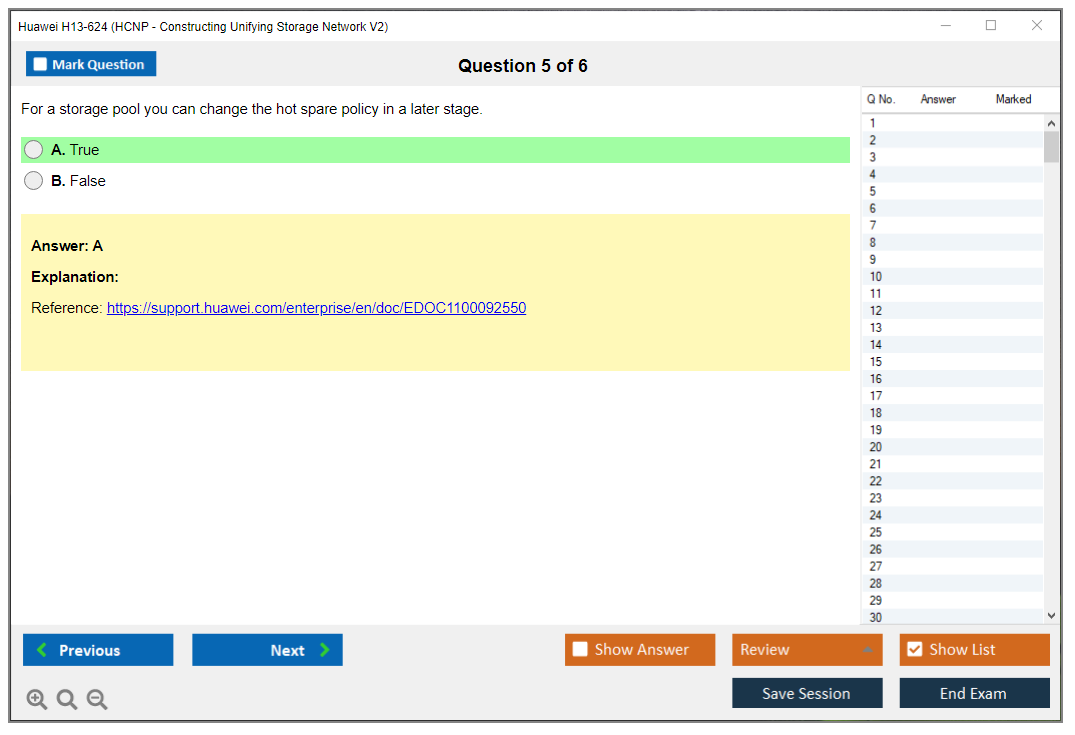
RAID technology gets explored deeply. Beyond basic RAID 0, 1, 5, 6, and 10, you need to understand RAID 50 and any proprietary RAID types Huawei implements. RAID rebuild processes, hot spare configuration (local versus global spares), and performance characteristics during normal operation versus degraded mode all show up. Honestly, degraded mode performance is where most people's theoretical knowledge falls apart.
Storage virtualization principles cover logical volume management, thin provisioning mechanics, storage pooling concepts, and the abstraction layers between physical disks and logical volumes presented to hosts. Snapshot technology includes copy-on-write versus redirect-on-write mechanisms. Know which approach Huawei uses and why. Snapshot hierarchies, scheduling, and space management are testable, particularly around what happens when snapshot space runs out.
Replication technologies compare synchronous versus asynchronous modes, consistency groups for maintaining write order across multiple LUNs, and RPO/RTO considerations that drive replication strategy decisions. Data reduction techniques include deduplication algorithms (inline versus post-process), compression methods, and how to calculate actual space efficiency when multiple techniques are combined. The math here trips people up.
Storage tiering concepts, especially SmartTier functionality, automate data migration between SSD, SAS, and NL-SAS tiers based on access patterns. You need to understand how the system monitors I/O patterns, makes migration decisions, and how manual overrides work for specific LUNs.
Cache mechanisms like read cache, write cache, cache mirroring for redundancy, cache partitioning between different workloads all impact overall system throughput in ways that become critical during peak loads. Know the performance trade-offs of different cache configurations.
Huawei storage solutions and components
OceanStor product family overview includes Dorado all-flash arrays for ultra-low latency workloads, OceanStor hybrid arrays that mix flash and spinning disk, and OceanStor Pacific distributed storage for scale-out scenarios. Product positioning matters. Which array fits which workload profile based on actual performance characteristics, not just marketing materials?
OceanStor hardware architecture covers controller architecture (active-active configurations), disk enclosures, interface modules (FC, iSCSI, FCoE), power and cooling systems, and how the platform scales. SmartTier technology automates tier management. You configure tier policies, monitor performance metrics, and let the system migrate data based on access patterns. Manual migration options exist for exceptions, also for situations where business requirements override performance data.
HyperMetro provides active-active data center architecture with automatic failover, consistency group management, and zero RPO/RTO scenarios. This is critical for business applications that can't tolerate downtime. Know the configuration requirements (network latency limits, bandwidth requirements) and how failover actually works at the I/O level.
HyperReplication handles disaster recovery with both synchronous and asynchronous modes. Remote replication configuration, bandwidth management to avoid saturating WAN links, and DR testing procedures without disrupting production replication all appear on the exam. Particularly the testing part since that's where implementation often gets lazy.
SmartVirtualization lets OceanStor arrays virtualize external storage from other vendors. This enables non-disruptive data migration from legacy arrays. You present the old array's LUNs to the OceanStor, which then re-presents them to hosts while migrating data in the background. Migration procedures and compatibility considerations are testable.
HyperSnap provides space-efficient snapshots using redirect-on-write. Snapshot cloning creates writable copies, rollback operations restore LUNs to previous snapshot points, and snapshot integration with backup software enables rapid backup operations. SmartQoS implements quality of service with IOPS and bandwidth limits, priority-based resource allocation, and multi-tenant performance isolation. In shared storage environments, you prevent noisy neighbors from starving other workloads. This becomes especially important in cloud or service provider scenarios. I once saw a single analytics job bring down an entire shared environment because nobody bothered configuring QoS properly, which is the kind of thing that makes you a believer real quick.
SmartCache uses SSD for cache acceleration beyond the controller cache. Cache partition strategies let you dedicate cache resources to specific workloads, and performance analysis tools show cache hit rates. SmartThin handles thin provisioning with space allocation policies, capacity monitoring, automatic space reclamation when data is deleted, and oversubscription management to prevent running out of physical space.
SmartDedupe and SmartCompression reduce storage footprint significantly. Inline deduplication happens during writes. Post-process happens during idle periods. Know the performance versus space savings trade-offs. Compression ratios vary by data type, and calculating actual space savings when combining deduplication and compression requires understanding how they interact. You can't just multiply the ratios together.
OceanStor management interfaces include DeviceManager web GUI for most operations, CLI commands for scripting and advanced config, REST API for integration with orchestration tools, and SNMP for monitoring integration.
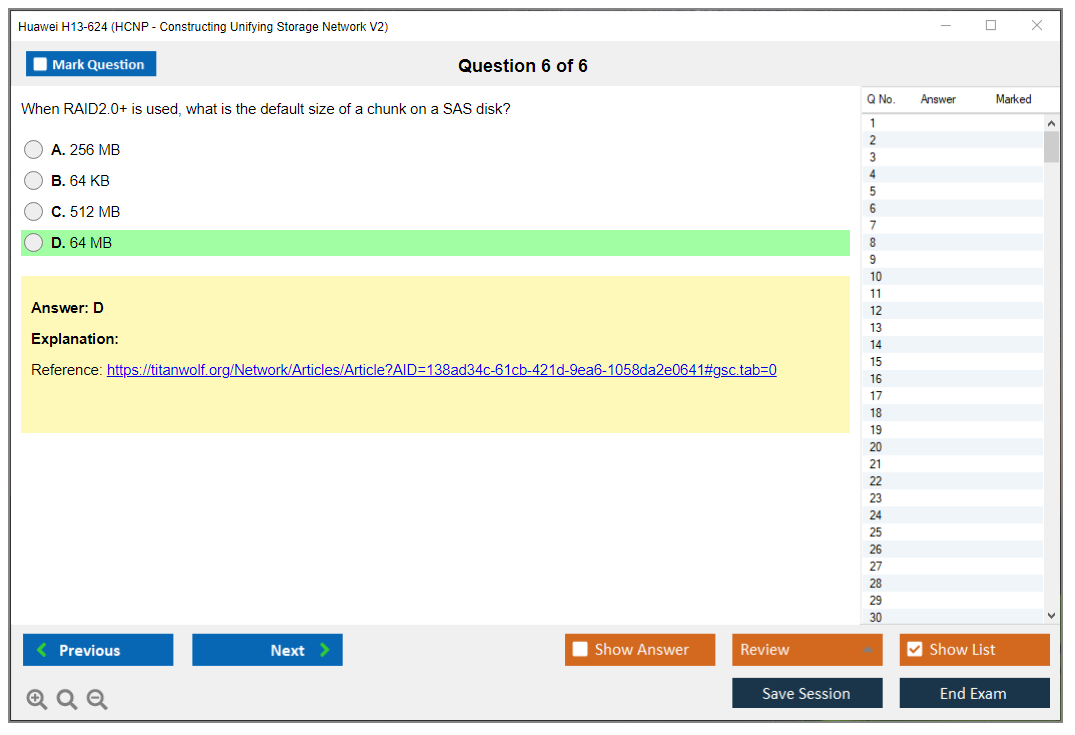
Initial system deployment covers hardware installation, cabling requirements (redundant paths for everything), network configuration (management network separate from storage traffic), and initial setup procedures. Storage pool creation involves disk domain configuration (grouping disks by type), RAID group creation with appropriate RAID levels, pool capacity planning to avoid fragmentation, and performance considerations around stripe size and chunk distribution that affect sequential versus random workload performance.
LUN provisioning workflows include setting LUN parameters like size, RAID type, tier preference. Capacity allocation (thick versus thin). Activating LUN features like compression or deduplication. Mapping LUNs to hosts. File system configuration for NAS includes file system creation on storage pools, quota management to prevent runaway space consumption, directory structures, and share configuration for NFS exports or SMB shares.
Host connectivity setup requires HBA installation and configuration, multipath software configuration (PowerPath, DM-Multipath on Linux, MPIO on Windows), and path failover testing to verify redundancy works. Network configuration spans management network setup, business network configuration for storage traffic, VLAN configuration to separate traffic types, and IP addressing schemes.
User and permission management implements role-based access control, user account creation with appropriate permissions, and security policies around password complexity and session timeouts. Replication configuration creates replication pairs between source and target LUNs, sets up consistency groups for application consistency, selects replication mode (sync/async), and runs initial synchronization.
Snapshot policy configuration automates snapshot scheduling, sets retention policies to manage snapshot sprawl, establishes naming conventions, and reserves snapshot space. Performance tuning during deployment optimizes cache configuration for expected workload, sets prefetch settings for sequential reads, configures I/O priority for critical LUNs, and profiles workloads to validate configuration actually delivers what you promised.
Integration with virtualization platforms like VMware vSphere enables VAAI/VASA support for offloading operations to the array, datastore provisioning, and vVols configuration for more granular VM-level storage management. Integration with backup solutions requires verifying compatibility, configuring snapshot integration for application-consistent backups, setting up backup proxy servers, and testing restore procedures. Because backups you haven't tested are just expensive hope.
Daily operational checks include system health monitoring through DeviceManager dashboards, capacity utilization review to catch thin provisioning over-allocation before it becomes critical, performance metrics analysis to identify degradation trends, and alert review to catch early warning signs.
Performance monitoring tools in DeviceManager show real-time and historical performance data. CLI performance commands provide detailed statistics. Analyzing historical data and trending helps with capacity planning and identifying chronic bottlenecks before they impact users. Trending is where proactive management separates itself from reactive firefighting.
Capacity management involves forecasting based on growth trends, monitoring thin provisioning to avoid out-of-space scenarios, configuring automatic space reclamation to free up deleted data, and planning capacity expansions. Firmware and software updates require planning around maintenance windows, compatibility verification with host software and applications, following update procedures, knowing rollback procedures if updates fail, and managing version compatibility across multi-array environments.
Hardware maintenance procedures cover disk replacement (hot-swap capabilities), controller failover testing to verify redundancy, component health monitoring for predictive failures, and predictive failure analysis based on SMART data. Log management includes collecting system logs, analyzing logs for troubleshooting (error codes, event correlation), archiving logs for compliance, and integrating with SIEM systems in security-focused environments.
Alert configuration sets appropriate threshold values, configures notification mechanisms like email or SNMP traps, prioritizes alerts to avoid alert fatigue, and sets up escalation procedures for critical issues. Backup and recovery operations manage backup schedules, verify backups actually work, test restore procedures regularly, and run disaster recovery drills.
Replication management monitors replication health, tracks bandwidth utilization to avoid saturation, analyzes lag time in asynchronous replication, and executes planned failover procedures for testing or maintenance. Security operations include user access auditing, security patch management, vulnerability assessment, and compliance reporting for regulatory requirements.
Systematic troubleshooting methodology follows problem identification, information gathering (logs, performance data, configuration), root cause analysis, solution implementation, and verification that the fix actually worked. Common storage issues include performance degradation, connectivity problems between hosts and storage, capacity alerts from thin provisioning over-allocation, replication failures, and snapshot issues.
Performance bottleneck identification requires finding whether the bottleneck is controller CPU, cache (insufficient or poor hit ratio), backend disks (spindle contention), or network (FC fabric congestion, Ethernet saturation). Usually it's not where you initially think it is. Log analysis techniques involve interpreting system logs, looking up error codes in Huawei documentation, correlating events across multiple log sources (storage logs, host logs, switch logs), and recognizing patterns that indicate specific failure modes.
Diagnostic tool usage includes built-in diagnostic commands in the CLI, performance analysis tools in DeviceManager, network diagnostic utilities like FC analyzer tools or packet captures, and vendor support tools for advanced diagnostics. Host-side troubleshooting addresses multipath configuration issues like paths not balancing or failover not working. HBA driver problems. Application-level performance issues. Host resource constraints like CPU or memory bottlenecks.
Network troubleshooting covers FC fabric issues like switch zoning misconfigurations, Ethernet network problems, latency issues from routing or distance, packet loss analysis, and bandwidth saturation. Replication troubleshooting handles synchronization failures, consistency group issues where some members fall out of sync, bandwidth limitations preventing replication from keeping up, and split-brain scenarios after network partitions. Split-brain's particularly nasty because both sides think they're primary.
Snapshot troubleshooting deals with snapshot space exhaustion (running out of reserved space), snapshot deletion failures, snapshot performance impact when too many snapshots exist, and snapshot consistency issues. Performance optimization strategies include cache optimization (sizing, partitioning), RAID group optimization (appropriate RAID levels, hot spot distribution), LUN distribution across controllers and disk groups, workload balancing, and QoS tuning to prevent resource contention.
Capacity optimization identifies space waste from abandoned LUNs or old snapshots, evaluates deduplication effectiveness, improves compression ratios by enabling compression on appropriate data types, and optimizes thin provisioning to maximize oversubscription without risk. Proactive maintenance uses predictive failure analysis from SMART data, trend analysis for capacity and performance to catch problems before they're critical, and recommends preventive actions.
Backup strategy design chooses between full and incremental backups based on recovery requirements, defines backup windows, sets retention policies balancing recovery needs against storage costs, and selects backup storage targets (disk, tape, cloud). Snapshot-based backup leverages array snapshots for rapid backup operations, replicates snapshots to backup targets, and enables instant recovery by cloning snapshots.
Disaster recovery planning analyzes RPO/RTO requirements to determine appropriate replication strategy, designs DR sites with adequate resources, selects replication strategy (sync for zero RPO, async for long distance), and schedules DR testing. HyperMetro for business continuity provides
Conclusion
Wrapping up your H13-624 path
Okay, real talk. The Huawei H13-624 (HCIP-Storage V5.0) definitely isn't easy. But here's the thing: it's absolutely manageable once you've wrapped your head around what they're actually testing you on, not just some vague idea of "storage stuff." The H13-624 exam difficulty lands exactly where you'd think for intermediate certification. Tougher than HCIA for sure, but nowhere near the nightmare level of HCIE. You've gotta have legitimate understanding of storage architecture fundamentals working in your favor here, because surface-level cramming and memorization tricks won't cut it when the questions start getting specific.
The H13-624 exam cost? Varies. Expect around $300 USD in most places, though your region might differ slightly. Not exactly pocket change, I know. The H13-624 passing score typically hits 600 out of 1000, which (honestly) sounds way more intimidating than it actually feels once you've invested proper prep time with legitimate HCIP-Storage V5.0 study materials instead of, like, random YouTube clips and hope.
What actually works? From what I've witnessed: candidates who crush this thing spend deliberate time working through the H13-624 exam objectives. Systematically. They don't cherry-pick the interesting topics or skip over boring foundational concepts like SAN and NAS concepts for Huawei, thinking they'll somehow wing their way through storage troubleshooting and performance tuning scenarios. OceanStor certification exam questions require you to demonstrate how systems function in actual production environments, not regurgitate textbook definitions verbatim.
HCIP-Storage V5.0 prerequisites? Technically optional. You can sit the exam without HCIA if you want. But I mean.. don't be that person who skips foundations and then complains afterward. Build your base first. Also (and this matters) HCIP-Storage V5.0 renewal hits every three years, so this isn't some one-and-done achievement you frame and forget about. You'll need to recertify or upgrade eventually to keep your Huawei storage certification status active.
The Huawei HCIP Storage V5.0 syllabus? Covers massive ground. Deployment workflows, data protection strategies, monitoring tools, RAID configurations. The works. It's thorough without crossing into impossible territory, provided you're actually getting hands-on practice and not just reading slides. I knew someone who thought reading documentation for two weeks straight would be enough. Spoiler: it wasn't.
Before scheduling anything, take stock. Be honest with yourself. Have you actually worked with real Huawei storage solutions in any capacity? Can you troubleshoot performance problems without frantically googling each step? An H13-624 practice test will reveal your readiness status pretty quickly, or show you need another solid month of lab work first.
Want preparation that actually mirrors real exam format? Check out the H13-624 Practice Exam Questions Pack. It's designed around current exam objectives and helps identify your weak areas before you waste that exam fee. Not gonna sugarcoat it: practicing with realistic question formats makes a ridiculous difference in both your confidence levels and actual performance when test day arrives.
