CSM-001 Practice Exam - Certified Scrum Master (CSM)
Reliable Study Materials & Testing Engine for CSM-001 Exam Success!
Exam Code: CSM-001
Exam Name: Certified Scrum Master (CSM)
Certification Provider: GAQM
Corresponding Certifications: Scrum Certifications , CSM


Free Updates PDF & Test Engine
Verified By IT Certified Experts
Guaranteed To Have Actual Exam Questions
Up-To-Date Exam Study Material
99.5% High Success Pass Rate
100% Accurate Answers
100% Money Back Guarantee
Instant Downloads
Free Fast Exam Updates
Exam Questions And Answers PDF
Best Value Available in Market
Try Demo Before You Buy
Secure Shopping Experience
CSM-001: Certified Scrum Master (CSM) Study Material and Test Engine
Last Update Check: Mar 18, 2026
Latest 133 Questions & Answers
Training Course 185 Lectures (4 Hours) - Course Overview
45-75% OFF
Hurry up! offer ends in 00 Days 00h 00m 00s
*Download the Test Player for FREE
Printable PDF & Test Engine Bundle
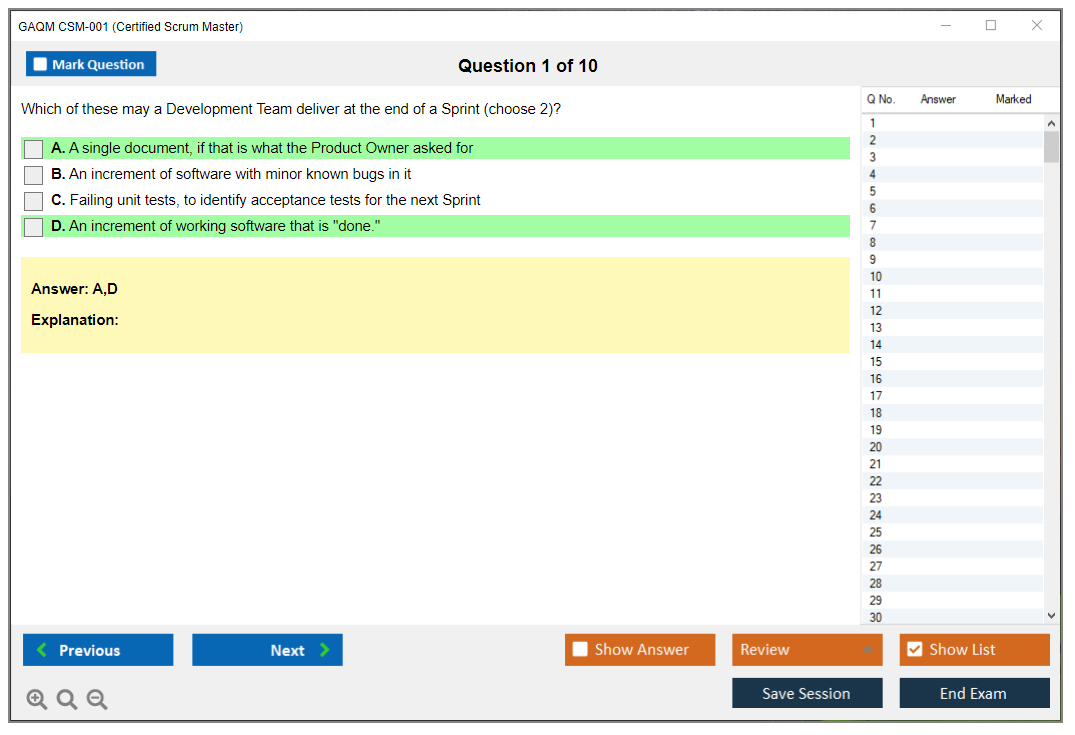
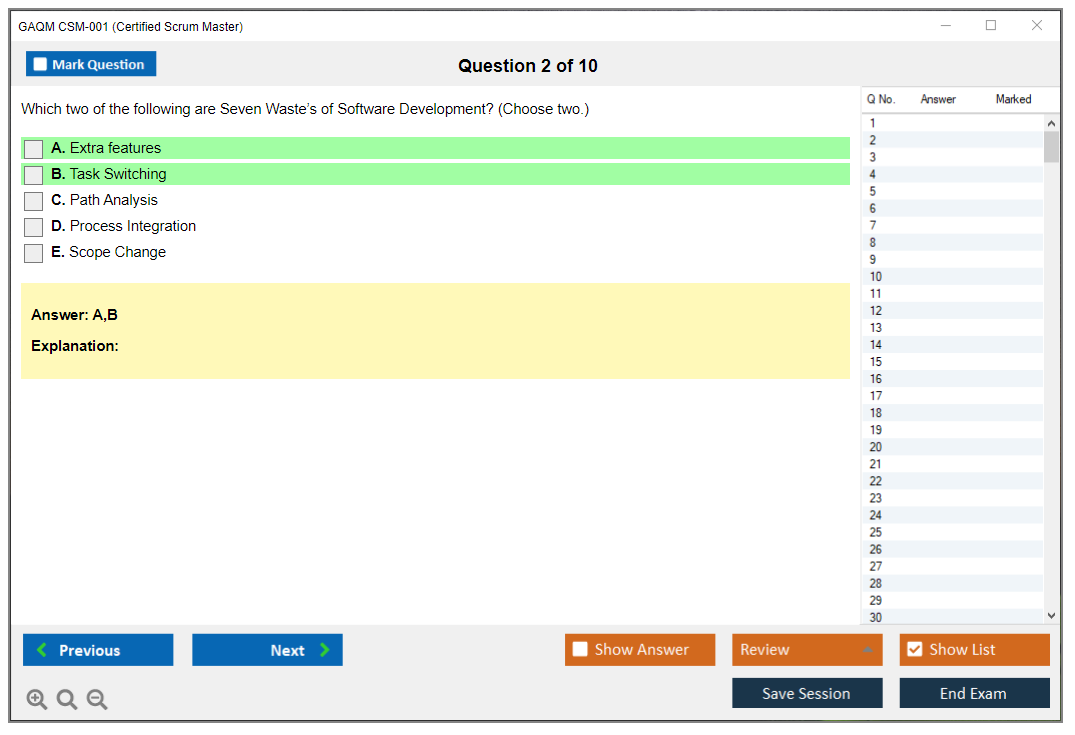
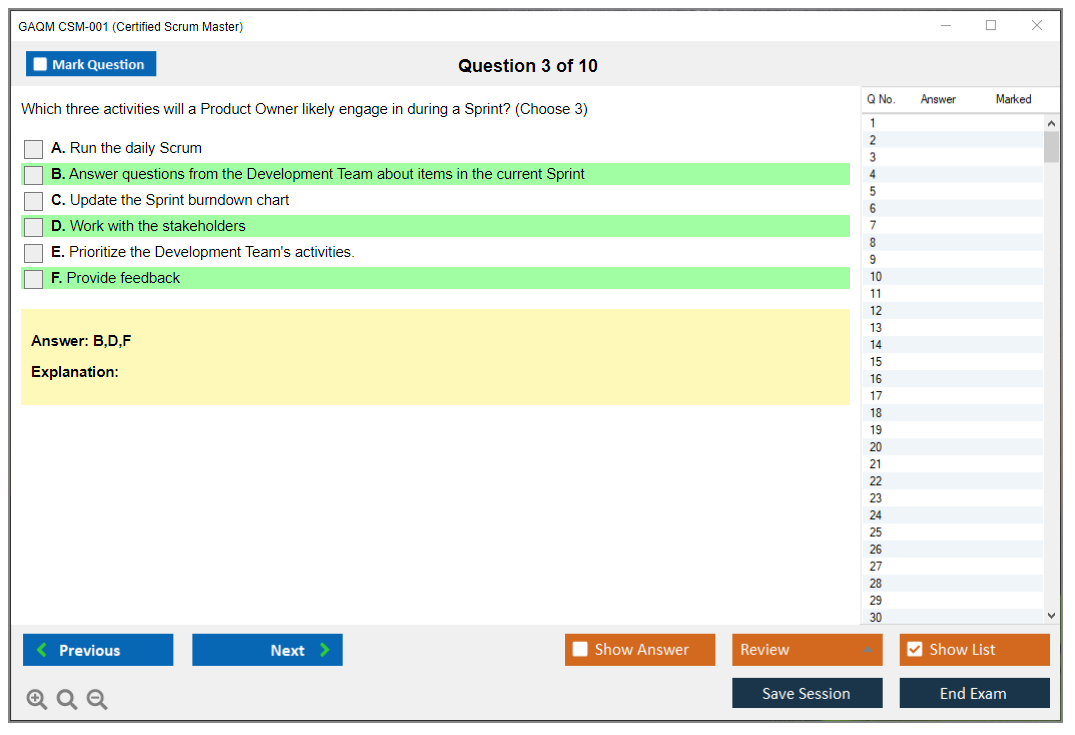
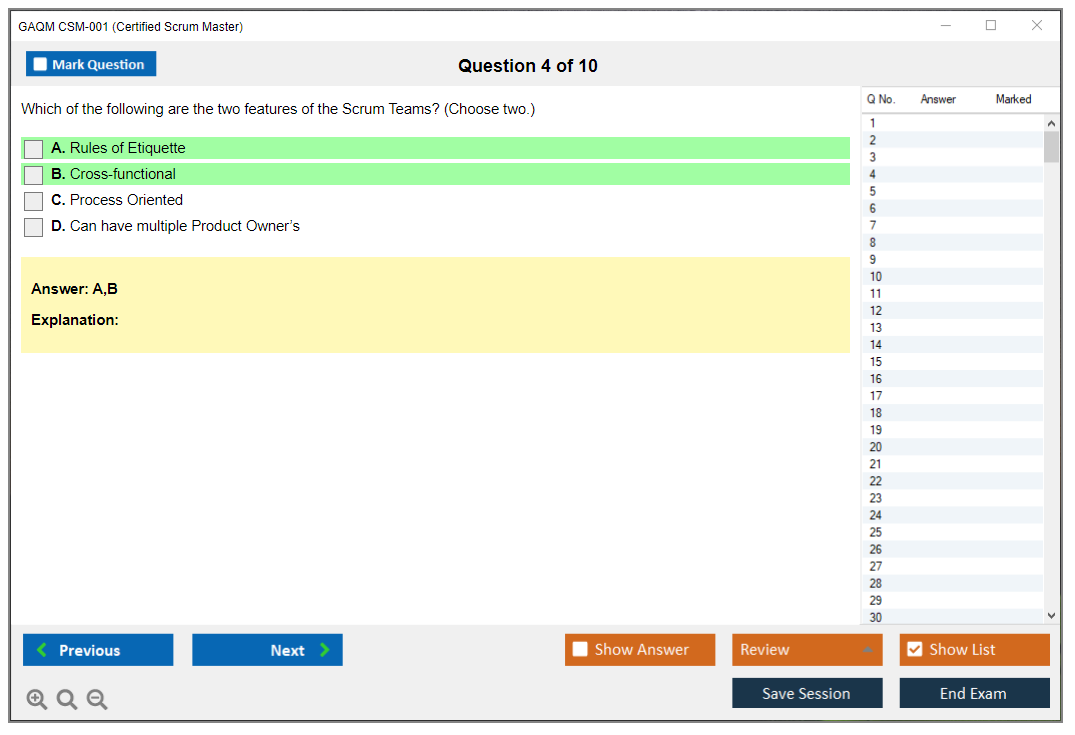
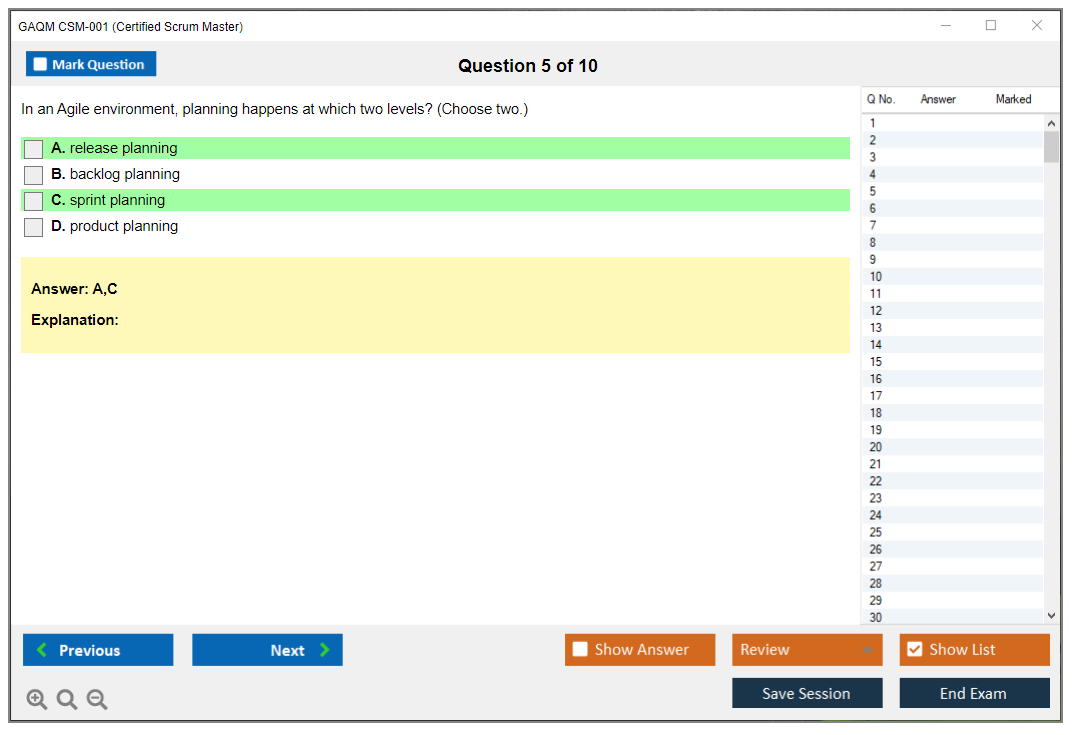
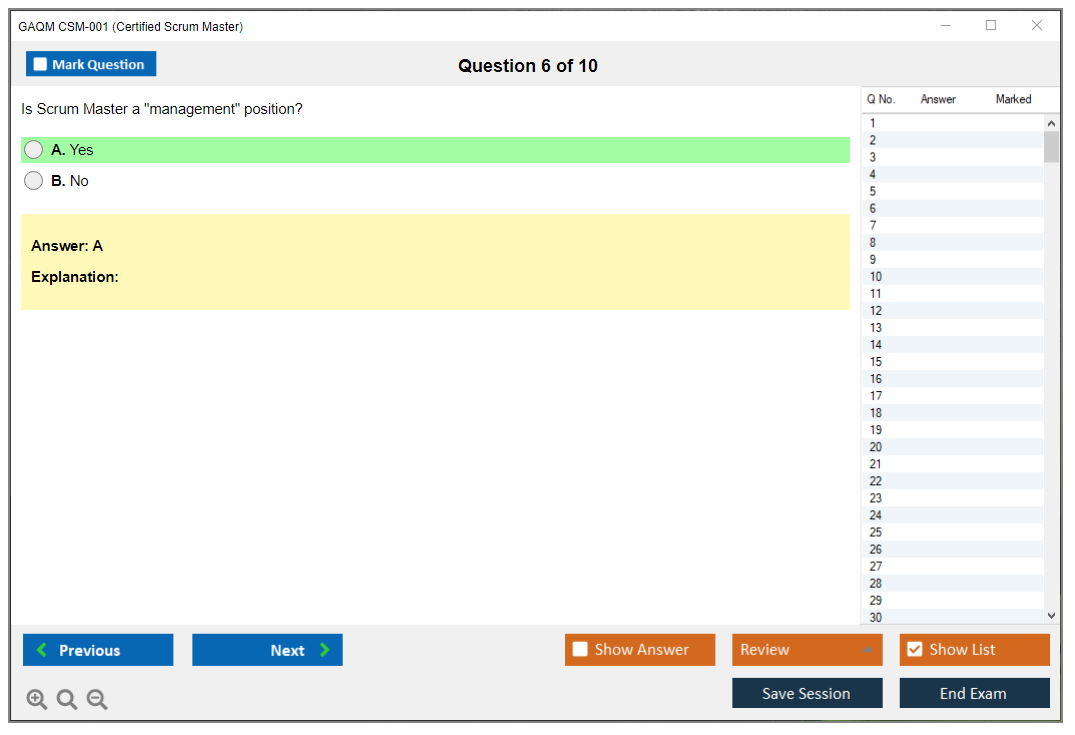
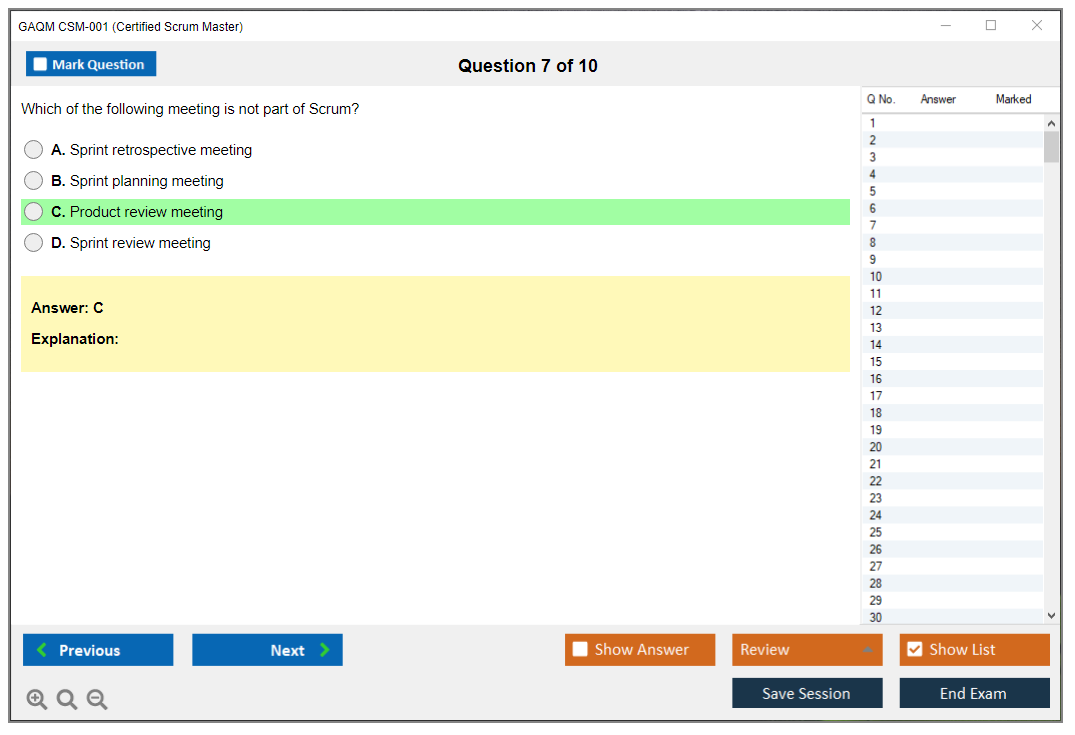
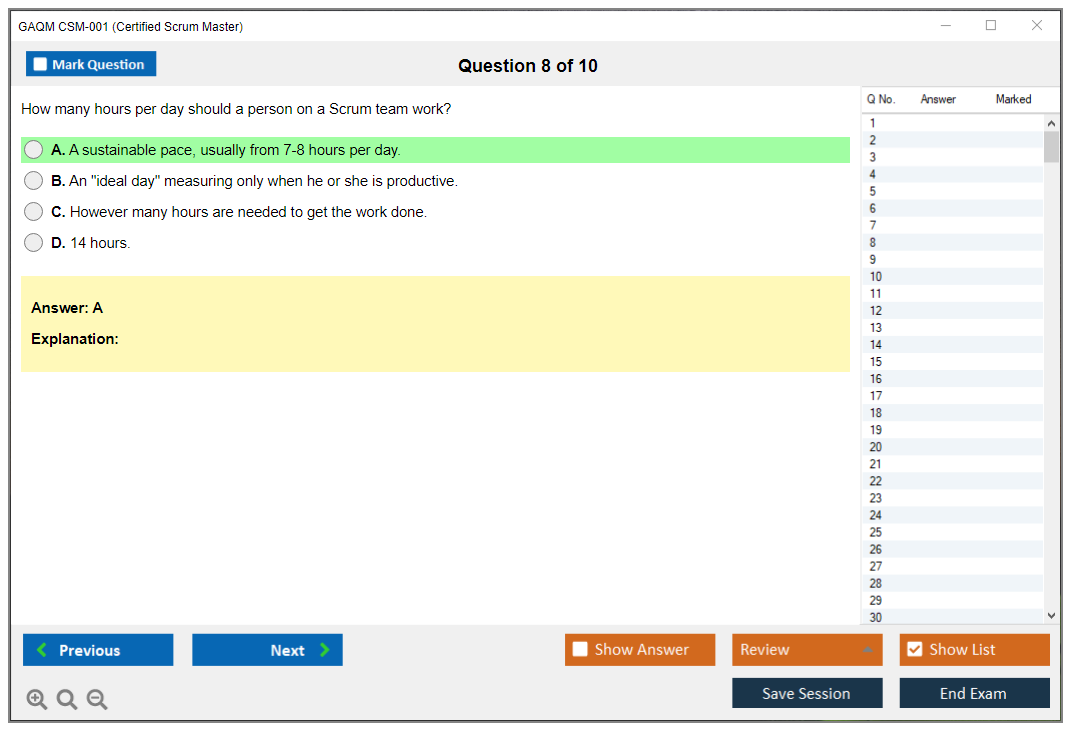
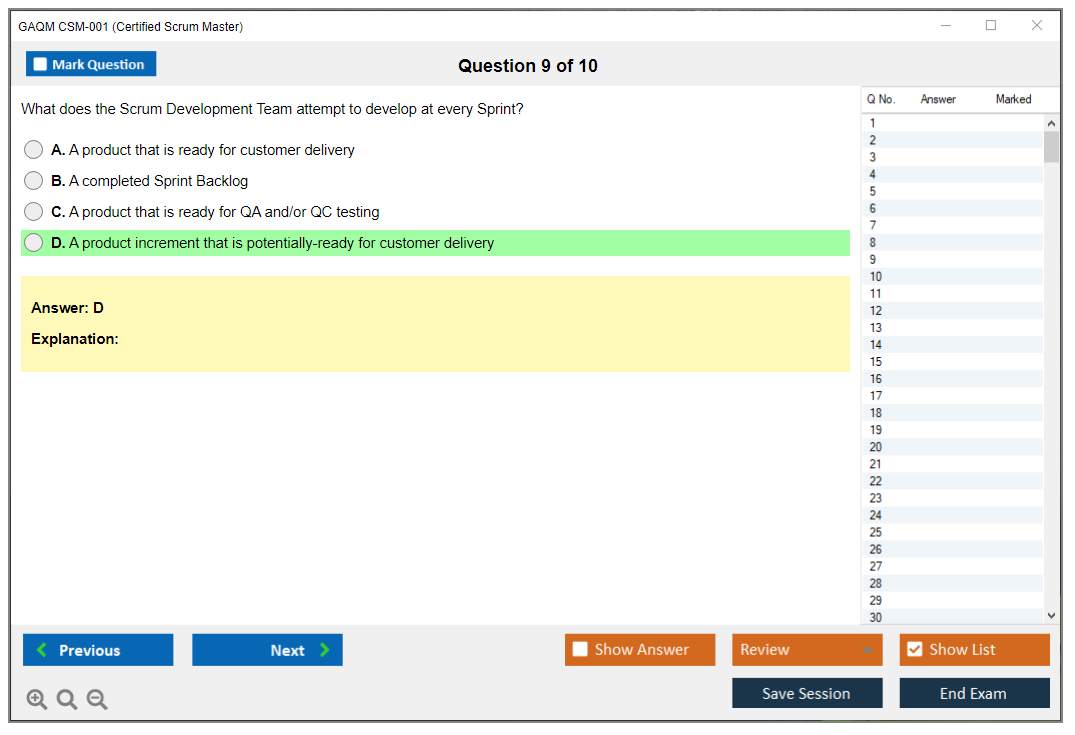
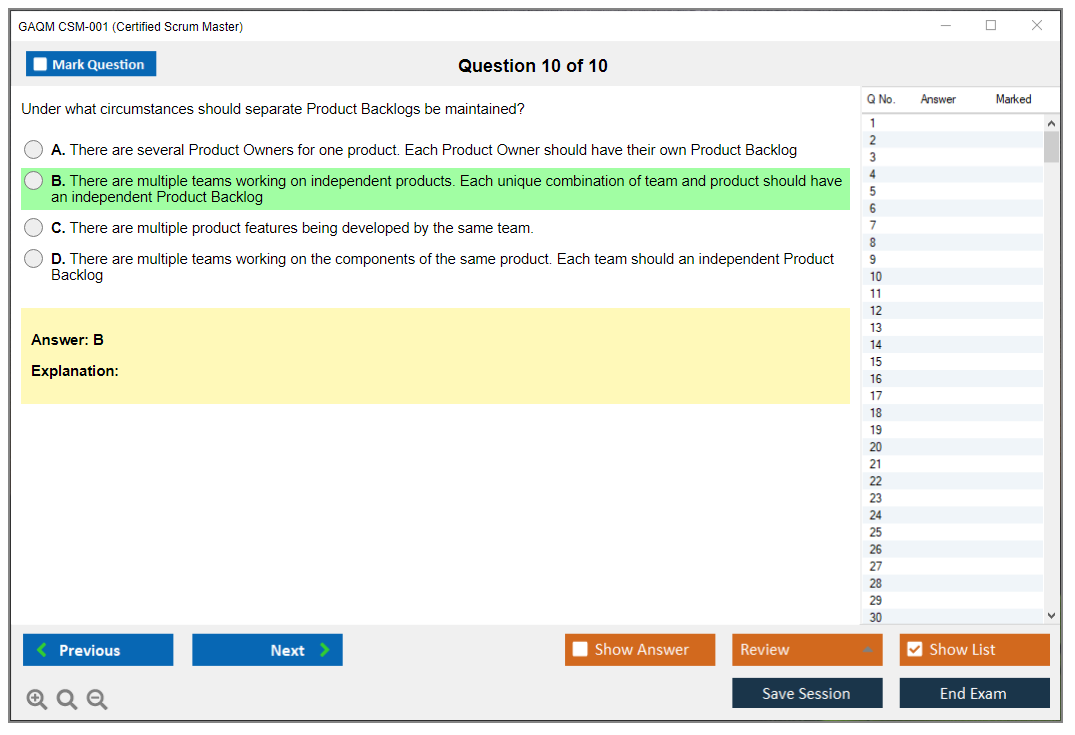
Dumpsarena GAQM Certified Scrum Master (CSM) (CSM-001) Free Practice Exam Simulator Test Engine Exam preparation with its cutting-edge combination of authentic test simulation, dynamic adaptability, and intuitive design. Recognized as the industry-leading practice platform, it empowers candidates to master their certification journey through these standout features.
What is in the Premium File?
Satisfaction Policy – Dumpsarena.co
At DumpsArena.co, your success is our top priority. Our dedicated technical team works tirelessly day and night to deliver high-quality, up-to-date Practice Exam and study resources. We carefully craft our content to ensure it’s accurate, relevant, and aligned with the latest exam guidelines. Your satisfaction matters to us, and we are always working to provide you with the best possible learning experience. If you’re ever unsatisfied with our material, don’t hesitate to reach out—we’re here to support you. With DumpsArena.co, you can study with confidence, backed by a team you can trust.
GAQM CSM-001 Exam FAQs
Introduction of GAQM CSM-001 Exam!
The GAQM Certified Scrum Master (CSM) exam is a certification exam designed to assess a candidate's knowledge and understanding of the Scrum framework and its application in the workplace. The exam covers topics such as Scrum roles, events, artifacts, and principles. It is designed to test a candidate's ability to apply Scrum principles and practices to real-world scenarios.
What is the Duration of GAQM CSM-001 Exam?
The duration of the GAQM Certified Scrum Master (CSM) exam is two hours.
What are the Number of Questions Asked in GAQM CSM-001 Exam?
The GAQM CSM-001 exam consists of a total of 75 multiple-choice questions.
What is the Passing Score for GAQM CSM-001 Exam?
The passing score required to pass the GAQM CSM-001 exam is 70%.
What is the Competency Level required for GAQM CSM-001 Exam?
The Competency Level required for GAQM CSM-001 exam is Foundation Level. This is the entry-level certification that requires a basic understanding of the principles of agile software development and the Certified Scrum Master® (CSM®) role.
What is the Question Format of GAQM CSM-001 Exam?
The GAQM Certified Scrum Master (CSM-001) exam consists of multiple choice and multiple response questions.
How Can You Take GAQM CSM-001 Exam?
The GAQM CSM-001 exam can be taken either online or in a testing center. Online exams are conducted through the GAQM Online Exams platform, while testing center exams are conducted through Pearson VUE.
What Language GAQM CSM-001 Exam is Offered?
The GAQM CSM-001 exam is offered in English.
What is the Cost of GAQM CSM-001 Exam?
The cost of the GAQM CSM-001 exam is $150 USD.
What is the Target Audience of GAQM CSM-001 Exam?
The target audience of the GAQM CSM-001 exam is professionals who are seeking to become Certified Scrum Masters. It is designed for individuals who have experience with Agile and Scrum methodologies and are looking to become certified in Scrum Master knowledge and practices.
What is the Average Salary of GAQM CSM-001 Certified in the Market?
The average salary for a GAQM Certified Scrum Master (CSM-001) is around $80,000 per year. However, this salary can vary depending on the individual's experience and the region they are located in.
Who are the Testing Providers of GAQM CSM-001 Exam?
The GAQM CSM-001 exam is administered by Pearson VUE. Pearson VUE is a global leader in computer-based testing and provides testing services to many organizations and certification programs.
What is the Recommended Experience for GAQM CSM-001 Exam?
The recommended experience for taking the GAQM CSM-001 exam is to have at least two years of experience working with Agile software development and Scrum principles. It is also recommended to have a working knowledge of the Scrum framework and its components, including roles, meetings, and artifacts. Additionally, knowledge of Agile project management and Lean principles is beneficial.
What are the Prerequisites of GAQM CSM-001 Exam?
The Prerequisite for GAQM CSM-001 Exam is that the candidate must hold a valid Foundation Level Certification in the relevant domain.
What is the Expected Retirement Date of GAQM CSM-001 Exam?
The official website to check the expected retirement date of GAQM CSM-001 exam is https://www.gaqm.org/certifications/certified-scrum-master-csm-001.html.
What is the Difficulty Level of GAQM CSM-001 Exam?
The difficulty level of the GAQM CSM-001 exam is considered to be moderate. The exam consists of 60 multiple-choice questions and is designed to test the knowledge and skills of Certified Scrum Masters.
What is the Roadmap / Track of GAQM CSM-001 Exam?
The GAQM CSM-001 Exam is a certification track and roadmap that is designed to assess the knowledge and skills of individuals in the field of Certified ScrumMaster (CSM). The exam covers topics such as Scrum fundamentals, Scrum roles, Scrum ceremonies, and Scrum artifacts. The exam is designed to provide individuals with the knowledge and skills necessary to be successful as a Certified ScrumMaster. Passing the exam is a prerequisite for obtaining the Certified ScrumMaster designation.
What are the Topics GAQM CSM-001 Exam Covers?
The GAQM Certified Scrum Master (CSM) Exam covers the core principles and practices of Scrum and Agile project management. The topics covered in the exam include:
1. Scrum Framework: This section covers the fundamentals of Scrum, including the Scrum values, roles, events, artifacts, and rules.
2. Agile Principles and Practices: This section covers the core principles and practices of Agile, such as self-organization, customer collaboration, and continuous improvement.
3. Team Dynamics and Facilitation: This section covers the skills needed to effectively facilitate and manage a Scrum team, including understanding team dynamics, setting expectations, and resolving conflicts.
4. Product Ownership: This section covers the skills and knowledge needed to effectively manage a product backlog, including understanding customer requirements, prioritizing features, and managing stakeholders.
5. Scrum in the Enterprise: This section covers the challenges of implementing Scrum in
What are the Sample Questions of GAQM CSM-001 Exam?
1. What is the purpose of the Scrum Master role?
2. What are the five Scrum values?
3. What is a Sprint Backlog?
4. What is the purpose of a Sprint Planning Meeting?
5. What is the Scrum of Scrums process?
6. What is the difference between a Sprint and an Iteration?
7. What is the purpose of the Daily Scrum Meeting?
8. What are the three pillars of Scrum?
9. What is the Scrum Team's responsibility in terms of product development?
10. What is the purpose of a Sprint Retrospective Meeting?
GAQM CSM-001 (Certified Scrum Master (CSM)) GAQM CSM-001 Certified Scrum Master (CSM) Overview Introduction to GAQM CSM-001 certification and its role in Agile project management So here's the deal. If you're trying to break into Agile or just want some formal credential proving you know your Scrum stuff, the GAQM CSM-001 Certified Scrum Master (CSM) certification's worth checking out. GAQM (that's Global Association for Quality Management) offers vendor-neutral certifications for IT and business folks who need recognized credentials without the insane price tag or those mandatory training classes other organizations basically shove down your throat. The CSM-001 validates foundational knowledge of the Scrum framework: roles, events, artifacts, all that core stuff. This certification's designed for professionals transitioning to Agile methodologies or hunting for formal Scrum Master credentials. Maybe you've been doing project management the old waterfall way for years, right? Then your... Read More
GAQM CSM-001 (Certified Scrum Master (CSM))
GAQM CSM-001 Certified Scrum Master (CSM) Overview
Introduction to GAQM CSM-001 certification and its role in Agile project management
So here's the deal. If you're trying to break into Agile or just want some formal credential proving you know your Scrum stuff, the GAQM CSM-001 Certified Scrum Master (CSM) certification's worth checking out. GAQM (that's Global Association for Quality Management) offers vendor-neutral certifications for IT and business folks who need recognized credentials without the insane price tag or those mandatory training classes other organizations basically shove down your throat. The CSM-001 validates foundational knowledge of the Scrum framework: roles, events, artifacts, all that core stuff.
This certification's designed for professionals transitioning to Agile methodologies or hunting for formal Scrum Master credentials. Maybe you've been doing project management the old waterfall way for years, right? Then your company just announced an "Agile transformation." That's when half the PMs in your office start panic-Googling Scrum certifications. I mean, we've all seen it happen. The CSM-001's recognized globally across industries adopting Scrum and Agile practices. Software shops, marketing teams, even manufacturing operations trying to speed up delivery cycles.
It complements other Agile certifications like PMI-ACP, SAFe, or ICAgile in a full skill portfolio, so if you're building out your resume with multiple Agile credentials, GAQM's offering slots in nicely alongside the bigger names.
What is GAQM CSM-001 and who should take it?
The GAQM CSM-001's an entry-level Scrum Master certification focusing on core Scrum principles and practices. Not advanced theory. Not scaled frameworks. Just fundamentals. The target audience includes aspiring Scrum Masters, team leads, project managers, product owners, developers, and business analysts. If you work anywhere near a Scrum team, honestly, this cert can help.
Ideal for professionals in software development, IT services, marketing, operations, and cross-functional teams. I've seen people from HR departments take it because they're supporting Agile transformations. Like, who would've thought? Suitable for individuals with limited Scrum experience seeking a structured learning path, the CSM-001 benefits career changers moving from traditional waterfall to Agile environments. You know the type: been running Gantt charts for a decade, suddenly everyone's talking about sprints and retrospectives, and you need to catch up yesterday.
Also valuable for managers overseeing Agile transformations and organizational change initiatives. If you're the one explaining to senior leadership why teams are doing "stand-ups" every morning, having the CSM-001 on your LinkedIn gives you credibility. Not to mention it saves you from those awkward moments when someone asks what a "retrospective" is and you're fumbling through an answer that sounds half-baked.
Key benefits and roles (Scrum Master, Agile team member, project lead)
Earning the GAQM CSM-001 certification demonstrates commitment to Agile principles and ongoing professional development. It validates understanding of the Scrum framework as defined in the Scrum Guide (the 2020 version, which's the current standard). The cert boosts resume credibility when applying for Scrum Master, Agile Coach, or team facilitation roles. Recruiters use keyword filters, and "Certified Scrum Master" is one of those magic phrases that gets your resume past the ATS bots.
Provides structured knowledge foundation for helping with Scrum events and coaching teams. You'll learn how to run Sprint Planning without it turning into a three-hour debate about story points. That happens way more often than anyone admits, trust me. Opens doors to higher-paying Agile roles. Average Scrum Master salary ranges $75K to $110K USD depending on location and experience. Not bad for what's basically a facilitation and coaching role.
Strengthens ability to remove impediments, build collaboration, and drive team performance. Supports career advancement into senior Scrum Master, Agile Coach, or program-level roles. Once you've got the CSM-001, you can layer on advanced certs like the Certified Agile Coach (CAC) or the Certified Agile Scrum Master (CASM) to move up the ladder.
Roles and responsibilities covered by the certification
The Scrum Master role's front and center here. You're a servant-leader who facilitates Scrum events, removes impediments, and coaches the team on Scrum practices. Not a project manager. Not some taskmaster cracking the whip. You're there to help the team self-organize and deliver value. Period.
Product Owner collaboration is another big chunk. Understanding how to support the Product Owner in backlog management and stakeholder communication. The Product Owner owns the "what," but you help with the "how" and "when." Development Team enablement means creating an environment for self-organization, cross-functionality, and continuous improvement. You're not assigning tasks. You're clearing the path so the team can do their best work without tripping over organizational nonsense.
Organizational change agent: helping organizations adopt Scrum, addressing cultural resistance, promoting empiricism. This's the hardest part because you're dealing with people who've done things a certain way for 15 years and don't see (wait, let me rephrase) they actively resist why they need to change. Facilitator and coach: leading Sprint Planning, Daily Scrum, Sprint Review, Sprint Retrospective with practical techniques. Each event's got a purpose and timebox, and your job's keeping things on track without being a dictator. Impediment remover: identifying and resolving blockers at team, organizational, and external levels. Sometimes it's a missing laptop. Sometimes it's a VP who won't make a decision. Both're your problem.
How GAQM CSM-001 fits into the Agile certification space
GAQM CSM-001's a vendor-neutral alternative to Scrum Alliance CSM and Scrum.org PSM I certifications. It's a more budget-friendly entry point compared to Scrum Alliance, which requires mandatory training that can run $1,000+ before you even sit the exam. With GAQM, you can self-study and take the test when you're ready.
Exam focuses on Scrum Guide 2020 principles: empiricism, Scrum values (commitment, courage, focus, openness, respect), roles, events, and artifacts. You can combine it with GAQM's Certified Agile Scrum Product Owner (CASPO) or other Agile credentials for broader expertise. It is a foundation before pursuing advanced certifications like A-CSM, PSM II, or SAFe Program Consultant. Think of it as your entry ticket to the Agile world. Once you're in, you can specialize however you want.
Real-world applications and career impact
The CSM-001 enables professionals to lead Scrum teams in software development, product delivery, marketing campaigns, and innovation projects. I've worked with Scrum Masters in e-commerce companies running two-week sprints to ship new features, and others in healthcare IT coordinating distributed teams across three time zones. Totally different contexts, same framework. It equips candidates to help with cross-functional collaboration in distributed and co-located teams, which's critical in the remote/hybrid work era we're all working through now.
Prepares individuals to implement Scrum in startups, enterprises, government agencies, and non-profits. Scrum isn't just for Silicon Valley tech companies anymore. Supports transition from project manager to Agile coach or transformation consultant roles. If you're tired of being the person who updates the project plan and want to actually help teams improve how they work, this's your path. Provides common language and framework for working with global Agile communities. Whether you're in Bangalore, Berlin, or Boston, the Scrum Guide's the same.
Certification validity and professional recognition
GAQM certifications're recognized by employers seeking practical, cost-effective Agile credentials. They're not as well-known as Scrum Alliance or Scrum.org (I'll be honest) but they're gaining traction, especially outside the U.S. The CSM-001 credential demonstrates baseline competency in Scrum framework and servant-leadership. You can list it on LinkedIn, resumes, and professional profiles. Just make sure you spell it out: "GAQM Certified Scrum Master (CSM-001)" so people know it's a formal certification.
Employers value GAQM certifications for their focus on applied knowledge and exam rigor. The test isn't a walk in the park. You actually have to know the material. Certification can be renewed or maintained through GAQM's recertification program, which typically involves continuing education or retaking the exam after a certain period. Check the official GAQM site for current renewal requirements, because these policies can change.
If you're serious about Agile and want a credential that won't break the bank, the GAQM CSM-001's a solid starting point. Pair it with hands-on experience, maybe a Certified Agile Developer (CAD) or Certified Software Testing Manager (CSTM) cert if you're more technical, and you'll have a well-rounded profile that stands out in the job market.
GAQM CSM-001 Exam Details
GAQM CSM-001 Certified Scrum Master (CSM) overview
What is GAQM CSM-001 and who should take it?
GAQM CSM-001 Certified Scrum Master (CSM) certification is basically GAQM's entry-level Scrum Master credential. It's aimed at people who want a Scrum Master title on paper and a decent check on Scrum fundamentals in practice. No drama whatsoever. Just a straightforward Scrum Master certification by GAQM that you can prep for with self-study if you've got the discipline, though not everyone does.
If your company's adopting Scrum and you're the "accidental Scrum Master," this is a clean way to prove you understand the framework without spending a fortune. Another good fit? Anyone doing delivery coordination, QA leads, analysts, and junior PMs trying to switch from task-master mode to servant leadership without feeling like they're losing control of everything. That's honestly the scariest part for most people.
Key benefits and roles (Scrum Master, Agile team member, project lead)
The main benefit is signal. Recruiters and internal managers like seeing a recognizable cert, and GAQM's cheaper than the training-bundled options, which can get ridiculously expensive. Also, prepping forces you to learn the official language. This matters because exams love the Scrum Guide wording, not your team's "Scrum-ish" habits that nobody outside your building would recognize.
Some people take it to become a Scrum Master. Others take it as an Agile team member who wants to stop guessing during Sprint Planning. Project leads take it because they keep getting pulled into Agile initiatives, and the thing is, the mindset shift's the hardest part.
Short version? It's practical. It's not magic.
GAQM CSM-001 exam details
Exam format (questions, duration, delivery)
The GAQM CSM-001 exam format's multiple-choice, and it mixes straight theoretical checks with scenario-based application questions that'll make you think twice. You'll see items that ask you to identify the right Scrum event or artifact, and then you'll get the messy ones where a team's struggling and you have to pick the "most Scrum" response, even if the option feels a little idealized compared to what actually happens in real teams.
Count-wise? It's typically 40 to 50 questions, but the exact number can vary, so confirm in the latest GAQM candidate guide before you plan your pacing or you'll stress yourself out for nothing. It's a closed-book exam, meaning no reference materials during the test. No "quick look at the Scrum Guide" moment. No notes on the desk at all.
Delivery options are pretty flexible. Online proctored delivery's usually available, which is great if you're remote or just don't want to burn half a day driving to a center. Paper-based testing may exist at authorized GAQM test centers in select regions, depending on where you live and what GAQM's offering locally.
One detail people miss is that questions are meant to cover all GAQM CSM-001 exam objectives with a balanced distribution across Scrum roles, events, and artifacts. You can't just cram "roles" and hope to brute force the rest like it's high school history. Scenario-based questions are a big part of what makes this an Agile Scrum fundamentals exam rather than a vocab quiz. You're applying Scrum principles to realistic team situations, with distractor answers that sound like what a traditional PM would do and honestly sometimes feel more natural. I once watched a colleague pick the "assign tasks immediately" option three times in a row because his instinct kept overriding what the framework actually says.
Exam duration and time management
GAQM usually allocates 60 to 90 minutes for completion, but verify the current duration on the GAQM website because providers tweak timing occasionally. That works out to roughly 1.5 to 2 minutes per question on average. Enough if you're decisive. Absolutely not enough if you reread every scenario three times because you're hunting for a trick that might not even be there.
Time management matters here. Answer easier questions first. Flag the ones that feel ambiguous. Circle back later when you've got momentum. There's no negative marking, so attempt everything even if you're uncertain, because leaving blanks is basically donating points to nobody.
Save the last 10 to 15 minutes for review. Not for rethinking your whole identity or career path. Just for checking flagged items, confirming you didn't misread "Daily Scrum" as "Sprint Review," and making sure you didn't click the second-best answer because it sounded "nice."
GAQM CSM-001 passing score
The GAQM CSM-001 passing score's commonly described as around 60 to 70%, but you need to confirm the exact threshold in official GAQM documentation because this can change without warning. Scoring's based on the number of correct answers, and again, no penalty for wrong answers, so guessing's a valid strategy when you've narrowed it down to two options.
Results are often immediate for online proctored exams. For paper-based tests, you may wait around 5 to 7 business days, which feels like forever. Your score report typically includes pass/fail status. A detailed breakdown by domain may not be provided, which's annoying if you like data, but it's normal for these entry certs unfortunately.
If you fail? Retakes are usually allowed after a waiting period, often 7 to 14 days, plus a retake fee. Multiple attempts are generally allowed, but GAQM policies spell out limits and pricing, so read the current rules before you assume you can rapid-fire attempts like it's a video game.
GAQM CSM-001 exam cost
GAQM CSM-001 exam cost usually lands around $150 to $250 USD depending on region, voucher source, and promos if you catch them at the right time. That's the big selling point. It's significantly lower than Scrum Alliance CSM, which often hits $1,000+ once you include mandatory training that takes up an entire weekend.
No mandatory training requirement? That's a real budget win. You can self-study with the Scrum Guide and targeted resources, then just pay for the voucher without begging your manager for training funds. Retake fees often run 50 to 75% of the original cost, so failing repeatedly gets expensive fast, but one retake still keeps you under the price of many training-first certs.
Study materials and practice tests can add $20 to $100 if you go premium, which I'd recommend. Optional courses and boot camps are usually in the $200 to $600 range if you want someone to walk you through Scrum roles events artifacts and common traps instead of figuring it out alone. For self-study candidates, a realistic total's $150 to $350 including the exam, practice tests, and a decent study guide that doesn't feel like it was written by a robot.
GAQM CSM-001 exam difficulty (what to expect)
GAQM CSM-001 exam difficulty's moderate for beginners. You'll be fine if you put in real time with the Scrum Guide and you stop treating it like trivia night at your local bar. For experienced Scrum practitioners, it's relatively straightforward, but only if you align your answers to the official framework, not "how we do it at work" because those are often completely different things.
Project managers tend to find it moderately challenging because Scrum punishes command-and-control instincts pretty hard. The hard part's accepting that the Scrum Master isn't the boss, the Developers own the plan, and the Product Owner owns the Product Backlog. You don't get to "just assign tasks" because the sprint's behind schedule and you're panicking.
Common pitfalls? They're predictable. Confusing Product Owner vs. Scrum Master responsibilities. Mixing up the Sprint Retrospective vs. Sprint Review purposes like they're interchangeable. Forgetting that empiricism's the point, and that transparency, inspection, and adaptation aren't cute words. They're basically the reason the framework exists in the first place.
GAQM CSM-001 objectives (exam syllabus)
Scrum framework fundamentals (values, theory, pillars)
Expect questions on Scrum values, empiricism, and the pillars that hold the whole thing up. This is where philosophical questions show up, and they're easy if you tie them back to real behavior: visibility, frequent check-ins, and changing course when reality says you're wrong instead of being stubborn.
Scrum roles and responsibilities (Scrum Master, Product Owner, Developers)
Know who does what. The exam loves edge cases. Who can cancel a Sprint, who owns ordering the backlog, who's accountable for the Increment, who coaches whom and under what circumstances.
Scrum events (Sprint, Planning, Daily Scrum, Review, Retrospective)
You need the purpose of each event, not just the name that everyone throws around. Also timing and outcomes matter, because scenario questions often hide the answer in what the team's trying to accomplish rather than making it obvious.
Scrum artifacts and commitments (Product Backlog, Sprint Backlog, Increment)
Artifacts are simple until someone starts mixing them up under pressure. Product Backlog's ordered work for the product. Sprint Backlog's the plan for the Sprint plus the work selected. Increment's the potentially releasable output, tied to the Definition of Done which everyone forgets about.
Estimation, planning, and delivery basics (velocity, forecasting, DoD/DoR)
This part's usually light, but you should know what teams commonly use for forecasting, what DoD's for, and why DoR's optional and not an official Scrum artifact even though half the teams out there treat it like gospel.
Coaching, facilitation, and impediment removal
Scenario questions live here permanently. The Scrum Master removes impediments, coaches the organization, and helps the team improve continuously. That's different from "chasing people for status updates" which is what nobody wants to do anyway.
Agile metrics and reporting (burn-down/burn-up, transparency)
You don't need to be a metrics nerd with spreadsheets everywhere, but you do need to recognize what charts mean and how they support transparency rather than punishment or micromanagement disguised as "visibility."
Scaling and real-world adoption considerations (high-level)
Usually high-level stuff. Basic awareness of multiple teams, coordination challenges, and the risks of turning Scrum into a process police system where nobody's actually enjoying their work.
Prerequisites and eligibility for GAQM CSM-001
Recommended background (Agile/Scrum exposure)
GAQM Certified Scrum Master prerequisites are typically light, which's nice. Having sat through a few Sprints helps a lot, because you'll visualize the scenarios instead of memorizing definitions like you're studying vocabulary in a language you'll never speak.
Required prerequisites (if any) and suggested experience
Generally there's no formal required training prerequisite, which's part of why people choose it over fancier options. Still, don't wing it cold if you've never seen a backlog or a retro in your life. You'll hate the exam and probably yourself.
Best study materials for GAQM CSM-001
Official GAQM resources (syllabus, handbook, candidate guide)
Start with GAQM's syllabus, handbook, and candidate guide because that's where the exam structure details live, plus the official list of GAQM CSM-001 exam objectives that you'll actually be tested on instead of what some random blog thinks is important.
Recommended Scrum references (Scrum Guide + core Agile reading)
Read the Scrum Guide. Twice minimum. Then read it again and write notes in your own words so it actually sticks. Add one solid Agile overview book if you want deeper context, but don't bury yourself in ten sources that contradict each other and leave you more confused.
Study plan (7-day / 14-day / 30-day options)
A 7-day plan's for people with experience who just need alignment with official terminology. A 14-day plan fits most beginners with steady daily time blocks. A 30-day plan's for busy folks who can only do small blocks and don't want to cram everything the night before like it's college finals.
GAQM CSM-001 practice tests and exam prep strategy
Where to find GAQM CSM-001 practice tests
GAQM CSM-001 practice tests show up on training sites, exam platforms, and sometimes bundled with paid study guides that vary wildly in quality. Also search for CSM-001 mock exam questions, but be picky because some are outdated or flat-out wrong and will teach you the wrong answers.
How to use mock exams effectively (timed sets, review wrong answers)
Take timed sets under exam conditions. Review every wrong answer thoroughly. Then review the ones you got right for the wrong reason, because that's the sneaky failure mode nobody talks about. This is basically the whole Scrum Master exam prep guide approach that actually works: practice, diagnose, patch the gaps.
Common question patterns and pitfalls
Two patterns show up constantly: "what should the Scrum Master do next" and "which event/artifact fits this situation best." The pitfall's picking what your workplace would do, not what Scrum says, which's frustrating but predictable. Distractors are designed for that exact trap.
How to register and schedule the GAQM CSM-001 exam
Registration steps
Buy a voucher from GAQM or an authorized partner, create your candidate profile with accurate info, then schedule your slot through their system. Online proctoring's often 24/7, so you can pick a weird time if your house is loud during the day or you're a night person.
Exam-day requirements and policies
For online proctored exams you'll need stable internet, a webcam, and a quiet room with good lighting. No extra monitors, no notes, no "my phone's face down so it doesn't count." Test centers have their own rules, but the vibe's the same. They're watching everything.
GAQM CSM-001 renewal and recertification
Certification validity period (if applicable)
GAQM CSM-001 renewal requirements depend on GAQM's current policy for certification validity, which isn't always clear. Some GAQM certs have validity periods, some are lifetime, and the only safe move's checking your certificate terms or the GAQM site directly rather than guessing.
Renewal requirements, fees, and continuing education (if applicable)
If renewal's required, it may involve a fee, a retest, or continuing education style proof that you've stayed current. Policies change frequently, so don't rely on an old blog post, including mine, when money and deadlines are on the line.
How to maintain your Scrum Master credential long term
Stay active in real Scrum teams doing actual work. Reread the Scrum Guide occasionally when updates drop. Keep a log of what you've learned from retrospectives. If renewal comes up later, you won't be scrambling to prove you've been paying attention.
GAQM CSM-001 FAQs
Cost, passing score, and difficulty recap
How much does the GAQM CSM-001 exam cost? Usually $150 to $250 USD, with region and promos affecting it depending on timing. What's the passing score for GAQM CSM-001 Certified Scrum Master? Often around 60 to 70%, but confirm in GAQM docs because it can shift. Is the GAQM CSM-001 exam difficult for beginners? Moderate difficulty, mostly because scenarios test judgment and Scrum values, not just memory like a vocabulary quiz.
Study materials and practice tests recap
GAQM CSM-001 study materials should start with GAQM's candidate guide plus the Scrum Guide as your foundation. Add GAQM CSM-001 practice tests and do them timed with no distractions, then review hard until patterns emerge.
Objectives, prerequisites, and renewal recap
What are the objectives covered in the GAQM Certified Scrum Master (CSM-001) exam? Scrum fundamentals, roles, events, artifacts, coaching, metrics, and a little scaling awareness. GAQM Certified Scrum Master prerequisites are usually minimal officially, but some exposure helps you not feel lost. How do GAQM CSM-001 renewal and recertification work? Check GAQM's current policy for your specific certificate, because that's the only source that counts when deadlines hit.
GAQM CSM-001 Exam Objectives and Syllabus
GAQM CSM-001 Exam Objectives and Syllabus
Overview of exam domains and knowledge areas
The GAQM CSM-001 Certified Scrum Master (CSM) certification isn't your typical "memorize and dump" exam, honestly. Built around the 2020 Scrum Guide, which changed some stuff that people still debate about online. The exam tests whether you actually understand how Scrum works in real situations, not just theory sitting in some textbook gathering dust.
There are six primary domains here. Scrum Theory & Values, Roles, Events, Artifacts, Scrum Master Service, and Agile Fundamentals. Each one digs into different parts of how you'd actually run a Scrum team or coach one, depending on where you land in the organization. The exam throws scenarios at you. Like "the Product Owner wants to change the Sprint Goal halfway through the Sprint, what do you do?" That kind of thing tests both your knowledge and whether you'd make the right call under pressure when everyone's staring at you waiting for an answer.
Questions aren't evenly spread. Roles, Events, and the Scrum Master's specific responsibilities get heavier weighting because that's where most people mess up in practice. Servant-leadership sounds nice on paper but the exam will test if you know what it means when the team's blocked or when stakeholders don't get empiricism. Facilitation, coaching, impediment removal. These aren't just buzzwords, they're testable skills.
If you're serious about passing, I'd suggest checking out the CSM-001 Practice Exam Questions Pack for $36.99. Real scenario-based questions help way more than just reading the Scrum Guide ten times while drinking coffee at 2 AM.
Domain 1: Scrum framework fundamentals
This domain covers 15,20% of the exam. Scrum's defined as a lightweight framework for addressing complex adaptive problems, not complicated ones. There's a difference, honestly. Complicated means you can figure it out with enough analysis. Complex means you learn as you go and adapt constantly based on what emerges. My old boss never understood this distinction and kept trying to plan everything six months out like we were building a bridge.
Empiricism's the foundation.
Three pillars: transparency, inspection, adaptation. Transparency means everyone sees the same thing. No hidden agendas, no secret backlogs. Inspection means you regularly check progress and artifacts to detect undesirable variances that might derail your Sprint Goal. Adaptation means you adjust when inspection reveals something's off, ideally as soon as possible to minimize further deviation. The exam loves asking when you'd apply each pillar in specific situations your team faces.
Scrum values? Commitment, courage, focus, openness, respect. Not just memorization. They'll ask how these values show up in Daily Scrums or Sprint Retrospectives when tensions run high. Like if a Developer hides a problem because they're scared of looking incompetent, which value's being violated? That's the kind of nuanced thinking they're after.
The Scrum theory includes iterative incremental approach, timeboxing, self-organization. Concepts that sound simple but get messy in practice. Timeboxing's huge. Every event has a maximum duration, never a minimum, which trips people up constantly. The exam will try to trick you with questions about extending events when teams claim they "need more time."
Agile Manifesto alignment matters too. Individuals over processes, working software over documentation, customer collaboration over contract negotiation, responding to change over following a plan. The thing is, the exam wants you to know Scrum embodies these principles, not just pays lip service to them in some corporate mission statement.
When to use Scrum? Complex product development, environments requiring frequent feedback and adaptation where requirements evolve. Not for well-defined manufacturing processes or simple projects with fixed requirements. You might see questions comparing Scrum with Kanban (continuous flow versus timeboxed Sprints) or XP (engineering practices) or SAFe (scaling framework). Just high-level awareness, not deep dives into every methodology ever invented.
Domain 2: Scrum roles and responsibilities
This is 20,25% of the exam and it's critical, no joke. The Scrum Team is Product Owner, Scrum Master, Developers. No sub-teams, no hierarchy, no "senior" versus "junior" distinctions. The 2020 guide dropped "Development Team" and just says "Developers" now, which confuses people who studied older materials and didn't get the memo.
The Scrum Master role gets dissected hard here. You're a servant-leader for the Scrum Team, which sounds fluffy until you're actually doing it. You help with Scrum events as requested or needed, not mandatory attendance at every event, but you make sure they happen and remain productive. You coach the team on self-management and cross-functionality, helping them grow beyond their comfort zones. You remove impediments to team progress. Could be anything from a broken build server to an organizational policy that's blocking the team from delivering value.
You make sure Scrum's understood and enacted. That means educating the Product Owner when they try to micromanage Developers during the Sprint, or helping stakeholders understand why you can't give them exact delivery dates six months out when you're dealing with complex adaptive problems.
Product Owner responsibilities focus on maximizing value of the product and the work of the Developers. They manage and communicate the Product Backlog, making sure everyone understands what's in it and why. They verify it's transparent, visible, understood by everyone who needs to see it. Key point: the Product Owner's a single person, not a committee or group decision-making body. The exam will test this. Can a committee be the Product Owner? Nope, never.
Developers are self-managing (they choose how to accomplish the Sprint Goal) and cross-functional (they possess all skills needed to create an Increment without depending on others outside the team). They're accountable for creating a usable Increment each Sprint that meets the Definition of Done. Typically 3,9 members for optimal communication and productivity, but that's a guideline not a hard rule carved in stone.
Stakeholder engagement's about collaboration, not command and control hierarchies. The Scrum Team works with customers, users, management, sponsors, but the Product Owner's the interface for Product Backlog decisions, filtering all those voices into a coherent vision.
If you're also looking at broader management certifications, APM-001 covers project management fundamentals that complement Scrum nicely without contradicting its principles.
Domain 3: Scrum events
This domain? 25,30% of the exam. It's the biggest chunk because events are where Scrum actually happens in the real world.
The Sprint's the container event. Fixed timebox of one month or less for consistency. Shorter Sprints give you more learning cycles and limit risk to one month's worth of cost. A new Sprint starts immediately after the previous Sprint concludes, no gap, no break. All work happens within Sprints, period. No changes endangering the Sprint Goal during the Sprint, though scope can be clarified and renegotiated with the Product Owner as learning occurs and new information emerges. Only the Product Owner can cancel a Sprint, and only if the Sprint Goal becomes obsolete or the market shifts dramatically.
Sprint Planning initiates the Sprint. Maximum 8 hours for a one-month Sprint, shorter for shorter Sprints proportionally. The entire Scrum Team collaborates on three topics: Why is this Sprint valuable to stakeholders? What can be Done this Sprint given current capacity? How will work get done by the team? Output's the Sprint Goal, Sprint Backlog (selected Product Backlog Items plus a plan for delivering the Increment and realizing the Sprint Goal).
Daily Scrum? Fifteen-minute timebox for Developers to inspect progress toward the Sprint Goal and adapt the Sprint Backlog as necessary. Same time and place every day to reduce complexity and make it a habit. Developers choose the structure and techniques. Could be three questions, could be walking the board, whatever works. The Scrum Master makes sure the event happens but Developers conduct it themselves. It's not a status meeting for management, I mean, that's the most violated rule in Scrum. Managers turning Daily Scrums into status reports where people defend their existence.
Sprint Review inspects the Sprint outcome and determines future adaptations based on feedback. Scrum Team presents results to stakeholders. Everyone collaborates on what to do next, what the Product Backlog should look like going forward. Maximum 4 hours for a one-month Sprint, shorter for shorter Sprints. It's a working session, not just a presentation with slides and applause. You're gathering feedback and making decisions.
Sprint Retrospective plans ways to increase quality and effectiveness for the next Sprint. Maximum 3 hours for a one-month Sprint, happens after the Sprint Review and before the next Sprint Planning. The Scrum Team inspects how the last Sprint went regarding individuals, interactions, processes, tools, and Definition of Done. Everything's on the table. You identify the most helpful changes to improve effectiveness, create a plan for implementing improvements. Most impactful improvements are addressed as soon as possible, ideally in the very next Sprint. This concludes the Sprint, closing the loop.
For those interested in broader Agile coaching certifications, CAC-001 dives deeper into organizational coaching beyond just team-level Scrum.
Domain 4: Scrum artifacts and commitments
15,20% of the exam. The 2020 Scrum Guide added commitments to each artifact, which is new material for a lot of people who certified years ago and haven't kept up.
Product Backlog's an emergent, ordered list of what's needed to improve the product over time. Single source of work for the Scrum Team. If it's not in the Product Backlog, it doesn't exist as far as planning's concerned. Product Owner's accountable for management, ordering, and refinement of items. Items become ready for Sprint Planning after refinement activities add detail, estimates, and clarity. The commitment for the Product Backlog's the Product Goal, a long-term objective that the Product Backlog emerges to achieve, giving everyone a shared target.
Sprint Backlog's composed of the Sprint Goal (why), selected Product Backlog Items (what), and a plan for delivering the Increment (how). It's a highly visible, real-time picture of work Developers plan to accomplish during the Sprint to achieve the Sprint Goal. Updated throughout the Sprint as learning occurs and work becomes clearer. Owned and managed by Developers exclusively. The commitment's the Sprint Goal, a single objective for the Sprint that provides coherence and focus when priorities get murky.
Increment's a concrete stepping stone toward the Product Goal. Each Increment's additive to all prior Increments and thoroughly verified, making sure they all work together without friction. Multiple Increments may be created within a Sprint. Honestly, the more the better for gathering feedback. The Increment's presented at the Sprint Review for inspection and adaptation. Must be usable regardless of whether the Product Owner decides to release it to production. The commitment's the Definition of Done, a formal description of the state of the Increment when it meets quality measures required for the product.
Definition of Done's a shared understanding of what it means for work to be complete, period. Provides transparency and quality standards everyone agrees on. If the organization has a DoD, the Scrum Team must follow it as a minimum. You can be stricter but not looser. If not, the Scrum Team must create one appropriate for the product they're building.
Domain 5: Estimation, planning, and delivery
10,15% of the exam. This covers practical techniques teams use day-to-day.
Estimation techniques like Planning Poker, T-shirt sizing, story points, relative estimation help teams forecast without false precision. The exam won't go super deep here but you should know these exist and why relative estimation often works better than absolute hour-based estimates that are always wrong.
Velocity's a measure of the amount of work a team completes in a Sprint based on historical data. Used for forecasting future Sprints, not as a performance metric to beat people over the head with (though everyone misuses it that way in performance reviews). The exam might ask about appropriate uses of velocity versus inappropriate ones.
Forecasting and release planning use historical velocity to predict future delivery timelines. Product Backlog refinement's an ongoing activity to add detail, estimates, and order to items. Not an official event, just something that happens throughout the Sprint. Usually takes about 10% of the team's capacity.
Definition of Ready (DoR)? An informal agreement on when backlog items are ready for Sprint Planning, like having acceptance criteria and estimates. Not in the Scrum Guide. It's optional, the thing is, some teams find it helpful. The exam might test whether DoR's required (it's not, unlike DoD).
Increment delivery versus release: a "Done" Increment doesn't have to be released to production immediately. The Product Owner decides when to release based on market conditions, stakeholder needs, business value. The exam will test this distinction because many people confuse "Done" with "released."
If you're exploring other process improvement certifications, CLSSGB covers Lean Six Sigma Green Belt, which pairs well with Agile practices for quality improvement.
Domain 6: Scrum Master service and coaching
10,15% of the exam. This is about how you actually do the job when rubber meets road.
Servant-leadership means serving the team, removing impediments, allowing self-organization. Not telling people what to do or micromanaging their work. Facilitation skills guide Scrum events without dominating, promoting collaboration and making sure everyone's voice gets heard. Coaching helps Developers, Product Owner, and organization understand and apply Scrum principles in their specific context.
Impediment removal happens at team, organizational, and external levels depending on what's blocking progress. A broken build server's a team-level impediment you might fix in hours. A policy requiring three approval signatures for every decision's an organizational impediment requiring political navigation. A vendor delay's an external impediment where you escalate and manage dependencies.
Promoting Scrum adoption means educating stakeholders, addressing resistance from people comfortable with the old ways, building an Agile mindset shift. You'll see questions about how to handle a VP who wants daily status reports from each Developer individually. Honestly, this tests whether you'll protect the team or cave to authority.
Metrics and transparency? Burn-down charts, burn-up charts, cumulative flow diagrams, velocity tracking. These make progress visible but the exam will test whether you understand their limitations and potential for misuse.
Conflict resolution addresses team dysfunctions, facilitates healthy disagreement without letting it turn toxic. Scaling considerations give high-level awareness of multiple teams working together. Nexus, LeSS, SAFe concepts surface here. Not deep, just awareness that scaling frameworks exist.
The CSM-001 Practice Exam Questions Pack really helps with these coaching scenarios because they're hard to learn from just reading. You need to practice the judgment calls.
How the exam tests these domains
Not gonna lie, the GAQM CSM-001 exam difficulty varies wildly by your background. If you've worked on a Scrum team for years, many questions will feel obvious and you'll breeze through. If you're coming from a traditional project management background with Gantt charts and detailed upfront planning, the mindset shift's real and uncomfortable.
The GAQM CSM-001 passing score's typically around 70%, though this can vary slightly depending on exam version. The GAQM CSM-001 exam cost runs about $300-400 depending on your location and whether there are promotions running. Check the official GAQM site for current pricing before you commit.
Questions are scenario-based. Multiple choice format. You'll see situations like "During Sprint Planning, the Developers realize they can't commit to all the Product Backlog Items the Product Owner wants, what should happen?" The answer tests whether you understand negotiation, self-management, and the Sprint Goal concept working together.
Some questions test definitions directly. "What's the maximum timebox for a Daily Scrum?" Easy. Fifteen minutes, everyone knows that. But then they'll throw a curveball like "Can the Daily Scrum be extended if the team needs more time to coordinate complex dependencies?" Answer: No, it's a fixed timebox, find another time to discuss.
For those also considering business analysis paths, CBAF-001 covers foundational business analysis skills that complement Scrum Product Owner knowledge nicely.
Preparing effectively for CSM-001
Study the 2020 Scrum Guide thoroughly. It's only 13 pages. Seriously, it's shorter than most restaurant menus. Read it multiple times until the words blur together. Then read it again while thinking about how each sentence might become an exam question testing your understanding.
Use the CSM-001 Practice Exam Questions Pack to identify weak areas where your knowledge gets shaky. Don't just memorize answers. Understand why wrong answers are wrong, what misconception they're testing.
GAQM CSM-001 study materials should include the official Scrum Guide, practice exams with detailed explanations, and ideally some real-world case studies showing how teams apply these principles. The exam tests application, not just memorization of definitions.
The GAQM CSM-001 renewal requirements are typically straightforward. Check GAQM's current policies as they can change over time. Most Scrum certifications require periodic renewal through continuing education or retesting to stay current.
If you're exploring related certifications, CASM-001 is the Certified Agile Scrum Master which has some overlap but different focus areas
Prerequisites and Eligibility for GAQM CSM-001
GAQM CSM-001 Certified Scrum Master (CSM) Overview
What is GAQM CSM-001 and who should take it?
The GAQM CSM-001 Certified Scrum Master (CSM) certification is a Scrum Master credential from GAQM that tests whether you've actually got a handle on Scrum basics and can apply them with real teams. It sits in the "I can explain Scrum clearly and not mess up the fundamentals" zone, which is where tons of new Agile teams struggle, honestly.
Student? Career changer? The "accidental Scrum Master" who got voluntold to run standups? This is a reasonable starting point. Also perfectly fine for devs, QA folks, analysts, support people, and project coordinators who want to speak Scrum without sounding like they just memorized buzzwords off LinkedIn. New to Agile? Still works.
Key benefits and roles (Scrum Master, Agile team member, project lead)
A Scrum Master credential can help you get past resume filters, sure, but the bigger win is confidence in meetings. You'll know what Scrum is actually trying to accomplish, what the roles and events and artifacts are, and why teams get stuck when they treat Scrum like some calendar app.
Roles that benefit:
Scrum Master, obviously, where you're coaching, removing blockers, and keeping the team aligned with Scrum rules even when stakeholders push for "just add one more thing."
Agile team member who wants to stop arguing about what "done" means.
Project lead or delivery lead who needs lightweight structure without turning everything into a Gantt chart situation.
GAQM CSM-001 Exam Details
Exam format (questions, duration, delivery)
GAQM's format details can vary by provider and listing, so always verify in the candidate guide before paying. In general, expect a multiple-choice style test that checks Agile Scrum fundamentals exam knowledge: definitions, responsibilities, event flow, artifacts, and practical scenarios. Online delivery's common. Policies matter. Read them.
Also, know the rules on retakes, ID requirements, and whether you can pause the exam. That stuff bites people.
GAQM CSM-001 passing score
People keep asking about the GAQM CSM-001 passing score, and yeah, you should confirm the current number directly in GAQM's handbook or exam page because it's the kind of detail that can change. Not gonna lie, candidates sometimes overfocus on the exact passing score like it's a video game high score, when the smarter move is learning the patterns and reasoning behind the Scrum framework.
Aim to score comfortably above whatever GAQM publishes. Build margin. You want to be calm, not calculating percentages mid-exam.
GAQM CSM-001 exam cost
Same story with GAQM CSM-001 exam cost: check GAQM's official site or an authorized partner, because pricing can depend on region, vouchers, bundles, or promos. Also watch for taxes and "exam administration" fees that show up at checkout.
Budget for a retake just in case. You plan for it and then you don't need it, that's the best outcome.
GAQM CSM-001 exam difficulty (what to expect)
The GAQM CSM-001 exam difficulty is usually manageable for beginners if you actually read the Scrum Guide and do practice questions. The people who struggle are the ones who skim, or who learned Scrum from workplace folklore where "Scrum Master is the team's manager" and "Daily Scrum is a status meeting for leadership." Wrong lane entirely.
Expect scenario questions. Tricky wording. A couple answers that sound right, but only one that matches actual Scrum rules. That's the game.
GAQM CSM-001 Objectives (Exam Syllabus)
Scrum framework fundamentals (values, theory, pillars)
The GAQM CSM-001 exam objectives typically start with Scrum theory: empiricism, transparency/inspection/adaptation, and the values. You need to know what Scrum's trying to optimize, and why timeboxes exist.
Short version? Feedback loops. Less pretending.
Scrum roles and responsibilities (Scrum Master, Product Owner, Developers)
Roles are huge. Scrum Master, Product Owner, Developers. Know who owns the Product Backlog, who can reorder it, who decides how to turn backlog into an Increment, and what the Scrum Master's responsible for versus what they influence.
This is where a lot of "real world Scrum" drifts. The exam tends to reward the official model, not whatever your company renamed things to.
Scrum events (Sprint, Planning, Daily Scrum, Review, Retrospective)
Events are usually tested as purpose-first, not agenda-first. Know why Sprint Planning exists, what the Daily Scrum's for, and what the Sprint Review is not. People mix up Review and Retro constantly.
Sprints are containers. Keep that straight. Timeboxes matter.
Scrum artifacts and commitments (Product Backlog, Sprint Backlog, Increment)
You'll want clean definitions of the artifacts and how they relate to commitments like Product Goal, Sprint Goal, and Definition of Done. Expect questions about transparency, and what happens when "done" is fuzzy.
Artifacts are information radiators. If the artifact lies, Scrum breaks.
Estimation, planning, and delivery basics (velocity, forecasting, DoD/DoR)
You may see lightweight estimation concepts, forecasting, velocity as a planning aid, and the difference between Definition of Done and any "ready" policy a team uses. Don't treat velocity like a KPI. The exam usually hates that approach.
One long truth: teams that obsess over points and velocity without understanding why they estimate end up gaming numbers, fighting over story points like they're real hours, and then wondering why delivery's still unpredictable. Learn the intent behind estimation instead of memorizing formulas.
Coaching, facilitation, and impediment removal
This is the "Scrum Master as a leader" area. Coaching, facilitation, removing impediments, helping the org understand Scrum. You'll likely see situational questions where the best answer's less control, more coaching, and more transparency.
Not a boss. Not a secretary. A guide.
Agile metrics and reporting (burn-down/burn-up, transparency)
Basic metrics show up: burn-down, burn-up, cumulative flow sometimes, and reporting that supports real learning. If a metric hides reality, it's not helping.
Keep it simple. Make work visible.
Scaling and real-world adoption considerations (high-level)
Scaling's usually high-level, not "memorize every framework." You might get questions about multiple teams, dependencies, and keeping a single Product Backlog or aligning on a Product Goal.
Scaling is messy. Expect tradeoffs. The exam still wants Scrum-first answers.
Prerequisites and Eligibility for GAQM CSM-001
Recommended background (Agile/Scrum exposure)
Here's the core point: GAQM Certified Scrum Master prerequisites are basically friendly to newcomers. The recommended background's simple exposure to Scrum concepts: read the Scrum Guide, understand roles/events/artifacts, and maybe observe a couple ceremonies if you can.
If you've never seen Scrum in action, that's fine. Read, watch a couple walkthroughs, and do practice questions until the words stop blurring together.
Required prerequisites (if any) and suggested experience
GAQM CSM-001 is open-enrollment. No gatekeeping. That means:
No required prerequisites. Period. No prior certifications needed. No formal training course requirement. No minimum years of experience. No educational degree requirement.
Accessible. That's the point.
Now, my opinion? Open-enrollment's great for entry-level folks, but it also means you need to self-police your readiness. If you can't explain the difference between a Sprint Review and a Retrospective without mixing them up, you're not ready yet, even if you're allowed to sit the exam tomorrow.
Suggested experience, not required: a few weeks around an Agile team, or running your own mini Scrum simulation for a personal project. Even a study group works. Practice talking out loud about Scrum, because that's how you catch misunderstandings fast. I once spent twenty minutes arguing about Sprint Goals with a colleague before realizing we were using completely different definitions. That kind of friction surfaces your gaps better than any flashcard deck.
Best Study Materials for GAQM CSM-001
Official GAQM resources (syllabus, handbook, candidate guide)
Start with the official GAQM syllabus and any candidate handbook. That's where you confirm exam policies, the current objective list, and details that affect planning, like retake rules and the latest blueprint. These are the core GAQM CSM-001 study materials because they define what you're being tested on.
Also, keep screenshots or PDFs of the objectives you studied. It helps you track coverage.
Recommended Scrum references (Scrum Guide + core Agile reading)
Read the Scrum Guide. Slowly. Twice.
Then add one or two Agile references if you like, but don't drown yourself. The exam's usually about Scrum rules and practical application, not a philosophy dissertation. A simple Scrum Master exam prep guide approach works: definitions, then scenarios, then practice tests.
Study plan (7-day / 14-day / 30-day options)
A few options, depending on your life:
7-day cram: read Scrum Guide day 1, objectives mapping day 2, then practice questions daily, review wrong answers hard. This is stressful. Some people love it.
14-day steady: alternate reading and quizzes, add short notes, do two timed mocks near the end. Better for retention.
30-day low stress: a little every day, more reflection, and you can actually watch real Scrum examples and connect concepts.
Pick the plan you'll follow. Not the one that sounds impressive.
GAQM CSM-001 Practice Tests and Exam Prep Strategy
Where to find GAQM CSM-001 practice tests
For GAQM CSM-001 practice tests, check GAQM's official resources first, then reputable training providers. Be careful with random dumps. They rot your understanding and can violate policies.
Also search for CSM-001 mock exam questions that explain why an answer's right, not just "A is correct." The explanation's where learning happens.
How to use mock exams effectively (timed sets, review wrong answers)
Do timed sets. Then do slow review.
Here's the part people skip: every wrong answer gets a note. What concept did you miss, which Scrum rule did you violate, and what keyword in the question misled you. After two rounds of that, your score jumps fast.
Common question patterns and pitfalls
Common traps include confusing Scrum Master with a project manager, treating Sprint Planning as scope lock theater, and assuming the Product Owner writes all backlog items personally. Another one: thinking the Daily Scrum's for reporting to the Scrum Master. It's for Developers to plan the day.
Read carefully. One word changes everything.
How to Register and Schedule the GAQM CSM-001 Exam
Registration steps
Registration usually looks like: choose the exam, create an account, pay, then schedule. Confirm your name matches your ID. Don't wing that.
If you're buying a voucher through a partner, confirm expiration dates. Vouchers love expiring quietly.
Exam-day requirements and policies
Expect ID checks. A stable internet connection. A quiet room if proctored. Some systems require a browser plugin or a compatibility test.
Do the system check early. Seriously.
GAQM CSM-001 Renewal and Recertification
Certification validity period (if applicable)
For GAQM CSM-001 renewal requirements, verify GAQM's current policy because validity periods and renewal rules can change over time. Some certifications are lifetime, some have renewal cycles, some require continuing education, and some just require a fee or a retest.
Renewal requirements, fees, and continuing education (if applicable)
If GAQM requires renewal, treat it like basic career hygiene: track dates, save proof of learning, and don't wait until the last week. Fees and steps should be in the official handbook.
The annoying part's paperwork. The useful part's staying sharp.
How to maintain your Scrum Master credential long term
Keep practicing. Run retrospectives. Read case studies. Learn how to coach without turning into the process police.
Scrum's simple. Humans aren't.
GAQM CSM-001 FAQs
Cost, passing score, and difficulty recap
How much does the GAQM CSM-001 exam cost? Check the official GAQM listing or authorized provider for your region, because the GAQM CSM-001 exam cost can vary with promos and bundles.
What is the passing score for GAQM CSM-001 Certified Scrum Master? Confirm the current GAQM CSM-001 passing score in the candidate guide, then aim above it with margin.
Is the GAQM CSM-001 exam difficult for beginners? The GAQM CSM-001 exam difficulty's reasonable if you learn the Scrum Guide and practice scenario questions, but it punishes memorized buzzwords.
Study materials and practice tests recap
What should I study? Use GAQM's official syllabus plus the Scrum Guide as your base GAQM CSM-001 study materials, then add practice questions.
Where do practice tests fit? GAQM CSM-001 practice tests and a couple timed mocks help you spot weak areas fast, especially when you review wrong answers properly.
Objectives, prerequisites, and renewal recap
What are the objectives covered in the GAQM Certified Scrum Master (CSM-001) exam? Expect Scrum fundamentals, roles, events, artifacts, basic planning/metrics, and practical Scrum Master behaviors aligned to GAQM CSM-001 exam objectives.
Do I need prerequisites? GAQM Certified Scrum Master prerequisites aren't required. Open enrollment, no mandated experience, no degree, no prior certs.
How do GAQM CSM-001 renewal and recertification work? Check GAQM's current policy for GAQM CSM-001 renewal requirements, including any validity period, fees, and whether continuing education or retesting's needed.
Conclusion
Wrapping up your GAQM CSM-001 path
Here's the reality.
Getting your GAQM CSM-001 Certified Scrum Master (CSM) certification won't magically transform you into some Scrum guru by morning. Let's be honest about that. But it demonstrates to employers that you've grasped the framework, you can distinguish between a Sprint Review and a Retrospective, and you're committed to thriving in Agile environments. That carries serious weight in today's competitive job market.
The GAQM CSM-001 exam difficulty? Totally manageable.
If you actually do the work. I mean really commit to it. You can't just breeze through the Scrum Guide one time and expect to ace questions about servant leadership or empiricism. Or coaching a Development Team when they're stuck on impediments. The GAQM CSM-001 exam objectives span everything from core Scrum values to real-world scenarios you're gonna encounter as a Scrum Master. Your preparation can't be half-hearted.
Something that helped me while studying for Agile certifications was simulating actual exam conditions during practice. Not gonna sugarcoat it. Familiarizing yourself with question patterns beforehand creates a massive advantage when test day arrives. You'll start spotting how GAQM structures their questions. Which distractors they love inserting. Where the sneaky wording typically lurks. That's why quality GAQM CSM-001 practice tests become critical. You've gotta drill those scenarios until they're muscle memory.
I remember my first Agile cert attempt. Walked in thinking I knew everything, walked out humbled. Turns out confidence without repetition is just arrogance wearing a disguise.
Fair pricing, honestly.
The GAQM CSM-001 exam cost remains reasonable when stacked against alternative certifications. Knowing the GAQM CSM-001 passing score from the start gives you a concrete goal. But here's the thing: you shouldn't aim to just scrape by. You want to exit that testing room feeling confident you've actually internalized this material, because you'll be implementing these Scrum principles in actual projects with real teams depending on your expertise.
Before scheduling your exam, make sure you've exhausted all available GAQM CSM-001 study materials. The official syllabus, the Scrum Guide (that's non-negotiable), and tons of mock questions. Speaking of preparation resources, if you need something solid to gauge your readiness, check out the CSM-001 Practice Exam Questions Pack at /gaqm-dumps/csm-001/. It's built to replicate the actual exam format and question style, so you'll understand what awaits you.
And hey, don't overlook GAQM CSM-001 renewal requirements. Maintaining current certification proves you're actively involved with the Scrum community and adapting to evolving practices. Now go crush that exam.
Show less info
Comments
Hot Exams
Related Exams
Certified Ethical Hacker (CEH)
Certified Data Centre Professional (CDCP)
ISO 31000 - Certified Lead Risk Manager
Linux Certified Professional (LCP) Powered by LPI
Certified Software Tester - Foundation Level (CSTFL)
Certified Professional Ethical Hacker (CPEH)
Certified Lean Six Sigma Yellow Belt
Certified Business Analyst - Foundation
ISO / IEC 27002 - Lead Implementer
Business Process Manager (BPM)
Associate in Project Management (APM)
Certified Project Director (CPD)
Certified Scrum Master (CSM)
Certified Software Tester - Intermediate Level (CSTIL)
Certified Data Centre Specialist (CDCS)
ISO 22301 BCMS - Certified Lead Auditor
How to Open Test Engine .dumpsarena Files
Use FREE DumpsArena Test Engine player to open .dumpsarena files


DumpsArena.co has a remarkable success record. We're confident of our products and provide a no hassle refund policy.

Your purchase with DumpsArena.co is safe and fast.
The DumpsArena.co website is protected by 256-bit SSL from Cloudflare, the leader in online security.