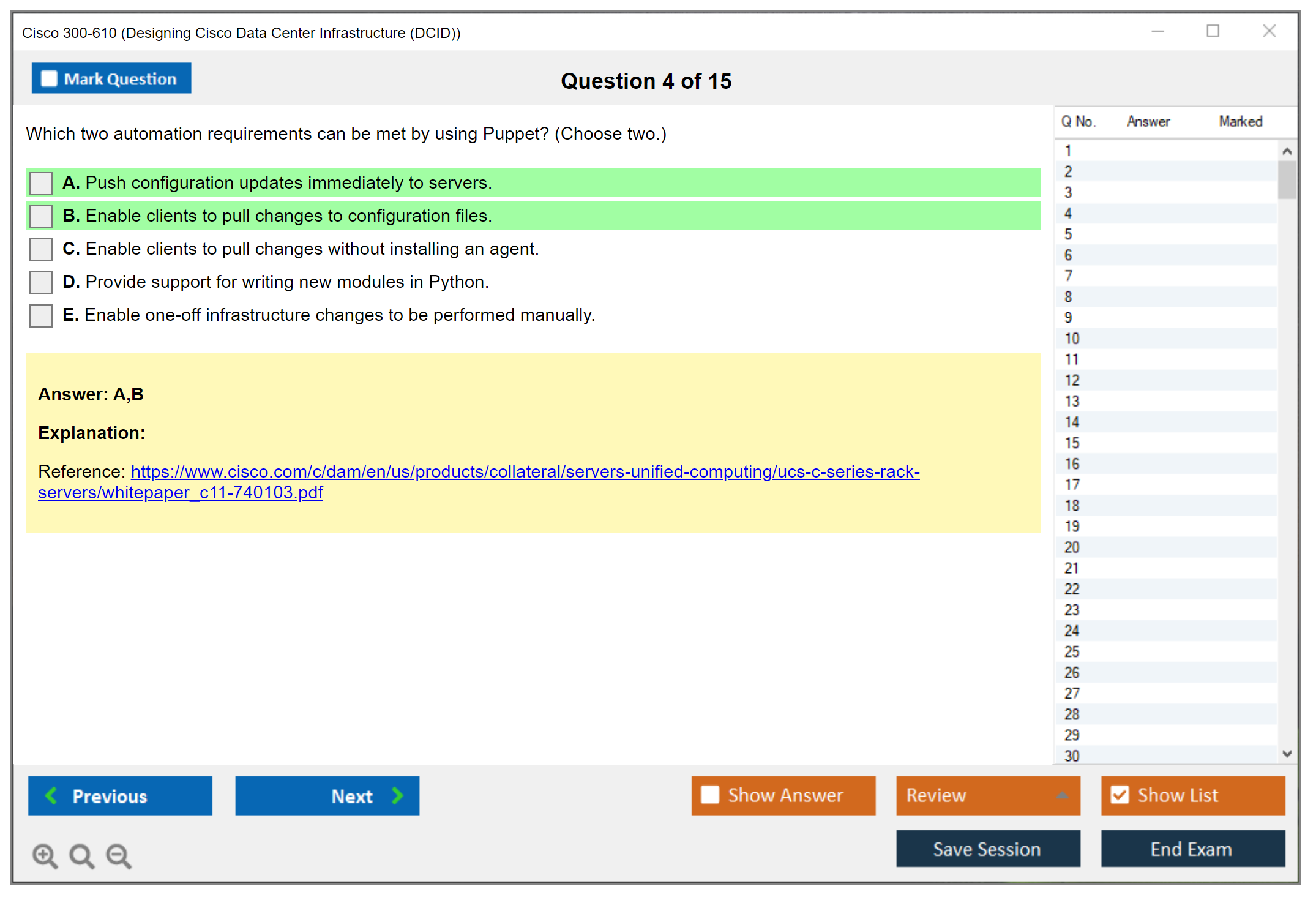
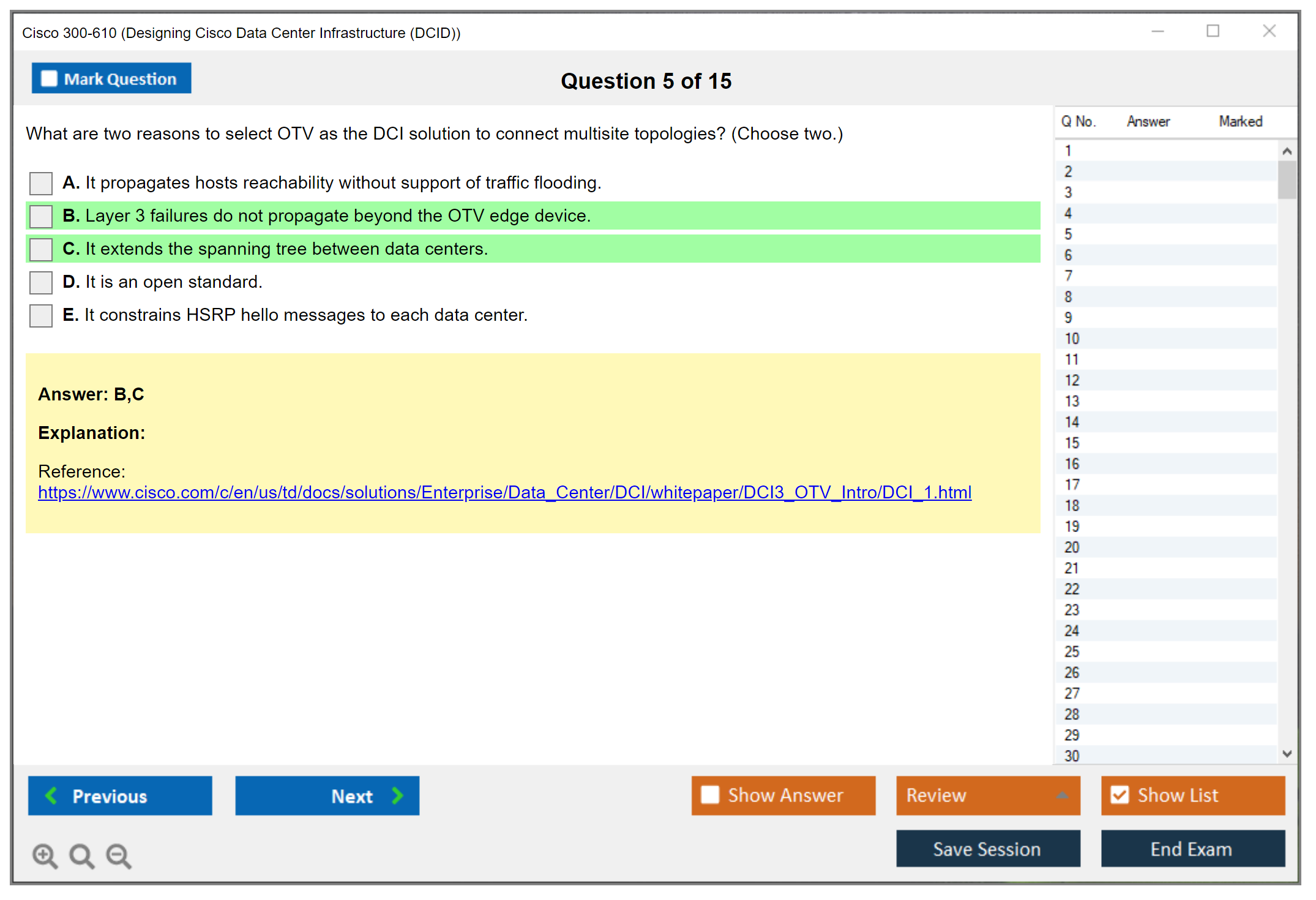
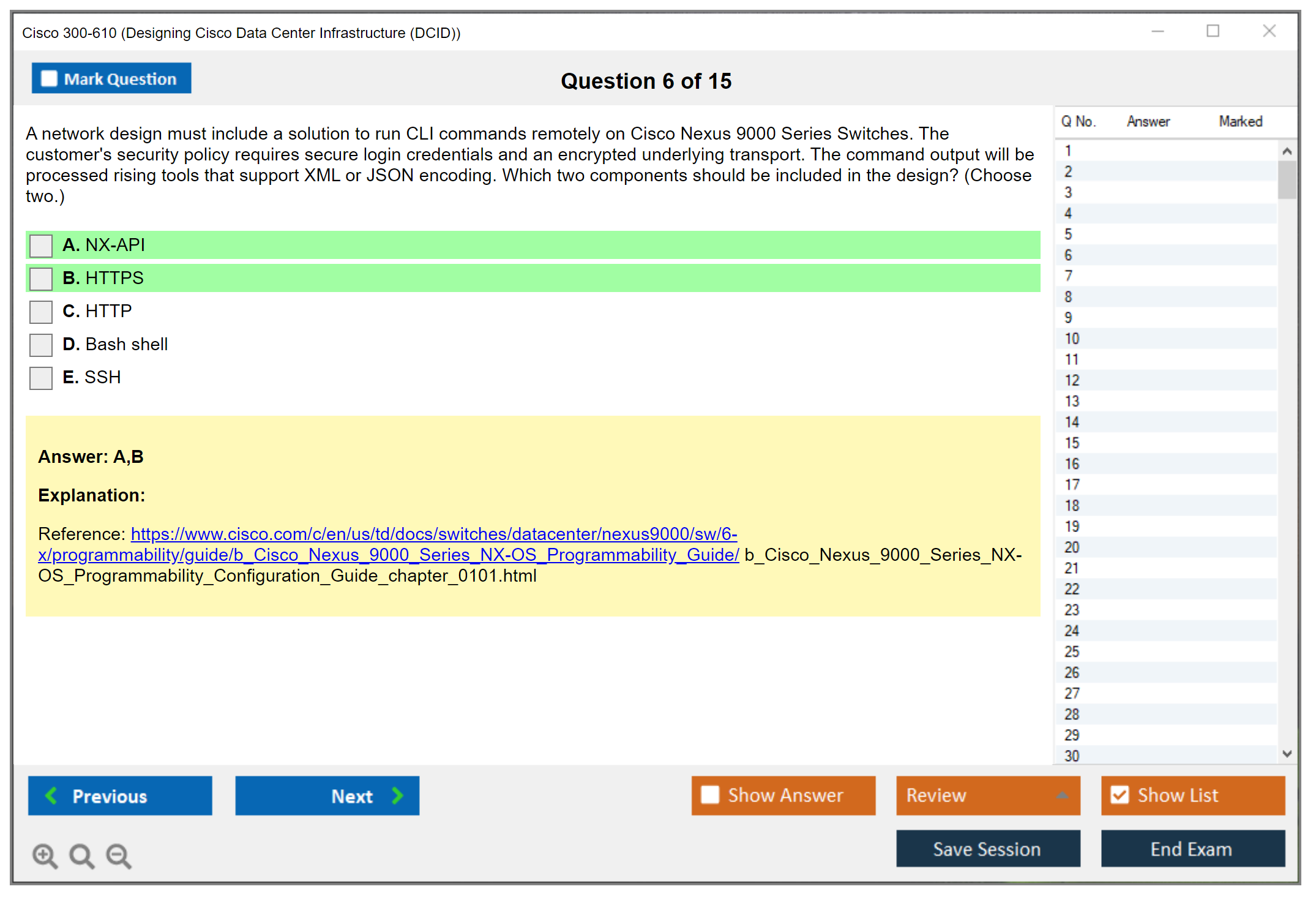
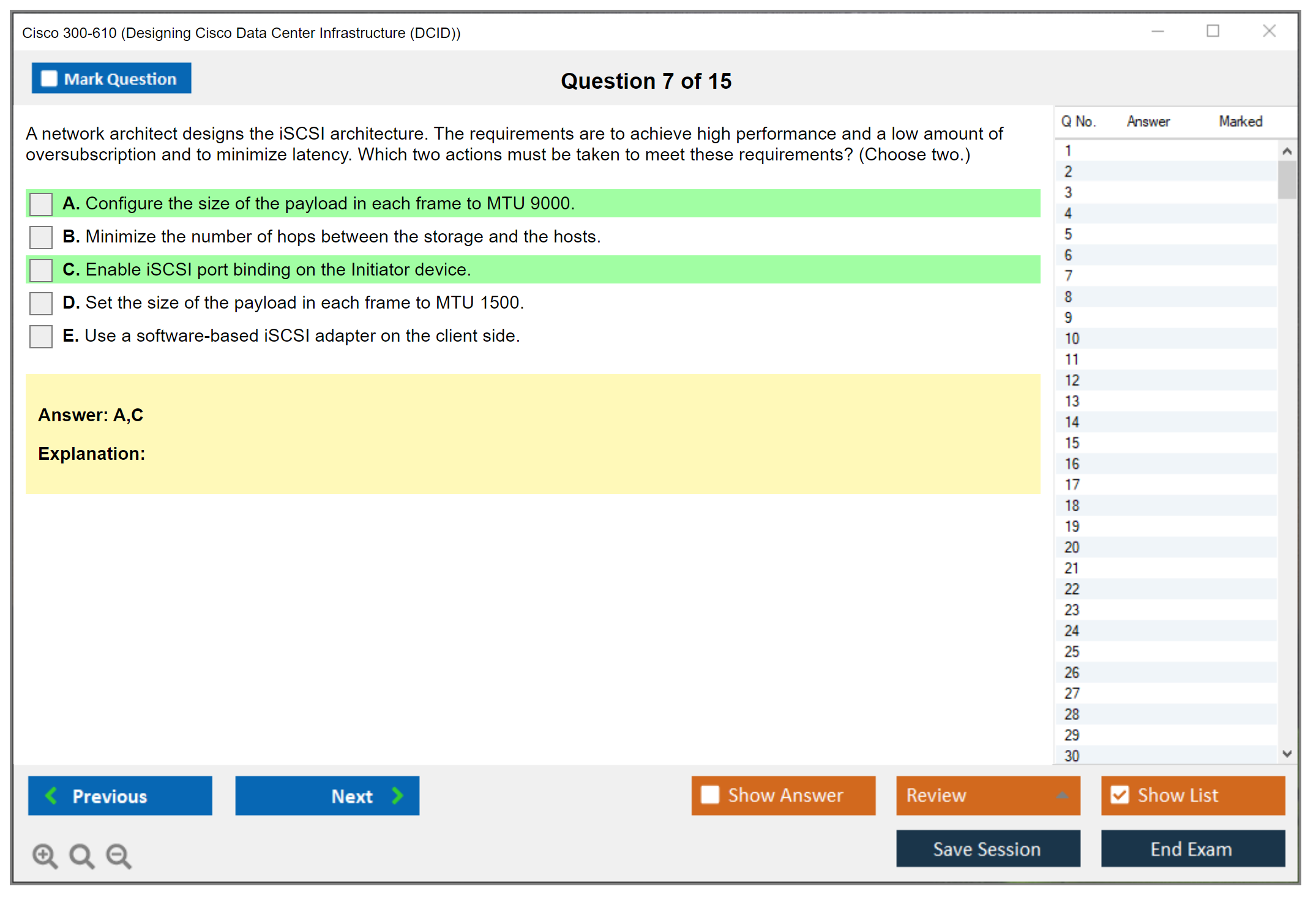
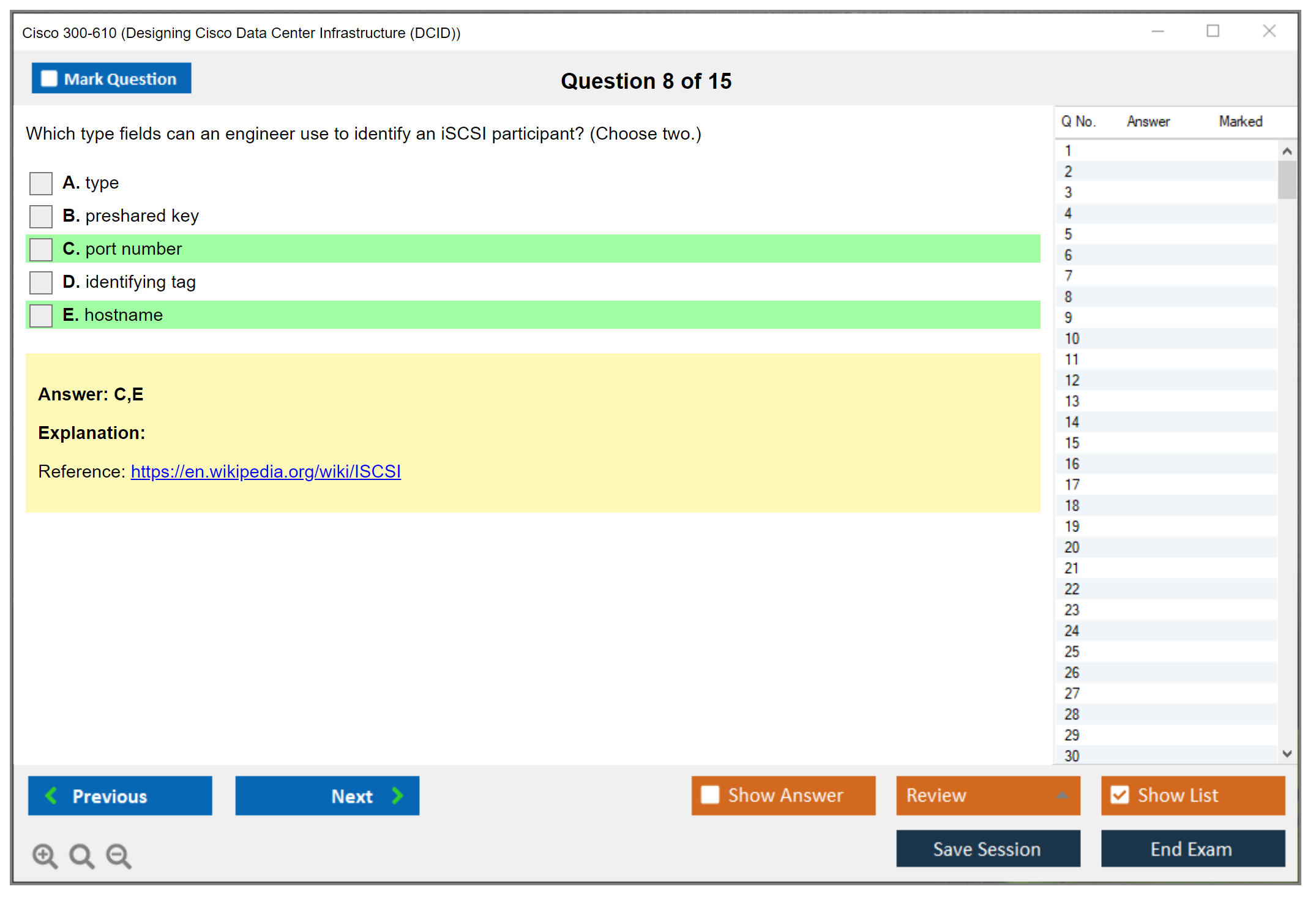
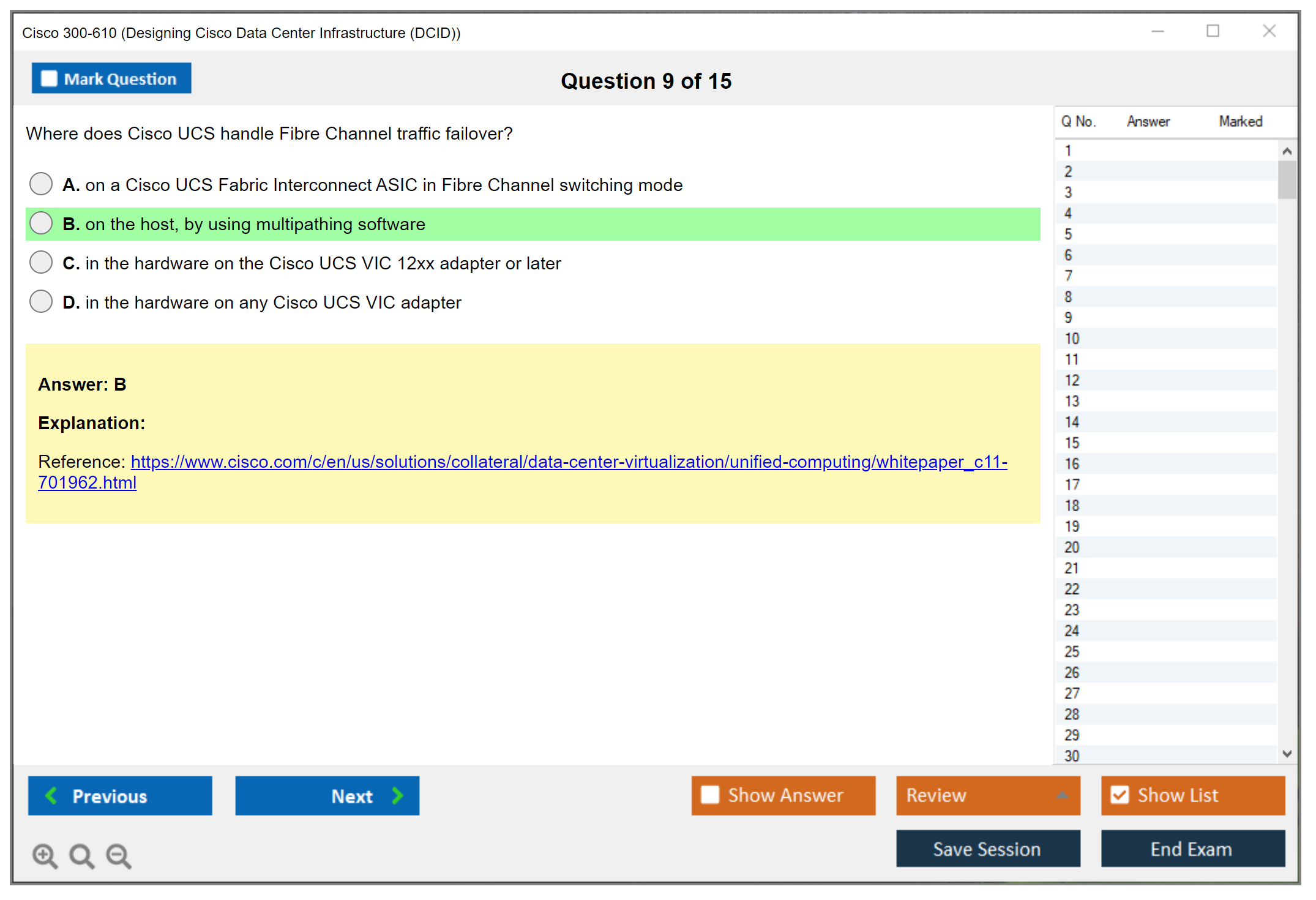
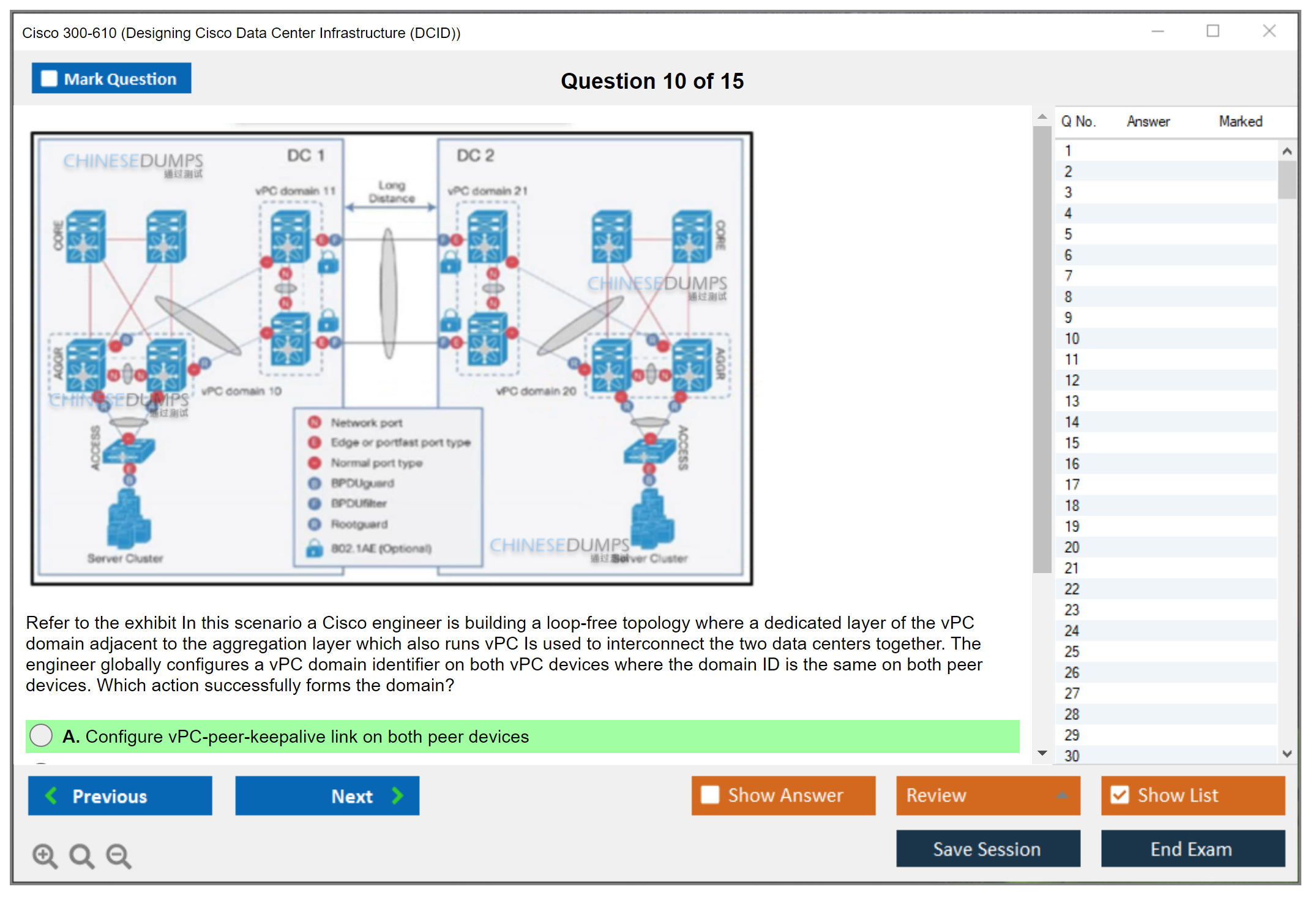
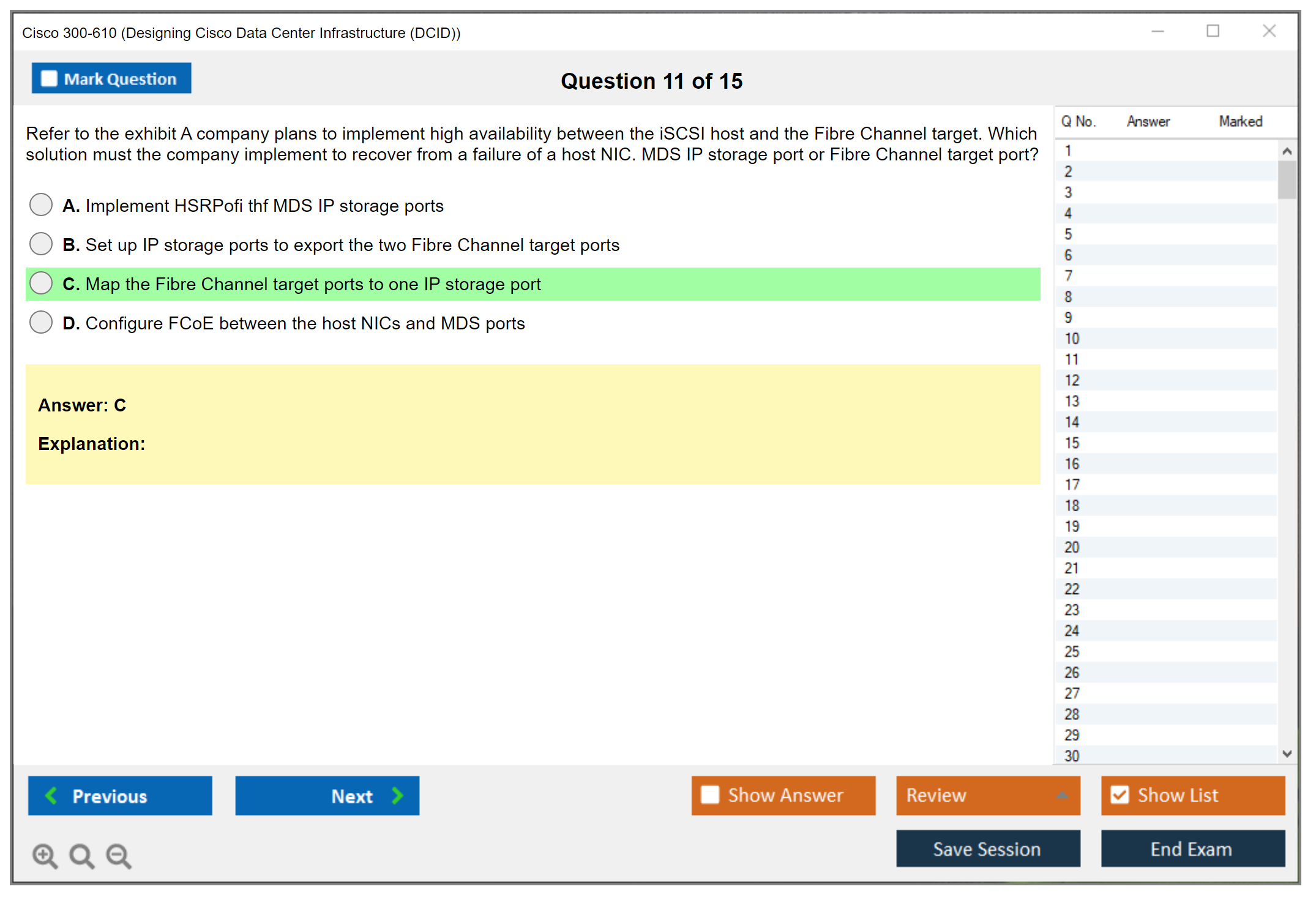
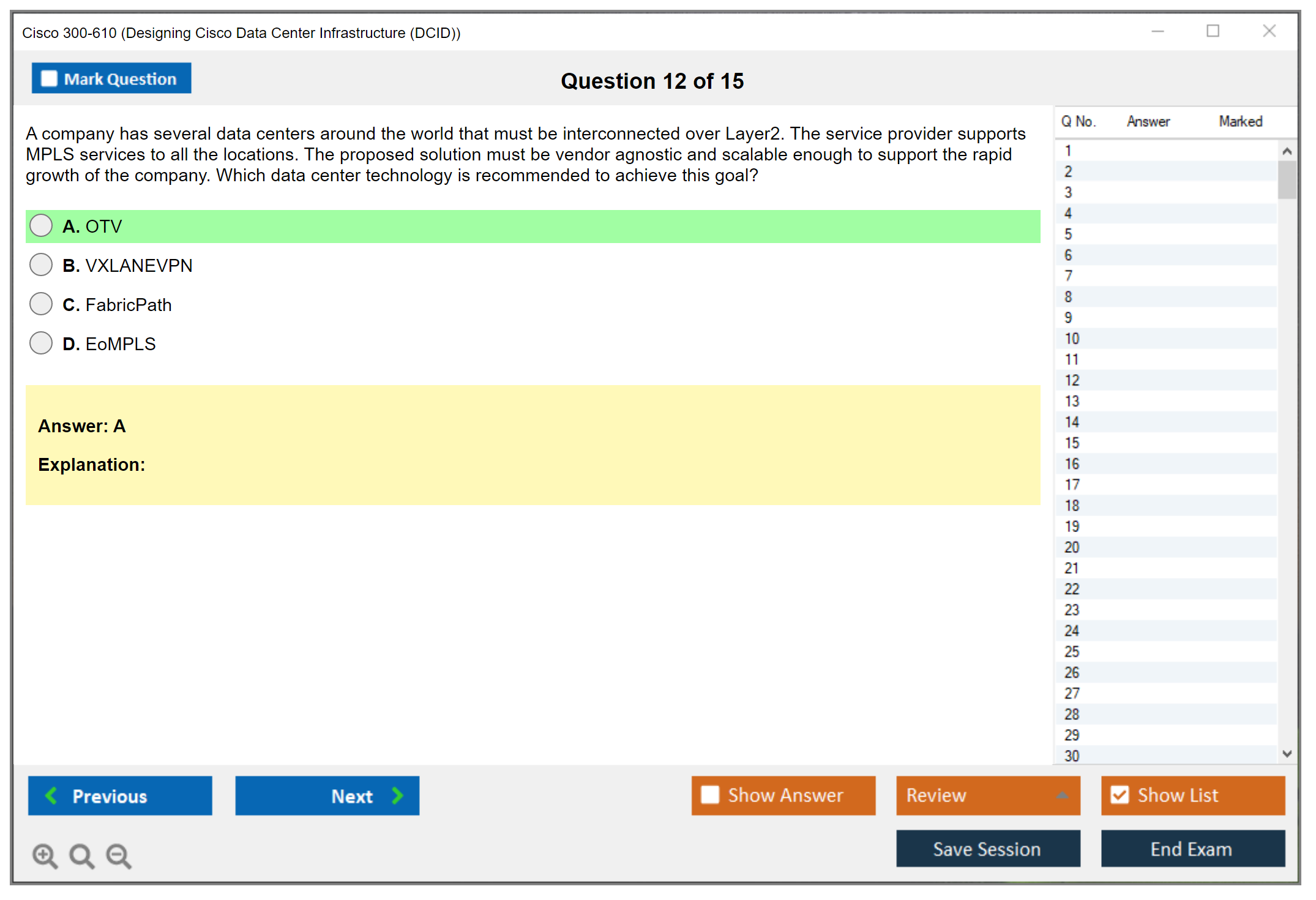
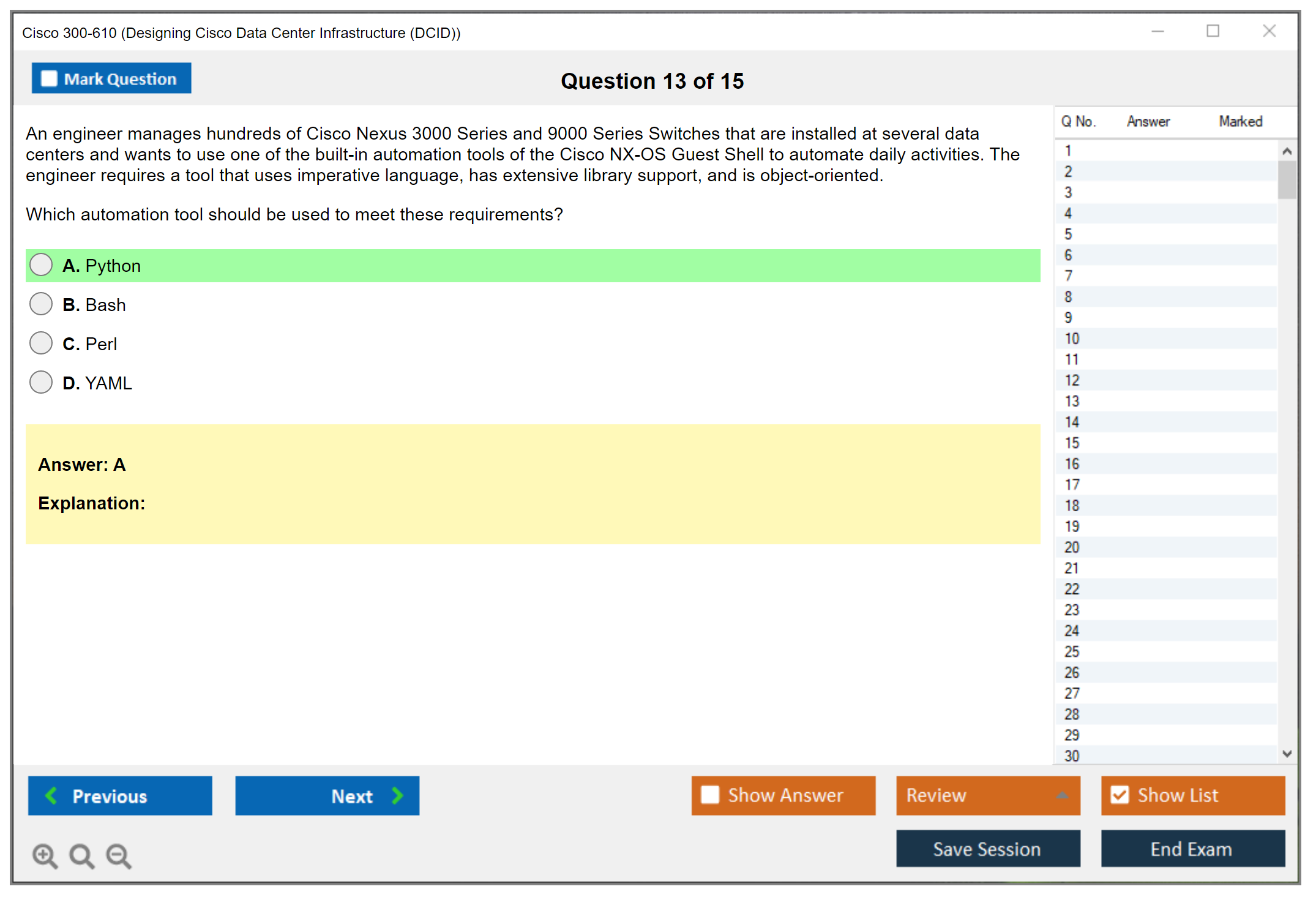
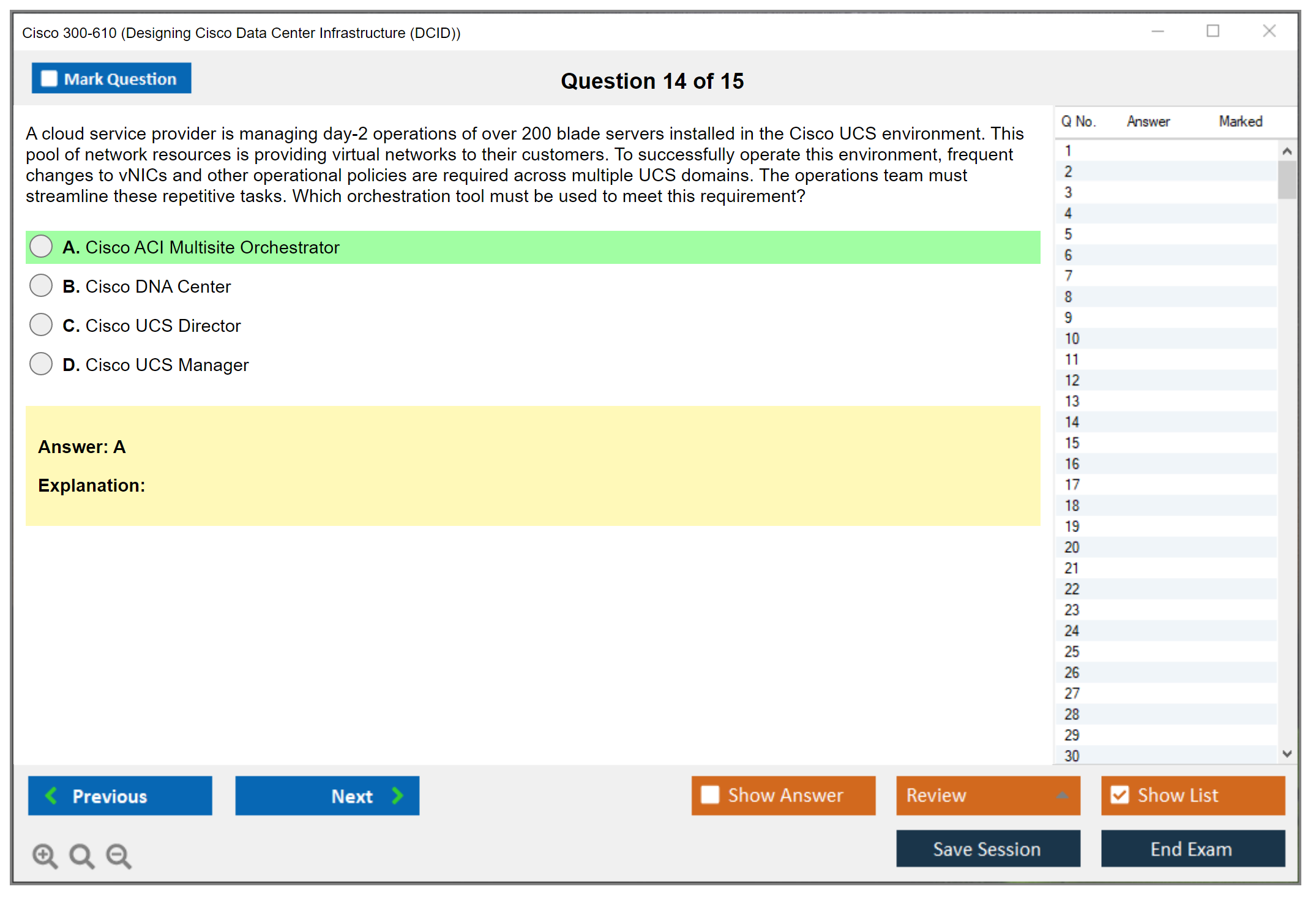
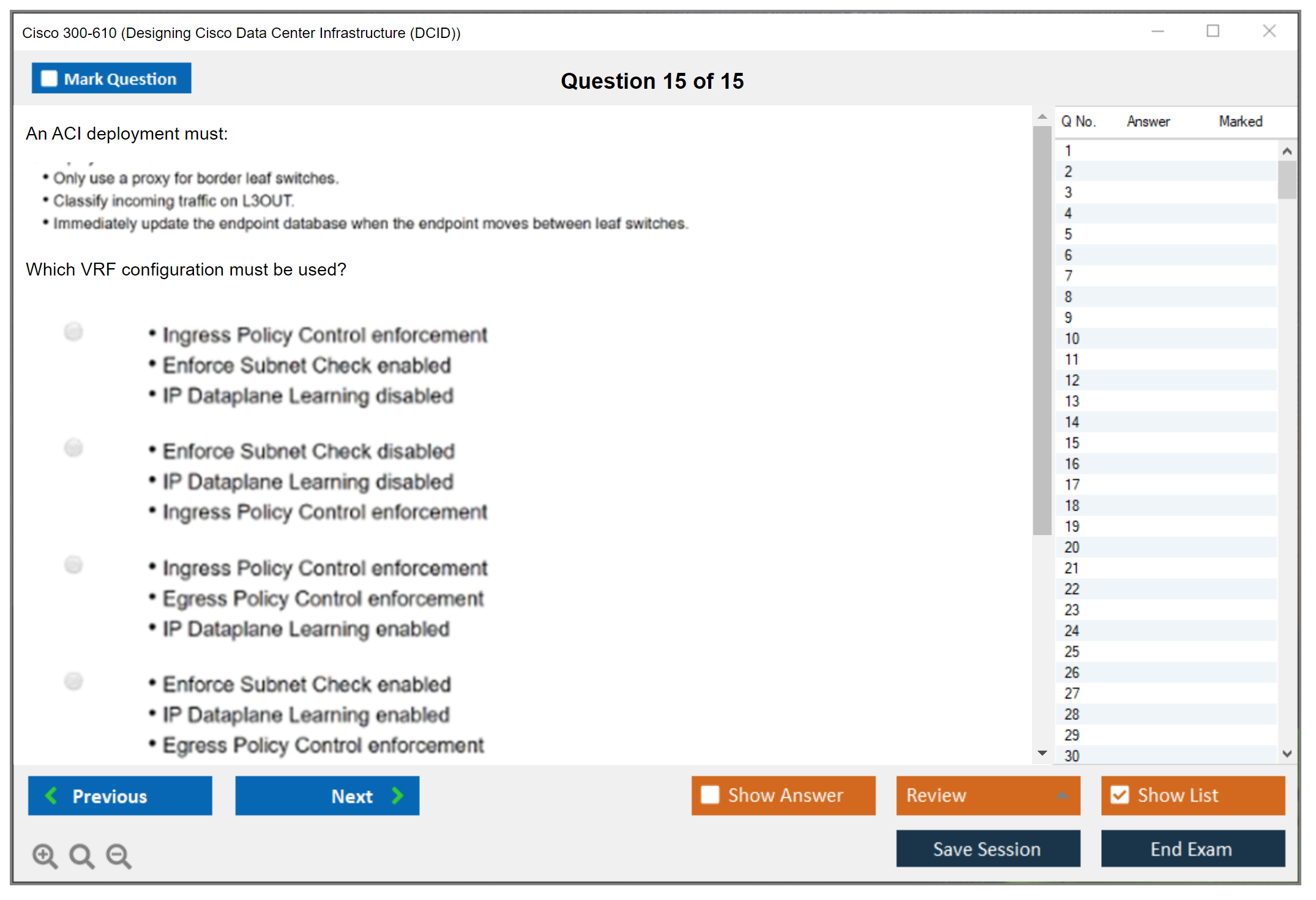
Cisco 300-610 (Designing Cisco Data Center Infrastructure (DCID))
Cisco 300-610 DCID Exam Overview
What is the 300-610 DCID exam?
The Cisco 300-610 DCID exam tests your ability to design data center infrastructure from scratch. This isn't about memorizing commands or clicking through GUIs. It's about making architectural decisions that'll affect an entire data center for years, impacting everything from daily operations to long-term scalability and business outcomes.
You're looking at scenarios where you need to choose between fabric topologies, decide how to scale compute resources, and figure out the best way to integrate storage networks with your existing environment. Real-world design challenges get thrown at you and you need to justify your choices based on business requirements, technical constraints, and best practices.
DCID stands for Designing Cisco Data Center Infrastructure if that wasn't obvious. The 300-610 exam validates that you can plan and architect solutions using Cisco's data center portfolio. ACI fabrics, Nexus switches, UCS compute platforms, and all the overlay technologies that tie them together. You're proving you can sit in a room with stakeholders and design something that'll work when the implementation team gets their hands on it.
Which certification uses 300-610 DCID?
The Cisco 300-610 DCID exam fits into the CCNP Data Center track as a concentration exam option. You'd pair it with the 350-601 DCCOR core exam to earn your full CCNP Data Center certification. That's the traditional path most people follow.
But there's another route that's pretty clever. Pass just the 300-610 exam by itself and you earn the Cisco Certified Specialist in Data Center Design designation. No core exam required for that specialist badge. This matters if you're already deep into data center design work but don't have time for the broader DCCOR curriculum, or if you want to demonstrate design expertise without committing to the full CCNP track right away.
The specialist certification proves you know your stuff in design specifically. That can be enough for certain roles or projects where architectural expertise is what matters most. I've seen consultants pursue just the specialist cert because that's exactly what their clients care about. Can you design a solution that won't fall apart under load?
Within the broader Cisco certification framework, CCNP Data Center sits at the professional level, one tier above CCNA and below the expert-level CCIE. The concentration exams like 300-610 let you specialize in areas like design, implementation (300-620 DCACI for ACI implementation), or automation. You pick the concentration that matches your job role or career direction.
Quick tangent here: I once worked with a guy who had his CCIE Data Center but couldn't design his way out of a paper bag. Brilliant at troubleshooting, could configure anything you threw at him, but ask him to plan a fabric from business requirements? Total blank stare. Just goes to show that implementation skills and design thinking are different animals.
Design vs implementation focus
This is key to understand.
The 300-610 exam doesn't care if you can configure a VXLAN tunnel from memory or troubleshoot a fabric interconnect's boot sequence. That's implementation territory covered by other exams.
Design exams test your judgment. You'll see questions that present a scenario with specific requirements. Maybe uptime targets, bandwidth needs, budget constraints, existing infrastructure. You need to propose an architecture that satisfies all those requirements while following Cisco best practices. Should you use a spine-leaf fabric or a traditional three-tier design? How many fabric interconnects do you need for this UCS domain? What's the right approach to segmentation for this multi-tenant environment?
The questions involve trade-offs. Sure, you could design a solution with maximum redundancy, but that might blow the budget or introduce unnecessary complexity for a small deployment. The exam wants to know if you can balance competing priorities and make decisions that make sense for the specific situation.
This makes the exam harder in some ways because you can't just memorize configs. You need to understand the "why" behind design choices, not just the "how" of implementation. But it's also more interesting if you've worked on data center projects, because the scenarios feel real.
Real-world applicability and career relevance
Data center design skills matter.
They matter more now than they did five years ago. Everyone's dealing with hybrid cloud, application modernization, and infrastructure that needs to support containerized workloads alongside traditional three-tier apps. You can't just throw more switches at the problem and hope it works out.
Organizations need people who can look at business requirements and translate them into infrastructure designs that'll scale, perform, and stay manageable over years of operation. That's what the DCID certification demonstrates. You're showing employers or clients that you can make strategic infrastructure decisions, not just follow implementation guides.
This certification carries weight when you're trying to move into architect roles or lead data center transformation projects. It signals you think beyond individual devices and consider the entire system. Companies planning major data center refreshes or cloud migrations specifically look for design expertise because those projects live or die based on architectural decisions made early on.
The certification also helps if you're in a position where you influence purchasing decisions or work with vendors to scope solutions. Having DCID on your resume tells people you understand the technical implications of different design choices, which makes you more valuable in pre-sales, consulting, or technical leadership roles.
Exam evolution and current technology alignment
Cisco updated the exam content to reflect where data center technology is in 2024 and heading into 2026. You'll see heavy emphasis on ACI fabric design, VXLAN EVPN architectures, and modern approaches to network automation and telemetry. The exam dropped some older content around traditional spanning tree designs in favor of more relevant fabric technologies.
UCS design content now includes newer platform options and integration patterns with hyperconverged infrastructure. Storage design covers current approaches to SAN connectivity, multipathing strategies, and how storage networks integrate with converged infrastructure deployments.
The exam recognizes that modern data centers aren't just network and compute anymore. You need to consider automation tooling, telemetry and monitoring design, and how infrastructure supports DevOps workflows. Not as deeply as something like 200-901 DevNet Associate would cover automation, but enough to show you're thinking about operations and lifecycle management during the design phase.
Exam logistics and practical details
The Cisco 300-610 exam cost runs $300 USD, though pricing varies slightly by region and you might see local taxes added. You register through Pearson VUE, which handles all Cisco certification exams. Testing centers are available globally, or you can take it via remote proctoring if you prefer testing from home or office.
Remote proctoring has gotten pretty reliable, but you need a quiet space with a webcam and stable internet. Some people prefer testing centers because there's fewer potential technical issues and you're in a controlled environment.
The exam's offered in English and Japanese currently. If you're comfortable with technical English, that's usually your best bet since Cisco documentation and most study materials are primarily in English anyway.
What is the passing score for Cisco 300-610? Cisco uses a scaled scoring system from 300 to 1000, and you need 825 to pass. Don't try to reverse-engineer how many questions that represents because the scoring algorithm is more complex than simple percentage calculations. Different questions carry different weights based on difficulty and other psychometric factors that Cisco doesn't fully disclose to maintain exam security.
You get 90 minutes. Question count isn't officially published but expect somewhere in the 55 to 65 range based on typical Cisco exam formats. Question types include multiple choice, drag-and-drop, and design scenario questions where you might need to evaluate multiple design options.
Validity period and staying current
Your certification's valid for three years from the date you pass. That three-year cycle is intentional. Data center technology evolves fast enough that what you knew in 2024 might be outdated by 2027. The recertification requirement keeps certified professionals current with technology shifts.
How do I renew my Cisco certification after passing 300-610? You've got options. Pass any current CCNP concentration exam, pass the DCCOR core exam again, or earn sufficient continuing education credits through Cisco's program. The CE credit path lets you take training courses, attend events, or complete other learning activities that Cisco recognizes for credit.
Most people either take another concentration exam to add skills or retake the core exam if they want to refresh that foundational knowledge. The CE credit path works well if you're attending Cisco Live regularly or taking official training courses anyway.
Prerequisites and recommended background
Cisco 300-610 prerequisites? Officially, none. You can register for and take the exam without having any other Cisco certifications. That's the formal answer.
The practical answer? You'll struggle without solid data center fundamentals. Cisco recommends three to five years of experience designing data center solutions. That's not arbitrary. The exam assumes you understand networking protocols, virtualization concepts, storage technologies, and compute architectures at a level you typically only get from hands-on work.
If you're coming from an enterprise networking background with your 200-301 CCNA or even 350-401 ENCOR, you'll need to learn data center-specific technologies. ACI and VXLAN EVPN operate differently than campus or WAN technologies. UCS compute design involves concepts that don't exist in pure networking roles.
Starting point if you're new to data center design: Get familiar with basic fabric concepts, understand how server virtualization affects network design, and learn the fundamentals of storage networking. The DCCOR material provides good foundational knowledge even if you're not planning to take that exam right away.
Complementary certifications and broader expertise
The 300-610 DCID exam pairs naturally with other Cisco tracks if you're building full expertise. Security professionals might combine this with 350-701 SCOR to understand how to design secure data center infrastructure. The security and segmentation aspects of data center design overlap significantly with broader security architecture.
Automation skills from 350-901 DEVCOR or the DevNet track complement design expertise well. Modern data center designs need to consider how infrastructure will be automated and managed programmatically. You can design a beautiful architecture that's impossible to operate efficiently if you don't think about automation from the start.
Cloud architects benefit from DCID knowledge when designing hybrid infrastructure or private cloud platforms. The design principles apply whether you're building on-premises data centers or architecting connectivity between on-prem and public cloud.
Study materials and preparation approach
Best Cisco 300-610 study materials start with the official exam topics list from Cisco's website. That blueprint tells you exactly what domains are covered and at what weight. Design exams cover a lot of ground, so you need to prioritize based on those percentages.
Cisco offers official training courses, though they're pricey. The content's solid but you're looking at several thousand dollars and multiple days of instructor-led training. Worth it if your employer pays or if you learn best in structured classroom environments.
Books and documentation are your friends for design exams. Cisco's design guides for ACI, UCS, and Nexus platforms contain the architectural principles and best practices that show up on the exam. White papers on VXLAN EVPN, fabric design patterns, and multi-site architectures are particularly valuable.
Lab work for a design exam looks different than implementation exam labs. You're not running through CLI configurations. Instead, you want exposure to design tools, architecture diagrams, and understanding how different components fit together. Cisco's design tools and simulators help, as does building test topologies in virtual environments to see how design decisions play out.
Cisco 300-610 practice tests need to focus on scenario-based questions, not just fact recall. Look for practice materials that present design challenges with multiple valid approaches and ask you to choose the best option based on specific requirements. Quality matters more than quantity here. One good practice exam that mirrors the actual question style is worth five that just test memorization.
Common challenges and difficulty assessment
How hard is the Cisco 300-610 DCID exam? It's legitimately challenging, but for different reasons than implementation exams. You can't brain-dump your way through design questions because they require judgment and contextual understanding.
The difficulty comes from scenarios where multiple answers could work technically, but only one is the best answer given the specific requirements. You need to consider factors like cost, complexity, scalability, and operational overhead at the same time. Miss one requirement buried in the scenario text and you might choose a technically sound solution that doesn't meet the business needs.
Time management matters. Design scenarios take longer to read and analyze than straightforward technical questions. You can't skim through them. Each scenario might include network diagrams, requirement lists, and constraint information that all factor into your answer, so rushing through costs you points.
Common trouble spots include fabric design trade-offs, UCS service profile design decisions, and questions about multi-tenancy and segmentation approaches. These areas require understanding the implications of different choices, not just knowing the features exist.
Reducing exam-day risk means practicing with timed scenarios so you develop efficient reading and analysis habits. Make sure you're not just recognizing the right answer but can explain why other options don't fit. That deeper understanding helps when the exam presents unfamiliar scenario variations.
Industry recognition and job market value
Employer demand for data center design skills is strong, particularly in industries running significant on-premises infrastructure or hybrid cloud environments. Financial services, healthcare, manufacturing, and large enterprises all need people who can architect resilient, scalable data center solutions.
The certification differentiates you. In competitive job markets, it demonstrates specialized expertise. Plenty of people can implement pre-designed solutions or follow runbooks. Fewer can design infrastructure from requirements, which is a more valuable and typically better-compensated skill.
The DCID certification helps people transition from implementation roles into architecture and design positions. It provides concrete evidence that you've developed design thinking and can handle the strategic aspects of data center infrastructure, not just the tactical configuration work.
Consulting and pre-sales roles particularly value this certification because those jobs require designing solutions for different clients with varying requirements. You're constantly evaluating trade-offs and proposing architectures, which is exactly what the exam tests.
Exam format and policy details
Standard Cisco exam policies apply to 300-610. You need two forms of ID for check-in. No personal items allowed in the testing area. If you fail, there's a five-day waiting period before you can retake it. After three attempts, you face a longer waiting period.
The exam uses Cisco's standard testing platform. Questions appear one at a time, you can mark questions for review and return to them before submitting. The interface shows remaining time and question count so you can pace yourself.
Design scenario questions might include exhibits like network diagrams or requirement tables. Make sure you review all provided information because details matter in design decisions. Sometimes the answer hinges on a specific requirement or constraint mentioned in the scenario text.
You won't get your detailed score report until after you complete the exam. Cisco shows you which domains you performed well in and which need improvement, which helps if you need to retake it. That feedback's useful for identifying weak areas in your design knowledge.
Cisco 300-610 Exam Cost and Registration
Cisco 300-610 DCID exam overview
What is the 300-610 DCID exam?
The Cisco 300-610 DCID exam tests design thinking around Cisco data center infrastructure, not command memorization. You'll face scenario prompts where the correct answer matches constraints, trade-offs, and operational reality. That's how real data center network design best practices work when budgets, risk tolerance, and office politics enter the picture.
Design brain needed. Trade-offs matter here. Context is everything.
Which certification uses 300-610 DCID? (CCNP Data Center / specialist context)
300-610 is the Designing Cisco Data Center Infrastructure (DCID) concentration exam under CCNP Data Center, and it gives you a specialist credential too. If you're chasing CCNP Data Center, this is one of those "pick your focus" exams. DCID is what you choose when you'd rather prove you can design around Nexus/ACI/UCS/SAN realities than just configure a single feature and move on.
Cisco 300-610 exam cost and registration
Cisco 300-610 exam cost (pricing and region/taxes notes)
The standard Cisco 300-610 exam cost sits at $300 USD (as of 2026). That's typical for Cisco's professional-level concentration exams, so if you've paid for any CCNP-track exam before, the price won't surprise you. Your wallet still complains though.
Here's the annoying bit: regional pricing shifts. Pearson VUE displays pricing in local currency, and it varies by country because of local market adjustments, currency conversion, and tax structures. VAT/GST can bump things noticeably. Depending on your location the final amount might feel like "$300 plus mystery math." If you're getting reimbursed, save that receipt with the tax breakdown. Finance departments need that documentation.
Retakes cost the same, by the way. No automatic discount. Budget twice if uncertain.
Discount opportunities (credits, partner perks, promos)
You've got some legitimate options to lower the Cisco 300-610 exam cost, though they're not always sitting there waiting.
Cisco Learning Credits (CLCs): If your company purchases Cisco training packages, they might have credits covering training and sometimes exam-related expenses depending on contract structure. Worth asking your Cisco account team. Tons of companies own credits and don't even know they're available.
Partner program benefits: Cisco partners occasionally get exam vouchers or discounts linked to partner tier, internal enablement programs, or specific initiatives. If you're working at a partner and paying personally, you might be leaving money on the table.
Volume licensing / training org deals: Training providers and larger organizations buying in bulk can sometimes access better rates via vouchers or negotiated agreements. Not something an individual can typically arrange, but it matters during team rollouts.
Occasional promotional pricing: Happens sometimes, though it's unpredictable. When Cisco runs promos, they're often tied to Cisco U. releases, Learning Network campaigns, or partner events.
Total cost of certification (what people forget)
The exam fee is the clean number. Your actual spend usually gets messier. Cisco 300-610 study materials might be a $40 book, or it could be a full official course. Lab time can be cheap if you've got work access, or pricey if you're renting rack time to practice UCS and ACI design considerations and validate how design decisions behave under stress.
Typical spending areas:
- Official courseware or subscription platforms (can be the biggest expense)
- Documentation time (free, but costs evenings and weekends)
- Cisco 300-610 practice tests (quality ones aren't always cheap)
- Lab access (ACI simulators, Nexus virtual images where permitted, or paid lab platforms)
- Optional instructor-led training (expensive, sometimes valuable if you need structure)
Where to register (Pearson VUE) and exam delivery options
Registration happens through Pearson VUE. The process is straightforward, but account linking has gotchas.
- Create or sign into your Cisco certification profile (Cisco Certification tracking system).
- From Cisco's exam scheduling links, jump to Pearson VUE and sign in or create an account.
- Link accounts when prompted. Name matching matters. Don't use "Mike" in one system and "Michael" in another unless you enjoy support tickets.
- Choose Cisco 300-610 DCID exam, select delivery method (test center or online), pick date/time, confirm policies, pay.
After scheduling, you'll receive confirmation email from Pearson VUE. Add it to your calendar. Print it if that's your style. Keep appointment details accessible because on exam day you don't want inbox archaeology.
Online vs test center delivery
Online via OnVUE: convenient, no travel, and you can grab odd hours. But your room setup needs to be perfect, your internet must cooperate, and you're accepting the "webcam surveillance" experience. Test center: more controlled environment, fewer tech surprises, and clearer rules, but you'll travel and work around their availability.
If your home setup is chaotic, go test center. If you can control noise, desk clutter, and bandwidth, online works fine.
Scheduling flexibility, rescheduling, cancellation, and payments
Time slots vary by region. In busy cities, you might find plenty of options, but prime weekend slots fill fast, and online appointments can get tight during certification rush periods. Booking 2 to 4 weeks ahead is a safe default. Last-minute scheduling sometimes works if you're flexible on timing.
Rescheduling and cancellation policies can shift by program and region, but typically you need to make changes 24 to 48 hours before the appointment to avoid penalties. Miss that window and you might pay a fee or forfeit the exam entirely as a no-show. Painful way to learn calendar discipline.
Payment methods usually include credit/debit cards, vouchers, and sometimes Cisco Learning Credits paths depending on how your organization purchases. Corporate billing arrangements exist, but they're typically handled through internal procurement or a training coordinator, not casually during checkout.
Exam vouchers, accommodations, employer sponsorship, and geography
Exam vouchers are commonly purchased through official Cisco training partners, Pearson VUE voucher programs where available, or via corporate training purchases. Watch expiration dates. Some expire in months, others last longer. Nothing stings like realizing your voucher died yesterday.
Testing accommodations are available for disabilities and sometimes language-related support, but you need to request them ahead of time with documentation. Don't wait until exam week. That's how people end up rescheduling and eating fees.
Employer sponsorship is the underrated cheat code here. If you can explain ROI in business terms (reduced design risk, better standardization, faster project delivery, fewer outages tied to bad assumptions around VXLAN EVPN and fabric design) you'll often get exam reimbursement and maybe training time approved. Companies like paying for skills that reduce operational drama.
Geographically, most regions have Pearson VUE centers within reasonable distance, but remote areas can be rough. If you're traveling, plan your route, show up early, and don't book the exam right after a flight lands unless stress is your hobby.
Cisco 300-610 passing score and exam format
Passing score (how Cisco reports scoring and what candidates should expect)
People constantly ask about the Cisco 300-610 passing score. Cisco typically doesn't publish a fixed universal number that's useful for planning, because scoring can be scaled and may vary by exam version. What you'll get is a score report with section-level performance feedback, which helps with retake planning if needed.
Number of questions, time limit, question types (as applicable)
Cisco professional exams commonly fall in the 90 to 120 minute range with a mix of multiple choice, multiple response, drag-and-drop, and scenario items. DCID leans toward design scenarios. You'll see prompts like "which architecture fits" or "what should you recommend," and you need careful reading because one word like "minimize operational overhead" changes the correct answer.
Exam policies (retakes, ID requirements, testing rules)
Retakes are allowed, but you pay again. Same fee. Bring valid government ID matching your registration name, and follow testing rules. Arguing with a proctor is a losing strategy.
Cisco 300-610 difficulty: how hard is DCID?
Difficulty level and who the exam is best for
How hard is it? Pretty challenging if you've only done config tickets. Reasonable if you've sat in design reviews and had to defend choices around availability domains, failure scenarios, and operational tooling.
Design thinking required. Trade-offs constantly. No perfect answers exist.
Common challenge areas (design scenarios, trade-offs, multi-domain decisions)
The difficult part is stitching domains together: compute, network, storage, and operations. You'll get questions where ACI policy design affects ops, or where SAN decisions impact recovery objectives, or where segmentation choices collide with application teams. Cisco data center infrastructure design is exactly that kind of cross-team complexity. I once watched a candidate nail all the technical pieces but miss three questions because they ignored the "budget constraint" phrase buried in the scenario. Read everything twice.
Tips to reduce exam-day risk
Read each question twice. Mark the constraints. If the prompt says "existing hardware" or "limited budget," don't pick the shiny option you'd choose in a greenfield fantasy. Time management matters too, because scenario questions can consume minutes fast if you overthink them.
Cisco 300-610 exam objectives (blueprint)
Data center network design (fabric, underlay/overlay, resiliency)
Expect fabric design themes, underlay/overlay concepts, resiliency patterns, and where designs break under failure. VXLAN EVPN and fabric design appears conceptually, and you should be comfortable with why you'd choose one approach over another, not just what it is.
Compute design (UCS domains, service profiles, scaling)
This is where UCS and ACI design considerations start colliding with real operations. Domains, scale boundaries, service profile strategy, firmware planning, and how design choices affect day-2 work.
Storage and SAN design (FC/FCoE concepts, availability, multipathing)
You don't need to be a storage-only engineer, but you do need to understand SAN availability, basic FC/FCoE concepts, and multipathing implications. "The network" isn't separate from storage when outages happen.
Automation and operations considerations (tooling, telemetry, lifecycle)
Design for operations. Telemetry, change control, lifecycle planning, and the reality that automation is great until it's brittle. This section often rewards people who've lived through upgrades.
Security and segmentation in data centers (policy, isolation approaches)
Segmentation, policy, and isolating workloads without making operations impossible. The exam favors practical security that humans can actually run.
Prerequisites and recommended experience
Cisco 300-610 prerequisites (formal vs recommended)
There are no strict Cisco 300-610 prerequisites like "you must hold X cert first" to sit the exam, but recommended experience is real. If you haven't been around data center projects, expect more study time.
Suggested background (ACI, Nexus, UCS, virtualization fundamentals)
ACI concepts, Nexus switching basics, UCS architecture, and virtualization fundamentals help a lot. You don't need to be the world's best operator, but you should know how these systems behave when things go wrong.
What to learn first if you're new to data center design
Start with architecture fundamentals and failure domains, then move to fabric concepts, then compute and storage integration. If you jump straight to memorizing features, you'll feel lost when the exam asks "what should you recommend" instead of "what command does it."
Best Cisco 300-610 study materials
Official Cisco learning and exam topics resources
Cisco's exam topics page and official course outlines are where you align to the Cisco 300-610 exam objectives. Cisco U content can be a solid fit if you like modular learning.
Books, guides, and documentation to prioritize
Prioritize Cisco Validated Designs where relevant, official configuration guides, and design guides. Docs are boring. Still necessary. This exam rewards people who read the footnotes.
Lab options (physical, virtual, and simulation approaches)
Physical labs are excellent if you have them. Virtual labs are usually sufficient for validating concepts and seeing workflows, especially around ACI constructs and management tooling, but remember DCID is design-heavy, so labbing supports understanding more than it replaces it.
Cisco 300-610 practice tests and exam prep strategy
Practice tests: what to look for (quality signals, scenario-based items)
Good Cisco 300-610 practice tests feel like mini design reviews. Bad ones are trivia dumps. Look for scenario-based questions with explanations that argue why an option is wrong, because that mirrors the exam.
Sample study plan (2,8 weeks) by experience level
If you already work in data centers, 2 to 4 weeks of focused review can be sufficient. If you're newer, 6 to 8 weeks is more realistic, because you're building mental models, not just memorizing.
Final-week checklist (weak areas, review notes, timed practice)
Timed practice sets. Review missed concepts. Re-skim the blueprint. Confirm your ID matches your registration. Do a system test if you're taking OnVUE.
Renewal and recertification after 300-610
How Cisco renewal works (certification cycle and CE credits overview)
For Cisco 300-610 renewal (recertification) context, Cisco certs typically renew on a cycle, and you can renew by earning continuing education credits or passing qualifying exams, depending on the credential level you're maintaining.
Renewal options (continuing education vs passing qualifying exams)
CE credits are nice if your employer pays for training anyway. Exams can be faster if you're already studying for the next thing. Pick what fits your work schedule and attention span.
Keeping your CCNP Data Center status active
Track your dates. Keep a folder of certificates and CE records. Don't wait until the last month. Life happens and then you're cramming for renewal while also doing your day job.
FAQs (People Also Ask)
How much does the Cisco 300-610 DCID exam cost?
$300 USD as of 2026, with possible regional currency and tax differences.
What is the passing score for Cisco 300-610?
Cisco typically doesn't publish a simple fixed number to memorize. You'll get a score report and section feedback after the exam.
Is Cisco 300-610 harder than other CCNP Data Center exams?
It can feel harder if you're more of a hands-on config person, because DCID is design and trade-offs, not rote commands.
What are the most important DCID objectives to master?
Fabric/underlay-overlay thinking, failure domains, compute and storage integration, and operational design choices you can defend in a real review.
What's the best way to use practice tests for 300-610?
Use them late in your prep, focus on explanations, and treat misses as pointers back to the Cisco 300-610 study materials and blueprint topics you actually need to tighten up.
Cisco 300-610 Passing Score and Exam Format
Passing score: what you actually need to know
Cisco doesn't publish the exact passing score for the 300-610 DCID exam. They use a scaled scoring system that typically falls somewhere between 750 and 850 out of 1000 points, but the precise number varies depending on which exam form you get. This drives people crazy because everyone wants a clear target.
The scaled scoring exists for a reason though. Cisco uses psychometric scaling to ensure fairness across different versions of the exam. Some forms might be slightly harder than others, so the passing threshold adjusts accordingly. You're not competing against a fixed percentage. You're demonstrating mastery against a standard that accounts for question difficulty, which is frustrating when you can't just say "I need 70% correct," but it does mean that if you get a particularly tough version, you're not automatically screwed compared to someone who tested on an easier day.
Pass or fail? You know immediately. When you finish the exam, you get instant pass/fail notification on screen. No waiting around for weeks wondering if you made it. The detailed score report shows your performance broken down by exam section, so you can see exactly where you struggled if you didn't pass. This breakdown matters because the 300-610 Practice Exam Questions Pack can help you target those weak areas if you need a retake.
Why Cisco doesn't do partial credit the way you'd expect
Professional-level Cisco exams like the 300-610 test demonstrated mastery across all domains, not just whether you can scrape together enough points from your strong areas to compensate for weak ones. You can't just nail the compute design section and completely bomb storage design. You need solid performance across the blueprint. Period.
This philosophy shows up in how they weight sections and evaluate your overall competency, and the exam isn't looking for specialists who know one corner of data center design really well. It wants architects who can make informed decisions across networking, compute, storage, automation, and security considerations. That's actually a good thing for your career, even if it makes the exam harder in the moment.
Questions, time, and what you're dealing with format-wise
You're looking at approximately 55-65 questions. Maybe more. The exact count varies by exam form, and Cisco includes unscored pilot items that they're testing for future exam versions (you won't know which ones those are, which is kind of annoying). You get 90 minutes of testing time, which sounds like a lot until you're staring at a complex design scenario with multiple exhibits and your brain starts doing that thing where it goes blank.
Time management is critical. That's about 80-100 seconds per question on average, but design scenarios will eat way more time than a straightforward multiple-choice question. Some of these scenarios have three or four parts. Some candidates rush through easier items to bank time for the complex stuff. Others pace themselves evenly and risk running short at the end.
Question types? Multiple-choice single answer, multiple-choice multiple answer (where you select all that apply), drag-and-drop matching, and simulation-based design scenarios. The design scenario emphasis is huge on this exam. Expect complex, multi-part questions that present business requirements, existing infrastructure constraints, and then ask you to make optimal architectural decisions. These aren't "what command configures X" questions. They're "given these requirements and trade-offs, which design approach best satisfies the customer's needs" situations that make you think. You might spend five minutes on one scenario and thirty seconds on a straightforward recall question, which throws your pacing off if you're not careful.
What you won't see (and what you will)
Unlike implementation exams such as the 350-601 DCCOR, the 300-610 doesn't include hands-on lab simulations where you configure devices. This is a design exam, so you're making architectural choices rather than typing commands. Some people find that harder because you can't just memorize configuration syntax. You'll see plenty of topology diagrams, and you need to be comfortable analyzing them quickly.
Exhibit-based questions? Everywhere. Many questions include network diagrams showing current infrastructure, requirements documents outlining business needs, or tables comparing different technology options. You'll need to reference these exhibits while answering, which adds to the cognitive load. Reading comprehension matters as much as technical knowledge, which surprises some people.
The difficulty progression can be interesting. Questions may increase in complexity as you move through the exam, though Cisco uses adaptive difficulty calibration on some exam formats. Whether you're getting harder questions because you're doing well or just because that's how this particular form is structured, you won't know, and trying to figure it out mid-exam will just mess with your head.
Navigation and review capabilities
Good news here. You can mark questions for review and work through backward through the exam in standard format, which is huge for time management. If you hit a brutal design scenario early on, mark it and move forward rather than burning 10 minutes and panicking. You can change answers before final submission, so that initial gut feeling isn't locked in forever.
I recommend flagging anything you're not 100% confident about. Be generous with those flags. Sometimes a later question will trigger a connection that helps you answer an earlier one, which has saved me before. The 300-610 Practice Exam Questions Pack lets you practice this review strategy before exam day.
Exam policies, ID requirements, and what you can't bring
Testing policies are strict. Super strict. No external materials allowed: no phones, no notes, no reference documents. If you're testing at a Pearson VUE center, you'll get a whiteboard or notepad for scratch work. Online proctoring through OnVUE uses a secure browser and you'll need to show your workspace via camera, which feels a bit invasive but that's just how they prevent cheating now.
ID requirements are non-negotiable. Government-issued photo identification where the name matches your registration exactly. Testing centers typically require two forms of ID. If your driver's license says "Robert" but you registered as "Bob," you're gonna have problems. They'll turn you away.
Prohibited items include phones, watches, notes, and any unauthorized electronics. Testing centers enforce this aggressively with metal detectors and locker storage. I've seen people turned away for showing up with smart watches they forgot they were wearing, which is brutal but understandable.
Breaks and testing environment
No scheduled breaks. There are no scheduled breaks during the 90-minute exam. You can take a bathroom break if absolutely necessary, but the exam clock keeps running, so you're burning your own time. Most people just power through, maybe hit the restroom right before check-in.
Online proctoring has specific workspace requirements for OnVUE. Clear desk, no secondary monitors visible in camera range, quiet room where you won't be interrupted. The room scan procedure at the start requires you to pan your camera around the entire space, which feels like you're on some surveillance show. Proctor interaction happens via chat if they need to communicate with you.
Testing center environment? Pretty standardized. Check-in procedures include ID verification and biometric signature, personal items go in a locker, you're escorted to a workstation. The testing room is usually shared with other candidates taking different exams, so you'll hear random keyboard clicking. Noise-canceling headphones are sometimes available, which helps.
Retake policy if things don't go your way
Failed the exam? There's a 5-day waiting period before you can retake, which feels like forever when you're motivated. After a second failure, it's 14 days. Third failure? Another 14 days. Fourth failure within a 12-month period triggers a 180-day waiting period, which basically means you're starting over with your study approach and maybe questioning your career choices.
This escalating penalty structure is designed to prevent people from just brute-forcing the exam repeatedly. Cisco wants you to actually learn the material between attempts rather than just memorizing question patterns. If you're hitting that third or fourth attempt, you need to reassess your study strategy entirely. Maybe work through the 300-620 DCACI implementation concepts to strengthen your foundation, or revisit fundamental networking with 350-401 ENCOR to fill knowledge gaps.
Score validity and certification lifecycle
Exam results remain valid for three years toward your certification. After that, you need to recertify to maintain active status. The certification isn't "lifetime." Cisco wants to ensure certified professionals stay current with evolving technologies, which makes sense given how fast data center tech changes.
Recertification can happen through continuing education credits or passing a qualifying exam. Many people just retake the same exam or take a different professional-level exam to reset their three-year clock, and that second option gives you more skills anyway. The 300-610 Practice Exam Questions Pack becomes useful again if you're planning to recertify by retaking the same exam years later, since the content does get updated periodically.
Appeals, disputes, and post-exam feedback
Cisco's policy on score challenges? Extremely limited. You can't really appeal your score just because you disagree with the result. They stand behind their psychometric analysis, and they're pretty firm about it. You can report technical issues if the exam delivery system malfunctioned (like if questions didn't display properly or the system crashed) but those need to be reported immediately to the proctor, not three days later when you've had time to stew about it.
After you finish, there's an optional post-exam survey about your testing experience. This doesn't affect your score at all, but Cisco does use the feedback to improve future exam versions. If you encountered unclear wording or exhibits that didn't match the question, that's worth mentioning. Just don't expect it to change your current result or anything.
Cisco 300-610 Difficulty: How Hard Is DCID?
Cisco 300-610 DCID exam overview
What is the 300-610 DCID exam?
The Cisco 300-610 DCID exam is Cisco's design-focused test for data centers, officially titled Designing Cisco Data Center Infrastructure (DCID). Architecture decisions matter here. Not CLI trivia. Not that "which command fixes this interface" stuff you might be used to.
You'll see prompts that read like a mini consulting engagement. Business goals, constraints, existing gear, a few gotchas thrown in, then you pick the best design direction. Some questions feel annoyingly subjective at first, and I mean that respectfully.
Which certification uses 300-610 DCID? (CCNP Data Center / specialist context)
Passing 300-610 earns you the Cisco Certified Specialist credential for DCID, and it also counts toward CCNP Data Center when paired with the core exam. That specialist angle matters because Cisco assumes you can think across domains. Not one silo, but networking plus compute plus storage plus security, all in the same question. Fun times.
Cisco 300-610 exam cost and registration
Cisco 300-610 exam cost (pricing and region/taxes notes)
Cisco 300-610 exam cost typically runs $300 USD (plus taxes depending on where you live). Some countries tack on VAT, some employers reimburse, some don't. Budget for it either way. Budget mentally for a retake too, because design exams can surprise people who sailed through implementation tests.
Where to register (Pearson VUE) and exam delivery options
Register through Pearson VUE. You can usually choose testing center or online proctored. Online's convenient but also stressful, because your webcam, your desk, your neighbor's lawn mower all suddenly become part of the exam experience whether you like it or not.
Cisco 300-610 passing score and exam format
Passing score (how Cisco reports scoring and what candidates should expect)
People always ask about Cisco 300-610 passing score, and Cisco doesn't publish a fixed number you can count on. They report results as pass/fail with section-level feedback, so you can't really game it. You've gotta know the material. Annoying but fair.
Number of questions, time limit, question types (as applicable)
Format's usually 55 to 65 questions in 90 minutes, so yeah, roughly 75 to 90 seconds per question. Not a lot when you're reading a scenario, translating business requirements into architecture, then eliminating answers that are all "kinda right" if you squint.
Question types? Mostly multiple choice and multiple select. Some items feel like "choose two" traps. Read carefully. Slow down, then speed up.
Exam policies (retakes, ID requirements, testing rules)
Retakes follow Cisco/Pearson rules (waiting periods apply) and you'll need proper ID that matches your registration. Testing rules are strict: no notes, no phone, no mumbling through your reasoning if you're online proctored. Yep, even whispering can trigger a warning.
Cisco 300-610 difficulty: how hard is DCID?
Difficulty level and who the exam is best for
Difficulty wise? I'd rate it moderately difficult to challenging. If you've done real Cisco data center infrastructure design work, it feels tough but fair. If your background's mostly implementation tickets, it can feel slippery, because the exam wants design judgment, not muscle memory or command syntax you've memorized.
Compared to other CCNP Data Center exams, DCID's usually more conceptual than 300-615 troubleshooting, but it asks for broader architecture knowledge than the implementation-heavy ones. It's a CCNP Data Center design exam that expects you to think like an architect. Trade-offs, risk, growth, budget. Political constraints, even if they don't call it that.
Common challenge areas (design scenarios, trade-offs, multi-domain decisions)
Candidates find DCID challenging because multiple approaches can be valid. That's the point. The exam's testing whether you know when one option is optimal, not whether you can list every feature of it. That's why people with strong hands-on skills sometimes stumble when the "best" answer is the one that fits with Cisco recommended practices, future scale, and failure domain reduction, not the one that works in a lab tonight.
Look, scenario complexity's real. Questions often include business requirements, availability targets, growth projections, and existing infrastructure constraints. You've gotta do multi-step reasoning without getting lost in the weeds. Then there's the breadth: networking, compute, storage, automation, security. Traditional silos? All mixed together. Short clock.
Depth still matters though. A lot. You need real UCS and ACI design considerations, plus solid overlay and underlay thinking, especially around VXLAN EVPN and fabric design. Common pitfall areas I see people complain about: VXLAN EVPN design decisions, multi-site ACI considerations, UCS domain sizing, and storage multipathing scenarios that punish sloppy assumptions.
One thing about multi-site, actually. Watched a colleague spend weeks preparing for every possible ACI multi-site question, only to get a single item on that topic. Meanwhile he blanked on a straightforward UCS domain sizing question worth the same points. Exam weighting's unpredictable that way, which is why you can't skip entire domains just because they seem "secondary."
Tips to reduce exam-day risk (time management, reading design prompts)
Time pressure's the silent killer. If you get stuck, mark it and move. Don't hero one scenario and burn five minutes trying to justify an answer your gut says is wrong. Also, read the constraint words like "must," "cannot," "existing," "budget capped," because the best answer's usually the one that respects constraints while still following data center network design best practices.
Sleep. Seriously. Arrive early. Trust your prep.
Cisco 300-610 exam objectives (blueprint)
Data center network design (fabric, underlay/overlay, resiliency)
This is where fabric choices, resiliency models, and underlay/overlay alignment show up in force. Expect questions about failure domains, scale, and where policy should live. ACI versus "classic" approaches comes up indirectly too.
Compute design (UCS domains, service profiles, scaling)
UCS architecture's a big deal. Domain sizing, fault domains, service profile strategy, and growth planning all get tested. One answer might work, but the better answer's the one that won't paint you into a corner when the next rack shows up in six months.
Storage and SAN design (FC/FCoE concepts, availability, multipathing)
SAN design pops up in ways that feel old-school until you realize many shops still run it. Multipathing, redundancy, and how you design for maintenance without outages. People underestimate this section, then regret it.
Automation and operations considerations (tooling, telemetry, lifecycle)
Automation's in scope, but don't expect a pure DevNet exam. Think tooling decisions, lifecycle management, and operational readiness. Day-2 matters.
Security and segmentation in data centers (policy, isolation approaches)
Segmentation. Policy models. Multi-tenant thinking. You don't need to be a firewall wizard, but you do need to place controls correctly and understand what you're protecting and why.
Prerequisites and recommended experience
Cisco 300-610 prerequisites (formal vs recommended)
For Cisco 300-610 prerequisites, there aren't hard formal prerequisites like "must have CCNA." Cisco does recommend experience though, and that's the real gate.
Suggested background (ACI, Nexus, UCS, virtualization fundamentals)
Cisco recommends 3 to 5 years of data center experience. That's realistic, not mandatory. Dedicated study can get less-experienced candidates over the line, but you'll need to compensate with labs, design reading, and lots of scenario practice.
What to learn first if you're new to data center design
Start with ACI basics, UCS architecture basics, and core L2/L3 design concepts like redundancy, routing domains, and failure isolation. Then add storage fundamentals. Then security segmentation. Don't start with random practice questions. Build a mental model first.
Best Cisco 300-610 study materials
Official Cisco learning and exam topics resources
Start with the Cisco 300-610 exam objectives page and map your weak spots honestly. Cisco's official training helps if you like structured courses, but the big win's aligning your notes to the blueprint.
Books, guides, and documentation to prioritize
Cisco design guides and validated designs matter here. The exam rewards "Cisco-ish" best practice. Read ACI multi-site docs if you're weak there, read UCS sizing guidance. Don't skip the boring PDFs. That's where the points are, the thing is.
Lab options (physical, virtual, and simulation approaches)
You can lab parts of this virtually, especially to understand flows and policy. Physical gear helps, but it's not required. What matters is practicing design scenarios, like "what breaks if we lose this leaf" or "where does policy enforcement belong."
Cisco 300-610 practice tests and exam prep strategy
Practice tests: what to look for (quality signals, scenario-based items)
For Cisco 300-610 practice tests, quality matters way more than quantity. You want scenario-based items with explanations, not just answer keys. If you want a focused option, the 300-610 Practice Exam Questions Pack is $36.99 and can be useful for drilling timing and spotting weak domains, as long as you treat it like a diagnostic tool and not a magic shortcut.
Sample study plan (2,8 weeks) by experience level
Experienced? Two to four weeks can work with focused evenings and a couple long weekend sessions. Newer? Plan six to eight weeks minimum. Most people who pass report 60 to 120 hours of real study (not videos playing while you scroll).
Spend one week on ACI design and multi-site, spend another on UCS and compute scaling, and actually write down sizing rules and failure domains. Then do storage and multipathing. Then do mixed scenarios. Use something like the 300-610 Practice Exam Questions Pack to pressure-test your speed and comprehension, and keep a notebook of why you missed what you missed.
Final-week checklist (weak areas, review notes, timed practice)
Timed sets. Review wrong answers. Re-read the objectives. Light labbing for concepts you still mix up, then stop cramming the night before. Your brain needs to be awake, not stuffed.
Renewal and recertification after 300-610
How Cisco renewal works (certification cycle and CE credits overview)
For Cisco 300-610 renewal (recertification), Cisco certifications run on a cycle (commonly three years), and you renew via continuing education credits or by passing qualifying exams.
Renewal options (continuing education vs passing qualifying exams)
CE credits are the calmer path if you can get them through work or paid training. Otherwise, passing another exam works too. Pick what fits your life.
Keeping your CCNP Data Center status active
Track dates. Don't guess. Set a calendar reminder. Recert sneaks up fast.
FAQs (people also ask)
How much does the Cisco 300-610 DCID exam cost?
Cisco 300-610 exam cost is typically $300 USD, plus local taxes and fees depending on region.
What is the passing score for Cisco 300-610?
Cisco doesn't publish a fixed Cisco 300-610 passing score. You get pass/fail plus section feedback.
Is Cisco 300-610 harder than other CCNP Data Center exams?
Often yes for people who prefer hands-on troubleshooting, because DCID's more conceptual and broader. It's less about fixing, more about choosing the best architecture under constraints.
What are the most important DCID objectives to master?
ACI fabric design, UCS architecture, and overlay/underlay principles show up a lot, plus multi-site thinking and storage availability design.
What's the best way to use practice tests for 300-610?
Use them to find patterns in your misses, then go back to docs and design guides. If you want a ready-made set for that, the 300-610 Practice Exam Questions Pack can help you rehearse pacing and elimination without wasting time writing your own questions.
Cisco 300-610 Exam Objectives (Blueprint)
Official exam blueprint overview
Look, Cisco isn't secretive about what they test. They publish a detailed exam topics outline for the 300-610 DCID exam that breaks down every major domain and subdomain. The whole structured approach they love. This blueprint gets updated periodically. Not constantly, but when significant technology shifts happen or best practices evolve in ways that actually matter to how enterprises architect their infrastructure. You can find it on Cisco's official certification site, and honestly? It's your roadmap.
Some candidates skip reading it carefully and just dive into study materials, but that's backwards. The blueprint tells you exactly where Cisco thinks your knowledge gaps might be and what design decisions matter most in real data center environments. The kind of stuff you'd actually encounter when a CTO asks why you're recommending one approach over another.
The document isn't just a list of buzzwords either. Each domain includes specific technologies, design considerations, and trade-offs you need to understand. We're talking fabric architectures, compute platforms like UCS, storage networking with FC and FCoE, automation tooling, security segmentation. The whole nine yards, really. Cisco structures it so you can see the relationship between infrastructure layers. How design choices cascade. One area affects another.
Weighting by domain
Here's where it gets practical.
The blueprint shows approximate percentages for each major topic area. Not exact question counts (Cisco doesn't give you that) but enough to prioritize your study time intelligently. Huge when you're juggling work and certification prep. If network design is 30% of the exam and storage is 15%, you know where to spend your hours. Some domains carry more weight because they represent foundational decisions that affect everything downstream.
These percentages shift slightly between exam versions. When ACI became more dominant in enterprise data centers, its weight in the exam increased accordingly. When automation tools matured, that section grew too. Check the version number on your blueprint to make sure you're studying current content, not something from three years ago that's been superseded by newer approaches or deprecated technologies.
Blueprint vs actual exam
Now here's the thing nobody tells you upfront. Wait, actually they do, but most people don't believe it until they sit for the exam. The blueprint provides the framework, sure, but actual exam questions test application and synthesis across multiple topic areas at once. You won't get a simple "configure VXLAN" question. Instead, you'll face a scenario where you need to design an overlay network considering east-west traffic patterns, failure domain isolation, and multi-tenancy requirements all at once, like a real-world engagement would demand. The 350-601 DCCOR exam covers implementation details, but 300-610 wants you thinking like an architect who has to justify decisions to stakeholders with budget concerns and political agendas.
Questions often present constraints: budget limitations, existing infrastructure that can't be replaced, business requirements like disaster recovery or compliance mandates. Your job is synthesizing knowledge from different blueprint sections to propose a coherent design. That's harder than memorizing facts, and it's where a lot of technically solid candidates stumble.
I remember studying for another Cisco exam years back and thinking I had everything down cold. Then the first scenario question popped up and I realized I'd been preparing for trivia, not architecture. Totally different mental model required.
Fabric architecture fundamentals
Spine-leaf topology is everywhere. Honestly, everywhere.
The blueprint expects you to articulate why: predictable latency, horizontal scalability, simplified troubleshooting compared to legacy three-tier architectures. You need to understand Clos network principles (how non-blocking architectures work, why oversubscription ratios matter and what ratios are acceptable for different workloads), and when you'd add additional spine layers for massive scale deployments beyond typical enterprise needs.
Scalability considerations aren't just about adding more switches, though. It's about ECMP path utilization, MAC address table limits, routing table size, control plane capacity. All the stuff that doesn't break until you're already in production and then it's a nightmare to fix.
Underlay network design
The underlay is your IP fabric foundation. Non-negotiable.
You'll need to justify protocol selection: OSPF vs IS-IS vs BGP. Really justify it with pros and cons specific to your scenario. Each has trade-offs. BGP gives you better scale and flexibility but adds complexity that some teams can't handle operationally. OSPF is simpler but has area design considerations that get messy at scale. IS-IS is elegant for large fabrics but less familiar to many engineers, which creates a staffing challenge. Link addressing schemes matter too: /31 point-to-point links, numbered vs unnumbered interfaces, IPv6 considerations for future-proofing even if you're not running it today.
Routing design for IP fabric includes load balancing across ECMP paths, fast convergence requirements that are actually achievable (not just theoretical), and BFD for failure detection without overwhelming the control plane. The 300-420 ENSLD exam covers similar design thinking for enterprise networks, but data center fabrics have tighter latency and availability requirements because applications are less forgiving.
Overlay network technologies
VXLAN fundamentals are non-negotiable. Period.
You need to know how it encapsulates Layer 2 frames in UDP, how VNIs map to network segments, and why 24-bit VNI space matters for multi-tenancy at cloud scale. EVPN control plane is the modern approach. It replaced multicast-based learning with BGP, giving you better control and visibility into what's actually happening in your overlay.
Multicast vs unicast underlay for BUM traffic is a classic design decision that still trips people up. Multicast is efficient but requires PIM configuration and has operational complexity that many teams underestimate. Ingress replication (unicast) is simpler but potentially less scalable, though honestly for most deployments it's fine. Anycast gateway design lets every leaf answer ARP requests for the default gateway, eliminating tromboning and providing active-active forwarding. Huge for performance.
Cisco ACI fabric design
ACI is a massive part of this exam. Can't stress that enough. Application Policy Infrastructure Controller (APIC) cluster sizing starts with understanding quorum requirements that are actually pretty strict: three controllers minimum for high availability, five for large deployments where you need more control plane capacity and resilience. Leaf and spine selection involves knowing different models' port counts, buffer sizes, and scale parameters that Cisco publishes but constantly evolves with new hardware. Multi-tier architecture decisions include whether to use border leaves, how many spines you need for your bandwidth requirements (which is math, not guessing), and when to implement multi-pod or multi-site architectures for geographic distribution.
Scale parameters are published by Cisco but you need to internalize them: endpoints per leaf, EPGs per tenant, contracts per EPG. All those numbers that seem abstract until you exceed them. Exceeding these limits causes operational problems that are expensive to fix after deployment. Like really expensive.
ACI policy model
Tenant design is about isolation and resource sharing at the same time, which sounds contradictory but isn't. Application profiles group EPGs logically. EPG strategy gets interesting. Do you use micro-segmentation with many small EPGs, or broader EPGs with contracts handling policy? There's no single right answer, and that ambiguity frustrates people who want cookbook solutions.
Contract design determines what communication is allowed between EPGs. vzAny simplifies contracts when an EPG needs to talk to many others, but it can create security risks if used carelessly. I've seen that go wrong. Preferred group usage lets you create a "trust zone" where members can communicate without explicit contracts, which is elegant but requires careful planning about who gets in.
Candidates get tripped up on contract directionality and how providers/consumers work. Not gonna lie. It's not intuitive until you've worked with it hands-on, and the exam expects you to understand it conceptually.
Multi-site ACI architecture
Inter-site connectivity options include Layer 3 networks with VXLAN EVPN or Multi-Pod with IPN infrastructure connecting everything. Multi-Site Orchestrator design centralizes policy across geographically distributed fabrics, which is powerful but introduces a management dependency. Stretched vs local EPG decisions depend on whether you need active-active data center operation or just disaster recovery capability. Those are very different requirements with different cost structures. Site autonomy considerations matter when network connectivity between sites is unreliable. You want each site to function independently if links go down, which they eventually will.
Traditional Nexus design
ACI is modern. Shiny.
But plenty of organizations run traditional Nexus architectures and will for years, so you can't ignore this section. vPC design principles include peer-link sizing that's adequate for all orphan traffic plus keepalive, vPC domain configuration that's consistent across peers, and orphan port handling strategies. Virtual PortChannel+ extends vPC to FabricPath environments for better scalability. FabricPath architecture itself provides Layer 2 multipathing without spanning tree limitations that cripple traditional designs. OTV (Overlay Transport Virtualization) for data center interconnect extends Layer 2 domains across Layer 3 networks. Useful for workload mobility and disaster recovery scenarios where you need consistent addressing.
High availability design
Redundancy at every tier is table stakes. Dual power supplies, redundant fabric connections, multiple paths through the network fabric. But failure domain isolation is equally important and often neglected. You don't want a single bad supervisor module taking down multiple switches because of poor domain design. Control plane resilience includes protocol tuning that's actually tested under load, graceful restart capabilities, and NSF/SSO for stateful switchover when hardware fails. Not gonna lie, high availability design is where theoretical knowledge meets expensive real-world lessons that nobody wants to learn in production.
Network segmentation
VRF design strategies provide isolation for tenants or applications with different security requirements or address space needs. Layer 2 vs Layer 3 boundaries is a fundamental architectural decision. Pushing Layer 3 to the access layer (routing to the host) is increasingly common but has implications for broadcast domains and mobility that you need to understand. Macro-segmentation separates large environments like production vs development. Micro-segmentation applies policy at the workload level, which is where security is headed but operationally complex.
Bandwidth and performance
Capacity planning methodologies require understanding current utilization patterns, growth trends that are realistic, and traffic patterns that actually exist in your applications. North-south traffic (client to data center) has different characteristics than east-west (server to server communication). East-west dominates in modern architectures with distributed applications and microservices talking constantly to each other.
Elephant flow handling is about identifying and managing large, long-duration flows that can congest links if not properly distributed or prioritized. QoS design in data center includes priority queuing for latency-sensitive traffic like voice or trading systems, bandwidth guarantees for important applications, and congestion avoidance mechanisms that actually work under stress.
Routing protocol selection
When to use BGP vs IGP in fabric is a design fork in the road with long-term implications. BGP is increasingly popular for both underlay and overlay because it scales well and provides policy control that IGPs struggle with at large scale. Route reflector design reduces full-mesh BGP peering requirements that would otherwise explode your configuration complexity. BGP EVPN address families (L2VPN EVPN, L3VPN EVPN) carry MAC and IP reachability information through the fabric. Protocol optimization includes timer tuning for faster convergence, prefix filtering to control what gets advertised, and route summarization where appropriate to reduce table sizes.
The 300-410 ENARSI exam goes deep on routing protocols, which helps here, but data center fabrics have specific requirements around convergence and scale that differ from enterprise campus networks pretty substantially.
Multi-tenancy considerations
Tenant isolation techniques range from VRFs and VXLANs to completely separate fabrics when security or compliance demands it. Shared services design lets multiple tenants access common resources like DNS or Active Directory without breaking isolation completely. Inter-tenant communication patterns need careful policy design. You're creating controlled exceptions to isolation, which is always a security risk that needs documentation and approval.
Data center interconnect
DCI technologies comparison involves understanding OTV, VXLAN over Layer 3, and MPLS options with their respective strengths. Each has distance limitations, bandwidth characteristics, and operational complexity that varies dramatically. Active-active data center design is the gold standard but requires stretched Layer 2 for some workloads (which is controversial), global load balancing that's actually reliable, and database replication strategies that maintain consistency. Disaster recovery considerations include RTO/RPO requirements that the business actually needs, failover automation that's been tested, and data consistency mechanisms that don't corrupt under partial failure.
Migration strategies
Brownfield to ACI migration approaches acknowledge that you can't rip and replace production infrastructure without career-limiting consequences. Phased migration planning might start with leaf-spine fabric running in traditional mode, then enable ACI features incrementally as you gain confidence and operational experience. Coexistence with legacy infrastructure uses border leaves and Layer 3 handoffs to maintain connectivity during extended transition periods.
Cisco UCS architecture overview
Understanding unified fabric means knowing how UCS converges LAN and SAN traffic over Ethernet with FCoE, which was revolutionary when introduced and still relevant today. FI-based designs use Fabric Interconnects as management and connectivity points. The traditional architecture most people know. FI-less designs (like UCS-X with Intersight) eliminate the FI bottleneck and management complexity. UCS-X vs traditional blade/rack servers involves understanding different use cases, expansion capabilities that matter for your growth, and management approaches that fit your team's skillset.
UCS domain design
Fabric Interconnect selection between 6400 and 6500 series depends on port count needs, uplink bandwidth requirements to your fabric, and expansion module requirements for future growth. Cluster configuration provides high availability that's actually automatic when done right. Port licensing and expansion module planning affect your total cost and future scalability in ways that aren't obvious initially.
Service profile concepts
Service profile templates are the key to stateless computing. This is where UCS really shines. Updating templates let you push changes to existing service profiles across hundreds of servers at once. Initial templates set configuration once during association and then lock it. UUID pools, MAC/WWNN/WWPN pool design ensures unique identifiers without manual assignment and the errors that inevitably come with that. This abstraction is powerful but requires planning your pool ranges carefully so you don't run out or create conflicts.
UCS policies and pools
Boot policy design determines where servers boot from: SAN, local disk, or network options like PXE. Power policies control capping and redundancy mode to manage your data center power budget. Maintenance policies define when firmware updates can happen and whether they require reboots that would disrupt workloads. Firmware management strategy includes synchronizing firmware across infrastructure (which is tedious but necessary), testing in non-production first (always), and planning rollback procedures for when updates go sideways.
Scalability planning
Maximum servers per domain has hard limits based on FI model that you absolutely cannot exceed. Chassis capacity planning considers IOM (IO Module) selection and bandwidth per blade, which varies a lot. Northbound connectivity bandwidth must support all server traffic plus management overhead without creating bottlenecks. Running out of capacity after deployment is expensive. Like really expensive.
UCS networking
Fabric failover behavior determines what happens when one fabric path fails. Does traffic move gracefully or do you get disruption? Pinning vs dynamic vNIC affects load distribution and failover speed in ways that matter for application performance. Network control policies include CDP, LLDP, and MAC address learning parameters that need to match your broader data center standards. VLAN/VSAN management in UCS requires understanding how VLANs map to vNICs and how VSAN trunking works for storage traffic specifically.
Storage connectivity in UCS
FCoE design converges storage and data traffic over unified fabric. Native FC keeps them separate on dedicated infrastructure. Direct-attached storage is simpler but less flexible for workload mobility. Boot from SAN considerations include zoning design, LUN masking for security and isolation, and multipath configuration for redundancy. Each approach has availability and performance implications that you need to evaluate against requirements. The thing is, there's always trade-offs.
UCS Manager vs Intersight
Management platform selection is increasingly important as Cisco pushes cloud-based management. Traditional UCS Manager runs on FIs with local control. Intersight Managed Mode provides cloud-based management with better visibility and automation capabilities that UCS Manager can't match. Cloud-based management considerations include internet connectivity requirements (which can be a blocker), data privacy concerns for regulated industries, and feature parity that's still evolving.
Stateless computing benefits
Service profile mobility lets you move workload definitions between hardware without reconfiguration. Hardware abstraction means server identity is logical, not tied to physical components that fail. Rapid provisioning comes from templates and automation reducing deployment from hours to minutes. Disaster recovery advantages include recreating server configurations on replacement hardware quickly without manual documentation that's inevitably outdated.
Fibre Channel fundamentals through storage virtualization
The storage section covers FC topology options, zoning strategies (single initiator single target is best practice for security and troubleshooting), and NPIV design for virtualiz
Conclusion
Wrapping up your 300-610 path
Look, the Cisco 300-610 DCID exam isn't just another cert box to tick. It's the design thinking test that separates folks who can follow runbooks from engineers who can architect resilient, scalable data center infrastructure from scratch. Once you nail this exam, you're proving you understand trade-offs between fabric designs, compute domain sizing, storage multipathing strategies, and automation touchpoints. All the messy real-world decisions that actually matter when someone hands you a blank whiteboard and a business requirement.
Getting through those exam objectives? Takes serious time. No shortcuts here. You've gotta internalize VXLAN EVPN fabric design, UCS service profile inheritance models, and how ACI policy enforcement actually flows through the system. The exam cost runs $400 USD (varies slightly by region), and you'll need to hit the passing score Cisco sets. They don't publish the exact number anymore, but plan for around 750-850 on their scaled scoring. That's why mixing official Cisco 300-610 study materials with hands-on lab time and quality Cisco 300-610 practice tests matters so much. You can't memorize your way through design scenarios.
The CCNP Data Center design exam difficulty hits differently than implementation tests. Completely different vibe. You're weighing options, not just configuring commands. Common stumbling blocks? Multi-domain design decisions where three answers could work, but only one fits the constraints they buried in paragraph two of the scenario. You've gotta read everything carefully, which sounds obvious until you're actually in there. Time management kills people too. Ninety minutes flies when you're parsing complex topologies and second-guessing yourself.
For recertification, remember Cisco moved to continuing education credits. You've got three years after passing 300-610 to accumulate 120 CE credits or pass another qualifying exam. Track it religiously. Don't let your CCNP Data Center lapse because you forgot to log a webinar. I've seen it happen to people who were otherwise on top of their game, and it's annoying as hell to have to sit the full exam again over something that mundane.
Before you schedule, grab a solid Cisco 300-610 practice tests resource that mirrors the scenario-heavy format. I'd recommend the 300-610 Practice Exam Questions Pack because it's built specifically around the current exam objectives with detailed explanations that actually teach data center network design best practices, not just answer keys. Run through it multiple times in timed mode, focus on your weak domains, and you'll walk into that Pearson VUE center ready to prove you can design infrastructure that scales.