

Cisco 300-535 SPAUTO Exam Overview and Introduction
The Cisco 300-535 SPAUTO exam is one of those professional-level certifications that actually demonstrates where service provider infrastructure's headed. We're talking about a full assessment that validates your ability to automate and program solutions in carrier-grade networks. Not your typical routing and switching exam. It's designed for engineers who understand that clicking through CLI commands one router at a time doesn't work anymore when you're managing infrastructure for millions of customers across continents.
What makes this particularly interesting? It focuses on the intersection of traditional service provider networking knowledge and modern programmability concepts. That's where the real transformation happens. You're expected to know how to implement automation workflows, work with API-driven configurations, and understand data modeling in environments where downtime gets measured in lost revenue per second. The exam validates skills in frameworks like Cisco NSO (Network Services Orchestrator), YANG data models, and RESTful APIs, technologies that've become critical as service providers roll out 5G, network slicing, and on-demand service provisioning.
Understanding the professional-level assessment structure
This exam tests theoretical knowledge and practical application. You can't just memorize API endpoints.
The questions are scenario-based. They often ask you to troubleshoot automation workflows, design orchestration solutions, or identify the correct approach for implementing model-driven programmability in real-world service provider environments. The complexity reaches levels most enterprise engineers never encounter. It's part of Cisco's Service Provider certification track, and the thing is, it reflects the massive shift happening in telecommunications right now. Away from manual provisioning toward software-defined everything.
The exam contributes toward the Cisco Certified Specialist, Service Provider Automation and Programmability credential, which holds pretty solid value in today's market. But here's something interesting: it can also be applied toward the Cisco Certified DevNet Professional certification when you combine it with the core exam. That creates flexibility in your career trajectory. That dual applicability shows how Cisco's trying to bridge traditional networking and modern software development practices. Similar to how the 200-901 DevNet Associate introduces programmability concepts at the associate level, SPAUTO takes those ideas into the specialized service provider domain.
Who actually needs this certification
Service provider network engineers transitioning to automation roles are obvious candidates. But I've seen network automation engineers, NetDevOps professionals working on CI/CD pipelines in telecommunications networks, and solutions architects designing automated service provisioning systems all benefit from this credential in tangible ways. Promotions, new roles, salary bumps.
Network programmers developing custom automation tools for carrier-grade networks definitely need this knowledge.
Systems engineers implementing orchestration platforms in SP infrastructure can't avoid these concepts anymore. When you're dealing with the scale and complexity of service provider networks, think tens of thousands of devices, multiple vendors, constantly changing service requirements driven by business units who want things yesterday, manual configuration becomes impossible. You need orchestration. APIs. Data models ensuring consistency across your entire infrastructure without human error creeping in. I once watched a colleague spend three days manually configuring VPN services across a regional network, only to discover a typo in one router that broke the entire service. That kind of thing doesn't happen with proper automation.
Where SPAUTO fits in the certification space
The positioning of this exam's pretty strategic. It's professional-level, which means it sits above associate-level certs like the 200-301 CCNA but doesn't require you to first complete a core exam in the SP track. That gives you a direct path if you've got relevant experience. Having knowledge from the 350-501 SPCOR exam definitely helps since you need to understand service provider architectures before you can effectively automate them. Automation without architectural understanding creates chaos faster than manual configuration ever could.
This certification aligns perfectly with the industry shift toward software-defined networking and infrastructure-as-code methodologies that've transformed how telecommunications companies operate. While other professional-level exams like 300-410 ENARSI or 300-510 advanced routing solutions focus on deep protocol knowledge, SPAUTO's all about how you programmatically manage and orchestrate those technologies. It complements traditional SP routing and switching certifications by adding the automation skills that employers are desperately seeking right now.
The evolution driving this exam's relevance
Service provider networks used to be configured almost entirely through CLI, right? Engineers would SSH into devices, type commands, copy-paste configurations, and hope they didn't introduce typos that'd bring down customer services. That worked when you were deploying new services monthly or even weekly. It doesn't work when customers expect service provisioning in minutes and 5G deployments require network slicing with different SLA guarantees for different traffic types. Gaming traffic needs low latency. IoT needs massive device density. Enhanced mobile broadband needs throughput.
Industry drivers pushing SP automation adoption are massive and accelerating. 5G deployment requires dynamic network reconfiguration that humans simply can't execute fast enough. Network slicing demands programmatic control with precision. Service velocity expectations from enterprise customers mean you can't have manual steps slowing down service delivery when competitors are offering instant provisioning. Standards bodies like IETF and OpenConfig have been shaping automation protocols and data models specifically to address these challenges. The integration with DevOps culture and continuous delivery practices in telecommunications isn't optional anymore. It's how modern service providers compete.
Core technologies you'll encounter
Cisco Network Services Orchestrator (NSO) is the central orchestration platform covered extensively. Think of NSO as the brain coordinating configurations across multi-vendor networks, maintaining service models, and ensuring transactional integrity when provisioning services. If one device configuration fails, everything rolls back automatically, preventing partial service deployments that create support nightmares.
You need to understand not just how to use NSO but how it works under the hood.
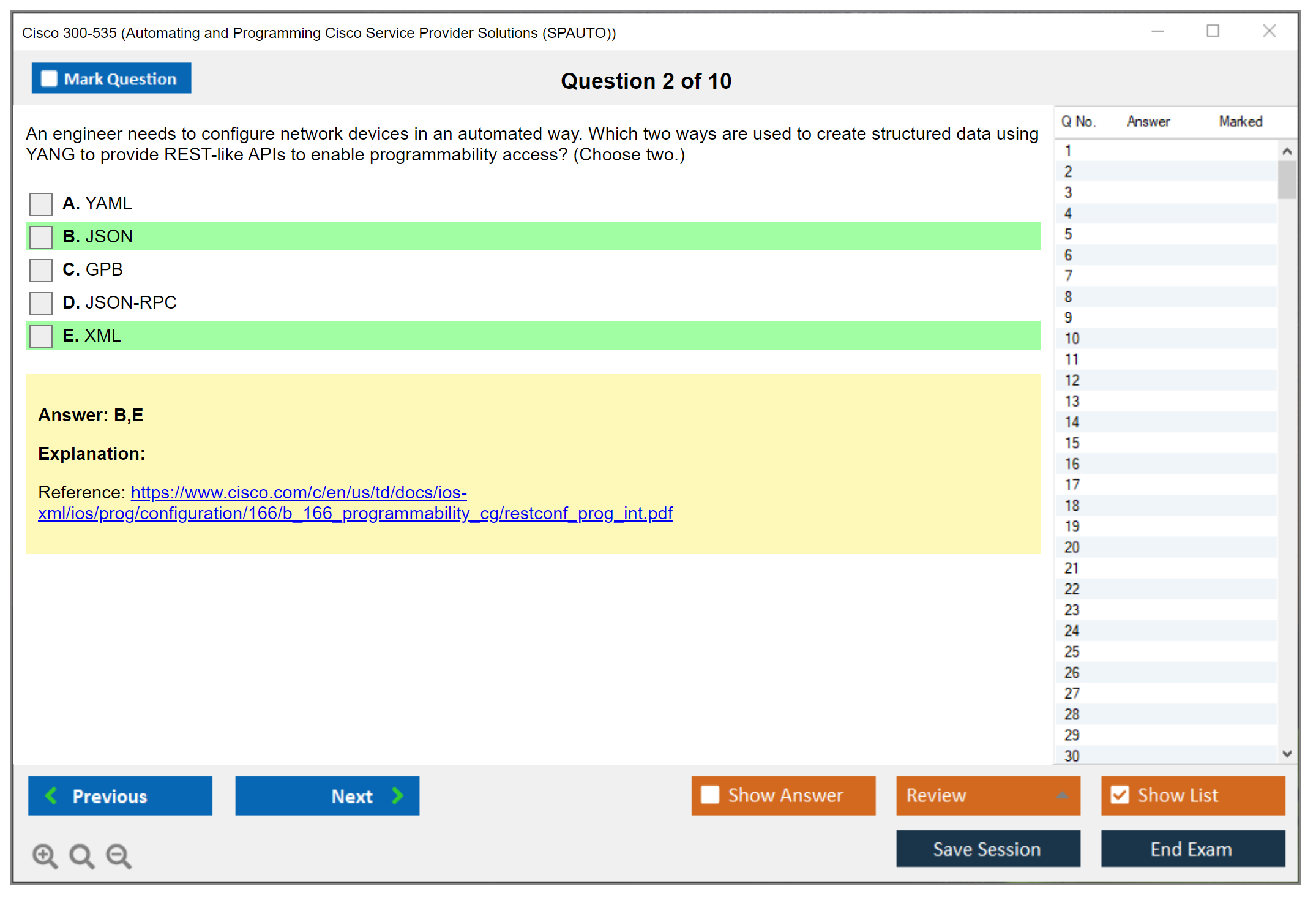
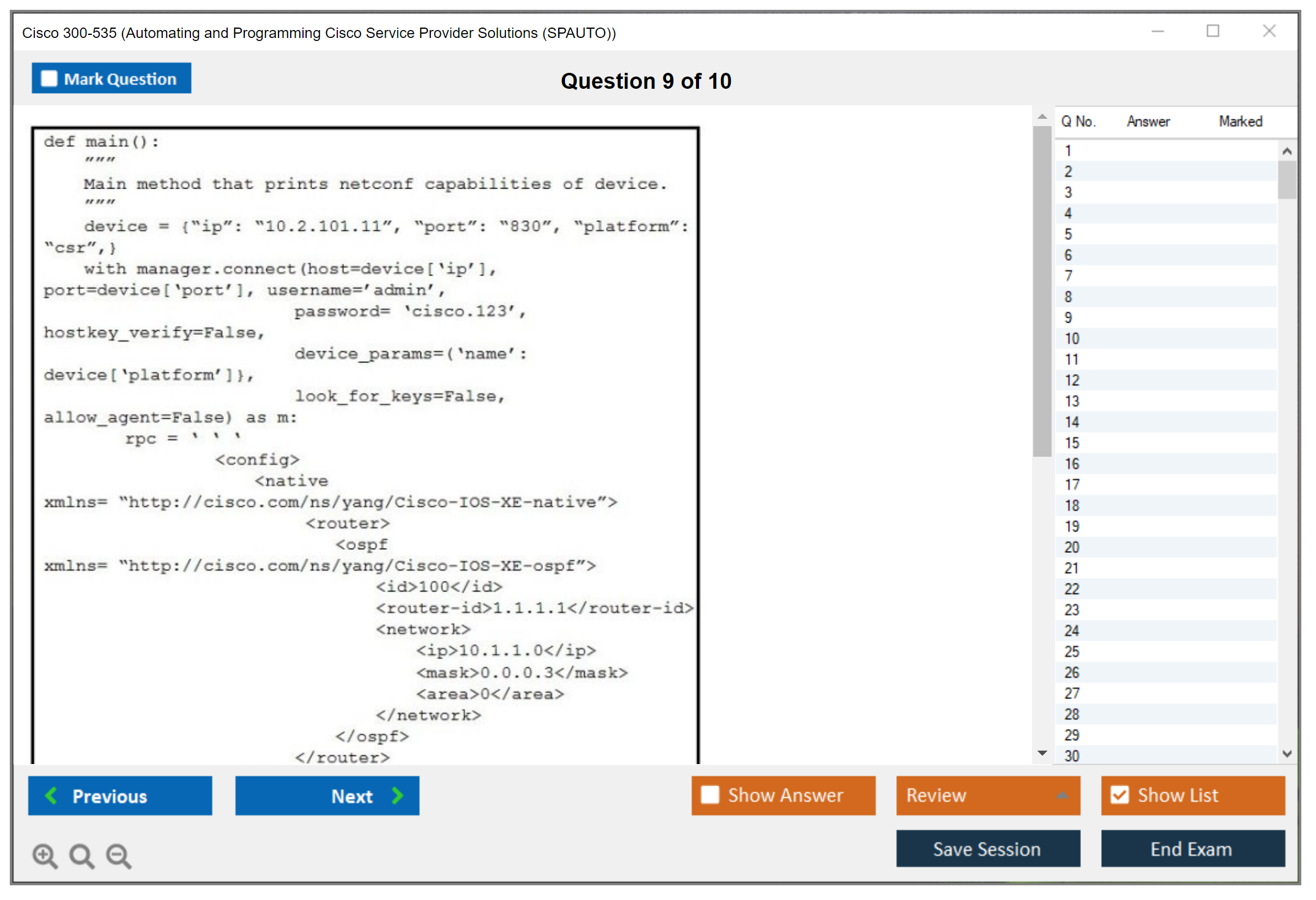
NETCONF and RESTCONF protocols for programmatic device management are huge topics you can't skip. These aren't just theoretical concepts. You need to know when to use NETCONF versus RESTCONF, how they handle configuration datastores, and how to construct proper RPC calls. YANG data modeling language is probably the most challenging aspect for engineers coming from traditional networking backgrounds. YANG defines the structure of configuration and operational data, and understanding YANG schemas is critical for working with model-driven programmability. It's like learning a new language where syntax errors have real network consequences.
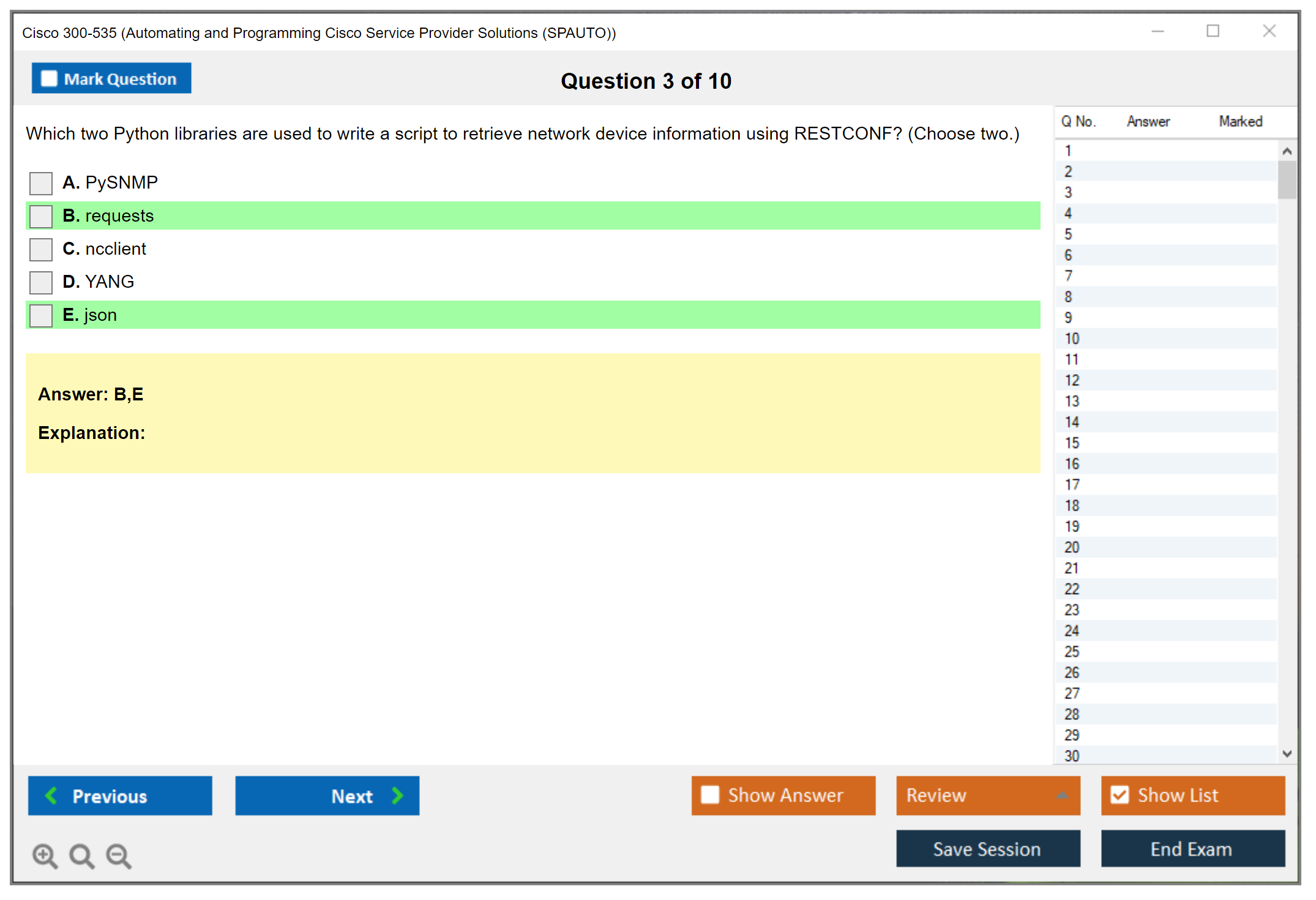
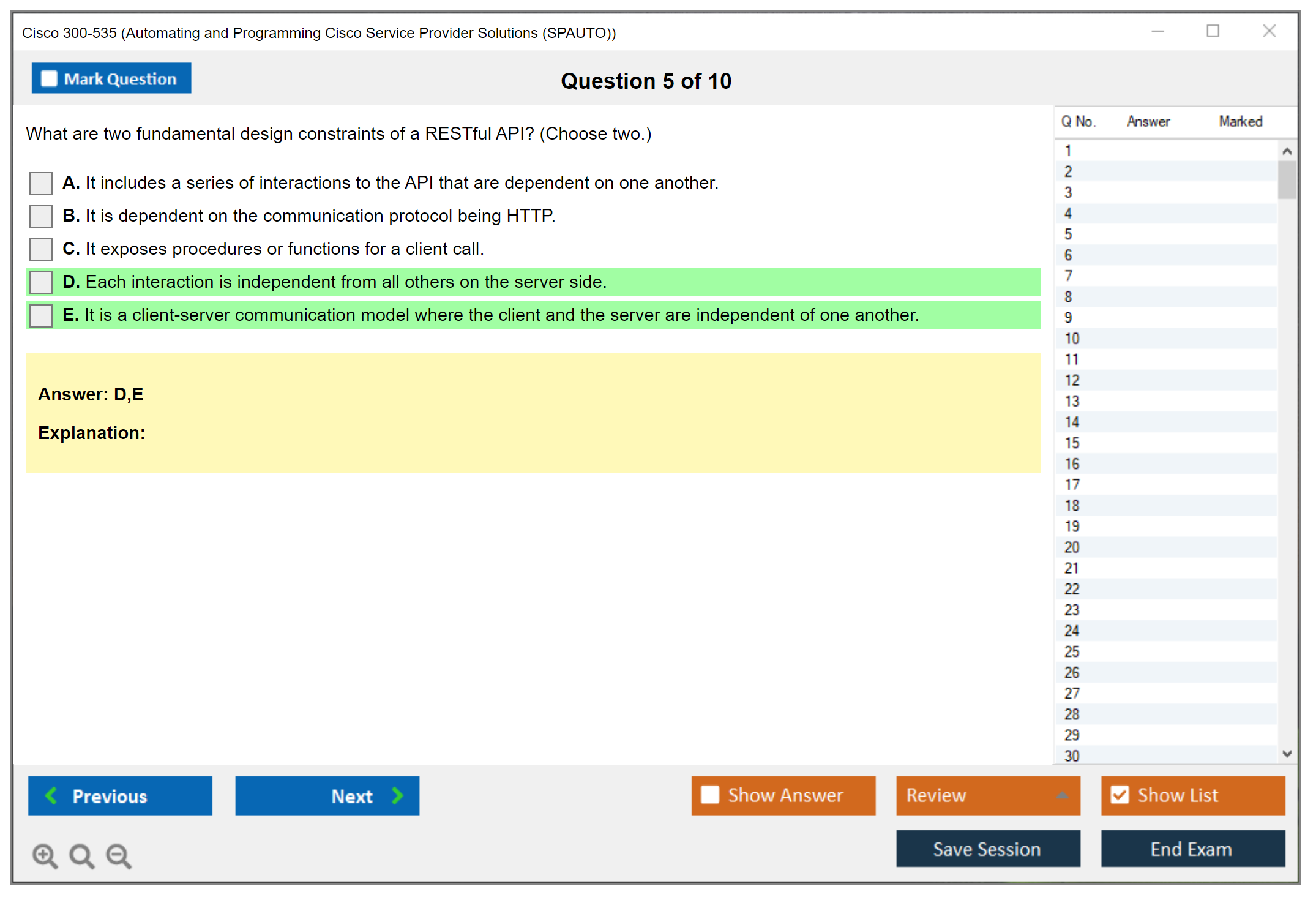
Python scripting comes up repeatedly since it's the de facto language for automation workflows and API interactions in the networking world. You don't need to be a software developer, but you should be comfortable reading Python code. Understanding how libraries like requests and ncclient work matters. Writing basic scripts to interact with APIs matters. RESTful API design principles matter too: understanding HTTP methods, status codes, authentication mechanisms, and how to design APIs that other systems can consume.
Real-world applications this exam validates
Automated service provisioning across multi-vendor SP networks is the killer use case. Imagine a customer ordering a new VPN service. Instead of manual configuration across dozens of devices from different vendors with different CLI syntaxes, NSO takes the high-level service parameters, translates them to device-specific configurations, and deploys everything transactionally in minutes rather than days. Zero-touch deployment of network services means new devices can come online and self-configure based on policies without human intervention.
Automated compliance checking? Huge in regulated industries.
Self-service portals enabling customers to provision services on-demand are becoming standard expectations rather than competitive differentiators. Automated network testing and validation workflows ensure that changes don't break existing services before they hit production. Integration between OSS/BSS systems and network infrastructure closes the loop between business operations and network operations, something that's been a gap in telecommunications for decades. Billing systems finally talking directly to network provisioning systems.
Exam logistics and preparation considerations
The exam costs $400 USD, which is standard for Cisco professional-level exams and reasonable considering the career impact. The passing score isn't publicly disclosed. Cisco uses a scaled scoring system where you'll see a score between 300 and 1000, and you need to hit their pass threshold which varies slightly by exam version to account for difficulty variations. The exam is 90 minutes long with 55 to 65 questions, typically a mix of multiple choice, drag-and-drop, and simulation-based questions that test your hands-on understanding.
Difficulty-wise, I'd say it's challenging if you don't have hands-on experience with the technologies. Book learning alone won't cut it. You can't just read about NSO and expect to answer detailed workflow questions about transaction managers and commit queues. The data modeling questions trip up a lot of people because YANG syntax and concepts aren't intuitive if you've only worked with CLI configurations your entire career. Similar to how 300-435 ENAUTO covers enterprise automation, SPAUTO requires you to think programmatically rather than procedurally. Understanding workflows and logic flows instead of memorizing command sequences.
Cisco 300-535 SPAUTO Exam Details and Logistics
What you're signing up for
The Cisco 300-535 SPAUTO exam is Cisco's pro-level test for people who automate service provider networks and want to prove they can do it with real tools, not just theory. It maps to Automating and Programming Cisco Service Provider Solutions, which is basically "SP networking meets APIs meets data modeling meets NSO".
Not a trivia quiz. Also not a pure coding exam. It's somewhere in the middle.
Who usually takes it
Most folks I see go after the 300-535 SPAUTO certification are already working around SP networks and they're tired of doing changes by hand. You've got network engineers moving into NetDevOps. Automation engineers who got pulled into NSO work. SRE-ish people supporting provisioning workflows. Even architects who need to stop hand-waving and actually understand how services get modeled and deployed.
If you've never touched service provider concepts, look, you can still study for it, but you'll feel the friction fast when scenarios start assuming you understand SP-style services, device scale, and why automation patterns matter when you're managing thousands of nodes with angry change windows breathing down your neck.
Cost and registration basics
Cisco SPAUTO exam cost typically runs $300 USD, though pricing varies by country and taxes, so don't be shocked if your checkout total looks different. Registration and payment run through the Pearson VUE platform, which is Cisco's normal pipeline for scheduling.
Pearson VUE's where you pick delivery mode. Date, location too. Payment options depend on region, but here's the big thing: if you've got Cisco Learning Credits, you can often apply them toward exam fees, which is nice when your employer bought training credits as part of a larger package.
Corporate vouchers exist too. Training bundles sometimes include discounted attempts, and if you're at a Cisco partner or you're a Cisco employee, there can be special pricing. Not always, not everywhere, but it's worth checking internally before you pay out of pocket. I mean, why wouldn't you?
Retakes are the other logistics piece people ignore until they're mad. The retake policy's a 5-day waiting period for the first retake, and 15 days for subsequent attempts. So if you're planning to "just see how it goes" a week before a deadline, that plan can fall apart quickly.
Passing score and how grading works
People always ask about the Cisco 300-535 passing score like it's a fixed magic number. Cisco uses scaled scoring, and the passing score typically falls in the 750 to 850 range out of 1000, but the exact number isn't publicly disclosed and can vary between versions.
Scaled scoring's Cisco's way of accounting for difficulty shifts across question sets. So if you get a slightly harder form, you're not punished for it. At least in theory.
A couple grading realities matter:
- Multiple-choice questions are generally all-or-nothing. No partial credit for "close enough."
- Simulation-style items get graded on task completion, so you can sometimes get credit even if your path to the answer wasn't pretty. Or you can lose it because you missed one key step.
You get a score report immediately after finishing, and it shows a breakdown by section so you can see weak areas. Won't show the exact questions you missed, which is annoying, but that's how these exams stay usable.
Format, timing, and question types
You get 90 minutes. No breaks. Time's a weapon.
Question count's usually around 55 to 65 questions, but Cisco doesn't publish an exact number, so treat it as "about an hour and a half of constant decisions." The exam mixes formats, and that's part of what makes the pacing tricky. The thing is, you can't just blaze through everything.
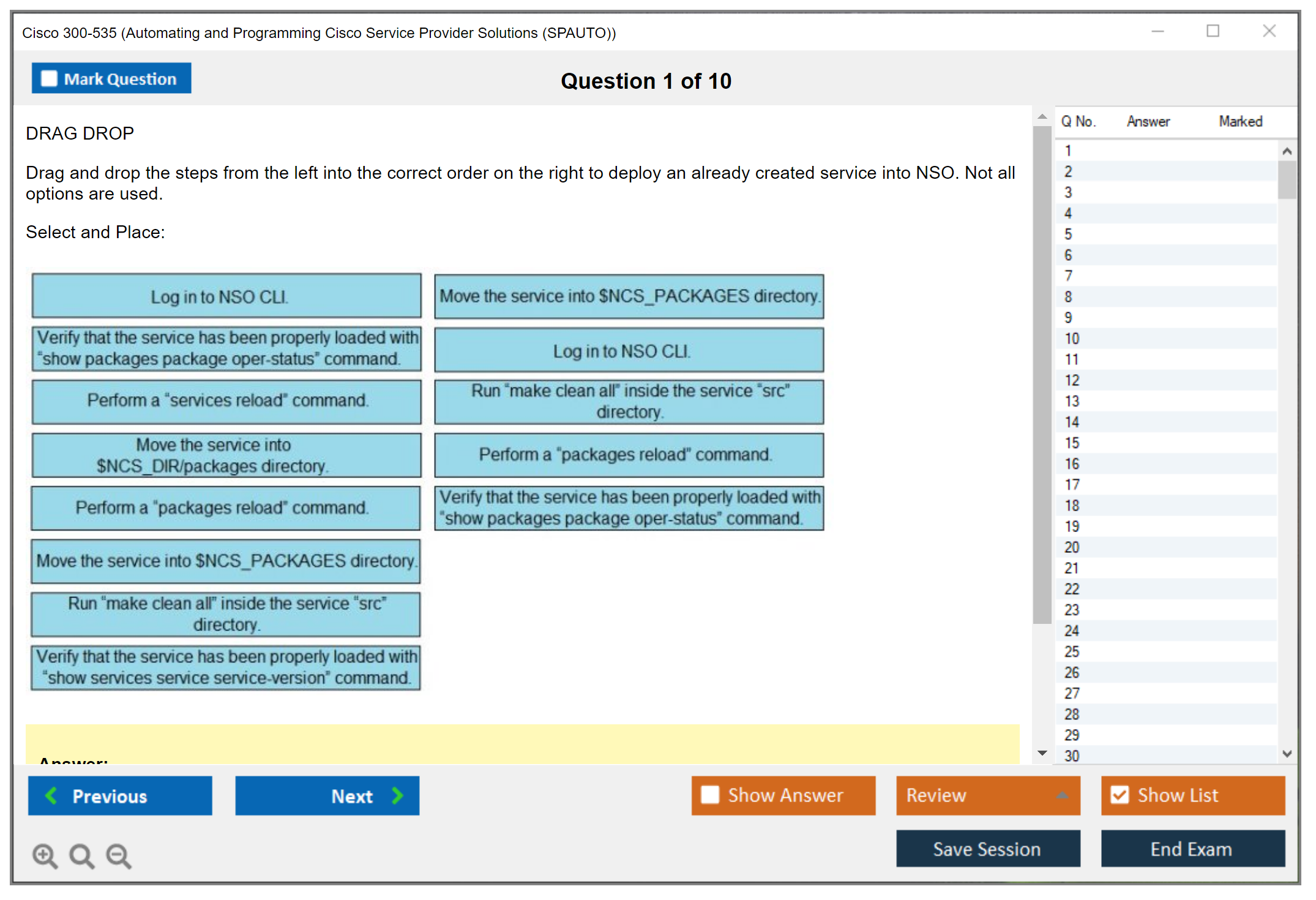
Common question types include multiple-choice single answer where you pick the best option, multiple-choice multiple answer where you pick all that apply (and yes, you can lose it by missing one), drag-and-drop matching usually to test conceptual relationships like protocol behavior or data model structures or NSO components, simulation-based questions requiring configuration or troubleshooting tasks, and scenario-based multi-part questions where one setup leads to several questions and you need to actually read the details instead of speed-clicking.
The exam punishes sloppy time management. Some questions are fast, some are sinkholes, and if you don't know when to move on, you can burn 12 minutes on one simulation and then sprint through the last 18 questions like your keyboard's on fire. Not ideal.
Delivery options and what they're really like
You can take the exam at Pearson VUE testing centers worldwide, or do online proctoring through OnVUE, assuming it's offered in your region and you meet the technical requirements.
Testing center advantages are boring but real: controlled environment, no worrying about your home internet dropping, no surprise Windows update, no roommate walking in. You show up, take it, leave. Simple.
Online proctored exams are handy, but they're picky. You'll need a webcam, microphone, a quiet secure room, and you'll run a system compatibility check ahead of time. I mean, it's fine when it works, but if your setup's even slightly weird, you can spend your pre-exam time troubleshooting instead of focusing. Not fun.
Scheduling flexibility depends on where you live. Urban areas tend to have more slots. Smaller cities can be a pain. I once had to drive 90 minutes because the only available slot in my town was during a week I'd be traveling, which meant burning half a tank of gas and getting up at 5 AM just to make the appointment window. Anyway.
Rescheduling and cancellation usually require 24-hour notice to avoid fees. Don't play chicken with that policy.
Why SPAUTO feels hard (even for smart people)
The "hard" part isn't one thing. It's the mix.
First, the breadth. You're expected to know networking concepts, programming basics, API mechanics, and data modeling, and then tie it together into how automation actually ships services. That's why people doing service provider network automation tend to do better than people who only studied from slides.
Second, Cisco NSO automation is its own world. NSO architecture, service packages, templates, workflows, how devices and services relate, and what breaks when you model something poorly. If you've only watched demos, you'll get exposed. Fast.
Third, YANG. A lot of candidates underestimate YANG data models because they think it's just syntax. It isn't. You need to understand structure, constraints, and how modeling choices affect operations and APIs, and questions often assume you've actually read models and validated them. Not just skimmed.
Fourth, API troubleshooting. Real-world troubleshooting shows up as "why is this call failing," which drags in HTTP methods, status codes, payload formats, and error handling. If you're shaky on REST behavior, you'll be guessing.
Finally, time. Ninety minutes isn't generous when you have to interpret scenarios and do hands-on style items. Quick decisions matter, and this is where practice beats reading. Every time.
Tools and technical environment you should recognize
Cisco doesn't publish "exact versions for everything" in a way you can treat like a contract, but the exam tends to reflect NSO-centric automation workflows and common tooling.
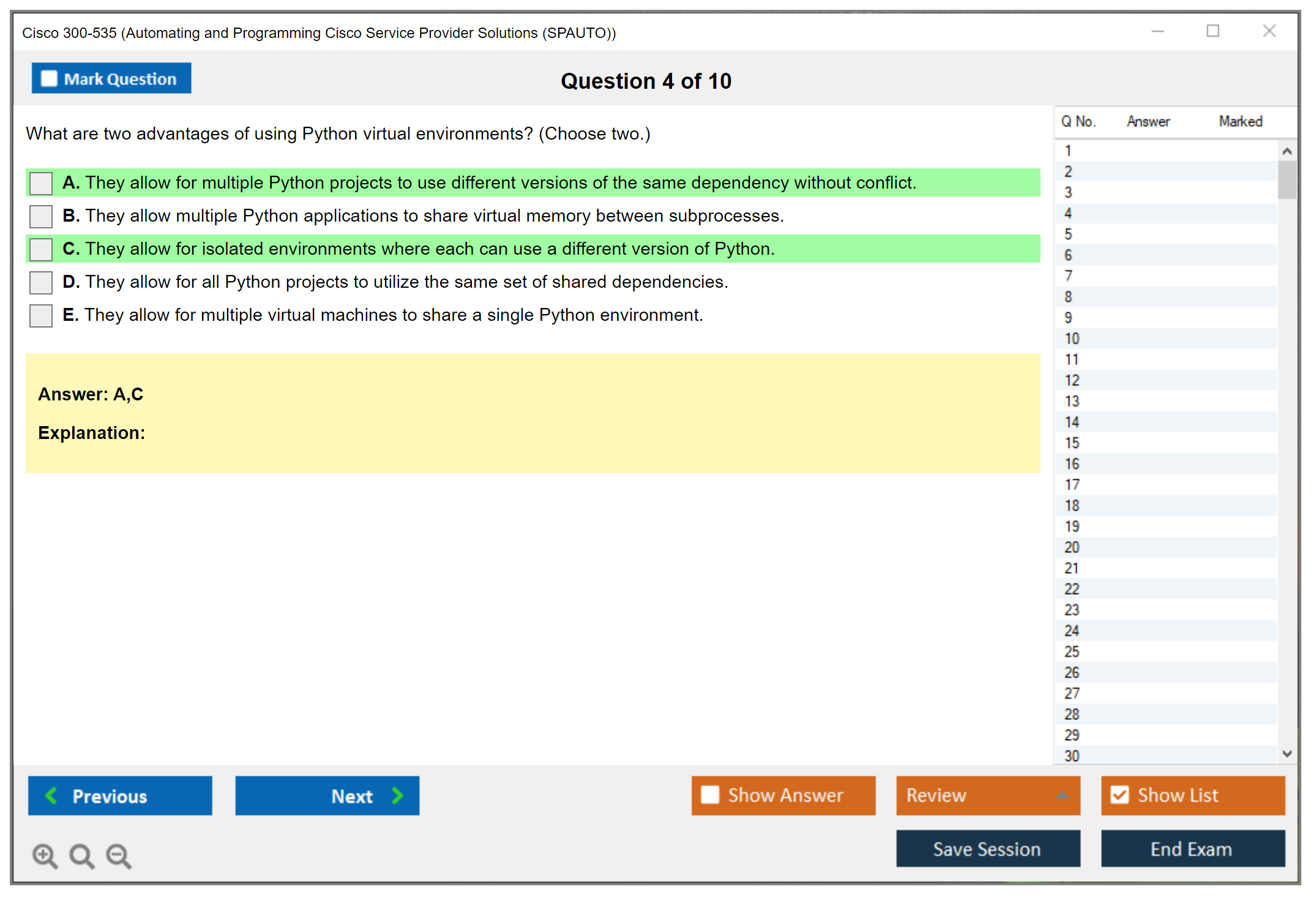
Expect exposure to Cisco NSO features and CLI concepts including service design patterns and package structure, Python libraries used in automation like 'requests', 'ncclient', and 'paramiko' (you don't need to be a software engineer, but you need to read code and reason about it), YANG tooling like 'pyang' and YANG Suite plus basic validation habits, NETCONF and RESTCONF on Cisco including message structure basics and what operations do, Git workflows for network-as-code repos with basic branching and commits and diff mentality, API testing tools like Postman and 'curl' and Python requests patterns, and Linux command-line comfort because automation environments live there and questions often assume you don't panic when you see a shell command.
How questions are usually distributed across domains
Cisco's blueprint can shift, but a typical distribution looks like roughly 20% network programmability foundations and API concepts, roughly 25% data modeling with YANG and data structure manipulation, roughly 30% Cisco NSO architecture and service packages and workflows, roughly 15% automation tools and Python scripting and version control, and roughly 10% testing and validation and operational considerations.
It can vary between exam versions, especially when Cisco updates objectives, so treat these as planning weights, not guarantees. If your study plan ignores YANG or NSO because you "don't like it," you're basically volunteering to fail.
Exam updates and version changes
Cisco updates exams periodically to reflect current best practices and technology versions. That means the Cisco SPAUTO exam objectives you find in an old blog post might not match what you're sitting for today.
Before you start studying, verify the current blueprint on Cisco's site and confirm the exam's active. Cisco usually announces retirement dates well ahead of time, often six months or more, so you're not blindsided, but you do need to look. Don't assume.
New versions can add topics, adjust weighting, and drop deprecated approaches. Study materials should match the current exam version, otherwise you'll waste time learning stuff that's no longer tested or worse, miss something that is.
Study materials that won't waste your time
Official Cisco training's the cleanest path if you've got budget or Cisco Learning Credits. Cisco's own courseware usually aligns best with the blueprint, even if it's not the most exciting thing you'll ever read.
Docs matter more than people want to admit. Prioritize NSO docs, NETCONF/RESTCONF references, and YANG resources. And yes, read actual models. That's where you learn what real-world YANG looks like, not toy examples. It's tedious but necessary.
Labs are the difference maker. If you can build a small NSO lab, do it. Use Cisco sandboxes if available. Install tooling locally. Write a tiny service. Break it. Fix it. That's the kind of experience simulation questions are fishing for.
Practice tests and prep strategy
A Cisco SPAUTO practice test can help with pacing and format, but question banks alone won't save you on simulations and troubleshooting scenarios. Look for practice that includes interpreting YANG, reading API payloads, and reasoning about NSO services, not just flashcards.
Hands-on beats memorization. Every time. No exceptions.
If you want a simple study rhythm, do it like this: learn concept, run a lab, write notes, then quiz yourself. Repeat. If you only watch videos, you'll feel good right up until the exam asks you to diagnose why a RESTCONF call returns a specific error and you realize you've never actually made the call.
Common mistakes I see
One: memorizing commands instead of understanding workflows. SPAUTO loves "what happens next" and "why did this break," and memorized snippets don't help much there.
Two: underestimating data modeling and API behavior. People treat YANG like a side topic and treat REST like "just JSON." Then the exam hits them with structure, constraints, and protocol mechanics, and they're stuck. Completely.
Three: skipping Git and Linux basics. Not because the exam's a Linux exam, but because automation work lives in that environment, and the questions reflect that reality.
Certification value and where it fits
If you're aiming at SP automation roles, this exam's a good signal. It pairs well with jobs that touch provisioning platforms, NSO-backed service delivery, or automation frameworks in carrier environments.
It also fits nicely if you're thinking about longer-term Cisco SP automation certification renewal planning, because Cisco's recert system rewards continuing education and staying active, not just passing one exam and forgetting everything.
Renewal and recertification
Cisco certs typically renew on a three-year cycle (depending on the certification level you earn and what you pair it with). Renewal options usually include earning continuing education credits or passing eligible exams again, and Cisco updates those rules occasionally, so check the current policy when you're within a year of expiration. Don't wait.
Continuing education's often the least painful route if your employer already pays for training. Retesting's fine too, but you're betting your renewal on one day going well, and I mean, life happens.
FAQ people keep asking
How much does the Cisco 300-535 SPAUTO exam cost?
Standard fee's $300 USD, with regional variation. You pay through Pearson VUE, and vouchers, Cisco Learning Credits, and partner/employee pricing may reduce cost.
What is the passing score for Cisco 300-535 SPAUTO?
Typically 750 to 850 out of 1000, but Cisco doesn't publish an exact fixed number. Scaled scoring's used and can vary by exam version.
Is the 300-535 SPAUTO exam hard?
Yes, for most people, because it combines NSO, YANG, APIs, and troubleshooting under tight time constraints, and simulation questions punish "I watched a video once" prep.
What are the objectives for the SPAUTO exam?
Expect coverage across programmability foundations, REST and NETCONF/RESTCONF on Cisco, YANG modeling, Cisco NSO service design and workflows, Python and tooling, plus testing and operational practices. Always verify the current blueprint before you start.
How do I renew after passing 300-535 SPAUTO?
Usually by meeting Cisco's recert requirements within the renewal window, either via continuing education credits or passing qualifying exams. The clean move's to plan renewal early so you're not cramming at the end of the cycle.
Detailed 300-535 SPAUTO Exam Objectives and Blueprint
What you're actually getting into with this exam
The Cisco 300-535 SPAUTO exam? It's not your typical routing and switching certification. This thing tests whether you can actually automate service provider networks using modern tools and APIs, and it's a different beast compared to traditional Cisco exams where you'd just memorize commands and topologies.
The Automating and Programming Cisco Service Provider Solutions certification targets folks working in large-scale networks. Think telecom providers, ISPs, and massive enterprise environments where complexity hits different. You'll need to prove you understand how to interact with network devices programmatically, work with data models, and orchestrate services across multi-vendor environments (which, the thing is, most production networks actually run). The exam costs $300 USD, same as most Cisco professional-level tests, and you need a 750-850 passing score. Yeah, Cisco doesn't publish the exact number. Super annoying.
Why service providers even care about automation
Service providers face pressure that enterprise networks just don't deal with at the same scale. When you're managing thousands of devices across multiple vendors, manual configuration becomes literally impossible.
The business drivers are straightforward. Service velocity matters because competitors will eat your lunch if they can spin up new offerings faster, right? Time-to-market reduction translates directly to revenue. Every single day your new service sits in a deployment queue is money left on the table, and that adds up fast. Operational expense reduction through less manual intervention is the big one though. One network engineer touching thousands of routers through automation beats twenty engineers clicking through CLI sessions any day of the week.
Consistency and reliability improvements hit different in multi-vendor environments where Cisco, Juniper, Nokia, and others coexist. You just can't hire enough people to manually configure everything at service provider scale. Even if you could, the error rate would be astronomical. I spent three weeks once tracking down an outage that turned out to be a single typo someone made at 2 AM during an emergency change.
The maturity path most organizations take
Automation maturity models show pretty clear patterns across the industry. Most start with scripting and task automation as entry-level work. Someone writes a Python script to backup configs or push ACL changes. That's fine for getting started, nothing wrong with it.
Configuration management and infrastructure-as-code principles come next, where you start treating network configs like application code with version control and testing. Service orchestration and intent-based networking represent the next level where you define what you want (the intent) and let systems figure out the how. Basically abstraction. Closed-loop automation with telemetry and remediation is the holy grail. Systems detect problems and fix themselves without human intervention, which sounds futuristic but it's happening now.
Core concepts that trip people up
The declarative vs. imperative configuration approaches concept confuses a lot of people at first. Imperative is step-by-step commands: "do this, then do that, then verify." Declarative is stating the desired end state: "I want these VLANs configured" and letting the system figure out the steps needed to get there. Most modern automation tools prefer declarative approaches because they're more resilient to variations in starting state.
Idempotency matters more than people think. I didn't get this at first either. An idempotent operation produces the same result whether you run it once or a hundred times, which prevents automation from breaking things when scripts run multiple times or fail partway through. State management and configuration drift detection help you identify when actual device configs deviate from intended state. Super critical in production networks where people sometimes make manual changes.
Abstraction layers separating service intent from device implementation let you define a VPN service once and deploy it across Cisco, Juniper, and Nokia boxes without rewriting everything for each vendor. The hierarchical service models (customer, service, resource layers) organize this complexity in manageable chunks that don't make your brain melt.
Getting comfortable with APIs and protocols
RESTful API fundamentals form the foundation for modern network automation. You absolutely need to understand HTTP methods and when to use each one. GET retrieves data without modifying anything. POST creates new resources. PUT replaces entire resources. PATCH updates specific fields. DELETE removes resources.
Status codes tell you what happened. 2xx means success, 4xx means you screwed up the request, 5xx means the server had problems on its end.
Resource-oriented design and URI structure follow patterns like "/api/v1/devices/{device-id}/interfaces" that make APIs predictable and discoverable once you understand the pattern. Authentication mechanisms vary. Basic auth is simple but insecure, token-based auth is common in production, OAuth handles delegation scenarios where you're acting on behalf of someone else. Request and response formats use JSON mostly, though XML still appears in NETCONF contexts because legacy.
NETCONF isn't going anywhere despite REST hype
NETCONF protocol architecture has been around since 2006 and service providers use it heavily despite all the REST hype you'll hear. The protocol layers stack up in a specific way: SSH provides encrypted transport, messages wrap operations in XML envelopes, operations include things like get-config and edit-config, and content follows YANG models that define what's actually valid.
The datastore concept matters a lot here. Candidate datastore holds proposed changes before they go live. Running datastore is the active configuration that's actually making your network work. Startup datastore loads on device boot. You can prepare changes in candidate, validate them to catch errors, then commit to running, which gives you a safety net. Subtree and XPath filtering let you retrieve exactly the data you need instead of dumping entire configs that take forever to parse.
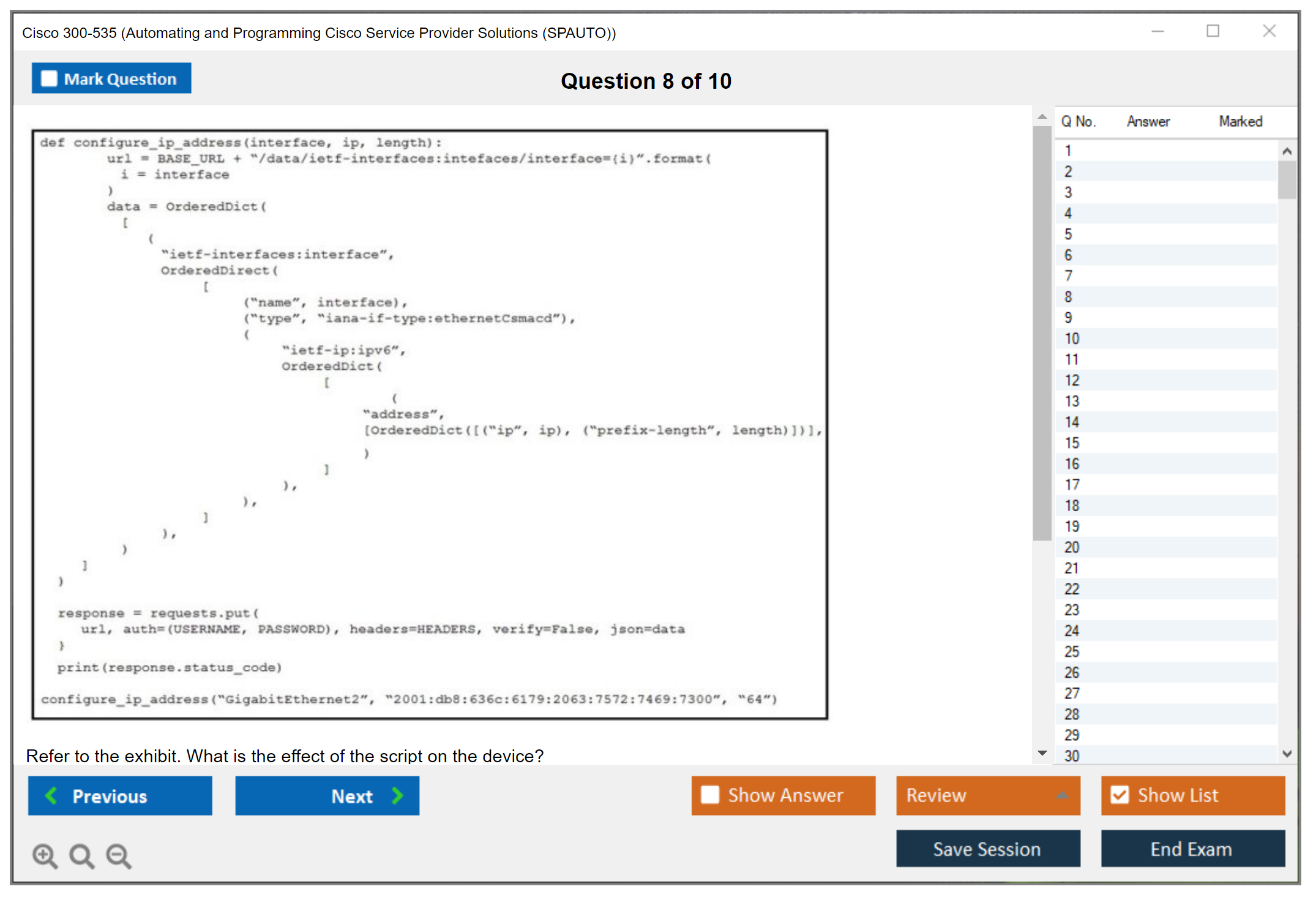
RESTCONF maps NETCONF operations to HTTP, which makes it easier to work with from web applications and scripts that already speak HTTP fluently. The URI structure for accessing YANG-modeled data follows patterns like "/restconf/data/interfaces/interface=GigabitEthernet0/0/1" that directly correspond to the YANG model tree. It's basically NETCONF over HTTP instead of SSH, which some people prefer.
YANG models are the secret sauce
YANG data modeling language defines the structure and constraints of configuration and operational data in a machine-readable way. Module structure includes headers with metadata about the model, imports from other modules you're building on, typedefs for custom data types specific to your needs, groupings for reusable chunks that appear in multiple places, and the actual data hierarchy using containers, lists, and leafs.
Constraints like must, when, mandatory, and min/max-elements enforce business rules in the model itself rather than in application code.
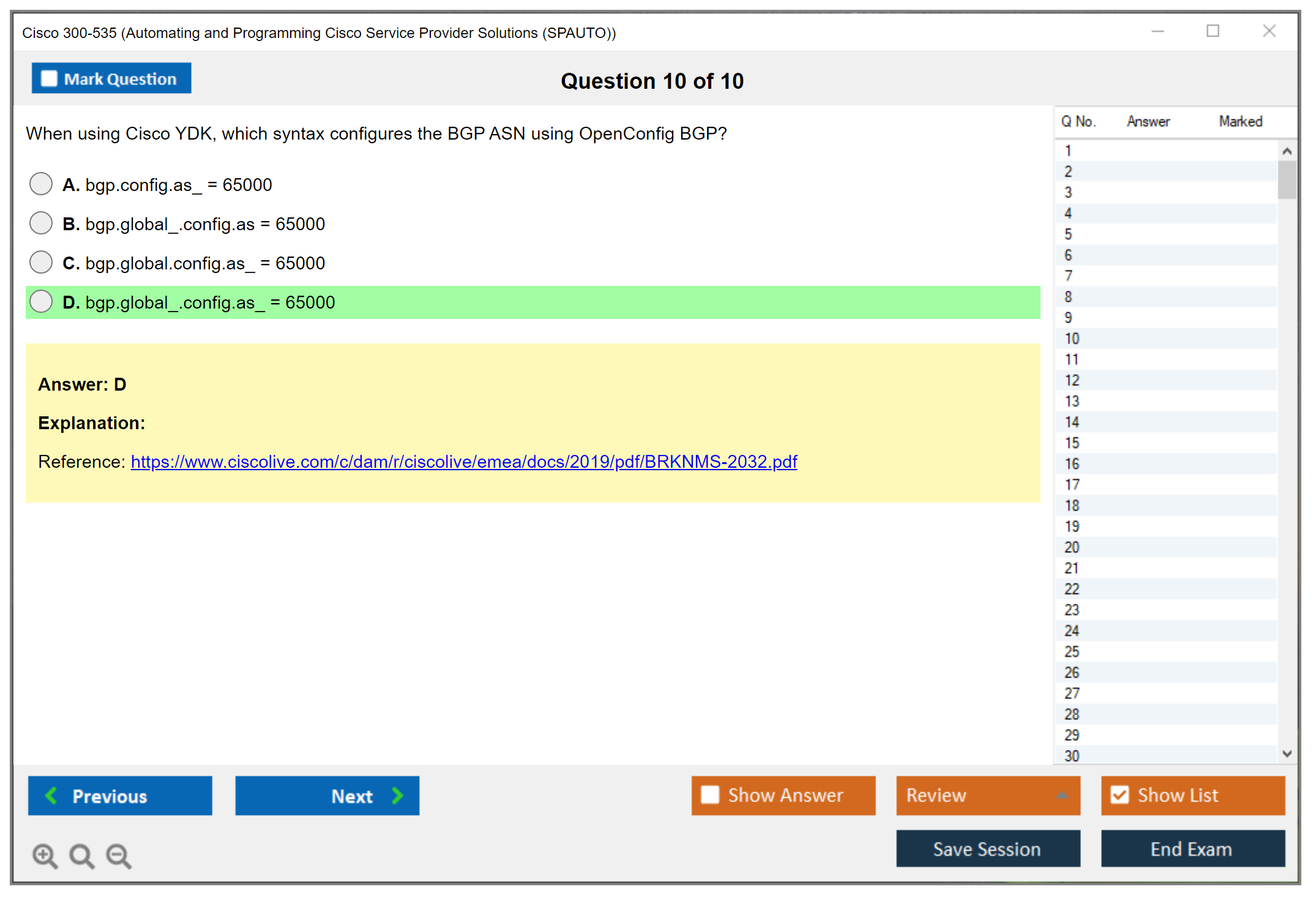
Standard YANG models come from different sources with different philosophies. IETF models cover common protocols: there's IETF YANG models for BGP, OSPF, interfaces, and system management that work across vendors theoretically. OpenConfig models take a vendor-neutral approach focused on operational use cases that network operators actually need. Then you've got Cisco native YANG models for IOS XR and IOS XE that expose vendor-specific features you can't get in standard models. The trade-off is always standardization vs. feature coverage.
Tools like pyang validate YANG modules and generate tree visualizations that make complex models easier to understand without reading raw YANG. Cisco YANG Suite provides a web interface for exploring models and testing API calls against real devices before you push to production. For anyone coming from 200-901 DevNet Associate, these tools will feel familiar because they're part of that ecosystem.
NSO deserves its own section honestly
Cisco NSO (Network Services Orchestrator) gets 25-30% of the exam weight for good reason. It's central to Cisco's automation story. NSO architecture includes a device manager that talks southbound to network devices using their native protocols, a service manager that handles service lifecycle from creation through modification to deletion, and the Configuration Database (CDB) that maintains the source of truth for network state.
Network Element Drivers (NEDs) translate between NSO's internal model and device-specific protocols, which is how you get multi-vendor support.
The transaction manager ensures ACID properties across multiple devices. Either all changes succeed or they all roll back, which is key when you're configuring VPN endpoints that need to match. Commit queue handles asynchronous deployment when you're touching hundreds of devices and don't want to wait for serial completion that could take hours.
Device management involves adding devices to inventory with credentials and connection details, organizing them into groups for bulk operations, fetching SSH keys for secure communication, and keeping NSO's view synchronized with actual device state through sync-from and sync-to operations. Device templates apply baseline configurations across device fleets consistently.
Service development follows a package structure that's pretty standardized. You define a YANG service model describing the service parameters customers can specify. Create XML templates that map service intent to device configurations across potentially multiple vendors. Compile the package to catch syntax errors. Reload it into NSO to make it available. The templates use variables and XPath expressions to generate device-specific configs from service inputs, which is where the abstraction magic happens. Creating service instances happens through CLI, RESTCONF, or NETCONF interfaces depending on what you're integrating with.
Python ties everything together
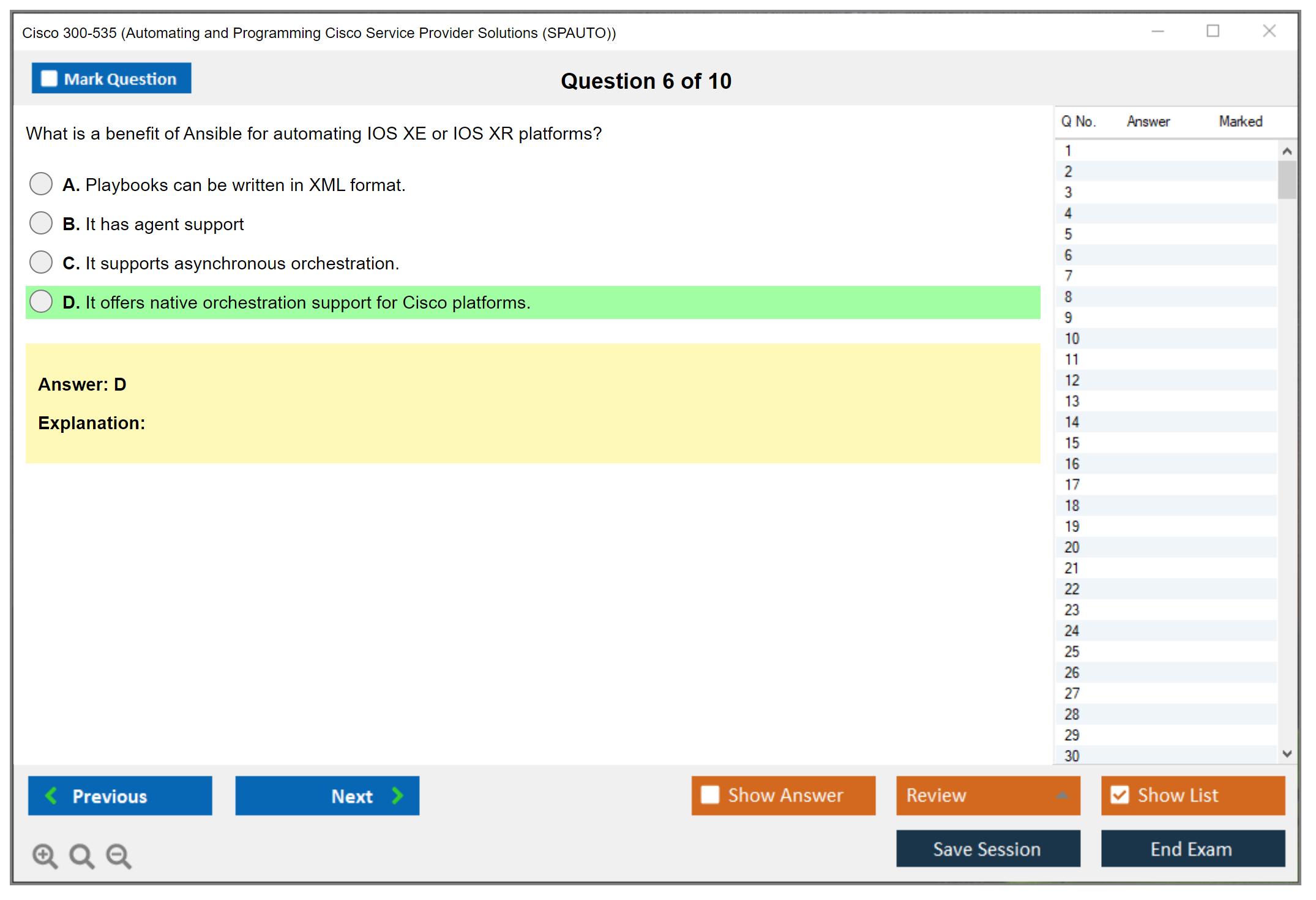
Python libraries for network automation include requests for REST APIs which is super common, ncclient for NETCONF interactions with network devices, xmltodict and json for parsing responses into usable data structures, and jinja2 for templating configurations and other text outputs. Error handling and logging make the difference between scripts that fail mysteriously at 3 AM and automation you can actually troubleshoot when things go wrong.
Version control with Git tracks both network configurations and automation code in the same workflows developers use. Branching strategies let you test changes safely before merging to production branches that deploy automatically. Pull requests and code review processes catch mistakes before they hit live networks. Super important when automation can break thousands of devices at once if you mess up a template. Similar patterns appear in 300-435 Automating Cisco Enterprise Solutions but SPAUTO focuses on service provider specific scenarios like managing BGP sessions across hundreds of peers.
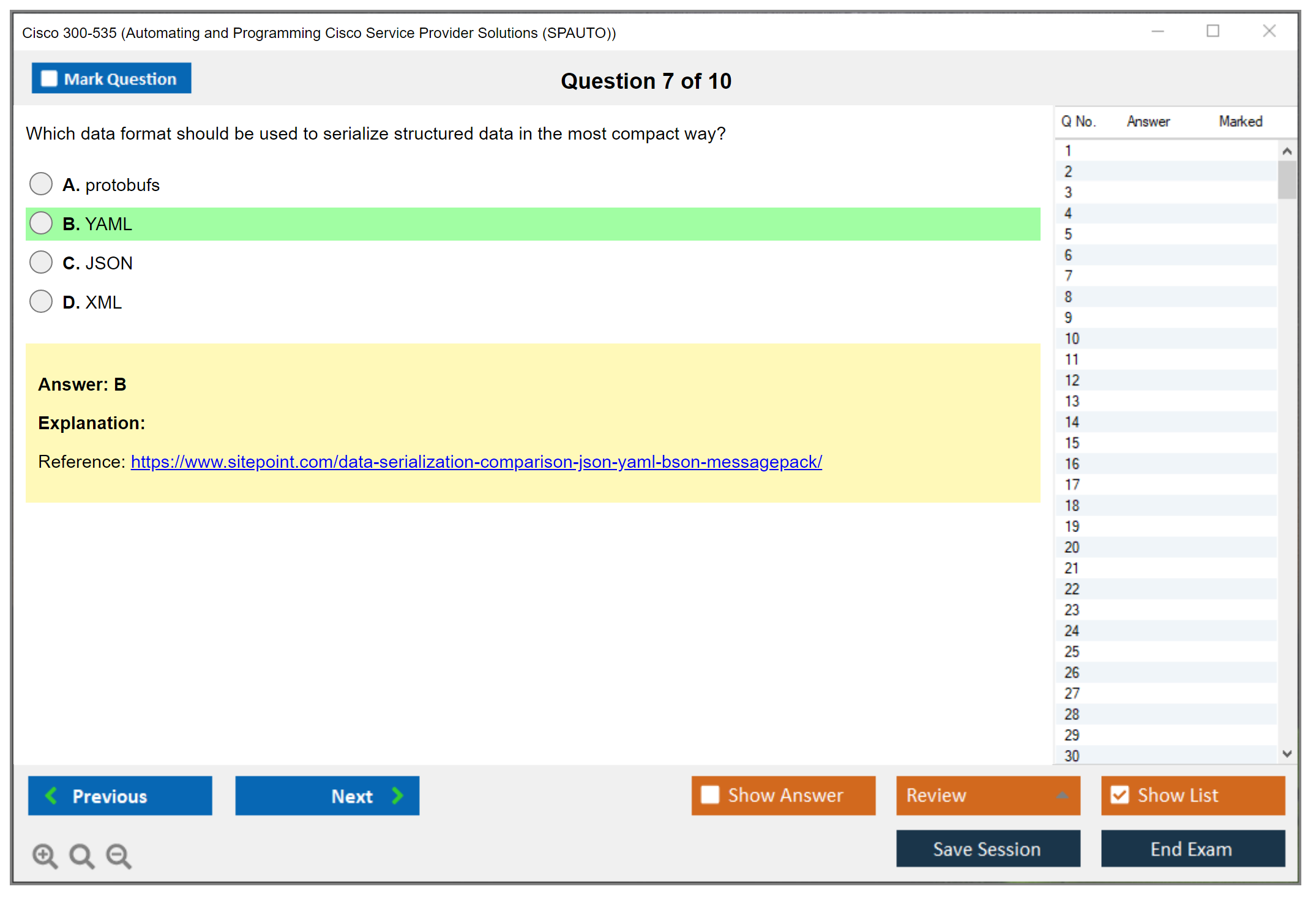
Jinja2 syntax with variables, loops, conditionals, and filters separates data from templates cleanly. You can maintain one template and feed it different YAML or JSON data sources to generate configs for different sites or customers. That's the reusability everyone talks about.
Testing and validation prevent disasters
Automated testing strategies prevent automation from becoming the fastest way to break things at scale. Unit testing validates individual functions work correctly in isolation. Integration testing checks end-to-end service provisioning flows across multiple systems. Validation testing confirms deployed configurations match intent and don't just look syntactically correct. Regression testing catches when updates to automation code break previously working scenarios that nobody thought to check.
Pre-deployment validation using dry-run and commit checks shows what would happen without actually changing anything on production devices. Post-deployment verification through operational state checks confirms services actually work from a user perspective, not just that configs got pushed successfully. Comparing intended state vs. actual device state catches configuration drift from manual changes or system failures that automation didn't handle.
Where this certification fits in your career
The SPAUTO certification makes sense if you're working in service provider environments or large enterprises with SP-scale challenges that normal enterprise networks don't hit. Network automation engineers, DevOps folks focused on infrastructure rather than applications, and service provider architects all benefit from this knowledge. It complements other professional-level certs. If you've done 350-501 SPCOR, SPAUTO is the logical automation-focused companion that builds on that foundation. For security-minded folks, 350-701 SCOR covers different ground but similar automation concepts appear because security automation uses the same tools.
Renewal follows Cisco's standard professional-level timelines. You've got three years from passing to recertify either by passing another professional exam, passing the CCIE lab if you're feeling ambitious, completing continuing education credits through training, or retaking SPAUTO itself.
Study materials that actually help
Official Cisco training exists but the best preparation combines hands-on lab work with reading actual documentation that explains the why, not just the what. NSO documentation, YANG model specifications, NETCONF and RESTCONF RFCs..these aren't exciting reads but they're literally what the exam tests against. Setting up a lab with Cisco DevNet sandboxes, NSO trial licenses, and some virtual routers gives you practical experience that question banks can't replicate no matter how many questions you memorize.
Our 300-535 Practice Exam Questions Pack at $36.99 helps you identify knowledge gaps and get comfortable with question formats you'll see on test day. But don't just memorize answers without understanding the concepts. Understand why each option is right or wrong, because the exam will rephrase scenarios. The exam tests workflows and problem-solving approaches, not command memorization like older Cisco tests did.
Common mistakes to watch for
Memorizing commands vs. understanding workflows kills a lot of candidates who prepared the wrong way. SPAUTO doesn't ask "what command configures OSPF" like older exams from the CLI era. It asks "how would you design an automation workflow to deploy OSPF across 500 routers with rollback capabilities and validation testing" which requires architectural thinking. Big difference in how you need to prepare.
Underestimating data modeling and API behavior trips up people with strong CLI backgrounds who've been doing networking for years. You need to understand YANG structure deeply, XPath navigation syntax, and how NETCONF operations interact with datastores in different scenarios. Surface-level knowledge won't cut it when questions dig into edge cases and error scenarios that happen in production.
Not gonna lie, this exam is harder than traditional Cisco tests if you're coming from a pure networking background without programming exposure or development experience. But it's totally passable with proper preparation and hands-on practice that goes beyond reading. The automation skills you build preparing for SPAUTO translate directly to real-world value in modern networks where automation isn't optional anymore.
Prerequisites and Recommended Experience for SPAUTO Success
Cisco 300-535 SPAUTO exam overview
What the 300-535 exam is
Look, the Cisco 300-535 SPAUTO exam sits right in that weird middle ground between "I can configure a backbone" and "I can automate changes across that backbone without breaking everything at once." It's Cisco's service provider automation test tied to Automating and Programming Cisco Service Provider Solutions, so you're getting a mix of actual SP networking reality plus automation mechanics. Not just theory. Not CLI trivia only.
The thing is, it's pretty opinionated about how modern SP operations should run. Model-driven management, APIs, YANG, all that stuff. Automation systems like Cisco NSO automation show up constantly because that's legitimately how a lot of providers push services at scale these days. Nobody wants some poor soul SSH'ing into 40 routers at 2 a.m. hoping muscle memory carries them through.
Who should take SPAUTO (target roles)
Network engineers in service provider environments, obviously. Automation-focused SRE-ish folks living somewhere between NOC and NetDevOps land. Anyone building service activation pipelines, writing Python glue code, or maintaining templates and models. Those lovely "why is BGP doing that" runbooks we all adore.
Consultants too. Vendor SEs. People constantly pulled into "can you automate this L3VPN turn-up?" meetings where nobody really wants to be. You know the type.
Cisco 300-535 SPAUTO exam details
Exam cost
Honestly, people ask about Cisco SPAUTO exam cost because nobody likes surprises at checkout, right? Pricing varies depending on your region and local taxes, but Cisco pro exams in this tier typically land somewhere in the few-hundred-dollar range. Check Cisco's exam page and Pearson VUE for the exact number where you actually live. "USD list price" and "what you pay after conversion and fees" aren't always friends.
Passing score
The Cisco 300-535 passing score isn't something Cisco publishes in a stable, here's-the-magic-number way. They can adjust scoring and forms between versions. If you see some specific number floating around online, treat it like a rumor unless it's directly from Cisco.
What I'd do instead? Aim for really being able to explain and perform the tasks, not just recognize answers. You want that "I can reason through NETCONF replies and YANG paths on the fly" energy. That's what saves you when a question's worded weird or introduces some scenario you didn't memorize.
Exam format, duration, and question types
Expect the usual Cisco pro exam vibe: timed session, multiple choice and multiple select questions, plus scenario-based stuff. Some questions feel like "what happens next" troubleshooting exercises. Others are more "pick the right API call or data model or workflow step" type deals.
It's less about typing configs and more about understanding the control plane and the automation plane simultaneously, which is honestly a different kind of tired.
Exam difficulty (why it feels hard)
The exam gets spicy because it crosses disciplines in ways that aren't always comfortable. SP networking's already dense, then you layer on model-driven automation where one wrong assumption about a YANG container or an API endpoint breaks the whole workflow.
Another factor: service providers do things at massive scale. Questions tend to assume you care about repeatability, rollbacks, idempotency, and operational safety. Not just "did the ping work once and we called it good." I've seen people with ten years of CLI experience absolutely freeze when confronted with declarative state concepts, because the muscle memory they've built doesn't translate cleanly.
300-535 SPAUTO objectives (blueprint)
Automation foundations you actually need
The Cisco SPAUTO exam objectives map to real operational automation stuff: service intent, provisioning flow, validation loops. You should be comfortable thinking in "declare desired state, let the system converge" terms rather than "paste config blob and pray nothing catches fire."
You'll run into concepts like transactionality, dry-runs, diffs, audit trails. Not every question uses those exact words, but the mindset is completely baked in.
APIs and programmability (REST, NETCONF/RESTCONF)
You need to recognize when REST makes sense versus when NETCONF makes sense, and what actually changes with NETCONF and RESTCONF on Cisco devices in practice. Know how data gets represented. Know how operations differ (GET vs edit-config style operations). Know what a typical response looks like when things work and when they don't.
Authentication patterns too. Tokens vs basic auth. Common HTTP status behaviors that mean "you messed up" versus "the device is confused." The exam won't turn you into an API developer overnight, but it'll absolutely punish "APIs are magic" thinking.
Data modeling with YANG
YANG data models aren't optional here. Sorry. You don't have to become a YANG author overnight, but you should read YANG like you read a routing policy: identify containers, lists, keys, leaf types, and how paths map to actual payloads you'd send.
If you've only ever done screen-scraping CLI output, this section's where you feel the shift. Model-driven is way cleaner long-term, but it forces precision upfront.
Cisco NSO concepts and workflows
Cisco NSO automation is a legitimately big deal in service provider automation, and the exam reflects that reality. You should understand service models, device models (NEDs), service packages, templates, and the whole idea of committing changes as transactions instead of hoping for the best.
NSO also brings operational concepts that show up in questions: partial failure handling, rollback mechanics, commit queues. What "sync-from" versus "sync-to" actually implies in practice. Look, NSO can feel like a whole separate product certification by itself. For SPAUTO you mainly need the workflows and the mental model, not every implementation detail.
Automation tooling and scripting (Python)
This is where Python for network automation (service provider) comes in. You're not building a Django app or anything fancy. You're writing scripts that pull state, compare intended versus actual, push changes, and validate post-change behavior without breaking customer services.
Think: requests library, parsing JSON and XML, handling errors gracefully, and not hardcoding everything like it's a one-off lab that'll never see production. Scripts that survive actual operations. Mostly.
Testing, validation, and ops considerations
This part's the "don't break the backbone" section. Pre-checks, post-checks, rollback strategy, logging, change windows. Knowing what you can safely automate versus what still needs human review because the blast radius is absolutely huge.
Prerequisites and recommended experience
Formal prerequisites and Cisco's recommendations
Cisco doesn't enforce mandatory prerequisites to register, so no, you don't technically need a specific cert first. That said, the 300-535 SPAUTO certification isn't exactly a friendly "start here" exam either. Cisco strongly recommends about 2 to 3 years working with service provider networking before attempting it.
That recommendation? Not marketing fluff. SP networks have their own patterns. Heavy BGP policy use, route reflectors everywhere, MPLS services, traffic engineering considerations. The automation questions assume you already know what you're automating and why it actually matters.
If you're coming from enterprise-only networking, you can still pass (people do), but you'll spend extra time learning how SP cores, edges, and services are normally designed. You'll need to practice translating that into repeatable service workflows instead of device-by-device CLI habits that don't scale.
Familiarity with Cisco IOS XR helps a lot. XE too, but XR especially shows up constantly in SP contexts. If you've never touched XR operationally, you'll waste brain cycles on "what does this command style even mean" instead of focusing on the automation and APIs where the points actually are.
Networking foundations you should not skip
Service provider architecture knowledge matters here. Core, edge, access layers. What lives where, why the core stays intentionally boring and stable, and why the edge is where services and customer policies pile up and get messy.
MPLS is another must. Know MPLS basics, labels, LDP versus RSVP-TE contextually, and then how MPLS services actually get delivered. L2VPN and L3VPN scenarios. EVPN too, because EVPN is legitimately everywhere now, not just in data centers anymore. You need to understand EVPN architectures well enough to reason about what a service model would represent when you're automating turn-ups.
BGP is the big one. BGP operations, path selection, policy implementation at scale. Communities. Local preference. MED behavior. Route filtering that doesn't accidentally blackhole traffic. If you've never built policy at scale, a lot of SP automation scenarios will feel abstract because you won't have an instinct for what needs to be templated and what needs to be per-customer variable.
IGPs matter as well. IS-IS and OSPF both show up in SP cores. You should know why one gets chosen over the other, what areas or levels mean operationally, and how the IGP supports label distribution, traffic engineering, and fast convergence when links flap.
Route reflectors and confederations. You don't need to design the world's biggest RR topology from memory, but you should understand why RRs exist, what changes operationally when you add them, and what goes catastrophically wrong when policies are inconsistent across clusters.
Segment routing is also on the list. You should understand what it buys you over traditional MPLS TE. Simpler state in the network, SR policies, the general "source chooses path" idea. Not every provider runs it perfectly yet, but the exam expects you to know the concepts and how automation might interact with SR deployments.
Multicast fundamentals show up too. Just the basics, honestly. What PIM does, why multicast is operationally touchy, how it fits into SP service delivery.
Understanding network services and operations
This is the part people legitimately underestimate. Customer service types and SLA requirements. Service activation workflows and dependencies that aren't always obvious. Multi-tenancy and service isolation techniques. QoS policies and implementation that actually matches what you sold.
You don't need to be a product manager. You do need to think like an operator: what inputs define a service, what dependencies must exist first (interfaces up, routing reachability, labels distributed, policies applied), and what "done" looks like beyond just "config committed successfully."
Honestly, if you've ever been on a bridge call where a service was technically "up" but the SLA was failing because QoS wasn't applied correctly on one side, you already get why this matters.
Programming and scripting background
The Python level that's "enough"
Basic to intermediate Python is the sweet spot. Variables, data types, lists, dictionaries, tuples. Control flow with if/else, for and while loops. Functions. Modules. File handling lightly. HTTP calls with requests. Parsing JSON properly. Some XML familiarity helps for NETCONF-ish contexts.
You don't need to be a software engineer, but you do need to read code and predict what it does. Then spot the bug when a payload key's wrong or a loop's building the wrong structure entirely.
Linux and tooling comfort
Prior exposure to Linux or Unix command-line environments is a big advantage. You'll likely be using Python venvs, pip, curl, maybe jq for parsing, maybe containers in your lab setup. Even just being comfortable with SSH keys, environment variables, and basic shell commands saves tons of time.
Tiny thing: Git basics help. Not required technically, but if you're studying seriously, you should version your lab scripts and configs because you will break them and you will desperately want to roll back.
Best study materials for Cisco SPAUTO (300-535)
Official options and what they're good for
Cisco's official courseware and digital learning paths are usually aligned to the blueprint pretty well, so they're solid for coverage. Expensive sometimes, yeah. Worth it if your employer pays, or if you need structure because self-study keeps turning into "I watched three videos and then reorganized my dotfiles for four hours."
Docs to prioritize
Prioritize NSO docs, YANG references, and device programmability guides. Focus on examples that show actual payloads and workflows. Not marketing pages that say "automation is great" without showing you anything. For NETCONF and RESTCONF, read enough to understand operations, encoding differences, typical errors, and how to discover what models a device actually supports.
Lab setup ideas
Use sandboxes if you can. DevNet environments help a lot. If you build a home lab, keep it simple: one or two virtual routers if possible, an NSO instance if you can run it, and a Python workstation. Then practice the loop: read state, push intended state, validate, handle failure gracefully.
Cisco 300-535 practice tests and exam prep strategy
Practice tests: what to look for
A Cisco SPAUTO practice test is useful if it forces you to actually reason, not just memorize patterns. Look for explanations that reference why an API call is correct, why a YANG path matters, why a workflow step comes before another one.
Garbage question banks exist. If the answers look like they were scraped from random forums with no explanation, skip them.
Hands-on labs vs question banks
Hands-on wins for this exam. Question banks help with timing and familiarity, but the hard questions are the ones where you need to visualize a workflow and predict system behavior. Lab time builds that reflex.
A 30/60/90-day approach
30 days if you already do SP automation at work. Focus on blueprint gaps and do targeted labs for weak spots.
60 days if you're strong in SP networking but newer to APIs, YANG, and NSO. Split time: half automation mechanics, half labs that automate a real service like L3VPN end-to-end.
90 days if you're coming from enterprise networking or you code but don't know SP. You'll need time to make MPLS, BGP policy, and SR feel normal, because otherwise the automation scenarios feel like random jargon glued together.
Common mistakes to avoid on the SPAUTO exam
Memorizing commands instead of workflows
People try to memorize specific endpoints, commands, or exact outputs. Then the question changes context slightly and they completely freeze. Know the flow instead: discover model, build payload, commit, verify, rollback logic.
Underestimating YANG and API behavior
If you ignore YANG structure, you'll miss easy points. If you assume REST always behaves like the examples you saw once, you'll miss edge cases. Read payloads carefully, pay attention to list keys, nesting, and what the device actually supports versus what documentation claims.
Certification value and career impact
Roles that get the most value
SP automation engineer, obviously. NetDevOps in a provider environment. NOC tooling engineer moving into actual engineering. Anyone building service catalogs and automated turn-ups.
It also helps if you're the person trying to drag a team from CLI-only changes into model-driven operations without starting a civil war. I mean, without too much resistance.
Where it fits in Cisco tracks
This exam fits with Cisco's service provider automation direction. It's a strong signal that you can work across networking and automation simultaneously, which is what hiring managers usually mean when they say "we want network automation" but then ask you about BGP for 40 minutes straight.
Renewal options and timelines
Cisco certs typically renew on a cycle (often three years), and the Cisco SP automation certification renewal approach usually includes continuing education credits or passing another qualifying exam. Check Cisco's recertification policy for the specific track you're applying this toward, because the rules depend on the certification level you're actually maintaining.
Continuing education vs retaking
Continuing education is nice if you're already doing training through work and can collect credits easily. Retaking an exam is straightforward but way more stressful. Pick what matches your schedule and budget.
FAQ (People Also Ask)
The Cisco 300-535 SPAUTO exam cost depends on your region and local taxes, so confirm via Cisco and Pearson VUE for your specific country. Expect it to be in the typical Cisco professional exam price range.
Cisco doesn't consistently publish a fixed Cisco 300-535 passing score for all exam forms. Plan to master the objectives instead of chasing a specific number.
Yes, for most people. It's hard because it blends SP networking depth with automation topics like YANG, APIs, and NSO workflows, and you can't fake understanding when the question's scenario-based.
The Cisco SPAUTO exam objectives cover service provider automation foundations, APIs (REST and NETCONF/RESTCONF), YANG modeling, NSO concepts, Python automation, and validation and operations.
You renew by meeting Cisco recertification requirements for the certification you earned, typically via continuing education credits or passing a qualifying exam before the deadline. Always verify the current policy on Cisco's recertification page.
Conclusion
Wrapping up your SPAUTO path
Here's the deal. The Cisco 300-535 SPAUTO exam? You can't just wing it with some weekend cramming. Service provider network automation's really complex, and that complexity is exactly what makes this certification worth pursuing in the first place. You're demonstrating you actually understand YANG data models, can work through NETCONF and RESTCONF on Cisco platforms, and know your way around Cisco NSO automation workflows without getting lost. Those skills matter when you're dealing with real SP environments.
The exam cost and passing score requirements we discussed earlier show Cisco's serious about this. They're looking for people who really grasp Python for network automation in service provider contexts, not just folks who've memorized a bunch of API calls and hope for the best. The SPAUTO exam objectives test whether you can actually think through automation problems, understand the reasoning behind data modeling decisions, and implement solutions that'll work at scale. Not just in some lab environment that's been perfectly configured.
Your study approach? Way more important than logging hours. Hands-on time with NSO absolutely destroys passively reading documentation. Set up labs. Break stuff. Figure out exactly why RESTCONF calls fail instead of just moving on. You've gotta understand the "why," not just the "what." Work through YANG model structures until they finally click in your brain.
I spent three weeks once debugging a transaction hook that kept rolling back for no apparent reason. Turned out to be a validation constraint I'd completely overlooked in a nested container. Would've never caught that reading docs alone.
The Cisco SPAUTO study materials and practice tests are useful tools, but they can't replace actually wrestling with automation challenges yourself. Not gonna sugarcoat it. Some candidates massively underestimate how much operational thinking this exam demands. it's syntax knowledge. You need to understand workflows, validation strategies, and how automation fits into broader SP operations as a whole. That's what separates candidates who pass from those who don't.
When you're ready to test your readiness, the 300-535 SPAUTO practice test resources really matter. Quality practice questions expose your knowledge gaps before exam day costs you both time and money. Our 300-535 Practice Exam Questions Pack gives you realistic scenarios that mirror actual exam content, helping you identify weak areas while there's still time to address them properly.
The SP automation certification renewal cycle means you'll keep learning anyway, which is honestly good because this field moves incredibly fast. But first you've got to pass this thing. Focus on understanding concepts deeply rather than surface memorization that evaporates the moment you leave the testing center. Build practical skills alongside theoretical knowledge. And give yourself enough runway. Rushing this exam rarely works out well.
You've got this.
But respect the challenge.
