

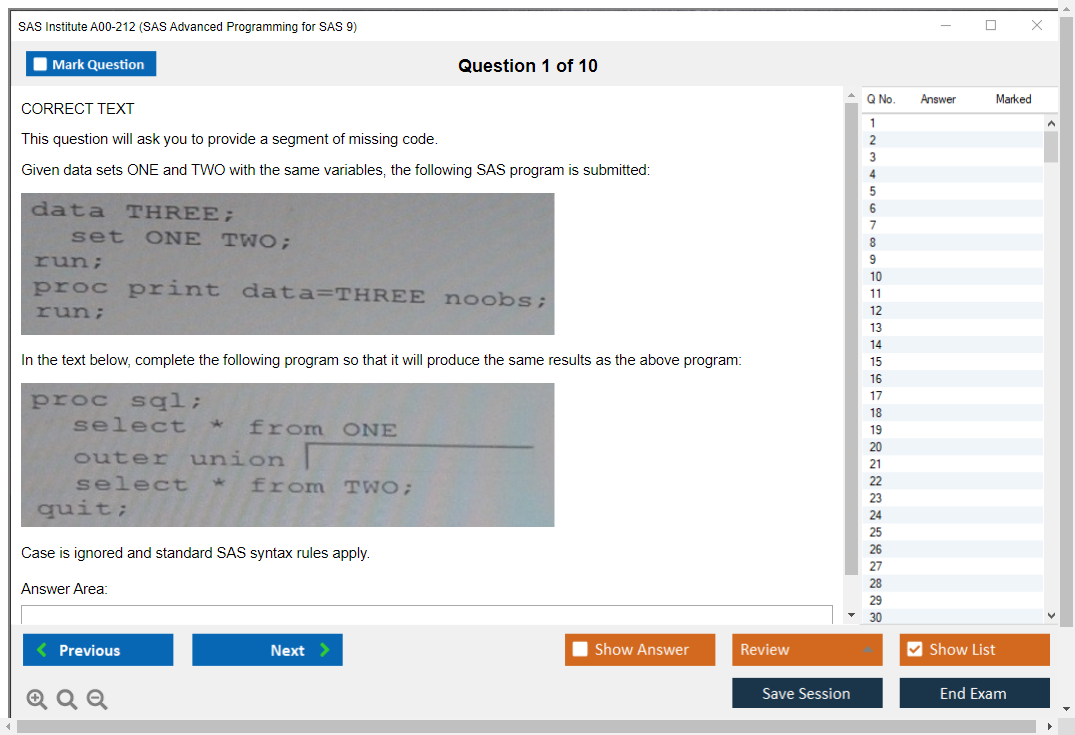
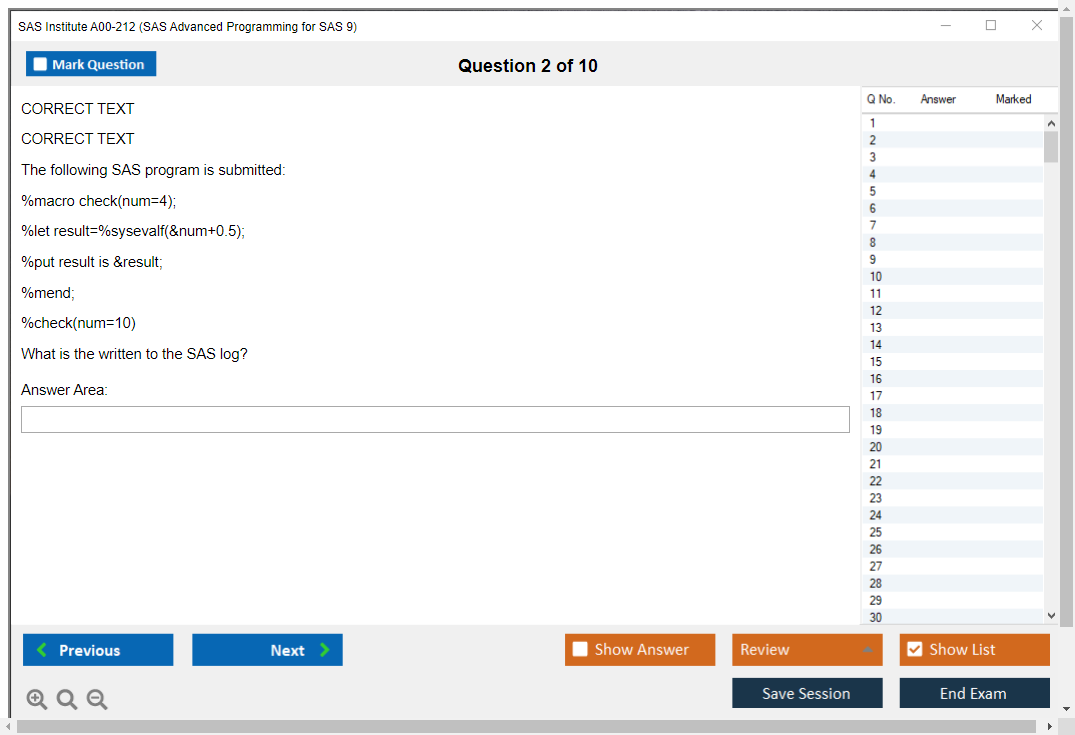
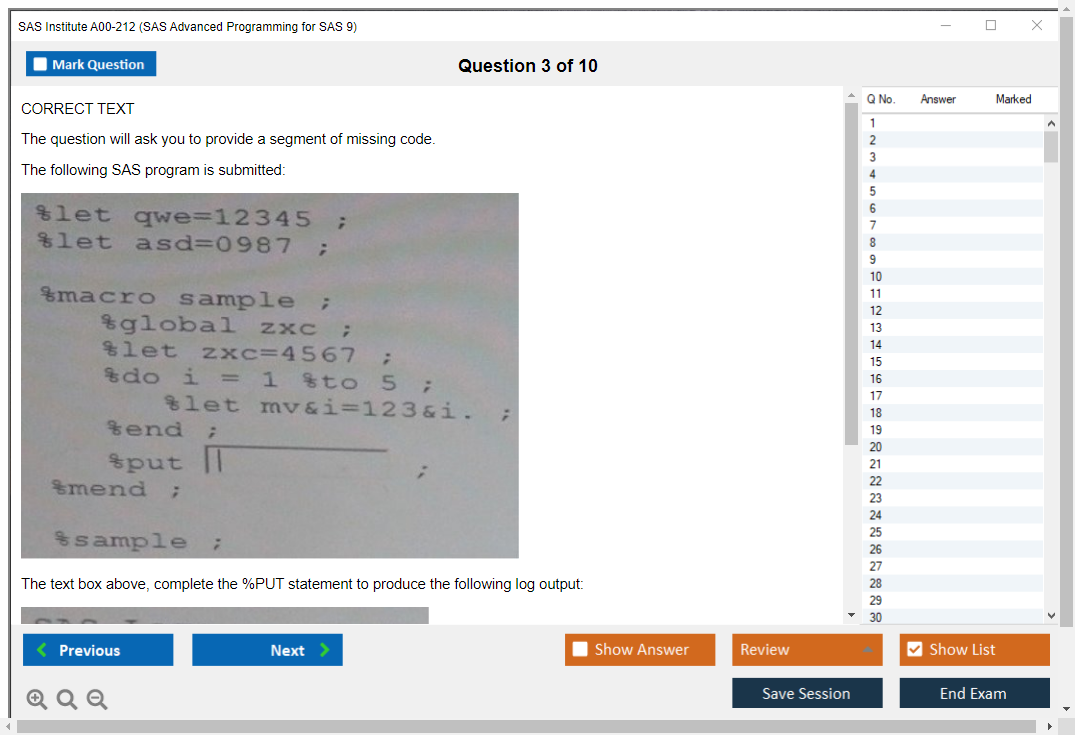
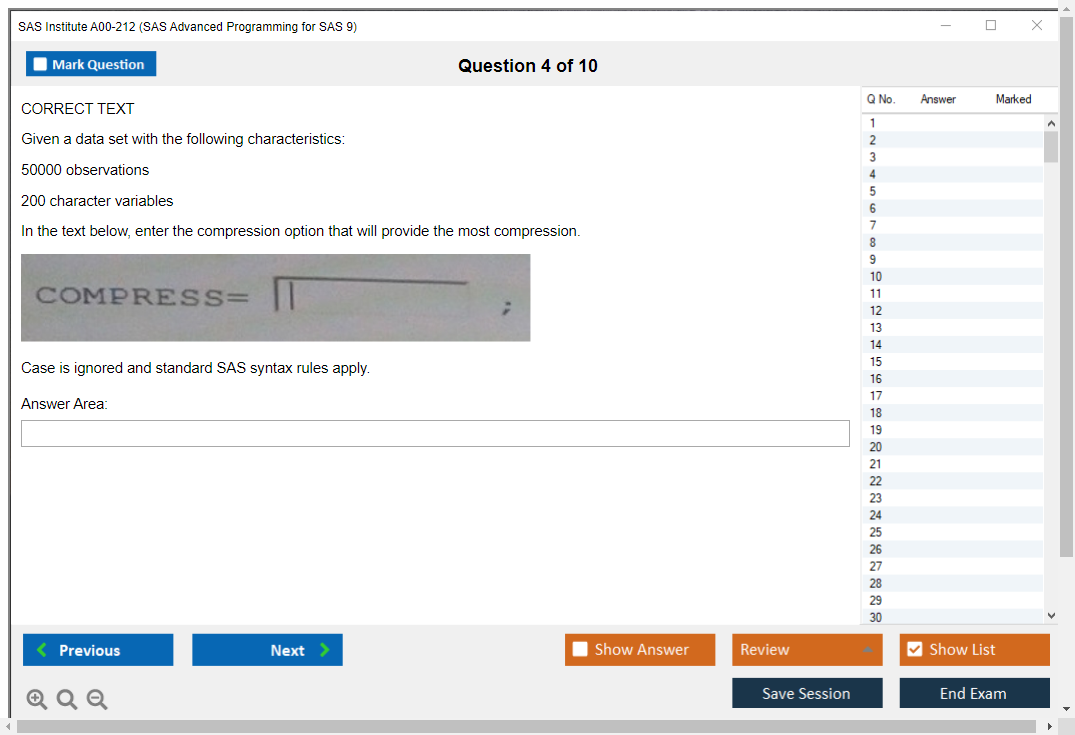
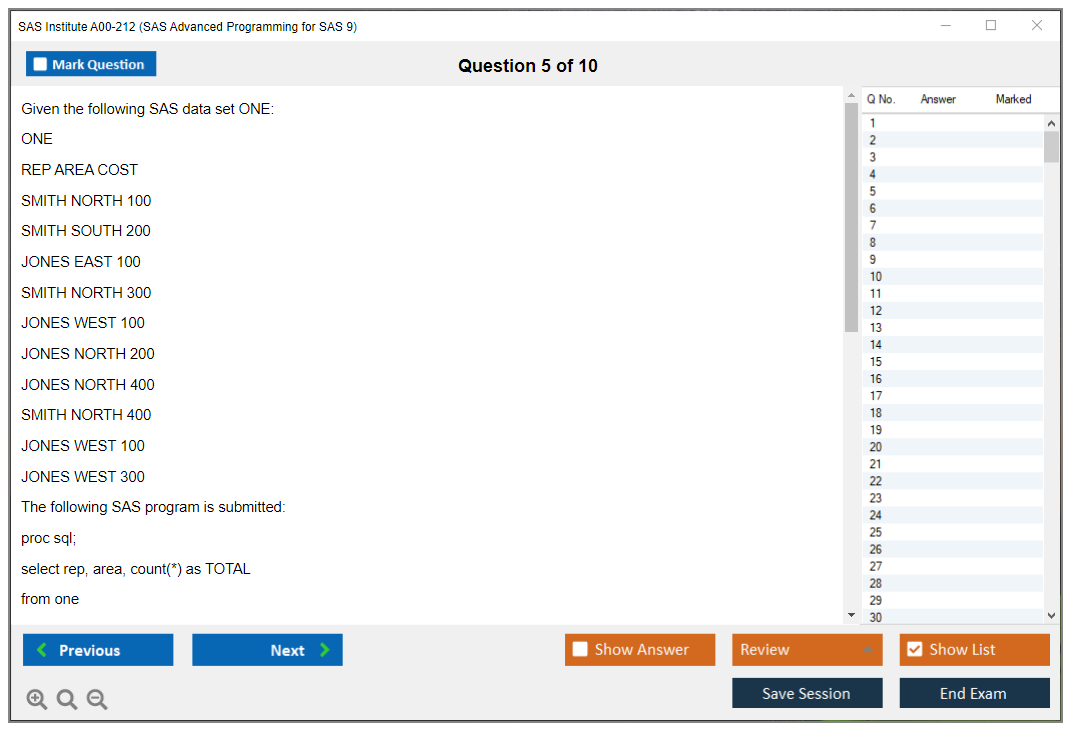
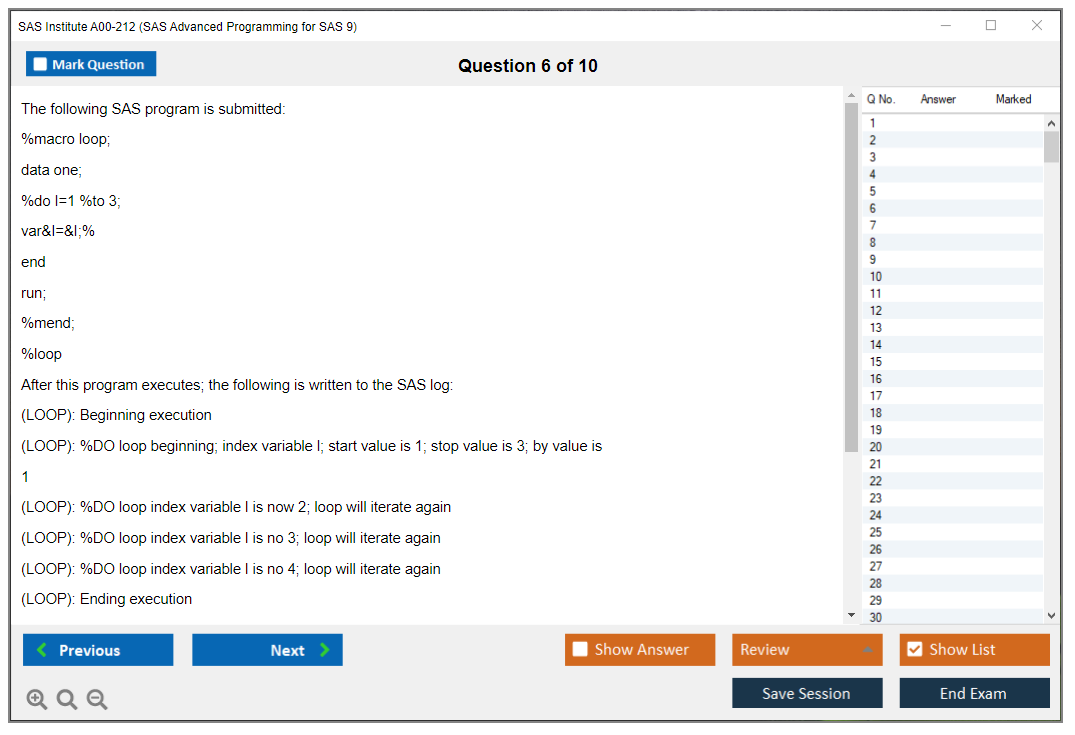
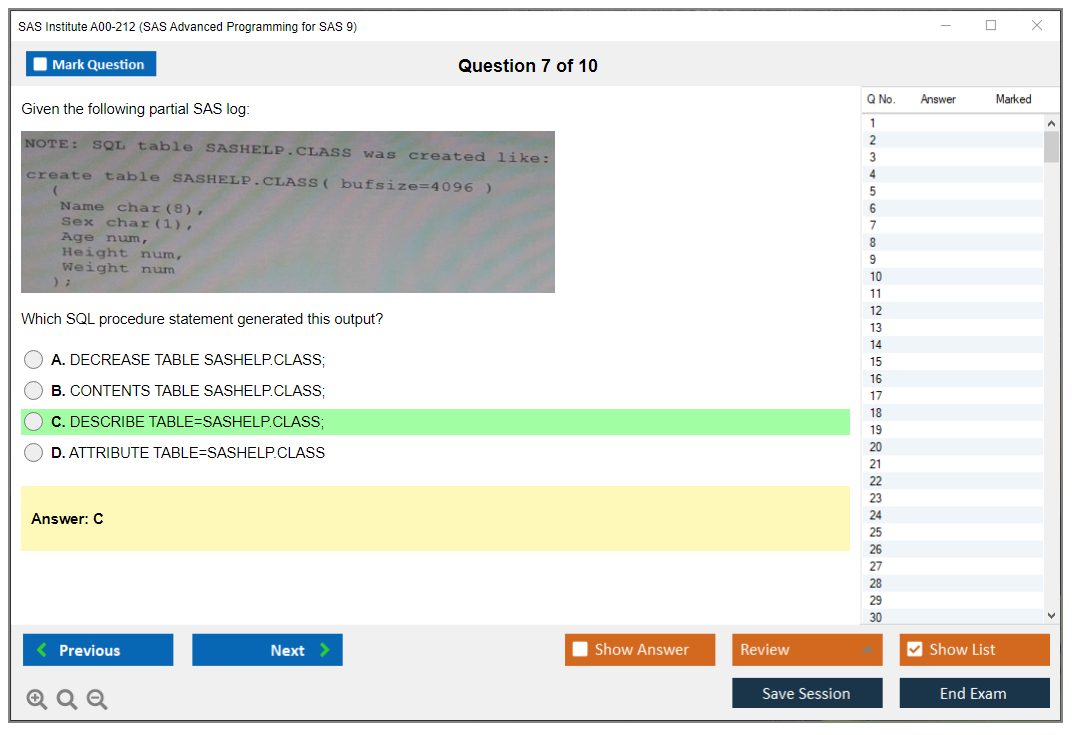
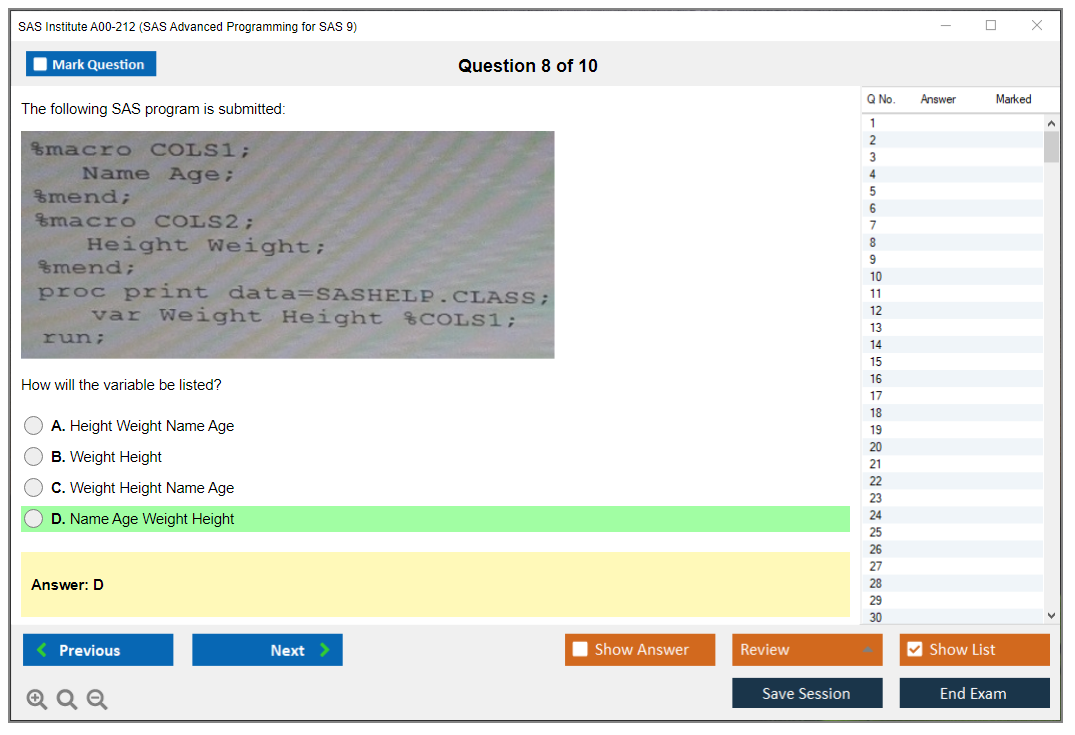
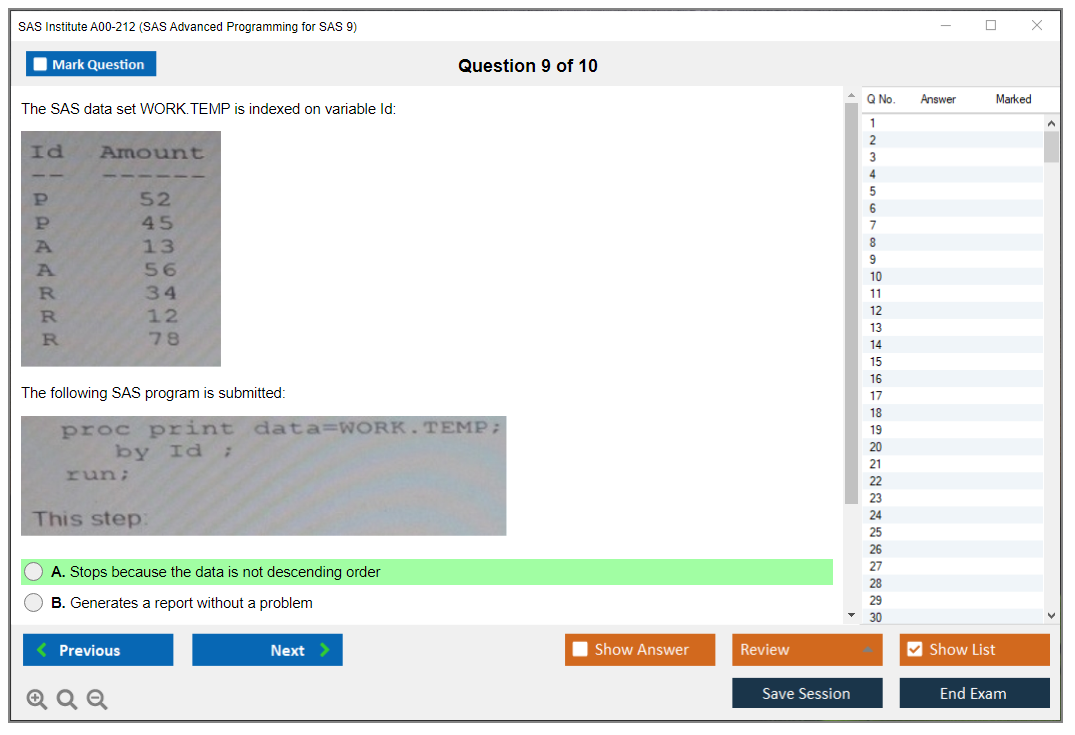
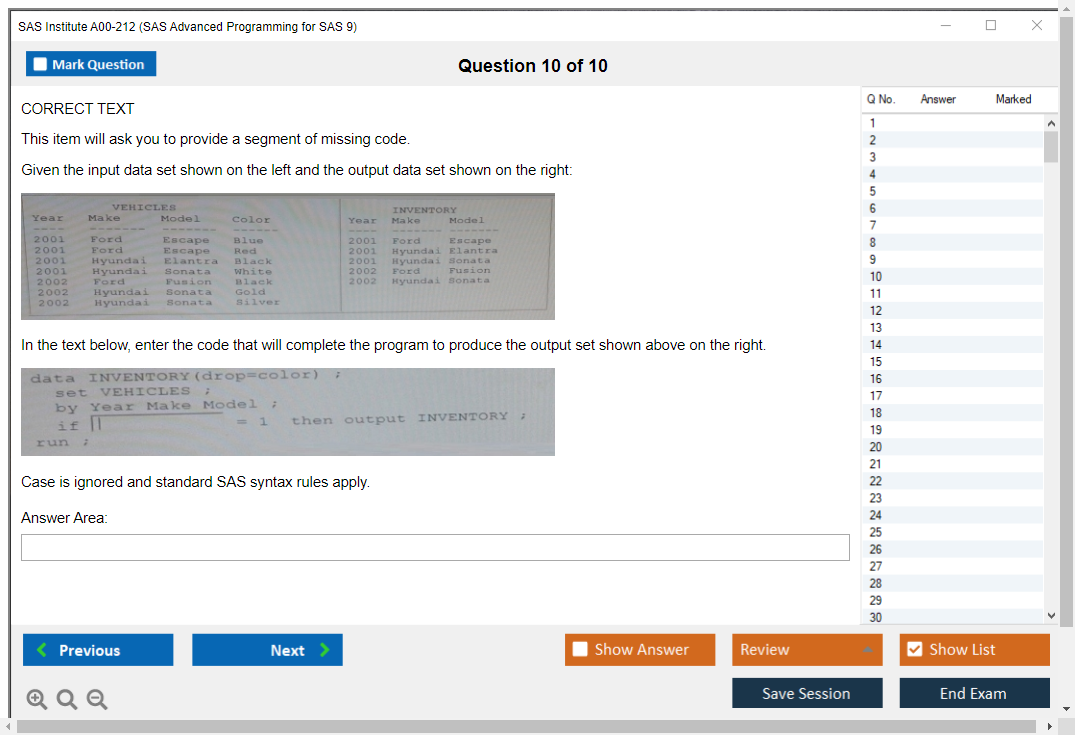
SAS Institute A00-212 (SAS Advanced Programming for SAS 9) Overview
The SAS A00-212 exam represents one of those certifications that actually means something in the data world. Anyone can claim SAS skills. But this credential? It proves you can handle the complex stuff, the kind of code that keeps production systems running smoothly and processes massive datasets without crashing servers or taking forever to execute.
What separates advanced programmers from everyone else
Look, the SAS Advanced Programming for SAS 9 certification is not about writing simple DATA steps or basic PROC FREQ statements. This exam validates you understand sophisticated programming techniques that most people never bother learning. We are talking hash objects, macro language development, advanced SQL optimization, and the kind of efficiency tricks that make the difference between code that runs in 10 minutes versus 10 hours. Organizations dealing with clinical trials data, financial reporting, or large-scale research projects need programmers who can architect solutions, not just copy-paste examples from documentation.
The credential demonstrates mastery over production-level SAS code development. When you are certified, employers know you can write maintainable code that other programmers can actually understand six months later. You understand when to use DATA step versus PROC SQL. You know why hash objects outperform traditional merges in certain scenarios and how to debug macro code that has gone sideways. Honestly, these skills separate senior programmers from folks still figuring out basic syntax.
Who actually needs this certification
Target roles include SAS programmers III/IV, lead programmers, statistical programming managers, and analytics architects. Clinical SAS programmers creating CDISC-compliant datasets absolutely need these skills. Financial analysts building automated reporting systems rely on macro programming and PROC SQL mastery covered in this exam. Research programmers processing complex survey data use array processing and BY-group techniques tested extensively.
Most candidates have 2-5 years hands-on SAS experience before attempting A00-212. You should be comfortable with production environments and large-scale data processing challenges. This is not your first rodeo with SAS. You have probably already passed the SAS Base Programming credential and worked through real-world problems that made you realize basic programming knowledge was not enough.
The exam appeals to consultants who need credible credentials when proposing SAS-based solutions to clients, professionals transitioning from other programming languages who need validated SAS expertise, and anyone working in healthcare, finance, pharmaceuticals, or research sectors where advanced analytics matter. Not gonna lie, if you are stuck doing simple reports and never touch macros or complex data manipulation, you might not need this yet.
Core competencies the exam validates
A00-212 exam objectives cover six primary domains that will test everything you think you know about SAS.
Advanced DATA step programming focuses on efficiency and complex logic. Understanding the Program Data Vector, compilation versus execution phases, and optimization strategies. You need to know how the DATA step actually works internally, not just memorize syntax.
PROC SQL mastery goes way beyond basic joins. The exam tests advanced joins, correlated subqueries, set operations, and when SQL outperforms DATA step approaches (or vice versa). I have seen programmers who rely exclusively on one method when the other would be dramatically faster. They don't even realize the performance hit they are causing. This certification proves you understand the tradeoffs.
Macro language development covers writing parameterized programs, debugging macro code, and understanding when macros actually help versus when they just complicate things unnecessarily. Hash objects get significant coverage because they are powerful but underutilized. Most programmers stick with traditional merges even when hash tables would be 10x faster. I once spent a whole afternoon convincing a colleague to try hash objects for a particularly gnarly merge problem, and honestly, watching the runtime drop from 45 minutes to under 3 was pretty satisfying.
Array processing happens everywhere. BY-group processing techniques and ODS output control round out the technical domains. Performance tuning appears throughout because writing code that technically works but takes eight hours to run does not cut it in production environments. The exam forces you to think about system resources, execution time, and code maintainability simultaneously.
What makes this exam challenging
The exam tests practical application rather than theoretical knowledge. You will face scenarios requiring you to select the optimal approach from multiple valid solutions. Sometimes three different techniques could solve a problem, but one runs in 30 seconds while another takes 20 minutes. The exam expects you to recognize these distinctions.
Candidates typically struggle with macro debugging, understanding when to apply specific advanced techniques, and optimizing code they did not write. The exam includes questions about interpreting SAS logs effectively. Troubleshooting complex code issues. Implementing defensive programming practices. You cannot just memorize syntax. You need to understand why code behaves certain ways and how to fix it when things break.
Most people underestimate the depth of PROC SQL knowledge required. Basic joins will not cut it. You need to understand correlated subqueries, inline views, remerging summary statistics, and SQL optimization techniques specific to SAS implementations.
How this fits into the certification ecosystem
This credential complements the base SAS programming credentials by proving advanced technical capabilities essential for senior-level positions. Many professionals pursue specialized certifications afterward, like Clinical Trials Programming or platform administration tracks depending on their career direction.
The exam focuses exclusively on SAS 9 platform capabilities, though many concepts transfer to newer SAS versions including Viya and SAS Studio. Look, the fundamentals of efficient programming do not change just because the interface does. Hash objects work similarly, macro programming principles remain constant, and optimization strategies apply across platforms. Some organizations still run SAS 9 in production anyway, so the certification remains highly relevant.
Career impact and practical value
Certified professionals typically command higher salaries and advancement opportunities compared to non-certified peers with equivalent experience.
Real talk? The credential provides advantages in job markets requiring demonstrated expertise beyond self-reported skills. Hiring managers recognize the rigorous examination standards and know certified candidates possess production-ready skills.
Organizations value this certification for validating skills in regulatory reporting, financial analytics, and operational intelligence applications. Clinical research organizations specifically seek programmers with advanced SAS skills for FDA submissions and complex trial analyses. Financial institutions need programmers who can process massive transaction datasets efficiently and produce automated regulatory reports.
The certification preparation process itself develops deeper understanding of SAS internals, execution phases, and compilation processes that improve everyday programming effectiveness. Even if you do not pass immediately, studying for A00-212 makes you a better programmer. You start thinking about code efficiency automatically, recognizing optimization opportunities, and writing cleaner, more maintainable programs.
Professionals use certification as foundation for specialized credentials in business intelligence, advanced analytics, or data integration development. The systematic problem-solving approach developed through exam preparation improves both speed and code quality in daily work. You will troubleshoot issues faster, write better documentation, and mentor junior programmers more effectively because you understand the underlying principles, not just surface-level syntax.
A00-212 Exam Details
What the certification proves
The SAS A00-212 exam is basically SAS saying, "cool, you can write SAS code, but can you write the kind of SAS code that doesn't melt down at scale, doesn't lie to you in the log, and doesn't take six hours when it could take six minutes." It maps to the SAS Advanced Programming for SAS 9 certification, which is the one people bring up when they're past the "I can do a PROC MEANS" stage and into "I can refactor this pipeline and explain why the PDV is behaving like that."
This cert's about judgment. Trade-offs. Speed versus readability. SQL versus DATA step. Index versus hash. Stuff you only learn after you've broken a few production jobs and had to explain yourself.
Who should take it
Advanced SAS programmers, sure. But more to the point, folks doing analytics engineering in SAS-heavy shops, ETL developers, clinical programmers who live in SDTM/ADaM land, and anyone who gets handed messy data and told "make it match that spec by 8am."
Not for beginners. Not even for "confident" beginners. If macro quoting still scares you, or you haven't spent quality time interpreting a log at 2am, you're gonna feel it.
How the exam is delivered
Core logistics first.
The SAS A00-212 exam is 60 questions total, a mix of multiple-choice and short-answer, and it's delivered through Pearson VUE. You sit it at a Pearson VUE testing center worldwide. In some regions you can do online proctoring, but that depends on where you live and what Pearson VUE's offering at the moment.
Two hours. 120 minutes. Do the math and you get about 2 minutes per question, which sounds fine until you hit one of those "here's a code fragment, here's the input data, what's the output and why" items. Then you realize you're mentally executing a DATA step with merges, BY groups, and retained variables with no editor. No notes. No SAS docs. No cheating with a second screen. Just you and your brain.
You can flag questions for review, which matters a lot because some items are quick wins and others are time sinks. The testing software gives a basic calculator, but the hard part isn't arithmetic. It's reading carefully.
What the questions feel like
Expect real-world scenarios.
You'll see business requirements and have to pick the best implementation approach, not just any approach that technically works. That means the exam tests efficiency and practicality, not memorizing syntax.
Some questions are "spot the bug" with log interpretation. Others are "predict what happens" based on compilation versus execution behavior, PDV contents, when variables are created, when they're set to missing, and how implicit output works. You'll also get performance-based judgment calls, like when DATA step hash objects beat an indexed lookup, or when SQL pass-through makes sense.
Randomized item banks are in play, so your exact set of questions won't match your coworker's. Same objectives, different combinations. There's no penalty for wrong answers, so leaving blanks is just donating points to the void. Guess if you have to.
Cost details you should know
The A00-212 exam cost is $180 USD globally, with small variations depending on currency conversion and local taxes. Payment goes through the SAS certification portal during registration, usually credit cards, and sometimes regional payment methods depending on where you are.
Fees are non-refundable. That part's annoying, but typical. Rescheduling's allowed up to 24 hours before your appointment through Pearson VUE, which is your safety valve when life happens, or when you realize you booked it the morning after a release weekend. Been there.
Passing score and scoring model
The A00-212 passing score is 68%. With 60 questions, that means you need at least 41 correct to pass. SAS uses criterion-referenced scoring, meaning you're measured against a fixed standard, not curved against other test-takers.
You get an immediate preliminary pass/fail at the end. The official score report shows up in the SAS certification portal within 24 hours. It includes a breakdown by objective domain, which is actually helpful if you fail because it points to what to fix instead of just saying "no."
Retakes require a 14-day wait. No limit on total attempts, but every attempt's a full payment again, so your "How to pass SAS A00-212" plan should include not winging it.
Why people say it's hard
Difficulty's rated advanced for a reason. It assumes you have a solid base SAS foundation plus hands-on time with more complex patterns. Not just reading about them. Using them. Debugging them.
Time pressure's real. Multi-step problems are common. And the exam loves questions where multiple answers could work, but only one's the most efficient or the cleanest given the scenario. That's the point. Syntax correctness is table stakes, but practical judgment's what gets tested.
You'll need comfort with reading complex nested logic, macro code, and advanced SQL without running it. If you depend on trial-and-error in the editor, look, this exam will expose that.
What you'll be tested on
The A00-212 exam objectives are spread across six domains, and the breadth's part of the pain. You can't just be "the macro person" and ignore SQL, because the exam won't let you.
Advanced DATA step programming shows up everywhere. PDV behavior, compilation versus execution, RETAIN, FIRST./LAST. processing, arrays, BY-group logic. Those little gotchas where one SET statement placement changes everything. I mean, half of "advanced SAS" is knowing what SAS is doing when you're not looking.
PROC SQL gets tested beyond basic joins. Think PROC SQL advanced joins and subqueries, correlated subqueries, set operators, summary queries. Knowing when SQL's the right tool versus when it's just the tool you personally like. Sometimes SQL's elegant. Sometimes it's slower and harder to debug. The exam wants you to see that.
Macro language is a big chunk too, including SAS macro language and macro debugging. Parameterization, macro variable scope, quoting functions, and reading macro-generated code in the log. Fragments. Traps. You need to be able to reason about what resolves when.
The rest you'll see, more casually but still enough to matter. ODS output and reporting, performance tuning, indexes, hash lookups, pass-through SQL, and troubleshooting techniques. SAS performance tuning and optimization isn't optional here, because the exam keeps asking "which approach is optimal," not "which approach is acceptable."
Actually, speaking of optimization, I once saw someone write a hash lookup inside a DO loop that ran a million iterations when they could have just done a simple merge. Took their job from three minutes to forty. That's the kind of thing you learn to spot fast after production goes sideways a few times.
Recommended background before you schedule it
If you haven't already, you should be comfortable with Base SAS programming like it's muscle memory. That includes reading logs fast, knowing common notes and warnings, and understanding how DATA step iterations work without needing to run it.
Hands-on checklist time.
You should be able to write and debug macro code with conditional logic and quoting, because the exam likes giving you almost-correct macros and asking what breaks. That's exactly what real jobs feel like. You should be able to choose between indexes, hash objects, and merges, since performance questions are where people lose points quickly. You should be able to do complex SQL joins and subqueries without getting confused by duplicate rows and missing matches.
Other stuff you should at least recognize: ODS destinations, PROC REPORT quirks, pass-through basics, and reading execution timing or resource hints from logs.
Study materials that actually help
An A00-212 study guide that mirrors the objective domains is your anchor. Don't pick one that's just a random SAS trivia dump. You want topic coverage aligned to the exam, with code-based examples.
For SAS 9 advanced programming training, official SAS courses can be worth it if you learn best in a structured format and you want curated labs. The best value's when you do the exercises seriously, not when you just watch videos at 1.5x speed and tell yourself you "covered" it.
Docs matter too. SAS documentation can be dry, but for edge cases, it's gold. Focus on DATA step processing, macro quoting, PROC SQL reference, and performance notes around indexes and hash usage.
Practice tests and prep strategy
A SAS Advanced Programming practice test is useful if it looks like the exam. Scenario-heavy. Code-heavy. Explanations that talk about why one answer's better, not just why it's correct. If a question bank's all short definition questions, it's not training you for the actual pain.
My favorite prep approach is lab-based. Build small projects that force the patterns. Take a medium dataset, write two solutions, one with PROC SQL and one with DATA step plus hash, then compare runtime and log output. Explain to yourself which you'd ship and why, because that's the exam's personality.
Common pitfalls: rushing, misreading BY-group assumptions, forgetting that compilation happens before execution. Burning ten minutes on one monster question when you could grab five easy points elsewhere. Flag it, move on, come back.
Renewal and staying current
SAS certification policies can change, so check the SAS portal for current renewal or maintenance rules for this credential. Some SAS certs have versioning expectations, and some don't require frequent renewals, but don't assume anything based on what a coworker did three years ago.
Skill-wise, even if your shop's moving toward Viya, SAS 9's still everywhere, particularly in regulated industries. Keep your fundamentals sharp. The concepts transfer.
Quick FAQ answers
How much does the SAS A00-212 exam cost?
The A00-212 exam cost is $180 USD, with possible small regional differences due to taxes and currency conversion.
What is the passing score for A00-212?
The A00-212 passing score is 68%, which is at least 41 correct answers out of 60.
Is SAS Advanced Programming (A00-212) hard?
Yes. Advanced level, time pressure, and lots of "pick the best approach" questions where two options work but one's faster or cleaner.
What are the objectives for the SAS A00-212 exam?
Six domains covering advanced DATA step work, advanced SQL, macro programming and debugging, advanced techniques like hash and index strategies, ODS and output control, and performance tuning plus troubleshooting.
What study materials and practice tests are best for A00-212?
Use an objective-aligned A00-212 study guide, official SAS 9 advanced programming training if you want structure, SAS docs for edge cases, and a SAS Advanced Programming practice test that's scenario-based with real explanations.
A00-212 Exam Objectives (What You'll Be Tested On)
The weighted domain breakdown that shapes your study priorities
The A00-212 exam objectives split into six weighted domains reflecting relative importance and question distribution across topics. Here's the thing: this isn't some random question collection. SAS literally tells you where to focus energy. Advanced DATA step programming grabs about 25%, making it the heaviest single area. If you're weak on DATA step efficiency techniques, honestly, you're already behind.
PROC SQL sits at roughly 20%. Same with macro language.
Those three domains alone? That's 65% of your exam right there. Not gonna lie, candidates who spread their study time evenly across all domains are making a tactical error. It's like studying vocabulary when grammar counts triple. Hit the big three hard, then fill in the gaps with advanced techniques (15%), ODS stuff (10%), and performance tuning (10%).
Advanced DATA step programming and what actually gets tested
This domain makes up approximately 25% of exam content, representing the largest single topic area. The exam tests efficiency techniques including WHERE versus IF statements, subsetting IF, OUTPUT statement control, and explicit versus implicit OUTPUT. These seem basic until you see the scenario questions that make you choose the most efficient approach from four working solutions. All of which technically function.
Candidates must understand PDV (Program Data Vector) behavior, variable attributes, and how SAS processes observations during compilation and execution phases.
Short version: know what happens when.
The PDV stuff trips people up constantly. I mean, you really need to visualize how SAS builds that temporary structure. When variables get initialized, what happens with retained values, how the whole compilation-execution dance actually works. Questions cover complex conditional logic using SELECT/WHEN, DO loops (iterative, conditional, and DO UNTIL/WHILE), plus nested logic structures. I've seen exam scenarios with three-level nested DO loops where you need to predict the exact number of iterations and final variable values without running a single line of code.
The exam tests array processing for repetitive operations. Multi-dimensional arrays, temporary arrays, array-based transformations. Arrays aren't optional knowledge here. You'll get multiple questions requiring array solutions. Temporary arrays for lookups, multi-dimensional arrays for matrix operations, that kind of thing.
BY-group processing represents critical content, including FIRST. and LAST. variables, retaining values across observations, calculating group statistics. Real talk: if you can't mentally trace through FIRST.variable and LAST.variable logic without running code, you're not ready. Advanced DATA step topics include look-ahead and look-behind techniques, lag and dif functions, maintaining running totals across observations. The lag function questions are particularly nasty because lag behavior depends on execution, not observation reading. Wait, let me clarify: it's about when the function executes, not when SAS reads the row.
My old manager used to joke that lag functions were invented just to mess with certification candidates. Half joking, probably.
PROC SQL advanced joins and subqueries domain
PROC SQL advanced joins and subqueries constitute approximately 20% of exam content, testing sophisticated data manipulation and query optimization.
Candidates must demonstrate mastery of all join types: inner, left, right, full, cross. And understand when each provides optimal solutions. It's not enough to know syntax. You need to predict result set row counts and identify which join type produces specific outputs.
The exam covers complex WHERE clause conditions, HAVING versus WHERE differences, subquery implementation in SELECT, FROM, and WHERE clauses. HAVING versus WHERE still confuses people who should honestly know better at this level. WHERE filters before grouping, HAVING filters after. Simple concept, but the exam buries it in complex scenarios. Questions test correlated subqueries, inline views, multi-level nesting for complex data extraction requirements that mirror real-world business problems.
Correlated subqueries are exam favorites because they combine multiple concepts into one question. You might see a question where a subquery references the outer query's table, and you need to determine if it'll execute once or once per row. SQL-specific functions, CASE logic, CALCULATED keyword usage appear in exam scenarios requiring data transformation during queries.
The exam tests understanding of SQL procedure advantages over DATA step approaches for specific operations like set operations (UNION, INTERSECT, EXCEPT). Candidates must recognize when PROC SQL provides efficiency benefits versus situations where DATA step processing proves more appropriate. Sometimes DATA step is faster. Sometimes SQL is cleaner. You need judgment, not just knowledge.
SAS macro language and macro debugging coverage
SAS macro language and macro debugging represents approximately 20% of exam content, testing automation and code generation capabilities.
The exam covers macro variable creation using %LET, CALL SYMPUT/SYMPUTX, INTO clause in PROC SQL. Three different creation methods means three different timing scenarios for when values become available. And the exam will absolutely test whether you understand those distinctions.
Questions test macro variable resolution timing, scope (global versus local), quoting functions (%STR, %NRSTR, %QUOTE, %BQUOTE). Macro quoting is where good programmers stumble. I mean, when do you need %STR versus %NRSTR? What happens if you don't quote a comma in a macro parameter? These details matter way more than people expect.
Macro program development including %MACRO/%MEND definition, parameter passing (positional and keyword), default values appears extensively. The exam tests conditional macro logic using %IF-%THEN-%ELSE, macro DO loops, iterative macro processing. You'll write no code during the exam, but you'll read plenty of macro code and predict what it generates.
Debugging techniques including MPRINT, MLOGIC, SYMBOLGEN options and interpretation of macro execution messages represent testable content. Recognizing MPRINT output versus MLOGIC output might seem trivial, but exam questions show you log excerpts and ask what's happening. Candidates must understand macro compilation versus execution, macro variable referencing with ampersands, indirect referencing techniques.
Questions cover autocall macro libraries, stored compiled macros, macro catalog management for production environments.
The production environment stuff gets overlooked in study plans, but it shows up on the exam.
Advanced techniques that separate casual from serious programmers
Advanced techniques domain comprises approximately 15% of exam content, focusing on specialized programming methods. DATA step hash objects receive significant emphasis, testing hash table creation, loading, searching, merging operations. Hash objects are the exam's way of identifying who's actually done advanced work versus who memorized Base Programming concepts and hoped for the best.
The exam covers hash object methods (FIND, CHECK, ADD, REPLACE, REMOVE) and hash iterator objects for table traversal. Questions test understanding when hash objects provide performance advantages over traditional DATA step merges, particularly with lookup tables. If you've got a 50-row transaction table and a 10-million-row lookup table, hash objects are your friend. Honestly, the exam will test whether you know why, not just that you've heard they're useful.
Array processing beyond basics includes dynamic array sizing, temporary versus retained arrays, multi-dimensional array applications.
The exam tests index creation, maintenance, appropriate usage scenarios for improving data access performance. Combining datasets using various techniques (SET, MERGE, UPDATE, MODIFY) and understanding performance implications appears in exam questions. UPDATE versus MODIFY still confuses people because both modify data, but their mechanisms differ completely.
ODS output and reporting essentials
ODS output and reporting represents approximately 10% of exam content, testing output control and customization. Candidates must understand ODS destinations (HTML, PDF, RTF, EXCEL), style templates, output object selection. The exam covers ODS TRACE for identifying output objects, ODS OUTPUT for capturing procedure results as datasets, ODS EXCLUDE/SELECT statements.
Questions test understanding of ODS Graphics integration, statistical graphics customization, template modification basics.
ODS gets less study attention than it deserves because it's only 10%, but those questions are straightforward if you've practiced. Skip this domain and you're throwing away easy points.
SAS performance tuning and optimization domain
SAS performance tuning and optimization comprises approximately 10% of exam content, testing efficiency analysis and improvement techniques. The exam covers benchmarking approaches, FULLSTIMER option interpretation, identifying performance bottlenecks through log analysis. Questions test understanding of data access methods (sequential versus indexed), appropriate index usage, when indexes improve versus degrade performance.
Candidates must recognize efficiency differences between WHERE processing, subsetting IF, DELETE statements. WHERE processes before data enters the PDV, subsetting IF processes after. That difference matters for performance, especially with massive datasets. The exam tests understanding of buffer size optimization, compression techniques, appropriate data storage formats.
SQL pass-through facility usage for database-specific optimization appears in questions involving external database access. Questions cover parallel processing concepts, threading options, multi-processor utilization for large-scale data operations. The exam tests understanding of data step views versus physical datasets and appropriate usage scenarios for each.
Candidates must recognize memory management implications of different coding approaches and select techniques minimizing resource consumption. All domains include troubleshooting scenarios requiring log interpretation, error identification, debugging strategy selection. The exam emphasizes selecting optimal solutions from multiple functional approaches based on efficiency, maintainability, scalability criteria. Not just "does it work?" but "is this the best way?"
For practice with realistic exam scenarios across all six domains, the A00-212 Practice Exam Questions Pack gives you $36.99 worth of focused preparation. If you're also considering platform administration, check out A00-250 for SAS 9 admin skills or A00-251 for Viya administration. And look, if you haven't passed A00-211 Base Programming yet, do that first. Advanced Programming assumes you've already mastered those fundamentals.
Prerequisites and Recommended Experience
No hard gate, but don't kid yourself
The SAS A00-212 exam is one of those certifications that technically lets anyone walk up and try it. The SAS Advanced Programming for SAS 9 certification has no formal prerequisites, and SAS Institute doesn't block you at registration if you're brand new. Cool, right? Also kind of dangerous, honestly.
Look, the exam assumes you've already lived in SAS for a while. Not "I watched a video series and copied the code," more like you've broken production jobs, fixed them, argued with the log, and learned why that one tiny length mismatch just wrecked your merge. That's the vibe.
Base programmer level knowledge is the real starting line
SAS strongly expects you to come in with the SAS Certified Base Programmer for SAS 9 credential, or at least the same knowledge in practice. Equivalent knowledge counts, but honestly you've gotta be brutally honest with yourself about what that means, because A00-212 won't wait for you to remember how implicit output works or what a SET statement actually does with PDV behavior.
Base certification level skill? Foundation for everything advanced. DATA step fundamentals. Basic procedures. How libraries work. How SAS reads data. How formats and informats change values. If you're still shaky on variable attributes like type, length, format, informat, label (and what those choices do to storage and joins later) you're gonna feel like the advanced questions are "trick questions" when they're really just consequences.
And yes, this is where people start googling A00-212 exam objectives and How to pass SAS A00-212 and then panic because they realize the objectives assume you already know the basics cold. That's normal. Also fixable, I mean it's just about putting in the work.
The experience level that actually matches the exam
SAS recommends real experience, and I agree with them here. A good minimum? Two to three years of hands-on SAS programming in production or serious analytical environments, with regular coding responsibilities. Not occasional. Not "I run the same PROC REPORT once a month." I mean daily or weekly work where your output gets used by somebody else and mistakes actually matter.
You should've written hundreds of SAS programs that respond to real business requirements. Not just tutorial exercises, not just classroom labs where the data's clean and the question's politely designed so one PROC solves it. Real work has messy requirements, half-known definitions, late changes, and data that fails validation in creative ways you couldn't even imagine existed.
This matters because SAS Advanced Programming for SAS 9 certification questions often test judgment. Which technique's appropriate. Which approach is faster. What breaks when you change the order of statements. You only build that instinct after you've shipped code and had to maintain it six months later with zero memory of what you were thinking, which happens to all of us eventually. Honestly the thing is, I once spent two hours debugging my own code from three months prior before I found the comment where past-me had warned future-me about exactly the mistake I'd just made. So yeah, documentation matters.
Big data volumes and performance thinking
If you've only worked with tiny toy datasets, the performance questions feel abstract. When you've run jobs on tens of millions of rows and watched them crawl, you start caring about reads, sorts, indexes, memory use, and whether your SQL's forcing multiple passes. Experience with large datasets, like millions of records, gives you the context to answer optimization questions without guessing.
SAS performance tuning and optimization isn't magic. It's boring, practical tradeoffs. Things like when a hash table's a win, when it blows memory, when a sort's unavoidable, when you can reduce I/O by keeping only needed variables, and which WHERE placement changes what gets processed. If you've never had to justify runtime or cost, you haven't had to learn those tradeoffs, and A00-212 absolutely expects you to recognize them.
Macro comfort helps, even if you're not a macro wizard
You don't need to be a macro language guru on day one, but prior exposure matters a lot. Basic macro variable usage, simple macro programs, parameter passing, and knowing the difference between compile time and run time'll save you. The macro language domain's where a lot of smart programmers suddenly feel dumb, because they can write clean DATA steps but they don't understand why their macro variable resolves weirdly inside quotes.
SAS macro language and macro debugging's also about reading the log and knowing what to turn on. MPRINT. SYMBOLGEN. MLOGIC. Stuff you only learn after fighting with it, which includes those nights where you stare at the screen wondering if you've fundamentally misunderstood computing. If your macro experience is basically "I used &SYSDATE once," spend time here before you lean on an A00-212 study guide or a SAS Advanced Programming practice test and hope for the best.
PROC SQL needs to be more than "SELECT *"
A00-212 expects comfort with PROC SQL beyond basic queries. Joins. Subqueries. Set operations. Knowing how SAS SQL behaves compared to database SQL. Being able to read SQL that somebody else wrote and spot why it duplicates rows or filters too late.
PROC SQL advanced joins and subqueries show up because that's where real SAS shops live. People join claims to members, labs to visits, trades to accounts, and they do it under deadlines. If you've never had to choose between a DATA step merge, PROC SQL join, or a hash object approach, the exam questions'll feel like philosophy instead of engineering.
Read other people's code, not just your own
This is underrated. Candidates should be comfortable reading and interpreting complex SAS code written by others, including nested logic and unfamiliar techniques. Because on the exam, you're often given code and asked what it does, what it outputs, or what's wrong with it. That's not about syntax memorization. That's about comprehension under pressure.
Fragments in logs. Weird DO blocks. BY-group processing with FIRST./LAST. arrays that re-map variables. DATA step hash objects. If you only ever write your own "style" of SAS, you get brittle fast.
Logs, errors, and debugging are part of the skill, period
You should be fluent in the SAS log. Notes, warnings, errors, and what they imply. Candidates who ignore notes get wrecked in real life and they also get wrecked on this exam. If you can't quickly interpret "numeric values have been converted to character values" or "MERGE statement has more than one data set with repeats of BY values," you're gonna lose time.
Experience with debugging tools and systematic troubleshooting approaches helps a lot. Not random tinkering. More like isolating the step, shrinking the data, reproducing the issue, then verifying assumptions about attributes and sort order. Attention to detail's huge here, because A00-212 likes subtle syntax differences and logic errors that look harmless until you think through execution.
Environment and architecture knowledge that sneaks into questions
Technical prerequisites aren't just "can you code." You should understand SAS system architecture basics, libraries, and data access methods across storage formats. Flat files. SAS datasets. Databases. Excel extracts, maybe even odd vendor dumps. If you've worked across Windows and Unix/Linux, even better, because platform-specific differences show up in file paths, encoding, line endings, and how jobs run in batch.
Also useful? SAS system options that affect execution, output, and performance. ODS output and reporting. Resource usage. Memory concepts. None of this is theoretical when you're running production schedules and you've gotta explain why a job went from 4 minutes to 40.
Professional habits that make you "advanced" faster
Production code standards matter. Documentation. Naming conventions. Avoiding reserved keywords. Writing maintainable code that somebody else can support. Version control and migration processes help too, even if your shop's imperfect about it, because it trains you to think about reproducibility and controlled changes.
Code review experience? Sneaky-good prep. Both getting feedback and giving it. You learn to explain why something's wrong, propose alternatives, and evaluate tradeoffs. That critical evaluation skill shows up in exam scenarios where multiple answers look plausible and only one's the best fit.
A quick hands-on checklist (and where practice packs fit)
If you're aiming for the SAS A00-212 exam, you should be comfortable doing most of this without hunting for examples every two minutes:
- Building and combining datasets with multiple techniques, knowing when each makes sense. DATA step merges, PROC SQL joins, hash joins, plus what happens when keys aren't unique.
- Working with biggish data and caring about efficiency. Recognizing when you're forcing sorts or extra passes.
- Macro basics, plus enough debugging skill to read a macro-heavy log without spiraling.
- Reading ugly code, explaining what it does.
Other stuff you should at least have seen: ODS output tricks, arrays and BY-group processing, data quality checks, basic database concepts beyond SAS.
If you want targeted drilling, a practice pack can help you find gaps fast, but it won't replace experience. I'd treat A00-212 Practice Exam Questions Pack like a pressure test after you've done real lab work, then circle back to weak areas with your notes and SAS docs, then hit A00-212 Practice Exam Questions Pack again to see if you actually improved.
And yeah, people ask about A00-212 exam cost and A00-212 passing score early, but your bigger issue's readiness. If you can't explain why one approach is faster or safer, the score math won't save you. Use your SAS 9 advanced programming training, your own projects, and a realistic question bank like A00-212 Practice Exam Questions Pack to measure whether you're thinking like an advanced programmer, not just coding like one.
Best Study Materials for SAS A00-212
Okay, real talk here. If you're prepping for the SAS A00-212 exam, you need to understand something right off the bat: this isn't your typical certification where you can just memorize some flashcards and call it a day. The SAS Advanced Programming for SAS 9 certification tests whether you can actually do advanced programming, not just recognize it in multiple choice. That's a completely different beast. You need to understand hash objects at a deep level, debug macros when they're throwing cryptic errors at 2 AM, and optimize SQL queries that are bringing production systems to a crawl. Real stuff.
The A00-212 exam cost runs around $180, though honestly that varies by region and sometimes SAS runs promotions. You'll need a passing score of 68% (which sounds manageable until you realize how detailed the questions get), and you're looking at 60 questions over 2 hours. That's tight. I mean, seriously tight when some questions make you analyze code that spans multiple pages.
Why this certification matters for your career
Look, this cert validates you can write efficient, production-quality SAS code. There's a massive difference between someone who can write a DATA step and someone who knows when to use a hash table versus a format versus restructuring the entire approach. Employers hiring for analytics roles, clinical trials programming, or financial modeling positions actually care about A00-212 because it proves you won't bring their servers to their knees with inefficient code.
If you've already knocked out the A00-211 (SAS Base Programming for SAS 9) certification, this is your logical next step. For folks in clinical trials specifically, you might eventually look at A00-280 (Clinical Trials Programming Using SAS 9), but honestly, get this advanced programming foundation first. Without solid advanced programming skills, you'll struggle with clinical trials work anyway. The thing is, clinical environments are unforgiving with code quality.
What the exam actually covers
The A00-212 exam objectives break down into some pretty specific domains, and they're not messing around. You've got advanced DATA step programming making up a chunk. Think array processing, BY-group operations, retaining values across iterations in ways that actually make sense performance-wise. Not just technically functional code that runs like molasses. Then there's PROC SQL, which accounts for about 20% of the exam. Not basic SQL. We're talking correlated subqueries, complex joins, set operators, the works.
Macro programming is huge. You need to understand macro variables versus macro programs, how to debug when things go sideways (and they will), and when macros actually improve your code versus just making it harder to maintain. Hash objects show up too. That's where a lot of people struggle because it's such a different approach from traditional DATA step processing.
ODS output and reporting gets tested, along with performance tuning concepts. The exam wants to know if you understand why one approach runs faster than another, not just that you can copy-paste code from documentation.
Official SAS training that actually helps
The Official SAS training curriculum is honestly where you should start, even though it's pricey. The "SAS Programming 3: Advanced Techniques and Efficiencies" course maps directly to exam objectives. It's not perfect. Some topics get glossed over. But it covers the core material comprehensively, walking you through efficiency comparisons, benchmarking techniques, and scenarios where different approaches make sense depending on data volume, server resources, and what you're actually trying to accomplish.
You'll also want the "Structured Query Language (SQL) Using SAS" course because PROC SQL questions can get tricky. Covers optimization brilliantly. The course dives into indexing strategies and the subtle differences between SQL logic and DATA step logic. I've seen people bomb the SQL section because they assumed their general SQL knowledge would transfer directly. It doesn't always, which honestly surprised me at first.
For macro programming, "SAS Macro Language 1: Essentials" gives you the foundation, though you'll probably need to supplement this with hands-on practice because the course moves fast. Macro debugging is something you learn by doing it wrong a hundred times. Or maybe two hundred, depending on how stubborn you are about reading error logs carefully.
SAS 9 advanced programming training comes in different delivery formats. Public classroom sessions run regularly in major cities. Virtual instructor-led options exist if you're remote. Some organizations arrange private on-site delivery for teams, which can be cost-effective if you've got multiple people certifying.
SAS documentation and what to prioritize
The official SAS documentation is massive and you could spend years reading it all. Who has that kind of time? Focus on the SAS macro language and macro debugging documentation first, specifically the sections on macro quoting functions, which trip people up constantly. The %STR, %NRSTR, %BQUOTE functions all have weird edge cases that show up on the exam.
For DATA step hash objects, read the SAS documentation examples but then build your own projects with them. Hash tables are powerful but conceptually different enough that reading alone doesn't cut it. You need to actually code lookup scenarios, multi-key hashes, and see where they perform better than merges.
The PROC SQL advanced joins and subqueries documentation includes performance considerations that directly relate to exam questions. Pay attention to when SAS optimizes certain join types and when it doesn't, because that knowledge separates people who pass from people who don't.
Third-party resources worth your time
Books help, though they date quickly, which is frustrating. The "Carpenter's Complete Guide to the SAS Macro Language" is old but still relevant for macro fundamentals. Ron Cody's books on SAS programming cover some advanced topics, though you'll need to pick selectively since not everything maps to exam objectives.
Online forums like SAS Communities and Stack Overflow have real-world problem-solving examples that are honestly invaluable. I've learned more about SAS performance tuning and optimization from reading how people debugged actual issues than from any single course. When you see someone explain why their million-row merge was running for hours and how they fixed it with a hash table, that sticks in your brain.
Some people swear by video courses on platforms like Udemy or LinkedIn Learning, but quality varies wildly. Look for instructors who've actually worked with enterprise SAS implementations, not just academic environments.
Practice tests and how to use them
The A00-212 Practice Exam Questions Pack at $36.99 gives you realistic question formats and helps you identify weak areas. Here's the thing: don't just take practice tests and review answers. When you get a question wrong, go code the scenario yourself. If there's a question about whether a certain macro approach works, fire up SAS and test it, break it, fix it again.
Quality SAS Advanced Programming practice test materials should include detailed explanations, not just correct answers. You want to understand why option B is right and why option C fails in specific edge cases.
Time yourself religiously. Two hours for 60 questions means you've got 2 minutes per question, but some questions require reading 30+ lines of code. You need to develop pattern recognition so you can quickly spot inefficiencies or errors without analyzing every single line.
Building a lab practice plan
Theory only gets you so far. You've gotta code. Set up practice scenarios that mirror exam domains. Build a dataset with a million rows and practice different merge techniques, timing each approach. Create macro programs that generate different outputs based on parameters, then deliberately break them and debug.
Work with ODS output and reporting by generating reports in multiple formats, understanding how ODS can capture procedure output as datasets (because that shows up on the exam).
Practice BY-group processing with complex scenarios. Nested BY groups, FIRST. and LAST. variables with multiple keys, that sort of thing. These concepts seem simple until you're debugging why your output has duplicate records.
What about other SAS certifications?
If you're in a platform admin role, you might eventually look at A00-250 (SAS Platform Administration for SAS9) or A00-251 (Administering SAS Viya 3.5). Different skill sets though. For programming specifically, A00-212 is the sweet spot for proving advanced capability.
The A00-215 (SAS Certified Associate: Programming Fundamentals Using SAS 9.4) is easier and might be where some people start, but it doesn't carry the same weight in job markets. Employers see that as entry-level.
Common pitfalls I've seen
People underestimate the SQL section massively. They think "I know SQL" and then get destroyed by SAS-specific optimization questions. That's honestly the most common complaint I hear from people who fail on their first attempt. Practice PROC SQL specifically, not just generic SQL.
Macro quoting is brutal. Another killer. The different quoting functions have subtle differences that matter on the exam. You need to know when %STR fails and %NRSTR works, and why, at a level where it's automatic.
Hash object syntax trips people up because it's verbose and easy to mistype. The exam includes code analysis questions where you spot errors, and hash syntax errors are common targets.
How long to study
Most people need 2-3 months of consistent study if they're already working with SAS regularly. Coming in cold? If you're coming in cold after the base cert, maybe 4-6 months. It really depends on how much hands-on coding you're doing. Someone writing SAS daily might only need a month of focused exam prep.
The cert is valid for five years, after which you need to recertify, which seems reasonable. SAS has been pushing Viya hard, so eventually you might look at A00-415 (SAS Viya Fundamentals of Programming) to stay relevant, but SAS 9 isn't going anywhere in enterprise environments anytime soon.
The A00-212 Practice Exam Questions Pack at /sas-institute-dumps/a00-212/ helps you gauge readiness before dropping $180 on the real exam. Use it strategically by taking it once before you start heavy studying to identify gaps, then again right before you schedule your exam.
Conclusion
Wrapping up your A00-212 path
Okay, real talk here.
The SAS A00-212 exam? It's not some weekend cramming project where you skim notes Friday night and magically pass Monday morning. This thing demands you actually understand how to tackle legitimate programming problems under pressure, not just parrot back code snippets you memorized. Hash objects alone? I've seen folks who've logged years in SAS completely stumble over them. The exam objectives throw everything at you. PROC SQL advanced joins, subqueries, SAS macro language debugging. And honestly, you need hands-on reps with every single topic.
That 68% passing score sounds doable. Until it doesn't.
You're sitting there wrestling with performance tuning scenarios or untangling gnarly macro code while the timer counts down. Suddenly that threshold feels way higher than it looked on paper. The A00-212 exam cost hovers around $180, which isn't chump change you wanna flush because you showed up half-ready. Most failures? They happen because people studied concepts but never actually developed the muscle memory that comes from writing efficient code repeatedly.
Your strategy matters more than raw study hours. Way more. A proper A00-212 study guide needs documentation deep-dives, sure, but here's where it gets real: you've gotta do lab work. Build those hash objects yourself. Write macros that break spectacularly, then fix them. Run ODS output scenarios until manipulating reports becomes second nature, I mean like you could do it half-asleep. That's when practice tests prove their worth. They expose the gap between what you assume you've mastered and what you can actually execute when pressure mounts.
SAS 9 advanced programming training helps, but nothing replaces grinding through realistic exam scenarios that mirror the actual question format and difficulty curve. I once spent three weeks thinking I had macro variables locked down, only to bomb a practice test because I couldn't debug conditional logic fast enough. Humbling as hell.
Before scheduling your SAS A00-212 exam, take this final step. The A00-212 Practice Exam Questions Pack at /sas-institute-dumps/a00-212/ delivers the closest simulation you'll find to what awaits in that testing center. These aren't randomly generated fluff questions. They're built around actual A00-212 exam objectives, hitting DATA step hash objects, macro debugging, performance optimization, all of it. Work through these under timed conditions and you'll know exactly where you stand.
The SAS Advanced Programming for SAS 9 certification? It opens doors. Senior analyst positions, data engineering roles, consulting gigs. They all respect this credential. But only when you've earned it for real, with preparation that digs way deeper than surface-level memorization. Put in the work now, use quality practice materials, and that passing score becomes totally achievable.

