
Linux Foundation CKAD Certification Overview
What is the Certified Kubernetes Application Developer (CKAD)?
CKAD's a big deal. The CKAD certification is a performance-based credential from the Linux Foundation and Cloud Native Computing Foundation that proves you can actually build and deploy applications on Kubernetes. Not just talk about it in meetings or recite definitions you memorized the night before.
This isn't your typical multiple-choice exam. You're sitting at a terminal for two hours, working with actual Kubernetes clusters, solving real problems that application developers face every single day. The exam checks practical skills in designing, building, configuring, and exposing cloud-native applications for Kubernetes environments. That hands-on format is what makes the certification valuable to employers who're tired of interviewing people who can't back up their resume claims.
The focus here? Application developer tasks specifically. Not cluster administration or security operations. You're not spinning up clusters or hardening control planes. You're deploying apps, configuring pods, managing deployments, troubleshooting containers that won't start, exposing services, and dealing with ConfigMaps and Secrets. It's the stuff developers actually do when they're working with Kubernetes in production environments, which means the certification proves ability to work with kubectl command-line tool in real-world scenarios where you don't have time to Google every single flag.
CKAD checks understanding of Kubernetes architecture from an application developer perspective. You need to know how pods communicate, how services route traffic, how deployments manage replica sets, and how configurations get injected into containers. The exam tests practical troubleshooting and debugging skills for containerized applications. Containers fail in weird ways and you need to know how to figure out why a pod's stuck in CrashLoopBackOff or why your service can't reach its endpoints.
It also confirms knowledge of cloud-native application design patterns and best practices. Things like health checks, resource limits, rolling updates, and proper label usage aren't just exam topics. They're patterns that separate production-ready applications from stuff that'll wake you up at 3am. My old team learned that the hard way after a Friday deployment without proper readiness probes brought down our entire staging environment right before a demo.
Who should take the CKAD program?
Application developers working with containerized environments? Obvious candidates. If you're building apps that run in Docker containers and deploy to Kubernetes, this certification backs up the deployment side of your skillset, which's increasingly expected even for "pure" developers who used to just throw code over the wall to ops teams.
DevOps engineers responsible for deploying and managing applications on Kubernetes clusters benefit from the structured knowledge path it provides. Software engineers transitioning to cloud-native development methodologies can use CKAD as a way to learn Kubernetes properly instead of just cobbling together kubectl commands from Stack Overflow. We've all done that, but at some point you need real understanding.
Full-stack developers expanding their infrastructure knowledge find CKAD valuable. Modern full-stack increasingly means understanding your deployment environment. Not just HTML and database queries. Site reliability engineers managing application reliability on Kubernetes platforms use this cert to formalize their developer-facing knowledge, especially if they came up through traditional sysadmin routes and need to understand application patterns better.
Technical leads and architects? They should probably have this certification or equivalent practical knowledge, because you can't design what you don't understand at a hands-on level. Professionals wanting to prove their Kubernetes application development expertise use CKAD when they've been working with Kubernetes but don't have formal credentials to show for it. Developers working in organizations adopting or migrating to Kubernetes infrastructure often get pushed toward CKAD by employers who want verified competency across their teams.
Engineers preparing for advanced Kubernetes certifications like CKA or CKS sometimes start with CKAD if they're coming from a development background rather than operations. The order depends on your current role and experience. Career changers entering the cloud-native field can use CKAD as a concrete goal that structures their learning, though you'll want some basic Linux and container experience first or you're gonna have a rough time.
Value and industry recognition of CKAD certification
The certification's highly valued. Employers in cloud computing, DevOps, and software development sectors love it because the performance-based format proves actual hands-on capability rather than theoretical knowledge. Look, anyone can memorize that a Deployment manages ReplicaSets which manage Pods, but can you actually debug why a rolling update's stuck? That's what CKAD proves.
It shows commitment to professional development and staying current with container technologies in an industry where skills get stale fast. Opens career opportunities with companies using Kubernetes for application deployment, which at this point's basically every company doing any kind of modern infrastructure work. Boosts earning potential and marketability in competitive technology job markets where Kubernetes skills command premium salaries.
The cert provides credibility when consulting or contracting for Kubernetes projects. Clients want proof you won't waste their money learning on the job. It backs up skills that directly translate to day-to-day work responsibilities, which isn't true for every certification out there (not naming names, but you know which ones). Distinguishes candidates in job applications and promotion considerations when everyone's resume claims "Kubernetes experience" but only some people can prove it.
CKAD certification career benefits
Average salary increase? Fifteen to twenty-five percent for certified Kubernetes professionals is commonly reported, though obviously that varies by market and your specific situation. Better resume credibility for application developer and DevOps positions is immediate. The cert shows up in recruiter searches and gets you past initial screening more reliably.
Greater confidence in handling production Kubernetes workloads comes from the exam preparation process itself, not just the credential you receive. Networking opportunities within the CNCF and Kubernetes community open up because you're part of a verified group of practitioners. Foundation for pursuing additional certifications in the Kubernetes ecosystem like CKA or CKS makes sense if you want to expand into administration or security specializations.
Recognition as a subject matter expert within organizations happens when you're the person who actually knows why things work, not just that they work. Better job security as Kubernetes adoption continues growing across industries means your skills stay relevant. That matters in a field where technologies rise and fall constantly. Remember when Docker Swarm was supposed to be the next big thing?
Current relevance in 2025 technology space
Kubernetes remains dominant. The leading container orchestration platform across industries, and that position has only solidified over the past few years. Cloud-native application development continues accelerating in enterprise environments as companies finish migrating from legacy infrastructure or at least running hybrid setups.
Multi-cloud and hybrid-cloud strategies increasingly rely on Kubernetes standardization. Why? It's the one orchestration layer that works consistently across AWS, Azure, GCP, and on-premises environments. Microservices architectures require Kubernetes expertise for solid implementation. You can't build distributed systems without understanding how to deploy and connect them.
Organizations prioritize hiring developers with verified Kubernetes competencies because unverified claims waste time in interviews and onboarding processes. Container orchestration skills are necessary for modern application deployment pipelines, and CKAD certification fits with industry trends toward infrastructure-as-code practices where developers own more of the deployment stack. If you're serious about application development in 2025 and beyond, Kubernetes knowledge isn't optional anymore. CKAD's one of the best ways to prove you have it.
CKAD Exam Details: Format, Cost, and Logistics
What the CKAD is, in plain English
The CKAD certification? It's the Kubernetes application developer certification proving you can actually build, configure, and debug workloads on Kubernetes with your hands on the keyboard. No theory quiz, no "pick A, B, C, or D," just you, a terminal, and a live cluster that'll happily break if you type the wrong thing.
It's aimed at people who write or ship apps into Kubernetes: devs, platform-minded devs, SREs who keep getting pulled into "why's my pod CrashLooping" tickets. If your day job includes kubectl exam preparation, YAML edits, or Kubernetes configuration and secrets, honestly, you're the target audience.
Who should actually take it
If you deploy apps and want a credential hiring managers recognize fast, the Certified Kubernetes Application Developer (CKAD) is a clean signal. Also a good forcing function if you've been "around Kubernetes" for a year but still Google the same Deployment syntax every time.
New grads can take it, sure, but if you've never touched a cluster? The Linux Foundation CKAD exam'll feel like speedrunning a foreign language exam while someone watches you through a webcam. Some folks like that pressure. Most don't.
What you pay and what you get
The CKAD exam cost is $395 USD (as of 2026), and that registration fee isn't just the sitting itself, which matters because a lot of certifications nickel-and-dime you later.
You get one free retake if you don't pass on attempt one, which takes the edge off. I mean, it changes your whole prep mentality because you can go for "good enough to pass" on the first run without spiraling.
Two sessions of killer.sh are included. If you've never used it, it's basically CKAD practice tests that feel uncomfortably close to the real thing, right down to the time pressure and the "did you really read the question" traps. The rest of the included stuff? More administrative but still useful: 12 months of exam portal access from purchase date, remote proctoring and technical support during the exam, and no extra costs for scheduling or rescheduling as long as you follow the allowed timeframes.
Pass and you get the digital certificate plus the CKAD badge. Employers can verify it through the included certification verification service, which sounds boring until you need it for a background check or a partner requirement. You also get access to the CNCF certified professional community and resources, which is a mixed bag but occasionally has solid study tips and events.
One more money note: discounts happen. Kubernetes community events, Linux Foundation promos, that kind of thing. Bundle pricing also shows up if you combine the exam with Linux Foundation training, which can be worth it if your employer's paying and wants a single line item.
How the exam actually works
Performance-based. Every question's a task.
You do real command execution against real Kubernetes environments. No multiple-choice questions at all.
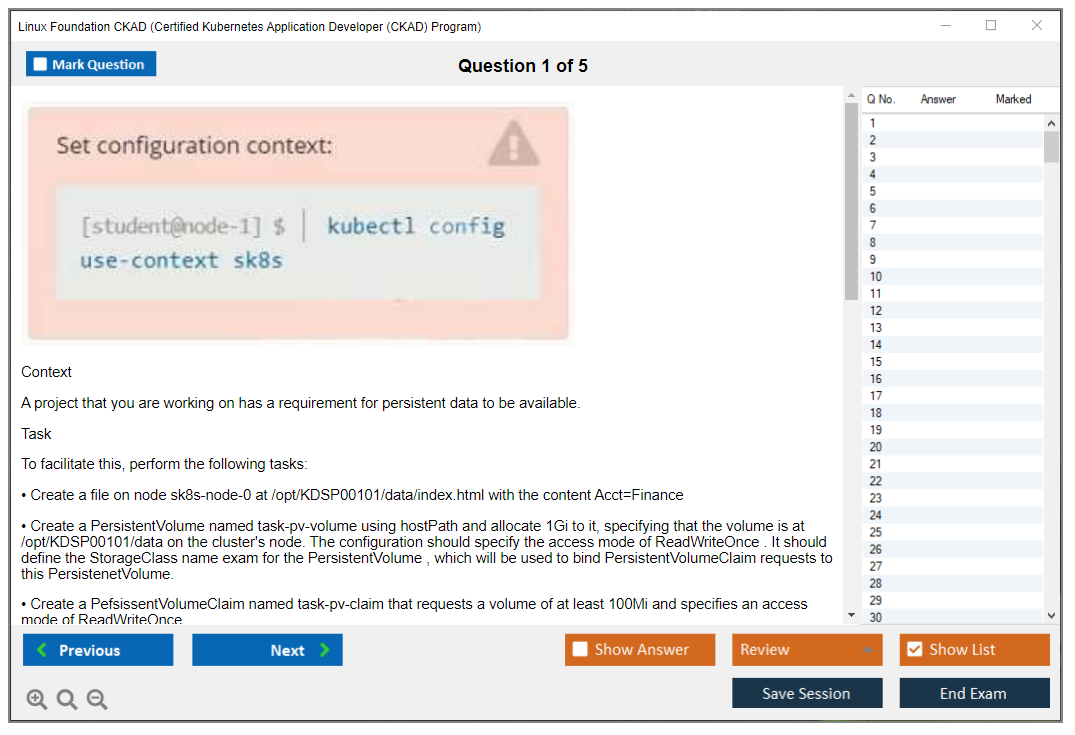
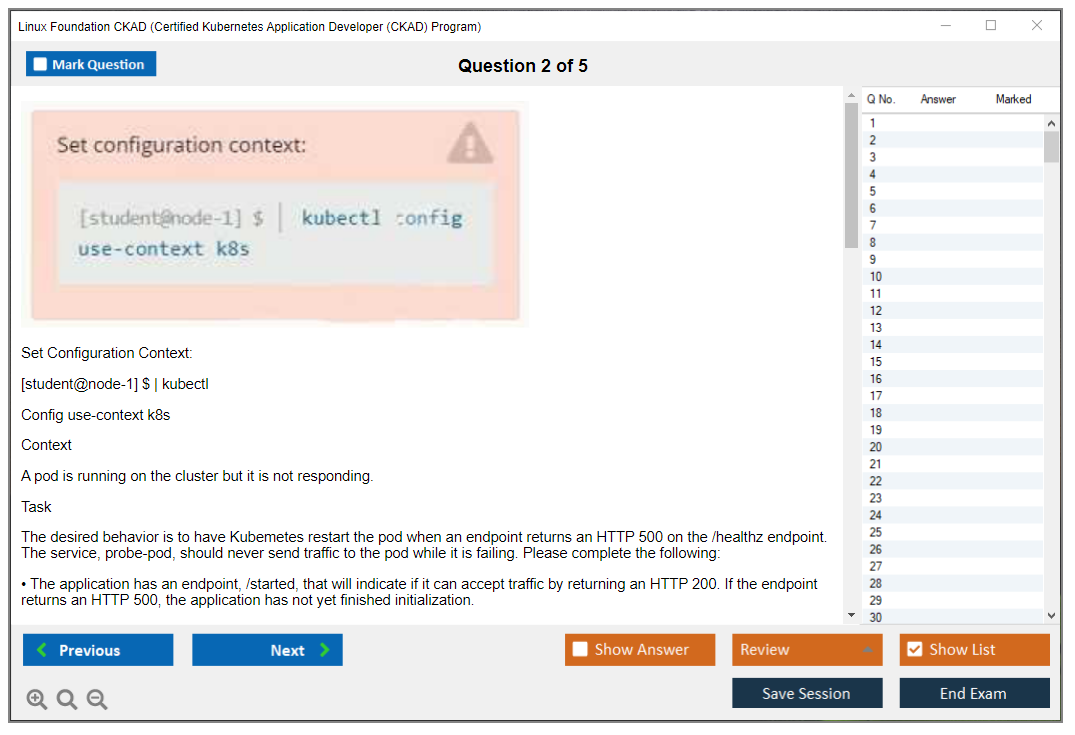
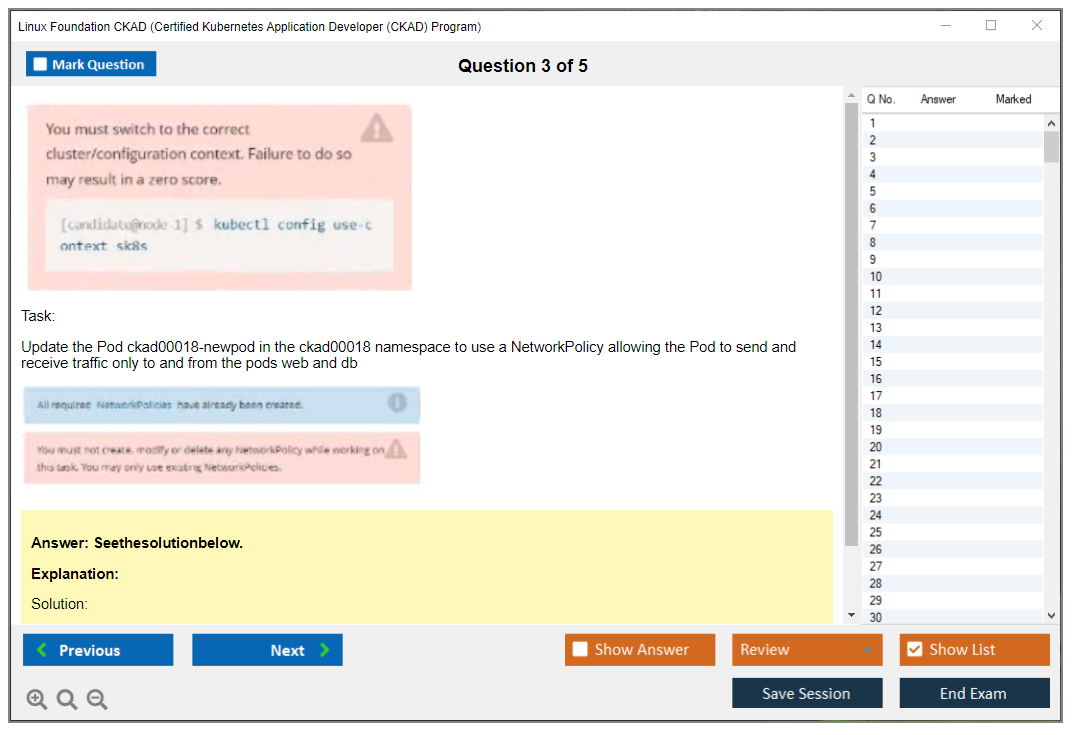
You'll be building and fixing things that look like real application developer work: create pods, wire up services, handle Kubernetes workloads and services, patch deployments, configure ConfigMaps and secrets, and do Kubernetes pod troubleshooting when something won't start. Tasks vary from "basic pod creation" to "why's this readiness probe failing" type debugging, and you don't get points for vibes.
Questions are weighted, some are quick wins, some are heavier, and partial credit exists. Which is huge, because you can often get most of the way there, validate what you can, and move on without rage-quitting the whole item.
Order's randomized. So no, you can't memorize a sequence. You can only get faster at the underlying skills, plus knowing where the docs are.
Docs access (and how people mess it up)
You can use official Kubernetes documentation during the exam, but only specific URLs are allowed. That's intentional. It rewards people who can search the docs fast, copy the right YAML pattern, and adapt it without breaking it.
Not gonna lie, the docs are both your best friend and your biggest time sink. If you're opening five tabs and reading paragraphs, you're already behind. You want targeted lookups, like the exact flags for a command, or the canonical example for a probe, or the structure for a NetworkPolicy.
Actually, side note here: I've seen people spend 10 minutes chasing down the "perfect" YAML example when they could've just used kubectl create to generate 80% of what they needed, then edited the missing bits. The docs are great, but they're also a rabbit hole if you don't stay focused. Sometimes speed beats perfection.
Timing, tasks, and the mental game
You get 120 minutes total. Two hours. Expect about 15 to 20 tasks.
On paper, that's like 6 to 8 minutes per task, but the distribution's ugly: some take 90 seconds if you're fluent, others take 15 minutes because you're debugging an app that fails for a non-obvious reason. Time pressure is a major part of CKAD exam difficulty, and anybody telling you otherwise is either a wizard or forgot the adrenaline.
No breaks. Timer stays visible. You can flag questions for review, which is nice, but only if you don't burn the first 90 minutes trying to perfect the first half. My opinion? Attempt everything, grab points everywhere, and only circle back if you've got time.
Remote proctoring and what exam day feels like
Delivery's remote proctored through PSI in a secure browser. You're on webcam, you share your screen, and a live proctor monitors the whole time. They'll chat you if something looks off or if your connection hiccups.
Before you start, you do a workspace check: clean desk, room scan, door closed, no other people wandering in. If you violate policies, the proctor can terminate the exam, and yes, it's as bad as it sounds.
Take it from home or an office, but pick the place where you control noise and interruptions. Random roommate drama's a terrible way to lose $395.
System requirements that actually matter
You need stable internet. Minimum 2 Mbps is the recommendation, but I'd want more than "minimum" when my certification attempt depends on it. Supported OS is Windows 10+, macOS, or Linux. Chrome or Chromium's required for the PSI secure platform.
Webcam needs at least 640x480 at 10 fps, plus a working microphone. You also need a government-issued photo ID for identity verification.
Environment rules are strict: quiet private room, clean desk, no phones, no smartwatches, no extra electronics. A single external monitor's allowed, or just your laptop screen. Don't get creative here. Creative's how people get flagged.
Scheduling, rescheduling, and retakes
You can schedule anytime within 12 months of purchase, and slots are available 24/7 across time zones. Rescheduling's free up to 24 hours before your appointment. Cancel later than that and you forfeit the attempt.
Check-in begins 15 minutes before start time. Show up late and you might lose the attempt without a refund. It's harsh, but it's the policy, so treat it like a flight.
That free retake's real. No waiting period's required between the first attempt and the retake, and the retake still has to happen within your 12-month eligibility window. Need a third attempt? You buy a new registration.
Passing score and results
People always ask about CKAD passing score. The published standard is 66% for CKAD, and you should treat that like "aim higher" because weighted tasks and silly mistakes can drop you fast.
Results show up through the exam portal after scoring. You'll get a breakdown by domain, which helps if you're planning a retake, and once you pass, the digital certificate and badge follow.
Why it feels hard (even if you know Kubernetes)
The thing is, the exam's hard because it's speed plus correctness under observation. You're doing real work, fast, with someone watching, on a system that punishes typos. Troubleshooting's where people bleed time, especially around probes, service selectors, DNS, and config issues like wrong keys in Kubernetes configuration and secrets.
Who finds it easier? Folks who live in kubectl daily, can read YAML like a second language, and already have muscle memory for common edits. Who finds it harder? Developers who only interact with Kubernetes through a CI pipeline, or people who learned from slides instead of doing reps.
What you need to know (objectives, not vibes)
The CKAD exam objectives focus on application-facing Kubernetes skills: core concepts like pods, deployments, jobs, and services. ConfigMaps and secrets. Ingress basics depending on environment. Observability and debugging, including logs, exec, describe, events, and fixing broken rollouts.
You don't need to be a cluster admin for CKAD, but you do need to be comfortable living inside namespaces, manipulating manifests quickly, and diagnosing why a workload won't become Ready.
Study materials and practice that actually helps
Official training from the Linux Foundation's fine if you like structured courses and your company pays. The Kubernetes docs are the real source of truth, and you should practice using them the way you will during the exam, meaning fast, targeted, and with a few bookmarked pages you know are allowed.
Hands-on matters more than reading. Local clusters like kind or minikube are good. So are cloud sandboxes if you can afford them. And killer.sh, since it's included, should be treated like mandatory homework, not optional.
Practice tests vs hands-on drills
Regular CKAD practice tests are okay for checking coverage, but performance-based practice is what moves the needle: timed mock exams, "do this task in 7 minutes" drills, repeated edits with kubectl apply, kubectl patch, and quick YAML generation.
Common areas to drill? Pods and deployments, services and selectors, probes, resource requests/limits, and configmaps/secrets. Also practice Kubernetes pod troubleshooting like you're on call and tired, because that's the vibe the clock creates.
Renewal and how long it lasts
The CKAD certification validity period is three years. After that, you renew by recertifying, which in practice means taking the exam again under whatever the current blueprint is.
If you're planning long-term, schedule renewal before your cert expires, because some employers care about "active" status, not "I passed once in 2022".
Prep timelines that match real life
If you already use Kubernetes weekly, a 1-week fast-track can work: killer.sh, timed drills, and plugging holes in objectives you keep missing. It's intense. Short sessions won't cut it. You need focused blocks.
If you're newer, 4 weeks is more realistic: week one for basics and YAML comfort, week two for workloads and services, week three for configuration and debugging, week four for timed runs and fixing your slow spots. Longer's fine too, but don't stretch it so much that you lose urgency.
CKAD vs CKA vs CKS
CKAD's for app developers shipping workloads. CKA's more admin and cluster operations. CKS is security-focused and assumes you can already operate Kubernetes confidently. If you're building apps, start CKAD. If you're running the platform, CKA first usually makes more sense.
Quick FAQs people ask
How much does the CKAD exam cost? $395 USD as of 2026, and it includes a free retake plus killer.sh sessions.
What's the passing score for CKAD? 66%.
How hard is the CKAD certification exam? Hard mostly because of time pressure and troubleshooting, not because the concepts are alien.
What are the CKAD exam objectives and domains? App-focused Kubernetes skills: workloads, services, config, observability, debugging, and common developer workflows.
How do I renew the CKAD certification? Cert's valid for three years, then you recertify by passing the current exam again.
CKAD Passing Score and Results
The infamous 66% threshold
The Linux Foundation CKAD certification requires a passing score of 66% as of the current 2026 exam version. That means you need to correctly complete tasks worth at least 66 points out of the total 100 available. This threshold's demanding but achievable if you've actually spent time in real Kubernetes environments rather than just memorizing theory.
The Linux Foundation and CNCF can adjust this passing threshold whenever they want. They've done it before with other certifications in their lineup. That's their prerogative as the certifying body, but 66% has remained fairly consistent for CKAD over the past few years.
Your score reflects the weighted value of correctly completed tasks you finish during the two-hour performance window. Here's something people don't always realize: the exam awards partial credit for partially correct solutions on some tasks. So if you configure a deployment mostly right but miss one label or environmental variable, you might still get 60-70% of those points.
Only the final state matters.
No penalty for incorrect attempts along the way.
The automated scoring system doesn't care how many times you deleted and recreated that pod. It evaluates your cluster's actual state against expected outcomes at the end of your exam session. I once watched a colleague spend 15 minutes fighting with a persistent volume claim, deleting and recreating it probably six times, but she still got full points because the final configuration was correct.
First-time pass rates and what that 66% really means
The 66% threshold sounds reasonable until you're actually in the exam environment with the clock ticking. Passing rates for first-time takers are generally estimated around 50-60%, though the Linux Foundation doesn't publish official statistics. That should tell you something about the difficulty level.
I've seen experienced developers with years of Docker experience completely bomb this thing because they couldn't work through kubectl efficiently enough. Speed matters almost as much as knowledge, maybe more in some scenarios depending on how comfortable you are troubleshooting under pressure and whether you've actually practiced the imperative commands versus just reading about them in documentation.
The tasks aren't evenly weighted either.
Simple tasks might be worth 2-4% each, while complex multi-step scenarios could be worth 8-10%. You need to develop an instinct for which questions to tackle first based on point value versus time investment. Skip the 2% question that'll take you 10 minutes of troubleshooting and knock out three 4% questions in that same timeframe. Triage matters.
How the scoring system actually works
Each task gets assigned a specific point value based on its complexity and importance to real-world Kubernetes application development. The automated scoring system then evaluates your cluster state against expected outcomes. It's checking whether the resources you created or modified meet all the specifications in the task requirements.
Configuration accuracy matters here.
Proper resource naming, correct specifications, right namespaces, accurate labels and selectors. All of this factors into scoring. The system's looking at the actual Kubernetes resources you've deployed, not your command history or your thought process.
Partial credit's possible when your solution meets some but not all requirements. Maybe you created the deployment with the right image and replicas but forgot to add the required configMap volume mount. You'd probably get partial points for that. But there's no negative marking for incorrect or incomplete attempts, which is generous compared to some other performance-based exams I've taken.
Your final score represents the percentage of total available points you earned across all tasks. Simple math. The execution's what gets tricky under time pressure.
When you'll get your results and what they include
Results typically arrive within 24 hours of exam completion.
You'll get an email notification sent to your registered address with pass/fail status. Most people get results within 12 hours, sometimes even faster.
The detailed score report shows the percentage you earned if you passed. Failed attempts also show your score, but here's the annoying part: you don't get a breakdown by individual questions. The Linux Foundation doesn't provide information about which specific tasks were incorrect. I get why they do this (exam security and all that), but it makes targeted improvement harder after a failed attempt, which feels frustrating when you're trying to figure out exactly where you went wrong.
You can't request manual review or rescoring of exam results.
The results are considered final once delivered by the certification authority. The scoring system's automated and supposedly objective, so there's no appeals process. Your score report's accessible through the Linux Foundation certification portal where you can download it anytime.
If you're looking for practice with realistic exam-style questions before your attempt, the CKAD Practice Exam Questions Pack for $36.99 gives you hands-on experience with the types of tasks you'll face.
Making sense of your score if you don't pass
Failed candidates need to use that score percentage strategically.
If you scored below 50%, that's a signal you need way more hands-on preparation. Not just reading documentation, but actually building things in Kubernetes clusters. Deploy applications, troubleshoot failing pods, work with configMaps and secrets until it's muscle memory.
Scores in the 55-65% range indicate you're close. You probably understand the concepts but need to work on speed and efficiency. Practice your kubectl commands. Learn the imperative commands that save time versus writing YAML from scratch. Memorize the documentation structure so you can find examples quickly. Know where things live.
You won't know which specific tasks you failed, which makes the retake prep process more about full review than targeted fixes. Some people find this frustrating, but I think it actually pushes you to master everything rather than just cramming weak areas.
The good news?
Failed attempts come with eligibility for a free retake (depending on your exam purchase package). Take advantage of that, but give yourself at least two weeks of focused practice before attempting again. Don't rush back in while you're still stinging from the first failure.
What happens when you pass
Passing candidates receive a digital certificate and Credly badge within 24 hours of the passing notification. The certificate includes your certification ID, issue date, and expiration date (three years from issue). You can download a PDF certificate from the Linux Foundation portal and share your digital badge through the Credly platform.
The certificate includes official Linux Foundation and CNCF logos.
Employers can verify your certification using the unique ID, which matters for job applications. I've had recruiters specifically ask for that certification ID to confirm validity.
Your certification's valid for three years before renewal's required. After that, you'll need to recertify, though the renewal process is generally less intensive than the initial exam. Some people also choose to pursue the CKA (Certified Kubernetes Administrator) or CKS (Certified Kubernetes Security Specialist) certifications to expand their Kubernetes credential portfolio.
The 66% passing threshold's definitely achievable with proper preparation, but don't underestimate the performance-based format. It's not about what you know in theory. It's about what you can actually do in a live cluster under time pressure.
CKAD Exam Difficulty: How Hard Is the Exam?
What the CKAD certification actually is
Look, CKAD certification is the Linux Foundation's hands-on exam for folks building and shipping apps on Kubernetes. Not cluster ops. Not security hardening. It's the day-to-day developer stuff: pods, deployments, services, configmaps, secrets, probes, and debugging when something inevitably breaks.
The exam is practical. That's why it stings.
If you write YAML for a living? It feels familiar. If you don't? It feels rude. No pity points.
Certified Kubernetes Application Developer (CKAD) is honestly a good fit if your job's closer to "I deploy microservices" than "I maintain etcd backups". I mean, it's also a decent forcing function if you've been circling Kubernetes forever and keep saying you'll learn it "next sprint".
You'll like it if you already touch Kubernetes workloads and services weekly, you've had to wrangle Kubernetes configuration and secrets in real projects, and you're comfortable staring at logs while your app's on fire. If your Kubernetes experience is mostly watching a course at 1.5x speed, the exam'll feel like getting tossed into the deep end with a timer running, honestly.
CKAD exam cost and what's included
CKAD exam cost changes sometimes depending on promos, but the Linux Foundation CKAD exam's typically in the few hundred USD range and usually includes one free retake. Check the Linux Foundation listing when you're ready to schedule because bundles and discounts pop up.
If you want extra drilling material that matches the "do the thing, don't talk about the thing" style, I'd pair official docs with something like this CKAD Practice Exam Questions Pack ($36.99). Not gonna lie, paying for focused drills can beat wasting nights collecting random GitHub questions that aren't timed and aren't scored.
Exam format, duration, and delivery
This is where CKAD exam difficulty spikes. The thing is, the Linux Foundation CKAD exam's performance-based, meaning you're in a terminal solving real tasks on a real cluster. No multiple-choice. No "pick two answers". You either create the resource correctly or you don't.
You get 120 minutes. Usually 15 to 20 tasks. And they're not tiny.
Time pressure's the hidden boss fight, because even if you know the content, you still need execution speed: fast kubectl, fast YAML edits, fast verification, and fast decision-making when a task could be solved three different ways but only one's quick enough to finish inside the clock.
Retakes, scheduling, and system requirements
Scheduling's through PSI with remote proctoring. Expect the usual: clean desk, webcam, stable internet, and a machine that won't decide to update mid-exam.
Retake rules depend on your purchase, but many bundles include one. If you fail, don't spiral. Most people fail because of time management and missed details, not because they're "bad at Kubernetes".
What is the CKAD passing score?
CKAD passing score's generally 66% (Linux Foundation has kept it around there). The scoring's weighted by question, so blowing off a big task can sink you even if you crushed a bunch of smaller ones.
Also, you don't need perfection. You need enough points. That mindset matters when the clock's bleeding out.
Score reporting and how results are delivered
Results typically arrive within a day or two (often faster). You'll see a score report with domain breakdowns, which is useful if you're reattempting and need to focus your CKAD study materials on weak spots like observability or configuration.
Overall CKAD exam difficulty assessment
CKAD exam difficulty's usually described as moderately difficult to challenging, and that's accurate. The performance-based format's tougher than multiple-choice exams because you can't "recognize" the right answer. You have to produce it under pressure, verify it, and move on without breaking something else in the namespace.
The passing rate floating around for first-time takers is often estimated around 50 to 60%. That feels believable. It's comparable to other hands-on technical certifications where speed matters, and it's definitely more challenging than theoretical Kubernetes knowledge assessments that just quiz concepts.
It's easier than CKA, in my opinion, because you're not living in cluster admin land all day, but it's still substantial. Real-world relevance makes it practical but demanding, and candidates with production Kubernetes experience generally find it more manageable because they've already built the muscle memory for kubectl exam preparation and Kubernetes pod troubleshooting when things go sideways.
Skills that make CKAD challenging (time pressure, troubleshooting)
Time pressure's the big one. You've got 120 minutes for a pile of complex tasks, and some of them are multi-step and detail-heavy, so you must work quickly while staying accurate. There's basically no time for extensive research or a trial-and-error approach.
kubectl speed matters more than people admit. Slow typing, not knowing shell shortcuts, or fumbling with context and namespaces'll wreck you. The exam punishes hesitation. You have to make quick decisions about approach without overthinking, then validate fast without "testing for ten minutes like you would at work".
Troubleshooting's the other pain point. A lot of tasks are "this deployment's broken, fix it", and under a timer you have limited time to methodically debug, so you need to interpret logs and events efficiently, understand how the pieces connect, and keep your cool while your brain's trying to do math on how many points you're about to lose.
Multi-step tasks add sneaky difficulty. You'll see questions where you must create a workload, attach config, wire a service, set probes, and maybe add a network policy. It's easy to miss one tiny requirement while you're rushing. One missed label. One wrong port name. Done.
Who typically finds CKAD easier/harder
People who find it easier: developers with 6+ months of production Kubernetes experience, folks who run kubectl daily, strong Linux CLI users, engineers who've deployed and troubleshot real apps, and anyone who's done similar performance-based exams before.
People who find it harder: candidates with mostly theoretical knowledge, anyone new to Linux terminals, people who rely on GUI tools, and those trying to pass without enough CKAD practice tests or timed labs. Also, if timed tests make you freeze, this exam amplifies that, because you can't sit and think for five minutes on a single question without paying for it later.
CKAD exam objectives you actually need to know
CKAD exam objectives shift slightly over time, but the themes stay stable.
Core concepts: pods, namespaces, labels, annotations, and basic resource anatomy. Then workloads like deployments, jobs, cronjobs, rolling updates, and how to quickly recover when you pushed a bad image tag. Services and networking show up too, plus ingress basics depending on the version, and yes, you'll be expected to handle Kubernetes workloads and services without hand-holding.
Config's unavoidable. Kubernetes configuration and secrets are everywhere in the exam, because real apps live and die by environment variables, mounted files, and correct references.
Observability and debugging: logs, exec, describe, events, probes, and basic "why won't this start" diagnosis. This is where Kubernetes pod troubleshooting skill pays off fast.
Official prerequisites (and what's strongly recommended)
There aren't hard prerequisites, but "recommended" is doing a lot of work here. You should be comfortable with kubectl, editing YAML quickly, switching contexts/namespaces without thinking, and doing basic Linux text manipulation. If you've never used vi or nano under pressure, fix that now.
Also, know the docs. Not everything's memorization, but you can't wander around documentation like you're browsing a blog at lunch. You need a plan.
Linux Foundation training and CKAD resources
Linux Foundation training's fine if you like structured courses, but you still need repetition. Honestly, the best CKAD study materials are the Kubernetes docs plus hands-on reps, because the exam's execution, not trivia.
Bookmark the docs pages you actually use: kubectl reference, resource pages for deployments/services/configmaps/secrets, and troubleshooting pages. Practice finding what you need in seconds. I spent half a Sunday once just opening and closing the same five doc pages until I could work through them with my eyes closed, which sounds ridiculous but shaved real minutes off my mock exam times.
And if you want focused exam-style drills, use something like the CKAD Practice Exam Questions Pack ($36.99) alongside labs. I mean, it's not magic, but it can tighten your timing and expose dumb gaps like "I always forget the flag for outputting YAML".
Practice tests vs performance-based practice (what works best)
CKAD practice tests help, but only if they force you into the terminal with a timer. Reading questions isn't practice. Doing tasks is practice.
Do timed mock exams. Do drills per domain. Repeat until boring.
One detailed suggestion: spend a week doing "kubectl sprints" where you create resources imperatively, output YAML, patch things, and clean up fast, because command syntax errors waste minutes and minutes are the currency here. Another one: build a personal checklist for validation, like "kubectl get, describe, logs, endpoints" so you don't guess when you can confirm in ten seconds.
Other areas to practice, more casually: configmaps, secrets, probes, service selectors, ingress basics, resource limits, and quick rollbacks.
Common reasons for failing CKAD
Most failures come down to time management. People leave questions incomplete because they got stuck perfecting one task, or they debug too long without moving on.
Lack of hands-on practice's next. Over-reliance on documentation's real too, because if you need to look up every flag, you'll run out of time. Weak troubleshooting skills, misreading requirements, poor kubectl fluency, and shaky core concepts all show up, and the exam punishes every one of those mistakes immediately.
If you want a simple fix: do more timed reps than you think you need, and treat speed as a skill you train, not a personality trait.
CKAD certification validity period
CKAD's valid for 3 years. That's the current Linux Foundation policy for Kubernetes certs.
Renewal options and when to recertify
You renew by recertifying, meaning you take the exam again (or the then-current version). Plan to re-up before it expires, because letting it lapse is annoying if your employer tracks compliance or if recruiters keep filtering by "active cert".
Fast-track plan for experienced Kubernetes users
Week 1: timed drills, kubectl speed, YAML templates, and a couple full mocks. Week 2: focus on weak domains, especially debugging and configuration, and do at least one more full timed run where you practice skipping and returning.
Standard plan for new-to-Kubernetes developers
Give yourself 4 weeks. First two weeks: build baseline skills and do labs daily. Third week: start timing everything. Fourth week: full mocks, review mistakes, tighten bookmarks, and stop changing your workflow.
Role-based differences and recommended path
CKAD vs CKA vs CKS's basically developer vs admin vs security. If your work's app delivery, start with CKAD. If you manage nodes, networking, cluster upgrades, and storage, CKA fits better. If you're deep into policies, runtime security, and supply chain controls, CKS is its own beast.
CKAD's easier than CKA, but don't confuse "easier" with "easy". It's still a serious exam.
FAQs about the CKAD program
How much does the CKAD exam cost? It's usually a few hundred dollars and often includes a retake, but check the current Linux Foundation CKAD exam page for exact pricing.
What's the passing score for CKAD? CKAD passing score's typically 66%.
How hard's the CKAD certification exam? CKAD exam difficulty's moderate to challenging because it's performance-based, timed, and heavy on kubectl speed and troubleshooting.
What are the CKAD exam objectives and domains? Expect workloads, services/networking, config (including Kubernetes configuration and secrets), and observability and troubleshooting.
How do I renew the CKAD certification? Recertify before the 3-year validity ends.
If you're prepping and want more terminal-first reps, the CKAD Practice Exam Questions Pack ($36.99) is a straightforward add-on to your lab time, especially if you keep failing mock exams because you're too slow, not because you don't know the material.
CKAD Exam Objectives and Domains
What the CNCF actually tests you on
The CKAD exam curriculum's built entirely around what CNCF publishes as their official objectives, and honestly it changes every year or so. Sometimes more often if we're being real. The 2026 version tests you on Kubernetes v1.29-1.30 features, which means if you're studying with old materials you might be preparing for APIs that don't even exist anymore or learning deprecated approaches that'll just confuse you during the actual exam.
This isn't like those multiple-choice cloud cert exams where you memorize trivia and call it a day. Every single objective on the CKAD curriculum translates directly into a hands-on task you'll perform during the test, and I mean actually perform. Typing commands, writing YAML, fixing broken configurations under time pressure. You won't be asked "what is a pod?" in some abstract way. You'll be told to create one with specific requirements, troubleshoot it when it doesn't start, or modify its configuration to meet new constraints that weren't there five minutes ago. The curriculum focuses exclusively on application developer tasks, not cluster administration stuff, so you won't be installing Kubernetes from scratch or managing etcd backups or anything like that.
Real talk? The domains aren't weighted equally either. Some areas get hammered harder than others during the exam. Knowing which ones carry more points helps you prioritize your study time instead of spreading yourself too thin across topics that barely show up.
Application Design and Build weighs in at 20%
This domain covers how you actually construct containerized applications for Kubernetes environments. It's foundational stuff. Understanding container images and build processes means you need to know your way around Dockerfiles. Not just writing them, but understanding how image layers work, how tags function, and what happens when you push images to registries. Multi-stage builds come up because they're the standard way to optimize image size and security in production environments.
I mean you should know how to build a container image that's actually suitable for Kubernetes deployment, not just something that technically runs. That includes security considerations like running as non-root users, minimizing attack surface, and understanding vulnerability scanning results. The exam won't ask you to perform a security audit, but you might need to modify a Dockerfile to address basic security requirements.
Defining and building cloud-native applications is about architectural thinking. Microservices principles, twelve-factor app methodology, stateless versus stateful design. These aren't just buzzwords. They're practical considerations that affect how you structure your Kubernetes manifests. Should this component be a Deployment or a StatefulSet? Does it need persistent storage? Can it scale horizontally or does it require sticky sessions? Those decisions matter.
Jobs and CronJobs? Essential for batch workloads. You'll create Jobs for one-time tasks like database migrations or data processing, configure parallelism settings when you need multiple pods working at once, set completion requirements, and put in proper failure handling. CronJobs extend this to scheduled execution, and you need to understand their scheduling syntax plus how to manage cleanup of completed job resources so you don't accumulate garbage in your cluster.
Application Deployment also gets 20% of your score
Using Kubernetes primitives to implement common deployment strategies means you're working with Deployments, ReplicaSets, Services, and labels to achieve different rollout patterns. The building blocks, basically. Rolling updates are the default, but you should be able to implement blue-green deployments by manipulating Service selectors and canary deployments by splitting traffic between different versions of your application.
Understanding Deployments and performing rolling updates goes deeper into the mechanics than most people realize when they first start studying. You'll configure deployment strategies (RollingUpdate versus Recreate), manage rollout history so you can see what changed between revisions, pause rollouts when something looks wrong, resume them when you've verified the fix, and roll back to previous versions when deployments fail. Scaling deployments horizontally is straightforward but you need to do it quickly under time pressure.
Not gonna lie, Helm is probably the most contentious inclusion in the CKAD curriculum because it's not core Kubernetes. It's a separate tool maintained by a different community. Wait, actually I should clarify that while it's CNCF-hosted, it feels like a different ecosystem entirely. I once spent three hours debugging a chart only to realize the issue was two spaces instead of four in the values file, which taught me more about YAML parsers than I ever wanted to know. But Helm's tested anyway. You need to understand chart structure, install applications from charts, customize deployments using values files, manage releases through their lifecycle, and potentially create basic charts. You don't need to be an expert who writes complex templates with advanced conditionals, but you should handle the common operations that application developers perform daily.
Application Observability and Maintenance takes 15%
Understanding API deprecations matters because Kubernetes evolves fast and APIs get deprecated regularly. Like, annoyingly regularly if you maintain older applications. You need to identify when manifests reference old API versions, migrate them to current versions, and understand the versioning scheme Kubernetes uses (alpha, beta, stable). The exam might give you a manifest that won't apply because it's using a deprecated API and you'll need to fix it.
Implementing probes is critical for container health monitoring, full stop. Liveness probes restart containers that are running but not actually functioning properly, like when your app is stuck in a deadlock. Readiness probes control whether traffic gets sent to a pod, which matters during startup or when a pod is temporarily unable to serve requests but doesn't need to be killed. Startup probes help with slow-starting containers that would otherwise fail liveness checks during initialization.
You'll choose between HTTP probes, TCP probes, and exec probes depending on what your application exposes. Then you'll tune timing parameters like initialDelaySeconds, periodSeconds, timeoutSeconds, and failureThreshold. Each one matters more than you'd think. Set these wrong and you get either pods that restart too aggressively or pods that stay in rotation when they're actually broken.
Using built-in CLI tools? Means mastering kubectl for monitoring. The kubectl logs command retrieves container output, which is your primary debugging tool when something goes wrong. The kubectl top command shows resource usage for nodes and pods, helping you identify performance issues or resource constraints. These seem basic but under exam pressure you need to use them efficiently with the right flags and selectors.
The thing is, the remaining domains continue with similar depth. Application Environment, Configuration and Security covers ConfigMaps, Secrets, SecurityContexts, ServiceAccounts, and resource limits. Services and Networking dives into Service types, NetworkPolicies, and Ingress. Each domain translates to specific tasks you'll perform during the two-hour exam window.
Understanding these objectives in detail helps you prepare better instead of just randomly practicing Kubernetes commands and hoping something sticks. The CKA certification covers cluster administration topics that CKAD deliberately excludes, while CKS focuses entirely on security aspects. Knowing what's actually on the CKAD curriculum versus what belongs to other certifications prevents you from wasting study time on irrelevant topics.
Conclusion
Wrapping up your CKAD path
Look, the CKAD certification isn't something you can just wing. Seriously, not happening. If you've been working with Kubernetes deployments day in and day out, maybe you can speedrun it, but for most people this thing requires actual dedicated prep time. Real commitment. The Linux Foundation CKAD exam throws you into a terminal and expects you to solve real problems under time pressure. No multiple choice safety net. No partial credit for "knowing the concept but not the exact syntax." It's brutal like that.
What separates people who pass from those who don't? Honestly, it's hands-on practice. Not reading about kubectl commands. Not watching tutorial videos on 1.5x speed. Actually typing commands, breaking things, troubleshooting why your pod won't start, figuring out why your ConfigMap isn't mounting correctly. The CKAD exam difficulty comes from the performance-based format, and you need muscle memory for common tasks, the kind that only develops when you've messed up enough times to remember what not to do.
The CKAD exam cost is substantial (currently $395, though prices change), so you don't wanna waste that investment by showing up unprepared. Your CKAD study materials should focus heavily on the exam objectives. Application design, multi-container pods, observability, services and networking. Bookmark the right sections of Kubernetes documentation 'cause you'll need to reference it during the exam itself.
Real talk here. CKAD practice tests are valuable. But they need to be realistic, timed, and focused on the actual task types you'll encounter. I've seen too many people grind through theoretical quizzes and then freeze when they need to debug a failing deployment in 3 minutes.
One resource worth checking out is the CKAD Practice Exam Questions Pack at /linux-foundation-dumps/ckad/. It's built specifically around the performance-based nature of the test, giving you scenarios that mirror what the Linux Foundation actually throws at you. Not gonna lie, practicing with realistic exam-style questions made a huge difference in my prep timeline. Some folks skip this step and regret it later when they're staring at unfamiliar problem formats with the clock ticking down.
The Certified Kubernetes Application Developer certification proves you can actually build and troubleshoot applications in Kubernetes environments. Not just talk about it in meetings. Wait, actually, let me clarify that. Not just understand the architecture diagrams. Actually do the work. And reaching that CKAD passing score of 66% means you've demonstrated competency across all the major domains.
Start practicing now. Set up your own cluster, break things deliberately, fix them under time constraints. The certification's worth it, but only if you put in the actual keyboard time.