

Fortinet NSE6_FWF-6.4 Exam Overview and Certification Value
Wireless security? Sounds straightforward. Until you're neck-deep in RF heatmaps trying to figure out why three hundred users suddenly can't connect to your corporate SSID, and honestly, that's when the panic sets in. The Fortinet NSE6_FWF-6.4 exam tests whether you actually know how to wrangle FortiGate and FortiWiFi devices into managing secure wireless networks. Not just whether you crammed some concepts the night before and hoped for the best.
What this certification actually proves
The Fortinet NSE 6 - Secure Wireless LAN 6.4 certification validates that you can design, deploy, and manage secure wireless networks using FortiGate and FortiWiFi devices running FortiOS 6.4. We're talking FortiGate wireless controller configuration. FortiAP management from discovery through troubleshooting. Authentication mechanisms like 802.1X and captive portals. Plus full wireless diagnostics when things inevitably go sideways (because they will).
This isn't a vendor-neutral wireless cert. You won't waste time on generic RF theory or IEEE standards trivia unless it directly relates to how Fortinet implements it. I mean, who's got time for that? Instead, you're learning FortiAP provisioning workflows, SSID-to-VLAN mapping in FortiOS, WPA2/WPA3 configuration specifics, and how to read FortiGate wireless logs when users start flooding your inbox with connectivity complaints.
Who actually needs this certification
Network security engineers managing Fortinet wireless deployments? Obvious candidates. Wireless infrastructure administrators who already know RF fundamentals but need to prove Fortinet-specific expertise fit the bill. IT professionals tasked with rolling out enterprise WiFi using FortiGate as the controller belong here too.
Security consultants implementing WiFi solutions for clients often pursue this because it demonstrates you're not just winging it with best practices. You know the Fortinet implementation details, the quirks, the gotchas that only come from real experience. Network architects designing secure wireless environments also benefit, especially if they're already working within the Fortinet ecosystem and want to show depth in wireless beyond basic firewall knowledge.
Honestly, if you're already working with FortiGate firewalls and your organization's adding wireless infrastructure, this cert makes a ton of sense. It's less useful if you're purely focused on other vendors' wireless solutions or if you haven't touched FortiOS before. You'd probably want to start with NSE4_FGT-7.2 to get the foundational FortiOS knowledge first before diving into specialized wireless stuff.
Career impact and what it signals
NSE 6 certifications position you as a Fortinet advanced specialist, not just someone who passed an associate-level exam and called it a day. Employers and clients recognize NSE 6 credentials as proof you've gone beyond basic competency. Like, anyone can configure a simple SSID, but troubleshooting rogue AP detection or implementing multi-site wireless architectures with centralized management requires actual expertise that you've built through hands-on work.
This opens opportunities for senior wireless security roles, especially in organizations with significant Fortinet deployments where they need someone who actually gets it. It demonstrates commitment to the Fortinet ecosystem, which matters if you're consulting or working for a Fortinet partner. Plus it shows you're willing to specialize rather than just collecting generic certifications like Pokemon cards. Speaking of which, I once worked with a guy who had seventeen certifications on his resume but couldn't troubleshoot a basic DHCP issue to save his life. Paper doesn't always mean competence.
Where it fits in Fortinet's certification ladder
The NSE 6 level sits above NSE4_FGT-7.2 (associate-level infrastructure security) and represents specialist-level knowledge in a specific domain. Kinda like comparing a general practitioner to a cardiologist. Unlike NSE 4, which covers broad FortiOS topics, NSE 6 tracks like NSE6_FWF-6.4 drill deep into one area.
It complements other NSE 6 tracks. Someone might hold NSE6_FWF-6.4 for wireless and NSE6_FWB-6.4 for web application security, building a complete skillset that way. These specialist certifications serve as stepping stones toward NSE 7 architect-level credentials like NSE7_EFW-7.0, where you're expected to design entire security infrastructures from scratch.
Real deployments where this knowledge matters
Managing enterprise wireless deployments means hundreds of FortiAPs across multiple buildings or sites. You're not just turning on WiFi. You're dealing with FortiAP discovery, authorization policies, profile assignments, and making sure firmware updates don't break everything at 3 AM when nobody's around to fix it.
Implementing secure guest access with captive portals that integrate with your existing authentication systems can get complicated fast. Troubleshooting RF interference when the microwave in the break room murders your 2.4GHz performance? Yeah, that's a real thing. Deploying 802.1X authentication for corporate networks with RADIUS backend integration.
Detecting and mitigating rogue access points someone plugged into the network because they wanted "better WiFi" near their desk. Configuring wireless mesh for areas where you can't run Ethernet without tearing up walls. Setting up wireless IPS/IDS to catch attacks specific to wireless networks, attacks that traditional firewalls completely miss. These are daily tasks in environments with serious wireless infrastructure, not theoretical scenarios you'll never encounter.
Certification expiration and renewal
Fortinet NSE 6 certifications typically remain valid for two years from the date you pass. Then they expire. After that, you'll need to renew through re-examination or completing updated certification requirements. This isn't optional. Fortinet actually enforces expiration, unlike some vendors who let certs sit forever gathering digital dust.
The renewal requirement makes sense given how quickly wireless technology and FortiOS evolve. What you learned about FortiOS 6.4 wireless features in 2021 might not reflect current best practices or capabilities in 2024. Might actually be outdated or deprecated even.
The FortiOS 6.4 specificity issue
This exam focuses exclusively on FortiOS 6.4 wireless capabilities. CLI commands, GUI workflows, feature sets, all specific to version 6.4, down to the exact syntax. Many concepts translate to newer versions, sure, but exam questions test 6.4 implementation details with precision that'll trip you up if you're used to newer versions.
Look, this creates a timing consideration you can't ignore. If Fortinet has already released FortiOS 7.x or 8.x wireless exams, pursuing the 6.4 exam might not make sense unless you're specifically managing 6.4 environments. Wait, let me think about this. Unless your employer's stuck on 6.4 for compliance reasons. Older exam versions eventually retire as Fortinet releases newer versions. You should verify current exam availability before investing study time. Nothing worse than preparing for an exam that gets retired three weeks before you're ready to sit for it.
How this differs from vendor-neutral wireless certs
Unlike CWNA or CWSP, which teach vendor-neutral wireless fundamentals (useful but generic), NSE6_FWF-6.4 assumes you understand basic WiFi and focuses specifically on Fortinet's implementation. You're learning FortiGate wireless controller functions, FortiAP integration with the Security Fabric, and Fortinet-specific troubleshooting tools that won't exist anywhere else.
This makes it more immediately applicable if you work in Fortinet environments but less transferable if you switch to Cisco, Aruba, or Meraki deployments down the road. The tradeoff is depth versus breadth. You gain detailed implementation knowledge at the cost of vendor portability, which might matter depending on your career trajectory.
NSE6_FWF-6.4 Exam Details and Logistics
What the certification validates
The Fortinet NSE6_FWF-6.4 exam is basically Fortinet asking, "Can you actually run secure WiFi on FortiOS 6.4 without just guessing every time?" It maps to the Fortinet NSE 6 Secure Wireless LAN 6.4 certification, and honestly, it focuses on real controller work: SSIDs, VLAN mapping, FortiAP behavior, authentication flows, and fixing broken wireless when the logs are literally yelling at you. Not theory-only stuff. Not some trivia contest where you memorize product launch dates.
Who should take this exam
If you touch FortiGate wireless controller features in production environments, this one's for you. Look, if you're a network admin who got voluntold to "own WiFi" after the last guy left, or you're a security engineer who keeps inheriting these WPA2-Enterprise setups with super weird RADIUS timeouts that nobody documented, the exam objectives will feel strangely familiar. It also fits folks building skills off a NSE6_FWF-6.4 study guide and trying to prove they can do more than just click around the GUI hoping stuff works. Helpdesk-only role? Probably too soon for this level.
Exam format (questions, time, delivery)
The exam's multiple-choice with scenario-based items thrown in. Expect a healthy mix of "what setting does X" and "here's a messy situation, what do you change first," with log snippets and configuration fragments sprinkled throughout to keep you honest. Typically it's 30 to 35 questions. Yeah, the count can vary a bit by delivery method.
You get 90 minutes total. That works out to around 2.5 to 3 minutes per question on paper, but honestly the math lies a little because scenario questions can eat five minutes easy if you start second-guessing what FortiOS 6.4's actually doing with profiles, tunnels, VLANs, and auth. Wait, was that bridge mode or tunnel? Delivery's either online proctoring through Pearson VUE or a physical testing center, depending on what you pick when scheduling.
Short clock. Read carefully. Don't rush logs. And maybe grab coffee before you start because that 90 minutes disappears faster than you think.
Exam cost
The NSE6_FWF-6.4 exam cost runs around $400 USD, but it varies by region, local tax rules, and testing center pricing policies. Check Fortinet's certification page before you buy anything, because pricing changes and sometimes there are training bundles that make the total less painful on your wallet. If your employer pays, great. If not, I mean, budget for a retake just in case things don't go perfectly first try.
Passing score (what to expect and how scoring works)
Fortinet doesn't publish the exact NSE 6 Secure Wireless LAN passing score anywhere official. The common expectation in the field's roughly 70 to 75% correct, and that feels about right given the difficulty and question style, but it's not carved in stone. Scoring's weighted, meaning not every question's worth the same number of points. Scenario-based questions tend to carry more weight than straight recall items, so getting the "easy" stuff right definitely helps, but it won't save you if you completely bomb the troubleshooting scenarios where you've gotta chain multiple concepts together.
Difficulty level (and what makes it challenging)
Is the NSE6_FWF-6.4 exam difficult? Yeah, it can be, mainly because it expects multi-step reasoning instead of surface-level memorization. You'll see situations where the "correct" answer depends on subtle differences between similar-looking options, like exactly how FortiAP profile inheritance works, what overrides what in the config stack, and which setting actually controls client behavior versus just controller display behavior.
The hard parts are usually these: deep wireless troubleshooting logic, detailed controller CLI and debug command familiarity, diagnosing RF or connectivity issues from cryptic logs, and knowing when a problem's authentication flow versus VLAN tagging versus AP provisioning sequence gone wrong. Not gonna lie, if you've only done happy-path deployments where everything just worked first time, the scenarios feel kinda mean.
Wireless fundamentals in Fortinet deployments
You need the basics down. Channels, power levels, band steering concepts, airtime fairness ideas, and how roaming decisions and security modes affect actual client experience. Fortinet won't ask you to be a full CWNA expert, but they'll definitely expect you to understand what's "normal" RF behavior versus a configuration problem masquerading as radio interference.
FortiGate/FortiWiFi as wireless controller (profiles, SSIDs, VLANs)
This is the core material. Expect FortiGate wireless controller configuration details like SSID objects, VLAN assignment methods, tunnel versus bridge mode trade-offs, and how firewall policies interact with SSIDs in ways that aren't immediately obvious. Also, SSID, VLAN, and captive portal on FortiWiFi shows up constantly, because captive portals and VLAN tagging are where clean network diagrams go to die in real life.
FortiAP discovery, authorization, and provisioning
You should be comfortable with FortiAP provisioning and profiles inside and out. Discovery methods, authorization states, and what happens when an AP's managed but not broadcasting correctly or stuck in some weird limbo. Profile inheritance and overrides are a classic trap question, especially when multiple SSIDs and radio profiles stack up in ways that don't match the mental model you built.
Security and access control (WPA2/WPA3, 802.1X, captive portal)
Expect heavy coverage of wireless security (WPA2/WPA3, 802.1X) on Fortinet plus captive portal flows with all their quirks. 802.1X with RADIUS is a frequent scenario because there are so many failure points: shared secret mismatch, EAP method mismatch, certificate problems, user group rules not applying, and policy routing mistakes that look exactly like auth failures but aren't. Captive portal questions often test sequence and redirection behavior, not just where the checkbox lives in the GUI.
Monitoring, troubleshooting, and diagnostics (logs, RF, rogue AP)
This is where the exam earns its reputation, honestly. Wireless debugging commands, controller logs, client state machines, and interpreting wireless troubleshooting and diagnostics (logs, RF, rogue AP) data under time pressure. Wireless intrusion detection events show up too, and you'll need to tell the difference between a real rogue AP security issue and a false positive that's just your neighboring coffee shop's WiFi bleeding over.
Best practices and common misconfigurations
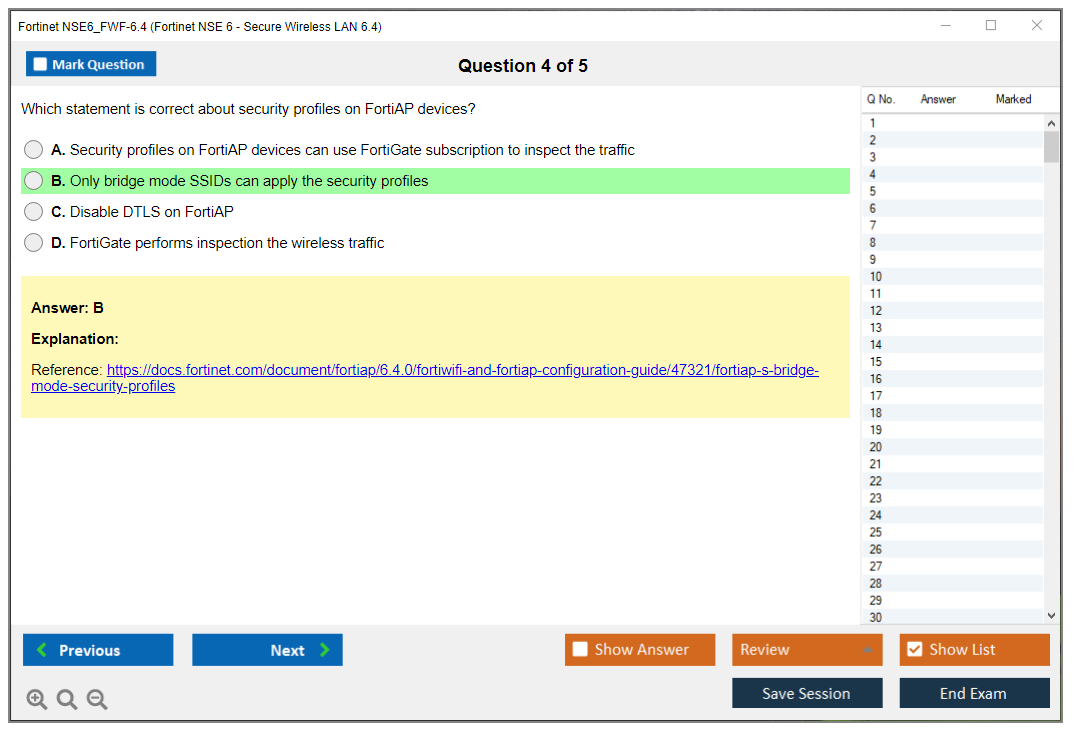
Common errors include mismatched VLANs between SSID and policy, incorrect tunnel settings that break DHCP, broken RADIUS reachability that nobody tested, and AP profiles that don't apply where you think they do because inheritance got weird. Also, mixing WPA modes without thinking about minimum client support requirements. Happens constantly in production.
Prerequisites (official and practical)
Fortinet's official prereqs can change by program version, so confirm on the NSE portal before assuming anything. Practically speaking, you want hands-on time with FortiOS 6.4 wireless features, at least one real FortiAP model you've configured from scratch, and the confidence to read configs without panicking when nothing's labeled clearly.
Recommended hands-on skills (FortiOS 6.4, FortiAP, switching basics)
Know switching basics cold. Trunks, native VLAN behavior, LLDP helps with troubleshooting, and how your FortiGate talks to access switches in the middle. If you can't trace a VLAN from SSID config all the way through to firewall policy, the exam's gonna hurt.
Official Fortinet training (NSE Institute / Training Portal)
Start with FortiWiFi 6.4 training from the NSE Institute if you can get access. I mean, it's aligned to the Fortinet wireless LAN 6.4 exam objectives, and that alignment matters way more than random YouTube WiFi content that might be two versions old.
Documentation to prioritize (FortiOS/FortiWiFi/FortiAP guides, admin docs)
Read the FortiOS 6.4 wireless controller sections and the FortiAP administration docs carefully. Pay special attention to default behaviors, because questions absolutely love testing whether you know what happens when you don't explicitly configure something.
Labs and home practice setup (FortiGate VM, FortiAP, test SSIDs)
A FortiGate VM can cover a lot of ground, but without at least one physical AP you miss the "why is this client doing that weird thing" experience completely. If you can only do one lab scenario, set up one WPA2-Enterprise SSID with RADIUS and deliberately watch logs during authentication failures. That's pure gold for exam prep.
Practice tests (how to use them effectively)
A NSE6_FWF-6.4 practice test is good for timing practice and spotting weak knowledge areas, not for memorizing NSE6_FWF-6.4 exam questions word-for-word. Do a full set, review every single miss thoroughly, then try to recreate the scenario in a lab if possible. If you can explain why each wrong option's actually wrong, you're getting close to ready.
High-yield topics checklist
Debug commands and log interpretation, profile inheritance rules, captive portal flows with all edge cases, 802.1X with RADIUS troubleshooting. Also worth mentioning: rogue AP detection events, VLAN mapping edge cases that break silently, and AP authorization state transitions.
Time management and question strategy
Don't camp on one difficult scenario early in the exam. Flag it, move on, come back with fresh eyes. Two minutes per question's a long time until suddenly it isn't.
Renewal options (retake, upgrade path, recertification timing)
Fortinet changes renewal rules over time, so check the NSE Institute portal for current validity periods and recert options that actually apply now. Often the practical answer's retake the current version exam or take the newer equivalent when FortiOS versions roll forward and exam blueprints update.
Staying current with FortiOS versions and product changes
Wireless features change across FortiOS releases more than you'd think. Keep notes on what changed between 6.4 and newer trains, especially around security modes and controller behavior differences, because your day job will drift ahead of the exam blueprint and you'll get confused about which features exist where.
Can I pass NSE6_FWF-6.4 without real FortiAP hardware?
Possible? Yeah, technically. Harder? Absolutely. You can learn configuration syntax and theory in a VM environment, but troubleshooting feels completely fake without real client associations and RF behavior doing unpredictable things.
What score do I need to pass if Fortinet doesn't publish it?
Assume you need 70 to 75% minimum and aim higher to be safe. Weighted scoring means you really want to be strong on scenarios, not just definition recall.
What's the fastest way to improve wireless troubleshooting skills?
Break things on purpose in your lab. Change one variable at a time, capture logs before and after, and learn what "normal" looks like when authentication, DHCP, VLAN tagging, and roaming all work correctly.
How do I schedule the exam?
Scheduling's easy: create a Pearson VUE account, find the exam in their catalog, pick a slot that works, pay the fee, then show up ready with proper ID, a clean desk area, and no extra screens if you're doing online proctoring.
NSE6_FWF-6.4 Exam Objectives and Content Blueprint
So you're thinking about the Fortinet NSE6_FWF-6.4 exam? Look, this certification proves you can design, deploy, and troubleshoot wireless networks using FortiGate and FortiWiFi controllers. It's not a beginner cert. Honestly, you need solid FortiOS fundamentals before tackling wireless-specific concepts. The exam tests your ability to configure SSIDs, manage FortiAPs, implement security policies, and diagnose RF issues when users complain about connectivity.
Real deal here. The Fortinet NSE 6 Secure Wireless LAN 6.4 certification validates advanced wireless LAN implementation skills on FortiOS 6.4. You're expected to configure wireless controllers, provision access points, implement WPA2/WPA3 security, integrate RADIUS authentication, deploy captive portals, and troubleshoot complex wireless scenarios. This isn't about knowing theoretical wireless concepts. It's about actually configuring FortiGate as a wireless controller and solving real problems when FortiAPs won't join or clients can't authenticate.
Network engineers managing Fortinet wireless deployments. Security professionals implementing wireless security policies. Anyone already comfortable with FortiOS fundamentals who needs to add wireless expertise. If you've never configured VLANs or firewall policies on FortiGate, the thing is, start there first.
Exam format, logistics, and what it costs
The NSE6_FWF-6.4 exam typically includes 35 multiple-choice questions. You get 70 minutes, which sounds generous but scenarios require careful reading, so that time disappears fast. It's delivered through Pearson VUE testing centers or online proctoring.
Exam cost runs around $400 USD, though pricing varies by region and testing center. Not gonna lie, that's a chunk of change. Make sure you're actually ready before scheduling.
Passing score and how scoring works
Fortinet doesn't officially publish the passing score for NSE6_FWF-6.4, but most candidates report needing somewhere in the 70-75% range. The exam uses scaled scoring, meaning question difficulty affects point values. You'll see your pass/fail status immediately after finishing, but won't get a detailed breakdown of which questions you missed.
Difficulty level and what makes it challenging
Is the NSE6_FWF-6.4 exam difficult? Yeah, it's tough. The wireless-specific troubleshooting scenarios trip up a lot of people. You need to understand not just GUI configuration but also CLI diagnostic commands. Questions often present log snippets or error messages, and you need to interpret what's actually failing. RF concepts like channel planning and interference detection require practical understanding, not just memorization.
I spent three weeks preparing for this exam and still walked out uncertain about six or seven questions. The RF troubleshooting stuff gets tricky when you're staring at signal strength values and trying to remember whether that interference pattern suggests microwave ovens or Bluetooth devices.
You need solid grasp of 802.11 standards. That means a/b/g/n/ac wave 1 and wave 2. The exam tests understanding of 2.4GHz versus 5GHz bands, including why 5GHz offers more non-overlapping channels but worse penetration through walls. Channel planning matters because overlapping channels create interference. Basic RF metrics like RSSI (received signal strength), SNR (signal-to-noise ratio), and noise floor determine connection quality.
FortiGate implements wireless controller functions either through built-in FortiWiFi hardware or via software licensing on standard FortiGate models. You'll need to understand controller-based topologies where FortiAPs connect to a central controller versus older autonomous AP architectures. Tunnel mode encrypts traffic from AP to controller, while local mode bridges traffic directly onto the local network.
FortiGate/FortiWiFi as wireless controller
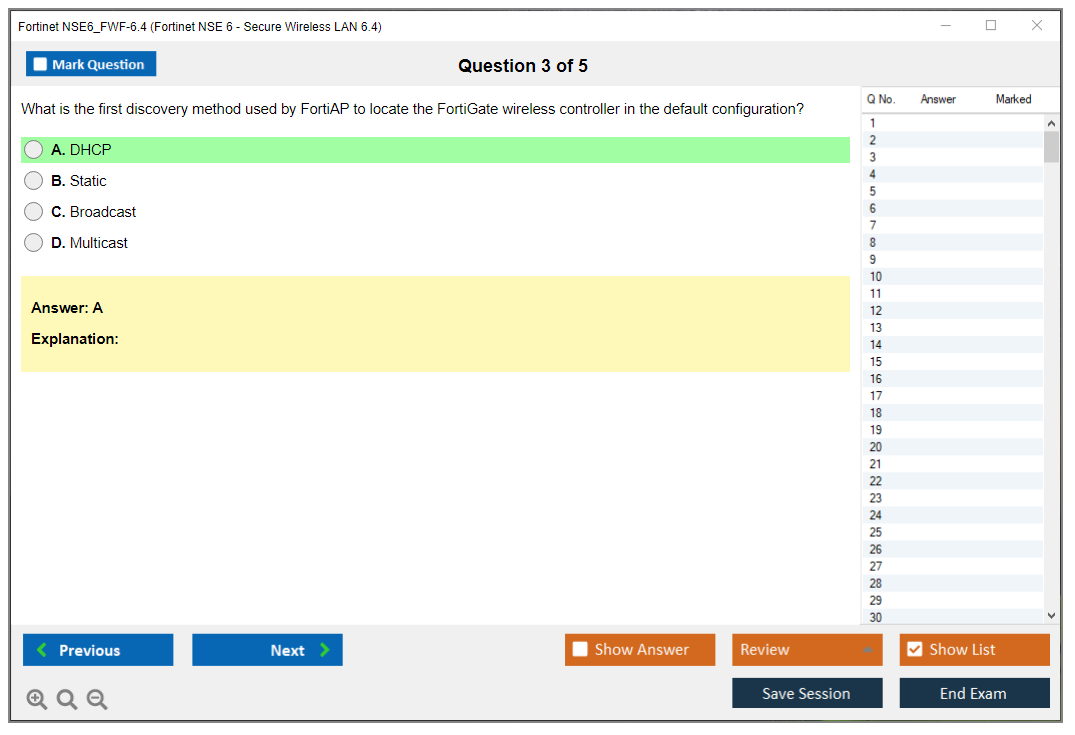
Configuring wireless controller mode involves enabling the wireless-controller feature, then creating SSID configurations and FortiAP profiles. Controller discovery works through DHCP option 138, DNS, or manual IP configuration. When you've got multiple controllers, AP load balancing distributes FortiAPs across controllers, and failover mechanisms ensure APs reconnect if their primary controller fails.
I mean, the difference between FortiGate with FortiWiFi license versus dedicated FortiWiFi appliances mostly comes down to built-in radios. FortiWiFi has integrated wireless, while licensed FortiGate purely acts as controller for external FortiAPs.
FortiAPs discover controllers through broadcast, DHCP options, or pre-configured controller IPs. Authorization happens through serial number or MAC address whitelisting. Unauthorized APs won't join. FortiAP profiles define radio settings like channels, power levels, and bandwidth. You assign profiles to individual APs or AP groups for bulk management. Firmware management pushes updates from controller to APs, and platform-specific configs account for different FortiAP model capabilities.
Security and access control configurations
Open authentication exists but only for specific use cases like guest networks with captive portals. WPA2-Personal uses pre-shared keys. Simple but doesn't scale for enterprise. WPA2-Enterprise with 802.1X authentication integrates RADIUS servers, supporting EAP methods like PEAP-MSCHAPv2 or EAP-TLS with certificates. WPA3-Personal and Enterprise offer improved security through SAE (simultaneous authentication of equals) and 192-bit mode.
Honestly? Configuring 802.1X means setting FortiGate as authenticator, pointing to RADIUS servers (FortiAuthenticator or third-party), selecting EAP methods, and mapping authenticated users to groups. MAC-based authentication provides fallback for devices that can't do 802.1X. Troubleshooting auth failures requires checking RADIUS logs, certificate validity, and user group assignments.
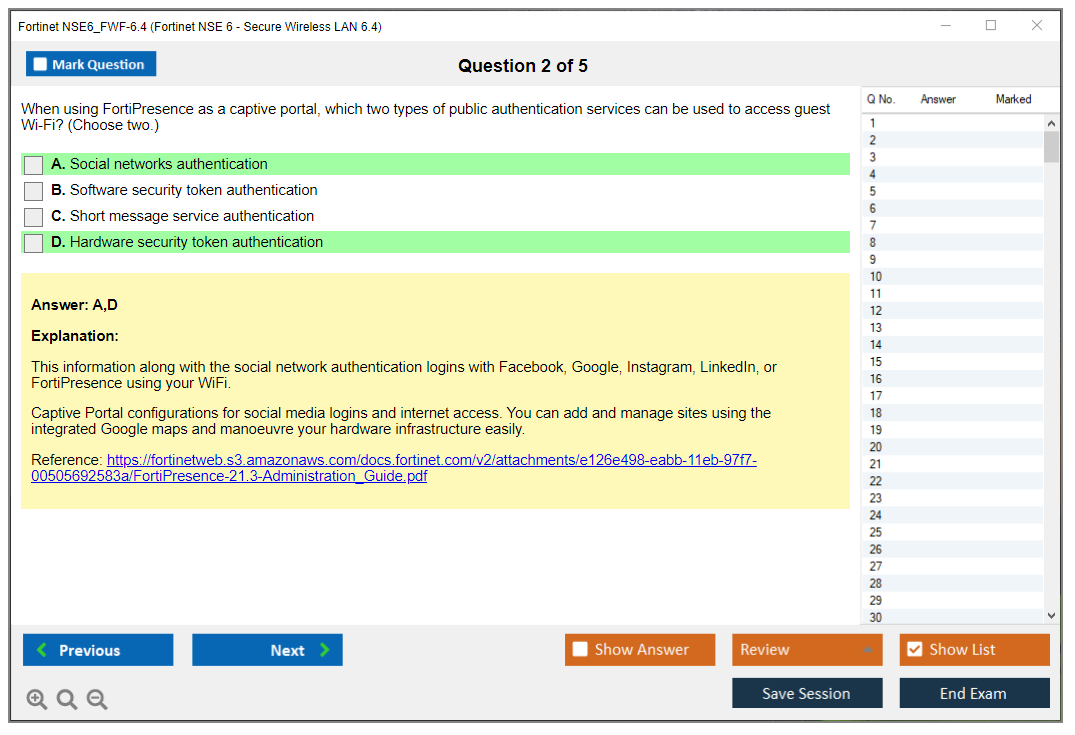
Captive portals redirect clients to authentication pages before granting network access. You can authenticate against local user database, RADIUS, LDAP, or FSSO. Customizing portal pages, managing session timeouts, and guest self-registration workflows are all testable. When portal redirection fails, check DNS resolution and proper exemption policies.
SSID, VLAN, and traffic segmentation
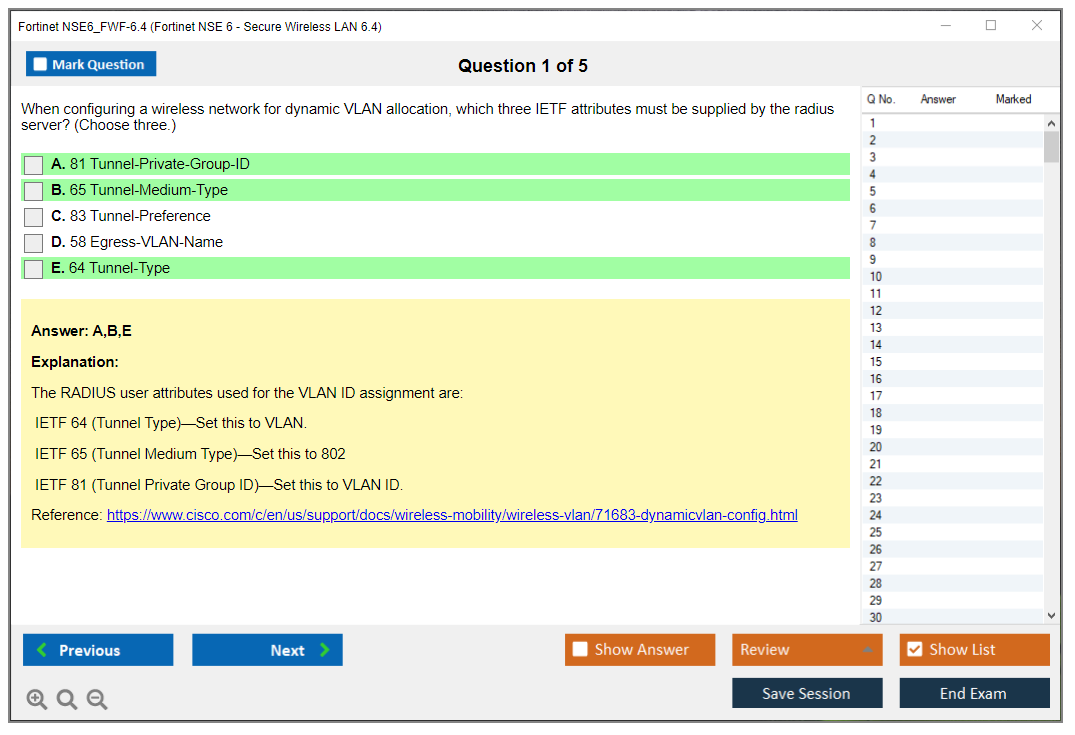
Creating multiple SSIDs lets you segment corporate, guest, and IoT traffic. Each SSID can map to different VLANs, apply different security policies, run in bridge or tunnel mode, and enforce client isolation. SSID scheduling turns networks on or off by time of day. Dynamic VLAN assignment based on RADIUS attributes puts clients into VLANs based on authentication credentials.
Wireless traffic flows through FortiGate firewall policies just like wired traffic. Guest networks typically land in separate VLANs with restricted policies, while corporate SSIDs route through standard security inspection.
Monitoring, troubleshooting, and diagnostics
The GUI shows connected clients, session info, and AP status. But honestly, CLI diagnostic commands matter more for the exam. Commands like 'diagnose wireless-controller wlac' show AP connections and 'diagnose wireless-controller wtp' displays AP details. Authentication logs, security event logs for rogue detection, and wireless IPS logs all provide troubleshooting data.
Rogue AP detection identifies unauthorized access points. Wireless IPS signatures detect attacks like evil twins or deauth floods. Spectrum analysis reveals non-WiFi interference sources. Systematic troubleshooting prevents random guessing. Verify physical connectivity, check AP authorization, validate SSID config, test authentication flow.
Similar to enterprise firewall troubleshooting, wireless issues require methodical diagnosis. Client can't connect? Check SSID broadcast, security settings, VLAN assignment, firewall policies. Authentication failing? Verify RADIUS server connectivity, certificate validity, user credentials.
Best practices and common mistakes
Site surveys determine AP placement and density. Channel planning avoids co-channel interference. Security policy design balances usability with protection. High-availability configurations prevent single controller failure from taking down wireless. Common misconfigurations include wrong SSID security mode, missing firewall policies for tunnel mode, incorrect VLAN assignments, and overpowered APs causing cell overlap.
Understanding these concepts deeply separates passing from failing the NSE6_FWF-6.4 exam. Not just memorizing GUI clicks. Get hands-on with actual FortiAP hardware or at least thoroughly lab the controller configurations.
Prerequisites and Recommended Experience for NSE6_FWF-6.4
Fortinet NSE6_FWF-6.4 (NSE 6, Secure Wireless LAN 6.4) Overview
Look, the Fortinet NSE6_FWF-6.4 exam doesn't care about textbook definitions. It's Fortinet asking whether you've actually managed secure WiFi deployments on FortiGate or FortiWiFi in messy, real conditions where users complain constantly, SSIDs vanish mysteriously at 3 PM every Tuesday, and guest portals decide to loop infinitely for no apparent reason. You need working knowledge of FortiGate functioning as a wireless controller, the entire FortiAP discovery and authorization dance, plus how security mechanisms like WPA2, WPA3, and 802.1X actually behave when users, VLANs, firewall policies, and guest access requirements all slam into each other simultaneously.
This is hands-on stuff. CLI isn't optional. Wireless gets complicated fast.
If you're the person everyone hunts down whenever an SSID mysteriously stops broadcasting or that guest captive portal enters an endless redirect nightmare, this exam makes sense for you. Perfect for Fortinet admins who've mastered firewall policies and NAT configurations but now suddenly own an entire FortiAP deployment. Firmware updates, profile management, rogue AP detection, the whole chaotic package.
NSE6_FWF-6.4 Exam Details
Fortinet specialist exams usually throw multiple choice and multiple select questions at you through their official testing partner in timed sessions that don't pause for coffee breaks or existential doubt. Question counts can vary slightly between versions, so verify current details when booking. Particularly important if you're building your time strategy around an NSE6_FWF-6.4 study guide or outdated prep materials someone shared in a Slack channel.
Everyone wants to know the price. Honestly, Fortinet pricing shifts by region, currency fluctuations, and whatever program adjustments they've made recently, so I won't pretend one number covers everyone everywhere. Check your Fortinet Training Portal or the exam registration system for current NSE6_FWF-6.4 exam cost details. Ask your partner account manager about voucher programs if you're purchasing through channels.
Here's another frequent question: "What is the passing score for Fortinet NSE6_FWF-6.4?" Fortinet typically doesn't broadcast a fixed cut score publicly, and they sometimes use scaled scoring algorithms. Treat the "NSE 6 Secure Wireless LAN passing score" as something you prepare well beyond, not a target you barely scrape past. Build enough cushion that one confusing captive portal scenario question won't wreck everything.
Yes, people constantly ask if the exam is hard. It's tough if your wireless experience consists mainly of clicking "connect" on your phone or if you've only ever poked around the GUI without understanding what's happening underneath. The challenge comes from blending FortiOS architecture, wireless controller logic, RF environment realities, authentication plumbing complexities, and troubleshooting methodology. All tested together under time pressure.
NSE6_FWF-6.4 Exam Objectives (Blueprint)
You need solid WiFi baseline knowledge: 802.11 standards, frequency bands, channel planning, and what interference actually looks like in crowded office environments. CWNA background helps, but it's not mandatory.
Expect heavy coverage of FortiGate wireless controller configuration specifics. How SSIDs map to VLANs, integrate with firewall policies, interact with DHCP servers. Proper network segmentation without accidentally bridging everything together.
This is where FortiAP provisioning and profiles becomes critical. Discovery protocols, authorization workflows, and diagnosing why an AP sits stuck in discovered-but-not-authorized limbo for hours.
You'll wrestle with wireless security (WPA2/WPA3, 802.1X) on Fortinet plus the genuine pain points. Certificate chain validation, RADIUS attribute mapping, EAP method selection, and guest access flow logic. Also, SSID, VLAN, and captive portal on FortiWiFi appears frequently and tests practical implementation, not just theory.
Master wireless troubleshooting and diagnostics (logs, RF, rogue AP) skills. Many candidates freeze completely because they've never practiced the diagnostic commands or interpreted RF spectrum analysis during preparation.
Incorrectly tagged VLANs. Security profiles applied wrong. RADIUS server timeouts nobody investigated. The "but it worked perfectly yesterday" syndrome. That real chaos.
Prerequisites and Recommended Experience
Fortinet's official position is unambiguous here: they strongly recommend completing both NSE 4 FortiGate Security and NSE 4 FortiGate Infrastructure before attempting any NSE 6 specialist exam. That's not bureaucratic gatekeeping, it's practical reality grounded in how candidates actually perform. If you don't already understand FortiOS objects thoroughly, basic routing concepts, policy evaluation flow, NAT behavior patterns, and how FortiGate conceptualizes interfaces and security zones, the wireless components feel disconnected and arbitrary. You waste precious study time relearning foundational concepts under exam pressure when you should be mastering advanced wireless-specific features instead.
FortiOS 6.4 familiarity is another "silent prerequisite" nobody mentions enough. The Fortinet NSE6_FWF-6.4 exam tests FortiOS 6.4 behavior specifically, including menu structures and feature implementations unique to that version. Hands-on experience with exactly 6.4 matters. "I used 7.2 at my previous job so I understand FortiOS" doesn't cut it here. GUI layouts shift between versions, feature names change subtly, default behaviors get modified, and CLI command trees stay similar but not identical. Those tiny version-specific differences are precisely what exam questions exploit when you're fatigued and second-guessing yourself.
Networking fundamentals matter way more than candidates admit until they're sitting in the exam staring at a complex scenario question. TCP/IP protocols. VLAN tagging mechanics. Switching concepts. Routing fundamentals. DHCP and DNS operations. NAT implementations. How all those pieces interconnect with wireless user traffic flows. One SSID configuration can place users into a specific VLAN, which triggers a DHCP scope assignment, which depends on a helper configuration, which crosses a firewall policy boundary, which gets inspected by security profiles, which then breaks mysteriously because you forgot about asymmetric routing or the return path. That's not really "wireless troubleshooting," that's fundamental networking knowledge applied to wireless contexts.
Actually, side note here, but I've watched so many people waste months chasing certifications backward. Like they want NSE 6 status but haven't touched FortiOS in production. They memorize dumps, pass somehow, then get absolutely destroyed in job interviews when someone asks them to walk through a simple authentication flow. The certification becomes worthless faster than expired milk.
You can memorize NSE6_FWF-6.4 exam questions endlessly, but without muscle memory you'll still struggle when scenarios require intuitive understanding rather than rote recall. I'd recommend 6 to 12 months working with FortiGate or FortiWiFi in either lab environments or production networks, plus substantial wireless management experience. At absolute minimum, invest 40 to 60 focused lab hours specifically on wireless controller features and FortiAP management workflows before scheduling your exam. Short practice sessions work fine. The repetition matters more than duration.
Spend serious time on FortiAP operational workflows: initial provisioning sequences, profile creation and assignment, channel and transmit power adjustments, firmware update procedures, and troubleshooting failed upgrades. Develop comfort with authentication infrastructure components too. RADIUS server integration, LDAP configurations, Active Directory integration basics, certificate management, and systematically identifying where authentication chains break down. Command-line proficiency helps tremendously because FortiOS CLI feels intuitive if you've worked extensively with other network equipment CLIs previously, and it makes troubleshooting dramatically faster when the GUI deliberately hides the one specific detail you desperately need.
Conduct an honest skills gap self-assessment. Can you confidently configure a secure SSID using 802.1X authentication, bind it properly to a VLAN, verify firewall policy flow, then troubleshoot connectivity failures using logs and packet captures methodically? If not, you're not "almost exam-ready." You're missing fundamental exam coverage areas.
Best Study Materials for NSE6_FWF-6.4
Fortinet's official training isn't technically mandatory, but the NSE 6 Secure Wireless LAN course provides structured content mapping directly to Fortinet wireless LAN 6.4 exam objectives. Most reliable method for avoiding weird knowledge gaps that bite you during the exam.
Focus intensely on wireless controller sections, FortiAP administration chapters, and authentication configuration guides. Skim other sections for context.
A FortiGate VM combined with at least one physical FortiAP creates an ideal practice environment. No hardware access? You can still practice extensive controller logic, object configuration, and CLI commands, but you'll miss hands-on RF behavior observation and real provisioning workflows.
Community resources (forums, KB articles, configuration examples)
Knowledge Base articles are absolutely gold for understanding troubleshooting patterns and edge cases. Community forums show you how other engineers break configurations in creative ways.
NSE6_FWF-6.4 Practice Tests and Exam Prep Strategy
If you use an NSE6_FWF-6.4 practice test, don't just memorize answer patterns mindlessly. Treat every missed question like a lab assignment: reproduce the scenario, fix the configuration, then document the exact CLI commands or GUI navigation path. If you want a paid practice option, the NSE6_FWF-6.4 Practice Exam Questions Pack costs $36.99 and works most effectively when you carefully review explanations and then validate configurations in your lab environment. Not when you're speed-running questions at 1 a.m. fueled by panic and energy drinks.
802.1X authentication flows, captive portal behavior patterns, FortiAP authorization processes, VLAN mapping configurations, and diagnostic command syntax. Other topics definitely matter, but these specific areas appear disproportionately often.
Flag lengthy scenario questions immediately and circle back later. Don't overthink confusing wording. Read what the question actually asks, not what you assume it's asking.
Renewal, Validity, and Keeping Your Certification Current
Candidates frequently ask how to renew the NSE 6 Secure Wireless LAN certification. Fortinet modifies program policies periodically, so verify current recertification requirements in your certification portal rather than relying on outdated forum posts. Typically it involves some combination of exam retakes, earning higher-level certifications, or completing updated exam versions.
FortiOS evolves rapidly. Maintain a small home lab for testing and make yourself actually read release notes when upgrading. I know, nobody enjoys that, but it prevents surprises.
FAQ
Possible? Yes, technically. Harder? Also yes, significantly. You'll miss hands-on provisioning experience and RF troubleshooting practice, so compensate aggressively with log analysis, extensive controller configuration labs, and thorough documentation study.
Aim to consistently score well above average on practice materials and understand the reasoning behind every answer, not just which letter to select. If you're looking for question practice, the NSE6_FWF-6.4 Practice Exam Questions Pack can help identify weak areas under pressure, but your actual lab troubleshooting results matter infinitely more than spreadsheet tracking.
Develop a systematic methodology. Start at client association level, then authentication, then DHCP assignment, then firewall policy evaluation, then routing decisions. Execute the appropriate CLI diagnostics at each stage. Capture packets when things break. Compare working versus broken traffic flows side-by-side. You'll improve faster than rereading another NSE6_FWF-6.4 study guide chapter for the fourth time hoping something clicks.
Best Study Materials and Resources for NSE6_FWF-6.4 Preparation
Your starting point for official training materials
Okay, real talk here. If you're serious about passing the Fortinet NSE6_FWF-6.4 exam, you need to start at training.fortinet.com and create a free account. No shortcuts on this one. The Fortinet NSE Institute training portal? That's where everything official lives: instructor-led courses, self-paced modules, exam registration, and all the documentation you'll actually need instead of random blog posts scattered across the internet that may or may not be relevant to your specific version. I mean, yeah, third-party stuff helps fill in gaps. But the NSE Institute is where you get the real curriculum that maps directly to what you'll face on test day, so don't skip it thinking you can wing it with unofficial materials alone.
The gold standard here? It's the NSE 6 Secure Wireless LAN 6.4 official course. Hands down. This is thorough instructor-led training that runs 2-3 days and covers every exam objective with hands-on labs, which honestly is the only way you'll actually understand FortiAP provisioning and wireless controller configuration beyond just memorizing commands that you'll forget five minutes after the test. You can take it through Fortinet authorized training partners or as virtual instructor-led training if you can't travel or your company won't pay for the trip. Not gonna lie, the VILT option saved me when I was prepping because I could do it from home without burning precious PTO days that I'd rather use for actual vacation.
Speaking of vacation days, I once burned through three of them for a certification boot camp that turned out to be mostly review material I already knew. Total waste. Now I'm way more selective about in-person training.
Fortinet sometimes offers self-paced online training for NSE 6 topics. Check the NSE Institute portal for current availability and pricing since these things change quarterly. These on-demand video modules let you go at your own speed. Perfect for night owls. Works great if you're juggling a full-time job and can only study at weird hours like 11 PM after the kids are asleep.
Documentation you actually need to read
Here's the thing. The FortiOS 6.4 documentation library is massive. We're talking thousands of pages here. Don't try reading everything or you'll burn out before you even start. Focus on the Administration Guide (specifically the wireless sections), the FortiWiFi 6.4 Handbook, the FortiAP Configuration Guide, and the Wireless Controller CLI Reference for version 6.4. Those four resources cover probably 80% of what you need to know for configuration, management, and troubleshooting scenarios on the exam. Maybe even 85% if you read them thoroughly.
The FortiOS 6.4 Cookbook? Gold. Absolute gold for practical stuff you'll use daily. It's not theory. It's step-by-step configuration guides for real deployment scenarios, troubleshooting workflows when things break (and they will break), and use cases you'll actually encounter in production environments. If you're weak on implementing captive portals or troubleshooting 802.1X authentication failures, the Cookbook has you covered with actual command sequences and expected outputs.
Don't skip the Fortinet knowledge base articles, seriously. Search the support portal for wireless-related topics, especially troubleshooting guides and known issues with FortiOS 6.4 wireless features. There's always weird stuff lurking in there. KB articles often explain the strange edge cases and configuration gotchas that don't make it into the official guides but definitely show up on exams because, well, exam writers love testing on exceptions to the rules.
Getting your hands dirty with labs
You need lab time. Period. End of discussion.
Reading documentation won't prepare you for scenario-based questions about why clients can't authenticate or how to configure multiple SSIDs with different security profiles when there's environmental complexity involved. FortiGate VM works great for wireless controller configuration practice. There's a free trial available on the Fortinet website. You can pair it with physical FortiAP hardware if you can get your hands on even older models from eBay or decommissioned enterprise gear. Honestly? If you're preparing for NSE4_FGT-7.2 or other Fortinet certs, you probably already have some lab gear lying around collecting dust that you can repurpose.
Some training partners offer cloud-based lab access with pre-configured FortiGate and FortiAP environments. This is perfect if you don't want to invest in hardware or deal with setting up your home lab from scratch, fighting with licensing issues, or explaining to your spouse why there's network equipment taking over the spare bedroom. Virtual labs typically include multiple FortiAP models and realistic network topologies that mirror enterprise deployments you'd actually see in the field.
Practice these specific scenarios religiously:
Configure multiple SSIDs with different security methods (open, WPA2-Personal, WPA2-Enterprise). Implement 802.1X with a RADIUS server. This trips up so many people. Deploy a captive portal with customization including splash pages and authentication workflows. Practice FortiAP discovery and authorization workflows until you can do them with your eyes closed. Troubleshoot authentication failures using CLI commands, not just the GUI. Configure rogue AP detection and containment policies. Interpret wireless logs to diagnose connectivity issues that aren't immediately obvious.
That list covers the high-yield hands-on skills that appear repeatedly on the NSE6_FWF-6.4 exam, probably accounting for 60-70% of the practical questions you'll face.
Community and supplementary resources
The Fortinet community forums at community.fortinet.com are underrated. Like, seriously underrated by most candidates. You'll find other NSE candidates struggling through the same concepts, certified professionals who've been there and done that, and real-world troubleshooting discussions that show you how people solve wireless problems in production environments where everything's messier than lab scenarios. Search for wireless-related threads before posting your own question. Chances are someone already asked about that weird FortiAP provisioning issue you're stuck on, possibly multiple times with different solutions depending on the specific firmware version.
YouTube has the official Fortinet channel. Useful stuff there. There's technical videos, feature demonstrations, and configuration walkthroughs for wireless deployments that make abstract concepts way more concrete. These videos are helpful when you're trying to visualize how FortiAP profiles work or how wireless controller high availability functions. Sometimes seeing it animated just clicks better than reading dense technical documentation for the fifth time.
For third-party study guides, check platforms like Udemy or Pluralsight, but verify they specifically cover FortiOS 6.4 and the NSE6_FWF-6.4 objectives before dropping money on them. Some courses are outdated or cover different FortiOS versions, which will confuse you more than help since command syntax and features change between versions. If you're also studying for NSE7_EFW-7.0 or NSE6_FWB-6.4, look for bundled courses that cover multiple NSE tracks. You'll save money and sometimes the instructors tie concepts together across different Fortinet products in ways that deepen your overall understanding.
Practice tests and realistic exam prep
The NSE6_FWF-6.4 Practice Exam Questions Pack at $36.99 gives you scenario-based questions that mirror the actual exam format pretty closely. Practice tests help you identify weak areas and get comfortable with the question style, which is half the battle. Don't just memorize answers like some kind of robot. Understand why each option is correct or wrong, because the exam will rephrase questions and change variables to catch people who only memorized without grasping the underlying logic.
Official Fortinet practice exams may be available through the NSE Institute. Check there first before buying third-party materials since official stuff is always more reliable. Some reputable certification training providers also offer practice question banks, but make sure they're recently updated for the 6.4 version specifically, not just generic wireless controller questions that could apply to any version.
Create your own study notes. As you go. This is non-negotiable.
Document your lab configurations with screenshots and command outputs. Build troubleshooting scenario notes where you describe the problem, your diagnostic process, and the solution. Maintain a command reference sheet for wireless CLI commands you use repeatedly. Organize it by function so you can quickly find what you need. These personalized materials are way more valuable than generic study guides because they're based on your actual hands-on work and the specific issues you encountered, which means they're adjusted to your learning gaps rather than generic ones.
Advanced practice techniques
Here's something most study guides won't tell you, honestly: deliberately break your configurations on purpose. Save a working config, then misconfigure authentication or SSID settings intentionally and practice troubleshooting using only CLI and log analysis without referring to your notes. This builds real troubleshooting skills instead of just following cookbook recipes that assume everything goes perfectly the first time (which never happens in production).
Practice wireless packet capture analysis if you can. I know it seems overkill, but it's not. Understanding EAP packet exchanges and recognizing normal versus abnormal authentication flows will help you answer troubleshooting questions correctly even when they throw curveball scenarios at you. Work through realistic case studies like deploying 50 FortiAPs across multiple buildings with different requirements, implementing guest WiFi with social media authentication that has to work for users who aren't tech-savvy, or detecting and containing rogue access points without disrupting legitimate wireless traffic.
The NSE6_FWF-6.4 study materials should complement your hands-on practice, not replace it. That's the critical distinction most people miss. I've seen people fail this exam because they only used brain dumps without understanding the underlying wireless concepts and FortiOS configuration logic, then they're shocked when scenario questions require actual comprehension rather than pattern matching. Don't be that person who has to retake it three times.
NSE6_FWF-6.4 Study Plan and Exam Preparation Strategy (~800
The Fortinet NSE6_FWF-6.4 exam is basically Fortinet saying: can you run a Secure Wireless LAN on FortiOS 6.4 without guessing? That means you can build SSIDs, map them to VLANs, lock them down with real auth, and then troubleshoot when users swear "Wi-Fi is down" but it's really DHCP, RF noise, or a bad profile push somebody made three weeks ago and forgot about. Honestly.
It also validates you know the Fortinet way of doing things. Profiles everywhere. Controller logic on the FortiGate. FortiAP behavior that looks simple until you hit discovery, authorization, and provisioning at scale and then you realize why the Fortinet NSE 6 Secure Wireless LAN 6.4 certification exists in the first place.
If you touch FortiGate wireless, FortiWiFi, or FortiAPs at work, this one's for you. If you want to be the person who can explain why WPA3 transition mode is breaking some old handhelds that accounting refuses to replace. If you're in networking and tired of being "the firewall person" only. Wireless opens up a whole different skillset people actually respect, I mean it.
Also, consultants. MSP folks. Anyone who keeps inheriting half-working captive portals. Pain.
Expect a timed, proctored exam with scenario-heavy multiple choice and troubleshooting style items where you're basically detective-ing through configs and symptoms. Fortinet exams usually reward "what would FortiOS do" more than "what should any vendor do," so your NSE6_FWF-6.4 study guide notes should include GUI paths, profile names, and default behaviors, not just wireless theory you'd apply to Cisco or Aruba.
Time pressure? Real. Some questions are short. Some are long and annoying, where you have to read logs, look at a config snippet in your head, and pick the least-wrong answer while the clock mocks you.
People ask, How much does the NSE6_FWF-6.4 exam cost? Fortinet pricing changes by region and delivery, so I'm not going to make up a number here. The move is to check the Fortinet Training/Certification portal for your location, because NSE6_FWF-6.4 exam cost can differ depending on test center vs online proctoring and any vouchers your partner account might have stashed away.
What is the passing score for Fortinet NSE6_FWF-6.4? The thing is, Fortinet often doesn't publish an exact NSE 6 Secure Wireless LAN passing score, and scoring can be scaled based on question difficulty weighting or whatever dark magic they use. Translation: you focus on mastery, not gaming a percentage. If you're consistently scoring strong on your NSE6_FWF-6.4 practice test runs and you can explain why each wrong answer is wrong, you're probably there. Honestly.
Is the NSE6_FWF-6.4 exam difficult? Look, it's not evil. But it's picky. The hard parts are the Fortinet-specific workflows. FortiAP provisioning sequences. Controller profiles that cascade in ways you didn't expect. VLAN mapping gotchas. Captive portal flows with external RADIUS. And troubleshooting with the right logs and RF views instead of just guessing. Memorizing acronyms won't save you when the question shows you a real config snippet with one subtle mistake buried in line twelve.
You still need basics. Channels, power, 2.4 vs 5 GHz behavior, roaming mechanics, airtime contention, interference patterns. Know it cold.
But the exam likes fundamentals tied to Fortinet screens and features, not abstract theory. Like, what telemetry you actually see in FortiOS, and what settings change client behavior versus just looking important in the GUI.
This is where your lab time pays off big. You should be able to do FortiGate wireless controller configuration from scratch: create SSID, map to an interface or VLAN, pick security, apply a profile, push it, and understand how that ties into firewall policy downstream. Also, you need to be comfortable with SSID, VLAN, and captive portal on FortiWiFi, because the questions love to mix "wireless config" with "why can't clients reach DNS" or "why is authentication timing out."
One long, rambling truth here: most failures in real life come from mismatched VLAN tags where somebody assumed the switch was trunking but it wasn't. Missing DHCP relay config. Or a policy that looks fine until you remember the SSID is bridged to a different interface than you think and FortiOS will happily let you miswire it all day without a single warning message. I've seen it happen maybe twenty times. People get mad. They blame Wi-Fi. It's never Wi-Fi.
Know FortiAP provisioning and profiles like you know your own phone number or coffee order. Discovery methods: broadcast, DHCP option, DNS, manual IP. Authorization states. What happens when an AP is managed by the wrong controller or stuck in limbo. How profiles apply, and what "override" means when you're trying to fix one problem AP without breaking fifty others that are working fine.
Expect wireless security (WPA2/WPA3, 802.1X) on Fortinet to show up a lot. Not gonna lie, if you've never troubleshot 802.1X in production, you will suffer through some of these questions. Know EAP types at a practical level. What you check first when auth fails. Where cert issues show up in logs. And what "fails open" actually looks like versus theory. Captive portal flows too: external portal vs local, user groups, policies, exemptions, redirect logic.
This is the part I wish more people practiced instead of just reading slides. Wireless troubleshooting and diagnostics (logs, RF, rogue AP) is not just "check signal bars." You need to know which logs matter. Event, wireless, user. What rogue detection is actually telling you versus false positives from neighbors. And how to interpret RF problems versus authentication problems versus routing problems that just feel like wireless issues.
Logs matter. RF matters. Policies matter.
Common mistakes show up in NSE6_FWF-6.4 exam questions because they show up constantly in real networks and Fortinet knows it. VLAN mismatch between AP and controller. Wrong SSID-to-interface mapping. WPA3 transition surprises with legacy devices. Captive portal exceptions missing for certain device types. AP stuck unauthorized because somebody changed the allow list. Also, profile sprawl where every site has custom tweaks instead of inheriting sane defaults.
Official prereqs are usually "recommended," not strict gatekeeping, but you still want solid FortiOS familiarity before diving into wireless controller stuff. Practically speaking, you should already be able to build basic policies, routes, DHCP scopes, and diagnose client connectivity without help. Otherwise the wireless part turns into a blame game where you can't tell if the problem is RF, auth, VLAN, policy, or routing. Honestly.
Hands-on beats reading. Always has, always will. You want FortiOS 6.4 comfort with the wireless controller sections, at least one FortiAP if you can get your hands on it (eBay, work lab, borrow from a friend), and basic switching knowledge for VLAN tagging and trunking because if you don't know where VLAN tags can get dropped you will chase ghosts for hours in troubleshooting scenarios.
FortiWiFi 6.4 training via the NSE Institute is the cleanest path because it matches the Fortinet wireless LAN 6.4 exam objectives exactly and doesn't waste your time on tangents. Watch it, then lab it, then watch the tricky parts again. Don't just binge videos at 2x speed and call it studying because you'll regret that when a config question appears.
Docs are boring. Docs are gold. Focus hard on the wireless controller sections, FortiAP provisioning and profile pages, security options with worked examples, and troubleshooting pages that show exactly where FortiOS exposes the data you need instead of making you guess.
If you can get a FortiAP, do it yesterday. If you can't, you can still learn a surprising amount with a FortiGate VM and simulated config work, but some RF and provisioning behavior is just easier to internalize with hardware in front of you. Build two SSIDs. Put one on a VLAN. Add captive portal. Break it on purpose. Fix it while pretending your boss is watching.
Forums and KBs are where you learn the weird stuff nobody teaches in official courses. Like specific client quirks (looking at you, Samsung and Apple roaming logic), roaming complaints that turned out to be power settings, and why a certain firmware build behaved oddly until a hotfix. Mentioned casually: Reddit's Fortinet sub, Fortinet Community forums, vendor KB searches with good keywords.
A good NSE6_FWF-6.4 practice test is for finding gaps in your knowledge, not for memorizing letter choices like some kind of standardized test hack. Do one pass cold. Review every single wrong answer until you understand the why. Then go lab that topic until it makes sense in your hands. If you want a paid set to drill with and pressure-test your readiness, the NSE6_FWF-6.4 Practice Exam Questions Pack is $36.99 and works well as a checkpoint after you've done real study, not as your only plan or shortcut.
Focus hard on controller profiles and how they cascade. SSID to VLAN mapping (especially bridge vs tunnel mode). AP authorization workflows. 802.1X flows with RADIUS. Captive portal behavior and exemptions. And troubleshooting tooling: logs, RF views, rogue AP detection. Also cover basics like channel planning and DFS, plus the small Fortinet gotchas that show up in configs and make you wonder why it didn't just work.
Read the last line first. Seriously, I mean it. Many questions hide the real ask at the end after a paragraph of setup. Then scan for keywords like "bridge," "tunnel," "802.1X," "captive portal," "rogue," "VLAN," and choose the answer that matches FortiOS behavior and defaults, not generic Wi-Fi advice you'd give on any other platform.
How do I renew the NSE 6 Secure Wireless LAN certification? The thing is, Fortinet changes program rules over time with NSE restructuring and version updates, so verify current validity period and renewal requirements in your certification portal instead of trusting old forum posts. Usually your options are retake the same exam or pass a newer version as you move forward in the track.
FortiOS moves fast. Features shift. Defaults change. The best habit is to read release notes around wireless features every few versions, and keep a tiny home lab config you can update and test new behaviors on. Stay current intentionally.
Yes, but it's harder and you'll feel it. You can learn profiles, policies, SSIDs, and auth logic entirely in a VM with documentation and screenshots filling gaps, then use docs and maybe YouTube demos to understand AP-specific behavior. Hardware just makes provisioning sequences and RF troubleshooting click faster in your brain because you see it happen instead of imagining it.
Assume you need to be consistently right across all objective areas, not just strong in one domain and weak in another hoping it averages out. If your practice exams are borderline or you're guessing on whole categories, postpone and study more. If you want extra drilling on weak areas and scenario practice, the NSE6_FWF-6.4 Practice Exam Questions Pack is an easy way to pressure-test your readiness without risking exam fees on a maybe.
Break your own lab on purpose. Change one thing at a time: VLAN tag, SSID security, profile setting, firewall policy. Then read the logs and controller status until the story makes sense and you can predict what broke before you even look. That habit is what turns random guessing into actual troubleshooting on exam day and at work when the CEO's iPad won't connect. Honestly.
Conclusion
Wrapping up your NSE6_FWF-6.4 path
Real talk here.
The Fortinet NSE6_FWF-6.4 exam isn't something you just breeze through on a weekend. It tests genuine operational knowledge around FortiGate wireless controller configuration, FortiAP provisioning and profiles, and the kind of wireless troubleshooting and diagnostics (logs, RF, rogue AP) you'd legitimately face when a hundred users suddenly can't connect to the SSID you just rolled out. You could memorize every Fortinet wireless LAN 6.4 exam objective and still bomb if you haven't spent time in the CLI or worked through captive portal authentication issues. Theory only gets you so far.
The NSE6_FWF-6.4 exam cost and NSE 6 Secure Wireless LAN passing score might vary depending on where you test, but the bigger investment is your time. You need hands-on experience with wireless security (WPA2/WPA3, 802.1X) on Fortinet environments, not just theory. FortiWiFi 6.4 training helps but building your own lab will teach you more than any NSE6_FWF-6.4 study guide alone. Even with a FortiGate VM and borrowed FortiAP if you can swing it. Get comfortable with SSID, VLAN, and captive portal on FortiWiFi setups because those scenarios show up in multiple contexts throughout the exam.
Practice is non-negotiable.
Real practice.
The best candidates I've seen approach this thing systematically. They work through official documentation first, then validate their understanding with labs, then test themselves repeatedly with quality practice materials. You can know FortiOS backward and forward but if you haven't specifically studied wireless controller operations, you'll miss questions. The Fortinet NSE 6 Secure Wireless LAN 6.4 certification validates a specialist skillset. Treat your prep that way.
If you're serious about passing, you should check out the NSE6_FWF-6.4 Practice Exam Questions Pack at /fortinet-dumps/nse6-fwf-64/. It's one of the better resources for getting familiar with the actual question styles and identifying weak spots in your knowledge before you sit for the real thing. I've got mixed feelings about dumps generally, but this one works for preparation. Combine that with solid lab work and you're in good shape.
The NSE6_FWF-6.4 practice test experience matters because it forces you to answer under pressure, just like the actual exam. You'll discover which NSE6_FWF-6.4 exam questions trip you up, usually the ones involving multi-step troubleshooting or configuration order dependencies. Fix those gaps now, not after you've already paid the exam fee. This certification opens doors in wireless infrastructure roles, but only if you actually earn it properly.
